The late Victorian red brick and terracotta cruciform building at the southern end of the Royal Observatory Greenwich (ROG) has recently enjoyed revived interest and a high profile thanks to its refurbishment and reopening as the Weller Astronomy Galleries, the Lloyd's Trust Learning Centre and the entrance to the Peter Harrison Planetarium in May 2007.Footnote 1 This is in marked contrast to the low esteem in which the building was held in the middle of the last century, when such architecture was deeply unfashionable. Margaret Wilson, daughter of Frank Dyson, the ninth Astronomer Royal, was typical in describing it in 1951 as a ‘pompous building’ in ‘the worst Town Hall style of Victorian architecture’.Footnote 2 Once the Royal Greenwich Observatory, as the working institution was renamed, had completed its move to Herstmonceux in Sussex and the Old Royal Observatory was transferred to the care of the National Maritime Museum, the South Building was considered for demolition. Fortunately, it was retained: the dome was used to house a planetarium and the museum's conservation department used the lower floors as studio space.Footnote 3 The building did not feature in the history of the Observatory as retold by the new museum and the meaning behind this substantial part of the Observatory site has been somewhat lost. Far less famous than Wren and Hooke's original observatory, this building nevertheless embodies the ambitious plans of William Christie, the eighth Astronomer Royal, for the creation of an efficient, modern observatory. We should be reminded that in 1899 The Times called it a ‘handsome building’ that was ‘now practically Greenwich Observatory, for it houses almost the entire staff’.Footnote 4
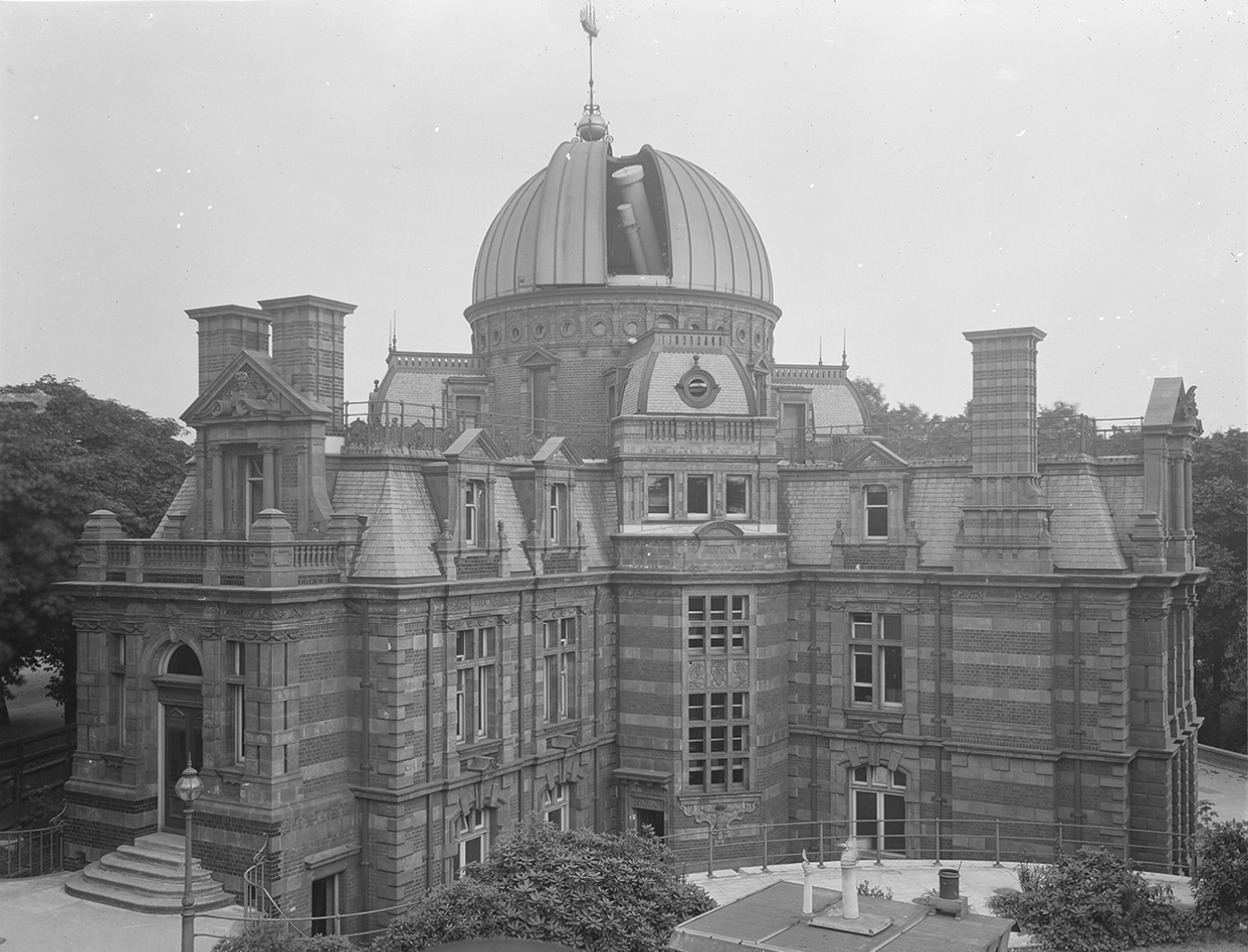
Writing a year later, E. Walter Maunder, first head of the ROG's Photographic and Spectroscopic Department, described the New Physical Observatory (Figure 1), as it was initially known, as essentially ‘for the office work … of the Observatory’; that is, the labour-intensive measuring and computing connected with practical astronomy, as well as the offices of the Astronomer Royal and his two assistants. The library, workshops, laboratories, dark rooms and stores for calculations and photographic plates made up most of the rest of the building, while the central, surmounting dome with its three telescopes was almost dismissed as ‘not its chief purpose’.Footnote 5 However, the history of this building is somewhat muddied if we begin first with descriptions of the finished building, for it was a long way from the initial proposals submitted by Christie in 1889. This paper will therefore uncover the process of planning, design and building of the New Physical Observatory. It will consider its relationship with scientific instruments, personnel and heritage as well as putting it in the context of developments in the work done at Greenwich and other nineteenth-century observatories. This building, like previous additions to the buildings at the ROG, answered practical needs but, unlike those structures, its shape was only in part dictated by the convenience of using instruments. Other factors that affected the design of this Admiralty-funded building will, therefore, also need to be brought into the story.
The New Physical Observatory in about 1910. P39986, National Maritime Museum.

This article will, in the process, draw attention to the extent of the changes that Christie brought to the ROG. Although A.J. Meadows has pointed to Christie's ‘determination to modernize the Observatory’, his extensive work on the buildings, his introduction of several large telescopes and his expansion of the staff, Christie has not been the subject of extensive research.Footnote 6 As Robert W. Smith has written, ‘scholars agree that [Airy] put his stamp on the institution to a much greater degree than the other nineteenth-century directors’, and those others have accordingly received less attention.Footnote 7 Putting aside the fact that Airy's tenure lasted forty-six years to Pond's twenty-four or Christie's twenty-nine, Smith's statement requires qualification. As will be shown, while Airy revolutionized the administration of the Observatory, he was extremely conservative in his understanding of the types of work that should be undertaken, notwithstanding the fact that magnetic, meteorological, spectroscopic and photographic observations were all inaugurated in his time. The expansions that took place under Christie – in building works, staff numbers, departments and types of work – can be interpreted as another revolution in the Observatory's history.Footnote 8 It should also be remembered that the Astronomers Royal were not all-powerful dictators. They were answerable to the Admiralty and, importantly, to the scientific advisers that constituted the Board of Visitors. They were also, sometimes more or sometimes less, answerable to scientific and general public opinion. Thus, while far from trying to replace Airy with Christie as the dominant individual of nineteenth-century British astronomy, this article aims to improve our understanding of the role of the ROG at a key moment both in the development of astronomy and in the relationship between science and government.
Royal Observatory site and buildings
The buildings and site of the Royal Observatory evolved to meet the changing needs of the working Observatory. While Wren and Hooke's original buildings – consisting of the Astronomer Royal's residence, Great Star Room (or Octagon Room) and Summer Houses, now collectively known as Flamsteed House – were built ‘for the Observator's habitation & a little for Pompe’, they also housed clocks and portable instruments. Beyond this there was, from the earliest days, a meridian observatory in the rear courtyard that contained a succession of instruments, including the one that was to become most important to Flamsteed, a mural arc. Other buildings erected on the site by successive Astronomers Royal, especially to the east and south, were, like this single-storey observatory, aligned north–south and dedicated to providing stability for increasingly large and accurate meridian instruments.Footnote 9 The most radical transformations took place in the nineteenth century, with the arrival of large equatorial and altazimuth telescopes that required domes and an unobstructed view. These appeared over the old meridian rooms and, in 1857, on top of a new building that supported George Biddell Airy's Great Equatorial. By and large the form of these buildings was dictated by that of the instruments that they housed, although more remains to be said about the relationship between these, and other, observatory buildings and the people who lived and worked within them.Footnote 10
Two other elements are crucial in considering the development of the buildings at Greenwich. First, there was the question of cost. Paid for since 1675 by the Board of Ordnance and, from 1818, the Admiralty, all projected works had to be approved and built by government departments. Such works, therefore, had to be carefully justified, with the foundation's utilitarian basis kept in mind, and, especially in periods of economic depression such as the 1890s, at least appear to be planned to meet their purpose as cheaply as efficiency would allow. Second, there was the constraint created by the shape of the Observatory's site. Atop a hill, the ROG is bordered by steep slopes to the north and west and a public highway to the east.Footnote 11 The only option for significant expansion was to the south. By the early nineteenth century the Observatory had begun to encroach on this ‘South Ground’ with the arrival of a wooden building, within and around which an additional programme of magnetic and meteorological observations was commenced. However, much of the available space was narrow, or the ground level uneven, and expansions into the land of Greenwich Park had to be negotiated and settled with a Royal Warrant. By the mid- to late nineteenth century it was a crowded site that had grown piecemeal to meet new needs as they arose. As the American astronomer Simon Newcomb put it,
Although it has now entered upon its third century, no attempt has ever been made to reconstruct it on a grand scale. Whenever any part of it was found insufficient for its purpose, new rooms were built for the special object in view, and thus it has been growing from the beginning by a process as natural and simple as that of the growth of a tree. Even now the very value of its structure is less than that of several other public observatories, though it eclipses them all in the results of its work.Footnote 12
It would be misleading to consider only the important working instruments when thinking about the growth of the Observatory's structures. Small instruments, instruments not currently in use, records and publications all needed to be stored and the Observatory's workers needed space to work, eat and sleep. Thus rooms or separate structures that housed portable instruments, the chronometers that the Admiralty sent to the Observatory for testing, books and manuscripts, offices and bedrooms, equipment for carpenters and gardeners, and so on, all appeared on the increasingly crowded site. The pressure on space was increased by, on the one hand, the length of time that the Observatory had been in existence – meaning that old instruments and records had accumulated – and, on the other, an expanding remit that took in the magnetic and meteorological observations, the new kinds of astronomy allowed by photography and spectroscopy, and increasing demands from the Admiralty, all of which required additional instruments, stores and, perhaps especially, people. Early in the century the staff had consisted of six assistants, with a fluctuating number of human computers; in 1888 there were eight assistants, superintending fifteen computers, and by the end of the century there was a total staff of about fifty. While the completed Physical Observatory certainly included design elements dictated by the use of instruments – providing protection, visibility and stability – they were far from being the only elements considered and, indeed, were only discussed relatively late in the process of planning.
The nineteenth-century development of the ROG remit
The completed cruciform building of the New Physical Observatory, opened in 1899, appears to be a carefully contrived solution to the problems regarding space and the increased amount and range of work being done at the ROG. It consolidated a number of existing temporary buildings with what had been a separate low-level dome for a group of equatorially mounted telescopes.Footnote 13 However, examination of the history of its planning, design and building shows that things were not quite so simple. As well as the constraints mentioned above, this is a story of changing goalposts regarding the position and role of a national observatory in the late nineteenth century. Thus, while it appears that the development of astronomical physics, particularly the application of photography and spectroscopy, were central to the decision to build a substantial new structure in the south of the Observatory's grounds, this is not where Christie began. The extent to which he seems to have responded to necessity and to opportunity as it arose, and to the suggestions of the architect, William Crisp, a civil engineer of the Admiralty's Works’ Department, is notable. The changing demands of work at the Observatory became manifest quickly enough to catch people – including the money men at the Admiralty – unprepared.
During the second half of the nineteenth century, while Airy was still Astronomer Royal, undertaking the new kinds of astronomy at Greenwich began to be considered. It would take the duties of staff beyond their timekeeping and star-mapping routine, based on meridian astronomy, and towards the kind of work that had traditionally been done by amateurs, who were free from the need to make a case for public funding on the basis of utility. Nevertheless, such work was increasingly finding a place in other private and national observatories and questions were asked about Greenwich's ability to compete.Footnote 14 Airy's view was that it should not attempt to compete, but remain focused on work useful to its patron and where it had established its international reputation. As he explained in his reports to the Observatory's Board of Visitors, ‘the first and necessary duties of the Observatory’ remained those by which astronomy aided navigation.Footnote 15 Recently additional work had, indeed, been undertaken. Some of this related, he said, to navigation alone: observations of changes in the Earth's magnetic field; work on magnetic disturbance caused by ships’ hulls; ‘the incessant attention to chronometers; the extensive dissemination of accurate time-signals; and the daily dropping of a time-ball at Deal’. Other new work was purely astronomical in nature, in particular photography and spectroscopy but also observation of double stars, nebulae, planets and sunspots.Footnote 16 This move reflected the possibilities opened up by new instruments and techniques, and the interests of astronomers, but also, notably, a new ‘public interest’ in the ‘less severely definite’ departments of astronomy.Footnote 17
Airy always reported on these matters cagily, pointing out repeatedly that such work was not within the strict interpretation of the ROG's remit. He had stated that the Board of Visitors ‘should judge’ whether this kind of observing should be added to the workload and budget, warning, ‘The character of the Observatory would be somewhat changed by this innovation … It would become, pro tanto, a physical Observatory’.Footnote 18 However, as Airy noted, they had in one respect long been a physical observatory, ‘by virtue of [the ROG's] Magnetical and Meteorological Department’. Because of their proficiency in this area, he suggested, the Greenwich observations ‘remove all necessity of subvention by the Government to any other magnetical or meteorological observatory in this part of Britain’.Footnote 19 This was a reference to institutions like Kew Observatory and the Meteorological Office, which Airy criticized because of the unnecessary public cost of apparently duplicated work, and recent calls for the founding of a new, government-funded observatory that would focus on the physics of astronomy.Footnote 20
The discussions about a possible new physical observatory centred around Norman Lockyer, who had made his name through his work in solar physics. They took place within the Royal Astronomical Society, the discussions of the Devonshire Commission – the Royal Commission that investigated scientific education and science funding in 1870–1875 – and the pages of the scientific press.Footnote 21 In 1872, one of Lockyer's key allies, Alexander Strange, presented a paper on ‘The insufficiency of existing national observatories’, which pressed the case that Greenwich was not only too small but, as an institution based on the mathematical theories of positional astronomy, fundamentally unsuitable to ‘contribute systematically to the advancement of the new branch of astronomy’.Footnote 22 The Council of the RAS was polarized over the matter, some out of respect for Airy or dislike of Lockyer's tendency towards self-promotion. There were, however, also explicit concerns expressed about the possibility of Britain falling, or having already fallen, behind other nations, particularly those with large research institutions like Germany.
In opposing calls for government funding of scientific research Airy was undoubtedly anxious about competing calls on the small funds available and concerned for the premier position of Greenwich. However, he had a clear and consistent view regarding what should and should not be funded. Research or series of observations that had no proven efficacy or utility were outside this remit. His belief was that ‘the Observatory is not the place for new physical investigations’ but that, if time and funding were available, it was ‘well adapted for following out any which, originating with private investigators, have been reduced to laws susceptible of verification by daily observation’.Footnote 23 Indeed, ‘Observations which demand larger telescopes, and especially observations which must be carried on in continual routine and with considerable expense, can only be maintained at a public observatory’.Footnote 24 When the Photographic and Spectroscopic Department arrived at the Observatory in 1873 it took on Warren De la Rue's programme of daily solar photography from Kew and adopted the use of spectroscopy for measuring the motion of stars, as developed by William Huggins. These programmes, although under constant threat of termination, could clearly be linked to existing work in meteorology or astrometry and partially undercut calls for a new national observatory. Airy was adamant that ‘Government ought to assist science only when it is partially established’, not new and speculative research.Footnote 25
In Airy's view it was for the good of science to limit the demands it made on government:
I am speaking in the interest of science when I say that we ought to be cautious about applying to the Government for money. In 1860 it was thought a great matter to ask simply for sea-conveyance. Lately, expenses to an enormous amount have been incurred in complicated ways and even for personal allowance. A House-of-Commons storm may be raised.Footnote 26
He was behind the times, and increasingly so. Men of science were asking for more because they understood that the likelihood of their receiving it was greater than it had been in the past, or at least that the principle of their receiving it was more generally accepted.Footnote 27 Airy, however, continued to argue for a retrenchment in the activities of the ROG. In 1880 he believed that the three departments of work that the Observatory was then engaged with – positional astronomy/time determination, meteorological and magnetic observations, and photographic and spectroscopic astronomy – were bordering on excessive. Although ‘[a]ll these departments appear at present to be working efficiently and well’, he could ‘easily imagine circumstances which would interfere materially with the successful continuation, in one place, of this triplicate series of observations’.Footnote 28 In his final report, Airy delivered a warning:
new astronomical subjects have arisen of which no one dreamed when our constitution was first fixed. The first of these was the measures of double stars. But this, though important as ever, has almost disappeared from our view when occupied with Solar and Spectroscopic Physics. I yield to no one in the interest which I take in these subjects, and in the admiration with which I regard the positive conclusions and the problematic suggestions which are founded on them. But I still point out that these are not parts of our original system, and their connexion with the Greenwich Observatory is at any time liable to question.Footnote 29
He was of the view that a publicly funded ‘Physical Observatory’, as ‘an institution for pure science’, was a dangerous venture: ‘without foundation on and continued connexion with a utilitarian object it will become disreputable’.Footnote 30 Rather, even more emphasis should be placed on ‘the observatory-operations bearing on chronometric navigation’, for example aiding the Merchant Navy through an expanded galvanic time signal network.Footnote 31
Despite Airy's wariness, however, when Christie was promoted from chief assistant to Astronomer Royal in 1881 he led an institution that was engaged in work that was not directly utilitarian in nature. While Airy had sought to divide astronomy into areas that government should and should not fund, ensuring that such funds as did exist continued to support the core work of the ROG, Christie was to seek to expand the definitions of the Observatory's remit to match the calls for an expansion of publicly funded science. It was clear that the Board of Visitors supported and encouraged this development and, indeed, that at times they dictated it: Airy stated in 1880 that ‘Photographic and Spectroscopic astronomy [had been] established at the instance of the Board of Visitors’ rather than by his own initiative.Footnote 32 It was also evident that the Admiralty was prepared to provide funds, where a case was well – or repeatedly – made. There seems to have been an assumption that the ROG would continue to engage in such work and that Christie would support its further development. While maintaining a sense of the Observatory's chief duties, Christie had a broader understanding than his predecessor of what the ROG could encompass. This difference in approach is perhaps evidenced by Airy's inclusion in his reports, from 1855 until his retirement, of a section headed ‘Extraneous work’, which Christie immediately removed. However, as will be made clear below, interpretations of the ROG's original purpose were always kept in mind and were carefully used to justify demands for expansion made to the Admiralty. By looking closely at the building of the Physical Observatory, we can see the new expectations of astronomers – meaning especially Christie and the Board of Visitors – coming into contact with the Admiralty and other branches of government in a period when the provision of state funding for science was increasingly accepted.
In contrast to Airy's repeated suggestions that one or other of the ROG departments might have to be discontinued, the very first of the ‘General remarks’ that Christie made in his first report to the Board of Visitors in 1882 suggested that ‘extension of the work of the Observatory, such as the progress of science may render desirable’, would early be under consideration. Focusing first on manpower, Christie highlighted how stretched they were and, again in contrast to Airy's view that fulfilling the expectations of astronomers and the public might jeopardize their fundamental meridian observations, stressed that ‘the Observatory can hardly maintain its position as a national institution if it gives no attention to objects which from time to time excite the interest of the astronomical world’.Footnote 33 The minutes of the meetings of the Board of Visitors demonstrate that many of the changes introduced in the 1880s and 1890s were at Christie's suggestion.Footnote 34 They were, however, enthusiastically endorsed by a Board that seems to have been frustrated by Airy's attitude.Footnote 35 It seems likely that on Airy's retirement the majority of the Visitors, especially De la Rue and Huggins, were hoping for a commitment to continuing astrophysical work at the Observatory. Christie was known to have an interest in such areas and his eventual choice as Airy's successor almost automatically opened the ROG to change in this direction.Footnote 36
Suggestions that Christie put forward in his annual reports were, apparently readily, taken up by the Board of Visitors, who recommended them to the Admiralty. They seem, in particular, to have been impressed by Christie's comments on the amount of work engulfing the ROG and the need for additional staff, additional space and better means of supervision. This was despite the fact that these problems were caused by the decision to engage in more types of astronomy, using a larger number of instruments.Footnote 37 Many of these additions were unplanned, but they were also responsive to a sense of the ROG's position relative to other, and especially foreign, observatories, a clear example being the appeal to national standing in the question of joining the international Carte du ciel project.Footnote 38 Christie – and the Board of Visitors – had an eye on the public perception of the ROG, and he claimed that the ‘increased demands made on the Observatory in recent years both by the scientific and the general public’ led inevitably to a ‘development of work’ that necessitated the hiring of additional staff.Footnote 39 The expectations of both these publics were, of course, coloured by their knowledge of what was done in other observatories and by the astronomical discoveries that received wide media coverage.Footnote 40 There was a sense of competition with grand institutions founded to showcase the most advanced instruments and private observatories exploring the use of spectroscopy and photography, or based around ever-larger telescopes that could explore surface details of other planets or the nature of nebulae. The number of observatories in existence worldwide had increased enormously over the course of the nineteenth century, with those newly founded in the United States of America able to jump straight into use of the new astronomical techniques. There, even the utilitarian Greenwich equivalent, the US Naval Observatory, briefly held the largest telescope in the world and was able to add to the tally of newly observed celestial objects.Footnote 41 Such things not only excited the imaginations of the wider public and potential funders; they also attracted the interest of astronomers, giving a sense of adding to new research rather than simply keeping account of the heavens.
While Airy felt that the public would be more satisfied by a utilitarian institution that demonstrably provided services in return for their money, Christie was clearly more sympathetic to the view that the public expected facilities that would explore the most modern kinds of astronomy and perhaps even allow discoveries of the kind that the Observatory so spectacularly – though understandably – missed in the case of Neptune in 1846.Footnote 42 When the ROG was reported on by a representative of the US Navy in an appendix to the Washington Observations, their conclusions would have made Airy proud but would perhaps have strengthened Christie's resolve to change the programme:
It has never been attempted at Greenwich to develop all branches of astronomy, but those undertaken may in their present state well be taken as models. Although we may not find much incentive for imitation in the present arrangement of buildings and instruments, which leave an impression rather of a succession of obligatory additions and alterations than of a well-conceived organic whole, we are moved to respect for the order, regularity and efficiency of the observatory in the manifold branches in which it engages.Footnote 43
The technical ability to make more and increasingly accurate observations generated an ever-increasing amount of paperwork and publishable data. This in itself, with or without a change in policy, put pressure on staff, space and finance. Airy had warned that ‘the increase of facilities for making observations’ would produce more observations than could be reduced and made useful. This might eventually, he said, mean that fewer observers but more computers would have to be employed.Footnote 44 Five years later, he highlighted the fact that every ‘novelty in the Observatory increases the amount of printing; and our annual volume now contains very nearly one thousand large and closely-printed pages’, while that of the Paris Observatory had around four hundred.Footnote 45 This increase continued: the London News reported in 1896 that while a ‘few years ago’ two to three thousand transit circle observations ‘was a very good year's work’, the ROG was now making 10,000 to 12,000, plus ever-increasing work in the other departments: ‘the whole business of the observatory has more than doubled within the past few years’.Footnote 46 For Airy these facts tended to add to his call for a scaling down of the Observatory's work outside its original ‘astronomy and navigation’ role. As we will see, however, for Christie they were used as justifications for his expansion of budget, workforce and site.
Christie had argued, from the beginning of his tenure as Astronomer Royal, that the existing staff was inadequate to deal with the work that the ROG was required and expected to do both to meet its historical utilitarian purpose and to ‘maintain the character of the Observatory as a scientific institution’ by adopting the new astronomical techniques.Footnote 47 The number of junior staff rose slowly, but by the 1890s Christie was demanding that the number of senior and supervisory staff should also be increased and that there should be more permanency among employees. Traditionally computers had been boys employed on a temporary basis who subsequently left to find more regular clerical work.Footnote 48 Since the 1850s, though, many had been taught to use the telescopes as well as to do calculations and Christie felt that it was a waste of talent and skills if the best were not given the opportunity to work towards better pay and a permanent position.Footnote 49 By the time Christie retired, there were about sixty members of staff, including two chief assistants (instead of one), six assistants, one clerical assistant, eleven established (i.e. permanent) computers and twenty-five temporary staff, sixteen of whom were qualified as observers. Other staff included carpenters, labourers, mechanics, porters and so on. Costs of salaries, wages and allowances at the ROG increased from £5,276 for the 1880–1881 year to £6,358 in 1889–1890 and £7,727 for 1899–1900.Footnote 50 This was a significant change in a short period of time, although Christie still felt that the ‘employment in an Astronomical Observatory of a temporary staff of boys so large relative to the permanent staff is open to grave objection’.Footnote 51
The staff at the Observatory were among a very few government-funded career scientists in this period. Christie was far more enthusiastic than Airy had been about his senior staff keeping abreast of new ideas and taking an interest in the wider field, as well as rewarding them with pay and autonomy. Christie, according to one source, ‘felt strongly that the great national Observatory must give the fullest scope for research work, if it were to maintain its prestige and to attract astronomers of intellectual eminence on to its Staff’, and that ‘erecting new buildings and acquiring new instruments’ was the means to do this.Footnote 52 This was also one of the advantages of the Greenwich site. It was close enough to London to allow not only Christie but also other members of staff to be intimately involved with the development of their disciplines through active roles within the Royal Society, Royal Astronomical Society and British Astronomical Association. This undoubtedly could be seen as underlining the importance of the ROG within the scientific world, increasing its reputation in both professional and amateur astronomical contexts.Footnote 53 It also, by allowing involvement with key societies and opportunities for speaking to and publishing for a range of audiences, ensured that the ROG was an attractive place for the best astronomers and mathematicians to make their careers. For Christie, increasing the Observatory's national and international prestige required an excellent, active and large staff as well as sufficiently impressive buildings.
When, eventually, the majority of Christie's building works had been completed and staffing plans implemented, the view from some quarters was that the ROG had finally caught up with the times. A headline in the New York Times article in 1896 read, ‘Improvements That Will Bring an Observatory, Already the Most Important in the World, up to a Degree of Excellence Reached Long Ago at Several Much More Modest Stations of Observation – New Buildings and Officials’.Footnote 54 This article quoted from another in the London News, which expressed the opinion that the ‘expansion of science during the past generation has been amazing, and the old observatory premises have long been becoming every year more and more hopelessly inadequate to the work that has somehow had to be carried on in it’. The report went on, ‘several new departments have of necessity been added to the observatory, while the old premises and many of the old instruments have fallen quite behind the times’, and ‘advances and development of science and the increased demands upon the resources of the observatory have rendered increased accommodation absolutely indispensable’. For this reporter, the government was insufficiently generous:
though the Astronomer Royal can get at the Treasury only through the Lords of the Admiralty, and has therefore to expend rather a painful amount of persistent energy before he can get any effective attention to his requirements, Mr. Christie has certainly succeeded in making his mark upon our great national institution …Footnote 55
The New Physical Observatory
The expansion of the Observatory's paperwork, library, archive and range of observations Airy dealt with by requesting the building of a New Library. This idea was raised in 1878, when Airy remarked on the ‘approaching necessity’ for a galleried building of about fifty by twenty feet. However, it proved to be difficult to get the Admiralty to agree to pay for it, and it was rejected from the Navy Estimates for two years running. This meant that it was not, in fact, complete until Christie's tenure began. Airy claimed,
If this addition be made to our buildings, and if no remarkable increase be made in the number or magnitude of our instruments, I believe that the Observatory may go on for many years without requiring any extension of its boundary. But if a very large equatoreal or other instrument of unusual dimensions were to be erected, we must either stilt the building on the New South Ground, or we must destroy the Magnetic Observatory or its dependencies. Whatever is done, I hope that the genuine ‘Flamsteed Hill,’ the place of the labours of Flamsteed and Bradley, – a site which, though limited, possesses very great advantages, – will never be abandoned.Footnote 56
This suggests that from within the Board of Visitors – the views of which had led to the arrival of the Great Equatorial telescope, the development of the Magnetic and Meteorological Department and the arrival of the Spectrographic and Photographic Department – the notion of moving to a new, larger, more suitable site had been raised. It was something that both Airy and Christie resisted, and to which the New Physical Observatory was a partial answer. The Board had evidently also complained about the appearance of the Observatory's site, particularly the wooden huts and sheds that supplemented the main buildings. Once the ground had been cleared in preparation for the New Library, Airy wrote in his report, ‘I am confident that the Visitors will recognize that the state and general appearance of the Observatory Grounds are much improved’.Footnote 57 The theme of the appearance of the buildings and site, and its inadequacy for an institution of national or international importance, were to be important for the conception and execution of the New Physical Laboratory.
Christie's tenure thus began with the building of the New Library, the completion of which was included in his first report to the Board of Visitors.Footnote 58 The following year new works were already projected, this time because – as Airy had anticipated – of the arrival of a large equatorial instrument.Footnote 59 While William Lassell's twenty-foot reflecting telescope was a gift, its acceptance implied significant investment. It required expenditure of £700, for a thirty-foot, low-level dome and, beyond this, its use inevitably required an additional workload for observers and computers.Footnote 60 The building was completed in 1884, a year that saw the total stock of instruments at the ROG increase with the return of all the instruments that had been used in the 1874 and 1882 transit of Venus expeditions. By the following year there were discussions about providing a larger equatorial to replace Airy's 12.8-inch Merz Great Equatorial, which in turn led to building work on the south-east dome. In 1888 building work was undertaken that extended the existing Computing Rooms and provided sinks and a darkroom for photography as well as a new eighteen-foot dome to house a six-inch refracting telescope with a photoheliograph. This work, Christie reported, was a ‘great convenience’ as ‘the whole of the astronomical establishment is now brought together’.Footnote 61 There was a clear change of direction in the aims and management of the ROG. Much of this evidently came from Christie himself, within a changing atmosphere in terms of what both the Board of Visitors and the Admiralty – and beyond them, the government and the voting public – were prepared to pay for. However, there is little evidence that either Christie or members of the Board of Visitors had any clear plan for future development. The additions seem often to have been ad hoc, responsive to changes as they appeared, opportunities when they arose and gifts when they were offered.
Thus in 1889, when Christie suggested the building of a new, permanent structure in the south ground of the Observatory, it was to be a one-storey brick building, forty by thirty feet, connecting with the low-rise Lassell Dome. It was to serve as ‘an Observatory museum for instruments of scientific value or historical interest’, for, ‘Owing to want of Space in the Observatory buildings the moveable instruments, clocks and other apparatus which are not in actual use, are for the most part stowed away in their boxes in wooden sheds’, which made their examination and care difficult.Footnote 62 This having been agreed by the Board of Visitors in June, Christie wrote to the Secretary of the Admiralty in August to request the building of an Observatory museum. He noted in addition that the wooden sheds were not sufficiently secure and that this accumulation of instruments was largely contributed to by the purchases made for the transit of Venus expeditions in 1874. Further, he declared that the building ‘would not require removal of any sheds’ and that those which previously housed the moveable instruments would be freed up for other purposes.Footnote 63 Days after this letter was sent, Christie visited Pulkovo, Imperial Russia's showpiece astrophysical observatory. What he saw there may have significantly changed his ambitions, although these had to be contained within what he could wrest from the Admiralty. While Pulkovo was built in the 1830s as a the epitome of an observatory for positional astronomy, and was not a model for a future astrophysical observatory, the splendour and coherence of its buildings may well have influenced Christie's thinking about what a national observatory should project to peers, rivals and the public.Footnote 64
The Admiralty authorized expenditure for the new building and William Crisp, of the Director of Works’ Department, began discussions with Christie regarding location and design. The tightness of the site proved an immediate problem and may have prompted Crisp to consider a rectangular building with a smaller footprint but of more than one storey. In April 1890 Christie wrote to say that Crisp need not limit the height ‘if you think it would improve its appearance to have it a floor or two higher’. The plan now also included the removal of some smaller structures in the Observatory grounds.Footnote 65 Shortly after this Christie recorded that he had proposed a plan with an octagonal central portion.Footnote 66 His ideas were clearly now some way beyond his original proposition, and Crisp warily advised, in a letter marked ‘Private’, ‘It is very desirable that you should call (spontaneously) to explain your views on [the] proposed new Buildings to the Director [of Works]’.Footnote 67 To the Board of Visitors in June 1890 Christie explained that the plan had, ‘After careful consideration’, been completely changed. The museum was now to become one of two wings placed to the east and west of the existing Lassell Dome, which would now be raised a storey. The other wing ‘would provide a suitable Computing Room for the Magnetic and Meteorological Branch, and sleeping accommodation for observers’.Footnote 68 This was required because the current Magnetic Computing Room was too small for the seven members of staff who worked there. The other advantage of this scheme was that it would raise the height of the Lassell telescope, observations from which were partially obscured by trees. It is difficult to know if this was post hoc justification for Christie's new project, or if the problems with the position of the recently built dome were a serious flaw, only just identified.
For Christie, the other great advantage of his scheme, as he told the Hydrographer, Captain W.J. Wharton, was that as the east wing ‘the storehouse museum can be built at once independently of the rest of the scheme’, using money already approved by the Admiralty.Footnote 69 However, by July 1890 Christie's ideas had become grander. In ‘semi-official’ correspondence with Crisp he proposed what he now called for the first time – in what must have been a very deliberate choice of name – the ‘Physical Observatory’. This was to have four two-storey wings and a central tower carrying the Lassell Dome. In the north wing he would house the Magnetic and Meteorological Branch, and in the west the Spectroscopic and Photoheliographic Branch, with bedrooms provided on the ground floor. The south wing was to be devoted to the Library (incidentally the equivalent location of the highly esteemed astronomical library at Pulkovo) while the east wing and most of the centre were to house the museum. This added space would relieve cramped accommodation elsewhere in the Observatory, and would ‘provide for growth in the future’.Footnote 70 Again, Crisp proposed caution: ‘I foresee grave difficulties in carrying out the proposal to erect this museum as a wing of a structure not contemplated in the vote’. He suggested that, following ‘the line of least resistance’, they propose spending the money already provided simply on ‘the erection of an octagonal museum 2 floors high’. This scheme ‘lends itself to future addition – vertically and laterally – the dome might be raised first – the wings added one by one’.Footnote 71 Christie took this advice, and therefore presented this idea – an octagonal building that was ‘practically complete in itself’ but ‘so planned and placed as to form part of a larger scheme’.Footnote 72
Christie left this rather vague, and said nothing here about when the larger building project might be contemplated. Rather, it was suggested that this was prudent foresight. However, the Director of Works, Henry Pilkington, who, according to Crisp, was ‘disposed to take an active interest in R.O. affairs’, ensured that a plan for a central portion to a future cruciform structure was provided.Footnote 73 Christie admitted in his response of November 1890 that he hoped that the north and south wings would be provided for in the 1891–1892 financial year, although the east and west wings were still to be considered only ‘at a later date’, despite the fact that the undecorated central octagon would look distinctly odd standing alone.Footnote 74 On 5 December that year he heard the news that he was to use as one of his principal arguments in getting the Admiralty to pay for the works. This was the announcement that the Admiralty wished the Royal Observatory to test a much greater number of chronometers and deck watches than it was already responsible for, doubling the accommodation needed. This, he claimed, meant that all four wings must proceed as soon as possible.Footnote 75 While Christie believed that his larger scheme was in the spirit, if not the letter, of the Board of Visitors’ recommendation, he was firmly told by the Admiralty that it should be resubmitted for the following year, and that only the south wing, now built in order to ‘give room for increase of chronometers’, would be put forward.Footnote 76
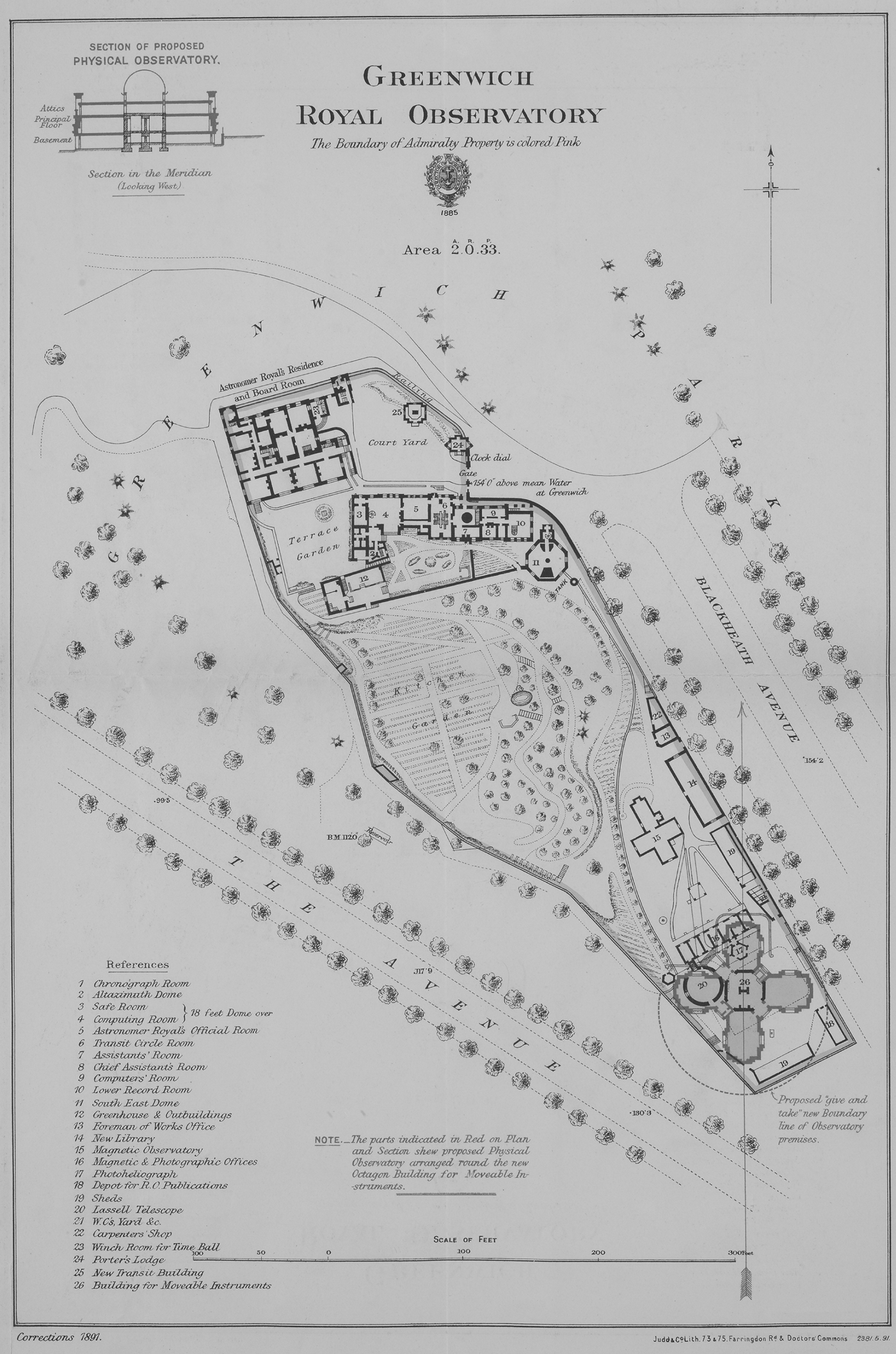
It is clear that by this date Christie had developed a grand vision of his Physical Observatory and its contents. The Department of Works provided a plan that showed this scheme superimposed over the confirmed central ‘Building for Moveable Instruments’ (Figure 2), although the Admiralty repeatedly resisted his pleas. ‘I feel strongly’, he wrote in November 1891, ‘that the complete cruciform building with 4 wings is what we require, though we may have to get it piecemeal’.Footnote 77 In the process of explaining his aims to the Board of Visitors and justifying his claims to the Admiralty, his presentation of the Observatory's needs got somewhat neater, and further away from his original proposals. One strand of argument was that a coherent, permanent building was required for a national institution. In his report to the Board of Visitors in June 1891, he wrote of the ‘wooden sheds and huts which now disfigure the Observatory grounds’, suggesting that these were ‘quite out of place’; ‘The time would seem to have come when an effort should be made to provide the Royal Observatory with buildings befitting its position as a permanent institution’. Another line underscored the inadequacy of the existing accommodation. Christie continued to stress the increase in number of chronometers as an immediate factor that was out of his control, and added consideration of the ‘increasing staff’ and ‘accumulating material’ that accompanied the Observatory's widening remit.Footnote 78 As well as being too cramped, the buildings and rooms used were a fire risk, too cold or within his official residence.
1891 plan showing the proposed position of a four-winged Physical Observatory, with attic, main and basement storeys, overlying the Magnetic and Photograph Offices, photoheliograph hut, Lassell Dome and new Building for Moveable Instruments. The dotted arc indicates a proposed ‘give-and-take’ boundary with the Royal Park. Royal Greenwich Observatory Archives, Cambridge University Library, RGO 7/50. Reproduced by kind permission of the Syndics of Cambridge University Library. Another plan showed a building with three wings, as a possible option that lessened the need to encroach on new land.
Pilkington suggested that Christie get his funding at least for the completion of the central octagon and the building of the south wing ‘on the understanding that the wing for Chronometers is provided for’.Footnote 79 Christie, however, continued to request the north wing as well. He had gained another argument for the speedy completion of the central portion, surmounted with the Lassell Dome, with the donation of a photoheliograph telescope by the physician and amateur astronomer Sir Henry Thompson.Footnote 80 This was an important instrument and a generous gift, but its mounting in the low-level Lassell Dome meant that the trees ‘now greatly interfere with its effective use’. The presence of this instrument also contributed to ‘the recent great increase in the photographic work of the Observatory’, which meant that a laboratory was ‘urgently needed’.Footnote 81 Christie depicted very unsatisfactory working conditions for the staff, which he insisted required urgent remedy. He said the seven members of the Magnetic and Meteorological Branch currently ‘have to work in a small ante-room built of wood and altogether unfitted for the purpose’. In general, he said, ‘The increase of the Observatory staff in recent years has made it a matter of urgency that proper accommodation should be provided to enable the work of the Observatory to be carried on’. He said it was a matter of ‘extreme difficulty’ to find space for desks, and that the necessity of splitting staff between different rooms ‘interferes with effective supervision of the work, and causes much loss of time’. All this would only get worse as additional assistants were due to arrive the next year. He claimed that these two wings were so important that the delay would cause ‘serious injury to the efficiency of the Observatory’. It would, he declared, ‘be considered absolutely necessary by any competent person who examined the question on the spot’.Footnote 82 Despite this, early in 1892 the Lords Commissioners were ‘unable to concur’, meaning that the decision was deferred once more.Footnote 83
Over the following years Christie continued to press his case, first for the north wing, then against a series of delays for building work and finally for the completion of the additional two wings. He stressed the need for proper care of the Observatory's property, as the ad hoc use of space in locations such as the library risked items being misplaced, and for proper supervision of the staff. When further work was again postponed in early 1893, Christie wrote a letter of righteous indignation repeating and enlarging previous arguments and suggesting that the Admiralty were seriously hampering the efficiency and threatening the accuracy of the Observatory's work.Footnote 84 It seems unlikely that needs had got so very much more pressing in the three and a half years since the idea for a one-storey, rectangular building was first mooted. Christie clearly amplified his problems in order to gain his new building, although it remains unclear whether the combination of his opportunism and others’ demands increased his problems unnecessarily, or if he saw each as a means to his end. What is clear is that, in a reversal of Airy's policy, Christie never suggested that he ought to rein in the Observatory's expenditure, staff and range of work. It was understood that this was to be a national observatory – partaking of as much new work in astronomy as it could – rather than that defined by Airy's strict interpretation of the original Royal Warrant.
However, Christie did understand what Airy had achieved in terms of the effective running of the ROG with regard to its ‘astronomy and navigation’ brief. Hinting that Airy's administrative efforts might be undone, Christie made much of the threat to the ‘efficiency of the Observatory’. Explaining that the parts of the Physical Observatory that had been built now obscured much of the sky, he claimed that the continuation of the series of photographs of the sun, taken continuously at Greenwich since 1873, was at risk. ‘It would’, he said, ‘be a scandal if this valuable series were interrupted through the piecemeal contribution of the Physical Observatory’. Getting tough, he added that if the repositioning of the dome was not done immediately, ‘I regret to have to state that I must disclaim all responsibility for the result’. In addition to this he noted that the staff were currently working in unsuitable conditions: badly ventilated, cold and cramped. He had previously pointed out that he was forced to use a room in his own residence for computers, and now highlighted the inappropriate nature of this arrangement with the news that there was a case of scarlet fever in his house. His parting shot was to question the Admiralty's commitment: ‘I trust that their Lordships having shewn their readiness to provide accommodation for the Navy Chronometers will not be unwilling to consider the urgent requirements of the Observatory staff’.Footnote 85 Christie's firm words got him the north wing in 1893, taking approved costs to £5,000, although building of even the south wing was slowed to a halt by delay in the supply of terracotta, by workforce disputes and by frost.
Late in 1894 Christie asked again for the east and west wings, which were to provide space for staff, records, calculations, publications and the library, to be added. He emphasized again the point about staff efficiency, but went a stage further, saying that ‘it is very desirable … that the Astronomer Royal and his staff should, as far as practicable, be concentrated in one building’.Footnote 86 This was only an extension of Christie's ideas on supervision, but was picked up by the Lords Commissioners of the Admiralty, who demanded an explanation, ‘as it was understood that the new building was intended to be a Physical Observatory’.Footnote 87 The nature of a modern observatory was far from clear to the Admiralty, although Christie did keep moving the goalposts and his reply makes clear how far his ideas had come. He now saw this new building as ‘the centre of the activity of the observatory’. He explained what he meant by ‘physical observatory’:
the rapid advances which have been and are made in the application of photography to astronomical research must necessarily lead to the employment of a larger portion of the Staff on work that comes under the designation ‘physical’. Again, such work does not consist merely in taking observations but includes a large amount of calculation and other work such as measuring photographs &c. Hence it comes that space is required not only for such an instrument as the Thompson 26″ Photographic Telescope but for the accommodation of the staff of workers, for the smaller instruments they use, and for the numerous volumes, whether printed or in manuscript, to which they have constantly to refer.
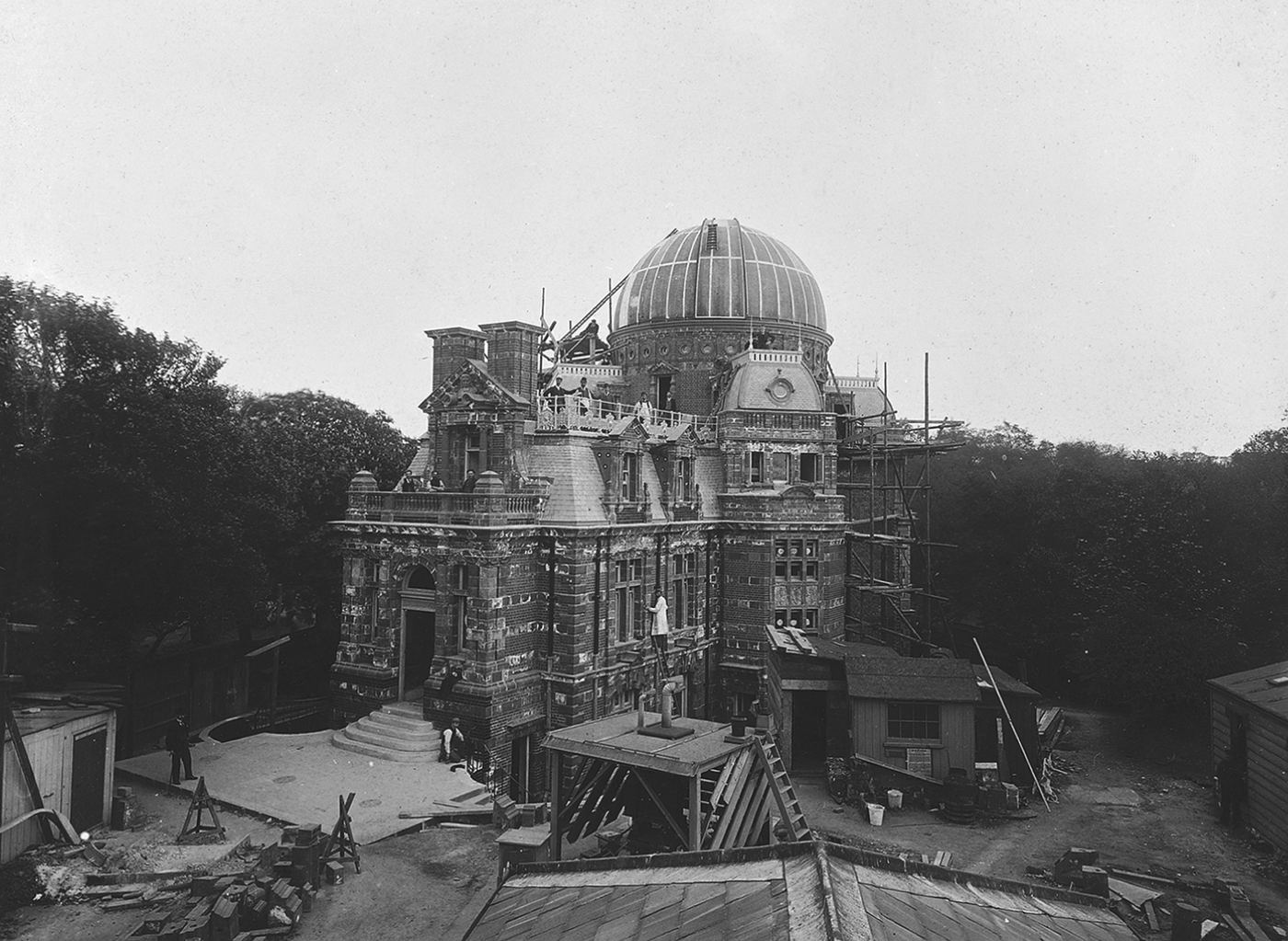
He presented his full plans for the use of the space which now was less dictated by the four wings than by the different levels: the ground floor was for workshops, storage of instruments and the library; the first, or principal, floor was for the offices of the Astronomer Royal, his chief assistant and clerk and for the desk workers of all the Observatory's branches, except for the Time Department, plus a small museum in the central octagon; in the attic floor and pavilions there was to be further storage for publications, records and photographs, laboratory and darkrooms. The dome was to carry three telescopes, the Thompson twenty-six-inch now replacing the Lassell telescope.Footnote 88 These plans were rejected again in 1895, and only approved the following year at an additional projected cost of £6,000, while in the meantime work on the other parts of the building was continuing only slowly and intermittently (Figure 3).
The north wing and central portion of the New Physical Observatory in 1896. B1006, National Maritime Museum.
The whole building was only completed in 1899. Favourable comments were made and the Observatory had its centralized facility for the majority of its staff – a long way from the museum for portable instruments that was first suggested in 1889. The London News welcomed the fact that Greenwich Observatory was ‘no longer the chaotic cluster of old buildings just inside the walls’ but ‘a striking adornment to Greenwich Park’, a ‘handsome and very elaborately ornamented structure in red brick and brown terra cotta, surmounted by a central dome and embellished by allegorical designs, by a large bust of Flamsteed, the first Astronomer Royal, and by tablets displaying the names of leading astronomers’. This meant that ‘Greenwich Observatory will present an appearance somewhat more in keeping with its world-wide fame, and, what is more, will have in the new building an instrument which will rank among the very finest in existence’.Footnote 89 New iron railings later replaced wooden fences, allowing passers-by to admire the building, and some, though not all, of the existing sheds and outbuildings were removed. Given that they were meant to have been replaced by this structure, it seems ironic that only six years later Christie reported to the Board of Visitors, ‘A permanent storehouse for portable instruments, huts, chronometer baskets, and general stores, is much needed to take the place of the existing wooden sheds’.Footnote 90
Design and decoration
The foregoing story of somewhat haphazard planning, standing alongside a desire to present the public with a national observatory building, is also revealed in the Physical Observatory's form and decoration. While architecturally unexceptional, its eclectic mix of influences being typical of late nineteenth-century public buildings, it evinced a certain grandeur and formality, as be fitted a national institution.Footnote 91 Crisp, the architect, commented that as a ‘formal class of architecture [was] necessarily adopted for the R.O.’ it was inadvisable to (literally) cut corners in order to squeeze the building onto the site.Footnote 92 Although new to the Greenwich site, a winged structure with a central, often octagonal, tower was almost de rigueur for observatories by this period and it seems quite possible that Christie's thinking travelled in this direction quite naturally in response, even before he had quite decided what else would be put into the other one, two or three wings.Footnote 93 Beyond this, however, Crisp seems to have been given a remarkably free hand. Christie appears to have been quite pleasantly surprised when, seeing drawings in 1893, he found that ‘the Physical Observatory when completed will, I think, be a handsome building which will greatly improve the appearance of the Observatory’.Footnote 94
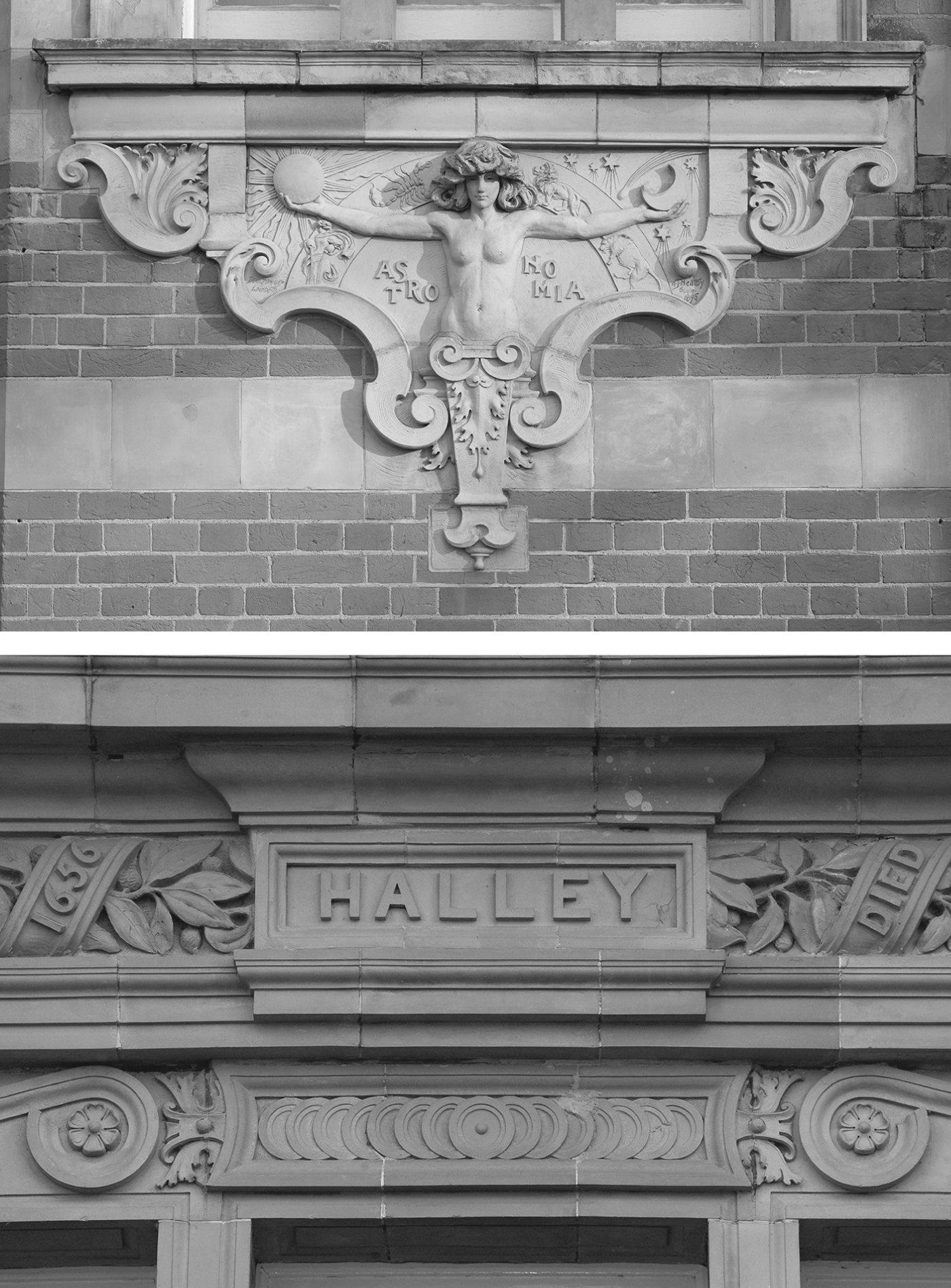
The terracotta decoration made it possible to include decorative as well as architectural elements in the design. Foliage, coats of arms, the bust, a decorative plaque, and twenty-four tablets above the first-floor windows, bearing a series of names linked to the history of astronomy with their dates among the foliage, were all eventually included (Figure 4). Such decoration was, of course, appropriate for such a building. At the new 1892–1896 building of the Royal Observatory in Edinburgh, the exterior of the library bore the names of Copernicus, Galileo, Kepler, Newton, Herschel, Bessel and Henderson, the first Astronomer Royal for Scotland. At Pulkovo, the entrance hall contained portraits of a similar series of historical greats and more recent inspirations for highly accurate positional and stellar astronomy.Footnote 95 Unlike at Edinburgh, the Greenwich list of names tells a very particular – and unusually practical rather than general – history of astronomy. As Christie wrote, ‘The idea is to present a sort of history of the Observatory from the beginning to the date of the building’.Footnote 96 First, Christie's seven predecessors as Astronomer Royal were honoured in the most prominent positions at the ends of each wing and on the four ‘lobbies’ of the central tower. The eighth of these more prestigious spots was, naturally, given to Newton. The other sixteen names were of ‘persons specially connected with the advancement of the Royal Observatory as Astronomers, Instrument Makers, Clock and Chronometer Makers’.Footnote 97 All working in England, they celebrate the Royal Observatory's identity as a pioneering institution for precision instruments and practical astronomy, and the world's prime location for the connection between timekeeping and astronomy.
Decorative plaques on the South Building at the Royal Observatory Greenwich (F6911-60, L2154-039 National Maritime Museum). The art nouveau plaque depicting Astronomia was designed by W.J. Neatby, head of the architectural department of Doulton & Co.
With few exceptions, the names on this building were solidly linked to the ROG's traditional role, and that which was defended by Airy against the incursions of the new astronomy. Likewise, the structure carrying the dome is decorated with windows that remind the viewer of portholes while the weather vane depicts Henry VIII's flagship, Henri Grace à Dieu, or Great Harry. Airy's cry of ‘astronomy and navigation’ might be ringing in our ears. Decorating a building that was intended to symbolize Greenwich's attempt to join the pioneering work of other public and private observatories, this scheme appears as a tribute to the old and passing order, marking a transition to the new. However, it also emphatically underlined Greenwich's very long history as a state-funded institution, singling it out from the tsar's observatory in Pulkovo, university-based institutions or privately financed observatories like many of those springing up in America. While funding by the Admiralty limited the extent to which Greenwich could transform itself, it also meant permanence and continuity and a level of security that was envied by the directors of many other institutions.
Conclusion
The Royal Observatory's New Physical Observatory could be seen as a triumphant realization of Christie's schemes, and of his dogged determination to drag what he could from the unwilling coffers of the Admiralty and Treasury. Despite the complex story behind its genesis, it presented a coherent whole and, finally, a fashionably designed focal building for the expanded, modern, working observatory. It provided much-needed accommodation for the range of activities and increased staff of the Observatory and remained in use, along similar lines, as long as the Observatory stayed at its Greenwich location. However, it might also be characterized as a wasted effort and missed opportunity. If Christie really dreamed of heading an observatory that could rival, or at least stand alongside, Pulkovo or Potsdam, then, it could be argued, he should have avoided this piecemeal, opportunistic approach that risked wasted money and effort. The writing was already on the wall for the future of observation at Greenwich, given the interference of industrial pollution and potential threat from electric trains. Thus, with hindsight at least, Christie should have halted works at Greenwich and begun serious lobbying for a removal of the institution to a more suitable location.
However, given the difficulties that Christie faced in getting approval for his building, he must have considered a complete rebuilding of the Royal Observatory on a new site to be too financially ambitious for the government to accept. Even the sums he requested – fairly small by Admiralty standards – required very significant lobbying on Christie's part. An obituary, written by a member of Greenwich staff, recalled the 1890s as ‘a busy period in Christie's life’, during which the ‘consideration of details of these instruments and consultation with Government departments as to the new buildings, left little time for individual astronomical work’. Indeed, as the archive testifies, ‘His time was largely occupied in drafting long letters, many of which were written in his own hand, to the instrument makers and to the Admiralty and Treasury’.Footnote 98 Perhaps it was as much as any man could have accomplished at this date, when government financing of non-utilitarian scientific research was still a novelty. The precedent that Christie set in this building and his wholehearted approval of the range of work, including some limited original research, being undertaken was surely important for his successors and the later development of the ROG. However, it is possible too that in his over-detailed focus on the problems thrown up by his increasingly complex ad hoc plans, he was unable stand back and contemplate the fuller picture.
His New Physical Observatory was, nevertheless, his plan for the British national observatory's international future, created piecemeal and justified by a mixed appeal to utility, efficiency, pragmatism, national honour and scientific ambition. For Christie, ensuring both the expansion of his observatory and the retention of the Greenwich location were desirable. In part this was about the significance attached to the history of the site, marking what was becoming accepted as the international prime meridian and revealing in its buildings the British government's long and steady – if not ever overwhelmingly generous – support of astronomy. However, the location also allowed the Astronomer Royal access to government departments, where he repeatedly made his case for additional funding, the many scientific committees on which he sat and the more informal meeting spaces of London's clubs. He and the more senior staff could also play a role in the scientific societies, take up opportunities for speaking and publishing and host the journalists who increasingly reported on their activities.
However, despite the statement made by the building and its original name (the speed with which this was dropped is revealing), it did not mark a very significant transition in terms of the work being done at Greenwich.Footnote 99 Certainly the photographic and larger telescopes created new possibilities, but, with the exception of the Carte du ciel, the programmes of observation remained those implemented, despite Airy's objections, in the 1870s. Rather, the building and the steady increase of staff marked a commitment to the continuation of programmes – those that made Greenwich pro tanto a physical observatory – that Airy had always marked as undesirable for an Admiralty-funded institution. Much of this was about the appearance of keeping up with the times or maintaining the ability to compete with other observatories rather than a real attempt to develop large programmes of new research. In the following decades, not only did the question of moving out of Greenwich become ever more pressing, but so too did the questions over the possible range of roles fitting for an Admiralty-funded astronomical and physical observatory. Thus, while assessment of specific decisions might question Christie's wisdom, opinions about whether he ought to have developed bolder plans should not be coloured by knowledge of a later history that was to see the ROG move, change funding department and, ultimately, lose its role.