



1. Introduction
The pedestal region just inside the last closed flux surface on a tokamak is characterized by strong radial gradients in pressure and electrostatic potential in both high or H mode (Wagner et al. Reference Wagner1982) and improved or I mode (Whyte et al. Reference Whyte2010) confinement regimes. Both regimes tend to have similar ion temperature profiles, but H mode has much stronger density gradients than I mode. Charge exchange recombination spectroscopy (CXRS) diagnostics of impurities has enabled the measurement of the strong radial electric field in the pedestal (McDermott et al. Reference Mcdermott, Lipschultz, Hughes, Catto, Hubbard, Hutchinson, Granetz, Greenwald, Labombard, Marr, Reinke, Rice and Whyte2009; Viezzer et al. Reference Viezzer, Pütterich, Conway, Dux, Happel, Fuchs, Mcdermott, Ryter, Sieglin, Suttrop, Willensdorfer and Wolfrum2013a) as well as in–out asymmetries in this field and in the impurity density (Churchill et al. Reference Churchill, Lipschultz and Theiler2013, Reference Churchill, Theiler, Lipschultz, Hutchinson, Reinke, Whyte, Hughes, Catto, Landreman, Ernst, Chang, Hager, Hubbard, Ennever and Walk2015; Viezzer et al. Reference Viezzer, Pütterich, Fable, Bergmann, Dux, Mcdermott, Churchill and Dunne2013b; Theiler et al. Reference Theiler, Churchill, Lipschultz, Landreman, Ernst, Hughes, Catto, Parra, Hutchinson, Reinke, Hubbard, Marmar, Terry and Walk2014). The scale lengths of the radial electric field can be as small as a poloidal ion gyroradius, making conventional neoclassical treatments (Hinton & Hazeltine Reference Hinton and Hazeltine1976) inappropriate (Trinczek et al. Reference Trinczek, Parra, Catto, Calvo and Landreman2023). To cope with the limitations of the conventional neoclassical orderings, but maintain a local treatment of transport, Helander (Reference Helander1998) employed a high charge number ordering of the impurities that allows some of the behaviour of the impurities to be understood for banana regime background ions. In particular, he demonstrated that large background or main ion gradients poloidally redistribute impurity ions to reduce both their parallel friction with the main ions and the neoclassical particle flux, and may do so by impurity accumulation on the high field side of a tokamak. Subsequent work considered strong rotation (Fülöp & Helander Reference Fülöp and Helander1999) and plateau regime background ions Landreman, Fülöp & Guszejnov (Reference Landreman, Fülöp and Guszejnov2011). For banana and plateau regime main ions the leading modification to the Maxwellian is from a poloidal gyroradius over a radial scale length correction. Alternately, for the collisional Pfirsch–Schülter background ions considered by Fülöp & Helander (Reference Fülöp and Helander2001) and Maget et al. (Reference Maget, Frank, Nicolas, Agullo, Garbet and Lütjens2020a,Reference Maget, Manas, Frank, Nicolas, Agullo and Garbetb) the leading modification is a mean free path over parallel connection length correction. In addition, because CXRS measures the impurity flow to determine the radial electric field, the banana regime formulation of Helander has been recast into a form that employs the measured poloidal impurity flow in place of a term that requires solving the complicated kinetic equation for the main ion species in the presence of impurities (Espinosa & Catto Reference Espinosa and Catto2017a,Reference Espinosa and Cattob, Reference Espinosa and Catto2018). In all these models the poloidal variation of the magnetic field is responsible for the poloidal variation of the impurity density, which is then responsible for the poloidal variation of the electric field.
As the pedestal may be in either the plateau or banana regime, the purpose of the material to follow is to build on these earlier treatments by demonstrating that these regimes share many of the same characteristics. In particular, the poloidal variation of the impurity density in the plateau regime and the large aspect ratio limit of the banana regime are shown to be the same. Moreover, the treatment here allows the retention of the impurity pressure gradient term neglected as small in these earlier treatments. This minor generalization is accomplished by allowing moderate impurity charge numbers such as nitrogen, carbon, and boron, and using an aspect ratio expansion for the impurity pressure gradient terms, and means that impurity flows need no longer be on a flux surface. All other terms are treated with the same generality as earlier treatments. In addition, the treatment here improves the earlier plateau regime solution of the main ion kinetic equation and its treatment of ambipolarity.
The next section introduces the tokamak notation and coordinates employed. Section 3 focuses on the general expressions for the parallel impurity momentum equation, quasineutrality, the radial impurity flux and the impurity flow, all with the slightly improved treatment of the impurity pressure. The general expressions are specialized to banana regime main ions in § 4 to show the results are consistent with earlier treatments when impurity pressure gradient terms are ignored. Plateau regime main ions are considered in § 5 in more detail as the treatment here generalizes the earlier treatment of Landreman et al. (Reference Landreman, Fülöp and Guszejnov2011). Section 6 presents approximate solutions for poloidal variation of the impurity density variation in the plateau and banana regimes as well as detailed discussion of radial particle transport. The implications for the diffusion and convection form of the impurity continuity equation are noted in § 7. A summary of the results is given in § 8, as well as a table of model predictions.
2. Tokamak geometry and notation
The magnetic field of an axisymmetric tokamak can be written as

where $\psi$ is the poloidal flux function, $\zeta$
 is the toroidal angle (with $|\boldsymbol{\nabla }\zeta |= {R^{ - 1}}$
 ), $\vartheta$
 is the poloidal angle, q is the safety factor, $\boldsymbol{b}$
 is a unit vector along $\boldsymbol{B}$
 and $I = I(\psi ) = R{B_t}$
 with R the major radius and ${B_t}$
 the toroidal magnetic field. By picking $\vartheta$
 such that

q will be a flux function $q = q(\psi )$ . Other useful relations are $\boldsymbol{B} \times \boldsymbol{\nabla }\psi = I\boldsymbol{B} - {B^2}{R^2}\boldsymbol{\nabla }\zeta$
 , $|\boldsymbol{\nabla }\psi |= R{B_p}$
 , $\boldsymbol{\nabla }\zeta \boldsymbol{\cdot }\boldsymbol{\nabla }\psi = 0 = \boldsymbol{\nabla }\zeta \boldsymbol{\cdot }\boldsymbol{\nabla }\vartheta$
 and $\boldsymbol{\nabla }\psi \times \boldsymbol{\nabla }\vartheta \boldsymbol{\cdot }\boldsymbol{\nabla }\zeta = \boldsymbol{B}\boldsymbol{\cdot }\boldsymbol{\nabla }\vartheta$
 , with ${B_p}$
 the poloidal magnetic field. The toroidal current is taken to be in the $\boldsymbol{\nabla }\zeta$
 direction to make ${B_p} > 0$
 and $\boldsymbol{B}\boldsymbol{\cdot }\boldsymbol{\nabla }\vartheta > 0$
 , and the low field side (LFS) equatorial plane is always taken to be $\vartheta = 0$
 with $\vartheta$
 increasing in the ${\boldsymbol{B}_p} = \boldsymbol{\nabla }\zeta \times \boldsymbol{\nabla }\psi$
 direction. The toroidal magnetic field can be in the co-current $({B_t} > 0)$
 or counter-current $({B_t} < 0)$
 direction. Alcator C-Mod viewed from above normally has $\boldsymbol{\nabla }\zeta$
 in the clockwise direction with ${B_t} > 0$
 (McDermott et al. Reference Mcdermott, Lipschultz, Hughes, Catto, Hubbard, Hutchinson, Granetz, Greenwald, Labombard, Marr, Reinke, Rice and Whyte2009; Theiler et al. Reference Theiler, Churchill, Lipschultz, Landreman, Ernst, Hughes, Catto, Parra, Hutchinson, Reinke, Hubbard, Marmar, Terry and Walk2014), while ASDEX Upgrade (AUG) viewed from above typically has $\boldsymbol{\nabla }\zeta$
 in the counter-clockwise direction with ${B_t} < 0$
 (Viezzer et al. Reference Viezzer, Pütterich, Conway, Dux, Happel, Fuchs, Mcdermott, Ryter, Sieglin, Suttrop, Willensdorfer and Wolfrum2013a). Consequently, for standard operation the poloidal magnetic field at the equatorial plane on the LFS points upward in C-Mod and downward in AUG.
In $\psi ,\vartheta ,\zeta$ variables the components of any vector $\boldsymbol{A}$
 can be written as

In this form it is easy to form the divergence

In a tokamak the flux surface average of a scalar quantity A is defined as

with $V^{\prime} = \oint {\textrm{d}\vartheta /\boldsymbol{B}\boldsymbol{\cdot }\boldsymbol{\nabla }\vartheta }$ and the $\vartheta$
 integral over a full $2\mathrm{\pi }$
 when $A = A(\psi ,\vartheta )$
 . The flux surface average operating on the divergence of a vector $\boldsymbol{A}$
 gives

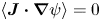
Then, for the current density $\boldsymbol{J}$ , for example, $\langle \boldsymbol{\nabla }\boldsymbol{\cdot }\boldsymbol{J}\rangle = 0$
 will give the ambipolarity condition $\langle \boldsymbol{J}\boldsymbol{\cdot }\boldsymbol{\nabla }\psi \rangle = 0$
 upon integration from the magnetic axis, where the radial current vanishes.
3. Conservation of impurity momentum and number, and quasineutrality
The lowest order momentum conservation equation for the impurities (subscript z, with ${Z_z}$ charge number and ${M_z}$
 mass, where e is the proton charge and c the light speed) is

where for the low flow speeds considered here the inertial term is negligible. Here, $F_{zi}^{||}$ is the parallel collisional friction between impurities and ions (subscript i), ${C_{zi}}$
 is the collision operator for impurities colliding with the main or background ions, ${n_z}$
 and ${p_z} = {n_z}{T_i}(\psi )$
 are the impurity density and pressure, ${\boldsymbol{V}_z}$
 is the impurity velocity and $\varPhi$
 is the electrostatic potential. Equilibration with the ions is assumed to give ${T_z} = {T_i}$
 , the ion temperature. Only subsonic rotation is considered. The sonic case was considered by Fülöp & Helander (Reference Fülöp and Helander1999).
To formulate theoretical descriptions that allow all the terms in (3.1) to be the same order for the moderate ${Z_z} \gg {Z_i}$ under consideration (with ${Z_z}{n_z} \ll {Z_i}{n_i}$
 ), the ordering

must be assumed to allow ${Z_z}e{n_z}\boldsymbol{\nabla }\varPhi \sim \boldsymbol{\nabla }{p_z}$ , where ${Z_i}$
 and ${n_i}$
 are the main ion charge number and density. This ordering is not as general as a true pedestal ordering that requires ${Z_i}e\varPhi \sim {T_i}$
 to permit ${Z_i}e{n_i}\partial \Phi /\partial \psi \sim \partial {p_i}/\partial \psi$
 (Trinczek et al. Reference Trinczek, Parra, Catto, Calvo and Landreman2023), but does allow insight into the CXRS measurements. Therefore, the theoretical models developed here all assume

An expression for the radial electric field $({E_r})$ is found by dotting momentum balance by $\boldsymbol{\nabla }\vartheta \times \boldsymbol{\nabla }\zeta$
 and neglecting the friction contribution as small to find

Injecting an impurity or using an intrinsic one and ignoring the parallel friction as small, the radial electric field is deduced by measuring the diamagnetic, toroidal flow and poloidal flow contributions, respectively (McDermott et al. Reference Mcdermott, Lipschultz, Hughes, Catto, Hubbard, Hutchinson, Granetz, Greenwald, Labombard, Marr, Reinke, Rice and Whyte2009; Viezzer et al. Reference Viezzer, Pütterich, Conway, Dux, Happel, Fuchs, Mcdermott, Ryter, Sieglin, Suttrop, Willensdorfer and Wolfrum2013a; Theiler et al. Reference Theiler, Churchill, Lipschultz, Landreman, Ernst, Hughes, Catto, Parra, Hutchinson, Reinke, Hubbard, Marmar, Terry and Walk2014; Cruz-Zabala et al. Reference Cruz-Zabala, Viezzer, Plank, Mcdermott, Cavedon, Fable, Dux, Cano-Megias, Pütterich, Jansen van Vuuren, Garcia-Munoz and Garcia Lopez2022). The orderings of (3.2) and (3.3) allow all terms in (3.4) to be the same order. The flux surface averaged electrostatic potential, $\langle \varPhi \rangle$ , is largely determined by the main ions through conservation of toroidal angular momentum. Measuring the radial impurity pressure gradient and poloidal and toroidal flows in (3.4) allows the radial electric field to be determined. The poloidal variation of the electrostatic potential, $\varPhi - \langle \varPhi \rangle$
 , can be rather strong due to the impurities. The poloidal variation of the impurity density is found from conservation of impurity parallel momentum. Impurities can result in strong poloidal variation in $\varPhi - \langle \varPhi \rangle$
 due to the need to maintain quasineutrality. Any contribution from $\partial (\varPhi - \langle \varPhi \rangle )/\partial \psi$
 , causes the radial electric field to vary poloidally.
Momentum balance also yields the perpendicular impurity flow velocity ${\boldsymbol{V}_{ \bot z}}$ giving

The impurity flow can also be written as

where the $\varUpsilon$ term allows a radial flow departure from a flux surface

The angular frequency ${\omega _z} = {\omega _z}(\psi ,\vartheta )$ contributes to the toroidal flow ${\boldsymbol{V}_z}\boldsymbol{\cdot }\boldsymbol{\nabla }\zeta = \; {\omega _z} + n_z^{ - 1}{L_z}\boldsymbol{B}\boldsymbol{\cdot }\boldsymbol{\nabla }\zeta$
 . The parallel flow coefficient ${L_z}$
 is related to the poloidal flow and leads to the useful expression

In addition, the impurity continuity equation gives

The retention of the radial impurity pressure gradient and the poloidal variation of the electrostatic potential and the impurity pressure mean that ${L_z}$ is not a flux function. In the Helander (Reference Helander1998) treatment $\partial \varUpsilon /\partial \psi$
 is ignored because ${Z_z}$
 is assumed very large. The poloidal variation of the impurity density and electrostatic potential are responsible for the radial impurity flow that does not occur in standard banana and plateau regime treatments that assume both are flux functions (Hinton & Hazeltine Reference Hinton and Hazeltine1976). The small radial flow correction $\varUpsilon$
 was not considered in earlier treatments that focused on measuring the poloidal variation of the impurity flow on a flux surface (Marr et al. Reference Marr, Lipschultz, Catto, Mcdermott, Reinke and Simakov2010; Pütterich et al. Reference Pütterich, Viezzer, Dux and Mcdermott2012).
To evaluate the friction in the parallel impurity momentum equation

collisional momentum conservation, ${M_z}\int {{\textrm{d}^3}v{v_{||}}{C_{zi}}} + {M_i}\int {{\textrm{d}^3}v{v_{||}}{C_{zi}}} = 0$ , is employed since it is convenient to use the collision operator ${C_{iz}}$
 for the faster background ions colliding with the slower impurities

where ${f_i} = {f_{i0}} + {f_{i1}}$ , with ${f_{i1}}$
 the non-adiabatic perturbed ion distribution function and ${f_{i0}}$
 the Maxwellian (which must be a flux function and depend on total energy in the banana and plateau regimes)

with ${n_i} \approx \langle {n_i}\rangle [1 - {Z_i}e(\varPhi - \langle \varPhi \rangle )/{T_i}]$ . It is convenient to keep the perturbed Maxwell– Boltzmann response in ${f_{i0}}$
 . The ion–impurity collision frequency ${\nu _{iz}}$
 is defined as

with $\ell n\varLambda$ the Coulomb logarithm, ${\nu _{iz}}/{\nu _{zi}} = {M_z}{n_z}/2{M_i}{n_i} \ll 1$
 and ${M_i}$
 the background ion mass. Evaluating the parallel friction gives

Only unlike collisions cause particle transport. The banana regime diffusivity for electrons colliding with the main ions, ${D_e}$ , is roughly ${D_e}\sim {q^2}\rho _e^2{\nu _{ei}}/{\varepsilon ^{3/2}} \propto {n_e}M_e^{1/2}$
 , with ${\rho _e}$
 the electron gyroradius, ${\nu _{ei}}$
 the electron–ion collision frequency and ${M_e}$
 the electron mass. The banana regime diffusivity for the faster moving main ions colliding with the slower moving impurities, ${D_i}$
 , is roughly ${D_i}\sim {q^2}\rho _i^2{\nu _{iz}}/{\varepsilon ^{3/2}} \propto Z_z^2{n_z}M_i^{1/2}$
 , with ${\rho _i}$
 the ion gyroradius. Therefore, as long as $Z_z^2{n_z}/{n_e} \gg {({M_e}/{M_i})^{1/2}}$
 electron transport can be ignored. Then, ambipolarity between the ions and impurities requires

with poloidal variation of $\varUpsilon$ (due to ${n_z}$
 and $\varPhi$
 ) essential to obtain finite particle fluxes. The poloidal variation of the magnetic field in the parallel friction gives rise to poloidal variation of the potential and the densities. These poloidal density variations must satisfy quasineutrality, which upon taking the poloidal derivative yields

Assuming the temperatures are flux functions, and using a Maxwell–Boltzmann response for the electrons, ${n_e} \approx \langle {n_e}\rangle [1 + e(\varPhi - \langle \varPhi \rangle )/{T_e}(\psi )]$ , and background ions, leads to

where the impurity density is assumed small in order not to alter lowest order quasineutrality, $\langle {n_e}\rangle = {Z_i}\langle {n_i}\rangle \gg {Z_z}\langle {n_z}\rangle$ . Consequently, the potential can be eliminated from the parallel momentum constraint and the solution for ${n_z}$
 must satisfy the solubility constraint $\langle BF_{iz}^{||}\rangle = 0$
 . Using quasineutrality to rewrite the parallel impurity equation yields

where

is allowed to be order unity or less, and $\tau = {Z_i}{T_e}/{T_i}$ . Equation (3.17), as well as (3.4) and the preceding orderings, allow ${Z_z}e(\varPhi - \langle \varPhi \rangle )/{T_i}\sim ({n_z} - \langle {n_z}\rangle )/{n_z}\sim 1$
 as well as ${Z_z}e\langle \varPhi \rangle \sim {T_i}$
 , but assume ${Z_i}e(\varPhi - \langle \varPhi \rangle )/{T_i} \ll 1.$

The poloidal variation of the impurity density is due to the poloidal variation of the magnetic field in $BF_{iz}^{||}$ . Normalizing with $n = {n_z}/\langle {n_z}\rangle$
 and ${b^2} = {B^2}/\langle {B^2}\rangle$
 , and introducing $\textrm{d}\theta = \langle \boldsymbol{B}\boldsymbol{\cdot }\boldsymbol{\nabla }\vartheta \rangle \,\textrm{d}\vartheta /\boldsymbol{B}\boldsymbol{\cdot }\boldsymbol{\nabla }\vartheta$
 to remove the $\vartheta$
 dependence of $\boldsymbol{B}\boldsymbol{\cdot }\boldsymbol{\nabla }\vartheta$
 , the parallel impurity momentum equation becomes

where ${n_i} \approx \langle {n_i}\rangle$ is used in the coefficients on the right side since it gives a negligible correction of order ${Z_i}e(\varPhi - \langle \varPhi \rangle )/{T_i}\sim {Z_z}({n_z} - \langle {n_z}\rangle )/\langle {n_e}\rangle \ll 1$
 . Here, and in the remainder of this and the following sections, ${n_i} \approx \langle {n_i}\rangle$
 and ${p_i} \approx \langle {p_i}\rangle = \langle {n_i}\rangle {T_i}$
 , but ${n_z} \ne \langle {n_z}\rangle$
 .
Taking the poloidal derivative of quasineutrality also allows $\varUpsilon$ to be written as

Notice that when ${Z_z}$ is very large, $\varUpsilon \to 0$
 giving $\partial {L_z}/\partial \vartheta \to 0$
 as in the limit considered by Helander (Reference Helander1998). Interestingly, the lowest order poloidal variation of ${L_z}$
 due to impurity diamagnetic effects can be retained by assuming the poloidal variation of the magnetic field is weak by ordering

This ordering is consistent with the inverse aspect ratio, $\varepsilon = a/R$ , expansion necessary in the plateau regime, where a is the minor radius. In the banana regime, this expansion is only necessary to treat impurity pressure terms, but illustrates how their behaviour enters to a limited extent. In the banana regime all other terms can be retained for general B, and therefore, for quite general ${n_z}$
 as long as the poloidal ion gyroradius is small compared with the radial scale lengths. The aspect ratio expansion means

where the last term is order ${\varepsilon ^2}$ . Consequently, impurity diamagnetic modifications of order ${Z_i}\varepsilon /{Z_z}$
 are retained by writing $\varUpsilon$
 as

with $\langle \varUpsilon \boldsymbol{B}\boldsymbol{\cdot }\boldsymbol{\nabla }\vartheta \rangle = \langle \Delta \boldsymbol{B}\boldsymbol{\cdot }\boldsymbol{\nabla }\vartheta \rangle$ and ${Z_i}{\varepsilon ^2}/{Z_z}$
 corrections from $\varDelta$


Ignoring the $\varDelta$ term as small in $\boldsymbol{\nabla }\boldsymbol{\cdot }({n_z}{\boldsymbol{V}_z}) = 0$
 and integrating (3.9) leads to

with ${K_z}$ a flux function associated with the poloidal flow. The preceding and

allow the parallel impurity flow to be written as

where in $\langle {p_z}\rangle$ terms the radial variation of B is weak compared with that of ${n_z}$
 , ${n_i}$
 and ${T_i}$
 .
To make further progress more details of the solution ${f_{i1}}$ are required. The required details can be obtained by considering the background ions to be in the banana $({\nu _\ast } \equiv {\nu _{ii}}qR/{v_i}{\varepsilon ^{3/2}} < 1)$
 or plateau ($1 < {\nu _{ii}}qR/{v_i}{\varepsilon ^{3/2}} \equiv {\nu _\ast } < 1/{\varepsilon ^{3/2}}$
 ) regimes, where ${\nu _{ii}} = 4\sqrt {\mathrm{\pi }} Z_i^4{e^4}{n_i}\ell n\varLambda /3M_i^{1/2}T_i^{3/2}$
 is the ion–ion collision frequency, ${\nu _\ast }$
 is the ion collisionality and ${v_i} = {(2{T_i}/{M_i})^{1/2}}$
 is the ion thermal speed. The banana regime is considered next and then the plateau regime. In both cases the impurities may be collisional even for moderate ${Z_z}/{Z_i}$
 , as ${\nu _{zz}}/{\nu _{ii}} = Z_z^4{n_z}M_i^{1/2}/Z_i^4{n_i}M_z^{1/2}\; \sim \; \alpha {({Z_z}/{Z_i})^{3/2}}$
 gives ${\nu _{zz}}qR/{v_z}\sim \; \alpha {({Z_z}/{Z_i})^2}({\nu _{ii}}qR/{v_i})$
 , with ${\nu _{zz}}$
 the impurity–impurity collision frequency and ${v_z} = \sqrt {2{T_i}/{M_z}}$
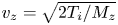 the impurity thermal speed. The preceding indicates the impurities become collisional when $\alpha {({Z_z}/{Z_i})^2} > 1$
 . Collisional background ions are not considered here, but were investigated by Fülöp & Helander (Reference Fülöp and Helander2001) and Maget et al. (Reference Maget, Frank, Nicolas, Agullo, Garbet and Lütjens2020a,Reference Maget, Manas, Frank, Nicolas, Agullo and Garbetb).
4. Banana regime background ions
In the banana regime $({\nu _{ii}}qR/{v_i} < {\varepsilon ^{3/2}})$ the background ion kinetic equation to be solved in total energy, $E = {v^2}/2 + {Z_i}e\varPhi /{M_i}$
 , and magnetic moment, $\mu = v_ \bot ^2/2B$
 , variables is

where ${C_1}$ is the ion–ion plus ion–impurity collision operator, ${\varOmega _i} = {Z_i}eB/{M_i}c$
 is the ion cyclotron frequency,

with ${n_i} = \eta \,{\textrm{e}^{ - {Z_i}e\varPhi /{T_i}}} \approx \langle {n_i}\rangle [1 - {Z_i}e(\varPhi - \langle \varPhi \rangle )/{T_i}]$ as before, with $\eta = \langle {n_i}\rangle \,{\textrm{e}^{{Z_i}e\langle \varPhi \rangle /{T_i}}}$
 a pseudo-density and ${h_1}$
 related to ${f_1}$
 by

Evaluating the integrals for the explicit friction terms yields

In the banana regime ${v_{||}}\boldsymbol{b}\boldsymbol{\cdot }\boldsymbol{\nabla }{h_1} = 0$ to lowest order making

a flux function. The trapped ion portion of ${h_1}$ vanishes as can be seen by transit averaging the next order kinetic equation and noting ${v_{||}}$
 changes sign upon reflection. Then the terms (3.14) on the right side of the parallel momentum equation combine to give

In addition, the radial particle flux is

Defining the gradient flux function G by

an impurity diamagnetic flux function $D \propto 1/{Z_z}$ by

a poloidal flow flux function

and a flow quantity U (that is only a flux function in the banana regime)

then the parallel impurity momentum equation in the banana regime becomes

To obtain the last term it is necessary to make an aspect ratio expansion, (3.22), but the other terms are valid for general B and ${n_z}$ . Notice that the final term in the expression multiplying D vanishes to lowest order upon flux surface averaging. Except for the generalization to include poloidal variation due to impurity diamagnetic effects, the orderings used here are essentially the same as Helander (Reference Helander1998) and Landreman et al. (Reference Landreman, Fülöp and Guszejnov2011) who ignore the impurity diamagnetic term D by assuming very large ${Z_z}/{Z_i}$
 . The treatment here retains D to lowest order in the parallel impurity momentum equation. Consequently, moderate ${Z_z}/{Z_i} \gg 1$
 such as carbon and boron are allowed, and very large ${Z_z}/{Z_i}$
 (e.g. tungsten) need not be assumed.
Helander (Reference Helander1998), Landreman et al. (Reference Landreman, Fülöp and Guszejnov2011) and the treatment herein allow

where the poloidal ion gyroradius, ${\rho _{ip}} = {v_i}B/{\varOmega _i}{B_p}$ , is assumed much smaller than the radial scale length ${L_ \bot }$
 . At the banana–plateau transition $G\sim ({\rho _{ip}}/{L_ \bot })\; {({Z_z}/{Z_i})^2}{\varepsilon ^{3/2}}$
 , indicating that for $G\sim 1$
 , ${({Z_z}/{Z_i})^2}{\varepsilon ^{3/2}} \gg 1$
 is required.
Recalling that in the banana regime the quantity U is a flux function, the solubility constraint

can be employed to eliminate K to find

(which agrees with Helander (Reference Helander1998) when ${Z_z} \to \infty$ ). The orderings assume $D/G\sim {Z_i}/{Z_z} \ll 1$
 . The D term assumes $\varepsilon \ll 1$
 and enters because then $D(1 - {b^2})/G(n - {b^2})\sim {Z_i}/\varepsilon {Z_z}\sim 1$
 is allowed. Measurements on Alcator C-Mod (Theiler et al. Reference Theiler, Churchill, Lipschultz, Landreman, Ernst, Hughes, Catto, Parra, Hutchinson, Reinke, Hubbard, Marmar, Terry and Walk2014) for ${B_t} > 0$
 indicate K > 0 and D > 0 over most of the pedestal in both H and I modes. In I mode ${\eta _i} \equiv \textrm{d}\ell n{T_i}/\textrm{d}\ell n{n_i} > 2\;$
 is expected, giving G < 0 in C-Mod and the flow term U > 0 in the banana regime. In H mode ${\eta _i} < 2\;$
 is anticipated giving G > 0 in C-Mod, so U can be of either sign.
CXRS can measure impurity flow as well as impurity density and temperature variations. Therefore, it is useful to use solubility to eliminate U instead of K to rewrite the parallel impurity momentum equation in the banana regime as

which generalizes the ${Z_z} \to \infty$ form in Espinosa & Catto (Reference Espinosa and Catto2017b) to include poloidal variation driven by the impurity pressure terms. To obtain this form, ${Z_i}/{Z_z}\sim \varepsilon$
 is assumed to simplify the D term by using $n{b^2}/\langle n{b^2}\rangle - {b^2} \approx n - 1$
 . The orderings allow $G\sim 1\sim K\textrm{ }\sim {Z_z}D/{Z_i}$
 . For this ordering impurity pressure effects are only allowed to alter the poloidal variation of the impurity density by terms of order $\varepsilon$
 . For a realistic, strongly varying magnetic field, this equation could be solved numerically to find strong poloidal variation in the impurity density. However, at present, it seems highly unlikely that the various coefficients can be determined with the requisite certainty. Only a simple limiting solution will be given once the corresponding plateau regime equation is derived in the next section. In the weak gradient and flow, low confinement limit (L mode), the small up–down asymmetry satisfies $(1 + \alpha )\partial n/\partial \theta \approx G(1 - {b^2})$
 as in Helander (Reference Helander1998).
In addition to the poloidal impurity density variation, the particle flux can be evaluated for banana regime background ions from the friction. Using the same orderings

The D term is negligible once (4.17) is averaged (recall it is derived assuming $\varepsilon \ll 1$ ) leading to the particle flux of banana regime background ions being

as in Espinosa & Catto (Reference Espinosa and Catto2017a,Reference Espinosa and Cattob, Reference Espinosa and Catto2018) who also assume ${T_i} = {T_z} = \langle {T_z}\rangle$ . This flux vanishes as desired for ${n_z} \to 0$
 . Also, large gradient ($G \gg 1$
 and $D \gg 1$
 ) and flow $(K \gg 1)$
 drives make the right side of (4.16) vanish and thereby reduces the friction, (4.17), and radial transport, (4.18), as pointed out by Helander (Reference Helander1998). When K is retained instead of U with $G = K \gg 1\sim D$
 , (4.16) reduces to

indicating that for G > 0 and K > 0 (G < 0 and K < 0) impurity accumulation will be large on the high field side (HFS), while impurity accumulation will occur on the LFS when G and K are of opposite sign. The general form (4.17) and the approximate form (4.19) allow strong poloidal variation in the magnetic field and impurity density. For example, (4.19) can be solved for a specified ${b^2}$ by defining $g \equiv G/K$
 to obtain the lowest-order result

for a fixed g. The constant $\langle n{b^2}\rangle$ is determined implicitly from the constraint

The special case g = 1 gives $n = {b^2}$ to lowest order. It allows (4.16) to be solved to next order to find $n = {b^2} + {K^{ - 1}}[(1 + \alpha {b^2})\partial {b^2}/\partial \theta - D({b^2} - 1){(2 + \partial \langle {p_z}\rangle /\partial \psi )^{ - 1}}\partial (\alpha \langle {p_z}\rangle )/\partial \psi ]$
 , demonstrating impurity diamagnetic modifications occur for $G = K \gg D\sim 1$
 .
The plateau regime parallel momentum equation and particle flux for the impurities are derived next in order that approximate solutions can be presented in a more streamlined and coordinated fashion.
5. Plateau regime background ions
In the plateau regime $(1 > {\nu _{ii}}qR/{v_i} > {\varepsilon ^{3/2}})$ the form of the unlike collision operator ${C_{iz}}\{ {f_{i1}}\}$
 makes it necessary to let

with ${H_1}$ and ${h_1}$
 related by

and, unlike the banana regime, ${v_{||}}\boldsymbol{b}\boldsymbol{\cdot }\boldsymbol{\nabla }{h_1} \ne 0$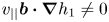 . Then the plateau regime background ion kinetic equation to be solved for $\varepsilon \ll 1$
 is

In addition, the parallel impurity momentum equation to be solved for $\varepsilon \ll 1$ is

Solving in the plateau regime involves subtleties that need to be explained in some detail as the procedure used here differs from that of Landreman et al. (Reference Landreman, Fülöp and Guszejnov2011) as they assume differences in poloidal variation are unimportant by making the replacement ${V_{||z}} \to - (cI/{Z_i}eB{n_i})[\partial {p_i}/\partial \psi + {Z_i}e{n_i}\partial \varPhi /\partial \psi + (y{b^2}{n_i}/2)\partial {T_i}/\partial \psi ] \equiv V_{||i}^{\textrm{plat}}$ . They assume very large ${Z_z}$
 so no $\langle {p_z}\rangle$
 terms enter, and determine y from ambipolarity to recover $V_{||i}^{\textrm{plat}}$
 , which is the usual plateau expression (Hinton & Hazeltine Reference Hinton and Hazeltine1976) for the parallel ion flow when y = 1.
For a plateau regime to exist $\varepsilon \approx r/{R_0} \ll 1$ is required, where ${R_0}$
 is the major radius of the magnetic axis. In addition to $\textrm{d}\theta = \langle \boldsymbol{B}\boldsymbol{\cdot }\boldsymbol{\nabla }\vartheta \rangle \,\textrm{d}\vartheta /\boldsymbol{B}\boldsymbol{\cdot }\boldsymbol{\nabla }\vartheta$
 and $B = {B_0}(1 - \varepsilon \cos \theta + \cdots )$
 , with $B_0^2 = \langle {B^2}\rangle$
 and $\langle \boldsymbol{B}\boldsymbol{\cdot }\boldsymbol{\nabla }\vartheta \rangle \approx {B_0}/q{R_0}$
 , a large aspect ratio form for n,

must be employed in the drive terms ${K_z}\partial (Bn_z^{ - 1})/\partial \theta$ , $(\partial \langle {p_z}\rangle /\partial \psi )\partial {(B{n_z})^{ - 1}}/\partial \theta$
 and $[(\partial /\partial \psi )\alpha \langle {p_z}\rangle \partial (n - 1)/\partial \theta ]$
 of ${V_{||z}}$
 . Here, ${n_c}$
 and ${n_s}$
 are coefficients that will be determined by solving (5.4). Then the plateau regime kinetic equation is written as

where $\theta$ dependence enters only via $\sin \theta$
 and $\cos \theta$
 . In the preceding

and

Even in the ${Z_z} \to \infty$ limit, the poloidal variation of the impurity density matters and enters through the ${K_z}{n_c}$
 and ${K_z}{n_s}$
 terms. In the plateau regime, most ions are collisionless requiring $qR{\nu _{ii}}/{v_i} \ll 1$
 . Nevertheless, collisions must be strong enough that no ions are trapped. The $\xi$
 boundary layer width ${\xi _w}$
 is found by balancing streaming with collisions, ${\xi _w}{v_i}\sim {\nu _{ii}}qR/\xi _w^2$
 , to find the plateau ordering $1 \gg {\xi _w}\sim {({\nu _{ii}}qR/{v_i})^{1/3}} \gg {\varepsilon ^{1/2}}$
 , with ${\varepsilon ^{1/2}}$
 the trapped fraction.
Once the kinetic equation is in the proper form for the plateau regime the details of the collision operator do not matter in most situations. However, to check, the unlike collision operator (3.11) is used for ion–impurity collisions and the following momentum conserving, model ion–ion collisions operator is employed

with ${W_{||i}} = 3{T_i}\int {{\textrm{d}^3}v{v_{||}}{v^{ - 3}}{f_{i1}}} /{M_i}\int {{\textrm{d}^3}v{v^{ - 1}}{f_{i0}}}$ , and, for ${v_{||}} = \xi v$
 ,

Only the diffusive terms matter in the plateau regime, giving

with

Then the plateau kinetic equation in v, $\xi$ variables becomes

where the mirror force term, $\varepsilon \mu {B_0}{v^{ - 1}}\sin \theta \partial {H_1}/\partial \xi \sim \varepsilon v{H_1}/{\xi _w}$ , is negligible compared with $\xi v\partial {H_1}/\partial \vartheta \sim {\xi _w}v{H_1}$
 in the $\xi$
 boundary layer of width ${\xi _w}$
 since $\varepsilon {({v_i}/{\nu _{ii}}qR)^{2/3}} \ll 1$
 .
The flux function ${K_z}$ must be chosen in a manner ensuring ion transport vanishes in the absence of impurities. It is tempting to think of the ion–impurity transport problem as being very much the same as the electron–ion transport problem. Nonetheless, there are important and subtle differences. In particular, impurity collisions cannot modify the ion distribution function when ${n_z} \to 0$
 , while the electron distribution is always modified by the ion collisions (see the Appendix of Pusztai & Catto (Reference Pusztai and Catto2010) for a summary of the electron–ion treatment).
Letting $u = \gamma \xi$ , defining

and noting that the localized solution to ${\partial ^2}h/\partial {u^2} - iuh ={-} 1$ is $h = \int_0^\infty {\textrm{d}x\,{\textrm{e}^{ - {x^3}/3 - iux}}}$
 , the plateau kinetic equation solution is found to be

where all $\xi \mathrm{\ \mathbin{\lower.3ex\hbox{$\buildrel< \over {\smash{\scriptstyle\sim}\vphantom{_x}}$}}\ }\sqrt \varepsilon$ ions are collisional and $\xi \sim 1$
 ions are collisionless. For this solution

implying

while

and

To evaluate the integrals needed here all that is required is

implying the replacement ${C_1}\{ {H_1}\} \to - {\nu _{\textrm{eff}}}{H_1}$ with ${\nu _{\textrm{eff}}}\sim \nu /\xi _w^2$
 can be employed in (5.6).
Only ${H_1}$ terms odd in ${v_{||}}$
 contribute to the friction giving

where

and

where $\partial \varepsilon /\partial \psi \approx 1/R_0^2{B_p} = q/r{R_0}{B_0}$ terms are ignored as unimportant compared with those varying on the radial scale of the pedestal and $\langle {B^{ - 1}}\int {{\textrm{d}^3}v{v^{ - 3}}{v_{||}}{H_1}} \rangle = 0$
 for any plateau regime solution. As a result, the parallel impurity momentum equation to order $\varepsilon$
 for plateau regime background ions is

exactly the same as for banana regime background ions when $\varepsilon \ll 1$ and (5.5) is inserted, implying that (4.16) can be used for both regimes! All D terms are local, except $\partial (n - 1)/\partial \psi$
 . The solution n is also local since it depends on radial first derivatives. However, $\partial (n - 1)/\partial \psi$
 is non-local as it implicitly leads to second derivatives in radius. The full expression for the D terms was not recovered in the Espinosa & Catto (Reference Espinosa and Catto2019) due to a less accurate treatment of the parallel friction; and because their (8) ignores radial derivatives and it is used in their (46) and (50) to obtain (51) (they also order the poloidal variation of the impurity density as stronger than the poloidal variation of B).
6. Approximate solutions for impurity density variation and radial particle transport
The parallel impurity momentum equation can be solved in detail if all radial profiles are accurately known, but as they are often not, it seems wisest to give a useful approximate solution for ${Z_i}/{Z_z}\mathrm{\ \mathbin{\lower.3ex\hbox{$\buildrel< \over {\smash{\scriptstyle\sim}\vphantom{_x}}$}}\ }\varepsilon \ll 1$ . As $G\sim 1\sim K\sim {Z_z}D/{Z_i}$
 , in this limit the lowest order parallel impurity momentum equation is simply

and the solution for both banana and plateau regime background ions is

The clear features of the solution are that the sign of G determines the up–down asymmetry. The in–out asymmetry depends on the sign and size of both K and G, where the sign of the flux surface averaged poloidal flow gives the sign of K,

as $\boldsymbol{\nabla }\vartheta$ and $\boldsymbol{\nabla }\zeta \times \boldsymbol{\nabla }\psi$
 are roughly in the same direction and $\boldsymbol{B}\boldsymbol{\cdot }\boldsymbol{\nabla }\vartheta \approx \langle \boldsymbol{B}\boldsymbol{\cdot }\boldsymbol{\nabla }\vartheta \rangle$
 to lowest order. A solution for n retaining impurity diamagnetic effects when $1 \gg {Z_i}/{Z_z} \gg \varepsilon$
 is given in Appendix A and further illustrates the need for radial profile information.
6.1. Banana regime transport
The large aspect ratio background ion particle flux for banana regime ions colliding with impurities is

as $\langle n{b^{ - 2}}\rangle - 1 = \langle {({b^2} - 1)^2}{b^{ - 2}}\rangle - \langle (n - 1)({b^2} - 1){b^{ - 2}}\rangle \approx (2 + {n_c}){\varepsilon ^2}$ , $\langle n{b^2}\rangle - 1 = \langle (n - 1)({b^2} - 1)\rangle \approx{-} {n_c}{\varepsilon ^2}$
 , $\langle n{b^{ - 2}}\rangle - {\langle n{b^2}\rangle ^{ - 1}} \approx 2{\varepsilon ^2}$
 and $K = G + \langle n{b^2}\rangle U + D \approx G + U$
 . Consequently, the direction of the radial ion particle flux for banana regime background ions depends on the sign of $IG \propto{-} {I^2}(2{T_i}\partial {n_i}/\partial \psi - {n_i}\partial {T_i}/\partial \psi )$
 , while the direction of the poloidal flow is unimportant as only ${K^2}$
 enters to reduce the transport. When IG > 0 or ${\eta _i} = \textrm{d}\ell n{T_i}/\textrm{d}\ell n{n_i}\; < 2$
 (as in H mode) the background ion particle flux is outward, while for IG < 0 or ${\eta _i} = \textrm{d}\ell n{T_i}/\textrm{d}\ell n{n_i}\; > 2$
 (as in I mode) the background ions are transported inward (Churchill et al. Reference Churchill, Theiler, Lipschultz, Hutchinson, Reinke, Whyte, Hughes, Catto, Landreman, Ernst, Chang, Hager, Hubbard, Ennever and Walk2015) and provide natural fuelling. This desirable ${\eta _i} > 2$
 case is sometimes referred to as temperature screening because the radial flux of impurities is outward (Wade, Houlberg & Baylor Reference Wade, Houlberg and Baylor2000).
6.2. Plateau regime transport
The lowest order expression for the friction used to obtain the parallel impurity momentum equation for plateau regime background ions is not good enough to evaluate the particle flux since $\langle {n_z}{\boldsymbol{V}_z}\boldsymbol{\cdot }\boldsymbol{\nabla }\psi \rangle = (cI/{Z_z}e)\langle F_{iz}^{||}/B\rangle = 0$ . As a result, the particle flux for plateau regime ions is negligibly small and ${K_z}$
 must be found from

where

as the poloidal variation of the potential is very weak. Evaluating the integrals by noting only the sin terms even in ${v_{||}}$ contribute, with $\langle {\sin ^2}\theta \rangle = 1/2$
 and ${\textrm{d}^3}v = 2\mathrm{\pi }{v^2}\,\textrm{d}v\,\textrm{d}\xi$
 , yields

where ${\varOmega _0} = {Z_i}e{B_0}/{M_i}c$ . The main ion density and temperature gradient terms give a plateau diffusivity of $qv_i^3/\varOmega _0^2R$
 (which is $M_i^{1/2}/M_e^{1/2} \gg 1$
 larger than the electron particle diffusivity).
Comparing the size of the $\partial {p_i}/\partial \psi$ terms from both ways of evaluating the particle flux and accounting for $\langle F_{iz}^{||}/B\rangle = 0$
 leads to

where electron transport is assumed negligible, $\alpha \mathrm{\ \mathbin{\lower.3ex\hbox{$\buildrel< \over {\smash{\scriptstyle\sim}\vphantom{_x}}$}}\ }1$ and $\sqrt \varepsilon < {\nu _{ii}}qR/\varepsilon {v_i} < 1/\varepsilon$
 in the plateau regime. The preceding estimate indicates the need to use $\langle \int {{\textrm{d}^3}v{H_1}{\boldsymbol{v}_d}\boldsymbol{\cdot }\boldsymbol{\nabla }\psi } \rangle$
 to evaluate ${K_z}$
 .
Based on the preceding estimates and the need to maintain ambipolarity between the ions and the impurities, the radial ion particle transport must vanish to lowest order

thereby determining ${K_z}$ to be given by

Again, friction seems to be acting reduce the neoclassical particle flux.
Ignoring poloidally varying terms, the preceding inserted in (3.28) leads to the lowest order relation between the parallel impurity and background ion flows

where $V_{||i}^{\textrm{plat}}$ is the usual plateau expression for the parallel ion flow (Hinton & Hazeltine Reference Hinton and Hazeltine1976). All the poloidally varying terms can be evaluated by using ${n_i}{V_{||i}} = \int {{\textrm{d}^3}v{v_{||}}{f_{i1}}}$
 to obtain the full relation between the parallel ion and impurity flows in the plateau regime

but as there are many terms and they are small in $\varepsilon$ they are not given here. These terms account for the difference between the results here and Landreman et al. (Reference Landreman, Fülöp and Guszejnov2011) for ${Z_z} \to \infty$
 .
Using the preceding expression for ${V_{||z}}$ gives a consistency check on the lowest order plateau regime poloidal impurity flow to be

On Alcator C-Mod a positive poloidal flow, K > 0, is typically observed when I > 0 (Theiler et al. Reference Theiler, Churchill, Lipschultz, Landreman, Ernst, Hughes, Catto, Parra, Hutchinson, Reinke, Hubbard, Marmar, Terry and Walk2014). In AUG when I < 0, a negative poloidal flow, K < 0, occurs (Viezzer et al. Reference Viezzer, Pütterich, Conway, Dux, Happel, Fuchs, Mcdermott, Ryter, Sieglin, Suttrop, Willensdorfer and Wolfrum2013a; Cruz-Zabala et al. Reference Cruz-Zabala, Viezzer, Plank, Mcdermott, Cavedon, Fable, Dux, Cano-Megias, Pütterich, Jansen van Vuuren, Garcia-Munoz and Garcia Lopez2022).
The plateau solution in Landreman et al. (Reference Landreman, Fülöp and Guszejnov2011) is sensibly formulated to recover the standard result without impurities, but to do so it assumes ${K_z}/{n_z} ={-} y(cI/2{Z_i}e\langle {B^2}\rangle )\partial {T_i}/\partial \psi$ in ${V_{||z}}$
 with the parameter y determined by ambipolarity. Their procedure replaces ${V_{||z}}$
 by ${V_{||i}}$
 in ${f_{i1}}$
 so does not properly account for various poloidally varying drive terms in ${C_{iz}}\{ ({V_{||z}} - {V_{||i}}){v_{||}}{f_{i0}}\} \ne 0$
 , and thereby misses impurity density drive terms such as ${K_z}\partial (Bn_z^{ - 1})/\partial \theta$
 which require writing $n = 1 + \varepsilon ({n_c}\cos \theta + {n_s}\sin \theta )$
 . Moreover, like all plateau regime treatments, Landreman et al. (Reference Landreman, Fülöp and Guszejnov2011) should only find ${H_1}$
 to lowest order in $\varepsilon$
 and be unable to evaluate the radial flux from the friction as $\langle F_{iz}^{||}/B\rangle = 0$
 .
7. Diffusion and convection form of impurity continuity
To cast the impurity continuity equation into the popular diffusion and convection form

for banana regime background ions and trace impurities, the small term D must be retained in (4.18) by making the replacement $G \to G - D$ , as suggested by (4.12) and (6.7). Of course, the orderings used here imply the particle diffusivity term ${D_z}$
 is less important than the radial convection velocity ${V_z}$
 . Using ambipolarity gives the impurity flux as $\langle {n_z}{\boldsymbol{V}_z}\boldsymbol{\cdot }\boldsymbol{\nabla }\psi \rangle ={-} {Z_i}\langle {n_i}{\boldsymbol{V}_i}\boldsymbol{\cdot }\boldsymbol{\nabla }\psi \rangle /{Z_z} \approx{-} R{B_p}({D_z}\partial \langle {n_z}\rangle /\partial r - {V_z}\langle {n_z}\rangle )$
 , upon using the large aspect ratio approximation $R{B_p}\partial /\partial \psi \approx \partial /\partial r$
 for $|\boldsymbol{\nabla }\psi |= R{B_p}$
 . Then (6.4) leads to

and

where the diffusivity and the first term in $R{V_z}/{D_z}$ are small by ${Z_i}/{Z_z}$
 . In the diffusion and convection form the outward diffusion $(\partial \langle {n_z}\rangle /\partial r < 0)$
 can be counteracted by a pinch $({V_z} < 0)$
 . Notice that the convection velocity changes sign at ${\eta _i} = 2$
 , with a pinch $({V_z} < 0)$
 for ${\eta _i} < 2$
 , and ${V_z} > 0$
 (outward) if ${\eta _i} > 2$
 . The direction of the poloidal flow is unimportant as only ${K^2}$
 enters.
In the plateau regime the vanishing of the radial impurity diffusion determines the unknown flux function ${K_z}$ , making the poloidal flow positive (K > 0). In this case it is not possible to write a diffusion–convection form of impurity continuity.
The treatment here and in Helander (Reference Helander1998) assumes that in the banana regime the time for the impurities to diffuse across the magnetic field, $L_ \bot ^2/{D_z}$ , is large compared with the time for the impurities to equilibrate along the magnetic field, ${q^2}{R^2}{\nu _{zz}}/v_z^2$
 . The ratio yields a restriction

consistent with allowing G ∼ 1 as assumed, and slightly more forgiving than the inequality of Helander (Reference Helander1998) who uses ${\varepsilon ^2}\sim 1$ . However, radial impurity convection is ${Z_z}/{Z_i}$
 faster than diffusion, making the restriction more severe by requiring$\; {G^2}{\varepsilon ^2}\alpha \ll {({Z_z}/{Z_i})^{1/2}}$
 . In the plateau regime the time for the impurities to diffuse across the field is very long as the radial transport is negligible, so the impurities are more easily able to equilibrate along the magnetic field.
8. Summary of results
The pedestal model considered herein assumes the poloidal ion gyroradius is small compared with the radial pedestal scale lengths. Within this important limitation (Trinczek et al. Reference Trinczek, Parra, Catto, Calvo and Landreman2023), a pedestal treatment is formulated and solved that evaluates the poloidal variation of the impurity density and electrostatic potential as related by (3.17). In addition, the radial transport of the background ions and impurities in both the banana and plateau regimes is evaluated with the impurity diamagnetic pressure term retained. Weak poloidal variation in the plasma density, (3.12) and (3.16), is also retained, but any poloidal variation of the equal ion and impurity temperatures is neglected. At large aspect ratio, when the subtleties of the plateau treatment are taken into account, the parallel impurity momentum equation, (5.24), is shown to be the same as in the banana regime. When the impurity diamagnetic terms are negligible, the banana regime treatment reduces to the original treatment of Helander (Reference Helander1998), with a gradient drive term and a second drive term that requires solving the perturbed ion kinetic equation, (4.1), and it also recovers the formulation of Espinosa & Catto (Reference Espinosa and Catto2017a,Reference Espinosa and Cattob, Reference Espinosa and Catto2018), for which the drives are the gradient term (4.8) and a poloidal flow term, (4.10), a term that can be measured by CXRS (McDermott et al. Reference Mcdermott, Lipschultz, Hughes, Catto, Hubbard, Hutchinson, Granetz, Greenwald, Labombard, Marr, Reinke, Rice and Whyte2009; Viezzer et al. Reference Viezzer, Pütterich, Conway, Dux, Happel, Fuchs, Mcdermott, Ryter, Sieglin, Suttrop, Willensdorfer and Wolfrum2013a,Reference Viezzer, Pütterich, Fable, Bergmann, Dux, Mcdermott, Churchill and Dunneb; Theiler et al. Reference Theiler, Churchill, Lipschultz, Landreman, Ernst, Hughes, Catto, Parra, Hutchinson, Reinke, Hubbard, Marmar, Terry and Walk2014; Cruz-Zabala et al. Reference Cruz-Zabala, Viezzer, Plank, Mcdermott, Cavedon, Fable, Dux, Cano-Megias, Pütterich, Jansen van Vuuren, Garcia-Munoz and Garcia Lopez2022).
The new impurity pressure gradient drive terms have the coefficient defined by (4.9) and also account for the non-local behaviour due to drift departures from flux surfaces due to the poloidal variation of the impurity density. All the impurity pressure gradient effects are obtained by assuming the aspect ratio is large – an assumption that need not be made for the other terms in the banana regime, but of course, must always be made in the plateau regime. The impurity pressure gradient terms provide an additional source of poloidal impurity density variation as can be seen by examining (4.16) and (5.24). However, because ${Z_i}/{Z_z} \ll 1$ they do not significantly alter the radial transport and poloidal flow in the plateau regime or the large aspect ratio limit of the banana regime. The plateau regime results found here remove limitations of an earlier treatment (Landreman et al. Reference Landreman, Fülöp and Guszejnov2011). Even with the inadequacies of the derivations herein, the neoclassical results derived for the particle transport and flows suggest useful means of checking them against experimental measurements even when the poloidal variation of the impurity density is not allowed to be strong. In the banana regime, when the gradient coefficient G and the poloidal flow coefficient K are order unity or larger, large poloidal impurity variation occurs for realistic magnetic fields, but only a large G and K solution is presented here. No attempt is made here to explain heat fluxes as they are expected to be a combination of neoclassical and $\boldsymbol{E} \times \boldsymbol{B}$
 shear regulated turbulent processes (Viezzer et al. Reference Viezzer, Fable, Cavedon, Angioni, Dux, Laggner, Bernert, Burckhart, Mcdermott, Püterich, Ryter, Willensdorfer and Wolfrum2017, Reference Viezzer, Cavedon, Fable, Laggner, Mcdermott, Galdon-Quiroga, Dunne, Kappatou, Angioni, Cano-Megias, Cruz-Zabala, Dux, Püterich, Ryter and Wolfrum2018). In addition, the collisional Pfirsch–Schlüter regime for the main ions is not considered as it requires ${\rho _{ip}}/{L_ \bot } \ll {v_i}/qR{\nu _{ii}} \ll 1$
 , leading to different results (Fülöp & Helander Reference Fülöp and Helander2001; Maget et al. Reference Maget, Frank, Nicolas, Agullo, Garbet and Lütjens2020a,Reference Maget, Manas, Frank, Nicolas, Agullo and Garbetb). Some C-Mod H mode plasmas may be collisional enough to enter the Pfirsch–Schlüter regime (Theiler et al. Reference Theiler, Churchill, Lipschultz, Landreman, Ernst, Hughes, Catto, Parra, Hutchinson, Reinke, Hubbard, Marmar, Terry and Walk2014).
The signs of $I = R{B_t}$ , G (the gradient drive term) and K (the poloidal flow drive term) vary depending on geometry and operation mode. Consequently, some notable results are summarized in Table 1 for the two directions of the toroidal magnetic field relative to the Ohmic current: aligned (co) and opposed (counter). The entries are largely based on (6.2), (6.3), (6.4), (6.9) and (6.13). Additional information follows from the general banana regime solution of Fülöp & Helander (Reference Fülöp and Helander1999) in the trace limit, for which

with $J \approx 1 - 1.46\sqrt \varepsilon$ . A brief derivation of the trace limit is presented in Appendix B. Based on this $\alpha \ll 1$
 limit, U/I > 0 for a normal negative temperature gradient. Consequently, using the lowest order solubility constraint K = G + U, in the H mode limit the poloidal flow is expected to be in the direction of the poloidal magnetic field for $I = R{B_t} > 0$
 , and opposite to the poloidal magnetic field for $I = R{B_t} < 0$
 . In the I mode limit measurements in C-Mod (Theiler et al. Reference Theiler, Churchill, Lipschultz, Landreman, Ernst, Hughes, Catto, Parra, Hutchinson, Reinke, Hubbard, Marmar, Terry and Walk2014) and AUG (Viezzer et al. Reference Viezzer, Pütterich, Conway, Dux, Happel, Fuchs, Mcdermott, Ryter, Sieglin, Suttrop, Willensdorfer and Wolfrum2013a) normally find ${V_p}{B_t} > 0$
 (that is, KI > 0), except perhaps near the last closed flux surface, leading to co ${\boldsymbol{B}_p}$
 flow for ${B_t} > \; 0$
 and counter ${\boldsymbol{B}_p}$
 for ${B_t} < \; 0$
 . In making Table 1, the stronger density gradient limit $({\eta _i} < 2)$
 is presumed to be H mode, while the weaker density gradient or temperature screening limit $({\eta _i} > 2)$
 is assumed to be I mode (the weakest gradient limit is expected to be L mode and is not listed as the poloidal variation is very weak as G and K are thought to be very small). The table is based on the results presented here except for the experimental observation that the poloidal flow term in I mode makes a negative radial electric field contribution. It indicates in–out impurity accumulation is a key difference between H and I mode pedestals, while the sign of the toroidal magnetic field and the poloidal impurity flow are the same (KI > 0).
Co ${\boldsymbol{B}_t}$ denotes ${\boldsymbol{B}_t} = I\boldsymbol{\nabla }\zeta$
 is in the direction of the Ohmic current, while counter ${\boldsymbol{B}_t}$
 is in the opposite direction. H mode plasmas are assumed to have ${\eta _i} \equiv \textrm{d}\ell n{T_i}/\textrm{d}\ell n{n_i}\; < 2\;$
 , while I mode plasmas are assumed to satisfy ${\eta _i} \equiv \textrm{d}\ell n{T_i}/\textrm{d}\ell n{n_i}\; > 2$
 . High and low field sides are denoted by HFS and LFS, respectively. Equation (6.2) is used to determine in–out and up–down asymmetries. L mode plasmas do not have significant poloidal variation or flow so do not have an appreciable radial electric field in the pedestal. Notice the signs of the toroidal magnetic field direction I and the poloidal impurity flow K are expected to be the same based on the theory presented here and the I mode experimental observation that ${V_p}{B_t} > 0$
 in (3.4) to make ${E_r} < 0$
 .

The simplest, large aspect ratio results obtained here can be qualitatively compared with experimental results. General aspect ratio results can be obtained from (4.20) and (4.21) for $\textrm{|}G\textrm{|} \gg 1$ , where normally g = G/K > 0 in H mode and G/K < 0 is expected in I mode. In particular, Alcator C-Mod with $I = R{B_t} > 0$
 measures a positive poloidal flow (K > 0) as well as a negative radial impurity pressure gradient (D > 0) in H and I mode (Theiler et al. Reference Theiler, Churchill, Lipschultz, Landreman, Ernst, Hughes, Catto, Parra, Hutchinson, Reinke, Hubbard, Marmar, Terry and Walk2014).
In H mode at Alcator C-Mod, the HFS impurity density is found to be larger than the LFS impurity density (Churchill et al. Reference Churchill, Lipschultz and Theiler2013, Reference Churchill, Theiler, Lipschultz, Hutchinson, Reinke, Whyte, Hughes, Catto, Landreman, Ernst, Chang, Hager, Hubbard, Ennever and Walk2015) as expected. And from (3.17), the poloidal electric field becomes more negative on the LFS as the impurity density increases on the HFS. The model considered here is consistent with impurity temperature alignment since ${T_i} = {T_z} = \langle {T_z}\rangle$ . And it is also consistent with total pressure, ${p_e} + {p_i}$
 , alignment. To see this, flux surface averaged quasineutrality, $\langle {n_e}\rangle = {Z_i}\langle {n_i}\rangle$
 , is used to find ${p_e} + {p_i} = {n_e}{T_e} + {n_i}{T_i} = \langle {n_e}\rangle [{T_e} + e(\varPhi - \langle \varPhi \rangle )] + {n_i}[{T_i} - {Z_i}e(\varPhi - \langle \varPhi \rangle )] = \langle {n_i}\rangle ({Z_i}{T_e} + {T_i})$
 , where ${T_e}$
 and ${T_i}$
 are flux functions. Interestingly, the impurity temperature alignment gives a nice match of profiles, possibly indicating that ion pressure anisotropy is spoiling total pressure alignment. However, the radial relation between $\varPhi - \langle \varPhi \rangle$
 and ${n_z} - \langle {n_z}\rangle$
 must also satisfy (3.17), and it is not apparent which alignment is better. Also, the poloidal variations are stronger than the large aspect ratio expansions often used here allow, and there may be some poloidal variation in the impurity temperature.
The poloidal variations in AUG are weaker than in C-Mod. Also, in AUG when $I = R{B_t} < 0$ and the poloidal flow is negative in H (as expected) and I modes (Viezzer et al. Reference Viezzer, Pütterich, Conway, Dux, Happel, Fuchs, Mcdermott, Ryter, Sieglin, Suttrop, Willensdorfer and Wolfrum2013a). In H mode at AUG, the impurity accumulation is on the HFS (Cruz-Zabala et al. Reference Cruz-Zabala, Viezzer, Plank, Mcdermott, Cavedon, Fable, Dux, Cano-Megias, Pütterich, Jansen van Vuuren, Garcia-Munoz and Garcia Lopez2022) as anticipated. Impurity density variation is weak in I mode (Churchill et al. Reference Churchill, Theiler, Lipschultz, Hutchinson, Reinke, Whyte, Hughes, Catto, Landreman, Ernst, Chang, Hager, Hubbard, Ennever and Walk2015; Cruz-Zabala et al. Reference Cruz-Zabala, Viezzer, Plank, Mcdermott, Cavedon, Fable, Dux, Cano-Megias, Pütterich, Jansen van Vuuren, Garcia-Munoz and Garcia Lopez2022), with possibly some LFS accumulation in C-Mod. Neither the radial electric field nor the electrostatic potential is a flux function based on (3.4). Moreover, the poloidal variation of the impurity density may be responsible for some of the poloidal variation of the poloidal impurity flow since ${n_z}{\boldsymbol{V}_z}\boldsymbol{\cdot }\boldsymbol{\nabla }\vartheta /\boldsymbol{B}\boldsymbol{\cdot }\boldsymbol{\nabla }\vartheta = {L_z}(\psi ,\vartheta )$
 is not a flux function because of impurity pressure gradient terms (3.26). Then, perhaps, the assumption that the impurity flow in the pedestal is in a flux surface (Marr et al. Reference Marr, Lipschultz, Catto, Mcdermott, Reinke and Simakov2010) is inadequate and the poloidally varying radial impurity flow, ${n_z}{\boldsymbol{V}_z}\boldsymbol{\cdot }\boldsymbol{\nabla }\psi ={-} \varUpsilon \boldsymbol{B}\boldsymbol{\cdot }\boldsymbol{\nabla }\vartheta$
 , is playing a role.
Finally, the large aspect ratio results reported here predict the up-down asymmetries in the impurity accumulation, but of course are unable to treat X-points and divertors as well as strong poloidal variation. Normally the direction of the up–down asymmetry in core L mode plasmas reverses when the toroidal magnetic field reverses to change the direction of $\boldsymbol{B} \times \boldsymbol{\nabla }B$ (Terry et al. Reference Terry, Marmar, Chen and Moos1977; Brau, Suckewer & Wong Reference Brau, Suckewer and Wong1983; Durst Reference Durst1992; Rice et al. Reference Rice, Terry, Marmar and Bombarda1997). Usually, the impurity accumulation is opposite to the $\boldsymbol{B} \times \boldsymbol{\nabla }B$
 direction (Brau et al. Reference Brau, Suckewer and Wong1983; Rice et al. Reference Rice, Terry, Marmar and Bombarda1997) and does not depend on the X-point location (Rice et al. Reference Rice, Terry, Marmar and Bombarda1997). Additional and more relevant H mode (nominally ${\eta _i} < 2$
 ) pedestal impurity asymmetry observations (Pedersen et al. Reference Pedersen, Granetz, Marmar, Mossessian, Hughes, Hutchinson, Terry and Rice2002) may be broadly in agreement with Helander (Reference Helander1998) and Fülöp & Helander (Reference Fülöp and Helander1999, Reference Fülöp and Helander2001) except for having asymmetries larger than predicted, occurring in pedestals with widths possibly comparable to the poloidal ion gyroradius, and perhaps not satisfying (7.4). Pedersen et al. (Reference Pedersen, Granetz, Marmar, Mossessian, Hughes, Hutchinson, Terry and Rice2002) also noted that observed pedestal location differences seemed consistent with a pinch velocity, possibly as expected from (7.3). Based on the simple model considered here, the $\boldsymbol{B} \times \boldsymbol{\nabla }B$
 drift is away from (toward) impurity accumulation in H mode (I mode) operation, while based on experimental observations in single null operation (Whyte et al. Reference Whyte2010; Ryter et al. Reference Ryter, Fischer, Fuchs, Happel, Mcdermott, Viezzer, Wolfrum, Barrera Orte, Bernert, Burckhart, da Graça, Kurzan, Mccarthy, Pütterich, Suttrop and Willensdorfer2017) the $\boldsymbol{B} \times \boldsymbol{\nabla }B$
 drift toward (away from) the X point is favourable for H mode (I mode). Consequently, H mode operation results in impurity accumulation away from the X point for favourable $\boldsymbol{B} \times \boldsymbol{\nabla }B$
 drift toward the X point operation. However, I mode favours accumulation toward and $\boldsymbol{B} \times \boldsymbol{\nabla }B$
 drift away from the X point.
Acknowledgements
P.J.C. is grateful to S. Espinosa for re-awakening his interest in the behaviour of impurities in the pedestal. The authors thank the J.P.P. reviewers for their suggestions and comments that noticeably improved the manuscript. The United States Government retains a non-exclusive, paid-up, irrevocable, worldwide license to publish or reproduce the published form of this manuscript, or allow others to do so, for United States Government purposes.
Editor Tünde Fülöp thanks the referees for their advice in evaluating this article.
Declaration of interests
The authors report no conflict of interest.
Funding
This work was supported by the U.S. Department of Energy under contract numbers DE-FG02-91ER-54109, DE-SC0006419, DE-SC0014264, and DE-SC0017381.
Appendix A. A slightly more general solution for n
The parallel impurity momentum equation (5.24) can be solved in more detail for $1 \gg {Z_i}/{Z_z} \gg \varepsilon$ if the radial profiles are accurately known, but as they are not, perhaps it is useful to give an approximate solution to further illustrate the profile complications. Inserting n and using the exponential fits

and

leads to

and

The solution for C and S constants is then

In this form the D terms are small. They give ${Z_i}/{Z_z} \ll 1$ corrections to G ∼ 1 ∼ K that are assumed to be more important than the higher-order $\varepsilon$
 corrections that are ignored. Radial profile information is needed for the D, C and S terms as well as in G, but as the D corrections are small these terms are of limited interest other than to illustrate how non-local effects due to impurity drift departures from a flux surface enter via $\partial (\alpha {n_c})/\partial \psi$
 and $\partial (\alpha {n_s})/\partial \psi$
 .
Appendix B. A solution for u in the trace limit of the banana regime
Keeping only ion–ion collisions the passing banana solubility constraint becomes

where $\partial {h_1}/\partial \vartheta = 0$ and ${C_{ii}}\{ {v_{||}}{f_{i0}}\} = 0$
 in the linearized collision operator ${C_{ii}}$
 . For the trapped ${h_1} = 0$
 as the average of the drive term over a full bounce vanishes since it is odd in ${v_{||}}$
 . For $\varepsilon \ll 1$
 the Kovrizhnikh model like particle collision operator (see Appendix A of Rosenbluth, Hazeltine & Hinton Reference Rosenbluth, Hazeltine and Hinton1972)

with $x = v\sqrt {{M_i}/2{T_i}}$ , ${W_{||i}} = 3{T_i}\int {{\textrm{d}^3}vS{v_{||}}{v^{ - 3}}{f_{i1}}} /{M_i}\int {{\textrm{d}^3}vS{v^{ - 1}}{f_{i0}}}$
 , $\textrm{Erf}(x) = 2{\mathrm{\pi }^{ - 1/2}}\int_0^x {\textrm{d}t\,{\textrm{e}^{ - {t^2}}}}$
 , $\rm{Erf^{\prime}}(x) = (2/\sqrt {\rm \pi} )\,{\textrm{e}^{ - {x^2}}}$
 and

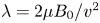
has been found to give reasonably accurate results for ε $\ll $ 1. Using $\lambda = 2\mu {B_0}/{v^2}$
 ,

leading to

with

needed to conserve momentum since ${C_{ii}}\{ {v_{||}}{f_{i0}}\} = 0,$ and where

with S = 1 giving $[\kern-0.15em[ 1 ]\kern-0.15em] = 1$ . Integrating from $\lambda = 0$
 to $\lambda$
 , and using $v_{||}^2 = {v^2}(1 - \lambda B/{B_0})$
 to find $2{v_{||}}\partial {v_{||}}/\partial \lambda ={-} {v^2}B/{B_0}$
 , leads to the passing response

where ${\varOmega _0} = {Z_i}e{B_0}/{M_i}c$ . The ion–impurity friction and ${W_{||i}}$
 require evaluating slightly different integrals because of S. Retaining S, but noting that it is sometimes convenient to let $S \to 1$
 to recover results for (5.9), and using ${\textrm{d}^3}v = \textrm{d}v\,\textrm{d}\lambda \,\textrm{d}\phi {v^3}B/{B_0}{v_{||}}$
 , gives (upon summing over both signs of ${v_{||}}$
 )

with ${h_1} = 0$ at the trapped–passing boundary. Defining the effective passing fraction as

the preceding becomes

Therefore, (B6) yields

or since $J \ne 1$

As a result, the trace limit of (4.5) becomes

since

where $[\kern-0.15em[ S ]\kern-0.15em] - 1 = \{ {\nu _{ii}}({x^2} - 1)\} /\{ {\nu _{ii}}\} \approx 0.33$ in the notation of Fülöp & Helander (Reference Fülöp and Helander1999), and u/I > 0. Therefore, the constraint $K \approx G + U$
 for I > 0 and G > 0 suggests K > 0, while for I < 0 and G < 0 it implies K < 0 (for IG < 0 the sign of K cannot be predicted). Interestingly, for S = 1, u = 0 = U, and $K \approx G$
 .
In addition, since$\int {{\textrm{d}^3}v{f_{i0}}{v^2}} ({M_i}{v^2}/2{T_i} - 5/2) = 0$

and

Then the parallel ion flow reduces to

where $(\; 5/2 - [\kern-0.15em[ S ]\kern-0.15em] ) = 3/2 - 0.33 = 1.17$ , as desired (Hinton & Hazeltine Reference Hinton and Hazeltine1976).



