Introduction
Seed dispersal and germination are critical periods of a plant's life cycle (Harper, Reference Harper1977; Swaine, Reference Swaine1996). The timing of seed dispersal and germination plays a key role, not only in individual plant fitness but also in plant population dynamics, which may ultimately affect floristic diversity (Baskin and Baskin, Reference Baskin and Baskin1998; Fenner and Thompson, Reference Fenner and Thompson2005). In temporally and spatially variable natural environments, unfavourable conditions for germination may occur unpredictably (Venable and Brown, 1988). Species therefore have evolved different strategies to offset these fluctuations in habitat suitability (Fenner and Thompson, Reference Fenner and Thompson2005). Tropical tree seeds exhibit a variety of dispersal and dormancy characteristics. The timing of dispersal is often the way by which species synchronize germination timing with favourable conditions for seedling establishment (Frankie et al., Reference Frankie, Baker and Opler1974). Dormancy is a strategic alternative to dispersal (Harper, Reference Harper1977), regulating the timing of germination in the field (Baskin and Baskin, Reference Baskin and Baskin1998; Fenner and Thompson, Reference Fenner and Thompson2005). Species also exhibit different germination characteristics or syndromes (Angevine and Chabot, Reference Angevine, Chabot, Solbrig, Jain, Johnson and Raven1979; Salazar et al., Reference Salazar, Goldstein, Franco and Miralles-Wilhelm2011; Silveira et al., Reference Silveira, Rafaella, Denise, Fernandes and Lemos-Filho2012); for example, tropical forest plants display a wide array of germination strategies, some species germinate just after dispersal or may even germinate before dispersal, whereas other species can stay in the soil seed bank for several years before germination occurs (Garwood, Reference Garwood1983; Vázquez-Yañez and Orozco-Segovia, Reference Vázquez-Yañes and Orozco-Segovia1993).
Species exhibit considerable variation in germination time. It is selectively advantageous to maintain high variability in this trait (Vázquez-Yañez and Orozco-Segovia, Reference Vázquez-Yañes and Orozco-Segovia1993; Baskin and Baskin, Reference Baskin and Baskin1998; Norden et al., Reference Norden, Daws, Mailyn, Gonzalez, Garwood and Chave2009). Rapid germination may allow seedlings to grow larger (Black and Wilkinson, Reference Black and Wilkinson1963), and maintain competitive dominance over seedlings from seeds that germinate later (Ross and Harper, Reference Ross and Harper1972). On the other hand, fast-germinating species may result in the entire seedling cohort suffering from high mortality in unpredictable environments. In this case natural selection may favour slow germination (Daws et al., Reference Daws, Ballard, Mullins, Garwood, Murray, Pearson and Burslem2007).
Seed germination among species is not only related to environmental factors, such as temperature, rainfall, light and altitude (Baskin and Baskin, Reference Baskin and Baskin1998; Kyereh et al., Reference Kyereh, Swaine and Thompson1999; Gutterman, Reference Gutterman2000), but also to life-history attributes, such as seed mass (Garwood, Reference Garwood1983; Leishman et al., Reference Leishman, Wright, Moles, Westoby and Fenner2000), dispersal strategy (Willson and Traveset, Reference Willson, Traveset and Fenner2000) and phylogeny (Figueroa, Reference Figueroa2003; Bu et al., Reference Bu, Du, Chen, Xu, Liu and Wen2008; Wang et al., Reference Wang, Baskin, Cui and Du2009). Therefore, to assess the role of natural selection on seed germination at the community level, it is necessary to take into account phylogeny and various biological and ecological factors when measuring the effect of any single variable.
The montane region of Hainan Island, China, with its high species richness, represents a key biodiversity hotspot (Jiang and Lu, Reference Jiang and Lu1991; Li, Reference Li, Li, Chen and Zhou2002). Demands for reforestation and restoration of Hainan Island are increasing following extensive deforestation and long-term intensive agricultural land use (Jiang and Lu, Reference Jiang and Lu1991; Li, Reference Li, Li, Chen and Zhou2002). Propagation of native Hainan species from seeds is important in the conservation of rare species and in production of plants needed for restoration projects. However, studies on seed traits, especially seed mass, germination and dormancy of native species in Hainan Island of China are limited so far. This study, at a regional scale, presents information about various aspects of the whole-seed biology of 66 tree species native to the Hainan Island, China. Given the wide variation in seed traits among these species, we tested differences in seed mass and germination patterns among different fruit types and species with different germination syndromes. The objective was also to determine to what extent dispersal and dormancy characteristics of seeds of various species fit into the overall strategy of survival in this biome, and to assess whether differences in seed germination among species from the same community are related to phylogeny, dispersal mode and dispersal season.
Materials and methods
Study site
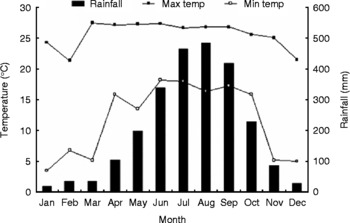
Our study was carried out in the tropical rainforest of Jianfengling National Natural Reserve (636.84 km2 area; 18°20′–18°57′N, 108°41′–109°12′E), located to the south-west of Hainan Island, China. The tropical evergreen monsoon forest occurs at 300–700 m altitude. The soil type of this region is latosol, the mean annual temperature and annual rainfall are 22°C and 2000 mm, respectively (Fig. 1). Rainy and dry seasons are clearly demarcated, with the dry season occurring from December to April and the rainy season from May to October. The vegetation is dominated by species of Dipterocarpaceae (Hopea hainanensis and Vatica mangachapoi), Lauraceae, Euphorbiaceae, Annonceae and Myrtaceae (Jiang and Lu, Reference Jiang and Lu1991; Li, Reference Li, Li, Chen and Zhou2002).
Monthly rainfall and temperature in the seasonal evergreen monsoon forest of Hainan Island, China.

Seed dispersal, maturation and germination
Seeds of 66 endemic species, belonging to 29 families and 49 genera, were collected from 1–5 parent trees when fruits were mature and ripe, between December 2006 and December 2007. All species were selected because of their commercial and ecological importance, as well as availability of mature seeds during the period of the experiment. All species are planted in, or considered feasible for, restoration and timber species plantations within the tropical rainforest of Hainan Island, China (Zhou, Reference Zhou2000).
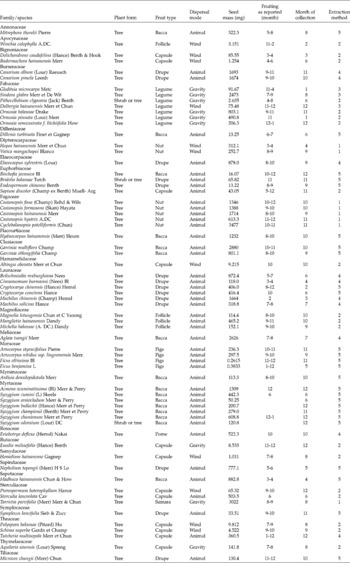
Fruits were cut from branches or collected from the ground only if they were ‘fresh’ and not decayed. Species (as reported by Chun, Reference Chun1964, Reference Chun1965; Guangdong Institute of Botany, 1974), their life-form, family, seed mass, maturation time, possible mode of dispersal and extraction method from fruits were recorded. The seed extraction method, depending on the type of fruit, followed the protocol of Thapliyal and Phartyal (Reference Thapliyal and Phartyal2005): (1) a single/double/multiple indehiscent fruit, described as ‘seed’ in the functional sense, required only drying; (2) dry fruits were split open, followed by drying in the sun (30–35°C) for 2 d and seeds were then extracted by shaking, tumbling, flowing, threshing, etc.; (3) the seeds from dry indehiscent fruits were extracted by rubbing them dry on a wire-net cloth and gently pounding with wooden clubs or hammering; (4) fleshy fruits, sometimes with bony endocarp, burst open or required extraction methods as above; (5) seeds from pulpy fruits were extracted by heaping the fruits in shade or by soaking to make the pulp soft and then macerating by hand or on a tray on wire-net cloth with constant washing in running tap water.
Following extraction and cleaning, seeds were dried in the laboratory under a fan or in the sun. Usually seeds derived from fruits that dry as they mature were dried in the sun, while those from fruits that are pulpy at maturity were dried in the shade.
Four replicates of 100 seeds were sown on sand in plastic trays under 50% of full sunlight. Large seeds were pushed into the sand for one-half of their diameter. Small seeds were covered by 1–3 mm of sand, if seeds were uncovered after watering they were covered with sand again. Due to shortage of seeds from Acmena acuminatissima, Calophyllum inophyllum, Quercus patelliformis, Sindora glabra and Drypetes perreticulata, we sowed four replicates of 50 seeds. Conditions in the nursery were similar to those of the natural environment. Average monthly rainfall and temperature (outdoor) data for the past 25 years in the study area, recorded by the Jianfengling Experimental Station (Research Institute of Tropical Forestry, Chinese Academy of Forestry), are presented in Fig. 1.
Germination was defined as emergence of any part of the shoot, since roots were buried in the sand, and was monitored every day, based upon interspecific differences until 1 month without any germination. The days to first germination and last germination of each species were recorded. The median length of germination time (the median value of all the times to germination, MLG) and the mean length of germination time (the mean value of all the times to germination, mean LG) were calculated (pooling individuals of each species from the four replicate batches) from the germination times of all seeds that germinated. Median lengths of germination time (MLG) for all the seeds that germinated were calculated as measures of dormancy. Seeds with a MLG ≤ 30 d were considered to be non-dormant, while those with MLG>30 d were considered to be dormant (Baskin and Baskin, Reference Baskin and Baskin2004).
For the purposes of nursery production, germination was defined as rapid if the MLG was ≤ 21 d, and slow if the MLG was ≥ 84 d. For tree production in the nursery, germination was defined as synchronous if all seedlings of a given species emerged within 21 d, and highly asynchronous if this occurred over a period of more than 84 d (Blakesley et al., Reference Blakesley, Elliot, Kuarak, Navakitbumrung, Zangkum and Anunsarnsunthorn2002).
Following Blakesley et al. (Reference Blakesley, Elliot, Kuarak, Navakitbumrung, Zangkum and Anunsarnsunthorn2002), we calculated the month of peak germination for each species, taking into consideration month of collection and MLG. For example, seeds collected in November with an MLG of 62 d will have a peak of germination in January. Then we plotted the number of species that had their peak of germination for each month.
Statistical analyses
One-way ANOVAs were used to determine the effects of phylogeny, dispersal mode and dispersal season on germination percentage, days to first germination, MLG, mean LG and days to last germination.
(1) Phylogenetic group: to evaluate phylogenetic effect on germination, each of the 65 angiosperm species was assigned to an Order according to Angiosperm Phylogeny Group III (2009): Ericales, Fabales, Fagales, Gentianales, Gunnerales, Lamiales, Laurales, Magnoliales, Malpighiales, Malvales, Myrtales, Oxalidales, Rosales, Sapindales, Saxifragales.
(2) Dispersal mode: each species was assigned to a dispersal category – anemochorous seeds with wings, hairs or a pappus; autochorous seeds having no obvious morphological structure for dispersal; zoochorous seeds with an aril or flesh.
(3) Dispersal season: according to rainfall and temperature (Fig. 1), dispersal mode was assigned to a dispersal season category – March–May, June–September, October–November, December–February.
Pearson correlation analysis was used to determine the correlation between all variables for germination studies. Data of germination were checked for normality and homogeneity of variances, and were log-transformed when necessary to correct deviations from these assumptions. All statistical methods were performed using SPPS Base 15 for Windows (SPSS, Inc., Chicago, Illinois, USA).
Results
Pattern of seed dispersal syndromes
Overall, berries (16 species), drupes (14 species) and capsules (12 species) were common and represented about 64% of the species, followed by legumes (7 species), nuts (7 species), figs (4 species) and follicles (4 species). Pomes and samaras were represented by only one species each. Zoochory was the most common dispersal mode (69.7%), followed by anemochory and autochory (16.7 and 13.6%, respectively). Seeds of 15, 7, 25 and 19 species were dispersed during the warm dry (March–May), rainy (June–September), late rainy (October–November) and cool dry (December–next February) seasons, respectively (see Appendix).
Dormancy and germination synchrony categories
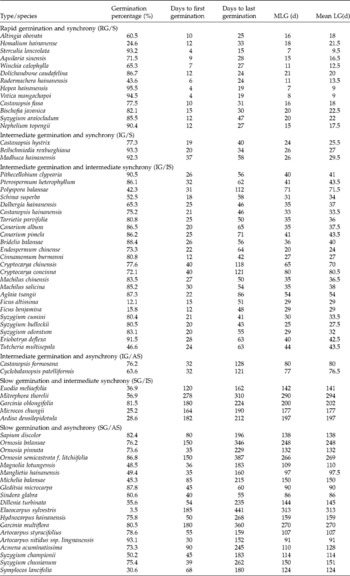
The MLG ranged from 7 to 272 d, and mean LG ranged from 10 to 353 d (Table 1). Based on the MLG and 30 d as the time-line, more than 65% (43 of 66) species had dormant seeds. Based on germination time and synchrony categories exhibited, six patterns could be distinguished (Table 1). The first group is characterized by rapid and synchronous germination (RG/S), e.g. Winchia calophylla, Dolichandrone caudafelina, Radermachera hainanensis, Hopea hainanensis, Vatica mangachapoi, Bischofia javanica, Castanopsis fissa, Altingia obovata, Syzygium araiocladum, Homalium hainanense, Nephelium topengii, Sterculia lanceolata and Aquilaria sinensis. The second group is characterized by intermediate but synchronous germination (IG/S), e.g. Castanopsis hystrix, Beilschmiedia roxburghiana and Madhuca hainanensis. The third group, intermediate and intermediately synchronous germination (IG/IS), includes Canarium album, Canarium pimela, Bridelia balansae, Endospermum chinense, Pithecellobium clypearia, Dalbergia hainanensis, Castanopsis hainanensis, Cinnamomum burmanni, Cryptocarya chinensis, Cryptocarya concinna, Machilus chinensis, Machilus salicina, Aglaia tsangii, Ficus altissima, Ficus benjamina, Syzygium cumini, Syzygium bullockii, Syzygium odoratum, Eriobotrya deflexa, Pterospermum heterophyllum, Tarrietia parvifolia, Polyspora balansae, Schima superba and Tutcheria multisepala. The fourth group is characterized by intermediate but asynchronous germination (IG/AS), e.g. Castanopsis formosana and Cyclobalanopsis patelliformis. The fifth group, slow and intermediately synchronous germination (SG/IS), e.g. Mitrephora thorelii, Garcinia oblongifolia, Microcos chungii, Ardisia densilepidotula and Euodia meliaefolia. The sixth group was characterized by slow and asynchronous germination (SG/AS), e.g. Dillenia turbinata, Elaeocaepus sylvestris, Sapium discolor, Gleditsia microcarpa, Sindora glabra, Ormosia balansae, Ormosia pinnata, Ormosia semicastrata f. litchiifolia, Hydnocarpus hainanensis, Garcinia multiflora, Magnolia lotungensis, Manglietia hainanensis, Michelia balansae, Artocarpus styracifolius, Artocarpus nitidus ssp. lingnanensis, Acmena acuminatissima, Syzygium championii, Syzygium chunianum and Symplocos lancifolia. Germination percentages among species with the six patterns were not significantly different (F= 1.916, P>0.05) but the differences in seed mass among the six patterns were significant (F= 3.055, P= 0.016). Seeds characterized by intermediate but asynchronous germination (IG/AS) were the largest, followed by seeds characterized by IG/S, IG/IS, SG/AS and SG/IS, whereas seeds characterized by rapid and synchronous germination (RG/S) were the smallest.
Germination data of seeds of 66 species from a seasonal evergreen monsoon forest in Hainan Island, China. Species are divided into six germination and synchrony categories

Correlation between germination and phylogeny, dispersal mode and dispersal season
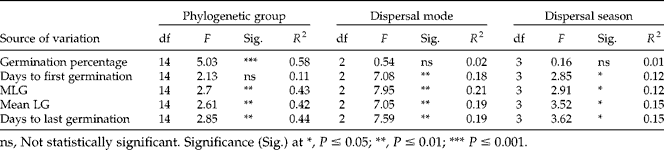
One-way ANOVAs showed that phylogenetic group had statistically significant effects on germination percentages of the 66 species; dispersal season and dispersal mode had statistically significant effects on days to first germination; phylogenetic group, dispersal season and dispersal mode had statistically significant effects on MLG, mean LG and days to last germination (Table 2).
One-way ANOVAs showing effect of phylogeny, dispersal mode and dispersal season on germination variables among species
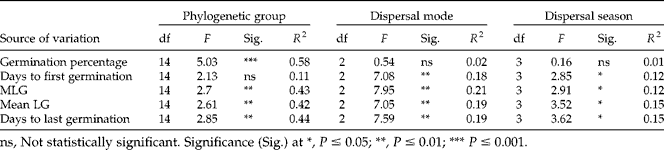
MLG, median value of all the times to germination; mean LG, mean value of all the times to germination.
ns, Not statistically significant. Significance (Sig.) at *, P≤ 0.05; **, P≤ 0.01; *** P≤ 0.001.
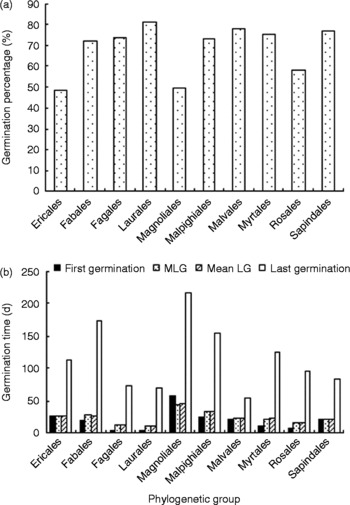
Species in the Laurales presented the highest germination percentage (81%), and species in the Ericales presented the lowest germination percentage (48%) (Fig. 2a); the days to first germination were not significantly different among phylogenetic groups; the MLG and mean LG displayed a significant difference among phylogenetic groups, species in the Magnoliales presented the longest MLG and mean LG (44 and 45 d, respectively), species in the Laurales presented shortest MLG and mean LG (13 and 12 d, respectively) (Fig. 2b).
Differences in (a) mean germination percentage and (b) germination time among phylogenetic groups (five orders – Gentianales, Gunnerales, Lamiales, Oxalidales and Saxifragales – with a low number of species were excluded). MLG, median value of all the times to germination; mean LG, mean value of all the times to germination.

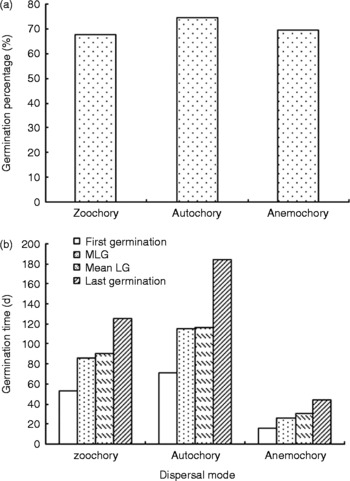
Germination percentage of seeds did not differ among dispersal mode (Fig. 3a). The days to first germination and days to last germination were significantly different among dispersal mode: anemochorous seeds presented shortest days to first germination and days to last germination (16 and 44 d, respectively), and autochorous seeds presented longest days to first germination and days to last germination (71 and 184 d, respectively). MLG and mean LG showed significant differences among dispersal mode: autochorous seeds presented the longest MLG and mean LG (both 115 d) whereas species with anemochorous seeds displayed shortest MLG and mean LG (26 and 30 d, respectively) (Fig. 3b).
Differences in (a) mean germination percentage and (b) germination time among dispersal mode groups. MLG, median value of all the times to germination; mean LG, mean value of all the times to germination.

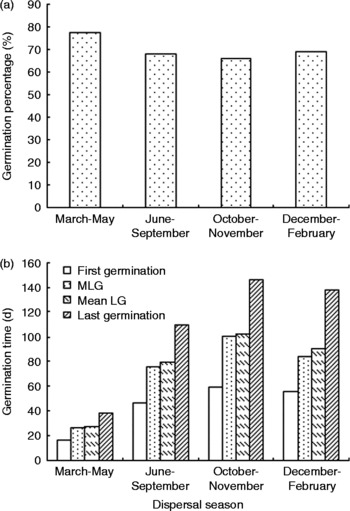
Germination percentage of seeds did not differ among dispersal season (Fig. 4a). The days to first germination and days to last germination were significantly different among dispersal season: seeds dispersed in March–May presented shortest days to first germination and days to last germination (16 and 38 d, respectively); seeds dispersed in October–November presented longest days to first germination and days to last germination (58 and 145 d, respectively). MLG and mean LG showed significant differences among dispersal season: seeds dispersed in March–May presented shortest MLG and mean LG (26 and 27 d, respectively) and seeds dispersed in October–November presented longest MLG and mean LG (both 102 d) (Fig. 4b).
Differences in (a) mean germination percentage and (b) germination time among dispersal season groups. MLG, median value of all the times to germination; mean LG, mean value of all the times to germination.

Seed mass and germination of species
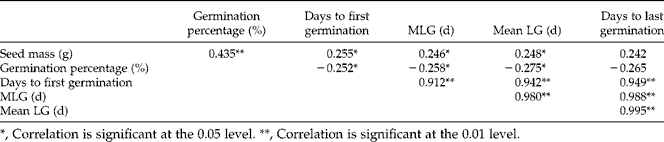
Correlation analyses showed that seed mass was positively correlated with germination percentage, days to first germination, MLG and mean LG. Germination percentage was negatively correlated with days to first germination, MLG and mean LG (Table 3).
Pearson correlation coefficients between seed mass, germination percentage, days to first germination, MLG, mean LG and days to last germination, calculated from germination data of 66 species from a seasonal evergreen monsoon forest in Hainan Island, China
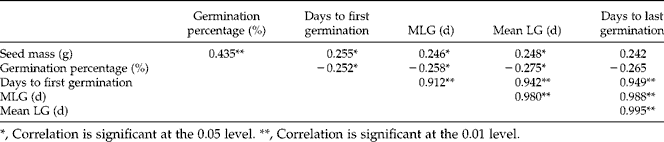
MLG, median value of all the times to germination; mean LG, mean value of all the times to germination.
*, Correlation is significant at the 0.05 level. **, Correlation is significant at the 0.01 level.
Month of peak seed maturation and germination
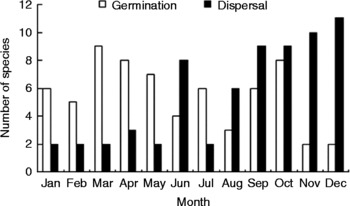
The number of species with a germination peak in each month is shown in Fig. 5. Fruits of five species matured in the hot, dry months (March–April), 36 matured during the rainy season (May–October) and 25 matured during the cool season (November–February). This seasonal variation resulted in a peak in nursery germination and seed dispersal, with the germination peak in March and October, while seed dispersal peaked in June and December (Fig. 5).
Number of species with seed dispersal and germination peaks in each month (calculated based on month of seed collection and median length of germination period).

Discussion
In our study, seed dispersal occurred throughout the rainy and dry seasons. Similarly, Thapliyal and Phartyal (Reference Thapliyal and Phartyal2005) reported that seeds of 77 studied tree species matured in the hot, dry summer months (April–June), rainy season (July–September), cold season (October–February) and late spring (March) in a monsoonal forest in northern India. Blakesley et al. (Reference Blakesley, Elliot, Kuarak, Navakitbumrung, Zangkum and Anunsarnsunthorn2002) reported that seeds of the 36 tree species they studied were dispersed throughout the wet and dry seasons in a tropical seasonal forest in Thailand. Sautu et al. (Reference Sautu, Baskin, Baskin and Condit2006) also reported that roughly equal percentages of seeds of 95 forest tree species were dispersed during the dry, early rainy and late rainy seasons in a tropical seasonal forest in Panama.
Considerable variation in mean time to germination has been reported in tropical forests around the world. For example, for eight species in a tropical seasonal rainforest in south-west China, the mean time to germination (MTG) ranged from 5 to 207 d (Yu et al., Reference Yu, Baskin, Baskin, Tang and Cao2008). For 157 species in a tropical seasonal moist forest in Panama, the mean length of dormancy (time between sowing and germination) ranged from 2 to 370 d (Garwood, Reference Garwood1983). Sautu et al. (Reference Sautu, Baskin, Baskin and Condit2006) reported that mean and median (MLG) lengths of germination period for 94 species in the same forest type in Panama were 3.7–253 d and 3–203 d, respectively. For 18 species in a Ghanaian tropical seasonal forest, MTG ranged from 16 to 79 d in forest understorey and from 15 to 100 d in a forest gap with 30% irradiance (Kyereh et al., Reference Kyereh, Swaine and Thompson1999). For 36 tree species in a tropical seasonal forest in Thailand, the median length of dormancy (MLD) ranged from 7 to 219 d (Blakesley et al., Reference Blakesley, Elliot, Kuarak, Navakitbumrung, Zangkum and Anunsarnsunthorn2002). Similarly, in the present study, the MLG ranged from 7 to 313 d and mean LG ranged from 9.5 to 353 d.
Baskin and Baskin (Reference Baskin, Baskin, Smith, Dickie, Linington, Pritchard and Probert2005) indicated that about 60% of the seeds of tropical rainforest and about 50% of those of tropical semi-evergreen forest are non-dormant at maturity. Here, more than 65% of the 66 studied species had dormant seeds. The proportion of species with dormant seeds was much higher than has been reported in several other tropical seasonal forests. Garwood (Reference Garwood1983) reported that about 50% of 157 species had dormant seeds, based on length of dormancy (MLD, days from sowing to germination) of 4 weeks, in her study of a seasonal tropical forest in Panama. In another example, of a seasonal moist tropical forest in Panama, Central America, Sautu et al. (Reference Sautu, Baskin, Baskin and Condit2006) reported about 48% of 94 tree species with dormant seeds, based on the median length of germination (MLG) of 30 d as the time-line between dormancy and non-dormancy. Seed dormancy can be an important survival strategy because it prevents seeds from germinating shortly after maturation, when seedlings might be exposed to unfavourable establishment conditions (Clauss and Venable, Reference Clauss and Venable2000).
Our results clearly show that seed germination percentage and germination time (except days to first germination) among species was strongly related to phylogenetic group (Order). Previous studies on various communities, for example, temperate rainforests (Figueroa, Reference Figueroa2003), alpine meadows (Bu et al., Reference Bu, Du, Chen, Xu, Liu and Wen2008) and arid and semi-arid zones (Wang et al., Reference Wang, Baskin, Cui and Du2009, Reference Wang, Chen, Baskin, Baskin, Cui, Zhang, Qiang and Du2012), have shown that there is a phylogenetic pattern of seed germination. Our results suggest that variation in seed germination may be closely related to phylogeny, i.e. inherent characters of species may play a prominent role in evolution and phylogeny of species may play an important role in natural selection for the regulation of seed germination. Thus, germination behaviour will be similar in more closely related species, regardless of ecological factors, than in distantly related species.
Seeds of M. hainanensis, M. lotungensis, H. hainanensis and M. thorelii were dormant and began to germinate after 1–3 months of sand burial in our study. Seeds of these species belonging to the Magnoliales have physiological dormancy, requiring 2–3 months of cold stratification to break dormancy (Baskin and Baskin, Reference Baskin, Baskin, Smith, Dickie, Linington, Pritchard and Probert2005). These species shed their seeds in the late rainy season and must experience a period of natural low temperature and a moist environment to come out of dormancy, which might ensure that they germinate in the next rainy season.
Physical dormancy has been recorded in 15 families of angiosperms (Baskin et al., Reference Baskin, Baskin and Li2000) and is well represented in the three subfamilies of Fabaceae (Caesalpinoideae, Mimosoideae and Papilionoideae) (Baskin and Baskin, Reference Baskin and Baskin1998). In our study, seeds of S. glabra, P. clypearia, D. hainanensis, O. balansae, O. pinnata and O. semicastrata f. litchiifolia can be assigned to physical dormancy. Such dormancy is caused by one or more layers of palisade cells in the seed or fruit coat that are impermeable to water (Baskin et al., Reference Baskin, Baskin and Li2000). Previous studies of species from several environments have shown that alternating temperatures between 15 and 35°C can break physical dormancy of seeds in tree species growing in gaps in a rainforest in Mexico (Vázquez-Yañes and Orozco-Segovia, Reference Vázquez-Yañes and Orozco-Segovia1982) and in non-climax tree species from the evergreen Atlantic forest (Paula et al., Reference Paula, Delgado, Paulilo and Santos2012; Souza et al., Reference Souza, Voltolini, Santos and Paulilo2012). Seeds with physical dormancy in the present study were dispersed in the late rainy season and cool dry season. These seeds experience natural fluctuating temperatures before germination, resulting in synchronization of the peak of germination with high rainfall.
Seeds with different dispersal strategies have been generally viewed as showing an adaptation to avoid unfavourable conditions (i.e. natural enemies, sibling interactions, any limitation of available resources to the parents), as well as to increase the probability of finding a suitable establishment site (Janzen, Reference Janzen1970; Cheplick, Reference Cheplick1993; Willson and Traveset, Reference Willson, Traveset and Fenner2000). In the present study, seed dispersal period had no significant effect on seed germination percentage, but did have a significant effect on time to germination and could explain independently 12–15% of the total variance in germination time in the rainforest. Garwood (Reference Garwood1983) recognized three germination syndromes: the first is delayed-rainy, seeds are dispersed in the rainy season but germination is delayed until the beginning of the next rainy season. In our study, G. oblongifolia, M. lotungensis, M. hainanensis, E. sylvestris, H. hainanensis, M. balansae, G. multiflora and A. densilepidotula conformed to the delayed rainy syndrome. The second germination syndrome is intermediate-dry, seeds are dispersed during the dry season and germination is delayed until the beginning of the rainy season. In the present study, O. semicastrata f. litchiifolia, M. chungii, E. meliaefolia, S. chunianum, S. championii, S. discolor, S. lancifolia, A. styracifolius, O. balansae, G. microcarpa, O. pinnata and C. chinensis can be assigned to the intermediate-dry syndrome. The third syndrome is rapid-rainy, seeds are dispersed and germinate in the rainy season. In our study, N. topengii, F. benjamina, S. lanceolata, R. hainanensis, S. araiocladum, B. roxburghiana, S. cumini, A. sinensis, H. hainanense, V. mangachapoi, S. superba, A. obovata and C. fissa appeared to be similar to this group. It is important to link the likelihood of seedling establishment with the ‘drought avoidance syndrome’ (Angevine and Chabot, Reference Angevine, Chabot, Solbrig, Jain, Johnson and Raven1979).
Species exhibit considerable variation in dormancy and germination synchrony. Results of our study show that species with seeds dispersed in the late dry/early wet season (March–May) tend to germinate quickly, whereas those with seeds dispersed towards the end of the wet season and into the dry season are likely to have a much longer length of dormancy (Fig. 4), similar to results of Blakesley et al. (Reference Blakesley, Elliot, Kuarak, Navakitbumrung, Zangkum and Anunsarnsunthorn2002) in a tropical seasonal forest in Thailand. Troup (Reference Troup1921) also described natural regeneration in many species; seeds of most species belonging to monsoon forests germinated in nursery beds near the onset of the rainy season. It is well recognized that germination at the onset of the rainy season is an evolutionarily selected trait in seasonal forests (Garwood, Reference Garwood1983; Marod et al., Reference Marod, Kutintara, Tanaka and Nakashizuka2002), which maximizes the use of the first rainy season for seedling establishment and increases the survival probability in the next dry season (Garwood, Reference Garwood1983).
Harper (Reference Harper1977) suggested that germination during the rainy season may reduce mortality and increase seedling establishment. In this study, seed germination occurred not just in the rainy season, but even in the driest season, which indicates that rainfall itself is not the only factor determining germination time, as was observed in other dry forests (Garwood, Reference Garwood1983; Van Schaik et al., Reference Van Schaik, Terborgh and Wright1993; Sautu et al., Reference Sautu, Baskin, Baskin and Condit2006). Some biotic factors, such as seed predators and litter, may be an additional factor affecting seed germination (Molofsky and Augspurger, Reference Molofsky and Augspurger1992; Vallejo-Marín et al., Reference Vallejo-Marín, Domínguez and Dirzo2006).
Seeds of desiccation-sensitive species are much more likely to be dispersed in the wet season, whereas those of desiccation-tolerant species are more likely to be dispersed in the dry season. However, in a tropical seasonal moist forest in Panama, very short-lived seeds were reported to be dispersed in the dry (DS), early rainy (ERS) and late rainy (LRS) seasons (Sautu et al., Reference Sautu, Baskin, Baskin and Condit2006). Seed of some desiccation-sensitive species, for example, V. mangachapoi, N. topengii, A. sinensis, M. hainanensis, H. hainanensis and S. lanceolata in the present study were dispersed in less wet (humid) months. Seeds of these species exhibited rapid synchronous germination. These species may rely on a seedling bank rather than a seed bank to persist and respond to favourable growth conditions and, therefore, require minimal time in the germination stage when they are particularly susceptible to pests and diseases (Daws et al., Reference Daws, Garwood and Pritchard2005). Rapid germination and high synchrony is an adaptation for avoidance of seed predation.
In this study, seed dispersal mode had no significant effect on the interspecific variation of germination percentage, but dispersal mode had a significant effect on germination time and could explain independently 18–21% of the germination time. Wind-dispersed seeds have faster germination than both unassisted-dispersed seeds and vertebrate-dispersed seeds. It has been suggested that in some species seed dormancy may have evolved to reduce the risk of sibling competition by spreading germination out in time (Venable and Brown, Reference Venable and Brown1988). Venable and Lawlor (Reference Venable and Lawlor1980) noted that there was a strong tendency for the poorly dispersed morph to have delayed germination and the well-dispersed morphs to have rapid germination.
A majority of fleshy and pulpy fruits produced seeds that take a long time to germinate, similar to results reported by Thapliyal and Phartyal (Reference Thapliyal and Phartyal2005) in a monsoonal forest in northern India. Seeds with fleshy and pulpy fruits exhibited slow germination and asynchronous/intermediate synchrony. A long time to germinate is possibly because of their dependence on frugivores for dispersal. Seeds that have hard, mechanically resistant coats that protect the embryo from damage during chewing or enzymatic action while passing through the gut, or depend on slow decomposition or insect action for release of seeds, can take a long time to germinate. Seeds of some species in this category take several years to germinate (Troup, Reference Troup1921) and length of dormancy could be the secondary effect of a defence mechanism. The germination of vertebrate-dispersed seeds with fleshy fruit, which may be swallowed by birds or other vertebrates, is promoted by passage through the animal's digestive system (Willson and Traveset, Reference Willson, Traveset and Fenner2000). These requirements have led to selection for delayed germination. Some seeds of fleshy and pulpy fruits ripen and are dispersed in the cold season (November or December). In this case, low temperature and/or lack of moisture may be another reason leading to slow decomposition or insect action for release of seeds; thus, they take a long time to germinate.
Theoretical models predict that small seeds are more likely to show delayed germination than large seeds (Venable and Brown, Reference Venable and Brown1988; Rees, Reference Rees1994; Norden et al., Reference Norden, Daws, Mailyn, Gonzalez, Garwood and Chave2009) and early emergence of large seeds can compensate for the lower number of seeds by increasing seedling survival (Westoby et al., Reference Westoby, Falster, Moles, Vesk and Wright2002). Conversely, small-seeded species may be more persistent in the soil seed bank (Venable and Brown, Reference Venable and Brown1988; Rees, Reference Rees1994), and delayed germination has been an important factor for the formation of a persistent soil seed bank. Swanborough and Westoby (Reference Swanborough and Westoby1996) considered that large seeds take a longer time to germinate than small ones because large seeds need a longer time for water to permeate than small ones. Faster germination might give small-seeded species a survival advantage, especially if conditions for seedling establishment remain favourable for only a short time (Moles and Westoby, Reference Moles and Westoby2004). Seed mass was weakly correlated with MLG and mean LG in the present study (Table 3), which is similar to results by Chen et al. (Reference Chen, Peng, Zhang and Zhao2002) who found a weak correlation between germination and seed mass in subtropical forests in China. Seed mass was significantly positively correlated with germination percentage across species. The higher germination percentage of large seeds than small ones can compensate for the lower number of seeds by increasing seedling survival (Verdú and Traveset, Reference Verdú and Traveset2005).
Acknowledgements
This research was funded by the National Natural Science Foundation of China (Nos 30570298 and 30430570) and the Special Research Program for Public-Welfare Forestry (‘Responses of forests to climate change and adaptive strategy of forestry in China’, Grant No. 200804001). The authors are grateful to Professor Yide Li for assistance in this study, and to Professor Shiman Huang and Mr Chaoyong Wang for assistance in seed collection and identification of tree species.
Fruit type, dispersal agent, seed mass, reported fruiting time, month of collection and seed extraction procedure for 66 species from a seasonal evergreen monsoon forest in Hainan Island, China. Fruiting as reported by Chun (Reference Chun1964, Reference Chun1965), Guangdong Institute of Botany (1974) and Zhou (Reference Zhou2000).