Joint action can be defined as “any form of social interaction whereby two or more individuals coordinate their actions in space and time to bring about a change in the environment” (Sebanz, Bekkering, & Knoblich, Reference Sebanz, Bekkering and Knoblich2006, p. 70). Having a conversation, dancing with a partner, opening a door for someone, or helping someone lift a large object are all examples of social interactions that require coordination of bodies and minds. Joint action is integral to our success as individuals and survival as a species, and it significantly broadens the range of complex actions that humans are capable of performing (Tomasello, Reference Tomasello2009). Although the coordination of behaviors might seem effortless on the surface, even the simplest coordinated actions involve a complex array of cognitive processes that require accurate and rapid predictions to build mental models of other people's cognitive states concerning their shared goals, action plans, and sensory experiences (Pesquita, Whitwell, & Enns, Reference Pesquita, Whitwell and Enns2018). The purpose of the present study was to examine children with and without autism spectrum disorder (ASD) in a real-world joint action task to determine whether children with ASD are less likely to coordinate their bodies and minds with others.
Sebanz et al. (Reference Sebanz, Bekkering and Knoblich2006) and Sebanz and Knoblich (Reference Sebanz and Knoblich2009) delineate several key components and processes that are necessary for successful joint action. For example, social attention and joint attention are processes by which individuals direct their attention towards interaction partners to glean social cues from facial information and to determine their partner's focus of attention. Therefore, these processes serve as a basic mechanism for creating a “perceptual common ground” between two minds, either to support the process of one person following another's lead or when two individuals are simultaneously engaged in similar actions during a joint action task (Bayliss, & Tipper, Reference Bayliss and Tipper2005; Sebanz et al., Reference Sebanz, Bekkering and Knoblich2006). In addition to sharing a partner's focus of attention, joint action is complemented by action observation, or observing the behavior of one's action partner, which triggers an automatic motor resonance within the observer, possibly via the mirror neuron system (Rizzolatti & Craighero, Reference Rizzolatti and Craighero2004; Williams, Whiten, Suddendorf, & Perrett, Reference Williams, Whiten, Suddendorf and Perrett2001). This motor resonance is thought to serve as a bridge between seeing and doing (Rizollati & Craighero, Reference Rizzolatti and Craighero2004), so it facilitates the understanding of another's actions and intentions (Blakemore & Decety, Reference Blakemore and Decety2001). Task-sharing is a process by which individuals predict their partner's future behavior by understanding their partner's perspectives and task demands, and it is aided by incorporating prior knowledge and experiences. For example, experimental studies have found that participants demonstrate neural motor resonance before an observed action occurs based on anticipation alone (Kilner, Vargas, Dubal, Blakemore, & Sirigu, Reference Kilner, Vargas, Duval, Blakemore and Sirigu2004; van Schie, Mars, Coles, & Bekkering, Reference van Schie, Mars, Coles and Bekkering2004). Finally, and most relevant to the present investigation, action coordination is a process by which individuals coordinate complementary actions with their partners in time and space such that that one's actions facilitate goal-directedness while also taking into account the needs, perspectives, and abilities of one's action partner (Sebanz et al., Reference Sebanz, Bekkering and Knoblich2006). Notably, these actions may not be identical to one another, or even similar, as when athletes outmaneuver opponents or when one catches a ball that is thrown from the other to score a basket or touchdown. Critically, individuals must intuitively incorporate the other's capabilities into their own action planning (Marsh, Richardson, Baron, & Schmidt, Reference Marsh, Richardson, Baron and Schmidt2006). For example, when moving furniture, a taller individual may bend down to keep the weight distribution of the furniture from shifting to a shorter partner.
Joint Action Abilities in ASD
Growing research interest in joint action has coincided with a paradigmatic shift in the study of social processes that is based on the awareness that social cognition and social behavior cannot be sufficiently studied in individual minds in isolation (Roepstorff & Frith, Reference Roepstorff and Frith2004; Sebanz et al., Reference Sebanz, Bekkering and Knoblich2006). Rather, joint action is best studied in real-time social interactions rather than in contrived computerized laboratory tasks (Birmingham & Kingstone, Reference Birmingham and Kingstone2009; Klin, Jones, Schultz, Volkmar, & Cohen, Reference Klin, Jones, Schultz, Volkmar and Cohen2002). This paradigm shift opens new possibilities, not only for the study of social behavior more broadly but also for the study of atypical social development in clinical populations. For example, a body of evidence is accumulating that suggests that coordination of bodies and minds facilitates quality in building relationships and social interaction. Indeed, a greater tendency to automatically mimic the facial expressions and body mannerisms of one's interaction partner is associated with greater liking, rapport, social connectedness, and enjoyment in the interaction even when these mimicry processes are beneath conscious awareness (see, Lakin, Reference Lakin, Hall and Knapp2013, for a review). Therefore, joint action is critical not only for successfully performing goal-directed actions but also for the experience of social well-being.
Based on this emerging body of research, an unanswered empirical question is whether disorders that are associated with impaired social functioning are characterized by differences in joint action abilities. For example, autism spectrum disorder is characterized in part by impaired social understanding, deficits in social communication, diminished social-emotional reciprocity, and difficulties with developing and maintaining relationships (APA, 2013). These deficits are theorized to stem from a dysfunctional social motivation neural network that sparks an atypical social-emotional developmental trajectory through reduced social attention (see, Chevallier, Kohls, Troiani, Brodkin, & Schultz, Reference Chevallier, Kohls, Troiani, Brodkin and Schultz2012, for a review). Although many of the mechanisms involved in joint action that we have described earlier (e.g., joint attention, imitation, and perspective-taking) are thought to be impaired in children with ASD (Baron-Cohen, Reference Baron-Cohen, Ellis and Bjorklund2005), to date very little work has directly examined joint action processes in these children.
Among the few studies that have directly examined joint action processes in children with ASD, most have reported evidence of atypical performance on joint action tasks (Colombi, Liebal, Tomasello, Young, Warneken, & Rogers, Reference Colombi, Liebal, Tomasello, Young, Warneken and Rogers2009; Liebal, Colombi, Rogers, Warneken, & Tomasello, Reference Liebal, Colombi, Rogers, Warneken and Tomasello2008; Scharoun & Bryden, Reference Scharoun and Bryden2016; Stoit et al., Reference Stoit, van Schie, Riem, Meulenbroek, Newman-Norlund, Slaats-Willemse and Buitelaar2011). For example, in Liebal et al.’s (Reference Liebal, Colombi, Rogers, Warneken and Tomasello2008) study, adult researchers staged an event where they struggled to grasp an out-of-reach object. They found that children aged 2–5 years old in two groups—with and without ASD but with similar intellectual delays—showed very similar rates of helping the researchers attain their goals by helping them retrieve the object. The researchers interpreted these findings as evidence of intact helping behaviors in children with ASD. However, in a second study where Liebal et al. (Reference Liebal, Colombi, Rogers, Warneken and Tomasello2008) studied a joint action task that required the researcher and child participants to work together to achieve a common goal, differences between the groups emerged. In two tasks, a toy was located in an apparatus that was designed such that it was impossible for the child to open individually, so the toy could only be retrieved when the child and adult researcher simultaneously pulled at each end. In a third task, the child and the researcher had to carry a large hoop that was covered with cloth and coordinate their actions in order to bounce a toy block up and down on the surface of the hoop structure. In a final task, one partner had to drop an object down one of two tubes to be caught by the other partner in a tin can. Coders who were partially blind to diagnosis rated the success with which these tasks were performed based on (a) the level of success in retrieving the toys in the first two tasks, (b) successfully bouncing the toy block up and down for a total of five seconds in the third task, and (c) successfully passing objects through the tube and catching it on the other side (to be counted as successful, the child had to pass the tasks both as a sender and catcher). Critically, in three of the four joint action tasks—that in combination appear to capture several components of the joint action process as defined by Sebanz et al. (Reference Sebanz, Bekkering and Knoblich2006) such as joint attention, task-sharing, and action coordination—significantly fewer participants with ASD than comparison group participants successfully completed the task. Taken together, the two studies suggest that poorer action coordination in ASD is not due to a lack of motivation to successfully complete joint action tasks (based on evidence for intact helping behaviors). Rather, they are due to less ability to successfully coordinate action patterns.
Using the same joint action tasks from Liebal et al.’s (Reference Liebal, Colombi, Rogers, Warneken and Tomasello2008) study, Colombi et al. (Reference Colombi, Liebal, Tomasello, Young, Warneken and Rogers2009) studied potential factors that might lead to reduced joint action abilities in children with ASD. In addition to the joint action tasks, the authors administered a “spontaneous imitation” task to gauge participants’ abilities to accurately mimic various simple motor actions, a “response to joint attention” task, which captured the participants’ tendencies to follow the gaze of the researchers, and an “intentionality task,” in which the researchers either modeled an action successfully or attempted that action but failed to complete it. The participants were then evaluated on their ability to mimic the behaviors or complete the intended actions that the researcher failed to complete. The authors conducted multiple regression analyses, predicting performance on the joint action tasks from performance on these other tasks. They found that imitation skills and joint attention abilities (but not performance on the intentionality tasks) independently contributed to success in the joint action tasks. The authors also noted that there were group differences between the children with ASD and the developmentally delayed children without ASD on imitation skills and joint attention, further supporting the authors’ hypothesis that these autism-specific deficits may contribute to impaired joint action abilities.
The Present Study
In the present study, children with and without ASD lifted and moved tables through a maze in three different conditions. It should be emphasized that all of the participants in our sample were in the normal intelligence (IQ) range and that there were no significant differences between the ASD and TD groups on IQ. This means that our participant sample may not generalize to the entire ASD population, but it was important for us to focus on participants in the normal IQ range so that we did not confound any effects that are specific to ASD with those that may be due to the comorbid condition of intellectual disability.
Small animal figurines were placed atop the tables, and the participants were encouraged to not let the figurines fall. Their performance was not evaluated based on whether the figures fell down or not. Rather, this was to standardize the task demands such that the participants would understand the objective of keeping the table relatively flat while moving it and to prevent them from carrying the table in different ways (e.g., sideways).
In an isolated condition, the participants moved a table by themselves. In two collaborative conditions, the participants moved tables with the assistance of an adult researcher or with the assistance of another child participant. A limitation of previous research in this area is that successful joint action was measured by using subjective experimenter coding. Therefore, given the dearth of available methods for objectively measuring joint action abilities, we developed two new methods for examining a key component of the joint action process—action coordination—a process by which individuals coordinate complementary action patterns with their partners to facilitate goal-directed behaviors. In one method, we used the “TableTop Tracker app” (developed by author JTE for this study), which uses the internal XYZW quaternion readings that are internal to iPhones to measure the extent to which the table “wobbles,” meaning the extent to which the table deviates from a smooth three-dimensional trajectory while being moved. Increased wobbles were used as an index of reduced coordination. In a second method, we coded the extent to which participants automatically and implicitly stepped in synchrony while moving the tables together. Using this measure, more synchronous stepping (as opposed to asynchronous stepping) suggests greater action coordination.
Comparisons between the three different table-moving conditions (child-only, child-adult and child-child) offer methodological advancements over previous research in this area. For example, the child-only condition serves as a baseline measure of “individual coordination” to determine whether children with ASD simply have gross motor differences (Ghaziuddin & Butler, Reference Ghaziuddin and Butler1998) when moving the table by themselves compared with typically developing children. Despite evidence that motor clumsiness or developmental delays that affect gross motor differences are common in children with ASD, previous studies have not specifically examined gross motor differences as a potential explanation for joint action differences in children with ASD (Moruzzi, Ogliari, Ronald, Happé, & Battaglia, Reference Moruzzi, Ogliari, Ronald, Happé and Battaglia2011; Paquet, Olliac, Golse, & Vaivre-Douret, Reference Paquet, Olliac, Golse and Vaivre-Douret2016). If evidence of poorer individual coordination is observed in the ASD group, this would suggest that any observed action coordination deficits could simply be due to gross motor differences. In contrast, evidence of intact individual coordination but poorer action coordination in ASD would suggest that any observed action coordination deficits are “relational” and may represent a greater difficulty coordinating bodies and minds with others. By comparing table movement in the child-only condition with the social conditions, we could determine the degree to which participants benefit from the help of another person, which we term “cooperation benefit.”
A final methodological strength of the present study is that by comparing the two social conditions—child-child versus child-adult—we could evaluate the extent to which the adult researchers scaffold joint action performance compared with the conditions when children must move tables with other children. No previous research that we are aware of has examined joint action in pairs of children with ASD. It is possible that children that are performing joint action tasks with another child may reveal ASD-specific differences that are masked when they are performing the same tasks with another adult. Based on these considerations, we had several specific predictions:
1. We predicted that children with ASD would complete the child-only task with less individual coordination (i.e., greater table movement) and/or less efficiency (slower task completion) based on previous research demonstrating gross motor differences in children with ASD.
2. Next we sought to determine whether any observed group differences in action coordination during the collaborative table-moving tasks were merely due to gross motor differences in ASD. To do this, we examined Diagnosis × Condition interactions and post hoc comparisons from an analysis of variance (ANOVA) to see whether the addition of a partner improved table stability in either diagnosis group. We predicted that children with ASD would experience less of a coordination benefit from the addition of a partner, which may represent lesser ability to coordinate bodies and minds during an action coordination task irrespective of baseline individual coordination.
3. Finally, we predicted that joint action differences between ASD and TD, where observed, would be most apparent when two children carry a table together compared with when a child carries the table with an adult researcher. This hypothesis stems from our expectation that adults adjust their behavior to match the needs of a child (e.g., coregulation, scaffolding) potentially minimizing the individual limitations of any given child (Ting & Weiss, Reference Ting and Weiss2017; Wood et al., Reference Wood, Petkovski, De Pasquale, Gottardo, Evans and Savage2016). In contrast, moving a table with another child may not be viewed as offering the same benefit as moving one with an adult. If confirmed, such a finding would have important methodological implications for future research in this area, as paradigms involving two children working together to complete goal-directed actions may reveal autism-specific differences that may be masked in paradigms where children are paired with adults.
This study has implications both for our understanding of ASD in particular and of human social behavior in general. If joint action differences are found in children with ASD, it is possible that joint action may underlie some of the social and communicative challenges that are characteristic of ASD. Additionally, ASD represents variance in social functioning that may be beneficial for informing the broader significance of joint action as an adaptive social process that is intrinsic to successful human functioning.
Methods
Participants
The participants were children with autism spectrum disorder (ASD) and typically developing (TD) children that were between the ages of 6 and 12 years old. They were recruited for the “Social Science Camp” at Simon Fraser University, a day-long event that exposes children to educational and fun activities while they also participate in various research activities. To participate in this study, parents of the children with ASD provided documentation from the British Columbia (BC) government confirming diagnosis from a qualified clinician in BC. As an ASD diagnosis is tied directly to substantial government funding in BC, the province has instituted standardized diagnostic practices that are based on the DSM-IV or V (depending on the age of the participants), and diagnoses are confirmed by using the Autism Diagnostic Interview-Revised and Autism Diagnostic Observation Schedule (American Psychiatric Association, 2013; Lord et al., Reference Lord, Risi, Lambrecht, Cook, Leventhal, DiLavore and Rutter2000; Rutter, Le Couteur, & Lord, Reference Rutter, Le Couteur and Lord2008). The sample characteristics are summarized in Table 1.
Descriptive statistics for participant characteristics

Materials and Measures
ASD Traits
ASD traits were measured by using the Autism Spectrum Quotient-Child Version (AQ; Auyeung, Baron-Cohen, Wheelwright, & Allison, Reference Auyeung, Baron-Cohen, Wheelwright and Allison2008). This version of the AQ is a parent-report measure with 50 items for assessing ASD symptomology, with higher scores indicating higher levels of ASD traits. This measure is a screening tool and is used primarily for research purposes. The AQ assesses social and nonsocial characteristics of ASD that relate to social skills, communication skills, attention to detail, imagination, and tolerance of change.
Social Competence
Social competence was measured by using the Multidimensional Social Competence Scale (MSCS), a 77-item scale that is designed to assess social competence in multiple populations (Trevisan, Tafreshi, Slaney, Yager, & Iarocci, Reference Trevisan, Tafreshi, Slaney, Yager and Iarocci2018; Yager & Iarocci, Reference Yager and Iarocci2013), with higher scores representing higher social competence. The MSCS has seven theoretically derived subscales including social motivation, social inferencing, demonstrating empathic concern, social knowledge, verbal conversation skills, nonverbal communication skills, and emotional regulation.
Alexithymia
Alexithymia was assessed by using the Children's Alexithymia Measure (CAM), a parent-report measure that is designed to assess early childhood indicators of alexithymic tendencies, which are represented by difficulties with identifying and describing one's own emotions (Way et al., Reference Way, Applegate, Cai, Franck, Black-Pond, Yelsma and Muliett2010). The CAM consists of 14 items that are scored on a scale from 0 to 3, with higher scores representing more severe alexithymia. Way et al. (Reference Way, Applegate, Cai, Franck, Black-Pond, Yelsma and Muliett2010) extensively validated the CAM with the use of expert opinion, graded item response theory modeling, and factor analysis to identify items that load onto their theorized unidimensional factor structure, and they demonstrated criterion-related validity and strong concurrent validity using theoretically related measures.
Intelligence
Intelligence was estimated with the Wechsler Abbreviated Scale of Intelligence (WASI; Wechsler, Reference Wechsler2011), which includes two subtests of nonverbal intelligence (Block Design and Matrix Reasoning) and two subtests of verbal intelligence (Vocabulary and Similarities). Due to the time constraints of the camp, only the Vocabulary and Matrix Reasoning subtests were administered. The Vocabulary subtest assesses abilities that are related to word knowledge and verbal concept formation by testing participants’ ability to provide word labels for objects that are presented to them and their ability to provide definitions of words that are presented visually and orally. The Matrix Reasoning subtest assesses abilities that are related to spatial reasoning, fluid intelligence, and perceptual organization by requiring participants to view a series of incomplete matrices and complete them by selecting the correct response option.
Study Procedure
Figure 1 shows a bird's-eye view of the testing environment in a room that measured 7.20 × 4.36 meters. Each participant moved a table through the S-shaped maze of stationary tables in three different conditions. In the child-only (CO) condition, individual participants moved a small round table by themselves. In the child-adult (CA) condition, participants moved a larger square table with the help of an adult researcher who was blind to the specific purpose of the study but not blind to participant diagnosis. In the child-child (CC) condition two participants (both TD or both ASD) moved the same larger square table together.
Bird’s-eye view of the room set up as a maze for the table top task. The “Xs” at points A and B indicate the starting and end points of the maze. Time and joint action indices were measured from the time participants lifted the table at one point, until the time the table was set down at the other point. The approximate room dimensions and the distance traveled by the tables are shown in the figure.

The task began when the participants first touched the tables to pick them up and ended when they placed the table down at the other end of the maze. Table moves started at either Point A or B, depending on where the table was last placed. Both points were marked with an ‘X’ on the floor so that the participants knew where to place the table after navigating the maze. Small animal figurines were placed on the tables in order to provide incentive to move the tables as smoothly as possible and online feedback about how well this was being accomplished. The participants were encouraged to try to move the tables without having the figurines fall down, but they were also told that if the figurines fell over they should still complete the table move as smoothly as possible.
The researchers read participants the following script: “Do you see the ‘X’ on the floor on the other side of the room? Your job is to move this table to the other side of the room without letting the animals fall to the ground.” In rare instances where participants did not understand the task instructions, the researcher modeled the task by moving the table herself. When the participants were in position and indicated that they understood the task instructions, a researcher stated, “Ready, set, go,” at which point the experimenter initiated the TableTop Tracker app and the participants were free to pick up the table and move it through the maze. There were two child participants and two adult researchers in a room per one testing session. The table moves were executed in a fixed order as follows: CO1, CO2, CA1, CA2, C1C2.
Experimental Measures
Action coordination: relative table movement
Table movement was measured by using an iPhone G5, installed with the TableTop Tracker app, which was taped to the underside of each table that the participants moved. The app was initiated and terminated remotely at the onset and offset of each trial by an experimenter in the room that was holding an iPad. For relevant analyses, action coordination represents the table movement that occurred during the collaborative conditions (child-child and child-adult), whereas individual coordination represents table movement during the child-only task.
The movement of the table during the trial was measured by using the XYZW quaternion readings that are internal to iPhones (https://developer.apple.com/documentation/accelerate/simd/working_with_quaternions). These are reported by the manufacturer to be sampled 60 times per second (60 Hz). Quaternions measure the direction and magnitude of movement in space along a dimension (vector) with the constraint that the four magnitudes in a given sample sum to 1.0. Two measures of movement were derived from the distribution of XYZW values that were sampled for each participant X-condition combination (cell in the data): a global movement measure and a local measure. The global measure was used to establish the gross movement of the table from point A to point B in the room. The local measure was used to index the amount of table movement that occurred that was above the gross movement that is required to transfer the table from A to B in the room (see Figure 1).
Global movement
The sampled recordings for each dimension (e.g., X) over time were smoothed with a loess line that was based on a traveling window of 75 samples. A window size of 75 was selected because it was approximately 1/8 of all of the time samples on a typical trial (mean time samples = 598, standard deviation = 441). Within each window, a quadratic function was fit to the data by using least squares, and these functions were then averaged over the windows to produce a smooth function that represented the movement of the table in three-dimensional space from point A to point B in Figure 1. A global standard deviation (globalSD) was determined from these loess lines. The globalSD values are an index of how much overall movement of the table was required to move it from A to B. Because each participant or pair of participants moved the tables the same distance on every trial, these numbers formed a baseline of movement measurement against which local deviations in movement could be assessed. To create a composite score of global movement, based on all four motion vectors, we aggregated the globalSD values based on the total Euclidean distance moved: globalSD = sqrt (X^2 + Y^2 + Z^2 + W^2).
Local movement
A local standard deviation (localSD) was also determined from the loess lines, to index the difference between the XYZW values that were sampled and the baseline global loess value for each time sample. The localSD values were also aggregated across all four dimensions: localSD = sqrt (X^2 + Y^2 + Z^2 + W^2), and they represent the total variability in movement relative to the global loess line at each time sample. LocalSD scores can be considered “second order variance” in that they represent local movement deviations from the expected global movements that occur on every trial.
Relative table movement scores (our main dependent variable) were obtained by dividing the localSD by the globalSD for each participant X condition. This measure has the advantage over the raw localSD scores of expressing the local movements (i.e., “wobbles”) as a proportion of the global movement of the table, which varied to some extent for each participant and condition. Therefore, departures from 0 on this measure are local movement perturbations relative to the gross movement that occurs when the table travels from point A to point B. Our assumption is that greater relative table movement indexes less individual coordination (in the child-only condition) and less action coordination (when dyads moved the tables together).
Action coordination: Stepping synchrony
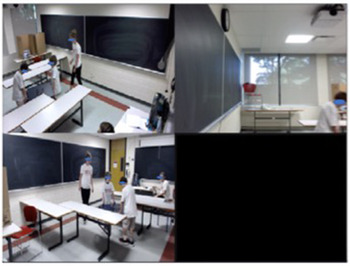
We also measured action coordination using third-party behavioral observation. For this measure, each trial by an individual or duo was videotaped from three different points of view, as illustrated in Figure 2. The video images were recorded by the built-in camera of a MacBook Air and two external cameras that were connected to the MacBook. The different camera angles were synchronized into one video recording by using a program called EvoCam (http://www.evological.com).
An example frame from the three simultaneous video images that coders see when coding video data. Faces in this image are overlaid with blue ovals to maintain anonymity.

Action Coordination was coded from these videos based on whether the legs of the respective participants moved in synchrony as they moved the tables in the child-child and child-adult conditions. Stepping synchrony was coded by a research assistant who was blind to the purpose of the study and blind to the diagnoses of the participants. To help with the coding process, the videos that were recorded from EvoCam were imported into ChronoViz V2.0.0 (Fouse, Weibel, Hutchins, & Hollan, Reference Fouse, Weibel, Hutchins and Hollan2011), an application that aids visualization and analysis of multimodal information by time-coding multiple variables simultaneously. For example, it allows coding of the frequency and duration of instances of both visual and vocal variables, even when such variables of interest occur at overlapping points. Even with multiple camera angles, the research assistant had occasional difficulty coding the videos. In many cases the camera angles cut off images of the participants’ legs due to nonideal camera placement. When the research assistant could not confidently code the stepping synchrony variables, these periods were coded as “Legs out of Sight.” The entire duration of each table move was coded into three categories: (a) In-Synch (IS) indicated that participants’ legs were moving in unison with each other, (b) “Out-of-Synch (OOS) indicated no clear coordination between the participants’ steps, and (c) Legs Out-of-Sight (LOS) indicated noncodable video footage in situations where not one of the camera angles could capture an interpretable viewpoint of the participants’ legs. In total, stepping synchrony was coded as LOS 35.74% of the time. To attain an estimate of interrater reliability, 10% of all of the videos were coded by a second researcher, yielding percentage of agreement of 82.7%. Stepping synchrony was calculated by first subtracting LOS from the total duration of the table move and then dividing IS from the remainder:

Results
Action coordination was first examined by using data from the TableTop Tracker App. The CO condition served as a baseline for measuring the extent to which the addition of a partner—either of an adult researcher or another child—benefitted table stability. The means and standard errors of relative movement scores are presented in Figure 3. However, our key interest was in how the degree of differences between the baseline CO condition and each of the CA and CC conditions changed according to diagnosis group, which we examined through Diagnosis × Condition interactions and post hoc comparisons. The differences between CO and the collaborative conditions (CA and CC) represent our operationalization of Cooperation Benefit—the extent to which table stability benefitted from the addition of a partner compared with the baseline individual condition.
Mean relative table movement by condition and diagnosis. Error bars represent <1 standard error of the mean. Higher scores represent greater table movement and therefore less coordination.

Action Coordination: Relative Table Movement
A 2 × 3 mixed ANOVA was conducted with diagnosis (ASD, TD) as the between-subjects factor, table-moving condition as the within subjects factor (CO, CA, CC), and relative table movement as the dependent variable. There was no main effect for diagnosis, F (1, 43) = .274, p = .603, ηp2 = .006. However, there was a significant within-subjects effect of condition, F (1, 43) = .71.407, p < .001, ηp2 = .624, such that that there was evidence of less relative table movement in the collaborative conditions (CA and CC) than in the individual CO condition. Of particular interest, there was a significant Diagnosis × Condition interaction, F (1, 43) = 3.835, p = .030, ηp2 = .154, prompting additional post hoc comparisons. Independent samples t tests revealed that relative to the TD group, the ASD group displayed significantly greater table stability (less movement) in the CO condition, t (47) = -2.041, p = .047, but marginally reduced table stability (more movement) in the CC condition, t (43) = 1.969, p = .054. Considering these post hoc findings together, the pattern suggests that the TD participants experienced greater “cooperation benefit” than the ASD group did. Table stability was nearly equal between the two diagnosis groups in the CA condition, t (47) = -.222, p = .825 (see Figure 3).
Action Coordination: Table Movement Time
Efficiency in the table-moving task can be assessed both by relative table movement (previous analysis) and by the length of time that is required to complete the task. In studies of speeded human performance, examining both of these variables allows one to assess the speed-accuracy tradeoffs that are made in completing a task. Typically, greater accuracy can be achieved by taking more time, and increased speed in a task comes at the cost of reduced accuracy. Figure 4 shows the mean time that was taken (in seconds) to complete the table-moving task in the six conditions of the experiment.
Mean duration (in seconds) to complete the table moving task. Error bars represent <1 standard error of the mean. Higher scores represent longer task duration and therefore less efficiency in the task.

To examine the time taken in the task, we ran a 2 × 3 mixed ANOVA with Diagnosis (ASD, TD) as the between-subjects factor, Condition (CO, CA, and CC) as the within-subjects factor, and task completion time as the dependent variable. There was a significant main effect for diagnosis such that the ASD group took significantly more time to complete the table moves, F (1, 43) = 8.752, p = .005, ηp2 = .169. There was also a significant Group × Condition interaction, F (1, 43) = 3.384, p = .043, ηp2 = .139, prompting us to conduct additional post hoc comparisons. Independent samples t tests revealed significant diagnosis group differences in CO completion time, t (43) = 2.131, p = .039, and CC completion time, t (23.484) = 2.243, p = .034, (a Welch's t test was conducted for the CC comparison because the homogeneity of variances assumption was violated) but not CA completion time, t (43) = .798, p = .429. There was also a significant main effect for table-move condition F (1, 42) = 13.180, p < .001, ηp2 = .237. Post hoc tests show that CA took significantly less time to complete the task than CC (p < .001), although no other pairwise comparisons were significant (ps > .18). The overall pattern of the results that are shown in Figure 4 suggests that the adult researchers scaffolded the task, masking any differences in completion time between the ASD and TD groups. This meant that group differences were apparent when the table was carried alone (CO), and they were most apparent when two children had to move a table together (CC). It is also likely that this slower task completion time in the ASD group during the CO condition represents a speed-accuracy tradeoff that contributed to the greater table stability described in the previous section.
Action Coordination: Overall Efficiency
Figure 5 combines the two table-carrying measures to provide a unified picture of the overall efficiency of the task in the six experimental conditions. Relative table movement is reflected on the vertical axis and completion time on the horizontal axis. This view of the two measures helps to clarify that there are no diagnosis group differences in the task when the children were carrying the tables with the adult (the two darkest data points). It is equally clear that on their own (CO), typically developing children sacrificed stability in order to move the tables at the same speed as in the CA condition, while children with ASD carried the tables with less stability and took longer to do so. However, the most important finding concerned the CC dyads, where the performance of typically developing CC dyads was only a little slower than that of the CA dyads while maintaining a similar level of table stability. In contrast, the CC pairs in the ASD group took considerably longer to achieve a level of table stability that was similar to that of the CA pairs.
A combined efficiency measure is achieved by examining the trade-off between accuracy (relative table movement) and speed (completion time) in the six conditions. Error bars represent <1 standard error of the mean. Scores closer to the origin represent greater efficiency in the task.

Action Coordination: Stepping Synchrony
We were interested in whether those with ASD would be less likely to spontaneously synchronize their steps with their partners during the table moves and to see whether stepping synchrony was associated with table moving stability. We ran a 2 × 2 mixed ANOVA with diagnosis as the between-subjects factor, condition (CC, CA) as the within-subjects factor, and percentage of stepping synchrony as the dependent variable. The CO condition was excluded from consideration for the obvious reason that synchrony requires two participants by definition. The distributions of the raw percentages were negatively skewed, so the analysis was conducted on transformed data by using arcsine transformations to normalize the distributions, thereby maximizing statistical power.
There was no significant main effect for diagnosis, F (2, 48) = 2.764, p = .103, ηp2 = .054. However, the Diagnosis × Table Move interaction was significant, F (2, 48) = 4.352, p = .042, ηp2 = .083. This interaction reflected the finding that TD pairs were coded as stepping in-synch for a significantly greater proportion of time than were the ASD pairs during the CC condition, t (46.82) = 2.284, p = .027 (a Welch's t test was conducted for this comparison because the homogeneity of variances assumption was violated), whereas there were no significant group differences in synchrony between the TD and ASD groups during the CA table-move condition, t (47) = −.443, p = .660. There was also a significant main effect for table-move condition such that there was significantly more synchrony in the CA condition than in the CC condition, F (2, 48) = 15.345, p < .001, ηp2 = .242. The adult researchers have much longer legs than the child participants do, so based on that alone they would be less likely to be stepping in synchrony. This finding suggests that the adult researchers were scaffolding the interaction, perhaps by shortening their steps to synchronize with the children. As shown in Figure 6, this pattern of findings suggests that children with ASD are less likely to step in-synch than TD children are. However, these differences are only apparent when two children move the tables together (CC condition), and group differences are masked when adult researchers scaffold the interaction during the CA condition. These findings are consistent with the pattern of findings in relative table movement and completion time, which found poorer coordination in the ASD group during the CC condition but no group differences during the CA condition.
Group differences in stepping synchrony. Error bars represent <1 standard error of the mean. Higher scores represent more in-synch stepping and therefore greater coordination.

Discussion
The purpose of this study was to compare indices of action coordination in children with ASD and typically developing children as they moved tables through a maze in three different conditions: (a) individually (CO), (b) collaboratively with a peer (CC), or (c) collaboratively with an adult (CA). We measured performance in this task in three different ways: (a) relative table movement (the extent to which the table wobbled while it was being moved from point A to B), (b) time to complete the task, and (c) the proportion of time that the participants spontaneously synchronized their steps while moving the tables. Considering each condition separately, a striking pattern of results emerged. In the CC condition, the ASD group demonstrated poorer performance on the task on all three dependent variables—they moved the tables with poorer stability, had slower task completion times, and were less likely to spontaneously synchronize their steps. In the CA condition, no group differences according to diagnosis emerged in any of these variables, suggesting that the adults are scaffolding the task and masking ASD-specific differences, a finding on which we will elaborate below. In the CO condition, the ASD group completed the task more slowly but with reduced relative table movement (i.e., greater individual coordination), suggesting a speed-accuracy tradeoff.
Cooperation Benefit Reduced in ASD
In one analysis, action coordination was measured with the TableTop Tracker app, which was installed on an iPhone that was taped to the bottom of the tables. The app indexed relative table movement, a measure of the degree to which the table wobbled while it was being moved between locations. A key finding from this analysis was that typically developing children benefitted significantly more from the help of a peer than the children with ASD did. This “cooperation benefit” was demonstrated by the finding that the ASD participants moved the table with more stability than the typically developing children in the CO condition did but with less stability than typically developing children in the CC condition did. Critically, this pattern of findings suggests that poorer joint action in the CC condition is unlikely to be due to gross motor differences in the ASD group. Instead, it may be due to implicit differences in the way that the children coordinate bodies and minds in a relational context. However, it will be important for future work to use more objective tests to examine the extent that potential differences in fine and gross motor, visuospatial skills (visual perception of objects in space), and proprioception (perception or awareness of the position and movement of one's body) may influence joint action differences in children with ASD.
Vygotsky (Reference Vygotsky1978) considered interactions with others as providing a means for children to express their greatest potential beyond their individual capacity, and he posited that interactions are a crucial mechanism for cognitive development. Within a relational developmental framework, social coordination is a complex process that develops over time as the child engages in increasingly sophisticated interactions with people and objects (Carpendale & Lewis, Reference Carpendale and Lewis2006). Much like language is thought to emerge from prior nonverbal forms of interaction in which attention is coordinated (i.e., joint attention), social coordination may be shaped by everyday interactional exchanges (i.e., joint actions) that are commonplace for many preschoolers (e.g., play with the same toy, cleaning up for snack, and even moving a table). Understanding the contribution that each partner makes as well as the dynamic interplay between partners in these exchanges will help us learn how to create opportunities for more successful social interactions within children's everyday activities.
The Role of Adult Scaffolding
Despite clear evidence of poorer task performance by the participants in the ASD group during the CC condition, there were no group differences according to diagnosis during the CA conditions. Social behaviors and challenges can best be understood with careful analysis of the nature of the social interaction between different partners. Variability in task performance with adult or child partners shows the role of social interaction in children's performance. Specifically, it demonstrates that joint action coordination is neither intact nor deficient in children with ASD. Rather, it is likely to be influenced by their partner's contribution. This implies that a child may appear to be more socially coordinated when interacting with an adult than with a child, but it also suggests that the potential to learn and improve on joint action increases when an adult or possibly older (more socially mature) child is the social partner. For example, there is evidence that social understanding in young children is positively associated with parent–child talk as well as with having an older sibling (see Carpendale & Lewis, Reference Carpendale and Lewis2006). Similarly, parental emotional scaffolding (e.g., being sensitive to the child's emotions, sharing the child's positive emotions, and valuing the child's participation) predicts children's emotional development (Ting & Weiss, Reference Ting and Weiss2017). Therefore, it is worth considering how joint action abilities my relate to social and communicative development in children with ASD.
Colombi et al. (Reference Colombi, Liebal, Tomasello, Young, Warneken and Rogers2009) found that joint action abilities covary with joint attention and imitation skills that are known to be critical for social and communicative development in children with ASD (Poon, Watson, Baranek, & Poe, Reference Poon, Watson, Baranek and Poe2012). The relationship is likely to be bidirectional such that communication challenges (e.g., reduced joint attention) may make it difficult to share the common perceptual ground that is necessary for seamlessly executing joint action tasks. However, joint actions are natural targets for intervention that can be seamlessly integrated into a child's daily routines similarly to how imitation and joint attention are targeted in parent coaching models of intervention (e.g., Reciprocal Imitation Training; Ingersoll & Schreibman, Reference Ingersoll and Schreibman2006). Such interventions can be parent- or teacher-mediated and could have children engaging with a sibling, peer, or caregiver in entertaining and goal-directed activities such as building a block tower together, painting a picture, working in teams to play cooperative video games, dancing, or playing sports, depending on the child's interests. Such joint action activities may help children with ASD to implicitly seek social information and coordinate behavior and action patterns with others, which may facilitate and accelerate social and communicative development.
Broader Adaptive Significance of Joint Action
Children with ASD without co-occurring intellectual disability may represent the low end of the normal variation in social functioning. As such, differences in specific aspects of social interaction, (e.g., social coordination) may be informative in understanding the role of joint action in human social-cognitive development and social adaptation. Our analysis of stepping synchrony revealed that children with ASD stepped synchronously with their partner significantly less often than TD children during the CC condition did, but no group differences were observed when moving the table with another adult researcher. Moreover, collaborating on this task with an adult was more beneficial than collaborating with another child from the ASD group, whereas TD children performed relatively equally regardless of whether their partner was a child or an adult. These findings parallel other existing data on atypical timing mechanisms in children with ASD. Marsh et al. (Reference Marsh, Isenhower, Richardson, Helt, Verbalis, Schmidt and Fein2013) used a rocking chair paradigm to demonstrate that typically developing children spontaneously rocked in unison with their caregivers, while children with ASD did not. The findings led the authors to conclude that “deficiencies in perceiving and responding to the rhythms of the world … ” (p. 1) may inhibit children with ASD from connecting with their environments, strongly detracting from seamless adaptation and integration into various social contexts (Marsh et al., Reference Marsh, Isenhower, Richardson, Helt, Verbalis, Schmidt and Fein2013). Therefore, successful action coordination may not be crucial just for performing goal-directed joint actions; it may also be critical for successful social and adaptive functioning.
Limitations and Future Directions
There were certain characteristics of our sample that warrant caution in interpreting our results. Age differences between the ASD and TD group approached significance such that the TD group was slightly younger. It is possible that these differences in age may have exaggerated or minimized the observed effect sizes on our group comparisons of interest. It is also important to note that the ASD group was in the normal IQ range. Therefore, the results of this study may not generalize to the entire ASD population because approximately 50% of individuals in the ASD population are intellectually disabled. In future research, it will be important to consider the specific roles of age and IQ on joint action in ASD.
Our study only examined child dyads of two TD children or two children with ASD. Another area for future research would be to examine ASD–TD dyads. Such research may have implications for how children with ASD could benefit from guidance and scaffolding of TD children during naturalistic joint action activities.
Acknowledgments
This work was supported by a grant from the Social Sciences and Humanities Research Council #410-2010-0282. We thank Dr. Adam Naples for helpful guidance on statistical analysis.