

Introduction
Any complete theory of territorial rights needs to address the particularity problem: which group, individual, or institution should hold territorial rights in which particular territory? (Nine Reference Nine2008a, Reference Nine2012, 27; Stilz Reference Stilz2009; Kolers Reference Kolers2012; Miller Reference Miller2012).Footnote 28 According to the legitimate state theory, legitimate states and they alone have territorial rights over their territories; illegitimate states and non-state entities do not, as a rule, have them (Stilz 2009, Reference Stilz2011). In this article, I distinguish between two interpretations of the legitimate state theory that differ from one another in their conceptions of statehood and of legitimacy. The first interpretation – call it the restrictive view – adopts the Westphalian sovereign state modelFootnote 29 and a liberal criterion of legitimacy; the second interpretation – call it the pluralist view – adopts a diversified notion of statehood and a contextual or external criterion of legitimacy (as described below). I argue that the restrictive interpretation is susceptible to three objections, which, taken together, render it problematic. The pluralist interpretation is not liable to the same and offers a promising approach to the particularity problem.
The legitimate state theory: three necessary featuresFootnote 30
That states hold territorial rights is an alternative to two approaches: the individualist and the nationalist. For the former, individuals are the primary holders of territorial rights, which they delegate to states on consent (Steiner Reference Steiner2008). On the latter, nations tied together by cultural bonds are the primary holders of territorial rights, which they come to hold by investing and creating material and symbolic value in a particular territory over time (Miller Reference Miller2012).Footnote 31 According to the legitimate state theory, states are the primary holders of territorial rights due to specific legal–political features that they have – as public authorities – but individuals and (cultural) nations do not have them (Nine Reference Nine2008a, 156; Stilz Reference Stilz2009; Stilz Reference Stilz2011). That a legal–political entity is the holder of the right is the first necessary element of the legitimate state theory. The second related necessary element pertains to the content. Territorial rights consist in jurisdictional authority, and, accordingly, they differ from property rights: they consist in territorial jurisdiction – the right to make, adjudicate, and enforce the laws in a given territory (Nine 2008b, Reference Nine2012, 6–7; Stilz Reference Stilz2009; Miller Reference Miller2012, 253). Legitimacy is the third necessary feature: the legal–political entity need not be legitimate to qualify as a rightful holder of territorial rights. In sum, any plausible interpretation of the legitimate state theory includes three features: territorial rights as jurisdiction, public authority as holder of the rights, and legitimacy. Which public authority and which criterion of legitimacy? Two answers are discussed below.
The restrictive view
In a compelling presentation and discussion of the legitimate state theory, Anna Stilz specifies the following conditions for territorial rights:
On the legitimate state theory, a state’s claim to territory is rightful if and only if (a) the state effectively implements a system of law defining and enforcing rights, especially property rights, on a territory; (b) its subjects have a legitimate claim to occupy that territory; (c) that system of law ‘rules in the name of the people,’ by protecting basic rights and granting the people a voice in defining them; and (d) the state is not a usurper (Stilz Reference Stilz2011, 578).
I draw on Stilz’s explication of the four conditions to outline the restrictive interpretation of the theory (henceforth RI), which adopts a Westphalian state model and a liberal account of legitimacy. I do not suggest that Stilz’s own position is necessarily committed to RI.Footnote 32 Rather, the pervasiveness of the Wesphalian state model and of liberal notions of legitimacy in scholarship in international relations and political theory (see discussion e.g. in Buchanan Reference Buchanan2000; Altman and Wellman 2009), make RI a likely interpretation of the theory – the interpretation by default, if no alternative is proposed.
To qualify for territorial rights over its territory, a state ought to meet conditions (a)–(d). Following Immanuel Kant’s Doctrine of Right, the state is seen as the appropriate holder of territorial rights due to its ability to ‘promulgate and enforce a unitary, public and objective criterion of rights, especially property rights, that binds everyone in a given area’ (Stilz Reference Stilz2011, 582).Footnote 33 On the Kantian view, the civil condition – including public law and an enforceable system of rights – is a solution to the problems of subjectivity (or unilateral interpretation) and assurance. Roughly, a public authority is necessary to define individual rights and enforce them (Ripstein Reference Ripstein2009: Ch. 6; Stilz Reference Stilz2011, 580).Footnote 34 Clearly, for Kant not every system of law that defines and enforces rights constitutes a civil condition; rather, an authority ought to fulfil requirements that concern the separation of powers and its ability to makes law ‘on behalf of everyone’ that it binds (Ripstein Reference Ripstein2009, 181). I do not assume that RI endorses the entire Kantian legal apparatus. I argue that even with a lenient notion of the Kantian state, RI unjustifiably excludes a class of legal–political entities from territorial rights.
According to RI, the state has two specific characteristics: it is unitary and territorially bounded; it has a central system of government that controls a territory with fixed borders. These are two archetypical features of the Westphalian state, which distinguish it from other forms of statehood. There are, however, other state models that define rights and enforce laws with reasonable certainty.Footnote 35 For instance, inhabitants in parts of the Holy Roman Empire lived for centuries under systems of law that defined and upheld their (differentiated, feudal) rights quite clearly and systematically. In this (narrow) sense, the Empire was a system of laws that addressed the problems of subjectivity and assurance.Footnote 36 At the same time it was not a unitary territorial state of the kind specified by RI. We have seen above that public authority as holder of territorial rights is a necessary feature of the legitimate state theory. However, the specific model of statehood endorsed by RI is not entailed. I argue below in favour of a more inclusive interpretation of statehood.
As criterion of legitimacy, RI endorses a familiar liberal criterion that consists in upholding decent standards of human rights within the polity’s jurisdiction. Full fledged democratic institutions are not required. Non-democratic regimes can be legitimate too if they comply with the required standards of human rights (Rawls Reference Rawls1999; Buchanan Reference Buchanan2002, 2003, 155–58). This legitimacy criterion is a prerequisite for territorial rights. Condition (c) requires a system of law that protects the basic rights of individuals and it gives the people ‘a voice in defining them’ (Stilz Reference Stilz2011, 578). Basic rights include:
… most of the core rights set down in the UN Declaration of Human Rights, including rights to life liberty and security; rights against slavery, torture, and arbitrary imprisonment; rights to equal protection of the law and fair trial; right to freedom of conscience and freedom of association; and rights to some form of political participation (Stilz Reference Stilz2011, 588).
A state that does not fulfil the standard of legitimacy is not a rightful holder of territorial rights in its territory; no particular agency holds territorial rights there.Footnote 37
A narrow conception of ‘people’ is the third component of RI. Who and what is a ‘people’ is important in the legitimate state theory for the following reason. According to condition (d) the state should not be a usurper. This requirement is met if the state does not rule territories of another legitimate state and does not violate ‘the prior territorial rights of a wrongfully annexed people’ (Stilz Reference Stilz2011, 590). As noted above, a public authority is a necessary feature of the theory; the people as such cannot directly hold and exercise territorial rights.Footnote 38 Thus, according to RI the people holds ‘residual’ territorial rights that consist in a right to re-establish its own state (that can then hold and exercise full territorial rights) and not be annexed by another state. Who qualifies as a ‘people’ for residual territorial rights? According to Stilz (Reference Stilz2011, 575–79) states are prior to peoples: to qualify as a people in the relevant sense, a group of individuals needs first be incorporated and live under a shared state. Through a political history of cooperation under and incorporation into a shared political authority, the group becomes a ‘people’ in the relevant sense. RI grants that a people holding residual territorial rights can sometimes come into existence also through cooperation and incorporation in a non-democratic and even illegitimate state. Yet, a state is required and, as we have seen above, state is meant in a specific sense – a territorial and unified one.Footnote 39 As a result, there were no peoples or territorial rights before the emergence of the Westphalian state and there are still no territorial rights where states of this model have not consolidated. This conclusion renders RI liable to three objections that I now turn to discuss.
Three objections
Consider contemporary implication of RI, for example, in the case of Tunisia. Over the past 400 years, the territory of the present-day Republic of Tunisia was ruled by Ottoman governors, a French protectorate and in the second half of the twentieth century, a local authoritarian regime, toppled in 2011 following a popular uprising. According to RI, no state has yet established territorial rights in Tunisia, because none has met the requirements of legitimate statehood – even if applied leniently. The current public authority has potential to establish territorial rights on the long run, if it will protect the required rights. Further, on RI, it is not clear that the authority currently in power has any special claim to govern the territory, because it is doubtful that a people (in the relevant sense) has come to exist and can be seen as having held residual rights that the current public authority exercises.
The Tunisian case is not sui generis. Even with a lenient application of RI, there is a long list of countries – especially, but not only, in Asia and Africa – that have not quite yet established territorial rights, and that it is doubtful that a people that holds residual rights has come to exist in them. Even though the political histories in many of these cases stretch back for centuries, it is not the kind of political history that counts, because RI requires a specific state model. Furthermore, among those entities that qualify as states in the relevant sense, only some already hold territorial rights, because a number of them do not fulfil the criterion of legitimacy.Footnote 40 This implication renders RI liable to the following objections.
1. Limited applicability: The legitimate state theory sets out to address the particularity problem. However, RI gives us little guidance on the question of who should have territorial rights where they are not yet established. If in a non-negligible portion of the world territorial rights are not yet established (because states fall short of the required standards of statehood and legitimacy) and it is doubtful that peoples with residual rights exist in these territories, then the restrictive view does not help us address the particularity problem in these parts.
2. Might and rights: The problem of limited applicability prompts a second concern. In the present international legal situation, states and their peoples are (at least nominally) recognized as holders of territorial rights in their territories, including the right to their natural resources. Even so, states and international business enterprises exercise significant control across borders and territories, sometimes in ways that are harmful and remarkably unfair to local populations (Ruggie Reference Ruggie2006; Wenar Reference Wenar2008). More often than not these deprived populations inhabit countries that under RI have no territorial rights over their territory. Thus, RI takes away from already weakened people the current legal status that they have, at least nominally, as holders of jurisdiction and resource rights in their countries.Footnote 41
3. Colonial legacies: Under RI, historical territorial claims by states and peoples that were ruled by colonial and imperial powers are, as a rule, null and void. In the period of expansion, colonial and imperial powers had no prior territorial rights to recognize in the lands and resources that they seized, because no legitimate states (or peoples with residual rights) already existed in those territories at the time. Some might argue that leaving behind historical territorial claims is a good thing, because dwelling on past injustices that may have occurred centuries ago draws attention and energy away from forward-looking struggles for justice. But RI does more than leave past injustices behind: it posits that they have never happened. It ascertains as norms some of the very excuses and justifications that past colonizers used in order to legitimize their territorial expansions, appropriate natural resources, and subjugate peoples – specifically, the failure by Europeans to recognize forms of legal and political organizations that they encountered in America as equal to European states in their rights and status (Arneil Reference Arneil1992; Kleingeld Reference Kleingeld2007; Cavallar Reference Cavallar2008).Footnote 42 RI echoes this normative framework by reiterating the distinction between peoples that have collective rights of jurisdiction and government in their lands, because they have a specific form of statehood, and those that have lesser rights because they do not have the ‘appropriate’ kind of state or the relevant system of property rights.
To those concerned by the detrimental effects of international asymmetries of wealth and power in the current international system, objections (1)–(3) render RI problematic. From the discussion so far desiderata for an alternative conception of the territorial rights-holder emerges. An alternative interpretation should:
(i) retain the three necessary elements of the legitimate state theory – territory-as-jurisdiction, public authority, and legitimacy
(ii) not undermine citizens of already weaker and poorer states by denying the territorial rights of their states, nor reiterate colonial logics
(iii) keep a critical perspective in regard to oppressive regimes (achieved in RI through the liberal legitimacy criterion).
Before proceeding to an alternative interpretation, a methodological clarification is in order. The pluralist interpretation (henceforth PI) potentially increases the number of territorial rights holders and claims. Is proliferation of states and conflicts entailed? The answer is negative for two reasons. First, PI is likely to recognize more of the currently existing states (or their peoples) as holders of territorial rights over their territory. In this way potential claims by other countries or outside agencies are ruled out, and subsequently the probability of conflicting valid claims decreases.Footnote 43 Second, PI is likely to recognize more ‘prior territorial rights’ under condition (d) of the theory – for instance, of peoples in different countries of the Americas before European settlement. However, the recognition of such historical rights is not as such an argument for state proliferation. Secession is certainly neither the only nor the preferred way to remedy hitherto unrecognized prior territorial rights (Buchanan Reference Buchanan2003: Ch. 8). PI proposes a guideline to identify valid prior territorial rights under the assumption that, with rare exceptions, secession will not emerge as the appropriate remedy.
The pluralist view: statehood reconsidered
In this section, I propose two alternatives to the Wesphalian conception of state: a soft Westphalian and a diversified conception of statehood. Both comply with the necessary elements of the legitimate state theory – maintaining the basic connection between territorial rights as jurisdiction and legal–political institutions – while they extend the range of legal–political entities that qualify as holders of territorial rights or a right to their territory. We have seen above that the Westphalian view requires that a state shall have (1) a unified system of law; (2) clear and fixed territorial borders; and (3) a central government that enforces the system of law in the entire territory. On this definition, medieval and early modern empires, kingdoms, and other political entities in Western and Central Europe do not qualify as states because they do not meet these conditions (Philpott Reference Philpott1995, 360; Jackson Reference Jackson1999). In medieval Europe
There were many different kinds of ‘political authorities’ whose relations were ambiguous and whose responsibilities and activities could easily conflict… The medieval map was not a territorial patchwork of different colours which represent independent countries under sovereign governments… Instead it was a complicated and confusing intermingling of lines and colours of varying shades and hues (Jackson Reference Jackson1999, 435).
Accordingly, on RI no territorial rights existed in Europe until Westphalian states emerged and stabilized. We may formulate then a softer Westphalian state model, according to which elements of modern statehood are sufficient for a legal–political entity to qualify as a state: (1) stable and complex system of law; (2) recognizable structures of legal and political authority; and (3) identifiable procedures for attaining them. Under this definition some of the legal–political units of medieval and early modern period in Europe are seen as states. To illustrate the difference, take the case of the County of Toulouse (or the region of Languedoc), which was brought under the rule of the Kings of France in the thirteenth century. Under the Westphalian model of statehood, the people under the reign of the Counts of Toulouse at the time of conquest are not seen as having lost their (claim to exercise) territorial right in this territory. Since no state was ruling the territory in question at the time, the Kings of France had no prior territorial rights to recognize in the territory that they came to rule. On a soft Westphalian view, the County had a sufficiently stable and developed legal–political system, so that it was a ‘state’. On this account, the Kingdom of France, which disregarded prior territorial rights of County that it incorporated, was a usurper (even if it were to prove an otherwise legitimate ruler).Footnote 44
The soft Westphalian view still excludes a wide range of legal–political entities from the status of territorial rights holder. Therefore, we can draw a distinction between it and the diversified view. On the diversified account, any system of law and government that meets minimal conditions of stability and functionality may (i.e. subject to specified criteria of legitimacy) qualify as a holder of territorial rights. The diversified conception does not discriminate a priori between states and other polities for this purpose.Footnote 45 Let us expound on the previous case, and consider some of the legal–political entities that France inherited or colonized, outside of Europe – for example, the Regency of Algiers, where French rule in Algeria began. While some of the territory of Algeria – especially coastal cities and their surroundings – were controlled at the time by a central governor and provincial governors appointed by him, other parts, mainly rural areas, had a legal–political system based on tribes that were autonomous from the central governors (Bennoune Reference Bennoune1987). In the period of territorial expansion to North America, European countries encountered a whole variety of polities. Some of them, for instance, the Iroquois Nations and Confederacy, constituted stable clan-based system of social, political, and legal organization (Fenton Reference Fenton1998). In contrast to the Westphalian view, the diversified view considers such polities equal to unified and territorial states in their territorial rights.
PI endorses a diversified conception of statehood. Does it fulfil the desiderata specified above? The diversified conception upholds (i) it too understands territorial rights as jurisdiction and accepts the basic connection between territorial rights and a legal–political agency. It contests the claim of the restrictive view that only one kind of law and politics qualifies as a public authority that holds territorial rights. Legal codes, public authorities, and societies governed by them are far more diverse than the Westphalian state and have existed for centuries and millennia before its appearance. RI unjustifiably excludes them from territorial rights – but the main features of the state theory do not require this exclusion. The diversified view also observes (ii) it reverses the colonial logic that refused to recognize various legal–political entities as equal holders of territorial rights, and also extends this status to some of the weaker states today. It remains to see whether and how can PI keep a critical perspective towards oppressive regimes. To this end, I now examine the criterion of legitimacy.
The pluralist view: legitimacy reconsidered
Let us consider the legitimacy criterion. To attain territorial rights a state, according to RI, needs not only be a state, but also a legitimate one according to a liberal legitimacy criterion (Stilz Reference Stilz2009, 204–05, Reference Stilz2011, 587–90). The liberal legitimacy criterion as understood by RI amplifies objection (2) because it enlarges the group of poorer and weaker states, which do not qualify for territorial rights; it also reinforces objection (3) because colonized countries, at the time of colonization, are seen as lacking territorial rights both on the statehood and on the legitimacy criteria.Footnote 46 Nonetheless, the liberal legitimacy criterion plays an important role in the theory: it keeps a critical perspective towards oppressive regimes, because they are seen as non-rightful holders of territorial rights. Can the objections be tackled without losing the critical perspective altogether? I propose two accounts of legitimacy that achieve this objective: context-sensitive legitimacy and external legitimacy.
A context-sensitive criterion of legitimacy evaluates an action, an institution, or a state of affairs against the background of standards and knowledge available to the participants. From this perspective, it makes little sense to assess the legitimacy of polities that existed centuries ago according to present day standards of human rights. A context-sensitive account seeks an entry point to the moral worlds of those living at the time or in the society in question and draws on the critical standards that were available to them. For instance, in the cases of colonial and imperial expansion, context-sensitive perspectives are often interested in the critiques of colonialism and of imperialism at the time, and in the ways that the moral standards of the participants themselves were defied in the process (e.g. Tully Reference Tully1994; Muthu Reference Muthu2003; Pitts Reference Pitts2005). Context-sensitive accounts do not endorse moral relativism. They recognize general moral principles at a high level of abstraction, but insist that those can have different valid meanings and applications in different times and contexts.
To evaluate the legitimacy of entities older than the modern state, the context-sensitive differs significantly from judgements according to the context-insensitive criterion in RI. On the latter account of legitimacy only those legal–political entities that meet present-day conditions of liberal legitimacy can qualify as holders of prior territorial rights in a current state. Subsequently, before the twentieth century no territorial rights existed; in most part of the globe not until the second half of the twentieth century and in non-negligible parts still at present no territorial rights have been established. Even the more prosperous, peaceful, and tolerant kingdoms and other polities of medieval and early modern time can hardly be described as upholding contemporary standards of human rights. Not because they were necessarily more oppressive than the average contemporary decent state, but because they operated according to different rationales and purposes. Although they may have protected some of the human interests that human rights today seek to enshrine, they certainly did not consider citizens equal in rights regardless of social rank, religion, or sex. The context-insensitive criterion of legitimacy leads either to the conclusion that territorial rights are very recent and far from universal or to stretching contemporary standards of human rights beyond recognition, to include past polities as legitimate.
Kant’s own theory of the civil condition is a case in point. Conceived in the late eighteenth century, it does not meet basic contemporary standards of liberal legitimacy, because it stipulates, for example, a definite distinction between men and women. While men depending on their occupation and wealth can be ‘passive’ or ‘active’ citizens in the Kantian commonwealth, women can only be passive citizens, by their nature (Kleingeld Reference Kleingeld1993; Kant Reference Kant1996 [1797], §46 6:314, 6:315). Article 2 of the 1948 Universal Declaration of Human Rights prohibits sex-based discrimination. Even if we accept (as I think we should) that the requirement to keep basic standards of human rights does not entail the full realization of gender equality, Kant’s distinction between men and women does not live up even to basic contemporary standards.
The context-sensitive criterion of legitimacy understands the general standards of legitimacy in a thinner and more abstract manner. The specific provisions of contemporary human rights are then seen as applications or interpretations of more general and abstract principles – for instance, of equal moral status or innate dignity of human beings. Accordingly, various polities can be recognized as legitimate in their own contexts, even if they do not meet present-day concrete standards of legitimacy. Consider, for instance, the ancient Babylonians. They left behind detailed information about their laws, beliefs, worship, and property rules – a famous piece of this material is the Code of Hammurabi (dated back to the 1770 BC). In this Code, one of the law-giver’s declared objectives is to bring right and justice to his country, and to protect the weak against the strong. While in this abstract formulation the Code seems to comply with present-day legitimate purpose of a public authority, it clearly does not meet contemporary criteria when the details are spelled out. First, the law-giver appeals to divine authority as the main source of validity of his law; second, physical punishment and trial by ordeal characterize the provisions of the Code and clearly fail to meet today’s standards of criminal justice. For content-insensitive criterion, this polity is squarely illegitimate, whereas, a context-sensitive interpretation passes judgement in light of the available knowledge and beliefs at that time and place. Context sensitivity does not involve suspending moral judgement; rather it seeks to mitigate prejudice and arrogance when engaging in such judgement.
The context-sensitive account broadens the range of legal–political entities that qualify as prior territorial rights holders. On this interpretation, various ancient, medieval, and early modern polities around the world are contextually legitimate, and thus potentially past holder of territorial rights. To break away with early modern and modern colonial legacies of international politics, law, and philosophy, this is an attractive option. It enables us to incorporate into current theory the recognition of past failure. However, it does not yet sufficiently address objection (2) – the problem of recognizing rights to territory where legitimate states (or public authorities) have not yet been established.
Recall the challenge raised by Tunisia and equivalents. RI recognized no holders of territorial rights in the country’s territory because no legitimate state has established itself in the territory on that view. The diversified notion of statehood coupled with a contextual account of legitimacy enable us to classify some of the past polities that existed in the territory as prior holders of territorial rights. When they were conquered or colonized or overtaken by an authoritarian regime, the ‘people’ remained the holders of residual rights, which the current state can claim to be exercising. This revised account addresses objection (2), but it leads to the following dilemma. On the one hand, if territorial rights have been held over the territory all along the past centuries then the critical perspective of the legitimacy requirement is lost. For instance, if the local authoritarian regime in Tunisia in the second half of the twentieth century is seen as contextually legitimate, then the critical perspective towards oppressive governments is lacking. Furthermore, Tunisia has had relatively flourishing political, legal, and social institutions even under authoritarianism. Countries with harsher political histories exacerbate the problem – for example, Chad that has known decades of civil wars and extreme hardship. In a theory that recognizes territorial rights as existent under such circumstances the critical perspective of the legitimacy criterion is void. On the other hand, if no territorial rights are held in such countries (in agreement with RI), once again some of the poorest and most vulnerable populations are stripped from what little legal–political status they have as, at least nominally, citizens of a sovereign country.
As a way out of this dilemma, I propose two distinctions: first, between ‘residual’ and ‘nascent’ territorial rights; second, between internal and external legitimacy. (1) Residual and nascent: Residual territorial rights are the rights that remain vested in the ‘people’ if their state collapsed or was conquered. For the legitimate state theory, the people do not directly hold territorial rights, but the public authority that incorporates the people into a legal–political agent. This (we have seen above) is a necessary feature of the theory. Residual territorial rights consist in the right of the people to re-establish its state, the rights’ holder (Stilz Reference Stilz2011, 580). This residual right is vested in a people – namely in a group that had already been incorporated in a state that established territorial rights before the institutional breakdown (e.g. as a result of war). It follows that the residual right is not held by groups that had not yet been incorporated in the relevant kind of state.
Nascent territorial rights, then, are the prima facie right of such group to establish a polity that exercises territorial rights. Like the residual right, the nascent right is vested in a ‘people’, and consists in a claim to establish independent statehood (or territorial autonomy). The nascent right is prima facie and in this sense weaker than the residual right. Different from the residual right, a ‘people’ that had never yet been incorporated into a state that exercised territorial rights qualifies for the nascent right. A ‘people’ for this purpose is a multitude of individuals with a shared political history, but not necessarily a history of legitimate statehood (of the kind required to qualify for residual territorial rights) – incorporation into illegitimate state or a non-state legal–political entity is sufficient. The distinction between residual and nascent rights enables the state theory to recognize, for instance, the ‘people’ of Chad as a holder of nascent right – a prima facie right to establish a legitimate polity; without by this recognizing the existing oppressive regime as already holding territorial rights.Footnote 47 Domestically, the nascent right grants the ‘people’ legitimacy to take action against the current regime for the purpose of brining about a more legitimate government; internationally the right imposes an obligation on agents that exercise power in the country – directly or through dealing with its government – not to make it harder for the people to transform their oppressive government.Footnote 48
(2) External and internal legitimacy: Altman and Wellman (Reference Altman and Wellman2008, 233) succinctly define internal legitimacy as the ‘threshold that determines when a state has the right to rule insiders’ and external legitimacy as the threshold that ‘determines when a state has a right against interference by outsiders’. Here, I am interested in the threshold for a specific kind of ‘interference’ by outsiders: when a state (or a people) has a right against claims by outsiders to territorial rights in its territory. For RI and the contextual account of legitimacy, the internal and external thresholds of legitimacy are identical in respect to territorial rights. If a state fulfils the condition that permits it to rule insiders (human rights standards), it gains by that the right against interference (i.e. territorial claims) by outsiders.Footnote 49 I propose to separate the two criteria of legitimacy and set a less-demanding threshold for external legitimacy. This way the remaining challenge is addressed: the theory keeps a critical perspective towards an oppressive regime that fails to meet the threshold of internal legitimacy – without stripping the polity as a whole, its citizens, and residents, from their claim to territorial rights in the territory. The polity stands to lose its territorial rights or denied recognition as holder of nascent rights when criteria of external legitimacy are not met. At the same time, the regime remains liable to critique, and possibly to corresponding sanctions, for failing to meet the threshold of internal legitimacy. Desiderata (ii) and (iii) above are met.
A full account of the threshold for external legitimacy cannot be provided here. However, for two reasons, the external legitimacy threshold regarding humanitarian intervention (i.e. crimes against humanity, humanitarian disasters, and totalitarianism) is plausible also in the context of territorial rights.Footnote 50 The first reason lies in the theory and practice of international human rights law. International human rights address governments by establishing standards for their conduct. However, as a rule, human rights standards do not pertain to the question which public authority or agency should be the one in power, authorized to make the laws and impose them. In distinction, the legitimate state theory is concerned with the question which agency should be the one in power authorized to make adjudicate and enforce the law in which particular territory. It pertains primarily to the legitimacy of the polity itself, not in the first instance to its conduct. International law also provides rudimentary standards – distinct from human rights – for thinking about the very legitimacy of the polity itself. These standards fall in the category of crimes against humanity and totalitarianism. The onus of proof then is on those that seek to transplant human rights standards into the new context.
The second reason is conceptual. Consider the analogy between the moral standards that apply to the state and the individual. If Rebecca made a morally deplorable decision to break into her neighbour’s home and steal a valuable ruby necklace, she should be punished for her conduct. But by deciding to violate the applicable standards of conduct, Rebecca does not stand to lose her very authority to take such decisions. It is implausible to deny her right and debilitate her capacity to take decisions as retribution for the theft. It will take very severe and recurrent criminality before the very authority of the person to take decisions is being questioned or denied. In the world of states, an analogous distinction may be found between human rights violations and crimes against humanity, or between authoritarian and totalitarian regimes. In sum, tying territorial rights to external standards of legitimacy enables the theory to avoid objections (1)–(3) and meet desiderata (i)–(iii). Many of the states that motivated objection (2) are seen as holding territorial or nascent rights under the external legitimacy account, and thus the objection is addressed. At the same time, the critical perspective in regard to oppressive regimes is kept, under criteria of internal legitimacy. Opposition movements are not, then, seen as violating the regimes territorial rights, but rather as resisting the ways in which these rights are being exercised, claiming to exercise them better – i.e. to attain internal legitimacy too.Footnote 51
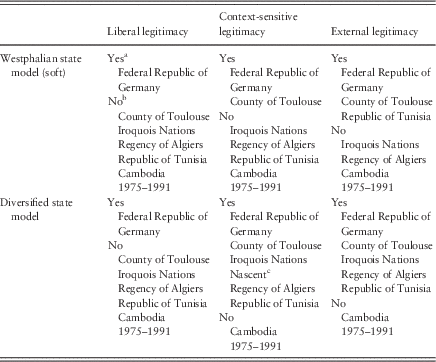
The table above summarizes the discussion: it illustrates which kinds of legal–political entities are recognized as holders of territorial rights – or nascent rights in each of the interpretations of the legitimate state theory discussed. RI endorses a Westphalian model of statehood and liberal criterion of legitimacy and is therefore liable to objections (1)–(3). PI recommends a diversified model of statehood and either context sensitive or external accounts legitimacy, and thus avoids the same objection (Table 1).
The restrictive and pluralist interpretations of the legitimate state theory

a The polity holds territorial rights. For past polities, the classification refers to the time of their existence. As noted above, it will take further consideration to establish whether lost territorial rights in the past have implications today and if so which.
b The polity does not hold territorial rights.
c The polity holds nascent territorial rights.
Conclusion
The legitimate state theory of territorial rights is open to two interpretations. The first – the restrictive view – employs a Westphalian model of statehood and a liberal criterion of legitimacy. I argued that it is liable as a consequence to three objections: limited applicability; undermining the rights of weaker states and their citizens; and reiteration of colonial legacies in international law. Thus, as an alternative I explored a second interpretation of the theory – the pluralist view – which employs a diversified model of state and either a contextual or an external criterion of legitimacy. As a result, the pluralist interpretation is not liable to the same objections and offers a promising approach to the particularity problem, from within the premises of the legitimate state theory of territorial rights.
Acknowledgements
For very helpful comments on previous versions of this article, I would like to thank the editors and anonymous reviewers of International Theory, Margaret Moore, and Annie Stilz.