INTRODUCTION
Traditionally, the cerebellum was perceived as a structure affecting the work of those parts of the central nervous system which were directly associated with motor function. It was not, thus, considered to influence human cognitive function. Such approach changed in the 1980s, when research demonstrated that patients with cerebellar damage exhibited cognitive deficits (Schmahmann, Reference Schmahmann1991). Further clinical trials demonstrated that the cerebellum affects top–down attention, visuospatial and verbal function, non-motor learning, and declarative memory (Baillieux, Smet, Paquier, De Deyn, & Mariën, Reference Baillieux, Smet, Paquier, De Deyn and Mariën2008; Drepper, Timmann, Kolb, & Diener, Reference Drepper, Timmann, Kolb and Diener1999; Golla, Thier, & Haarmeier, Reference Golla, Thier and Haarmeier2005; Gottwald, Wilde, Mihajlovic, & Mehdorn, Reference Gottwald, Wilde, Mihajlovic and Mehdorn2004; Schmahmann & Sherman, Reference Schmahmann and Sherman1998; Tavano et al., Reference Tavano, Grasso, Gagliardi, Triulzi, Bresolin, Fabbro and Borgatti2007), but also more complex behavior regulation processes, namely executive function (Bellebaum & Daum, Reference Bellebaum and Daum2007).
The term executive function has become one of the key notions in contemporary neuroscience (Jurado & Rosselli, Reference Jurado and Rosselli2007). What gained a fair amount of recognition in clinical neuropsychology was Lezak’s concept (Reference Lezak1995), whereby executive functions form a system that allows carrying out a deliberate action. They comprise four processes: volition, planning, purposive action, and effective performance. The correct performance of each of these depends on the completion of the previous one. Thanks to them, people are able to modify and customize their reactions depending on the changing conditions (Anderson, Jacobs, & Anderson, Reference Anderson, Jacobs and Anderson2011). Another complex process associated with executive function is working memory. According to Baddeley (Reference Baddeley2012), it involves phonological loop, visuospatial sketchpad, episodic buffer, and the central executive system performing the control function. Working memory is believed to be responsible for the processing of information for a short time, while executive functions play a role in allocating cognitive resources, monitoring, control, and inhibition of other cognitive processes and behavioral reactions (Diamond, Reference Diamond2013).
Both executive functions and working memory were associated mainly with the activity of the frontal lobes, which suggested the existence of a clear link between one anatomical structure and a complex function, which proved too simplistic an assumption (Alvarez & Emory, Reference Alvarez and Emory2006). Although pathology within the frontal lobes of the brain often leads to executive problems, it has not confirmed the existence of one single typical “frontal lobe syndrome,” because the profile of impairment is patient-specific and depends on various factors, for example, size and location of the damage (Godefroy, Reference Godefroy2003). In addition, executive impairment is not always the result of lesions of the frontal cortex of the brain, but could also occur due to subcortical lesions (Heyder, Suchan, & Daum, Reference Heyder, Suchan and Daum2004), and, on the other hand, damage to the frontal lobes does not always lead to executive function deficits (Baddeley, Della Sala, Papagno, & Spinnler, Reference Baddeley, Della Sala, Papagno and Spinnler1997). Further studies confirmed that executive functions and working memory may be linked to the activity of the superordinate cognitive control network, with a particular involvement of dorsolateral prefrontal cortex (DL-PFC), anterior cingulate cortex (ACC), and subcortical structures, namely basal ganglia and the thalamus (Aron & Poldrack, Reference Aron and Poldrack2006; Dosenbach, Fair, Cohen, Schlaggar, & Petersen, Reference Dosenbach, Fair, Cohen, Schlaggar and Petersen2008; Niendam et al., Reference Niendam, Laird, Ray, Dean, Glahn and Carter2012; Yarkoni et al., Reference Yarkoni, Gray, Chrastil, Barch, Green and Braver2005). It has been demonstrated that the cerebellum mediates in information processing by means of closed cerebellar–cortical loops, or more specifically, through the thalamus it affects the work of the PFC, which in turn sends impulses to the cerebellum through the pontine nuclei (Bostan & Strick, Reference Bostan and Strick2010; Heyder et al., Reference Heyder, Suchan and Daum2004; Schmahmann, Reference Schmahmann1997). These findings were confirmed in research using functional magnetic resonance imaging (MRI) that showed strong projections from the output nuclei to the DL-PFC, the frontal pole, and the inferior parietal lobule (O’Reilly, Beckmann, Tomassini, Ramnani, & Johansen-Berg, Reference O’Reilly, Beckmann, Tomassini, Ramnani and Johansen-Berg2010), as well as the medial PFC and anterior PFC (Krienen & Buckner, Reference Krienen and Buckner2009). Additional neuroanatomical evidence was provided in the study by Granziera, Schmahmann, Hadjikhani, Meyer, and Meuli (Reference Granziera, Schmahmann, Hadjikhani, Meyer and Meuli2009), who by using structural MRI and diffusion spectrum imaging characterized in detail the connections between various areas in those parts of the cerebellum that form closed neuronal loops as well as its projections to the thalamus.
Research on patients with cerebellar lesions confirms its role in the fulfillment of particular executive functions. The data come from neuropsychological analyses of case studies, observations of selective deficits carried out on small groups of patients, or extensive intergroup comparisons. Some research findings show mild neuropsychological impairment in the group of patients analyzed (Beldarrain, Garcia-Monco, Quintana, Llorens, & Rodeno, Reference Beldarrain, Garcia-Monco, Quintana, Llorens and Rodeno1997; Malm et al., Reference Malm, Kristensen, Karlsson, Carlberg, Fagerlund and Olsson1998). According to other findings, patients after neurosurgical procedures on the cerebellum may exhibit profound neuropsychological dysfunction (Kalashnikova, Zueva, Pugacheva, & Korsakova, Reference Kalashnikova, Zueva, Pugacheva and Korsakova2005; Schmahmann & Sherman, 1998). It is also demonstrated that cognitive impairments undergo a partial or complete remission after a few months (Hoffmann & Schmitt, Reference Hoffmann and Schmitt2004; Hokkanen, Kauranen, Roine, Salonen, & Kotila, Reference Hokkanen, Kauranen, Roine, Salonen and Kotila2006; Neau, Anllo, Bonnaud, Ingrand, & Gil, Reference Neau, Anllo, Bonnaud, Ingrand and Gil2000).
Case study analyses have provided inconsistent data on the relationship between cerebellar pathology, executive function impairment, and working memory deficits. In their latest published work, D’aes and Mariën (Reference D’aes and Mariën2015), analyzed 75 case studies published since 1981, where a variety of executive deficits and working memory disorders were found in 19 patients. In the other patients, such deficits were not found or their mental processes were not assessed. Therefore, it was difficult to draw clear conclusions on the basis of such a review.
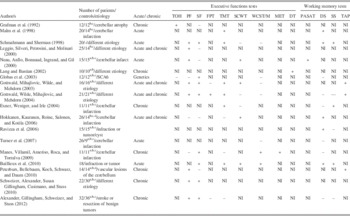
As shown in Table 1, most comparative studies report on the existence of deficits within various aspects of executive function in patients with either lesions or atrophy of the cerebellum. At the same time, there is a considerable variation in patients’ results depending on the study andneuropsychological tests applied. Some studies confirm deficits in mental flexibility assessed by means of Verbal Fluency Test (VFT) and Trail Making Test (TMT), verbal inhibition of the dominant reaction measured with the Stroop Color Word Test (SCWT), and problem solving deficits revealed in the performance of the Wisconsin Card Sorting Test (WCST) or its modified version. Interesting results are provided in the study by Lang and Bastian (Reference Kortte, Horner and Windham2002), in which they demonstrated deficits in multitasking (effective coordination of different sensory inputs or behavioral outputs) and a study by Manes, Villamil, Ameriso, Roca, and Torralva (Reference Manes, Villamil, Ameriso, Roca and Torralva2009), in which they confirmed the “real life” executive deficits on the basis of an assessment carried out by means of an ecological test—the Multiple Errands Test (MET). In many studies, the authors have drawn conclusions about the existence of executive deficits based on the patients’ response times, which also could point to a slower processing of information. However, not all the studies confirm the existence of executive dysfunction in patients.
Survey on patient studies testing for executive functions deficits and working memory impairments after cerebellar damage

Note. +=deficits present; -=no deficits present; NI=no information; DS=Digit Span from Wechsler Memory Scale (WMS) or Wechsler Adult Intelligence Scale – Revised (WAIS-R); FPT=Five Point Test; MET=Multiple Errands Test; DT=dual task (multitasking); PASAT=Paced Auditory Serial Addition Test; PF=phonemic fluency; SF=semantic fluency; SCWT=Stroop Color Word Test; SS=Spatial Span from Wechsler Memory Scale (WMS); TAP=Testbatterie zur Aufmerksamkeitsprüfung; TMT=Trail Making Test; TOH=Tower of Hanoi; WCST/M=Wisconsin Card Sorting Test or modified.
a Healthy controls matched for gender.
b Age.
c Years of education.
d Premorbid intelligence quotient.
Similarly, certain deficits in working memory have been found in patients with a damaged cerebellum. However, it should be noted that these deficits were rather mild. Ravizza et al. (Reference Ravizza, McCormick, Schlerf, Justus, Ivry and Fiez2006) demonstrated that patients’ performance of the Digit Span test, although within a population norm, was significantly worse compared with the control group. In addition, patients exhibited verbal memory deficits, with no impairment observed within non-verbal memory. In a study by Neau et al. (Reference Neau, Anllo, Bonnaud, Ingrand and Gil2000), patients had significantly lower scores on the Paced Auditory Serial Addition Test (PASAT). In this case, however, it is difficult to attribute the scores only to working memory deficits, since the test can also be used to evaluate auditory attention and executive functions. Working memory deficits have also been demonstrated by patients’ performance of the Testbatterie zur Aufmerksamkeitsprüfung (TAP, Gottwald, Mihajlovic, Wilde, & Mehdorn, Reference Gottwald, Mihajlovic, Wilde and Mehdorn2003; Gottwald et al., Reference Gottwald, Wilde, Mihajlovic and Mehdorn2004; Peterburs, Bellebaum, Koch, Schwarz, & Daum, Reference Peterburs, Bellebaum, Koch, Schwarz and Daum2010). The studies presented in Table 1 describe patients with different etiology of the disease, used a variety of research techniques, and the neuropsychological assessment was performed in different stages of the disease (acute or chronic), which made it difficult to compare the results obtained by the patients.
Schmahmann and Sherman (1998) demonstrated the presence of executive function deficits in the form of problems in the areas of planning, set shifting, and working memory in patients with cerebellar pathology. The patients also displayed other cognitive impairments and premorbid personality changes, which was dubbed the cerebellar cognitive affective syndrome (CCAS). Bellebaum and Daum (2007) noted that, despite the fact that other studies seem to have confirmed executive and cognitive deficits in patients with a damaged cerebellum, the interpretation of these results should be made very cautiously, because the location of the damage and test results differ greatly across individual patients.
Functional neuroimaging studies of healthy subjects provide further evidence of the involvement of the cerebellum in cognitive and executive processes, as they demonstrate the activation of this structure in the performance of tasks involving top–down attention (Kellermann et al., Reference Kellermann, Regenbogen, De Vos, Mößnang, Finkelmeyer and Habel2012), verbal working memory (Marvel & Desmond, Reference Marvel and Desmond2012; Stoodley, Valera, & Schmahmann, Reference Stoodley, Valera and Schmahmann2012), the processes of cognitive inhibition (Brunamonti et al., Reference Brunamonti, Chiricozzi, Clausi, Olivito, Giusti, Molinari and Leggio2014; Rubia, Smith, Taylor, & Brammer, Reference Rubia, Smith, Taylor and Brammer2007; Strick, Dum, & Fiez, Reference Strick, Dum and Fiez2009), verbal fluency (Hubrich-Ungureanu, Kaemmerer, Henn, & Braus, Reference Hubrich-Ungureanu, Kaemmerer, Henn and Braus2002; Frings et al., 2006), and executive functions and decision-making processes (Nagahama et al., Reference Nagahama, Fukuyama, Yamauchi, Matsuzaki, Konishi, Shibasaki and Kimura1996; Vorhold et al., Reference Vorhold, Giessing, Wiedemann, Schütz, Gauggel and Fink2007). The cerebellum, neocerebellum in particular, is important for these processes through its activity in (a) the right and left control executive networks, (b) the salience network, and (c) the default-mode network (Habas et al., Reference Habas, Kamdar, Nguyen, Prater, Beckmann, Menon and Greicius2009; Ito, Reference Ito2008).
As is clear from the literature review, the issue of executive function impairment and working memory deficits in patients with an isolated cerebellar pathology has not been fully resolved. Some research results show that patients exhibit a certain degree of impairment within the listed mental processes, but others have not confirmed its presence. The existence of numerous controversies regarding the subject, together with the importance of the aforementioned functions in the performance of complex operations by the patients with cerebellar pathology, has prompted us to formulate the following research aim: to determine the level of executive function and working memory in patients who had undergone neurosurgery due to pathologies of the cerebellum. Previously, Courchesne and Allen (Reference Courchesne and Allen1997) established that the cerebellum is responsible for preparation of neural activity for new stimuli, optimization of their processing, and readiness to react, and its damage does not eliminate executive functions, but rather weakens them. In turn, Schmahmann and Sherman (1998, 2010) presented their theory of “dysmetria of thought,” according to which cognitive deficits may occur after damage to the cerebellum, in much the same way as the motor deficits arise. Based on these assumptions and the review of available research, we formulated the main hypothesis that patients undergoing surgery due to cerebellar pathology, compared with healthy persons, exhibit impairment within executive functions and working memory. In addition, we assumed that these dysfunctions manifest themselves in the following areas: (1) conceptual thinking; (2) inhibition control of verbal response, and (3) set-shifting in a non-verbal task, because those were often assessed in previous studies, but there still remains a lack of consensus concerning this issue in the field (see Table 1).
METHOD
Participants
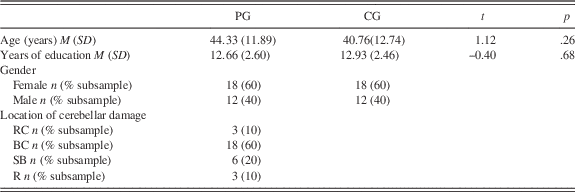
The participants were divided into two groups: patients (PG) and control (CG). The patient group comprised 30 adults with diagnosed pathology (cancer without metastases) within the cerebellum who had undergone neurosurgery. In 18 patients, the lesion was located in the vermis and medial part of the cerebellum, in 6 patients in extreme lateral parts of its hemispheres, in 3 patients in the lateral parts of the hemispheres, and in 3 remaining ones they were spread over all areas of the cerebellum. Qualified for neuropsychological assessment were patients who were at least 6 months post-procedure.
All PG subjects underwent neurological examination, an MRI or computed tomography examination, and were diagnosed with an isolated pathology within the posterior cranial cavity. In addition, subjects from both groups had to score 24 points or higher in the Mini Mental State Examination (MMSE).
The control group comprised 30 (18 women and 12 men) healthy adult volunteers matched for age, sex, and number of years of schooling. Healthy controls were recruited from ads from a variety of institutions, including research centers and educational facilities. Groups were formed through purposeful selection. They did not differ in terms of age (t=1.12; p>.05) or the number of years of education (t=−0.40; p>.05). Sociodemographic and clinical data are presented in Table 2.
Sociodemographic characteristics of the participants

Note. PG=patients group; CG=control group; Specific location of cerebellar pathology: RC=vermis and the medial part; BC=lateral part of the hemisphere; SB=extreme lateral part of the hemisphere; R=all areas.
Exclusion criteria for participation in the study were different preexisting neurological diseases, mental illness, past craniocerebral trauma, severe diseases of parenchymatous organs, addiction to drugs and/or alcohol, mental retardation, and dementia. All participants were briefed with the purpose of the research and gave their written consent to participate in the study in accordance with a Protocol approved by the Commission of Bioethics.
Materials and Procedures
Assessment tools used in the study were the Wisconsin Card Sorting Test (WCST), the Stroop Color-Word Test (SCWT), the Trail Making Test A and B (TMT), and Digit Span (DS). Assessment was conducted by a team of psychologists. The procedure assumed the following order of tests: WCST, SCWT, TMT, DS.
The WCST has a Polish standardization and normalization (Jaworowska, Reference Jaworowska2002). The test is based on its original American version (Heaton, Chelune, Talley, Kay, & Curtiss, Reference Heaton, Chelune, Talley, Kay and Curtiss1993). It consists of four stimulus cards of different color, shape, and the number of items in two identical sets of 64 responses. In the study, the test was interrupted after six categories, or when all the cards had been used. The WCST is used to measure flexibility of abstract thought, concept formation, working memory, executive functions, as well as frontal lobe and ACC impairment (Alvarez & Emory, 2006; Stuss et al., Reference Stuss, Levine, Alexander, Hong, Palumbo, Hamer and Izukawa2000). In our own analyses, to measure the level of problem solving ability (based on factor analyses conducted on patient groups comprising subjects with mental and neurological disorders and healthy individuals), we assumed four indices most often applied in the neuropsychological interpretation, namely, Errors, Number of categories completed, Perseverative responses,, and Perseverative errors (Jodzio & Biechowska, Reference Jodzio and Biechowska2010; Paolo, Tröster, Axelrod, & Koller, Reference Paolo, Tröster, Axelrod and Koller1995; Polgár et al., Reference Polgár, Réthelyi, Bálint, Komlósi, Czobor and Bitter2010; Strauss, Sherman, & Spreen, Reference Strauss, Sherman and Spreen2006).
In the study, we used a modified version of the SCWT, the Victoria version, which consisted of three tasks: (a) speed reading of names of colors printed in black; (b) speed naming of colors presented in the form of rectangles; (c) speed naming of color words printed in ink of different color (e.g., the word “yellow” printed in green; Strauss et al., Reference Strauss, Sherman and Spreen2006). We measured performance time of the task and the number of errors. The SCWT is applied to assess cognitive inhibition of the prepotent automatic reading response’s distracting influence and measure inhibitory control in a conflict situation. The parameters we measured were performance time and the number of errors. In the analyses, we adopted the following indices: (a) trial 1 time (Time 1: speed reading of names of colors); (b) trial 2 time (Time 2: speed naming of colors); (c) trial 3 time (Time 3: speed naming of color words); (d) number of errors in trial 1 (Errors 1); (e) number of errors in trial 2 (Errors 2); (f) number of errors in trial 3 (Errors 3). Due to the fact that, in case of pathology of the cerebellum, it was difficult to separate executive functions from the speed of information processing, following strategies described by Macniven et al. (Reference Macniven, Davis, Ho, Bradshaw, Szabadi and Constantinescu2008), we tried to extract the score regarding the dominant verbal response inhibition by taking into account indices of absolute interference Time 3–2 and Time 3–1, as well as relative interference 100×[(Time 3–2)/Time 2] and 100×[(Time 3–1)/Time 1].
The TMT is composed of two separately assessed parts (A and B; Reitan, Reference Reitan1958). Part A consists in connecting 25 circles containing numbers from 1 to 25, arranged irregularly. In part B, the subject is to alternate between irregularly arranged circles containing numbers from 1 to 13 and letters from A to L, connecting them with a continuous line (Tombaugh, Reference Tombaugh2004). The tool is used in assessment of executive function, rapid set shifting, rate of recognition of symbolic meaning of numbers and letters, ability to symmetrically search through the sheet to connect the numbers and/or letters, as well as planning and task performance under time pressure (Kortte, Horner, & Windham, Reference Kortte, Horner and Windham2002). TMT may also serve as a measure of working memory, executive control, extended concentration, and hand-eye coordination (Tyburski et al., 2014). In the study, performance times for each of the two parts (Time A and Time B) were regarded as the measures of the method. Errors were rare and therefore were not treated as indicators of quality of reaction. In the case of this test, we also had problems in separating executive function from the speed of information processing in patients with cerebellar lesions, so following the strategy used by Macniven et al. (Reference Macniven, Davis, Ho, Bradshaw, Szabadi and Constantinescu2008), we tried to extract the score referring to set shifting by taking into account the indices of absolute interference Time B-A, as well as relative interference 100×[(Time B–A)/Time A].
The use of the Digit Span task has a long history in psychology and dates back to the early works of Ebbinghaus and Galton (Tulsky et al., Reference Tulsky, Saklofske, Chelune, Heaton, Ivnik, Bornstein, Pifitera and Ledbetter2003). We used its version from the Polish adaptation of the Wechsler Adult Intelligence Scale – Revised (WAIS-R; Brzeziński et al., Reference Brzeziński, Gaul, Hornowska, Jaworowska, Machowski and Zakrzewska2004). The method consists of two variants. It is believed that Digit Span “forward” is a simple repetition task and involves mostly auditory short-term memory. The “backward” variant, on the other hand, is a more complicated task and requires manipulation of information stored in short-term memory, which makes it a better measure of working memory (Wilde, Strauss, & Tulsky, Reference Wilde, Strauss and Tulsky2004). Performance of both versions engages attention and linguistic function participating in silent repetition of recorded material (Strauss et al., Reference Strauss, Sherman and Spreen2006). In our analyses, we focused on performance measures of the two variants of the test, namely forward and backward digit span.
Statistical Analyses
The results were subjected to statistical analysis using the statistical package SPSS version 21. Continuous variables are presented as mean (M) and standard deviation (SD). The Shapiro-Wilk test was performed to examine normality of researched variables. To verify the differences between the groups for variables with normal distribution the Student t test was administered. Alternatively, the non-parametric Mann-Whitney U test was used. To determine the effect size of the inter-group differences the following were applied: for parametric tests the Cohen’s d (Cohen, Reference Cohen1992) method, and for non-parametric tests Wendt’s r rank-biserial correlation method (Rosenthal & Rubin, Reference Rosenthal and Rubin2003; Wendt, Reference Wendt1972).
RESULTS
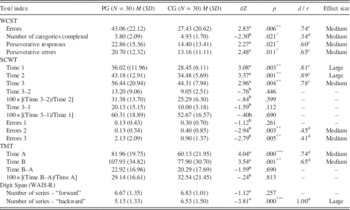
The following constitutes the analysis of the data gathered in the research project. The patient group (PG) was compared to the control group (CG) in terms of the results obtained in the WCST, SCWT, TMT, and DS WAIS-R. The results are presented in Table 3. Compared to their CG counterparts, PG subjects got lower results with regard to four basic indicators of the WCST: Errors (t=2.83; p<.01), Number of categories completed (Z=−2.30; p<.05), Perseverative responses (t=2.27; p<.05), and Perseverative errors (t=2.48; p<.05). For four indicators medium effect sizes were demonstrated (.05< d >.74 or .2 < r >.5).
Significance of differences in execution of neuropsychological tests

Note. PG=patients group; CG=control group; WCST=Wisconsin Card Sorting Test; SCWT=Stroop Color Word Test; TMT=Trail Making Test; WAIS-R=Wechsler Adults Intelligence Scale=Revised.
a Student t-test.
b Mann-Whitney U test.
c Cohen’s d effect size: small (.20 –.49), medium (.50 –.79), large (>.80).
d Wendt’s r rank-biserial correlation effect size: small (.10–.29), medium (.30–49), large (.50–1.00).
*p<.05.
**p<.01.
***p<.001.
In the SCWT patient group, subjects compared to healthy controls exhibited longer reaction times: Time 1 (t=3.08; p<.01), Time 2 (t=3.37; p<.01), and Time 3 (t=2.96; p<.01). Medium or large effect sizes were demonstrated for those indicators (.78< d >.89). No differences among participants were shown in the first trial of the SCWT with regard to Errors 1 index (p>.05). Patients, however, made more mistakes in the second and third trial of the test: Errors 2 (Z=−2.94; p<.01) and Errors 3 (Z=−2.79; p<.01). Medium effect sizes were demonstrated for those indicators (.41< r >.45). No inter-group differences were found in the performance of the SCWT for absolute interference or relative interference.
In the TMT patient group, subjects exhibited longer reaction times than healthy controls for both indicators: Time A (t=4.04; p<.001) and Time B (t=3.54; p<.01). Medium effect sizes were demonstrated for both indicators (.65< d >.74). No inter-group differences were observed in the performance of the TMT for absolute interference or relative interference.
In the backward DS patient group, subjects managed to repeat significantly fewer series of digits than their healthy counterparts (t=−3.81; p<.001), with large effect sizes of mean differences (d=1.0). There were no inter-group differences in the performance of forward DS.
DISCUSSION
The purpose of this work was to determine the impact of isolated damage located within the cerebellum on executive function in patients having undergone neurosurgery. Research results establish that PG subjects manifest significant executive function deficits affecting abstract thinking, problem-solving, and verbal working memory. Those processes are linked to the activity of different areas of the brain involved in the so-called central executive network, including, for example, DL-PFC, ACC, basal ganglia, the thalamus, and the cerebellum (Niendam et al., Reference Niendam, Laird, Ray, Dean, Glahn and Carter2012). Deficits within the aforementioned processes may affect both professional and everyday activity of the patients, contributing to difficulties in making complex decisions, performing fast actions, driving motor vehicles, or working under stress among other things (Manes et al., Reference Manes, Villamil, Ameriso, Roca and Torralva2009).
Most neuropsychological tests have a complex structure and various executive and cognitive processes affect their performance (Lezak, Howieson, & Loring, Reference Lezak, Howieson and Loring2004). Moreover, executive functions are of a complex nature themselves, with their various domains not linked to one another, a proof of which may constitute little correlation between the results of different tools used in their assessment, for example, WCST, TMT, VFT (Anderson et al., Reference Anderson, Jacobs and Anderson2011; Jurado & Rosselli, 2007). Therefore, a separate interpretation of particular tests measuring different executive functions was assumed in the analyses.
The analysis of the results of the WCST measures demonstrated that the PG had difficulties in problem solving, set shifting, and abstract thinking. These indicators were recognized as best relating to the described mental processes (Jodzio & Biechowska, 2010; Paolo et al., Reference Paolo, Tröster, Axelrod and Koller1995; Polgár et al., Reference Polgár, Réthelyi, Bálint, Komlósi, Czobor and Bitter2010; Strauss et al., Reference Strauss, Sherman and Spreen2006). Similar results have been shown in studies that compared the results of patients with cerebellar pathology to the normal population (Baillieux et al., Reference Baillieux, De Smet, Dobbeleir, Paquier, De Deyn and Mariën2010). These deficits have also been found in children and young adults with a diagnosed malignant tumor of the cerebellum (Karatekin, Lazareff, & Asarnow, Reference Karatekin, Lazareff and Asarnow2000). Other studies, however, have failed to demonstrate difficulties in terms of problem solving in patients with lesions of the cerebellum of different etiology (Globas et al., Reference Globas, Bösch, Zühlke, Daum, Dichgans and Bürk2003; Gottwald et al., Reference Gottwald, Mihajlovic, Wilde and Mehdorn2003, Reference Gottwald, Wilde, Mihajlovic and Mehdorn2004; Schmahmann & Sherman, 1998). Despite the fact that there were certain controversies concerning the test’s theoretical validity (Baillieux et al., Reference Baillieux, Smet, Paquier, De Deyn and Mariën2008), in several neuropsychological studies researchers managed to confirm executive deficits in patients with various mental and neurological disorders associated with abnormal functioning of the brain, mainly the PFC, the ACC, and the cerebellum (Alvarez et al., 2006; Demakis, Reference Demakis2003; Stuss et al., Reference Stuss, Levine, Alexander, Hong, Palumbo, Hamer and Izukawa2000). It has been shown that cerebellar damage can change the activity of DL-PFC and indirectly affect the processes of thinking and problem solving (Koziol, Budding, & Chidekel, Reference Koziol, Budding and Chidekel2012).
Increased response times in the SCWT indicated patients’ difficulties in the reading ability (Time 1), as the process is highly automated; the color naming ability as it requires activation of the mental lexicon (Time 2) and color naming in a conflict situation, that is, interference (Time 3). Based on the results in test 3 (Time 3 and Errors 3), a cautious conclusion can be drawn about problems concerning dominant response inhibition in patients with PG. However, a lack of inter-group differences in absolute and relative measures of the SCWT could mean a lack of clear deficits in cognitive inhibition. Therefore, increased reaction times could be better explained in terms of reduced speed of information processing. In a study by Gottwald et al. (Reference Gottwald, Mihajlovic, Wilde and Mehdorn2003) carried out on a similar group of patients, the researchers did not find the presence of cognitive inhibition deficits based on the Stroop paradigm either. It was anticipated that the cerebellum, through its connections with the subcortical nuclei, could participate in the regulation of the inhibition networks in the brain and take an active part in the process of detection and correction of errors (Brunamonti et al., Reference Brunamonti, Chiricozzi, Clausi, Olivito, Giusti, Molinari and Leggio2014; Falkenstein et al., Reference Falkenstein, Hielscher, Dziobek, Schwarzenau, Hoormann, Sundermann and Hohnsbein2001; Ito, Reference Ito2008; Ullsperger & von Cramon, Reference Ullsperger and von Cramon2006), which was also confirmed in the functional neuroimaging studies on healthy individuals during their performance of the SCWT (Egner & Hirsch, Reference Egner and Hirsch2005; Stoodley & Schmahmann, Reference Stoodley and Schmahmann2010). However, it should be borne in mind that even if a particular structure of the brain is activated during a cognitive task, it does not prove that it is indispensable for its correct performance. Moreover, if the structure forms a connection with another structure in the functional neural network activated during the execution of the task, it does not prove that all the elements of this network are equivalent for the performance of the task either (Alexander, Gillingham, Schweizer, & Stuss, Reference Alexander, Gillingham, Schweizer and Stuss2012).
Higher response times across the patient group in TMT A could attest to the deficits in the speed of recognition of symbolic meaning of numbers, the ability to symmetrically scan the sheet to connect the numbers in a specific order, or their capacity to plan and carry out the task under time pressure. Lower results in TMT B could, in turn, indicate problems in the area of working memory and mental abilities to shift attention, that is, to rapidly change one’s mental set. Some other researchers came to similar conclusions (Exner, Weniger, & Irle, Reference Exner, Weniger and Irle2004; Gottwald et al., Reference Gottwald, Wilde, Mihajlovic and Mehdorn2004; Malm et al., Reference Malm, Kristensen, Karlsson, Carlberg, Fagerlund and Olsson1998; Schmahmann & Sherman, 1998). However, the results regarding absolute and relative interference rates on the TMT did not confirm clear problems in set shifting and working memory. Therefore, increased reaction times in the TMT, as in the case of the SCWT, could rather indicate a reduced speed of information processing. Still, this does not alter the fact that the cerebellum may affect the activity of the superordinate cognitive control network, as was previously mentioned (Hokkanen et al., Reference Hokkanen, Kauranen, Roine, Salonen and Kotila2006). Haarmeier and Thier (Reference Haarmeier and Thier2007) described features of attention on the basis of the results of several studies on patients with lesions of the cerebellum. It turned out that basic features of top–down attention, such as prolonged concentration, are usually preserved. More complex processes, such as set shifting, that assume a greater involvement of the cognitive system and working memory, on the other hand, are more likely to be disturbed.
Based on the patients’ results on backward Digit Span, we demonstrated dysfunctions of verbal working memory. Similar results were reported in other studies (Exner et al., Reference Exner, Weniger and Irle2004; Hokkanen et al., Reference Hokkanen, Kauranen, Roine, Salonen and Kotila2006; Malm et al., Reference Malm, Kristensen, Karlsson, Carlberg, Fagerlund and Olsson1998; Schmahmann & Sherman, 1998). It should, however, be noted that these deficits may usually be small and only slightly differ from the population norm (Ravizza et al., Reference Ravizza, McCormick, Schlerf, Justus, Ivry and Fiez2006). There were no deficits observed in auditory attention span, as the patients managed to repeat a similar number of digits in the forward Digit Span. The cerebellum is likely to participate in the coding of phonological information and to help strengthen memory traces in the articulatory loop (Justus, Ravizza, Fiez, & Ivry, Reference Justus, Ravizza, Fiez and Ivry2005; Ravizza, Reference Ravizza2001). Neuroimaging studies show that the cerebellum actively cooperates with the Broca’s area (Brodmann’s area 44 and 45) during retention of verbal information over time (Chein & Fiez, Reference Chein and Fiez2001; Majerus et al., Reference Majerus, Laureys, Collette, Del Fiore, Degueldre, Luxen and Metz‐Lutz2003). Therefore, the cerebellum seems to play a key role in short-term processing and retention of information, and its damage may lead to various deficits within verbal working memory.
The deficits within the area of executive functions and working memory as shown in our study can be explained in terms of three different mechanisms: (a) altered activity of prefrontal structures by the damaged cerebellum (Kellermann et al., Reference Kellermann, Regenbogen, De Vos, Mößnang, Finkelmeyer and Habel2012); (b) diaschisis, that is, blood flow reduction in the PFC of the contralateral hemisphere to the unilateral cerebellar lesion (Rousseaux & Steinling, Reference Rousseaux and Steinling1992); and (c) disconnection, that is, damage to connecting pathways in the neural loops between the cerebellum, thalamus, and PFC (Catani, Reference Catani2005). Collected data did not establish which mechanism was the most likely cause of the described disorders. Instead, it is possible to assume the proposal of Courchesne and Allen (Reference Courchesne and Allen1997) that damage to the cerebellum does not eliminate executive functions but rather it reduces them. In addition, our findings support Schmahmann’s theory (Schmahmann & Sherman, 1998, 2010) of “dysmetria of thought,” according to which cognitive or executive impairment may occur after damage to the cerebellum, in much the same way as the motor deficits arise.
In summary, the study shows various deficits within executive function (problem solving, set shifting, cognitive inhibition, and working memory) in a sample of neurosurgical patients. Other authors report on mild impairment, which often quickly goes into remission in patients with cerebellar pathology (Alexander et al., Reference Alexander, Gillingham, Schweizer and Stuss2012; Exner et al., Reference Exner, Weniger and Irle2004; Manes et al., Reference Manes, Villamil, Ameriso, Roca and Torralva2009). Such discrepancies may be accounted for as stemming from different pathomechanisms of the lesions. In our study, the pathology was caused by neoplastic changes. Different analyses (Exner et al., Reference Exner, Weniger and Irle2004; Hoffmann & Schmitt, 2004; Manes et al., Reference Manes, Villamil, Ameriso, Roca and Torralva2009; Neau et al., Reference Neau, Anllo, Bonnaud, Ingrand and Gil2000), on the other hand, report on ischemic strokes as its potential causes, which may involve varying neuroplasticity processes underlying the remission of impaired functions (Di Pino et al., Reference Di Pino, Pellegrino, Assenza, Capone, Ferreri, Formica and Di Lazzaro2014; Hutchinson, Reference Hutchinson2010).
To conclude, the results presented here confirm the findings of other studies and require further empirical verification. A significant value of the research lies within the use of a neuropsychological test battery assessing various executive functions and a large clinical group. It should be stressed that the data obtained enables consideration of a wider diagnostic context, especially useful in the work of a therapeutic team. We are aware of the limitation in the form of little predictive power of the administered tools in the real life context, that is, their low ecological validity (Burgess et al., Reference Burgess, Alderman, Forbes, Costello, Coates, Dawson and Channon2006; Manes et al., Reference Manes, Villamil, Ameriso, Roca and Torralva2009). Further research therefore should investigate pharmacotherapy and the meaning of cognitive deficits for the psychosocial functioning of the patients.
CONFLICT OF INTEREST
The authors declare no conflict of interest.