CHD is the leading cause of infant deaths due to birth defects. Although there is a strong hereditary basis, a genetic aetiology is identified in <20% of the individuals diagnosed with CHDs. This reflects the unspecified significance of complex gene–environment interactions to congenital heart defects.Reference Khairy, Ionescu-Ittu and Mackie 1 – Reference Wessels and Willems 4
The prevalence of acquired heart disease has decreased over the past decade, but the incidence of CHD has remained unchanged and has even increased, likely due to better detection and improved survival. These alterations in population demographics, such as racial, ethnic, or cultural characteristics, within time emphasise the need to re-assess the contribution of genetic and environmental risk factors in the pathogenesis of congenital heart defects.Reference Marelli, Mackie and Ionescu-Ittu 5 – Reference Jenkins, Correa and Feinstein 7
Maternal smoking during pregnancy is found to be associated with septal defects.Reference Malik, Cleves and Honein 8 It has also been reported that maternal fever or influenza may be associated with right-sided obstructive lesions and atrioventricular septal defects in infants with Down syndrome, whereas maternal use of antipyretics may attenuate such an association.Reference Oster, Riehle-Colarusso and Alverson 9 , Reference Feldkamp, Meyer and Krikov 10 Similarly, the reduction in pre-pregnancy maternal weight and periconceptional usage of multivitamins and folic acid are found to be related with the decreased risk of congenital heart defects.Reference Watkins and Botto 11
The number of clinical studies linking environmental exposures to birth defects has increased in relation to the reported association of maternal, and paternal, illnesses, nutritional deficiencies, drugs, and chemical exposures during embryogenesis and early fetal development; however, the problems in recording the environmental exposures during pregnancy, the difficulties in quantifying these exposures, and the bias in maternal recalling limit the ability to determine the causality.Reference Marelli, Mackie and Ionescu-Ittu 5 – Reference Jenkins, Correa and Feinstein 7
The aim of the present study was to determine the role of toxic elements and trace elements in the pathogenesis of conotruncal heart malformations by measuring their concentrations in the first meconium specimens of the affected newborns.
Materials and methods
This prospective, case-controlled study was approved by the Institutional Review Board and Ethical Committee of Dr. Sami Ulus Obstetrics, Gynecology and Pediatrics Research and Education Hospital. We collected 1st-day meconium specimens from 60 term newborns with conotruncal heart defects and from 72 healthy term newborns that were delivered at the Neonatology Department of the study centre between January, 2010 and January, 2012; 1st-day meconium specimens were collected as meconium was considered as an objective indicator of fetal exposure to heavy metals and trace elements during the gestational period. Cord blood levels of heavy metals and trace elements were not measured as they may not always reflect the degree of fetal exposure during pregnancy because of the instantaneous status of fetal circulation.
Data related to maternal age, parental smoking, parental residence, parental occupation, maternal nutrition, and family history of congenital heart defects were obtained from medical files and retrospective telephone interviews. Moreover, data related to gestational age, birth weight, newborn’s sex, and delivery type were recorded for each case based on the hospital files. At the time of meconium collection, none of the newborns was receiving intravenous fluids, electrolyte support, total parenteral nutrition, or any orally administered essential minerals or vitamins. Written informed consent was obtained from parents or legal guardians of the recruited newborns.
Measurement of heavy metals and trace elements in meconium
Each meconium sample was analysed for levels of iron, copper, zinc, cadmium, and lead. The meconium from each diaper was weighed, transferred to a metal-free glass tube in ice, and then frozen immediately and maintained at −20°C until testing. For analysis, all specimens were dried in a drying oven at 120°C for 1 hour, after which dry weights were recorded. Small amounts (~0.8–1 g) of each sample were transferred to a series of test tubes; 3 ml of concentrated nitric acid was added to each tube, and the mixture was allowed to digest in the oven at 100°C for 1 hour. After cooling, 3 ml of 60% perchloric acid was added to each tube. Next, the mixtures were heated at 120°C and reduced to half volume. The digested material was then diluted to 10 ml with de-ionised water, centrifuged at 500 g, and filtered to remove insoluble material. Each final dilution was mixed in a shaker for 15 minutes just before measurements were taken.
Meconium levels of lead, cadmium, zinc, copper, and iron were determined using a flame atomic absorption spectrophotometer (Shimadzu AA-680, Shimadzu Corp., Kyoto, Japan) based on comparison with external standards. The standards were freshly prepared from standard stock metal solutions (Titrisol 1000±0.002 mg/L, Merck & Co., Kenilworth, NJ, USA) just before analysis, and were used for initial calibration for each substance. These solutions were also used as internal quality standards. Hollow Cathode Lamp and Background Correction (with Deuterium Lamp) modes were selected for element analyses. Each result was corrected for the appropriate reagent used and matrix blanks. For the accuracy of trace element concentrations, each sample was measured twice for each element analysis and the differences <5% between two measurements were accepted. The result for each substance was expressed as micrograms per gram of dry meconium (µg/g dry weight).Reference Ostrea, Moroles and Ngoumga 12
De-ionised water was used to clean the chamber and as zero control for each analysis. The stock standard metal solutions for every metal (1000 mg/L, Merck) were used for positive control and tested for every 25 samples for the reliability of measurement. Minimum detectable limits for lead, cadmium, zinc, copper, and iron were, respectively, 0.045, 0.009, 0.037, 0.080, and 0.014 µg/ml. The recovery of trace elements – zinc and copper – spiked in meconium ranged between 94.1% (92.4–96.7%) and 93–101%, and per cent variance ranged around 2.6% (2.2–3.1%). The recovery of heavy metals – lead and cadmium – spiked in meconium ranged between 100 and 102%. The inter-assay coefficient of variability ranged between 0.34 and 8.9%, and the intra-assay coefficient of variability ranged between 0.44 and 8.44%.Reference Taylor, Branch and Day 13
Statistical analysis
The collected data were analysed by Statistical Package for Social Sciences version 16.0 (SPSS IBM Inc., Armonk, New York, United States of America) on computerised media. The Shapiro–Wilk test was used to test the distribution of variables. Continuous variables were expressed as either mean±SD or median (with a range from minimum to maximum), and categorical variables were denoted as numbers or percentages. Paired samples t-test and χ2-test were used to compare the normally distributed continuous and categorical variables of the two groups, whereas Pearson’s correlation tests were used to detect the correlations; two-tailed p values <0.05 were accepted to be statistically significant. A retrospective post hoc analysis was carried out to show that a cohort size of 123 newborns, with 72 healthy controls and 51 newborns with conotruncal defects, had 67.6% power to detect a difference at the 0.05 significance level.
Results
The present study is a review of 51 chromosomally normal newborns diagnosed with conotruncal defects and 72 healthy newborns; nine newborns that were simultaneously diagnosed with conotruncal defects and chromosomal abnormalities were removed from the final analysis. Conotruncal heart defects referred to the lesions leading to left ventricle outlet obstruction in 28 newborns (46.7%), lesions reducing pulmonary perfusion in 20 newborns (30%), and lesions increasing pulmonary perfusion in 12 newborns (20%).
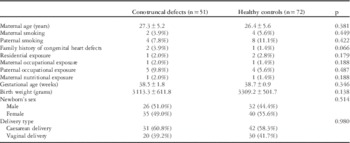
Table 1 demonstrates that the conotruncal defect and the healthy control groups had statistically similar demographic and clinical characteristics: one newborn with conotruncal defect had a mother working in a paint factory, whereas one healthy newborn had a mother working in a factory that produces artificial fertilisers; two newborns with conotruncal defects and one healthy newborn had fathers working in a dry battery factory, whereas three newborns with conotruncal defects and one healthy newborn had fathers working in car repair shops; and two healthy newborns had fathers working in a refinery.
Demographic and clinical characteristics of the study cohort after exclusion of newborns with chromosomal abnormalities.

Table 2 shows that mean concentrations of lead, cadmium, iron, zinc, and copper were significantly higher in the conotruncal defect group than the healthy control group (Table 2).
Biochemical characteristics of the study cohort after exclusion of newborns with chromosomal abnormalities.

*p<0.05 was accepted to be statistically significant
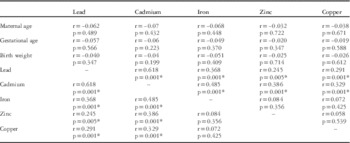
Significant and positive correlations were detected between lead and cadmium (r=0.618, p=0.001), lead and iron (r=0.368, p=0.001), lead and zinc (r=0.245, p=0.005), lead and copper (r=0.291, p=0.001), cadmium and iron (r=0.485, p=0.001), cadmium and zinc (r=0.386, p=0.001), and cadmium and copper (r=0.329, p=0.001) concentrations (Table 3).
Correlations among variables.

r=Correlation coefficient
*p<0.05 was accepted to be statistically significant
Discussion
Conotruncal heart malformations are congenital defects that result in the obstruction of cardiac outflow tracts. The exact aetiology of these malformations is unknown but there is a tendency for addressing genetic and environmental factors. The search for the genetic basis of conotruncal heart malformations remains incomplete without an assessment of environmental factors, because these factors can influence the pathogenetic mechanisms either independently or through gene–environment interactions.Reference Johnson 14 , Reference Gelb and Chung 15
A recent epidemiological study has noted a significant increase in the frequency of prenatal exposure to environmental risk factors. These factors include advanced maternal and paternal age at conception, higher maternal body mass index, higher frequency of maternal medical conditions during pregnancy, such as urinary tract infections and type 1 diabetes, and higher prenatal exposure to medications.Reference Fung, Manlhiot and Naik 16 Lower birth weight and gestational age are also found to be associated with the increased risk of tetralogy of Fallot, double-outlet right ventricle, and truncus arteriosus, although the relationship between birth weight and gestational age and transposition of the great arteries is less clear.Reference Blue, Patel and Korst 17 , Reference Yu, Mao and Chen 18
As for the present study, healthy newborns and newborns with conotruncal heart defects were found to be statistically similar with respect to maternal age, gestational age, and birth weight. The failure in identifying significant differences of maternal age, gestational age, and birth weight might be attributed to the small cohort size.
Epigenetics has been suggested as the probable cause that predisposes to the concurrent occurrence of CHDs and accompanying placental dysfunction. It is well known that gene expression patterns are controlled through two principle mechanisms during cell differentiation. The first or “best understood” mechanism proceeds through the DNA sequence itself. The second or “epigenetic” mechanism refers to the inherited changes in gene function that occur independently of the alterations in the primary DNA sequence.Reference Kwon, Arnold and Hsiao 19 – Reference Ueno, Weidinger and Osugi 21
The best defined epigenetic modifications are DNA methylation and histone modifications. Both modifications participate in Wnt signalling, which is a critical pathway in early cardiomyogenesis and placentation.Reference Kwon, Cordes and Srivastava 20 , Reference Ueno, Weidinger and Osugi 21
After fertilisation, DNA sequences undergo progressive demethylation and become hypomethylated during the pluripotential stages of embryogenesis. As cells differentiate, a more hypermethylated state is achieved. Thus, cells are targeted to their own specific fate and other genes are silenced through methylation.Reference Nafee, Farrell and Carroll 22 , Reference Kiefer 23
Recent reports have demonstrated that alcohol exposure alters DNA methylation profiles and causes demethylation in mouse embryos at early neurulation and patterning of 5-methylcytosine expression during neurogenesis.Reference Liu, Balaraman and Wang 24 , Reference Zhou, Chen and Love 25 Such an impact can be expected for maternal exposure to toxic metals and trace elements during early embryonic development. It has been reported that toxic metals can make up specific complexes by acting in combination with trace elements, and thus interfere with DNA repair mechanisms.Reference Salnikow and Zhitkovich 26
Toxic metals and trace elements can be transported from mother to fetus via blood circulation and their excessive levels may accumulate in the fetus and cause harm. The levels of trace elements and toxic metals in a newborn’s blood usually may not always reflect the degree of fetal exposure to toxic metals or actual degrees of excess or deficiency of trace elements. The reason is that the concentrations of toxic metals and trace elements in a newborn’s blood mostly depend on the instantaneous status of circulation and metabolism.Reference Turker, Ergen and Karakoç 27 , Reference Turker, Ozsoy and Ozdemir 28
Meconium is the dark viscous stool that is passed by newborns in the first few days of life. This material may provide an index of mineral accumulation by the fetus, as stool is normally not excreted during intrauterine life. Many substances processed by the fetus accumulate in the fetal intestine, thus meconium analysis may also be used to assess levels of fetal exposure to toxic metals during the gestational period. Therefore, the composition of this first postnatal meconium can be considered to reflect the nutritional “history” of the fetus objectively, as all inorganic elements are received from the mother.Reference Geaghan 29 , Reference Joya, Marchei and Salat-Batlle 30
According to an epidemiological study conducted in China, the most prominent clustering trend for CHD prevalence among 0-to 14-year-old children in the Sichuan Basin showed a plausibly close similarity with that observed in the Tuojiang River Basin. The high ecological risk of heavy metals such as cadmium, arsenic, and lead sediments in the middle and lower streams of the Tuojiang River and ammonia–nitrogen pollution have been regarded as the main contributors to the high prevalence of congenital cardiac defects.Reference Ma, Zhao and Ren 31
In compliance with the Chinese study, this study points out significantly higher concentrations of toxic metals and trace elements in 1st-day meconium samples of the chromosomally normal newborns with conotruncal defects. No statistically significant difference can be found between the conotruncal defect and healthy control groups with respect to occupational, nutritional, and residential exposure of the parents.
On the other hand, a number of moderately significant correlations have been detected among heavy metals and trace elements. This finding suggests that newborns are somehow exposed to an environment that is polluted by more than one element. It is quite possible that heavy metals and trace elements act collaboratively in the pathogenesis of conotruncal defects. It may be speculated that conotruncal defects may occur as DNA methylation mechanisms are impaired by cumulative effects of heavy metals and trace elements during fetal development, and fetal exposure to these inorganic substances may occur through the mothers who are living within an already polluted environment.
The power of the present study is limited by the relatively small cohort size, the absence of cord blood levels of heavy metals and trace elements, as well as the recalling bias, which may have affected the reliability of the data related to occupational, residential, and nutritional exposure of the parents. Large-scale, prospective studies are needed to clarify the role of heavy metals and trace elements in the pathogenesis of conotruncal heart defects that affect chromosomally normal children.
Acknowledgements
None.
Financial Support
This research received no specific grant from any funding agency, commercial, or not-for-profit sectors.
Conflicts of Interest
None.
Ethical Standards
The authors assert that all procedures contributing to this work comply with the ethical standards of the relevant national guidelines on human experimentation (Iyi Klinik Uygulamaları, Klinik Arastirmalar Dernegi, 2015) and with the Helsinki Declaration of 1975, as revised in 2008, and have been approved by the Ethical Committee of Dr. Sami Ulus Obstetrics, Gynecology and Pediatrics Research and Education Hospital.