INTRODUCTION
Mesoamerica is home to one of the most diverse and threatened amphibian faunas on the planet (Vié et al. Reference VIÉ, HILTON-TAYLOR and STUART2009). Widespread forest loss is the primary threat to amphibian biodiversity in the region and likely interacts with other known causes of declines such as contamination and disease (Becker & Zamudio Reference BECKER and ZAMUDIO2011, Gardner et al. Reference GARDNER, BARLOW and PERES2007, Kerby et al. Reference KERBY, HART and STORFER2011, Vié et al. Reference VIÉ, HILTON-TAYLOR and STUART2009, Whitfield et al. Reference WHITFIELD, KERBY, GENTRY and DONNELLY2012). Amphibians may be particularly vulnerable to forest conversion because they are small-bodied, have limited vagility, and high susceptibility to desiccation, which can impede dispersal and reduce survival in habitats with little cover (Nowakowski et al. Reference NOWAKOWSKI, OTERO-JIMENEZ, ALLEN, DIAZ-ESCOBAR and DONNELLY2013, Rothermel & Luhring Reference ROTHERMEL and LUHRING2005).
In north-eastern Costa Rica, the establishment of cattle pastures was the primary driver of deforestation during the previous three decades (Butterfield Reference BUTTERFIELD, McDade, Bawa, Hespenheide and Hartshorn1994). Pastures are characterized by extensive cover of grasses that inhibit the recruitment of woody plants, and by microclimates that are warmer and drier than in forest (Nowakowski et al. Reference NOWAKOWSKI, OTERO-JIMENEZ, ALLEN, DIAZ-ESCOBAR and DONNELLY2013, Slocum Reference SLOCUM2001). If pastures represent poor-quality habitat for amphibians, populations in pastures may act as sinks, may be dominated by subordinate individuals, and could experience greater fitness costs than individuals in nearby forest, such as increased parasite loads and reduced growth and survival (Hitchings & Beebee Reference HITCHINGS and BEEBEE1997, McKenzie Reference MCKENZIE2007). Fitness costs may be reflected by lower relative abundances in pastures and by indices of physical condition, such as body size and endurance (Neckel-Oliveira & Gascon Reference NECKEL-OLIVEIRA and GASCON2006).
The number of trees left standing after forest conversion varies greatly among pastures, and remnant trees are likely important mediators of habitat quality for amphibians in these systems (Felton et al. Reference FELTON, KNIGHT, WOOD, ZAMMIT and LINDENMAYER2010). Single trees create environments that differ from open pasture by altering micro-climate, facilitating recruitment of native vegetation, and providing foraging sites and reproductive resources (Manning et al. Reference MANNING, FISCHER and LINDENMAYER2006, Slocum Reference SLOCUM2001). Trees in pastures could facilitate inter-patch movement among forests by acting as stepping stones or function as discrete habitat patches for amphibian species with limited home-range requirements (Chan-McLeod & Moy Reference CHAN-MCLEOD and MOY2007, Lumsden & Bennet Reference LUMSDEN and BENNET2005).
The dart-poison frog, Oophaga pumilio (Schmidt 1857), is associated with large trees in forest, which are responsible for the provisioning of refugia, leaf-litter foraging and oviposition sites, and tadpole rearing sites in phytotelmata that are common in epiphytic bromeliads (Donnelly Reference DONNELLY1989a). A previous study showed that average abundances of O. pumilio were 13 times greater along transects in forest than in adjacent pastures, suggesting that pastures represent relatively inhospitable habitat for this species (Kurz et al., unpubl. data). However, the extent to which pasture trees are used by O. pumilio is unknown.
The objectives of our study were to compare the use of individual trees by O. pumilio in forest-fragment edge zones and adjacent pastures, to determine if trees in pastures function as stepping stones or as primary habitat, and to compare indices of physical condition between frogs found in forest edge-zones and nearby pastures. Specifically, we employed mark–recapture methods to determine (1) if the average number of frogs per tree, observed sex ratios, and probability of moving among trees differed between forest edges and adjacent-pasture habitat, (2) which factors were important for explaining abundances of O. pumilio at single trees and (3) to compare size, condition and endurance as proxies of fitness of individuals found in pasture and forest habitats. We expected, a priori, that per-tree abundances would be lower and movement probability would be greater (i.e. lower residency time) at pasture trees than forest-edge trees and that individuals in pastures would be in poorer physical condition than those in forest.
METHODS
Study area and species
Our study was conducted from June to August of 2012 in the Sarapiquí canton in Costa Rica. The study area has a mean annual temperature of 25 ºC and an annual precipitation of ~4 m (Sanford et al. Reference SANFORD, PAABY, LUVALL, PHILLIPS, McDade, Bawa, Hespenheide and Hartshorn1994). Principal land-cover categories in the region are forest, pasture, pineapple and banana plantations (Sesnie et al. Reference SESNIE, GESSLER, FINEGAN and THESSLER2008). There is still moderate cover of fragmented forest (c. 50% of the landscape), and nearest-neighbour distances between forest patches are typically ≤200 m (Nowakowski et al. Reference NOWAKOWSKI, OTERO-JIMENEZ, ALLEN, DIAZ-ESCOBAR and DONNELLY2013). While cattle pastures represent the dominant land use in the region, occupying approximately 20% of the land area, most pastures are of modest size and adjacent to forest.
The study species was O. pumilio, a small red poison frog with blue hind limbs that is common in lowland forests (Savage Reference SAVAGE2002). Adults of this species are considered to be philopatric and maintain home ranges on the order of 10–30 m2 (Donnelly Reference DONNELLY1989b). Habitat requirements for O. pumilio include tadpole rearing sites, such as bromeliads, tree holes and Heliconia, and leaf-litter oviposition substrates (Donnelly Reference DONNELLY1989a, Pröhl & Berke Reference PRÖHL and BERKE2001). Donnelly (Reference DONNELLY1989a) found that bromeliads were an important resource for O. pumilio, which limited population densities; however, additions of leaf litter increased the home-range size of O. pumilio (Donnelly Reference DONNELLY1989b). Territorial behaviour has been documented in both males and females, which may influence space-use, and therefore could also limit densities (Gardner & Graves Reference GARDNER and GRAVES2005, Meuche et al. Reference MEUCHE, LINSENMAIR and PRÖHL2011).
Sampling methods
Three replicate sites, separated by 3.5–8 km, were selected in the landscape near La Selva Biological Station, each consisting of a remnant forest (110–392 ha in area) that has experienced some degree of selective logging in the past and an adjacent pasture with remnant trees. To select study trees at each site, we demarcated forest-pasture edges, 100–150 m in length. Forest–pasture edges are typically abrupt, and vegetation structure (i.e. total basal area, biomass and canopy closure) in forest is not strongly influenced by edge proximity in this system (Nowakowski et al. Reference NOWAKOWSKI, OTERO-JIMENEZ, ALLEN, DIAZ-ESCOBAR and DONNELLY2013, Schedlbauer et al. Reference SCHEDLBAUER, FINEGAN and KAVANAGH2007). On the pasture side of the edge, we marked all of the nearest 21–30 trees (>25 cm dbh), which ranged between 2–150 m distance from the edge. Many of the trees in pasture belonged to the genera Dipteryx, Ficus and Pentaclethra. Because we were interested in documenting movement among trees within habitats as well as between forest and pasture habitat, we marked forest trees along the edge zone to a distance of 25–30 m into the forest.
To approximate the random spatial distribution of focal trees sampled in the pastures (where some trees were isolated and others occurred in small clusters) and to approximate the size distribution of pasture trees (pastures trees tended to be large), the following procedure was used to select forest trees. Initially, all large trees (dbh >45 cm) within the edge zone were marked. Next, we revisited each large tree and determined by coin flip if: (1) the tree would remain in the sample or be replaced by a nearby small tree (<45 cm dbh); (2) a second coin flip determined if the tree would be sampled as a singleton (not sampled as part of a cluster) or part of a small cluster of sampled trees; (3) if the tree was to be part of a cluster, random numbers between two and five were used to determine the number of trees sampled in clusters. The selection procedure was repeated at each marked tree in the forest until an equal number of forest trees were selected to those already marked in the pasture. If the selected number was too low after completing the randomized selection, the large-tree criterion was lowered to dbh >35 cm.
Mark–recapture surveys involved visiting a site on 3 consecutive days to search all marked trees for frogs and then returning 6–7 d later to conduct another 3 d of surveys. Three sampling bouts were conducted at each of the three sites in a rotation and all trees were surveyed a total of nine times. Across all sites, we completed surveys at a total of 147 trees, 74 pasture trees and 73 forest trees. We surveyed for frogs using visual encounter searches within a 3-m radius at the base of each tree for 4 min. We gently probed the leaf litter using PVC poles, and all captured O. pumilio individuals were given a unique mark using toe-clipping methods (Donnelly et al. Reference DONNELLY, GUYER, JUTERBOCK, ALFORD, Heyer, Donnelly, McDiarmid, Hayek and Foster1994). We also measured mass (to 0.05 g) and snout-vent-length (SVL; to nearest mm). Sex was determined by the presence of dark gular sacs in adult males (Donnelly Reference DONNELLY1989c). Capture status was recorded for each frog encountered during subsequent surveys throughout the field season. Frogs were immediately released at the site of capture after processing.
At each tree, we measured environmental factors that we hypothesized might affect frog abundances. The diameter at breast height (dbh) of trees was measured using a dbh tape. Leaf litter per cent coverage was measured by placing a PVC pole at the base of a tree in each of four cardinal directions and recording presence–absence of leaf litter at five points marked on the pole for a total of 20 points. An index of bromeliad load was obtained for each tree by counting the number of bromeliads present within the 3-m search radius and along the bole of the tree up to and including the first branch. Cattle disturbance was estimated by counting the number of dung pats within the search radius and number of logs was also counted at each tree. To characterize the effect of individual trees on local microclimate, temperature was measured at a subset of trees in forest and pasture as well as in open pasture and at random points in forest using iButton hygrochron temperature sensors (Maxim Integrated Products).
Indices of physical condition were measured in two ways: (1) body size of forest and pasture frogs was estimated as mean SVL and mass measured during mark and recapture surveys, and (2) endurance of individuals captured from each forest and pasture site (n = 36) was measured using a treadmill in an ambient-air laboratory. The treadmill was constructed inside a portable toolbox with a soft-rubber belt that was moved by a small electrical motor. The walls around the treadmill were lined with foam to keep the frog confined to the conveyer belt. A foam wall was placed on the back of the belt to provide a stimulus to propel the frog forward, leaving only a small space between the bottom of the wall and the belt (c. 0.5 cm). Occasionally, frogs attempted to escape during the first minutes of the trial and a PVC tube was used to immediately detach the frogs from the walls; most individuals quickly acclimated to the treadmill and hopped continuously during the majority of the trial. Before each blind trial, a frog was randomly selected and its SVL and sex were recorded. Three consecutive trials were conducted with each frog to test the assumption that frogs stopped hopping when they became tired, and the trial ended when the frog stopped hopping and fell off the end of the treadmill. All frogs were released at their capture sites.
Statistical analyses
We averaged the number of frogs per tree across sites and compared forest-edge zones and pasture habitats using an independent-sample t-test that does not assume equal variances. We compared the proportions of males and females occupying trees in forest and pasture using a Chi-squared test. To compare mean size between habitats, the SVL and mass of frogs were first converted to z-scores, which were calculated separately for males and females using the mean and SD from the pooled dataset to standardize by sex. We also calculated a body condition index for each individual, because condition can exhibit a stronger association with fitness than size measures (Meuche et al. Reference MEUCHE, LINSENMAIR and PRÖHL2012). The condition index was calculated as the residuals obtained from simple linear regressions between SVL and mass estimated separately for males (F = 15.5, df = 55, R2 = 0.22, P < 0.001, y = −0.552 + 0.068x) and females (F = 38.6, df = 101, R2 = 0.28, P < 0.001, y = −0.513 + 0.065x). Mean z-scores and condition indices were compared between habitat types using unequal variance t-tests. To compare mean endurance times on treadmills, we used a non-parametric Wilcoxon test because times were not normally distributed. We analysed endurance time for the first run of the three successive runs.
We analysed the number of unique captures at individual trees using a generalized linear model. Because the response consisted of count data, we specified a Poisson distribution with log link. First, we fitted a model with all explanatory variables, including distance to the forest edge, number of logs and bromeliads, tree dbh, per cent leaf-litter cover, number of cow pats and habitat type. The number of logs and dbh were log-transformed to reduce the influence of outliers. We assessed the existence of spatial autocorrelation in the data using spline variograms and correlograms generated for each site and for the entire dataset, and found no evidence for spatial non-independence of the residuals (Zuur et al. Reference ZUUR, IENO, WALKER, SAVELIEV and SMITH2009). Next, a stepwise model-selection routine with AIC was used to choose a subset of explanatory variables and the model was refitted with the best subset. Because data exploration revealed potential interactions with habitat type, we fitted an additional model that included interactions between selected environmental variables and habitat type and compared these models using AIC values.
We analysed the probability of movement among trees for individuals that were recaptured at least once using a multiple-logistic regression model. The recapture status, 0 for frogs recaptured at the same tree and 1 for frogs recaptured at a tree other than the original capture location, was entered as the binary dependent variable. Habitat, environmental variables associated with the location of first-time capture, along with sex and SVL were entered as independent variables. Stepwise selection with AIC was used to determine the best model. All analyses were performed using the R statistical platform v.2.15.1.
RESULTS
We captured a total of 167 individuals; 87 individuals were recorded at trees in pastures and 80 individuals were recorded at trees in forest-edge zones. There was no significant difference in mean number of individuals captured per tree between forest and pasture (t = −0.148, df = 2.15, P = 0.895). The proportion of males and females also did not differ between forest (35% M and 65% F) and pasture (38% M and 62% F; χ2 = 0.169, df = 1, P = 0.68).
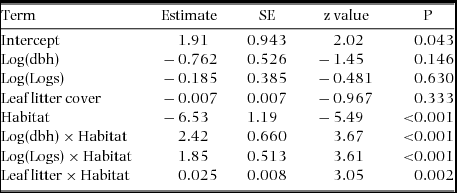
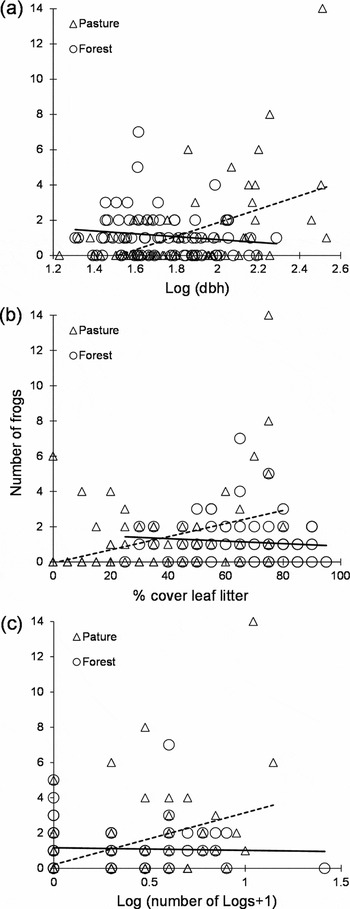
Counts at single trees were influenced by several environmental variables; the final model included logs (mean ± SD; forest: 1.8 ± 3.3 logs; pasture: 1.9 ± 2.6 logs), leaf litter (forest: 68% ± 17%; pasture: 33% ± 23%), tree dbh (forest: 61.9 ± 35.5 cm; pasture: 85.1 ± 70.4 cm), and the interactions of these variables with habitat type (Table 1, Figure 1). Because a single tree included an unusually high number of individuals (14) that may have exerted strong influence in the analysis, we conducted a second analysis excluding this observation. All terms significant in the original model were significant without this observation; so, we present the model with the full set of observations (Table 1). Maximum daytime temperatures recorded with iButton sensors were (mean ± SD) 28.2 °C ± 1.76 °C under forest trees, 28.7 °C ± 1.93 °C at random forest points, 34.6 °C ± 6.59 °C under pasture trees, and 38.2 °C ± 4.55 °C in open pasture.
Parameter estimates and P-values from a generalized linear model used to evaluate the effects of local environmental variables on counts of Oophaga pumilio at individual trees in forest and pasture habitats in north-eastern Costa Rica.

Relationships between number of unique captures of Oophaga pumilio at each tree and significant predictor variables, log dbh (a), leaf-litter cover (b), and the log of the number of logs (c). Least-squares regression lines are included to demonstrate the interactions between variables measured at pasture (dashed lines) and trees in forest-edge zones (solid lines) in Sarapiquí, Costa Rica.

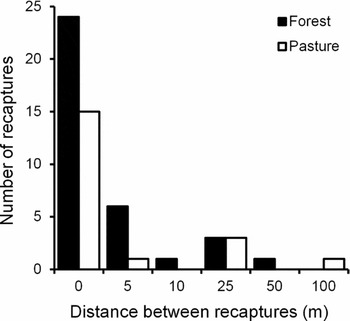
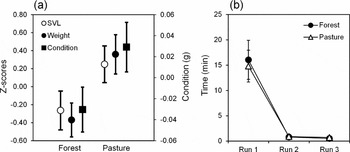
A total of 59 individuals were recaptured (35% of total captures) during our surveys. Fifty-eight per cent of recaptured individuals were females and 42% were males. Most individuals were recaptured at the site of initial capture. However, 16 individuals were recaptured at different trees (Figure 2). Three individuals were observed to have moved between forest and pasture habitat. None of the explanatory variables measured, including sex, size and habitat, was a significant predictor of movement among different trees (P > 0.05 for all variables). Mean mass (g) standardized by sex (Figure 3a; t = −4.96, df = 155.3, P < 0.001), mean SVL (mm) standardized by sex (t = −3.39, df = 159.7, P < 0.001), and mean body condition index (t = −3.66, df = 157, P < 0.001) were all greater in pasture than in forest. There was no difference in mean endurance time during treadmill trials between frogs captured in pastures and in forest (Figure 3b; W = 171, P = 0.773).
Histogram of distances moved between focal trees by Oophaga pumilio individuals during a mark–recapture study in pastures and forest-edge zones in north-eastern Costa Rica.

The mean z-scores for SVL and weight standardized by sex (left axis) and mean body condition values (right axis) for Oophaga pumilio individuals captured in pastures and forest in Sarapiquí, Costa Rica (a). The mean endurance times of frogs in the treadmill experiment (b). All error bars represent 95% confidence intervals.

DISCUSSION
Here we show that remnant trees are salient habitat features for O. pumilio in pastures that otherwise represent inhospitable landscape components for this species. In previous studies, plots and transect surveys randomly located in pastures recorded very few O. pumilio individuals in comparison to adjacent forest habitat (Kurz et al. unpubl. data, Nowakowski et al. unpubl. data). However, mark–recapture data from this study show that per-tree abundances were similar at trees in forest and pasture, and observed sex ratios did not differ between habitats, suggesting that the habitat value of pastures for O. pumilio is likely dependent on the number of remnant trees left standing.
Temperature and moisture differences may account, in part, for the importance of trees in pastures, as microclimates under single trees tend to be cooler and wetter than in open pasture (Manning et al. Reference MANNING, FISCHER and LINDENMAYER2006). Amphibians are particularly sensitive to changes in microclimate because they are ectothermic and have highly permeable skin making them susceptible to desiccation (Wells Reference WELLS2007). In particular, species in tropical zones may have narrow thermal tolerances, and for some species, temperatures in forests are already near their thermal maxima (Sunday et al. Reference SUNDAY, BATES and DULVY2011, Whitfield et al. unpubl. data).
We found that the relationship between explanatory variables and abundances of O. pumilio was stronger in pastures than in forest-edge zones (Figure 1). The significant interactions may reflect the importance of individual trees as distinct habitat patches in the pasture matrix. Home ranges of individuals, which are typically similar in size to our search areas (Donnelly Reference DONNELLY1989b), may correspond more closely in space with individual trees in pastures than in forests, because resources in pastures are presumably tightly coupled with individual trees. In forest, on the other hand, resources and individual home ranges may include several trees rather than being linked with any one tree.
The number of logs, dbh and leaf litter were identified as important predictors of frog abundance. In pastures, tree diameter is related to the size of the habitat patch, and we observed that larger trees supported greater numbers of individuals. Leaf litter is an important resource for O. pumilio; the arthropod diet of this species is found in the leaf litter (Donnelly Reference DONNELLY1991), which also serves as oviposition sites (Donnelly Reference DONNELLY1989a) and refuge sites (pers. obs.). Average leaf-litter cover was lower in pasture than in forest, and while leaf-litter addition did not change frog densities in previous experiments (Donnelly Reference DONNELLY1989a), it is conceivable that below a given threshold it may become a limiting factor. Downed logs also represent potential refuge sites from high temperatures and predators.
We recaptured 59 marked individuals and observed that the majority (73%) did not move from the original tree of capture. We recorded only 16 indviduals that moved between study trees and probability of movement was not influenced by any of the measured predictor variables, including habitat type, sex, size and environmental variables (Figure 2). It is possible that our data underestimate the frequency of movement, for example, if individuals moved between trees, but were not recaptured or moved out of the study area. While long-term mark–recapture data are needed to draw definitive conclusions about population dynamics in pastures, our data suggest that over the course of the study, individuals maintained home ranges at single trees in pastures and that movement among trees was limited.
Previous research on amphibians in human land-uses has demonstrated that use of these habitats may have associated fitness costs, such as reduced larval survival and body size (Hitchings & Beebee Reference HITCHINGS and BEEBEE1997, Neckel-Oliveira & Gascon Reference NECKEL-OLIVEIRA and GASCON2006). In this study, endurance tests showed no difference between groups, and contrary to our expectations, frogs tended to be larger and have greater body condition values in pastures than in forest habitat (Figure 3). Possible explanations for the significant size and condition differences include: (1) there are demographic differences between forest edges and pasture habitats that manifested in a younger age structure in the forest, (2) per capita resource availability is greater in pastures, which in turn could reflect abundance and quality of resources or lower competition in pastures, or (3) environmental conditions in pasture select for individuals that attain greater mass and length. Our results do not support the hypotheses that individuals in pastures are subordinates or are in poorer physical condition than forest frogs; however, future research should focus on long-term differences in population growth rates and migration rates between forest and pasture to lend insight into whether pastures act as population sinks (Pulliam Reference PULLIAM1988).
Remnant trees are likely important features of altered landscapes, and their value to wildlife, on a per-tree basis, may be disproportionately greater in human-altered habitats than in forest (Fischer et al. Reference FISCHER, STOTT and LAW2010). A number of studies have documented the importance of remnant trees for bird and bat communities in agricultural landscapes (Fischer et al. Reference FISCHER, STOTT and LAW2010, Mahood et al. Reference MAHOOD, LEES and PERES2012, Sekercioglu et al. Reference SEKERCIOGLU, LOARIE, BRENES, EHRLICH and DAILY2007), and Felton et al. (Reference FELTON, KNIGHT, WOOD, ZAMMIT and LINDENMAYER2010) showed that the presence of remnant-native vegetation influenced the response of reptiles and amphibian communities to pastures in Australia and Africa. Our results for O. pumilio corroborate previous findings and collectively, this research suggests that remnant trees represent important habitat structures in altered landscapes that should be actively conserved (Fischer et al. Reference FISCHER, STOTT, ZERGER, WARREN, SHERREN and FORRESTER2009, Harvey et al. Reference HARVEY, MEDINA, SÁNCHEZ, VÍLCHEZ, HERNÁNDEZ, SAENZ, MAES, CASANOVES and SINCLAIR2006, Manning et al. Reference MANNING, FISCHER and LINDENMAYER2006). As agricultural and pastoral land-uses intensify (i.e. increase in extent and homogeneity), the amount of remnant vegetation on the landscape decreases (Karp et al. Reference KARP, ROMINGER, ZOOK, RANGANATHAN, EHRLICH and DAILY2012). While pastures may be relatively poor habitat for amphibians compared with forest (Kurz et al. unpubl. data, Nowakowski et al. Reference NOWAKOWSKI, OTERO-JIMENEZ, ALLEN, DIAZ-ESCOBAR and DONNELLY2013), the number of remnant trees left standing may greatly modify the value of pastures as habitat and corridors.
ACKNOWLEDGEMENTS
We are grateful to M. Veiman for assistance in the field, R. Saporito for providing the treadmill aparatus, D. Dierick and L. Linhoff for treadmill troubleshooting, and to Joshua Samm for editorial assistance. We would also like to thank the staff at La Selva Biological Station, M. Casey, E. Starke, D. Leon and O. Paniagua for granting access to their properties, and MINAET/SINAC for providing permits. DR and AW were supported by NSF grant number DBI 0851933. The project was carried out with FIU-IACUC permission number 12-003. This paper is contribution number 251 to the Program in Tropical Biology at Florida International University.