Pulmonary atresia with intact ventricular septum is a complex heterogenous lesion with complicated management algorithms.Reference Zuberbuhler and Anderson1–Reference Alwi, Geetha and Bilkis3 In the presence of an adequately sized right ventricle and the absence of right ventricular-dependent coronary blood flow, radiofrequency-assisted balloon dilation of the atretic pulmonary valve is usually performed.Reference Hausdorf, Schulze-Neick and Lange4, Reference Humpl, Söderberg and McCrindle5 For those with right ventricular-dependent coronary blood flow, a single-ventricle palliation is embarked upon.Reference Kreutzer, Mayorquim and Kreutzer6 Survival for these infants is disproportionately low compared with other lesions that have undergone single-ventricle palliation.Reference Daubeney, Delany and Anderson7, Reference Daubeney, Wang and Delany8 Much of the suboptimal survival can be attributed to the tenuous coronary circulation to both left and right ventricles.Reference Freedom, Anderson and Perrin9, Reference Hwang, Taylor and Freedom10 There is a higher early mortality associated with the primary intervention; in most cases, this is a modified Blalock–Taussig shunt,Reference Sanghavi, Flanagan, Powell, Curran, Picard and Rhodes11–Reference Jahangiri, Zurakowski, Bichell, Mayer, del Nido and Jonas13 however ductal stenting may also be an option.Reference Schneider, Zartner, Sidiropoulos, Konertz and Hausdorf14 The purpose of this study was to look at those infants with very small ventricles, dependant of coronary blood flow undergoing single-ventricle palliation, who have the worst survival. We wanted to look at risk factors that might predict early mortality in view of the high early attrition of these infants. Identifying patients at high risk of early mortality might alter pre-operative counselling, influence intraoperative and post-operative care strategies.
Materials and methods
Patients
This study was approved by the Research Ethics Board at the Hospital for Sick Children. Patients were identified retrospectively from the cardiac database from July, 2000 to July, 2008; patients were included in the final cohort if they matched the following definition of pulmonary atresia with intact ventricular septum and did not have any exclusion criteria. For the purpose of the study, pulmonary atresia with intact ventricular septum was defined as either membranous or muscular atresia of the right ventricular outflow tract with an intact ventricular septum, either with or without right ventricular hypoplasia. Patients with anomalous pulmonary venous drainage, unbalanced atrioventricular septal defect, and discordant atrioventricular or ventriculoarterial connections were excluded. In most cases the decision to perform single-ventricle palliation is based on echocardiographic evaluation of right ventricular size and the presence or absence of coronary artery ostia. Where the diagnosis is not clear catheterisation is performed to further evaluate coronary artery anatomy.
Data collection and risk factors
We reviewed baseline anatomical risk factors by determining anatomy by echocardiography. Right ventricular width, length, area, and interventricular septum thickness were measured to assess right ventricular size and right ventricular hypertrophy. Any episodes of clinical instability, that is, hypotension, before the primary intervention were recorded. Clinical status as determined by the vital signs and the arterial blood gas was examined at the time of induction of anaesthesia. Data on any events that occurred during the primary intervention such as hypotension or technical surgical problems were collected. The final set of risk factors were the infants’ clinical status on returning to the critical care unit; this would reflect a combination of events occurring up to this point and also look at early predictors of mortality. Early cardiovascular decompensation was defined as either a cardiac arrest or any acute deterioration that required extracorporeal membranous oxygenation within 48 hours of returning to the critical care unit.
Data analysis
Data are presented as means, medians, standard deviations, and ranges for normal and non-normal data as appropriate. Mathematical transformations were used for highly skewed measurements. We modelled survival against all of our baseline and pre-operative risk factors, and early cardiovascular collapse against post-operative clinical status. Variables potentially influencing survival were then entered into the model to test for significance. Significance was taken as a p-value of less than 0.05 with the sign of the parameter estimate (+/−) indicating either a positive (+) or negative relationship (−). The strength of our risk factors on likelihood of selected outcomes was established through stratification analysis. For the most significant findings, we plotted what the model predicted our survival would be if this particular variable was on the 25th, 50th, and 75th percentiles for that individual. All statistical analyses were performed using SAS statistical software version 9.2 (SAS institute, Cary, North Carolina, United States).
Results
During the 8-year study period, 42 infants were diagnosed with pulmonary atresia and intact ventricular septum, 19 of whom underwent single-ventricle palliation. The other 23 infants underwent radiofrequency perforation of the right ventricular outflow tract and were not included in this study. There was a prenatal diagnosis in seven patients (39%) and in total there were 12 males (57%); this did not influence the survival. All infants were on a continuous prostaglandin E-type infusion, two infants were mechanically ventilated and one was on a dopamine infusion on admission. Before any intervention, four infants had one or more episodes of hypotension, which required treatment (either fluid bolus or inotropes); one developed necrotising enterocolitis, which was treated medically. These events were not associated with an increased risk of mortality (p = 0.63). Although there were trends towards a higher mortality in infants of a lower weight, this did not reach statistical significance (p = 0.18). The effect of the pre-operative pH on the predicted survival can be seen in Figure 1.
Survival according to the pH at induction of anaesthesia for those undergoing the first intervention of a single-ventricle palliation (pH variable adjusted for non-normality).

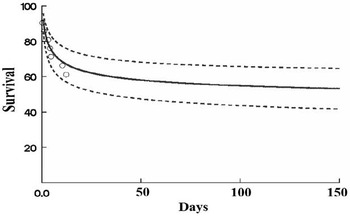
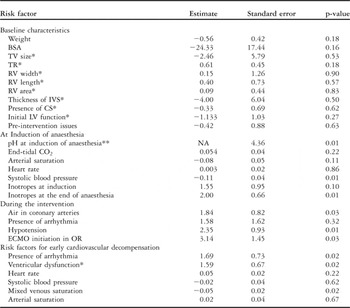
The mean birth weight was 2.7 plus or minus 0.4 kilograms and the mean age at the time of the primary intervention was 4.3 days with a range form 3 to 12 days. Eighteen patients had a modified Blalock–Taussig shunt, either 3.0 or 3.5 millimetres depending on weight, and the other had a ductal stent. There were seven deaths and one patient underwent cardiac transplantation, following failed single-ventricle palliation. For the most part we modelled overall mortality; however, for the last set we modelled early cardiovascular decompensation on the critical care unit. Figure 2 shows the survival curve following single-ventricle palliation, which demonstrates an early hazard phase that subsequently levels off. The presence of coronary sinusoids, as diagnosed by echocardiogram, did not predict mortality. Right ventricular dimensions, that is, area, width, and length, and interventricular septum thickness on the pre-operative echocardiogram also did not affect survival. Predictors of mortality were a lower arterial pH (p = 0.01) during the primary intervention and a lower systolic blood pressure (p = 0.01) at induction of anaesthesia. The initiation of inotropes during the operation or intervention (p = 0.01) and technical issues, such as suspected air in the coronary arteries in two cases and embolisation of the patent ductus arteriosus stent in one case, were also predictive (p = 0.03; Table 1).
There is a high initial early mortality that subsequently levels off for those who underwent single-ventricle palliation. Events are shown with dots with the overlying parametric model (solid line) and 95% confidence limits (dotted line).

Risk factors for mortality for those undergoing a single-ventricle repair.

BSA, body surface area; CS, coronary sinusoids; ECMO, extracorporeal membrane oxygenation; IVS, interventricular septum; LV, left ventricular; NA, not applicable; OR, operation room; RV, right ventricular; TR, tricuspid regurgitation; TV, tricuspid valve
*By echocardiography; **adjusted for non-normality
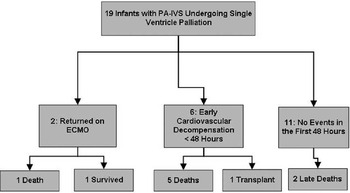
All infants were ventilated and 14 out of 19 were on inotropic support on returning from operating room. Five patients returned from the operating room with an open sternum that remained open for a mean of 3.2 plus or minus 1.1 days. A total of six patients had an episode of acute cardiovascular decompensation within the first 48 hours in the cardiac critical care unit; two returned from the operating room on extracorporeal membranous oxygenation, and 11 did not have any events in the first 24 hours. One of the patients arrested in the operating room following shunt insertion and the other had profound hypotension; the shunt size was thought to be appropriate in both cases. Of the two patients who returned from the operating room on extracorporeal membranous oxygenation, one survived and one died. Of the six patients with acute decompensation within 48 hours of the intervention, all were placed on extracorporeal membranous oxygenation; five of these infants eventually died and one underwent cardiac transplantation (Fig 3). Four of the six patients with an episode of acute decompensation had an echocardiogram performed before commencing extracorporeal membranous oxygenation; all showed moderate-to-severe left ventricular dysfunction (Table 1). The mean time to the commencing extracorporeal membranous oxygenation was 48 ± 9 minutes. Of the five infants who died, extracorporeal membranous oxygenation was discontinued due to severe neurological injury in two cases. Of the other three deaths, two had multi-organ dysfunction and one developed fungal sepsis. The median duration of extracorporeal membranous oxygenation support was 9 days with a range from 5 to 12 days. There were two late deaths that appeared unrelated to the acute events of the intervention.
Outcomes for the entire cohort of infants with PA-IVS. ECMO, extracorporeal membrane oxygenation; OR, operation room; PA-IVS, pulmonary atresia with intact ventricular septum; RF, radiofrequency assisted.

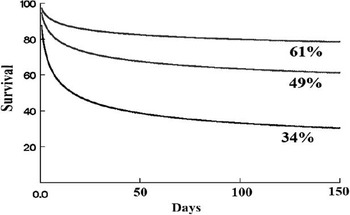
The presence of a tachyarrhythmia (p = 0.02) on admission to the cardiac critical care unit predicted early cardiovascular decompensation (<48 hours). The mean mixed venous saturation in those with cardiovascular decompensation was 35 plus or minus 11% compared to 55 plus or minus 18% in those without (p = 0.02). The predicted survival curves for infants stratified according to the mixed venous saturation on admission are illustrated in Figure 4. Left ventricular dysfunction in the immediate post-operative period also predicted mortality (p = 0.02); however, this may be due to repeated echocardiograms on infants in a critical condition.
Survival curves for infants whose mixed venous saturations were on the 25th, 50th, and 75th percentiles on admission to the cardiac critical care unit. There is a significant decrease in survival as the mixed venous saturation drops below the 50th percentile.

There were a total of six cases of necrotising enterocolitis diagnosed post-intervention; however, this did not predict mortality. The mean time to extubation for survivors was 3.7 days plus or minus 1.2 days and the mean duration of intensive care stay was 8.5 plus or minus 2.1 days. There were no additional catheter studies performed while these infants were on the intensive care unit.
Autopsy reports were available on five patients. All showed extreme right ventricular hypoplasia with a right ventricular dimension less than 1 centimetre. There was evidence of left ventricular ischaemia with large infarcts or multiple areas of focal necrosis especially in the subendocardial region. In two autopsy specimens, one of the coronary arteries was not connected to the aorta and in another both coronaries were not connected. The two cases in which there was just one coronary artery arising from the aorta were not diagnosed by echocardiography.
Discussion
This study reviews the critical care outcomes of 19 infants who underwent single-ventricle palliation at a single centre. All had a right ventricle that was deemed not suitable for biventricular repair and most had coronary sinusoids with varying degrees of right ventricular dependence. The main predictors of mortality were a lower pH before surgery/intervention, technical issues or hypotension during surgery/intervention, and the initial mixed venous saturation in the cardiac critical care unit.
Daubeney et alReference Daubeney, Delany and Anderson7, Reference Daubeney, Wang and Delany8 have published short- and medium-term outcomes in pulmonary atresia with intact ventricular septum undergoing single-ventricle palliation, reporting a 1 year survival of 70%. Survival for those who underwent a systemic to pulmonary artery shunt as the first intervention was approximately 50%, which is comparable to ours. They also showed a similar early hazard phase with high mortality in the first few weeks to months. When they stratified according to right ventricular size, the so-called unipartite ventricle (smallest type) had a survival of 20%. However, they did not look at clinical risk factors around the time of surgery. Because of the very early hazard for death it is important to look in detail at clinical factors during the perioperative period, which might predict increased mortality. Despite smaller numbers in our study, we have looked in significant detail at factors during the perioperative period that may have influenced survival.
Survival for pulmonary atresia with intact ventricular septum with a miniscule right ventricle is disproportionately low compared to other single-ventricle lesions.Reference Coles, Freedom and Lightfoot15, Reference Guleserian, Armsby, Thiagarajan, del Nido and Mayer16 Even for survivors, it has been shown that there are marked differences in left ventricular contractility when comparing tricuspid atresia with pulmonary atresia.Reference Tanoue, Kado, Maeda, Shiokawa, Fusazaki and Ishikawa17 Ekman-Joelsson et alReference Ekman-Joelsson, Berggren, Boll, Sixt and Sunnegardh18 has shown perfusion defects in the left ventricular free wall of patients with pulmonary atresia with intact ventricular septum who have undergone single-ventricle palliation. It is likely that the blood supply to the myocardium is adversely affected even in the absence of performing right ventricular decompression. The Boston group has seen 100% mortality in their patients with aortocoronary atresia who have undergone single-ventricle palliation; hence, these patients are now listed for cardiac transplantation.Reference Guleserian, Armsby, Thiagarajan, del Nido and Mayer16 It is clear that the difference in survival relates in some way to modified myocardial perfusion; the precise mechanism is likely multi-factorial. It is possible that a modified Blalock–Taussig shunt could decrease aortic diastolic pressure or increase left ventricular end-diastolic pressures; it is also likely that these infants are highly susceptible to intraoperative events such as hypotension or air emboli.
There is a high early risk of mortality for infants undergoing single-ventricle palliation. Our findings indicate that this relates, at least in part to coronary ischaemia, either during or shortly after the primary intervention. In all of the cases in which an autopsy was available, there was extensive left ventricular myocardial necrosis. In addition, the presence of an arrhythmia, ventricular tachycardia in two cases, predicted early cardiovascular decompensation on the critical care unit. We had two cases in which there was suspected air in the coronary arteries during surgery. However, it is possible in these cases, as well as in others, that coronary ischaemia may have occurred as a consequence of decreased coronary perfusion following shunt insertion. A lower pH at induction of anaesthesia was predictive of later mortality. This would indicate that some of these infants are already haemodynamically compromised before the primary intervention. Therefore, intraoperative technical issues, induced changes in the amount of left-to-right shunting, and intraoperative hypotension may not be the sole cause of the high early mortality.
Many of the deaths occurred within 48 hours of the intervention. A lower mixed venous saturation was the only predictor of early mortality. The risk stratification can be seen in Figure 4 with remarkably poor survival when the mixed venous saturation reached the lower third interquartile range. For these infants, early mechanical support is the only management strategy that might have changed the outcome. The use of cardiopulmonary bypass or extracorporeal membranous oxygenation in these infants however results in lower right heart filling pressures that can further exacerbate coronary ischaemia. It is noteworthy that of the six patients who were placed on extracorporeal membranous oxygenation in the cardiac critical care unit, only one underwent successful cardiac transplantation. We did not perform a cardiac catheterisation on any of the infants on extracorporeal membranous oxygenation, as we were satisfied on our echocardiogram images that there was no shunt obstruction. In two cases, there was evidence of severe cerebral injury following cardiac arrest, and therefore catheterisation was not indicated. It is possible in the others that shunt obstruction was not diagnosed; hence cardiac catheterisation might be indicated in these patients. Only one infant was successfully weaned from extracorporeal membranous oxygenation; this is consistent with other published data for this lesion.Reference Allan, Thiagarajan, del Nido, Roth, Almodovar and Laussen19
It is clear from our study that attempting cardiac transplantation from extracorporeal membranous oxygenation following failed palliation does not yield favourable results. Optimal imaging of the anatomy and the coronary arteries, in addition to considering the abovementioned risk factors are important considerations when deciding whether to opt for primary cardiac transplantation. Because of suboptimal visualisation of the coronary arteries by echocardiogram, angiography for delineation of sinusoids and stenosis is worth considering. In addition, the best strategy for managing these patients can only determined by pooling the best available diagnostic information from multi-centre studies.
In our experience, it is usually quite apparent whether biventricular repair or single-ventricle palliation is the most appropriate initial strategy. Those who have undergone biventricular repair have all performed remarkably well; however, they represent in essence a different pathological entity. The high mortality in those at the severe end of the spectrum undergoing single-ventricle palliation has been some cause for concern in our institution. Our experience with ductal stenting for this lesion is limited. However, initial work would suggest that this strategy is associated with similar problems. Some institutions now perform cardiac transplantation on all of those with atresia of both coronary arteries. While the short-term results of transplantation are obviously better, the long-term results from the single ventricle palliation may be superior. Although this has not been adopted as policy in our institution, it is certainly not an unreasonable strategy to present to parents.
Limitations
This is a small study of a very rare type of congenital cardiac lesion, hence it is subject to all of the inherent bias associated with this type of study. Because of the relatively long-time period over which the study was conducted, there may have been evolving surgical practices, which is difficult to account for. In addition, the small sample size and the low number of events are another weaknesses of the study. We tested quite a large number of variables; hence, when taking a p-value of 0.05, 5% of the significant results could have occurred by chance alone.