The incidence of Clostridium difficile infection (CDI) has steadily risen since 2000 in the United States, Canada, and Europe.Reference McDonald, Owings and Jernigan 1 – Reference Burckhardt, Friedrich, Beier and Eckmanns 4 These infections place a substantial burden on the US healthcare system, with annual estimated costs >$3 billion.Reference Surawicz, Brandt and Binion 5 Recurrent Clostridium difficile infection (RCDI), defined as reappearance of CDI symptoms along with positive testing after successful treatment of CDI with appropriate therapy, occurs in up to 30%–65% of patients with Clostridium difficile infection.Reference McDonald, Owings and Jernigan 1 , Reference Surawicz, Brandt and Binion 5 Recurrent infections are expensive and negatively impact patient quality of life.Reference Surawicz, Brandt and Binion 5
Vancomycin, most often prescribed as a pulsed or tapered regimen, is the current standard of care in treating RCDI.Reference Surawicz, Brandt and Binion 5 However, evidence supporting its effectiveness is mixed, and no data for guidance on specific dosing and duration are available. Vancomycin is expensive and has a high rate of RCDI regardless of the dose, duration, or regimen (eg, pulse or tapered) prescribed.Reference Surawicz, Brandt and Binion 5 – Reference Johnson 9
Recently proposed guidelines from the American College of Gastroenterology (ACG) and American Gastroenterology Association (AGA) include fecal microbiota transplantation (FMT) as a therapeutic option for RCDI at or after the third recurrence.Reference Surawicz, Brandt and Binion 5 , Reference Bakken, Borody and Brandt 10 FMT consists of transplanting a fecal suspension from a healthy donor into the RCDI patient’s gastrointestinal tract. While enema is a common transplantation method, alternative routes include nasoenteral (nasogastric and nasojejunal) tubes and colonoscopy.Reference Kassam, Lee, Yuan and Hunt 11 , Reference van Nood, Vrieze and Nieuwdorp 12 Though no randomized controlled trials have been conducted to determine the efficacy of FMT in treating RCDI, the sparse published literature on this new technique suggests favorable cure rates with FMT, with what appears to be a relatively low risk of associated adverse events.Reference Surawicz, Brandt and Binion 5 , Reference Bakken, Borody and Brandt 10 , Reference Kassam, Lee, Yuan and Hunt 11 , Reference Brandt 13 – Reference Borody and Campbell 19
One recent economic analysis demonstrated FMT to be cost-effective in the context of RCDI.Reference Konijeti, Sauk, Shrime, Gupta and Ananthakrishnan 20 The purpose of this study was to estimate the cost-effectiveness of FMT compared with vancomycin for the treatment of RCDI in adults, specifically following guidelines proposed by the ACG and AGA.
METHODS
We constructed a decision-analytic computer simulation model using TreeAge Pro 2014 (TreeAge Software, Williamstown, Massachusetts) to compare the current standard approach using tapered vancomycin to FMT for RCDI from the third-party payer perspective. The inputs for our model were derived from the published literature, which included clinical studies, systematic reviews, and other cost-effectiveness analyses.Reference McFarland, Elmer and Surawicz 7 , Reference Bakken, Borody and Brandt 10 , Reference Kassam, Lee, Yuan and Hunt 11 , Reference Brandt, Aroniadis and Mellow 14 , Reference Rohlke and Stollman 17 , Reference Bartsch, Curry, Harrison and Lee 21 – Reference Constantinides, Heriot and Remzi 30
To investigate the clinical impact of FMT, we incorporated data from a multicenter long-term follow-up study that evaluated FMT for RCDI using a colonoscopic approach.Reference Brandt, Aroniadis and Mellow 14 Because simulated patients were followed for 90 days, discounting, a method used to weight costs and benefits according to the time at which they occur,Reference Claxton, Paulden, Gravelle, Brouwer and Culyer 31 was not necessary. The effectiveness measure was quality-adjusted life years (QALYs), a commonly used effectiveness metric in the economic evaluation literature. QALYs are constructed by weighting the duration of time in a certain health state by the patient’s quality of life in that specific health state. These utility weights, which quantify patients’ preferences for health states, typically range from 0 (death) to 1 (perfect health).Reference Whitehead and Ali 32 , Reference Weinstein, Torrance and McGuire 33
Model Design
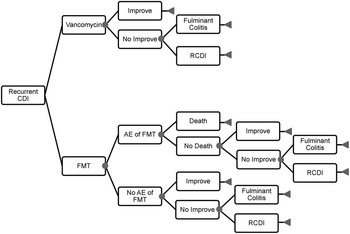
A schematic representation of our model is shown in Figure 1. Patients entered the model after the third recurrence (fourth occurrence) of CDI, following guidelines published in April 2013.Reference Surawicz, Brandt and Binion 5 We assumed that patients entering the model were treated on an outpatient basis.
Model structure. FMT, fecal microbiota transplantation. RCDI, recurrent Clostridium difficile infection.

Patients entering the model could be treated with another course of tapered vancomycin or FMT. We assumed vancomycin was given as 250 mg every 6 hours for 2 weeks followed by a 6-week oral vancomycin taper.Reference Bartsch, Curry, Harrison and Lee 21 For FMT, we assumed that donor stool was administered via colonoscopy. This is the same protocol used in the only multicenter long-term follow-up study evaluating FMT to date.Reference Brandt, Aroniadis and Mellow 14
Patients were followed for 90 days after initiation of vancomycin taper or FMT treatment, at which point patients were considered to be improved, or “cured,” if they had not developed RCDI.Reference Brandt, Aroniadis and Mellow 14 If patients did not improve from either treatment, they could enter either a state of severe/fulminant colitis or RCDI. Recurrence could occur at any time after completing the respective therapy. Patients with fulminant colitis were not considered appropriate candidates for FMT administered via colonoscope. If fulminant colitis or RCDI occurred after treatment, patients remained in this disease state for the remainder of the 90-day follow-up.
Model Variables
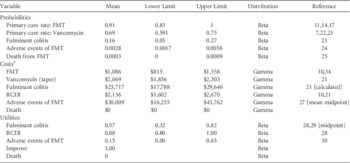
All input parameters for the model, including probabilities, costs and utilities, along with corresponding distribution parameters, are listed in Table 1. In the previously mentioned prospective trial, probability of FMT cure, defined as no recurrence within the first 90 days after treatment, was 91%.Reference Brandt, Aroniadis and Mellow 14 Similar rates of cure have been quoted in the literature, ranging from 83% to 100%.Reference Kassam, Lee, Yuan and Hunt 11 , Reference Rohlke and Stollman 17 Probability of cure from vancomycin ranged from 59% to 75%, with a mean cure rate of 69%.Reference McFarland, Elmer and Surawicz 7 , Reference McFarland, Surawicz, Rubin, Fekety, Elmer and Greenberg 22 , Reference Figueroa, Johnson, Sambol, Goldstein, Citron and Gerding 23 Probability of developing fulminant colitis, which would be treated with inpatient medical or surgical treatment, ranged from 5% to 26%, with a mean probability of 16%.Reference Bartsch, Curry, Harrison and Lee 21
Model Variables

NOTE. FMT, fecal microbiota transplantation; RCDI, recurrent Clostridium difficile infection.
a Costs are reported as 2011 US dollars.
Although adverse events have been reported in patients with other underlying conditions who receive FMT, to date, none, including death, are thought to be a direct result of FMT in patients without underlying comorbid conditions.Reference Kassam, Lee, Yuan and Hunt 11 , Reference Rohlke and Stollman 17 Adverse effects of FMT were, therefore, assumed to be equivalent to aggregate adverse effects of a diagnostic colonoscopy procedure (including anesthesia).Reference Whitlock, Lin, Liles, Beil and Fu 24 Similarly, the probability of death from FMT was assumed to be equivalent to the probability of death from colonoscopy procedure. Reference Ko and Dominitz 25 Adverse effects of vancomycin were assumed to be negligible, as this drug formulation is not systemically absorbed, and were not included in this model.
Cost data were obtained from the Center for Medicare and Medicaid Services (CMS) and from previous cost-studies.Reference Bakken, Borody and Brandt 10 , Reference Bartsch, Curry, Harrison and Lee 21 , 26 , Reference Pignone, Saha, Hoerger and Mandelblatt 27 Cost data were adjusted to 2011 US dollars using the Consumer Price Index from the Bureau of Labor Statistics. 26 The mean direct cost of FMT, including screening donor and recipient for potential infectious risks as well as procedure and facility costs was $1,086 (range, $815–1,358).Reference Bakken, Borody and Brandt 10 , 34 The mean cost of tapered vancomycin course was $2,069 (range, $1,836–2,303).Reference Bartsch, Curry, Harrison and Lee 21 This cost was based on the assumption of a prolonged 6-week taper following 2-weeks of initial therapy. The cost of RCDI was $2,136 (range, $1,602–2,670) and included the cost of repeat testing and treatment with another course of vancomycin taper.Reference Bakken, Borody and Brandt 10 , Reference Bartsch, Curry, Harrison and Lee 21 Cost of developing severe colitis was $23,717 (range, $17,788–29,646) and reflected an aggregate cost of severe/fulminant colitis, which includes hospitalization and medical therapy, as well as probability and costs of surgery.Reference Bakken, Borody and Brandt 10 , Reference Bartsch, Curry, Harrison and Lee 21 The cost of FMT adverse effects was estimated to be equivalent to the cost of colonoscopy adverse effects as reported in a prior cost study.Reference Pignone, Saha, Hoerger and Mandelblatt 27
Currently, no published utility values exist for CDI. Therefore, similar to other economic analyses that have considered treatment or prevention strategies for CDI, we used previously defined utilities of similar disease states as estimates of colitis- and RCDI-associated QALYs.Reference Bartsch, Umscheid, Fishman and Lee 28 – Reference Constantinides, Heriot and Remzi 30
Sensitivity Analysis
In addition to base-case analyses, we also conducted one-way sensitivity analyses in which we varied the value of several key parameters individually, as well as probabilistic sensitivity analysis varying all parameters simultaneously in 10,000 second-order Monte Carlo simulations. The distributions used in the probabilistic sensitivity analysis for each parameter are shown in Table 1.
RESULTS
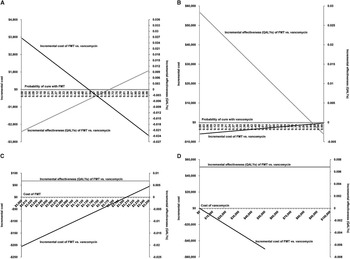
The results of the base-case analyses are shown in Table 2. Base-case analysis showed that FMT was less costly ($1,669 vs $3,788) and more effective (0.242 QALYs vs 0.235 QALYs) than vancomycin for RCDI. When a new strategy is both more effective and less costly than a comparator, the new strategy is deemed to be “dominant.” One-way sensitivity analyses identified threshold values of several important input parameters for which FMT was no longer the dominant strategy. As can be seen in Figure 2A, the FMT strategy was more effective than the vancomycin strategy as long as the cure rate for FMT was ≥70% and was less costly than the vancomycin strategy as long as the cure rate for FMT was ≥53%. Figure 2B and 2C present similar results for 1-way sensitivity analyses for the cure rate for vancomycin and the cost of FMT, respectively. The FMT strategy was less costly than the vancomycin strategy across the entire range of values for the cure rate for vancomycin and was more effective than the vancomycin strategy across the entire range of values for the cost of FMT. The FMT strategy was no longer dominant when the cure rate for vancomycin exceeded 90% and when the cost of FMT exceeded $3,205. Finally, Figure 2D shows that, with all other values held at their base-case level, the FMT strategy dominated the vancomycin strategy regardless of the cost of vancomycin.
One-way sensitivity analysis. (A) Probability of cure with FMT. (B) Probability of cure with vancomycin. (C) Cost of FMT. (D) Cost of vancomycin. FMT is the dominant strategy when the black line is below the x-axis and the gray line is above the x-axis. When the reverse is true, vancomycin is the dominant strategy. FMT, fecal microbiota transplantation. QALY, quality-adjusted life year. Cost values are reported as 2011 US dollars.

Base-Case Results, Cost-Effectiveness of FMT versus Vancomycin

NOTE. FMT, fecal microbiota transplantation. QALY, quality-adjusted life year. C/E, cost-effectiveness.
a Cost values are reported as 2011 US dollars.
Probabilistic sensitivity analysis, varying all parameters simultaneously, showed that FMT was the dominant strategy; it was more effective and less costly that vancomycin in all 10,000 second-order Monte Carlo simulations.
DISCUSSION
This study is the first cost-effectiveness analysis investigating the use of FMT for the treatment of RCDI, based specifically on current recommendations and guidelines. We found that FMT administered via colonoscopy was both less costly and more effective than a prolonged oral vancomycin taper in the base-case analysis. FMT cost and the probabilities of cure with FMT and vancomycin were the primary drivers of our base-case analysis. FMT also appears to be cost-effective compared to vancomycin at all willingness-to-pay thresholds based on the probabilistic sensitivity analysis.
Notably, after our analysis was complete, a study by Konijeti et alReference Konijeti, Sauk, Shrime, Gupta and Ananthakrishnan 20 evaluated the cost-effectiveness of FMT via colonoscopy compared to vancomycin, metronidazole, or fidaxomicin for the first recurrence of CDI after initial treatment. Though similarities exist, the model structure, inputs, and subsequent results, were slightly different than ours. Assumptions made in the Konijeti model include cure rates of FMT for earlier recurrence, which was based on current data of cure rates of FMT for later recurrences. Fidaxomicin, which currently has limited and conflicting clinical data, was also included in the model. Our model minimizes these assumptions and is unique, as it is the first to evaluate the use of FMT specifically at the third RCDI, as currently recommended by the ACG and AGA. Additionally, we explored a wide range for the values of the cost of vancomycin (Figure 2D) in sensitivity analyses, which can be relevant for decision makers. We also conducted an extensive one-way sensitivity analysis on the cure rate for FMT (Figure 2A). This is important because, while FMT cure rates have been reported to be >90% in the general population, they have been found to be much lower in certain subpopulations. In particular, Kelly et alReference Kelly, Ihunnah and Fischer 35 report a 78% cure rate for FMT in immunocompromised patients. Ultimately, our results validate the findings of the recently published study.
Prior cost-effectiveness analyses evaluating other CDI interventions reported in the published literature are limited. Two studies comparing fidaxomicin to vancomycin have been performed, with slightly different conclusions. One study comparing fidaxomicin to oral vancomycin yielded an incremental cost-effectiveness ratio (ICER) of $67,576/QALY. Probabilistic sensitivity analysis showed that fidaxomicin had an 80.2% chance of being cost-effective at willingness-to-pay threshold of $100,000/QALY.Reference Stranges, Hutton and Collins 29 Another study suggested that fidaxomicin is not cost-effective as a first-line treatment for CDI but could potentially be a cost-effective option compared to vancomycin based on typing of the Clostridium difficile strain.Reference Bartsch, Umscheid, Fishman and Lee 28
We chose to focus on vancomycin as the reference treatment strategy because it is the treatment recommended for RCDI by ACG and Infectious Disease Society of America guidelines.Reference Surawicz, Brandt and Binion 5 , Reference Cohen, Gerding and Johnson 36 However, our model shows that vancomycin was not a cost-effective option compared to FMT in patients with RCDI in our base-case analysis. The cost of vancomycin had a negligible effect on the model. We did not evaluate other therapeutic options for RCDI. Some studies support the use of intravenous immunoglobulin, probiotics, cholestyramine, or fidaxomicin in RCDI, though the evidence is deemed marginal.Reference Surawicz, Brandt and Binion 5 – Reference Johnson 9 , Reference Kunimoto and Thomson 37
Economically dominant interventions, such as FMT versus vancomycin, are relatively uncommon in health care. Therefore, finding an intervention that is clinically effective and also cost saving supports its implementation as a potential first line modality. Future studies are needed to standardize FMT methods, improve and maximize clinical effectiveness, and decrease RCDI rates, which will further reduce the economic burden of RCDI to the healthcare system. This study provides convincing evidence for policymakers and researchers to further investigate FMT therapy.
This study had several important limitations. Notably, this analysis utilized a simulation model. Models, by definition, are simplifications of reality and may not reflect all real-world considerations.
In this study, we used data from adult subjects who were without other serious comorbid conditions such as end-stage renal disease or inflammatory bowel disease (IBD). Data suggest a different risk profile in these patients for the strategies compared, including a single case report of bacteremia following FMT in a patient with IBD.Reference Yamazaki, Nakamura and Yamagata 38 – Reference De Leon, Watson and Kelly 40 Another recent report describes a negative outcome in a patient with cancer, diabetes, and coronary artery disease.Reference Solari, Fairchild, Noa and Wallace 41 The model cohort excluded patients with fulminant colitis, as colonoscopy would not be performed in such patients. If fecal transplantation were considered in patients with fulminant colitis or signs of toxic megacolon, nasoenteral administration would likely be preferred, given the risks of performing colonoscopy in these patients.
We assumed that patients receive FMT via colonoscopy, and our model inputs reflect probability of success as reported in the literature via colonoscopy. Other ranges for probability of success may be relevant for patients with comorbid conditions, including underlying immune compromise.Reference Kelly, Ihunnah and Fischer 35 Previously published data suggest higher success rates of FMT via colonoscopy compared to other methods.Reference Kassam, Lee, Yuan and Hunt 11 , Reference Brandt and Aroniadis 16 , Reference Rohlke and Stollman 17 , Reference Borody and Campbell 19 However, newer technologies such as fecal transplant capsules may have comparable success rates of FMT for RCDI. 42 If the capsule method is indeed equivocal, alternative routes for FMT may prove even less costly than the values used in this model, with a presumed similar safety profile.
We also assumed that all patients entering the model received outpatient treatment, which decreases costs since it does not incorporate hospitalizations. This may not always be true; sometimes patients are admitted to the hospital with moderate CDI or can develop CDI while hospitalized and might still be considered candidates for FMT. Additionally, although we did not model an inpatient population, we would expect similar cost-effectiveness thresholds.
The data used for parameters in our model came from different studies of varying quality. Given the lack of existing studies examining FMT from which to gather inputs, results may be affected by data from future studies. Additionally, we recognize that the vancomycin cost input may vary with different taper regimens. Length of vancomycin taper directly affects the cost parameter of this variable in the model. However, we assumed that if a patient has a fourth RCDI, prescribing providers would err on the side of a prolonged taper rather than a shorter course.
To temper these assumptions, we chose a conservative model design by underestimating some of the parameters associated with vancomycin. For example, we decided not to incorporate adverse effects of vancomycin and its respective associated costs. Most reported side effects of this nonabsorbed medication are nonspecific or mild gastrointestinal symptoms.Reference Louie, Miller and Mullane 43
We chose to perform this study from the third-party payer perspective, using data from the United States’ Center for Medicare and Medicaid Services as our point of reference. We acknowledge that the results may differ when considering the societal perspective, which would include costs from the patient perspective such as additional direct costs (eg, patient transportation and out-of-pocket costs) as well as indirect costs (eg, patient and/or caregiver missed work and other time costs). Future prospective studies are needed to confirm the results of our analysis. In addition, future studies should be used to analyze different routes of FMT administration, as well as the role of FMT for initial and earlier recurrences of CDI.
In conclusion, the results of our decision-analytic computer simulation suggest that FMT may be a cost-saving intervention in managing RCDI compared to vancomycin use, which may help decrease the economic burden to the healthcare system. This information provides makers of healthcare policy an additional insight when considering RCDI treatments in today’s changing healthcare economic landscape. Our results provide support for future trials to demonstrate efficacy of this new treatment strategy.
Acknowledgments
We acknowledge the research resources of the Utah Center for Clinical and Translational Sciences UL1TR001067. We also gratefully acknowledge Dr. Raj Srivastava, Dr. John Pohl, and Dr. Stephen Guthery for their assistance at various stages of project development.
Financial support: Dr. Nelson was funded by a Department of Veterans Affairs, Health Services Research & Development grant (CDA 11–210).
Potential conflicts of interest: All authors report no conflicts of interest relevant to this article.