Introduction
The ultimate performance of nuclear fuels is influenced by a host of materials properties, including thermomechanical strength, chemical stability, microstructure, and lattice defects. Overlaying this multitude of properties, nuclear fuels are exposed to a severe irradiation environment, which causes a continuous change of materials properties. Nuclear fuel behavior is therefore exceptionally rich, and a predictive understanding poses significant challenges. Experimental investigations of nuclear fuel materials, however, are very costly and, due to the risk of toxicity and radioactivity, are often restricted. Computational simulation and modeling can play a decisive role in the research on nuclear fuel materials, as first-principles modeling is now capable of providing precise, valuable insights and property data from an atomistic perspective. In fact, first-principles studies based on density functional theory (DFT) have already greatly contributed by supplying fundamental electronic-structure knowledgeReference Dudarev, Botton, Savrasov, Humphreys and Sutton1–Reference Dorado, Amadon, Freyss and Bertolus8 and the material properties of defect-containing nuclear fuels.Reference Anderson, Lezama, Uberuaga, Deo and Conradson9–Reference Vigier, Den Auwer, Fillaux, Maslennikov, Noël, Roques, Shuh, Simoni, Tyliszczak and Moisy20
Among all fuel materials, UO2 and PuO2 have been most extensively studied both experimentally and computationally. This is especially true for UO2, the standard nuclear fuel for light water reactors. PuO2 has attracted interest because of its importance in mixed oxide fuel, (U,Pu)O2, and as a radiotoxic ingredient of spent fuel. Various actinide compounds, including UC and U-Pu-C alloys, have also recently been investigated as candidate fuels for next-generation reactors.Reference Vigier, Den Auwer, Fillaux, Maslennikov, Noël, Roques, Shuh, Simoni, Tyliszczak and Moisy20, Reference Freyss21 The intricate nature of the 5f electrons in the actinides is crucial to understanding nuclear fuel properties such as chemical bonding, heat conductivity,Reference Yin and Savrasov22 fission gas behavior,Reference Freyss, Vergnet and Petit11, Reference Yun, Kim, Kim and Park12, Reference Yun, Eriksson and Oppeneer14–Reference Dorado, Freyss and Martin19 and the surface interaction with moleculesReference Huda and Ray23 relevant to fuel corrosion.Reference Skomurski, Ewing, Rohl, Gale and Becker24 Hence, understanding actinide electronic structure is a prerequisite for understanding the behavior of nuclear fuel materials.
The local spin density approximation (LSDA) and the generalized gradient approximation (GGA) are most widely used in DFT-based first-principles calculations to estimate the exchange and correlation energy of electrons. The DFT provides an exact mapping of a many-electron system to a single-electron system, in which the electron moves in an effective potential; however, its exact form is not known. The unknown exchange-correlation potential is locally approximated in the LSDA by that of an electron in a homogeneous electron gas having the same density. The GGA is also a local approximation, but in addition, it takes the gradient of the electron density into account. Both approximations have been successfully applied to describe many of the fuel materials properties, despite their known limitation in capturing strong correlation effects of f-electrons.Reference Dudarev, Nguyen Manh and Sutton25, Reference Baer and Schoenes26 In defect energy calculations, using DFT-LSDA/GGA Hamiltonians have provided results consistent with experimental data.Reference Freyss, Vergnet and Petit11–Reference Yun, Oppeneer, Kim and Park15 Taking spin polarization into account is of particular importance to 5f electrons in order to achieve accurate defect energies.Reference Yun, Eriksson and Oppeneer13, Reference Yun, Eriksson and Oppeneer14 The success of predicting various nuclear fuel properties via a DFT-LSDA/GGA account of electron interactions can be explained by considering the energy scale of associated defect energies that are ~2–7 eV in UO2.Reference Freyss, Vergnet and Petit11–Reference Yun, Oppeneer, Kim and Park15 This is much larger than the energy corrections that would properly account for strong electron correlation effects among the 5f electrons. A further complicating aspect of first-principles modeling applied to nuclear materials is that, on account of the large atomic mass of the actinide atoms, relativistic calculations need to be performed. In particular, the relativistic spin-orbit coupling can lead to shifts of ~1–2 eV in the energies of the 5f electrons.
In the following section, some of the main achievements of DFT modeling of nuclear fuels are reviewed. Subsequently, key requirements to improve DFT fuel calculations are discussed. The outlook of this methodology in future nuclear fuel materials design is examined in the last section.
Application of DFT to nuclear fuel characterization
Fundamental properties: UO2
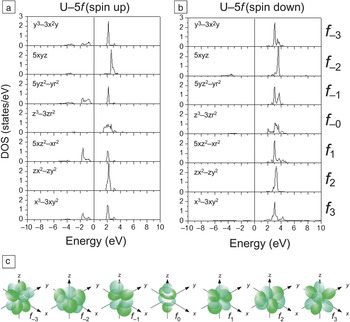
In addition to its technical importance as the standard nuclear fuel material, UO2 has attracted interest as a prototypical actinide compound to investigate the intriguing behavior of f-electrons in an open 5f shell. UO2 crystallizes in the cubic fluorite CaF2 structure and develops antiferromagnetic order below 30 K.Reference Laskowski, Madsen, Blaha and Schwarz3, Reference Dorado, Freyss and Martin19, Reference Dudarev, Nguyen Manh and Sutton25 Various DFT studies have been conducted to investigate basic properties of UO2, including its structural, chemical, thermodynamic, electronic, and magnetic properties.Reference Dudarev, Botton, Savrasov, Humphreys and Sutton1–Reference Dorado, Amadon, Freyss and Bertolus8 In particular, advanced DFT-based approximations beyond the LSDA and GGA, such as LSDA/GGA+U, Reference Dudarev, Nguyen Manh and Sutton25, Reference Baer and Schoenes26 hybrid functionals,Reference Prodan, Scuseria and Martin5, Reference Kudin, Scuseria and Martin27, Reference Atta-Fynn and Ray28 self-interaction correction (SIC),Reference Petit, Svane, Szotek and Temmerman29, Reference Petit, Svane, Szotek, Temmerman and Stocks30 and DFT+DMFT (dynamical mean field theory) approaches,Reference Yin and Savrasov22 have been developed to correctly capture the strong correlations of 5f electrons in UO2 that are responsible for its insulating behavior with a bandgap energy of about 2 eV. Figure 1 shows calculated m-decomposed partial f-electron density of states (PDOS) of UO2 obtained from GGA+U calculations.Reference Yun, Kim, Lim and Park6 The PDOS explains the role of the 5f electrons in the U–O bonding in conjunction with antiferromagnetic ordering in UO2.
(a) Spin up and (b) spin down m-orbital decomposed partial electron density of states (PDOS) of the uranium 5f electrons in UO2. (c) Sketch of the seven 5f orbitals.Reference Petrucci, Harwood and Herring31 The first-principles calculations provide detailed information on the chemical bonding between uranium and oxygen.

The diagram at the bottom shows the seven 5f, m = –3 to 3 orbitals.Reference Petrucci, Harwood and Herring31 Among these orbitals, four spin-up orbitals (m = –3,–1,1,3) are partially occupied in UO2 with lobes directed along either the x- or y-axis in the coordinate system and without a nodal plane perpendicular to the z-axis. The four 5f PDOS peaks are coincident with peaks in the O p-DOS (i.e., these four 5f orbitals hybridize with O 2p x and 2p y orbitals).Reference Yun, Kim, Lim and Park6 The electronic structure of UO2 is still a challenging topic, and comprehensive DFT studies are being conducted that consider spin-orbit and crystal field effects in order to investigate the crystal field levels and non-collinear magnetic structure of UO2.Reference Zhou and Ozoliņš32
Materials properties
Defects
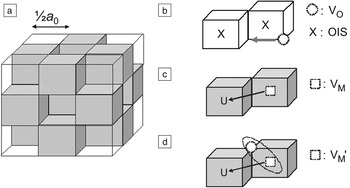
Defects are central to an understanding of atomic transport in nuclear fuels. In particular, it is known that point defects form a major diffusion channel for fission gas atoms in the fuel matrix. To model defect-containing materials, a supercell approach is required. A 2 × 2 × 2 supercell containing 96 atoms has been predominantly used in recent DFT calculations.Reference Yun, Kim, Kim and Park12–Reference Dorado, Freyss and Martin19Figure 2a shows the oxygen sublattice in a 2 × 2 × 2 supercell of cubic UO2, ThO2, and PuO2. The oxygen atoms are located at the corners of each cube, and actinide atoms are located at the center of alternative grey cubes.
(a) Oxygen sublattice of a 2 × 2 × 2 supercell of actinide dioxides; (b) the migration of an oxygen vacancy VO between two adjacent lattice sites; (c) the migration of an actinide vacancy VM (M = U or Th); (d) the migration of an actinide vacancy VM’ due to the effective movement of a joint vacancy, VMO. OIS, octahedral interstitial site; a 0, lattice parameter.

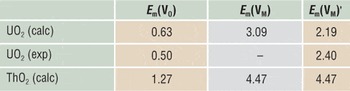
Table I reports formation energies of major intrinsic defects in UO2. Here an oxygen Frenkel pair consists of an oxygen interstitial and vacancy, and a Schottky trio defect consists of one uranium vacancy and two oxygen vacancies formed in the UO2 lattice. The five computed energies were obtained using DFT-based methods and a 2 × 2 × 2 supercell. Most of the calculated values are in good agreement with the experimental data (last column), which illustrates that parameter-free DFT calculations are reliable and accurate within an acceptable error range. Another important achievement of DFT studies is the improved understanding of atomistic diffusion. Table II gives DFT-computed migration energies of single vacancies in UO2 and ThO2. The migration energy was calculated from the energy difference between an initial configuration and a saddle point when a M (U or Th) or O vacancy, denoted VM or VO, respectively, moves from its initial lattice site to the nearest adjacent site, as shown in Figure 2b. The migration energy of VU is calculated to be almost 50% higher than the experimental value, whereas that of VO agrees very well. However, the overestimated result for VU can be explained by considering the effective movement of a combined U and O vacancy, VUO, as depicted in Figure 2d. The migration energy of VU is reduced by about 1 eV due to the existence of an adjacent VO. Hence, the calculations predict a detailed atomistic process in which an oxygen vacancy plays an important role to enhance the mobility of a uranium vacancy in UO2. The migration energies of single vacancies in ThO2 (see Table II) are predicted to be significantly higher than those in UO2.Reference Yun, Oppeneer, Kim and Park15 The assisting influence of a VO was not observed in the movement of a Th vacancy. DFT studies thus predict that point defects are less easily created as well as less mobile in ThO2 than in UO2.
Calculated and experimental formation energies in eV of intrinsic defects in UO2.

The calculated resultsReference Iwasawa, Chen, Kaneta, Ohnuma, Geng and Kinoshita16–Reference Dorado, Freyss and Martin19 were obtained using the generalized gradient approximation with added Coulombic correlation (GGA+U) approach, except for the resultsReference Yun, Oppeneer, Kim and Park15 obtained using GGA.
ComputedReference Yun, Kim, Kim and Park12, Reference Yun, Oppeneer, Kim and Park15 and experimentalReference Matzke33 migration energies E m in eV.

VO and VM indicate oxygen and actinide atom vacancies (M = Th or U), respectively, and E m(VM)’ indicates the effective migration energy of an M-vacancy within the joint VM and VO movement.
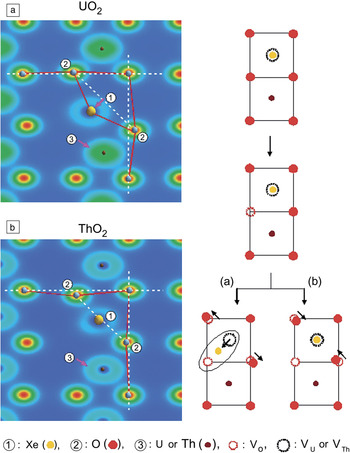
The diffusion of fission gases in the fuel matrix is closely connected to lattice defects, as these defects are known to act as a major diffusion channel of fission gas atoms. Therefore, based on the defect energetics, it is expected that fission gas atoms are less mobile in ThO2 than in UO2. Further calculations were conducted to understand diffusion behavior of fission gas atoms in ThO2 and UO2, and it was reportedReference Yun, Oppeneer, Kim and Park15 that Xe, which is one of the highest fractional released fission gases in UO2, is more likely to diffuse in UO2 than in ThO2. Figure 3a and 3b show the electron charge distribution of UO2 and ThO2, respectively, and clearly illustrate the different behavior of Xe in the two oxides. In Figure 3a, Xe with index (1) is initially at VU, and subsequently is seen to move during atomic relaxation when a VO (2) is created at the nearest lattice site. In contrast, in ThO2, Xe remains at the initial position of VTh during atomic relaxation, despite the creation of a new VO nearby, as shown in Figure 3b. A detailed schematic diagram depicting the Xe behavior in the two dioxides is plotted on the right side in Figure 3.
Electron charge distribution of Xe-VMO complex obtained through atomic relaxation in (a) UO2 and (b) ThO2. The magnitude of the electron density is indicated by a color grading, where red is used for the highest electron density and blue for the lowest one. Xe moves from the initial position at VU to the center of VUO when a VO is created at the nearest lattice site, while in (b), it remains at the initial position of VTh, despite the creation of a new VO nearby. These processes are schematically explained in the right-hand panel.

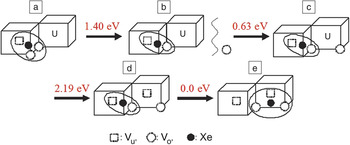
In UO2, the barrier-less movement of Xe during atomic relaxation is due to the strain energy of Xe caused by its relatively large atomic radius (Xe = 2.15 Å, U4+ = 1.01 Å, Th4+ = 1.07 Å).Reference Matzke33 However, the strain-energy effect of Xe seems not enough to cause Xe movement in ThO2. This is mainly associated with the strong resistance of Th against variation of its valency in ThO2. Th in ThO2 is most stable with 4+ valency, and electron redistribution is energetically unfavorable, which affects the formation and mobility of defect atoms and the diffusion of Xe atoms. These DFT results are supported by experiments showing that the Xe release is lower in UO2 mixed with ThO2, (U,Th)O2Reference Kim, Park, Yun, Kim, Ryu, Song, Choo and Hong34 than in UO2. It is very important to understand the diffusion mechanism of fission gases in nuclear fuels, because fission gas is one of the parameters that severely affects fuel safety conditions, such as fuel swelling, thermal conductivity, and fuel rod pressure after it is released into the gap between fuel pellet and cladding. Controlling fission gas release is therefore a crucial factor to increase nuclear fuel burnup, which is the degree to which the fuel material is consumed in the nuclear reactor so that the fuel efficiency is improved. First-principles studies investigating the trap sites and diffusion mechanism of fission gases reported that Xe atoms prefer to accommodate the charge neutral UO2 trivacancy among existing interstitial sites and various vacancies due to its charge neutrality as well as its large size, which are suitable to accommodate the large atomic radius of Xe.Reference Matzke33, Reference Matzke35 The trivacancy was moreover computed to play a central role in the Xe diffusion in UO2 through the successive process of dissociation and association of the Xe-trivacancy complex,Reference Yun, Kim, Kim and Park12 as shown in Figure 4.
(a) Structure of a Xe-trivacancy complex, (b) dissociation of VO from a Xe-trivacancy with binding energy of about 1.4 eV, (c) combination of a new VO with the migration energy of 0.63 eV, (d) migration of VU with the help of the nearest VO with a migration energy of 2.19 eV, (e) formation of a new Xe-trivacancy complex by the spontaneous movement of Xe due to strain energy in the UO2 lattice.Reference Anderson, Lezama, Uberuaga, Deo and Conradson9

It should be mentioned that accurate atomic transport modeling is a challenge in DFT research, as it is necessary to take temperature effects into account to achieve close energy values. Supercell size is also a sensitive parameter that affects energy calculations required for atomic transport; this aspect will be discussed in more detail later.
Thermodynamic behavior
The heat transfer from the fuel to the coolant is the central process to generate electricity from nuclear power. Knowledge of the fuel’s thermodynamic properties is therefore essential to model the fuel’s behavior under operation conditions at high temperatures. First-principles methods are increasingly being used to determine the thermodynamic properties of nuclear fuels. Recently, a DFT+DMFT study of the lattice dynamical properties of UO2 and PuO2 (i.e., their phonon spectra) was reported.Reference Yin and Savrasov22 The calculations suggested that an improved thermal conductivity of the fuel could be achieved through dedicated materials design, building on the observation that dispersive longitudinal optic phonon modes do not contribute to the heat transfer.Reference Yin and Savrasov22 Thus far, however, only a few DFT-based calculations of the phonon spectrum of actinide materials have been performed, employing either the linear response theoryReference Yin and Savrasov22, Reference Dai, Savrasov, Kotliar, Migliori, Ledbetter and Abrahams36 or the direct approach.Reference Parlinski37, Reference Piekarz, Parlinski, Jochym, Oles, Sanchez and Rebizant38 In the former approach, a perturbation of the atomic positions with the periodicity of the original lattice is treated with standard perturbation theory, and first-order corrections are computed. In the direct approach, or so-called supercell method, a finite displacement of several atoms in a supercell is employed to compute atomic force constants and the phonon spectrum. In this direct approach, it is important to achieve convergence of phonon frequencies with respect to supercell size. Generation of such data would be a valuable step for characterizing the thermal properties of nuclear fuels. An alternative first-principles approach is to use DFT to compute interatomic potentials, which are subsequently used in molecular dynamics (MD) simulations. This approach has already been successfully applied to describe the thermal expansion of dioxide fuelsReference Yamada, Kurosaki, Uno and Yamanaka39 and the next-generation fuel uranium nitride (UN).Reference Chen, Wang, Lai, Li, Ao and Long40
DFT calculations on nuclear fuel: Computational costs
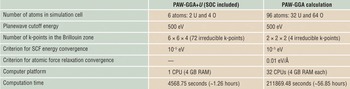
The computationally heaviest step in DFT calculations for nuclear fuel materials is to perform the self-consistent field (SCF) total energy minimization (i.e., the iterative calculation of single-particle wave functions and the effective potential that depends on these wave functions until the starting and evaluated potential match). The costs of the SCF calculation depend mainly on the number of atoms in the chosen simulation cell. To obtain the electronic structure, cohesive properties, and magnetic properties, a calculation for a single unit cell suffices, and the required computation time is usually less than a few hours for the convergence of the SCF total energy with a single CPU. Table III shows the imposed parameter values and the computation time to calculate the electronic structure of UO2. A tetragonal unit cell is used to model antiferromagnetically ordered UO2, which consists of two U atoms with antiparallel magnetic moments and four O atoms. Once the self-consistent electronic charge density and wave functions are computed, other elements of the electronic structure, such as the electronic density of states and energy band structure, can be computed quickly.
Computational details for self-consistent field (SCF) calculations of antiferromagnetic UO2 using the VASP (Vienna ab initio simulation package) code.45

The VASP code is an ab initio quantum mechanical calculation code using pseudopotentials and a plane-wave basis set. First column: The total energy calculation performed with the projector augmented wave (PAW) method and with spin-orbit coupling (SOC) and an additional Coulomb correlation U included. Second column: The formation energy of a uranium vacancy VU using the PAW-GGA (generalized gradient approximation) method. The calculation includes relaxation of all atomic positions in the supercell until all atomic forces are minimized.
The use of a large simulation cell is essential for defect-related calculations, such as formation and migration energy of defects. The computation time required increases approximately as ~N 3, with N being the number of atoms in the simulation cell. Moreover, to simulate a system with defects, all atomic positions in the system have to be relaxed to obtain the overall minimal energy configuration. This implies that all atomic positions must be optimized until the forces acting on each of the atoms in the supercell vanish. This is usually an extremely time-consuming task. Table III summarizes the computational details for the calculation of the formation energy of a uranium vacancy VU in UO2 using the 2 × 2 × 2 supercell. The number of used CPUs was determined by carrying out an optimization test for the parallel computing platform. From Table III, it can be seen that the complete SCF total energy convergence with structural optimization requires a considerable computation time of 57 hours. Hence, the computational costs to simulate defect diffusion in nuclear fuels are massive. The reduction of computational costs is therefore an important key to increase the impact of first-principles techniques for nuclear fuel modeling. Nonetheless, in spite of the considerable computational efforts required, the costs of performing experimental studies on nuclear fuel materials are unequivocally higher.
Limitations and improvements to DFT modeling
Several challenges are currently encountered in analyses of nuclear fuels using DFT. The first area that requires additional research is extensions and improvements of the DFT+U methodology, since 5f states in actinide oxides are strongly correlated. Here, the U indicates the effective interaction parameter that is added to correct the on-site Coulomb repulsion interaction of the 5f electrons. The DFT+U method has become an important approximation in the study of nuclear fuel materials. It is, from a numerical perspective, a relatively simple extension beyond the standard GGA and can be applied in parallel computations to treat supercells with a large number of atoms. However, the DFT+U functional has the weakness that, depending on the initial density matrix in the self-consistent cycle, one can converge to a metastable state instead of the ground state.Reference Amadon, Jollet and Torrent7 A solution to this problem could be the recently proposed density-matrix controlling scheme,Reference Dorado, Amadon, Freyss and Bertolus8 which was successfully applied to reach the ground state of UO2. The density-matrix controlling scheme is a definite improvement to correctly determine the ground state of actinide oxides within DFT+U calculations and could have a significant and positive impact on fuel materials research. However, it has not been applied yet for lattice defect calculations in a supercell. In addition to improvements of the DFT+U functional, it is also necessary that other approximations to the Hamiltonian, such as hybrid functionals,Reference Kudin, Scuseria and Martin27, Reference Atta-Fynn and Ray28 SIC,Reference Petit, Svane, Szotek and Temmerman29, Reference Petit, Svane, Szotek, Temmerman and Stocks30 and DFT+DMFT, Reference Yin and Savrasov22 be tested and developed further to calculate nuclear fuel materials, in combination with the development of parallelized versions of these approaches appropriate to the analyses associated with supercell domains.
A second demand on DFT-based techniques is to provide a better characterization of temperature-dependent properties in nuclear fuels. For many fuel materials properties, it is essential to take temperature-dependent effects into account. For example, fission gas diffusion occurs dominantly at temperatures over 1000°C.Reference Matzke33 Nonetheless, standard DFT calculations can provide acceptable results for fission gas behavior.Reference Freyss, Vergnet and Petit11, Reference Yun, Kim, Kim and Park12, Reference Yun, Eriksson and Oppeneer14, Reference Yun, Oppeneer, Kim and Park15, Reference Dorado, Freyss and Martin19 For instance, the migration energy of Xe between two interstitial sites was calculated as 4.69 eV,Reference Yun, Eriksson and Oppeneer14 and this agrees with experimental data of 3.90 eV within 20%.Reference Matzke33 However, when expansion of the lattice was accounted for, it was found that the migration energy was reduced to 3.78 eV,Reference Yun, Eriksson and Oppeneer14 which calls into question the validity of the nominal result. MerminReference Mermin41 generalized the Hohenberg-Kohn theorem (that a many-electron problem can be exactly mapped to a single-electron problem) to finite temperatures. Temperature-dependent DFT has been successfully applied to describe materials behavior over a wide range in temperature, up to almost 1000ºC.Reference Freyss, Vergnet and Petit11, Reference Yun, Kim, Kim and Park12, Reference Yun, Eriksson and Oppeneer14, Reference Yun, Oppeneer, Kim and Park15, Reference Dorado, Freyss and Martin19 Using temperature-dependent DFT in combination with MD simulations, Mattsson et al.Reference Mattsson, Sandberg, Armiento and Mattsson42 computed the anomalous temperature evolution of the vacancy formation energy in Mo up to about 2700ºC, and Root et al.Reference Root, Magyar, Carpenter, Hanson and Mattsson43 studied xenon’s behavior at extreme conditions of high pressure and high temperature. Although T-dependent (temperature dependent) DFT can thus be employed to high-temperature dynamic and thermodynamic properties, it has not yet been applied to nuclear materials. Standard DFT-based MD simulations have already been performed.Reference Mattsson, Sandberg, Armiento and Mattsson42–Reference Govers, Lemehov, Hou and Verwerft44 These are, for example, well-suited to investigate the important role of fission gas diffusionReference Freyss, Vergnet and Petit11, Reference Yun, Kim, Kim and Park12, Reference Yun, Eriksson and Oppeneer14, Reference Yun, Oppeneer, Kim and Park15, Reference Dorado, Freyss and Martin19 in the nuclear fuel. DFT-based MD simulationsReference Govers, Lemehov, Hou and Verwerft44 of the temperature-dependent diffusion coefficient and pathway were reported for UO2. Furthermore, the defect jump rate and absolute concentration can be calculated as a function of temperature using the DFT-based MD.Reference Mattsson, Sandberg, Armiento and Mattsson42 MD is implemented in several DFT simulation packages.45, 46
Current limitations on supercell size are a third area deserving of research attention. The scale of DFT-based modeling is, in general, limited to cells of the order of a few hundred atoms, and this limits the types of defect structures and interactions that may be considered. For example, to calculate the migration energy of fission gas atoms in a dilute concentration, a reasonably large supercell, consisting approximately of N times the unit cell for a defect concentration of 1/N, is needed to model a system containing several defects well separated from each other; otherwise, the defect-defect interaction between adjacent cells will be too large to obtain accurate energy values. Suitable supercell sizes can be determined from the geometry optimization of the supercell containing defects by carrying out total energy convergence tests, including atomic relaxation as a function of supercell size (i.e., the lattice coordinates of all the atoms in the supercell are modified during the total energy calculation until they converge to their equilibrium positions that are defined by the criterion that the forces acting on each atom are smaller than a lower value, usually 0.01 eV/Å). An efficient approximation has been developed recently that allows larger system sizes to be considered, allowing for an analysis of dislocation and dislocation-solute physics.Reference Trinkle and Woodward47 A 540-atom supercell was used with periodic boundary conditions to the dislocation line direction. To improve computational efficiency for such a huge number of atoms, the cell was divided into three regions, and forces in the separate regions were relaxed, subject to a consideration of the long-range elastic response of the material.
Along with the development of algorithms focused on defects and actinides, it is also important to improve computational performance capacity through the development of efficient parallel computing algorithms. While not strictly focused on nuclear fuels, such generic improvements to DFT methodology may prove to have the largest impact of all on the ability to consider large numbers of atoms.
Summary and future role of DFT techniques in nuclear fuel research
First-principles modeling is now widely accepted as a tool not only to develop advanced fuels with improved efficiency in current reactors but also to design nuclear fuel materials of the future.Reference Grimes, Konings and Edwards48 As already noted, for instance, density functional theory (DFT) studies predict that ThO2 possesses qualities superior to UO2 with regard to chemical stability and defect dynamics. Nitrides such as (U,Pu,MA)N and (Pu,MA,Zr)N, where MA is a minor actinide, are now being investigated using DFT as promising advanced nuclear fuel because of their high thermal conductivity and high melting point.Reference Muta, Kurosaki, Uno and Yamanaka49 In a recent DFT study, point defects in uranium mononitride were investigated, calculating the defect formation energy as well as defect-induced electronic density redistribution.Reference Kotomin, Grimes, Mastrikov and Ashley50, Reference Lu, Wang, Li, Shi and Zhang51 Uranium monocarbide and ternary alloys, including U-Pu-C, are now considered as possible candidates for next-generation reactor fuels because of the combination of a high melting temperature and high actinide density,Reference Vigier, Den Auwer, Fillaux, Maslennikov, Noël, Roques, Shuh, Simoni, Tyliszczak and Moisy20, Reference Freyss21 and first-principles calculations have been performed to investigate the thermodynamic properties and phase diagram of these alloys.Reference Freyss21 Advanced DFT modeling can already provide valuable knowledge regarding the existence of potential candidate materials before experimental data, such as structure and basic properties.
During the last few decades, first-principles calculations performed within the framework of DFT have had a tremendous and positive impact on nuclear fuels research. It has become evident that DFT can significantly contribute to the nuclear energy industry by providing both insights and quantitative property data associated with fuel performance. Parameter-free DFT calculations have not only improved the reliability and accuracy of computed materials properties, but they also contributed to a better understanding of the microstructural character of nuclear fuels. However, the current DFT techniques need further improvement, with the primary need being associated with the ability to scale up to larger numbers of atoms and to develop finite temperature predictions of material behavior.
Acknowledgments
The Swedish Nuclear Fuel and Waste Management Company, SKB, and the European Commission have supported this work. The authors acknowledge valuable discussions with Kwangheon Park, Hanchul Kim, Olle Eriksson, and Lars Werme.