INTRODUCTION
Purpose in life is a component of well-being that denotes an ability to derive meaning from and perceive purpose in daily life experiences (Ryff, Reference Ryff1989). In adulthood and old age, higher level of purpose has been associated with higher level of cognitive function (Boyle, Buchman, Barnes, & Bennett, Reference Boyle, Buchman, Barnes and Bennett2010; Lewis, Turiano, Payne, & Hill, Reference Lewis, Turiano, Payne and Hill2017), slower rate of cognitive decline (Boyle et al., Reference Boyle, Buchman, Barnes and Bennett2010; Kim, Shin, Scicolone, & Parmelee, Reference Kim, Shin, Scicolone and Parmelee2019), and lower risk of incident cognitive impairment (Boyle et al., Reference Boyle, Buchman, Barnes and Bennett2010; Sutin, Luchetti, Stephan, & Terracciano, Reference Sutin, Luchetti, Stephan and Terracciano2020) and dementia (Boyle et al., Reference Boyle, Buchman, Barnes and Bennett2010; Sutin, Stephan, & Terraccino, Reference Sutin, Stephan and Terracciano2018). Recent data suggest that purpose is not related to the pathologies underlying Alzheimer’s disease and related disorders but may lessen the deleterious effects of these pathologies on memory and cognition (Boyle, Buchman, Wilson, Yu, Schneider, & Bennett, Reference Boyle, Buchman, Wilson, Yu, Schneider and Bennett2012; Ribeiro, Yassuda, & Neri, Reference Ribeiro, Yassuda and Neri2020). However, there have been few studies of the purpose–cognition association in racial and ethnic minorities and results have been inconsistent (Lewis et al., Reference Lewis, Turiano, Payne and Hill2017; Sutin et al., Reference Sutin, Stephan and Terracciano2018).
In the present analyses, we examine the association of purpose in life with likelihood of dementia and its precursor, mild cognitive impairment (MCI), in older black and white Brazilians. Informants of older Brazilian decedents underwent a uniform interview that included a measure of purpose in life and clinical classification of MCI and dementia. In analyses, we tested the hypothesis that higher level of purpose in life was associated with lower likelihood of clinical diagnoses. We examined the hypothesized association further in two sets of analyses. First, because depression is associated with both well-being (Ryff & Keyes, Reference Ryff and Keyes1995) and dementia (Saczynski et al. Reference Saczynski, Beiser, Seshadri, Auerbach, Wolf and Au2010), we repeated the initial analyses controlling for a history of major depression. Second, because there is limited knowledge about the association of purpose with dementia in racial minorities and people with little education, we tested for interactions of race and education with purpose.
METHODS
Decedents and Informants
The Pathology, Alzheimer’s and Related Dementias Study (PARDoS) enrolls deceased older adults who died from natural non-violent causes in the state of Sao Paulo, Brazil, and includes cases originally enrolled in the Study of Ancestry and Neurodegenerative Diseases. After consent by legal representatives of the decedent, informants were asked to participate in a structured interview while waiting for completion of brain and other organ removal. The study was approved by the Brazilian national ethics committee Commissao Nacional de Etica em Pesquisa (CONEP). Because participants are deceased, the study is exempt from human subjects review in the United States.
Clinical Interview
An informant of the decedent had a 60–90 min interview with a study nurse. If more than one representative of the decedent was available, we primarily considered the responses of the person most closely related to the decedent. The interview assessed basic demographic information including age at death, sex, education, and race; psychosocial factors; and clinical diagnoses of MCI and dementia.
Assessment of Purpose in Life
We assessed purpose in life with 6 items from the self-report purpose in life subscale of the Ryff measure of psychological well-being (Ryff, Reference Ryff1989; Ryff & Keyes, Reference Ryff and Keyes1995). We adapted the items for use with an informant. The informant was asked to rate on a 5-point scale how well each item characterized the decedent across the lifespan before (s)he got sick, with higher scores indicating higher levels of the trait.
Item scores (range: 1–5) were averaged to yield a total score. In prior research, the standard self-report version of the scale has been shown to have adequate internal consistency in groups from the United States (Sutin et al., Reference Sutin, Stephan and Terracciano2018) and Brazil (Ribiero et al., Reference Ribeiro, Yassuda and Neri2020) and to predict subsequent cognitive impairment (Boyle et al., Reference Boyle, Buchman, Barnes and Bennett2010; Sutin et al., Reference Sutin, Stephan and Terracciano2018) and decline (Boyle et al., Reference Boyle, Buchman, Barnes and Bennett2010; Kim et al., Reference Kim, Shin, Scicolone and Parmelee2019). Although informant report is often used to assess personality traits, we are not aware of previous research on informant report of purpose.
Assessment of Depression
We adapted the depression portion of the National Institute of Mental Health Diagnostic Interview Schedule (Robins, Helzer, & Croughan, Reference Robins, Helzer and Croughan1981) for informant report (Saldanha et al., Reference Saldanha, Suemoto, Rodriguez, Leite, Nascimento, Ferreti-Rebustini and Nunes2020). The informant was asked about past depressive symptoms. The diagnosis of major depression required persistent depressed mood or loss of interest accompanied by at least 4 additional depressive symptoms.
Assessment of MCI and Dementia
To clinically classify MCI and dementia in the decedents, we used the informant portions of the Clinical Dementia Rating Scale (Morris, Reference Morris1993). The scale yields 5-point ratings of functioning in six domains: memory, orientation, judgment and problem solving, community affairs, home and hobbies, and personal care. An algorithm converted domain scores to an overall rating of no cognitive impairment (score = 0), mild cognitive impairment (score = .5), or dementia (score > .5). Dementia diagnoses based on the informant portion of the Clinical Dementia Rating Scale have been shown to have good agreement with diagnoses based on an in-person examination, with estimates of sensitivity/specificity for the diagnosis of dementia of 80%/98% in one study (Waite et al., Reference Waite, Grayson, Jorm, Creasey, Cullen, Bennett, Casey and Broe1999) and 87%/84% in another study (Ferretti et al., Reference Ferretti, Damin, Brucki, Morillo, Perroco, Campora and Nitrini2010).
Statistical Analysis
The alpha level for all analyses was set at .05. We used Cronbach’s coefficient alpha to assess the internal consistency of the informant-based measure of purpose, Pearson correlation coefficients to assess the relation of age and education to purpose, and student t-tests to assess possible sex and race differences in purpose. We used analysis of variance to test for diagnostic group differences in age and education and chi-square tests to examine diagnostic differences in sex and race.
To test the hypotheses that higher purpose is associated with lower likelihood of MCI and dementia, we constructed a series of logistic regression models. The dependent variable for one set of models was no cognitive impairment versus MCI. The dependent variable for the second set of analyses was no cognitive impairment versus dementia. The two core models had five independent variables (entered simultaneously): purpose in life, age at death, sex, education, and race. We repeated each core model with a term added for the potentially confounding effect of depression. In addition, we repeated each core model, first with a term for the interaction of race and purpose and then again with a term for the interaction of education and purpose.
RESULTS
Characteristics of Decedents and Informants
At the time of these analyses, 1,514 individuals aged 65 years or older at death had a consent signed by a legal representative for brain removal and examination of the decedent and had an informant who agreed to do the interview. They died at a mean age of 79.6 (SD = 8.9; range: 65–110). They had completed a mean of 4.8 years of formal education (SD = 3.9; range: 0–25); 797 (52.6%) were women. Proxy reported race was black in 168 (11.1%), mixed in 342 (22.6%), and white in 1,004 (66.3%). In analyses, we combined the black and mixed groups to facilitate comparisons with research done in countries such as the United States that do not include a census category of “mixed”.
All informant interviews took place within 36 h of the death of the decedent. The relationships of the informants to the decedent were as follows: child (77.9%), grandchild (8.5%), sibling (5.4%), spouse (4.5%), other relative or in-law (1.7%), other (8.0%). The informants had known the decedents for a mean of 47.0 years (SD = 12.3). In the last year of the decedent’s life, 70.4% of informants reported daily contact with the decedent, 28.4% reported weekly contact, and 1.1% reported monthly contact.
Purpose in Life
Scores on the measure of purpose ranged from 1.5 to 5.0 (mean = 3.5, SD = .6), with higher scores indicating higher levels of the trait. Cronbach’s coefficient alpha was .71 with similar values within each racial subgroup (.73 in black/mixed subgroup; .70 in white subgroup). These estimates indicate adequate internal consistency and are comparable to estimates based on self-report versions of the purpose scale in groups from Brazil (Ribeiro et al., Reference Ribeiro, Yassuda and Neri2020) and the United States (Sutin et al., Reference Sutin, Stephan and Terracciano2018). Neither age (r = −.01, p = .682) nor education (r = .04, p = .164) was related to purpose, and there were no sex (mean for women = 3.5 versus mean for men = 3.4, t[1,464] = 1.1, p = .285) or race (mean for black/mixed subgroup = 3.4 versus mean for white subgroup = 3.5, t[1,512] = 1.3, p = .199) differences in purpose.
Clinical Diagnosis
Based on structured informant interview using the Clinical Dementia Rating Scale, 940 individuals were diagnosed with no cognitive impairment, 121 with mild cognitive impairment, and 453 with dementia. As shown in Table 1, those with cognitive impairment were older and less educated than those with no cognitive impairment; women were more likely to have cognitive impairment than men; and cognitive impairment was marginally less common in the black/mixed subgroup than the white subgroup.
Demographic characteristics of the diagnostic groups *

* Values are mean (standard deviation) unless otherwise indicated.
Purpose and Clinical Diagnosis
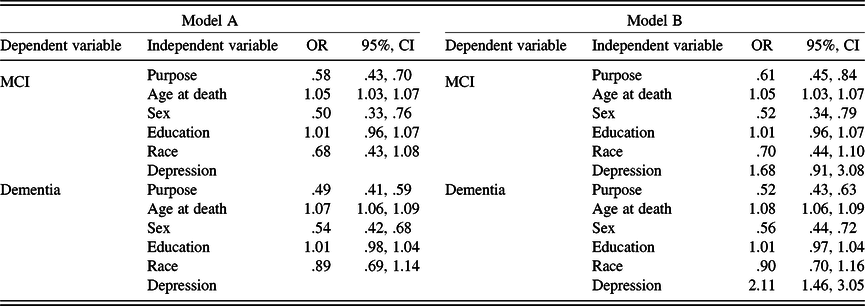
To test for the hypothesized association of purpose with MCI and dementia, we constructed separate logistic regression models, with no cognitive impairment versus MCI as the outcome in one model and no cognitive impairment versus dementia as the outcome in a second model. Terms for each model included purpose, age at death, sex, education, and race. As shown for model A in Table 2, higher level of purpose was associated with lower likelihood of MCI and dementia, as hypothesized. The associations from these models are shown in Figure 1: as level of purpose increases, the likelihood of MCI (upper panel) and dementia (lower panel) decreases.
Relation of purpose in life and other independent variables to mild cognitive impairment and dementia *

CI, confidence interval; MCI, mild cognitive impairment; OR, odds ratio.
* From 4 logistic regression models.
Relation of purpose in life to likelihood of mild cognitive impairment (upper panel) and dementia (lower panel) estimated from logistic regression models adjusted for age at death, sex, education, and race.

A total of 161 of the decedents (10.6%) met criteria for a major depressive episode at some point during life. To determine whether depression could account for the association of purpose with MCI and dementia, we repeated the original logistic regression models with a term added for depression. As shown for models B in Table 2, the associations of purpose with MCI and dementia persisted.
To determine whether frequency of informant contact with the decedent in the last year of life affected results, we repeated the analyses in Table 2 with a term added for frequency of contact (daily vs weekly/monthly). In each analysis, the frequency term was not significant and the effect of purpose was essentially unchanged.
To test whether the association of purpose with dementia varied in racial minorities and persons with limited education, we repeated the original logistic regression models with terms added for the interaction of race with purpose in one set of models and the interaction of education with purpose in a second set of models. Neither race nor education modified the association of purpose with clinical diagnoses.
DISCUSSION
In a community-based study of aging and dementia in more than 1,500 older Brazilian decedents, we tested the hypothesis that higher purpose in life is associated with lower likelihood of MCI and dementia. Knowledgeable informants underwent a uniform structured interview to assess purpose in life and diagnose MCI and dementia in decendents. We found that higher purpose in life was robustly related to lower likelihood of both MCI and dementia, supporting the study hypothesis. The results suggest that the association of purpose with cognition in older non-Latinos generalizes to older Latinos in South America, consistent with a previous study of purpose and incident dementia in older Latinos from the United States (Kim et al. Reference Kim, Shin, Scicolone and Parmelee2019).
Possible racial differences in the relation of self-reported purpose to cognitive outcomes have been investigated in the Health and Retirement Study with conflicting results. In one set of analyses, the association of higher purpose with lower subsequent risk of dementia did not differ between black and white persons (Sutin, Stephan, & Terraccino, Reference Sutin, Stephan and Terracciano2018). However, a subsequent set of analyses found that the association of higher purpose with slower subsequent cognitive decline was stronger in black persons than white persons (Lewis et al., Reference Lewis, Turiano, Payne and Hill2017). In the present analyses, we found no racial differences in the association of informant-reported purpose with likelihood of either MCI or dementia. Although further research is needed, the present results suggest that the association of purpose with late life cognitive health generalizes across ethnic and racial lines.
The bases of the association of purpose with MCI and dementia are uncertain. Clinical-pathological research suggests that purpose is not directly related to the pathologies traditionally associated with MCI and dementia (Boyle, Buchman, Wilson, Yu, Schneider, & Bennett, Reference Boyle, Buchman, Wilson, Yu, Schneider and Bennett2012). This is important because it suggests that purpose is a true risk factor for dementia rather than a consequence of the condition. In addition, the association of Alzheimer’s disease pathology with cognitive dysfunction is weaker in those with a higher level of purpose compared to those with a lower level of purpose (Boyle, Buchman, Wilson, Yu, Schneider, & Bennett, Reference Boyle, Buchman, Wilson, Yu, Schneider and Bennett2012). Thus, purpose somehow buffers the deleterious effects of Alzheimer’s disease pathology and thereby strengthens cognitive reserve in old age. That purpose may enhance cognitive reserve and that the association may generalize across ethnic and racial lines suggest that interventions targeting purpose may help maintain not only well-being in old age but also cognitive function in diverse populations of older persons. Prior research suggests that purpose is modifiable with a variety of procedures, including mindfulness-based stress reduction (Moss et al., Reference Moss, Reibel and Greeson2015), positive narrative interventions (Friedman et al., Reference Friedman, Ruini, Foy, Jaros, Love and Ryff2019; Casetti, Vescovelli, & Ruini, Reference Cesetti, Vescovelli and Ruini2017), promotion of meaningful social roles (Heaven et al., Reference Heaven, Brown and White2013), and psychotherapy (Frankl, Reference Frankl1959). However, lower level of cognitive function (Boyle et al. Reference Boyle, Buchman, Barnes and Bennett2010; Lewis et al., Reference Lewis, Turiano, Payne and Hill2017) and more rapid rate of cognitive decline (Wilson et al., Reference Wilson, Boyle, Segawa, Yu, Begeny, Anagnos and Bennett2013) have been associated with lower level of purpose suggesting that maintaining a strong sense of purpose in old age may partly depend on maintaining cognitive skills. Further longitudinal research on the possibly bidirectional relationship between purpose and cognition is needed.
These results have strengths and limitations that should be noted. Analyses are based on a large racially diverse group of participants. Clinical classification of MCI and dementia was based on a uniform previously validated evaluation. Purpose in life was assessed with a widely used self-report scale but modifying the scale for informant report may have increased measurement error. Another limitation is that results are based on a selected group of decedents and so it will be important to replicate these findings in other groups. Longitudinal studies have shown that purpose can change over time (Hill, Turiano, Spiro, & Mroczek, Reference Hill, Turiano, Spiro and Mroczek2015; Hill & Weston, Reference Hill and Weston2019), but ratings of purpose were not anchored to a specific time point. Also, assessing purpose and MCI/dementia at the same point in time may have biased our estimate of the association between them.
In conclusion, we found that higher sense of purpose in life (as reported by an informant) was associated with preserved cognition proximate to death in older black and white Brazilian decedents. The results suggest that interventions to enhance purpose may provide a means of enhancing cognitive reserve in diverse racial and ethnic groups.
ACKNOWLEDGMENTS
The authors wish to thank the informants and the study staff in the United States and Brazil.
FINANCIAL SUPPORT
The study was supported by the National Institute on Aging grant R01AG54058.
CONFLICTS OF INTEREST
None.