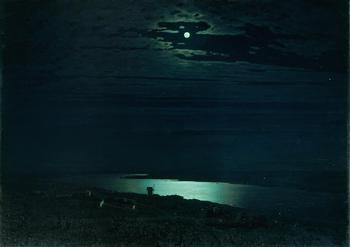
“What is this? A picture or reality?” The poet Iakov Polonskii excitedly asked in a magazine article in 1880, referring to an image of nocturnal landscape. He went on: “In a golden frame or from an open window do we see this moon, these clouds, the dark distance … the play of light?”Footnote 1 When in November of that year Arkhip Kuindzhi inaugurated a solo, one-work exhibition of his new oil painting Night on the Dnepr, the event, unprecedented in Russia, sent ripples of exhilaration through St. Petersburg. Measuring forty-one by fifty-six inches, the painting was mounted on a standing screen (shirma) in a deliberately darkened room at the Society for the Encouragement of Artists on Bolshaia Morskaia Street.Footnote 2 (See Figure 1). The drapes were drawn, allowing little daylight to penetrate the space of the unusual one-picture show. Only the lamps, concealed and angled just so, cast light on the image.Footnote 3 From dawn to dusk, for thirty kopecks apiece, ladies and gentlemen, cadets and civil servants, merchants and young women crowded into the exhibition's tight quarters to have a look.Footnote 4 Kuindzhi himself ushered them inside, making sure visitor numbers did not exceed safety limits and answering an occasional question. Although by 1880 an air of sensationalism created by a painting was not unheard of, the uproar around Kuindzhi's show warrants a closer look.Footnote 5
Arkhip Kuindzhi, Moonlit Night on the Dnepr/Night on the Dnepr, 1880. Oil on canvas, 105 × 144 cm. State Russian Museum, St. Petersburg.
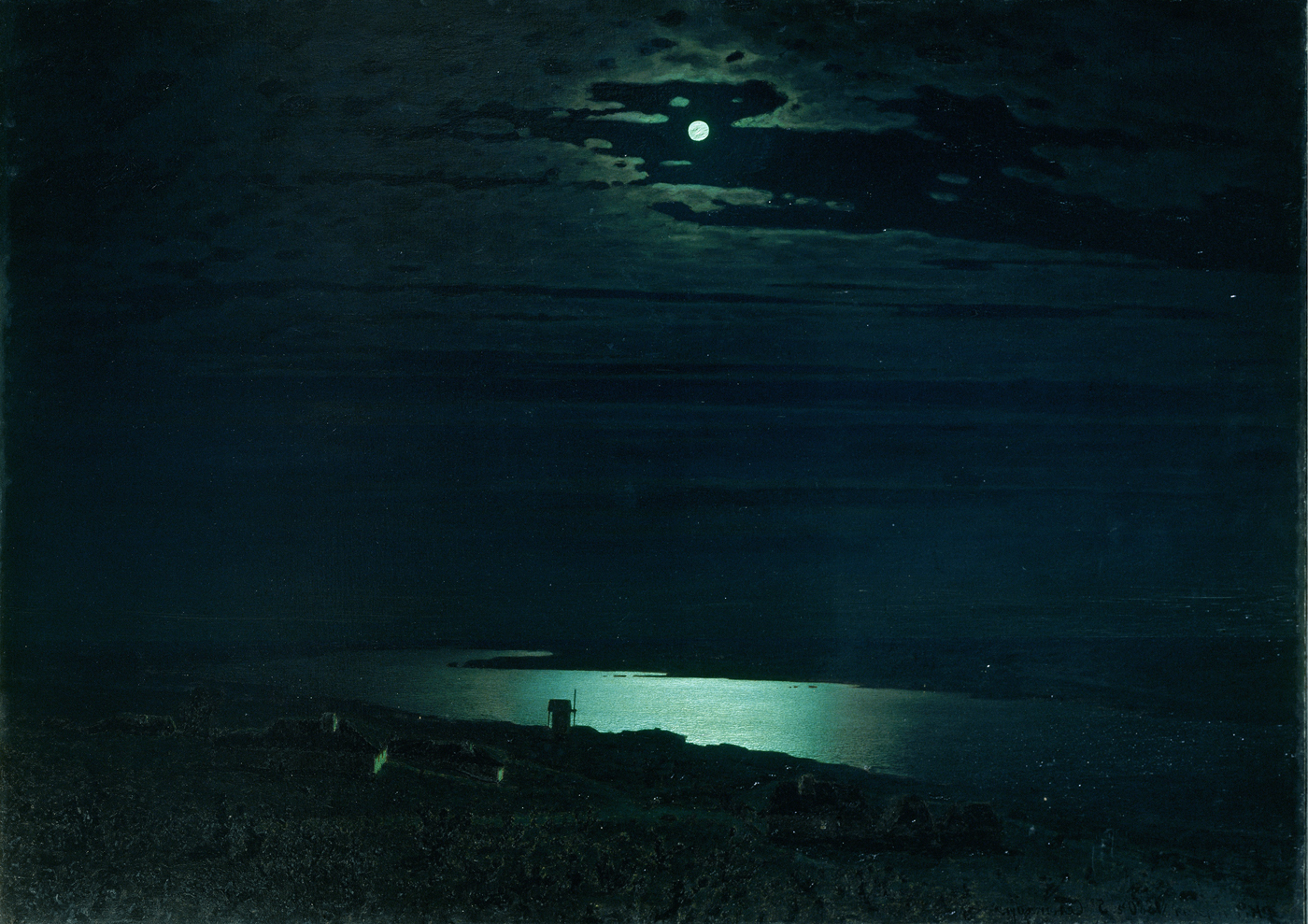
Eyewitness accounts suggest that Night on the Dnepr overwhelmed its original viewers with its audaciously contrasting palette.Footnote 6 It was the spectacular lunar glow emanating from Kuindzhi's canvas, however, that most enthralled the public and compelled some to peek behind the picture in expectation of a hidden source of illumination.Footnote 7 On the surface, the painting owed its tremendous and controversial success to its unorthodox presentation. On closer inspection, this clever mode of display reveals an approach to painting that was embedded in contemporary scientific knowledge, the debate on the aesthetic of realism, and a range of popular visual amusements with varied ontologies.
In Russia, the scientific mode of inquiry started to penetrate the cultural sphere by the mid-nineteenth century.Footnote 8 In 1846, Vissarion Belinskii wrote in reference to the developments of the natural school in literature: “Psychology which is not based on physiology is as unsubstantial as physiology that knows not the existence of anatomy.”Footnote 9 In the visual arts, the landscape painter Ivan Shishkin declared: “The poetic feeling toward nature is outdated … the landscape painter must join forces with the natural scientist”—and used the aid of photography in his painstaking rendering of the Russian forest.Footnote 10 Kuindzhi's involvement with science, or more precisely human visual perception, animated his creative project unlike any of his compatriots. Similar to J. M. W. Turner and Eugène Delacroix, who in the first half of the century engaged with scientific theories of color, Kuindzhi collaborated with the prominent physicist Fedor Petrushevskii to turn physiological knowledge into spectacular, and exceedingly profitable, representations of natural phenomena. Like his European predecessors, Kuindzhi sought to reconcile Isaac Newton's discovery of the properties of light with the material nature of pigments.
I argue that Kuindzhi's persistent interest in vision and color not only shaped his artistic identity but also led the painter to an innovative reconceptualization of his entire practice. Rather than being concerned with the conventionalized representation of reality or observations of nature, he based his work in a deeply modern understanding of sensory perception in which vision played a key role. This article asserts that Kuindzhi's single-minded pursuit of a powerful optical experience through the medium of color and a theatricalized viewing environment founded on the physiology of vision propelled his landscapes to exceed their painterly limits. Addressing the totality of Kuindzhi's artistic endeavor—the way he approached his craft and treated the painterly medium, his exhibition practices once he struck out on his own, and, importantly, how the public treated his works—allows us to see the artist as an innovator who participated in shifting paradigms of representation. I also look beyond the national perspective, taking my cue from Rosalind Blakesley's recent book, where she argues that: “the nationalistic bias … tempered [Russian painting's] reception outside Russia and contributed to its exclusion from broader narratives of eighteenth- and nineteenth-century art.”Footnote 11 Such wider view, both beyond the institution of easel painting and the national bounds, offers a key corrective to the accepted narrative of modern art and Kuindzhi's place in it.
In art-historical scholarship, Kuindzhi has long been discussed as an anomaly, a kind of curious phenomenon who fits awkwardly within the narrative of nineteenth-century Russian painting.Footnote 12 The reasons for this are manifold. To begin, the artist's ethnic background, reportedly outlandish behavior, and idiosyncratic exhibition strategies all contributed to separating him from his peers during his lifetime.Footnote 13 The standard accounts of Russian art long dominated by the Association of Traveling Art Exhibitions, known as the Peredvizhniki, further reinforced Kuindzhi's status as a peculiar outlier. The leading artistic circle that formally coalesced in 1870 championed a particular realist aesthetic. The critic Vladimir Stasov, pivotal in shaping the brand of realism that became synonymous with the Russian school, came to define it in terms that narrowed with time. Supportive of the group's ethos from the outset, he saw the Peredvizhniki's primary mission to be the creation of a new national aesthetic that would tell stories specific to Russia and her concerns.Footnote 14 Enlisting the landscape genre in the formation of the national path, Stasov called for depicting the “unique Russian landscape,” rather than imitating western models.Footnote 15 Carol Adlam notes that a “particular by-product of the Stasovian template of the emergence of realism has been the notion that the aesthetic considerations of Russian realism were essentially subordinate to its culturally symbolic significance.”Footnote 16 Uninterested in subjects of social relevance, Kuindzhi became a casualty of this circumscribed interpretation. In 1904, Alexandre Benois, in his history of the Russian school of painting, pointed out Kuindzhi's proclivity for “cheap effects,” which, he claimed, the artist inherited from his teacher, the marine artist Ivan Aivazovskii.Footnote 17 Yet Benois commended Kuindzhi's use of a bright, original palette and marked him as the first in Russian painting to signal the “simplification of form.”Footnote 18
Continuing Stasov's rhetoric, Soviet scholars established the tendentious art of the Peredvizhniki as the precursor of Socialist Realism, thereby pushing Kuindzhi further to the fringes of Russia art.Footnote 19 They never considered him within an aesthetic program other than realism, and as a realist he failed to measure up to the likes of Il΄ia Repin and Shishkin.Footnote 20 Unlike the work of his peers, Kuindzhi's formal experimentation—especially his treatment of space and color—and his disregard for socially-critical content failed to fit the genealogy of Socialist Realism and to satisfy the official line of Soviet art history.
In an essay written in 1975 on the occasion of the Metropolitan Museum of Art's acquisition of Kuindzhi's late-career Red Sunset on the Dnepr (1905–8), John Bowlt represents a western historiographic perspective. For Bowlt, the painter holds “a distinctive position in the history of nineteenth-century Russian art” as someone who is concerned exclusively with “mood and sensibility.”Footnote 21 The scholar assigns Kuindzhi to a “luminist school,” further separating him from his colleagues in the Association, not least because such a school did not exist in Russia.Footnote 22 Bowlt views the artist as the sole figure among his compatriots, attentive to the intrinsic qualities of the medium and committed to exploring its potential. To support his characterization, he compares Kuindzhi to the Hudson River School painters.Footnote 23 If in the Soviet narrative Kuindzhi is an inadequate realist, in the west he simply falls through the cracks, Bowlt's essay being the notable exception. Although Bowlt's interpretation of the painter's oeuvre suggests aesthetic drabness in the rest of nineteenth-century Russian art, he was the first to draw the attention of western scholars to the unconventional realist.
My objective is not to recuperate the Peredvizhniki and Russian painting from the limited and fundamentally distorted perspective I have outlined—several scholars have been doing this important work.Footnote 24 Nor is my intention to claim for Kuindzhi a lightly uneasy but ultimately fitting place in the Russian school—indeed, many of his canvases resist this, and it is precisely what makes him such a fascinating and productive subject of study. Instead, my aim is to scrutinize Kuindzhi's anomalous status by virtue of a transnational and interdisciplinary lens.
The details of Kuindzhi's early days in St. Petersburg are blurry. Whether he was officially enrolled at the Imperial Academy of Arts remains undetermined. Unlike his colleagues and friends Ivan Kramskoi or Repin, Kuindzhi did not leave behind memoirs or letters, hence this article's reliance on the accounts of his contemporaries. Mikhail Nevedomskii's biography, published in 1913, three years after the painter's death, claims that Kuindzhi had arrived in the capital in the early 1860s with a dream to study at the prestigious if conservative institution where he was accepted on a third try in 1868. Footnote 25 He did not, however, complete the program.Footnote 26 Olga Voronova's monograph contends that the young transplant from Ukraine may have never been interested in becoming the Academy's full-time student. Instead, he audited classes and earned a living by selecting backgrounds and arranging customers into poses in a photographic portrait studio.Footnote 27 Kept at the Russian Museum in St. Petersburg, most of the aspiring artist's early drawings, made from plaster casts and academic installations, are awkward, especially if compared with renderings by his peers Repin and Nikolai Polenov.Footnote 28 Kuindzhi's deficiency in draftsmanship, which had ostensibly caused him to fail entrance exams to the Academy twice, became bound with his outsider status. The artist's perceived lack of technique and putative autodidacticism are inseparable both from his singular aesthetic and critical discourse surrounding his art. When in 1879 he displayed three new landscapes with the Peredvizhniki, of which he was member from 1875 to 1879, Stasov remarked that much in Kuindzhi's work remained “unfinished [nedodelano], unstudied [ne izucheno], sacrificed.”Footnote 29 The eminent critic heralded the artist's rare poetic sensibility while chastising him for technical inadequacy and what he perceived as the regrettable prioritizing of painting the effects of light.Footnote 30
“Is This Really a Creative Act?”
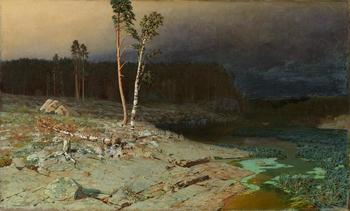
The 1870s was a formative decade in Kuindzhi's artistic development. He began to show his work at the annual academic exhibitions in 1870 and two years later was awarded the academic title of “Class Artist, Third Grade” for the oil painting Osenniaia rasputitsa (Autumn Slush, 1872).Footnote 31 According to Repin, a big shift in Kuindzhi's evolution as a painter came following his stay on Valaam Island.Footnote 32 Located north of St. Petersburg in Lake Ladoga, the island, with its ancient monastery and craggy, somber topography was a favorite destination among painters and the intelligentsia in the late nineteenth century.Footnote 33 When Kuindzhi visited there in the summers of 1870 and 1872, he worked tirelessly, producing numerous highly accomplished sketches en plein air.Footnote 34 Na ostrove Valaame (On Valaam Island, 1873) resulted from these trips and was exhibited at the annual show of the Academy.Footnote 35 (See Figure 2) The work drew attention immediately. “An extremely impressive thing,” Repin remarked, “everybody likes it terribly, and today Kramskoi stopped by—he is thrilled by it.”Footnote 36 It caught Fedor Dostoevskii's eye as well, moving him to note the landscape's power to make the beholder feel the foggy dampness of northern nature. Delighting at the ordinariness of the painting's subject matter, the author exclaimed, “[b]ut nonetheless, how good it is!”Footnote 37
Arkhip Kuindzhi, On Valaam Island, 1873. Oil on canvas, 79.5 × 131.6 cm. State Tretiakov Gallery, Moscow.
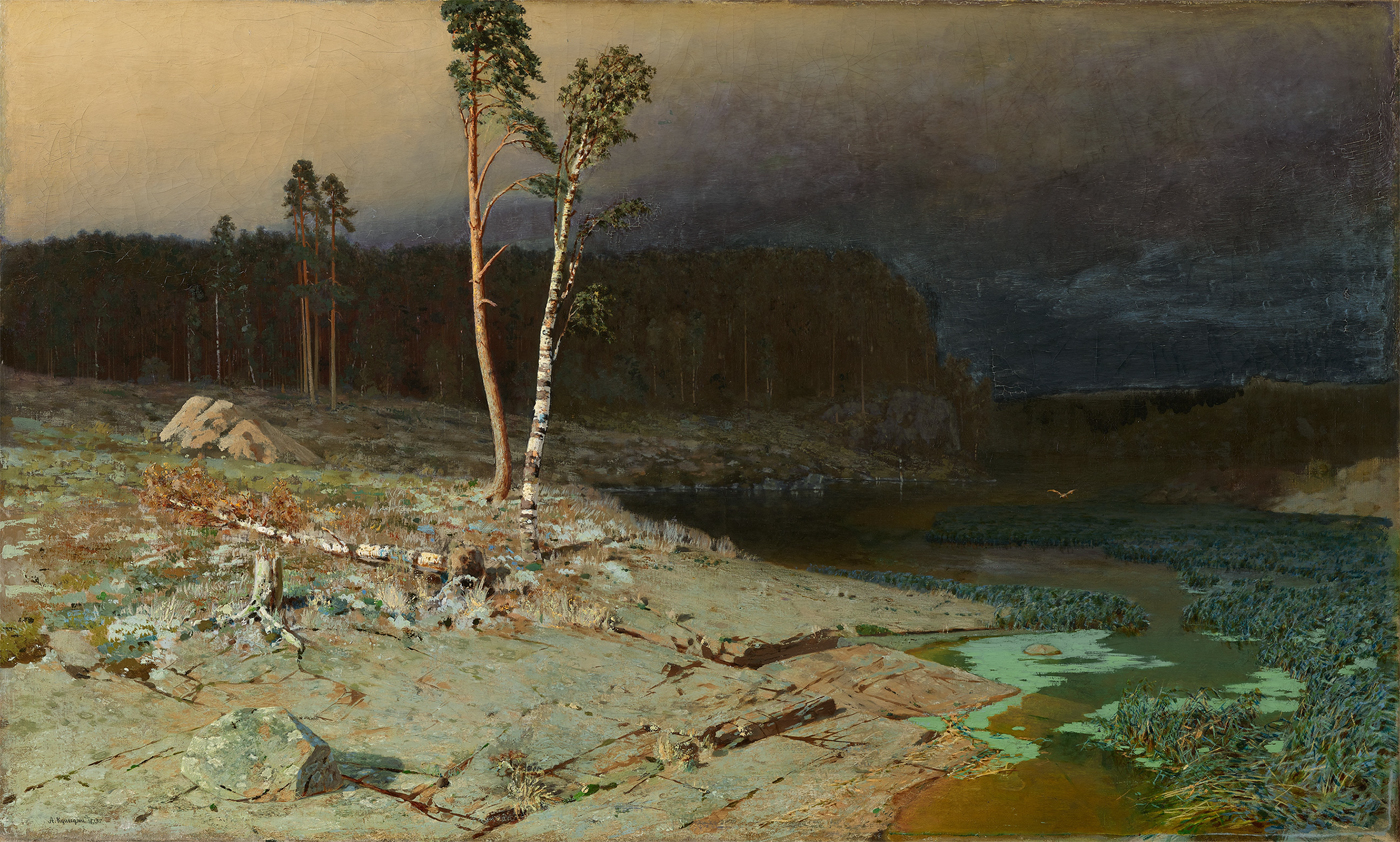
The forest in the left background sinks into twilight. On the right, the muddy stream winds its way from the background forward, providing an uninviting repoussoir—one would do well to wear rubber boots in this terrain. At bottom right, the wave of the dark-green grasses activates one's hearing at the imagined contact of boots with the swampy water. A scraggly pine, its top severed by the frame, and a fragile birch occupy the middle ground, slightly off center, echoed by the tree trunks further back, before they are subsumed by the somber forest. Kuindzhi's focus, nonetheless, is not the accurate rendition of the trees, although their species is still recognizable, but the effects of sunlight. A sense of melancholy, conveyed by the subdued palette of much of the painting, erupts in the upper section into the coloristic drama of the greens, pinks, yellows, and purples of either the sunset or sunrise. This iridescent patch plays off the lichened stone and muddy water at the bottom of the frame.
The “unstudied” quality ascribed to Kuindzhi's paintings by Stasov several years later emerges here from the less than successful rendering of depth, especially evident where the forest abruptly ends and abuts the dark vegetation and sky. The stark contrast between this darkness and what seems to be the uneven horizon line gives this half of the painting a rather flat appearance, drawing attention to the constitutive elements of the artist's materials: paint, brush, and canvas. The single bird in low flight somewhat compensates for the spatial flaw by pulling the eye into the distance. Together with the title, On Valaam Island supplies enough detail—the bird, the lichen on the stone, the bent stalks, and especially, the play of light—to create the sense of a real place at a particular moment in the day. It also complies with Stasov's programmatic call for a uniquely Russian landscape—not pretty, not picturesque, but recognizably native.
Yet for a realist, the handling of space leaves much to be desired. Considered within the precepts of realism, which presupposes an adherence to linear perspective, it would not do. If, however, the spatial treatment is interpreted as a move away from realist representation, the painting signals a different perceptual system. Rather than inviting the beholder into the pictorial world through the power of a one-point perspective, the landscape locates its potency elsewhere, namely in the poetic and moody depiction of light. Perspectival rules and the drawing technique are submitted to color, which already in this early work asserts a palpable vitality. From this canvas onwards, the painterly light effects of Kuindzhi's paintings proved to be unsettling for many critics and colleagues, whose reactions ran from qualified praise to bewilderment to outright dismissal.
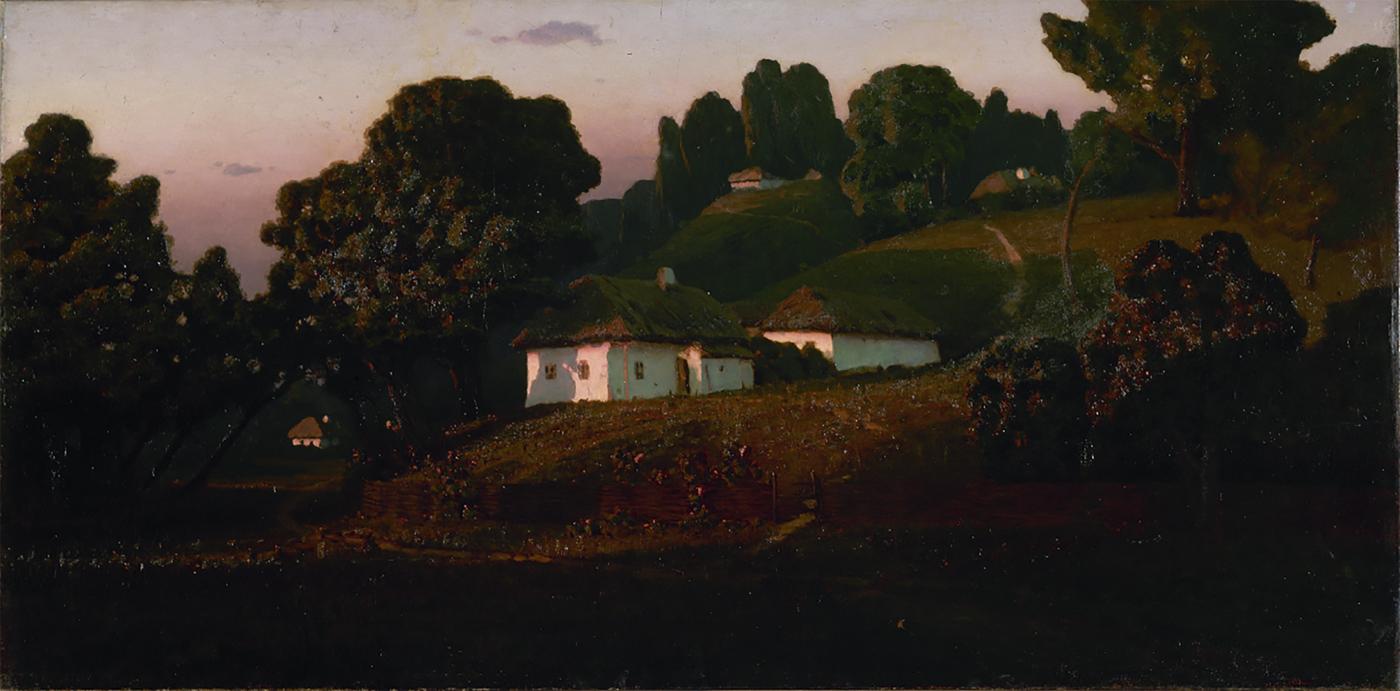
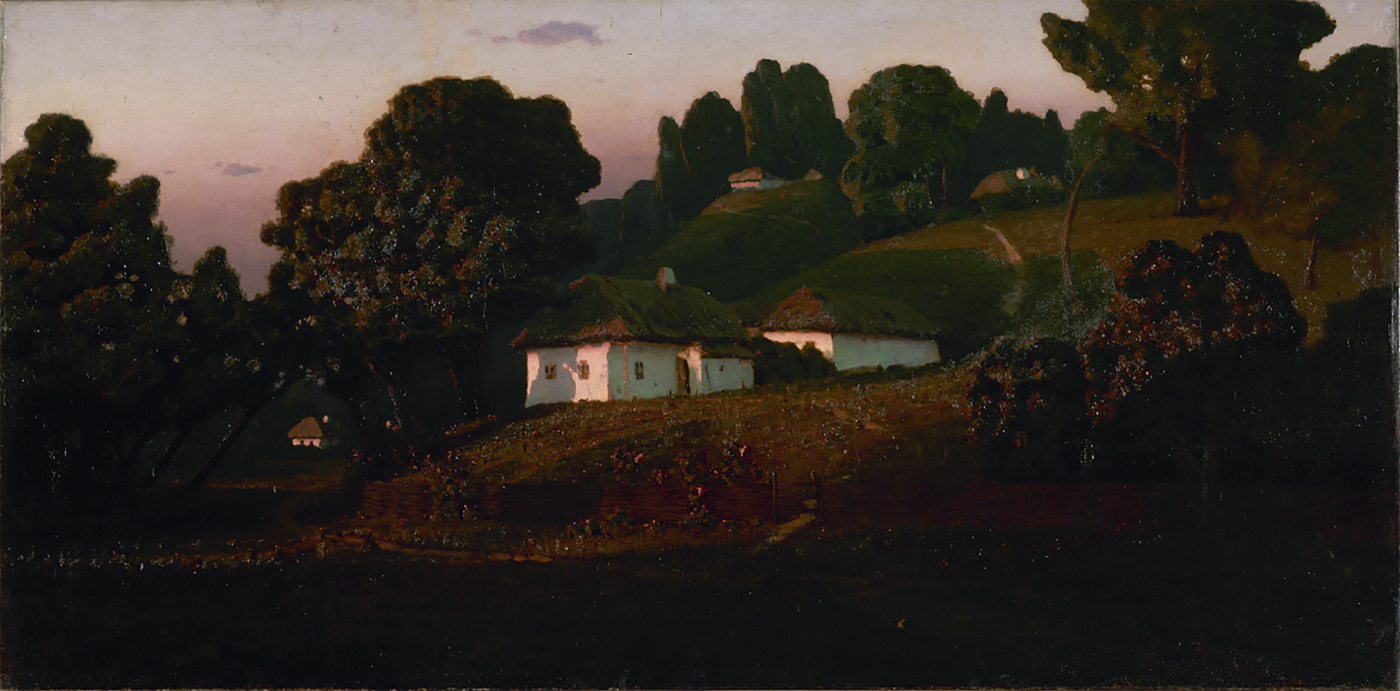
Vecher (Evening, 1878), shown at the sixth Traveling Art exhibition, depicts a Ukrainian village.Footnote 38 (See Figure 3). The intense illumination of the descending sun sets aflame the treetops, the hill, and the bright white walls of the huts. In a letter to Repin, Kramskoi confessed:
I'm a complete fool before this painting. I see that the light on the white hut is so true, so true [tak veren, tak veren] that my eye tires of looking at it as it tires of looking at living reality [zhivaia deistvitel΄nost΄]: in five minutes my eyes hurt, I turn away, shut my eyes and no longer want to look. Is this really a creative act? … I don't quite understand Kuindzhi. Add to that the thick clothy trees [sukonnye derev΄ia], extreme naiveté and primitiveness of drawing … Footnote 39
Kramskoi struggled to reconcile Kuindzhi's unsatisfactory technique—“thick clothy trees,” “primitiveness of drawing”—with what he perceived to be an extremely verisimilar portrayal of evening light. Rather than identifying the urge to close his eyes with an artistic victory, Kramskoi appeared at a loss before a painting with such a discomfiting illusion of light—“Is this really a creative act?” He seems to ask: should an artwork produce this kind of corporeal response? Or to use the language of physiology, which saw great popularity at the time among Russia's educated classes, is it too close to the notion of involuntary reflex, such as the automatic shutting of one's eyes, for instance?
Arkhip Kuindzhi, Evening in Ukraine/Evening, 1878. Oil on canvas, 81 × 163 cm. State Tretiakov Gallery, Moscow.
Kramskoi found Kuindzhi's color (kolorit) “completely incomprehensible” in Les (Forest, 1878), displayed in the same show.Footnote 40 He conceded that perhaps it contained a “completely new painterly principle, employing the truest colors from the scientific standpoint,” and likened his experience of this picture to reading a treatise on spectral colors “that are unknown to the human eye since we don't encounter them in the impressions around us.”Footnote 41 Pavel Chistiakov, an influential teacher at the Academy of Arts, said simply of Kuindzhi's canvases at this exhibit: “Kuindzhi has gone mad [spiatil].”Footnote 42
Arriving at the Academy in 1872, Chistiakov created a comprehensive program for its students, substantially reconsidering the previously taught methods.Footnote 43 The pillars of Chistiakov's instruction were drawing, painting, and composition, with all three sharing equal importance.Footnote 44 This was a marked departure from the system borrowed from the French Academy, which in turn followed the Italian Renaissance dictate, where drawing, or disegno, occupied the top position in the hierarchy of technical mastery. Importantly, a scientific approach to painterly color was an integral component in Chistiakov's pedagogy. Footnote 45 He embedded his own interest in the physiology of vision, color theories, and properties of light into his teaching, aware that knowledge of these scientific developments could be employed to art's benefit.Footnote 46 Why, then, this reaction from a pedagogical reformer who needed no convincing about the usefulness of science?
A possible answer lies in Chistiakov's emphasis on the priority of accommodating nature's three-dimensionality to the flat canvas in his method of teaching color. Above all, he cultivated in his students the importance of thinking spatially about different colors on a rectangular plane. A painted object was not to be considered static, but rather a color, or colors, “in movement,” dynamically relating to other objects’ mass, volume, and negative spaces on a pictorial surface.Footnote 47 Maintaining the illusion of three-dimensional space through drawing, composition, and color was the cornerstone of Chistiakov's system. His color exercises were submitted to this principle of realist representation, even if they accounted for physiological discrepancies in the relationship of light and colored objects. I argue that Chistiakov's often-uncharitable declarations about Kuindzhi's work come from a fundamentally different understanding of painting. It is true that the academician's pedagogy elevated color to an almost-equal footing with line and composition. It was meant to remain there, however, without destabilizing the hierarchy. Instead, Kuindzhi's palette demanded to be reckoned with. Put simply, Kuindzhi's bold treatment of color—its high intensity, crude blending technique or at times its absence, and vivid contrasts—had not been seen before in Russian painting. Rather than serving a well-defined function in the overall pictorial composition, Kuindzhi's colors pulled in or repelled the viewer by their sheer material force, disregarding the rules of spatial illusion.
Kuindzhi was routinely lambasted for his inferior draftsmanship, but his handling of color during this period, when he was the artistic toast of St. Petersburg, had a curious role in the discourse surrounding his art. The painter's coloristic exploration was not acknowledged as genuine artistic practice but received the disparaging label of “effects.” It is as though Kramskoi, Chistiakov, and others did not possess the language with which to respond to such primacy given to the medium of color in a realist aesthetic. As the question of color inevitably arose, it most often was entwined with an eye-catching, show-off quality (effektnost΄), even before Kuindzhi created his theatricalized viewing environment.Footnote 48 Following the sensation of his moonlight show, “Kuindzhi” and “effect” became inseparable.
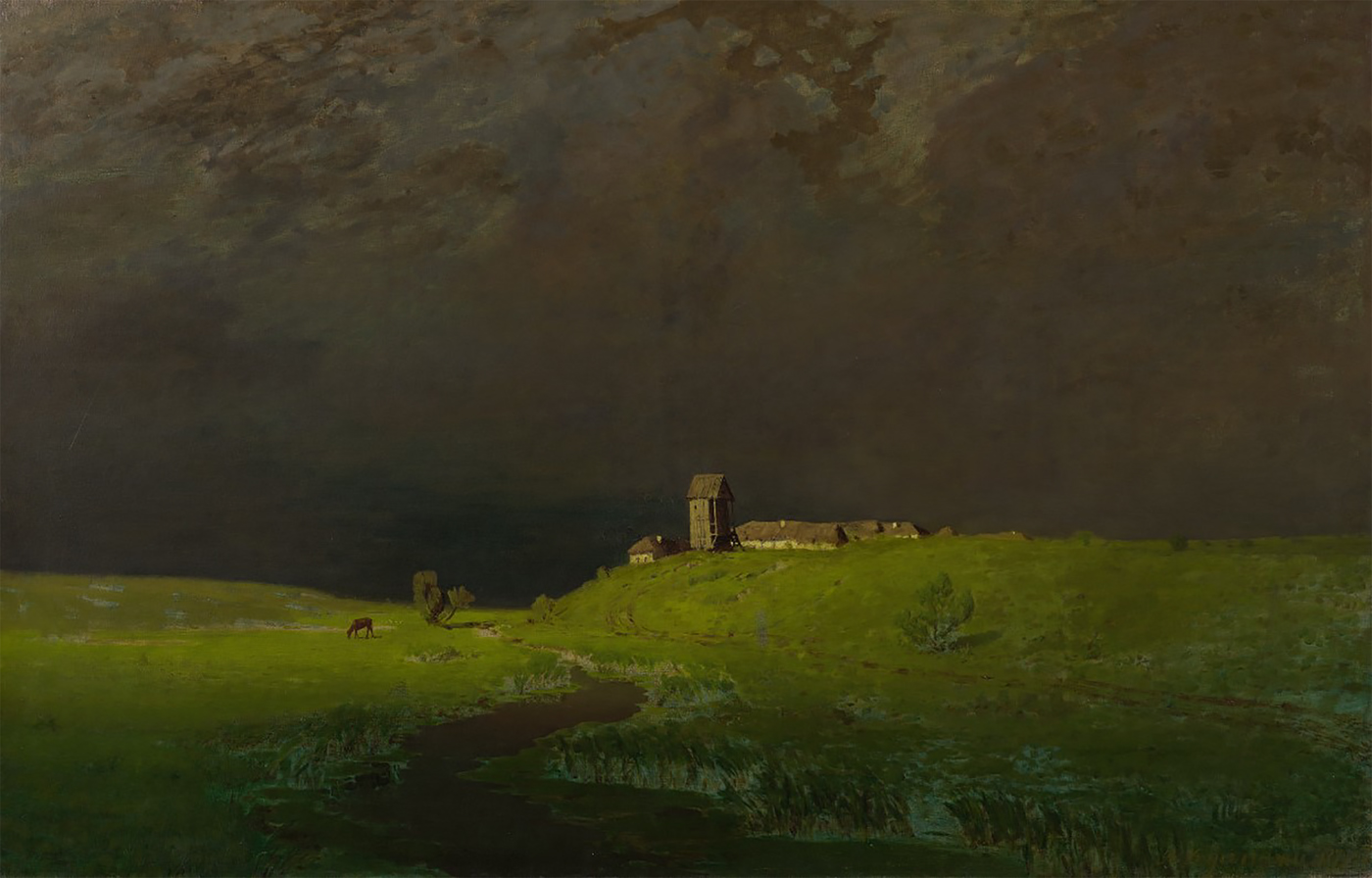
Posle dozhdia (After the Rain, 1879) depicts an expansive landscape. (See Figure 4) A horse in the middle ground, just off-center, grazes on the pasture. A cluster of shacks, quickly executed to produce a tumbledown impression, crests the hill in the center background. Bathed in a patch of sunlight, which emerges through the thick, parting thunderclouds, the bright-green meadow glows phosphorescently. The sky's dark-greens and purples, swallowing two-thirds of the composition, provide a startling contrast with the picture's lower section, whose greens and splashes of yellow advance toward the beholder. Kuindzhi separates the still-menacing heavens from the sun-flooded meadow by foregoing the blending technique. The shacks and the lone animal are caught in the delirious pool of illumination that suffuses the scene with the pastoral mood and impression of fresh air after a rainstorm. While supplying visual interest, the shacks and the horse are not the heart of the landscape. The generous swaths of earth and sky are Kuindzhi's supreme obsession—the play of light and its material substantiation through pigments. Critics and fellow artists found the dynamism emerging from these poles of color contrast too strange. Repin recalled the painter Illarion Prianishnikov's snide comment about the work: “I think this … light is from before the birth of Christ.”Footnote 49 Although vague, this remark can only be interpreted negatively: there was no place for such visual effects in fine-art painting.
Arkhip Kuindzhi, After the Rain, 1879. Oil on canvas, 105 × 161 cm. State Russian Museum, St. Petersburg.
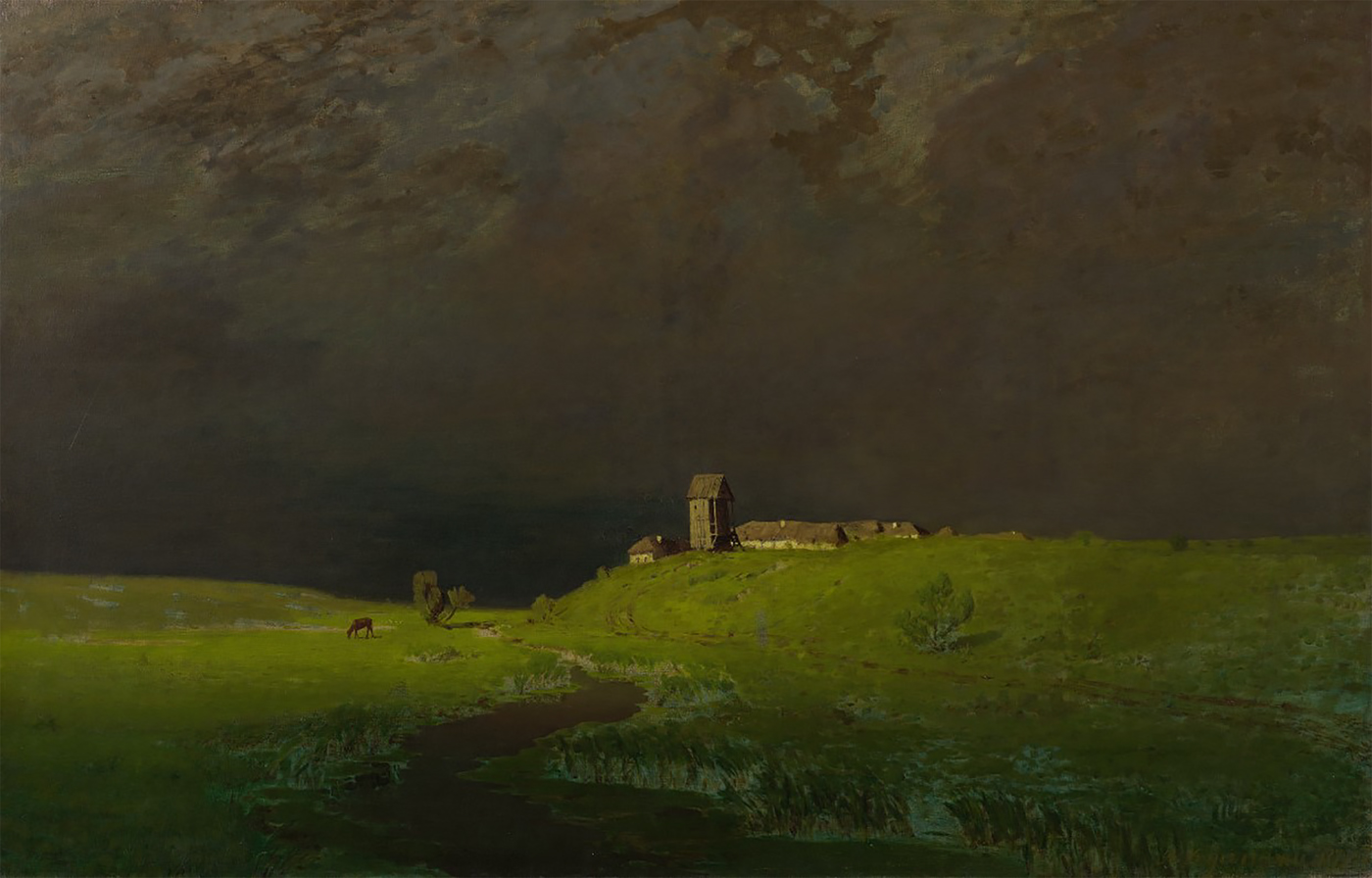
After the Rain, like Evening and Night on the Dnepr, is concerned with the coloristic drama manifested in the portentous darkness and radiant explosion of light. It is not brought to the canvas solely by artistic imagination; rather, it also follows from the careful study of the physiological peculiarities of human perception. Amid the perplexed or dismissive reactions in the artistic camp, the voices of the scientists Dmitrii Mendeleev and Fedor Petrushevskii expressed full satisfaction with Kuindzhi's representation of the quality and behavior of sunlight in this landscape: light was distributed not haphazardly (“kak bog na dushu polozhit”), but precisely “according to the patterns consistent with the laws of physics.”Footnote 50
The Eye in a Dark Room
During the 1860s and 70s, leading Russian universities became bustling centers of knowledge production. The historian Alexander Vucinich notes that “science ceased to be a secondary intellectual force in Russian culture and became as important as the antirationalist tradition in understanding the full spectrum of Russian thought.”Footnote 51 Thanks to the expansion of laboratories and other research institutions, specialized fields emerged. The field of physiology especially witnessed a surge in popularity. Physiology “was no longer a subject taught only in medical schools … in St. Petersburg, I. M. Sechenov made it not only a distinct academic subject but also an area of great emphasis.”Footnote 52 During Kuindzhi's formative period, the prominent chemist Mendeleev and the physicist Petrushevskii regularly lectured at the Art Academy and held additional classes for artists at St. Petersburg University where both men were professors.Footnote 53 Kuindzhi's interest in the science of color and perception emerged in their classes, which he attended either as an auditor or student, and was further reinforced by a subsequent friendship with both scientists.
A frequent visitor to Mendeleev and his wife Anna's weekly gatherings in the late 1870s and through the 1880s, Kuindzhi rubbed shoulders with literary figures and fellow artists as well as botanists, physiologists, and other colleagues from the host's university circle.Footnote 54 Customary company at the Mendeleevs’ soirées embodied the epistemological concerns of late nineteenth-century Russia, where the mingling of the creative and scientific spheres often precipitated heady debate. Indeed, when Kuindzhi exhibited his sensational nocturne, Mendeleev used this occasion to write a piece for The Golos (Voice), in which he reflected upon the revival of interest in landscape painting, and the coincident shift away from man and toward the humble observation of nature in science.Footnote 55 It is no exaggeration to say that the era's ambience of intellectual excitement and Kuindzhi's closeness with the most distinguished scientists formed his outlook on art. Thanks to Mendeleev and Petrushevskii, the painter developed a passionate, life-long interest in the study of light, color, and human perception. Representations of nature founded in physiological knowledge proved crucial to Kuindzhi's envisioning of his art practice. Moreover, Petrushevskii's insight into the chemical composition of pigments encouraged the artist's intimate familiarity with the painterly medium, which in his hands transformed into a splendid illusion of light.
Petrushevskii was a popular figure among the Peredvizhniki, but he and Kuindzhi developed an especially close and mutually beneficial friendship that lasted for several decades and expressed itself in a number of collaborations.Footnote 56 An established physicist by the 1870s, Petrushevskii's research pursuits were many, including vision and the science of color.Footnote 57 An amateur landscape painter himself, he had a personal stake in physiological optics. The scientist published two books on the topic, Light and Color by Themselves and in Relation to Painting, Six Public Lectures (1883), and Paints and Painting (1891).Footnote 58 Like his European colleagues—Hermann von Helmholtz, Richard Liebreich, Ernst Wilhelm von Brücke, and Jules Jamin, among them—the Russian physicist regarded art as a legitimate area of scientific inquiry. In the 1883 Light and Color, Petrushevskii addresses the lay reader, painters in particular, synthesizing nineteenth-century research on vision and painting and adding his own investigations in the field. Modeled on the series of lectures Optisches über Malerei (The Relation of Optics to Painting) given by the giant of modern physiology Helmholtz in 1871–73 and published in 1876, the Russian scientist's volume exalts the sensory abilities of artists.Footnote 59 For Helmholtz and Petrushevskii, artists must be regarded as “persons whose observation of sensuous impressions is particularly vivid and accurate, and whose memory of these images [of reality] is particularly true.”Footnote 60 Both scientists privilege the creative figure as someone who possesses an exceptionally well-tuned perceptual apparatus, which, however, is not enough for painterly interpretation of the surroundings; the artist must equip himself with physiological knowledge.
Petrushevskii's scientific framework is rooted in the idea of art imitating nature, where art is always at a disadvantage, for nature's “means are immeasurable and inexhaustible.”Footnote 61 For the natural scientist of the late nineteenth century, this premise necessitated scientific solutions for abetting the painter in his endeavor to represent the visible world with the limited tools at his disposal. Petrushevskii, following Helmholtz, offered to counter the medium's material deficiency by turning to physiology. The Russian scientist makes an explicit distinction between the notions of reality and representation when he says that the key task of painting is not to represent the world as it exists, “but as it seems to us, as objects appear in relation to each other.”Footnote 62 By making this distinction, he emphasizes the importance of physiological knowledge for artists.
Like many researchers on vision before him, Petrushevskii locates the pursuit of painterly truth in the human body. The rational optics exemplified by Cartesian perspectivalism, which dominated art practice and discourse since the Renaissance, gave way to the intricate, subjective optics of the human eye.Footnote 63 Petrushevskii's position on visual representation is situated in the era's epistemological shifts, which have been influentially investigated by Jonathan Crary. The physicist refers to what Crary has called “embodied vision,” a notion deeply tied to the “discovery that knowledge was conditioned by the physical and anatomical functioning of the body, and perhaps most importantly, of the eyes.”Footnote 64 In attempting to portray real-life phenomena using his medium, the painter must train his eye to separate internalized, habitual ideas about color—the grass is green and snow is white—from the mercurial impressions produced by the senses.
In Popular Lectures, Helmholtz explains eye sensitivity to varying degrees of light, information he finds paramount for painters. The eye, after prolonged exposure to bright daylight, becomes fatigued, while the opposite holds true in dim illumination: eye sensitivity increases. In Helmholtz's words, “The eye of the traveller of the desert … has been dulled to the last degree by the dazzling sunshine; while that of the wanderer by moonlight has been raised to the extreme of sensitiveness [sic].”Footnote 65 Differentiating between actual lived experiences and looking at a painted image, the physiologist argues that the latter possesses a “certain mean degree of sensitiveness” caused by the moderate light conditions of a conventional site for showing paintings, such as a gallery. He advises the painter to choose and apply his colors accordingly to produce the same impression that sunlight or moonlight creates in either the dulled or sharpened eye of its observer.Footnote 66 Helmholtz speaks at length of the intensity of light and human ability to discern its varying degrees in interiors. However, his recommendation to artists, while detailed, does not extend beyond appropriate color selection: it is focused on the materiality of the medium. Mainly, he urges painters not to neglect “the mean degree of sensitivity.”
In the retelling of this episode in Light and Colors, Petrushevskii notes, “eye sensitivity becomes significant if the eye remains for a long time in a poorly lit room.”Footnote 67 He replaces Helmholtz's romantic “wanderer by moonlight” with the human eye—perhaps of an exhibit-goer or artist—in an enclosed space. I read Petrushevskii's substitution of Helmholtz's wanderer by “the eye in a poorly lit room” as the Russian scientist's consideration of the crucial role of an exhibition environment in the physiological interplay of perception and color, which had been brilliantly accomplished by his friend Kuindzhi three years previously. An enclosed, deliberately-darkened space figures prominently in the physicist's second work on the subject of painting and vision published in 1891.
Intended as a handbook for painters, Paints and Painting offers advice on determining the chemical composition and quality of pigments available from different manufacturers, as well as a detailed analysis of the mixing of material colors and their behavior under natural and artificial light. There can be little doubt that Kuindzhi consulted Petrushevskii on the optimal viewing conditions for his nocturne. Consider the following extract from the section “Influence of Illumination on Colors of Objects”:
Artificial illumination by gas and kerosene in homes presents a big concern for the artist and admirer of painting, since not only tones of the painting change, but in general the relations between tones get violated. A painting is painted in daylight, and each color, or a mixture of colors, has intrinsic relative tones; under the orange light of gas, paint tones become utterly different because paints cannot select all their intrinsic colors in sufficient amount from the kerosene or gas lighting. … Sensory perception of color in the evening presents a special case … perception of color turns out to be not as falsified in the artificial illumination as one might expect judging from the extreme transformations that are really occurring in colors themselves. … This conclusion could be verified in the following experiment. Let us imagine that being in a room lit by daylight we can, through a small opening in the door, see into an adjacent dark room, in which hangs a painting that is illuminated only by a lamp. The color scheme of this picture may appear terrible to us, but by walking into the dark room and allowing the eye to adjust to the lamp light, we will find that the impression of the painting is not so bad as seemed to us a few minutes ago. The explanation must be sought in the particular state of the eye under artificial lighting.Footnote 68
The passage seems to allude to Kuindzhi's unorthodox choice of display at the Society for the Encouragement of Artists. Although Petrushevskii may have been inspired by his friend's audacious conception, I suspect that the pair closely collaborated on the artist's first solo show, after Kuindzhi's break with the Peredvizhniki.Footnote 69 While his book was published in 1891, Petrushevskii had been continually preoccupied by physiological theories of perception, as we have seen. It is certainly likely that Kuindzhi's quest for color prompted the physicist to return to his research on physiological optics in 1872–73, shortly after the two had met, following a decade-long hiatus.Footnote 70 The excerpt from Petrushevskii's 1891 manual suggests that a specific viewing environment may have been integral to the initial idea for Kuindzhi's luminous nightscape, particularly as it is buttressed by the artist's enduring involvement with the scientific approach to painting color. In November 1880, “the eye in a poorly lit room” on Bolshaia Morskaia Street was scientifically primed for experiencing the painted image of moonlight to the fullest.
“External Contrivances”: Intermediality
In The Observer: Essays on the History of Vision, Mikhail Iampolski examines painting's close ties with popular forms of entertainment, such as the panorama, diorama, and the pantomime in the late eighteenth and early nineteenth centuries. In particular, he explores painting's grappling with the vexed issue of light following Newton's discovery of the color spectrum. He places Newton's findings at the heart of the transformation of painting into a theatrical spectacle.Footnote 71 The traditional, natural philosophical theory of color, largely based on Aristotle and his followers’ inconsistent fragments, asserted that color was a mixture of whiteness and blackness and claimed that color was a property of the surfaces of perceived objects. By transmitting a ray of light through a prism, Newton invalidated the prevailing Aristotelian view, postulating that color was a property of the light reflecting from and refracting through objects and not of objects themselves. In its pure form, light was a white compound substance constituted by rays with different properties.Footnote 72 The rays that could not be further divided into smaller units by reflection or refraction Newton regarded as the “primary colors,” of which he discerned seven.
The exemplars for illustrating this groundbreaking optical analysis were the rainbow and the iridescent plumage of the peacock's tail. Newton's theory, however, did not provide painters with an applicable solution for representing light—the peacock's tail aside, how does one render the invisible with paint and brushes? “Light in its pure form remained inaccessible for painting,” Iampolski notes.Footnote 73 Thus, Newton's claims opened up a gulf between science and art practice, for he never distinguished between the colors of light and those of material pigments. In the post-Newtonian imaginary, Iampolski envisages the problem of light as a two-plane structure: one comprises the rarified theoretical sphere of Newton, the other the “sullied” universe of humans where light is intermixed with earthly objects.Footnote 74 Petrushevskii and Kuindzhi belonged to an international group of scientists and artists, among them Johann Wolfgang von Goethe, David Brewster, Eugène Delacroix, J. M. W. Turner, and the Impressionists, all of whom tried to reconcile the two. Efforts to do so—effectively to reinterpret Newtonian optics within the canon of natural philosophical theory of color—frequently led painting astray.Footnote 75 It is as though the dispositif of fine-art painting could not rein in such a spectacular representation of the natural phenomena of light. The chasm between nature and painting's attempts to replicate it resulted in turning the former into a repertoire of stage tricks and vulgarizing the latter.
Kuindzhi never painted for the stage. Although his professional universe in the 1870s and 80s was confined to easel painting, his point of contact with the realm of theatrical illusion is nonetheless significant. It exceeds “theatrical,” “decorative,” and “backdrop-like,” the derogatory epithets often given to his landscapes.Footnote 76 The three solo shows, mounted in 1880, 1881, and 1882, exhibited landscapes in a carefully-controlled environment, and showcased scientific-painterly exploration in color and light effects. In an 1882–83 article, Stasov had this to say about Kuindzhi's display practice:
Certain elements of his technique, fire illumination [ognennoe osveshchenie] and various other external [vneshnie] contrivances in his exhibitions border on decorative stage painting and panoramas. This was the reason why he was often attacked. I, however, do not see anything offensive or reprehensible in it for art: perhaps in the future all art exhibitions will employ such auxiliary methods, particularly when there is not enough sun and daylight. Kuindzhi's boldness and initiative are admirable.Footnote 77
These external contrivances of Kuindzhi's shows—the dark, the lamps, the screen—unsettled the academic establishment and some Peredvizhniki who saw them as violating the bounds of good taste and proper decorum of fine-art exhibitions. This transgression also indicates the artist's efforts to solve the issue of painting light scientifically. To do so, he used his knowledge of the physiology of vision and turned to what I call the intermedial mode of display.
Such intermediality relied on the borrowing of certain elements from popular amusements: dioramas, circular and moving panoramas, and magic lantern performances. Although different in scale and viewing behavior, these mass attractions, popular in nineteenth-century Europe, share several key features with Kuindzhi's daring conception of an exhibition space. All rely on the manipulation of light and enlist artificial darkness to affect the spectacle. The circular panorama allowed the visitor to perambulate somewhat freely, taking in a breathtaking vista or dramatic battle scene. In a dioramic séance, like in a magic lantern performance, the spectator sat in her seat in anticipation of a show where day rolled into night before her eyes. Often painted on large transparencies, public dioramas performed their magic by ensuring that the intricate light apparatus was hidden from view behind the painted scene.Footnote 78 “[V]isitors first passed through a darkened tunnel upon entering the building,” before emerging into a circular room with seats and boxes like a theater.Footnote 79 “After their eyes had had time to adjust to the darkness,” Stephan Oettermann explains, “the curtain went up, revealing the picture.”Footnote 80 The diorama's principal attraction was the illusion of meteorological phenomena or of time passing in the painted scene, frequently a landscape or church interior, enacted by a series of light changes.
Crucial to Kuindzhi's spatial and visual conception was the fact that Night was hung on a screen rather than a wall, as was customary in a gallery and salon. The presence of the screen invited interplay between the image and the public.Footnote 81 Screens of all shapes, sizes, and materials had by 1880 a rich history in architecture, science, and entertainment.Footnote 82 Famously, in the late eighteenth century, Etienne-Gaspard Robertson's Phantasmagoria astonished audiences throughout Europe with quivering figures of ghosts projected onto a sheet with the aid of a magic lantern on wheels.Footnote 83 Louis Daguerre's “double-effect” diorama relied on a translucent canvas painted on both sides with two distinct scenes, which alternated with the manipulation of the lighting mechanism, generating the most incredible effects.Footnote 84 Inherent in the function of a screen is the act of concealment and its opposite, the act of revealing. In the moonlight exhibit, many visitors reportedly were tempted to peek behind the canvas, convinced that the picture was painted on a transparency or glass.Footnote 85 The screen's presence manipulated audiences’ expectations, structuring their perception of the landscape.
Available witness accounts indicate that exhibit-goers did not merely wish to look at the painting; they wished to interact with it, like they would with dioramic or magic lantern images.Footnote 86 The proliferation of new visual experiences in the nineteenth century aided by technology called into question the very nature of vision, as Jonathan Crary, Martin Jay, and others have demonstrated.Footnote 87 The public at the Kuindzhi exhibition expected to be tricked, trusting neither their eyes nor the painted canvas. In other words, they treated the landscape as a technological object and not as a painting to be contemplated from a physical or symbolic distance. But Kuindzhi's design of the environment went beyond sight, activating other sensory functions. If scale, spatial arrangement, and code of conduct in panoramic, dioramic, and public magic lantern shows precluded spectators from directly engaging in acts of demystification, in the exhibit room on Bolshaia Morskaia Street, they had a chance to get intimately close to what they perceived to be a craftily-made image, an image whose materiality was suspect. Some came armed with a magnifying glass, determined to crack the mystery of the alternately brilliant and black surface.Footnote 88 What viewers delighted in was the painting's physical uncertainty—was this indeed a painting or a kind of optical trickery? The material solidity of Night on the Dnepr dissolved into the web of visual practices familiar to nineteenth-century Russian urbanites. Conceived as a work within a carefully constructed environment, Kuindzhi's landscape can effectively be considered a “technological image,” to use Tom Gunning's term.
It refers not only to “images produced by technological means (such as mechanically-produced tapestries or prints, or the chromolithographs that set off the age of mechanical reproduction), but images that owe their existence to a device and are optically produced by it rather than simply reproduced.”Footnote 89 Gunning identifies technological images as ontologically different from those that are fixed in space, “embodied in pigment or canvas.”Footnote 90 I wish to augment his useful definition to include other kinds of images whose visual potency relies upon different forms of interaction of the image with the viewer and the environment.Footnote 91 I argue that Night can be seen as a technological image, comparable to those produced with the aid of devices Gunning describes. Shown in a conventional gallery setting, the nocturne would arguably not have required the viewer's involvement beyond contemplation. The beholder may have admired the light effects, daring palette, or felt the need to close his eyes, as Kramskoi did. Placed in the intermedial environment Kuindzhi created for it, however, likely in collaboration with Petrushevskii, not only did the canvas encourage interaction, it depended upon it for a maximal optical effect. While fixed in space, the image was called into a fuller existence by the spatial arrangement, behaving as if optically produced.
The perceived ontological unreliability imparted a dialectical quality to the landscape, inspiring divergent reactions among critics. Nikolai Strakhov compared it to admiring a great portrait only to have the unpleasant impression that it has actual, instead of painted, hair glued to the canvas. “Evidently, the more natural, the better,” Strakhov explained, “but the glued-on hair spoils the portrait. Here it is the same. The moonlight is too natural, too striking in its naturalness, and so it ruins the harmony of the picture.”Footnote 92 In contrast, Aleksei Suvorin called Night “magical,” which for him meant unequivocal realism. Suvorin saw the picture as a social imperative because it demonstrated that a genuinely realist artwork is not beholden to tendentious subjects. Realism need not always seek impact by leading the viewer into the proverbial “gloom … sorrow, slush, swamp.”Footnote 93 Rather, he asserted, it can be located in the powerful affect produced by an expressive landscape. Suvorin used the painting as an occasion to attack the Peredvizhniki's brand of realism as “fabricated,” “constructed [delannyi],” “grown amidst political squabbles and animosity ”Footnote 94 His words evoke Stasov's characterization of Kuindzhi's work as “unfinished” and “unstudied.” If for Stasov, these qualities indicated a lack, for Suvorin, they signaled a model of realism that prized an aesthetic experience for itself.
“Normal Vision”: Conclusion
Highly suspect as realist, Kuindzhi's art supplied fodder for Kramskoi, Chistiakov and others, who did not quite know what to do with its simplified forms, flattening out of pictorial space, and foregrounding of color. If superb draftsmanship and painterly technique were secondary to socially-charged narratives, Kuindzhi failed on both counts; his technique was considered subpar and his work suggested no interest in such narratives. Instead, his practice revealed a dimension in Russian painting that was less in tune with the aesthetic championed at home than with the modernist developments in France. The perceived incompleteness of Kuindzhi's paintings as well as his preoccupation with light echoed the main offenses leveled by Russians at Impressionism.
Most Peredvizhniki who encountered Impressionist canvases on their sojourns to the French capital dismissed them as too sketchy and unfinished.Footnote 95 In a letter to Stasov from Paris in July 1876, Kramskoi polemicized Emile Zola's article that had just appeared in the Vestnik Evropy (Messenger of Europe). The French author had reviewed both the Salon show and the second Impressionist exhibit on rue Le Peletier.Footnote 96 Kramskoi fulminated against Zola's description of Claude Monet, Berthe Morisot, Camille Pissarro, and their associates as agents of a radical transformation of French painting. To him, their formal experiments amounted to merely seeking a sensation in order to shock the jaded Parisian public.Footnote 97 He conceded that the fugitive impressions of light seen in their paintings existed in nature, but they could not be “the basis … only in rare cases may the artist resort to this effect.”Footnote 98 Although Kramskoi, in a positivist gesture characteristic of the times, professed high regard for science, when faced with the art that used scientific knowledge for visually interpreting the world, he communicated discomfort, even resistance.
Conventionalized representations continued to dominate Kramskoi's view of proper artistic expression, as evidenced by his reaction to the Impressionists. He pronounced Manet (he probably meant Monet) “near-sighted, who, although outdoors, cannot see further than his nose,” and asserted that art should “be intended for people who … are in full command of their minds and memory and … who have normal vision.”Footnote 99 What Kramskoi understood by “normal vision” was precisely the conventionalized depiction of natural phenomena that was rejected by scientists who studied perception. Using the trope of the flawed eye for repudiating Impressionist painterly investigations, he indicated again—this time not in reference to Kuindzhi but to the French avant-garde—the uneasiness about “embodied vision,” and by extension, an uneasiness about science. This vision was, of course, intricately linked with the perception of color, which was what Kuindzhi's paintings were all about.Footnote 100
While the public was enthralled by the experience of Night on the Dnepr, the astonishment of his colleagues was often mixed with unease. They knew that the painting was just that, a painting: a representation executed with oil on the two-dimensional surface of a primed canvas. No illumination hidden behind the standing screen or magic lunar pigment was to be found. Kramskoi shared his unease about the nocturne with Suvorin:
This painting is really filled with light and air, the river really flows in all its might, and the sky is truly limitless and deep. I have known this picture for some time now, seen it at all moments of day and under all lighting conditions, and I can attest that just as during my first encounter … I could not help but feel physiological irritation of the eye as if from real light, in all the subsequent times the same sensation would come over me at the sight of this picture.Footnote 101
Although Kramskoi ensured the critic that he was duly impressed by the celestial light's realism, as with Kuindzhi's earlier landscapes, he distrusted a physiological reaction to an artwork. To him, the urge to close his eyes undermined the painting's status as genuine art. Kramskoi hesitated to let physiology into the elevated spiritual plane of the interplay between art and beholder, for it threatened to overwhelm the latter and annihilate the distance necessary for contemplating art. While using physiology's very language to describe his reaction, the venerable Peredvizhnik appeared troubled by the moral implications of an aesthetic object that activated physiological operations with such impudence.
In 1860, the celebrated physiologist Ivan Sechenov delivered a series of lectures at the Medical and Surgical Academy that “produced a sensation among … all Petersburg.”Footnote 102 Three years later, Meditsinskii vestnik (The Medical Herald) published his seminal “Reflexes of the Brain.”Footnote 103 Sechenov, who had studied in Heidelberg under the tutelage of Helmholtz and worked in Paris in the laboratory of Claude Bernard, postulated that all psychical activity arose in the body as a result of reflex mechanisms. In the study, Sechenov went through the sensorium to explicate how external stimuli produce and maintain psychical processes that act upon the sense organs. One of his discoveries was the interaction of the mechanisms of inhibition and excitation of reflex movements in all internal activity. Repeatedly, when writing of Kuindzhi's work, Kramskoi registered his sensory disquiet, which was followed by a motor operation, the closing of the eyes. He claimed to have failed to develop resistance to the repeated stimulation the nocturne inflicted upon his retina. Such language is straight out of “Reflexes of the Brain”; in other words, Kramskoi did not form a habit despite numerous exposures to Kuindzhi's visual effects, which should have enabled him to expect the stimulus and therefore inhibit the reflex movement.Footnote 104 Chistiakov as well could not embrace this reaction. Although his pedagogical system posited the problem of color dually—as it exists in life and as perceived by the human eye—the physiological undercurrent of Kuindzhi's paintings irked him.
It is curious that color, the most crucial element of the artist's work in affecting physical discomfort is left unexamined, although the physiological basis of color was by then well established. Could it be that physiology suggested a language while art discourse had yet to do so? It is as though the only path to a serious analysis of Kuindzhi's handling of color was either through the language of lack, mainly his lack of technical mastery, or the language of physiology, via the unpleasant sensations of the embodied eye. Despite their purported embrace of science for art practice, Kramskoi and Chistiakov appeared unable to welcome its materialization in a painting. The language of physiology, meanwhile, failed to capture Kuindzhi's visual idiom and the new relation it proposed between painting and viewer.
Something else is at play here, however. Prompted by the 1881 exhibition of Berezovaia roshcha (The Birch Grove, 1881?)—again, a one-picture affair—Chistiakov pontificated in a letter to the art collector Pavel Tretiakov.Footnote 105 “Art that astonishes … isn't lasting. The effect, although it strongly affects the public, quickly becomes tiresome! … High art is … quiet, it affects the soul imperceptibly … fine art does not scream about itself.”Footnote 106 He denied Kuindzhi a place in the domain of high art because the painter chased the production of an incongruous response in the beholder: astonishment.Footnote 107 It is likely that the evaluation of Chistiakov and others was entangled with Kuindzhi's enviable position on the art market: he prospered unlike most Peredvizhniki. It was more than the artist's “external contrivances” and what I call the intermedial mode of display that made his work sought-after, which permitted him the kind of professional independence many of his colleagues did not enjoy. Night had been sold to the Grand Duke Konstantin for a record sum of five thousand rubles before the show opened, with moneyed customers requesting additional copies.Footnote 108 Kuindzhi's critics could not separate his obsession with light effects from producing them on demand.Footnote 109 To them, both had a whiff of profiteering. Sensationalism and money—surely, this was not their vision of Russian art.
In “Towards a Newer Laocoon,” Clement Greenberg says that a modern painting “exhausts itself in the visual sensation it produces. There is nothing to identify, connect or think about, but everything to feel.”Footnote 110 In Kuindzhi's canvases, there was perhaps too much to feel. Kramskoi especially seemed at pains to articulate the bothersome originality of Kuindzhi's painterly expression. Yet to insert Kuindzhi into the Greenbergian trajectory of modern art is to implicitly accept its biases, most notably “the rule of ocularity,” in Caroline Jones's phrase.Footnote 111 To be sure, Kuindzhi's attempts to paint light scientifically are rooted in the physiology of sight, but his intermedial means of exhibition mobilized the moving body of the spectator for a set of broader sensory experiences that embraced an interplay of the body's “perceptual and proprioceptive signals as well as the changing sensory envelope of the self.”Footnote 112 The multisensory ethos of Kuindzhi's modern work called for an active spectator. The painter's violation of display practices invited in turn violation of the accepted etiquette by sundry exhibit-goers, constructing a powerful affective relationship between object and subject beyond contemplation and vision. Kuindzhi, therefore, did not disavow the social but configured the public's relation to his art in a way that elevated aesthetic experience to a vital social imperative.