Coarctation of the aorta accounts for 5–7% of all CHDs, and has an incidence of 0.3–0.4% per 1000 live births.Reference Padua, Garcia and Rubira 1 It is defined as a short-segment narrowing in the area of the aortic isthmus.Reference Warnes, Williams and Bashore 2 Systemic hypertension manifesting after surgical coarctation repair is a known long-term sequela and affects between 16.8 and 34% of subjects.Reference Canniffe, Ou and Walsh 3 Previous studies have suggested that the risk of developing hypertension is reduced if the coarctation repair is performed at a younger age, ranging from within the first year of life up to 9 years of age.Reference Brown, Burkhart and Connolly 4 – Reference O’Sullivan, Derrick and Darnell 6 Knowing the likelihood of developing hypertension depending on the age the child at the primary coarctation repair is important to counsel parents on the future risk of their child developing hypertension, and second to help inform the frequency of long-term blood pressure surveillance after the primary repair. On the basis of our experience on patients operated on since the opening of the Evelina London Children’s Hospital in 2005, our objective was to investigate the risk of developing future need for treatment of arterial hypertension and re-coarctation of the aorta depending on the age of primary coarctation repair, and thus further refine the optimal age at which coarctation repair is most effective in reducing this risk.
Methods
This was a retrospective cohort study examining patients with coarctation of the aorta who underwent surgery as the primary treatment from October, 2005 to October, 2014. Patients were identified from the institutional database of the Department of Congenital Heart Disease (Heartsuite, Systeria, Glasgow, United Kingdom). After identification, patients were anonymised by assigning each patient a code. Included were all children aged <16 years with previously untreated aortic coarctation. Excluded were patients with complex CHD defined as having associated cardiac defects other than the commonly associated heart lesions of coarctation, which are ventricular septal defect, bicuspid aortic valve, aortic stenosis, and patent ductus arteriosus. Also excluded were those with no documented follow-up data and those aged 16 years and older at the time of their first operation. Patients lost to further follow-up after the initial follow-up were included.
Data were extracted from the departmental database and patient notes. The main outcome event at follow-up was of the need for anti-hypertensive treatment at the last known clinic follow-up. There were no well-defined criteria for initiating anti-hypertensive medications as this was not clearly or consistently documented in the patient records. The presence of re-coarctation of the aorta – defined as the documentation of this diagnosis at clinic follow-up or an echocardiographic Doppler peak flow velocity in the distal descending aorta of >2.5 m/second – was examined. Patients were divided into groups according to their age: neonates (⩽28 days of life), infants (>28 days ⩽12 months), and children (>12 months). Demographic data included age at surgery and sex. We collected data on whether the patient had an antenatal diagnosis of coarctation. We included descriptive data on the type of surgical procedure performed; however, we used the need for cardiopulmonary bypass to define more complex procedures and went on to see whether procedure complexity had an influence on the outcomes. We examined whether the level of postoperative illness severity, using the duration of paediatric intensive care unit stay postoperatively and the need for inotropic support, had any relationship with the outcomes.
The present study was approved as an audit by the institutional board of the Evelina Children’s Hospital. The need for parental/patient consent was waived.
Statistics
Comparisons between categorical variables were examined using ANOVA and χ2 analysis. Cox’s proportional hazards regression analyses were used for both need for anti-hypertensives and need for re-coarctation as outcomes. In both models, the three age groups – neonate, infant, and child – were tested as categorical covariates, and in both models the use of cardiopulmonary bypass was included. The time elapsed from the time of surgery to outcome was used to calculate Kaplan–Meier time to event curves. Comparisons of continuous variables by means were examined using unpaired Student’s t-test. A p value of <0.05 was considered statistically significant. Data were analysed using Stata v 13.1 (Stata Corp, Texas, United States of America).
Results
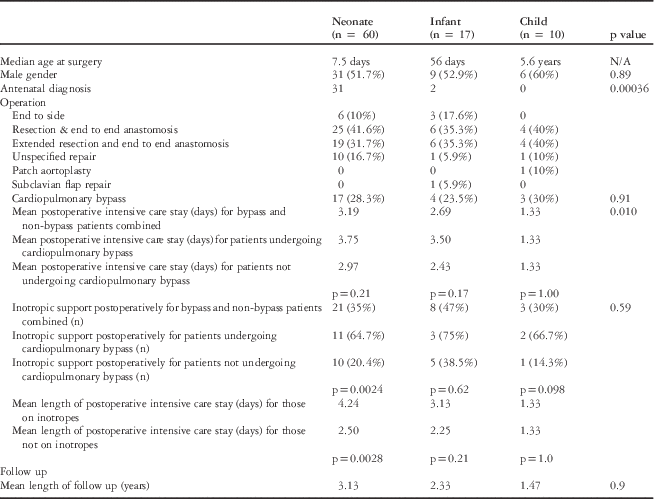
A total of 97 patients who had undergone primary surgical treatment for coarctation were identified from our database. Of these, a total of 10 were excluded: nine had no follow-up data in our institution, and one patient was incorrectly coded as coarctation of the aorta. The final study population consisted of 87 patients. There were no mortalities in the postoperative or follow-up periods. A summary of patient characteristics, length of intensive care stay, need for inotropic support with respect to those who did and did not undergo cardiopulmonary bypass, and the length of intensive care unit stay in relation to need for inotropic support postoperatively is displayed in Table 1. Types of operations performed were resection with end-to-end or end-to-side anastomosis, extended arch resection and arch reconstruction, subclavian flap repair, and patch aortoplasty. Patients in whom the type of surgery performed was unclear were grouped as “unspecified repair”. In all, 24 patients (27.6%) underwent procedures requiring cardiopulmonary bypass and the proportions requiring bypass were similar between the age groups. There were no statistically significant differences within the age groups regarding length of postoperative intensive care stay among patients undergoing bypass versus non-bypass procedures. For neonates, infants, and children, the mean postoperative days on intensive care for bypass and non-bypass showed no significant difference. In infants and children, there was no significant difference in the mean postoperative stay for those requiring inotropes; however, neonates requiring inotropes did have a significantly longer intensive care stay, 4.24 days versus 2.5 days (p=0.0028). Antenatal diagnosis was highest in the neonatal group as expected. Neonates had the longest length of postoperative time on intensive care (3.19 days in neonates compared with 2.69 days for infants and 1.33 days for children). Neonates also formed the highest proportion (17 patients, 70.8%) of the 24 patients requiring cardiopulmonary bypass, and 11 (64.7%) of these 17 neonates requiring bypass required inotropes postoperatively.
Summary of patient characteristics, operations, cardiopulmonary bypass, need for inotropic support and length of intensive care stay.

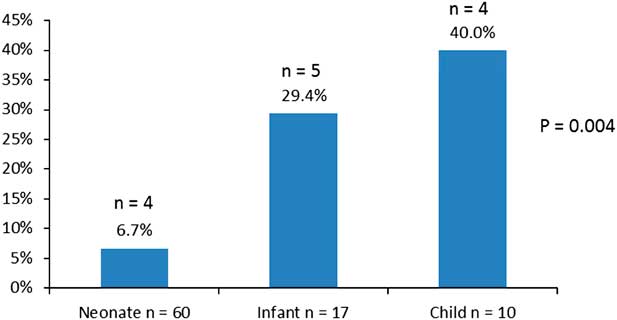
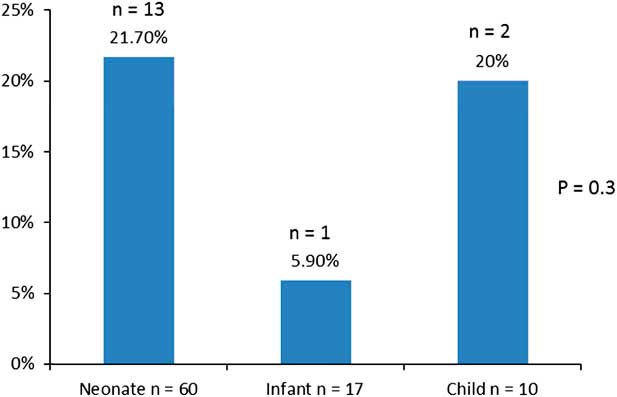
The median time of follow-up until outcome – that is, long-term anti-hypertensive medication, re-coarctation, or being well at the last clinic follow-up – was 699.5 days (range from 11 days to 3285 days). There was no statistical difference in the duration of mean follow-up between the age groups for all the outcomes (Table 1). The outcomes according to age subgroups are summarised in Figures 1 and 2. The proportion requiring long-term anti-hypertensive medication, which consisted of angiotensin-converting enzyme inhibitors, β-blockers, or calcium channel antagonists, was lowest in the neonatal group, being 6.7%. The proportion requiring long-term medication increased in older children at the time of their first surgical intervention: 29.4% if first operated on as an infant and 40% if first operated on over 1 year of age. These differences were statistically significant (p=0.004). We were unable to demonstrate a significant difference in the proportion of those requiring re-coarctation depending on the age they were first operated, although the prevalence was the lowest in the infant age group, being 5.9 versus 21.7% in the neonatal group and 20% in those over 1 year of age (p=0.3). Only five patients who developed re-coarctation required antihypertensive medication versus 11 re-coarctation patients who did not end up with medications. The odds ratio for requiring antihypertensive medication in the presence of recurrence was 3.58, but this was not statistical significant (p=0.052). Only one neonate showed evidence of residual coarctation in the immediate postoperative period after a non-cardiopulmonary bypass resection and end-to-end anastomosis procedure. In the same postoperative period, the patient underwent a balloon catheter dilatation, but later developed re-coarctation 67 days postoperatively from the original procedure.
Outcome of need for anti-hypertensive medication in neonatal, infant and child age groups.

Outcome of prevalence of re-coarctation in neonatal, infant and child age groups.

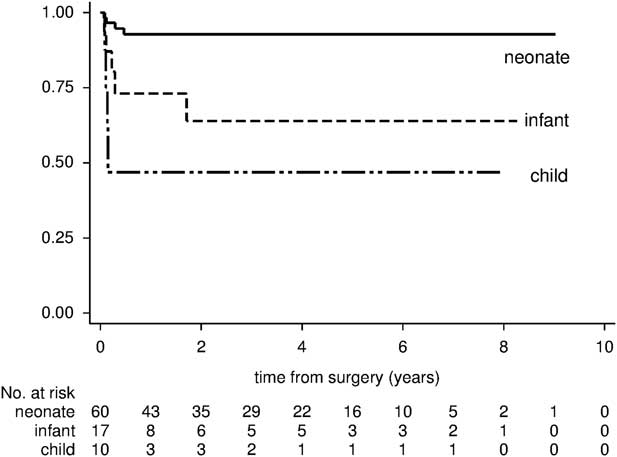
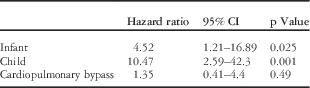
Hazard ratios for requiring long-term anti-hypertensives are summarised in Table 2. The results were the same before and after adjustment for cardiopulmonary bypass. The results after adjustment for cardiopulmonary bypass are displayed. Hazard ratios demonstrated that compared with neonates those operated during infancy and childhood were 4.5 times (95% confidence interval 1.2–16.9, p=0.025) and 10.5 times (95% confidence interval 2.6–42.3, p=0.001), respectively, at increased risk of requiring anti-hypertensive medication. These data are graphically represented in the Kaplan–Meier plot in Figure 3. Length of intensive care unit stay, need for postoperative inotropes, and antenatal diagnosis had no influence on the likelihood of requiring future anti-hypertensive medication.
Kaplan-Meier plot of risk of requiring future anti-hypertensive medication following primary surgical coarctation repair in neonatal, infant and child groups.

Hazard ratios for requiring long-term anti-hypertensives in infants and children versus the neonatal group, after adjusting for cardiopulmonary bypass.

CI=confidence interval
Among those operated under 1 year of age, the mean systolic blood pressure at clinic follow-up showed no difference in those on medication versus no medication (103 versus 98 mmHg, p=0.32). Blood pressure Z-scores existed for those over the age of 1 year. 7 During the follow-up period, for those operated over 1 year of age, the mean systolic and diastolic blood pressure Z-scores in those not on medication were 0.98 and 0.83, respectively, obtained from 103 blood pressure measurements in 82 patients. The mean systolic and diastolic blood pressure Z-scores in those continuing on anti-hypertensive medication at last clinic follow-up was 1.9 and 1.01, respectively, in four blood pressure measurements in four patients. The difference in mean systolic Z-scores between those on medication versus not on medication was statistically significant, p=0.048 (95% confidence interval 0.6–1.89), whereas the difference in mean diastolic Z-scores was statistically insignificant, p=0.73 (95% confidence interval 0.81–1.15). There were insufficient data to answer whether there was a difference in blood pressure before or after starting medications.
There was no association between age at repair and re-coarctation of the aorta, with infant and child hazard ratios being 0.27 (p=0.21) and 1.34 (p=0.7), respectively.
With two exceptions, there was no significant difference across all the age groups between re-coarctation versus no re-coarctation with respect to the number of patients who required postoperative inotropes, cardiopulmonary bypass, antenatal diagnosis of coarctation, and mean length of intensive care stay postoperatively. The exceptions were, first, in the child category where 100% (two out of two) of re-coarctations required postoperative inotropes compared with only 13% (one out of eight) in the non-re-coarctation group (p=0.02), and in the infant group 100% (one out of one) of re-coarctations had an antenatal diagnosis compared with 6% (one out of 16) in the non re-coarctation group (p=0.048).
A total of 26 patients were discharged on anti-hypertensive medications after their surgery. Among these patients, the median age at surgery was 33.5 days (interquartile range from 13 to 390 days), and five of them (19%) continued on medications: four patients continued on angiotensin-converting enzyme inhibitors, aged 8, 34, 217, and 217 days at time of primary surgery, and one patient aged was 7 years and 9 months was initially on β-blockers converting later to an angiotensin-converting enzyme inhibitor at the time of primary surgery. The number of patients requiring anti-hypertensives at initial clinic follow-up was less than the number of patients who were discharged on medication after their surgery. Presumably some had their medication stopped following interim assessments, which were not documented.
Discussion
In this study, we have demonstrated that the risk of medical treatment for arterial hypertension was 4.5 times and 10.5 times higher if primary surgical repair was performed during infancy and childhood, respectively, compared with surgery in the neonatal period. Several studies have demonstrated that older age at coarctation surgery conveys an increased risk of future hypertension,Reference Brown, Burkhart and Connolly 4 , Reference Seirafi, Warner and Geggel 5 , Reference Bergdahl, Bjork and Jonasson 8 – Reference Liberthson, Pennington and Jacobs 11 and our results are in keeping with this. Previous studies, however, had a much wider age range of study participants, including adults undergoing their first coarctation surgery. Our study population comprised children under the age of 16 years only. This enabled us to examine more closely the risk of developing hypertension in younger age groups and further delineated optimal timing of coarctation surgery. On the basis of our results, this appears to be in the neonatal period.
Proposed mechanisms for developing long-term hypertension in this context include abnormal baroreceptor function, decreased aortic compliance, ventricular stiffness, endothelial dysfunction, and neuroendocrine changes as a result of re-modelling, whilst the coarctation is present. It seems that the longer the coarctation is left unoperated, the more re-modelling takes place and is likely to be less reversible.Reference de Divitiis, Pilla and Kattenhorn 12 – Reference Kenny, Polson and Martin 18 We hypothesised that the more unwell patients with longer post-operative intensive care stays and needing inotropes would be more likely to develop future hypertension and re-coarctation. We also thought an antenatal diagnosis of coarctation and the use of cardiopulmonary bypass may have had a protective effect on future hypertension or re-coarctation, as those diagnosed antenatally would be less likely to have presented later and unwell, and cardiopulmonary bypass is associated with more extensive resection of coarctation tissue and more extensive aortic arch reconstruction, thereby reducing the substrate for re-coarctation in the future. We could not, however, show an influence of cardiopulmonary bypass on the length of stay, but most of these patients required inotropes postoperatively, and those on inotropes had a longer mean duration of stay on intensive care. This reached statistical significance in the neonatal group only. The need for inotropic support would be expected to be associated with cardiopulmonary bypass as postoperative systemic inflammatory response can cause cardiovascular instability. We assume that this is the reason for longer duration of intensive care. There was, however, no statistically significant difference in the proportions needing inotropic support, cardiopulmonary bypass, having an antenatal diagnosis of coarctation, and length of postoperative intensive care in the hypertension treatment group compared with no treatment groups.
We have demonstrated a better outcome in terms of a lower risk of needing long-term anti-hypertensive medication if primary coarctation repair is performed as a neonate; however, unfortunately, not all patients are diagnosed that early. Knowing the likelihood of developing hypertension in the future depending on the age of primary repair is useful for long-term surveillance, treatment, and counselling of these patients to reduce the associated long-term cardiovascular morbidity.
We were unable to demonstrate whether age at primary procedure was associated with an increased or decreased prevalence of re-coarctation, probably because of the relatively small study population. We did not perform a subgroup analysis of outcomes depending on which type of surgical procedure was performed as the subgroup numbers were small; however, taking cardiopulmonary bypass as a surrogate marker for a more extensive procedure, we could not show a significant difference in the proportions that underwent cardiopulmonary bypass in both the hypertension treatment and the re-coarctation groups.
Limitations
This was a retrospective, single-centre study. The patient numbers were small, and therefore our results may not be generalisable to a wider population. The small number of patients in the infant and child groups most likely accounted for the reason why no significant differences could be seen in the length of intensive care stay for cardiopulmonary bypass versus no cardiopulmonary bypass in these patients, as well as no difference in the duration of intensive care stay for infants and children requiring and not requiring postoperative inotropic support. Our study was also underpowered to confidently state that the rate of re-coarctation was the same between the three groups.
We did not examine whether the presence of commonly associated lesions of coarctation, including ventricular defect, patent duct, and bicuspid aortic valve, had an influence on our outcomes. We also did not collect data on whether the commonly associated lesions were repaired or not at the time of surgery. We used the need for anti-hypertensive treatment as a surrogate of hypertension. The reason for using this definition was as follows: ambulatory blood pressure measurements were rarely used to confirm hypertension – seven measurements in five patients. The lack of ambulatory blood pressure documentation in itself would have been partially offset if consistent recording of casual blood pressure measurements was sustained at all outpatient follow-ups. Casual blood pressure recordings have a 66% sensitivity and 88% specificity for detecting hypertension confirmed by subsequent 24 hour recordingsReference O’Sullivan, Derrick and Darnell 6 ; however, the recording of casual blood pressure measurements were sufficiently lacking in the data we retrieved to be used as the primary marker of normotension and hypertension. Some patients were lost to follow-up and some had incomplete records. Only 195 (65%) out of a total of 298 clinic visits had documented blood pressure values. Where blood pressure was recorded, it is unclear whether the method of recording blood pressure – technique including which limb and equipment used – was consistent. Interestingly, this level of blood pressure documentation was similar to published outpatient data by Gillet et al,Reference Gillett, Wong and Wilson 19 where blood pressure was recorded in 233 (69%) out of 338 clinic visits in those followed-up after coarctation repair. This suboptimal documentation of blood pressure recordings poses a significant risk of under-recognition of hypertension in this high-risk group of patients. The implication for our study is that the prevalence of hypertension may have been higher than we were able to demonstrate (type II error). We did however show that for our patients over 1 year of age, those on anti-hypertensive medication did have a statistically significant higher mean systolic z-score compared to those that were not on medication, and that our patients not on anti-hypertensive medication had mean blood pressure z-scores within normal limits.
There was no statistically significant difference in follow-up times for the different age groups. Hence, the risk of not detecting the need for anti-hypertensive medication or re-coarctation over time was similar in all age groups. As the follow-up period was relatively short with a median of 2.33 years, it is possible that the patients classified as “well” may have developed hypertension later in life. Future studies should be prospective with longer follow-up periods into adulthood and ideally be multi-centred to maximise enrolment. Such a study should have a standardised protocol to collect blood pressure measurements and diagnose hypertension.
Conclusion
We have demonstrated that primary repair of aortic coarctation is best performed in the neonatal period to reduce the risk of needing anti-hypertensive medication later in life. Long-term screening for hypertension and good documentation of blood pressure measurements should be mandatory for every patient followed-up after coarctation repair to reduce the risk of future cardiovascular morbidity.
Acknowledgements
The authors thank Thomas Witter for his help in sourcing the raw data from the institutional database.
Financial Support
This research received no specific grant from any funding agency or from commercial or not-for-profit sectors.
Conflicts of Interest
None.
Ethical Standards
The study was approved as an audit by the institutional board of the Evelina Children’s Hospital. The need for parental/patient consent was waived.