Implications
This research aimed to investigate the learning ability and memory retention of offspring breeders descended from breeders receiving reduced balanced protein (RP) diets. Nowadays, people are increasingly concerned about the welfare issues of feed-controlled broiler breeders as a result from intensive selection for fast growth and lower feed conversion ratio. A better understanding of breeder cognition and possible transgenerational effects might be beneficial in improving the welfare status of broiler breeders.
Introduction
Chickens (Gallus gallus) learn quickly and this ability allows them to adapt and survive both in their natural environment and under experimental laboratory conditions (Nicol, Reference Nicol2015). In view of the learning ability of birds, discriminative and associative tests were introduced to determine their sensory perception and preference (Vallortigara and Zanforlin, Reference Vallortigara and Zanforlin1989; Ueda, et al., Reference Ueda, Suehiro, Kainou and Bungo2005). Over the past few decades, domestic chickens were subjected to intensive selection programs to improve reproductive performance for laying hens and growth rate for broilers. Simultaneously, the living environment of chickens also changed dramatically from free ranging to captivity and from backyard to intensive farming. When captive animals are provided with an environment that is physically similar to their wild habitats, their behavioral and physiological adaptation will be readily achieved (Price, Reference Price1999). However, modern intensive management together with selection procedures induced physiological alterations which could be challenging for adaptation. Lindqvist and Jensen (Reference Lindqvist and Jensen2009) proclaimed that birds selected for high production may invest more resources into production traits and less in other biological processes. They found that White Leghorn hens showed an impaired spatial learning ability compared with their Red Jungle Fowl ancestors and were less capable of adapting to an unpredictable environment.
With continuing selection, broilers are characterized by fast growth and consequently, by a voracious appetite. In terms of the parent stock, the reproductive ability has been reduced dramatically due to the improvements in growth rate which creates one of the well-known ‘fast growth v. reproduction-health’ paradox (Decuypere et al., Reference Decuypere, Bruggeman, Everaert, Li, Boonen, De Tavernier, Janssens and Buys2010). As a consequence, broiler breeders need strictly controlled feeding programs to reach the desired egg and chick production goals (De Jong and Guémené, Reference De Jong and Guémené2011). This inevitably leads to welfare issues, such as hunger, frustration, stereotypic behavior and polydipsia, which induces another breeder paradox: ‘acceptable reproduction – health v. hunger stress – impaired welfare’ (Decuypere et al., Reference Decuypere, Bruggeman, Everaert, Li, Boonen, De Tavernier, Janssens and Buys2010; De Jong and Guémené, Reference De Jong and Guémené2011). Extensive studies were conducted to tackle welfare issues related to the controlled feeding management, but information on learning ability, cognition and memory of broiler breeders is scarce. To examine the cognitive abilities of animals, T-maze test is a useful tool (Buckley et al., Reference Buckley, Sandilands, Tolkamp and D’Eath2011; Li et al., Reference Li, Lesuisse, Schallier, Wang, Driessen, Everaert and Buyse2018). In these tests, animals are placed at the base of a T-shaped maze with rewards provided at one or both arms of the maze, and the animals must choose which path to take. Buckley et al. (Reference Buckley, Sandilands, Tolkamp and D’Eath2011) reported that broiler breeders seemed incapable of accomplishing a T-maze dietary discrimination task. They hypothesized that broiler breeders were too hungry, and this overwhelmed their ability to differentiate various feeds and feed amount. However, a low overall success rate was observed in breeders with a less controlled feeding program, indicated the difficulty of these tests for broiler breeders. Therefore, in the current study, the broiler breeders were only expected to locate the feed located in the far end of the left or right arm of a T-maze (reward v. no reward discrimination test).
Furthermore, there is sufficient evidence to support environment and nutrition dependent transgenerational effects on offspring performance, in both mammals and birds. In rodents, a perinatal isocaloric low protein diet had negative developmental programming effects on the learning and motivational behavior of pups (Reyes-Castro et al., Reference Reyes-Castro, Rodriguez, Rodriguez-Gonzalez, Wimmer, McDonald, Larrea, Nathanielsz and Zambrano2011). In poultry, numerous studies revealed that maternal and early life environmental (e.g. temperature, stress, toxins, noise) and nutritional (e.g. prenatal malnutrition, supplements, feed restriction) factors can influence development, physiology and behavior of the progeny (reviewed by Dixon et al., Reference Dixon, Sparks and Rutherford2016). Moreover, reduced protein diets have received increasing attention due to the environmental and economic interests. To the best of our knowledge, there is no data available regarding the effects of a reduced protein diet on the learning ability and memory retention of broiler breeders over generations. In our study, three successive generations of broiler breeders were generated and provided with a RP diet (25% CP and amino acids (AA) reduction of standard control (C) diet) or standard C diet in the first two generations. Transgenerational effects of the RP diets on learning ability and memory retention of broiler breeders in the third generation which were fed with standard C diets were investigated.
Material and methods
Experimental design
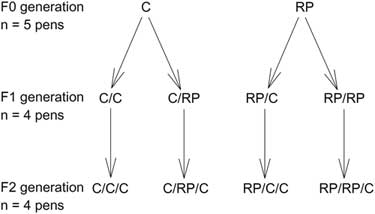
Figure 1 gives an overview of the experimental setup. Reduced balanced protein diets which had a 25% CP and AA reduction were studied over three generations of female breeders (Li et al., Reference Li, Lesuisse, Schallier, Clímaco, Wang, Bautil, Everaert and Buyse2017). In short, there were two treatments for F0 generation: a (C group, fed with standard commercial diets and an RP group, fed with RP diets. The female F0-progeny of each treatment was divided into the two dietary treatments, resulting in four treatments for the F1 generation: C/C, C/RP, RP/C and RP/RP (letters indicating the breeder feed in, respectively, the F0 and F1 generation). The female F1-progeny of each treatment was fed with standard C diet which resulted in four treatments for the F2 generation: C/C/C, C/RP/C, RP/C/C and RP/RP/C (letters indicating the breeder feed in F0, F1 and F2 generation, respectively). Males of each generation were fed with a standard C diet.
Pedigree construction of the three broiler breeder generations research.

C=control; RP=reduced balanced protein.
Breeder husbandry and management
Animals
The animals reared in present study were the same as the study of Li et al. (Reference Li, Lesuisse, Schallier, Clímaco, Wang, Bautil, Everaert and Buyse2017). For the F0 generation, a total of 160 1-day-old healthy pure line A female breeders were evenly divided into two treatments (C and RP), resulting in 16 breeders per pen (1.5×2 m) with five replicates per treatment. Concurrently, 40 1-day-old pure line A male breeders were raised in two pens within the same poultry house as the breeders. At week 19, 12 mature males around the target BW were selected and transferred into individual cages (60×40×60 cm) in another house. The other males were kept in the two original pens and served as spares to replace less productive males. Weekly artificial insemination started at week 25, for which the semen of the 12 selected males was pooled. Eggs collected from week 35 to week 36 were incubated to obtain the F1 generation (as previously described by Lesuisse et al., Reference Lesuisse, Li, Schallier, Leblois, Everaert and Buyse2017). At hatch, we obtained 152 and 136 1-day-old healthy female F0-progeny chicks from the C and RP group, respectively. The female progeny of each group was evenly distributed to eight pens and were fed on either C or RP diets. Thus, the F1 generation had four treatments with four replicates each (C/C, C/RP, RP/C and RP/RP group). There were 19 breeders per pen for C/C and C/RP group and 17 breeders per pen for RP/C and RP/RP group. In week 27, the number of breeders in each pen were on average (variance) 14 (0.67), 14 (0.67), 12.5 (0.25), 12 (0.67) for C/C, C/RP, RP/C and RP/RP, respectively. Meanwhile, 63 males of the C group progeny were reared in a floor pen elsewhere. At week 19, 18 sexual mature and healthy males were transferred into individual cages for semen collection whereas the rest of the males were kept on standby. Eggs from weeks 38 to 40 of the F1 generation were collected to generate the F2 generation. After incubation, 71, 75, 66 and 51 healthy female chicks were collected from C/C, C/RP, RP/C and RP/RP group, respectively. The chicks from each group were evenly allotted to four pens leading to four replicates for each treatment of F2 generation (C/C/C, C/RP/C, RP/C/C and RP/RP/C). In week 27, the number of breeders in each group were on average (variance) 12 (0.00), 12 (0.00), 12 (0.00), 10 (0.00) for the C/C/C, C/RP/C, RP/C/C and RP/RP/C, respectively. The female breeders were raised until weeks 40, 44 and 46 for the F0, F1 and F2 generation, respectively.
Husbandry and management
A detailed description of light and temperature schedules can be found in Li et al. (Reference Li, Lesuisse, Schallier, Clímaco, Wang, Bautil, Everaert and Buyse2017). Briefly, one bell-shape drinker (36 cm in diameter) was available for each pen. For the first 2 weeks, the breeders had ad libitum access to feed and water. This was followed by a controlled feed allocation, supplied at 0900 h on each day and water was available during light hours. During the rearing period of all three generations, a four-phase feeding program was applied: a starter 1 diet (1) from hatch until day 21 for all breeders; a starter 2 diet (2) from day 22 until 42; a grower diet (3) from days 43 to 105; and the pre-breeder diet (4) from day 106 until 5% of egg production (calculated for each treatment). During the laying period, breeder diets were given to breeder hens. The dietary treatment was applied from day 21 onwards and lasted throughout the rearing and laying period. For each feeding phase, diets were formulated to be isocaloric and the same raw materials were used in formulating the diets. Reduced balanced protein diets had a 25% reduction in CP and AA compared with C diets. To achieve a similar target BW as the C diet fed breeders, RP diet fed breeders received about 10% more feed. The feed amount was calculated weekly according to the required BW (Aviagen, 2013) and/or laying performance during the rearing and laying period. Male breeders received a limited feed amount from the 3rd week onwards and were fed a standard diet during the entire experimental period. The compositions of the different diets in the rearing and laying phase were provided in the study of Li et al. (Reference Li, Lesuisse, Schallier, Clímaco, Wang, Bautil, Everaert and Buyse2017). The tip of the upper beak was trimmed using a hot blade Debeaker apparatus (Lyon Technologies Inc., Chula Vista, CA, USA) at day 3 by a qualified veterinarian. Vaccinations were carried out according to the standard commercial vaccination program (Galluvet, Lummen, Belgium).
Measurements
T-maze learning test
The T-maze arena was composed of a start box (0.5×0.5 m) connected with a start arm (2.5 m). The end of the start arm conjoined with a left and a right arm (both 1 m) at a 90° angle. The height of the arena was 0.5 m. There were two manually operated guillotine doors situated at the entrance of the left and right arm. The protocol of the reward v. no reward discrimination test was the same as described in the study of Li et al. (Reference Li, Lesuisse, Schallier, Wang, Driessen, Everaert and Buyse2018). All breeders selected for conducting the test had no access to feed before being subjected to the T-maze test. They were introduced to the start arm in a group of six or seven and allowed to explore and habituate for 20 min with the guillotine doors closed. Afterwards, the group of breeders had access for 20 min to the left and right arms which had feed available in a metal feeder (0.5 m in length) at both ends. Each time a breeder located the feed at one end, it was brought back to the start arm and led to the feed again by gently pushing them forward (three times for each arm). In the actual test, a single breeder was placed in the start box, both doors open. This time, the metal feeder with feed reward was only available at the far end of either left or right arm with the other arm empty. Each breeder performed the test six times with the reward always located at the same arm. The left/right location of the reward was balanced between breeders and the order in which four treatments of breeders conducted the tests was maintained during the trials. Each test repetition lasted for maximum 10 min and the breeders were allowed to eat for 1 min after test completion. Breeders were marked as successful only after they located the feed reward at five out of six test repetitions. The C diet was used as feed reward for all the test breeders. It was always the same person who stayed in the testing room within the breeders’ line of sight for habituation and training purposes, and who later carried out the six consecutive tests and time recording. Times recorded for each repetition were the total time used for solving the test at each repetition (Tt), the time from the beginning until entering the feed available arm (Ts) and the time from entering the feed available arm to accessing the feed (Td). Breeders that failed more than once at finding the feed within 10 min were classified as unsuccessful.
Learning test schedule
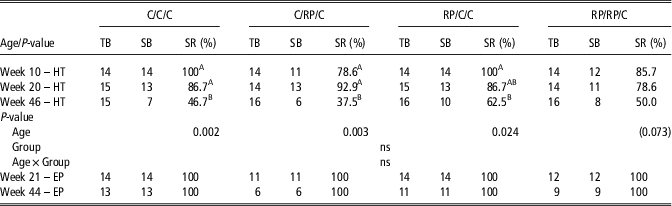
In week 10, breeders from each treatment were randomly selected and were allowed a habituation (20 min) and training (20 min) period in the T-maze construction. Thereafter, the learning test was performed with each individual breeder for six times in a row with each test repetition immediately after another. In weeks 21 and 44, the same breeders from week 10 were again subjected to the T-maze test (animal number may vary due to mortality or morbidity, Table 1), but this time without habituation and training periods. If breeders successfully completed the T-maze test this time around, we considered their memory retention established. In weeks 20 and 46, other breeders from each treatment that never experienced the T-maze test were selected and subjected to a habituation (20 min) and training (20 min) period before the actual test. The success rate of newly habituated and trained breeders from each treatment was recorded at different ages to determine the T-maze test learning ability. For clarification, the following abbreviations were used throughout this manuscript: HT=breeders with habituation and training periods before the test; EP=same (experienced) breeders used as in week 10 and now without habituation and training periods before the test in weeks 21 and 44. The number of breeders used in each week is listed in Table 1.
The number of broiler breeders used, number of successful broiler breeders and success rates in each T-maze test

C=control; RP=reduced balanced protein; TB=total number of breeders used in the tests; SB=successful breeders; SR=success rate; HT=breeders with habituation and training periods; EP=same (experienced) breeders used in week 10 and without habituation and training periods.
ns: P>0.05.
A,BDifferent superscript letters in the same column indicate significant difference between ages.
Controlled feed intake degree
The controlled feed intake degree (CFD) calculation was modified according to the method described by Hocking (Reference Hocking1993). The formula is as follows:
 $$\eqalignno{ & {\rm CFD} \left( \,\%\, \right) \cr & {\equals}\left( {1{\minus}{\rm }{{{\rm Feed}\,{\rm intake}\,{\rm of}\,{\rm restricted}\,{\rm breeders } \left ( {{\rm F}2\,{\rm generation}} \right)} \over {{{\rm Feed}\,{\rm intake}\,{\rm of}\,{\rm the}\,{\rm estimated}\,{\rm intake} \,{\rm of}\,{\rm breeders}\,{\rm of}\,{\rm the}\,{\rm same}\,{\rm BW}\,{\rm fed}\,ad libitum}}} \right){\asterisk}100\,\%\, $$
The CFD of the four groups was averaged since they were all fed with the C diet and only had minor differences in feed amount allocation. The feed intake of breeders fed ad libitum was provided by a breeder company but this information is confidential. It is noteworthy that the higher the CFD, the less feed amount was provided for the breeders.
Statistics
The JMP Pro.12 software (SAS Institute Inc., Cary, NC, USA) was used for all data analysis. Chi-Square test was performed to assess the age and treatment effects regarding success rates (%) in the T-maze learning test. The duration of Tt, Ts and Td were log transformed to obtain a normal distribution. A generalized linear mixed effect model (GLME) was used to determine the effects of age, dietary treatment, test repetition and their interactions of the durations (Tt, Ts and Td). The six consecutive tests were considered repeated measures. Experimental breeders were taken as a random effect and nested in treatments. Breeders that failed the tests were excluded from GLME analysis. Success rates are presented as percentages. The duration of Tt, Ts and Td are presented as means. P<0.05 is considered as significantly different. A tendency of difference was defined when 0.05<P<0.10 was observed.
Results
Success rate
The number of animals used, the amount of animals that successfully completed the T-maze tests and the corresponding success rates are listed in Table 1. No treatment effect was observed for any of the ages tested (week 10: χ 2=5.929, P=0.115; week 20: χ 2=1.212, P=0.750; week 46: χ 2=2.051, P=0.562). For the breeders with HT, the success rates of breeders from each treatment in week 46 were significantly lower than those recorded at earlier ages except a tendency for the RP/RP/C group (C/C/C: χ 2=12.872, P=0.002; C/RP/C: χ 2=11.569, P=0.003; RP/C/C: χ 2=7.487, P=0.024; RP/RP/C: χ 2=5.225, P=0.073). All EP breeders completed the test successfully (100% of success rate) regardless of age.
T-maze performance
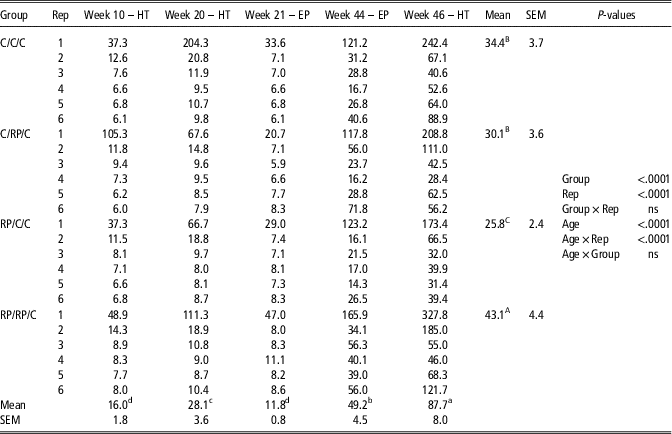
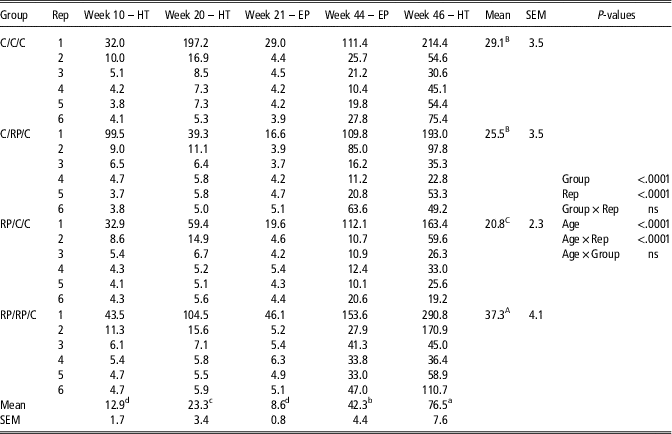
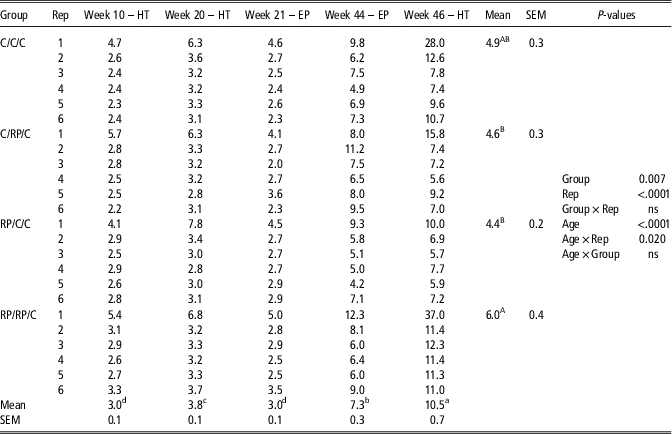
The times used in completing the test in each week are listed in Table 2 (Tt), Table 3 (Ts) and Table 4 (Td). There were significant age effects (Tt: F 4,196=124.761 P<0.0001; Ts: F 4,198=120.321 P<0.0001; Td: F 4,196=110.986 P<0.0001), group effects (Tt: F 3,196=7.553 P<0.0001; Ts: F 3,198=8.718 P<0.0001; Td: F 3,196=4.160 P=0.007) and repetition effects (Tt: F 5,1006=352.924 P<0.0001; Ts: F 5,1003=364.368 P<0.0001; Td: F 5,1004=148.105 P<0.0001) for Tt, Ts and Td. The RP/RP/C group had significantly longer Tt and Ts compared with the other three groups whereas the RP/C/C group had the shortest Tt and Ts. The RP/RP/C group had a significantly longer Td than the C/RP/C and RP/C/C groups. The age effect of Tt, Ts and Td was similar for all groups, as significant differences were found between all weeks except between week 10 and week 21. Tt, Ts and Td gradually decreased from test repetition 1 to repetition 3 and there was an increased Td at repetition 6. An interaction between repetition and age in Tt (F 20,1005=6.146 P<0.0001), Ts (F 20,1002=6.435 P<0.0001) and Td (F 20,1004=5.467 P<0.0001) was observed. The interactions of age×group and group×repetition were not significant for Tt, Ts and Td.
Effects of reduced balanced protein diet in the first two generations on the total time (Tt, seconds) used in completing the T-maze test of the F2 generation broiler breeders

HT=breeders with habituation and training periods; EP=same (experienced) breeders used in week 10 and without habituation and training periods; C=control; RP=reduced balanced protein
Data are presented as means.
ns: P>0.05.
a,b,c,dDiffernet superscript letters in the same row indicate significant difference between ages.
A,B,CDiffernet superscript letters in the same column indicate significant difference between groups.
Effects of reduced balanced protein diet in the first two generations on the time from the beginning to entering the feed available arm (Ts, seconds), used in the T-maze test of the F2 generation broiler breeders

Rep=repetition; HT=breeders with habituation and training periods; EP=same (experienced) breeders used in week 10 and without habituation and training periods; C=control; RP=reduced balanced protein.
Data are presented as means.
ns: P>0.05.
a,b,c,dDiffernet superscript letters in the same row indicate significant difference between ages.
A,B,CDiffernet superscript letters in the same column indicate significant difference between groups.
Effects of reduced balanced protein diet in the first two generations on the time from entering the feed available arm to access the feed (Td, seconds), used in the T-maze test of the F2 generation broiler breeders

Rep=repetition; HT=breeders with habituation and training periods; EP=same (experienced) breeders used in week 10 and without habituation and training periods; C=control; RP=reduced balanced protein.
Data are presented as means.
ns: P>0.05.
a,b,c,dDiffernet superscript letters in the same row indicate significant difference between ages.
A,B,CDiffernet superscript letters in the same column indicate significant difference between groups.
Controlled feed intake degree
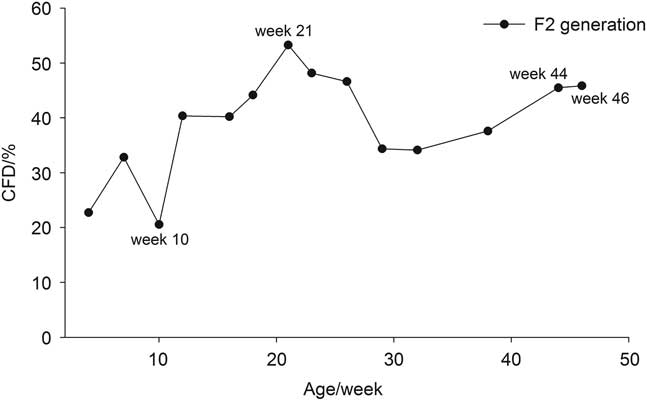
As shown in Figure 2, the CFD of our breeders gradually increased to the highest level in week 21 (53.29%) and decreased afterwards until week 32 (34.13%). However, it increased again to 45.48% in week 44 and 45.85% in week 46. Before the CFD peaked in week 21, there was a drop down to 20.55% in week 10.
The controlled feed intake degree (CFD) based on feed allocation of the F2 generation broiler breeders and the feed intake of broiler breeders fed ad libitum. The higher the CFD, the less feed amount was provided for the breeders.

Discussion
Our results clearly indicate that the success rate (i.e. learning ability) of HT broiler breeders in solving the T-maze test decreased and the time spent to complete the test increased with age. Breeders can retain an early learning experience (week 10) until an older age (week 21 and week 44). The time needed to complete the T-maze test at a later age was reduced considerably by the early learning experience. There was a dietary effect from the previous generations on the time spent to complete the T-maze test of breeders in the third generation.
The decline in success rate of HT breeders at an older age indicates a reduction of their learning ability. This is in agreement with rodent and human studies on aging, in which cognitive (learning) ability impairments were reported. For example, aged Long-Evans male rats acquired a spatial learning task more slowly (Gallagher et al., Reference Gallagher, Burwell and Burchinal1993); and in humans, cognitive performance declined over most of adulthood (summarized by Germine et al., Reference Germine, Duchaine and Nakayama2011). Nomura and Okuma (Reference Nomura and Okuma1999) observed that some neurochemical parameters (glutamate, aspartate and alanine) and biochemical parameters (protein kinase C and calmodulin dependent protein kinase II) in the brain of SAMP8 mice are involved in the learning and cognitive ability reduction with age. In poultry, commercial laying hens produced less floor eggs when perches were provided in the pen in week 4 compared with perch provision at older ages up to week 20, which indicated that perching learning ability declined with age (Appleby et al., Reference Appleby, Duncan and McRae1988). To the best of our knowledge, our study was the first to investigate the learning ability of broiler breeders at different ages. A declined learning ability, as established by the T-maze test, with age was observed. Jakubczak (Reference Jakubczak1973) summarized that age differences become increasingly apparent as task difficulty increases. Therefore, it is concluded that our reward v. no reward discrimination T-maze test can be an appropriate method for assessing the learning ability of broiler breeders, at least within their commercial life span.
The increased amount of time spent to finish the T-maze test at a later age was most likely caused by increased BW. General activity (inversely reflected by the time spent sitting) was reported to have a positive correlation with the suppression in growth rate (Savory and Lariviere, Reference Savory and Lariviere2000). This result supports the idea that birds with high BW have a decreased activity level. Bokkers and Koene (Reference Bokkers and Koene2003) examined the behavior of fast- and slow-growing broilers to 12 weeks of age. They found that the walking activity decreased with age in both broiler lines and decreased more quickly in the fast-growing broilers which was probably due to their increasing BW. In our study, older broiler breeders took more time to complete the test and this could be associated with an increased BW (average BW in week 10: 953 g, week 20: 2175 g, week 21: 2296 g and week 44: 4581 g). Furthermore, Bokkers et al. (Reference Bokkers, Koene, Rodenburg, Zimmerman and Spruijt2004) reported that broilers can balance their investments and profits depending on the level of controlled feed intake (i.e. more restricted birds are more motivated to work for feed). From the 3rd week onwards, broiler breeders used in this study were under controlled feed intake to maintain the target BW. At week 10, the CFD was the lowest at 20.55%, but the BW was also lower compared with those of weeks 20 and 46. The CFD of week 20 and week 46 did not differ much: around 53.29% and 45.85%, respectively. Bokkers and Koene (Reference Bokkers and Koene2004) reported that the feeding acquirement was the dominant motivational factor for the walking ability of birds with a low BW, whereas physical ability was the determining factor for high BW birds. In present study, breeders with a higher CFD needed more time to complete the test in weeks 20 to 21 and weeks 44 to 46. However, breeders with lower CFD in week 10 completed the T-maze task faster. It is hypothesized that the 20.55% of CFD was severe enough to provoke rapid test performance in week 10 (higher physical ability with lower BW) and that BW was the driving factor at a later age to complete the test.
Interestingly, all the broiler breeders who were trained for the T-maze test early in week 10 performed perfectly (each with 100% of success rate) in the T-maze test in week 21 and week 44. We concluded that long-term memory retention of the T-maze test was present in the tested broiler breeders. Comparably, rats were reported to retain information for what, when and where a food-based event occurred (Babb and Crystal Reference Babb and Crystal2005). Food-storing birds such as scrub jays were observed to have a memory retention of food type and location up to 172 h (Clayton et al., Reference Clayton, Yu and Dickinson2001). In laying hens, a task-based memory to open an acrylic door of 1, 4 and 7 days was reported by Zheng et al. (Reference Zheng, Sales, Green and Gates2012). In general, memory retentions in different aspects do exist in mammals and birds. As far as we know, we are the first to investigate broiler breeder memory retention based on a T-maze test and in such long-term retention intervals. As evidenced by the 100% success rate in all four groups in week 21, the T-maze test information was retained by the broiler breeders at least for 11 weeks. The complete success rate in week 44 might be contributed to the experience in week 10 and the repeated test performance in week 21. Furthermore, the early experience in week 10 also enhanced the T-maze test solving performance at later ages as the week 21 – EP and week 44 – EP breeders were significantly faster compared with the week 20 – HT and week 46 – HT breeders, respectively. As Elias and Elia (Reference Elias and Elia1976) concluded, many kinds of early experiences (handling, environmental enrichment and shock treatment) affect later behavioral performance such as avoidance learning. Accordingly, the T-maze test experience in week 10 was memorized and this enhanced the performance of the same test at later ages.
In addition to the findings described above, receiving an RP dietary treatment in the previous generations affected the time spent to complete the test of the third-generation offspring fed with standard C diet. In general, the RP/RP/C breeders were always slower whereas the RP/C/C breeders were faster in the test. For tested breeders, introduction to a T-maze test always brings forth a sudden change in environment (home pen changed to the T-maze arena). When chicks are introduced to novel environments, a period of vigilance and exploring is needed for acclimatization (Nätt et al., Reference Nätt, Lindqvist, Stranneheim, Lundeberg, Torjesen and Jensen2009). The breeders’ ability to cope with environmental change (being cautious and exploratory) probably influenced their test performance. For example, the RP/RP/C breeders might have been more cautious and therefore spent more time exploring than the other three groups. Nätt et al. (Reference Nätt, Lindqvist, Stranneheim, Lundeberg, Torjesen and Jensen2009) reported that unpredictable feed access caused adaptive responses in feeding behavior and a stronger dominance, which may affect offspring through epigenetic mechanisms. In our study, behaviors such as feather pecking and walking were revealed to be more popular at some points in the RP dietary treatments of the first two generations (unpublished observations). Maternal nutritional or behavioral induced stress could contribute to learning impairments in chicks and this could be passed on to their offspring (Lindqvist et al., Reference Lindqvist, Janczak, Nätt, Baranowska, Lindqvist, Wichman, Lundeberg, Lindberg, Torjesen and Jensen2007). The developmental or metabolic alterations of chicks caused by maternal low protein dietary treatment were also reported to influence offspring performance (Rao et al., Reference Rao, Xie, Yang, Chen, Grossmann and Zhao2009). Here, we hypothesize that the behavioral changes caused by the RP dietary treatment in the previous generations might actuate a variation in coping abilities toward environmental changes in F2 breeders. This might have affected the different performance of breeders in the T-maze test. The exact mechanisms behind the observed differences in test performance still need to be explored. In future experiments, closer behavioral observations during the entire experimental period and during the T-maze test could be helpful in gaining a better understanding of the learning performance of broiler breeders.
In conclusion, the learning ability of broiler breeders in a reward v. no reward discrimination T-maze test decreases with age. The older the breeders, the more time they require to complete the test. The working performance in the T-maze test at an older age can be improved considerably by providing an early learning experience, which can be memorized for at least 11 weeks. In addition, RP dietary treatments in previous generations may have impacts on a series of developmental, metabolic and behavioral aspects of breeders. These effects might be passed on to the offspring, as different durations in time needed to complete the T-maze test within four treatments were observed.
Acknowledgements
A part of this work is supported by the Government Agency for Innovation by Science and Technology (IWT-141671) and China Scholarship Council (CSC). The diligent technical assistance of André Respen is gratefully acknowledged.
Declaration of interest
The authors declared that there are no conflicts of interest to this work.
Ethics statement
The present research was approved by the ethical commission for experimental use of animals of the KU Leuven under accession number P187/2013.
Software and data repository resources
None of the data were deposited in an official repository.