

An improbable conjunction: Maurice Greene and Italian texts
An article's title can sometimes appear all the more provocative for being prosaic. If the present title evokes surprise by its matter-of-fact reference to Italian-language works by Maurice Greene (1696–1755), a man generally viewed as a quintessentially English figure, such a reaction is entirely welcome since it signals that there is something new to bring to the table. In fact, this rarely mentioned and largely unexplored corner of Greene's œuvre is not only substantial in both quality and quantity: it can also shed valuable light both on Greene's compositional activity and musical style as a whole and on the evolution of Italian vocal chamber music as cultivated in Britain during a critical period centred on the second quarter of the eighteenth century.
Greene's known Italian-language compositions total 37, comprising 11 cantatas for soprano and continuo, four duets for two voices and continuo, seven arias for soprano, violin and continuo and a cycle of 15 settings of Italian translations of odes from the Anacreontea (a collection attributed in its earliest source to Anacreon and in the eighteenth century still believed to be largely authentic) scored for voice and continuo. These works are accurately describable as ‘chamber’ compositions: they were all commissioned and performed privately, away from the public gaze, and some may have served as teaching material. Unlike Greene's better-known anthems, services, celebratory odes and songs or cantatas on English texts, they went unreported in the press, and none of them was published during the composer's lifetime.
Nor was there any hurry to perform or otherwise publicize this rich corpus of music after Greene's death. His music library was inherited by William Boyce (1711–79), who, starting out as a chorister at St Paul's Cathedral in London, was in turn an articled apprentice (from 1727 until 1733), a protégé and, finally, a friend of Greene, whom he succeeded as Master of the King's Music in 1755. In 1760–73 Boyce brought to fruition Greene's project to compile and publish an anthology of the best Anglican church music produced over the previous two centuries with the celebrated three-volume collection entitled Cathedral Music.Footnote 1 Under the terms of Greene's will Boyce had to undertake not to publish any of Greene's music remaining only in manuscript, and this included all the ‘Italian’ music. The reason for this injunction is not made explicit, but it seems unlikely, at any rate, to have been a fear that the music would damage Greene's reputation if it appeared in print.
Following Boyce's own death, his music library was sold at auction by Christie's.Footnote 2 During his ownership of the manuscripts of Greene's ‘Italian’ works, which had probably come to him in the form of separate fascicles, Boyce did his best to assemble these works in a more or less rational sequence and have them bound in a single volume, which still bears a label with the original lot number, 49, on its front cover. The sale catalogue describes the lot with tolerable accuracy as ‘Italian Duettos, Cantatas, and Airs, by Dr. Green. MS.’, omitting only to make separate mention of the odes, which were perhaps classed as airs.
This oblong quarto volume numbering 107 folios, which contains all Greene's known ‘Italian’ works except for one cantata, was bought for 6s by Philip Hayes (1738–97), Professor of Music at Oxford, who penned a personal description of its content on a flyleaf. Following Hayes's death, it was fleetingly owned by the Rev. Osborne Wight (1752/3–1800), from whose estate it passed in 1801 to its present location, the Bodleian Library in Oxford. For almost a century the volume remained uncatalogued and seemingly unexamined. Finally, in Falconer Madan's Summary Catalogue of Western Manuscripts of 1897, its contents were succinctly described.Footnote 3 Madan committed some small errors in reproducing the Italian of the textual incipits, but a more serious shortcoming was his failure on two occasions to spot the boundary between two distinct works, as a result of which neither the duet O quanti passi ho fatti! al fiume, al poggio Footnote 4 nor the cantata Infelice tortorella is listed. In an article enumerating and evaluating the Greene manuscripts held by the Bodleian Library, Ernest Walker (1911) corrected some of Madan's mistakes (not, however, the omission of Infelice tortorella) and made numerous, mainly favourable, critical observations on the music that remain of interest, even if slightly marred by a propensity to praise or damn without giving clear reasons for the verdict.Footnote 5 A more careful and informative listing (though still without the missing cantata), augmented by accurate bibliographic descriptions that mainly concern scribal hands, appears in the second volume (‘A Descriptive Catalogue of the Works of Maurice Greene’) of the doctoral thesis of H. Diack Johnstone (1968), the fullest study to date of Greene's life and achievement.Footnote 6 Between then and 2015 nothing new of significance has been written on this source and its contents.Footnote 7
Setting Italian texts was for Greene certainly no passing fad. His Italian cantatas were written singly or in small groups from the early 1720s at the latest to at least the middle of the 1730s. Composition in the three other vocal genres appears to have been more episodic: the arias belong to the second half of the 1720s; the duets to the second half of the 1730s; the odes to the very end of the 1730s or the early 1740s. This combined span of around 20 years takes us from the time when Greene was merely organist at St Paul's to the apogee of his career, when he had also become Organist and Composer to the Chapel Royal (1727), Doctor and Professor of Music at Cambridge University (1730) and Master of the King's Band (1735). The same period also saw him active in a voluntary capacity as a founder-member of the Castle Society (1724), the Academy of Ancient Music (1726), the Apollo Society (quickly following Greene's resignation from the Academy in 1731 in solidarity with Giovanni Bononcini)Footnote 8 and the Fund for the Support of Decay'd Musicians and their Families (1738: later renamed the Royal Society of Musicians).
Greene was unquestionably the doyen of English musicians belonging to the generation separating Blow and Purcell from Boyce and Arne. But a shadow hung over his entire career, and that shadow was Handel, the great interloper. To judge from his titles and distinctions, Greene was the star in the firmament, but in reality that position was occupied de facto by Handel, a musician of supreme gifts and uncommon energy who had the added fortune to enjoy the continuous favour of his fellow Germans, the first two Hanoverian monarchs. Indeed, on several occasions Handel snatched from his English rival commissions for works of national importance (the coronation anthems in 1727, the wedding anthems for Princess Anne in 1733Footnote 9 and Prince Frederick Louis in 1736, the funeral anthem for Queen Caroline in 1737 and the Dettingen Te Deum in 1743) that in theory belonged to him ex officio.
The enmity that Handel harboured towards Greene, following a brief period of amity during which the Englishman facilitated the German's access to the organ at St Paul's, is legendary and needs no elaboration here. Greene must have reciprocated Handel's feelings, but chose to respond both diplomatically (no disparaging remarks by him about Handel are on record) and, as a composer, with great caution. His primary strategy appears to have been one of avoiding direct confrontation. This took three distinct forms. In genres for which Handel showed no interest, Greene was free to write, and in suitable instances to publish, without inhibition. These included the vocal music written as daily fare for the Anglican rite, voluntaries for organ and secular vocal music of all kinds (cantatas, songs, catches etc.) in English. In certain genres where Handel's dominance was unchallengeable – primarily opera in Italian, in which, as both Hawkins and Burney inform us,Footnote 10 Greene took great interest as an ordinary opera-goer – he simply abstained. He published no instrumental ensemble music in the form of concertos and sonatas, and there are no surviving manuscripts containing works of this kind, despite a few tantalizing and possibly erroneous later references;Footnote 11 it is perhaps significant that his sole instrumental publication not originally written for solo keyboard, the Six Overtures […] in Seven Parts of 1745, does not compete directly with Handel, since these works are of non-operatic provenance. Finally, in two specific domains Greene, with encouragement from his patrons and close circle, penned a sizable corpus of works that ‘shadow’ Handel's production – but stand at one remove from it, having been written for private performance away from the public arena. The first is that of dramatic music in English, of which representative works are the pastoral (or masque) Florimel (1734), the full-length pastoral opera Phoebe (1747) and the oratorio The Song of Deborah and Barak (1732). But as Johnstone, and after him Matthew Gardner, have pointed out, these works did not succeed in slipping under Handel's radar: retaliation, clearly aimed at inviting inter-composer comparison, arrived very quickly in the shape of Deborah (HWV 51,1733) and, after the lapse of some time, in Hercules (HWV 60, 1744: revisiting a subject treated in Greene's masque The Judgment of Hercules of c.1739) and Jephtha (HWV 70, 1751: responding to Greene's identically titled oratorio of 1737).Footnote 12 The second domain was that of vocal chamber music in Italian. It is true that Handel, too, wrote an appreciable quantity of music of this kind (cantatas, duets and free-standing arias) during his career in England, in addition to which his more numerous works of the same kind written in Italy or Hanover were in wide circulation, but the two composers' paths seem not to have crossed in this instance. Even when they set cantata texts by the same poet, Paolo Rolli, there was no overlap in their choices.
One fundamental question remains: why did Greene, almost alone among British composers of his time, venture to compose ‘Italian’ music? The only other native speaker of English to have composed Italian cantatas and arias in quantity was the Anglo-Irish organist Thomas Roseingrave (1690/91–1766), who published two collections, each containing six Italian cantatas, in c.1735 and c.1739, respectively.Footnote 13 Roseingrave was in fact a pioneer among British composers in this domain, for soon after his return in 1715 or 1716 from Italy, where he had been resident since 1709, he was writing such works for James Brydges, Earl of Carnarvon (soon to become Duke of Chandos).Footnote 14 The same or similar works were also heard at public concerts: the Daily Courant of 25 March 1718 advertised for the next day a benefit concert for the singer Mlle Coraill at Hickford's Great Room at which a cantata ‘with instruments’ by Roseingrave was billed, and there is an advertisement in the Daily Post of 9 February 1720 for the performance at the little theatre in Lincoln Inn's Fields, the following day, of a ‘new Cantata in Italian’ by him, the singer on this occasion being the Scottish tenor Alexander Gordon. A trailblazer Roseingrave certainly was, but that is unfortunately the sole merit of these compositions. The ineptitude with which the Italian language is set – the worst offence is the nonsensical placing two lines too early of the start of the B section of the second aria of Rolli's text Torna a me più soave del giorno – shows that he profited little from his long Italian sojourn, while the music itself is very crude, rambling incoherently in its A sections and quickly running out of steam in its B sections. Burney was unquestionably a little kind to Roseingrave's Italian cantatas when he described them as ‘the most pleasing of his works’,Footnote 15 but we must remember that this composer was a popular figure loyally supported by his friends during his descent into mental instability, a fact that may lie behind the historian's guarded praise.
At all events, the precedent set by Roseingrave very likely provided a stimulus for Greene's induction into the world of Italian vocal music. How Greene mastered Italian so quickly and effectively without setting foot in Italy is an unsolved mystery. Not only did he fully understand the meaning of the poetry – an essential precondition for sensitive word-painting – but he was equally accurate, with regard to accentuation and prosody, in his word-setting. Where he takes licences – for example, in imparting an unfamiliar stress to the definite article (il, la etc.), in ignoring synaloepha (the coalescence of adjacent vowels belonging to different words) or in playfully jumbling the order of words – these are exactly the same licences taken by contemporary composers who were native speakers. Instances when features of the setting remind one that Greene was a foreigner are extremely rare: far more so than in the cases of Roseingrave or less expert Germans such as Heinichen. In his feeling for the Italian language Greene is very much the equal of Handel and Hasse.
Manuals for teaching Italian were plentiful in London from the start of the eighteenth century, and so, too, were immigrant teachers. Greene may very well have taken his first steps towards learning Italian at the end of the second decade of the century. We do know, however, that he was the sole English musician to subscribe in 1723 to Angelo Maria Cori's best-selling manual A New Method for the Italian Tongue, the subscribers to which came mainly from the English nobility and gentry plus the Italian community in London. This isolated position perhaps reflects the unusualness of his aspiration. What remains unclear, however, is whether Greene bought Cori's manual as an absolute novice or as a more advanced speaker who wished to reinforce his knowledge, or even to pass it on to an apprentice or pupil. Greene may also at some stage have received linguistic advice from Italian musicians resident in, or visiting, London, several of whom were later to become fellow members of the Academy of Ancient Music (Bononcini, Chelleri, Geminiani, Haym, Senesino, Tosi). The most likely mentor among them, Bononcini, was a recognized specialist – indeed, already a ‘classic’– in the composition of chamber cantatas and duets: one who moved in the same Catholic-leaning circles as Greene and shared his antipathy towards Handel. Even some of Greene's own pupils, who were in many cases also his patrons and had themselves acquired a knowledge of Italian at home from a tutor or abroad on the Grand Tour, could possibly have lent him occasional assistance. This thought leads us on naturally to a brief consideration of the general position of Italian vocal music in Britain during the first half of the eighteenth century.
Italophilia and operamania in England, 1700–50
Appreciation and imitation of Italian literature, architecture, pictorial art and music in Britain goes back beyond the High Renaissance at least as far as Chaucer's echoes of Boccaccio's Decameron in the Canterbury Tales. To take a mere handful of examples, it is reflected in the sonnets of Shakespeare and Spenser, Italian settings, characters and mores depicted in Elizabethan and Jacobean plays, the designs of Inigo Jones and the madrigals of Weelkes and Gibbons. However, only in music did a decision over whether to adopt (or to retain) the Italian language become salient and problematic. Nourished especially by the experience of the Grand Tour, a phenomenon associated above all with the British Isles and constantly growing during the seventeenth and eighteenth centuries, a public fascinated with things Italian and increasingly able to enjoy them without translation, literal or metaphorical, came into being. During the seventeenth century many publications of Italian vocal chamber music passed, through personal purchase or via intermediaries, into the hands of British collectors. So, too, did manuscript collections. For cantatas, these stretched from mid-century masters such as Luigi Rossi and Giacomo Carissimi to the end-of-century (and later) productions of the ‘classic’ generation represented by Alessandro Scarlatti (1660–1725) and some younger contemporaries, who included notably Francesco Gasparini (1661–1727), Giovanni Bononcini (1670–1747), Emanuele d'Astorga (1680–c.1757) and Benedetto Marcello (1686–1739). Duets were dominated by those of the peerless Agostino Steffani (1654–1728), fittingly chosen by the Academy of Ancient Music as its president in absentia.
But collection and enjoyment in the homes of connoisseurs was a very different thing from presentation by professional musicians in public performance, which required, first, singers conversant with the Italian language and vocal technique and, second, an audience capable of understanding, at least to some degree, what was being sung. By 1700 that threshold had still not generally been crossed. It is symptomatic that when, around 1710, a popular cantata from Tomaso Albinoni's op. 4 (1702) was separately published in London, a specially written English text was provided.Footnote 16 Another indicator is that when Pepusch's future wife, the Italian (or possibly Franco-Italian) Margherita de L'Épine, performed a cantata at a London concert given in 1706, one year after her companion Jakob Greber had unsuccessfully experimented there with opera sung throughout in Italian in the shape of Gli amori d'Ergasto, she jettisoned her most familiar language, Italian, and presented instead ‘an English cantata compos'd after the Italian manner’.Footnote 17
In fact, the receptiveness of London audiences to Italian-style vocal music coupled with their inability or unwillingness to hear it sung in Italian opened a window of opportunity for resident musicians to create a new musical genre: the English cantata. This would be recognizably orthodox in structure, favouring the two-recitative (RARA) or single-recitative (ARA) structure that had become the norm in Italian chamber cantatas and would admit a moderate amount of melismatic writing in the arias. Between 1708 and 1710 three composers of note – Daniel Purcell, John Eccles and John Christopher Pepusch – committed to print singly produced English cantatas, and with Pepusch's publication in 1710 of his Six English Cantatas, which were quickly followed by similar sets, the new genre could be said to have come of age.
Had the English cantata followed a path similar to that of its cousin across the Channel, the cantate françoise, it would have at this point established a definitive dominance, relegating the Italian cantata to the status of an exotic curiosity. That this did not happen can be ascribed to two quite different causes. First, the unprecedented influx of Italian singers and operisti of other kinds (including not only players and poets but also coaches, prompters and hangers-on of many kinds) sustained the demand for small-scale Italian-language works: the visiting singers, few of whom were comfortable singing in English, needed a repertory to use in concerts and conversazioni during, and at the margins of, the operatic seasons, and they were naturally supported in this by their British patrons and that part of polite society which wished to put its knowledge of their language to good use. This process gathered steam after the production of Handel's Rinaldo in 1711 and culminated during the brief life of the Royal Academy of Music (1720–8). The operamania of the 1720s is wittily summed up in a few sentences from a letter written by John Gay (soon to become the librettist of The Beggar's Opera) to Jonathan Swift on 3 February 1723:
As for the reigning Amusement of the town, tis entirely Musick. real fiddles, Bass Viols and Haut boys not poetical Harps, Lyres, and reeds. Theres no body allow'd to say I Sing but an Eunuch or an Italian Woman. Every body is grown now as great a judge of Musick as they were in your time of Poetry, and folks that could not distinguish one tune from another now daily dispute about the different Styles of Hendel, Bononcini and Attilio. People have now forgot Homer, and Virgil & Caesar, or at least they have lost their ranks, for in London and Westminster in all polite conversation's, Senesino is daily voted to be the greatest man that ever liv'd.Footnote 18
Only briefly troubled (contrary to popular mythology) by the phenomenal success of the last-named work in 1728, Italian opera continued at a high level of intensity during the 1730s despite its organizational fragmentation and economic insecurity, and its pre-eminence in the social life of the élite did not weaken very appreciably thereafter. To some extent, the ‘culture wars’ paralleled political and confessional divisions. Italian culture, epitomized by opera, was associated, not altogether unjustly, with dissident currents (Tory, Catholic, Jacobite, cosmopolitan) in opposition to the dominant ones (Whig, Anglican, pro-Hanoverian, patriotic). This was not necessarily to its disadvantage, since the cultivation of Italian-language music alongside, or in preference to, English music at a domestic level – and especially in the small-scale forms – not only gave evidence of education and sophistication but also, in an entirely safe way, hinted at one or other forms of dissidence and in that way could serve to create social solidarity among minority groups.
The other cause is, strangely, not mentioned in the two most authoritative sources of information on the history and repertory of the English cantata.Footnote 19 Simply put, it is that English poets collectively failed to create versification conventions equivalent to those of Italian poesia per musica that mapped conventional poetic organization unambiguously on to its musical counterpart, forging a tight bond of interdependency between the two. More specifically, even when a poetic stanza is headed ‘Recitative’, as commonly occurs in the first generation of texts purpose-written for English cantatas by such authors as John Hughes, Matthew Prior and William Congreve, the character of the poetry itself does not mark it out as such. In theory, it would have been possible to forge an authentically English counterpart to versi sciolti, mixing trimeter with pentameter and reserving rhyme for a final couplet, but this does not happen in any example I have studied: the familiar tetrameter, usually formed into rhyming couplets, that is favoured for the aria stanzas (and lyric poetry in general) pervades the recitatives equally.
In reality, this is a continuation, under a new name, of seventeenth-century British traditions. Where songs from this period are not simply in binary and/or strophic form, they are often formed into multi-sectional – one might almost say multi-movement – structures, and recitative style is one of the many possible styles that the composer is free to select for a given section on any pertinent grounds, including those of mere contrast.Footnote 20 In this context, recitative is an autonomous compositional choice, not an inescapable poetic prescription. Such liberty is quite alien to the tradition of the Italian chamber cantata and its cognate genres.Footnote 21
The corollary of this freedom enjoyed by the composer was that it was in fact unnecessary to employ custom-written verse when writing vocal music. The whole of the rich tradition of English verse was in principle open to him as raw material for a cantata or any other kind of vocal music. The advantages and potentialities of this flexible text-music relationship, which has been accepted as normal ever since the rise of the modern art-song tradition at the end of the eighteenth century, are too obvious to need stating. But a price was also paid: the non-adoption of the kind of discipline exemplified by the poesia per musica tradition, which set clear genre boundaries and at its best produced balanced, well-proportioned results while leaving sufficient room for innovation and personal expression, left the English cantata too poorly defined to thrive as a distinctive genre, even if the title ‘cantata’ retained its lustre and vague descriptive power.
With the establishment of the Royal Academy of Music came the arrival of a cohort of Italian composers who for about 15 years succeeded in denting the primacy of the English cantata through their publication of nine collections of Italian cantatas, supplemented by the composition of numerous cantatas by the same men and a few other Italians that remained in manuscript.Footnote 22 Some of these publications were lavishly produced and received generous support from patrons and a host of subscribers; others were more modestly produced and marketed. Collectively, they contain both music of high quality (especially from Bononcini, Ariosti, Chelleri and Porpora) and more humdrum fare. Most are, so to speak, sample cards of what their composers have already written or, more especially, would like to write in the future for willing patrons. This ‘self-advertising’ function explains why six of the collections mixed cantatas with works of different type in which their respective composers specialized. In chronological order, the publications are by Giovanni Bononcini (1721, with duets), Attilio Ariosti (1724, with viola d'amore lessons), Fortunato Chelleri (1727, with arias), Pietro Sandoni (c.1727, with harpsichord sonatas), Mauro D'Alay (1728, with violin sonatas), Carlo Arrigoni (1732), Giovanni Rolli (1733, with harpsichord lessons), Antonio Duni (1735) and Nicola Porpora (1735).Footnote 23 As Roseingrave's published cantatas show, the vogue for Italian vocal chamber music continued for a while, albeit at a lower intensity. But soon the Italian cantata passed into obsolescence, and in the second half of the century lighter and shorter forms such as the arietta, canzonetta and Venetian ballad arrived to take its place.
It is therefore no surprise that the bulk of Greene's ‘Italian’ compositions, if not all of them, came into being precisely during those two decades when the demand for such music was at its highest in London and Britain: the 1720s and 1730s.
The musical sources of Greene's ‘Italian’ works
I. The Oxford manuscript
Bodleian Library MS Mus. 52.d has already been sufficiently discussed to need little further introduction. The description of its content penned by Philip Hayes is not wholly accurate – it omits mention of the arias and errs in naming William Boyce the ‘chief’ scribe besides Greene himself – but it conveys the gist adequately:
This Book contains Chamber Duets | Odes of Anacreon, and Cantatas, | in Italian; compos'd by Dr Green: | Many of them in his own hand, writing [sic: ‘writing’ is a later insertion] | and the rest chiefly in Dr Boyces hand, | While he was a pupil of Dr Green's. | Purchas'd out of Dr Boyces Sale | by Phil: Hayes.
The remaining discussion can suitably take the form of a column-by-column discussion of the data presented in Table 1. Following the progressive number in the first column, the folios for each item are given. Where gaps in the foliation occur between items, it can be assumed that the missing folios or sides belong, bibliographically speaking, to the preceding item and are void of notation. When an item begins on the same side as the end of the previous item or on a verso side, it follows that it belongs to the same bibliographic and musical entity. These continuities, reinforcing all the other commonalities, enable items 7–12 and 18–32 to be identified as collections of pieces planned as such from the outset.
The content of Oxford, Bodleian Library, MS Mus.52.d.
| No. | Folios | Genre | Incipit | Superscriptions | Hand(s) | Key | Scoring | Range |
|---|---|---|---|---|---|---|---|---|
| 1 | 2r–5r | Duet | Non piangete, amati rai | Duetto da camera due soprani | D (A) | E | S,S,Bc | e′–g′′ d#′–f#′′ |
| 2 | 6r–8r | Duet | Non so: con dolce moto | Duetto a due soprani | A | C | S,S,Bc | e′–ab′′ c′–e′′ |
| 3 | 10r–11v | Duet | Quanto mai felice siete | Duetto sop[rano e alto] | A | A | S,A,Bc | e′–f#′′ b–e′′ |
| 4 | 12r–13v | Duet | O quanti passi ho fatti! al fiume, al pozzo | — | A | G | S,S,Bc | d′–g′′ d′–e′′ |
| 5 | 14r–17v | Aria | O Libertà, o dea celeste | La libertà | A | E | S,Vl,Bc | d#′–g#′′ |
| 6 | 18r–22v | Cant | O pastori, io v'avviso | Cantata a voce sola | E | Bb | S,Vl,Bc | e′–g′′ |
| 7 | 23r–24v | Aria | Quanto contenta godi | — | E | e | S,Vl,Bc | e′–a′′ |
| 8 | 25r–28r | Aria | Spiega il volo e passa il mar | — | E | a | S,Vl,Bc | c′–bb′′ |
| 9 | 28v–30v | Aria | Langue il fior sull'arsa sponda | — | E | a | S,Vl,Bc | e′–bb′′ |
| 10 | 30v–31v | Aria | T'amo, o cara, e da te ’l core | — | E | A | S,Vl,Bc | e′–a′′ |
| 11 | 32r–35r | Aria | Nell'orror della procella | — | E | A | S,Vl,Bc | c#′–b′′ |
| 12 | 35r–37r | Aria | Farfalletta festosetta | — | E | A | S,Vl,Bc | d#′–a′′ |
| 13 | 40r–43v | Cant | Nel tuo foglio, o amata Irene | Cantata a voce sola | F (A) | D | S,Bc | d′–f#′′ |
| 14 | 44r–47v | Cant | Solitudine campestre | Cantata a voce sola | A | d | S,Bc | e′–g′′ |
| 15 | 48r–53r | Cant | Non te lo dissi già | Cantata a voce sola | B | E | S,Bc | b–d#′′ |
| 16 | 54r–57v | Cant | Veggio la cara Fille | Cantata a voce sola | B | G | S,Bc | d′–g′′ |
| 17 | 58r–61r | Cant | Al ventilar dell'ora | Cantata a Voce Sola del Sig.r D.r Green | G | C | S,Bc | c′–e′′ |
| 18 | 62r–63r | Ode | Voglio dire degli Atridi | Oda I:ma d'Anacreonte | H | Bb | S,Bc | d′–g′′ |
| 19 | 63v–64v | Ode | Sovra i mirti tenerelli | Oda IV:a | H | Bb | S,Bc | d′–g′′ |
| 20 | 65r–66v | Ode | Già d'intorno a nostre tempia | Oda VI | H | E | S,Bc | e′–g#′′ |
| 21 | 66v–67v | Ode | Non penso a Gige | Oda XV | H | A | S,Bc | e′–a′′ |
| 22 | 68r–68v | Ode | Canta or tu la rissa in Tebe | Oda XVI | H | Eb | S,Bc | eb′–g′′ |
| 23 | 69r–69v | Ode | Già di Tantalo la figlia | Oda XX | H | Eb | S,Bc | e′–f#′′ |
| 24 | 70r–70v | Ode | Datemi, o donne | Oda XXI | H | G | S,Bc | d′–g′′ |
| 25 | 71r–71v | Ode | Battillo, siediti | Oda XXII | H | F | S,Bc | e′–a′′ |
| 26 | 72r–73r | Ode | Se a ricchezze fosse unita | Oda XXIII | H | A | S,Bc | d#′–f#′′ |
| 27 | 73v–74v | Ode | Se Bacco in me penetra | Oda XXVI | H | Eb | B,Bc | A–f′ |
| 28 | 75r–76r | Ode | Posto in agguato | Oda XXX | H | D | S,Bc | d′–f#′′ |
| 29 | 76v–77v | Ode | Mi fuggi, o bella | Oda XXXIV | H | a/A | S,Bc | e′–f#′′ |
| 30 | 78r–80v | Ode | Bel mirar la desiata | Oda XXXVII | H | A | S,Bc | e′–g#′′ |
| 31 | 81r–82r | Ode | Vecchio son, ma non mi rendo | Oda XXXVIII | H | a | B,Bc | A– f′ |
| 32 | 82r–83v | Ode | È duro il non amare | Oda XLVI | H | g | S,Bc | d′–ab′′ |
| 33 | 84r–89v | Duet | Rapide sì volate | A Due Soprani | I (A) | F | S,S,Str | f′–a′′ c′–f′′ |
| 34 | 90r–94v | Cant | Mille volte sospirando | Cantata a voce sola | C | D | S,Bc | a–f#′′ |
| 35 | 95r–99v | Cant | Infelice tortorella | — | C | d | S,Bc | A–f′ |
| 36 | 100r–103r | Cant | Quanto grata al cor mi sei | Cantata a voce sola | A | E | S,Bc | c#′–a′′ |
| 37 | 104r–106v | Cant | Ninfa vezzosa | Cantata a voce sola | A | F | S,Bc | d′–a′′ |
The Genre column offers a simple classification that in all cases coincides with the description given in diplomatic transcription (if present) in the Superscriptions column. ‘Cant’ stands, of course, for ‘Cantata’. The textual incipits follow the customary procedure of quoting the full first line of poetry in normalized and modernized form. The Hand(s) column assigns each scribe an identifying letter. ‘A’ is Greene himself. The autograph manuscripts he retained in his personal archive are, as one would expect, non-calligraphic; they frequently exhibit alterations made either during composition or subsequently. Where ‘A’ appears in parentheses, Greene's hand is a supplementary one adding elements such as a heading, a tempo direction or bass figuring. ‘B’ and ‘C’ represent, respectively, the hands of Martin Smith (c.1715–86) and William Boyce, who in their youth served Greene as apprentices.Footnote 24 Scribes D–H remain unidentified, but ‘D’ and ‘F’, at least, seem most likely, given Greene's additions, likewise to have been apprentices or pupils.Footnote 25 ‘G’ is an outlier, since he appears to have been an Italian. The most significant factor leading to this conclusion is his symbol for a semiquaver rest (resembling a bird in flight viewed from the front), which contrasts with the ordinary native English form, which resembles the modern symbol.
Key identifications use upper case for major tonalities, lower case for minor ones. The abbreviations used in the Scoring column are S (Soprano), A (Alto), B (Bass), Vl (Violin), Bc (Basso continuo) and Str (Strings, comprising two violins, viola and basso continuo). Note that the broad designations ‘Soprano’ and ‘Alto’ follow automatically from the choice of clef: within each category there is enormous variety in the register and width of the actual compasses. This variety emerges in the final column, Range. In Greene's time professional singers’ compasses were public knowledge – almost a facet of their identity – and were sometimes even specified in contracts of engagement. Close study of vocal compasses proves very useful in the difficult task of establishing (or at least proposing as possibilities) the recipients of Greene's compositions.
II. The Rome manuscript
The second substantial source of Greene's ‘Italian’ music, not known to Johnstone at the time of his dissertation, is an album containing vocal music, mostly on Italian texts and scored for chamber forces, which is held by the Fondo Mario, donated in 1926 to the library (in recent years renamed the Bibliomediateca) of the Accademia Nazionale di S. Cecilia in Rome.Footnote 26 ‘Mario’ was the stage name of the Italian operatic tenor Giovanni Matteo De Candia (1810–83), who was also an indefatigable purchaser of music: his preserved collection runs to 857 manuscripts housing 2,487 separate items.Footnote 27 Mario first visited London in 1837 in an unsuccessful quest to revive his military career by joining the British Army as an officer. Between 1839 and 1867 he paid numerous further visits in the pursuit of his later, and more fruitful, occupation, testimony to which is the salient position within his collection of items of British provenance. The 34 items in the album include 18 pieces by Greene, all of which also appear in the Oxford manuscript. Their particular value resides less in their musical texts, which exhibit only relatively trivial variants, than in certain annotations made by the owner (who was also the scribe), which shed a revelatory light on some of the pieces. By describing the volume, with its 80 oblong quarto folios, as an ‘album’ I am using the term in a quasi-technical sense to denote a ready-made volume containing pages ruled with staves but otherwise void, into which the owner would enter, one by one, the chosen copied pieces. Such albums were favoured by British amateur musicians during their period of instruction and were sometimes used later to collect repertoire for performance or study.
This owner of this album reveals her identity in two autograph inscriptions on a flyleaf, which read: [upper right-hand corner] E. Planta | [lower right-hand corner] E. Parish | nata | Planta. The combination of maiden name and married surname and the use of Italian ‘nata’ mark her out instantly as Elizabeth Planta (1740/1–1823), a member of an intellectually very distinguished family, Swiss by origin but settled in England since 1752, and indeed a very noteworthy person in her own right. Elizabeth personally copied out the whole manuscript in a hand matching that of the flyleaf inscriptions. Moreover, her responsibility for the compilation of the manuscript matches perfectly her known strong interest in music and, especially, her very close connection to Mary Bowes, wife of the fabulously wealthy landowner and politician George Bowes. Under her maiden name of Gilbert, she had been a presumed pupil of Greene talented enough as a singer to take the title role in a performance of his Florimel at his London house in 1737.Footnote 28
Elizabeth was the second daughter of Andreas Planta (1717–73), a polymath of noble origin who started out as pastor of Castasegna, a Protestant parish in the Grisons, became subsequently a professor of mathematics at Ansbach and was in 1752 made minister of the German Reformed Church at the Savoy. Other posts and honours soon followed: in 1757 he became tutor in French to Mary Bowes's wayward daughter Mary Eleanor; in 1758, an assistant librarian at the British Museum; at some point in the 1760s, tutor in Italian to Queen Charlotte; and in 1770, a Fellow of the Royal Society. Andreas's son Joseph (1744–1827) succeeded his father in 1773 as an assistant librarian at the British Museum, later rising to become an under-librarian (1776) and finally principal librarian (1799). His elder daughter Frederica (d. 1778) was tutor in English to the royal princesses. His youngest daughter, Anna Elisabetha (known as Eliza: b. 1757), led the most eventful life of all the siblings, succeeding Elizabeth in 1776 as governess to the children of Mary Eleanor Bowes but very soon afterwards hurriedly marrying the Rev. Henry Stephens in order to hide an indiscretion. Impoverished by her husband's premature death, she moved to Russia with her children as a governess but very soon made an advantageous marriage and became a leading society lady there.Footnote 29
Elizabeth herself was engaged by Mary Bowes in 1757 as governess to Mary Eleanor Bowes. After her young charge married (disastrously) at the age of 18 in 1767, she was retained, effectively as a ‘lady's companion’, by Mary Bowes.
In 1774 she briefly served as governess to Mary Eleanor's children, but was paid off generously with £2,000 in 1776 with what may have been either ‘hush money’ or a contribution to her dowry. On 30 March 1777 she married John Parish, Superintendent of Ordnance at the Tower of London, a cultured man who was a Fellow of the Society of Antiquaries of London. In 1791 Elizabeth moved with John to Gibraltar, where he had been sent as Ordnance Storekeeper. Widowed in 1798, Elizabeth returned to England and spent the years leading up to her death in Petersham, Surrey.Footnote 30
Elizabeth was a keen opera-goer, especially in the company of Mary Bowes, as attested by a second volume in the Fondo Mario once owned by her, which contains extracts copied from the published music of operas staged in London between 1765 and 1777.Footnote 31 There is no documentary confirmation that she herself was a practical musician (as opposed to a mere collector), but the fact that her sister Eliza is known to have played the harpsichord suggests that tuition in music formed an integral part of the Planta sisters' education. Accordingly, Elizabeth may well have been able to sing, play or accompany her own voice in much of the repertoire contained in her album.
The compositions by Greene in the album are listed in Table 2. Not included are the works by other composers: four duets by Steffani plus (as a space-filler) an anonymous and unidentified canzonetta for solo voice (ff. 1–25); a two-voice canzonetta by Mattia Vento (f. 35); the six Canzonette a due, op. 6 (1767), of J. C. Bach plus (as a space-filler) an anonymous and unidentified French air for solo voice (ff. 36–45); and three arias from Pergolesi's L'Olimpiade (ff. 69–80).Footnote 32
The content of Rome, Accademia di S. Cecilia, Bibliomediateca, A.Ms.3728.
| Folios | Genre | No. in Table 1 | Incipit | Superscriptions | Annotations |
|---|---|---|---|---|---|
| 26r–30v | Aria | 5 | O Libertà, o dea celeste | La Libertà [space] Aria di Camera | D.r Green | the words by | Addison |
| 31r–34v | Duet | 1 | Non piangete, amati rai | Duetto di camera. a due soprani | — |
| 46r–48r | Duet | 4 | O quanti passi ho fatti! al fiume, al pozzo | — | From Pastor Fido | set to music by a Lady |
| 49r–50r | Ode | 18 | Voglio dire degli Atridi | Oda 1.ma d'Anacreonte | These odes were never printed | by D.r Green [sic] particular injunction |
| 50v–52r | Ode | 19 | Sovra [i] mirti tenerelli | Oda 4a | |
| 52r–53v | Ode | 20 | Già d'intorno a nostre tempia | Oda 6ta | |
| 54r–55r | Ode | 21 | Non penso a Gige | Oda 15 | |
| 55v–56r | Ode | 24 | Datemi, o donne | Oda 21. | |
| 56v–57r | Ode | 25 | Battillo, siediti | Oda 22 | |
| 57v–58r | Ode | 26 | Se a ricchezze fosse unita | Oda 23 | |
| 58v–59r | Ode | 28 | Posto in agguato | Oda 30 | |
| 59v–60r | Ode | 29 | Mi fuggi, o bella | Oda 34 | |
| 60v–62v | Ode | 30 | Bel mirar la desiata | Oda 37 | |
| 63r–63v | Ode | 31 | Vecchio son, ma non mi rendo | Oda 38. | |
| 64r–65r | Ode | 32 | È duro il non amare | [Oda 46] | |
| 65r–66r | Ode | 23 | Già di Tantalo la figlia | Oda 20 | |
| 66r–66v | Ode | 22 | Canta or tu la rissa in Tebe | Oda 16 | |
| 67r–68r | Ode | 27 | Se Bacco in me penetra | Oda 26 |
The wove paper with the watermark G R | WHATMAN used for the album is identifiable as type ‘H’ in Jens Peter Larsen's classification.Footnote 33 Larsen dates its manufacture to the second half of the 1760s, and this period matches the publication date of the Bach canzonettas very neatly. The compilation of the album perhaps started at, or just before, the time when Elizabeth came to live with Mrs Bowes and then continued for a number of years until the final page was reached.
One might initially wonder whether Elizabeth had not somehow gained access to Greene's manuscripts while they were in Boyce's custody, perhaps via her sister Frederica or even her father, given their court connections. But this hypothesis is untenable, since the ‘inside knowledge’ conveyed by the three annotations in the last column of Table 2 could not have been gleaned from those manuscripts themselves, nor would there have been any authoritative basis for the many added bass figures in her copies. It is far more likely that Elizabeth had access to manuscripts specially prepared by Greene for an earlier recipient – and that recipient was most probably Mary Bowes, who could well have been the selfsame ‘lady’ said to have composed O quanti passi, which is a creditable enough effort for an amateur but falls well short of Greene's normal compositional standard. Mary, if the composer, would almost certainly have known well the source of its literary text – Guarini's Il pastor fido in its original form (not Giacomo Rossi's adaptation for Handel's opera) – and by inserting the duet as a space-filler at the end of a binio in the Oxford manuscript (ff. 10–13) that already contained his duet Quanto mai felici siete, Greene may have thought to honour a gifted pupil, gratify a loyal patron and preserve a happy memory.Footnote 34 The correct information that the text of La libertà is by Addison could have come to Elizabeth by word of mouth or been recorded in her copy text; likewise, the information that Greene had forbidden publication of the odes – which would made especial sense if they had originally been a collection offered to, or commissioned by, Mary Bowes.
It is curious that in Elizabeth's album the last three odes entered are out of sequence (in the Oxford manuscript the odes follow, obviously intentionally, the numerical order determined by the literary originals). The reason for the deviation is elusive, but since the six Bach canzonets, probably copied from a published edition, likewise appear in a jumbled sequence, the modified order of the odes may have had no rationale beyond personal whim.
III. Other sources
There are three sources containing isolated specimens of ‘Italian’ music by Greene, and two of them transmit the same cantata for soprano and continuo, Lascia di tormentarmi, tiranna gelosia, absent from the Oxford manuscript.
Edinburgh University Library today possesses a large archive originating from the landowning Baillie family of Mellerstain in the Scottish Borders. Lady Grisell Baillie (1665–1746) was a great lover of music who employed a succession of eminent music masters, from Jakob Kremberg to Pietro Sandoni and Girolamo Polani, to teach her daughters Grisell (or ‘Grisie’: 1692–1759) and Rachel (1696–1773). Grisie was the more talented musician of the two. She made an unhappy marriage to Sir Alexander Murray in 1710 but after a legal separation in 1714 returned permanently to her mother's side, maintaining her great interest in singing.
The manuscript P1436, a binder's collection of 494 pages entitled Di Diversi Cantat[e] and containing 56 vocal works or extracts, mostly by Handel and his Italian contemporaries (many associated with the Royal Academy of Music, whose productions the family attended while resident in London), represents a repertoire acquired during a period beginning no later than April 1722 and ending no earlier than 1726.Footnote 35 The two items opening the volume, which are autographs of rather clumsily written Italian cantatas by the Scottish amateur composer Alexander Bayne respectively dated 27 April and 2 May 1722, hint at chronological organization of the volume, but this is belied by the considerable randomness in the order of the datable items that follow. Greene is represented by two compositions. One (pp. 71–80) is a unique source of his English song Generous, gay and gallant nation. Composed to a specially written text by Alexander Pope, this was used by the diva Margherita Durastanti on 17 March 1724 as a farewell song to her British patrons. The other (pp. 63–8) is a copy, in an unidentified hand, of Lascia di tormentarmi, which is headed ‘Cantata Mr Green a voce Sola’. Written a little higher than the surrounding text, ‘Mr Green’ appears to be an insertion by the same hand in a space deliberately left vacant. The mezzo-soprano compass required for this cantata (b–d′′) matches quite closely that of the second of Bayne's cantatas, Qual tortorella il cor (bb–f′′), which is inscribed ‘For Mrs Murray’, so there is a good possibility that Grisie was the intended performer also of Greene's work.
Lascia di tormentarmi is one of two Greene cantatas transmitted anonymously by a three-volume manuscript collection containing a total of 175 items, almost entirely vocal, that belongs to the Gresham Music Library today housed in the Guildhall Library, London; the second cantata is Quanto grata al cor mi sei.Footnote 36 The provenance of this collection is obscure: it belongs to the many donations made to the library of Gresham College in the mid-nineteenth century in response to a public appeal by the college's Professor of Music, Edward Taylor, and the present-day division of the items into three volumes is not original. The content is fairly homogeneous, being dominated by the triumvirate of Handel, Bononcini and Ariosti that ruled the roost at the Royal Academy of Music, plus Carlo Arrigoni. All but one of the vocal items are in Italian, and Greene is the only composer of English birth represented.
The hands that copied the two cantatas, apparently English (to judge from the shape of certain notational elements), are unidentified, and neither appears in the rest of the collection. Both manuscripts are inexpertly notated and contain numerous errors. One could well imagine that they are the work of Greene's apprentices. Lascia di tormentarmi, which is in G minor (concluding in G major) in the Edinburgh source, here appears in A minor/major with some inconspicuous textual variants. There is not enough evidence to determine with absolute certainty which version is the later, but a tiny detail in the final aria seems to point to the Guildhall manuscript. In the Edinburgh manuscript the first four bars of the introductory continuo ritornello are identical, except for their octave, with the opening phrase of the vocal part. In the Guildhall source, however, there is an added note in the third bar that improves the music's flow. However, this elaboration is omitted from the restatement of the ritornello closing the A section, which suggests that Greene failed to follow through a planned change to the original composition. As regards Quanto grata al cor mi sei, the autograph status of the Oxford source and the copious addition of figures in the Guildhall manuscript makes their chronological sequence clear, but one should also note in the second source a subtle change to the bass line of bar 22 in the second aria, which has the look of a deliberate improvement introduced, presumably, by Greene himself.
Finally, copies of Greene's duets Non so: con dolce moto and Quanto mai felici siete are found in a binder's collection at the British Library containing in addition vocal music by Samuel Arnold (an anonymous score of his oratorio The Cure of Saul), J. S. and J. C. Bach, Jommelli, Lobo, B. Marcello, Pergolesi, Steffani and Torri.Footnote 37 Both duets have their notes and bass figures written in the same unidentified hand – probably that of an apprentice – but Greene himself contributed the superscriptions (respectively, ‘Duetto [space] a Due Soprani’ and ‘Duetto [space] Soprano è contralto’), the underlaid text, the tempo directions and the bass figuring, which is more copious than in the Oxford sources. Curiously, the name of the composer (similarly absent from the Oxford volume) has not been added. While it is common for archival manuscripts, especially autograph ones, modestly to forbear from revealing the composer's identity, the same is much less true of works intentionally passed to the outside world. So perhaps these two copies were originally made for the private study of the main scribe, who, if an apprentice, would have lived in Greene's house, thereby becoming almost a family member.
The literary sources of Greene's ‘Italian’ works
In Italy and in transalpine centres of Italian culture such as Vienna a high proportion of the literary texts used for vocal chamber music was written by poets and poetasters operating within the ambit of courts or accademie. There was, so to speak, a rapid and efficient production line running from poet to composer, and then from composer to patron and/or performers. Outside Italy, in contrast, poets competent in, and willing to provide, poesia per musica for small-scale works were few. The result was that composers wishing to, or asked to, write such music, even if themselves Italians, often had no option but to search for the score of a similar work and appropriate its text. Only rarely was cantata verse available from a source other than an earlier musical setting. The genre, commonly regarded as ephemeral if not downright trivial, enjoyed low literary status, with the result that poets rarely acknowledged their authorship of it, and even less often committed it to print.
In distant England, however, a major Italian literary figure, Paolo Rolli (1687–1765), who spent his most productive years (1715–44) there, constitutes a shining exception. Rolli's second collection of poetry, published in London in 1727,Footnote 38 contained 25 cantata texts, on which composers in Britain and also abroad feasted for the rest of the century and even beyond. Starting with Handel (in advance of their publication)Footnote 39 and continuing with Greene, Giuseppe Sammartini, Paolo Rolli's brother Giovanni, De Fesch, Roseingrave, Hasse, Carl Heinrich Graun and a few later figures, the composers who, like Arcadian butterflies attracted by light, were drawn inexorably to Rolli's cantata texts were many. Not only were these poems easily available: they were also, for their genre, of exceptionally high literary quality, rarely content simply to trot out the trite Arcadian stereotypes of the rejected lover, the shy lover, the separated lover, the reluctant lover and the rest. George Dorris, author of a classic study of Rolli's life, work and environment, writes appositely of ‘verse so smooth and melodious that at the same time it cried out for music and seemed to disdain it’.Footnote 40
Besides Rolli, three Italian poets with known musical connections were active in London between the second and the fourth decades of the century. These were Giacomo Rossi, Nicola Francesco Haym and Angelo Maria Cori, who have been mentioned separately earlier. However, all three specialized in the writing (or, more frequently, adaptation) of operatic librettos, not in lyric poetry, so their authorship of cantata texts is potential rather than confirmed. The most likely among them is Haym, of whom there survive Italian cantatas composed in London and dated 1701 and 1704, which must be among the earliest written on British soil.Footnote 41 It is far from certain that Haym penned his own cantata texts, but if he did so, he would have been in the company of some illustrious musicians, including Alessandro Scarlatti and Benedetto Marcello.
Table 3, which identifies the literary sources, is largely self-explanatory. In the Source column ‘1727′ stands for Rolli's publication of canzonettas and cantatas from that year (see note 37), and ‘1739′ for the editio princeps of his Italian translation (with some omissions) of the odes of the Anacreontea.Footnote 42 The last column (Other details) notes, first, the location – not in all cases the sole one – of the cantatas by other composers from which Greene took some of his texts; second, the city, theatre, year, act and scene, and role pertaining to the arias whose texts Greene borrowed from librettos; third, the provenance of the aria texts used by Greene for his chamber duets. Further discussion of these appropriations occurs in the genre-by-genre discussion of the 37 works that follows.
The literary sources of Greene's ‘Italian’ works.
| Incipit | Poet | Source | Other details |
|---|---|---|---|
| 1. Cantatas | |||
| Al ventilar dell'ora | P. Rolli | 1727, no. 13 | |
| Infelice tortorella | unknown | unknown | |
| Lascia di tormentarmi, tiranna gelosia | unknown | setting by G. Bononcini | GB-Lbl, R.M.24.c.17., ff. 49v–51r |
| Mille volte sospirando | unknown | setting by F. Gasparini | I-Nc, Cantate 140(2) |
| Nel tuo foglio, o vaga Irene | P. Rolli (?) | unknown | |
| Ninfa vezzosa | P. Rolli | 1727, no. 2 | |
| Non te lo dissi già | P. Rolli | 1727, no. 8 | |
| O pastori, io v'avviso | unknown | setting by N. Porpora | GB, Lbl, Add. MS 14209, ff. 23r–27v |
| Quanto grata al cor mi sei | unknown | unknown | |
| Solitudine campestre | P. Rolli | 1727, no. 23 | |
| Veggio la cara Fille | P. Rolli | 1727, no. 21 | |
| 2. Arias | |||
| Farfalletta festosetta | B. Pasqualigo | Ifigenia in Tauride (G. Orlandini) | Venice, San Giovanni Grisostomo, 1719. III.7, Oreste. |
| Langue il fior sull'arsa sponda | S. Pallavicino | L'inganno trionfante in amore (A. Vivaldi) | Venice, S. Angelo, 1725. II.13, Stesicrea. |
| Nell'orror della procella | M. Noris rev. P. Rolli | Ciro (F. Gasparini) | Rome, Teatro Capranica, 1716. III.13, Ciro. |
| O libertà, o dea celeste | J. Addison, trans. A. M. Salvini | A Letter from Italy (1701) | As published in The Works of the Right Honourable Joseph Addison, Esq. (London, 1721). |
| Quanto contenta godi | A. Salvi | Gli equivoci d'amore e d'innocenza (F. Gasparini) | Venice, San Giovanni Grisostomo, 1723. II.7, Raimondo. |
| Spiega il volo e passa il mar | C. N. Stampa | L'Arianna nell'isola di Nasso (G. Porta) | Milan, Regio Ducal Teatro, 1723. II.8, Arianna. |
| T'amo, o cara, e da te ’l core | A. Salvi | Ipermestra (G. Giacomelli) | Venice, San Giovanni Grisostomo, 1724. II.9, Linceo. |
| 3. Duets | |||
| Non piangete, amati rai | P. Metastasio | Ciro riconosciuto | First set in 1736. I.9, Cambise. |
| Non so: con dolce moto | P. Metastasio | Ciro riconosciuto | First set in 1736. II.5, Astiage. |
| O quanti passi ho fatti! al fiume, al poggio | G. B. Guarini | Il pastor fido | II.2, Ergasto. Greene's authorship of the music is doubtful. |
| Quanto mai felici siete | P. Metastasio | Ezio | First set in 1732. I.5, Onoria. |
| Rapide sì volate | P. Rolli | Sabrina (pasticcio) | London, Haymarket, 1737. I.2, Brunalto. |
| 4. Odes | |||
| Voglio dire degli Atridi | P. Rolli | 1739, no. 1 | |
| Sovra i mirti tenerelli | P. Rolli | 1739, no. 4 | |
| Già d'intorno a nostre tempia | P. Rolli | 1739, no. 6 | |
| Non penso a Gige | P. Rolli | 1739, no. 15 | |
| Canta or tu la rissa in Tebe | P. Rolli | 1739, no. 16 | |
| Già di Tantalo la figlia | P. Rolli | 1739, no. 20 | |
| Datemi, o donne | P. Rolli | 1739, no. 21 | |
| Battillo, siediti | P. Rolli | 1739, no. 22 | |
| Se a ricchezze fosse unita | P. Rolli | 1739, no. 23 | |
| Se Bacco in me penetra | P. Rolli | 1739, no. 26 | |
| Posto in agguato | P. Rolli | 1739, no. 30 | |
| Mi fuggi, o bella | P. Rolli | 1739, no. 34 | |
| Bel mirar la desiata | P. Rolli | 1739, no. 37 | |
| Vecchio son, ma non mi rendo | P. Rolli | 1739, no. 38 | |
| È duro il non amare | P. Rolli | 1739, no. 46 |
The cantatas
All of Greene's 11 Italian cantatas except one conform to the classic late-Baroque Italian type for soprano with continuo accompaniment. This was not a foregone conclusion, since cantatas written in England, including Greene's three surviving English cantatas, tend to call for additional instruments and/or voices – a reflection, perhaps, of their widespread use as concert music or ‘social’ music for amateurs. Classic, too, is the regular adoption of either the four-movement (RARA) design – the so-called ‘double’ cantata consisting of two recitative-aria pairs – or its more streamlined three-movement (ARA) counterpart.Footnote 43 A clear majority of his cantatas opt for the three-movement layout (only Lascia di tormentarmi, O pastori, io v'avviso and Veggio la cara Fille have an introductory recitative), but one must always remember that in Italian cantatas structural decisions of this kind were nearly always made autonomously by the poet, the composer automatically complying. Even in Italy, but still more in England, there was a growing bias in the eighteenth century towards the concise ARA plan, which at a stroke reduced the role of recitative, then as now seen by non-connoisseurs as the less intrinsically interesting component,Footnote 44 but which had the potentially unfortunate side effect of forcing the arias to share a tonality, thereby removing a useful potential element of contrast. This pre-supposed, of course, that the cantata was treated as a tonally closed structure. A very few composers, notably Handel but also some Italians including Barsanti and Alessandro Marcello, were prepared to cut the Gordian knot and adopt so-called ‘operatic’ (i.e., open) tonality, but Greene was among the majority who did not.Footnote 45 On one occasion (Lascia di tormentarmi) he begins in the minor and ends in the parallel major. This kind of modal shift, which is well established in French music already in the seventeenth century and becomes part of the international style in the second half of the eighteenth century, is uncommon in the Italian cantata but highly characteristic of the possibly French-influenced English song tradition following the Restoration, which is Greene's likely source of inspiration.
The chronology of Greene's surviving Italian cantatas is fairly clear in broad outline. The earliest is almost certainly the autograph Quanto grata al cor mi sei, which borrows the text of a Bononcini cantata composed during the 1690s.Footnote 46 Alone among them, it employs an old-fashioned three-sharp key signature for E major, a feature already modernized in Generous, gay and gallant nation of 1724 and not found elsewhere in Greene's music.Footnote 47 It also uses an unusual form of C clef not seen in his other known works and which is used in slightly more cursive form by Boyce, who may have picked it up from him. This form consists of a riser resembling the top of a flagpole towards which two streamers pointing slightly upwards lead on the left-hand side. These ‘streamers’, which enclose the relevant staff line, are drawn as double parallel lines. Greene's more familiar form of C clef elegantly frames a Z-like ‘squiggle’ with closely spaced double vertical lines.
Cantatas similarly dating from the 1720s are the two others with poetic texts taken directly from their settings by the composers named in Table 3 (in each case, the particular setting is clearly identifiable through the furtive musical borrowings – to be discussed – that Greene made in addition), plus Lascia di tormentarmi and Infelice tortorella.Footnote 48 The two cantatas preserved in Oxford in Boyce's hand (Mille volte sospirando and Infelice tortorella) are unlikely to predate 1727, the year when his apprenticeship to Greene began – unless, of course, these copies were made some time after the date of composition, which is not impossible. Since their vocal compass is identical (a–f′′), they may well have been destined for the same singer. Greene's novice status as a composer of Italian cantatas emerges in an interesting musical idiosyncrasy occurring seven times in this group of five works, but only once subsequently. This is the observance of tonal closure not only in the A section of a da-capo aria structure (where it is mandatory) but also in the B section (where it is abnormal). Very soon, however, Greene starts to conform more reliably to the common practice, which (in major keys) is to place the first main cadence of the B section in the relative minor and then to add a short tailpiece taking the music to a second key, which is more often than not the mediant minor.
Five of the six remaining cantatas are settings of Rolli texts. It does not appear, however, that they were written particularly soon after these texts first came out in print (in 1727) or necessarily within a short time span. Indeed, the diversity of the vocal ranges required suggests multiple singers and occasions. It is not certain that Greene took the texts directly from the first published edition, since there are minor orthographic variants and even changed words in his textual underlay. Most conspicuous is the replacement of the original, alliterative ‘vaga’ by ‘cara’ in the opening line of Veggio la cara Fille. Also, in Al ventilar dell'ora, Greene replaces Rolli's ‘Ati’ with the more familiar ‘Aci’.Footnote 49
Perhaps the earliest of Greene's Rolli settings were Solitudine campestre and Ninfa vezzosa, which he wrote out with an uncharacteristically scratchy pen. Both are backward-looking: the first in its choice of a tonally closed B section in the opening aria, and the second in the binary form (with sectional repeats) of the A section of its opening aria, which harks back to Italian cantatas in a light, dance-like style written around the turn of the century.Footnote 50 The two cantatas copied by Martin Smith, Non te lo dissi già and Veggio la cara Fille, presumably postdate the start of his apprenticeship with Greene (1733) – with the same caveat as made earlier for Boyce. Al ventilar dell'ora was copied no earlier than 1730, since the unidentified Italian scribe styles Greene ‘Dr’ in the title. The style of this piece might initially look retrospective, since its opening aria, like that of Quanto grata al cor mi sei, employs a modulating ostinato figure in the bass that recalls Alessandro Scarlatti and his immediate followers rather than pointing to the generation of Porpora and Sammartini. But one must also remember that Greene was heir to a rich tradition of English music revelling in that device, as in particular his anthems show, so its retention in a cantata is really no surprise.
The authorship of the poetic text of Nel tuo foglio, o vaga Irene is a mystery. This incipit has come to light neither in any setting by a different composer nor in the published rime of any poet. A possible clue to its author is the rejection of the so-called ‘etymological’ H for the verb ‘ha’ (has) in the fourth line, which Greene's underlay spells as ‘à’. The elimination of this Latin-derived mute letter was first put into practice by the influential Venetian printer Aldo Manuzio the younger in the sixteenth century. But many stellar figures of the literary world rebelled against this innovation, and in 1691 the Accademia della Crusca, bowing to pressure, reinstated the H for the relevant forms of the verb avere (to have), as generally remains the case today.Footnote 51 Rolli and Cori were among the small minority of poets who in the early eighteenth century resisted this reversion to earlier usage, whereas Haym and Rossi, for instance, accepted it. On these grounds, Rolli would be a strong candidate for the poem's authorship. However, the banality of the poetic subject (the separation of two lovers) and the liberal use of end-rhyme throughout the central recitative rather than just in its final couplet, make this less likely. At all events, the musical style of this cantata places it unequivocally in the later group.
The original singers of these cantatas remain a matter for speculation, since the manuscripts and contemporary references furnish precious few clues. The vocal compass of O pastori, e′–g′′, is close to that for the soprano in Greene's English two-voice cantata Strephon and Chloe sung by Margaret Robinson c.1725.Footnote 52 Margaret, like her more famous elder sister Anastasia, was a singing pupil of Bononcini (a witness at her marriage in 1728), but reportedly suffered from stage fright and rarely performed in public, whereas Anastasia was highly sought after as an operatic singer. Both sisters had been born in Italy, where their father Thomas, a portrait painter, was at the time working and studying, so they were fluent in Italian and, being Catholics, were entirely at home in the overlapping milieus of Italian musicians and English co-religionists. Anastasia retired from the operatic stage in 1724, having secretly married Charles Mordaunt, Earl of Peterborough, about two years earlier (the marriage was acknowledged publicly only in 1735, just before the earl's death). Maintained by Peterborough, she lived after her retirement in Parson's Green, Twickenham, where she held conversazioni attended by, among others, Greene and his Italian colleagues from the Academy of Ancient Music Tosi and Bononcini. Originally a soprano, Anastasia had become a mezzo-soprano by the time of her retirement, her typical compass by then being a–d′′. Only one Greene cantata, Non te lo dissi già (where the required compass is a–d#′′), fits this specification closely, but Anastasia's private concerts may of course have been the setting for the performance of Greene's cantatas by other singers. Nor should we overlook the possibility of their performance at meetings of the Academy of Ancient Music or the Castle Society. The cantatas composed in the 1730s could well have been written for singers associated with the Opera of the Nobility. The Apollo Society is another possibility: we know that the longer dramatic works it hosted, several of which were published together in 1740,Footnote 53 were exclusively settings of English texts, but the nature of the shorter works performed at its meetings is not known.
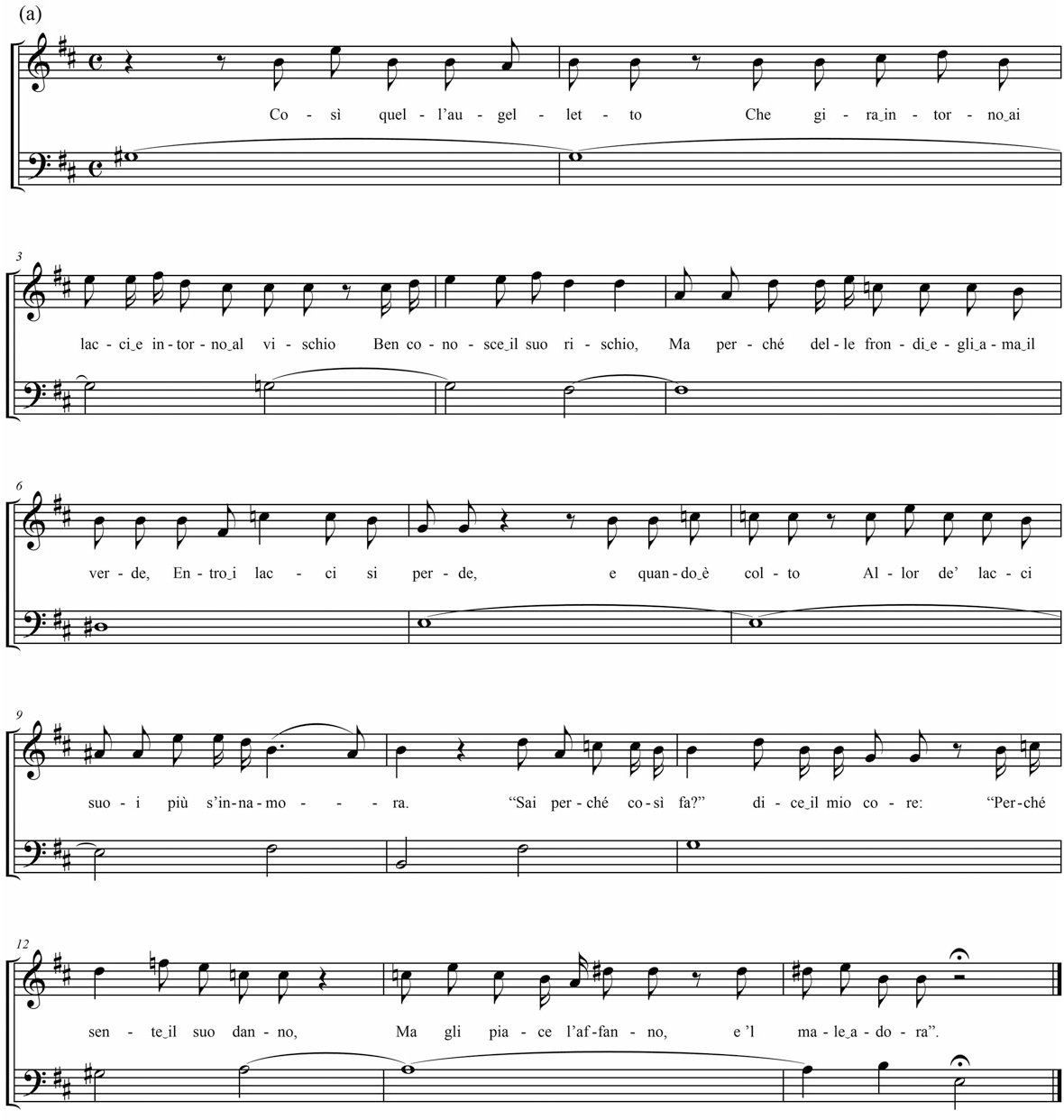
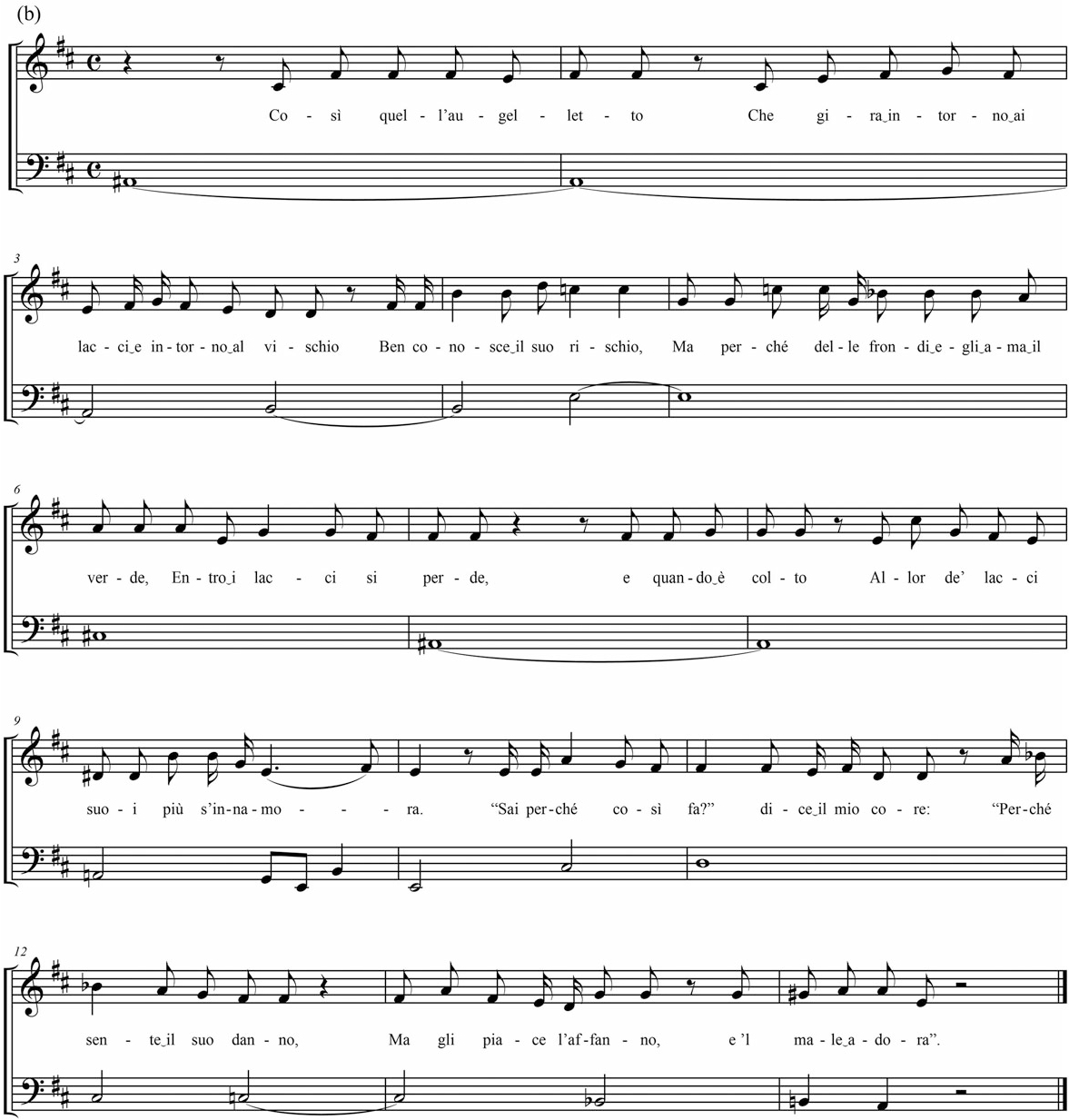
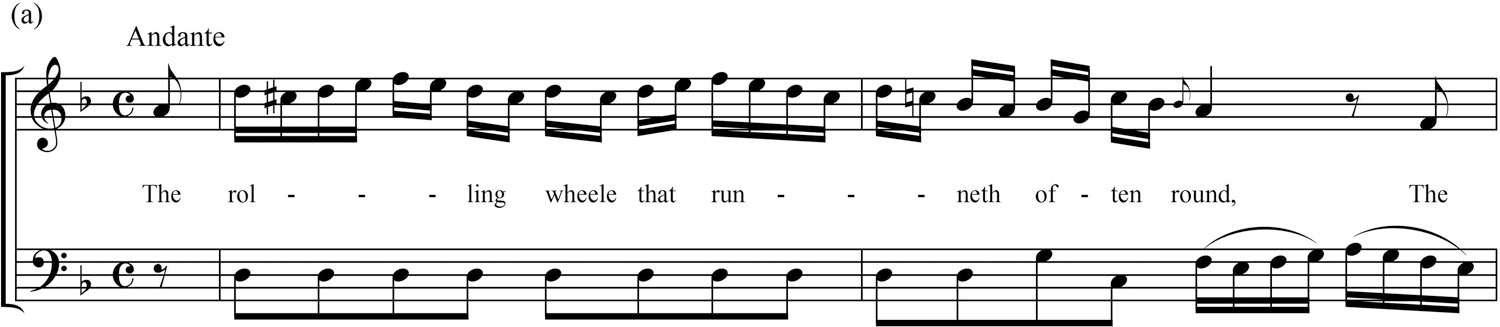
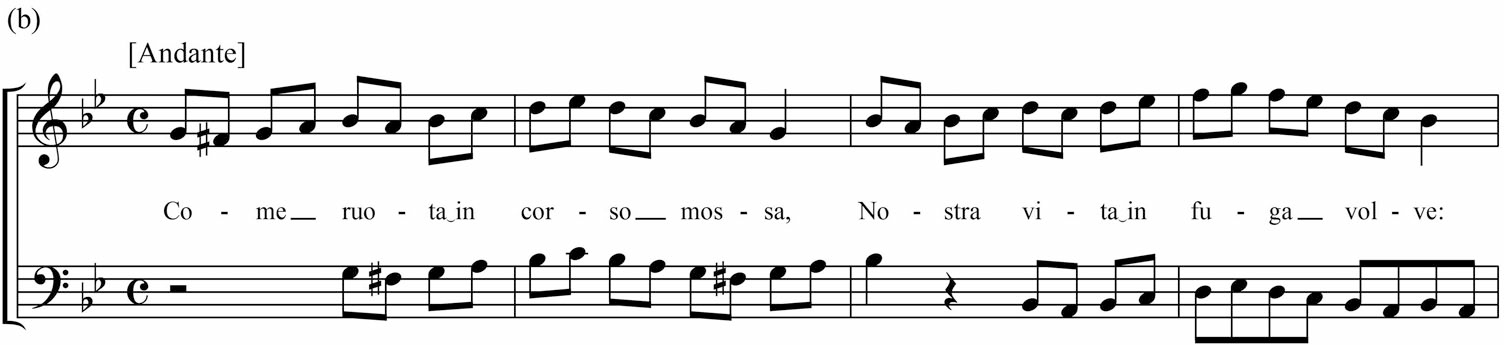
When he started to write Italian cantatas, a major preoccupation of Greene must have been to avoid blunders in the accentuation, inflection and rhythm of the words – particularly in recitatives, where such weaknesses would be more evident. This, rather than laziness or a lack of musical self-confidence, may be the reason why, in three instances that have come to light, in the process of taking the words from an earlier recitative he also ‘shadowed’ closely its original musical setting. His technique is illustrated with striking clarity in Mille volte sospirando, for which the model was a setting by Gasparini.Footnote 54 The two settings are shown in full as Examples 1a and 1b.
Francesco Gasparini, Mille volte sospirando, recitative. Naples, Conservatorio S. Pietro a Majella, Cantate 140(2).

Maurice Greene, Mille volte sospirando, recitative. Oxford, Bodleian Library, MS Mus. 52.d.

The subject of the cantata is the recklessness of a lover despite his awareness of the dangers. In the central recitative the lover is likened to a bird which, far from being wary of becoming caught in a trap, masochistically relishes the prospect:Footnote 55
| Così quell'augelletto | Thus that bird |
| Che gira intorno ai lacci e intorno al vischio | which circles round nooses and the snare |
| Ben consosce il suo rischio, | knows well the risk it runs, |
| Ma perché delle frondi egli ama il verde, | but because it loves the green of the fronds |
| Entro i lacci si perde, e quando è colto | it loses its liberty, and when caught |
| Allor de’ lacci suoi più s'innamora. | falls in love with its captivity all the more. |
| ‘Sai perché così fa?’ dice il mio core: | ‘Do you know why it does so?’, my heart asks: |
| ‘Perché sente il suo danno, | ‘Because it senses its ruin, |
| Ma gli piace l'affanno, e ’l male adora’. | but enjoys horror and loves misfortune’. |
This text is saturated with keywords crying out for expressive highlighting: ‘lacci’ (nooses); ‘vischio’ (snare); ‘rischio’ (risk); ‘perde’ (loses); ‘colto’ (caught); ‘s'innamora’ (falls in love); ‘danno’ (ruin); ‘affanno’ (horror); ‘male’ (misfortune). Gasparini's setting tends towards the bland, stereotypical functionality that has given recitative a bad name. ‘Vischio’ receives the mild shock of a chromatic alteration in the bass, but ‘rischio’ is set, strangely, to a calm cadential resolution. The neutral ‘verde’ (green) in bar 6 perversely coincides with the strongest harmonic progression of the whole recitative (with its implicit false relation D–D#), while ‘perde’ in bar 7 is the cue for a disappointingly routine cadence. The Neapolitan Sixth (C natural) for ‘colto’ in bar 8 and the unexpected lingering over the third syllable of ‘s'innamora’ in bar 9 are better. The expressive potential of ‘danno’ is ignored, however, even though the shortly following ‘affanno’ is appropriately treated.
At first sight, Greene's setting appears to be a very close paraphrase of its model. The number of bars is exactly the same; the rhythm of the vocal line is identical except in bar 10; leaving aside the missing minim in the final bar, the rhythm of the bass is a very close match except in bar 9, and the harmony changes at the same points. The contour of the melodic line is always similar, and in many phrases the original intervallic structure is reproduced, although not necessarily at the same pitch level relative to the bass – for instance, in the setting of the first line notes 1–2 are the same (allowing for the difference of key), while notes 3–7 collectively slip down a perfect fourth. There are similar close analogies in the bass part. Greene also pays a less overt and possibly unintentional homage to Gasparini's recitative in bars 4–5, where a Neapolitan Sixth fittingly chosen for the word ‘rischio’ echoes the original note and chord in bar 8 of the earlier setting.
But Greene's concern for expression and word-painting takes him into new territory. Whereas Gasparini had (in bars 4–6) juxtaposed two six-three chords a minor third apart, Greene does this twice in succession in bars 4–7, brilliantly conveying the sense of ‘perde’ as the music suddenly spirals downwards as if losing control.Footnote 56 The bittersweet effect of the bass B natural in bar 14, a deliberate ‘kink’ in the lamento figure initiated in bar 11, is another inspired touch.
The melodic structure of the cadence for ‘s'innamora’ in bars 9–10 deserves comment. Its I–II–I (rather than the more familiar III–II–I) contour, originally restricted to recitatives, started finding wide use in arias during the second half of the 1720s, with Neapolitan composers leading the way. The first appearance in London of this ‘arch’ cadence, as one might term it, is pinpointed by Burney, who noticed it in Pulcheria's first aria (sung by Faustina), Vado per ubbidirti, in Handel's Riccardo primo (1727).Footnote 57 This type of cadence quickly found its natural home at the end of the second and sometimes also third vocal periods of a da capo aria, a cadenza for the singer customarily being inserted between the first tonic and the trilled supertonic. Indeed, it is the linear ancestor of the artificially distended cadence enclosing the cadenza of a Classical concerto. Greene's mature cantata arias abound in the device, and there are also two instances of a slightly later melodic structure fitted to the same harmonic framework, which I term the ‘hook’ cadence.Footnote 58 Here, the first note is not the tonic but the dominant, which rises to the supertonic.
In O pastori, io v'avviso Greene repeats the exercise of ‘shadowing’ both recitatives of the cantata from which the text is taken: the widely circulated setting by Porpora.Footnote 59 The technique employed and the artistic superiority of Greene's treatment follow the pattern already described. The point is not – or not necessarily – that he is the better composer tout court: it is perhaps rather that he, as an enthusiastic neophyte, is trying a little harder to rise above the merely workmanlike. It is interesting that he takes on board an idiosyncratic feature of Porpora's recitatives: the frequent displacement of harmonic movement from the strong first and third beats of the bar to the weaker second and fourth beats, a habit that greatly increases the already considerable number of ties between bass notes.
The two recitatives of Lascia di tormentarmi, tiranna gelosia appear to derive the rhythm and contour of their melodic openings from Bononcini's homonymous cantata.Footnote 60 However, exact modelling ceases after that point: perhaps Greene was now ready to spread his wings.
One interesting feature of Greene's recitatives that was probably inherited, knowingly or unknowingly, from his experience of writing English songs is the relatively frequent appearance of grace-notes functioning as appoggiaturas and sometimes even as two-note slides:Footnote 61 Italians hardly ever used grace-notes to represent appoggiaturas in their recitatives, either relying on the singer to supply them extempore according to universally followed conventions or writing them out at the correct pitch as full-size notes. Another slightly deviant characteristic of Greene's recitatives, especially in the later cantatas, is their occasional tolerance of more regular patterns (literal repetitions, symmetrically balanced phrases) than Italian usage ordinarily favours. Lastly, the high incidence of final cadences terminating in or on the dominant chord of the ensuing aria betrays a composer with roots in instrumental music: Italian cantata composers generally preferred a more oblique, less predictable, harmonic transition from recitative to aria.Footnote 62
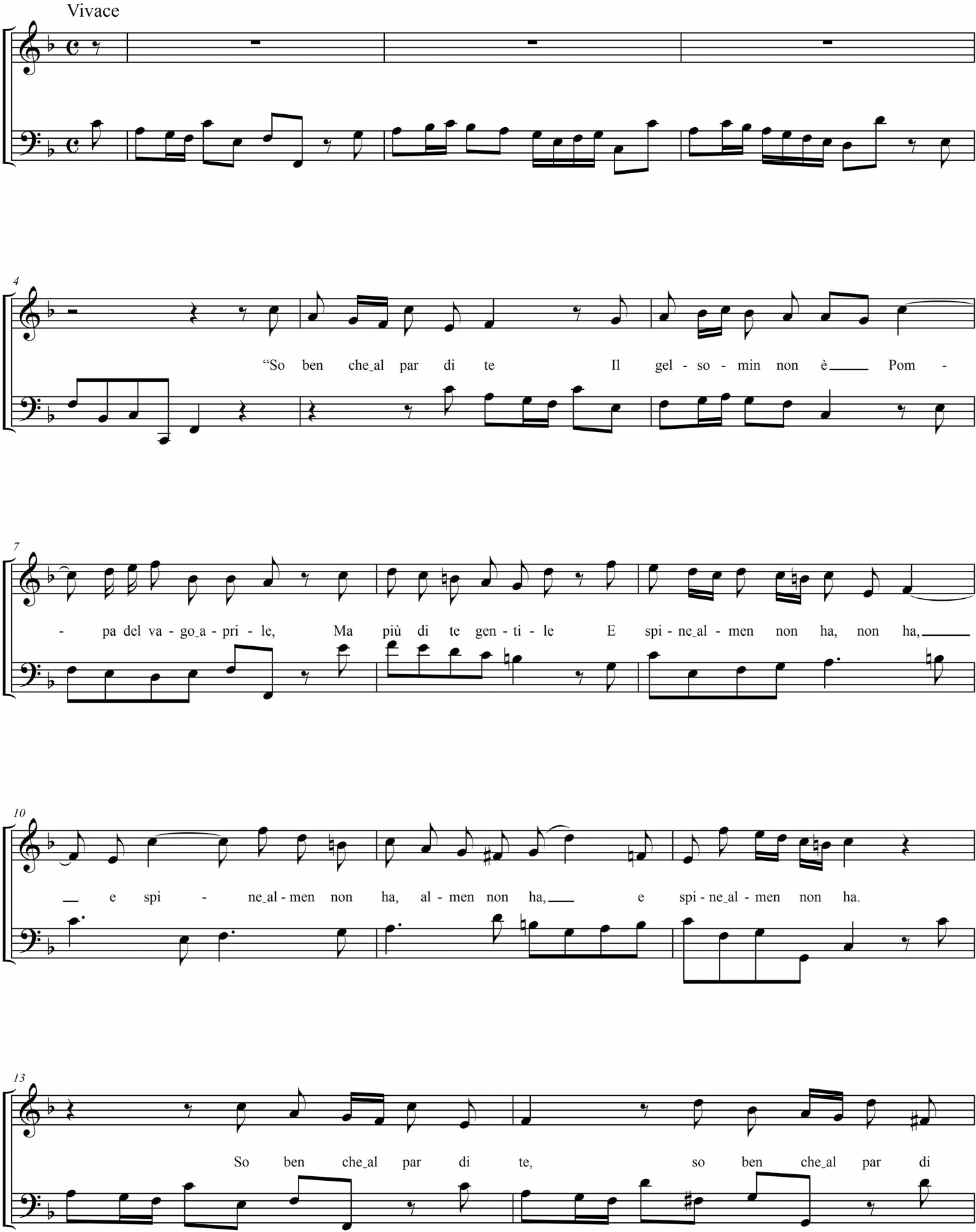
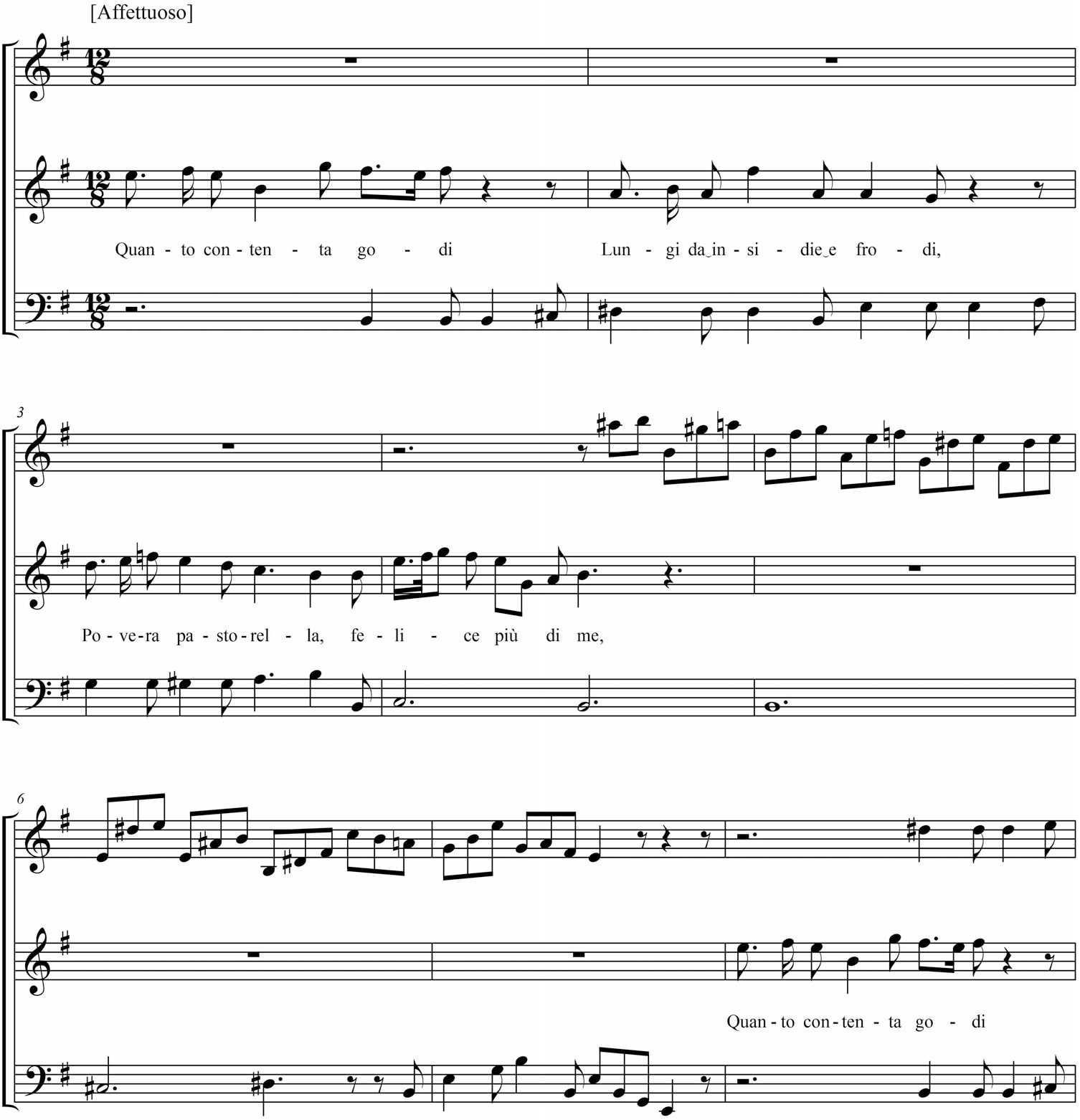
Greene paraphrases the opening of the first aria of Gasparini's Mille volte sospirando in his own setting of the text, but similar borrowing is not evident elsewhere in his arias. Here, he writes from the start with a confident fluency. Following normal Italian practice, he tends to match musical and poetic metres. If the poetic metre is ‘long’ (from ottonario, eight-syllable metre, upwards), so, too, is the musical metre (3/4, 4/4 or 12/8). Conversely, ‘short’ poetic metre results in ‘short’ musical metre (3/8, 2/4, 6/8). The correlation is not perfect (as Example 2 will show), but is close enough to deserve mention. In matters of tempo Greene, whose instinct is more lyrical than dramatic, shuns the extremes. He favours the moderately slow Affettuoso (which becomes almost a ‘signature’ tempo marking) for first arias and the moderately quick Vivace or Andante vivace for second arias.
Maurice Greene, Ninfa vezzosa, second aria, bars 1–14 (bass figures omitted). Oxford, Bodleian Library, MS Mus. 52.d.

Greene's interpretation of da capo aria structure, a ground plan from which neither his poets nor he ever deviate in these works, keeps pace with progressive trends. His later cantatas, especially, favour a bi-periodic B section in which the entire text of the second semistrophe – no longer just its closing line or lines – is worked through twice, resulting in two substantial, discrete vocal periods. Accordingly, the B section grows to become comparable in length to the A section (minus its framing ritornellos): rich terrain for an inventive composer such as Greene. In the second aria of Ninfa vezzosa the B section (Affettuoso, 3/4) contrasts with the A section (Vivace, 4/4) in tempo and metre as well as affetto, an increasingly common solution from the 1730s onwards.
Another progressive feature, also seen, for example, in the contemporary cantatas of Girolamo Polani, is the option for what I shall term ‘tonic reversion’ at the start of the second vocal period. In its ‘classic’, Scarlattian phase an Italian Baroque aria in a major key, having cadenced in the dominant and interposed an instrumental link passage or central ritornello in that key, usually begins the second vocal period in the dominant, often with a transposed restatement of the opening vocal material, and remains there for a short while before veering off towards peripheral keys or else returning directly to the tonic. The newer practice, which has its exact counterpart in a common variety of the nascent sonata form, is to revert instantly to the home key at the start of the second vocal period. This allows the composer, if he so wishes, simply to ‘paste in’ the original opening bars of the first vocal section. But if any single general characteristic lends distinction to Greene's writing, it is his avoidance of over-facile solutions and corresponding delight in elaborated restatement – in other words, development. To illustrate this, we can examine the first 14 bars of the second aria of Ninfa vezzosa, shown as Example 2.
The four-bar continuo ritornello, markedly melodic in character in its first three phrases (each of which anticipates material presented either at the outset of the first vocal period or later), belongs to a type very frequently encountered in Greene's cantata in common time, with quaver upbeats to the phrases and clear segmentation between them. Like most Italian composers, Greene is prepared either to make the bass interactive with the vocal line via imitation and dialogue or to give the bass one or more characteristic motives (which may be totally independent or alternatively extracted from the vocal line) repeated in ostinato fashion. When the voice enters, the bass responds with a canonic imitation of its initial phrase. Like Domenico Scarlatti in his keyboard sonatas, Greene uses this canonic topos to get his creative juices flowing before introducing more complexity to the harmony, rhythm and phrase-structure, abandoning the simple symmetries of the period's first four bars. This progressive elaboration is mirrored in the delivery of the text, which in classic Italian fashion begins by presenting the first four lines in largely syllabic fashion and without word-repetition – the ear is, so to speak, enabled to ‘read’ the poem exactly as it appears on the page. For the fifth line, however, word-repetition and phrase-repetition (in the second period extended melisma will be added to the mix) are used to produce a sense of climax paralleling the ‘punch line’ function of that portion of text. This process of cumulative elaboration is executed in a manner both light (in texture and economy of means) and natural: Greene's seemingly effortless cantabilità is a match for Handel's, and what he lacks in expressive intensity he makes up for with his gracefulness and wit. This wit emerges at the start of the second vocal period in bar 13, where the sequence of canonic imitation between bass and voice is playfully reversed.
The expressive sequential continuation in bar 14 that takes the music from F major up to G minor is a reminder of Burney's not only cruellest but also most perverse general criticism of Greene's music: that it over-indulged ‘the repetition of passages a note higher or a note lower in what the Italians call rosalia, which are always dull, tiresome, and indications of a sterile fancy’.Footnote 63 It is a shame that Greene's ardent nineteenth-century defender George Hogarth, who tore to shreds Burney's jaundiced objection to Greene's fondness for melisma (‘divisions’) and ornaments (less evident in his ‘Italian’ music than in his anthems), did not do the same for this accusation regarding sequences.Footnote 64 In reality, Greene, always alert to the need for variety, tends to break off literal sequential repetition after only one transposed restatement, whereas other composers in an Italianate style from J. S. Bach to Handel and Vivaldi happily admit many more repetitions. When a conspicuous exception occurs, as in the bass part of the movement ‘Among the Gods there is none like thee’ from the anthem O Lord, give ear (1720), the intention is obviously to use a mechanically repetitive ostinato as a foil to one or more freely unfolding and deliberately non-repetitive melodic lines. Another feature revealing the subtlety of Greene's judgment – one he shares with Handel – is his careful distinction between even and dotted rhythms, which he often mixes to make attractive patterns.
Perhaps the most original and attractive feature of Greene's style, and one shown to advantage on the broad canvas of the da capo aria, is his delight in modulation beyond the bare structural necessities. Whatever its final cadential destination, a period is likely to make fleeting visits to other keys (or, if one prefers, to ‘tonicize’ additional scale degrees) en route – a process that results, by the time the movement has finished, in a rich tonal palette embracing not merely one or two but several peripheral keys, which occasionally even venture outside the regular ambitus.Footnote 65 For example, the second aria of Nel tuo foglio, o vaga Irene follows the tonal trajectory D-A-D / C-D-b-f#-e-a-e-b.Footnote 66 On occasion, Greene is guilty of obscuring the useful aural distinction between structural and incidental modulation, so that the listener finds it hard to plot the overall tonal course of the movement. But this failing is rare, and the range and frequency of modulation in Greene's arias, coupled with his harmonic resourcefulness, are a great asset.
The arias
Remarkably, a footnote on the same page in Burney's General History that mentions the ‘arch’ cadence is the clue revealing the identity, beyond reasonable doubt, of the singer for whom the group of six arias on ff. 23r–37r in the Oxford volume was written: the eminent Venetian soprano Faustina Bordoni (1697–1761), engaged by the Royal Academy of Music for three successive seasons (1726–8).Footnote 67 Burney writes: ‘E was a remarkably powerful note in this singer's voice, and we find most of her capital songs in sharp keys, where that chord [= note] frequently occurred.’ Winton Dean has expanded on Burney's statement, writing ‘Half the arias Handel composed for [Faustina] are in A or E, major or minor’, while C. Steven LaRue has shown how, in Handel's last five operas written for the Academy, her arias greatly favour ‘sharp’ keys (whereas her rival Francesca Cuzzoni gravitated towards ‘flat’ keys).Footnote 68
As if to exemplify Dean's point, Greene's arias comprise three in A major, two in A minor and one in E minor. Moreover, all the arias conspicuously privilege the note e′′, returning to it repeatedly, sometimes sustaining it in a manner inviting a trill or messa di voce and placing it at climactic points.Footnote 69 The vocal compass, ordinarily e′– a′′ but with occasional extension downwards to c′ or upwards to b′′, is perfect for Faustina. The connection to her is also supported by the fact that three of the arias are taken from the librettos of operas in which she sang (although none of the arias was assigned to her role) – something unlikely to have happened without her participation in their selection. The addition of a part for obbligato violin in all six arias suggests the participation of Faustina's constant companion and reputed lover whom she had insisted, against initial opposition from the Royal Academy's orchestra and directors, on bringing with her to London: Mauro D'Alay, nicknamed ‘Maurino’.Footnote 70 Finally, the fact that their copyist was the scribe responsible for O, pastori points to a date in the middle to late 1720s, which fits Faustina's presence in London perfectly.
Free-standing arias of operatic type intended from the start for use in concerts, conversazioni and domestic recreation were in the late 1720s something of a novelty in London. True, in 1727 Fortunato Chelleri had brought out a collection containing three cantatas and eight arias. But at least six of these arias, and possibly all of them, were extracted from Chelleri's operas dating from the years 1719–22, and were probably published as a self-awarded consolation prize for being unsuccessful at breaking into the charmed circle of composers to whom the Royal Academy entrusted its commissions for new operas.Footnote 71 Greene may have been among the earliest composers of purpose-written concert arias in Italian.
All six arias are of medium length and very orthodox in overall design, as if Greene were taking special care not to take the celebrated diva outside her comfort zone. They are pleasantly varied in mood, metre and tempo, which could suggest that Faustina performed them (or some of them) in sequence. The opening of Quanto contenta godi, shown as Example 3, represents the gentler side of Greene. Its siciliana rhythm, slow harmonic rhythm and wistful chromatic inflections almost suggest Vivaldi, many of whose arias (but, so far as one knows, no complete operas) were by then in circulation in Britain. Here, too, the note e′′ makes its presence felt.Footnote 72
Maurice Greene, Quanto contenta godi, bars 1–8. Oxford, Bodleian Library, MS Mus. 52.d.

O Libertà, o dea celeste is an aria (the Rome album terms it an ‘aria di camera’) of a radically different type. It is, indeed, a prototype for a kind of piece encountered several years later in Greene's odes. Its key (E major), vocal compass (e′– a′′) and use of an obbligato violin seem once again to fit the ‘Faustina’ profile.
However, we must first examine its literary provenance. The text is an Italian translation of a famous stanza, made popular by its patriotic sentiment, in Joseph Addison's extended poem A Letter from Italy (1701). An Italian friend and correspondent of Addison, Anton Maria Salvini, who was a professor of Greek at the University of Florence and a keen translator from several languages (he had already translated into Italian Addison's much-admired tragedy Cato), undertook to do the same for this poem. Problems with the local censor, who regarded its content as anti-papal, prevented publication in Italy,Footnote 73 but when Addison's literary works were published posthumously in 1721 (he had died two years earlier) the opportunity was taken to interleave Salvini's translation with the original.Footnote 74 Here, in parallel text, is a diplomatic transcription of the relevant stanza in both languages:
| Oh Liberty, thou Goddess heavenly bright, | O Libertà, o Dea Celeste, e Bella! |
| Profuse of bliss, and pregnant with delight! | Di ben profusa, e pregna di diletto! |
| Eternal pleasures in thy presence reign, | Piaceri eterni te presente regnano. |
| And smiling Plenty leads thy wanton train; | Guida tuo gaio tren lieta dovizia; |
| Eas'd of her load Subjection grows more light, | Vien nel suo peso Suggezion più lieve; |
| And Poverty looks chearful in thy sight; | Povertà sembra allegra in tua veduta; |
| Thou mak'st the gloomy face of Nature gay, | Fai di Natura il viso oscuro gaio; |
| Giv'st beauty to the Sun, and pleasure to the Day. | Doni al Sole bellezza, al giorno gioia. |
How would such a stanza of eight hendecasyllables best be set? The easiest option would be to set it all as recitative, but this would hardly make a satisfactory recital piece. Greene resorts to a characteristically English solution: he sets the outer portions of the stanza as a pair of through-composed arias, selecting lines 4–6 (but the syntax and sense would have permitted alternative choices) for treatment as recitative. By this means, a ‘synthetic’ ARA cantata is formed.
But why was this text chosen in the first place? One possibility suggests itself: not a certainty, but at least a hypothesis that fits the situation. Immediately before her final departure from England in early July 1728, Faustina visited her most important English patrons, who included the king and queen, to take a formal leave of them.Footnote 75 It was customary for eminent visiting singers to pay tribute to their hosts by singing a piece in praise of their nation, as Durastanti had done in the English language in a public theatre in 1724. But Faustina is not known either to have sung in English or to have sung in a public theatre except in an opera. Any performance by her as a leave-taking gesture must have been in Italian and in a private setting. To find a piece of elegant Italian verse of the right length that flattered Britain was a tall order, but in Greene's setting we may have discovered the very ingenious and exquisitely realized solution, which perhaps also surreptitiously commemorates the relationship of Faustina and Maurino, since the first of the two ‘aria’ sections treats the violin as a wordless partner to the voice in the manner of a love duet.
If it is correct to infer that Elizabeth Planta's copy of La libertà was made from one owned by Mary Bowes, it is easy to see why the latter would have had an interest in possessing it, for in 1757 a massive stone column topped by the figure of Lady Liberty, a pet project of Mary's husband, was completed in the grounds of Gibside Hall. In that context, Greene's composition may have acquired a second emblematic significance not originally envisaged.
The duets
The most surprising thing about Greene's four duets (ignoring O quanti passi) is not the operatic provenance of their texts but the fact that in each case the chosen text originally belonged to a solo aria, not a duet. But on reflection, this is really not so strange. As purpose-written chamber duets, such as those of Steffani and Handel, remind us, to have two voices sing a common text belongs to the mainstream tradition, and in any case operatic duets, provided that these are duets of concord (love or common feelings) rather than discord (hate or contrasted feelings), usually have minimal textual differentiation between the two parts (as when ‘mia cara’ is answered with ‘mio caro’) or even none. One inevitable consequence, however, is that the structure is uniformly that of the conventional da capo aria rather than any of the alternative designs so often found in duets, which range from the simple (through-composed or binary) to the complex (composite or multi-movement).
In the three duets with simple continuo accompaniment the texts are by Metastasio: one taken from Ezio (first staged in 1732) and two from Ciro riconosciuto (1736). The instrumentally accompanied duet borrows its text from an aria, originally sung by Farinelli, in Rolli's Sabrina, premiered on 26 April 1737. Part of Greene's purpose may have been to set favourite lines in a format better suited to social music-making. Quite likely, these duets, which closely resemble one another, were written in quick succession: therefore no earlier than 1737. Given Mary Bowes's probable possession of at least one of them, she may have in some way been connected with their original performance.
Greene shows a perfect understanding of how to construct a musical period in a duet. Typically, the voices start by dialoguing in relaxed fashion, with entries well spaced, thereby providing an opportunity to hear the words clearly and become acquainted with the main thematic material. That done, the voices are drawn more tightly together, often in close imitation, and the zone of maximum contrapuntal and harmonic tension is reached. Finally, the union of sentiment is expressed through a relaxation into homophony, with long chains of suitable parallel intervals. The string parts in Rapide sì volate, where the quick-fire exchange of canonic snippets between the sopranos generates real excitement (as experienced by the character in the opera, who is hastening to be reunited with his beloved), are skilfully handled but clearly subordinate. Here, as generally elsewhere, our composer has little interest in the niceties of violin bowing and articulation (beyond the occasional staccato): melodic and contrapuntal functions remain uppermost.Footnote 76
Greene's reputation for being, by English standards, a very Italianate and galant composer is brought out particularly well in these works. Otherwise, the general qualities remarked on for the cantatas and arias are fully displayed. Non piangete, amati rai is transcribed complete, though strangely without comment, by Walker.Footnote 77
The odes
If we may ignore three very short canons with Italian texts published in Greene's Catches and Canons for Three and Four voices (1747), his last, and in some respects most remarkable, ‘Italian’ compositions were the 15 Ode d'Anacreonte. Their texts were Greene's own selection from the 51 odes in a translation from the Anacreontea by Rolli that had been published in 1739.Footnote 78 In all likelihood, the settings were written as a planned group within a short space of time, but how soon after Rolli's publication appeared is not possible at present to determine. Since the works of the Anacreontea form a unity at several levels – stylistic, authorial (attributed to Anacreon), topical (dealing with drink, love, aesthetic or sensory pleasure and the brevity of existence) and philosophical (epicurean, but with moments of melancholy or stoical resignation) – Greene's settings can fittingly be described as a song cycle in a broader sense, if one accepts that there is no discernible narrative thread and probably no original expectation of a performance of the whole at one sitting. There is enough consistency in the vocal compasses to suggest that the odes were written for two specific performers, one of whom, as already intimated, may have been Mary Bowes: the soprano remains within d′–a′′, while the bass chosen for the two songs whose poetic credibility depends absolutely on their execution by a male singer ranges from A up to f′.Footnote 79 In the most obvious precedent for the Ode d'Anacreonte, Greene's collection containing settings of 25 sonnets taken from Edmund Spenser's cycle Amoretti, which was composed in 1738 and published in March 1739, the overall compass (c′–a′′) is not significantly different, but the variability from one song to another is somewhat greater, suggesting that the composer had in mind from the start a collection from which different singers would select whichever songs best suited their individual range. Moreover, the asymmetry in the later collection between 13 songs for soprano (or tenor) and only two for bass would have been rather odd, commercially speaking, in a collection destined for publication.
Its sequel-like relationship to Spensers Amoretti, as Greene entitled his published collection, provides the vital key to understanding the Ode d'Anacreonte. Johnstone's description of the first-named cycle as ‘Greene's finest achievement in the whole field of English solo song’ is, if anything too cautious.Footnote 80 The collection is revolutionary in that it places the poet and his creation firmly in the centre ground, anticipating the typical Liederbuch of the nineteenth century. Indeed, the poet's name is emblazoned on the title – a novelty in itself; Spenser himself is lauded as ‘the best of poets’ in Greene's dedication of the volume to Harriet, Duchess of Newcastle (another of his pupils-cum-patrons); each song is headed by the word ‘sonnet’ in a non-stop tribute to the poetic source; sonnet 80 (from a total of 89 poems) is moved to first place with the obvious intention of highlighting its very overt reference to Spenser's ‘signature’ work, the Faerie Queene. Greene places the other 24 selected sonnets in their original order within Spenser's cycle, which is a poetic diary of his thoughts and impressions during his courtship of his future wife, Elizabeth Boyle. In a strictly chronological sense, the 25 extracted sonnets obviously form a kind of narrative, but since the progression is one of fluctuating moods or random thoughts rather than of unfolding events its shaping force is weak to the point of irrelevance.
Spenser's sonnets are absolutely uniform in structure: 14 lines of pentameter subdivided into three quatrains and a final couplet. Greene's settings, in contrast, go out of their way to vary the musical structure and (thanks to the untrammelled liberty to repeat lines and phrases) the length of the songs to a surprising degree. Following a favoured English practice, the songs are composite, containing variously two, three and even four movements (many extremely short) that map rather capriciously on to the structural divisions of the poetry. The movement types range from short, through-composed designs to binary structures that are either symmetrical or asymmetrical and have both sections, one section or neither section repeated. The option, within binary form, of reutilizing the text underlaid to the first section in the second section rather than moving on to fresh text creates a useful instrument of flexibility that Greene fully exploits. To a limited extent, he makes use of refrains, most notably in Sweet smile, the daughter of the Queene of Love (numbered 39 by Spenser and 12 by Greene). The same tonic is generally maintained throughout the sequence of movements, but there are seven instances of modal shifting (usually from minor to major). Occasional endings with half closes help to maintain continuity between movements.
The departures of the odes from this basic template are not many, and all entail venturing further along the same path, sometimes with the co-option of Italian features. Since both the number of lines and the poetic metre of Rolli's translations vary very greatly, Greene's settings of them range in complexity from a single binary movement (Ode 8) to a chain of five separate movements (Ode 37), even though there is no simple correlation between the length of the poem and the musical structure or duration. In five odes (nos. 4, 15, 20, 30 and 37) Greene inserts an Italian-style recitative or arioso, and one observes a little more tonal variety than in the Amoretti, again reflecting the influence of the cantata. Occasional appearances of da capo form, sometimes entailing textual repetition and sometimes not, increase the structural variety. Recapitulated mottos and sections become more frequent. The bass part is a little more active (and also interactive) than in the Amoretti, and the participation of a stringed instrument seems more essential.Footnote 81 But the melodic style is virtually unchanged: limpid, unfussy and rather restrained – much more ‘English’, in fact, than ‘Italian’. Compare, for example, the openings of Amoretti no. 5 (The rolling wheele) and that of the B section of the first movement of Oda 4 (Sovra i mirti tenerelli), shown as Example 4. The figures illustrating a revolving wheel are almost the same, and their treatment is not dissimilar. If the words were removed, would one readily know which was which?
Maurice Greene, The rolling wheele that runneth often round, bars 1–2 (bass figures omitted). No. 4 in Spensers Amoretti (London, 1739).

Maurice Greene, Sovra i mirti tenerelli, bars 21–4 (bass figures omitted). Oxford, Bodleian Library, MS Mus. 52.d.

One could almost describe Greene's Ode d'Anacreonte as English-style songs that just happen to have Italian texts. This was already very nearly the case with La libertà over a decade earlier, and the process of assimilation to English style is now complete. Only the sporadic appearance of a recitative or da capo structure reminds one, briefly, of the world of his Italian cantatas. Any Italian singer in Britain not already thoroughly acculturated would have been bewildered by these compositions. Once again, one has to make the point forcefully that there was no ready-made model within the post-Renaissance Italian tradition for the setting of verse not originally designed for music: the composer had perforce to find an ad hoc solution. In that light, it is understandable that Greene, a man by now past the zenith of his career and probably increasingly reluctant to experiment, in large part retreated to the tradition he knew best rather than attempting to find a radical new way of taking the Italian tradition forward. One should, of course, be grateful that Greene continued to write serious music at all on Italian texts, since after 1740 the Italian cantata and chamber duet were losing public favour as rapidly as they had once won it.
If the Ode come across as skilful rather than musically exciting in the way that Greene's ‘Italian’ works of the 1720s and 1730s frequently are, they share with the Amoretti a laudable desire to showcase at length the work of a particular poet – something even rarer at the time within the Italian tradition than it was in Britain. There are many examples of Italian cantata cycles where the poet was either the composer himself, a court poet to whom he was effectively tied or a patron,Footnote 82 but in none of these instances can one honestly say that the composer ‘chose’ the author of the texts he set out of aesthetic admiration, let alone with a sense of mission. In that perspective, the Ode constitute a radical and prophetic innovation – but a stillborn one, since they came into being at the wrong time in the wrong country and were, anyhow, scarcely at all in public view.
So ended, on a slightly ambiguous note, Maurice Greene's close involvement over some 20 years with italianità. Ironically, although there have been commentators aplenty from his time onwards who have remarked on the Italianate qualities of his music,Footnote 83 what he did when he set out explicitly to be ‘Italian’ has been discussed in detail for the first time in these pages. The 37 works in question are much more than a curiosity (although they are certainly that as well) or a preparation for compositions of greater import: they are in their own right a valuable and individual contribution to the Baroque repertory at an international level.
Note on contributor
Michael Talbot is Emeritus Professor of Music at the University of Liverpool. He is best known for his work as an author and editor on Italian music of the period 1680–1780, notably that of Vivaldi, but in recent years he has increasingly turned his attention to northern European music with or without Italian connections, and in particular to music in Britain. Recent studies by him have embraced composers as diverse as Jacob Cervetto, Robert Valentine, Matthew Novell, Thomas Bowman and Johann Friedrich Schreivogel.