



Introduction
Domestic horses (Equus caballus) and their use for pulling vehicles (e.g. chariotry) and riding profoundly transformed the subsistence economy, trade, warfare and geopolitics of vast areas of Eurasia (Clutton-Brock Reference Clutton-Brock1992; Drews Reference Drews2004; Anthony Reference Anthony2007; Kelekna Reference Kelekna2009). In China, on the south-eastern edge of the Eurasian steppe, horses are traditionally considered one of six key domesticated animal species, and have historically played a crucial role in economic, cultural and military life (Ren & Dong Reference Ren and Dong2016). While the earliest chapters of the human-horse story in ancient China remain difficult to reconstruct, zooarchaeological data offer one of the most important sources of scientific insight (Yuan & Flad Reference Yuan, Flad and Mashkour2006).
In China, domesticated horses first appear in archaeological contexts in the middle Yellow River Valley during the late second millennium BC. They are usually found in dedicated pits, with or without accompanying chariots, associated with elite burials at Anyang, the last capital of the Shang Dynasty (c. 1600–1046 BC; Yuan & Flad Reference Yuan, Flad and Mashkour2006). Chariot-horse pits of similar configuration have also been found across the eastern and western territories of the Shang Dynasty, at sites such as Qianzhangda and Laoniupo in the present-day Shandong and Shaanxi provinces of northern China (Liu Reference Liu2002; Institute of Archaeology, Chinese Academy of Social Sciences 2005).
Chariots appear to have reached their peak social prominence in the succeeding Zhou period (c. eleventh to third centuries BC), when the inclusion of horses and chariots in elite mortuary contexts constituted a crucial part of Zhou etiquette (Wu Reference Wu2013). Through much of the early first millennium BC, horse-drawn chariots became central to military activities, with access to quality horses shaping the power base of Chinese states (Rawson et al. Reference Rawson, Huan and Taylor2021). By the late first millennium BC, frequent incursions of mounted pastoralists and the tactical advantages of ridden horses prompted the sedentary farming states in northern China to adopt riding and mounted archery (Meserve Reference Meserve1998; Barnes Reference Barnes2015), with equestrianism thereafter becoming a key component of the social and political fabric of East Asia.
Horses and chariots in mortuary contexts in late Shang and Zhou China are almost exclusively associated with elites. This has led many scholars to focus on logistical traits, such as the number of horses and chariots used, and the design of the latter, with interpretations largely centred on the implications for social hierarchy and practice (e.g. Zhao Reference Zhao2011; Wu Reference Wu2013). Important questions about the practical exploitation of horses found in these contexts, however, remain to be resolved: what types of horses were selected for burial in chariot-horse pits, were these animals actually used to pull chariots in life (i.e. were they working horses), and what can we learn about the health, management and life histories of these animals?
Archaeologists have used specific patterns of dental deformation in zooarchaeological samples as a means of identifying working horses. The equipment used to control a horse (e.g. bridle and bit) can cause damage to the teeth (Anthony & Brown Reference Anthony and Brown1991; Brown & Anthony Reference Brown and Anthony1998; Bendrey Reference Bendrey2007) and these dental markers may have further relevance for distinguishing strategies of horse use in the archaeological record (Taylor et al. Reference Taylor2021).
The identification of changes to the post-cranial skeleton can also provide direct evidence. Unique pathological markers on the vertebrae have been used to infer horse riding (Levine et al. Reference Levine, Whitwell and Jeffcott2005; Lepetz et al. Reference Lepetz, Debue, Batsukh, Pankova and Simpson2020; Li et al. Reference Li2020). Although abnormal osseous changes to limb bones can occur in non-working animals, pathological deformations are commonly identified on the limb bones of animals used for load-bearing or pulling vehicles (Baker & Brothwell Reference Baker and Brothwell1980; Bökönyi Reference Bökönyi1993; Bartosiewicz et al. Reference Bartosiewicz, Neer and Lentacker1997; Weber Reference Weber, Villa, Gourichon, Choyke and Buitenhuis2008; Bartosiewicz & Gál Reference Bartosiewicz and Gál2013; Salmi & Niinimäki Reference Salmi and Niinimäki2016; Schrader et al. Reference Schrader, Smith, Olsen and Buzon2018). In addition, left/right asymmetry in cranial pathology may point to riding, as has been observed for mounted riding in modern and archaeological assemblages (Li et al. Reference Li2020; Taylor et al. Reference Taylor2021), whereas chariot pulling might be expected to produce a more even balance of left and right forces on the animal's head (Taylor & Tuvshinjargal Reference Taylor, Tuvshinjargal, Bartosiewicz and Gál2018).
In sum, while the extant literature suggests that traction may have differential effects on the forelimbs and the shoulder/neck region, no complete pathological study of horse skeletons has yet established the impact of ancient chariotry on a horse's skeleton. Here, we present a detailed zooarchaeological and palaeopathological analysis of eight horse skeletons from chariot-horse pit no. 5 (MK5) at the Bronze Age burial site of Shijia in China's Gansu Province. We find that the horses in MK5 were working animals used for pulling chariots. By comparing our results with relevant published data, we evaluate the potential of the skeletal and dental abnormalities observed on the Shijia horses for distinguishing between chariot horses and their ridden counterparts more generally.
The burial site of Shijia
Located on the loess tableland east of the Malian River, the burial site of Shijia (35°24′46″N, 107°58′27″E) lies near the modern town of Zaosheng (Figure 1; Wang Reference Wang2019). The site was first discovered in the 1960s, when fragments of horse bones and bronze artefacts were unearthed by chance during the construction of cave dwellings. Excavations from 2016 to 2019 were conducted in Area I to the west of a modern road that divides the site in two. These excavations revealed 177 burials, three chariot-horse pits and one sacrificial pit (Wang & Zhang Reference Wang and Zhang2021).
Location of Shijia (figure by C. Zhang).

Area I consists of two sections. In the north, small, shallow pit burials contained a limited number of grave goods, suggesting that their occupants were likely to have been non-elite residents. In the south, however, larger pit burials, some with traces of a wooden framework, yielded more elaborate grave goods likely to be associated with elite groups. The sacrificial pit and chariot-horse pits were found in this southern section of Area I (Wang & Zhang Reference Wang and Zhang2021).
The configuration of the burials and chariot-horse pits, alongside the grave goods, suggests that the site dates to the Eastern Zhou period (c. eighth to third centuries BC; Wang & Zhang Reference Wang and Zhang2021). The Shijia burial site and Yucun, a large, contemporaneous settlement close to Shijia, are key to understanding the region's cultural and political milieu around the time of the Shang–Zhou dynastic transition (Du et al. Reference Du, Wang, Wang and Wang2019).
The chariot-horse pit MK5 and the horse assemblage
The rectangular pit MK5, located in the southern part of Area I's southern section, contained five chariots (Chariots 1–5) and eight horses (Horses A–H). The chariots were aligned west–east, with their draft poles orientated to the east (Figure 2). Bronze bits and bridle fittings were found inside the chariot boxes. Apart from the easternmost chariot (Chariot 1), which was unaccompanied by horses, each of the other four chariots was associated with two articulated horses, one to the north of the chariot and the other to the south (Figure 3). The yokes of the chariots rested on the necks of horses. Seven human skeletons were found buried in coffins placed within individual, rectangular, shallow pits beneath Chariots 2 to 5. Burial pit MK5 can be dated to the middle of the Spring and Autumn period (c. seventh to sixth century BC), based on the bronze artefacts from the pit. An AMS radiocarbon measurement of 2410±30 BP (Beta-608071) from Horse G also places the context in the mid first millennium BC, when calibrated (Figure 4). Except for some post-depositional breakage, the MK5 horse skeletons are generally well preserved, with limited damage from weathering or the actions of carnivores or rodents.
The chariot-horse pit MK5 at Shijia (photograph by Y. Wang).

The chariots and horses in MK5: top left) Chariot 2, Horses A & B; top right) Chariot 3, Horses C & D; bottom left) Chariot 4, Horses E & F; bottom right) Chariot 5, Horses G & H (photograph by Y. Wang).

AMS radiocarbon date obtained from Horse G in MK5. Conventional radiocarbon age (Beta-608071, 2410±30 BP) was generated by the Beta Analytic Radiocarbon Dating Laboratory. Calibration was performed in OxCal v.4.4 (Bronk Ramsey Reference Bronk Ramsey2009), using the IntCal20 calibration curve (Reimer et al. Reference Reimer2020).

Methods
We determined the sex of each horse according to the number and presence/absence of well-developed canines. Horses with four large canines were determined to be male (Sisson Reference Sisson1953). As many of the analysed specimens’ pelvic bones were damaged post-depositionally, we were unable to use pelvic morphology to assess the sex. Age estimates are based on dental eruption (Silver Reference Silver, Brothwell and Higgs1969) and the morphology of the lower incisors (Sisson Reference Sisson1953; Chinese People's Liberation Army University of Veterinary Medicine 1979).
We analysed the crania, teeth, vertebrae and limbs of the eight horses for abnormal osseous changes or deformations. Following Levine (Reference Levine1999), Levine and colleagues (Reference Levine, Whitwell and Jeffcott2005), Bartosiewicz and Gál (Reference Bartosiewicz and Gál2013) and Li and colleagues (2020), we identified and recorded abnormal changes to the vertebrae and limbs, focusing on instances of new bone formation, bone loss and trauma. We calculated the occurrence of abnormalities for each vertebra, reporting these as a percentage of the total assemblage (see Li et al. Reference Li2020). If a vertebra could not be identified to element, or an element was missing, these specimens were omitted from further analysis.
For each horse, we examined cranial abnormalities linked to human actions, inspecting nasal bones for remodelling associated with deformation caused by bridles. We also took measurements of the maximum depth of the grooves on the premaxilla, which are linked to heavy exertion (following Taylor et al. Reference Taylor, Bayarsaikhan and Tuvshinjargal2015), and recorded the deeper of the values for the left and right-hand sides. In addition, we categorised entheseal bone formation at the site of the nuchal (nape) ligament attachment, assigning a score to each observed cranium, following the scoring system developed by Bendrey (Reference Bendrey2008). We also documented the remodelling and damage to the second premolars, following Anthony and colleagues (Reference Anthony, Brown, George, Olsen, Grant, Choyke and Bartosiewicz2006), Brown and Anthony (Reference Brown and Anthony1998) and Taylor and colleagues (2021), measuring identifiable occlusal (biting edge) bevels using the procedure described in Anthony and colleagues (Reference Anthony, Brown, George, Olsen, Grant, Choyke and Bartosiewicz2006). Based on Bendrey's (Reference Bendrey2007) system, we observed the diastemata (space between the front teeth and cheek teeth) of the horses and scored the degrees of abnormal new bone formation or loss. The online supplementary materials (OSM) give further details (Tables S1–S3) and images of skeletal abnormalities (Figures S1 & S2).
Results
Sex and age-at-death
Five of the eight horses chosen for burial in MK5 have four well-developed canines and the other three have two or three, indicating that these horses were all males. Dental wear of the lower incisors further indicates that all these horses died between 9 and 12 years of age. Within this range, most individual pairs of horses selected for a specific chariot were also essentially identical in terms of estimated age (Table S1).
Abnormalities on crania and teeth
We observed measurable grooves on the premaxilla of seven horses (Table S1). Three horses exhibit medial and lateral grooves (Horses F and G) or medial grooves (Horse E) on both sides of the premaxilla. The others show a medial groove only on the left. The depth of the medial grooves is between 0.4 and 1.9mm (1.0mm mean) and that of the lateral grooves ranges from 0.2mm to 0.4mm (0.3mm mean). These measurements are smaller than the values recorded in horses from the Deer Stone-Khirigsuur complex in Late Bronze Age Mongolia (means of 1.1mm and 0.5mm for medial and lateral grooves) and those for modern ridden horses (means of 1.3mm and 0.5mm), but are larger than those for feral horses (means of 0.6mm and 0.1mm; Taylor et al. Reference Taylor, Bayarsaikhan and Tuvshinjargal2015).
Regarding the occipital bone, six horses exhibit nuchal ossification of varying degrees (Figure S1). The higher the score for a given specimen, the more pronounced the nuchal ossification is. Specifically, four horses show pronounced new bone formation (a score of 4 to 6), values which are typically only found in horses used for riding or vehicle pulling (Bendrey Reference Bendrey2008; Taylor et al. Reference Taylor, Bayarsaikhan and Tuvshinjargal2015); two horses have scores of 2/2 and 3/2, respectively (Table S1).
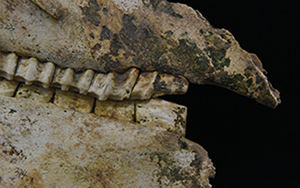
All horses, except Horses C and H, had dentition sufficiently preserved to allow assessment of bit-related damage to the lower second premolars. In all the horses, the anterior surface (both left and right) exhibits roughly parallel enamel/dentine exposure, measuring between 4.3 and 17.3mm in height (Table S2), and appear unaffected by developmental defects such as enamel hypoplasia (Taylor & Barrón-Ortiz Reference Taylor and Barrón-Ortiz2021). Three horses (Horses D–F) exhibit occlusal bevels on both lower and opposing upper second premolars, and these bevels cannot be attributed to natural malocclusion (Figure 5: top). Horses A and B have bevels only on the lower dentition. As for the upper second premolars, slight bevelling to the occlusal surface was observed on Horse H.
Bevel on second molars in occlusal view (top left: Horse D; top right: Horse F) and new bone formation on the diastema (bottom left: Horse C; bottom right: Horse G) (figure by Y. Li).

Five horses have sufficiently preserved diastemata (the space between the canines and the premolars; Figure 5: bottom) for observation. Horses B and G exhibit pronounced ossification, both scoring 3 for the left side and 2 for the right. Slight new bone formation on the diastema is documented in Horses C and F (scoring 1–2 and 1, respectively). Horse D has new bone formation on the right diastema, scoring 2–3.
Abnormalities on vertebrae
In total, 234 pieces of horse vertebrae were sufficiently well preserved for analysis, of which 102 (43.6 per cent) exhibit abnormalities. The most common type of abnormality is osteophytes (excessive bone growth), which were identified on anterior and posterior articular processes, costal grooves of vertebrae, and anterior and posterior articular surfaces of vertebral bodies (Figure S2). We also identified vertebral fusion on lumbar vertebrae 5 and 6 of Horse E. In terms of frequency (Table S3), abnormalities are most common on two portions of the horses’ spines (cervical vertebra 7 to thoracic vertebra 7, and thoracic vertebra 18 to lumbar vertebra 6), with abnormalities occurring on more than 40 per cent of each vertebra in these groups. Lower rates of occurrence were recorded for cervical vertebrae 1–6 and thoracic vertebrae 15–17. We did not identify any abnormalities on thoracic vertebrae 8–14. Osteophytes also occurred on the sacra of Horses E and F.
Abnormalities on limb bones
We identified abnormal osseous changes to the limbs of all horses except Horse C, particularly metacarpal III, metatarsal III, phalanx I (both fore and hind phalanges), radius, and intermediate carpals (Figure 6). The shaft or distal trochlea of fore phalanx I of seven horses, for example, show exostosis (excessive bone growth on the surface). This type of pathological deformation also formed on the joint area of metatarsal III and intermediate carpals. The metacarpal III of four horses fused with metacarpal II or metacarpal IV (on both sides for three horses), and, in some cases, the distal lateral shaft of metacarpal III exhibits excessive bone growth. Bony projections also occurred on the proximal articular surface of the radius in two horses.
Examples of abnormal osseous changes to the limb bones: top) 1: Horse A, metacarpal III; 2: Horse F, metacarpal III; 3: Horse H, metatarsal III; bottom) 1: Horse F, phalanx I; 2–3: Horse E, phalanx I (figure by Y. Li).

Asymmetry
We noted some left/right asymmetry of enamel/dentine exposure on six horses, with Horses B, D and H (all right-hand horses in their respective pairs) exhibiting more severe exposure on the left side, whereas Horses E and G (left-hand horses in their respective pairs) and Horse F (right-hand horse) show greater exposure on the right side. This pattern does not appear to correlate with the position of the animals within their chariot team. In addition, Horses B (right) and G (left) exhibit more severe osseous changes to the left diastema and Horse D (right) on the right. There is also asymmetry of vertebral abnormalities in these animals (Table S3). Specifically, while Horses B (right), C, E and G (all left) exhibit more severe osseous changes on the left side of the spine, Horses A (left), D, F and H (all right) show a directional bias towards the right side (Figure 7). As discussed below, these patterns suggest that the horses in MK5 (except Horses A and B) have asymmetrical tooth wear and bone pathologies that align more frequently than not with the position in which they were interred.
Left/right asymmetry of diastema bone formation and vertebral abnormalities in horses in MK5 (figure by Z. Huang and Y. Li).

Discussion
The selection of horses in MK5: working animals?
Dental abnormalities occur in all horses in MK5 with sufficiently preserved mandibles and maxillae. Given the presence of bronze bits and cheekpieces in MK5 and other burials at Shijia, we believe that the damage to the horses’ second premolars and diastemata was caused by the use of metal bits to control these animals. The high incidence of dental changes in our sample strongly contrasts with the results of the analysis of assemblages from the first-millennium BC Chinese chariot-horse burials at the site of Xinzheng. It would therefore seem that the Shijia evidence indicates that intensive pulling of chariots can produce a strong signature in the dentition, even though the sample size does not allow us to determine that chariot use results in differential impacts to the upper dentition (Taylor et al. Reference Taylor2021).
The formation of grooves on the premaxilla is apparently caused by the frequent and continuous exercising of a horse (Pérez & Martin Reference Pérez and Martin2001). Taylor and colleagues (Reference Taylor, Bayarsaikhan and Tuvshinjargal2015) have found that modern ridden horses have a higher mean depth of medial grooves than their feral counterparts in the equine samples examined. Most horses in MK5 have medial grooves on the premaxilla, with a depth range similar to that of the Late Bronze Age horses of the Mongolian Deer Stone-Khirigsuur complex, which are likely to have been used for pulling chariots (Taylor et al. Reference Taylor, Bayarsaikhan and Tuvshinjargal2015), suggesting that the Shijia horses were possibly similarly employed. Furthermore, most of the Shijia horses analysed had a nuchal ossification score of 4 to 6, exhibiting a severity of abnormalities similar to levels recorded in modern horses over 20 years of age used for riding and traction (Bendrey Reference Bendrey2008).
Combined, multiple lines of evidence suggest that the eight MK5 horses were working animals. Considering their association with chariots, bits, bridle fittings and humans who were possibly charioteers, these horses were most probably used for pulling chariots. Out of the eight horses, six have vertebral abnormalities and diastema bone formation that align with the position in the pit relative to the chariot with which they are interred, and two have more severe abnormalities on the opposite side, with wear only slightly more prominent on that side, perhaps suggesting somewhat inconsistent side preference when working. In general, the position of the horses appears to be linked to their place in the chariot team and reflects their use as working animals. Their deposition within a chariot-horse pit, while part of ritualised sacrificial practices, seems nevertheless to have been informed by their regular use as working horses.
Our analysis of the horses’ dentition shows that all the MK5 horses were males between 9 and 12 years old, indicating that these animals may have been selected for their strength, health and experience. A recent ethnographic survey carried out by Li and colleagues (2020) indicates that modern pastoralists in central Inner Mongolia in northern China consider 8 to 12 years as the prime age for their horses. In horse burials of the second and first millennia BC across eastern and central Asia, adult male horses of similar age (although such sites exhibit a greater variety of estimated age-at-death) were often selected for inclusion in elite burials, perhaps as the personal transport animals of the deceased (Lepetz Reference Lepetz2013; Taylor et al. Reference Taylor2017). Based on the close correspondence between the age of the horses found in individual chariot pairs, it is likely that the horses in MK5 were raised and trained as chariot teams from a young age, and that those chosen for burial with the deceased were experienced animals in the prime of their lives as working horses.
Distinguishing chariot horses from ridden horses
Because of the horses’ direct association with chariots, the data generated by this study allow us to evaluate the potential of the skeletal and dental abnormalities observed for differentiating between horses used for pulling vehicles and their ridden counterparts.
In an assemblage of eight horses from the latter half of the first millennium BC at Shirenzigou and Xigou (Xinjiang, north-western China), Li and colleagues (2020) identify four major types of vertebral abnormalities (i.e. osteophyte, spinal fusion, horizontal fracture on the vertebra's epiphysis and overriding/joining of dorsal spinal processes), indicating that these horses were ridden. In these assemblages, pathological deformations on thoracic vertebra 13 to lumbar vertebra 4 appear to have been the most severe; thoracic vertebrae 1–7 also exhibited abnormal osseous changes (Figure 8b), whereas a lower rate of abnormalities was recorded for cervical vertebrae. An assemblage of nine Early Iron Age horses from Kalasu in north-western Xinjiang exhibits similar abnormalities on thoracic vertebrae 13–18 (particularly 16–18) and lumbar vertebrae 1–6 (You et al. Reference You, Yu, Betts and Jia2020). Similar categories of abnormalities, particularly horizontal fracture on the vertebra's epiphysis and overriding/joining of dorsal spinal processes, have also been documented in Iron Age horses in other parts of Eurasia, such as those from burials in the Altai Mountains (Levine et al. Reference Levine, Whitwell and Jeffcott2005).
Occurrence rate of abnormalities on chariot-pulling horses from Shijia (a) and ridden horses from Shirenzigou & Xigou (b). The subtraction of Shirenzigou and Xigou from Shijia is shown in (c), with positive values shown in yellow and negative values in blue. The figures are modified from Barone (Reference Barone1976: pl. 6) (figure by Z. Huang and Y. Li).

Since the Shijia, Shirenzigou and Xigou horses are mostly adult males, differences related to age and sex are unlikely to have influenced skeletal patterning across these assemblages. The ridden horses from Shirenzigou and Xigou thus provide a well-studied baseline for comparison with the chariot horses from Shijia, enabling us to characterise differences in the anatomical effects on horses of pulling chariots versus being ridden in the first millennium BC.
Comparing these datasets reveals important differences in pathological patterns in the spinal column between ridden and chariot-pulling horses. Vertebral abnormalities among the chariot horses from Shijia are characterised by osteophytes of varying degrees, most commonly in cervical vertebra 7 to thoracic vertebra 7 (Figure 8a). The frequency of abnormalities in these vertebrae is higher than that of the Early Iron Age ridden horses from Xinjiang. Abnormalities on the Shijia horses’ cervical vertebrae 1–6 are also prominent compared with fewer occurrences or complete absence among the Xinjiang specimens. There is little difference between chariot horses and ridden horses for thoracic vertebrae 1–7 and lumbar vertebrae. The ridden horses from Xinjiang, however, exhibit fusion and overriding/joining of dorsal spinal processes on these vertebrae, along with osteophytes. Spinal fusion was observed in three of eight horses from Shirenzigou and Xigou, whereas only one specimen from Shijia showed spinal fusion on lumbar vertebrae 5–6. The most discernible distinction between the Shijia horses and the ridden horses from Xinjiang lies in thoracic vertebrae 8–17 (Figure 8c). The occurrence of abnormalities on these vertebrae among the ridden horses is high, particularly for thoracic vertebrae 14–17, whereas the percentage for the Shijia horses is remarkably low, and abnormalities are only present on thoracic vertebrae 15–17 (Figure 8a).
The respective assemblages also exhibit clear differences in the frequency of pathologies of the forelimb. Ridden horses from Shirenzigou and Xigou show abnormalities only on fore phalanx I; among the Kalasu ridden horses, infrequent abnormalities were recorded on metacarpal III, pelvis, femur and tibia (You et al. Reference You, Yu, Betts and Jia2020). In contrast, the Shijia chariot horses have a higher rate of abnormalities on limb bones, particularly the forelimbs (e.g. metacarpal III and phalanx I; Figure 8c). This is possibly associated with the use and position of the yoke, as well as the additional weight borne by the forelimbs when pulling a vehicle (Weber Reference Weber, Villa, Gourichon, Choyke and Buitenhuis2008; Salmi et al. Reference Salmi, Niinimäki and Pudas2020). Chariots in Bronze Age China were normally drawn by pairs of horses harnessed to a draught pole, with the yoke resting on their necks (Shaughnessy Reference Shaughnessy1988). The lower portion of the cervical vertebrae would thus bear much pressure from the yoke when the chariot moved forward, whereas less pressure may have been exerted on the lower portion of the thoracic vertebrae of chariot horses when compared with ridden horses.
Finally, asymmetrical patterning in skeletal abnormality may provide important points of comparison between horses used for pulling vehicles and ridden horses. Among the ridden horses from Shirenzigou and Xigou, we observed consistent and pronounced asymmetry in new bone formation on the vertebral column, with a strong tendency towards the horse's left side (Li et al. Reference Li2020). Similar features on the Shijia horses display a more balanced pattern, with an equal number of horses exhibiting either left or right asymmetry in the vertebral column (Figure 7). The position of each horse in the chariot team largely corresponds to this asymmetry, with horses buried in the right-hand position generally showing abnormal bone formation biased towards the right and vice versa. This pattern is also matched by pathological bone formation on the diastema. With the exception of Horses A and B, the patterning in skeletal abnormalities suggests that the Shijia horse teams were trained and driven in the same positions in their teams over an extended period.
Overall, our results suggest that vertebral abnormalities and their distribution along the spine may help to differentiate between chariot horses and ridden horses. On the one hand, ridden horses seem prone to more categories of vertebral abnormalities, of which transverse horizontal fracture on the epiphyses and overriding/joining of dorsal spinal processes appear to be unique to ridden horses. The degree of spinal fusion is also more prominent in ridden horses than in chariot horses. Osseous changes to middle and lower thoracic vertebrae (thoracic vertebrae 8–18) are rare in horses used for pulling chariots, but more evident in ridden animals. The lower caudal thoracic vertebrae of ridden horses normally bear much of the external force exerted by riders, while this region is spared from similar stresses in horses pulling vehicles. Systematic patterning in left/right asymmetry of new bone formation, particularly in the vertebral column, may also distinguish chariot horses from ridden horses.
Our characterisation of the Shijia chariot horses raises important questions about larger networks of horse breeding, supply and exchange in ancient China. Recent research (Rawson et al. Reference Rawson, Huan and Taylor2021) has posited that poor soil and habitat conditions in central China may have stimulated social and economic connections across steppe and desert margins with productive breeding zones in the Mongolian steppes. Given Shijia's location at the part of China which is poorly suited to horse breeding, future work could address the question of horse breeding and exchange at Shijia, and investigate possible relationships with steppe and desert cultures to the north.
Wider implications
Our results provide a new toolkit for archaeologists seeking to trace evidence of horse transport in the zooarchaeological record, particularly in contexts where the use of horses for riding or vehicle pulling may be in question. Following the initial domestication of horses in the Pontic-Caspian region c. 4000 BP or earlier (Librado et al. Reference Librado2021), domestic horses spread across much of Eurasia. In the absence of robust skeletal indicators on the horses themselves, reconstructions of the use-history of individual horses must be debated when only indirect indicators, such as the pairing of buried horses, the analysis of associated horse equipment, or pathologies found in human skeletons that may be related to horsemanship (Wagner et al. Reference Wagner2011; Chechushkov et al. Reference Chechushkov, Usmanova and Kosintsev2020), are used. Detailed, full-skeleton pathological comparisons of early horse skeletons with the Shijia assemblage can now help to identify the uses to which early domestic horses were put elsewhere in Inner Asia and further afield.
Conclusion
The burial site of Shijia provides an opportunity to explore the possible working lives of individual horses buried in chariot-horse pits—a practice of social and ritual significance for the elites of Bronze Age China. Direct zooarchaeological and palaeopathological evidence indicates that the horses in chariot-horse pit MK5 at Shijia were prime-age males that pulled chariots during their lifetimes. This suggests that at least some elites in Bronze Age China were interred alongside working horses. The latter are likely to have been part of experienced teams that lived and trained together before joining the deceased in their burials. Our findings allow for a better understanding of the nature of chariot-horse pits with regard to the selection of horses and human-horse interactions in Bronze Age China. Our dataset, specifically the identification of skeletal abnormalities which differ between chariot and ridden horses, provides a point of reference that may help trace the emergence of chariot transport and the transition to riding in ancient Eurasia and more generally adds to our understanding of human-horse interactions around the world.
Funding statement
This research was supported, in part, by the National Social Science Fund of China (grant no. 18CKG024), the Key Research and Development Program of Ningxia Hui Autonomous Region (grant no. 2020BFG02008) and the Professional Support Program for Excellent Young Scholars of Northwest University.
Acknowledgements
We would like to thank the Harvard-Yenching Institute for support in this research. We also thank the anonymous reviewers for their constructive comments and suggestions on this manuscript.
Supplementary material
To view supplementary material for this article, please visit https://doi.org/10.15184/aqy.2023.54.



