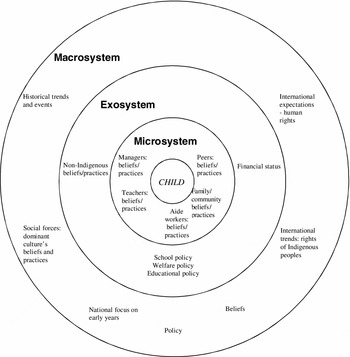
The Early Years Learning Framework for Australia (Department of Education, Employment and Workplace Relations, 2009) emphasises that children's own identity is constructed within their given context of family and community. It goes on to highlight that identity is not fixed and that it is shaped by experiences. It follows, therefore, that initial experiences of children in formal schooling should be as positive as possible. For children in remote Aboriginal communities there is, at times, a disjuncture between their early years’ experiences and the expectations and aspirations of the Western curriculum they encounter on entry into formal schooling. In the Western context, the bio-ecological model (see Figure 1) is commonly used to understand and explain aspects of children's development. This paper extends the model by weaving through it aspects of Nakata's (Reference Nakata2007a) cultural interface theory. This proved seminal in the conceptualisation and implementation of the initiative undertaken in five remote Aboriginal communities in the Northern Territory (NT) to enhance the pre-reading and numeracy skills of 4-year-old children, to smooth their transition into formal schooling. The implementation of the initiative is described, then findings from the current study are analysed in terms of the aforementioned model and theory, which provide a basis for explaining the success of the initiative specifically in terms of children's identity and sense of self-efficacy.
The bio-ecological model.

Theoretical Framework
The Bio-Ecological Model
The bio-ecological model is commonly used in a Western context to explain and understand aspects of children's development. Elements within the various systems in the bio-ecological model (see Figure 1) potentially influence the self-efficacy and educational outcomes of children. Within the bio-ecological model, transactions occur when there is interplay between the child at the centre and the settings within which the child operates. It is not simply a one- or two-way interaction that occurs. As one element or system influences another in any interaction, so the influenced one changes; but, at the same time, the element or system that initiated the interplay is also affected and transformed, and nothing remains the same. In the current study, the elements pertinent to the children at the centre of the project might be influenced by any or all of the elements noted in Figure 1.
Although the emphasis on developmental environment is familiar to educators, Bronfenbrenner's (Reference Bronfenbrenner1979) call for examination of the ‘multiperson systems not limited to a single setting’ and ‘aspects of the environment beyond the immediate setting’ (p. 178) challenges those concerned with the education of children in Aboriginal contexts to look beyond the tensions of high socio-economic status versus low socio-economic status, national curriculum standards versus community priorities, or parent and community aspirations versus bureaucratic goals.
Explaining the transaction dynamic, and developing his original proposition, Bronfenbrenner (Reference Bronfenbrenner and Vasta1989) wrote:
the ecology of human development is the scientific study of the progressive, mutual accommodation, throughout the life course, between an active, growing human being, and the changing properties of the immediate settings in which the developing person lives, as this process is affected by the relations between these settings, and by the larger contexts in which the settings are embedded. (p. 188)
Using Bronfenbrenner's (Reference Bronfenbrenner and Vasta1989) model and applying it to children in remote Aboriginal communities, it is possible to represent the transactions likely to operate within such a child's ecosystem in Figure 1. There are several notable points that emerge from this model that profoundly influence the way the effectiveness of an initiative, such as the one described in this article, can be evaluated. First, the impact of interaction between the child and others is seen transactionally, not additively. Second, it is clearly explained that the settings within which the child develops are ever changing, affected by relations and transactions between the settings. Third, the unique nature and circumstances of each child's situation are reflected, honouring the notion that needs, abilities, and barriers to learning are likely to differ from child to child.
In the current study, it was clearly evident that the initiative would be part of a ‘changing setting’ — that non-Aboriginal partners in the initiative were not best placed to make decisions on process or even content, and that it would need to be led by the Aboriginal partners. Certainly, the principles remained the same, but the way they were enacted were strongly influenced by the work of Martin Nakata (Reference Nakata2007a), who coined the term ‘education at the cultural interface’ (p. 7). In the conceptual development of the initiative, the researchers were strongly influenced by Nakata's framework and the ensuing work of Yunkaporta and McGinty (Reference Yunkaporta and McGinty2009), who built on Nakata's work.
Aboriginal Standpoint — Relatedness
Building an Aboriginal standpoint into a theoretical framework requires more than the inclusion of Aboriginal and Torres Strait Islander narratives and perspectives (Nakata, Reference Nakata2007b; Yunkaporta & McGinty, Reference Yunkaporta and McGinty2009). It requires the recognition of the existence of Aboriginal and Torres Strait Islander knowledge systems and an understanding of the complexities of the cultural interface. Therefore, an Aboriginal and Torres Strait Islander standpoint can never be reduced to just the inclusion of Aboriginal and Torres Strait Islander content (Nakata, Reference Nakata2007b). Edwards and Buxton (Reference Edwards and Buxton1998) in Guyunggu explain an Aboriginal way of being as an interrelatedness of people, land and spirit. Foley (Reference Foley2002) conceived this epistemological standpoint as grounded in Aboriginal knowledge of spirituality and philosophy.
Supporting this view, Martin (Reference Martin2003) promotes a ‘relational epistemology supported by a relational ontology’ (p. 205). This, she holds, ‘helps us focus our attention on our interrelatedness, and our interdependence with each other and our greater surroundings’ (p. 205). In order to achieve this, Martin (Reference Martin2003) advocates that:
Indigenist research occurs through centring Aboriginal Ways of Knowing, Ways of Being and Ways of Doing in alignment with aspects of western qualitative research frameworks. This alignment or harmonisation occurs in both the structure of the research and in the research procedures. (p. 209)
In the current study, this was achieved by the 6-month lead-in to the implementation of the initiative, involving the aims, aspirations and motivations of the Aboriginal Elders in each community, leading to a tailored version specific to their purposes.
In later work, Martin (Reference Martin2007), in highlighting the positives that come from research with Aboriginal people, as opposed to on Aboriginal people, notes that the:
. . . goal is to prepare for change so that it expands one's autonomy, agency and relatedness and does not diminish or limit this autonomy, agency and relatedness. This must occur as coming amongst others in relatedness, so as not to silence, displace or make them invisible. (p. 18)
Later again, Martin (Reference Martin, MacNaughton, Rolfe and Siraj-Blatchford2010) explains relatedness further:
Indigenist research is Aboriginal sovereignty through respecting and centring Aboriginal ways of viewing the world and all things in it, of knowing, giving meaning to and valuing the world, and in the ways this is expressed. (p. 96)
In the current study, this was at the forefront of the thinking of the academics who were to be involved in the initiative. The Elders were the driving force in the implementation, and the activities chosen to achieve the aims exemplified the relatedness to ‘the world and all things in it’ (Martin, Reference Martin2007, p. 96).
Cultural Interface Theoretical Framework
In order to provide a deep level of analysis of the data in the current study, Martin Nakata's cultural interface theory provided a suitable framework as it provided a means to capture the nuanced and multidimensional nature of the place of non-Aboriginal teachers charged with the responsibility of supporting an initiative in remote Aboriginal communities with whom they did not have an existing relationship.
Martin Nakata, a Torres Strait Islander man, ‘captured this complexity and conceptualised it as a broader interface’ (Nakata, Reference Nakata2007b, p. 198). What he has termed as ‘cultural interface’ is embodied by points of intersecting trajectories. Nakata explains as follows:
It is a multi-layered and multi-dimensional space of dynamic relations constituted by the intersections of time, place, distance, different systems of thought, competing and contesting discourses within and between different knowledge traditions, and different systems of social, economic and political organisation. It is a space for many shifting and complex intersections between different people with different histories, experiences, languages, agendas, aspirations and responses. . . . All these elements cohere together at the interface in the everyday. (Nakata, Reference Nakata2007b, p. 199)
Nakata argues that the elements and relationships in this space is how one's thinking, understandings, knowledges, identities and histories change in a continuing state of process — our ‘lived realities’ (Nakata, Reference Nakata2007b, p. 199). According to Nakata there are three guiding principles:
Firstly, Indigenous people are entangled in a very contested knowledge space at the cultural interface; secondly, to move forward it is necessary to recognise the continuities and discontinuities of Indigenous agency; and, thirdly, the understanding of the continual tension that informs and limits what can be said and what is left unsaid in the everyday. (Nakata, Reference Nakata2007b, pp. 215–216)
Nakata (Reference Nakata2001) has also described the successful application of the cultural interface theory in education as requiring the starting point to be Aboriginal and Torres Strait Islander ‘lifeworlds’ and then extending learners in the overlap with non-local realities, maintaining continuity with the past while learning skills relevant to the present and the future. He further asserts that the cultural interface approach is not simply a platform for Aboriginal and Torres Strait Islander students to transition into mainstream education, but ‘should be considered an innovation, enhancing critical thinking and problem-solving skills that are relevant for learners of any culture’ (Nakata, as cited in Yunkaporta & McGinty, Reference Yunkaporta and McGinty2009, p. 17). By 2007, Nakata (Reference Nakata2007b) had extended this view to describe the cultural interface as a space where there is a dialogical exchange between non-Aboriginal and Aboriginal systems. Taking this further in what it means for those working at the cultural interface in education, there is the acknowledgement that it is a ‘dynamic space between ancestral and western realities’ (Yunkaporta & McGinty, Reference Yunkaporta and McGinty2009, p. 58).
This was the founding principle on which the current initiative was based. Contact with Aboriginal people in the remote communities in which the initiative took place and established links from another project meant that the communities had ownership of the current project from the outset, taking care of the decisions regarding who would work with the children and what sorts of activities would take place. The project aimed to discover what might be introduced to improve 4-year-old children's literacy and numeracy.
Background
There is a need to generate information on critical factors that enhance the learning outcomes for Aboriginal children ‘if we are to mount a concerted effort to close the gap’ (Nakata, Nakata, & Chin, Reference Nakata, Nakata and Chin2008, p. 143). It was elements of this ‘gap’ that motivated the conceptualisation and actualisation of the current initiative.
Diversity
There are more than 80 Aboriginal language groups in the NT, from the Larrakia nation of Darwin to the Arrernte people of the Alice Springs region. Aboriginal people account for one third of the NT's 220,000 population, with those Aboriginal citizens speaking several dozen heritage languages (Grimes, Reference Grimes2009). Darwin is home to 100,000 of the total population. Most of 72,000 Aboriginal people in the NT live in remote communities. Distances are vast, with travel to some remote communities impossible by road during the Wet season when roads become impassable. Power supply to the communities is variable and internet access often not possible. Extremes of temperature impact on life and living for all who live in the NT.
Under- or Unqualified Early Childhood Teachers
Despite the government's ambition to provide 4-year-old children with preschool experiences under the guidance of a 4-year tertiary qualified teacher, the reality in the five Aboriginal communities where the current initiative took place was that none of the early childhood educators had teaching qualifications. This is common in rural and remote areas of the NT.
Rationale for the Current Initiative
The rationale for the current initiative was to combat the fact that in Australia today, ‘Indigenous students at all levels experience worse educational outcomes than non-Indigenous students’ (Steering Committee for the Review of Government Service Provisions, 2007, p. 4), and to reach the marginalised (UNESCO, 2010). There are undisputed benefits to quality education in the early years (Berk, Reference Berk2010; Cooper, Reference Cooper2011; Howes et al., Reference Howes, Burchinal, Pianta, Bryant, Early, Clifford and Barbarin2008; Moss & Dahlberg, Reference Moss and Dahlberg2008; Woodhead & Oates, Reference Woodhead and Oates2009). In the NT there is a shortage of Aboriginal teachers, and because of the remoteness of the NT communities and the inhospitable weather conditions, it is difficult to recruit and retain qualified non-Aboriginal staff (Maher, Reference Maher2010). The current study was firmly positioned in the perspective of wanting to improve the children's literacy and numeracy skills on entry into formal schooling rather than approaching it from a school readiness (Clark & Zygmunt-Fillwalk, Reference Clark and Zygmunt-Fillwalk2008; Lara-Cinisomo et al, Reference Lara-Cinisomo, Fuligni, Daughterty, Howes and Karoly2009; Noel, Reference Noel2010) stance. The intense commitment of the Elders of the communities was driven by their wish for children to transition easily into formal schooling and not suffer a sudden crisis of self-confidence they had seen occur time and time again. Children who were extremely well adjusted within community life, seeing themselves as efficacious learners and contributors to this life, were suddenly seeing themselves as incompetent on entry into formal schooling where the medium of instruction was not their home language and where the pedagogy was foreign to them.
Methodology
The current study was Department of Education, Employment and Workplace Relations (DEEWR) funded. All the schools in the study were Catholic schools; the Catholic Education Office of the NT provided ethical clearance for completion of the research work involving children.
The current study took place in the naturalistic/interpretive paradigm where concern for the individual is prioritised and an attempt is made to understand participants’ subjective lived experiences in answering the research questions. In this study, voice was important, as highlighted earlier (Martin, Reference Martin2003, Reference Martin2007). The researchers sought to understand what meaning and understanding the participants have constructed (Merriam, Reference Merriam2009) because it could otherwise happen that the Western framing noted by Nakata (Reference Nakata2007b) and Martin (Reference Martin2003) would determine the initial implementation. Care was taken not to ‘silence, displace or make them [Aboriginal partners] invisible’ (Martin, Reference Martin2007, p. 18). Furthermore, participants’ contexts were expected to be idiosyncratic, multifaceted and complex, and there could be differences in in the ways the Elders wished the project to proceed.
A multiple case studies methodology was utilised to get a range of data across five community preschools. This range of cases provided the researchers with the ability to see trends common to all sites and those particular to specific circumstances. Case studies ‘recognize the complexity and “embeddedness” of social truths . . . (and) can represent something of the discrepancies or conflicts between viewpoints held by participants’ (Cohen, Manion, & Morrison, Reference Cohen, Manion and Morrison2011, p. 292). The current study sought to investigate the effectiveness of the implementation of collaborative planning and provision of learning opportunities, to improve the pre-reading and numeracy ability of 4-year-olds in order to smooth their transition into formal schooling.
Methods
Data was collected by interviews with the early childhood educators, interviews with the lecturers involved in the project, observation of the activities children were involved in, discussions with the Elders, journal entries from both lecturers and early childhood educators, and from minutes of meetings of the Steering Committee.
Design of the Study
Initial phase of implementation: A 6-month period of preparation was undertaken by the university coordinator of this project, a non-Aboriginal woman, making links with the community Elders in the first place to discuss the project and seek their input into any value they might discern; the power of decision-making was left with them. It was here that the first clear example of the cultural interface was evidenced. The researcher came from the perspective of wishing to offer a way of improving children's transitioning into formal schooling and a Western curriculum. The Elders were more interested in the improved literacy and numeracy as a means of ensuring children's wellbeing and sense of identity being negatively impacted before the initiative. They were mildly interested in the access literacy and numeracy would give their children to ‘middle Australia’, as they called it; they were much more interested in their children having the tools to access the curriculum in school so that they would continue to see themselves as effective and efficacious learners.
When the Elders were supportive of the project, the university coordinator then met with Aboriginal and non-Aboriginal leaders within the schools to which the preschools were attached, to gain their perspectives of the perceived advantages and challenges, and to tailor the implementation to their specific requirements. Their responses reinforced for the researchers how critical it would be to ensure the privileging of Aboriginal and local place-based knowledge in the implementation of the initiative.
The input from the Elders and their perspective guided the way the projects unfolded in the five communities. Additionally, the aim was to empower the early childhood educator, regardless of whether or not that person had formal qualifications or whether they were Aboriginal or non-Aboriginal, to want to implement the program, to be able to implement the program, to be able to articulate why these strategies are important to children's learning, and to continue with the initiative at the end of 2 years.
Reflecting their need for assurance that this project was not yet another colonising exercise, Elders at one community wanted to know if it would mean the teacher would have to leave the community if she wanted to upskill, in which case they would not wish to participate. At another, they wanted to be sure there would be no financial disadvantage to families if children did not wish to attend the preschool with this initiative. At a third site, where a number of different family groups or ‘skin groups’ were represented, Elders wanted to know if mothers of children would still be welcome at the preschool where the teacher was not of their skin group or language. At that time, the mothers, who were multilingual, translated for the children, and they wanted the assurance that the current mentoring and support would not be affected. At several sites the Elders wanted to know if their language or English would be used and, when given the choice, almost all wanted both to be used with the children, although one site wanted more English to be used. While supportive of an initiative that held the potential to improve outcomes for their children, Elders were clear that they did not want the current positives of the preschool within their community compromised in any way. The way the introduction and the whole project unfolded ensured that they were the leaders, the decision-makers and the drivers of change of topic or focus as the project progressed over 2 years.
The final part of the preparation took place when the coordinator of the project met with the teachers in the preschools who would be pivotal in the success or otherwise of the program and who had already been mandated by their communities to be a part of the project. At all times, the community members were in partnership with the university academic and the researchers in completing this project.
Findings — Two Illustrative Stories
The academics involved in the project worked for 2 years with preschool teachers, 4-year-old children and their families to enhance the children's literacy and numeracy skills on entry into formal schooling at age 5. All the lecturers were non-Aboriginal but had previous experience in working with Aboriginal people. From its conception, because of the theoretical framework within which they were working, principles of the cultural interface were at the forefront. They honoured the need to harmonise with the ‘lived experience . . . the different knowledge traditions, . . . the many shifting and complex intersections between different people’ within the communities in which they were working. Every effort was made to respect and centre Aboriginal ways of knowing, being and doing, as highlighted by Martin (Reference Martin2003, Reference Martin2007, Reference Martin, MacNaughton, Rolfe and Siraj-Blatchford2010). The authors of this article therefore prefer to present the findings through storytelling and narrative, as exemplifying ‘Indigenous epistemological basis of knowledge construction’ (Nakata, Reference Nakata2007a, p. 10). To illustrate:
Example of Literacy Initiative at One Site
At the start of the project in Community X, a situational analysis showed that there was little focus on written texts in the preschool. The oral tradition within the community is extremely strong, visual representation through traditional art work is highly prized, and there was evidence of these in the preschool; but few books were available.
The lecturer, working with the preschool teacher who had no formal qualifications in early childhood education but who was a highly respected member of Community X, discussed how they might bring the children's lived experience into the classroom. They trialled providing each child with a disposable camera, and the children took pictures of things that interested them, reflecting their lives. The pictures were uploaded into a computer and each child dictated the text for their book. Each child's book was produced, not just for that child but one for each child, and a ‘big book’ was made of each child's story. A bookcase was provided to each home and the children could take their book and their friends’ books home and keep them there. They loved their books and were fascinated with their friends’ books too, ‘reading’ them to family members and getting family members to read to them. Putting their lives at the centre was key to engaging the children and they developed an intense interest in books and reading. Many had taken photos of their trees, their river, or their mountain. Some had taken photos of a fishing expedition, and family members doing art work. The decision was made by Community X Elders that the text should be in English so that children would have more exposure to English prior to formal schooling. At times, however, children's mother tongue words were used in conjunction with English if that was what the children preferred.
Next there was whole community expedition to country — their traditional lands. The Elders told dreamtime stories and they sang and danced. Photos were taken throughout and books were made of that expedition. The children were enchanted both with the stories told by the Elders, but also by the books that ensued. This was the cultural interface epitomised.
Soon, commercially produced picture books, some of which were reflective of the local Aboriginal culture, could be introduced to the preschool; by now, children were completely enamoured of reading, and at the preschool, which adopted a free play philosophy, the children would choose to spend protracted periods reading, often in groups, talking and discussing, and focusing with deep concentration on the fine detail of the pictures.
At the same time the teacher in the preschool became keen to upskill and it was made possible for her to complete a Certificate III in Children's Services during the project. There is no doubt that this early childhood educator was empowered and motivated to engage the children in literacy and numeracy activities, and their transition to formal schooling has been shown to be uncomplicated in that the children had all the pre-reading skills and attitudes necessary to engage with teaching in the formal classroom (Record of Steering Committee, 2011).
Key to the success of this program was that the lecturer increasingly withdrew from being the initiator of ideas and became more coach, then mentor, then friend and equal, a learner together with the teacher. This method had several notable outcomes as it impacted positively on the positioning of the Aboriginal teacher's self-efficacy and agency as she saw herself being successful in the Western academy, as well as augmenting her success and worth within her own context. Being in the role of teacher and enhancing the lecturer's cultural capacity was a powerful outcome for both.
Example of Numeracy Initiative in Another Community
Community Y is surrounded by water — the ocean as well as rivers and large areas becoming submerged during the wet season. The preschool educator quickly saw the importance of providing activities that linked to the children's lives. At one time she therefore used the theme of fishing, with which all children were intimately familiar. Accompanied by two of the Elders, teacher and children went down to the little community harbour and counted the boats. Children chose a large leaf from a nearby tree to represent each boat they could see. Using the leaf-boats as manipulatives they then categorised them by colour. Then the teacher drew two circles in the dirt and children placed their boat in the appropriate circle depending on its categorising characteristic defined by: those that had some sort of protection from the sun and those that did not, those that had two motors and those that had one, and those that had fishing rods visible and those that did not. Children moved their ‘boat’ as necessary when the next category was discussed. One of the Elders told the dreamtime story of the formation of the river that flows into the ocean there. The children collected seashells to take back to preschool and had a picnic under a tree; talking about the triangular shape of the sandwiches, the teacher also using them as concrete examples of half and quarter. On the way back to school, they popped into the supermarket that sells whole fresh fish. Children discussed the way they were set out — similar fish grouped together. They decided which were big fish and which were small fish. They counted how many of each sort there were.
Back at the preschool some children chose to make boats out of various materials available to them and to see which boats floated the best in a trough of water. Others drew fish, cut them out and made a fish shop, then role-played selling the fish to customers. Still others used the shells and sorted them by shape and colour. Soon the children were counting anything and everything, demonstrating an ability to form sets; within weeks they were able to discuss how many more and how many fewer of objects there were; later many were able to combine sets. These are known to be pivotally important abilities for children on entry into formal schooling.
Fast Forward to 2014
While the children in the study have not yet participated in a National Assessment Program — Literacy and Numeracy (NAPLAN) test, which is arguably in any case not a good measure for children whose home language is not English, the children's transition into formal schooling was much less problematic than the Elders had described in the past. Additionally, attendance rates were much better. It is not possible to say that there is a causal relationship between the initiative described in this article and better attendance as there are just so many factors that can influence this. Nevertheless, it is the view of the early childhood educators that this has played an important and ongoing role in improved attendance. The Elders maintain that the improved attendance is as a result of the children feeling more competent in school than previous cohorts did. Lecturers suggest that the close involvement of the Elders in the initiative had a ripple effect to the parents and that this may well have contributed too.
When the NAPLAN results become available in 2015 they will be reported elsewhere. The main strength of this article, however, is that it describes the study and its implementation within a framework that may be transferable to other initiatives that are being posited in collaboration with Aboriginal communities. These are put forward in the discussion.
Discussion
There are clear links to the model as depicted in Figure 1. At the macrosystem level, beliefs of non-Aboriginal Australians had motivated political leaders to promulgate policy and to fund initiatives to reduce the disparity in achievement between Aboriginal and non-Aboriginal children. This traversed to the exosystem level, where the university was able to access the funding and conceptualise a program that might achieve those aims. At the mesosystem level, the coordinator of the project, whose beliefs were influenced by her previous interactions with Aboriginal people, brought into existence a project that would have Aboriginal ways of knowing, being and doing as a key pillar. It was clear that the children would be developing at the cultural interface, ‘the contested space between two knowledge systems’, as described by Nakata (Reference Nakata2007a, p. 9). The aim of this project was to improve the literacy and numeracy skills of 4-year-olds in such a way that the confluence of knowledges would help to bridge the divide, at microsystem level, between the children's and their families’ cultural aspirations and those of a largely Western curriculum they would encounter on entry into formal schooling. Those aspirations encompass a broad array of elements, paramount of which is ‘the Indigenous epistemological basis of knowledge construction . . . are embedded . . . in ways of story-telling, of memory-making, in narrative, art and performance; in cultural and social practices, of relating to kin, of socialising children; in ways of thinking, of transmitting knowledge’ (Nakata, Reference Nakata2007a, p. 10).
Driven by beliefs at a macrosystem level, the Australian government's strategy in the NT provided funding for projects aimed at enhancing the numeracy and literacy levels of Aboriginal children on entry to formal schooling. At an exosystem level, university faculty members could access the funding and develop initiatives aspiring to achieve these aims in partnership with Elders in the remote communities. At a mesolevel, lecturers interacted with all community members, the parents, the teachers and the children. At a microsystem level, the children and parents were engaged with the school in a common endeavour.
In the current study, it is also possible to interpret events within the nexus between transactional interactions and Nakata's cultural interface theory. The notion has been mooted that education in Aboriginal communities is part of a larger process still ongoing in Australia — that of achieving equality between Aboriginal and non-Aboriginal people in areas of wellbeing, health, life expectancy and educational levels, lack of which may lead to exclusion in society. Consequently, policy makers largely embraced the worldwide trend away from deficit thinking in relation to Aboriginal people, favouring the social and bio-ecological models that see education as the ideal embraced by all as the way to have Aboriginal children stand proudly with a foot in both cultures. In terms of the model, these macrosystem elements contribute to the philosophical perspective adopted in the Belonging, Being, Becoming: The Early Years Learning Framework for Australia (Department of Education, Employment and Workplace Relations, 2009), a national early childhood curriculum and a first for Australia. This mandatory curriculum in turn contributes to policy formation at an exo- and mesosystem level as schools analyse its potential and organise its implementation.
The move in Australia, at a macro- and exosystem level, is towards a rights-based educational system that acknowledges that being, becoming and belonging will look different in a variety of contexts. While it might never be possible fully to realise social justice when we keep ‘wrestling with what words to use’ (Tharp, Reference Tharp2012) to capture precisely what we mean, interpretations of social justice are usually based on the equitable distribution of social goods, and education is considered a social good (Ben-Porath, Reference Ben-Porath2012; Buchanan, Reference Buchanan2011). Additional aspects for interpretation are ‘recognition (how . . . we ensure a level playing field for competition) and . . . outcomes (how . . . we make certain that successes are fairly distributed in relation to populations)’ (Hytten & Bettez, Reference Hytten and Bettez2011, p. 11). Exclusion from the social good of education is unjust from all these perspectives when it is premised on a marginalising condition.
Therefore, at an exosystem level in Australia, education policy aspires to a system where stigmatisation and separation will cease to exist and every learner's rights to human dignity, to education and to equality will be realised. The literature on social justice focuses precisely on issues of ethnicity, as well as race, class, gender and sexual orientation (Applebaum, Reference Applebaum2012; Atweh, Reference Atweh2011; Beswick, Sloat, & Willms, Reference Beswick, Sloat and Willms2008; Ho, Reference Ho2012; Hytten & Bettez, Reference Hytten and Bettez2011; Jennings, Reference Jennings2012; Jocson, Reference Jocson2009; Lee, Reference Lee2012; Skutnabb-Kangas, Reference Skutnabb-Kangas2012), where Australia is making gains but has not been able to empower its Aboriginal people to achieve on any measures to the same level as non-Aboriginal Australians. In the proposed model, it is possible to see a positive way forward if, at an exosystem level, some adaptations indeed need to be effected to achieve successful education at the cultural interface. This was achieved with acknowledgment of the power of foregrounding Aboriginal knowledges, stories and sense of place in the development of educational approaches. People who understand the proposed model will see themselves as having agency and not needing to lose their identity; in this case, collective agency of groups within the system, such as Elders in the community, teachers, school managers and parent groups. As such, they can have an effective voice. Seen within this model, stakeholders can comprehend that elements traverse all levels. If they voice criticism, dissatisfaction or suggestions, these will be heard by politicians at an exo- or macrosystem level and changes to policy can be made, which in turn can alter practice to the benefit of those ‘actors’ in the centre of the model. This contribution of retaining Aboriginal identity, shown to be so important for children's academic outcomes, is potentially empowering for people to consider, as described in the current study.
The authors note the necessity of providing, within the educational system, quality education with an emphasis on all marginalised groups; however, the current study brought to light the challenges of remote communities, which could be informed by the challenges from Aboriginal people:
• demanding more adequate support services;
• insisting on appropriate facilities and materials;
• specifying what is currently ineffective in policies and legislation;
• voicing dissatisfaction with inadequate teacher education programs; and
• partnering with researchers to counter the lack of relevant research information.
From the findings in the current study, it is evident that local knowledge must be a non-negotiable in the curriculum. It follows, therefore, that this holds implications for initial teacher education if graduates are to be effective in meeting the educational needs of Aboriginal children in their classes. At a macrosystem level this focus has been profiled in the Professional Standards for Teachers. The focus area of Standard 1.4 is ‘strategies for teaching Aboriginal and Torres Strait Islander students’. Standard 2.4 requires teachers to respect Aboriginal people, to understand their histories and cultures ‘to promote reconciliation between Indigenous and non-Indigneous Australians’ (Ministerial Council for Education, Early Childhood Development and Youth Affairs, 2011). At a meso- and exo-system level, teacher education courses need to have a strong emphasis on specifically how teacher education students in practice have Aboriginal ways of knowing, being and doing in their planning for teaching to meet their needs. At a microsystem level, this can be evidenced and evaluated during their professional experience placements.
Within the proposed model, even a relatively small-scale study such as this one can contribute to the setting of guidelines for new studies, and as points of reference for national, state and territory education departments as they consider how to move forward to lessen previously described negative impacts. Policy need no longer be seen in a top-down, autocratic paradigm. Within this model, all are actors in various systems of the model. Thus, effective education for Aboriginal people can become a shared vision through ensuring an interface between cultures and not the imposition of a meaningless curriculum on children who have experiences and strengths other than those conceived of by curriculum developers.
About the Authors
Marguerite Maher is Professor of Education and Dean of the School of Education at the University Of Notre Dame Australia. She has extensive experience in designing early childhood education courses in New Zealand, the Northern Territory, and most recently leading the accreditation of the Bachelor of Education (Birth to 12 Years) at the University of Notre Dame Australia. Her research has been with Aboriginal and Torres Strait Islander people, and in the areas of early childhood education and inclusive education.
Lisa Buxton is a Yugambeh and Bundjalung woman. She is currently the Aboriginal Education Advisor in the Eastern Region of the Catholic Education Office, Sydney. She is also an education consultant and writes for Iscariot Media. At the same time she is completing her Master of Philosophy in Education at the University of Notre Dame Australia.