
That the anarchic structure of the international system generates incentives for states to balance each other's power is conventional wisdom in international relations. The absence of a third-party mechanism to enforce the peace creates a self-help system in which each state can rely only on its own resources and those of its allies to ensure its territorial integrity.
The existing literature regards incentives to balance as a consequence of anarchy. As a result, they do not vary across international systems. Rather, as Waltz observes, “balance-of-power politics prevail whenever two, and only two, requirements are met: that the order be anarchic and that it be populated by units wishing to survive.”Footnote 1 The contemporary system is, therefore, an anomaly. Neither a single country nor any coalition of states has attempted to match US power in the quarter century since the Soviet Union collapsed. This is so despite the fact that by “virtually any measure,” as Walt notes, the United States “enjoys an asymmetry of power unseen since the modern state system” began.Footnote 2
The contemporary era is aptly described, therefore, as unipolar—it is a system in which one state is “unambiguously in a class by itself compared to all other states.”Footnote 3 The substantial margin of power the United States currently commands enables it to act much more freely abroad than it could during the bipolar era. Then, its interventions threatened to spark a Soviet reaction that could escalate to nuclear war. Indeed, Jervis regarded the risk of such a war as the most exigent issue of the bipolar era. Now, he believes, the most urgent issue is whether the incentives of other states to balance US power will destabilize the existing system, threatening to unleash conflict on the scale that historically accompanied shifts between systems.Footnote 4
Many students of international relations do not share the concern Jervis expresses. They believe that the contemporary system will prove remarkably durable. Their reasons vary. Some argue that the benevolent hegemony that the United States exercises deters challenges to its dominance. Others contend that the system is more robust than Waltz claims because international institutions constrain the unilateral exercise of the unipole's power. Still others accord a central role to the severe collective-action problem that any prospective countervailing coalition confronts. Finally, some argue that the sheer size of the US arsenal insures against the collapse of the unipolar world.
None of these explanations has as a logical consequence what is perhaps the most unexpected outcome of the Soviet implosion: the maintenance of a very large gap between the contemporary US military arsenal and the military forces of other states. We explain it here using a natural extension of the seminal analysis of the international system Waltz advanced long ago.Footnote 5 He relied on what was then a state-of-the art analysis of interactions among firms in an oligopoly. We extend his analysis to a dynamic setting in which the unipole's pre-existing military stocks affect the spending decision of a prospective challenger. Like Waltz, we conclude that the stability of the system is independent of the attributes and practices of the incumbent power—that is, it does not require the dominant state either to behave benevolently or to abide by the institutional rules of the game.
Rather, the unipole's decision to maintain an imbalance of military capabilities emerges endogenously in response to an entry problem that might otherwise torpedo its continued dominance. The equilibrium outcome of the game-theoretic model we analyze is inconsistent with the long-standing belief that an anarchic system inevitably creates incentives to engage in balancing behavior. It is, nonetheless, consistent with the view Pentagon officials expressed as early as 1992. Barely had the Cold War ended when they made clear that they intended to maintain a US military arsenal capable of “deterring and defeating potential aggressors from aspiring to a larger regional or global role.”Footnote 6 Ten years later, President George W. Bush reiterated this view. Speaking to West Point cadets, he made clear that the United States “has and intends to keep military strengths beyond challenge thereby making the destabilizing arms races of earlier eras pointless.”Footnote 7 Nothing in subsequent US behavior suggests that this strategy has changed: preserving unipolarity, as Layne observes, has been “the overriding grand strategic objective of every post-Cold War administration from George H.W. Bush's to Barack Obama's.”Footnote 8
No existing discussion of the stability of the current system explains the US decision to maintain large stocks of guns after the Soviet implosion. Here, we document the existing arms gap that emerged after 1990. Then, we analyze a game-theoretic model that shows why a pre-existing arms stock can enable the unipole to deter a challenge to its power. The unipole's arsenal reduces the would-be challenger's marginal return to spending on weapons, rendering any effort it makes to match the unipole's power futile. In the absence of pre-existing stocks, a challenger has an incentive to spend as much on arms as the would-be unipole, producing a traditional balance-of-power world and a symmetric distribution of global resources. While the model does not rule out another state's claim on local resources, it does suggest that the danger of escalation is likely to preclude its recourse to force, given the asymmetry in overall power.
Because the contemporary system is the first instance of unipolarity since the advent of the modern state system, we cannot systematically test our argument against the alternatives. However, existing data about the relative size and composition of the US military arsenal and about the US use of its capacity are consistent with the argument we advance about US military strategy since the end of the Cold War.
Existing Literature
Some observers argue that the absence of balancing in the contemporary era is a result of the fact that it is the United States that occupies the role of the pivotal player. Anarchy alone, they claim, is insufficient to precipitate balancing. Rather, “it matters who the unipole is, where it is located, and how it chooses to use its power.”Footnote 9 In their view, the United States has chosen to behave as the international equivalent of a benevolent dictator to protect its singular position in the international system. It plays the role Olson long ago assigned to the largest member of what he called a “privileged” group—that is, a group that includes one member that is better off if it bears all the costs of supplying public goods if the alternative is their absence.Footnote 10 Because the US assumption of this role enables other states to free ride on its supply of international public goods, they incur much lower costs than if they had engaged in balancing instead. The implicit exchange produces, according to Lake, an international hierarchy—a relationship in which countries cede authority to the dominant state in return for public goods.Footnote 11
Some proponents of this argument acknowledge that not all states view the United States as a benign hegemon. Joffe, for example, concedes that the United States “irks and domineers” as it tries “to call the shots and bend the rules.”Footnote 12 Walt, too, recognizes that “Europeans may dislike US policies, Asians may worry about US judgments, and Chinese leaders may see the United States as a rival over the longer term.”Footnote 13 Nonetheless, both Joffe and Walt regard these grievances as insufficient to precipitate balancing because it is common knowledge that the United States does not “go to war for land and glory.”Footnote 14 Balancing “cranks” up only if the dominant state behaves as “an aggressive T. rex” rather than as a “usually placid elephant.”Footnote 15
In the benevolent-hegemon interpretation, states condition their decision making on the unipole's current behavior. They base their strategies on the belief, as Glaser says, that “the United States is likely a primarily security-seeking state that is uninterested in conquering or coercing major powers.” Accepting this belief, he adds, enables them to forego “the massive investments that effective systemic counterbalancing would require.”Footnote 16 Yet, as Glaser himself notes, states inevitably harbor some residual uncertainty about US intentions. This is so because they recognize that the US strategy is not irreversible: a benevolent hegemon cannot credibly commit to behave in the same way indefinitely. Indeed, the US force posture itself implies a refusal to tie its own hands.
Precisely for this reason, other analysts focus on the role of institutions. In their view, post-war institutions have endured beyond the Cold War at least in part because they endow their members with the power to constrain the unipole's behavior. As long as the incumbent unipole regards the integrity of an existing institution as a vital national interest, its members can rely on a trigger mechanism to restrict its unilateral exercise of power.Footnote 17 The World Trade Organization (WTO), for example, has induced the United States to reverse actions adjudged as violating its rules.
The WTO is not a typical institution, however. Apart from its formal dispute-resolution mechanism, the WTO also counts among its members individual states that are better off if they punish a US defection even if each acts alone. It is incentive compatible for a large member state to retaliate against another large state if the second state raises a tariff. This is so because the trade-policy preferences of states capable of exercising market power conform to those of the well-known Prisoner's Dilemma (PD) game. The prospect of retaliation makes the unipole better off if it complies with than if it violates WTO rules. In this case, playing fair is optimal even for a state that stands alone in terms of military power.
In other cases, institutional trigger mechanisms do not necessarily represent credible retaliatory threats. Despite the fact that the United Nations Security Council deadlocked on authorizing the use of force in Kosovo, for example, the United States and its NATO allies began a series of air strikes intended to coerce the Serbs. The United States also launched a war against Iraq in 2003 although the Security Council refused to endorse its action. In neither case did the UN have the armed forces necessary to deter the United States. Nor was any individual member state capable of or willing to punish the United States' deviation from the tacit rules of the game. In contrast to the private gains that a large state receives should it retaliate against the United States in the case of trade, any benefits that a UN member's action might produce are both nonexcludable and nonrival in consumption. This was true, of course, even during the Cold War. Then, however, a substitute for the lack of an effective UN enforcement mechanism existed: Soviet power kept the United States from wandering off the equilibrium path.
The explanation of unipolar stability that Wohlforth; Brooks and Wohlforth; and Posen offer comes closest to our own.Footnote 18 The United States, they point out, is the first state in modern history to hold a decisive edge in all underlying dimensions of power. It is this raw power, they assert, that rules out any challenge to the existing system.Footnote 19 Posen considers the US “command of the commons”—that is, its “military advantage at sea, in the air, and in space”—as both necessary and sufficient to make the emergence of a countervailing power extremely unlikely.Footnote 20
This interpretation of unipolar stability leaves one very important question unanswered. It does not explain why maintaining large military forces makes the unipole better off than ramping them up as needed. When the world wars broke out, for example, the United States had enormous but nonetheless latent military power in the form of the physical and human capital required to produce combat forces equipped with state-of-the-art weaponry but it had not yet engaged them in production. Only when it became a belligerent did it build up its forces to a level sufficient to ensure an allied victory. As of December 1941, for example, the US Army had 1.7 million men under its command. Less than four years later, the corresponding statistic was 8 million. Infantry forces alone expanded from 870,000 to 2.8 million men in the same period of time.Footnote 21
We explain why maintaining a military advantage ex ante, rather than when a threat emerges, makes the United States better off despite the large opportunity costs it incurs in foregone investment and consumption.
The Military Gap
It is perhaps obvious to note that the post-Cold War US military arsenal did not arise in a fit of absent-mindedness. Washington could have opted to reap a peace dividend, skewing consumption toward butter rather than guns as it did in the wake of each world war. It could have demobilized, closed overseas bases, and reduced spending on maintenance or research and development. But it made a very different choice. The standing US military capacity now far exceeds that of any state that might conceivably seek to challenge the existing system.
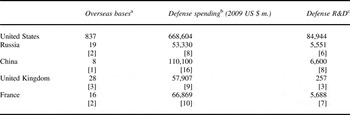
Table 1 displays various components of US military power relative to other large states as of 2009.Footnote 22 The table shows that the United States maintains 837 military bases outside its fifty states, more than 700 of them on foreign territory. The most generous corresponding estimates are twenty-eight for the United Kingdom and eight for China. The United States now has almost 150,000 troops stationed abroad in almost 150 countries.Footnote 23 No other major nation has more than 30,000 troops stationed outside its home territory. Britain and France command the largest number of them. China and Russia, in contrast, “typically deploy forces totaling only in the thousands … worldwide.”Footnote 24
Elements of military power, 2009

Sources: aKlien Reference Klien2009; MacDonald, Donahue, and Danyluk Reference MacDonald, Donahue and Danyluk2004; Rogers and Simon Reference Rogers and Simon2009. bStockholm International Peace Research Institute Military Expenditures Data. cOECD Science, Technology, and R&D Statistics 2017; IISS 2010. Numbers in square brackets represent percent of US.
The same pattern prevails in aggregate defense spending. US defense expenditures exceed those of China, the next largest spender, by a factor of six. The ratio of US to Russian defense expenditures is almost 13:1. The US research and development budget is also enormous relative to that of Russia and China, signaling the US intent not only to maintain large forces but also to ensure that they are equipped with state-of-the-art weaponry. The United States has made clear that it intends to maintain “technological superiority over any potential adversaries,” and it has the stocks of capital, human and otherwise, necessary to do so.Footnote 25 To this end, it funds a $11.5 billion science and technology program and a $63.5 billion Research, Development, Test, and Evaluation Portfolio.Footnote 26
While Washington has closed some bases, it has prepositioned ships at sea capable of deploying quickly to just about any point on the globe.Footnote 27 The Navy has ten nuclear-powered supercarriers—“ten more than the rest of the world.”Footnote 28 Both Britain and France have shelved their plans to increase their carrier fleets beyond the one that each now has in service, leaving the task of commanding the seas to the US Navy. No other country comes close to having a power-projection capacity that approaches that of the United States.
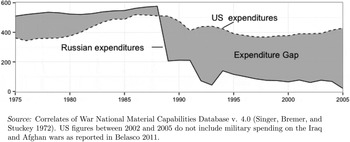
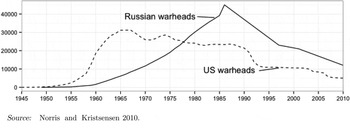
Moreover, US defense spending and that of Russia, its closest competitor, have diverged steadily since the late 1980s. While Cold War spending of the super powers slowly decreased over the entire period between 1945 and 1992, Figure 1 shows that Russian military spending dropped very sharply when the Cold War ended. US military expenditures, again net of the costs associated with the wars in Iraq and Afghanistan, remained remarkably constant. The trend does not change appreciably even after the September 2001 attacks.
US-Russia military expenditures, 1975–2005 (bn. 2009 US$)

Its large edge in aggregate military power does not mean that the United States can call the shots in every area of the world any more than it could within its sphere of influence during the bipolar era. That neither the United States nor the Soviet Union could always control the actions of even their closest allies did not, however, cast doubt on their superpower status.Footnote 29 Britain, France, and Israel, for example, all intervened militarily in an effort to undo Nasser's 1956 nationalization of the Suez Canal. A US threat to impose economic sanctions forced all three to withdraw. The Cold War also witnessed the development of nuclear arsenals by both Britain and France despite the fact that the United States had made its disapproval clear ex ante. In 1966, France withdrew from the integrated military command of NATO, expressing its opposition to what it perceived as US dominance of the alliance. Germany, under the Brandt government, adopted a policy of Ostpolitik that the United States regarded as at best somewhat premature.
None of their actions, however, represented a challenge to the overall world order. Neither the British nor French nuclear stocks enabled either country to come even close to the aggregate power that the superpowers wielded. Nor did either London or Paris have an interest in a fundamental shift in the post-war order, given their large stakes in the system that Washington had set up and steadfastly maintained after World War II. The multitude of international institutions that were integral elements of the US order, including but not limited to the General Agreement of Treaties and Trade (GATT), the WTO, and the International Monetary Fund (IMF), have paid out large dividends to its members that seemed unlikely to continue without US dominance of the Western world.
Analogously, US power does not now pre-empt all claims against the contemporary status quo. China's pursuit of its offshore interests is perhaps the most salient example. The Department of Defense considers the “preparation for a potential Taiwan conflict” as the “primary driver” of China's buildup of its maritime capabilities.Footnote 30 It, of course, recognizes that China also seeks control over disputed resources in the East and South China Seas. Beijing has been steadily accumulating the capacity to acquire anti-access and area denial (A2/AD) capabilities, including an anti-ship ballistic missile capacity (i.e., the DF-21D) and the development of fifth-generation fighter aircraft.Footnote 31 It has also engaged in a series of provocations off its shores, including its declaration of an air defense identification zone (ADIZ) in the East China Sea that overlaps with the existing zones of other countries, its dispatch of offshore patrols intended to defend its claims to fishing rights, its reclamation of land in the area, and a short-lived attempt to set up its first deep-water drilling rig in an area Vietnam also claims.
Its actions have elicited robust diplomatic and military responses. “Rebalancing” toward the Pacific, the United States has tightened ties with several countries in the region (e.g., Japan, the Philippines, Singapore, and Vietnam). Washington has also expanded and upgraded its military capacity in the area, deploying state-of-the-art ships, submarines, and aircraft to the region. It has also dispatched forces on freedom-of-navigation missions intended to demonstrate its resolve to maintain its access to disputed waters off China's shores. To pre-empt the escalation of any inadvertent military clash, the United States and China signed a memorandum of understanding (MOU) in 2014 to create “a common understanding of operational procedures for when air and maritime vessels meet at sea.”Footnote 32 Beijing's offshore claims are not a reliable indicator of its foreign policy as a whole, however. As Johnston argues, a state can “be newly assertive on some limited range of issues while leaving other major policies unchanged.”Footnote 33
That said, Beijing has also built up its nuclear capacity. Available estimates indicate that China until very recently possessed only about twenty liquid-fueled missiles in fixed positions. In a crisis, these weapons “would need to be fueled and mated with warheads … a process that could take several hours, if not longer, and might make the systems vulnerable to a US preemptive attack.”Footnote 34 China now has between fifty and seventy-five land-based intercontinental ballistic missiles (ICBMs) capable of striking the continental United States and three JIN-class nuclear-powered ballistic missile submarines that will “eventually” carry JL-2 submarine-launched ballistic missiles with an estimated range of 7,400 kilometers.Footnote 35 The Department of Defense regards China's nuclear buildup as an effort to secure a second-strike capacity–that is, “a nuclear force able to survive an attack and respond with sufficient strength to inflict unacceptable damage on an enemy.”Footnote 36
Other aspects of China's overall military spending have also attracted attention. As Beckley argues, China is “rising but it is not catching up.”Footnote 37 Beijing has one aircraft carrier, a retrofitted Cold-War-era Kuznetsov class bought from Ukraine, but it does not yet have have any fixed-wing aircraft capable of taking off from its deck.Footnote 38 Neither of the two carriers it has under construction “is a nuclear supercarrier capable of contesting the ‘blue water,’ or deep open oceans, where the United States Navy dominates.”Footnote 39 Indeed, a significant part of its most advanced weapons technology and platforms are sourced overseas.Footnote 40
Stepping back to view the larger strategic picture, we see two factors that mitigate against any effort by China to effect a fundamental transformation of the contemporary world order. Its “core developmental and economic interests” have led China to acquire enormous stakes in the existing system.Footnote 41 It became the world's largest trading nation in 2013, accounting for 11 percent of global imports and exports.Footnote 42 It is now the second largest trading partner of the United States and the largest trading partner of the European Union. Both Japan and Taiwan, despite the fact that they are targets of China's ire in other respects, rank among its ten largest trading partners. As of 2015, China became the world's largest recipient of foreign-direct-investment inflows.Footnote 43 Its international economic engagement is critical to its effort to maintain domestic political stability, making it highly vulnerable to a disruption of its existing economic ties. Indeed, Christensen regards the danger of exile from global markets as “the real security challenge that keeps … China's leaders up at night.”Footnote 44 It is not surprising that Beijing has become an active participant in a large number of multilateral economic institutions, including the WTO, the World Bank, and the International Monetary Fund. Although Lawrence describes its role in the WTO as that “of a status quo power rather than as one seeking major systemic change”Footnote 45 China has sometimes contested the rules that govern the organizations it joins, and it has established potentially rival institutions such as the Asian Infrastructure Investment Bank. At the same time, its public-goods contributions have continued to rise, making it “the largest contributor of peacekeeping troops and police forces of all permanent UNSC members.” It now also cooperates with Western efforts to police the Gulf of Aden and the Mekong River.Footnote 46
Second, building up even its aggregate military resources is unlikely to endow China with the ability to challenge the existing order as a whole. As Brooks and Wohlforth observe, “unlike past rising powers, China is at a much lower technological level than the leading state making its ability to distill raw economic resources into top-end military capabilities … much more constrained.”Footnote 47 Moreover, they note, “the nature of technology itself has changed to make it even harder for new entrants to match the military capabilities of the leading state.” They conclude that “true counter-hegemonic balancing— … either matching or negating the United States’ superpower capabilities—will long remain effectively out of reach for China.”Footnote 48
Whether China will make an effort to do so, of course, also depends on the likely response of the United States. The game-theoretic analysis we turn to next makes clear that the ex ante military capacity of the United States, originally a legacy of the bipolar era, enables it to keep the optimal arms allocation of any would-be competitor below its own. As the China case suggests, this does not necessarily imply that no other state has an incentive to acquire additional arms. It does, however, imply that any prospective challenger's overall arsenal will not reach the level that would empower it to challenge the unipole's control of the existing order.
Strategic Military Capacity
Like Wohlforth, Brooks and Wohlforth, and Posen, we interpret the stock of US military forces as the product of an aggregate welfare-maximizing strategy.Footnote 49 That it is the national interest that drives the size and composition of the US arsenal is consistent with evidence from the Cold War. After 1945, US forces closely tracked the Soviet arms buildup to maintain the balance of power, as we discuss in more detail. The buildup of US forces after the Cold War is consistent with a strategy of strategic preemption and with a complementary or perhaps an alternative interpretation that attributes it to the political power of defense contractors and subcontractors—what Eisenhower long ago described as the military-industrial complex.Footnote 50
The contemporary literature, however, expresses considerable skepticism about the direction of the causal arrow linking special interests and policy decisions. It suggests that interest-group contributions are endogenous to the preferences of policy-makers—that is, groups target officials who already share their interests. More recently, panel-data analyses that include district and legislator fixed effects show that estimates of the impact of a widely varied set of PAC contributions do not differ significantly from zero.Footnote 51 Isolating the impact of the defense industry is particularly difficult because the Pentagon has incentives of its own to distribute its spending widely across congressional districts. Analyzing the relative explanatory power of the defense industry is, in any case, beyond the scope of this paper.
Here, we limit our ambitions to analyzing a game-theoretic model that explains the US decision to keep intact its Cold-War trade-off between the production of guns and butter even after the Soviet collapse. Our explanation does not invoke institutions, hegemonic benevolence, public goods, or collective-action problems. Because no informational asymmetries exist, it also does not invoke reputation.Footnote 52 For the same reason, it does not rely on the logic of the chain-store paradox—the willingness of an incumbent to fight entry in order to send a costly signal of its type. It is important to note, however, that adding incomplete information to the model—for example, about the other side's marginal cost of arming—would not change the strategic incentives we describe.
International Competition in Arms: Baseline Model
To develop our theory of unipolar stability, we begin by modeling international relations as a contest between two countries, a unipole, U, and a challenger, CH. In the contest, the unipole and the challenger simultaneously choose to allocate resources to the production of a military arsenal, a U , a CH . The share each country receives of global resources, Π, is a function of its arsenal and the arsenals of other countries.
A technology of war transforms military arsenals into military capabilities. We assume the technology of war is a contest function giving a share
 $$\Pi _U (a_U, a_{CH} ) = \displaystyle{{a_U + 1} \over {a_U + a_{CH} + 2}}$$
to the unipole and 1 − Π U (a U , a CH ) to the challenger.
The contest function is increasing in a country's military arsenal, decreasing in its opponent's arsenal, and the marginal returns to military arsenals are decreasing. Because the contest function is symmetric, the share of the global resource that each country consumes is determined by its share of total military resources. We assume that countries are risk neutral.Footnote 53 Without any allocation by either actor, available resources are split evenly. As a result, any asymmetry that arises in our model is a product of each actor's choices.
Acquiring the military arsenal necessary to secure a larger piece of the global pie requires a country to incur two types of inputs. It has to expend resources to acquire the human and physical capital, k i , that sending troops into battle today or in the future requires, such as training forces and procuring military hardware. We call these capital inputs. When a country actually deploys forces, it incurs additional labor, l i , and materials costs—for example, expenditures on combat pay, fuel, munitions, and transport. We assume that a unit of input of each type has constant marginal cost, making the cost of producing military capacity linear. We label the unit cost of capital as r and the cost of labor and munitions as m.
The arsenal is the result of the choice of these inputs. We assume that a Leontief production function applies—that is, one in which a fixed ratio exists between inputs irrespective of the level of output. The function is expressed as
 $$a_i = \min \{ \theta l_i, \omega k_i \}. $$
The choice variables for each state are l i and k i and the constants θ and ω satisfy the fixed-proportion property. For example, if a unit of military capability was equivalent to a usable tank—that is, the tank itself, a driver, and a gunner, then the coefficient on capital would be ω = 1 and on labor would be θ = 1/2. Thus, if there is no tank, then a i = 0 or if there is one tank but no driver, a i is 1/2.
When the international contest is played, countries also may have an existing stock of military capital. We allow for the existence of a capital stock
 $\bar k_i $
with a cost function
 $\phi _i (l_i, k_i ;\bar k_i )$
for our players
 $$\phi _i (l_i, k_i ;\bar k_i ) = r\max \{ k_i - \bar k_i, 0\} + ml_i $$
To clarify the implications of our assumption about costs, consider an example in which the unipole wants to deploy a mechanized infantry company abroad. These companies typically consist of three platoons and fourteen infantry fighting vehicles (IFVs). If the fourteen IFVs were already part of its existing capital stock, the unipole would not need to incur the costs of procuring them (i.e., r). As a result, the only costs associated with deploying the company are expenditures on labor, munitions, and fuel (m). But if the unipole wanted to deploy another company and it had no spare IFVs, then deployment would require it to purchase both the vehicle and the labor, munitions, and fuel.
Thus, the utility of a unipole and challenger for a set of allocations is
 $$u_U (a_U, a_{CH} ) = \Pi _U (a_U, a_{CH} ) - \phi _i (l_U, k_U ;\bar k_U )$$
 $$u_{CH} (a_U, a_{CH} ) = 1 - \Pi _U (a_U, a_{CH} ) - \phi _i (l_{CH}, k_{CH} ;\bar k_{CH} )$$
In a situation in which the countries are symmetric and neither has any pre-existing capital, it is easy to describe the optimal choices of the players. So for
 $\bar k_U = \bar k_{CH} = 0$
, both countries allocate positive resources to the international competition and their choices—their best responses—will be
 $$k_U^{^\ast} (k_{CH} ) = \displaystyle{1 \over \omega} ( - 2 - \omega k_{CH} + \displaystyle{{\sqrt {\theta \omega}} \over {\sqrt {r\theta + m\omega}}} \sqrt {(1 + \omega k_{CH} )} )$$
 $$k_{CH}^{^\ast} (k_U ) = \displaystyle{1 \over \omega} ( - 2 - \omega k_U + \displaystyle{{\sqrt {\theta \omega}} \over {\sqrt {r\theta + m\omega}}} \sqrt {(1 + \omega k_U )} )$$
 $$l_U^{^\ast} = \displaystyle{\omega \over \theta} k_U^{^\ast} $$
 $$l_{CH}^{^\ast} = \displaystyle{\omega \over \theta} k_{CH}^{^\ast} $$
In equilibrium, each country chooses an allocation of resources that sets its marginal benefit of expanding military capability equal to its marginal cost of doing so, given its opponent's allocation. As a result, if the marginal cost of capital or deployment increases, allocations of resources to military capabilities decrease. When the countries simultaneously best respond we have a Nash equilibrium.
Proposition 1
Suppose that
 $\bar k_U = \bar k_{CH} = 0$
. Let
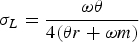 $\sigma _L = \displaystyle{{\omega \theta} \over {4(\theta r + \omega m)}}$
. Then in any Nash equilibrium both arsenals are positive,
 $$a_U^{s{^\ast}} = \sigma _L - 1,$$
 $$a_{CH}^{s{^\ast}} = \sigma _L - 1,$$
if and only if 0 < m < r < ω/4 and θ > (4mω)/(ω − 4r). In this equilibrium the share of the resource for each country is 1/2.
Proof
All proofs are in the appendix.
 ${\rm \squf} $
To make comparisons across models as clear as possible in what follows, we assume that 0 < m < r < ω/4 and θ > (4mω)/(ω − 4r), implying that the allocation for each player is positive for some values of its opponent's choices.
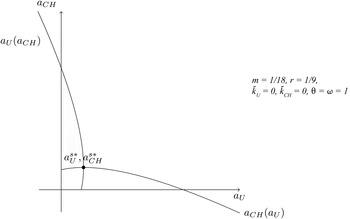
Figure 2 illustrates an example of the equilibrium of this game when r = 1/9 and m = 1/18 and the production of military capabilities takes equal shares of capital and labor. The two functions trace out the optimal arsenals of each actor, where
 $a_U^* (a_{CH} )$
is the unipole's optimal arsenal for each choice by the challenger and
 $a_{CH}^* (a_U )$
is the challenger's optimal arsenal for each choice by the unipole. The figure shows that when the opponent's level of arms is low, a country's optimal response is increasing in its opponent's arsenal. However, when the arsenal of the opponent is sufficiently high, increases in its military spending discourage its rival's spending. As a result, the optimal arsenal is nonmonotonic in the rival's choice.
Countries’ optimal arsenals in the symmetric game

The point where these functions cross is the equilibrium of the contest in which the players are symmetric and neither has a pre-existing capital stock. If we substitute r and m into our solution we get (½, ½)—that is, an even split of available global resources. This is analogous to the bipolar world in which at the end of the war neither superpower had a pre-existing capital stock advantage that empowered it to exert as significant an impact on the spending of the other.
International Competition with Pre-existing Capital Stocks
Now, we analyze the same strategic interaction, but this time the unipole has an existing capital stock equal to
 $\bar k_U \gt 0$
at the beginning of the contest. The actions of the unipole in the contest now depend on the level of its pre-existing military capital stock. First, consider the arsenal the unipole would build in equilibrium if it had no capital stock. That is an amount
 $a_U^{s*} $
, resulting from the equilibrium to the symmetric game. If its pre-existing capital stock is small, specifically less than is necessary to generate an arsenal equal to
 $a_U^{s*} $
, then its stock has no effect on the optimal choice of military size. This is because, even though the pre-existing capital stock gives the unipole a “discount” on the first few units of capital being acquired, the optimal size of the military is still determined by setting the marginal cost equal to the marginal benefit of the next unit when paying for both capital and labor. As a result, when the military capital stock,
 $\omega \bar k_U $
, is less than
 $a_U^{s*} $
, the unipole builds an arsenal of size
 $a_U^{s*} $
in the game.
If, however,
 $\omega \bar k_U $
is greater than this symmetric equilibrium allocation,
 $a_U^{s*} $
, but less than what the unipole would choose if the capital component were free, then the contest allocation of the unipole is exactly
 $\omega \bar k_U $
. This is because below
 $\omega \bar k_U $
the unipole's marginal benefit of acquiring more arms is greater than the marginal cost of doing so because of its existing stock of military capital. For example, think of this as a case in which the unipole has a number of infantry fighting vehicles left over from a previous war and all it needs is to equip a new unit is to train new solders at a cost m. Thus, at least up to
 $\omega \bar k_U $
, the marginal cost is smaller than without the capital stock, and because
 $\omega \bar k_U $
is below the allocation the unipole would choose were the capital component free, the marginal calculation is positive and it is worthwhile expanding up to at least
 $\omega \bar k_U $
.
Above
 $\omega \bar k_U $
, the unipole pays both the capital cost r and the mobilization cost m. Here it must both purchase vehicles and train men. Because the unipole is at an allocation
 $a_U \gt a_U^{s*} $
, we know that the marginal cost of doing so exceeds the marginal benefit. As a result, its optimal choice must be to build
 $a_U^* = \omega \bar k_U $
. Finally, if
 $\omega \bar k_U $
were larger than the amount the unipole would allocate in an equilibrium where military capital was free, and it only need pay a cost m, then how much more pre-existing capital the unipole has is irrelevant. The unipole just operates, for all practical purposes, as if there were no capital costs. This means that capital components like tanks or advanced weapons systems may go unused. These outcomes are formally summarized by conditions on the costs of capital and mobilization in our model and are described formally in the following proposition.
Proposition 2
Suppose the positive arsenal condition of Proposition 1 is satisfied and that
 $\bar k_U \gt 0$
but
 $\bar k_{CH} = 0$
. Let
 $\sigma _H = \displaystyle{{\omega \theta (\theta r + \omega m)} \over {(\theta r + 2\omega m)^2}} $
. Then the unipole's equilibrium arsenal is
 $$a_U^{^\ast} (a_{CH}, \bar k_U ) = \left( {\matrix{ {\sigma _L - 1} & {if\bar k_U \le \displaystyle{1 \over \omega} (\sigma _L - 1)} \cr {\omega \bar k_U} & {if\displaystyle{1 \over \omega} (\sigma _L - 1) \lt k_U \lt \displaystyle{1 \over \omega} (\sigma _H - 1)} \cr {\sigma _H - 1} & {if\omega \bar k_U \gt \displaystyle{1 \over \omega} (\sigma _H - 1).} \cr}} \right.$$
The logic of optimal allocations implies that the unipole's military arsenal in the contest increases with its pre-existing capital stock. Now we can show clearly why pre-existing capacity can endow the unipole with the ability to decrease the military allocation of its challenger. As
 $\omega \bar k_U $
increases past the equilibrium arsenal of a country without any capital stock, the unipole's spending on arms increases. This decreases the challenger's marginal return to spending because beyond the symmetric allocation military spending starts to exhibit decreasing marginal returns. In our model, this is the manifestation of the fact that building military capabilities can have economies of scale up to a point. Beyond this point the next battleship or armored battalion makes less of a marginal contribution to military success than the last. This fact creates an optimal procurement curve that declines from the challenger's peak arsenal as the incumbent's spending rises. In fact, the higher the unipole's pre-existing advantage, the more diminishing marginal returns affect a challenger's behavior.
It is also easy to show that the challenger's arsenal, when it pays all capital and manpower costs, is maximized at
 $a_{CH}^{s*} = \sigma _L - 1$
.Footnote
54
So when the unipole has pre-existing capital, the equilibrium allocations and resource shares also depend on this stock.
Proposition 3
With pre-existing capital stock the Nash-equilibrium arsenals in the contest are
 $$\matrix{ {\left( {\sigma _L - 1,\sigma _L - 1} \right)} \hfill & {if\ \bar k_U \le \displaystyle{1 \over \omega} (\sigma _L - 1)} \hfill \cr {\left( {\omega \bar k_U, \displaystyle{{\sqrt {\theta \omega (\theta r + \omega m)(1 + \bar k_U \omega ^2 )}} \over {(\theta r + \omega m)}} - 2\bar k_U \omega ^2} \right)} \hfill & {if\ \displaystyle{1 \over \omega} (\sigma _L - 1) \lt \bar k_U \le \displaystyle{1 \over \omega} (\sigma _H - 1)} \hfill \cr {\left( {\sigma _H - 1,\displaystyle{{\theta \omega m} \over {(\theta r + 2\omega m)^2}} - 1} \right)} \hfill & {if\ \displaystyle{1 \over \omega} (\sigma _H - 1) \lt \bar k_U.} \hfill \cr} $$
This proposition has an immediate corollary
Corollary 1
The unipole's share is weakly increasing in k U .
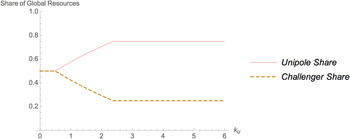
Figure 3 shows the consequences of an existing capital stock. As the unipole's capital stock increases, it initially has no effect on resource shares. Once
 $\bar k_U $
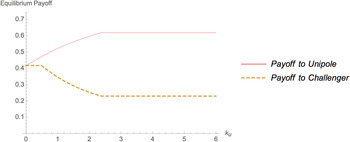
passes the amount of capital that the unipole would purchase in the equilibrium of the symmetric game, however, the unipole's arsenal and its global resource share go up while both the arsenal and share of global resources that accrue to the challenger decrease. As Figure 3 shows, the unipole gets up to three quarters of the resources, leaving one quarter for the challenger—that is, the outcome of the game effectively transfers to the unipole 50 percent of the share of the resources that the challenger obtains in the symmetric game.
Payoffs of the unipole and the challenger as a function of
 $\bar k_U $
, r = 1/9, m = 1/18, θ = ω = 1

From Proposition 3 we can also see that only when the unipole has a capital advantage does the distribution of benefits depend on the costs of military capacity or the state of the military technology—being capital or labor intensive—because the arsenals for small capital stocks are equal.
What are the payoffs to the two sides when a pre-existing capital stock
 $\bar k_U $
exists? Figure 4 shows the results when r = 1/9, m = 1/18, and θ = ω = 1, which are typical results for all values of r and m when they are sufficiently small that both countries procure arms in the symmetric game with no pre-existing military capital.
Payoffs of the unipole and the challenger as a function of
 $\bar k_U $
, r = 1/9; m = 1/18, and θ = ω = 1

Figure 4 shows that at first an existing capital stock represents only a cost-saving benefit for the unipole. This is the case where shares of resource remain unchanged. The unipole's utility goes up by
 $r\bar k_U $
because it need not pay the cost of arms for its first
 $\bar k_U $
units. Also the challenger's utility here is flat because the unipole's cost saving does not affect its marginal calculations and, therefore, does not influence the contest allocations. Once the capital stock begins to influence the unipole's action, however, the story changes. The unipole's utility continues to increase, but at a faster rate, while the challenger's begins to decrease. This is because
 $\bar k_U $
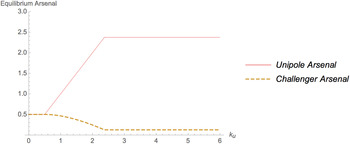
has two effects. First, it increases the unipole's military spending in the contest. Second, as seen in Figure 5, it also decreases the challenger's optimal spending level.
Arsenals of the unipole and the challenger as a function of
 $\bar k_U $
, r = 1/9, m = 1/18, and θ = ω = 1

The diverging payoffs continue until the pre-existing capital stock parameter is so large that the unipole is constrained by what would be its optimal action if it never had to pay for tanks or battleships.
Why might the unipole have a pre-existing stock? The end of the Cold War is consistent with an extension of this model in which the unipole had previously been engaged in a contest with a country with a different cost structure that resulted in equilibrium spending with higher allocations. Then, suppose for some reason that the rival collapses and the unipole's previous capital purchases remain intact. In a new world with a different kind of potential competition, we would face a situation like the one we model here.
As one can see in Figure 5 and Proposition 3, the pre-existing capital stock of the unipole can only lower the challenger's allocation to a certain degree because of a credibility constraint. That is, when the capital stock essentially makes the unipole's cost structure one in which no capital cost r exists, the unipole can only choose to allocate resources up to its best response when paying for only labor. In such an instance, the challenger may still allocate positive amounts to the military contest, but less than the unipole.
An inspection of the best response for the challenger also shows that for a fixed pre-existing allocation
 $\bar k_U $
, increasing the cost of production, either through r or m, leads to a smaller allocation of resources in the contest and a smaller share of the pie for the challenger. When no pre-existing capital stock exists, this is not the case as r and m affect the allocations of both players and, though allocations may change, the changes result in the same distribution of the resources between them.
International Competition in Arms When Each Chooses a Capital Stock Before Competition Begins
Finally, we consider a situation in which there is no pre-existing capital. The capital stock of each country is a product of the choice each makes before the resource competition between them begins.
To model this situation, suppose that before the unipole and the challenger play the contest, they simultaneously choose to invest in capital. Thus, we now have a two-stage game. In the first stage, each country makes an investment in capital; in the second stage, the contest between them begins. We start by considering a game where the unipole is one in name only—in other words, it has no initial advantage—and we ask if there exists an equilibrium where both countries invest in capital in the first period. Our first result is that no such equilibrium exists.
Proposition 4
Suppose the condition of Proposition 1 is satisfied. There is no subgame perfect equilibrium where both countries invest in military capital in the first period at an amount greater than θ/4(θr + ωm) − 1/ω.
In the two-period game with investment in which one player has a known capital stock, the other will not invest in period one to influence the military allocation of its rival. In the symmetric situation, if there is an equilibrium in which the unipole invests to influence the actions of its challenger, then there is also an equilibrium where the challenger can invest and influence the actions of the unipole. So why is the United States is the unipole in the contemporary era?
We know from Proposition 4 that if the unipole's existing capital stock at the beginning of period one is sufficient to affect its allocation in the contest, then for every
 $\bar k_U $
, the challenger's best response is to invest zero and then to best respond to
 $\omega \bar k_U $
in the second period. We are then left to find the optimal level of investment for the unipole. To do this consider the same two-period game, but now where the unipole has a stock
 $\bar k_U $
such that
 $\omega \bar k_U \gt a_U^{s*} $
.
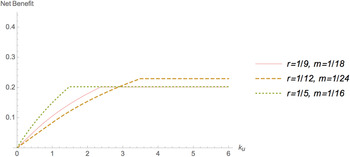
Two questions arise. First, given an existing capital stock that influences play, would the unipole wish to expand its investment? Proposition 5 (in the appendix), shows that the marginal benefit of expanding the capital stock in period one to affect the contest is less than the marginal cost of doing so. Thus, the unipole has no incentive to invest in additional stock in the first period. That being said, there is a payoff benefit to having the existing capital stock if it is sufficiently large. Proposition 6 gives the range of existing stocks that the unipole would be interested in maintaining. For each stock, we can solve for the price that the unipole would be willing to pay to keep it.
Figure 6 has three functions for three different values of r and m, with ω = 1, illustrating the benefit gap between the symmetric game and the game in which one state has a pre-existing capital stock. The benefit is positive in every case. The line traces out the maximum price that the unipole would be willing to pay to maintain its pre-existing capital stock. Our analysis allows us to infer two things. First, if at the outset we have two symmetric states without capital stocks, there would not be a unilateral investment to create a deterrence force and a unipolar environment. That is, unipolarity arises only after a major-power collapse.Footnote 55 Second, if a single country begins with an existing advantage as a result of some accident of history, it would be in that country's interest to pay a substantial amount to maintain its capital advantage. In fact, we know that the maximum possible payoff in the game between symmetric countries is 1/2. From Figure 6, we can see that the benefit of the capital stock can be as high as 50 percent of that payoff. In other words, maintaining a capital advantage rather than allowing it to lapse can result in redistributing half of the resources a challenger would expect to consume in a “bipolar” system.
Net benefit of starting the game with capital stock
 $\bar k_U $

Strategic Investment in the Contemporary System?
The validity of our argument depends on whether we can show that the United States has strategically maintained a military capital stock. The absence of a strong challenge or spending on a similar scale by a potential rival is not conclusive by itself: as Achen and Snidal pointed out long ago, reliable evidence of strategic manipulation can be hard to find.Footnote 56 As we noted earlier, some observers believe that the existing order may be a consequence of the fact that prospective challengers benefit from the existing status quo. Alternatively, it might be the case that conventional-force accumulation is unnecessary in a nuclear age. However, the mutual assured destruction (MAD) that prevailed during the Cold War did not preclude the buildup of conventional military stocks by the superpowers or their major allies. Apart from the role of nuclear arms as the ultima ratio in international politics, their utility across a range of conflicts is limited. This implies that, as Tellis and colleagues put it, the “ability to conduct different and sophisticated forms of conventional warfare will … remain the critical index of national power because of its undiminished utility, flexibility, responsiveness and credibility.”Footnote 57 Force accumulation might also be attributed to the extended-deterrent role the United States plays. Again, however, it is hard to argue that this task has become more rather than less costly in the wake of the disappearance of the most consequential and widespread threat to US interests.
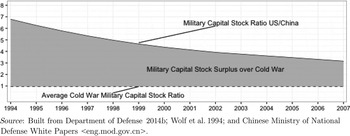
To address the question of whether the contemporary US military stock exists because of its power to deter, we first ask whether its evolution over time is consistent with our theory. The pattern of great-power military capital accumulation during and after the Cold War is telling. Using data from RAND and from the Chinese Defense Ministry White Paper, we calculate US, Soviet, and Chinese military capital stocks. We obtained outlays for procurement from the Defense Department's Green Book and various reports to the president and Congress by the secretary of defense. Starting with the 1994 RAND estimate,Footnote 58 we depreciate the capital stock by the average rate of capital depreciation for military goods found in FraumeniFootnote 59 and add that year's procurement. When annual data on equipment procurement is not available for the PRC, we use the average equipment share—about one-third of the total defense budget—to estimate it. The data show that during the Cold War, the US-Soviet military-stock ratio averaged 0.954. Between 1945 and 1991 US and Soviet military capital stocks tracked each other closely: over the entire Cold War era, the ratio ranges between 0.78 and 1.15.
A very different pattern emerges in the wake of the Soviet collapse. Because China seems widely regarded to be the state most likely to challenge the existing system, we plot the average ratio of US to Chinese military capital stocks between 1994 and 2007 in Figure 7.Footnote 60 The difference between the bipolar and unipolar eras is striking: the post-Cold War ratio has varied between three and seven, averaging 4.5. The difference between these values is consistent with the shift our model predicts to a world in which the incumbent unipole maintains excess military capacity in order to deter a challenge to its dominance.
Military capital stock ratios for the Cold War and post-Cold War period

Why is this evidence of strategic behavior? Suppose that the United States had not had an existing military capacity when the Cold War ended. Then, the evolution of its stock would have conformed to the natural life cycle of weapons systems—that is, it would have depreciated at the rate estimated to apply to military stocks generally. Had it done so, the ratio of US to Chinese capital stocks in 2007 would have been 1.23, on par with the Cold-War ratio between US and Soviet stocks. In reality, however, a much larger disparity of about 3.15 exists in 2007, net of the costs of the wars in Afghanistan and Iraq.
The argument we advance here also implies that the emergence of a unipolar system will shift the composition of capacity. Reducing its marginal cost of fighting requires the unipole to adapt its capacity to conform closely to the type of challenge it is likely to encounter and the weapons it is likely to involve. During the Cold War, the distribution of US military capital skewed toward the accumulation of nuclear forces, the most powerful deterrent to a Soviet challenge in Western Europe. Any contemporary challenger is much less likely to wield a credible nuclear threat during a crisis than was the USSR. Similarly, we would expect the number of US forces and ships stationed abroad to decline sharply, particularly in areas central to the East-West conflict.
Figure 8 is consistent with this implication of our deterrence model. It displays the number of US and Soviet nuclear warheads during and after the Cold War. While the United States maintains a distinct lead until the late 1970s with some bumps thereafter, the fall-off accelerates with the inception of the unipolar system and the shift in the types of conflict that were likely to accompany it. Although some of the decline in warheads was endogenous to various arms-control agreements, the agreements appear in retrospect as endogenous to the impending collapse of the bipolar system. An even sharper decline occurs in the number of US nuclear weapons deployed to Western Europe after the Cold War: they fell from more than 7,000 in the 1970s to approximately 500 in 2005.Footnote 61
Number of nuclear warheads for the US and Russia

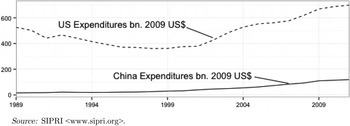
Another important question is how to explain the recent rise in Chinese military expenditures in light of our model. Much has been made of the growth in Beijing's recent defense budgets. Indeed, it has moved China into second place in annual national military expenditures. Nonetheless, Figure 9 shows that a very large gap persists between US and Chinese expenditures: the ratio between them is about six to one.
US and PRC military expenditures: 1989–2011

While obviously not conclusive, the data on post-Cold-War patterns are consistent with the adoption of a strategy by the incumbent unipole intended to accumulate the excess military capacity necessary to secure its dominance.
Conclusion
This paper fills an important lacuna in the existing literature about the durability of unipolarity. We explain why the United States opted to forgo the increase in consumption and investment it could have realized had it shifted resources from the production of guns to the output of butter. Building on the industrial-organization literature about the impact of capital investment on entry,Footnote 62 we show that an equilibrium outcome in which deterrence prevails arises because the unipole's accumulation of military capital enables it to credibly commit to respond to a challenger more fiercely than it would have otherwise. This result differs from Dixit's analysis in which contests between firms produce downward-sloping best-response functions.Footnote 63 It also differs from his 1987 paper in which competition and deterrence depend on the technology of the contest and a player's ability to commit ex ante to a level of effort that makes its strategy credible.
In our explanation, the dominant power's military arsenal can secure the foundations of the unipolar system. Whether it does so is a function of the parameters of a strategic interaction that the incumbent's own action influences. As such, the stability of the contemporary international system does not necessarily depend on whether the dominant power is a benevolent or status-quo power, is in good standing in various institutions, or on its choice to maintain more forces in being than other states. Instead, the critical issue is whether its arms stocks make investment in a strong military unprofitable for potential challengers. Extending Waltz's reasoning to a case in which dynamics matter, we demonstrate that one of his principal conclusions does not necessarily follow: anarchic international systems do not always create incentives for balancing. We believe this to be an important addendum—perhaps more accurately, a corrigendum—to a widely accepted theory about the behavior of states in an anarchic world.
Appendix
Symmetric Nash Equilibrium
Proposition 1
Symmetric Nash Equilibrium with no pre-existing investment.
First we prove a lemma.
Lemma 1
At any optimum
 $$l_i^{^\ast} = \displaystyle{\omega \over \theta} (k_i^{^\ast} + \bar k_i ).$$
Proof
Consider a situation where there is Leontief production of military arsenals and any case where k i > 0 and l i > 0. We claim the optimal choices of l i and k i must be such that
 $$\theta l_i^{^\ast} = \omega (k_i^{^\ast} + \bar k_i )$$
or
 $$l_i^{^\ast} = \displaystyle{\omega \over \theta} (k_i^{^\ast} + \bar k_i ).$$
Suppose not. That is, suppose that the equality does not hold at an optimal choice. Without loss of generality, suppose that
 $\theta l_i^* \gt \omega (k_i^* + \bar k_i )$
. Since production of a military arsenal with a capital stock
 $\bar k_i \ge 0$
is
 $$\min \{ \theta l_i^{^\ast}, \omega (k_i + \bar k_i )\}, $$
we know the payoff to this strategy is
 $$\Pi (\omega (k_i + \bar k_i ),a_j ) - rk_i^{^\ast} - ml_i^{^\ast}. $$
But i can get the same share
 $\Pi (\omega (k_i^* + \bar k_i ),a_j )$
, but lower her cost by cutting
 $l_i^* $
to
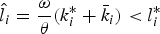 $\hat l_i = \displaystyle{\omega \over \theta} (k_i^* + \bar k_i ) \lt l_i^* $
, a contradiction with this being an optimal allocation.
Now to prove proposition 1.
 ${\rm \squf} $
Proof
From Lemma 1 we know that we have an optimization problem for each player that must satisfy the equality constraint
 $$l_i = \displaystyle{\omega \over \theta} (k_i + \bar k_i ).$$
Substituting in the right-hand side of this equation for l i in the objective function gives us the program
 $$\mathop {\max} \limits_{k_i} \displaystyle{{\omega k_i + 1} \over {\omega k_i + \omega k_j + 2}} - r\max \{ k_i - \bar k_i, 0\} - m\displaystyle{\omega \over \theta} (k_i + \bar k_i ).$$
First-order conditions give
 $$k_U^{^\ast} (k_{CH} ) = \displaystyle{1 \over \omega} (2 - \omega k_{CH} + \displaystyle{{\sqrt {\theta \omega}} \over {\sqrt {r\theta + m\omega}}} \sqrt {(1 + \omega k_{CH} )} )$$
 $$k_{CH}^{^\ast} (k_U ) = \displaystyle{1 \over \omega} (2 - \omega k_U + \displaystyle{{\sqrt {\theta \omega}} \over {\sqrt {r\theta + m\omega}}} \sqrt {(1 + \omega k_U )} )$$
 $$l_U^{^\ast} = \displaystyle{\omega \over \theta} k_U^{^\ast} $$
 $$l_{CH}^{^\ast} = \displaystyle{\omega \over \theta} k_{CH}^{^\ast} $$
The simultaneous solutions to these equations are
 $$k_U^{^\ast} = - \displaystyle{1 \over \omega} + \displaystyle{\theta \over {4(\theta r + \omega m)}}$$
 $$l_U^{^\ast} = - \displaystyle{1 \over \theta} + \displaystyle{\omega \over {4(\theta r + \omega m)}}$$
 $$k_{CH}^{^\ast} = - \displaystyle{1 \over \omega} + \displaystyle{\theta \over {4(\theta r + \omega m)}}$$
 $$l_{CH}^{^\ast} = - \displaystyle{1 \over \theta} + \displaystyle{\omega \over {4(\theta r + \omega m)}}$$
Finally, let
 $\sigma _L = \displaystyle{{\omega \theta} \over {4(\theta r + \omega m)}}$
, by the Leontief production function the arsenals are
 $$a_U^{s{^\ast}} = \sigma _L - 1,$$
 $$a_{CH}^{s{^\ast}} = \sigma _L - 1,$$
if and only if
 $0 \lt m \lt r \lt \displaystyle{\omega \over 4}$
and θ > (4mω)(ω − 4r).
Since the allocations are symmetric, and so is the contest function, the countries’ shares are 1/2, 1/2.
 ${\rm \squf} $
Lemma Characterizing the Maximal Arsenal
Lemma 2
Suppose 0 < m < r < ω/4 and θ > (4mω)(ω − 4r).
 $k_{CH}^{s*} $
is the global maximum of the challenger's best response.
Proof
The second derivative of the challenger's best response with respect to k
U
is negative so the best response has a unique maximum. Maximizing the best response with respect to k
U
, gives
 $k_U = \displaystyle{\theta \over {4(\theta r + \omega m)}} - \displaystyle{1 \over \omega} $
. We know the best response to this is also
 $k_{CH} = \displaystyle{\theta \over {4(\theta r + \omega m)}} - \displaystyle{1 \over \omega} $
, the symmetric equilibrium choice. Therefore the best response k
CH
(k
U
) is maximized at the symmetric equilibrium solution.
 ${\rm \squf} $
Proposition 3
The equilibrium when the unipole has pre-existing capital stock.
Proof
Suppose the unipole has a pre-existing capital stock of
 $\bar k_U \gt 0$
and an objective function
 $$\Pi _i (a_U, a_{CH} ) - \phi _u (a_u, \bar k_U ).$$
To find the best-response hold the strategy of a CH constant and optimize.
This gives us three cases. First when
 $\omega \bar k_U $
is less than the allocation made in the symmetric Nash equilibrium, then the capital stock has no effect on marginal calculations and the best response is the same.
Next suppose
 $\displaystyle{1 \over \omega} (\sigma _L - 1) \lt \bar k_U \le \displaystyle{1 \over \omega} (\sigma _H - 1)$
. Then the derivative of equation (3) is positive up to
 $\omega \bar k_U $
and negative after
 $\omega \bar k_U $
, making building an arsenal using all of
 $\omega \bar k_U $
optimal.
Last, suppose
 $\displaystyle{1 \over \omega} (\sigma _H - 1) \lt \bar k_U $
. Then the first order condition of the expected utility is zero at
 $k_U = \displaystyle{1 \over \omega} (\sigma _H - 1)$
and the optimal arsenal is σ
H
− 1.
With the unipole's best response defined as such, we can then solve simultaneously for the unipole and challenger's equilibrium actions and get
 $$\matrix{ {\left( {\sigma _L - 1,\sigma _L - 1} \right)} \hfill & {if\ \bar k_U \le \displaystyle{1 \over \omega} (\sigma _L - 1)} \hfill \cr {\left( {\omega \bar k_U, \displaystyle{{\sqrt {\theta \omega (\theta r + \omega m)(1 + \bar k_U \omega ^2 )}} \over {(\theta r + \omega m)}} - 2\bar k_U \omega ^2} \right)} \hfill & {if\ \displaystyle{1 \over \omega} (\sigma _L - 1) \lt \bar k_U \le \displaystyle{1 \over \omega} (\sigma _H - 1)} \hfill \cr {\left( {\sigma _H - 1,\displaystyle{{\theta \omega m} \over {(\theta r + 2\omega m)^2}} - 1} \right)} \hfill & {if\ \displaystyle{1 \over \omega} (\sigma _H - 1) \lt \bar k_U.} \hfill \cr} $$
 ${\rm \squf} $
Corollary 1. The unipole's share is weakly increasing in
 $\bar k_U $
.

Proposition 4
There is no subgame perfect equilibrium where both countries invest in military capital in the first period at an amount greater than θ/4(θr + ωm) − 1/ω.
Proof
Suppose 0 < m < r < ω/4, θ > (4mω)(ω − 4r), and there is an equilibrium where both players choose a
 $\bar k_i \gt \theta /4(\theta r + \omega m) - 1/\omega $
. Let
 $a_i^{*L} (\bar k_{ - i} )$
be the optimal arsenal of country i when −i makes a capital choice of
 $\bar k_{ - i} $
and the capital cost is r = 0. Then i’s equilibrium arsenal is the
 $\min \{\bar k_i, a_i^{*L} (\bar k_{ - i} )\} $
. To start, note that if
 $a_i^{*L} (\bar k_{ - i} ) = \min \{ \bar k_i, a_i^{*L} (\bar k_{ - i} )\} $
, then some capital is not being used and i can improve their payoff without affecting their share by investing less in the first period. We can then conclude that, from the investment stage, if
 $\bar k_i \gt \theta /4(\theta r + \omega m) - 1/\omega $
for both, then the arsenals are
 $(\omega \bar k_1, \omega \bar k_2 )$
, which determine payoffs.
Now suppose the two countries choose first-period investments
 $\bar k_i \gt \theta /4(\theta r + \omega m) - 1/\omega $
and the outcome of the contest is determined by the second-period optimal arsenals of
 $(\omega \bar k_1, \omega \bar k_2 )$
. From the perspective of the investment period, the payoff to this strategy is the same as the game with one period and
 $\bar k_i = 0$
. Since the second-period action of player –i does not change as a function of i’s actions, the optimization problem is to choose the best response. But as we know from the solution to the equations in Proposition 1, the unique solution to the simultaneous equations is θ/4(θr + ωm) − 1/ω and at least one player must have a profitable deviation, a contradiction.
 ${\rm \squf} $
Proposition 5
Suppose 0 < m < r < ω/4 and θ > (4mω)(ω − 4r). Then no country has an incentive to unilaterally invest in the first period of the two-period game more than
 $\displaystyle{1 \over \omega} (\sigma _L - 1)$
.
Proof
Suppose 0 < m < r < ω/4 and θ > (4mω)(ω − 4r). From the perspective of the first period, country i is choosing an investment in capital to maximize their utility of the game under the constraint that the opponent will play a best response and production is Leontief. This gives a first-order condition along the best response of
 $$\displaystyle{{\partial \Pi _i} \over {\partial \omega \bar k_i}} (\omega \bar k_i, a_{ - i} (\omega \bar k_i )) + \displaystyle{{\partial \Pi _i} \over {\partial a_{ - i}}} (\omega k,a_{ - i}^{^\ast} (\omega \bar k_i ))\displaystyle{{da_{ - i}^{^\ast}} \over {d\omega \bar k_i}} (\omega \bar k_i ) - (r + m) = 0$$
because by proposition 4 there are no equilibria where both sides invest.
By Lemma 2 we know
 $$\displaystyle{{da_i^{^\ast} (\omega k)} \over {d\omega \bar k_i}} = 0$$
at
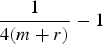 $\displaystyle{1 \over {4(m + r)}} - 1$
and so does the first-order condition in the contest
 $$\displaystyle{{\partial \Pi _i} \over {\partial \bar k_i}} (\bar k_i, a_{ - i} (\bar k_i )) - (r + m) = 0.$$
So the investment strategy that satisfies the first-order condition when only one country invests in the first period leads to the same choice in the contest as if there were no investment period at all.
Proposition 6
For any
 $\bar k_U \gt 0$
the unipole prefers the payoff to the game with
 $\bar k_U $
to the one without. The maximum the amount the unipole would be willing to pay to maintain a benefit of
 $\bar k_U $
is:
 $$\matrix{ {\bar k_U r} & {if} & {\bar k_U \le \displaystyle{1 \over \omega} (\sigma _L - 1)} \cr {\sqrt {((1 + \bar k_U \omega )(r\theta + m\omega ))/(\theta \omega )} + \bar k_U (r - \omega m/\theta ) - (1/2)} & {if} & {\displaystyle{1 \over \omega} (\sigma _L - 1) \lt \bar k_U \le \displaystyle{1 \over \omega} (\sigma _H - 1)} \cr {\displaystyle{r \over 4}\left(\displaystyle{{\theta (4m\omega + 3\theta r)} \over {(2m\omega + \theta r)^2}} - \displaystyle{4 \over \omega} \right)} & {if} & {\bar k_U \gt \displaystyle{1 \over \omega} (\sigma _H - 1)} \cr} $$
Proof
To prove that the unipole prefers the game with the existing capital stock to the one without, one need only see that the payoff to a game starting with
 $\bar k_U \gt 0$
is
 $$\matrix{ {\bar k_U r + \displaystyle{m \over \theta} + \displaystyle{r \over \omega} + \displaystyle{1 \over 4}} & {{if}} & {\bar k_U \le \displaystyle{1 \over \omega} (\sigma _L - 1)} \cr {\displaystyle{{(m\omega + \theta r)\left( {\theta \omega (\bar k_U \omega + 1) - \bar k_U \sqrt {\theta \omega ^3 (\bar k_U \omega + 1)(m\omega + \theta r)}} \right)} \over {\sqrt {\theta ^3 \omega ^3 (\bar k_U \omega + 1)(m\omega + \theta r)}}}} & {{ if}} & {\displaystyle{1 \over \omega} (\sigma _L - 1) \lt \bar k_U \le \displaystyle{1 \over \omega} (\sigma _H - 1)} \cr {\displaystyle{{m^2 \omega ^2 (\theta + 4m) + \theta ^2 r^2 (\theta + m) + 2\theta mr\omega (\theta + 2m)} \over {\theta (2m\omega + \theta r)^2}}} & {{if}} & {\bar k_U \gt \displaystyle{1 \over \omega} (\sigma _H - 1)} \cr} $$
and that the payoff to the game with
 $\bar k_U = 0$
is 1/4 + r/ω + m/θ.
The gap is then calculated by simply taking the difference.
 ${\rm \squf} $
Supplementary Material
Supplementary material for this article is available at <https://doi.org/10.1017/S0020818317000170>.