Introduction
Fragmentation of natural forests may change primary landscapes by transforming continuous habitats into patches (Harrison, Reference Harrison1991). Agricultural activity is one of the main causes of habitat loss and creates heterogeneous forest fragments surrounded by matrix fields (McLaughlin & Mineau, Reference McLaughlin and Mineau1995; Laurance & Bierregaard, Reference Laurance and Bierregaard1997).
Mammals are good indicators of the degree of preservation of a given area because they respond quickly to environmental changes (Epstein et al., Reference Epstein, Dobson, Vandermeer and Rosenthal1997), and most belong to higher trophic levels. The fragmentation of natural environments may increase the abundance of some generalist species of mammals and therefore affect the transmission of parasites and pathogens (Hulbert & Boag, Reference Hulbert and Boag2001; Poulin, Reference Poulin2007; Reperant et al., Reference Reperant, Hegglin, Tanner, Fischer and Deplazes2009). Considering that parasites can alter their rodent hosts’ communities, affect other interactions in an ecosystem and are influenced by changes in the environment, they can be important components for community structuring and biodiversity (Marcogliese, Reference Marcogliese2003; Hudson et al., Reference Hudson, Dobson and Lafferty2006; Mas-Coma et al., Reference Mas-Coma, Valero and Bargues2008). In addition, the parasite load in small mammals can be related to the degree of habitat fragmentation (Püttker et al., Reference Püttker, Meyer-Lucht and Sommer2008). One of the major consequences of habitat loss is the reduction of species diversity, which may influence the occurrence of diseases (Suzán et al., Reference Suzán, Esponda, Carrasco-Hernández, Aguirre, Aguirre, Ostfeld and Daszask2012). Apparently, there is a relationship between parasite prevalence and the degree of environmental disturbance (Bordes et al., Reference Bordes, Morand, Pilosof, Claude, Krasnov, Cosson, Chaval, Ribas, Chaisiri, Blasdell, Herbreteau, Dupuy and Tran2015).
Gastrointestinal helminths of terrestrial mammals may have immature free-living stages in direct contact with the external environment, and they may therefore be affected by adverse effects, including humidity and temperature changes (Brouat & Duplantier, Reference Brouat and Duplantier2007; Froeschke & Matthee, Reference Froeschke and Matthee2014). Therefore, habitat characteristics may influence the helminth community structure (Behnke et al., Reference Behnke, Lewis, Mohd Zain and Gilbert1999). Thus, helminth parasitism of small mammals is a useful model to study the effects of environmental disturbance on host–parasite interactions (Gardner & Campbell, Reference Gardner and Campbell1992). However, habitat structuring in host and parasite communities is poorly understood.
The helminth community structure and biomass of three sigmodontinae rodents (Akodon cursor, A. montensis and Oligoryzomys nigripes) were studied previously in Atlantic Forest fragments within an agricultural landscape in south-eastern Brazil (Simões et al., Reference Simões, Souza, Maldonado and Luque2011, Reference Simões, Maldonado and Luque2012). The aim of the present study was to investigate the influence of habitat fragmentation on the helminth communities of those sigmodontinae rodents. We evaluated the effects of habitat fragmentation on the parasite communities and on the microhabitat selection of the hosts. We hypothesized that habitat fragmentation would alter the pattern of helminth species occurrence and richness, due to specific habitat-related requirements of the parasites related to their life cycles. Moreover, we expected that fragmentation would influence habitat selection of the hosts.
Materials and methods
Study sites and habitat description
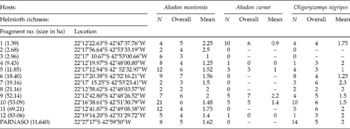
This study was carried out in 12 remnants of the Mountain Atlantic Forest within an agricultural landscape in Córrego Sujo (22°12′S and 42°48′W) and Venda Nova (22°17′S and 42°53′W) in the Municipality of Teresopolis, state of Rio de Janeiro, Brazil, in 2004 and 2005. Fragments were selected randomly and varied from 1.30 ha to 83.06 ha (table 1). The matrix among fragments included vegetable fields and cattle-raising pastures. Serra dos Órgãos National Park (PARNASO), which is a preserved area with 11,640 ha of continuous Mountain Atlantic Forest vegetation in the same region, served as a control area.
Overall and mean richness of helminths in three rodent species from fragment areas 1–12 and the preserved area (PARNASO) in Teresopolis, state of Rio de Janeiro, Brazil. N, number of hosts examined. Fragments are listed in ascending order of size.

The climate of the region is highland mesothermic (Cwb), according to Kopen's classification, with mild temperatures, rainy summers and a dry season between June and August (Ayoade, Reference Ayoade1986). The minimum mean monthly temperature observed in the region was 8.6°C and the maximum mean monthly temperature was 27.2°C. Mean monthly rainfall ranged from 36 mm during the winter to 310 mm during the summer (INMET, 2005).
The microhabitat was measured at every trapping station within an area of 9 m2 around the traps. Variables were measured in each trapping station at five spots: the central trap station and four others 1.5 m distant from the central station and located to the north, south, east and west of the station (Freitas et al., Reference Freitas, Cerqueira and Vieira2002). Eight quantitative variables were measured: litter cover (lit), soil exposure (soil), vegetation cover on the ground (vcg), presence of roots and logs (root), presence of rocks (rock), canopy cover (can), number of trees with a diameter at breast height ≥ 5 (tree), and vertical density obstruction at three different heights (0 to 50 cm [vdo1], 50 cm to 1 m [vdo2], and 1 m to 1.5 m [vdo3]). These variables were measured using a 0.5 × 0.5 m frame, which was divided into 100 open squares of wire mesh, as proposed by Freitas et al. (Reference Freitas, Cerqueira and Vieira2002). We counted the frequency of the squares occupied by each variable.
Three additional categorical descriptors were evaluated by considering an area of 9 m2 around each point: vegetation height (height) classified as low (1), medium (2) or high (3); understorey, which is a lower stratum of vegetation beneath the canopy (und), classified as open (1), sparse (2) or dense (3); and the presence of water courses (water) classified as present (1) or absent (0).
Collection and examination of rodents
Rodents were collected with Tomahawk® traps (Model 201; 16 × 5 × 5 inches; Hazelhurst, Wisconsin, USA) and Sherman® traps (Model XLK; 3 × 3.75 × 12 inches; Tallahasse, Florida, USA) that were baited with a mixture of peanut butter, banana, oats and bacon. Traps were placed on the ground at each trapping point. Four transects were established in each fragment and in the control area. The number of trapping stations per transect in each fragment was proportional to its size, with five trapping stations per transect in small fragments (up to 10 ha), ten trapping stations per transect in medium-sized fragments (between 10 and 40 ha), and 15 trapping stations per transect in large fragments (larger than 40 ha) and in PARNASO. Five additional traps were placed on the borders of each transect, and six additional traps were placed in the understorey at a height of 2 m in each transect. The trapping stations were spaced 20 m apart. The trapping took place over five consecutive nights. The total trapping effort of the study was 5170 trap nights.
Rodents were euthanized in a CO2 chamber, necropsied and identified by external and cranial morphology and karyotypic analysis. Nematodes, trematodes and cestodes were collected from the lungs, bile ducts, stomach, small intestine and caecum, including the thoracic and abdominal cavities. They were washed in saline solution (NaCl 0.85%) and fixed in AFA (acetic acid 2%, formaldehyde 3% and ethanol 95%). Nematodes were cleared in lactophenol, and trematodes and cestodes were stained with chlorhydric carmine. Helminths were identified under a Zeiss Standard 20 light microscope (Zeiss, Jena, Germany). Taxonomic identification was carried out following Travassos (Reference Travassos1937), Yamaguti (Reference Yamaguti1961), Khalil et al. (Reference Khalil, Jones and Bray1994), Vicente et al. (Reference Vicente, Rodrigues, Gomes and Pinto1997), Gibson et al. (Reference Gibson, Jones and Bray2002) and Jones et al. (Reference Jones, Bray and Gibson2005). The helminth species list and community parameters were previously published in Simões et al. (Reference Simões, Souza, Maldonado and Luque2011).
One hundred and thirteen specimens of A. montensis were collected; 11 were collected in PARNASO and 102 in fragments. This species occurred in all areas. Akodon cursor was present in only six fragments and included 25 animals. Sixty-two O. nigripes specimens were collected; 46 were in fragments and 16 in PARNASO. This species occurred in all areas, except for two small fragments.
Voucher specimens of collected rodents were deposited at the National Museum of Rio de Janeiro, and those of helminths were deposited at the Helminthological Collection of the Oswaldo Cruz Institute.
Data analysis
Overall richness of the helminth species was considered as the number of species found, and the mean species richness of helminths was the sum of the number of helminth species in each individual host divided by the number of analysed hosts. Both parameters were calculated for each fragment and for each host species. Helminth abundance was also calculated for each fragment and for each host species, as the total number of helminths recovered divided by the number of analysed rodents (Bush et al., Reference Bush, Lafferty, Lotz and Shostak1997). The helminth prevalence of each species was calculated as the proportion of the infected rodents for a given helminth species in relation to the total number of analysed rodents (Bush et al., Reference Bush, Lafferty, Lotz and Shostak1997) for each fragment and for each host. Data were tested for normal distribution using the Shapiro–Wilk test. Helminth richness, abundance and prevalence of each host for each fragment were correlated with the fragment sizes using Spearman's correlation because data did not fit a normal distribution. Rodent abundances were also correlated with fragment sizes for each species using the same method. For this analysis, rodent abundances were calculated relative to the trapping effort of each area. A relative abundance index was calculated for each species by dividing the number of rodents by the trapping effort in each area and then multiplying the result by 100, as the trapping effort varied according to the size of the fragments.
Nested subset analyses were used to examine whether the distribution patterns of the helminth communities of each host followed a nested pattern, considering all sampling areas. The analysis was performed in two ways: regardless of the size of the area and in relation to the size of the area. Nestedness was estimated using the nestedness measure of overlap and decreasing fills (NODF) metric (Almeida-Neto et al., Reference Almeida-Neto, Guimarães, Guimarães, Loyola and Ulrich2008). The observed pattern was compared with the null model by generating 1000 random matrices.
Habitat selection by the rodent species and the relationships between the habitat features of the external environment and the presence of the helminths were analysed using binary logistic regression, considering the presence and absence of each species in each point measured. The individual effects of each independent habitat variable on the response variable were analysed first using simple logistic regressions to minimize the number of variables in the final model. Second, significant variables in this first stage were selected for inclusion in a final model of multiple regressions. We assumed that for a given helminth species, points where hosts were collected included the characteristics of the external habitat favourable to the occurrence of the parasite. These analyses were carried out separately for fragments and for the control area to evaluate the effects of fragmentation on hosts and on the most abundant helminth species. Quantitative habitat variables were normalized to a standard unit of area measured, following Cerqueira & Freitas (Reference Cerqueira and Freitas1999). Correlated variables were excluded from the analyses. Consequently, the habitat variables used in the microhabitat analyses of the rodent and helminth species were reduced to the following: vdo2, soil, rock, root, canopy, height, understorey and water.
Statistical analyses were performed with PASW Statistics Software version 18 (SPSS Inc., Chicago, Illinois, USA), and with PAST version 2.10 (Hammer et al., Reference Hammer, Harper and Ryan2001). Nestedness analyses were performed using ANINHADO Software version Bangu 3.0.3 (Guimarães & Guimarães, Reference Guimarães and Guimarães2006). A level of P < 0.05 was considered significant in all the analyses. Correlations and nestedness analyses were performed only for helminth communities of A. montensis and O. nigripes, as there were insufficient data for A. cursor.
Results
Helminth composition and richness
Thirteen nematode, three cestode, and two trematode species were recovered from the three rodent hosts. The helminth fauna of A. cursor, A. montensis and O. nigripes showed some similarities. The trematode Canaania obesa, the cestode Rodentolepis akodontis, and the nematodes Stilestrongylus lanfrediae, S. aculeata, S. eta, Guerrerostrongylus zetta, Trichofreitasia lenti and Angiostrongylus sp. were present in at least two of the three hosts.
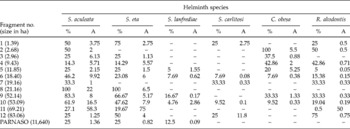
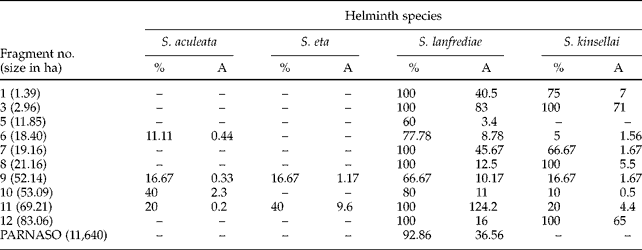
Stilestrongylus aculeata and S. eta were the most abundant and prevalent species in A. montensis and in A. cursor, occurring in almost all areas where these hosts were collected. They were also present in O. nigripes but in smaller abundances. The trematode C. obesa and the cestode R. akodontis were also very prevalent in A. montensis and A. cursor; they were less prevalent in O. nigripes, occurring only in rodents collected in the fragments (tables 2 and 3). Trichofreitasia lenti occurred in A. montensis only in animals collected in PARNASO, and P. numidica occurred in this host in animals collected in PARNASO and in one large fragment. Stilestrongylus lanfrediae and Syphacia carlitosi were also common in A. cursor and in A. montensis. The nematodes Angiostrongylus sp. and Litomosoides silvai also occurred in these hosts but in few fragments, while Trichuris sp. was observed only in one fragment in A. montensis. Stilestrongylus lanfrediae and Syphacia kinsellai were the most abundant and prevalent helminths of O. nigripes (table 3). In this host, Cysticercus fasciolaris and Avellaria sp. occurred only in animals from PARNASO, and G. zetta and T. lenti occurred in animals collected in PARNASO and in two large- and medium-sized fragments. The nematode Litomosoides odilae and the cestode Railletina sp. were also observed in O. nigripes but in only one fragment each.
The prevalence (%) and abundance (A) of the most frequently occurring helminth species in Akodon montensis in fragment areas 1–12 and the preserved area (PARNASO) in Teresopolis, state of Rio de Janeiro, Brazil.

The prevalence (%) and abundance (A) of the most frequently occurring helminth species in Oligoryzomys nigripes in fragment areas 1, 3, 5–12 and the preserved area (PARNASO) in Teresopolis, state of Rio de Janeiro, Brazil.
With regard to helminth richness, nine species were recovered from A. cursor, and 12 helminth species were recovered from A. montensis and from O. nigripes. In these two species, overall richness and mean richness in PARNASO were within the range observed in fragments (table 1). There was a marginally significant correlation between helminth richness of O. nigripes and the size of the area when the control area was included in the analysis (overall richness: r= 0.541, P= 0.057, N= 13; mean richness: r= 0.541, P= 0.068, N= 13). For A. montensis, this correlation was not significant.
In A. montensis, helminth abundance was greater in larger fragments, and there was a positive correlation between its helminth abundance and the size of the area when the control area was not included in the analysis (r= 0.685, P= 0.014, N= 12). The helminth abundance in O. nigripes was not correlated with fragment size, irrespective of whether the control area was included or excluded from the analysis. There was no correlation between helminth prevalence and the size of the area in any species. There was also no correlation between rodent abundance and the size of the fragments for any rodent species, with or without the control area.
The helminth communities of A. montensis and O. nigripes followed a nested subset structure of species distribution in both analyses: either dependent on the size of the area (A. montensis: NODF = 18.55, P= 0.00; O. nigripes: NODF = 15.19, P= 0.00) or independent of the size of the area (A. montensis: NODF = 36.89, P= 0.00; O. nigripes: NODF = 30.25, P= 0.00).
Habitat
Akodon cursor, which was collected only in the fragments, had an inverse relationship with canopy cover (can: B = − 0.006, P= 0, selected model: r 2= 0.130, P= 0, df = 4). Akodon montensis had a direct relationship with vertical density obstructions at medium height (vdo2: B = 0.410, P= 0.005) and with the absence of watercourses (water: B = 2.390, P= 0.018) in fragments (selected model: r 2 = 0.077, P= 0.001, df = 6). In PARNASO, A. montensis also had a direct relationship with vdo2 (B = 1.068, P= 0.018) and a marginal inverse relationship with the presence of rocks (rock: B = − 1.624, P= 0.054; selected model: r 2 = 0.294, P= 0.002, df = 2). The rodent O. nigripes had a direct relationship with canopy cover (can: B = 0.015, P= 0.003) and with vdo2 (B = 0.593; P= 0.004) in fragments (selected model: r 2= 0.105, P= 0, df = 2). In PARNASO, O. nigripes had a positive association with the presence of roots and logs (root: B = 6.766, P= 0.024) and a marginally significant relation with sparse understorey (und2: B = 2.439, P= 0.053; selected model: r 2 = 0.256, P= 0.012, df = 3).
The presence of the following helminth species was analysed in relation to external habitat features: S. lanfrediae, S. aculeata, S. eta, C. obesa, S. kinsellai and G. zetta. Only these species presented sufficient data for this analysis. The occurrence of the nematode S. lanfrediae had an opposite relationship with vdo2 when comparing the fragments with PARNASO. It showed a direct relation with this variable in fragments (B = 0.402, P= 0.0321, selected model: r 2= 0.039, P= 0.018, df = 2) but a marginally significant inverse relation in PARNASO (B = − 0.991, P= 0.050, selected model: r 2= 0.135, P= 0.022, df = 1).
The occurrence of S. aculeata displayed a marginally significant inverse relationship with canopy cover in fragments (can: B = –0.002, P= 0.06, selected model: r 2= 0.013, P= 0.07, df = 1). This species could not be analysed in PARNASO. The nematode G. zetta, which occurred predominantly in animals from PARNASO, showed a direct relationship with the presence of roots and logs in this area (root: B = 6.017, P= 0.045, selected model: r 2 = 0.119, P= 0.04, df = 1).
The trematode C. obesa, which was found only in animals collected in fragmented areas, had an inverse relationship with canopy cover (B = − 0.004, P= 0.037) and a direct relationship with vdo2 (B = − 0.004, P= 0.004) (selected model: r 2 = 0.057, P= 0.028, df = 2).
The occurrence of S. eta was not significantly related to any variable in the fragmented areas or in PARNASO. The nematode S. kinsellai, which occurred only in O. nigripes collected in the fragmented areas, also showed no relationship with the habitat variables.
Discussion
Previously, Simões et al. (Reference Simões, Souza, Maldonado and Luque2011) discussed helminth species richness and community structures. Nematodes were the most represented helminth phylum in all rodent species in the present study, and the total helminth richness observed was high when compared to that reported in other studies, which varied from seven to eight for A. montensis and from two to four for O. nigripes (Püttker et al., Reference Püttker, Meyer-Lucht and Sommer2008; Navone et al., Reference Navone, Notarnicola, Nava, Robles, Galliari and Lareschi2009; Kuhnen et al., Reference Kuhnen, Graipel and Pinto2012).
Except for G. zetta, the helminth fauna of A. cursor was a subset of the helminth fauna of A. montensis. Previous studies have also demonstrated greater species richness of helminths recovered from A. montensis compared to those from A. cursor (Gomes et al., Reference Gomes, Cruz, Vicente and Pinto2003; Püttker et al., Reference Püttker, Meyer-Lucht and Sommer2008; Pinto et al., Reference Pinto, Knoff, Gomes and Noronha2011). Although the overall and the mean helminth species richness of A. montensis and O. nigripes were similar in the present study, only six species were shared between these hosts. This partial similarity may be due to the fact that these two rodents occur in the same environments (Umetsu & Pardini, Reference Umetsu and Pardini2007) and frequently occur in high numbers in other studies in the Atlantic Forest because of their opportunist nature (Bonecker et al., Reference Bonecker, Portugal, Costa-Neto and Gentile2009; Antunes et al., Reference Antunes, Campos, Oliveira-Santos and Graipel2010).
The helminth community structure of A. montensis and O. nigripes followed a nested pattern of distribution, indicating that smaller fragments are characterized by a subset of the species that occur in larger fragments and in PARNASO. Other studies found the same pattern in the parasites of mammals (Goüy de Bellocq et al., Reference Goüy de Bellocq, Sarà, Casanova, Feliu and Morand2003; Dallas & Presley, Reference Dallas and Presley2014). In spite of the fact that the number of hosts collected was not large, we may suggest that fragmentation had a greater influence on the composition of the helminth fauna in O. nigripes than in A. montensis. This finding is supported by the fact that more species were recovered from O. nigripes occurring only in PARNASO and in large fragments when compared to species recovered from A. montensis. On the other hand, fragmentation seemed to be more related to helminth abundance in A. montensis; greater abundances were found in larger fragments. According to Lafferty & Kuris (Reference Lafferty and Kuris1999), immature phases of trichostronglylids, helminths of the genus Guerrerostrongylus and Stilestrongylus, are vulnerable to adverse effects of the environment, such as increased sunlight and decreased moisture. These environmental effects might be greater in disturbed and fragmented areas, thereby reducing the abundance of the helminths.
The influence of habitat fragmentation differed among the helminth species: fragmentation apparently has a greater effect on T. lenti, P. numidica, C. fasciolaris, Avellaria sp. and G. zetta than on the other helminths, as they occurred predominantly in the preserved or larger areas. Trichostrongylids have a direct life cycle and can be transmitted through the habit of licking pelage (Hernandez & Sukhdeo, 1995) or by eating grasses where the infective larvae are adhered (Brouat et al., Reference Brouat, Kane, Diouf, Bâ, Sall-Dramé and Duplantier2007). Moreover, variations in temperature and humidity are important characteristics for the development of trichostrongylid larvae in the environment. In this sense, the microclimate of the soil surface can provide a suitable wet environment for the continuous development of these helminths (Urquhart et al., Reference Urquhart, Armour, Duncan, Dunn and Jennings1998). In common with all trichostrongylids, T. lenti and Avellaria sp. have a direct life cycle (Vicente et al., Reference Vicente, Rodrigues, Gomes and Pinto1997), which is favoured in preserved areas and areas with greater vegetation cover. Although P. numidica and C. fasciolaris have indirect life cycles that require an arthropod and a rodent as intermediate hosts, respectively (Crook & Grundmann, Reference Crook and Grundmann1964; Bomfim, Reference Bomfim2001), habitats with less human impact may benefit them. In the present study, both the fragment size and the level of disturbance appeared to have less effect on the species S. lanfrediae, S. eta, S. kinsellai, C. obesa and R. akodontis. Habitat preferences of hosts governed the occurrence of the helminths, as expected. Meanwhile, specific characteristics of the environment for the life cycles of the helminths may also have dictated their occurrence, as discussed below.
Oligoryzomys nigripes was the most important host of S. lanfrediae; they were recovered from O. nigripes in almost all fragments and in high numbers, although they occurred in all three rodent hosts studied (Simões et al., Reference Simões, Souza, Maldonado and Luque2011). The infected host releases eggs in the faeces and therefore may suffer a variety of adverse effects due to various processes, such as changes in temperature and pH, desiccation and freezing (Urquhart et al., Reference Urquhart, Armour, Duncan, Dunn and Jennings1998; Lafferty & Kuris, Reference Lafferty and Kuris1999; Marcogliese, Reference Marcogliese2003), precluding the development of the larval stage (Urquhart et al., Reference Urquhart, Armour, Duncan, Dunn and Jennings1998). The positive association of S. lanfrediae with the vegetation density at a medium height in fragments may be because it needs a more humid environment to maintain the viability of its larvae. However, S. lanfrediae showed a marginally significant negative association with this same variable in PARNASO. The latter may be attributed to the behaviour of its host, O. nigripes, as this rodent exhibits scansorial habits, occupying scrub vegetation as well as the ground. These attributes likely favour infection and dispersal of the helminth. The relationship of O. nigripes with the presence of roots and fallen logs in the preserved area corroborates this hypothesis.
Guerrerostrongylus zetta, which was one of the species mostly affected by fragmentation, was associated with the presence of roots and fallen logs in the preserved area. The occurrence of roots and fallen logs may increase the amount of organic matter on the ground (Heck et al., Reference Heck, De Marco, Hahn, Kluge, Spilki and Van Der Sand2013), creating a favourable environment for the development of helminths (Godinho, Reference Godinho2003). Furthermore, O. nigripes, which was the most important host of this helminth, showed a relationship with the same variable in PARNASO that may be associated with the scansorial habit of the rodent, as mentioned above.
The trematode C. obesa occurred predominantly in A. montensis. Maldonado et al. (Reference Maldonado, Pinheiro, Simões and Lanfredi2010) asserted that the rodent genus Akodon is probably the major definitive host of this helminth. Canaania obesa belongs to the Dicrocoeliidae family. The most common intermediate hosts of this genus are gastropods (Fried & Graczyk, 1997) or ants of the genus Formica (Urquhart et al., Reference Urquhart, Armour, Duncan, Dunn and Jennings1998). Thus, the transmission of the trematode may depend on the ingestion of the invertebrate host (Maldonado et al., Reference Maldonado, Pinheiro, Simões and Lanfredi2010) by a sigmodontinae rodent (Travassos, Reference Travassos1944). Temperature affects the development of the immature stages of dicrocoelids in the ant. After being infected, the intermediate host tends to migrate to the apical end of plants, thereby increasing the chances of being ingested by the definitive host (Urquhart et al., Reference Urquhart, Armour, Duncan, Dunn and Jennings1998). This scenario was possibly reproduced in this study, given the association of A. montensis with dense vegetation close to the ground. According to Gomes et al. (Reference Gomes, Cruz, Vicente and Pinto2003), the soil cover of the Atlantic Forest plays a fundamental role in the transmission of digenetic helminths. The association of this helminth with open canopy cover, which is related to the habitat preference of A. cursor, may be due to the occurrence of this host in border areas of the fragments that are characterized by open areas with open canopy and higher temperatures.
Stilestronylus eta, S. aculeata and S. kinsellai did not show a significant relationship with any of the habitat variables. This suggests that these parasites are able to complete the development of their life cycles, regardless of the degree of disturbance in the environment.
The occurrence and distribution of helminth species are directly associated with the occurrence of their respective hosts (Poulin, Reference Poulin2007). Parasites that have complex life cycles and include free-living stages infect host species whose presence and behaviour enable the development of the parasite in the environment in which they occur. In the present study, the occurrence of the nematode S. lanfrediae appeared to be related to vegetation near the ground, C. obesa was associated with a dense understorey and open canopy, and G. zetta was associated with dense organic matter on the ground. These features likely represent the attributes of the external environment needed for the development of the life cycles of these parasites.
The fragmentation process may negatively affect the life cycles of some species of parasites (Lafferty & Kuris, Reference Lafferty and Kuris1999; Patz et al., Reference Patz, Graczyk, Geller and Vittor2000; Pakdeenarong et al., Reference Pakdeenarong, Siribat, Chaisiri, Douangboupha, Ribas, Chaval, Herbreteau and Morand2014); however, the effects on parasite species richness may not be adverse. A study using network analysis found that fragmentation influenced the connectance of some host–parasite interactions but did not affect parasite species richness (Bordes et al., Reference Bordes, Morand, Pilosof, Claude, Krasnov, Cosson, Chaval, Ribas, Chaisiri, Blasdell, Herbreteau, Dupuy and Tran2015). In addition, resource-rich landscapes such as crop fields may provide more favourable conditions for the life cycles of helminths, increasing their species richness and abundances (Froeschke & Matthee, Reference Froeschke and Matthee2014). The present report is a preliminary study, but it is the first study in Brazil to relate helminths, rodent hosts and microhabitat characteristics in the scope of environmental fragmentation. Here we suggest that helminth species composition and host–parasite interactions were more related to the fragmentation process caused by agricultural activities in the region than helminth richness. Fragmentation could limit the occurrence of some species, such as G. zetta and P. numidica, to less-fragmented areas and thus affect some host–parasite interactions. Further studies on host–parasite interactions over larger spatial and temporal scales are necessary to better understand this issue.
Acknowledgements
We thank Dr P.S. D'Andrea and N. Olifiers for the coordination of the mammalian component of the project, Dr Hartmut Gaese for general coordination of the project, B.R. Teixeira, V.C. Vaz, J.W.F. Costa and colleagues from Laboratório de Biologia e Parasitologia de Mamíferos Silvestres Reservatórios (FIOCRUZ) for their help in the field work, S.T. Mansur for help in microhabitat measurement in the field, Dr C.R. Bonvicino for identifying rodents by karyological analysis, the people of Venda Nova at Teresópolis, for allowing us to conduct the field work on their property, and the PARNASO administration for many operational facilities. We also thank Dr Helena Bergallo and Dr José Luís Passos Cordeiro for some suggestions.
Financial support
This project was supported by Instituto Oswaldo Cruz, Fundação Oswaldo Cruz, CNPq (Brazilian Council for Scientific and Technological Development) and BMBF (Bundesministerium für Bildung und Forschung). T.S.C. received grants from Fundação Carlos Chagas Filho de Amparo à Pesquisa do Rio de Janeiro (Faperj).
Conflict of interest
None.
Ethical standards
Rodent collections were authorized by the Brazilian Institute of Environment and Renewable Natural Resources, licence numbers 061/2003, 064/2004, 129/2004 and 068/2005. All procedures were in accordance with the Ethical Committee on Animal Use of Fundação Oswaldo Cruz, licence number P-0083-01.