Introduction
Cochlear implantation is considered an effective and safe method of rehabilitation for patients with severe to profound deafness. Over the last two decades, more than 60 000 cochlear implants have been successfully installed worldwide. This makes the cochlear implant arguably the most successful neural prosthesis in the history of medicine; although results remain variable and unpredictable for any given individual, a substantial proportion of implant recipients now recover high levels of open-set speech comprehension.Reference Chmiel, Sutton and Jenkins1–Reference Labadie, Carrasco, Gilmer and Pillsbury4 Cochlear implantation permits the implant recipient to reintegrate with the hearing world.
Riyadh is the capital of Saudi Arabia, with a population of more than 4 million. The King Abdulaziz University Hospital cochlear implant programme is one of two such programmes in Riyadh. Our programme commenced in June 1995, and more than 135 patients had been implanted by 31 December 2008.
In this report, we describe our pre-operative evaluation and surgical techniques. In addition, we discuss our centre's post-operative results, programming strategies and rehabilitation process, together with the difficulties faced during initiation of the programme.
Patients and methods
The cochlear implant programme at King Abdulaziz University Hospital, Riyadh, commenced in June 1995. By 31 December 2008, more than 135 patients had been implanted. The case notes of 117 patients were examined and their data reviewed (the remaining patients had been recently implanted and their case notes were incomplete). Of these 117 implanted patients, 100 had received Nucleus devices, 11 Med-El devices and six Advanced Bionics Clarion devices.
Pre-operatively, all patients had bilateral profound hearing loss, with a monosyllabic word score of 10 per cent or less in the best aided conditions. Their general health was good. They were psychologically stable, had realistic expectations, and were willing to participate in post-operative testing and rehabilitation. High resolution computed tomography (CT) scans of the temporal bones were obtained for all patients. In selected cases, magnetic resonance imaging scans were obtained to verify the patency of the cochlear turns and the status of the cochlear nerve.
Surgical approach
Standard cochlear implantation techniques were used. At the beginning of the programme, an extended endaural incision (Hanover) was used (78 cases). This procedure was later replaced by the smaller and more sophisticated minimal approach (Nottingham incision; 39 cases).
The cochlea was approached via a standard facial recess approach. A cochleostomy was typically performed antero-inferior to the round window niche, using a 1 mm diamond burr. The electrode array was inserted fully in 111 cases and partially in six cases. The cochleostomy was sealed with pieces of periosteum. The receiver stimulator was stabilised in a previously drilled well, posterior to the mastoidectomy. The stapedial reflex threshold was recorded in all cases, together with neural response telemetry. The wound was closed in layers; dermal sutures were usually avoided in paediatric patients.
Radiological evaluation of the electrode array position was routinely undertaken on the first post-operative day, using conventional radiography (transorbital view).
All paediatric patients received pneumococcus and Haemophilus influenzae vaccinations. Adult patients received only pneumococcus vaccination.
A major complication was defined as one leading to explantation or re-implantation, death of the patient, or excess hospitalisation (i.e. more than one week). A minor complication was defined as one which was self-limiting or which improved with conservative measures.Reference Batman, Inanli, Özturk, Tutkun and Sehitoġh5
Evaluation procedure
We undertook pre-operative auditory evaluation with hearing aids, and then four-week post-operative auditory evaluation after initial stimulation of the cochlear implant, followed by evaluation at three, six and 12 months. The sound field warble tone threshold was measured for the frequencies 250–800 Hz, pre- and post-operatively (with the hearing aid and the cochlear implant, respectively). Pre-operative speech perception tests were performed in a calibrated, free field, sound-proof booth with the patient using their hearing aid at 70–80 SPL via a loud speaker. Pre-operative evaluations were performed in both monaural or binaural listening conditions. Post-operatively, monaural implant evaluations were performed.
Each patient received individual auditory and communication skills training. Their progress was assessed using the Listening Progress Profile, a receptive language skill test, together with an expressive language skill test and lip-reading in paediatric patients. The Minimal Auditory Capability test was used in adult patients.
Results
A total of 117 patients (47 females (40 per cent) and 70 males (60 per cent)) were implanted between June 1995 and December 2008. All patients met the implantation criteria. Patients comprised 82 children (age range 2.5–14 years, mean age 4.8 years) and 35 adults (age range 17–47 years; mean age 30.9 years) (Table I).
Patient demographics

Data represent patient numbers unless otherwise specified. Yr = years
The patients were divided into four groups according to the type of implant used. Fourteen patients were implanted with a Nucleus 22 device (cochlear AG Basel- Switzerland), 86 with a Nucleus 24 device (cochlear AG Basel- Switzerland), 11 with a Med-El device (MED-EL-medical electronics, Innsbruck, Austria) and six with an Advanced Bionics Clarion device (Advanced Bionics Corporation, Valencia, 1355 USA). Table I summarises the demographics of these groups. The cochlear implantation programme initially utilised an extended endaural incision (used in 78 patients); this was later replaced by the Nottingham incision (used in 39 patients).
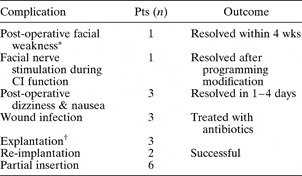
Three adult patients required explantation, two (both male) due to recurrent otitis media following canal wall down mastoidectomy, and one (female) due to unexplained severe headache and tinnitus. Two patients required re-implantation because of electrode migration. One patient suffered transient facial nerve paresis (House–Brackmann grade II to III) which recovered completely after four weeks. One patient experienced facial nerve stimulation when their implant was activated; the relevant channel was switched off (Table II).
Cochlear implantation complications

*House–Brackmann grade II–III. †Two after recurrent otitis media; one due to unexplained severe headache and tinnitus. Pts = patients; wks = weeks; CI = cochlear implant
Post-operative, transient unsteadiness was noted in five patients. Three patients suffered wound infection, settled with extensive antibiotics.
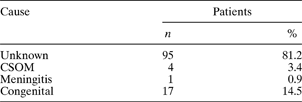
The commonest aetiology of deafness was unknown causes (95 patients, 81.2 per cent), followed by congenital (17 patients, 14.5 per cent), chronic suppurative otitis media (four patients, 3.4 per cent) and meningitis (one patient, 0.9 per cent) (Table III).
Patients' causes of deafness
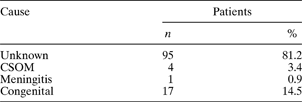
CSOM = chronic suppurative otitis media
We had difficulty locating the scala tympani in six paediatric patients, although their high resolution CT scans were normal and their history was negative regarding congenital anomalies and meningitis. Electrode insertion in these cases was partial (i.e. 15–17 electrodes inside).
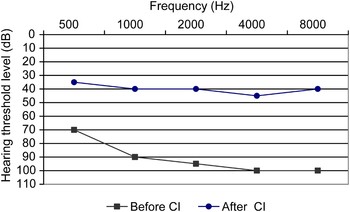
Patients' perception and discrimination of sounds and speech were evaluated using a protocol designed to meet the needs of the Arabic language. The average maximum post-implantation speech discrimination score at 18 months was 82.4 per cent (range, 24–94 per cent), compared with 7.3 per cent pre-operatively. The Listening Progress Profile test was used in 66 pre-lingual children (age range, three to seven years), and showed a rapid, marked improvement in sound and speech detection at six months post-implantation (Figure 1). At 24 months post-implantation, these 66 children all obtained the maximum possible score. The most significant improvements in performance were noted in the first year after implantation. Superior performances were noted in post-lingual adults with recent onset of deafness. All pre-lingual patients showed constant improvement in their vocabulary usage and their reading, writing, cognitive and mathematics skills. These patients developed speech production at least intelligible to a professional listener. Better results were noted in pre-lingual patients younger than five years. Pure tone audiograms measured before and six months after implantation showed an improvement in free field tone threshold in 95 per cent of patients, with an average gain of 40 dB (Figure 2).
Patients' Listening Progress Profile (LPP) results.

CI = cochlear implantation.

Discussion
Three types of cochlear implant devices were used in this study: Nucleus (22 or 24), Med-El and Advanced Bionics Clarion. Although the number of patients implanted with Med-El and Advanced Bionics Clarion devices was small compared with those receiving a Nucleus device, there were no significant differences between these patients regarding complications and audiological performance. We began our cochlear implant programme using the Nucleus 22 model, later adopting the more sophisticated Nucleus 24 Contour Advanced device (currently still used).
Intra-operative and post-operative implant programming was performed using compatible hardware and software. Neural response telemetry technology (version 3.0) was utilised for intra-operative electrode function assessment and post-operative mapping, and facilitated hearing threshold programming in pre-lingual children. Programming sessions were scheduled according to the specific needs of each patient. The majority of patients implanted with a Nucleus device (80 per cent) underwent implant programming using the advanced combination encoders (ACE) coding strategy. The spectral peak coding (SPEAK) coding strategy was utilised early in 14 per cent of cases. Eleven patients were implanted with a Med-El Combi 40+ device; in these cases, the continuous interleaved sampling (CIS) CIS+ strategy was used for programming. The High Resolution Broadband coding strategy was the commonest programming strategy in the six patients implanted with Advanced Bionics Clarion devices.
Six paediatric patients were found to have an abnormally located cochlea. Their pre-operative high resolution CT scans were normal, with patent cochleae. We could insert the electrodes partially (i.e. 15–17 electrodes inside) when we drilled more superiorly towards the footplate. We attributed this to an abnormally rotated cochlea. To our knowledge, such cases have not previously been reported. These six patients' mean maximum post-implantation speech discrimination score at 24 months was 72.4 per cent, and their speech was at least intelligible to a professional listener.
There are some reports of meningitis following cochlear implantation, the majority from the USA.Reference Josefson6 Meningitis was not observed in any of our patients. All paediatric patients were vaccinated against pneumococcus and H influenzae.
The majority of our implanted patients were children (70 per cent), and their mean age at implantation was 4.8 years. The incidence of severe to profound sensory neural hearing loss among Saudi Arabian children (i.e. age 12 years or less) is 0.72 per cent.Reference Abdulmomen and Zakzouk7 When we commenced our cochlear implant programme in 1995, general awareness of the importance of cochlear implantation was far below our expectations. Over the last five years, however, we have begun to receive children younger than three years. Numerous reports have shown that excellent results are achievable in pre-lingual patients when a cochlear implant is received before the age of three years.Reference Chmiel, Sutton and Jenkins1–Reference Kirk, Miyamoto, Lento, Ying, O'Neill and Fears3 Our main goal now is to implant younger pre-lingual children as soon as possible, even during the first year of life.
We successfully managed two difficult adult cases of cochlear implantation. Both cases involved canal wall down mastoidectomy due to chronic suppurative otitis media with cholesteatoma. One patient developed mastoid cavity infection with extrusion of the electrode, five years post-implantation; the infection could not be controlled without explantation, the implant was surgically removed. The other patient developed middle-ear infection with partial extrusion of the electrode array and tympanic membrane perforation, six years post-implantation. The infection was controlled after explantation and repair of the tympanic membrane defect.
A third adult case was explanted due to troublesome tinnitus and unexplained severe headache which settled only partially. The patient insisted that the implant be removed.
One child developed transient facial nerve paresis (House–Brackmann grade II to III), which resolved within four weeks with tapering prednisolone (1 mg/kg/day).
Another patient experienced facial nerve stimulation during implant function, which resolved after switching off the relevant channel.
Post-operative unsteadiness was noticed in three patients; this resolved after 1 to 4 days.
Cochlear implantation has been recognised as a safe intervention. However, as with any other surgical procedure, it has an inherent risk of minor and major complications. The overall reported incidence of post-implant complications is 5–37 per cent.Reference Kirk, Miyamoto, Lento, Ying, O'Neill and Fears3, Reference Labadie, Carrasco, Gilmer and Pillsbury4, Reference Karatzanis, Chimona, Prokopakis, Kyrmizakis and Velegrakis8–Reference Green, Bhatt, Saeed and Ramsden10 In our patient series, the overall incidence of complications was 16.2 per cent, which is comparable to other reports.Reference Dutt, Ray, Hadjihannas, Cooper, Donaldson and Proops11–Reference Miyamoto, Houston and Bergesson13 The majority of our complications were encountered at the beginning of our implant programme. Cochlear implantation is a rehabilitative surgical procedure, and side effects should be minimised. Appropriate patient selection and care with anaesthetic and surgical techniques are vital. Various authors have reported a variety of problems at the implant site. Most have been transient or have responded to local measures. Others have required prolonged treatment, revision or even explantation.Reference Batman, Inanli, Özturk, Tutkun and Sehitoġh5 Interestingly, we have experienced no complications over the last five years, perhaps implying the positive effect of a learning curve for the surgeons involved.
The most significant improvements in post-implantation speech discrimination scores were noted during the first year of implantation. Superior results were noted in post-lingual adults. The majority of pre-lingual patients showed constant improvement in their vocabulary usage, articulatory and prosody variation, and skills regarding reading, writing, cognition and mathematics.
The Listening Progress Profile test was used to monitor the development of auditory perception in the early stages after implantation. This is a sensitive test of progress in speech development in young children. Our mean Listening Progress Profile scores at 24 months were in agreement with other authors' reports.Reference Niklopoulos, Wells and Archböld14
The number of implanted patients in this series was relatively small. This was due to the following factors.
The first was patients' poor awareness of the importance of early detection of deafness. At the beginning of the our implant programme, Saudi Arabia had no universal, routine programme of early detection of hearing loss in newborns, and this delayed the diagnosis of hearing loss until the child was at an unfavourable age for implantation.
The second reason for our small patient numbers was patients' lack of awareness of the value of cochlear implant surgery. At the start of our cochlear implant programme, we had hardly any success in convincing parents to implant their deaf children. However, in the last five years we have been unable to accommodate the large number of deaf patients requesting cochlear implantation.
The third reason for our small numbers was the fact that King Abdulaziz University Hospital is a government hospital. Government funding of the cochlear implant programme has not been constant, and has been less than the suggested budget for the programme. Last year, however, the programme received better financial support, which will reduce the long waiting list of patients and help to treat and rehabilitate more deaf individuals.
Conclusion
The outcomes of our cochlear implantation series are comparable to previous reports. Numerous studies have shown that excellent results are achieved in pre-lingual children when a cochlear implant is received before the age of three years. Our programme now aims to implant pre-lingual children as early as possible, even in the first year of life. The possibility of an abnormally rotated cochlea should be borne in mind when difficulty is encountered during cochleostomy.
As cochlear implant technology evolves and surgical techniques continue to improve, our programme will continue its efforts to provide effective auditory rehabilitation to deaf children and adults in Riyadh.