




No CrossRef data available.
Long-term survival in children with atrioventricular septal defect and common atrioventricular valvar orifice in Sweden
Published online by Cambridge University Press: 20 January 2005
Abstract
Background: The survival for patients with atrioventricular septal defect has improved markedly over the last decades and, during the same period, the survival of children with Down's syndrome has also increased. The aim of our study was to investigate long-term survival in patients having atrioventricular septal defect with common valvar orifice, but without associated significant congenital heart defects, in the setting of Down's syndrome, comparing the findings to those in chromosomally normal children with the same malformation. Methods and results: In a population-based retrospective study, we scrutinised the medical records from 801 liveborn children with atrioventricular septal defect born in Sweden during the period 1973 through 1997. Data on gender, presence or absence of Down's syndrome, associated congenital heart defects, date of birth, operation and death were recorded and followed up until 2001. An isolated atrioventricular septal defect with common atrioventricular valvar orifice was present in 502 children, of whom 86% had Down's syndrome. We found a significant reduction over time in age at operation, and in postoperative mortality at 30 days, from 28 to 1%. Using a multiple logistic regression model, we found no significant differences in mortality between genders, nor between those with or without Down's syndrome. Early corrective surgery could not be identified as a significant independent factor for survival. The 5-year postoperative survival in patients with Down's syndrome increased from 65% over the period from 1973 through 1977, to about 90% in the period 1993 through 1997, and the same trend was observed in chromosomally normal patients. Conclusions: Survival in uncomplicated atrioventricular septal defect with common atrioventricular valvar orifice has greatly increased, and surgical correction is now equally successful in patients with Down's syndrome and chromosomally normal patients, and for both genders. Death in connection with surgery is no longer the major threat, and focus must now be on long-term follow-up.
Information
- Type
- Original Article
- Information
- Copyright
- © 2004 Cambridge University Press
Atrioventricular septal defect in the setting of a common atrioventricular junction is a severe congenital cardiac malformation, which previously led to death from heart failure or pulmonary vascular disease during childhood. The lesion accounts for just less than one-twentieth of all congenital cardiac defects,1,2 and is the most frequent congenital cardiac malformation associated with Down's syndrome.3, 4 Surgical correction of atrioventricular septal defect was first introduced by Lillehei and co-workers in 1955.5 Initially, there was a high mortality and morbidity among the children with Down's syndrome having congenital cardiac malformations.6, 7 During the last decades, the management of all congenital heart defects has been revolutionised by new diagnostic methods and surgical techniques, including more attention to protection of the central nervous system and myocardium during bypass.8–11 New, more selective agents for treatment of postoperative pulmonary hypertension, and other improvements in the medical care, have been introduced. The aim of this investigation was to study the mortality and survival in a national cohort of children born with atrioventricular septal defect over a 30-year period, especially those having a common atrioventricular valvar orifice in the absence of other associated congenital cardiac malformations, a combination we will refer to as isolated atrioventricular septal defect. Our further objectives were to elucidate the importance of gender, Down's syndrome and age at operation as predictors for postoperative mortality and long-term survival.
Methods
Population studied
We included all the infants in Sweden, which has a population of 9 million, born live between 1 January 1973 and 31 December 1997 with atrioventricular septal defect and common atrioventricular valvar orifice diagnosed according to the international coding systems (ISC 200–208, ICD 9; 745G; ICD 10; Q21.2) and complementary information. We excluded those having trisomies other than Down's syndrome, and all those with shunting through an atrioventricular septal defect confined at atrial level, the so-called “isolated ostium primum atrial septal defect”. Other children with trisomies, such as 13 and 18, where not offered surgical treatment during the period of study, and were therefore not included. We excluded those with shunting exclusively at atrial level because we deemed this association to represent a different hemodynamic situation, with less risk for symptoms early in life, and less risk for early development of pulmonary hypertension. The population in Sweden in 1973 was 8,144,428, rising to 8,847,625 by 1997.
Information on the 1150 cases of atrioventricular septal defect, the 2,599,624 live births, and the 3355 children known to have Down's syndrome was retrieved from the National Board of Health and Welfare from three Swedish registers, namely the Register of Congenital Malformations, the Register of Congenital Heart Malformations, and the Medical Birth Register. As these national registers were not complete at the beginning of the period of study, we also searched the local registries at the four Swedish centres specialising in paediatric cardiology for additional cases of atrioventricular septal defect. In this way, we added another 327 children, the majority born before 1987. Of the initial 1150 cases, we excluded 317 (27.6%), the majority because they were not compatible with our criterions for inclusion. Most had isolated “ostium primum” defects with or without involvement of the left atrioventricular valve, while a few were excluded because of misregistration. We also excluded 32 cases because of insufficient information (2.8%). Thus, 801 children were finally diagnosed as having atrioventricular septal defects suitable for analysis within our criterions (Fig. 1). These cases were then divided into groups with small and restrictive ventricular components, with approximately half or less of systemic pressure in the right ventricle, and those with unrestrictive ventricular components to the atrioventricular septal defect. We further divided the group into isolated and complex categories. The isolated group, of 502 patients, included also cases with additional defects within the oval fossa, those with patency of the arterial duct, and those with a small additional ventricular septal defect. The complex cases included 60 with obstruction of the left ventricular outflow tract due to subaortic stenosis or coarctation, 55 with obstruction of the right ventricular outflow tract because of pulmonary stenosis or Fallot's anomaly, 34 with isomerism of the atrial appendages, 43 with severely unbalanced ventricular volumes, and 55 with other complex forms. In 5 children, we were unable to classify precisely the type of atrioventricular septal defect. This report focuses on the cases with isolated uncomplicated atrioventricular septal defect with unrestrictive ventricular shunting. The study was approved by the Ethics Committee of the Karolinska Institute, along with the Ethical Committees of all participating centres in this multicentric study.

Figure 1. Population-based study of atrioventricular septal defect (AVSD) in Sweden 1973–1997. The distribution of males and females with and without Down's syndrome (DS) is shown.
Data were collected in the year 2002. The endpoint of the study was 31 December, 2001. The medical case record for each child was scrutinised to confirm the diagnosis of atrioventricular septal defect with common valvar orifice, a non-restrictive ventricular component, and the potential also for interatrial shunting through the “primum” defect. The diagnosis was confirmed by echocardiography, cardiac catheterisation, surgery or autopsy, or in some early cases by clinical examination in combination with electrocardiogram and chest radiography. During the period of study, modifications of the surgical techniques were introduced, such as the two-patch technique.12 We studied only corrective, and not palliative, procedures. We identified 15 patients who had initial banding (4.0%) of the pulmonary trunk during the period from 1973 through 1989. Of these, four died before the corrective surgery was performed. One child, born in 1974, had no initial corrective surgery, but underwent cardiac transplantation in 1996, and died shortly afterwards.
The following data were used in the analyses: gender, karyotype, associated congenital cardiac defects, date of birth and at corrective but not palliative surgery, and date at death. Follow-up was pursued until death, the endpoint of the study, or the date of the last medical record. All individuals recorded as being alive on December 31, 2001 were confirmed as being so in the National Population Database. We lost only 10 cases to follow-up.
Statistical analysis
The Stat View program package Ver 5.0 (Abacus Concepts, Inc., Berkely, CA, USA.) was used in the statistical analyses. The cohort of isolated atrioventricular septal defect was divided into 5 different periods of birth, from 1973 through 1977, 1978 through 1982, 1983 through 1987, 1988 through 1992, and 1993 through 1997. Results are presented as means with median and range in parentheses. When appropriate, the Mann Whitney rank test was used for comparison of medians. The Chi square test was used for comparison of proportions between groups. Differences between proportions are given with 95% confidence intervals for the differences in parentheses. The Kaplan-Meier method was applied for survival curves.13 To find statistically significant positive predictors for postoperative mortality and 5-year survival, we performed a multiple logistic regression analysis for the following variables: Time period of birth, operation versus non-operation, age at operation, Down's syndrome versus chromosomally normal patients, and gender. The dependent variable was survival at 5 years of age. Because of significant interaction between the period of birth and operation versus non-operation and age at operation respectively, correction factors were calculated and introduced in the statistical model.
Results
Prevalence
A total of 801 children were diagnosed with atrioventricular septal defect. Of these, 551 subjects (68.9%) had Down's syndrome. The prevalence of atrioventricular septal defect in the period 1973 through 1997 was 0.31 per 1000 liveborn. The prevalence of Down's syndrome in Sweden during the same period of time was 1.29 per 1000 liveborn, the prevalence of atrioventricular septal defect with Down's syndrome was 0.2 per 1000, and the prevalence of atrioventricular septal defect without Down's syndrome was 0.1 per 1000. Thus, the prevalence of atrioventricular septal defect was approximately 16% in children with Down's syndrome. The mean observation time for the survivors was 13.4 years, with a range from 4 to 28 years.
The number of newborn children in Sweden, the number with isolated atrioventricular septal defects, and the number undergoing surgical correction during the five periods of study, are depicted in Figure 2.

Figure 2. Number of liveborn children (left y-axis), number of liveborn children with isolated atrioventricular septal defect (right y-axis), and number of children with surgically corrected isolated atrioventricular septal defect (right y-axis) born during different time-periods in Sweden from 1973 through 1997.
Mortality in isolated atrioventricular septal defect
The rate of operations increased over time in isolated atrioventricular septal defect, and was accompanied by a decrease in postoperative mortality (Table 1). In the patients with Down's syndrome, the rate of operations increased from 39.0% (32/82) in the first period of the study, from 1973 through 1977, to 97.9% (95/97) in the last period from 1993 through 1997.
Table 1. Rates of anatomical correction and mortality in children with uncomplicated atrioventricular septal defect and Down's syndrome.

The mean age at operation of the children with Down's syndrome decreased from 39.9 months (median 30.2, range 8.9–116.7) in the period from 1973 through 1977 to 4.2 months (median 3.9, range 0.6–10.7) in the period from 1993 through 1997 (p < 0.0001), while in chromosomally normal children, it decreased from 19.2 months (median 18.5, range 6.1–34.9) to 7.6 months (median 6.3, range 2.5–17.7) (p < 0.05) (Fig. 3).

Figure 3. Age (months) at anatomical correction of isolated atrioventricular septal defect (n = 377), by year of birth among children with and without Down's syndrome (DS) born in Sweden 1973–1997. 1 standard deviation indicated.
The mortality for the overall period of study from 1973 through 2001 was 40.4% in those with Down's syndrome (175/433), and 37.7% in the chromosomally normal population (26/69) (p = 0.7). No difference in mortality was observed for gender. In Table 2, showing children undergoing or not undergoing surgery, only the 1-year cumulative mortality in the children with Down's syndrome was significantly reduced during the observed period.
Table 2. Cumulative mortality in children with uncomplicated atrioventricular septal defect with and without Down's syndrome.

The early postoperative mortality was 28% (9/32) in those with Down's syndrome from 1973 through 1977. This decreased to 1% (1/95) in those born over the period 1993 through 1997 (p < 0.0001, difference 27.1, 95% confidence intervals 11.4 to 42.8, Table 1). The mortality was higher in the chromosomally normal children, but this also decreased over time. The cumulative 5-year postoperative mortality in the children with Down's syndrome decreased from 35.5% (11/31) in the period 1973 through 1977 to 8.5% (7/82) in the period 1993 through 1996 (p < 0.005, difference 26.9, 95% confidence intervals 9.1 to 44.8).
The cumulative postoperative mortality for all isolated atrioventricular septal defects at the endpoint of the study in December 2001 was 27.5%. In those with Down's syndrome, the mortality was 28.5% (91/322), and in the chromosomally normal children it was 22.2% (12/54) (p = 0.4). In contrast, among the children with isolated atrioventricular septal defect not treated surgically, the mortality was 79.7% (98/123); being 77.8% (84/108) for those with Down's syndrome, and 93.3% (14/15) for the chromosomally normal children (p = 0.3).
In the Kaplan-Meier survival curves shown in Figures 4 and 5, the greatest improvement in survival was seen in the last period of study. The increase in survival in children undergoing surgery is shown in Figure 5.

Figure 4. Cumulative survival in isolated atrioventricular septal defect (n = 502) to endpoint of study in December 2001 (mean observation time 13.5 years), in children born in the period 1973 through 1997 in Sweden, illustrated by a Kaplan-Meier survival curve. Distribution for different years of birth. Number of survivors and total number of liveborns (n) in each time period.

Figure 5. Cumulative survival to endpoint of study in December 2001 (mean observation time 13.5 years) in surgically treated () and non-surgically treated (—) children with isolated atrioventricular septal defect in Sweden born from 1973 through 1977, 1983 through 1987, and 1993 through 1997.
In Figure 6, we show the mortality at 5 years of age in operated as opposed to non-operated children. In those undergoing surgery, after a slight increase, the mortality rate decreased between the periods, and the odds ratio for death in children undergoing surgery was 0.65 per 5-year interval for the whole period of study. In those not having surgery, the group mortality rate increased continuously, with an odds ratio for death for the whole period of 1.5 per 5-year interval. A multiple logistic regression model on 5-year survival was used, where period of birth, operation or non-operation, and interactions from these variables, as well as gender, Down's syndrome versus chromosomally normal children, and early operation at less than 6 months of age were analysed. The results are presented in Table 3. Female gender seemed to have slightly increased the risk for death, with an odds ratio of 1.11, but when adjusting for time periods, there was no longer a difference between genders, and the adjusted odds ratio was 0.98. Chromosomally normal children showed an increased risk for death in comparison with those having Down's syndrome, with an odds ratio of 1.26. After adjustment for time periods, this increased and the adjusted odds ratio was 1.43, which remained not statistically significant.
Table 3. Risk factors for death at 5 years of age in children with uncomplicated atrioventricular septal defect.


Figure 6. Mortality at 5 years of age (%) in operated and unoperated children with isolated atrioventricular septal defect born from 1973 through 1997 in Sweden. Odds ratio (OR) for death in operated children born in different time-periods.
Discussion
There has been a major reduction in mortality among the children born with atrioventricular septal defect, and an increased use of corrective cardiac surgery. The well known association between atrioventricular septal defect and Down's syndrome3, 14 is reinforced by our present study. In agreement with other reports, we found that associated complex congenital cardiac malformations were more common in the chromosomally normal children. A predominance of males among children with congenital cardiac defects has been observed previously1 and a higher proportion of congenital cardiac defects in females with Down's syndrome.15 In atrioventricular septal defect, a predominance of females was observed by Pinto and colleagues16, with a ratio of females to males of 1.8 to 1, and our study confirms this association, with an overall female to male ratio of 1.3 to 1. This difference in gender seemed to be especially pronounced in the chromosomally normal children with isolated atrioventricular septal defect, and in those with restrictive ventricular shunting, where this ratio was 4.5 to 1 and 2.1 to 1, respectively. The reason for this female predominance in patients having atrioventricular septal defect is still unknown.
Reliability and validity
This population-based cohort study contains, to our knowledge, the largest number of individual cases of atrioventricular septal defect thus far studied. By virtue of the unique personal identification numbers used in Sweden, it was possible to trace almost all cases of atrioventricular septal defect over time. A limitation of the study may be missed cases, especially in the beginning of the study period when national registers were not complete. Some children with atrioventricular septal defect may have died early, without a proper cardiac evaluation. The observed distribution of atrioventricular septal defect, however, is consistent with the numbers of children born with Down's syndrome, and with the total number of all births in Sweden, making a significant number of undiagnosed cases unlikely (Fig. 2). Furthermore, the prevalence of atrioventricular septal defects found in the present study is similar to that reported from the Baltimore-Washington Infant study, which was 0.362 per 1000 livebirths.17
Surgically corrected isolated atrioventricular septal defect
In the beginning of the period of our study, late operations and a high mortality rate were common. By the end of our study, almost all children with isolated atrioventricular septal defect had undergone corrective surgery at an age below 6 months, with a very low postoperative mortality rate. A small proportion of children with isolated atrioventricular septal defect were considered inoperable, because of irreversible pulmonary hypertension, prematurity, or other additional major malformations. It is apparent (Fig. 3) that, in the early years, children with Down's syndrome with atrioventricular septal defect did not receive the same treatment as the chromosomally normal children with this cardiac malformation. This was a common practice in many centers.18 Exclusion criterions for surgery were, however, very different in later years compared to earlier years. By the end of our study, equal access to medical treatment for all children irrespective of disability had become the accepted policy. The decreasing age at operation did not seem to have a negative influence on the postoperative mortality, and has generally been considered as one positive factor for survival. In the logistic regression model, however, age at operation could not be shown to be an independent factor for survival because of co-variation between lower age at operation and the later time period. It is our belief, nonetheless, that lower age at surgery is a positive factor for survival. The increase in survival to 5 years of age is statistically more an effect of increased use of corrective surgery and other improvements in the care of these children with time, than an effect of lower age at operation in itself. As increasing evidence was produced of the higher risk of early development of irreversible pulmonary hypertension in children with Down's syndrome and atrioventricular septal defect, early corrective surgery for those with trisomy 21 began to be recommended in the 1990s,19, 20 and was rapidly generally practised.
Mortality in isolated atrioventricular septal defect
In the children with Down's syndrome with isolated atrioventricular septal defect, the mortality increased initially as surgery became more frequently used. There was also a later reduction in mortality in those with Down's syndrome compared to the chromosomally normal group. The reason for these observations may be the above-mentioned higher age at operation in children with Down's syndrome, with higher postoperative mortality. In isolated atrioventricular septal defect in the last period, the mortality rate of the chromosomally normal children seemed equal to that of those with Down's syndrome. In the multiple logistic regression model, there was a trend of poorer outcome in the chromosomally normal children with isolated atrioventricular septal defect, albeit that it was not significant.
The cumulative 5- and 10-year mortality showed no significant improvement, and longer follow-up will be necessary to detect an increase in long-term survival (Table 2).
The early postoperative mortality rate in isolated atrioventricular septal defect decreased over time in those with and without Down's syndrome, and was in the same range as in other cohorts studied.9, 21 The early postoperative mortality rate in the last period was only 1%, but the overall mortality, including late cardiac and other causes of death, was 9.5% (Table 1). It seems that factors other than cardiac surgery will dominate as causes of death in the future.
Survival
The improved survival for each time-cohort can be explained by several factors, not only the skills of the surgeons, remembering that, in Sweden, the surgery for congenital cardiac defects was centralised after 1993, but also the expertise of all the teams concerned in the care of the child with atrioventricular septal defect, from birth to corrective surgery and postoperative care. The progress in the treatment of other associated malformations may also have contributed to the outcome. A National Health supervision programme for the care of children with Down's syndrome was introduced in Sweden in 1990, and guidelines for optimal care of persons with trisomy 21, including adults, were published in 1995.22 The survival curve for children with Down's syndrome and atrioventricular septal defect is now approaching that for children with this syndrome in the absence of congenital cardiac defects. With a longer period of observation than in the present study, time will show the long-term outcome of surgical interventions in these children. Some of them may suffer from progressive pulmonary hypertension in spite of early operation, while others may develop atrioventricular valvar dysfunction or arrhythmias.
The survival was higher in surgically treated children in all periods of study than for those not having surgery. When interaction between period of birth and surgical correction had been taken into account in the logistic regression model, there was still a significant reduction in the odds ratio for death over the years, suggesting that other important improvements have been made in the care of these children. The highest mortality in all periods was noted in the small group of non-surgically treated children born from 1990 through 1997, indicating a selection bias, as severe and multiple risk factors dominated this group. The odds ratio analysis suggests that death was 50 times more prevalent in children with atrioventricular septal defect not having the benefit of surgical treatment. Surgical correction seems to be equally successful in children with Down's syndrome as in those who are chromosomally normal, and in both sexes, at least during the number of years of follow-up achieved in this study.
Conclusion
This population-based study is unique in that it is nationwide, and comprises a large cohort of 502 children with isolated atrioventricular septal defect individually followed up for a maximum of 28 years.
Dramatic improvements in survival have followed early diagnosis and operation, particularly in the children with Down's syndrome. All children with atrioventricular septal defect are offered the same medical care, irrespective of their chromosomal state. The cumulative post-operative 5-year survival in isolated atrioventricular septal defect increased to 90% at the end of the study, and the early operative mortality was reduced to 1%. Despite these achievements, more than 10% of the children will still not reach an adult age. Death in connection with surgery is no longer the major threat, and the focus must now be on long-term follow-up. Identification and treatment of cardiac and non-cardiac late complications may further improve the quality of life, morbidity, and life expectancy in children born with atrioventricular septal defect.
Acknowledgements
This study was supported by Uppsala County Association Against Heart and Lung Diseases, Erik Karin och Gösta Selanders Foundation, the Samariten Foundation, the Sävstaholm Society and the Carl Tesdorph Foundation and the Swedish Medical Research Council (grant No. S2104).
We thank Johan Lindbäck for giving statistical expertise.
References
Keith JD. Prevalence, incidence and epidemiology. In: Keith JD, Rowe RD, Vlad P (eds). Heart disease in infancy and childhood. New York, Macmillan 1978, 3rd edn, pp 3–13.
Perry LW, Ferencz C, Rubin JD, Loffredo CA. Infants with congenital heart disease: the cases. In: Ferencz C, Rubin JD, Loffredo CA, Magee CA (eds). Epidemiology of congenital heart disease. The Baltimore Infant Study 1981–1989. Mount Kisco, New York, Futura Publishing Company, Inc. 1993, pp 33–62.
Marino B, Vario U, Corno A, et al. Atrioventricular canal in Down's syndrome. Prevalence of associated cardiac malformations compared with patients without Down's syndrome. Am J Dis Child 1990; 144: 1120–1122.Google Scholar
Carmi R, Boughman JA, Ferencz C. Endocardial cushion defect: further studies of “isolated” versus “syndromic” occurrence. Am J Med Genet 1992; 43: 569–575.Google Scholar
Lillehei CW, Cohen M, Warden HE, Varco RL. The direct vision intracardiac correction of congenital anomalies by controlled cross circulation. Surgery 1955; 38: 11–29.Google Scholar
Frid C, Drott P, Lundell B, Rasmussen F, Anneren G. Mortality in Down's syndrome in relation to congenital malformations. J Intellect Disabil Res 1999; 43 (PT 3): 234–241.Google Scholar
Frid C, Annerén G, Rasmussen F, Sundelin C, Drott P. Utilization of Medical Care among Children with Down's syndrome. J Intellect Disabil Res 2002; 46: 310–317.Google Scholar
Bjork VO, Thorén C. New ways of treating children with congenital heart disease. Cor Vasa 1981; 23: 49–55.Google Scholar
Najm HK, Coles JG, Endo M, et al. Complete atrioventricular septal defects: results of repair, risk factors, and freedom from reoperation. Circulation 1997; 96: II-311–II-315.Google Scholar
Crawford FA Jr, Stroud MR. Surgical repair of complete atrioventricular septal defect. Ann Thorac Surg 2001; 72: 1621–1628; discussion 162.Google Scholar
Freedom RM, Lock J, Bricker J. Pediatric cardiology and cardiovascular surgery: 1950–2000. Circulation 2000; 102: IV58–IV68.Google Scholar
Trusler GA. Discussion of Mills NL, Ochsner JL, King TD. Correction of type C complete atrioventricular canal: surgical considerations. J Thorac Cardiovasc Surg 1971; 71: 20–28.Google Scholar
Kaplan EL, Meier T. Nonparametric estimates from incomplete observations. J Am Stat Assoc 1958; 53: 457–481.Google Scholar
Van Praagh S, Antoniadis S, Otero-Coto E, Leidenfrost RD, Van Praagh R. Common atrioventricular canal with and without conotruncal malformations: an anatomic study of 251 postmortem cases. In: Nora JJ, Takao A (eds). Congenital Heart Disease: causes and processes. Mount Kisco, New York, Futura Publishing Co 1984, pp 599–639.
Baird PA, Sadovnick AD. Life expectancy in Down syndrome. J Pediatr 1987; 110: 849–854.Google Scholar
Pinto FF, Nunes L, Ferras F, Sampayo F. Down's syndrome: different distribution of congenital heart diseases between the sexes. Int J Cardiol 1990; 27: 175–178.Google Scholar
Ferencz C, Rubin JD, McCarter RJ, et al. Congenital heart disease: prevalence at livebirth. The Baltimore-Washington Infant Study. Am J Epidemiol 1985; 121: 31–36.Google Scholar
Bull C, Rigby ML, Shinebourne EA. Should management of complete atrioventricular canal defect be influenced by coexistent Down's syndrome? Lancet 1985; 1: 1147–1149.Google Scholar
Yamaki S, Yasui H, Kado H, et al. Pulmonary vascular disease and operative indications in complete atrioventricular canal defect in early infancy. J Thorac Cardiovasc Surg 1993; 106: 398–405.Google Scholar
Clapp S, Perry BL, Farooki ZQ, et al. Down's syndrome, complete atrioventricular canal, and pulmonary vascular obstructive disease. J Thorac Cardiovasc Surg 1990; 100: 115–121.Google Scholar
Masuda M, Kado H, Kajihara N, et al. Early and late results of total correction of congenital cardiac anomalies in infancy. Jpn J Thorac Cardiovasc Surg 2001; 49: 497–503.Google Scholar
Pueschel SM, Annerén G, Durlach R, Flores J, Sustroá M, Verma IC. Guidelines for optimal medical care of persons with Down's syndrome. International League of Societies for Persons with Mental Handicap (ILSMH). Acta Paediatr 1995; 84 (7): 823–827.Google Scholar

Population-based study of atrioventricular septal defect (AVSD) in Sweden 1973–1997. The distribution of males and females with and without Down's syndrome (DS) is shown.

Number of liveborn children (left y-axis), number of liveborn children with isolated atrioventricular septal defect (right y-axis), and number of children with surgically corrected isolated atrioventricular septal defect (right y-axis) born during different time-periods in Sweden from 1973 through 1997.
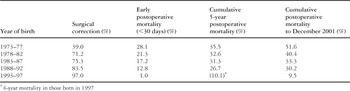
Table 1.

Age (months) at anatomical correction of isolated atrioventricular septal defect (n = 377), by year of birth among children with and without Down's syndrome (DS) born in Sweden 1973–1997. 1 standard deviation indicated.
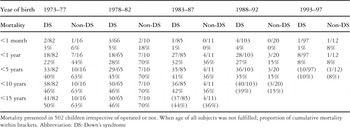
Table 2.

Cumulative survival in isolated atrioventricular septal defect (n = 502) to endpoint of study in December 2001 (mean observation time 13.5 years), in children born in the period 1973 through 1997 in Sweden, illustrated by a Kaplan-Meier survival curve. Distribution for different years of birth. Number of survivors and total number of liveborns (n) in each time period.

Cumulative survival to endpoint of study in December 2001 (mean observation time 13.5 years) in surgically treated () and non-surgically treated (—) children with isolated atrioventricular septal defect in Sweden born from 1973 through 1977, 1983 through 1987, and 1993 through 1997.
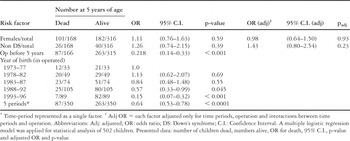
Table 3.

Mortality at 5 years of age (%) in operated and unoperated children with isolated atrioventricular septal defect born from 1973 through 1997 in Sweden. Odds ratio (OR) for death in operated children born in different time-periods.
 You have
Access
- 28
- Cited by