

Medical student's attitudes towards psychiatry have an impact on their overall educational experience, the quality of care psychiatric patients receive from physicians in the future and also recruitment to the specialty. Reference Das and Chandrasena1,Reference Nielson and Eaton2 In a survey 16 years ago we found that the perception of psychiatry in an Irish university was positive prior to and immediately following an 8-week clinical clerkship and on completion of the programme there was an increase in the proportion of students who indicated that they might choose a career in psychiatry. Reference Sloan, Browne, Meagher, Lane, Larkin and Casey3 A number of other studies have reported a positive change in attitude to psychiatry after a psychiatric clerkship, and others have failed to find any influence of a clerkship on students’ attitudes (Box 1).
Recent changes in Ireland underlie the importance of re-evaluating medical student attitudes to psychiatry in a new era. The Irish healthcare system both at undergraduate and postgraduate level is going through a period of considerable flux and change. At undergraduate level in University College Dublin, class sizes have increased, there has been the introduction of undergraduate modularisation with a reduction in the duration of the final-year psychiatric clerkships and the introduction of thematic and small group teaching. At postgraduate level the implementation of the European Union (EU) working time directive has changed the way junior doctors work and possibly altered medical student access to clinical teams. Budgetary cuts in the healthcare system have reduced the staffing levels, increased the pressure on clinical teams, potentially altering the clerkship experience of psychiatry for students. In 2009 the College of Psychiatry of Ireland was formed. The College is an Irish-only body and emerged when three bodies merged: The Irish College of Psychiatrists (a division of the Royal College of Psychiatrists UK), The Irish Psychiatric Association and The Irish Psychiatric Training Committee. According to some USA, British and Australian studies, the percentage of students choosing psychiatry as their future specialty has decreased considerably. Reference Brockington and Mumford11-Reference Malhi, Parker, Parker, Kirkby, Boyce and Yellowlees13 A similar trend has been noted in Ireland, with less than 50% of first-year training posts in psychiatry in Ireland filled in July 2011. In the UK only 61% of core training posts in psychiatry for 2011 had been filled by the first round of specialty recruitment, despite the Royal College of Psychiatrists extending the application window by almost a month. Reference Jacques14 All these factors have the potential to have an impact on medical student training and attitudes, warrant evaluation and may need to be considered in future training development if we are to recruit the best into the specialty.
Box 1 Studies examining the effect of clerkship on medical student attitudes to psychiatry
- Study
-
Attitudes
- Araya et al Reference Araya, Jasresic and Wilkinson4 (1992)
-
Positive
- Sloan et al Reference Sloan, Browne, Meagher, Lane, Larkin and Casey3 (1996)
-
Positive
- Al-Ansari et al Reference Al-Ansari and Alsadadi5 (2002)
-
No change
- Galka et al Reference Galka, Perkins, Butler, Griffith, Schmetzer and Avirrappattu6 (2005)
-
No change
- Niedermier et al Reference Niedermier, Bornstein and Brandemihl7 (2006)
-
Positive
- Fischel et al Reference Fischel, Manna, Krivoy, Lewis and Weizman8 (2008)
-
No change
- Sajid et al Reference Sajid, Khan, Shakir, Moazam-Zaman and Ali9 (2009)
-
Positive
- Xavier et al Reference Xavier and Almeida10 (2010)
-
Positive
In the UK, studies have consistently shown that only 3-4% of newly qualified doctors intend to pursue psychiatry as a career. Reference Maidment, Livingstone, Katona, Whitaker and Katona15 These findings are in contrast to the findings of a study that looked at the career intentions of potential UK medical students, which found that 12.4% reported a definite intention of pursuing psychiatry. Reference Maidment, Livingstone, Katona, Whitaker and Katona15 Although these studies are of different populations, authors have suggested that this might suggest a negative influence of undergraduate education on medical students’ career aspirations to pursue psychiatry. Reference Maidment, Livingstone, Katona, McParland and Noble16 Previous studies have reported decay in the interest of medical students in a career in psychiatry over the course of their medical school education. Reference Merton, Bloom and Rogoff17 Anumber of studies have demonstrated a more positive attitude to psychiatry as a subject and as a potential career choice in preclinical rather than clinical medical students. Reference Maidment, Livingstone, Katona, Whitaker and Katona15,Reference Pardes18
Aims
In light of these findings and the earlier introduction of psychiatric teaching to the curriculum in University College Dublin, we felt the assessment and comparison of the preclinical and clinical-year students’ attitudes to psychiatry and to a career in psychiatry in the same university could be instructive. Furthermore, little has been published on the capacity of a non-clinical teaching module to affect medical students’ attitudes to psychiatry as a subject and as a potential career choice. Our aims were as follows.
-
(a) In light of significant changes at undergraduate and postgraduate education level in Ireland, to reassess and compare the attitudes of Irish final-year medical students to psychiatry in 2010 with their 1994 counterparts.
-
(b) Assess and compare the attitudes of third-year and final-year medical students in the same university to psychiatry and a career in psychiatry.
-
(c) Assess and compare the impact of two dierent teaching modules on the attitudes of medical students towards psychiatry and also towards a career in psychiatry.
Method
Participants
At University College Dublin, psychiatry is taught as part of an introductory multisubject module in the final preclinical year (year 3) and again as a final-year subject with half the class completing a clerkship in year 5 and the remaining half completing their psychiatry clerkship in their final year (year 6).
During the academic year of 2010/2011, all students completing the third-year psychiatry preclinical module and all students completing the final-year clinical clerkship were asked to anonymously complete three attitudinal questionnaires on the first day of teaching prior to receiving any tuition in psychiatry and again on the final day of their module in psychiatry immediately after their end of module multiple choice questionnaire (MCQ) examination.
In third year, a mandatory 9-week composite module of psychiatry, obstetrics and paediatrics is delivered. Each specialty gets equal teaching time. The psychiatric teaching in this module comprises a series of nine interactive lectures in psychiatry used in combination with e-learning materials and three small group workshops. At the end of the module, student's are assessed by objective structured clinical examination (OSCE) and an MCQ.
The final year mandatory 6-week clinical psychiatry clerkship consists of 6 weeks of clinical attachment where students are assigned to one of six centres where they are allocated to a multidisciplinary clinical team. Teaching is delivered thematically. Every morning there is a small group teaching session on the theme for the day, followed by team attachment when students are given specific theme-related tasks such as to assess a patient with a specific condition or elicit specific information from multidisciplinary team members. Each afternoon students have a lecture to summarise and reinforce what they have learnt. Under the supervision of the consultant and registrar the students are involved in the clinical assessment of in-patients, out-patients and day patients. Students are assessed by continuous assessment and case presentation (20%), a reflective essay (20%), an MCQ paper (20%) and an OSCE (40%).
In 1994 the mandatory 8-week psychiatry clerkship consisted of a 1-week introduction to psychiatry by means of didactic lectures followed by a 5-week unstructured clinical attachment. A sixth week was spent attached to a child and adolescent unit. In week 7 the students visited some subspecialty facilities such as the forensic unit and centres for learning disability. The final week consisted of revision with a tutor. The exam in 1994 consisted of a clinical case-based exam and a written paper.
Questionnaires
In order to facilitate a direct comparison with the study completed 16 years ago and also with previous studies, we used the following three questionnaires, which have been used in a number of published studies. All of these questionnaires have been validated as measures of the attitudes of medical students to psychiatry and have previously been shown to be sensitive to change. These questionnaires included: the Attitudes to Psychiatry (ATP-30) scale, Reference Burra, Kalin, Leichner, Handforth, Jarrett and Amara19 the Specific Attitude to Psychiatry (SATP) questionnaire Reference Wilkinson, Greer and Toone20 and the Das & Chandrasena questionnaire. Reference Das and Chandrasena1
Completion of all three questionnaires took approximately 20 min. At the end of the module, students were asked to indicate their interest in psychiatry as a career and were encouraged to use the free-text section on the questionnaire to describe their subjective opinion of psychiatry. Data relating to gender, age and marital status were also compiled.
The Attitudes to Psychiatry (ATP-30) scale
The ATP-30 was validated on Canadian medical students and residents training in psychiatry. It was previously used in research of attitudes of both Kenyan Reference Niedermier, Bornstein and Brandemihl7 and Arabian Gulf Reference Al-Ansari and Alsadadi5 medical students. This is a 30-item questionnaire designed to measure the influence of psychiatric training on attitudes to psychiatry held by undergraduate medical students. The ATP uses a five-point Likert-type scale: 1, strongly agree; 2, agree; 3, neutral opinion; 4, disagree; and 5, strongly disagree. A total attitudinal score was computed for each respondent. Reference Burra, Kalin, Leichner, Handforth, Jarrett and Amara19
The Specific Attitude to Psychiatry (SATP) questionnaire
The SATP is a well-validated questionnaire and has previously been used in research of the attitudes of both British and Chilean medical undergraduates to psychiatry. Reference Wilkinson, Greer and Toone20 It contains 18 individual items relating to psychiatrists, psychiatry and psychiatric treatment. Of the 18 items, 9 express positive views and 9 express negative views. Attitudes are measured on a four-point scale from one (strongly agree) to four (strongly disagree). There is no ‘mixed feelings’ category. Although there are no formal instructions from the authors regarding the calculation of a total score, it is possible to compute this using a method similar to that of the ATP-30.
The Das & Chandrasena questionnaire
The Das & Chandrasena questionnaire contains 26 items and was validated on Canadian medical students. Reference Das and Chandrasena1 It is an extended version of the questionnaire developed by Nielson & Eaton. Reference Nielson and Eaton2 Response is on a five-point Likert-type scale as for the ATP-30. It is not possible to calculate a total score using this questionnaire.
Analysis
Data were analysed using the Statistical Package for the Social Sciences (SPSS) version 17 on Windows. Paired t-tests were used in the analyses of pre- and post-module mean total scores. Wilcoxon signed rank test were used in the analyses of student responses to questionnaire items pre- and post-module and conventional t-tests to examine group differences. Pearson's correlation coefficient was used to examine correlations between continuous variables.
Results
In the final-year sample, 169 students of a total of 198 students completed at least one of the questionnaires, however only 147 students (88 females, 59 males) could be identified as completing both pre- and post-questionnaires and thus be included in the analysis (74%). In the third-year sample, 150 students of a total of 196 students completed at least one of the questionnaires, however only 142 students (75 males, 67 females) could be identified as completing both pre- and post-questionnaires and thus be included in the analysis (72%). For demographic details of the three groups see Table 1.
Demographics of medical students

| n (%) | |||
|---|---|---|---|
| Third year, 2010 (n =142) |
Final year, 2010 (n = 147)Footnote a |
Final year, 1994 (n =110) |
|
| Gender | |||
| Male | 75 (53) | 59 (40) | 51 (46) |
| Female 67 (47) | 88 (60) | 59 (54) | |
| Marital status | |||
| Single | 139 (98) | 142 (97) | 105 (95) |
| Married | 2 (2) | 2(1) | 5(5) |
| Nationality | |||
| Irish | 101 (71) | 106 (72) | N/A |
| Malaysian | 16 (11) | 22 (15) | N/A |
| Canadian | 9 (7) | 14 (10) | N/A |
| American | 7 (5) | 2 (1) | N/A |
| Other | 9 (7) | 2 (1) | N/A |
| Medicine first degree? | |||
| Yes | 103 (73) | 130 (88) | N/A |
| No | 39 (27) | 17 (12) | N/A |
N/A, information not available.
a One student did not disclose their nationality.
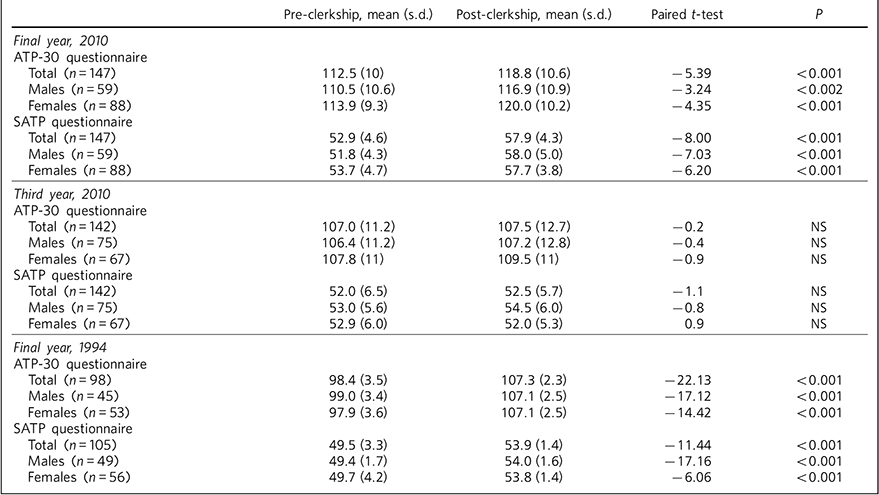
In the 2010 final-year sample the pre-module mean score on the ATP-30 (logical neutral point: 90) was 112.5 (s.d. = 10) and this rose significantly (P<0.001) to 118.83 (s.d. = 10.6) post-module (Table 2). Female students were statistically more likely to score higher on the pre-module ATP-30 than male students (r = 0.20, P<0.02). The SATP questionnaire has a neutral score of 45. The pre-module mean SATP score of 52.9 (s.d. = 4.64) increased significantly (P<0.001) to 57.85 (s.d. = 4.30) at the end of the module.
Pre- and post-module mean total scores for the Attitudes to Psychiatry (ATP-30) and the Specific Attitude to Psychiatry (SATP) questionnaires
| Pre-clerkship, mean (s.d.) | Post-clerkship, mean (s.d.) | Paired t-test | P | |
|---|---|---|---|---|
| Final year, 2010 | ||||
| ATP-30 questionnaire | ||||
| Total (n = 147) | 112.5 (10) | 118.8 (10.6) | –5.39 | <0.001 |
| Males (n = 59) | 110.5 (10.6) | 116.9 (10.9) | –3.24 | <0.002 |
| Females (n = 88) | 113.9 (9.3) | 120.0 (10.2) | –4.35 | <0.001 |
| SATP questionnaire | ||||
| Total (n =147) | 52.9 (4.6) | 57.9 (4.3) | –8.00 | <0.001 |
| Males (n = 59) | 51.8 (4.3) | 58.0 (5.0) | –7.03 | <0.001 |
| Females (n = 88) | 53.7 (4.7) | 57.7 (3.8) | –6.20 | <0.001 |
| Third year, 2010 | ||||
| ATP-30 questionnaire | ||||
| Total (n = 142) | 107.0 (11.2) | 107.5 (12.7) | –0.2 | NS |
| Males (n = 75) | 106.4 (11.2) | 107.2 (12.8) | –0.4 | NS |
| Females (n =67) | 107.8 (11) | 109.5 (11) | –0.9 | NS |
| SATP questionnaire | ||||
| Total (n = 142) | 52.0 (6.5) | 52.5 (5.7) | –1.1 | NS |
| Males (n = 75) | 53.0 (5.6) | 54.5 (6.0) | –0.8 | NS |
| Females (n =67) | 52.9 (6.0) | 52.0 (5.3) | 0.9 | NS |
| Final year, 1994 | ||||
| ATP-30 questionnaire | ||||
| Total (n = 98) | 98.4 (3.5) | 107.3 (2.3) | –22.13 | <0.001 |
| Males (n = 45) | 99.0 (3.4) | 107.1 (2.5) | –17.12 | <0.001 |
| Females (n = 53) | 97.9 (3.6) | 107.1 (2.5) | –14.42 | <0.001 |
| SATP questionnaire | ||||
| Total (n = 105) | 49.5 (3.3) | 53.9 (1.4) | –11.44 | <0.001 |
| Males (n =49) | 49.4 (1.7) | 54.0 (1.6) | –17.16 | <0.001 |
| Females (n = 56) | 49.7 (4.2) | 53.8 (1.4) | –6.06 | <0.001 |
Compared with the final-year students in 1994, final-year students in 2010 were significantly more positive in their attitude to psychiatry both pre- and post-clerkship, as measured on the ATP-30 and on the SATP (Table 2). In 1994 the ATP-30 pre-clerkship mean was 98.4 (s.d. = 3.5) and the SATP pre-clerkship mean was 49.5 (s.d. = 3.3). The difference between the 1994 sample and the 2010 sample was statistically significant for both pre-clerkship means (ATP-30: t = 13.4, P<0.001; SATP: t = 6.3, P<0.001). Post-clerkship in the 1994 sample the ATP-30 had a mean of 107.3 (s.d. = 2.3) and the SATP had a mean of 53.9 (s.d. = 1.4). The difference between the two samples post-clerkship score was also statistically significant (ATP: t = 10.6, P<0.001; SATP: t = 8.7835, P<0.001). In both studies there was a statistically significant rise in the ATP-30 and SATP post-clerkship means (Table 2).
In the 2010 third-year sample the pre-module mean score on the ATP-30 was lower than the 2010 final-year sample at 107 (s.d. = 11.2) but higher than the 1994 final-year sample. The post-module score was 107.5 (s.d. = 12.7), this was not a statistically significant increase. The pre-module mean SATP score was also lower than the 2010 final-year sample at 52 (s.d. = 6.5) but higher than the 1994 final-year sample. The SATP score rose, although not with significance, to 52.5 (s.d. = 5.7). There was no relationship between gender and either of the post-module total scores on the ATP-30 or the SATP (Table 2).
ATP-30
Results of the Wilcoxon signed rank test for individual questionnaire items that showed significant change from pre- to post-module are displayed in Table 3. In 1994, post-clerkship students were more likely to believe that ‘Psychiatric training increases our understanding of medical and surgical patients’ only. No other statistically significant changes occurred in items on the ATP-30 in the 1994 sample.
Attitudes to Psychiatry (ATP-30) items in 2010 that showed significant change from pre- to post-module

| Pre-module, % (n) | Post-module, % (n) | Wilcoxon Z |
|||
|---|---|---|---|---|---|
| Item | Agree | Disagree | Agree | Disagree | |
| Final year (n =147) | |||||
| 9. Psychiatric training increases our understanding of medical and surgical patients | 79 (116) | 9 (13) | 86 (127) | 7 (10) | 3.77*** |
| 10. The majority of students report that their psychiatric undergraduate training has been valuable | 63 (93) | 3 (5) | 84 (124) | 5 (7) | 4.65*** |
| 23. These days psychiatry is the most important part of the curriculnum | 10 (15) | 70 (104) | 18 (26) | 60 (88) | 2.20* |
| 25. In recent years psychiatric treatment has become quite effective | 67 (98) | 3 (5) | 87 (128) | 5 (7) | 4.62*** |
| 29. Psychiatric patients are often more interesting to work with than other patients | 55 (81) | 8 (12) | 76 (112) | 8 (12) | 5.27*** |
| Third year (n = 142) | |||||
| 23. These days psychiatry is the most important part of the curriculum | 4 (6) | 68 (97) | 20 (28) | 46 (65) | 2.0* |
| 25. In recent years psychiatric treatment has become quite effective | 54 (77) | 5 (7) | 73 (104) | 4 (6) | 3.2** |
* P<0.05; ** P<0.01; *** P<0.001.
Das & Chandrasena questionnaire
Table 4 describes the items that showed significant changes from pre- to post-module for the 2010 final-year and third-year students. In the 1994 sample, only one item on this questionnaire changed significantly after the clerkship, this was that ‘Psychiatrists should, where necessary, continue to have the legal power to treat patients against their will’; the percentage of students who agreed with this statement rose from 3.6% to 40% post-clerkship. In the 2010 final-year sample, 78% of students agreed with this statement prior to their module and this rose to 81% after completion of the module.
Das & Chandrasena items in 2010 that showed significant change from pre- to post-module

| Pre-module, % (n) | Post-module, % (n) | Wilcoxon Z |
|||
|---|---|---|---|---|---|
| Item | Agree | Disagree | Agree | Disagree | |
| Final year (n = 147) | |||||
| 1. Psychiatry has advanced considerably in recent years in the biological treatment and understanding of schizophrenia and bipolar | 67 (98) | 2 (3) | 91 (133) | 3 (5) | 4.65Footnote *** |
| 5. If someone in my family was very emotionally upset and the situation didn't seem to be improving, I would recommend a psychiatric consultation | 67 (98) | 6 (9) | 83 (122) | 3 (5) | 3.37Footnote *** |
| 6. Psychiatric consultations for medical and surgical patients are only rarely helpful | 3 (5) | 69 (101) | 1 (2) | 90 (132) | 4.43Footnote *** |
| 24. There is no place for ECT in modern medicine | 9 (13) | 46 (67) | 2 (3) | 89 (131) | 9.10Footnote *** |
| Third year (n = 142) | |||||
| 24. There is no place for ECT in modern medicine | 24 (34) | 50 (71) | 8 (11) | 84 (119) | 4.2Footnote *** |
ECT, electroconvulsive therapy.
*** P<0.001.
SATP
In the 1994 study, statistically significant changes occurred in 3 of the 18 items. Although only one of these changes is replicated in the 2010 sample, four items did change significantly (Table 5). In the 1994 study, 58% of students prior to the clerkship agreed that psychiatrists ‘are more concerned than other doctors to establish rapport with their patients’: this rose to 85% post-clerkship. In 2010, 95% of students agreed with this statement prior to the module and 96% agreed after. In the 1994 study, 57% of students prior to the clerkship agreed that ‘Psychiatric skills are essential in general practice’: this rose to 95% after the clerkship. In our study 93% agreed with this statement pre-module and 93% post-module. The final SATP item that reached statistical significance in the 1994 study and also in the 2010 study was that ‘Too little time is devoted to psychiatry in the medical curriculum’. In 1994, prior to the clerkship 30% of students agreed with this statement and 46% agreed post-clerkship. In the 2010 sample, 38.6% of students agreed with this statement prior and 50% after the module.
The Specific Attitude to Psychiatry (SATP) items in 2010 that showed significant change from pre- to post-module

| Pre-module, % (n) | Post-module, % (n) | Wilcoxon Z |
|||
|---|---|---|---|---|---|
| Item | Agree | Disagree | Agree | Disagree | |
| Final year (n =147) | |||||
| 8. Psychiatric patients hardly ever get better | 33 (49) | 67 (98) | 5 (7) | 95 (140) | 5.50*** |
| 10. Within medicine, psychiatry is one of the less important specialties | 22 (32) | 79 (116) | 1 (1) | 89 (131) | 2.89*** |
| 14. Too little time is devoted to psychiatry in the medical curriculum | 35 (52) | 57 (83) | 64 (94) | 34 (50) | 3.13** |
| 18. Psychiatric patients, generally speaking are not easy to like | 32 (47) | 62 (91) | 9 (13) | 87 (128) | 4.95*** |
| Third year (n = 142) | |||||
| 8. Psychiatric patients hardly ever get better | 35 (50) | 65 (92) | 11 (15) | 87 (124) | 4.30*** |
| 10. Within medicine, psychiatry is one of the less important specialties | 23 (33) | 77 (109) | 8 (12) | 87 (124) | 2.2** |
** P<0.01; *** P<0.001.
We found no correlation between the ATP-30 or SATP scores and the end of module exam results. No association was found between age and attitudes to psychiatry or interest in a career in psychiatry. No association was found between a family member working in mental health services and scores on the ATP-30 or SATP pre- or post-module. Students who expressed an interest in becoming a psychiatrist at the end of either of the modules were more likely to score higher on both the ATP-30 and the SATP (third year: r = –0.55, P<0.001; final year: r = –0.44, P<0.001).
In response to the question ‘Would you like to be a psychiatrist?’, prior to the module 18% (n = 26) of final-year students and 22% (n = 32) of third-year students stated they would and this increased to 33% (n = 49) of final-year students and 32% (n = 47) of the third-year students after. Students in the third year were no more likely than their final-year colleagues to express an interest in becoming a psychiatrist, however 14% of third-year students (n = 20) wrote in the free-text section that they were undecided and awaited the clinical attachment in the final year. Those students for whom medicine was not their first degree were less likely to report an interest in psychiatry as a career (r = 0.275, P<0.05). In response to a similar if less specific question in 1994 ‘Have you ever considered taking up psychiatry?’, 45% of students stated that they had prior to the clerkship, whereas afterwards 57% stated they had.
In the free-text section in the post-module questionnaire only 7% (n = 10) of the final-year students expressed negative opinions about psychiatry, whereas only 3% (n =4) of third-year students expressed negative opinions about psychiatry. Examples of these negative attitudes included statements that psychiatry was ‘too slow paced’, ‘too emotionally demanding’ and ‘just not for me’. No association was found between those students who expressed negative opinions of psychiatry and scores on the ATP-30 or the SATP. However, there was a trend for students who spontaneously expressed negative or critical attitudes to psychiatry to have poorer psychiatry examination results when compared with the remainder of the students (t = –1.7, P = 0.07). In 1994, 34% of students expressed negative attitudes to psychiatry; views expressed at this time included statements that psychiatry was ‘too vague’, ‘unscientific’, ‘depressing’ and that it was associated with ‘low job satisfaction’.
Discussion
Limitations
A particular methodological issue that must be addressed is that despite assurances otherwise, students may perceive that negative answers on the surveys, in particular prior to their clerkships, may result in less favourable treatment during their module. Thus inducing a bias towards an ‘expected’ group response. Anonymity was assured but students may not necessarily believe this to be the case, and so adjust their responses accordingly. We took several measures to reduce bias from fear of revealing negative attitudes, and to diminish any tendencies to give a socially favourable response. First, participation was optional; second, students were assured that their responses would not be analysed until the end of all of their psychiatry modules. Furthermore, we allowed a free-text response to allow students to express their opinion of psychiatry and to outline the reasons they would or would not consider a career in psychiatry. The responses in this free text were sufficiently disparate to assure us that they were expressing their genuine opinions.
Main findings
The attitudes of preclinical and clinical medical students in Ireland towards psychiatry are positive even prior to any teaching in psychiatry as evidenced by their scores on the ATP-30 and SATP. These attitudes are more positive now than they were in 1994. Unlike the findings of other studies, prior to commencing the modules the final-year and third-year students did not differ significantly in their attitudes to psychiatry.
Possible explanations for findings
A number of factors may explain the more positive attitude to psychiatry seen in this final-year sample of Irish students compared with their 1994 counterparts. Some authors believe that the general opinion of psychiatry is gradually improving, together with its social image in general. Reference Brown, Addie and Eagles21,Reference Pailhez, Bulbena, Coll, Salvador and Balon22 Psychiatry is now being introduced at an earlier stage of the curriculum and all final-year students in the 2010 sample themselves completed the third-year composite module that included some psychiatry teaching. Authors have suggested that the overemphasis on acute hospital-based medicine during undergraduate training acts as a powerful disincentive for recruitment into primary care and the same may apply for psychiatry. Reference Whitecomb and Cohen23 Others feel that influences are less subtle, with direct negative effects on attitudes to psychiatry occurring during medical and surgical training. Reference Creed and Goldberg24 It would seem reasonable to propose that the preclinical teaching in psychiatry could have prevented the decay in attitude during the clinical years that has been described in other studies.
The post-module scores of the 2010 final-year sample are also higher than the 1994 sample. Although this may seem unsurprising in light of the higher pre-module scores, one could also say that the higher pre-module scores make a significant shift in attitude even more difficult to achieve. A factor that may be contributing to this finding is the new psychiatric curriculum, which although shorter is using newer teaching methods and is more inclusive of other medical specialties thereby increasing the relevance of psychiatry to medical training overall. Other studies have found that shorter but more interactive teaching methods are at least as, if not more, effective than traditional clerkships characterised by old-style didactic lectures. Reference Singh, Baxter, Standen and Duggan25
The third-year medical students who participated in a composite module that had psychiatry teaching as a component did not demonstrate a change - either positive or negative - in their attitude to psychiatry. This is in contrast with their final-year colleagues who after completion of their 6-week clinical attachment demonstrated significant improvements in their attitudes to psychiatry as a specialty and their interest in psychiatry as a career. This suggests that the clinical module, with its emphasis on patients and psychiatric team contact, has the greater capacity to change medical students’ attitudes at least in the short term. So although the earlier introduction of psychiatry into the teaching curriculum of medical school may not itself alter attitudes to psychiatry, it may reinforce pre-existing positive attitudes and increase the likelihood that they will be maintained during and after the clinical years.
Students who have completed a degree prior to medicine were less likely in this study to express an interest in a career in psychiatry. Irish medical schools, on the basis of government recommendations in 2006, have been increasing the intake of graduate entry students to medicine. 26 Psychiatry had expected, based on previous research, to benefit from this in that graduates might be more likely to consider a career in psychiatry. Reference Cameron and Persad27,Reference Nemetz and Weiner28 However, our study does not show this to be likely in Ireland. Nemetz & Weiner found that those who chose psychiatry had majored more often in the humanities or social sciences rather than the natural sciences. Reference Nemetz and Weiner28 A similar study in Canada found that those students expressing an interest in a career in psychiatry are more likely to have completed an undergraduate degree in the humanities than the biological sciences. Reference Gowans, Glazier, Wright, Brenneis and Scott29 However, entry requirements to Irish graduate medical school may prejudice entry in favour of a background in biological science as opposed to social science or the humanities. Results from our study suggest that graduate-entry medical students at University College Dublin (n = 56) are entering medicine with a bachelor degree in the natural sciences (n = 41, 73%) rather than from the humanities/social sciences (n = 3, 5%). This is an issue not only for Irish psychiatry but also psychiatry across Europe as graduate entry into medicine increases in prevalence. Of particular concern is the fact that some UK universities restrict entry to graduate medicine to graduates in the biological sciences. 30
After completing the module we found a significant rise in the proportion of students who stated that they would like to be a psychiatrist. However, neither the apparent positive attitude to psychiatry nor the declared intention by medical students to follow a career in psychiatry appears to be translating into increased recruitment into the specialty. The transient nature of attitudinal changes has been well described. Reference Brockington and Mumford11 Perhaps stated career intentions in medical school, even in the final year, may not necessarily translate into an actual career choice post-internship. Mowbray & Davies found that 65% of students who chose a career in psychiatry do so after graduation. Reference Mowbray and Davies31 It may be that students are attracted to the module they are completing at the time and as other specialties get more time in the medical school curriculum the interest ignited or fanned by the psychiatric clerkship wanes in the face of other medical experiences. It does seem that the more exposure students have (to either community or hospital medicine), the keener they become on careers in those areas. Reference Howe and Ives32 A development that may help to address this in Ireland is that in 2011 for the first time intern positions in psychiatry became available. Similar programmes in the UK have anecdotally been associated with positive recruitment outcomes.
Implications
Our data suggest that the past 16 years have seen a significant improvement in the attitudes of medical students to psychiatry, however this has not corresponded to increased recruitment into psychiatry. The challenge, which is not unique to Ireland, is how to reduce the dissonance between a positive attitude to psychiatry as a specialty, and the actual choice of psychiatry as a career. The findings of this study call for further investigation in Ireland regarding the factors influencing medical students that determine the ultimate choice of or rejection of psychiatry as a career.
Acknowledgements
We would like to acknowledge the considerable work of the group who published the 1996 paper: Dr Darina Sloan, Dr Stephen Browne, Dr Diane Meagher, Dr Conall Larkin, Professor Patricia Casey, Professor Noel Walsh and Professor Eadbhard O’Callaghan.


 Open access


eLetters
No eLetters have been published for this article.