Introduction
Glyphosate is a nonselective, systemic herbicide that inhibits 5-enolpyruvylshikimate-3-phosphate synthase within plants, bacteria, and some fungi (Dill Reference Dill2005; Franz et al. Reference Franz, Mao and Sikorski1997). Glyphosate is efficacious on annual, biennial, and perennial weeds, is relatively inexpensive, and exhibits low toxicity to the environment and mammals (Duke and Powles Reference Duke and Powles2008). It translocates within the apoplast and symplast, accumulating in actively growing tissues within the plant (Franz et al. Reference Franz, Mao and Sikorski1997). Glyphosate readily binds to soil colloids, and therefore provides no residual weed control (Franz et al. Reference Franz, Mao and Sikorski1997). The efficacy of glyphosate is affected by weed species and weed size at the time of application; therefore, herbicide rate may need to be adjusted for acceptable weed control (Hartzler et al. Reference Hartzler, Singer, Kohler and Buhler2006). Glyphosate-resistant (GR) crops were first introduced in 1996 in canola (Brassica napus L.) and soybean (Dill Reference Dill2005). The introduction of GR crops has led to increased use of glyphosate within a growing season and in consecutive years, which increases the selection pressure for GR weeds (Duke and Powles Reference Duke and Powles2008).
Horseweed, also known as Canada fleabane or marestail, is a broadleaf weed in the Asteraceae family (Loux et al. Reference Loux, Stachler, Johnson, Nice, Davis and Nordby2006). Horseweed can germinate in the fall after the mother plant releases seed, allowing it to overwinter and have a competitive advantage over annual crops and weed species the following growing season (Main et al. Reference Main, Steckel, Hayes and Mueller2006). In Ontario, horseweed biotypes have been observed to germinate at temperatures as low as 8 C (Tozzi et al. Reference Tozzi, Beckie, Weiss, Gonzalez-Andujar, Storkey, Cici and Van Acker2014). The majority of horseweed emergence in Ontario has been observed in the month of May (spring) and late August (fall) (Tozzi and Van Acker Reference Tozzi and Van Acker2014). Tillage is an important factor in horseweed management, as the reduction in tillage has led to the increase of horseweed in no-till corn (Zea mays L.) and soybean (Loux et al. Reference Loux, Stachler, Johnson, Nice, Davis and Nordby2006). Nandula et al. (Reference Nandula, Eubank, Poston, Koger and Reddy2006) observed a decrease in emergence with an increase in seed depth, which may be due to the small horseweed seeds having limited reserves (Tozzi et al. Reference Tozzi, Beckie, Weiss, Gonzalez-Andujar, Storkey, Cici and Van Acker2014). The dispersion of horseweed seed hundreds of meters from the source is due to a pappus attached to the seed (Dauer et al. Reference Dauer, Mortensen and Humston2006). Previously, glyphosate provided excellent control of horseweed, but the intense selection pressure from multiple applications of glyphosate has led to the evolution of GR horseweed in Delaware, USA, in 2000, and in Ontario, Canada, in 2010, as well as in many other locations in North America (Bruce and Kells Reference Bruce and Kells1990; Byker et al. Reference Byker, Soltani, Robinson, Tardif, Lawton and Sikkema2013; Heap Reference Heap2018; VanGessel Reference VanGessel2001). GR horseweed has been reported to decrease soybean yield up to 69% in Ontario (Budd Reference Budd2016). Horseweed has evolved resistance to five different sites of action globally: Groups 2, 5, 7, 9, and 22 (Heap Reference Heap2018).
The increase in GR weeds and weeds with resistance to multiple sites of action has increased the demand for new herbicide modes of action and biotechnology traits. One solution that became commercially available in Canada in 2017 is glyphosate/dicamba-resistant soybean (Roundup Ready 2 Xtend® soybean). Glyphosate/dicamba-resistant soybean contains separate genes that confer resistance to glyphosate and dicamba. Glyphosate is an effective option for the control of susceptible grass and broadleaf weeds; dicamba has activity on a wide range of broadleaf weeds, including GR biotypes, and can be an effective second mode of action on glyphosate-susceptible broadleaf species. Dicamba is a Group 4, benzoic acid, growth-regulator (synthetic auxin) herbicide (Cobb and Reade Reference Cobb and Reade2010). Dicamba provides short residual broadleaf weed control. The length of residual activity is dependent on the soil type, rainfall, and soil organic matter (Burnside and Lavy Reference Burnside and Lavy1966; Shaner Reference Shaner2014; Smith Reference Smith1973).
Previous research by Budd et al. (Reference Budd, Soltani, Robinson, Hooker, Miller and Sikkema2016) found that saflufenacil (25 g ai ha−1) applied to 25-cm-tall GR horseweed provided 95% to 99% control. Other research on the control of GR horseweed observed there was a decrease in efficacy with saflufenacil (25 or 50 g ai ha−1) as plant height increased from 5 to 45 cm; increasing the rate ≥75 g ai ha−1 did not increase control (Mellendorf et al. Reference Mellendorf, Young, Matthews and Young2013). Kruger et al. (Reference Kruger, Davis, Weller and Johnson2010) observed 97% to 98% GR horseweed control across all application timings (0 to 7 cm, 7 to 15 cm, 15 to 30 cm, and >30 cm) with the diglycolamine salt of dicamba (280 g ae ha−1). Dicamba (280 g ae ha−1, dimethylamine salt) controlled horseweed 89% to 99% with >97% control of plants measuring 1 to 30 cm; 2,4-D ester and 2,4-D amine at 560 g ae ha−1 controlled horseweed (30-cm in height at application) 94% to 97% and 90% to 93%, respectively (Kruger et al. Reference Kruger, Davis, Weller and Johnson2010).
The hypothesis was that GR horseweed control will decrease as the application timing is delayed and the rate of glyphosate/dicamba is reduced. Therefore, the objective of this study was to evaluate the efficacy of glyphosate/dicamba for the control of GR horseweed at three rates of glyphosate/dicamba and three application timings.
Materials and Methods
This study was conducted near Mull (42.401671°N, 81.991098°W), Blenheim (42.335561°N, 81.997442°W), and Harrow, Ontario (42.035582°N, 82.918173°W), in 2016, and near Mull, Thamesville (42.551722°N, 81.977180°W), and Harrow, Ontario, in 2017, for a total of six site-years. A 3 by 4 factorial was arranged in a randomized complete block design with four replications. Factor 1 was application timings (when the height of horseweed was on average 5, 15, or 25 cm); factor 2 was glyphosate/dicamba rates (0, 900, 1,350, or 1,800 g ae ha−1). The premix formulation of glyphosate/dicamba is a 2 to 1 ratio of glyphosate to dicamba. Glyphosate is present in the premix as a monoethanolamine salt at 240 g ae L−1, and dicamba is present as a diglycolamine salt at 120 g ae L−1. The herbicide applications were based on weed height and not soybean stage; therefore, some applications made at the 5- or 15-cm stage were applied before crop planting or emergence. Herbicides were applied with a 1.5-m hand boom at 275 psi and rate of 200 L ha−1 with four Turbo TeeJet® induction (Teejet Technologies, Wheaton IL) nozzles spaced 50-cm apart. Soybean cultivars DKB14-41 and DKB10-01 (Monsanto, St Louis, MO) were planted with a no-till planter in 2016 and 2017, respectively. Each plot was 2.25-m wide (3 soybean rows spaced 75-cm apart) and 8-m long. Soybean was planted at a rate of approximately 400,000 seeds ha−1 to an approximate depth of 4 cm. One in-season application of glyphosate (450 g ae ha−1) was applied per location per year to remove other weeds within the trial area. Soybean injury was assessed visually at 2 and 4 weeks after emergence, where 0% was no injury compared to soybean in the weedy control and 100% was plant death. Horseweed control was assessed visually at 2, 4, and 8 wk after application (WAA), where 0% was no difference between the treatment and the weedy control and 100% was no visible weeds in the plot. At 6 WAA, density and biomass were determined by counting the number of horseweed plants within two 0.25m2 quadrants in each plot. The plants were cut at the soil surface, placed in a paper bag, and dried at 60 C. After 2 wk, the plant samples were removed and the weight was recorded. In 2016, soybean yield was determined by harvesting two 1-m subsamples by hand from two rows of each plot. The soybean plants were threshed with a stationary Almaco thresher (Almaco, Nevada, IA). In 2017, two rows of soybean plot−1 was harvested at maturity with an Almaco small plot combine. Soybean weight and moisture content were recorded, and moisture content was corrected to 14.5%.
The GLIMMIX procedure in SAS v. 9.4 (SAS Institute, Cary, NC) was used for statistical analysis. The fixed effects were the herbicide rate and application timing, and the random effects were environment and block. Residuals were analyzed individually for each analysis using the UNIVARIATE procedure for normality, homogeneity, and errors independent of each other. The weedy controls were not included in the control analysis. Soybean yield and horseweed control data at 2 and 4 WAA were fit to a normal distribution using the identity link. Horseweed control data at 8 WAA were fit to a beta distribution, and cumulative complementary log-log link was used. Horseweed density and biomass data were analyzed using a log-normal distribution with the identity link and back-transformed within SAS for presentation purposes. Soybean yield data did not need transformation. Treatment means were separated by Fisher’s protected LSD and a Tukey-Kramer adjustment with alpha set at P = 0.05.
Results and Discussion
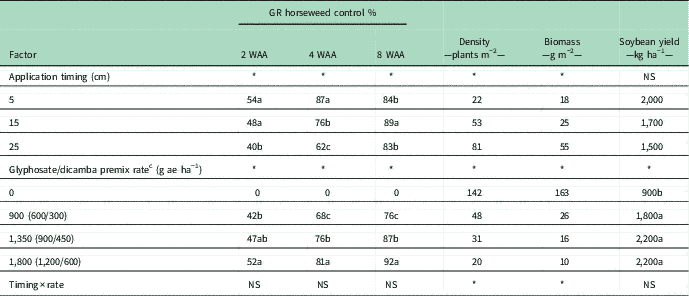
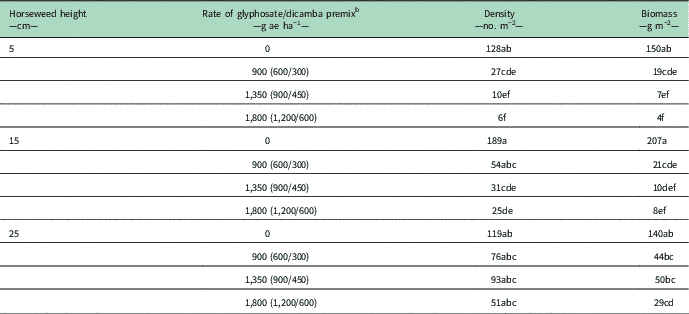
Glyphosate/dicamba caused no visible soybean injury at the application rates and timings evaluated (unpublished data). There was no interaction between glyphosate/dicamba application timing and rate for GR horseweed control and soybean yield; therefore, the main effects will be presented (Table 1). There was an interaction between glyphosate/dicamba application timing and rate for GR horseweed density and biomass; therefore, the simple effects will be presented (Table 2).

a Abbreviations: GR, glyphosate-resistant; NS, not significant; WAA, weeks after application.
b Means for GR horseweed control, density, and biomass and soybean yield for application timings and herbicide rates at 6 site-year locations in 2016 and 2017 in Ontario. Means followed by the same letter within a column are not statistically different according to Fisher’s protected LSD (P = 0.05); asterisk (*) indicates significant difference between application timings, herbicide rates, or timings × rates.
c The premix formulation of glyphosate/dicamba is a 2 to 1 ratio of glyphosate to dicamba.
Means for horseweed density and biomass from six experiments in Ontario in 2016 and 2017. a

a Means followed by the same letter within a column are not statistically different according to Fisher’s protected LSD (P = 0.05).
b The premix formulation of glyphosate/dicamba is a 2 to 1 ratio of glyphosate to dicamba.
Application Timing
GR horseweed control and soybean yield were affected by glyphosate/dicamba application timing (5-, 15-, or 25-cm-tall GR horseweed at the time of application) (Table 1). At 2 and 4 WAA, as the application of glyphosate/dicamba was delayed, there was a decrease in the control of GR horseweed. At 2 WAA, there was no difference in control when glyphosate/dicamba was applied to GR horseweed that was 5 or 15 cm in height, but control was decreased when application was delayed until GR horseweed was 25 cm in height. At 4 WAA, glyphosate/dicamba applied to 5-, 15-, and 25-cm-tall GR horseweed provided 87%, 76%, and 62% control, respectively. At 8 WAA, glyphosate/dicamba applied to 15-cm horseweed was the most efficacious, and applications to horseweed 5 and 25cm in height produced similar results and were less effective than the 15-cm application. There was a trend to reduced soybean yield as the application of glyphosate/dicamba was delayed, but differences were not significant.
Application Rate
There was an effect of glyphosate/dicamba rate (900, 1,350, and 1,800 g ae ha−1) on GR horseweed control. At 2, 4, and 8 WAA, there was an increase in GR horseweed control as the rate of glyphosate/dicamba increased (Table 1). At 2, 4, and 8 WAA, glyphosate/dicamba (900 g ae ha−1) controlled GR horseweed 42%, 68%, and 76%, respectively; whereas when the rate was increased to 1,800 g ae ha−1 control increased to 52%, 81%, and 92%, respectively; there was a 10% to 16% increase in control with the highest rate. Reduced GR horseweed interference after application of glyphosate/dicamba (900, 1,350, and 1,800 g ae ha−1) resulted in an increase in soybean yield of 100% to 144% compared with the weedy control.
Interaction of Glyphosate/Dicamba Application Timing and Rate on GR Horseweed Density and Biomass
Glyphosate/dicamba reduced GR horseweed density 22% to 95% (Table 2). Glyphosate/dicamba (900, 1,350, and 1,800 g ae ha−1) applied to 5-, 15-, and 25-cm-tall plants reduced GR horseweed density 78% to 95%, 71% to 86%, and 36% to 57%, respectively, indicating that the delayed application resulted in a smaller decrease in density. At 6 WAA, glyphosate/dicamba at 900, 1,350, and 1,800 g ae ha−1 applied at the 5-cm application timing decreased GR horseweed density 78%, 92%, and 95%, respectively; when the application was delayed until the GR horseweed was 15 cm in height there was a decrease in density at only the 1,350 and 1,800 g ae ha−1 rates, and when the application was delayed until the GR horseweed was 25 cm in height, there was a no decrease in GR horseweed density as rate increased. Although there was a numeric decrease in density as glyphosate/dicamba rate was increased at each application timing, there was a much greater decrease in density with the early-application timing.
Glyphosate/dicamba (900, 1,350, and 1,800 g ae ha−1) reduced horseweed biomass 64% to 97% (Table 2). Glyphosate/dicamba applied to 5-, 15-, and 25-cm-tall plants reduced GR horseweed biomass 87% to 97%, 90% to 96%, and 64% to 79%, respectively, indicating that the delayed application resulted in a smaller decrease in biomass. At 6 WAA, glyphosate/dicamba at 900, 1,350, and 1,800 g ae ha−1 applied to 5- or 15-cm-tall plants decreased GR horseweed biomass 87% to 90%, 95%, and 96% to 97%, respectively. When the glyphosate/dicamba application was delayed until GR horseweed was 25 cm in height, there was no decrease in biomass when glyphosate/dicamba was applied at 900 and 1,350 g ae ha−1; glyphosate/dicamba at 1,800 g ae ha−1 decreased GR horseweed biomass 79%. There was a numeric decrease in GR horseweed biomass as glyphosate/dicamba rate was increased at each application timing. Biomass decreased with all rates of glyphosate/dicamba applied to horseweed 5 or 15 cm in height compared with the weedy control. There was only a decrease in biomass compared with the weedy control at the 25-cm application timing when glyphosate/dicamba was applied at 1,800 g ae ha−1.
In conclusion, there was no soybean injury observed in this study, which was expected with the use of glyphosate/dicamba-resistant soybean cultivars. There was an increase in GR horseweed control with an increase in glyphosate/dicamba rate and at earlier application timings. Reductions in biomass and density followed the same trend, with the greatest reduction observed when the herbicide was applied at the higher rates to weeds that were 5 or 15 cm in height. Control at 2 WAA was 40% to 54%, indicating that dicamba is a slow-acting herbicide and may need to be mixed with another herbicide for faster early-season weed control. Early weed control is important; previous research found a soybean yield loss of 5% or less was observed when soybean was maintained weed free until the V3 growth stage (Van Acker et al. Reference Van Acker, Swanton and Weise1993). Similarly, in this study, there was a trend to reduced soybean yield when herbicide application was delayed. At 6 WAA, the late-application timing (25 cm) resulted in a smaller decrease in GR horseweed density and biomass, indicating reduced efficacy with delayed herbicide applications. At all application timings, there was a trend to a greater decrease in density and biomass as the rate of glyphosate/dicamba was increased. This study found that glyphosate/dicamba should be applied at medium to high rates (1,350 to 1,800 g ae ha−1) to weeds <15 cm to ensure adequate GR horseweed control.
Acknowledgments
Funding for this project was provided in part by the Grain Farmers of Ontario and through the Growing Forward (GF 2) program administered by the Agricultural Adaptation Council (AAC). No conflicts of interest have been declared.