Introduction
Gastric ulceration has been described as a significant problem in many populations of equines in the UK and overseas. Many studies have been undertaken to determine its prevalence in horses, in particular Thoroughbreds and Standardbreds in race training. The prevalence of gastric ulceration has been shown to be as high as 100% in actively training racehorses (Murray et al., Reference Murray, Schusser, Pipers and Gross1996), 70% in Thoroughbred broodmares (Le Jeune et al., Reference Le Jeune, Nieto, Dechant and Snyder2008) and 17% in non-working mixed breed horses (Hartmann and Frankeny, Reference Hartmann and Frankeny2003). Gastric ulceration can lead to animals displaying clinical signs such as lack of appetite, weight loss, recurrent colic and general poor condition. Many studies have focused upon intensive housing (Orsini and Pipers, Reference Orsini and Pipers1997) and training systems (White et al., Reference White, McClure, Sifferman, Holste, Fleishman, Murray and Cramer2007) and have shown that environmental and management stresses are risk factors for the development of gastric ulcers. Other risk factors such as diets high in carbohydrate (Murray and Eichorn, Reference Murray and Eichorn1996), confinement in barns (despite ad libutum forage) and intermittent feeding (Murray and Schusser, Reference Murray and Schusser1993) have been identified as having significant effects upon the development of gastric ulceration in equines.
No study of gastric ulceration in donkeys has been found in the literature. Donkeys have traditionally been thought of as stoic, ‘hardy’ animals that do not display signs of stress or disease as would other equid species (Matthews and Van Dijk, Reference Matthews and Van Dijk2004; Ashley et al., Reference Ashley, Waterman-Pearson and Whay2005). However, during routine post-mortem examination of donkeys at the Donkey Sanctuary, UK, it became apparent that gastric ulcers were common and ulceration was, in some cases, extensive. A preliminary study of routine post-mortem data for herd health-monitoring purposes showed that during some months of the year up to 75% of donkeys being necropsied had some evidence of gastric ulceration. This raised many issues, as risk factors identified in horses are rarely encountered in this donkey population, particularly as they are non-working animals with a constant supply of forage. A project was therefore implemented to examine the prevalence of gastric ulceration in the resident donkey population at the Donkey Sanctuary using gastric ulcer data routinely collected at post mortem during the study period and to determine potential risk factors.
Material and methods
Selection of cases
All records of donkeys that died or were euthanased at the Donkey Sanctuary during 2005 and 2006 were examined (n = 533). It is standard practice that all donkeys that die or are euthanased are necropsied with no selection where possible. All cases included in the study were necropsied by the same pathologist to ensure continuity of the scoring systems used and the study was performed retrospectively. Donkeys were excluded from study if they were examined by another pathologist (n = 40); a number of donkeys were not necropsied due to reasons beyond our control (public holidays, sickness and closure of facilities) (n = 19), and due to time constraints a number of donkeys were also excluded as they only had a limited necropsy with no examination of the stomach, these animals were all suffering from chronic laminitis (n = 38). A further 10 cases did not have adequate management or clinical chemistry information available and were hence excluded, leaving 426 cases for the study. All donkeys included were euthanased or died while under veterinary treatment and were residents on any one of the Donkey Sanctuary’s seven farms in the South West of England.
Data collected
Information was collected for each case including age, gender, body condition score, feeding regimes, farm location prior to death and date of death. All cases had the main findings at necropsy recorded and pre-death records were examined to determine whether the donkey was showing hyperlipaemia prior to death. Hyperlipaemia was diagnosed by assessing terminal blood samples and those donkeys with triglycerides of >4.3 mmol/l (Crane, Reference Crane1996) were classified as having hyperlipaemia. Administration of non-steroidal anti-inflammatory drugs (NSAIDs) such as phenylbutazone (Equipalazone; Arnolds Veterinary Products, Harlescott, Shrewsbury, UK), carprofen (Rimadyl; Pfizer Limited, Sandwich, Kent, UK), flunixin meglumine (Finadyne; Schering Plough Animal Health, Uxbridge, Middlesex, UK) and meloxicam (Metacam; Boehringer Ingelheim, Bracknell, Berkshire, UK) for at least 7 days immediately prior to death was also noted, with each drug being individually identified.
Ulcer diagnosis and characterisation
Diagnosis of gastric ulceration was made by gross examination of the stomach at necropsy. The locations of the ulcers were recorded and classified as glandular, non-glandular, pylorus or margo plicatus. It was recorded if ulcers occurred in multiple locations. Ulcer size was recorded by the pathologist with regard to the area the ulceration covered. For analysis purposes, the areas covered by ulceration were classified into four categories: no ulceration apparent, small (<2 cm2), medium (≥2 cm2 < 10 cm2) or extensive (≥10 cm2) and were denoted classes 1 to 4, respectively.
Statistical analysis
Data were analysed using SPSS version 15 (SPSS Inc., Chicago, USA, 2006). χ 2-tests were used to test the association of the presence of gastric ulcers and categorical variables and Student’s two-sampled t-test was used for age collected as a continuous variable. Univariate analysis was performed as a screening test prior to performing multivariate analysis. Odds ratios (ORs) and their 95% confidence intervals were calculated for the effect of feeding regimes, gender, causes of death and administration of NSAIDs (predictor variables) on the presence of gastric ulceration (dependent variable). Multivariable analysis was then performed to see if the interaction of predictor variables altered the predictor variable main effect on the dependent variable, as it is possible that many of the variables were not mutually independent. Variables with P < 0.2 in the univariate analysis were selected for the multivariable model. Any non-statistically significant main effects or interactions were sequentially removed and rerun until the model was finalised. The level of significance was P = 0.05.
Results
Gastric ulcers
In total, 426 necropsy records for donkeys were examined; the necropsies were all carried out during 2005 and 2006. Gastric ulcers were recorded in 174 (41.3%) of these donkeys. When the records were examined 78 (18.3%) of all of the donkeys necropsied had hyperlipaemia at the time of death.
The squamous area along the margo plicatus was the most commonly affected site, with 155 (89%) of the donkeys showing ulceration. This was followed by the glandular area; ulcers were found in this region in 18 (10%) donkeys. In 19 (11%) donkeys, ulcers were observed in more than one area of the stomach, 16 donkeys had ulcers in two regions, two (1%) had lesions in three regions and one had lesions in all four areas of the stomach as described previously.
In total, 194 areas of ulceration were observed; most (n = 96, 49%) of the ulcers were medium-sized, i.e. greater than 2 cm2 but less than 10 cm2, and the remaining ulcers were classed as small (n = 54, 28%) or extensive (n = 44, 23%).
Influence of gender and age
Of the donkeys necropsied, 195 (46%) were female and 231 (54%) were castrated males (geldings). Analysis showed that sex did not have a significant effect (P = 0.64) on the prevalence of ulcers.
The mean estimated age of the donkeys examined was 30.5 ± 6.8 years. The mean estimated age for geldings was 30.3 ± 6.8 and for females it was 30.7 ± 6.8 years. The mean estimated age of those donkeys presenting with gastric ulcers was 30.8 ± 6.6 years, when compared with those animals without, whose mean estimated age was 30.3 ± 6.6 years; this was not significantly different.
Clinical risk factors for the development of gastric ulceration
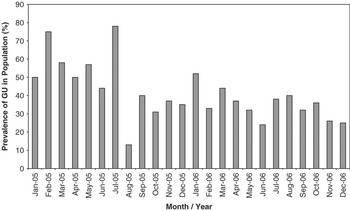
The number of necropsies studied in 2005 and 2006 was 204 and 235, respectively. Between 1 January 2005 and 31 December 2005, 47% (n = 95) of the donkeys necropsied had evidence of gastric ulcers; in 2006 this had fallen to 39% (n = 92). According to statistical analysis, the year of necropsy did not have a significant effect on the presence of ulcers (P = 0.11). The number of necropsies performed in the winter (n = 61 in 2005, n = 57 in 2006) is significantly higher than that in the summer (n = 33 in 2005, n = 40 in 2006). The frequency of ulceration varied monthly between 13% and 78% over the 2-year period (Figure 1). In 2005, the frequency observed in the winter was 53.3% and 45% in the summer but analysis showed no significant difference between the seasons. In 2006, again there was no significant difference noted between the seasons.
A bar chart to demonstrate the prevalence of gastric ulceration (GU) during the period 2005 to 2006 in donkeys necropsied at the Donkey Sanctuary, UK.

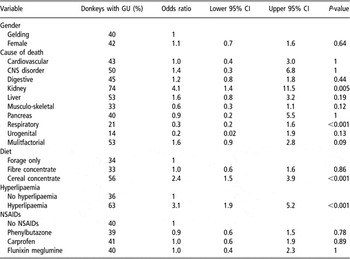
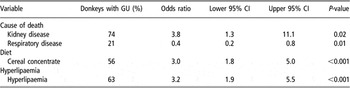
Univariate ORs were calculated for categorical data and are shown in Table 1; multivariable analysis is shown in Table 2. Hyperlipaemia was noted in 79 (18%) of the donkeys that were necropsied; donkeys with concurrent hyperlipaemia were at a significantly higher risk of developing gastric ulceration (OR = 3.2; P < 0.001), with 62% (n = 49) of hyperlipaemia cases also having gastric ulceration.
Univariate analysis of risk factors for gastric ulceration in donkeys housed at the Donkey Sanctuary, UK, between 1 January 2005 and 31 December 2006

GU = gastric ulceration; CI = confidence interval; CNS = central nervous system; NSAIDs = non-steroidal anti-inflammatory drugs.
Multivariable analysis of risk factors for gastric ulceration in donkeys housed at the Donkey Sanctuary, UK, between 1 January 2005 and 31 December 2006

GU = gastric ulceration; CI = confidence interval.
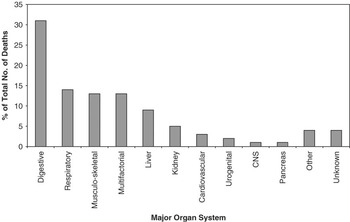
The majority of donkeys that were necropsied were euthanased or died due to a problem in one of the main body organ systems as shown in Figure 2. Digestive disorders (impaction colic, small and large intestinal disorders and peritonitis) were the most common reasons for euthanasia or death, accounting for 133 cases (31%). Musculo-skeletal disorders (including laminitis, arthritis and fractures) accounted for 13% and respiratory disorders (pulmonary fibrosis, guttural pouch disease and bacterial and viral pneumonia) were also a common cause of death (14%) in this population of animals. When analysed, only donkeys euthanased due to kidney disorder were at a significantly increased risk (OR = 3.8; P = 0.02) of developing gastric ulceration. Donkeys with respiratory disease were at a decreased risk of gastric ulceration (OR = 0.4; P = 0.01) when compared with other euthanased donkeys.
A bar chart illustrating causes of death when categorised according to the major organ system involved.

Information on administration of NSAIDs was available for 418 (98%) of the donkeys studied. Of the donkeys studied, 214 (50.2%) of these donkeys received NSAIDs for a period of at least 7 days immediately prior to death, with the majority receiving drugs over a period of months or years. OR indicated that treatment with NSAIDs (Phenylbutazone n = 137, carprofen n = 51, flunixin meglumine n = 25 and meloxicam n = 1) did not significantly increase the risk of gastric ulceration in this donkey population. In particular, the localisation of ulcers was examined in donkeys receiving NSAIDs; donkeys receiving NSAIDs were not significantly more likely to have ulcers in the glandular region of the stomach than those not receiving NSAIDs (P = 0.9).
Effect of diet on the incidence of gastric ulceration
The diets of the donkeys necropsied could be categorised as forage only (n = 160, 37%), forage supplemented with cereal-based concentrates (n = 144, 34%) or forage supplemented with fibre-based concentrates (n = 122, 29%). Donkeys fed a diet including cereal-based concentrates were significantly more likely to exhibit gastric ulcers at necropsy and were found to have an OR of 3.0 (P < 0.001) when compared with donkeys on a fibre-only diet. Donkeys receiving a cereal-based diet had a prevalence of 55% (n = 80) compared with 33% (n = 40) of donkeys on a fibre-based concentrate diet and 34% (n = 54) of donkeys receiving a forage-only diet.
Discussion
This study has demonstrated that gastric ulceration is a common finding at necropsy in donkeys at the Donkey Sanctuary, being found in 41% of the donkeys studied over a 2-year period. This is the first evidence available that gastric ulceration is a problem in this equid species. The donkeys studied were not working and had a sedentary lifestyle with access to forage at all times and have not been traditionally considered as being at high risk of developing gastric ulcers.
Gastric ulceration is a complicated and multifactorial disease with varied risk factors in equids including stress, exercise and diet. Such risk factors may lead to an imbalance in aggressive factors within the stomach such as hydrochloric acid, pepsin, volatile fatty acids and bile acids, and those factors protecting against gastric ulceration such as mucus and bicarbonate (Andrews et al., Reference Andrews, Buchanan, Elliott, Al Jassim, McGowan and Saxton2008). Gastric ulcers in the squamous mucosa may be directly related to the amount of exposure to gastric acidity whereas ulceration in the glandular area of the stomach is more likely to be due to decreased blood flow, bicarbonate and mucus secretion. Such a multifactorial nature makes this disease difficult to assess and treat. Animals with gastric ulceration are often difficult to diagnose as they may exhibit clinical signs intermittently or infrequently. The donkey is stoic in nature, which further exacerbates the difficulty in diagnosis as they rarely exhibit the classic symptoms of disease shown by other equids (Matthews et al., Reference Matthews, Peck, Taylor and Mealey2001; Ashley et al., Reference Ashley, Waterman-Pearson and Whay2005). Donkeys frequently present as being ‘dull’, which can be a sign of many medical and behavioural problems, including gastric ulceration.
The necropsies studied were carried out over a period of 2 years by an experienced pathologist, allowing a scoring system to be developed and adhered to with no operator bias to influence results. The authors acknowledge that other scoring systems are available; however, at the time of data collection alternative scoring systems were not yet in place. Other scoring systems may concentrate on the visual scoring of ulcers based on number and location (McAllister et al., Reference McAllister, Andrews, Deegan, Ruoff and Olofsson1997) or the depth of ulceration (Andrews et al., Reference Andrews, Sifferman, Bernard, Hughes, Holste, Daurio, Alva and Cox1999) in addition to the surface area covered by the ulceration, and may provide opportunities to further understand the clinical consequences of ulceration in this donkey population.
Steps were taken to reduce bias in this retrospective study although some may exist. It is a policy that all donkeys that die or euthanased are necropsied; however, due to time and staffing constraints, 38 animals suffering from chronic foot disease were excluded from the study. Death or euthanasia due to musculo-skeletal disease was not significantly associated with gastric ulceration but exclusion of this population may have introduced some bias; other reasons for case exclusion were random.
Gastric ulceration was shown to be present in all areas of the donkey stomach; however, as is the case in horses, the margo plicatus was the most commonly affected region (McAllister et al., Reference McAllister, Andrews, Deegan, Ruoff and Olofsson1997; Sandin et al., Reference Sandin, Skidell, Haggstrom and Nilsson2000; Begg and O’Sullivan, Reference Begg and O’Sullivan2003). Interestingly, the ulcers seen appear to be larger in the surface area, with the majority being 2 to 10 cm2, than those seen in previous studies in horses where the majority of ulcers seen were less than 1 cm2 (Sandin et al., Reference Sandin, Skidell, Haggstrom and Nilsson2000). This may be due to the animals’ advanced age and concurrent health problems or perhaps their ability to mask or cope with the pain associated with pronounced ulceration compared with horses.
Gender did not appear to have any bearing upon the development of ulceration; however, all males at the Donkey Sanctuary are castrated soon after arrival and thus no stallions were available for study. In previous reports, stallions have been shown to have a significantly higher prevalence of ulceration than mares or geldings (Rabuffo et al., Reference Rabuffo, Orsini, Sullivan, Engiles, Norman and Boston2002). The population studied was elderly and had a mean age of approximately 30.5 years. Unfortunately, there are no data available for other geriatric equid species for comparison. In this study, increasing age was shown not to be a significant risk factor in contrast to other reports where age has had a significant influence, although previous studies have mainly involved younger animals (Rabuffo et al., Reference Rabuffo, Orsini, Sullivan, Engiles, Norman and Boston2002; Chameroy et al., Reference Chameroy, Nadeau, Bushmisch, Dinger, Hoagland and Saxton2006). This is a sector of the donkey population that the Donkey Sanctuary does not routinely manage in large numbers or hold necropsy data for; few donkeys at the sanctuary are less than 10 years old and the current average age of the population is 23 years old.
Hyperlipaemia is a frequent complication in moribund donkeys, and among the ailing donkeys in this survey 79 (18%) developed hyperlipaemia before the decision to euthanase. Of this number, a high proportion showed gastric ulceration (62%) and this association was statistically significant (P < 0.001). Whether hyperlipaemia is a risk factor for the development of ulceration or vice versa is difficult to determine. Active gastric ulcers may be sufficiently painful to cause inappetance, resulting in fat catabolism and rising serum triglycerides. Conversely, it is possible that stress from the severity and chronicity of the presenting condition may have induced ulceration. However, the great majority of these ulcers were along the margo plicatus, implying a more likely pathogenesis due to gastric acidity (Nadeau et al., Reference Nadeau, Andrews, Mathews, Argenzio and Blackford1998).
This study has also quantified the major organ systems involved in the death/euthanasia of the donkeys studied. Donkeys with disorders of the kidneys displayed higher frequencies of gastric ulceration than donkeys euthanased due to other disorders. Animals with such disorders may be difficult to manage and often have a poor appetite, and consequently poor condition, and may need supplementary feeding for which traditionally concentrate feeds were used. These animals often refuse to ‘trickle feed’ throughout the day, preferring to lead a sedentary lifestyle and survive only on the supplementary feeds provided. These feeding behaviours, coupled with the disease-associated factors, may all predispose to ulceration problems. Interestingly, donkeys that were euthanased or died due to respiratory disease were at a decreased risk of gastric ulceration. The reasons for this decreased risk are unclear and warrant further study. Donkeys with existing respiratory disease are often housed in smaller groups, on rubber matting bedding rather than on straw and often receive clenbuterol; unfortunately, these factors were not included in the original study but would be interesting for future studies.
The administration of NSAIDs has been hypothesised as a potential risk factor for gastric ulceration in previous studies; however, this study agrees with many other studies in equids (Vatistas et al., Reference Vatistas, Sifferman, Holste, Cox, Pinalto and Schultz1999; Sandin et al., Reference Sandin, Skidell, Haggstrom and Nilsson2000) and shows that the frequency of this condition in donkeys receiving NSAID treatments when compared with donkeys receiving no treatment was not significantly different. When the location of ulcers was studied, there was also no increased risk of glandular ulceration when donkeys received NSAIDs, as has been suggested in previous studies (Murray, Reference Murray1991). This is highly pertinent for the management of pain in donkeys, particularly as they often have to be maintained on a higher dose of NSAID than would be used in a pony of the same size due to their increased rate of metabolism of NSAIDs when compared with other equids (Matthews et al., Reference Matthews, Peck, Taylor and Mealey2001).
This study showed an odds risk ratio of 3.0 for donkeys developing gastric ulceration when being fed a cereal-based diet. Many of the donkeys at the Donkey Sanctuary are elderly and have dental problems. These animals often require supplementary feeding in addition to the ad libitum forage. Feeding of cereal-based concentrates has been shown in previous studies to lead to an increase in concentrations of volatile fatty acids in the stomach, resulting in a lowering of gastric pH with subsequent development of ulceration (Nadeau et al., Reference Nadeau, Andrews, Mathews, Argenzio and Blackford1998).
The wild donkey has evolved to eat high fibre, poor nutritional quality food and is a ‘trickle feeder’. Donkeys kept in the UK and other developed countries are often fed inappropriately, with feedstuffs that are too energy rich and low in fibre. It would appear from this study that these feeding regimes may put donkeys at risk of developing gastric ulcers in addition to many other medical disorders such as laminitis. The results of this study indicate that donkeys maintained on a concentrate diet based upon fibre (short chopped fibre and high-fibre nuts) are at a decreased risk of gastric ulceration when compared with those fed cereal-based concentrates. This is encouraging as it allows management of ill or elderly animals requiring supplementary feeding while still imitating natural feeding behaviours.
This study has demonstrated that gastric ulceration is a significant problem in an elderly population of donkeys resident at The Donkey Sanctuary, UK; it is therefore possible that the wider population of donkeys in developed countries are at risk of this disease. This information has been used to develop healthcare and feeding regimes for all animals that are resident at The Donkey Sanctuary. The study highlights the fact that gastric ulceration may be a common problem in the donkey although it is not frequently diagnosed prior to death. We would encourage all veterinary surgeons encountering donkeys suffering from hyperlipaemia and kidney disease to consider prophylactic treatment for this condition.
Acknowledgements
This study was financially supported by the Donkey Sanctuary. The study was also kindly supported by the Clinical Research Outreach Programme, part of the CIDC at the University of Cambridge. We would like to thank all of the staff and vets at the Donkey Sanctuary that have assisted in the collection of data.