Although the process of health technology (HT) adoption in healthcare systems has become a relevant topic, an important number of valuable and innovative HTs never reach the clinical practice. Conversely, many HTs with no significant added value have been adopted (Reference Sampietro-Colom, Lach and Cicchetti1). This situation can be overcome effectively by applying HT assessment (HTA) at the hospital level, which represents the main entry level for innovative HTs. Hospital-based HTA (HB-HTA) may be applied as a managerial tool to ensure accountable decision making about the introduction of, the disinvestment from, and the reallocation of HTs (Reference Cicchetti and Fontana2). Several forms of HB-HTA are employed in diverse manners in many countries (Reference Sampietro-Colom and Martin3), with the aim of implementing local HTA processes and methods. Such contextualization takes into consideration the specificity of the hospital culture and organization as well as the contingent characteristics of the assessment process itself, for example, the comparator available in the clinical practice and the hospital's organizational processes (Reference Sampietro-Colom, Lach and Cicchetti1).
Several phenomena seem to have influenced this adaptation. The first, perceived at the local level, is related to the financing system, the budget constraints and policies which organizations must comply with, together with the need to achieve effectiveness and provide high-quality care (Reference Lafortune, Farand, Mondou, Sicotte and Battista4). The second phenomenon is related to the increasing awareness of contextual factors, which can dramatically influence the adoption of a specific technology (Reference Cicchetti and Fontana2).
The design and activities of HTA units have been compared at the national, regional, and local levels (Reference Martelli, La Torre and Di Ghionno5). Particularly relevant is the first worldwide survey in 2008 by the HB-HTA Interest Group of Health Technology Assessment international (HTAi) (Reference Cicchetti, Marchetti, Dibidino and Corio6). The main purpose of this survey was to investigate the application of HTA logic, methods, and tools in hospitals and other healthcare organizations, in supporting managerial decision making and clinical practice. The working group sought to characterize different hospital organizational models based on their focus of action and organizational approaches designed explicitly for HTA (Reference Cicchetti, Marchetti, Dibidino and Corio6).
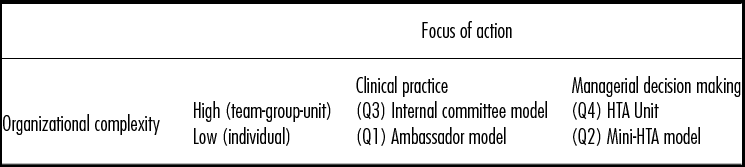
Four organizational models for HB-HTA emerged from the study (Table 1): (i) The ambassador model, in which clinicians play the role of “opinion leaders” (ambassadors) in promoting HB-HTA within their organizations. While they may not take part in the assessment process, they play a key role in the diffusion of results within the hospital. This model fits the case of the Swedish hospitals. (ii) The mini-HTA, in which individual professionals participate actively in the assessment process to inform higher-level decision makers, as in the case of Danish hospitals. (iii) The internal committee model, in which multidisciplinary groups representing different perspectives in hospital produce and review evidence, then issue recommendations that are useful throughout the hospital system. Usually, documents are produced on a peer-to-peer basis by a professional group of clinicians, rarely working full time on HTA. The model is commonly used in health maintenance organizations in the United States and in some Canadian hospitals. (iv) The HTA unit, which has a formal organizational structure based on the full-time employment of specialized HTA personnel. This model represents the highest degree of structure for HB-HTA (Reference Cicchetti, Marchetti, Dibidino and Corio6).
Four Models of Hospital-Based Health Technology Assessment

Source: Cicchetti et al. (Reference Cicchetti, Marchetti, Dibidino and Corio6).
More than fifty institutions were invited to participate in the HTAi survey; representatives from thirty-three institutions completed the questionnaire, and, of them, thirty HTA systems were able to be allocated to the four model categories (Reference Cicchetti, Marchetti, Dibidino and Corio6). At the time of the survey, the HTA unit model dominated the international arena (19/30 institutions [63 percent]), followed by the internal committee model (7/30 institutions [23 percent]). The survey pointed out that, at that time, HB-HTA units aimed to support managerial decision making and inform clinical practice. Data collected with the 2008 survey contributed to the description of HTA organizational arrangements at the local level. Nevertheless, this first study had some limitations, mainly due to the lack of information about the outcomes of the HB-HTA process. A more recent systematic review of 18 studies showed the positive results of HTA application at the hospital level, with examples fitting the four models assessed in the 2008 HTAi survey (Reference Gagnon, Desmartis, Poder and Witteman7).
Other recent efforts to describe organizational models of HB-HTA have been made in Italy. In 2013, the Centre for Healthcare Management Studies and Research (Ce.Ri.S.Ma.S) and the Italian Federation of Healthcare Organizations (FIASO) conducted separate surveys to assess the diffusion of HB-HTA in the Italian system and its impact on hospital decision making (8;9). Although these contributions made a large amount of useful information available to decision makers, the findings should not be considered as generalizable outside the Italian context.
Despite the development in the field, a scant of knowledge is still observable about tools and methods useful to classify the existing organizational models of HB-HTA. One useful framework may refer to the contingency theory, a managerial theory holding that there is no best way to design an organization, lead a business, or implement any complex social action (Reference Daft10). Instead, the effective course of action depends (is “contingent” or “contextual”) on the internal and external situations. Research demonstrated that internal and external factors are able to influence organizational design, particularly in terms of how some organizational structural variables are combined, such as: the level of hierarchy, the centralization of power, the specialization of labor, the formalization of processes and procedures, and the personal qualifications of the personnel.
Internal factors, such as the type of technology adopted by the organization, its size (i.e., small or big-large), its life cycle phase (i.e., starting-up, growing, mature, declining), and the type of strategic conduct, should be considered in the selection of an HB-HTA organizational model. At the same time, also external factors, such as environmental characteristics, institutional bonds, and competitive behavior, can also affect the organizational design (Reference Daft10). This study is placed in the context of healthcare management and medical innovation literature to address this gap and aims to provide a deeper understanding of the characteristics and features affecting the organizational models of HB-HTA units. Particularly, our research question was addressed by exploring, describing, interpreting, and explaining HB-HTA initiatives across countries.
Such goal was part of the Adopting Hospital-Based Health Technology Assessment (AdHopHTA) European project (Reference Sampietro-Colom, Lach and Cicchetti1). One of the objectives of the project was to gain empirical evidence about HB-HTA by critically appraising the existing HB-HTA organizational models. The AdHopHTA project produced new knowledge about the characteristics of HT adoption in hospitals with and without HTA functions in place (Reference Sampietro-Colom, Lach and Cicchetti1), healthcare managers’ use of information to shape decisions about HT (Reference Kidholm, Ølholm and Birk-Olsen11), and differences in decision-making processes according to the type of HT (e.g., related to drugs, medical devices, or medical equipment) to be introduced (Reference Sampietro-Colom, Lach and Cicchetti1). Moreover, the project shed light on models of cooperation between national/regional HTA bodies and HB-HTA functions/units (Reference Halmesmäki, Pasternack and Roine12), and produced a consensus statement on guiding principles for good HB-HTA practices (Reference Sampietro-Colom, Lach and Pasternack13). Evidence collected in the project, as well as the one this study refers to, all contributes to the realization of the principal outputs the Project, including a practical guidance on HB-HTA, a new mini-HTA formulary, and a database containing information on more than 290 mini-HTAs.
STUDY AIMS
A subgroup of AdHopHTA project researchers explored the characteristics and elements of HB-HTA initiatives in seven participating hospitals, and investigated how these units organize the process of assessment of HTs to inform hospital decision making in adoption and management of HTs. This study aims to describe and compare the characteristics of seven HB-HTA programs/units. This objective may help to further compare the approaches, frameworks, and organizational models of HB-HTA units and to identify the contextual (i.e., “contingent”) factors, internal and external to the hospitals under consideration, that shape organizational variables. Finally, the study proposes a model able to classify the diversity of cases into a limited number of ideal-typical organizational categories.
RESEARCH METHODOLOGY
An interview study was conducted as part of the AdHopHTA project to compare seven HB-HTA initiatives. Questions were based on the analytical framework of the European Foundation for Quality Management (EFQM) (14) adapted for HB-HTA. This model involves the evaluation of nine criteria, namely Enablers and Results, to determine how organizations (in this case, HB-HTA functions/units) perform “key processes activities” and the type results from HB-HTA activities (Reference Sampietro-Colom, Lach and Cicchetti1).
Data Sources and Sample Selection
Data were collected from two different sources. First, semi-structured interviews were conducted with HB-HTA leaders. Interviewees were first asked background questions about themselves and the hospitals which they were affiliated to; they were then asked core questions about their HB-HTA organizational models, related to (i) leadership, in terms of the characteristics of the HB-HTA governance; (ii) strategy, namely the mission, the main operative objectives and the alignment to upper level strategies; (iii) personnel, in terms of the number and competencies of people involved; (iv) partnerships and resources, that is the amount and nature of linkages to further networks and partners; (v) process, products, services, and results of HB-HTA activity (kind of technologies assessed, methods used, the efficacy of the recommendation produced by any HB-HTA process). (Interview guide is available by the authors upon request.)
Interviews were conducted by telephone or Skype between July and October 2014. With respondents’ permission, they were recorded, transcribed, and sent to respondents for final validation. The second data source was official documentation obtained from the hospitals, when available. Such documentation, including the organizational chart of the unit, the mission statement, and strategies, was considered a useful source to understand some topics emerging from the interviews more in depth.
Data Extraction and Analysis
Data collected were used to construct seven case studies on HB-HTA organizational models, which were compared using the case study method, which is aimed at investigating a contemporary phenomenon in its real context (Reference Yin15). Case studies were compared across a set of predefined items coherent with previous literature. Relevant parts of the case studies text were collected in a form were the items of interest were listed. Then qualitative sections of the text were codified to make the underlying information comparable. Cross-case analysis was used to compare key organizational variables characterizing each HB-HTA solution. Such an approach intends to investigate similarities and differences across cases, which are the unit of the analysis (Reference Mathison16).
RESULTS
Cross-Case Analysis: Description of HB-HTA Initiatives
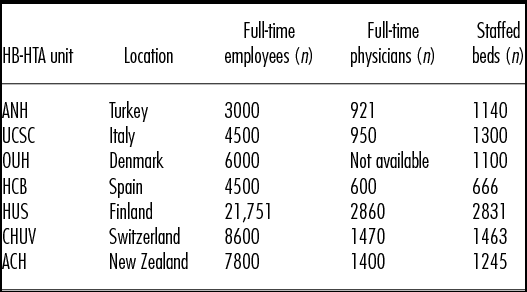
The following seven HB-HTA functions/units were included in the analysis: (i) the Hospital Clinic of Barcelona (HCB), Catalonia (Spain); (ii) the Ankara Numune Training and Research Hospital (ANH), Turkey; (iii) the University Hospital of Lausanne (CHUV), Switzerland; (iv) the Hospital District of Helsinki and Uusimaa (HUS), Finland; (v) the Odense University Hospital (OUH), Denmark; (vi) the Fondazione Policlinico “A. Gemelli,” Catholic University of Rome (UCSC), Italy; (vii) and the Auckland City Hospital (ACH) of the Auckland District Health Board, New Zealand. Background characteristics of these hospitals are shown in Table 2.
Characteristics of Hospitals

HB-HTA, hospital-based health technology assessment; ANH, Ankara Numune Training and Research Hospital; UCSC, Fondazione Policlinico “A. Gemelli,” Catholic University of Rome; OUH, Odense University Hospital; HCB, Hospital Clinic of Barcelona; HUS, Hospital District of Helsinki and Uusimaa; CHUV, University Hospital of Lausanne; ACH, Auckland City Hospital.
Leadership and Strategy
Case comparison showed that five of the seven HB-HTA units are formally structured within the organizational hospital hierarchy (Supplementary Table 1). Strategies for HB-HTA initiatives were aligned primarily with the hospitals’ corporate strategies; four of the seven units aligned their strategies with healthcare planning at national/regional level. Strategy alignment did not appear to be linked to unit's maturity.
Personnel and Resources
The configuration of HB-HTAs’ staff situation was heterogeneous. Two of seven leaders and three of seven personnel were fully devoted to hospital HTA activities. “Mature” units were more likely to use full-time contracts than the units more recently established. The stage of maturity seemed to affect organizational arrangements and the formalization of processes. Mature units held formal positions within their hospitals’ organizational hierarchy, followed formal procedures when informing decision makers, had formal personnel recruiting processes, and were more likely to organize training programs for collaborators and external customers. Newly established units showed less formalization of procedures for HTA and personnel management. Most professionals in all units were medical doctors, health economists, and public health specialists, the key professional profiles for performing HTA. Most unit leaders were medical doctors.
PROCESS AND RESULTS
The role of almost all units in HT adoption was mandatory, even when solely advisory. The role of the HB-HTA unit was strictly related to the assessment phase in almost all cases; units tended not to be systematically involved in other phases of the HT management process (e.g., procurement). Some HB-HTA functions were also involved in the acquisition and implementation phases.
Analysis of the performance and impact of the HB-HTA units was usually carried out by unit leaders in a nonsystematic manner. The budget of only one unit specifically covered operational costs, while three implemented strategies to seek for external additional resources (e.g., participating in research projects). This behavior seemed to be related to more mature units’ pursuit of increased formalization and structuration.
HTA processes and procedures were largely similar among hospitals. However, decisions regarding the comparators to be used, the perspectives to be taken, the adoption of the Population-Intervention-Comparison-Outcome (PICO) model, the choice of dissemination tools, and participation in training activities varied considerably and were not related to unit maturity. We found no evidence of the systematic use of tools to ensure assessor independence; conflict of interest declarations, for example, were used only sporadically. Patients were never involved in the assessment process.
The contributions of the HTA units to overall hospital performance appeared to be formally measured rarely, even if perceived as valuable by the stakeholders. No HB-HTA unit used any indicator to assess its performance or scientific impact systematically. Hospital decision makers generally had high levels of compliance with recommendations produced by the units, but they complied more with clinicians’ requests for technology. Thus, the HB-HTA process served as a formal filter in addressing the choice of technology adoption, even when a formal final recommendation is not provided in the HTA reports.
HB-HTA Organizational Parameters
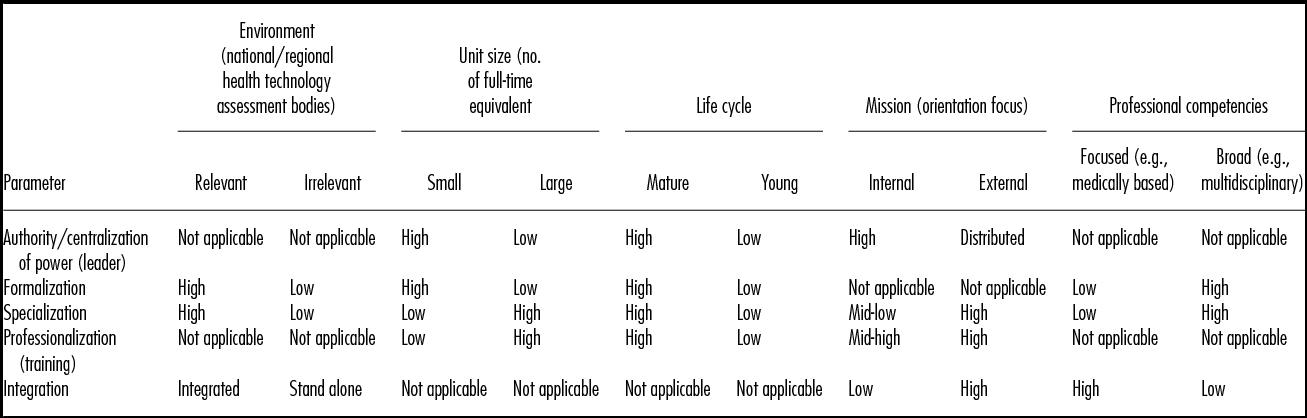
HB-HTA functions/units had different organizational structures, due to the effects of different combinations of basic organizational variables. Differences were evident in the degree and use of authority as a coordinating mechanism and centralization/decentralization of power, specialization of labor, formalization of procedures, and qualification of personnel. The adoption of different types of organizational models in hospitals appeared to depend on contextual factors (“contingent” variables) which lead to differences such as unit size, maturity stage, mission/vision (internal or external orientation), the heterogeneity of professional competencies (focused or broad), and the relevance of the institutional environment in HTA (collaboration at the national/regional levels; relevant or irrelevant) (see Table 3). For example, functional collaboration between hospital-level and national/regional HTA bodies was more likely when the institutional environment was characterized by strong national/regional HTA bodies.
Structural Parameters and Contingent Variables

Source: adapted from Sampietro et al. (Reference Sampietro-Colom, Lach and Cicchetti1).
Some structural variables seemed to be particularly relevant and tended to characterize the organizational models. Different combinations of (i) formalization/specialization and (ii) level of integration were used to identify the four ideal types of HB-HTA unit. Highly specialized units (those dedicating specific competencies and/or formal procedures to the management of specific HTA processes) tended to be more formalized (they operated using formal procedures). Specialization is needed to manage different tasks (e.g., HTA for drugs and devices, a 3-year HT investment plan). “Mature” HB-HTA functions tended to be more formalized and highly specialized.
On the other hand, some less “mature” HB-HTA functions preferred to maintain flexibility, with less specialization and formalization. In these units, the same people managed different tasks using more homogenous (same form/template used for different technologies) and less formalized procedures. Two typical modes of the level of integration and level of structuration were identified. Integration was high in units creating multiple linkages with HTA organizations/institutions at other institutional levels (“allies”). Of course, this integration can be based on formal agreements or informal collaboration.
Contingency Model for HB-HTA
Combinations of the mentioned two-mode variables defined the contingency model presented in Table 4.
Hospital-Based HTA Contingency Model

HTA, health technology assessment; HUS, Hospital District of Helsinki and Uusimaa; OUH, Odense University Hospital; CHUV, University Hospital of Lausanne; ANH, Ankara Numune Training and Research Hospital; UCSC, Fondazione Policlinico “A. Gemelli,” Catholic University of Rome; HCB, Hospital Clinic of Barcelona; ACH, Auckland City Hospital. Source: adapted from Sampietro et al. (Reference Sampietro-Colom, Lach and Cicchetti1); Sampietro-Colom and Martin (Reference Sampietro-Colom and Martin3).
HB-HTA/units operating in institutional contexts that lacked formal cooperation with national/regional HTA bodies and have formal structured procedures were considered to have the organizational structure of “independent-informal groups.” These groups support hospital managerial decisions in a fairly informal manner, disconnected from other levels of the healthcare system. In general, this structure is the first stage in the development of an HB-HTA unit. In this scenario, “pioneers” are acting voluntarily, without full-time dedication to HTA, to demonstrate its usefulness. Among cases examined in this study, the ACH unit represents this structure.
“Integrated-essential” HB-HTA units are characterized by low levels of organizational structuration and formalization, but they are embedded in a context in which competencies and other support for performing HTA are available. They are characterized by limited numbers of internal collaborators, who are able to involve many other actors and “allies” in their activities. They are embedded in a system of collaboration that includes universities and research centers, which can provide useful competencies and workforce to manage HTA processes. The ANH and CHUV units fall into this category.
“Stand-alone” HB-HTA units are focused mainly on internal processes and are embedded in contexts where national regional bodies are not present or they exist but have no specific influence on HB-HTA groups. This category includes more mature units with highly formalized and specialized procedures, such as the UCSC and HCB units examined in this study.
“Integrated-specialized” HB-HTA units are embedded in a context characterized by the presence of national/regional HTA bodies or functions. Even when they gain relevant autonomy, their actions are influenced by opportunities for formal (or occasionally informal) collaboration with these bodies. They present high levels of formalization, and their activities are recognized within their hospitals. Potential examples from our cases are the OUH and HUS units (Reference Cicchetti, Marchetti, Iacopino, D'Amico and Sampietro-Colom17).
DISCUSSION AND CONCLUSIONS
The use of HTA to support managerial decision making and clinical practice has increased over the past 15 years. Many hospitals worldwide have established HB-HTA functions/units with diverse organizational models in terms of professional capabilities, leadership type, level of procedure formalization, and labor specialization. Our study contributes to the existing literature on management of health innovations and specifically, it provides some insight on how different organizational models are shaped to govern the uptake of technologies at hospital level. More in detail, we identified the extent to which some organizational or “structural” variables, namely the level of procedure formalization/structuration and the level of integration with other HTA bodies at the national, regional, and provincial levels, predominantly shape the HB-HTA approach. Crossing these two dimensions, four options have emerged: integrated specialized HTA unit, stand-alone HTA unit, integrated-essential HTA, and independent group unit.
These HB-HTA categories should be considered to be as ideal types; they do not capture the real complexity of HB-HTA units. Nevertheless, the model communicates the richness of available solutions for the implementation of HTA functions within hospitals. It also describes an organizational life cycle for HB-HTA functions. Younger units (start-up units), in general, are informal and less connected to the external environment (independent groups). Personnel work part time on a voluntary basis, without strong formal endorsement from management and follow informal procedures. The presence or absence of national/regional HTA bodies acting as hubs of HTA networks influences the evolution of units toward integrated or stand-alone solutions. Evolution toward more mature HB-HTA function is characterized by increasing levels of formalization of processes, and progressive alignment of strategies and goals with hospital-level strategies. In this evolution, HB-HTA functions gain internal and external legitimacy until they are fully recognized as key actors in the implementation of hospital development strategies and are considered as partners at the national/regional level (Reference Cicchetti, Marchetti, Iacopino, D'Amico and Sampietro-Colom17).
Our findings are that HB-HTAs display a range of organizational characteristics used for HB-HTA in different contexts and suggest some implications for policy and management. First, we provide a new classification of HB-HTA models, which differs from that proposed in 2008 by the HTAi Interest Group (Reference Cicchetti, Marchetti, Dibidino and Corio6). The new HB-HTA models try to capture the logical evolution of HB-HTA in a dynamic changing context, mainly due to the increasing need of hospital decision makers to take informed decisions. Second, the results of the cross-case analysis suggest that existing models of HB-HTA reflect the core principles of contingency theory, whereby contextual needs and circumstances appear to be key drivers for the structure of HB-HTA units. Contextual factors relevant to the selection of an appropriate organizational model include the institutional HTA framework at the national and regional levels, the diffusion of HTA and evidence-based medicine culture within the hospital, the size and institutional profile (teaching or nonteaching) of the hospital (with regard to the unit's position in the hospital hierarchical model), the type of leadership needed, the level of existing formalization of procedures and communication, and the degree of labor specialization.
This study has some limitations. The small number of case studies impedes generalization of the findings, which may be valid only in the contexts examined. Nevertheless, the cases represent diverse geographical and institutional contexts and are related to HB-HTA initiatives at very different stages of development; they thus provided a unique opportunity to frame a generic model that probably embraces the different HB-HTA initiatives currently available. Further research is needed to investigate the generalizability of such framework as well as the impact and effectiveness of each organizational model presented in the study. Our research group is already engaged in the collection of data on additional cases to challenge the results of the present analysis.
SUPPLEMENTARY MATERIAL
Supplementary Table 1: https://doi.org/10.1017/S0266462318000119
CONFLICTS OF INTEREST
The authors have nothing to disclose.