Introduction
Anxiety is the sixth leading cause of disability worldwide (Baxter et al. Reference Baxter, Vos, Scott, Ferrari and Whiteford2014), affecting 4.2% of people aged 55+ years globally (Baxter et al. Reference Baxter, Scott, Vos and Whiteford2013), and accounting for 325–418 years lived with disability per 100 000 persons aged 50 years and older (Baxter et al. Reference Baxter, Vos, Scott, Ferrari and Whiteford2014). In Ireland, 13% of older adults have reported clinically significant anxiety symptoms (Barrett et al. Reference Barrett, Burke, Cronin, Hickey, Kamiya, Kenny, Layte, Maty, McGee and Morgan2011). Anxiety has also been associated with numerous mental and physical comorbidities (Vancampfort et al. Reference Vancampfort, Koyanagi, Hallgren, Probst and Stubbs2017), such as pain, and early mortality (Roest et al. Reference Roest, Zuidersma and de Jonge2012). Further, health services are continually required to adapt and respond to the increasing absolute number of older adults with mood disorders requiring treatment as a result of an ageing population within the European Union (Rechel et al. Reference Rechel, Grundy, Robine, Cylus, Mackenbach, Knai and McKee2013).
Although the majority of those who suffer from anxiety do not seek treatment (Demyttenaere et al. Reference Demyttenaere, Bruffaerts, Posada-Villa, Gasquet, Kovess, Lepine, Angermeyer, Bernert, de Girolamo and Morosini2004), maladaptive anxiety symptoms are costly because of direct psychiatric and non-psychiatric treatment costs (Chisholm et al. Reference Chisholm, Sweeny, Sheehan, Rasmussen, Smit, Cuijpers and Saxena2016). Among those who do seek treatment, the first-line treatment remains pharmacotherapy, such as selective serotonin reuptake inhibitors (SSRIs) (Baldwin et al. Reference Baldwin, Waldman and Allgulander2011; Reinhold et al. Reference Reinhold, Mandos, Rickels and Lohoff2011). Nonetheless, SSRIs do not work for about one-third of patients and are associated with the development or worsening of chronic physical diseases, obesity, diabetes and cardio-metabolic diseases (Correll et al. Reference Correll, Detraux, De Lepeleire and De Hert2015; de Vries et al. Reference de Vries, de Jonge, van den Heuvel, Turner and Roest2016; Vancampfort et al. Reference Vancampfort, Rosenbaum, Schuch, Ward, Probst and Stubbs2016, Reference Vancampfort, Koyanagi, Hallgren, Probst and Stubbs2017). Thus, there is a continued need to identify and investigate alternative prevention and treatment strategies.
Through improvements in functional status and wellbeing and social benefits, physical activity (PA) has been shown to be pivotal to the concept of ‘healthy ageing’ (Bauman et al. Reference Bauman, Merom, Bull, Buchner and Fiatarone Singh2016). Additionally, it is easily accessible and has few negative side effects. As a result, there has been continued interest in the benefits of regular PA for psychological status among the elderly. Compared with depression, the association between PA and anxiety has received significantly less attention. Recent large-scale cross-sectional evidence demonstrates an inverse association between PA and anxiety (Stubbs et al. Reference Stubbs, Koyanagi, Hallgren, Firth, Richards, Schuch, Rosenbaum, Mugisha, Veronese and Lahti2017a), supporting previous longitudinal evidence of the inverse association between PA and subsequent anxiety among older adults (Heesch et al. Reference Heesch, Burton and Brown2011; Pasco et al. Reference Pasco, Williams, Jacka, Henry, Coulson, Brennan, Leslie, Nicholson, Kotowicz and Berk2011). However, longitudinal associations between PA and anxiety symptoms in the general population have been mixed (de Moor et al. Reference De Moor, Boomsma, Stubbe, Willemsen and de Geus2008; ten Have et al. Reference ten Have, de Graaf and Monshouwer2011; Brunes et al. Reference Brunes, Gudmundsdottir and Augestad2015; Kang et al. Reference Kang, Bae, Kim, Shin, Yoon and Kim2016). Experimental evidence has supported the anxiolytic effects of exercise training among non-clinical adult populations (Rebar et al. Reference Rebar, Stanton, Geard, Short, Duncan and Vandelanotte2015), chronically ill patients (Herring et al. Reference Herring, O'Connor and Dishman2010) and individuals with anxiety disorders (Herring et al. Reference Herring, Jacob, Suveg, Dishman and O'Connor2012; Stubbs et al. Reference Stubbs, Vancampfort, Rosenbaum, Firth, Cosco, Veronese, Salum and Schuch2017b). Additionally, experimentally increasing sedentary behaviour has been demonstrated to increase anxiety among active young adults (Edwards & Loprinzi, Reference Edwards and Loprinzi2016).
There is limited evidence regarding a dose–response relationship between PA and mental health outcomes. Evidence suggests large variability in the preference for and tolerance of different exercise intensities, and a ‘one size fits all’ approach may not work, but examining this dose–response in large populations may help to best formulate specific PA recommendations for mental health. Evidence to support a dose–response relationship between PA and anxiety from epidemiological studies (Dunn et al. Reference Dunn, Trivedi and O'Neal2001; Sanchez-Villegas et al. Reference Sanchez-Villegas, Ara, Guillen-Grima, Bes-Rastrollo, Varo-Cenarruzabeitia and Martinez-Gonzalez2008; Heesch et al. Reference Heesch, Burton and Brown2011; ten Have et al. Reference ten Have, de Graaf and Monshouwer2011) and randomised controlled trials (Wipfli et al. Reference Wipfli, Rethorst and Landers2008; Jayakody et al. Reference Jayakody, Gunadasa and Hosker2013) is mixed. There is evidence to suggest that the dose and modality of exercise considered efficacious for the treatment of depression is similar to that included in PA guidelines for the general population (Haskell et al. Reference Haskell, Lee, Pate, Powell, Blair, Franklin, Macera, Heath, Thompson and Bauman2007; Stanton & Reaburn, Reference Stanton and Reaburn2014); however, evidence to support meeting these recommended guidelines to improve anxiety is sparse.
Thus, the present study used data from The Irish Longitudinal Study of Ageing (TILDA) to (1) examine cross-sectional and longitudinal associations between meeting PA guidelines and anxiety symptoms and status, and (2) characterise the potential cross-sectional and longitudinal dose–response relationship between PA and anxiety symptoms and status. Because anxiety symptoms have higher prevalence among women (Brunes et al. Reference Brunes, Gudmundsdottir and Augestad2015; Kang et al. Reference Kang, Bae, Kim, Shin, Yoon and Kim2016) and sex-related differences in anxiety symptom response to PA have been recently reported (Brunes et al. Reference Brunes, Gudmundsdottir and Augestad2015), an exploratory objective was (3) to examine potential sex-related differences in the association between PA and anxiety.
Methods
This study used STROBE recommendations to guide reporting (Von Elm et al. Reference Von Elm, Altman, Egger, Pocock, Gøtzsche and Vandenbroucke2008).
Study population and measures
Data for the first (Barrett et al. Reference Barrett, Burke, Cronin, Hickey, Kamiya, Kenny, Layte, Maty, McGee and Morgan2011) and second (Nolan et al. Reference Nolan, O'Regan, Dooley, Wallace, Hever, Cronin, Hudson and Kenny2014) waves of TILDA were gathered between October 2009 and February 2011 and between April 2012 and January 2013, respectively, and analysed in 2017. TILDA is a nationally representative, equal probability sample (Whelan, Reference Whelan1979) of community-dwelling adults aged ⩾50 years, and their partners of any age, resident in the Republic of Ireland. Participants gave full informed consent to participate in the study and ethical approval was obtained from the Trinity College Dublin Faculty of Health Sciences Research Ethics Committee. Further study design details are published elsewhere (Kenny et al. Reference Kenny, Whelan, Cronin, Kamiya, Kearney, O'Regan and Ziegel2010). From 8504 participants who responded to the first wave, PA and anxiety data at waves 1 and 2 were available for 6094 respondents. Following exclusion of participants with incomplete covariate data (n = 1917), cross-sectional analyses in the present study focused on 4175 participants (56.8% female) aged ⩾50 years with complete data. Respondents who reported anxiety at baseline (n = 1010) were excluded from longitudinal analyses, leaving a sample of 3165 anxiety-free older adults who were included in longitudinal analyses.
Anxiety symptoms were assessed at waves 1 and 2 using the anxiety subscale of the Hospital Anxiety and Depression Scale (HADS-A) (Zigmond & Snaith, Reference Zigmond and Snaith1983). The scale consists of seven items rated on a four-point Likert scale from 0 (not at all) to 3 (very often indeed) with five items reverse scored. The HADS-A is scored such that higher scores indicate greater anxiety symptoms. Probable anxiety was indicated by scores ⩾8, which has been associated with good sensitivity and specificity (Bjelland et al. Reference Bjelland, Dahl, Haug and Neckelmann2002). The HADS-A has previously been validated in a sample of elderly subjects selected from the general population (Spinhoven et al. Reference Spinhoven, Ormel, Sloekers, Kempen, Speckens and Van Hemert1997) and shown to have high internal consistency in TILDA (Cronbach's α = 0.84) (Santini et al. Reference Santini, Koyanagi, Tyrovolas and Haro2015).
PA was measured at wave 1 using the short International PA Questionnaire (IPAQ) (Craig et al. Reference Craig, Marshall, Sjöström, Bauman, Booth, Ainsworth, Pratt, Ekelund, Yngve and Sallis2003), for which respondents are asked to report the number of days and duration of the vigorous, moderate and walking activities they undertook during the previous 7 days. Data were summed within each activity category (i.e. vigorous intensity, moderate intensity and walking) to estimate the total number of minutes engaged in PA per week. Respondents who reported walking or moderate-to-vigorous PA (MVPA) greater than a combined 16 h/day were excluded (n = 7). The remaining respondents were classified as meeting MVPA guidelines (i.e. reporting ⩾150 min weekly of MVPA, or ⩾75 min weekly of vigorous PA, or ⩾500 MET.minutes weekly) or not. Three categories, inactive, minimally active and very active, were determined as recommended (http://www.ipaq.ki.se). IPAQ categories were preferred to IPAQ MET continuous score because of the highly asymmetric distribution of this continuous score. For the current study, only wave 1 PA data were used.
Participants also provided information at wave 1 regarding variables that may influence the association of PA with anxiety. Participant characteristics and environmental variables included age, sex, waist circumference, social class and the presence of pain. Pain was assessed by a single question ‘Are you often troubled with pain?’ Age was classified using four categories (i.e. 50–59, 60–69, 70–79 and 80+ years). Waist circumference was classified as low- or increased-risk according to WHO guidelines (i.e. males: >94 cm; females >80 cm) (WHO, 2000; Grundy et al. Reference Grundy, Cleeman, Daniels, Donato, Eckel, Franklin, Gordon, Krauss, Savage and Smith2005). Social class was defined according to the European Socioeconomic Classification (EseC) scheme (Rose & Harrison, Reference Rose and Harrison2007). The ESeC classifies people according to their positions within labour markets and with special attention to their employment relations. In order to improve sample coverage, those who were not in paid employment were allocated to a ‘not working’ group (n = 1112). Smoking status was assessed by self-reported current or never/previous smoker.
Statistical analysis
Statistical analyses were conducted using SPSS Version 22.0 (Armonk, NY, USA: IBM Corp.). The χ 2 tests examined differences in meeting PA guidelines, anxiety, sex, age, waist circumference, social class, smoking and pain categories between those included and excluded from analyses [i.e. those with complete IPAQ-SF (wave 1) and HADS-A (waves 1 and 2) data but missing covariate data]. The χ 2 tests examined differences in pain, sex, age, waist circumference, social class and smoking categories between meeting and not meeting MVPA guidelines. For significant χ 2 tests, Z tests were calculated for column proportions for each row in the χ 2 contingency table and Bonferroni-corrected for multiple comparisons (Sharpe, Reference Sharpe2015).
One-way analyses of variance (ANOVAs) and Fisher's least significant difference planned contrasts quantified differences in waves 1 and 2 anxiety symptoms between those meeting and not meeting PA guidelines, IPAQ categories and sexes. Two-way ANOVAs examined variation in waves 1 and 2 anxiety symptoms by meeting PA guidelines, sex and their interaction, and IPAQ categories, sex and their interaction. To move beyond null-hypothesis significance testing in favour of estimation based on effect sizes and confidence intervals (Cumming, Reference Cumming2013), Hedges’ g effect sizes and associated 95% confidence intervals (95% CI) were calculated to quantify the magnitude of differences in anxiety scores between different volumes (i.e. PA guidelines and IPAQ categories) of PA, and between sexes.
Binomial logistic regression quantified associations [i.e. crude and adjusted odds ratios (ORs)] between both meeting MVPA guidelines and IPAQ categories and anxiety status at waves 1 and 2. Covariates in adjusted models were pain, age, sex, waist circumference, social class and smoking status.
Results
Participant characteristics
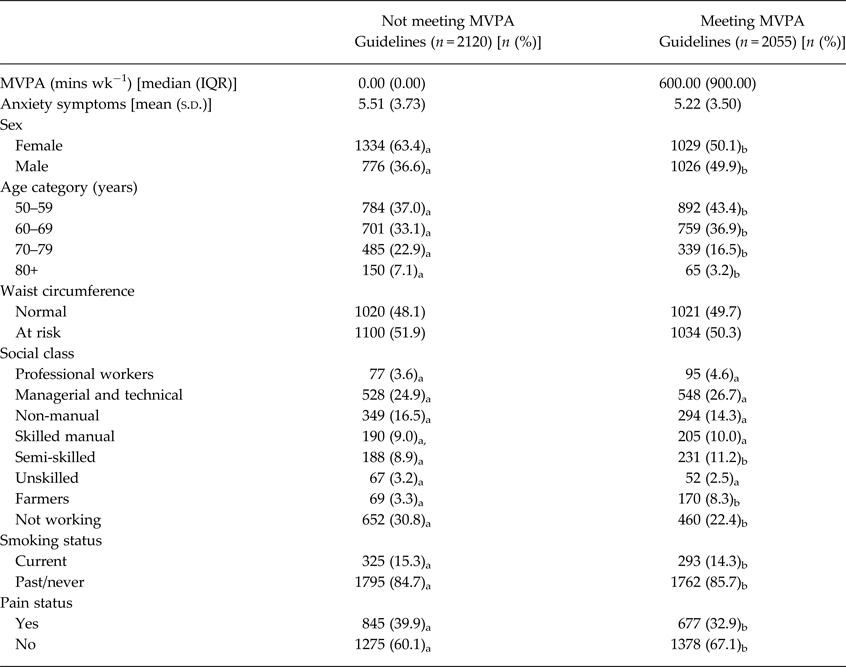
Compared with the analytic sample, a significantly greater proportion of excluded respondents were aged ⩾80 years (7.6% v. 5.1%), male (47.2% v. 43.2%), current smokers (18.5% v. 14.8%) and did not experience pain (69.0% v. 63.5%; all p < 0.05). There were no significant differences between excluded and included participants for meeting PA guidelines, anxiety status or waist circumference (all p > 0.24). Wave 1 participant characteristics are presented in Table 1. Pain [χ 2 (1, N = 4175) = 21.54, p < 0.001], sex [χ 2 (1, N = 4175) = 75.50, p < 0.001], age [χ 2 (3, N = 4175) = 67.74, p < 0.001] and social class [χ 2 (7, N = 4175) = 88.98, p < 0.001] significantly differed according to meeting MVPA guidelines. Waist circumference [χ 2 (1, N = 4175) = 1.03, p > 0.31] and smoking status [χ 2 (1, N = 4175) = 0.95, p > 0.32] did not significantly differ. Results from follow-up tests are shown in Table 1. Briefly, a statistically significant greater proportion of respondents who were aged 70–79 or ⩾80 years, female or experienced pain were not meeting MVPA guidelines (all p < 0.05). Wave 1 anxiety symptoms were significantly higher among females (5.82 ± 3.69) than males (4.76 ± 3.40; F (1,4174) = 90.58, p < 0.001). The magnitude of difference was small but significant (g = 0.30; 95% CI 0.24–0.36).
Baseline participant characteristics

mins, minutes; MVPA, moderate-to-vigorous physical activity; wk, week.
Different subscript letters indicate a subset of each category whose column proportions differ statistically significantly at the 0.05 level.
Cross-sectional associations between IPAQ categories and anxiety
Prevalence of anxiety was 24.2% (n = 1010). Planned contrasts showed significantly lower anxiety symptoms for the very active (5.17 ± 3.50) group compared with the inactive (5.60 ± 3.75, p = 0.002; g = 0.12, 95% CI 0.04–0.20) group, and no significant differences between the minimally active (5.35 ± 3.58) group and the very active (p = 0.17; g = 0.05, 95% CI −0.02 to 0.12) or inactive (p = 0.07; g = 0.05, 95% CI −0.02 to 0.12) groups.
There was a significant interaction between IPAQ categories and sex (F (2,4169) = 4.19, p = 0.02). Among females, the magnitude of differences between the inactive and minimally active (g = 0.02, 95% CI −0.08 to 0.11) and very active (g = 0.07, 95% CI −0.03 to 0.17) groups were statistically non-significant and small. There was a non-significant, small difference between the minimally active and very active groups (g = 0.05, 95% CI −0.05 to 0.15). Among males, the magnitude of differences between the inactive and minimally active (g = 0.13, 95% CI 0.01–0.26) group was non-significant and small. There were also non-significant, small differences between the very active and minimally active (g = −0.04, 95% CI −0.15 to 0.06) and inactive (g = 0.09, 95% CI −0.03 to 0.21) groups.
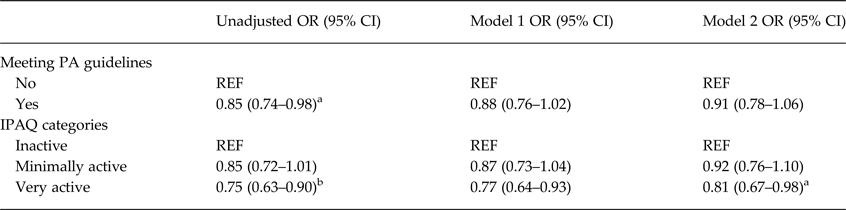
Table 2 presents crude and adjusted ORs for the associations between PA tertile and anxiety status. Fully adjusted ORs are reported here. Minimally active and very active groups were non-significantly associated with 8.4% (95% CI −9.8 to 23.6%; p = 0.34) and significantly associated with 18.8% (95% CI 1.9–32.9%; p = 0.03) lower odds of anxiety, respectively.
Odds ratios (OR) and 95% confidence intervals (CI) derived from binominal logistic regression analyses as indicators of cross-sectional associations between physical activity (PA) and anxiety
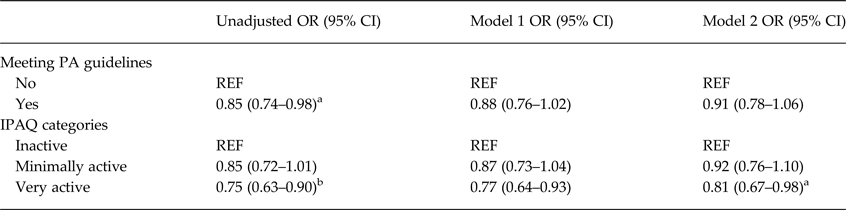
REF, reference category.
ap < 0.05; bp < 0.01.
Model 1 adjusted for age, sex, waist circumference, social class, smoking status.
Model 2 adjusted for age, sex, waist circumference, social class, smoking status, pain.
Cross-sectional associations between meeting PA guidelines and anxiety
Anxiety symptoms were significantly higher among people not meeting MVPA guidelines (5.51 ± 3.73) than those meeting PA guidelines (5.22 ± 3.50; F (1,4173) = 6.23, p = 0.01; g = 0.08, 95% CI 0.02–0.14).
There was no significant interaction between meeting PA guidelines and sex (F (1,4171) = 0.30, p = 0.58). The magnitude of difference between meeting and not meeting PA guidelines was statistically non-significant and small among females (g = 0.05, 95% CI −0.03 to 0.14) and males (g = 0.02, 95% CI −0.08 to 0.11).
Table 2 presents crude and adjusted ORs for the associations between meeting PA guidelines and anxiety status. Fully adjusted ORs are reported here. Meeting the guidelines was non-significantly associated with 9.3% (95% CI −5.5 to 21.9%; p = 0.21) lower odds of anxiety.
Longitudinal associations between IPAQ categories and anxiety
Incidence of anxiety was 3.4% (n = 109). Planned contrasts showed non-significantly reduced anxiety symptoms for the very active group (2.41 ± 2.36) compared with the minimally active (2.55 ± 2.51, p = 0.15; g = 0.06, 95% CI −0.02 to 0.14) and inactive (2.48 ± 2.39, p = 0.53; g = 0.03, 95% CI −0.06 to 0.12) groups, and a non-significant difference between the inactive and minimally active (p = 0.48; g = −0.03, 95% CI −0.12 to 0.06) groups.
There was no significant interaction between IPAQ categories and sex (F (2,3161) = 0.05, p = 0.95). Among females, there were non-significant differences between the inactive group and the minimally active (g = −0.06, 95% CI −0.17 to 0.05) and very active (g = −0.02, 95% CI −0.14 to 0.10) groups. There was a small, non-significant difference between the minimally active and very active (g = 0.04, 95% CI −0.08 to 0.16) groups. Among males, the magnitude of differences between the inactive group and the minimally active (g = −0.04, 95% CI −0.18 to 0.10) and very active (g = −0.03, 95% CI −0.16 to 0.11) groups were non-significant and small. There was a small, non-significant difference between the minimally active and very active (g = 0.02, 95% CI −0.10 to 0.13) groups.
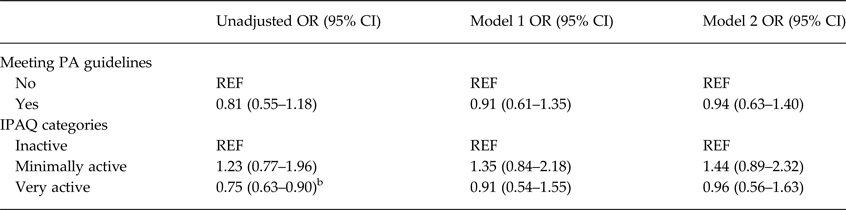
Table 3 presents crude and adjusted ORs for the associations between IPAQ categories and anxiety status. Fully adjusted ORs are reported here. The very active group was non-significantly associated with 4.3% (95% CI −62.7 to 43.6%; p = 0.87) reduced odds of anxiety. The minimally active group was associated with 43.5% (95% CI −12.3 to 132.3%; p = 0.14) increased odds of anxiety.
Odds ratios (OR) and 95% confidence intervals (CI) derived from binominal logistic regression analyses as indicators of prospecctive associations between physical activity (PA) and anxiety
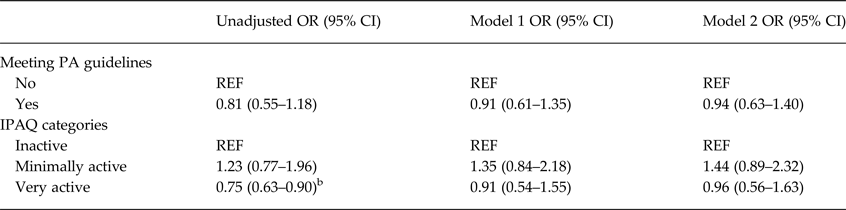
IPAQ, International PA Questionnaire; REF, reference category.
ap < 0.05.
Model 1 adjusted for age, sex, waist circumference, social class, smoking status.
Model 2 adjusted for age, sex, waist circumference, social class, smoking status, pain.
Longitudinal associations between meeting PA guidelines and anxiety
Anxiety symptoms did not significantly differ between people meeting (2.44 ± 3.38) and not meeting (2.52 ± 2.47; F (1,3165) = 0.69, p = 0.41; g = 0.03, 95% CI −0.04 to 0.10) MVPA guidelines.
There was no significant interaction between meeting PA guidelines and sex (F (13163) = 0.31, p = 0.58). The magnitude of difference between meeting and not meeting PA guidelines was statistically non-significant and small among females (g = 0.01, 95% CI −0.09 to 0.10) and males (g = −0.03, 95% CI −0.13 to 0.07).
Table 3 presents crude and adjusted ORs for the associations between meeting PA guidelines and anxiety status. Fully adjusted ORs are reported here. Meeting PA recommendations was non-significantly associated with 6.3% (95% CI −39.7 to 37.2%; p = 0.75) reduced odds of anxiety.
Discussion
To the authors’ knowledge, this is the largest cross-sectional and longitudinal investigation of meeting PA guidelines and anxiety among older adults. The present unadjusted cross-sectional and longitudinal findings appear to support the beneficial effects of meeting PA guidelines or engaging in high levels of PA to reduce the likelihood of anxiety symptoms and status. However, following adjustment only high volumes of MVPA were significantly associated with lower prevalence of anxiety, while all prospective associations between PA and anxiety were small and no longer significant, suggesting a potential moderating effect by one or more covariates.
A dose–response was observed in cross-sectional analyses; there were no significant findings in prospective analyses. Previous research has reported a graded relationship between PA and the relative risk of developing anxiety (Sanchez-Villegas et al. Reference Sanchez-Villegas, Ara, Guillen-Grima, Bes-Rastrollo, Varo-Cenarruzabeitia and Martinez-Gonzalez2008), and a cross-sectional dose–response relationship between PA and cognition in older adults (de Souto Barreto et al. Reference de Souto Barreto, Delrieu, Andrieu, Vellas and Rolland2016); however, evidence has been mixed (ten Have et al. Reference ten Have, de Graaf and Monshouwer2011).
The crude and adjusted odds of reduced anxiety observed in the current study are small compared with previous research. For example, large-scale cross-sectional evidence (Stubbs et al. Reference Stubbs, Koyanagi, Hallgren, Firth, Richards, Schuch, Rosenbaum, Mugisha, Veronese and Lahti2017a) and longitudinal evidence in older adults (Pasco et al. Reference Pasco, Williams, Jacka, Henry, Coulson, Brennan, Leslie, Nicholson, Kotowicz and Berk2011) has demonstrated a 23.1 and 45% reduction in odds of anxiety, respectively. However, similarly small reductions in anxiety symptoms to those observed in the present study have previously been observed in older adults (Ivanova et al. Reference Ivanova, Burns, Deschênes, Knäuper and Schmitz2017). Anxiety symptom expression can differ between age groups (Diefenbach et al. Reference Diefenbach, Stanley and Beck2001; Wolitzky-Taylor et al. Reference Wolitzky-Taylor, Castriotta, Lenze, Stanley and Craske2010), and older adults may tend to experience and/or report more somatic symptoms (Davies et al. Reference Davies, Burn, McKenzie, Brothwell and Wattis1993). Indeed, the potential utility of developing specific instruments to measure anxiety symptoms among older adults has previously been noted (Bryant et al. Reference Bryant, Jackson and Ames2008). Thus, it is plausible that the HADS was a less than optimal measure of anxiety symptoms and status in the current population given its focus on cognitive symptoms.
Pain is a well-established comorbidity in anxiety disorders. There is evidence for a reverse causal link (Gureje, Reference Gureje2008), shared risk factors (Gureje, Reference Gureje2008) and overlap among the neuroanatomy thought to be involved in pain processing and anxiety (LeDoux, Reference LeDoux2000; Vogt, Reference Vogt2005; Zhuo, Reference Zhuo2008). PA and exercise also improve pain and anxiety. For example, prolonged exercise in healthy individuals has improved pain tolerance (Jones et al. Reference Jones, Booth, Taylor and Barry2014) and modulation (Ellingson et al. Reference Ellingson, Colbert and Cook2012). Although the present study did not directly examine the association between pain and anxiety, pain was included as a covariate in the analyses. The presence of pain was associated with a 108.7% (95% CI 79.8–142.3%, p < 0.001) increase in odds of experiencing concurrent anxiety, and a 109.7% (95% CI 41.5–210.8%, p < 0.001) increase in odds of developing anxiety during 2-year follow-up. Therefore, future research should examine the potential moderating/mediating role that pain plays in the PA–anxiety relationship.
Anxiety was significantly higher among females, supporting previous epidemiological evidence that European females are twice as likely to suffer anxiety disorders (Alonso et al. Reference Alonso, Angermeyer, Bernert, Bruffaerts, Brugha, Bryson, Girolamo, Graaf, Demyttenaere and Gasquet2004) or possible anxiety (Brunes et al. Reference Brunes, Gudmundsdottir and Augestad2015) than males. Genetic (Feingold, Reference Feingold1994; McLean & Anderson, Reference McLean and Anderson2009), neurobiological (Altemus, Reference Altemus2006; McLean & Anderson, Reference McLean and Anderson2009), psychological (Bekker & van Mens-Verhulst, Reference Bekker and van Mens-Verhulst2007) and bioenvironmental (McLean & Anderson, Reference McLean and Anderson2009) factors potentially underlie sex-related differences in mental health. Poorer baseline mood, and subsequently larger improvements following acute exercise, have also been observed in females (McDowell et al. Reference McDowell, Campbell and Herring2016); however, in the present study, although the cross-sectional interaction between sex and meeting PA guidelines was significant, the magnitude of associations were small among both females and males.
Although not examined in the present study, social support may play an important role in the PA–anxiety relationship. Social support has been shown to play a key role in recovery from affective disorders (Hallgren et al. Reference Hallgren, Lundin, Tee, Burström and Forsell2017), and cross-sectional studies have demonstrated inverse associations between social support and mental health in the general population (Grav et al. Reference Grav, Hellzèn, Romild and Stordal2012) and older adults (Golden et al. Reference Golden, Conroy, Bruce, Denihan, Greene, Kirby and Lawlor2009; Liu et al. Reference Liu, Gou and Zuo2016). Social support is also positively associated with PA engagement among older adults (Koyanagi et al. Reference Koyanagi, Stubbs, Smith, Gardner and Vancampfort2017; Smith et al. Reference Smith, Banting, Eime, O'Sullivan and van Uffelen2017). It is plausible that social support plays a moderating/mediating role in the PA–mental health relationship.
Limitations and strengths
Firstly, questionnaire-based activity measures can be problematic and susceptible to over-reporting (Manini et al. Reference Manini, Everhart, Patel, Schoeller, Colbert, Visser, Tylavsky, Bauer, Goodpaster and Harris2006); thus, it is plausible that the relationship between PA and anxiety may have been underestimated. Indeed, in the current study, the overall average weekly MVPA of 470 min far exceeds recommendations (PAGAC, 2008). However, there was substantial variation in reported MVPA, and the overall mean weekly MVPA is potentially misleading as the median amount of weekly MVPA was 120 min. Secondly, it is plausible that the association between PA and anxiety could be bi-directional, and anxiety symptoms and disorders cause declines in PA levels (Da Silva et al. Reference Da Silva, Singh-Manoux, Brunner, Kaffashian, Shipley, Kivimäki and Nabi2012). It is plausible that anxiety symptoms may take longer than 2 years to emerge in a general population survey, and so the 2-year follow-up may have resulted in a lower incident anxiety rate; however, as the HADS assesses anxiety symptoms experienced in the last week, a 2-year follow-up should have been more than sufficient to observe the development of new anxiety cases. Additionally, non-measured variables, such as genetic variation (De Moor et al. Reference De Moor, Boomsma, Stubbe, Willemsen and de Geus2008), could have influenced both PA levels and the development of anxiety. Nonetheless, the present study also has notable strengths, including the use of a large national sample of elderly community-dwelling males and females and direct examination of the importance of meeting recommended PA guidelines.
Future research
Future research should investigate (1) the anxiolytic effect of sub-guideline levels of PA, which has been shown to reduce odds of mortality (Hupin et al. Reference Hupin, Roche, Gremeaux, Chatard, Oriol, Gaspoz, Barthélémy and Edouard2015), (2) the potential moderating/mediating roles of pain and/or social support in the PA–anxiety relationship and (3) the potential anxiogenic influence of sedentary behaviour independent of PA levels.
Acknowledgements
The authors have no financial disclosures. The authors disclose no conflicts of interest. The TILDA study was supported by the Irish Government, the Atlantic Philanthropies and Irish Life PLC. This work was also supported by the Health Research Board of Ireland (Grant reference: HRA_PHS/2012/30). The sponsors played no role in study design, methods, subject recruitment, data collection, analysis or preparation of the paper.
Financial Support
This research received no specific grant from any funding agency, commercial or not-for-profit sectors.
Conflict of Interest
None.
Ethical Standard
The authors assert that all procedures contributing to this work comply with the ethical standards of the relevant national and institutional committees on human experimentation and with the Helsinki Declaration of 1975, as revised in 2008.
Availability of Data and Materials
Dataset files are publicly accessible and provided by The Irish Longitudinal Study on Ageing. Information on how to access these is available at www.tilda.tcd.ie.
Supplementary Material
The supplementary material for this article can be found at https://doi.org/10.1017/S204579601800001X.