Fear has an evolutionary purpose for humans. Steimer defines fear as “a motivational state aroused by specific stimuli that give rise to defensive behavior or escape. Reference Steimer1 ” Response to fear can trigger life-saving actions; however, it can also trigger life-endangering behavior such as avoidance and the spreading of misinformation. The fear-based responses (FBR) and their contribution to the Ebola crisis in West-Africa 2014-2016 are well documented by Shultz et al. Reference Shultz, Cooper and Baingana2 Our current study discusses a rapid qualitative assessment (RQA) model that relied heavily upon community participation to identify the causes of the FBR that were driving the spread of the Ebola virus in Sierra Leone. The efficacy of an in depth RQA is previously proven; however, this model focuses on inclusion of all stakeholders, not isolated groups within the impacted communities. Reference Johnson and Vindrola-Padros3 This community-based information provided an informed and data-driven basis for implementing an effective and rapid response. Reference Shultz, Cooper and Baingana2 Such models continue to demonstrate their relevance even now with FBRs driving behavior related to the coronavirus disease 2019 (COVID-19) global pandemic.
“Fear-related behaviors (FRBs) are individual or collective behaviors and actions initiated in response to fear reactions that are triggered by a perceived threat or actual exposure to a potentially traumatizing event. Importantly, FRBs modulate the future risk of harm. Reference Shultz, Cooper and Baingana2 ” When a disaster occurs as the result of 1 event, such as a tsunami or hurricane, then FBR protect human life and serve an evolutionary and biological purpose. Programs that arrive and deploy quickly, providing outside resources and expertise, are welcomed by the communities impacted and are able to deliver life-saving care and interventions in directly impactful ways. Individual choices and fear are still driving decision-making in these types of disasters. However, when the threats are viral and go global, like with Ebola and coronavirus viruses, individual decision-making and fear drive human choices at a regional and a global scale in ways that often promote the spread of disease and destruction. Addressing fear-based responses of health-care workers and the population at large must be an essential strategy in these types of disaster responses because they hamper the ability of implementing partners to achieve any measure of success. Reference Shultz, Cooper and Baingana2 The real impact of FBRs is wide ranging, and impacts mental health for essential workers, the ability for governments and agencies to effectively respond and contain threats, and restricts economic growth by prolonging epidemics and pandemics. Reference Shultz, Cooper and Baingana2 Very few models exist to rapidly assess the determinants of FBRs and combat them within epidemic or disaster settings, which was imperative in this response as FBRs were the number 1 drivers of the epidemic as stated by Johnson and Vindrola-Padros. Reference Johnson and Vindrola-Padros3
Methods
Setting
The Ebola epidemic had been running rampant since July 2014 when the first case was diagnosed in the Pujehun District near the Liberia border. By December 2014, a total of 9446 people were confirmed to be infected and 2758 people had died. Reference Cancedda, Davis and Dierberg4 As the crisis continued, additional global actors mobilized to respond. Among the global actors was Partners in Health (PIH), an International Non-Governmental Organization (INGO) whose mission is “to provide a preferential option for the poor in health care. Reference Cancedda, Davis and Dierberg4 ” PIH partnered with a local Sierra Leonian non-governmental organization (NGO), The Wellbody Alliance, to tap into that organization’s experience and knowledge of the local context, as well as being able to leverage their presence in a region that was developing community health volunteers before Ebola. PIH was determined to establish a Community Health Workers (CHW) program, as they believe that “paid, trained and coordinated community health workers are vital to health education, case detection, and linking people to care. Reference Cancedda, Davis and Dierberg4 ” PIH had already been responding to the crisis with medical interventions through a partnership with the Sierra Leonian government to staff and run the government Ebola Treatment Unit (ETU) in Port Loko. This partnership with the government provided an entry into expanding their response to include community-based components. PIH chose to focus on survivor services and the creation of a robust CHW program to support the medical response.
Study Design/Model for RQA
A 3-person, community-centered team was deployed by PIH. It included 1 expatriate with a master’s degree in public health and 15 plus y of experience working in development as well as extensive experience working in Sierra Leone with community-based programs. It also included 2 local staff members who were community mobilizers and had been involved in the epidemic response from the beginning. We elected to conduct a participatory RQA of stakeholders in the Ebola response before designing the intervention requested by PIH. This RQA would focus on the 3 Chiefdoms with the highest case numbers and involve extensive community participation. We started with identified community and response leaders and used a snowball network approach to access a range and scope of perspectives. Every group or person we spoke with advised us of others who could also provide in depth information regarding the community views on the response, the gaps, and the drivers of fear. We also gathered observational and qualitative data from the government officials, Ebola Treatment Facilities, and the British Military.
The following 4 open-ended questions framed the assessment: (1) What’s currently happening? (2) What are the gaps? (3) What filled those gaps pre-event? (4) Why isn’t it working now?
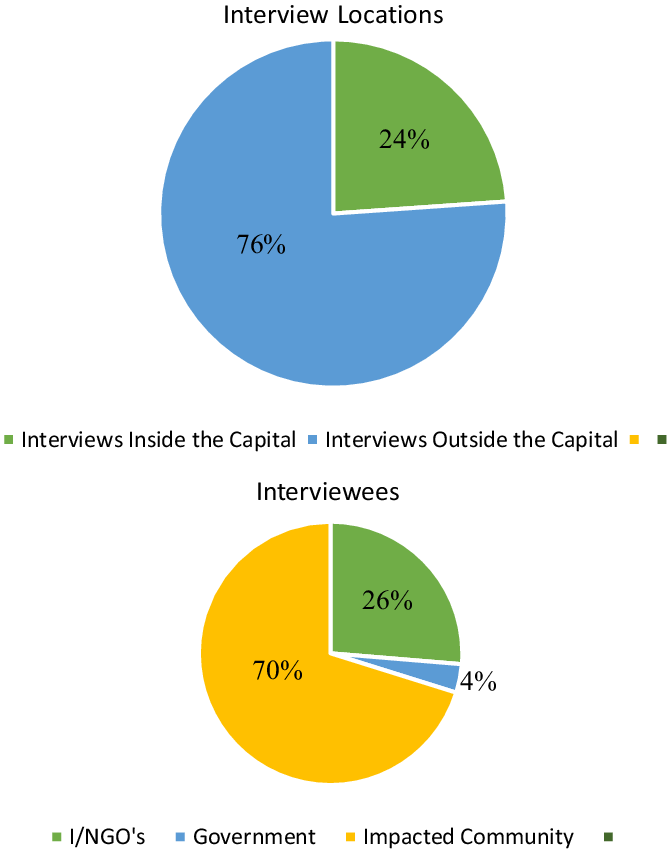
During the phase 1 interviews, the 3 team members took handwritten notes. All the interviews were conducted with all 3 team members present, so the notes could be validated against others’ perceptions during the analysis. The information shared by participants was reframed and repeated back to them for clarification and validation of summary findings on the spot. At the end of each day, the team analyzed the interviews through peer debriefing and visual mapping. They identified key themes, which were used to frame the enquiries of the following day. The assessment was conducted over 4 d. It began with identified community leaders and evolved to include Ebola response coordination partners, both government and NGO leadership, community leaders, both elected and socially selected. It also included pre-event community organizations such as men’s and women’s groups in each village, the Paramount Chiefs for each administrate Chiefdom in the district, religious leaders, education leaders, and government officials. A total of 76% of those interviewed were outside the capitol, 24% lived or worked in the capitol. Seventy percent of those interviewed were community members directly impacted by the epidemic, 26% were INGOs working on the Ebola response, and 4% were Sierra Leonian government employees. The interviews were halted after 4 d, once the team began to hear repetition in the responses and the key themes reached saturation. See also Figure 1.
Breakdown by percentage of interviews done in the district capital versus outside the capital. As well as who in the communities were interviewed.

Data Analysis and Verification
The team used an integrated approach to analyzing the data gathered. Every evening at the end of the interviews, the notes were re-read and discussed and classified into thematic categories. We all had knowledge of the fear-based behaviors that saturated media coverage, and our thematic framing focused on rooting out the causes of those FBRs, as highlighted in the article by Cancedda et al. Reference Cancedda, Davis and Dierberg4 The results of our integrated analysis were then shared with the community groups and leaders previously interviewed, and their feedback and contributions were actively sought for phase 2 and will be described in the Methods section. Overall, this process involved asking for community participation at 2 phases in the design process, ensuring that the information gathered was contextually and culturally validated to the Ebola epidemic in process. The use of a snowball method to select participants, the integrated data analysis, and the final validation leant confidence in our findings and the resulting program design that was built.
Results
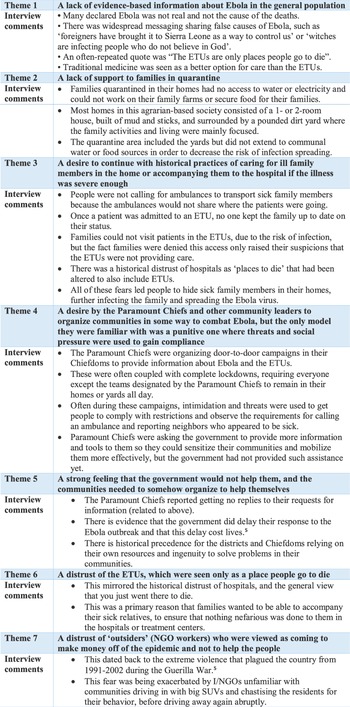
The RQA focused on all stakeholders, those in the community and those that were part of the response. Recurring themes emerged during the course of the RQA and were tracked against known fear-based responses driving the spread of the virus, as highlighted by Richards et al. Reference Richards, Mokuwa and Welmers5 Once a saturation of these thematic concepts was reached, the team moved on to phase 2: analysis and verification. This was done by revisiting approximately 25% of the interviewees to confirm our findings. Our findings allowed us to clearly draw a line between the fears in the community and the resulting behavior. We could see that a lack of evidence-based information on the virus as well as the treatment and care provided in the ETUs was preventing the population from seeking assistance. We also learned that this lack of knowledge was exacerbating the continuation of harmful behavior and practices that spread the virus further. For more details on the themes identified and the correlating data collected, please see Figure 2.
Themes.

Gaps Identified
During the RQA of the existing response, the following gaps were identified in the response system that could be addressed using Community Based Participatory Research (CBPR) in the form of a comprehensive Community Health Worker program. Our findings correlated with a similar assessment done in Liberia by The Ministry of Health the World Health Organization offices in that country. Reference Kutalek, Wang and Fallah6
-
Maintaining quarantine integrity:
Families were being quarantined to their home compounds with no access to food, water, communication, or information about their ill family members in the ETUs. This was causing countless people to violate their quarantine, further spreading Ebola and exacerbating the epidemic.
-
Active case finding need:
When people were falling ill, family members were keeping them at home to care for them because they did not trust the ETUs or the government. Part of this distrust was caused by a lack of communication from the ETU to the family after patients were admitted. Another factor was a generational distrust of the government, communities were accustomed to taking care of themselves independently and not relying on the government. The involvement of the military, both British and Sierra Leonian, contributed to this distrust as well.
-
Evidence-based community education about Ebola, what happens in the ETU, and survivors:
This information coming from a trusted source to the community would increase compliance with necessary epidemic restrictions, limiting the spread of disease and decreasing the mortality if people could be treated earlier as confirmed by Kellerborg et al. Reference Kellerborg, Brouwer and van Baal7
-
Provide communication link between villages/families and the ETUs:
Patients were removed from the communities by the government ambulances and then seemed to disappear, with family members never hearing which ETU they were taken to or how they were fairing.
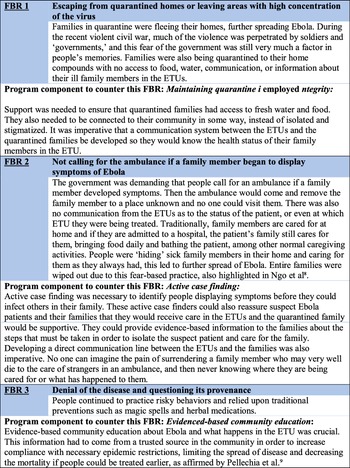
A multifaceted intervention to implement guidelines around best practices in community health work to improve trust in a health system was needed. As the existing health system had collapsed, it was important that the intervention be built within an existing social structure that was culturally appropriate. The assessment phase had concentrated its focus on the communities impacted, building the system in a way that leaned into existing community infrastructure would rely on the relationships already begun. The RQA provided a clear picture of the FBRs contributing to the continuing spread of Ebola. For more information on the FBRs and the resulting program components developed to address them, please see Figure 3.
Fear-based responses.

Conclusions/Discussion
Based on the themes of the interviews, identification of gaps in the existing response structure, and identification of the root causes of the FBRs, the following key components for a community-based program were identified. The information gathered in the RQA would go on to inform the structure of the program, the topics and length of the training necessary, and the methods for integration into the existing response structure in a way that would close gaps and strengthen the overall response. We would use community-based participatory research similar to that of Harris et al., the relationships with the stakeholders developed during the RQA, and establish a comprehensive CHW program. Reference Harris, Bradham and Baumgarten10 It would consist of a 1 group pretest-posttest design and continual feedback loops allowing for continual adaptation and maximum efficacy due to the ever-evolving nature of the epidemic and response. This program will be highlighted further in a future study expanding on the structure and implementation of the CHW program of Ebola response volunteers.
Historically, our crisis and disaster response models are predicated on older military models of warfare, as highlighted by Dara et al. Reference Dara, Ashton and Farmer11 The focus in these cases is on body retrieval from battlefields and rapid medical assessments and care. Most current medical responses follow a similar model, focusing heavily on rapid clinical assessment, care for the sick or injured, and management of the dead. The UN has a model of coordination that is activated during most disaster responses. It dictates that coordinating committees be constituted, and that they include representatives from the local government as well as I/NGO partners. 12 This has proven effective previously because it provides a consistent pattern to response that can be duplicated quickly worldwide. In our case study, we demonstrate that community participation at the inception of this coordination should exist well beyond tokenism to address underlying fear-based behaviors that are causing the disaster. This idea is supported in other literature but those primarily focus on RQAs with specific stakeholders only. There should be further study and examination of methods that involve all stakeholders at the start of any disaster or epidemic response. Schultz and other researchers also recommend a “a rapid assessment of outbreak-associated psychological stressors, for both civilians and health care workers,” Reference Shultz, Cooper and Baingana2 specifically in the context of this Ebola epidemic in West Africa, but that same recommendation can be easily applied to all types of emergency responses.
During the assessment phase of the United Nations model there is a Multi Cluster/Sample Initial Rapid Assessment (MIRA) process outlined. This step does include information gathering at the community level, but only allows for a “good enough” approach. 12 Emphasis is placed on the fact that community level information should be gleaned from secondary data review and external direct observation in the first phase of a response. This has proven useful in more static response, such as hurricanes or tsunamis. We propose that this is inadequate and does not allow the responders to understand the full context of the crisis, and, therefore, how to adequality address it. This is particularly true when the crisis is exacerbated by human behavior and fear-based responses. Our findings correlated with a similar assessment done in Liberia by The Ministry of Health the WHO offices in that country. Reference Kutalek, Wang and Fallah6
We propose that community level information be gathered at the same time as government and I/NGO organizations are arriving and coordinating. We provided an example of a model that is rapid and easily implemented but has enormous impact on the depth and breadth of the response, by gaining a deeper understanding of the social anthropological drivers of behavior. Then this information can be combined with the medical response to develop a relief pathway for the impacted communities. An interdisciplinary model that pauses, for just a moment, to explore the boundaries of those intrinsic systems, will be stronger and more quickly able to respond to the unfolding crisis.
Fear-based responses had an impact on the current global pandemic, potentially accelerating the spread of the severe acute respiratory syndrome coronavirus 2 (SARS-CoV-2), which causes COVID-19. Early in the pandemic, studies examined the impact fear had on how people absorbed and interpreted information related to the virus. Salvi et al, showed that people who were afraid were more likely to believe and share false information about the virus. Reference Salvi, Iannello and Cancer13 This further reinforces the paper’s argument that gathering information on the causes of FBRs needs to be integrated into the response as well. An early, and targeted focus on the root causes of FBRs might support slowing the spread of disease, potentially saving lives and money.
More research in the field of community-based interventions during an emergency response is desperately needed. This model has only been tested in this Ebola epidemic, and further testing in additional settings would be beneficial to demonstrate its importance and impact. Public health emergency preparedness (PHEP) focuses on the institutional and medical capacity, which is extremely important. We believe that the community capabilities and insights are equally important and should be considered at all phases of the response. This collaboration will lead to better distribution of resources and improved outcomes for all stakeholders, affirmed by Ramsbottom et al. Reference Ramsbottom, Ramsbottom and O’Brien14 Biological crises versus natural disasters do offer different contexts, but the same model could easily apply. We strongly concur with the declaration of Horwood et al. “Now is the time to consider how to bring social science into the center of future pandemic surveillance, response, community preparedness, and health system strengthening.” Reference Horwood, Butler and Barker15
Acknowledgments
The authors thank the following individuals and others for their support and efforts to make this response and research possible: Dr. Bailor Berry, Cheery Keta, Gibrilla Sheriff, the Paramount Chiefs and village Chiefs for Kafu Bullum, Maforki, and Lokomasama in Sierra Leone, the Sierra Leonian Ministry of Health, and Partners in Health.
Authors Contributions
C.P.N. Substantial contributions to the conception or design of the work; or the acquisition, analysis, or interpretation of data for the work; AND Drafting the work or revising it critically for important intellectual content; AND Final approval of the version to be published; AND Agreement to be accountable for all aspects of the work in ensuring that questions related to the accuracy or integrity of any part of the work are appropriately investigated and resolved. P.vd.V. Substantial contributions to the design of the work; AND revising it critically for important intellectual content; AND Final approval of the version to be published. M.T. Substantial contributions to the design of the work; AND revising it critically for important intellectual content; AND Final approval of the version to be published. M.A. Substantial contributions to the conception or design of the work; or the acquisition, analysis, or interpretation of data for the work; AND revising the work critically for important intellectual content; AND Final approval of the version to be published; AND Agreement to be accountable for all aspects of the work in ensuring that questions related to the accuracy or integrity of any part of the work are appropriately investigated and resolved.
Funding statement
There is no funding provided for this research. The research was conducted when the lead author (C. Nally) was working as a staff member for Partners in Health during the Ebola Response in Sierra Leone in 2015. The author was paid for working on the Ebola response in Sierra Leone, but the research was conducted on her own time. Her current PhD program is not funded, and the author is writing on her own time.
Conflict(s) of interest
The authors declare no conflicts of interest. Author Patrick Van de Voorde is an unpaid board member of the Belgian Society of Emergency Medicine (BESEDIM) and the European Resuscitation Council (ERC).
Disclaimer
The views expressed in this paper are the authors’ own and do not reflect the views of Ghent University or Partners in Health.
Ethical standard
Approved consent was obtained from Ghent University, and we confirm that the research abided by the principles in the Declaration of Helsinki