Research findings suggest that depression and psychosocial stress may have an etiological role in diverse diseases in adulthood, including cardiovascular disease, chronic pain, stroke, diabetes mellitus, susceptibility to infectious diseases, and HIV disease progression (Cohen, Tyrrell, & Smith, Reference Cohen, Tyrrell and Smith1991; Holahan et al., Reference Holahan, Pahl, Cronkite, Holahan, North and Moos2010; Ickovics et al., Reference Ickovics, Hamburger, Vlahov, Schoenbaum, Schuman and Boland2001; Miller, Chen, & Cole, Reference Miller, Chen and Cole2009; Rozanski, Blumenthal, & Kaplan, Reference Rozanski, Blumenthal and Kaplan1999). These associations provide a basis for the allostatic load model, a leading framework for linking stress, health, and development (Juster, McEwen, & Lupien, Reference Juster, McEwen and Lupien2010). The pathophysiological mechanisms leading to such varied disease states are not fully elucidated, but considerable evidence points to inflammation as one likely mediator (Juster et al., Reference Juster, McEwen and Lupien2010; Karelina & DeVries, Reference Karelina and DeVries2011). Whether the health impacts of depression and stress and the underlying mechanisms are apparent in childhood is not yet clear and represents a major developmental question with sizable public health implications. The current study is part of an ongoing effort to translate research on stress exposure and health outcomes from adults to children. Specifically, we examined the links between two indicators of psychological well-being in children, depression and self-efficacy, and markers of immune functioning and illnesses in a short-term longitudinal study of typically developing 7- to 13-year-old children.
Clinical and epidemiological studies provide robust evidence that psychosocial stress and depression are associated with changes in adult immune function (Musselman, Evans, & Nemeroff, Reference Musselman, Evans and Nemeroff1998; Padgett & Glaser, Reference Padgett and Glaser2003). Specifically, a recent meta-analysis involving over 400 subjects showed that levels of the proinflammatory cytokine interleukin 6 (IL-6) and tumor necrosis factor-alpha were elevated in subjects with major depressive disorder compared to normal controls (Dowlati et al., Reference Dowlati, Herrmann, Swardfager, Liu, Sham and Reim2010). In addition, elevated concentrations of IL-6 were reported in subjects with higher levels of stress associated with elevated blood pressure and more severe symptoms during an upper respiratory infection (Brydon & Steptoe, Reference Brydon and Steptoe2005; Cohen, Doyle, & Skoner, Reference Cohen, Doyle and Skoner1999). Chronic psychosocial stress and depression may increase immune activation via greater glucocorticoid resistance (Pace & Miller, Reference Pace and Miller2009; Pace et al., Reference Pace, Mletzko, Alagbe, Musselman, Nemeroff and Miller2006). Other studies suggest that depression may suppress immune activation, as shown in previous studies linking depression to reductions in lymphocyte proliferative responses to mitogens, natural killer (NK) cell activity, and cellular immunity to viruses (Irwin, Reference Irwin2002; Kronfol, Reference Kronfol1983; Schleifer, Keller, & Bartlett, Reference Schleifer, Bartlett, Keller, Eckholdt, Shiflett and Delaney2002). These apparently contradictory findings have not yet been reconciled, and underscore the need for further study.
Research translating the adult findings on depression or stress and immunity to pediatric samples is now underway (Worthman & Panter-Brick, Reference Worthman and Panter-Brick2008), but to date findings are limited, particularly with respect to specific mechanisms. Nevertheless, several reports link some aspect of general family stress to one or the other marker of immune functioning. Wolf, Miller, and Chen (Reference Wolf, Miller and Chen2008) found that parent-reported perceived stress and depressive symptoms were associated with increased levels of the T-helper cell type 2 markers IL-4 and eosinophilic cationic protein in their children. Another indicator of family stress, harsh family climate in early childhood, was linked to a pro-inflammatory phenotype during adolescence (Miller & Chen, Reference Miller and Chen2010). In a healthy ambulatory sample, we previously reported that parental psychiatric symptoms predicted elevated NK cell activity in their children and increased CD8+ T cell responses to chronic viral stimulation with cytomegalovirus (Caserta et al., Reference Caserta, O'Connor, Wyman, Wang, Moynihan and Cross2008).
The above findings support the broad hypothesis that stress may compromise health in children, but further research is needed to address several developmental questions not yet tackled in existing studies. One concerns the point in development at which reliable associations may be detected. Animal studies demonstrate that the effect of early stress exposure may have lasting impact on inflammatory markers (Hennessy, Deak, & Schiml-Webb, Reference Hennessy, Deak and Schiml-Webb2010) and that there are reliable links between behavior and immunity (Granger, Hood, Dreschel, Sergeant, & Likos, Reference Granger, Hood, Dreschel, Sergeant and Likos2001), but the immune outcomes are, as in most human studies, limited to adulthood. Accordingly, it is not clear when in development a reliable impact on immune mechanisms can be detected. It may be that reliable links between stress exposure and immune outcomes are not detectable in younger children, perhaps because of greater immunological reserve that underlies resilience or because stress exposure effects are detectable only after prolonged, that is, more chronic, stress exposure. The current study seeks to address this question by testing whether one of the most reliable associations in adult psychoneuroimmunology, an association between IL-6 and self-reported depressive symptoms, is found in young children.
A further developmental question for research is the identification of the risk phenotype that may associate with child immune function. Major depressive disorder, the focus of much of the adult work, is rare in preadolescent (especially prepubertal) children (Angold, Costello, Erkanli, & Worthman, Reference Angold, Costello, Erkanli and Worthman1999). Therefore, if inflammation were specifically associated with depression, then the link may not be detectable in preadolescent samples. In fact, studies of immune function and depressive symptoms in children and adolescents have yielded inconsistent findings. For example, whereas one study of 8–12-year-olds reported that major depression was associated with lower NK cytotoxity and increased concanavalin A mitogen responses (Barlett, Schleifer, Demetrikopoulos, & Keller, Reference Barlett, Schleifer, Demetrikopoulos and Keller1995), a different study of adolescents found major depression associated with increased NK cell activity, increases in circulating lymphocytes and lymphocyte subsets, and with lower concanavalin A mitogen responses (Schleifer et al., Reference Schleifer, Keller and Bartlett2002). Still other studies found few differences on measures of immunity associated with depression (Birmaher et al., Reference Birmaher, Rabin, Garcia, Jain, Whiteside and Williamson1994; Shain et al., Reference Shain, Kronfol, Naylor, Goel, Evans and Schaefer1991; Targum, Clarkson, Magac-Harris, Marshall, & Skwerer, Reference Targum, Clarkson, Magac-Harris, Marshall and Skwerer1990). Small sample size and varying health status of participants may explain the discrepant findings so far reported. In any event, epidemiological data underscore the substantial role of age and sex on rates of depression (Angold, Costello, & Worthman, Reference Angold, Costello and Worthman1998) and point to these as likely moderators of a link with physical health. As a result, we consider age and sex as moderators of the link between depressive symptoms and immune markers.
In addition, it may be that a number of psychological states predict inflammation, as suggested, for example, by the adult work on optimism and positive emotional style (Cohen, Doyle, Turner, Alper, & Skoner, Reference Cohen, Doyle, Turner, Alper and Skoner2003). We therefore also include in this study a measure of perceived self-efficacy, or positive beliefs in one's ability to enact actions in order to achieve desired goals (Bandura, Reference Bandura1977). Perceived self-efficacy is a predictor of positive social–emotional and behavioral functioning among at-risk or high-stress youth (Cowen et al., Reference Cowen, Wyman, Work, Kim, Fagen and Magnus1997; Masten & Coatsworth, Reference Masten and Coatsworth1998; Wyman, Cowen, Work, & Parker, Reference Wyman, Cowen, Work and Parker1991). This study extends prior work on behavioral outcomes to immunity and health.
In summary, in the present study, as part of a developmental study of an allostatic load model, we sought to extend work on the children's psychological well-being and health, and the mechanisms involved. Pediatric research has included a range of immune markers, some linked to particular disease states of the clinical samples studied; no particular or optimal set of immune markers is easily discernible from existing studies. Here, we include a common marker of inflammation, IL-6, and a frequently assessed indicator of immune activation, NK cell cytotoxicity. To examine if the association with immune markers translate to health outcomes, we include a measure of illness, based on detailed diary data. These immune and health data were examined in relation to children's self-reports over a 1-year period.
Methods
Subject enrollment and protocol
Children ages 5–10 and their primary caregivers were recruited and enrolled between July 1, 2001 and June 30, 2003 from a population participating in a longitudinal study of childhood viral infections in the Division of Pediatric Infectious Diseases at the University of Rochester Medical Center. The children had initially been identified during visits to the emergency department or other pediatric services of the Golisano Children's Hospital at Strong in Rochester, NY. One child per family (chosen based upon inclusion criteria and previous participation in the prior study) was enrolled, and all children were well at the time of enrollment. Children with chronic diseases adversely affecting the immune system (e.g., those on chronic corticosteroid therapy) were excluded. The Research Subjects Review Board of the University of Rochester approved this study. All caregivers provided informed consent, and children provided verbal assent. A $45 honorarium was given to the family following each visit.
The full study protocol spanned a 3-year period, and consisted of seven visits approximately 6 months apart. At each visit, blood samples were collected from children, and each child's vital signs, including height and weight, were measured. The enrolled parent supplied demographic information and completed several measures of family stress and perceived personal distress, including psychiatric symptoms. At each visit, the parent also provided an interim medical history of illnesses and other health conditions between visits, and reported any symptoms of illness in the child in the preceding two weeks (see Caserta et al., Reference Caserta, O'Connor, Wyman, Wang, Moynihan and Cross2008). For the first 2 years of the study (Visits 1–4), children engaged in quiet activities in a separate room while their parents were interviewed. Beginning at the fifth visit and continuing for the next year (Visits 5–7), children completed self-report measures of depression symptoms and self-efficacy (described below). The fifth visit was chosen to initiate the collection of child self-report data because it was presumed that the youngest children in the study (the youngest child was age 5 years at study Visit 1) would not have been reliable reporters on all of the self-report measures at the earlier waves. The present study focuses on this 1-year period during which child-report measures of depression and self-efficacy were obtained.
Illness diary
At enrollment, parents were given a diary form and digital thermometer and instructed to record each week their child's health status, including temperatures associated with every instance of illness. Strict definitions of illnesses were not provided to parents. Rather, parents were asked to record all episodes they considered illnesses, all associated symptoms, and their child's corresponding temperature. Diaries were collected via mail on a monthly basis. If a diary was not returned, then a study nurse contacted the family by phone to collect the information. If a family could not be reached, the diary was updated at the next clinic visit. All of the illness records were reviewed by a pediatric infectious disease specialist who was not part of the study team and who was kept unaware of all subject characteristics. That specialist coded each episode of illness to determine if the episode was consistent with an illness and to determine if multiple records from a 14-day time period reflected a single (e.g., a single viral upper respiratory tract infection recorded as a cold and sore throat) or multiple illnesses (e.g., viral respiratory tract infection and otitis media). Physical trauma, elective or orthopedic surgery, mental health/behavioral problems, constipation, and well-childcare visits were not coded as illnesses. Allergies, asthma, eczema, and contact dermatitis were included. Over the 3-year study, 1065 incidents were coded as separate illnesses and 330 were reported as febrile illnesses, with 230 temperatures recorded (Caserta et al., Reference Caserta, O'Connor, Wyman, Wang, Moynihan and Cross2008). Fever was defined as a temperature >38°C. If the families reported fever but a temperature was not provided (i.e., temperature data were missing), then the illness was recorded as a febrile illness. If families reported a fever but the recorded temperature was ≤38°C, then the illness was recorded as without fever.
Laboratory assays
NK cell cytotoxicity assays were performed on whole blood samples as previously reported (Bromelow, Galea-Lauri, O'Brien, & Souberbielle, Reference Bromelow, Galea-Lauri, O'Brien and Souberbielle1998; Caserta et al., Reference Caserta, O'Connor, Wyman, Wang, Moynihan and Cross2008). The percent specific lysis was calculated as 100 × (cpm experimental – cpm spontaneous)/(cpm maximum – cpm spontaneous) for each dilution of whole blood. The percent specific lysis at each dilution was log transformed and linear regression was used to estimate the dilution that corresponded to 20% lysis, which was then used as an overall measure of NK cell cytotoxicity for each visit.
Plasma samples were assayed in duplicate using the Quantikine High Sensitivity ELISA kit for human interleukin 6 (IL-6) concentrations (R and D Systems, Minneapolis, MN) according to the manufacturer's instructions (Eisenberger, Inagaki, Mashal, & Irwin, Reference Eisenberger, Inagaki, Mashal and Irwin2010; Kiecolt-Glaser et al., Reference Kiecolt-Glaser, Gouin, Weng, Malarkey, Beversdorf and Glaser2011).
Child psychosocial measures
At Visits 5–7, the children completed the Children's Depression Inventory—Short Form (CDI-SF; Kovacs, Reference Kovacs1992). The self-report CDI-SF was designed for children from age 7 to 17 years and consists of 10 questions covering cognitive, affective, and behavioral symptoms associated with depression. For each item, the child selects which of three descriptors spanning minimal to significant symptomotology best describes him/her in the past 2 weeks. The items originated from the longer, 27-item CDI (Kovacs, Reference Kovacs1992) and were selected based on a backward stepwise internal consistency reliability analysis. Higher CDI-SF scores reflect more depression symptoms. The 10 items had an alpha reliability coefficient of 0.80.
At Visits 5–7, children also completed the Perceived Self Efficacy Scale (PSE; Cowen et al., Reference Cowen, Work, Hightower, Wyman, Parker and Lotyczowski1991). This 14-item self-report measure assesses children's judgments about their ability to achieve their desired goals in common problem situations, spanning school challenges, peer and family conflicts, and being in new, unfamiliar situations. For each item, children rate their degree of certainty in achieving a desired outcome on a 3-point Likert scale (not at all sure to very sure). The measure is designed to assess a combination of self-efficacy beliefs and outcome expectations (Bandura & Cervone, Reference Bandura and Cervone1983). The PSE scale has demonstrated adequate internal consistency and construct validity: higher scores are associated with positive behavioral and social–emotional functioning among children in general populations and among those exposed to chronic psychosocial adversity (Wyman et al., Reference Wyman, Cowen, Work, Hoyt-Meyers, Magnus and Fagen1999). An internal consistency coefficient of 0.59 was found for the present study. Higher PSE scores reflect greater perceived self-efficacy.
Covariates
Parent psychiatric symptoms were ascertained at each visit using the 51-item Brief Symptom Inventory (BSI; Derogatis, Dellapietra, & Kilroy, Reference Derogatis, Dellapietra and Kilroy1992). The items assess nine symptom clusters including depression, anxiety, and psychoticism. For each item, the parent provides a severity rating of 0 to 4 based on the prior month. The total symptom score was used, which has been shown to be sensitive to changes in psychological status due to mental disorders and social–interpersonal events. Higher BSI total scores indicate more psychiatric symptoms. We used the BSI as a covariate in models testing associations between children's self-evaluations and health because of previous analyses indicating that parent-reported symptoms were a predictor of increased illnesses and altered immune function in children (Caserta et al., Reference Caserta, O'Connor, Wyman, Wang, Moynihan and Cross2008). In addition, we used family income as another covariate: total yearly family income was assessed at enrollment and at subsequent visits parents were asked to report any changes in income. Child age and sex were also included as covariates and moderators (see below).
Statistical analysis
Analyses were performed with SAS (version 9.2, SAS Institute Inc, Cary, NC). Descriptive analyses were conducted to summarize the data using means, standard deviation, frequency, and percentage as appropriate; and correlations were examined among the study variables. Mixed models were used to evaluate the relationships among the repeatedly measured variables of CDI-SF, PSE, BSI, and income. Patterns of attrition were examined and the assumption of missing completely at random was tested. Plasma IL-6 concentration and NK cell function were log-transformed for normality model assumption and back transformed to the original metric for presentation.
To evaluate whether depression and self-efficacy were associated with the two immune function measures, plasma IL-6 concentration and NK cell function, longitudinal data analysis was performed using mixed models with random subject effects to account for within-subject correlation over time. Plasma IL-6 concentration and NK cell function assessed at Visit 5 through Visit 7 were the dependent variables. Depression (CDI-SF) and self-efficacy (PSE) prior to each visit were used as time-varying predictors. In addition to child age and sex, two additional covariates were added to the models—annual household income and parent psychiatric symptoms (BSI)—to account for well-established effects of those two family variables on child health and to better ascertain the unique contributions of children's self-reported depression and self-efficacy. Also included in each model was immune function at the prior visit (Visit 4) corresponding to the dependent variable (plasma IL-6 concentration or NK cell function) and whether an illness had been reported for the child in the preceding 14 days. Race/ethnicity was not found to be associated with either of the immune responses and therefore was not included as a covariate. Body mass index (BMI) was added to the model testing plasma IL-6 concentrations to account for its association with plasma IL-6 concentration (Shelton & Miller, Reference Shelton and Miller2010). We tested for moderation effects of gender and age on the relationship between depression and immune function in two ways. First, we included both main effects and interaction terms in the regression model. Second, we examined separately the effects of depression on immune function by estimating models for four subgroups defined by age (older vs. younger) and sex in order to test our hypothesis that the adverse effects on health from depression would be greatest in older girls in our sample.
The general estimating equation (Zeger & Liang, Reference Zeger and Liang1986) with a log link function and Poisson errors was used to test the association of depression and self-efficacy with parent-reported child illnesses, as appropriate for the distribution of these count data. Depression and self-efficacy reported by children at Visit 5 were the independent variables of primary interest in analyses predicting number of illnesses in the following year. In addition to children's age and sex, the other covariates in the model were: total illnesses reported by parents in the previous year (Visits 3–5) and the two indicators of family stress at Visit 5: parent psychiatric symptoms (BSI) and annual household income. To account for seasonal effects on children's illnesses, the number of parent-reported illnesses between Visits 5 and 7 was used as the dependent variable so that it covers 1 year. Actual length of reporting time was treated as the offset in the model to justify the variation of this variable among subjects. By using a prospective, longitudinal model (i.e., Visit 5 CDI-SF and PSE predicting illnesses over the next year), the potential confounding effects of illness on children's depression and perceived self-efficacy were reduced. To examine whether the association was moderated by age and sex, interaction analyses were also performed and models were estimated separately for the four groups of children stratified by age (using the median age, 9.3 years) and sex; the association of depression and self-efficacy with febrile illness was analyzed in a similar manner. Whether or not the child had at least one reported febrile illness between Visits 5 and 7 was used as dependent variable to fit a logistic model using the general estimating equation, with a logit link and binary error, with the same set of covariates and independent variables as in the model for total illnesses. Moderation effects of age and sex were also tested and age/sex subgroup analyses were conducted. Mediation analysis (Baron & Kenny, Reference Baron and Kenny1986) was performed to test if plasma IL-6 concentration and NK cell function mediated the relationship between depression and child illnesses.
Results
Cohort description
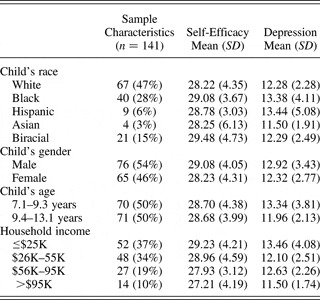
Of 170 enrolled child–caregiver dyads, 141 were retained at the fifth visit when child depression and self-efficacy measures were first collected (Table 1). Ninety-three percent of the enrolled caregivers were female (mean age = 35 years, range = 21–73) and 89% were either the target child's biological or adoptive parent. A total of 120 subjects completed all seven visits (71% of enrolled). The reasons for leaving the study were noncompliance with follow-up visits (62%), self-withdrawal due to lack of interest (24%), and relocation away from area (14%). Sample attrition was unrelated to any measured child or parent characteristic, family income, or family stress and personal distress measures completed by caregivers at enrollment. The assumption of data missing completely at random was tested and found to be valid.
Subject characteristics

Note: Age and income at time of first assessment of depression and self-efficacy. Age is presented at the median split (see details on age interactions).
Preliminary analyses
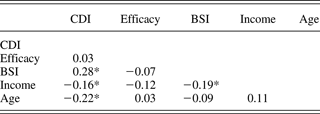
Table 1 includes basic demographic data on the sample. Children's self-reported depression symptoms were moderately stable over the three visits spanning one year (Visits 5–7), as shown by an intraclass correlation coefficient of 0.49 for CDI-SF scores (subject as the class). The intraclass correlation coefficient for PSE scores was 0.26. Intercorrelations among the study variables at baseline were tested with Fisher's Z transformation test and are presented in Table 2. Children's depression symptoms and perceived self-efficacy scores were not significantly correlated. Parent self-reported BSI score and income were not associated with self-efficacy; BSI was positively correlated with child depression (correlation coefficient = .28, p < 0.01); income was marginally negatively correlated with child self-reported depression scores (correlation coefficient = −.16, p = .05). Income was negatively associated with parent psychiatric symptoms (BSI total; correlation coefficient = −.19, p = .03). Neither depression nor self-efficacy scores were associated with child sex. Baseline CDI-SF was correlated with child age, with older children having lower scores (correlation coefficient = −.22, p = .01).
Pearson correlations among variables at Visit 5
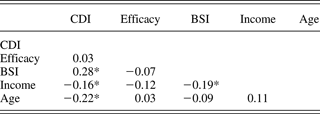
Note: CDI, Child Depression Inventory; BSI, Brief Symptom Inventory.
*p ≤ .05.
Over the three visits (5–7), 372 plasma IL-6, and 353 NK cell assays from 138 individuals were collected for analysis. Two subjects' plasma IL-6 concentrations were excluded from analysis due to extreme outlying values. The intraclass correlation coefficients for plasma IL-6 concentration and NK cell function were .35 and .44, respectively, indicating moderate stability. Plasma IL-6 concentrations had an overall range of 0.12–11.50 pg/ml and NK cell function ranged from 1.20 to 22.35 (dilution corresponding to 20% lysis). The total number of illnesses recorded between Visits 5 and 7 was 190 and the number of febrile illnesses was 38.
Children's self-report measures and immune responses: Perceived self-efficacy
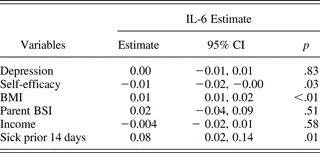
Children reporting higher perceived self-efficacy had lower plasma IL-6 concentrations. After controlling for children's age, sex, BMI, parent psychiatric symptoms, family income, and previous IL-6 concentrations (Visit 4), for each 1-U increase in PSE score, the log10 of plasma IL-6 concentration decreased by 0.01 pg/ml (95% confidence interval [CI] = −0.02–0.00; Table 3). The model indicated that children with higher BMI also had elevated plasma IL-6 concentrations over the 1-year period (for each 1-U increased in BMI the log10 of plasma IL-6 concentrations increased by 0.01 pg/ml (95% CI = 0.01–0.02); in addition, occurrence of illness in the 2 weeks before the study visit was associated with an 0.08-U increase in log10 of plasma IL-6 (95% CI = 0.02–0.14). Estimates reported in Table 3 are based on log10 transformation because of the distribution of IL-6, but that makes interpretation of effect size difficult; accordingly, we also report, for illustrative purposes only, nontransformed estimates of the raw IL-6 scale for significant predictors: for self-efficacy, for each 1-U increase in PSE score, the plasma IL-6 concentration decreased by 0.03 pg/ml; for each 1-U increase in BMI, the plasma IL-6 concentrations increased by 0.01 pg/ml; occurrence of illness in the 2 weeks before the study visit was associated with an 0.32-U increase in plasma IL-6.
Adjusted mean differences in the log10 of IL-6 levels for study variables

Note: CI, confidence interval; BMI, body mass index; BSI, Brief Symptom Inventory. For each variable, the estimates correspond to the change in log10 interleukin 6 (IL-6) level of 1-U increase. Analyses were adjusted for child age, sex, and prior IL-6 levels (Visit 4).
Perceived self-efficacy was not associated with NK cell function (p = .27) or with illnesses (p = .13) or febrile illnesses (p = .07). Further analyses assessing interactions by age and sex did not detect any evidence of moderation. None of the two-way or three-way interactions were statistical significant (p > .05).
Children's self-report measures and immune responses: Depressive symptoms
Over the 1-year period, there was not a main effect association between depression and IL-6. Moderation analyses indicated no interactions: the lack of significant association between depression and IL-6 was consistent across age and sex and Age × Sex subgroups (younger female, p = .82, younger male, p = .94; older female, p = .25, older male, p = .81).
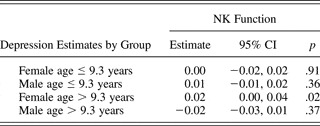
Children's NK cell function was not associated with depression scores in the full cohort over the 1-year study, but there was evidence of moderation by age (using the median split) and sex. A stratified subgroup analyses showed that depression was positively associated with NK function in older girls but not in any of the other three groups (Table 4). Further analyses of the older girl subsample indicated that, after controlling for self-efficacy, parent psychiatric symptoms, family income, being sick in the prior 14 days, and previous NK function (Visit 4), each 1-U increase in depression (CDI-SF) score increased the log10 of NK function by 0.02 U (95% CI = 0.00–0.04). For the nontransformed (raw) NK cell scale, each 1-U increase in depression increased NK function by 0.27. For younger females, older males, and younger males, no association was found between self-reported depression and NK function.
Adjusted mean differences in the log10 of NK function for depression in females and males stratified by age

Note: For each variable, the estimates correspond to the change in log10 natural killer (NK) cell function of 1-U increase. Analyses were adjusted for child age, sex, parent psychiatric symptoms (Brief Sympton Inventory), income, and prior NK function.
Children's self-report measures and health
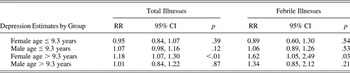
In the full cohort of children, neither PSE nor CDI-SF measured at Visit 5 was associated with total illnesses over the subsequent 1-year period (controlling for initial level of illnesses), nor with the likelihood of having a febrile illness. However, analyses stratified by age and sex showed that higher depression scores were associated with increased illnesses in the following year only among older girls (Table 5): each 1-U increase in depression symptoms was associated an increased rate of total illnesses of 18% (rate ratio = 1.18, 95% CI = 1.07–1.30). Febrile illnesses, a subset of total child illnesses, showed the same effect: for older girls, higher depression scores predicted an increased risk of having at least one febrile illness during the next year (odds ratio = 1.62, 95% CI = 1.05–2.49). There was no significant association between depression and illnesses found in the other groups. There was not a significant association between self-efficacy and illnesses in the sample as a whole or when the sample was stratified by age and sex.
Estimated rate ratios for the association between depression and total illnesses and febrile illnesses for females and males stratified by age

Note: Outcome was febrile illness in a 1-year period after assessment of depression and self-efficacy. Analyses were adjusted for child age, sex, parent psychiatric symptoms (Brief Sympton Inventory), income, and illnesses in the previous year. RR, rate ratio.
Mediation analyses were limited to older girls because it was only in the subsample of girls that we obtained links between depression and illness and depression and NK cell function. However, we found no evidence that the relationship between depression and illnesses were mediated by NK cell function.
Discussion
In a prospective, 1-year longitudinal study of a normative, healthy sample of preadolescent children, we found modest support for a link between psychological well-being and immune functioning and illness. The strongest link, observed in the entire cohort of children, was a negative association between self-efficacy and IL-6. Two further associations were also detected, but only in older girls: depression was associated with increased NK cell function and with higher rates of illness.
The findings extend research on stress and health and allostatic load in children in several important ways. First, rather than rely on parent reports of stress, we included children's self-reports of well-being, indexed by efficacy and depressive symptoms as predictors of immunity and health. These two indicators of psychological well-being are widely researched in the developmental and clinical psychology literature as causes and effects of psychosocial stress and as predictors of long-term behavioral adjustment. We provide some of the only evidence so far that these psychological measures also predict health outcomes in normally developing children. The self-report data also provides an extension to the prior research on stress and children's health, which has to date been dominated by parent reports of child stress exposure and, in some cases, inferred from parent self-report of their own psychological symptoms. The finding that children's own views of their ability to cope with stress predicted lower levels of IL-6 extends a considerable adult literature on psychological outlook and immunity. For example, positive emotional style, assessed by measures of extraversion, agreeableness, and positive relationship style is associated with less colds following respiratory viral challenge (Cohen, Alper, Doyle, Treanor, & Turner, Reference Cohen, Alper, Doyle, Treanor and Turner2006; Cohen et al., Reference Cohen, Doyle, Turner, Alper and Skoner2003). In addition, increased optimism was inversely associated with an IL-6 response to acute psychosocial stress (Brydon, Walker, Wawrzyniak, Chart, & Steptoe, Reference Brydon, Walker, Wawrzyniak, Chart and Steptoe2009), whereas pessimism was associated with increased levels of IL-6, C-reactive protein, and fibrinogen (Roy et al., Reference Roy, Diez-Roux, Seeman, Ranjit, Shea and Cushman2010). Coping, appraisal and other psychological resources and dispositions need also to be incorporated into models of stress and health in pediatric samples. It was significant that the prediction from self-efficacy to IL-6 was independent of parental symptoms, providing further support for the need to consider psychological processes within the child as distinct from general markers of stress exposure as reported on by parents.
Second, results from the study begin to piece together a developmental model of psychoneuroimmunology. On the one hand, children who report greater ability to achieve desired results in common situations showed a healthier, and presumably more adaptive immunological profile and reduced levels of IL-6; evidence of positive psychological appraisal and coping was associated with reduced generalized inflammation, a prediction that comports easily with existing animal and adult work. On the other hand, in older girls (only), we found that depression was associated with increased NK function or cytotoxicity. That is congruent with our earlier finding that psychosocial stress as reported by parents predicted increased NK cell function (Caserta et al., Reference Caserta, O'Connor, Wyman, Wang, Moynihan and Cross2008). The extent to which the increased NK cell function associated with depression is compatible with or contradicts adult studies is confounded by the inconsistency across adult studies, with some reporting a decrease (Park et al., Reference Park, Lee, Chae, Lee, Han and Jeon2006) but others reporting an increase (Ravindran, Griffiths, Merali, & Anisman, Reference Ravindran, Griffiths, Merali and Anisman1998; Seidel et al., Reference Seidel, Arolt, Hunstiger, Rink, Behnisch and Kirchner1996) in NK cells in depression. These discrepancies may be resolved by attention to depression subtypes (Ravindran et al., Reference Ravindran, Griffiths, Merali and Anisman1998), something that we were not able to investigate in our sample. In any event, it may be noteworthy that a link with NK cell function was found only in older girls, who may, by virtue of the age and sex effects on depression, present the most “adultlike” in terms of risk for depression. That a limited or focused effect of depression in older girls was also detected for illnesses also warrants consideration and implies, at a minimum, that age and sex may emerge as modifiers of the links between stress/psychological symptoms and immunity in pediatric samples. It is noteworthy that sex effects on the link between depression and immune markers have also been reported in adult studies (Brummett et al., Reference Brummett, Boyle, Ortel, Becker, Siegler and Williams2010; Steptoe, O'Donnell, Badrick, Kumari, & Marmot, Reference Steptoe, O'Donnell, Badrick, Kumari and Marmot2008). Further work that incorporates the hormonal and neurophysiological changes associated with puberty (e.g., Dahl & Gunnar, Reference Dahl and Gunnar2009) is needed to revise and expand a developmental model of psychoneuroimmunology.
A nonfinding also deserves attention for what it may suggest about developmental influences and the detection of allostatic load in young people, namely, the lack of association between depression and IL-6. This lack of association in the current sample does contradict adult work that shows a reliable but small negative association between depressive symptoms and IL-6 (Dowlati et al., Reference Dowlati, Herrmann, Swardfager, Liu, Sham and Reim2010; and tumor necrosis factor-alpha, which was not assessed in the current study). That raises the possibility that, for reasons not yet clear, associations between behavioral/psychological well-being and IL-6 either may be less robust in children or slower to develop, perhaps requiring chronic stress or depression, a possibility implicit in the adult work and in the allostatic load model but not yet adequately tested. In other words, our findings on a preadolescent sample do not mimic in every way the patterns so far reported in adults.
Finally, we did not find evidence that changes in immune markers mediated the effects of depression on health outcomes. In fact, we found, in older girls, depression leading to both increased NK cell function and increased illness. It may be that the impact on immunity and on observable health outcomes are under different time course constraints; it is also likely that health outcomes are multiply determined and that any specific immune marker may not carry sufficient impact to alter a systemic illness.
Several limitations of the study should be noted. Detailed data on pubertal development were not available in this study; more precise measurement of pubertal changes may help clarify the moderating influence of sex and age on depression and IL-6 and illnesses. The young age of the sample may also confound interpretations of age and sex; indeed, we did not detect strong age and gender effects on levels of depressive symptoms that are found in pubertal or adolescent samples. In addition, the interpretation of depression symptoms should be considered in light of the generally nonclinical nature of symptoms and impairment; arguably, a strength of this study, which would increase its generalizability, is that we detected associations within a healthy sample, outside of the clinical extremes. A variety of other potential markers of immunity that could have been assessed were not included. We targeted those that had a sizable adult literature, and so had a limited focus; analyses of a wider array of pro- and anti-inflammatory markers will be needed to develop a comprehensive developmental model of psychoneuroimmunology. Furthermore, although the study sample size was adequately powered for main effects analyses and compares favorably with studies in the area, the power to detect multiway interactions was limited and the reliability of interactions is notably less robust than main effects. Therefore, despite the strong a priori case for analyzing data by age and sex, replication of these findings is necessary before drawing firm conclusions. Finally, we proposed directional hypotheses concerning within-individual change, derived from adult and animal work, that changes in depression and self-efficacy would be associated with immune markers, the dependent variable. It is plausible that the direction of effects is reciprocal, and the time course for charting the dynamic interplay between psychological well-being and health and immune markers requires further study. These limitations are offset by several strengths of the paper, including the longitudinal design with multiple occasions of measurement of psychological and immune data, and detailed health diary data verified, to a considerable extent, by medical investigators on the project.
Clinical implications of the findings are not yet clear, but promising. Perhaps the most obvious is the need to consider physical well-being in those children who report psychological distress, in both assessment and intervention. If further research also endorses links between psychological well-being and physical health in children, then this would provide a conceptual–biological basis for instituting an interdisciplinary model for child health assessment, something that is not now widely established.