Introduction
Attention biases to threatening stimuli are thought to be part of the etiology of anxiety disorders (Roy et al., Reference Roy, Vasa, Bruck, Mogg, Bradley, Sweeney, Bergman, Mcclure-Tone, Pine and Team2008). Persistent attention to threat, particularly when marked by low thresholds for threat detection, may underscore information processing biases leading to, or reinforcing, disorder (Roy et al., Reference Roy, Vasa, Bruck, Mogg, Bradley, Sweeney, Bergman, Mcclure-Tone, Pine and Team2008).
A standard task used to assess attention biases to threat is the dot-probe paradigm (MacLeod et al., Reference MacLeod, Mathews and Tata1986). In this task, participants are presented with an emotionally valenced cue paired with a cue of neutral valence (e.g., one angry facial configuration, one neutral configuration) on a computer screen. These stimuli disappear and one of cues is replaced with a “probe.” The participant is asked to respond by noting the probe’s location or identity, usually with a motor response, such as a button press. The latency to respond to the probe in the salient cue’s (e.g., angry) prior location versus probes in the control cue’s (e.g., neutral) location is thought to index the magnitude of an attentional bias to the emotional cue (MacLeod et al., Reference MacLeod, Mathews and Tata1986).
However, much discussion has emerged regarding the actual utility of the dot-probe task. Concerns have been raised regarding both internal reliability, seen in split-half and test–retest calculations (Chapman et al., Reference Chapman, Devue and Grimshaw2019; Price et al., Reference Price, Kuckertz, Siegle, Ladouceur, Silk, Ryan, Dahl and Amir2015; Schmukle, Reference Schmukle2005), and predictive validity, such as inconsistency in associations between task performance and levels of anxiety (Kappenman et al., Reference Kappenman, Farrens, Luck and Hajcak Proudfit2014). In addition, participants vary greatly within their own responses on a trial-by-trial level (Price et al., Reference Price, Kuckertz, Siegle, Ladouceur, Silk, Ryan, Dahl and Amir2015). Many cite this within-person variability as a shortcoming of the task, contributing to broader psychometric concerns (Chapman et al., Reference Chapman, Devue and Grimshaw2019; Price et al., Reference Price, Kuckertz, Siegle, Ladouceur, Silk, Ryan, Dahl and Amir2015; Staugaard, Reference Staugaard2009).
Importantly, attention biases are not a static construct (Gunther, Brown, et al., Reference Gunther, Brown, Fu, MacNeill, Jones, Ermanni and Pérez-Edgar2021; Gunther, Fu, et al., Reference Gunther, Fu, MacNeill, Vallorani, Ermanni and Pérez-Edgar2021) and intraindividual variability within the task may be meaningful in understanding individual differences in affect-biased attention (Price et al., Reference Price, Kuckertz, Siegle, Ladouceur, Silk, Ryan, Dahl and Amir2015). Attention bias variability (ABV) provides a metric capturing the degree of intraindividual variability within a task session. In contrast to traditional dot-probe metrics, ABV offers much improved reliability (Price et al., Reference Price, Kuckertz, Siegle, Ladouceur, Silk, Ryan, Dahl and Amir2015). In the present study, we examined how traditional bias scores and ABV metrics among mothers may differentially predict changes in infant socioemotional development in the first 2 years of life.
Broadly, ABV is thought to capture inconsistency in vigilance/avoidance responses to emotionally valenced stimuli (Price et al., Reference Price, Kuckertz, Siegle, Ladouceur, Silk, Ryan, Dahl and Amir2015). Inconsistency may be associated with individual differences in regulatory behaviors including emotion regulation or attentional control, which may be transdiagnostic risk factors for psychopathology (Cludius et al., Reference Cludius, Mennin and Ehring2020; Dadds & Frick, Reference Dadds and Frick2019; McTeague et al., Reference McTeague, Goodkind and Etkin2016). For example, Bardeen et al. (Reference Bardeen, Daniel, Hinnant and Orcutt2017) found a positive relation between emotion dysregulation and ABV to threatening pictures in a community sample of adults. Deficits in emotion regulation may be a risk factor for potentially maladaptive patterns of behavior, such as anxiety and aggression (McLaughlin et al., Reference McLaughlin, Hatzenbuehler, Mennin and Nolen-Hoeksema2011). Additionally, attentional control mediated the relation between ABV and anxiety in one sample of adults (Clarke et al., Reference Clarke, Marinovic, Todd, Basanovic, Chen and Notebaert2020) and the relation between ABV and post-traumatic stress disorder (PTSD) symptomology was mediated by emotion regulation abilities in another sample (Klanecky Earl et al., Reference Klanecky Earl, Robinson, Mills, Khanna, Bar-Haim and Badura-Brack2020). Further, Bardeen et al. (Reference Bardeen, Tull, Daniel, Evenden and Stevens2016) found that attentional control moderated the relation between ABV and PTSD, where individuals with both PTSD and lower levels of attentional control had greater ABV to threatening stimuli, but individuals with PTSD and higher levels of attentional control had lower ABV. Together, these findings suggest ABV may be related to more general cognitive processes such as emotion regulation and attentional control, which are often captured as mean-level variables.
We also see direct associations between ABV and psychopathology. ABV is associated with disorders that are often linked to attention biases to threat, including PTSD and anxiety. Individuals with PTSD, for example, are often characterized in part by a hypervigilance to threat. Among individuals with PTSD, ABV to threat-related cues is positively related to symptom severity (Badura-Brack et al., Reference Badura-Brack, Naim, Ryan, Levy, Abend, Khanna, McDermott, Pine and Bar-Haim2015; Bardeen et al., Reference Bardeen, Tull, Daniel, Evenden and Stevens2016; Iacoviello et al., Reference Iacoviello, Wu, Abend, Murrough, Feder, Fruchterm, Levinstein, Wald, Bailey, Pine, Neumeiser, Bar-Haim and Charney2014; Naim et al., Reference Naim, Abend, Wald, Eldar, Levi, Fruchter, Ginat, Halpern, Sipos, Adler, Bliese, Quartana, Pine and Bar-Haim2015; Swick & Ashley, Reference Swick and Ashley2017).
However, studies on the direct associations between ABV and anxiety disorders are not always consistent. Some work finds no relation between a formal anxiety diagnosis and ABV to threatening stimuli (Gade et al., Reference Gade, Molloy and Anderson2021; Naim et al., Reference Naim, Abend, Wald, Eldar, Levi, Fruchter, Ginat, Halpern, Sipos, Adler, Bliese, Quartana, Pine and Bar-Haim2015) or subclinical levels of trait anxiety and ABV to threat (Naim et al., Reference Naim, Abend, Wald, Eldar, Levi, Fruchter, Ginat, Halpern, Sipos, Adler, Bliese, Quartana, Pine and Bar-Haim2015). In contrast, Clarke and colleagues (Reference Clarke, Marinovic, Todd, Basanovic, Chen and Notebaert2020) found that greater ABV to negative words compared to neutral words was positively associated with reported anxiety symptoms in a community sample of adults. These findings also extend to phobias. Zvielli et al. (Reference Zvielli, Bernstein and Koster2015) examined ABV in adults reporting a spider phobia who completed a dot-probe task with spiders and butterflies. They found that greater ABV to the spider trials was associated with a spider phobia. Together, these findings suggest that ABV may relate broadly to psychopathologies characterized in part by extreme patterns of responses to identified threats.
While prior research has focused on how ABV to threat relates to psychopathology or risk within the individual, there is a paucity of work examining how these attentional patterns may impact relationships. The broader literature suggests that ABV may be related to individual psychopathology, such as anxiety disorders. The parenting literature, in turn, has shown strong relations between caregiver anxiety symptoms and socioemotional difficulties in their offspring (Barker et al., Reference Barker, Jaffee, Uher and Maughan2011; Glasheen et al., Reference Glasheen, Richardson and Fabio2009). By examining relations between ABV and infant negative affect, a risk factor for anxiety, we are examining a potential proximal mechanism that may help us better understand the etiology of associations between caregiver and child psychopathology.
While work with ABV is still emerging, the research reviewed above suggests that ABV relates to variation in attentional control and/or emotion regulation. Attentional control and emotion regulation, although distinct, have each been associated with the way in which an individual structures their home environment (Bridgett et al., Reference Bridgett, Burt, Laake and Oddi2013) and the way caregivers interact with their infants (Geeraerts et al., Reference Geeraerts, Endendijk, Deater-Deckard, Huijding, Deutz, van den Boomen and Deković2021). These profiles are also related to more chaotic households (Bridgett et al., Reference Bridgett, Burt, Laake and Oddi2013; Mokrova et al., Reference Mokrova, O’Brien, Calkins and Keane2010) and inconsistent parenting (Murray & Johnston, Reference Murray and Johnston2006). A parent’s ability to regulate their emotions may also relate to their responsiveness to their child (Dix, Reference Dix1991) or the ways in which they discipline their child (Lorber & Slep, Reference Lorber and Slep2005). For example, a caregiver with high attentional control may structure an organized household. Similarly, a caregiver with high attentional control and/or high emotion regulation may also be more likely to respond positively to their child’s behavior, as they are able to better regulate their own negative emotions when their child behaves in a way that may be undesirable or unexpected.
For a caregiver with lower levels of attentional control or emotion regulation, we could expect a more chaotic household and a higher propensity to respond negatively to their child’s behavior, as these regulatory processes and behaviors may be more effortful and less readily called upon (Bridgett et al., Reference Bridgett, Burt, Laake and Oddi2013; Geeraerts et al., Reference Geeraerts, Endendijk, Deater-Deckard, Huijding, Deutz, van den Boomen and Deković2021). Conversely, overcontrolled behaviors may also have negative implications within a household, contributing to increased risk for internalizing disorders for the caregiver (Gilbert et al., Reference Gilbert, Perino, Myers and Sylvester2020; Henderson et al., Reference Henderson, Pine and Fox2015; Henderson & Wilson, Reference Henderson and Wilson2017; White et al., Reference White, McDermott, Degnan, Henderson and Fox2011) as well as patterns of rigid parenting behaviors such as overprotection (Kiel & Buss, Reference Kiel and Buss2010, Reference Kiel and Buss2011).
Here, we view interactions between the caregiver and child through the lens of Bronfenbrenner’s bioecological model (Bronfenbrenner & Morris, Reference Bronfenbrenner and Morris2007). In this approach, a child’s development is shaped by the environment in which a child exists, and interactions between different “systems” that encompass their environment. The microsystem refers to the most proximal space in which a child develops, including their home and family. The literature suggests that ABV may reflect regulatory processes in attentional and emotional domains that are in turn associated with how a child’s microsystem is structured. Here we focus on the potential that caregiver ABV may be associated with the developmental trajectories of the children they care for. Assessing how caregiver ABV to threat may relate to developmental changes in child socioemotional development tests a novel attentional mechanism of parent-to-child transmission of psychopathology risk. We are particularly interested in how ABV may relate to socioemotional development during infancy, a period in which a child is particularly reliant on their caregiver for shaping both their physical and social world. Infancy is also a period of heightened plasticity (Guyer et al., Reference Guyer, Pérez-Edgar and Crone2018), when neural networks that support attention emerge and functionally integrate, reflecting adult-like patterns by 12 months (Gao et al., Reference Gao, Gilmore, Shen, Smith, Zhu and Lin2013). Thus, this developmental phase is one of increased malleability as a function of environmental context (Guyer et al., Reference Guyer, Pérez-Edgar and Crone2018).
In this study, we examined how caregiver ABV to threat is related to infant negative affect over the first 2 years of life. Negative affect is a temperamental risk factor for psychopathology that is evident in the first months of life. While prior work finds normative increases in negative affect through infancy (Braungart-Rieker et al., Reference Braungart-Rieker, Hill-Soderlund-A. and Karrass2010; Dollar & Calkins, Reference Dollar and Calkins2019), relatively high levels of negative affect are a risk factor for socioemotional maladaptation later in childhood and adolescence, including depression and anxiety (Lonigan et al., Reference Lonigan, Phillips and Hooe2003). High levels of infant negative affect are also associated with a behaviorally inhibited temperament, which is a risk factor for social anxiety disorder (Calkins et al., Reference Calkins, Fox and Marshall1996; Chronis-Tuscano et al., Reference Chronis-Tuscano, Degnan, Pine, Perez-Edgar, Henderson, Diaz, Raggi and Fox2009). Understanding the relation between ABV to threat and infant/toddler negative affect may help to better elucidate a mechanism for the intergenerational transmission of psychopathology.
Prior work with ABV has been conducted exclusively with button press reaction time. However, eye-tracking metrics of attention bias appear to have better reliability and validity, relative to button press (Price et al., Reference Price, Kuckertz, Siegle, Ladouceur, Silk, Ryan, Dahl and Amir2015; Waechter et al., Reference Waechter, Nelson, Wright, Hyatt and Oakman2014). In addition, eye-tracking may help reveal attentional processes, such as preferential viewing of the emotional stimuli used in the task, and more reflexive patterns of orienting that precede the recorded button press. Here, we leverage eye-tracking technology to examine ABV to threat during the dot-probe task, using both button presses and fixation latencies.
Our main question of interest examines how ABV to threat in a sample of parents may relate to trajectories of infant negative affect. We also assess the traditional attention bias score typically derived from the dot-probe task, to interrogate the specificity of these relations. We hypothesized that infants of caregivers with higher button press ABV would have potentiated increases in negative affect across the first 2 years of life. We predicted that bias scores, the more traditional dot-probe metric, would not significantly relate to infant negative affect over time. Because the fixation ABV measure was a novel computation not used in prior work, we had no specific hypotheses for this metric and analyses were exploratory.
Methods
Participants
Participants were selected from a larger longitudinal sample (N = 357) assessing the emergence of attention and temperament through infancy and toddlerhood (Pérez-Edgar et al., Reference Pérez-Edgar, LoBue, Buss and Field2021). Data were collected from infants at 4, 8, 12, 18, and 24 months, using a multi-method approach. A comprehensive list of all measures collected from this sample can be found in Pérez-Edgar et al., Reference Pérez-Edgar, LoBue, Buss and Field2021. For the current project, primary caregivers completed an emotional dot-probe task with concurrent eye-tracking at all 5 timepoints. They also reported on their infant’s temperament via questionnaire measures. The Institutional Review Boards at the Pennsylvania State University and Rutgers University – Newark approved all procedures and parents provided written consent and were compensated for their participation.
Of the larger sample, participants were recruited through local baby registries (40% families) and university-sponsored participant databases (13% families). In addition, we used a variety of community-level recruitment strategies, such as visiting local lactation/parenting classes, communicating with families at local community events, and talking to parents at local hospitals, health care centers, and Women’s and Infant Centers (WIC). Community recruiting identified 38% of our families. Prospective families were contacted by letter, email, or phone explaining the motivations and methods of the study. The remaining 10% of families were recruited by word-of-mouth. These families were either referred by enrolled participants, referred by the researchers, or were graduate students at each of the universities.
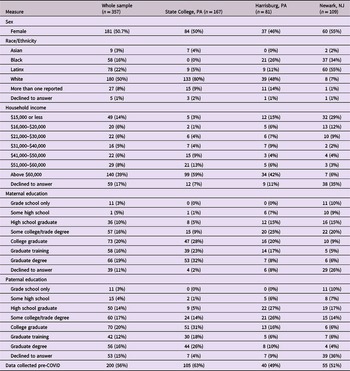
Infants and their caregivers were enrolled when the infants were 4 months of age (N = 298; 151 males, 147 females; M age = 4.80 months; SD age = 0.80, Range age = 3.27–7.60 months), with an additional 46 participants enrolled at 8 months (N = 46; 19 males, 27 females; M age = 8.83 months; SD age = 0.73, Range age = 7.53–10.20 months), and 13 at 12 months (N = 13; 6 males, 7 females; M age = 12.73 months; SD age = 1.12, Range age = 10.63–14.90 months, for a total enrollment of 357 infants in the full sample (176 males, 181 females). Participants were recruited from areas surrounding three sites: State College, PA (N = 167), Harrisburg, PA (N = 81) and Newark, NJ (N = 109). Caregivers identified 58 of the infants (16%) as African American/Black, 9 (3%) as Asian, 78 (22%) as Latinx, 180 (50%) as White, and 27 (8%) as mixed race. Five (1%) additional caregivers declined to provide this information. 99% of respondents identified as the infant’s biological parent (N = 5 reporting something other than biological parent). The participating parent at each time point self-identified as the primary caregiver, and post hoc data cleaning ensured that the same caregiver completed the eye-tracking task at each analyzed timepoint.
Caregivers were asked to report on their annual household income, as well as maternal and paternal education. This information, for the entire sample as well as for each site, can be found in Table 1.
Table summarizing demographics of whole sample, as well as parsed by testing location

Of this larger sample (n = 357), inclusion in analysis depended on variables collected from families. The model assessing button press ABV (n = 239), the model assessing fixation-based ABV (n = 214), and the model using a traditional threat bias score (n = 249) each contained a slightly different sample based on data availability and quality.
Data collection began on October 31, 2016 and continued until August 17, 2021. Infants and their parents scheduled for visits after March 11, 2020 (World Health Organization’s declaration of the COVID-19 global pandemic) did not come into the lab and instead were sent questionnaires via email. Data that required in-person, in-lab interactions, like the dot-probe task, were treated as missing data for applicable participants. Of the 357 individuals enrolled in the larger study, 200 completed all five time points of data collection prior to March 11, 2020. The remaining 157 participants did not complete participation by this time and therefore attempts were made to collect questionnaire data remotely.
Measures
Adult dot-probe
An adaptation of the standard dot-probe task, designed to assess attentional biases (MacLeod et al., Reference MacLeod, Mathews and Tata1986), was presented to the infants’ caregivers, relying on both gaze and button presses to assess attention biases. Eye-tracking data were collected across sites using SMI eye-tracking systems, using either the SMI RED or REDm system, both offering comparable specifications/capabilities (SensoMotoric Instruments, Teltow, Germany). Participants were seated ∼60 cm from a 22” Dell monitor for stimulus presentation. Gaze was calibrated using a 5-point calibration followed by a 4-point validation. Gaze data was sampled at 60 Hz and collected by Experiment Center (SensoMotoric Instruments, Teltow, Germany). Adults were calibrated below 2° of visual angle deviation from all calibration points.
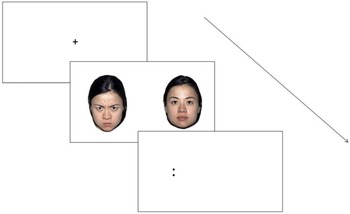
Consistent with the calibration procedure, stimuli were presented using Experiment Center. Adults were presented with 160 experimental trials. Each trial began with a centrally presented fixation cross for 500 ms. Following was a horizontal pair of faces sampled from the NimStim face set (Tottenham et al., Reference Tottenham, Tanaka, Leon, McCarry, Nurse, Hare, Marcus, Westerlund, Casey and Nelson2009) for 500ms. Pairs of faces were either angry and neutral, happy and neutral, or two neutral faces. Facial stimuli were approximately 19 cm × 13 cm and the visual angle of each face was 17.99° (H) × 12.37° (W). The faces were 24.45° apart. Eight actors (four male) provided neutral, happy, or angry, closed mouth images.
Next, a “probe” appeared on the screen in the same location as either the left or right face for 500 ms. The probes were two dots that were either horizontally or vertically. Participants were prompted to press the “D” button on a keyboard if the dots were horizontal, and the “K” button if the dots were vertical. If the probe appeared in the same location as the “emotional” (i.e., angry or happy) face, the trial was marked as “congruent.” Conversely, if the probe appeared in the same location as the neutral face, the trial was marked as “incongruent.” This generated a total of five different trial types: angry-congruent, angry incongruent, happy congruent, happy incongruent, or neutral. Finally, the trial was concluded with a 1,000 ms intertrial interval, which was a blank screen. Figure 1 depicts the progression of stimuli for each trial of the task.
Schematic of the dot-probe task used to calculate ABV. Each trial began with a central fixation cross (500 ms) followed by paired faces of a neutral and emotionally valenced face (500 ms). Finally, one face was replaced by a probe, either two horizontal dots or vertical dots (500 ms). During this window, participants were asked to indicate the orientation of the dots. The intertrial interval was 1000 ms. The illustrated trial presents face stimuli from the NimStim Face Stimulus set (Tottenham et al., Reference Tottenham, Tanaka, Leon, McCarry, Nurse, Hare, Marcus, Westerlund, Casey and Nelson2009) approved for publication.

Areas of interest (AOIs) were drawn as ellipses enclosing both the faces and the probes. A 1 cm “error margin” was added to each ellipse, to account for the deviation permitted in the calibration procedure. Analyses were based on gaze to these designated AOIs. Fixations, defined as gaze maintained for at least 80ms within a 100-pixel maximum dispersion, were extracted with BeGaze (SensoMotoric Instruments, Teltow, Germany). All other computations of gaze metrics were performed using in-house R scripts (R Core Team, 2020).
Metrics were cleaned on a trial-by-trial level. For button press data, only correct trials were used in subsequent computations. RT latencies less than 150 ms and greater than 2,000 ms were excluded from the final data set. Finally, for gaze data, if a fixation was not detected to the probe during a trial, that trial was not included (Fu et al., Reference Fu, Taber-Thomas and Pérez-Edgar2017; Morales et al., Reference Morales, Pérez-Edgar and Buss2015; Thai et al., Reference Thai, Taber-Thomas and Pérez-Edgar2016). Even with these criteria, a relatively large proportion of trials were retained for analyses. Across the five time points, an average ranging from 137.86 to 141.19 trials (out of 160) were retained for gaze analyses and an average ranging from 132.16 to 146.07 trials (out of 160) were retained for analyses using button presses.
For these analyses we were most interested in responses to angry faces. ABV for trials with angry faces was calculated using button press reaction times, according to Zvielli et al. (Reference Zvielli, Bernstein and Koster2015) using custom scripts in a combination of Matlab release 2017b (Matlab, 2017) and R version 3.6.2 (R Core Team, 2020). In this computation, trial-level bias scores were calculated by subtracting the response time latencies of temporally adjacent pairs (within ± 5 trials) of angry-congruent and angry-incongruent trials, that is trials in which the probe was in the same and opposite location as the angry face, respectively. From trial-level bias scores, the ABV metric was derived by dividing the sum of all trial-level bias scores by the number of temporally adjacent pairs. Additional details on these computations can be found in Zvielli et al (Reference Zvielli, Bernstein and Koster2015). Additionally, as a novel computation, we used the same ABV calculation using latency to fixate on the probe, as opposed to the button press reaction time. Finally, angry bias scores, a traditional dot-probe metric, were calculated from the button press data. This was done by subtracting the average reaction time to respond on angry-congruent trials, from the average reaction time to respond to angry-incongruent trials.
Within each of these measures, we examined the data for extreme values that were likely attributed to measurement error rather than individual differences. We removed one value from the data set of button press ABV, and one value from the data set of eye-tracking ABV, determined using visual inspection of a scatter plot, before moving forward with subsequent analyses.
Infant negative affect
The Infant Behavior Questionnaire (IBQ-R) was used to measure negative affect at 4, 8, and 12 months. The IBQ-R is a 191-item survey designed to assess general patterns of behavior associated with temperament in infancy (3–12 months; Parade & Leerkes, Reference Parade and Leerkes2008; Putnam et al., Reference Putnam, Helbig, Gartstein, Rothbart and Leerkes2014). Parents rated how often they observed a behavior in the past week. Each item describes an infant’s behavior (e.g., During feeding, how often did the baby lie or sit quietly?) using a 7-point scale (never, very rarely, less than half the time, half the time, more than half the time, almost always, always). Parents are also given a “not applicable” response option for use when the infant has not been observed in the situation described. We focused analyses upon the negativity factor, one of three broader factors derived from the questionnaire. Sadness, distress to limitations, fear, and falling reactivity subscales load onto this factor. The IBQ-R has demonstrated good internal consistency, reliability, and validity, including correlations with laboratory observations (Gartstein & Marmion, Reference Gartstein and Marmion2008; Goldsmith & Campos, Reference Goldsmith and Campos1990; Parade & Leerkes, Reference Parade and Leerkes2008). Across the full sample, IBQ reliabilities were good at 4 months (Cronbach’s alpha = 0.776–0.953), 8 months (Cronbach’s alpha = 0.728–0.943), and 12 months (Cronbach’s alpha = 0.767–0.922).
The Toddler Behavior Assessment Questionnaire (TBAQ) was used to measure infant negative affect at 18 and 24 months. The TBAQ is a 120-item survey designed to assess general patterns of behavior associated with temperament in young children (Goldsmith, Reference Goldsmith1996). Parents rated how often their toddler displayed a specific behavior in the past month using a 7-point Likert scale (1 = never, 2 = very rarely, 3 = less than half the time, 4 = half the time, 5 = more than half the time, 6 = almost always, 7 = always). Each item loads onto one of 11 subscales (Activity Level, Anger, Appropriate Attention Allocation, Inhibitory Control, Interest, Object Fear, Perceptual Sensitivity, Pleasure, Sadness, Social Fear, Soothability). Items from each subscale are averaged to obtain scale scores. Where the TBAQ does not have an explicit negative affect subscale, Goldsmith (Reference Goldsmith1996) reported high levels of convergence with various subscales of the IBQ. Thus, in line with prior publications (e.g., Vallorani et al., Reference Vallorani, Fu, Morales, LoBue, Buss and Pérez-Edgar2021), we generated our own negative affect subscale by using the anger, sadness, social fear, and object fear subscales. Reliabilities across TBAQ subscales were good (Cronbach’s alpha = 0.612–0.850).
Caregiver anxiety
The Beck Anxiety Inventory (BAI) is a 21-item self-report questionnaire for evaluating the severity of anxiety in healthy and psychiatric populations (Beck et al., Reference Beck, Epstein, Brown and Steer1988a). It was collected at the 4-, 8-, 12-, 18-, and 24-month time points. The BAI was specifically designed to distinguish cognitive and somatic symptoms of anxiety from symptoms of depression. Parents rated individual symptoms of anxiety (e.g., fear of losing control) in the past month using a 4-point Likert scale (0 = not at all, 1 = mildly, 2 = moderately, 3 = severely). The BAI is scored by adding the highest ratings for all 21 items, for a score range from 0 to 63. Higher scores indicate greater symptom severity. Good psychometric properties have been demonstrated for the BAI among multiple outpatient samples (Morin et al., Reference Morin, Landreville, Colecchi, McDonald, Stone and Ling1999; Steer et al., Reference Steer, Willman, Kay and Beck1994; Wetherell & Areán, Reference Wetherell and Areán1997). Internal consistency of the measure for the total sample was strong across time points (α 4-months = 0.91, α 8-months = 0.89, α 12-months = 0.93, α 18-months = 0.94, α 24-months = 0.92) and adequate test–retest reliability has been demonstrated for anxiety patients (r = 0.75 to 0.83; Beck et al., Reference Beck, Steer and Garbin1988b; de Beurs et al., Reference de Beurs, Wilson, Chambless, Goldstein and Feske1997). The measure is also moderately correlated with anxiety (r = 0.36 to 0.69) and depression measures (r = 0.25 to 0.56) completed by psychiatric (Beck et al., Reference Beck, Epstein, Brown and Steer1988a) and normative samples (Osman et al., Reference Osman, Kopper, Barrios, Osman and Wade1997). We considered caregiver anxiety in characterizing our sample and as a covariate in analyses (see below) due to prior work suggesting possible associations between anxiety and ABV in adults (Clarke et al., Reference Clarke, Marinovic, Todd, Basanovic, Chen and Notebaert2020).
Data analysis
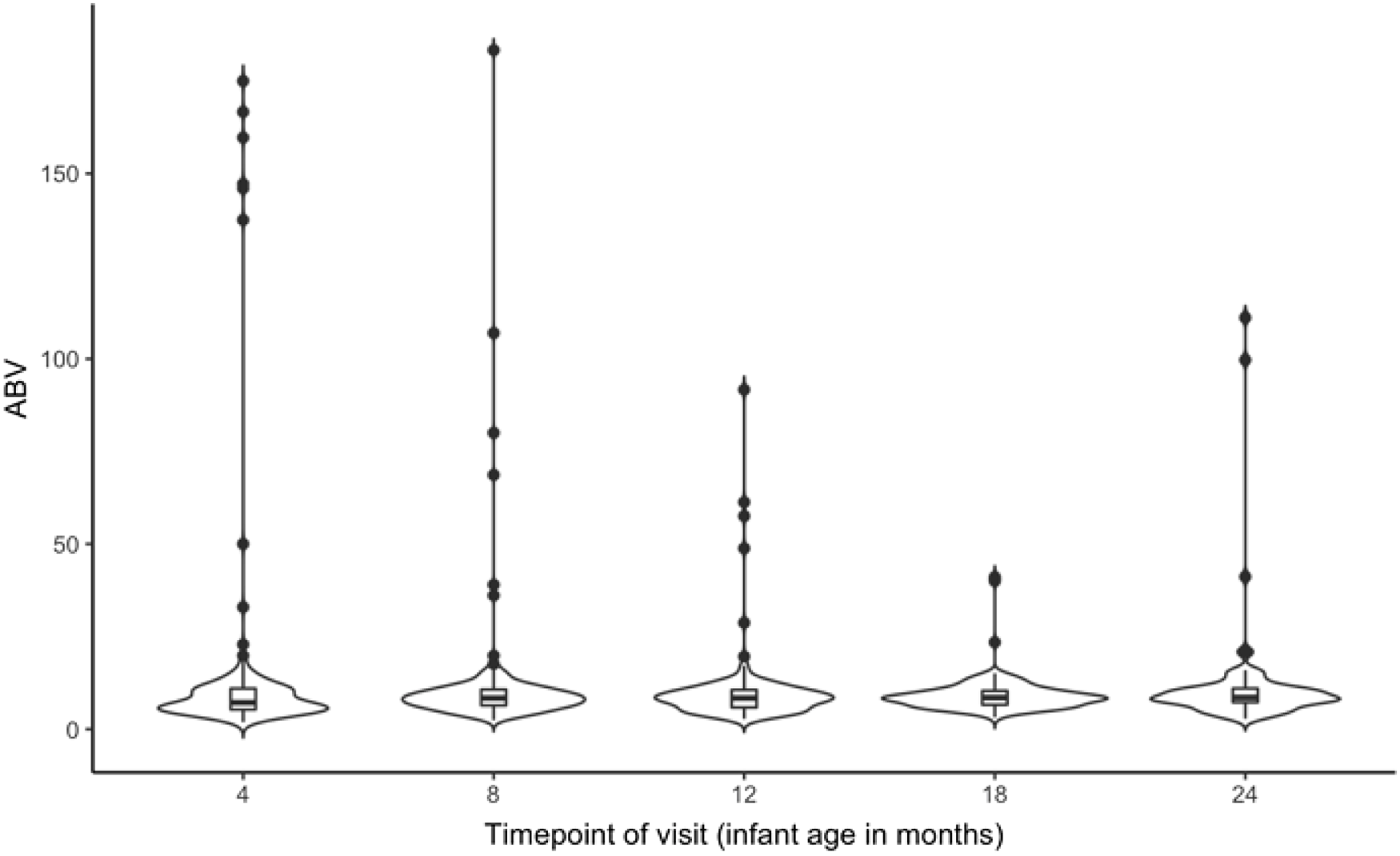
We first sought to characterize our metrics of caregiver threat attention within this sample to examine stability and fluctuations in threat attention over time. Because ABV is associated with trait-like constructs including regulation and psychopathology (Bardeen et al., Reference Bardeen, Tull, Daniel, Evenden and Stevens2016, Reference Bardeen, Daniel, Hinnant and Orcutt2017; Clarke et al., Reference Clarke, Marinovic, Todd, Basanovic, Chen and Notebaert2020; Klanecky Earl et al., Reference Klanecky Earl, Robinson, Mills, Khanna, Bar-Haim and Badura-Brack2020; Zvielli et al., Reference Zvielli, Bernstein and Koster2015), from a theoretical basis we hypothesized that ABV would be relatively stable over time. We ran a conditional growth model to test whether the mother’s ABV to threat changed as a function of infant age (between 4 and 24 months postpartum). For consistency across our three metrics of interest, we also ran and examined additional growth models for fixation ABV to threat as well as threat bias scores. We found that infant age did not significantly predict button press or gaze ABV to threat (p = 0.40 and p = 0.52, respectively) or threat bias scores (p = 0.13). Figure 2 depicts distribution of the button press ABV metric at each measurement timepoint.
Violin plots depicting the distribution of parent button press ABV across repeated measurements.

As a follow-up we computed intraclass coefficients (ICCs) for each metric (Koo & Li, Reference Koo and Li2016). We found that the ICC for button press ABV to threat was good (ICC = 0.75, 95% CI 0.710.79) and the ICC for gaze ABV to threat was moderate (ICC = 0.47, 95% CI 0.38–0.55). Unsurprisingly, in light of research finding low test-retest reliability for bias scores in the dot probe (Chapman et al., Reference Chapman, Devue and Grimshaw2019; Price et al., Reference Price, Kuckertz, Siegle, Ladouceur, Silk, Ryan, Dahl and Amir2015; Schmukle, Reference Schmukle2005), the ICC for threat bias scores was poor (ICC = 0.11, 95% CI −0.04, 0.23). With our theoretical orientation as well as relatively good stability for both ABV measures (our primary measures of interest), we chose to average each of these metrics across infant age to create average scores for button press ABV, fixation ABV, and attention bias for each caregiver to use in all subsequent analysis. Additionally, due to the onset of the COVID-19 pandemic, this average score mitigated concerns of systematically missing in-person data, as we discussed in the participants section. These ICC metrics also speak to the relative reliability of each ABV measure, and the lack thereof for the traditional dot-probe bias score.
With the relative novelty of both ABV metrics, we then sought to describe the distributions of these metrics within our sample by constructing histograms. Additionally, we assessed interrelations between button press ABV, fixation ABV, and attention bias scores. We also examined interrelations with caregiver anxiety, based on the literature suggesting that ABV and anxiety may be correlated. To mirror our processing of the attention bias metrics, we averaged caregiver anxiety across time points for analytic purposes.
Finally, we used conditional growth models to examine the extent to which infant negative affect systematically varied as a function of age, and the interaction of age with caregiver threat attention metrics (button press ABV, fixation ABV, and attention bias score). Infant age was a continuous variable reflecting the infant’s exact age at time of questionnaire completion, and was entered as a random effect in all models. We included child sex, family income, medication usage during pregnancy, infant birthweight, and average caregiver anxiety as conceptually relevant covariates. We also covaried for average number of usable eye-tracking and button press trials, as appropriate.
Participants were included in the analysis if 1) at least one assessment of caregiver dot-probe metric and 2) at least one assessment of infant negative affect was available. Thus, final sample sizes were slightly different for each model.
Models were fitted using the lme4 package (Bates et al., Reference Bates, Mächler, Bolker and Walker2015) in R (R Core Team, 2020). Restricted maximum likelihood (REML) in lme4 was used to handle missing data points in repeated measures of infant negative affect. Statistical significance was evaluated at α = 0.05. Significant interactions were probed using simple-slopes and regions of significance analysis using the interactions package (Long, Reference Long2019).
Results
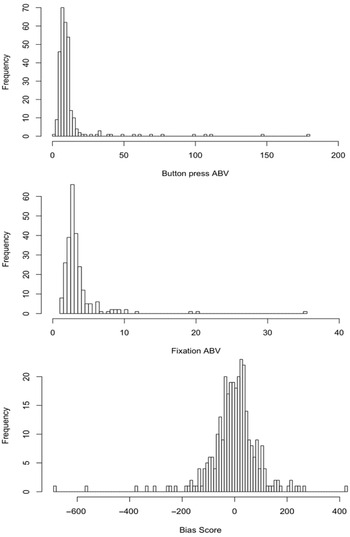
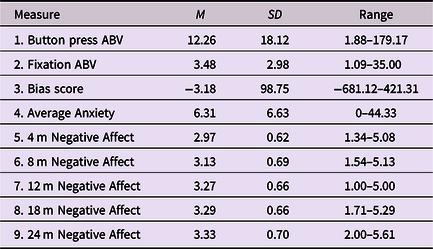
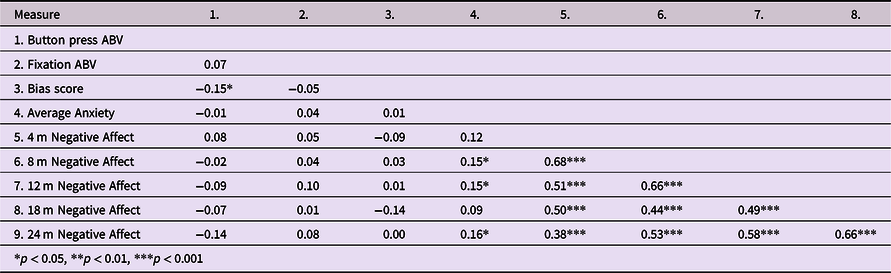
In examining histograms of each attention bias metric, we noted that both button-press ABV and fixation ABV were positively skewed, but this was not the case for attention bias scores. Histograms can be seen in Figure 3. We also noted that within our sample there were no significant associations between any of our attention bias metrics and caregiver anxiety; the only significant correlation was that between button press ABV and bias score, b = −0.15, p = 0.01. Full descriptive statistics and correlations are in Tables 2 and 3.
Histograms depicting distributions of each attention bias metric within the sample. Note that axis scales are different across plots.

Descriptive statistics for attention bias metrics collected from the caregiver, in addition to caregiver anxiety and repeated measures of infant negative affect

Correlations between attention bias metrics collected from the caregiver, in addition to caregiver anxiety and repeated measures of infant negative affect

In order to contextualize our findings, we first modeled the prototypical trajectory on infant negative affect over the first 2 years of life, within our sample. A random intercept and slopes linear growth model of infant negative affect indicated that negative affect significantly increased over time, γ10 = 0.017 (SE = 0.003), p < 0.001, such that for the prototypical infant, negative affect increased by 0.017, γ00 + γ10 = 2.97 + 0.017 = 2.99 every month.
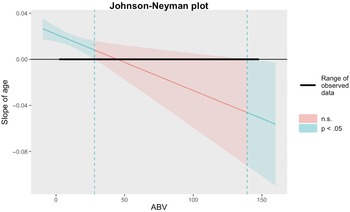
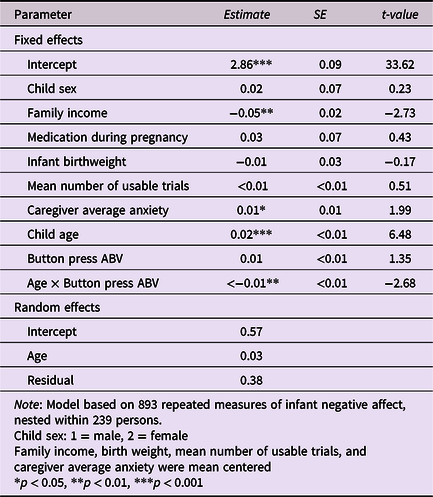
Infant negative affect systematically varied as a function of the interaction between infant age and caregiver button press ABV, γ50 = −0.0005, p < 0.01 (Table 4). We probed this interaction with regions of significance analyses, shown in Figure 4. For infants whose caregivers demonstrated a low-to-average ABV (<28.03), infant age was positively associated with negative affect, indicating trajectories that significantly increased between 4 and 24 months. Increases in infant negative affect are in line with the prototypical pattern for the sample, but these increases were potentiated in steepness as caregiver ABV decreased. In contrast, for infants whose caregivers demonstrated a relatively high ABV (>28.03 and <139.26), infant age was not associated with negative affect, indicating that their negative affect trajectories were stable over time. Interestingly, for a small group of infants whose caregivers demonstrated extreme high ABV (>139.26), infant age was negatively associated with negative affect, indicating trajectories that significantly decreased over time.
Johnson–Neyman plot showing regions of significance for the two-way interaction between caregiver button press ABV to threat and infant age on infant negative affect.

Multilevel model assessing relations between button press ABV and infant age on infant negative affect, covarying for child sex, family income, medication usage during pregnancy, and infant birthweight

Infant negative affect trajectories did not systematically vary as a function of caregiver fixation ABV to threat (p = .56), threat bias scores (p = 0.27), or the interaction between age and either variable (p = 0.91 and p = 0.16, respectively).
We conducted follow-up analyses to test whether any socioemotional correlates of the COVID pandemic may be driving these results. Tables S1 and S2 in the supplement show this same model run with only children who completed data collection prior to March 11, 2020 (n = 141, Table S1) and with children who did not complete data collection prior to this date (n = 120, Table S2). We found that the model including the pre-COVID onset sample replicated the directionality and significance of effects as the primary model for button press ABV, indicating that aspects of the COVID pandemic did not drive our reported effects. The model including the post-COVID onset sample retained directionality of effects but the interaction between age and button press ABV did not reach significance.
Discussion
In this study, we assessed the relation between different metrics of caregiver attention and trajectories of infant negative affect over the first 2 years of life. We compared relations between ABV metrics (derived from both button presses and gaze fixations) and the standard threat bias score, which has been traditionally derived from the dot-probe task. Contrary to our hypotheses, high levels of caregiver ABV to threat did not predict steeper positive trajectories of infant negative affect. Instead, we found that very high levels of caregiver ABV to threat related to decreases in infant negative affect between 4 and 24 months. We also found that lower levels of caregiver ABV to threat, which may reflect more stable attention biases to threat, were related to steeper positive trajectories of infant negative affect over time. These changes in negative affect through development reflect changes in how an infant/toddler is responding to stimuli in their environment that they may find unpleasant, frightening, or frustrating (Gartstein & Marmion, Reference Gartstein and Marmion2008). Interestingly, these findings were specific to ABV to threat derived from button presses, while no significant effects emerged for ABV to threat derived from fixation data or for traditional threat bias scores.
These findings suggest that ABV to threat from button presses, ABV to threat from gaze fixations, and threat bias scores may capture distinct attentional mechanisms. Outside of a correlation between button press ABV and traditional bias scores, these metrics were not correlated and had different distributions. Prior work suggests that ABV to threat derived from button press captures regulatory behaviors such as emotion regulation (Bardeen et al., Reference Bardeen, Daniel, Hinnant and Orcutt2017; Klanecky Earl et al., Reference Klanecky Earl, Robinson, Mills, Khanna, Bar-Haim and Badura-Brack2020) and/or attentional control (Bardeen et al., Reference Bardeen, Tull, Daniel, Evenden and Stevens2016; Clarke et al., Reference Clarke, Marinovic, Todd, Basanovic, Chen and Notebaert2020), especially when presenting threat-valenced stimuli. In this context, high ABV would reflect low emotion regulation and/or attentional control and low ABV reflects high emotion regulation and/or attentional control.
Differences in a caregiver’s responses to their infant cues and their immediate environment may uniquely impact the quality of caregiver–infant interactions. For example, caregivers with higher attentional control may more readily anticipate and attend to infant emotional cues, facilitating the caregiver’s accurate interpretation of infant negative affect in context to consistently respond with sensitive behaviors. Although empirical work on the specific relation between visual attention and parenting behaviors is scarce, findings from studies of parental self-regulation support this interpretation. For example, higher maternal self-regulation has been associated with lower infant negative affect (Bridgett et al., Reference Bridgett, Burt, Laake and Oddi2013), and parents with higher effortful control and executive function are more likely to respond in a nonnegative way to children’s negative cues (Geeraerts et al., Reference Geeraerts, Endendijk, Deater-Deckard, Huijding, Deutz, van den Boomen and Deković2021).
While the direction of our effects seems to contradict these previous findings, other studies of parenting and temperament suggest that some parenting behaviors associated with high attentional control in caregivers are not necessarily adaptive for all children. For example, Kiel and Buss (Reference Kiel and Buss2010) reported that for temperamentally fearful children, mothers’ ready anticipation of children’s fearful responses was associated with the perpetuation of high fear. Furthermore, in a follow-up study of the same fearful children, they also reported that higher maternal accuracy in predicting children’s fear responses at age two predicted greater social withdrawal at age five (Kiel & Buss, Reference Kiel and Buss2011). Indeed, the association between caregiver ABV and significant increases in infant negative affect only emerged in our sample at low-to-average levels of ABV, which at the extreme may indicate extremely high attentional control on the part of the caregiver.
Borrowing from the attention literature more broadly, recent work also suggests that extreme high attentional control may reflect overcontrol and rigid cognitions that may confer risk for psychopathology in the individual. Specifically, rigidity in attention may potentiate periods of negative affect and inability to disengage from negative states, which over time may potentiate risk for internalizing disorders (Gilbert et al., Reference Gilbert, Perino, Myers and Sylvester2020; Henderson et al., Reference Henderson, Pine and Fox2015; Henderson & Wilson, Reference Henderson and Wilson2017; White et al., Reference White, McDermott, Degnan, Henderson and Fox2011). Therefore, it is possible that low ABV may play a role in anticipatory and overprotective behaviors, which as reported by Kiel and Buss (Reference Kiel and Buss2010, Reference Kiel and Buss2011), may then lead to potentiated increases in infant negative affect over time. Low ABV can also be interpreted as reflecting the stability/consistency of a caregiver’s attentional bias to or away from threat, which may similarly relate to the way that they curate or filter their infant’s socioemotional environment and have implications for levels of infant negative affect over time (Vallorani et al., Reference Vallorani, Fu, Morales, LoBue, Buss and Pérez-Edgar2021).
We were surprised to find that high caregiver ABV to threat related to decreases in negative affect. Typically, we see normative increases in negative affect through infancy (Braungart-Rieker et al., Reference Braungart-Rieker, Hill-Soderlund-A. and Karrass2010; Dollar & Calkins, Reference Dollar and Calkins2019), as was the case in our overall sample. This increase in negative affect reflects, in part, the infant’s growing awareness of their own motivations and goals, the limitations imposed by the environment and their own immaturity, and the resulting feelings of frustration and distress (Dollar & Calkins, Reference Dollar and Calkins2019).
Although relatively little work has sought to interpret what decreases in negative affect may mean in infant emotional development, we put forward the idea that this trajectory may reflect the infant’s response to diminished environmental responsiveness. However, we acknowledge that the regions of significance analysis found that decreases in negative affect were significant only for extremely high levels of caregiver ABV, specifically levels greater than 10 standard deviations above the mean, so these patterns may reflect a small subsection of the general population. As reviewed, high ABV may relate to a caregiver’s low attentional control and/or emotion regulation. These behaviors may manifest in the way that a caregiver curates their household and/or interacts with their infant. If a caregiver is low in attentional control or emotion regulation, they may be disorganized in the way they manage their household or inconsistent in the way that they respond to their child. With repetition, a lack of statistical regularity in an infant’s environment may alter the threshold at which they respond to environmental stimuli, or the nature of these responses (Sherman et al., Reference Sherman, Graves and Turk-Browne2020).
Another possible explanation is that parents with extreme patterns of ABV may interpret their infants’ behaviors differently than parents with more moderate levels of ABV, and these differences are reflected in caregiver reports of infant temperament. Future work should examine interrelations between levels of caregiver ABV and more naturalistic parenting behaviors, parent–child interactions, and/or infant temperament to directly test each of these possible explanations.
Our study provides preliminary evidence that extreme patterns of ABV to threat, not just high ABV, may contribute to socioemotional development. For example, it may be that either the unpredictability posed by high ABV to threat or the rigidity posed by low ABV both evoke adaptation in infants to cope with potentially extreme rearing environments, and that these compensatory mechanisms are reflected in their trajectories of negative affect. While some increases in negative affect over time are normative (Braungart-Rieker et al., Reference Braungart-Rieker, Hill-Soderlund-A. and Karrass2010; Dollar & Calkins, Reference Dollar and Calkins2019), more work is also needed to investigate the threshold at which increases in negative affect trajectories predict maladaptation. Similarly, there is a paucity of work examining the implications of decreases in negative affect over time. As such, additional research should interrogate how these early life trajectories are associated with socioemotional development.
These data add to the literature that characterizes ABV to threat within a community sample. While most work with ABV has been focused on clinical populations, such as individuals with PTSD (Badura-Brack et al., Reference Badura-Brack, Naim, Ryan, Levy, Abend, Khanna, McDermott, Pine and Bar-Haim2015; Bardeen et al., Reference Bardeen, Tull, Daniel, Evenden and Stevens2016; Iacoviello et al., Reference Iacoviello, Wu, Abend, Murrough, Feder, Fruchterm, Levinstein, Wald, Bailey, Pine, Neumeiser, Bar-Haim and Charney2014; Naim et al., Reference Naim, Abend, Wald, Eldar, Levi, Fruchter, Ginat, Halpern, Sipos, Adler, Bliese, Quartana, Pine and Bar-Haim2015; Swick & Ashley. Reference Swick and Ashley2017), the current sample was relatively racially and socioeconomically diverse, and not strategically selected for psychopathology. Indeed, within our sample only 4 caregivers had an average anxiety score suggesting “severe” anxiety (1.38%), and only 25 caregivers had an average anxiety score suggesting anxiety of “moderate” levels (8.65%) (Beck & Steer, Reference Beck and Steer1993). Participants provided up to five repeated measures of ABV over the course of nearly 2 years, as well as traditional threat bias scores from the dot probe and ABV derived from gaze fixation data. Here, we found that these metrics were all relatively stable over time, suggesting that ABV to threat may be trait-like during adulthood among a generally healthy sample. ICC values for button press ABV, fixation ABV, and traditional bias scores also revealed that both ABV metrics offered relatively good reliability, where bias scores had low reliability. This is consistent with previous work examining psychometrics of the dot-probe task (Chapman et al., Reference Chapman, Devue and Grimshaw2019; Price et al., Reference Price, Kuckertz, Siegle, Ladouceur, Silk, Ryan, Dahl and Amir2015; Schmukle, Reference Schmukle2005).
Additionally, the caregivers in this sample were all postpartum, and the time after childbirth is often associated with fluctuations in depression, anxiety, and stress for parents (Matthey et al., Reference Matthey, Barnett, Howie and Kavanagh2003; Pawluski et al., Reference Pawluski, Lonstein and Fleming2017). And yet, we did not note fluctuations in ABV or attention bias. However, we offer the caveat that we do not have data on ABV prior to childbirth, so we cannot speak to stability across both prenatal and postnatal years. We also note that within this sample, we found no significant associations between anxiety and button press ABV, fixation ABV, or a traditional threat bias score.
We also found that ABV to threat derived from button presses had a different relation to longitudinal changes in infant negative affect than ABV to threat derived from gaze fixations, as well as traditional dot-probe threat bias scores. This suggests the uniqueness of button press ABV in capturing cognitive processes within an emotional context. This dissociation between button press metrics and eye-tracking metrics is not unusual (e.g., Fu et al., Reference Fu, Nelson, Borge, Buss and Pérez-Edgar2019). This may be in part due to the fact that eye-tracking is a more proximal metric of attention, while reaction time is often an endpoint in a cascading set of processes such as perceptual processing, decision-making, and, finally, initiating a motor response. Thus, our data suggest that the processes associated with infant trajectories of negative affect may emerge within this cascade, and after initial patterns of visual attention, which may be more reflexive.
While more work is needed to better understand the more specific cognitive processes underlying differences in ABV to better characterize the metric, these findings give further credence to the notion of including ABV as a metric in studies involving the dot probe as an additional way of capturing individual differences in attention to affective cues. Bivariate correlations also found that button press ABV was significantly, inversely related to bias scores. Very limited work has examined button press ABV and vias scores within the same sample to date; future work should both seek to replicate this finding as well as better test possible mechanisms underlying this relation. Future work should also continue to examine ABV in community samples and better understand relations between ABV and attentional control and/or emotion regulation.
This study is not without its limitations. We note that ABV and report of infant negative affect were provided by the same individual, which may bias results. For example, caregiver ABV may relate to underlying biases that the caregiver has in assessing their infant’s behavior. Thus, with our current analysis it is possible that it is not the infant’s negative affect is decreasing over time, but that the parent’s perception of their infant’s negative affect is changing over time. However, recent work suggests that mothers can disaggregate self-report of child temperament from their own symptom profile (Olino et al., Reference Olino, Guerra-Guzman, Hayden and Klein2020). Future work should incorporate parent-report of infant negative affect from multiple caregivers, as well as behavioral assessments of temperament to examine how caregiver ABV relates to longitudinal changes in these metrics over time.
In conclusion, these data suggest that caregiver ABV to threat may be a relevant factor in an infant’s ecosystem, with potential influences on how levels of infant negative affect change over the first 2 years of life. Additionally, our findings pose the idea that both high and low caregiver ABV to threat may be a potential risk factor in infant trajectories of negative affect within the caregiver–child dyad. Additional work is needed to support the emerging idea that caregiver affect-biased attention is an important contextual influence on infant socioemotional development.
Supplementary material
The supplementary material for this article can be found at https://doi.org/10.1017/S0954579422000736
Funding
The study was supported by grants from the National Science Foundation Graduate Research Fellowship under Grant No. DGE1255832 (to KEG), the National Institute of Neurological Disorders and Stroke under Grant No. 1F99NS120411-01 (to BA) and the National Institute of Mental Health under Grant No. R01MH109692 (to VL, KB, and KPE).
Conflicts of interest
None.