Introduction
In September 2010, a Chilean Mapuche intellectual, Pedro Cayuqueo, published a brief article entitled ‘So Close, So Far’. Cayuqueo began the article by noting that he often wished he had been born in Argentina rather than Chile, since, from his perspective, the Argentine state has looked much more favourably on its Mapuche population than has the Chilean.Footnote 1 Despite the apparent and visible differences for Mapuche people in the two countries, Cayuqueo expressed surprise that during a recent visit throughout Argentina, Argentine Mapuches repeated the same phrases to him: they were ‘part of a single people, the same nation’; ‘a single people divided by two states’.Footnote 2 These phrases came as a surprise because of the physical and symbolic border that divides Mapuche people and the sense among many Mapuches that this has resulted in the development of separate identities. Cayuqueo's musings point to a central tension for Mapuche people: they are both citizens of different nation-states and members of a cross-border Mapuche nation. Yet this is not always how Mapuche people have thought of themselves, and the idea of a cross-border national Mapuche identity, as a political identity, has waxed and waned over the centuries. In this article, I explore this tension while addressing the following questions: What kind of geopolitical imagination is forged out of a nation-building process that is at once embedded within distinct nation-states and transcends them, and what kinds of tensions and contradictions shape this process?
I analyse three central areas – organisational history, material culture (in the form of national symbols) and discourse – to understand how people are imagining and shaping the Mapuche cross-border nation. This is a movement akin to other ‘stateless’ national movements in that it is aimed at creating a national identity that is different from the hegemonic national identity.Footnote 3 Yet it has important differences. First, this is a cross-border movement, one aimed at bringing together Mapuche people in two different countries, who sometimes reside quite far from the international border, and uniting them under a single political project, a process that requires a significant amount of imagination. Second, this is an indigenous movement, a type of activism largely left out of the literature on nationalism.
Looking at the Mapuche cross-border nation reveals new theoretical insights into the nation-building process. I argue that this project shows the building of a contested imagined community, what I call a multi-scalar geopolitical imaginary.Footnote 4 It is multi-scalar in the sense that the nation-building projects signify Mapuche belonging on multiple scales: a within-state level and a cross-border level. It is geopolitical in the sense that it involves imagining the nation through its geography, politics and culture. The geopolitical imagination emerges out of Mapuche intellectuals’ projects of ‘thinking otherwise’ and of imagining a nation that is betwixt and between, both confined by state borders and existing across them.Footnote 5 Yet these projects are full of internal debates and contradictions; they are unbounded, open works that simultaneously project Mapuche belonging within nation-state political borders and across them.
Nations and Nation-Building
Literature on nations and nationalism tends to fall into one of two camps – looking either at the relationship between the state and the nation, or at nationalist movements. In the first area, scholars focus on state attempts to create a sense of unity and commonality among the populace by promoting a common national identity through symbols, language and a shared identity.Footnote 6 Often this shared identity is enforced through differentiation between national subjects and outsiders and is a way to ensure the homogeneity of the nation, by enforcing state geopolitics on the nation.
This picture, while a general overview of the state–nation relationship, misses the nuances present in Latin American nationalism. In the first place, the role of the state is often mediated through other actors. Itzigsohn and vom Hau suggest that while nationalism is driven by the state, it is shaped by the relationship between the state and social movements or alternative elites.Footnote 7 States react to challenges to the dominant ideologies by these other actors by shifting the meanings associated with the nation. Further, nationalist projects of the state take shape in particular ways through the interaction of transnational, national and local discourses, histories and politics. As Patricia Richards argues, local elites play a critical role in interpreting the national project of the state, often reinforcing certain aspects of it while rejecting others.Footnote 8
Peasants and other non-elite actors also shape national projects. During the mid-nineteenth century in Mexico and Peru, peasants took part in political coalitions in which they ‘struggled to create their own national-democratic vision’.Footnote 9 They confronted the contradictions between the liberalism espoused by their democratic societies and the realities that left peasants out of national discussions. Similarly, indigenous communities in Southern Mexico enact their own ‘local nationalisms’, utilising some state and some local symbols as they interpret the nation from their own point of view.Footnote 10 Thus, while the state is often a central actor in nationalist projects, these projects are mediated, transformed and shaped in conjunction with or in opposition to other actors.
Second, the exclusionary aspect of nationalism may not have been as strong in Latin America as in other places. Miller argues that ‘from the early twentieth century onwards Latin American nationalisms have drawn upon a rhetoric of inclusion, which may in some cases have opened up possibilities for the marginalised to renegotiate their position’.Footnote 11 This kind of rhetorical inclusion – even through problematic discourse like mestizaje – has contributed to the sense among citizens of Latin American countries that nationalism is not just a tool of the elite but is also a vehicle for popular participation in politics. It is in this sense that the discourse of nations and nationalism is appealing to Mapuche intellectuals. In building a multi-scalar nation, one of the meanings associated with national belonging is at the level of interaction with the state. Mapuche intellectuals draw on a history of rhetorical inclusion in state discourse of nationalism to define their own nationalism, a pillar of which is engagement with the state over an alternative sense of belonging.
The second area of nationalism literature tends to focus on nationalist movements. Although some of these movements have the creation of a new state as their goal, others, such as those in Quebec, Scotland and Catalonia, have engaged in ‘stateless nationalism’.Footnote 12 Movements in these regions search for some level of autonomy within the broader nation-state but usually do not also engage in a multi-scalar cross-border nation-building project.
Although generally excluded from analyses of these groups, indigenous movements hold important similarities and differences from other nationalist movements that can deepen our understanding of the construction of new geopolitical imaginaries. Certainly not all indigenous mobilisations are nationalist, and most indigenous movements do not have secession as a central goal.Footnote 13 Yet, indigenous people and scholars alike use the terms ‘nations’ and ‘self-determination’ to describe indigenous peoples and their activism.Footnote 14 Indeed, many indigenous groups in Latin America have struggled precisely to be considered a pueblo, a people, a collective group, a nation. It is for this reason that indigenous peoples advocate for constitutional changes recognising the ‘plurinational’ character of their countries.Footnote 15 Further, many indigenous groups promote self-determination and sovereignty within their communities, a goal that has been central to – and hotly contested within – struggles in Mexico and elsewhere.Footnote 16 The kind of ‘thinking otherwise’ engaged in by indigenous intellectuals can yield new forms of national imaginaries, such as the multi-scalar nationalism of Mapuche cross-border activism, which looks different than the stateless nationalism of other non-indigenous groups.
It is useful to look at indigenous movements, too, as similar to post-colonial struggles. Partha Chatterjee argues that in anti-colonial settings, colonised people adopt Western rational forms of nationalism, what he terms the ‘material domain’ of culture, in order to overcome dominance.Footnote 17 Yet, they simultaneously retain and build a distinctive spiritual realm of national culture. This allows them to construct a form of nationalism that is both legitimate in its use of Western rational tools and distinct from colonial forms of nationalism in its emphasis on a unique and superior spiritual dimension. For Chatterjee, being able to imagine a ‘“modern” national culture that is nevertheless not Western’ is a central aspect of post-colonial nation-building.Footnote 18 Yet, this may not be as simple as it seems. Other scholars posit that modernity depends on the colonial domination of non-Western people.Footnote 19 Becoming modern, in this sense, means wearing the mantle of Western thought masked as universal thought that erases other local histories. The trick, it seems, is to imagine a nation that is not constrained by modernity but that instead draws on the specific local knowledge of non-Western, colonised people. It is to create an alternative modernity and geopolitical imaginary through the nation-building project.
I argue that Mapuche intellectuals are drawing on two traditions to envision the Mapuche cross-border nation. I use the term ‘intellectuals’ throughout the article to refer to Mapuches who are engaged in this nation-building project. I draw from Gramsci, who argues that organic intellectuals contest hegemony and are engaged in ‘nourishing the imaginings of emergent working class groups’.Footnote 20 I also draw from Rappaport, who suggests that indigenous organic intellectuals maintain a dual role as both activists and promoters of ethnic cultural and political rights. She states that ‘the work of indigenous organic intellectuals is not confined to educated writing, but to the creation from below of an activist politics of identity’.Footnote 21 I see Mapuche intellectuals as people who are engaged in activism around their identity but who also specifically create and advance imaginings about what it means to be Mapuche and to belong to a Mapuche nation that exists both within and across state borders.
The first tradition that Mapuche intellectuals draw on engages directly with the state; as such, part of the multi-scalar nation is imagining how to be a member of a Mapuche nation that exists squarely within the borders of Chile or Argentina. This is the nation-building that aligns with the stateless nations described in much of the nationalism literature. The second strand of geopolitical imagining envisions a cross-border Mapuche nation that overcomes borders and political separation. While this strand also draws on the same symbols of the nation, as I describe below, it is less defined geographically and politically. Its borders and politics are more fluid and more subject to debate. When brought together, these two traditions allow for the creation of a multi-scalar nation-building project. In this project, multiple levels of national belonging exist simultaneously and national symbols signify the two levels of belonging at the same time, leading to a complicated, contested yet ultimately innovative way of imagining the Mapuche nation.Footnote 22
Nationalising Projects
A first and central reality confronting Mapuche intellectuals in their quest to build a cross-border nation is the challenge of doing this within and across two states that are also engaged in nationalising projects – projects that include indigenous people. Historically, the nationalising projects of Latin America were also largely racialising projects.Footnote 23 By the end of the 1880s, both the Argentine and Chilean states had expanded into territory previously occupied by indigenous peoples, conquering those peoples through military exploits and bringing them under the control of the state. The indigenous population in both countries was greatly diminished after these military campaigns, and those who remained quickly found themselves the subjects of nationalising projects aimed at assimilation. This period was also characterised by nation-building projects for the two young states; these projects were aimed at promoting a homogenous white European-descendent identity, one that was equated at the time with modernity and civilisation.Footnote 24
The success of these projects lies in the fact that public intellectuals and the public in general question the legitimate rights of indigenous people in both countries. Some Chileans advocate that Mapuche are indigenous people who migrated to Chile from Argentina. This is perhaps a perverse assessment, given that the national narrative in Argentina proposes the opposite – that the Mapuche are indigenous people of Chile who migrated to what is now Argentina in the 1600s and conquered the other indigenous groups living there. This casts the Mapuche as being from everywhere and nowhere all at once. Many current scholars in Argentina argue that the narrative of Mapuche-as-Chilean-immigrant served as strategic justification for the Argentine state's expansion into the Pampas and Patagonia (the southern regions of the current country) and its military conquest of the Mapuche people.Footnote 25 Yet in Argentine popular culture, this account is widely circulated as the truth.
Despite the fact that indigenous people's legitimacy is questioned in both countries, the two states have historically dealt with indigenous peoples differently, and in both places, the story is complicated. Two basic and recent differences have to do with official state recognition of indigenous people and state policy towards indigenous people. In the first instance, Argentina looks relatively more progressive than Chile – it granted constitutional recognition to indigenous people in 1994 and ratified ILO Convention 169, which recognises indigenous people's rights, in 2000. This happened through a combination of indigenous activism and state desires to be seen favourably in the international community.Footnote 26 In comparison, Chile does not officially recognise indigenous peoples in its Constitution, and it ratified ILO Convention 169 in 2008, relatively late for a Latin American country.Footnote 27
In terms of policy, however, the roles are reversed. Argentina created the Instituto Nacional de Asuntos Indígenas (National Institute of Indigenous Affairs, INAI) in 1985; according to its mission statement, INAI's goal is to support indigenous people and assure their development and participation in the nation. It is a relatively small office in the Ministry of Development and historically has had little visibility when it comes to indigenous politics. Perhaps to improve its legitimacy, in 2008 INAI created the Council of Indigenous Participation, composed of indigenous representatives and government bureaucrats, to try to include indigenous people and support them in their efforts to achieve community development. Compared with INAI, the Corporación Nacional de Desarrollo Indígena (National Corporation for Indigenous Development, CONADI), created in Chile by President Aylwin as part of the Indigenous Law of 1992, is a more visible – if contentious – player in state–indigenous politics.Footnote 28 Its activities range from registering indigenous individuals and communities and holding competitions for scholarships and other resources, to providing support for small indigenous businesses, establishing a fund to support subsidies for land, and implementing cultural programmes. The state is engaged in what some have called ‘neoliberal multiculturalism’: visibly supporting indigenous activities that fit with state visions of the nation while criminalising others by applying anti-terrorist laws to indigenous activism.Footnote 29 Mapuche activists thus have to operate in a complicated political terrain.
These nationalising projects have shaped Mapuche organising. Because of this, the majority of Mapuche activism takes place within the nation-state realm and is directed towards the nation-state, not towards cross-border organising. Mapuche organisations have had to struggle to show that Mapuches, as a people, make up a valid, integral and current part of the national identity. This has been a struggle in both countries and also requires Mapuche activists to direct much of their energy towards the nation-state. The focus on the nation-state has constrained cross-border Mapuche mobilisation, but it has also contributed to the Mapuche cross-border national imaginary and to the ability to imagine the Mapuche nation as both within nation-state borders and across them.
As Pavez shows in his collection of letters written by Mapuche leaders during the 1800s, Mapuche people have long interacted at both the national and cross-border level.Footnote 30 The letters Pavez has collected are directed to Mapuche and non-Mapuche people alike. They show that at diverse moments in time, Mapuches made different alliances depending on their interactions and their ‘geographical positions within Wallmapu’.Footnote 31 Two things are of interest: firstly, Mapuches were negotiating with leaders in Buenos Aires, in Santiago or in regional cities. They were thus taking part in the nation-building projects of both nations, as potential future citizens. Secondly, however, Pavez uses the term ‘Wallmapu’, the Mapuche word for ‘all Mapuche territory’, to describe Mapuche leaders’ locations, despite the fact that the authors of the letters did not use this word. This suggests a modern reading of the letters that shows some level of coherence amid the decentralised governing structure which characterised the Mapuche people, and thus some sense of a shared national identity.Footnote 32 In their creation of a multi-scalar Mapuche nation, Mapuche intellectuals draw on this history of imagining a Mapuche nation that could exist both within each country and across the border.
Argentina's nationalising project
State-led nationalising projects have not just constrained Mapuche organising to within nation-state borders; they have also shaped Mapuche organisational structures and conceptions of identity. For example, Argentina has a federal political system much like the federal state system in the United States. Provinces wield a fair amount of political autonomy, and many political, economic and social decisions are made at the provincial level. Provincial governments create and implement their own laws about land use, education, resource allocation and development, and provinces also maintain their own constitutions. While these are clearly not as important as the Argentine Constitution, they do carry a significant amount of weight and play an important role in political negotiations. Because of the federalist system and the number of important political decisions that are made at the provincial level, Mapuche people have historically negotiated with provincial governments – instead of the federal government – over issues ranging from bilingual education to land use. Consequently, Mapuche organisations have developed within provinces rather than across them, responding to what many Mapuche leaders see as the distinct political and social realities of the different provinces.
Province-based organising has had unintended consequences, most notably that there is often little contact between provincial Mapuche organisations and even less political coordination. Provincial Mapuche organisations have developed along different trajectories depending on their provincial context, and they emphasise different claims and rights. When I asked Mapuche leaders in the neighbouring provinces of Neuquén and Río Negro about their relationships with Mapuche organisations in the other province, most leaders responded that they were sometimes invited to cultural events or that they had met one or two leaders from the other province, but they also mentioned that they did not have sustained contact and that they shared no common political strategy. One Mapuche man who leads a Mapuche organisation in his city and is involved in the Coordinadora del Parlamento del Pueblo Mapuche (Coordinator of the Parliament of the Mapuche People), a province-wide Río Negro organisation, noted, ‘Being Mapuche in Río Negro is not the same as being Mapuche in Neuquén. They have their laws; we have our laws. They have their history; we have our history. We have different relationships with our governments, and we have lived different experiences. We are different.’Footnote 33 The lack of coherence in Mapuche identity and political structure within Argentina, let alone across Argentina and Chile, means that the geopolitical imagination required for a multi-scalar cross-border nation is all the more complicated.
Chile's nationalising project
Mapuche organisations in Chile have also been shaped by the state, but in different ways. There, divisions are not along provincial lines but instead tend to be along political party lines. This has to do, in part, with Chile's state structure – because Chile is a centralised state, it does not have the strong provincial divisions found in Argentina. Instead of being divided by province, Mapuche organisations in Chile are divided by other factors: political strategies, political parties and state policies.
Since Mapuche people began organising for political change in the early 1900s, they have been divided by political strategy, by involvement in political parties and by state policies.Footnote 34 While some of these fault lines are insurmountable, organisations and communities may participate in seemingly contradictory ways: claiming autonomy while accepting help from the state, or participating in both a political party and a Mapuche organisation. Yet there appears to be consensus that the central result is a division among Mapuche leaders and organisations, largely driven by the role of the state in accepting certain forms of Mapuche politics while criminalising others. An activist and public intellectual who works for an NGO that supports Mapuche rights suggested that ‘the [Chilean] state is co-opting Mapuche leaders in an attempt to weaken the Mapuche movement’ by incorporating these leaders into government positions.Footnote 35 Another Mapuche man who was running for an elected position representing indigenous people in a government agency exemplified the way that the state has divided Mapuche people. He noted, ‘Sometimes you have to make roadblocks or protest the state, but I can't do that right now. I'm a professional, and I have too much at stake to take part in more radical movements: my family, my job, my income and my reputation.’Footnote 36 For him, protecting these elements of his life means that he cannot take part in any activity that might run the risk of landing him in jail, and therefore that he cannot participate in certain forms of Mapuche activism.
In Chile, the result of such fragmentation is the lack of an overarching Mapuche organisation representing the needs and claims of multiple groups. Further, over the years since the return to democracy, there have developed nearly intractable divisions between organisations. One activist noted the bitterness among Mapuche leaders and the extent to which they have lost their ability to work together. He stated, ‘Mapuche leaders don't trust each other anymore. They all backstab one another, and no one wants to work together on anything.’Footnote 37
Like all social movements, Mapuche movements in Argentina and Chile experience divisions. I point out these divisions to show the very different ways in which Mapuche organising has been shaped by state projects in the two different countries. In Argentina, the federal structure of the state creates divisions by provincial lines, even when Argentine politics more generally ignores indigenous people and their claims. In contrast, state policies in Chile divided Mapuche organisations by political party and political strategy, authorising certain kinds of cultural and political claims while criminalising others.
In Argentina and Chile, state projects create obstacles for both parts of the multi-scalar Mapuche nationalist project. First, while both states embrace multiculturalism to some extent and thereby recognise Mapuche people, they reject more radical claims for autonomy or Mapuche nationhood. Both states use multiculturalism to include Mapuche people in the larger state nationalising projects and in doing so lessen the sense of a distinct Mapuche national identity. If Chile (or Argentina) is multicultural, then Mapuche people have a place within the Chilean (or Argentine) nation. From this logic, Chile and Argentina can justify their denial of Mapuche attempts to create a truly plurinational state based on indigenous autonomy. As a result of state attempts to selectively incorporate Mapuche people into the state-sanctioned nation, it can be difficult for Mapuche intellectuals to envision a Mapuche nation even within the borders of the state. They may feel constrained by the logic of the nation promoted and delineated by the state. Second, indigenous people are shaped by the dominant state identity and may not always relate to their indigenous counterparts across the border. This lack of awareness and even rivalry between the countries manifests itself in intra-Mapuche relations, as I show below with regard to some of the debates over national symbols.
The Mapuche Cross-Border Nation Takes Root
Despite the obstacles to both dimensions of the multi-scalar geopolitical imagination, many Mapuche and non-Mapuche scholars and intellectuals suggest that Mapuche people in Chile and Argentina share a common identity as a single people.Footnote 38 I trace the blossoming of this nation-building project to the early 1990s and the founding of the influential Chilean Mapuche organisation the Consejo de Todas las Tierras (Council of All Lands, CTT). The CTT emerged in the early 1990s, when Chile was transitioning from a dictatorship under General Pinochet to a democracy. The young Mapuches involved in this organisation were committed to creating a Mapuche organisation that was autonomous of political parties and that was structured along traditional leadership lines. This was to be an ethnic organisation in both its outlook and its structure.Footnote 39
The CTT initially organised around the 500th anniversary of Columbus’ arrival in the Americas. In 1990 it organised its first gathering in Temuco, in southern Chile, and invited indigenous authorities from Argentina. It was at this meeting that the Consejo's name officially became the Gran Consejo de Todas las Tierras (Grand Council of All Lands, hereafter the Consejo), emphasising autonomy and a shared political goal. Aucán Huilcaman, the leader of the Consejo, told the local newspaper that the ancestral rights and international rights of indigenous people, together with an indigenous language, an organisation and a history, gave the Mapuche people the right to autonomous control over a contiguous territory extending throughout southern Chile. While Mapuche leaders from Chile and Argentina came together at this moment and recognised their shared goals of political and cultural autonomy, in concrete terms, Chilean Mapuches still saw their territory as existing primarily within the borders of the Chilean state. For example, in interviews from the early 1990s, Huilcaman stated that the land takeovers orchestrated by the Consejo ‘will continue, until we take back the territory [that extends] from the southern edge of the Bio Bio and southwards’.Footnote 40 References to the Bio Bio River, a defining feature of Mapuche territory within Chile, and the fact that the Consejo's land takeovers occurred in Chile, suggest that the concrete aspects of the Mapuche nation were initially imagined by the Consejo as existing within the borders of the Chilean state. The first facet of the multi-scalar geopolitical imagination was beginning to take shape, though the second was not yet there.
Despite this, Mapuches on both sides of the border recognised the importance of this connection. The president of the Indigenous Association of the Republic of Argentina at the time, Rogelio Guanuco, noted, ‘It was a magnificent meeting and was of great importance for Mapuche aspirations.’Footnote 41 This was especially true because of a growing desire on the part of Argentine Mapuches to learn more about Mapuche culture and traditions, which many felt had been lost over the generations, from Chilean Mapuches. It is not clear that Argentine Mapuches really do lack knowledge of Mapuche traditions, but when I asked both Chilean and Argentine Mapuches about this, they pointed to the near complete absence of machis, or shamans, in Argentina, despite the fact that machis are integral to Mapuche cultural and religious practices.
Thus, some Argentine Mapuche activists began to take part in these cross-border gatherings as part of an effort to discover how to be a ‘real’ Mapuche. Wladimir Painemal, a Mapuche activist and intellectual from Chile who participated in some later cross-border workshops, noted that the Chilean Mapuches ‘brought people that had knowledge about the topic of Mapuche culture in order to give workshops’. He suggested that ‘it seemed as though there was a certain kind of lack of knowledge and that in the Ninth Region [southern Chile], especially here in our zone, we maintain cultural knowledge more strongly than in the rest of Wallmapu’.Footnote 42 This did not just benefit the Argentine Mapuches, however. It also introduced Chilean Mapuches to their Argentine counterparts and created connections between them that continue to this day and have been strengthened by continued participation in cross-border workshops and religious ceremonies.Footnote 43
The curiosity with which both groups of Mapuche approached these meetings reflects the different perceptions that Mapuches had and continue to have about one another, perhaps as a result of the state nationalising projects that created distinct Chilean and Argentine Mapuche identities. It also reflects one of the central benefits they see in cross-border activism: learning from one another. Nearly 20 years after the series of meetings in the early 1990s, Argentine Mapuches continue to lament their cultural knowledge and look to Chile for a deeper understanding of Mapuche culture. Conversely, Chilean Mapuches frequently expressed to me that they see Argentine Mapuches as being more advanced politically, and they look across the border for an effective model of political organisation.
A Mapuche woman who participates in the Federación Mapuche Neuquina (Mapuche Federation of Neuquén, FMN) in Neuquén explained the difference in these perceptions in the following way:
Mapuche people in Chile have been more able to maintain their culture than we have: the state did not deny their cultural existence. But the conflicts over land between Mapuche people and the state have meant that the state has tried to make Mapuche people weak politically … In Argentina, the state historically denied our existence, thus forcing us to lose our culture in order to survive. But we have had room to organize politically, so we have developed a more unified Mapuche political agenda … We look to Chilean Mapuches for Mapuche culture, and they look to us for Mapuche politics.Footnote 44
This comment might seem surprising given the long history of Mapuche activism, political mobilisation and repression in Chile. In this case, the Argentine Mapuche seems to be speaking to the fact that Argentine Mapuches have had some political successes – such as the constitutional recognition of indigenous people – and that the Mapuche movement in Argentina, and especially in the province of Neuquén, is fairly unified. Argentine Mapuches have also faced less repression in their mobilisation over the past 30 years than have the Chilean Mapuches.Footnote 45 Further, it is important to point out that it is not the actual differences in politics that matter here, but the perceptions of those differences. As this quote indicates, the process of ‘looking to’ Mapuches on the other side of the border indicates that these perceived differences are also opportunities to share experiences and learn from one another.
Nation-Building Projects
With the success of the 1990 meeting in Temuco – both in bringing together activists from around the world in support of indigenous rights and in forging a common Mapuche identity between Chileans and Argentines – a second meeting was planned for 1991, this one to take place in Argentina. Instead of a meeting meant to draw national and international attention to the question of indigenous rights, and particularly the right to autonomy over territory, this meeting was self-consciously about creating a common cross-border national Mapuche identity, the second facet of the multi-scalar geopolitical imaginary. Mapuche activists initiated nation-building projects that Mapuche people continue to uphold and engage in today: a common Mapuche flag to represent the Mapuche nation (in both Chile and Argentina), a common alphabet that would be used to write Mapuzungun, the Mapuche language, and a common political goal of autonomy and territory, symbolised through naming and mapping the Mapuche cross-border nation. These national objects are not fixed – as is most obvious in the case of the alphabet, where there is no consensus within or between the two countries on the correct version – and it is precisely the debates and discussions around them that signify the nation-building project. Further, the symbols of the nation take on different meanings in the two state contexts; the debates about them are sometimes specific to the Argentine or Chilean setting, a fact that complicates this process but also allows for the imagination of multiple levels of national belonging.
Creating the Mapuche flag
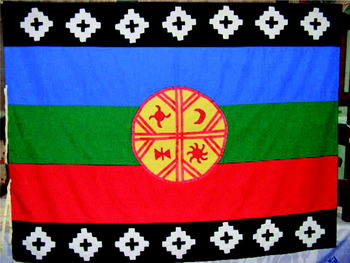
The creation of a Mapuche flag is a particularly important aspect of the nation-building projects, as it is the most visible. In an interview, Jorge Weke Katrikir, the Mapuche artist who designed the flag, noted that in the early 1990s, the leader of the Consejo, Aucán Huilcaman, was acutely aware of the fact that the Mapuche people did not have an internationally recognised symbol representing them. Having travelled to Europe multiple times and having been exposed to other nationalist groups, Huilcaman must have realised the importance of having a national symbol or flag when making unified claims as a people. Further, this was not the first time that a Mapuche organisation had created a flag intended to represent all Mapuche people: the Federación Araucana of the 1930s as well as Ad-Mapu in the 1980s had created flags for this purpose.Footnote 46 The Consejo issued a call for Mapuche communities in Chile to present their ideas for a Mapuche flag, and after it had gathered the most important elements of Mapuche identity from five regions in Chile, it began a consulting process in which it ‘took the prototypes of flags to different regions in order to gain consensus on what would be the final emblem’.Footnote 47 Through this consulting process, six flags were chosen – five representing five distinct Mapuche regions and one representing all Mapuche people. The leaders of the Consejo then took these flags to the 1991 meeting with Argentine Mapuches held in Argentina.
Argentine Mapuches brought their own versions of the flag, and debate ensued about which flag would best represent the Mapuche people. For some Chilean and Argentine Mapuches, there was concern about the use of the colour red in the flag. The Consejo flag designed by Weke Katrikir has a horizontal red stripe taking up one-third of the area. Symbolically, red is a colour of power for Mapuches and can represent aggression or war. A young Mapuche man in Argentina who did not participate in the meeting suggested that this makes the flag inappropriate for use at a ceremonial event. He argued that with the use of red, the flag ‘does not accurately reflect who we are as a people’.Footnote 48 Even some leaders who took part in the debates over the flag had their doubts. According to Domingo Colicoy, a founding member of the Consejo:
I have personally been concerned that the flag has not subsequently been considered as strictly a political measure … I always said that if a flag for example didn't consider the criteria of the colours it wouldn't be able to enter real ceremonial spaces, such as the case of the colour red … So to me it seems like this was an error, an imposition of one sector – that I don't think was the majority – to impose this colour.Footnote 49
The Mapuche Flag

Despite the concerns within Mapuche communities, the Consejo flag was adopted at this meeting and is currently recognised as the Mapuche flag in both Chile and Argentina (see Figure 1). Although its first public use was during a protest in Temuco in 1992, when Aucán Huilcaman unfurled it while giving a speech and being assaulted by the police, it appears that initially the flag was more widely adopted in Argentina than in Chile.Footnote 50 Wladimir Painemal mentions that in the early 2000s, during a series of cross-border workshops, he and other Chilean Mapuche activists ‘found the Mapuche flag there [in Argentina], which during that time, even in the 2000s, was the flag of the Consejo’.Footnote 51 Perhaps because in Chile the flag was associated with a single (and politically contentious) organisation, the Consejo, there was more reluctance on the part of Chilean Mapuches to adopt it as a universal Mapuche flag. In contrast, for Mapuches in Argentina, the flag did not carry these same connotations. Thus, in Argentina, Mapuche people more easily saw it as a general flag and more quickly adopted it as such.
Over the decades, since its acceptance as more than just the flag of the Consejo, the flag has been widely used in protests and political events to represent Mapuche people, Mapuche claims and even Mapuche culture. What is perhaps most interesting about the flag is that it is simultaneously accepted as a national symbol and criticised in this role. Few would argue that it does not function as a national symbol, as it clearly functions the way other flags function: it immediately signifies the Mapuche people. However, there are mixed ideas about the extent to which it truly represents national belonging. Colicoy suggests:
Today, the flag has greater acceptance in the non-Mapuche world than in the Mapuche world. So some people use it for marches but only for marches. And there are people, I would imagine, Mapuche people included, who wear a lot of T-shirts and that sort of thing [with the flag on them], but they do that mostly to reaffirm their identity.Footnote 52
For Colicoy, then, the flag, while symbolic, serves primarily as a superficial symbol – one used largely by non-Mapuches or to communicate nationhood to non-Mapuches. When used by Mapuches, he sees its use as limited to protests or to the very individual act of self-affirmation. The national, collective nature of such a symbol is downplayed in Colicoy's description.
In contrast, Weke sees a much larger role for the Mapuche flag that he designed, stating: ‘It's what I always dreamed. The flag is a symbol of liberation, of self-recognition as a millennia-old nation, of creating unity within diversity, of respect, of valuing each front in our struggle, of valuing each contribution that a Mapuche person makes, wherever he or she may be … We [Chilean] Mapuche cannot honour the Chilean flag.’Footnote 53 Other Mapuche activists concur with this assessment; when talking about the flag, Victor Naguil, a leader of the nascent Chilean Mapuche political party Wallmapuwen, suggests:
This flag has the great worth of being the only one that has the character of a national emblem, of having been adopted by a large number of Mapuche organisations and of being clearly recognized, both by the Mapuche and non-Mapuche populations, as ‘the Mapuche flag’. Further, one has to consider that it is the only Mapuche national emblem that is used in both Gulumapu (Chile) and Puelmapu (Argentina).Footnote 54
In these perspectives, the flag clearly functions as part of the geopolitical imaginary both within the Chilean and Argentine states and across the border: it represents a different symbol of national belonging than the Chilean (or Argentine) flag and also unifies Mapuche people in both countries. It is a definite part of the Mapuche cross-border nation-building project, and it is also one of the clearest examples of the multi-scalar nature of this geopolitical imaginary. The attempts to raise the Mapuche flag in Argentine and Chilean public spaces highlight the two symbolic levels on which the imaginary works; they also highlight the tensions associated with this kind of national imaginary.
Flag-raising in Argentina and Chile
In Argentina, all school-aged children participate in a yearly ‘flag ceremony’ celebrating Argentine identity. During this ceremony, the top student of the class carries the Argentine flag and all of the children promise their loyalty to the flag, and thus to the Argentine nation. This act has been met with resistance by Mapuches in Neuquén. In a school in Neuquén in 2000, the top child in the class, a Mapuche girl, insisted on carrying the Mapuche flag instead of the Argentine one. Surprisingly, the head of the school acquiesced to this demand, saying that she would allow it ‘as a gesture of respect for cultural diversity’ and would carry the Argentine flag herself so that both flags were represented.Footnote 55 During one of its parliaments in 2000, the Mapuche Federation of Neuquén also addressed this issue. In its resolution that year, which included a section on transforming the education system in Neuquén, the organisation suggested that ‘Mapuche people be exempt from the obligatory act of the “promise to the flag”’ – in other words, Mapuche people in Neuquén should not be forced to show their loyalty to Argentina.Footnote 56 In 2005, an article in the Neuquén newspaper, the Diario Río Negro, noted with surprise that five Mapuche students had graduated that year and had elected to carry the Mapuche flag instead of the Argentine one. When the journalist asked a Mapuche representative, Mary Pichiñán, about this phenomenon and whether these students were Mapuche-Argentine, she discounted this hyphenated identity, responding, ‘They are Mapuche; they don't recognize themselves as Argentine.’Footnote 57
Similar processes are taking place in Chile. In 2010, the Chilean state passed a resolution granting a municipality in southern Chile the power to fly the Mapuche flag along with the Chilean flag in front of municipal government buildings with the recognition that this ‘satisfies a cultural, education or artistic expression of the ethnic group’.Footnote 58 Since then, other cities in southern Chile have granted permission for the Mapuche flag to be flown on days that are ‘significant for Mapuche people’ such as the Day of Indigenous People, the Mapuche New Year (We Tripantu) and the Day of the Indigenous Woman.Footnote 59
Despite the state perspective that the flag represents cultural difference, Mapuche people themselves often have a different interpretation of this newly granted right. Aucán Huilcaman, who continues to be the leader of the Consejo, has argued that the right to fly the flag represents ‘the liberation from all forms of oppression that the Chilean state maintains over the Mapuche people’.Footnote 60 Another Mapuche leader has noted that a flag-raising in a town near Temuco, Padre Las Casas, showed that Chilean society was ‘recognizing the Mapuche nation's own emblem’.Footnote 61 On the International Day of the Indigenous Woman, 5 September 2011, Mapuche leaders hoisted the Mapuche flag in front of the Temuco municipal government building. Luis Penchuleo, the spokesperson for the Mapuche political party Wallmapuwen, which had organised the flag-raising, also emphasised the importance of the flag as a national symbol: it ‘marks our presence as a people that inhabit this territory and that should be represented in public spaces with our own identifying symbols’.Footnote 62 Both the notions of national identity and of a legitimate right to national symbols within a certain territory are present in these intellectuals’ responses.
These examples from both countries show that the Mapuche flag expresses a distinct national identity, especially when used during highly visible events and in contestation of the state structures associated with nation-building, such as the school. They also point to a tension inherent in the use of the flag. On the one hand this is clearly a symbol that unites Mapuche people from Chile and Argentina, but on the other, it is also explicitly used to reaffirm the Mapuche nation within each country. For example, Huilcaman speaks of the significance of the flag-raising in the Chilean context only, referring to the ability of the Mapuche people to ‘affirm a … collective conscience’ in the face of Chilean state repression. Thus, while the Mapuche flag may be used to negate Chilean or Argentine identity altogether (as in the case of the Mapuche woman who declared that the children were Mapuche and not Argentine), it does not negate the Mapuche nation within the Chilean or Argentine state borders. It allows for the simultaneous imagining of a cross-border Mapuche nation and a within-border nation.
Debates about the Mapuche alphabet
A second aspect of the Mapuche nation-building project that began as part of the anti-Columbus celebration meetings dealt with language. Since Mapuzungun was historically an oral language, there was no official alphabet. At these meetings, however, the Consejo presented an alphabet created by a Chilean Mapuche linguist, Anselmo Ragileo, in 1982. It uses letters that are not used in Spanish – ‘k’ and ‘w’, substitutes ‘v’ for ‘u’ – and the letter ‘g’ represents an ‘ng’ sound. The people who support this alphabet argue that its use is a step towards autonomy, as a Mapuche created it. Further, it does not rely on the colonial spellings from Spanish – the language of the colonisers. Reading something written in this alphabet clearly indicates that it is distinct from Spanish, and indeed many Spanish-speakers would have a hard time identifying and pronouncing words written in the Ragileo alphabet. It is meant to be foreign to Spanish-speakers. Then and now, Mapuche activists interested in autonomy have argued that this was the most appropriate alphabet, and this perspective led the Mapuche activists at the meetings to adopt the Raguileo alphabet as the official alphabet representing Mapuzungun.
The creation of a Mapuche national alphabet has not been as straightforward as the creation of a flag. In 1986, a group of linguists and anthropologists in Temuco, Chile, created a different Mapuche alphabet, called the unified alphabet. And there is yet a third official Mapuche alphabet operating in Chile: the Chilean state and its entities, such as the Ministry of Education and CONADI, use an alphabet that is neither the Ragileo nor the unified alphabet but instead the Azümchefe alphabet. In Argentina, the situation is no less complicated. An urban Mapuche organisation in the province of Neuquén that is involved in education, the Coordinación de Organizaciones Mapuche (Coordination of Mapuche Organisations, COM, part of the Mapuche Federation of Neuquén), uses the Ragileo alphabet. However, other Mapuche leaders, teachers and activists use their own alphabets, not adhering to the Ragileo alphabet or to any of the other alphabets established in Chile. For example, Nicacio Antinao, who teaches the Mapuche language at the regional university and runs language programs for college students and teachers, has created his own alphabet, which he uses for language instruction in Neuquén and Río Negro.
Part of the problem stems from different perspectives about what is important in an alphabet. According to an Argentine Mapuche woman who participates in the COM, ‘The Ragileo alphabet is one of the central claims of our people, it is the faithful way to write our language.’Footnote 63 Mapuche people who support the use of the Ragileo alphabet argue that it is a more accurate phonetic description of Mapuzungun than other alphabets. More importantly, however, the choice to use Ragileo is seen as a choice that leads towards autonomy, as it is not imposed on Mapuche people by the government or by non-Mapuche experts but chosen by Mapuche people themselves – it represents an autonomous political stance. Although Ragileo is no less Western than a Spanish-based alphabet in that it uses Latin characters, the use of Ragileo has symbolic importance, as it differentiates Mapuche spellings from Spanish ones. Compare, for example, the name Calfú, using a Spanish-based alphabet, with its Ragileo counterpart: Kajfv. The latter is sure to give most Spanish-speakers pause as they try to figure out just how to pronounce the name and exactly what it might mean. This is a clear way to differentiate members of the Mapuche nation, who understand this lexicon, from non-Mapuche Chileans and Argentines.
In contrast, for other Mapuche people, the political aspect of the alphabet is less important than its practical application. A Mapuche leader in Neuquén who teaches Mapuzungun to Mapuche and non-Mapuche people alike argued, ‘If you're trying to teach Mapuzungun to Mapuche people, some of whom have very basic education levels, they won't understand Ragileo. The point isn't to confuse them, it's to get them to speak and understand the language.’Footnote 64 Here the emphasis is on cultural maintenance and revival, not on the politics of a particular alphabet.
Debates go beyond different perspectives about what constitutes the best alphabet. They are also shaped by location and perspective about an alphabet's usefulness in the specific context of Chile or Argentina. A young Mapuche man who teaches Mapuzungun at a local university in Argentina offered a location-based critique of Ragileo. He argued: ‘Ragileo comes from Chile, and therefore it does not represent the Mapuzungun that we speak here in Argentina. Just as Chileans have different accents than we do [when speaking Spanish], they also have a different way of speaking Mapuzungun. We shouldn't depend on their alphabet because it's not the alphabet that best represents our way of speaking.’Footnote 65 When I suggested to him that most Chilean Mapuches also do not use Ragileo, he shrugged and said that he still feels that since it originated in Chile, it does not capture the Mapuzungun of Argentine Mapuches. The inability to agree on this issue within each country, let alone the cross-border misinterpretations surrounding the alphabet, translates into tensions and debates over who has the power and authority to determine which alphabet should be used by the Mapuche nation.
Naming and mapping the Mapuche nation
A third aspect that is central to nation-building is naming the nation, and this has also been an integral aspect of a cross-border Mapuche project. It is intertwined with map-making and the process of defining and drawing territorial boundaries. Current-day Mapuche activists strategically use a Mapuche word to define their territory: Wallmapu. Wallmapu means ‘all Mapuche territory’ in the Mapuche language. By its very definition, Wallmapu encompasses land in Chile (ngulumapu) and land in Argentina (puelmapu). Denoting land in two countries with a single word implies the unity of this land and erases the international border that cuts across this territory.
In using a Mapuche word to describe their territory, contemporary Mapuche leaders are trying to establish the Mapuche nation as something different from the Chilean and Argentine nation-states. They are using a new name as a way to disregard borders, emphasise a common territory and identity, and avoid using the language of the states. This is part of a process of pan-Mapuche activism, which Guillaume Boccara defines in the following way: ‘Pan-Mapuche activism (i.e. new forms of knowledge production and organizing transnational mobilisation) contributes to create Mapucheness, that is, a renovated indigenous consciousness and a standardized indigenous culture within a re-demarcated indigenous territory.’Footnote 66 Since Mapuche people are divided into two consolidated states, they are actively working to create an identity and delimit a territory that does not rely on the language or the borders of these states. This is a deliberate nation-building project for Mapuche intellectuals, as it signals that Mapuche people are the same people even across the Chilean–Argentine international border, and that they live in a unified territory with a single name.
The use of the term Wallmapu to designate a Mapuche territory also implies a level of autonomy: Mapuche people are naming themselves and their territory in their own language. Further, over the last few years, Mapuche intellectuals have begun to create a central feature of nation-building: map-making.Footnote 67 In their maps, the Mapuche cartographers do not show the Andes as a geographical dividing line; instead, they ‘flatten’ the Andes and thus disrupt what is taken to be a ‘natural’ division between the Chilean and Argentine nation-states. In addition to denaturalising the Andes as a political border, Mapuche intellectuals also disregard other political borders, extending the reach of the Mapuche nation from the Atlantic to the Pacific and incorporating large swaths of land that are currently part of Chile and Argentina. Through this process, ‘the denaturalising of national territorial divisions and borders is concomitant with a process of indigenous space renaturalising. In recent Mapuche documentation, Wallmapu often appears as though it had always been out there.’Footnote 68 By naturalising Wallmapu as Mapuche territory that has ‘always been out there’, Mapuche activists are challenging the framework of the nation-state by implying an existence that long predates the nation-state and its arbitrary borders.
A striking feature of the different maps of Wallmapu is their non-uniformity. First, there are vast differences in levels of detail on the maps. Some are quite literally a block of colour that extends across the southern part of South America, with the word ‘Mapu’ (land) written across the block.Footnote 69 Others show the names of towns, often written using a Mapuzungun alphabet (Temuko instead of Temuco) or expressed as the historical Mapuche name for the place (Furilofche instead of Bariloche).Footnote 70 And still others show regional demarcations rather than town names: Lafkenche (people of the coast) and Pewenche (people of the mountains).Footnote 71
It is not unusual for maps to vary in such ways. What is perhaps more unusual is a second difference among the maps: a lack of consensus about where the boundaries and borders of the Mapuche nation are drawn. Some maps show an extension of Mapuche territory to Buenos Aires, while others stop far short of the Atlantic coast.Footnote 72 Some include southern reaches in both countries – the island of Chiloé in Chile and part of the province of Chubut in Argentina – while others draw the border farther north, excluding Chiloé or the Argentine province of Río Negro.Footnote 73 It is difficult to find systematic differences across the maps that correspond with the map-maker's identity since most of the maps that are widely shared and available on the internet do not name a cartographer. The conclusion that can be drawn from these differences is that the maps visibly show the contested nature of the nation-building project. There is no central body determining what the official borders of the nation should be; instead there are formal and informal visions of it, expressed by cartographers in idiosyncratic ways. The imaginings are geopolitical, yet they are not unified. They are untidy and uncontained, allowed to exist in their contradictions and to spark the kinds of debates and musings necessary for a vibrant nation.
Finally, some Mapuche intellectuals are involved in creating and naming the Mapuche nation though print and internet media in the form of Azkintuwe, a cross-border Mapuche newspaper. Azkintuwe, which means ‘the viewpoint’ in Mapuzungun, was established in 2003 as ‘the first instance of a Mapuche press with super-state coverage, with an extensive network of correspondents in Chile and Argentina’.Footnote 74 Its goal is to provide coverage of Mapuche and other indigenous issues to Mapuche people in both countries, and to ‘promote the rights of the Mapuche People as a nation’.Footnote 75 In an interview, Pedro Cayuqueo, the director of the paper, emphasised that he and the other founders wanted to ensure that issues on both sides of the border were equally represented – that ‘puelmapu [Argentina] wasn't just the last page of the newspaper’.Footnote 76
Azkintuwe has been particularly effective in solidifying the notion of a Mapuche nation and in helping to open channels of communication between Mapuches in Chile and Argentina. Cayuqueo told me that he realised the impact of Azkintuwe when reading a thesis about urban Mapuche youths in Santiago. Many of the youths said in interviews, ‘we are a country [patria], a nation, and we have a newspaper, Azkintuwe’.Footnote 77 The explicit link between belonging to a Mapuche nation and having a newspaper that represents this nation that was articulated by these youths highlights Azkintuwe's impact. Cayuqueo noted that the task of creating a newspaper that represents the Mapuche nation in all of its diversity has not been easy, but that the paper's consistency and longevity mean the readers trust it. Cayuqueo believes that this, in turn, has facilitated conversation among Mapuche people from different perspectives and across the Chile–Argentina border. Of course, Azkintuwe did come into existence at a time when internet access was more readily available, which also facilitated cross-border communication, but having Azkintuwe as a reference point and source of reliable information certainly facilitated a multi-scalar geopolitical imagination.
Other publications, including books, blogs, radio stations and another Mapuche news source that is solely on the internet (www.mapuexpress.com), reinforce the idea that Mapuche people share a common national identity. In 2006, four Mapuche intellectuals in Chile published a book called Escucha, winka! (Listen, Non-Mapuches!) that was written to establish a ‘Mapuche National History’ common to Mapuche people in Chile and Argentina. This intellectual project attempts to construct the historical features of the Mapuche nation and defend its presence and rights in the current moment. As part of this project, the authors suggest that Mapuche territory ‘never belonged to [the states]. It was never Chilean or Argentine. We call this territory Wallmapu, the Mapuche country.’Footnote 78 In the epilogue, the authors lay out the future of what Wallmapu might look like. Strikingly, they suggest that the Mapuche political project should be one of autonomy rather than of ethno-nationalism or even simply nationalism. They suggest that since many non-Mapuche people live in what was once Mapuche territory, an ethno-nationalist movement would be exclusive and ignore the concerns and rights of non-Mapuche people. However, ‘Ideally, a movement for autonomy without exclusion would be headed both by winkas and Mapuches, under an intercultural vision or with horizontal interethnic relations.’Footnote 79
Within this intellectual and political project, there are internal political differences that lead to different interpretations about what constitutes a Mapuche nation. These tensions are largely about the level of politics and the level of nationhood, both of which are at the heart of multi-scalar geopolitical imagination. Rosamel Millamán, a Mapuche intellectual and activist, suggests that a current wave of Mapuche activism prioritises ‘lo local’ – the local. He argues that the politics of decentralisation can lead to a broad goal: ‘building the organisational bases for territorial autonomy from the bottom up’.Footnote 80 This involves strengthening the traditional and local Mapuche unit of political administration, the Lof. While the authors of Escucha, winka! emphasise the Lof in their epilogue, it is also important to note the inter-ethnic nature of their proposal and their insistence that autonomy of the Mapuche nation will only happen through horizontal partnerships with non-Mapuches.
Mapuche intellectuals and organisations do not all agree on political strategy or at what level to enact this strategy. There are dynamic and sometimes contentious processes of imagining a Mapuche nation. Nowhere is this tension more apparent than in the discourse and actions of Wallmapuwen, the nascent Chilean Mapuche political party. Wallmapuwen describes itself as nationalist, and some of its literature defines the Mapuche nation as a cross-border nation. For example, one of its founding documents lists as the very first ideological principle that Mapuche people on both sides of the Andes ‘constitute a single people … a Nation’.Footnote 81 The name Wallmapuwen contains ‘Wallmapu’, which signifies a Mapuche nation extending into Chile and Argentina, but as a Chilean political party, its actions are concretely within and directed towards the Chilean state. It supports political candidates solely within Chile and deals only with the Chilean state and political system. Thus, when members of Wallmapuwen talk about the Mapuche nation, it is not always clear whether they mean the cross-border nation or the nation that exists within Chile. This tension around the specific definition of the Mapuche nation and specific political strategies associated with this nation are at the heart of the complicated processes involved in multi-scalar geopolitical imagination.
Conclusion: Imagining a Multi-scalar Nation
Mapuche activists and intellectuals on both sides of the border are engaged in a process of imagining a shared national community that is at once geographical, political and cultural. This is a messy project full of debates, constraints and tensions. Actors on both sides of the border are simultaneously working within the constraints imposed by the state in which they live and trying to imagine a nation that exists outside of those constraints. Part of this nation-building project, like all nation-building projects, is to invent symbols that unify and represent the national identity.Footnote 82 And yet, in this case, the symbols often take on a dual meaning, representing both the within-border Mapuche nation and the cross-border one. To some extent, the very constraints of the state nationalising projects have helped facilitate the dual nature of these symbols and of the imagining itself. Shaped by the specific political history of state–indigenous relations, Mapuche intellectuals in Argentina and Chile imagine themselves as at once opposed to the homogenising nationalism of their state and also part of a bigger cross-border Mapuche nation. This is the essence of the multi-scalar geopolitical imagination.
State responses to Mapuche organising continue to shape the Mapuche nation-building project. On the one hand, the state appropriates certain aspects of Mapuche national identity, although it does so differently in the two countries. In Chile, for example, the state uses its own official version of the alphabet for bilingual education and official publications. In Argentina, by contrast, the state tends to let local Mapuche intellectuals define the alphabet for bilingual programmes, so its usage varies from location to location. Both countries too have begun to allow limited use of the Mapuche flag, something seen as a victory for Mapuche people seeking a plurinational state. From a more critical perspective, however, this can be seen as an attempt to co-opt the symbol of the flag, to depoliticise it and to transform it into a token representing cultural difference rather than political demands. There is continual negotiation between the state and Mapuche intellectuals over what these symbols mean. The map seems to be the one symbol that has not been taken up in any form by either state; perhaps it is the most threatening of the three symbols, the one that most powerfully represents a distinct vision of the nation that is wholly at odds with both states’ visions of their national community.
In response to the shifts in state reactions to the Mapuche multi-scalar geopolitical imagination, Mapuche intellectuals regularly clarify their vision of the nation. Much of the clarification, debate and discussion takes place through – and is highly facilitated by – communication technology. Since the birth of Azkintuwe and its dual publication in print and online, there has been a veritable explosion of internet resources dedicated to Mapuche issues – from blogs and websites to Twitter accounts and email listservs. Organisations represent themselves online, and intellectuals engage in debates on Twitter about what precisely is meant by the Mapuche nation or Mapuche autonomy. The ability to connect to other Mapuche people, regardless of where they live, has been central to sustaining a shared sense of collective Mapuche belonging.
Understanding the Mapuche nation-building project as one that happens on multiple levels simultaneously raises questions about the scale of nation-building projects in general. The Mapuche nations that exist within the Chilean and Argentine borders are shaped and constrained by national politics and borders, but intellectuals are ‘thinking otherwise’ in a way that imagines a nation outside of the constraints of modernity (in this case, the modern nation-state borders). This imagined Mapuche nation exists on different levels simultaneously, in a betwixt and between space, and its symbols represent the nations of these different levels. It has undefined borders and draws on the historic diversity and looseness of Mapuche political organisation while also making use of modern technologies and ways of solidifying identities. Finally, this imagined nation has the power to contest the homogenous imaginings of the Chilean and Argentine states and to also propose something bigger than these states – to imagine a different form of national belonging.