Introduction
CHDs are the most common birth defect, affecting approximately 0.8% to 1.2% of newborns across the globe with variable severity.Reference Bouma and Mulder1,Reference van der Linde, Konings and Slager2 Over the past 30 years, the early mortality from CHDs has significantly declined with advancements in perioperative management.Reference Wu, He and Shao3,Reference Allen, Allan, Su and McBride4 With at least 75% of CHD patients surviving to middle age, these adults are also at risk of other co-morbidities and many will require continued follow-up care.Reference Dellborg, Giang and Eriksson5,Reference Moons, Van Deyk, Dedroog, Troost and Budts6 This increasing complexity can feel overwhelming to some patients and their caretakers to navigate their medical needs.Reference Ratzan7,Reference Morrison, Glick and Yin8
In the context of CHDs, health literacy is important to understand and process health information and engage in informed healthcare decision-making for these patients.Reference Morrison, Glick and Yin8 Previously, studies have shown that, in general, patients and caregivers with poorer health literacy have increased cardiovascular risk factors, increased healthcare utilisation, and decreased self-reported health.Reference Liechty, Saltzman, Musaad and Team9–Reference Baker, Parker, Williams, Clark and Nurss13 In addition, paediatric patients with CHDs have poorer outcomes in cognitive, developmental, and neurological domains, with conflicting results on the impact of the CHD on the child’s quality of life.Reference Marino, Lipkin and Newburger14–Reference Bertoletti, Marx, Hattge Junior and Pellanda16 In a study of adolescents with CHDs, fewer than 50% were able to name their heart defect.Reference Van Deyk, Pelgrims and Troost17 While parents have a better understanding of CHD care than their adolescents (51% vs. 39%), both are considered suboptimal.Reference Yang, Chen, Wang, Gau and Moons18 As these adolescents enter adulthood, they gain more autonomy but also more responsibility over their own care. In small cohorts of adults with CHDs from 1995 to 2001, only 42–66% can name or describe their diagnosis.Reference Cetta and Warnes19–Reference Moons, De Volder and Budts21 Adults with CHDs have also been shown to have increased healthcare utilisation;Reference Benderly, Buber and Kalter-Leibovici22 however, there has not been a recent, large cohort study of adults with CHDs exploring such outcomes in association with disease recognition.
The purpose of this study is to determine the accuracy of adults with a history of intervention for CHDs in recognising the name of their disease and to evaluate the association of defect knowledge with various demographic and self-reported health outcomes. We hypothesised that correct identification of one’s CHD diagnosis would be associated with a higher degree of education, more recent follow-up care, and better perceived overall, physical, and mental health.
Methods
This cross-sectional cohort study was performed as part of the CHD Project to Understand Lifelong Survivor Experience, the methods of which have previously been described.Reference Oster, Yang and Shi23 Briefly, a questionnaire was sent in 2021–2023 to patients aged 18–82 years who had intervention for a CHD between 1982 and 2003 at one of 11 US centres in the Pediatric Cardiac Care Consortium, the longest-standing registry of cardiac interventions for paediatric patients in the United States. The following centres were included: University of Minnesota, Children’s Minnesota, University of Iowa, Cleveland Clinic, Children’s National Medical Center, Norton Children’s, Children’s Hospital at Washington University, Children’s Mercy Hospital, Medical University of South Carolina, Augusta University, and Children’s Medical Center of Dallas, with Emory University serving as the Data Coordinating Center.
For this study, we included any survey respondent who had any one of the 18 primary diagnoses of interest and who reported answers to the questions regarding outcomes of concern for this study. Participants who did not answer the questions of concern were excluded. In addition to demographic information, the questionnaire asked, “What is the name of the heart problem that you were born with?” This question was to be answered by either the patient or a patient proxy if the patient was unable to complete the survey themselves. A series of checkboxes were provided including 18 CHDs which were listed as follows: aortic valve stenosis, atrial septal defect, atrioventricular septal defect or atrioventricular canal, bicuspid aortic valve, coarctation of aorta, double-outlet right ventricle, Ebstein anomaly, hypoplastic left heart syndrome, patent ductus arteriosus, pulmonary atresia, pulmonary valve stenosis, single ventricle, tetralogy of Fallot, total anomalous pulmonary venous return, transposition of the great arteries, tricuspid atresia, truncus arteriosus, and ventricular septal defect. There were also options to write in a diagnosis, to mark “Don’t know/not sure,” or to mark “No heart problem that I know of.”
For this project, the true primary diagnosis as listed in the Pediatric Cardiac Care Consortium data was compared to the patient’s responses, and any response that did not include the charted primary diagnosis was considered not a match for this analysis. Responses in which a participant wrote in “other” and provided a description were manually reviewed by two authors (Williams and Oster) to determine the most accurate diagnosis or were determined to be “not matched.” For example, patients who wrote in “Taussig Bing malformation,” which was not a listed option, were matched with double-outlet right ventricle. However, a non-specific answer like “5 holes in heart” was not correctly matched to a primary diagnosis. For patients with single-ventricle disease, patients were given credit for a correct diagnosis if their selection (e.g., a patient with hypoplastic left heart syndrome chose the “single ventricle” option) or description (e.g., a patient with hypoplastic left heart syndrome wrote “Fontan”) would convey enough information for a provider to deliver appropriate care.
Demographic information of interest included age, sex, race/ethnicity, education level, and household income. Self-reported outcomes included healthcare utilisation and perceptions of physical, emotional, and cognitive function. Responses to questions about concern for future and overall health were rated on a 5-point Likert scale using “not at all concerned,” “not very concerned,” “somewhat concerned,” and “very concerned.” The remainder of the questions about the quality of life, general health, physical health, and mental health were similarly rated on a Likert scale with “poor,” “only fair,” “good,” “very good,” and “excellent.”
When stratifying by CHD severity for the analysis of this data, mild two-ventricle disease (mild) included atrial septal defect, ventricular septal defect, and patent ductus arteriosus; moderate two-ventricle disease (moderate) included bicuspid aortic valve, pulmonary valve stenosis, Ebstein anomaly, tetralogy of Fallot, atrioventricular septal defect, and coarctation of aorta; severe two-ventricle disease included coarctation of aorta + ventricular septal defect, total anomalous pulmonary venous return, truncus arteriosus, and d-transposition of the great arteries; and single ventricle disease included tricuspid atresia, hypoplastic left heart syndrome, and unbalanced atrioventricular septal defect. Finally, unclassifiable two-ventricle diseases (unclassifiable) included aortic valve stenosis, double-outlet right ventricle, and pulmonary atresia (all types).
Statistical analysis was performed to generate the required contingency tables and to calculate the associated p-values. A chi-squared analysis was chosen as the appropriate statistical test to assess the association between correct diagnosis identification and key demographic information and outcomes data. The null hypothesis was that there would be no association between the correct diagnosis identification and the demographic and outcome variables, while the alternative hypothesis was that there would be such an association. An alpha significance level of 0.05 was chosen, where a p-value less than 0.05 was indicative of a significant association.
Results
Of 3133 participants in the CHD Project to Understand Lifelong Survivor Experience, 2747 were diagnosed with one of the 18 CHD types of interest and provided sufficient survey response information to be included in this study. Mean age of respondents was 32.5 years, with the majority of respondents being female (56%) and non-Hispanic White (88%).
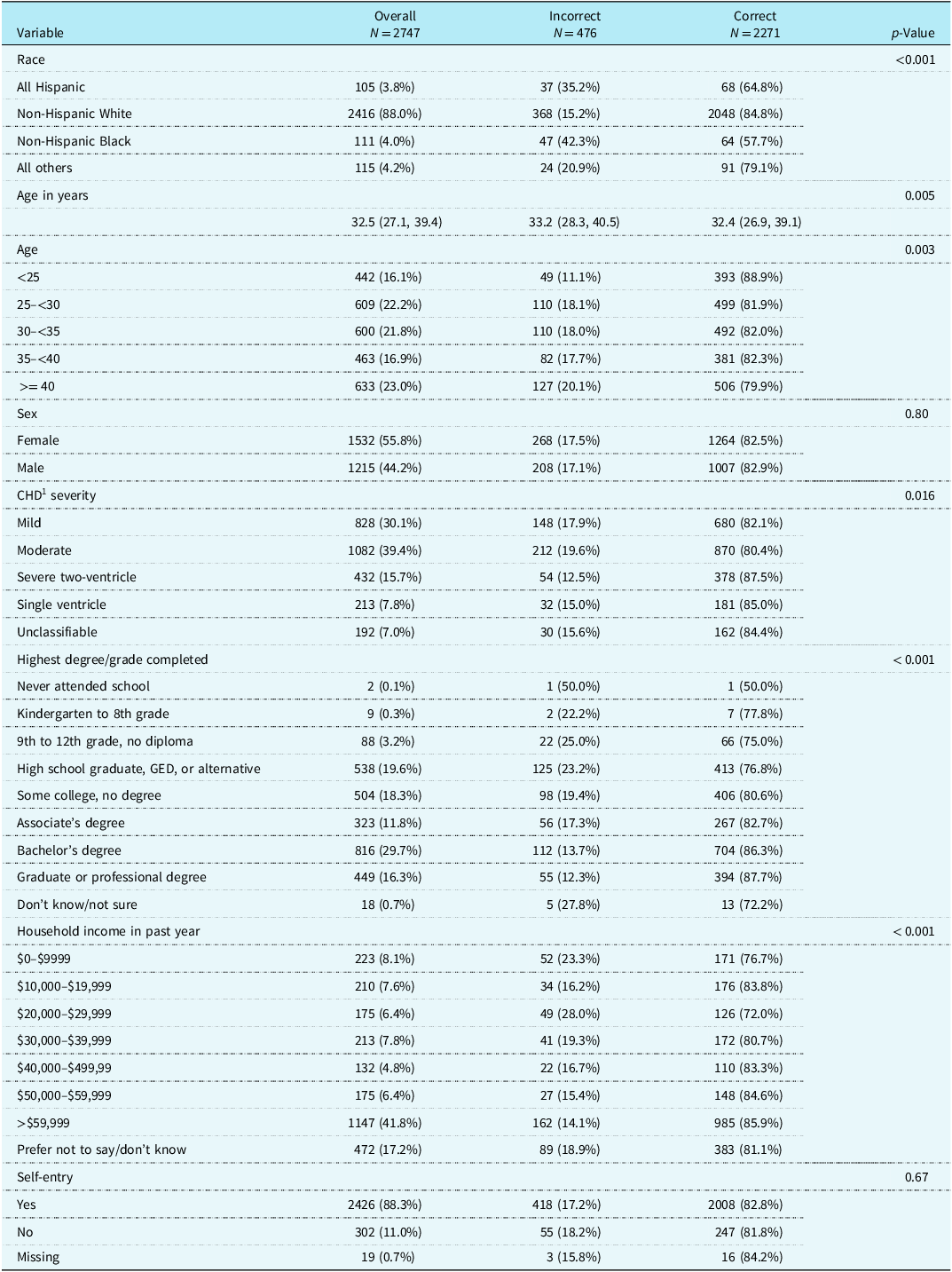
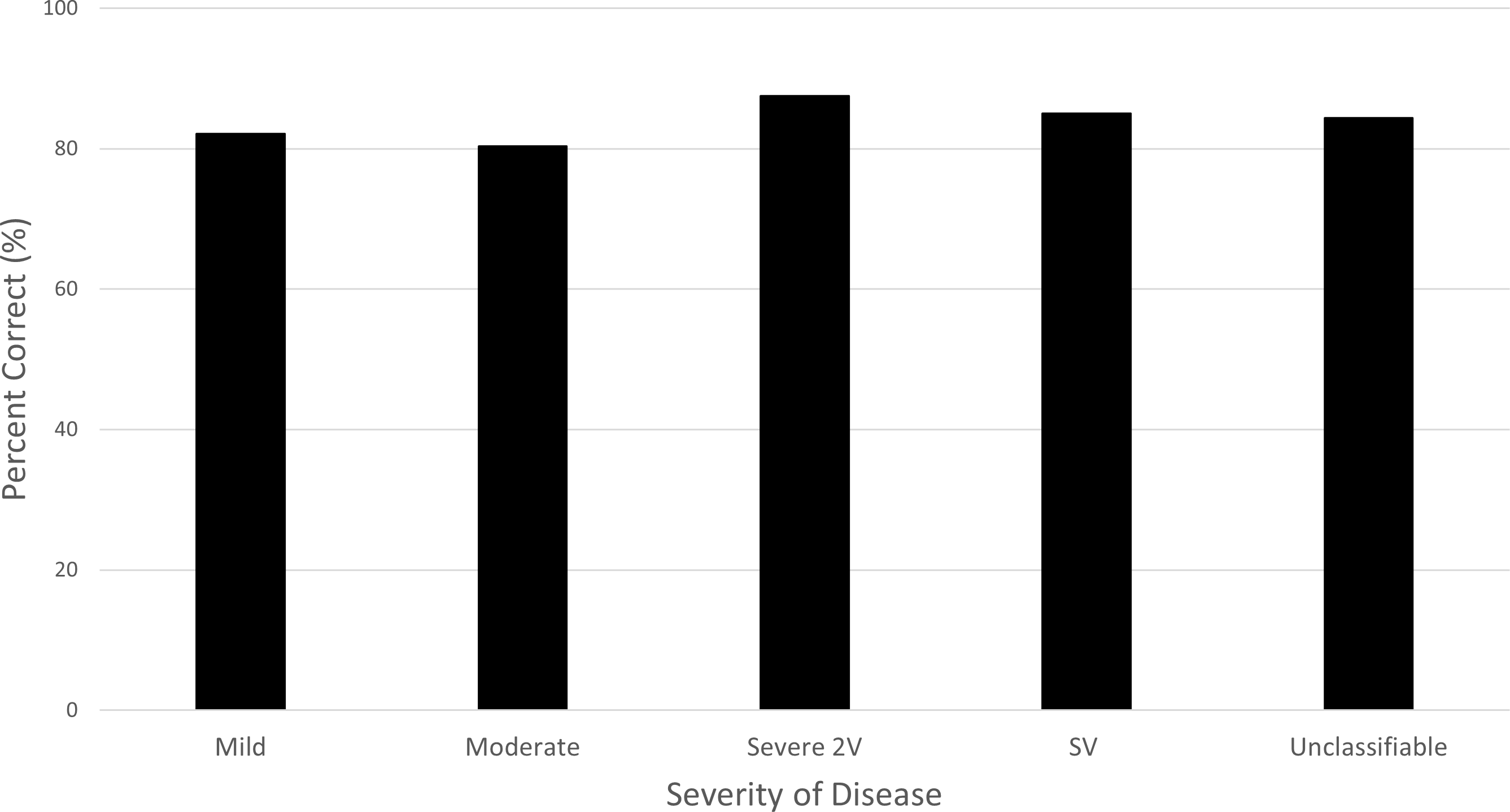
Of the respondents, 2271 (83%) correctly identified their CHD (Table 1). There were no differences in the likelihood of correct diagnosis by sex. Those who were younger (<25 years of age) and of non-Hispanic White race/ethnicity were more likely to correctly identify their diagnosis. Participants who correctly chose their diagnosis also had a higher level of education and a higher household income. When assessing the severity of the disease, patients with severe two-ventricle disease were most likely to correctly identify their CHD (88% correct), slightly higher than those with single-ventricle disease (85%); those with mild (82% correct) and with moderate (80% correct) CHD were least likely (Figure 1).
Patient demographic factors associated with correctly identifying their primary heart defect

Table 1 Long description
The table presents data on patient demographic factors associated with correctly identifying their primary heart defect. It includes 2747 respondents, with 476 incorrect and 2271 correct identifications. The table is organized into several rows and columns, detailing variables such as race, age, sex, CHD severity, highest degree/grade completed, household income, and self-entry. Each row provides specific data points for these variables, showing the distribution of respondents across different categories and their corresponding correct and incorrect identification rates. Notable trends include higher correct identification rates among non-Hispanic White respondents, those with higher education levels, and those with higher household incomes. Additionally, younger respondents and those with severe two-ventricle disease were more likely to correctly identify their CHD.
1 CHD.
The percentage of patients who correctly identified their primary CHD stratified by disease severity. The severity of CHD was associated with a patient’s ability to correctly identify their defect (p = 0.002). The lowest accuracy was among the single-ventricle group, with the highest being the severe two-ventricle group. Mild two-ventricle disease (mild) included atrial septal defect, ventricular septal defect, and patent ductus arteriosus. Moderate two-ventricle disease (moderate) included bicuspid aortic valve, pulmonary valve stenosis, Ebstein anomaly, tetralogy of fallot, atrioventricular septal defect, and coarctation of aorta. Severe two-ventricle disease included coarctation of aorta + ventricular septal defect, total anomalous pulmonary venous return, truncus arteriosus, and d-transposition of the great arteries. Single-ventricle disease included tricuspid atresia, hypoplastic left heart syndrome, and unbalanced atrioventricular septal defect. Unclassifiable two-ventricle disease included aortic valve stenosis, double-outlet right ventricle, and pulmonary atresia (all types).

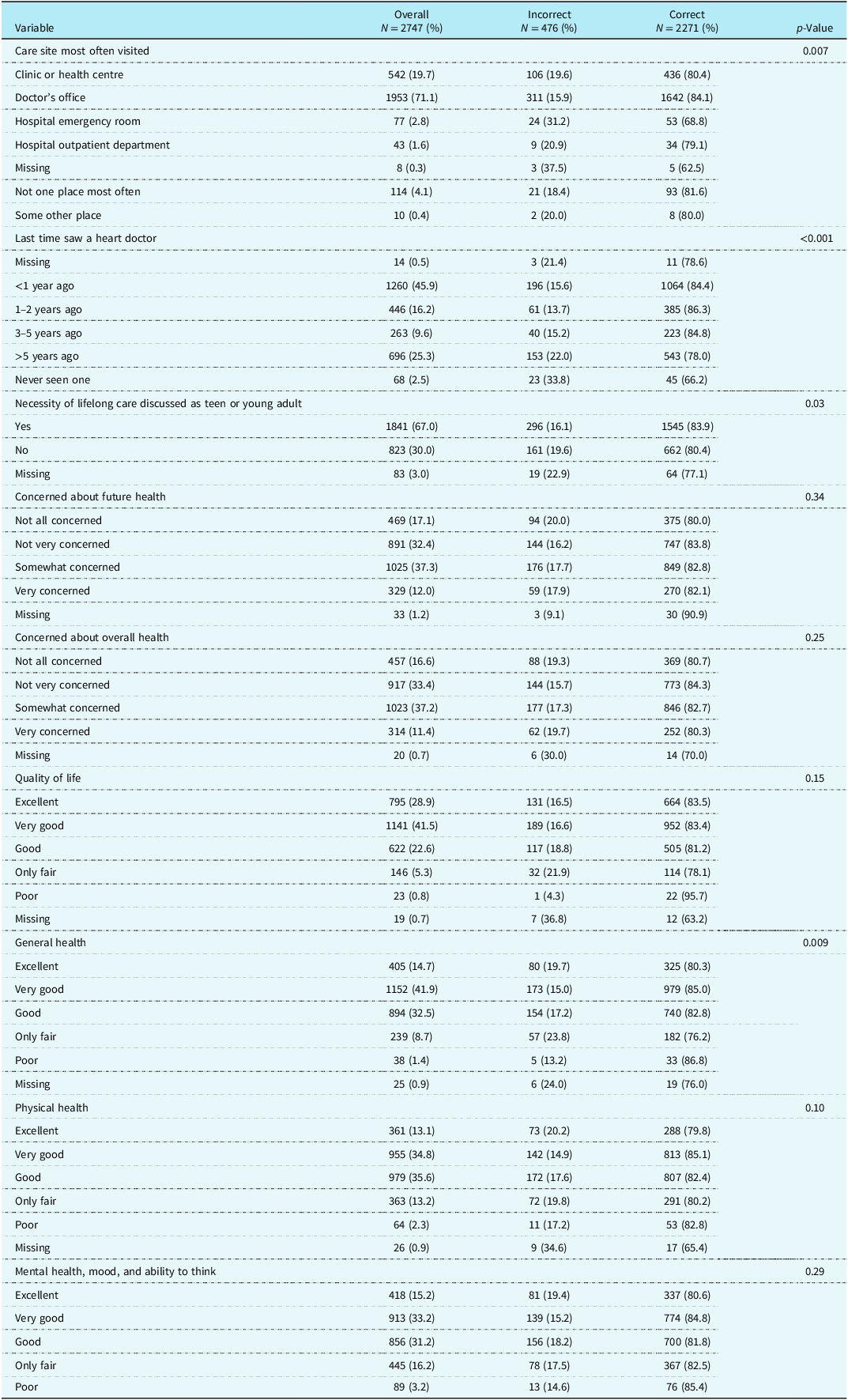
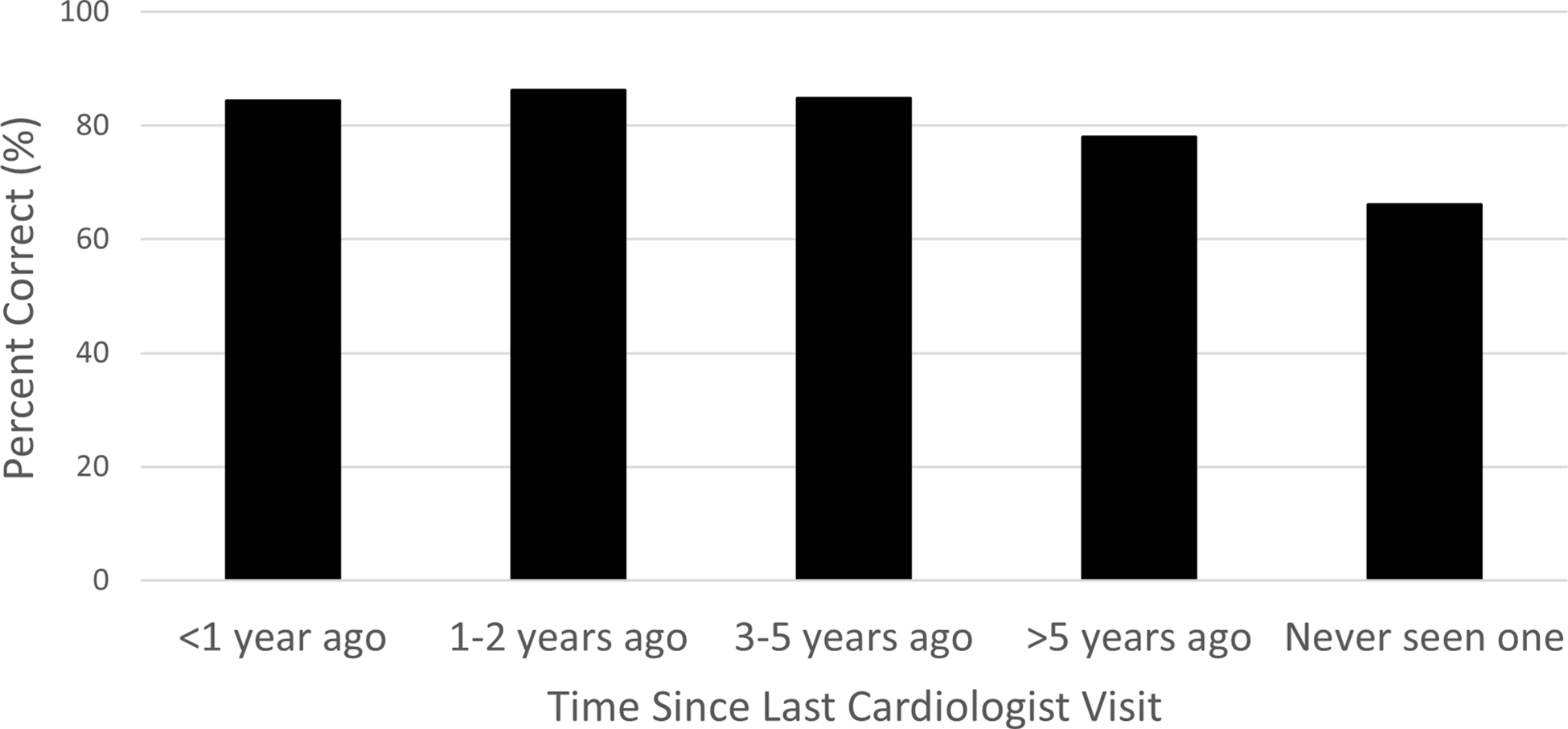
Table 2 considers primary healthcare utilisation, follow-up care, and self-perceptions of health outcomes. Most patients (71%) most often visited a doctor’s office for their care, while 3% most often visited the Emergency Department (Table 2). Those who most often visited a doctor’s office compared to other care sites had the highest percent correct (84%), while those who primarily visited the emergency room had the lowest (69%). About a quarter of the participants had not seen a cardiologist within 5 years (Figure 2). Those who had not seen a cardiologist in more than 5 years or reported they had never seen one were least likely to correctly identify their diagnosis (78% and 66%, respectively), whereas 85% of patients who had seen a cardiologist within the last 5 years were able to correctly identify their diagnosis. When asked whether a doctor had discussed the need for lifelong care when the patient was a teenager or young adult, 67% of respondents answered “Yes,” with those responding in the affirmative slightly more likely to correctly identify their diagnosis compared to those who responded in the negative (84% vs. 80%, p = 0.028).
Outcomes associated with identification of primary CHD

Table 2 Long description
The table presents data on healthcare utilization, follow-up care, and self-perceptions of health outcomes for patients with CHD. It includes 2747 participants, divided into incorrect and correct identification of primary CHD. The table has 13 rows and 6 columns. Column headers are Variable, Overall N = 2747 (%), Incorrect N = 476 (%), Correct N = 2271 (%), and p Value. Row labels include Care site most often visited, Last time saw a heart doctor, Necessity of lifelong care discussed as teen or young adult, Concerned about future health, Concerned about overall health, Quality of life, General health, Physical health, and Mental health, mood, and ability to think. Each row provides percentages for overall, incorrect, and correct identification of primary CHD. Notable trends include the highest percentage of correct identification among those who most often visited a doctor’s office (84%) and the lowest among those who visited the emergency room (69%). Additionally, those who had seen a cardiologist within the last 5 years had a higher correct identification rate (85%) compared to those who had not seen one in over 5 years (78%) or never (66%).
The percentage of patients who accurately recognised their primary CHD stratified by time since the last cardiologist visit. Those who had not seen their cardiologist in the past 5 years had decreased accuracy in disease recognition (p < 0.001).

When considering patients’ concerns about their future and overall health, there were no statistically significant differences in responses between those who correctly identified their diagnosis versus those who did not (Table 2). Similarly, there were no significant differences between the two groups in ratings of quality of life, physical health, mental health, mood, and ability. There was a statistically significant difference across categories for responses regarding general health, but no clear pattern or trend to the differences (e.g., those with a correct diagnosis were more likely to choose “very good” general health compared to those without a correct diagnosis, but they were also more likely to choose “poor” general health).
Discussion
In this large, multicenter cross-sectional cohort study of adults with CHDs, we found that participants did quite well in correctly identifying their primary defect. Those who were able to correctly identify their defect were more likely to have seen a cardiologist in the prior 5 years than those who were not able to identify their defect. However, correct identification of one’s CHD did not correlate to other key outcomes of interest, in particular patient ratings of overall health, physical health, mental health, or quality of life.
Our finding of 83% of patients correctly identifying their CHD is notably higher than many prior studies.Reference Cetta and Warnes19–Reference Moons, De Volder and Budts21 There are various potential reasons for this discrepancy. First, in contrast to prior studies, the patients in our study were required to have had an intervention for a CHD. It can be hypothesised that patients who have undergone a procedure may be more aware of their diagnosis. Second, there may be differences due to enrolment patterns. The overall response rate for the CHD Project to Understand Lifelong Survivor Experience was 22%, with response rates varying by sex, age, and race/ethnicity, but not by CHD severity.Reference Oster, Yang and Shi23 It is possible that there could be a response bias, such that those who are more aware of their underlying CHD may be more likely to participate in the study and return the survey. Finally, there may be differences in ability to identify one’s defect when prompted with options. That is, persons may be more likely to identify their defect from a multiple-choice list, as in our survey, rather than by free response.
Although the rate of 83% correct is encouraging, it is notable that there were differences according to demographics. First, both Hispanic and non-Hispanic Black patients were much less likely than non-Hispanic White patients to identify their primary CHD correctly. The reasons for this are unclear, but this does provide an opportunity for targeted intervention to increase awareness of one’s defect. Younger patients had a significantly higher likelihood of correctly identifying their defect compared to older patients. Potential reasons for this include patients benefiting from recent medical advances in early diagnosis, as well as increased health literacy and parental advocacy for patients.Reference Wu, He and Shao3,Reference Ashcraft, Asato, Houtrow, Kavalieratos, Miller and Ray24 It was unexpected that there was no difference in accuracy when comparing males to females; previous studies have shown women tend to have an increased health literacy compared to men.Reference Clouston, Manganello and Richards25 Finally, it was surprising that patients with severe two-ventricle disease had the highest rate of correct identification, slightly higher than the single-ventricle group. This finding was in spite of giving those with single-ventricle disease credit, even if their answer was non-specific (but conveyed enough information to indicate single-ventricle disease).
There were other patient factors worth mentioning with regard to predictors of accuracy. The lack of difference when the survey was completed by a proxy was interesting, given the expectation that the caregiver would have a better understanding of the patient’s disease. However, this could exemplify the increased communication of medical information between caregivers and patients. In terms of education and salary in this cohort, those with a higher education and higher salary tended to have a better diagnosis accuracy, findings that suggest that these patients may have had a higher baseline medical knowledge and access to consistent healthcare. Further exploration is required to determine if there are actionable factors, like increased access to equitable healthcare, that could explain this finding.
The primary key differences in outcomes between those who could correctly identify their CHD and those who could not focused on healthcare services. Those who could correctly identify their defect were more likely to have seen a cardiologist in the last 5 years and were more likely to visit a clinic, health centre, or doctor’s office as their primary site of medical care instead of an emergency department. Patients with CHDs experiencing lapses in their specialty care and decreased follow-up have an associated increase in mortality and complications.Reference Kempny, Diller and Dimopoulos26,Reference Lammers, Helm and Bauer27 Therefore, it is important to consider that increasing the knowledge of patients could effectively increase continuity in specialised care. Indeed, those patients more likely to report having been counselled regarding the need for lifelong care for CHD were also more likely to correctly identify their defect. Regarding the use of the emergency department, low health literacy has been associated with increased preventable emergency department visits in adults,Reference Balakrishnan, Herndon, Zhang, Payton, Shuster and Carden28 so it is reassuring that CHD patients are most often visiting the doctor’s office with only 2.8% primarily going to the emergency department. This pattern allows for better continuity of care and could contribute to the high accuracy of these patients.
The ability to correctly identify one’s CHD did not translate to better perceived health outcomes or quality of life. Regarding concern about future health or overall health, results were similar for those with accurate disease identification versus those without. About half of all patients were somewhat concerned or very concerned about their future health and their overall health. Reassuringly, more than two-thirds of patients rated their quality of life as excellent or very good, but disease identification did not seem to be associated with this finding. Results were mixed for perceptions of general health, physical health, and mental health, with no clear pattern for better outcomes for those with correct identification as opposed to those without.
This study is not without its limitations. First, as mentioned previously, there is the possibility of selection bias, as those with better disease recognition and perhaps even better health outcomes may have been more likely to participate. Second, despite recruiting 11 different centres, there is limited racial and ethnic representation in the CHD Project to Understand Lifelong Survivor Experience. This is partly due to the demographics of the centres included in the Pediatric Cardiac Care Consortium, but it is also a result of the higher participation rates among eligible non-Hispanic White subjects. Nevertheless, in this study, we were still able to find notable differences in the accuracy of disease identification by race/ethnicity. Finally, given the nature of the study design, it is important to recognise that these findings represent correlation, not causation.
Conclusion
In conclusion, patients who have had intervention for their CHD are overall very capable of recognising their diagnosis. Nevertheless, efforts such as increasing awareness of one’s diagnosis should be considered as a potential means to increase continuity of care. Further investigation is required to understand the age and racial/ethnic disparities to help tailor this education to better suit the needs of CHD patients.
Acknowledgements
The authors would like to thank the survey participants for their time and effort in contributing to this project.
Financial support
This study was supported by the National Heart, Lung, and Blood Institute (HL122392).
Competing interests
The author(s) declare none.