Introduction/Background
Medication administration is an essential aspect of prehospital care in both the civilian and the military combat setting. Using the Tactical Combat Casualty Care (TCCC) guidelines, combat medics administer medications in the prehospital tactical setting, similar to the prehospital medical direction protocols in the civilian setting.Reference Butler, Kotwal and Buckenmaier 1 , 2 However, the combat medic is limited in applying their skill set when not deployed.Reference Cunningham 3 , Reference Cunningham 4 This is similar to the very limited scope of duty of civilian prehospital personnel when functioning in the hospital setting, starkly contrasted with their prehospital practices. It is speculated that because the combat medic is routinely restricted from administrating parenteral medications while at their home station, it decreases their familiarity, knowledge, and skills administering these medications while deployed.Reference De Lorenzo 5 While combat medics are allowed to administer medications in some very limited garrison-based settings, this is not routine practice.
These cases were acquired as part of a project seeking to train US Army combat medics to perform prehospital TCCC functions in the garrison-based emergency department (ED) setting. The series provides an example of the feasibility of a training program for combat medics to extend their prehospital scope of practice into the ED setting.
Case Acquisition
A training project was put in place in the ED at Bayne-Jones Army Community Hospital (BJACH) at Fort Polk, Louisiana (USA) piloting a program to train combat medics to perform prehospital functions. These cases were acquired as a part of this project. Training and quality assurance data were collected throughout the overarching project. The Brooke Army Medical Center (San Antonio, Texas USA) regulatory office policy does not require IRB oversight or regulatory review for projects primarily designed for quality assurance.
Combat medics were provided one-on-one training with a staff physician or physician assistant based on the “five rights” of medication administration: right medication, right dose, right time, right route, and right patient. A protocol was created. Medications would be obtained from the electronic dispensing system per usual methods. The medic was required to draw up the medications under direct supervision of the provider whom they were working under. Syringes would then be labeled in a standard fashion. The medic and the provider would discuss the indication for the medication, proper route and method of administration, along with adverse events to observe for. After administration of the medication, the combat medics were then required to fill out a quality assurance form documenting each administration. This form was then turned into the medical director for the department for quality assurance reviews. Quality assurance review specifically sought to evaluate for signs of adverse events to include: wrong patient, wrong medication, wrong route, wrong dose, allergic reaction, or significant adverse event requiring intervention. Additionally, charts were reviewed retrospectively as a secondary method for monitoring safety. Combat medics were also required to identify themselves and their role upon entering the room.
Case Data
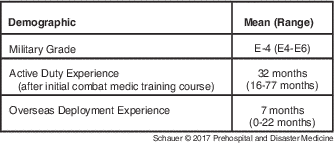
During the project time period, there were 43 documented administrations of medications given by the combat medics. Table 1 outlines the demographics of the combat medics involved in the project. All combat medics involved had 68 weeks of training (approximately equivalent to Advanced Emergency Medical Technician [EMT]) and were assigned to the ED at BJACH. The medications were administered to 19 separate patients during this time period – several patients received multiple medications, which is why the total N exceeds 19.
The Basic Demographics of the Combat Medics that were Involved in the Project

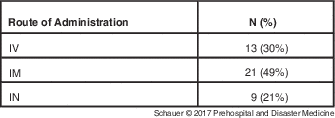
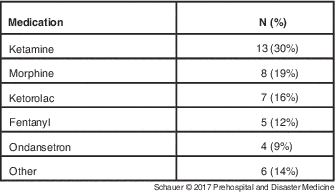
Table 2 outlines the routes of administration of the parenteral medications administered. Table 3 outlines the most common medications given by number. The remaining medications consisted of: diphenhydramine (n=1), haloperidol (n=2), dicyclomine (n=1), glucagon (n=1), and methylprednisolone (n=1).
The Number of Times Medications were Given and Which Route

Abbreviations: IM, intramuscular; IN, intranasal; IV, intravenous.
The Number of Times a Medication was Given

No adverse events were noted throughout the project period.
Discussion
In this limited case series, combat medics were able to administer parenteral medications to patients under provider supervision. There were no medication errors or adverse events noted.
There is a long-standing gap in the skills expected of a combat medic (eg, parenteral administration of selected medications) and their ability to train at home station in the Military Treatment Facility. Similar limitations exist for the civilian medics when functioning inside the walls of a hospital, outside the scope of their prehospital medical direction. The military has attempted to address these limitations with little success. In contrast to the military’s challenges, Texas (USA) has made progress. Texas’ on-going battle with health care resource limitationsReference Derlet and Richards 6 has provided the motivation necessary to bring the paramedic scope of practice into the hospital setting under HB2020 and SB1899. 7 , 8 The success of this project supports the development of such programs to train civilian medics to use their skill set within the hospital setting. Careful expansion of this pilot project could help bridge a critical training gap for combat medics and could serve as a model for training medics in other settings, including the civilian sector. Utilizing this pool of trained health care personnel to fulfill other roles may ease the already over-burdened system many states are experiencing.
Limitations
This project is limited by the limited sample size on a small scale. This pilot project demonstrated safe and effective medic integration into ED patient care at a single site. It is unclear how this would extrapolate to other settings. Additionally, while combat medic training is similar to the civilian model with all combat medics EMT (formerly EMT-Basic) certified, they do have significant additional trauma training, and thus skill levels may not be directly translatable to all settings.
Conclusion
In this limited case series, combat medics safely administered parenteral medications under indirect provider supervision. Further research is needed to further develop this training model for both the military and civilian setting.