
PS01-001 Regional comparison of self-efficacy and diet regimen compliance among elderly patients with diabetes
Shizue Mizuno, Miwa Yamamoto, Kyoto Koka Women's University, Japan
Masako Aota, Meiji University of Integrative Medicine, Japan
Objective: The study aimed to elucidate factors that influence self-efficacy (hereafter “SE”) and diet regimen compliance among urban and rural elderly patients with diabetes.
Methods: Subjects were male and female patients with type-2 diabetes aged 65 years or older, who were receiving outpatient treatment. We conducted an interview-based questionnaire survey. Survey items included basic background, SE, ADL, and total calorie intake. Statistical analysis was performed using the chi-square test and t-test. This study was approved by the ethics committee of the Kagawa University Faculty of Medicine.
Results: We surveyed a total of 147 subjects (urban, 105; rural, 42). Mean ages of urban and rural patients were 70.6±4.1 years and 71.2±5.2 years, respectively. There was no interference in ADL for 102 urban patients (97.1%) and 38 rural patients (90.5%). Mean HbA1c was 7.4±1.4 for urban patients and 7.2±1.3 for rural patients; total calorie intake was 1775.7±427.0 kcal for urban patients and 1883.9±554.1 kcal for rural patients, with no significant difference observed. Factors influencing SE among urban patients included employment, good maintenance of BMI, and lack of ADL interference.
For rural patients, the influencing factor was the presence of a spouse. Factors affecting calorie intake in urban patients were being female, cohabitation, presence of spouse. Among rural patients, the factors were employment, and educational hospitalization. No association was found between SE, calorie intake, and diabetes-related factors among both urban and rural patients. Moreover, in a comparison of urban and rural patients, many urban patients were engaged in proactive behavior to cope with their condition.
Conclusion: These results suggest that in implementing diet regimens for urban and rural elderly patients with diabetes, offering individualized support effectively allows elderly people to maintain their own lifestyle rhythms.
PS01-002 Sexuality after 65 - Critical Clinical Challenges
Vinodkumar Gangolli, Masina Hospital, India
Avinash Desousa, LTM Medical College and Hospital, Sion, India
Recent research suggests that a high proportion of men and women remain sexually active well into later life and refutes the myth that aging and sexual dysfunction are inexorably linked. Changes in physiology do not render a meaningful sexual relationship impossible. The extent to which aging affects sexual function depends largely on physiological, psychological, pharmacological, and illness-related factors. In this paper we review the sex related changes that occur as part of the normal aging process in men and women. Also discussed are the myths and stereotypes associated with old age sexuality and the medical, social, healthcare, and institutional barriers to sexuality and sexual health in later life. This review describes the fact that many elderly people enjoy an active sex life and examines the evidence against the general perception of an ‘asexual’ old age. It offers an overview of the evidence for healthcare professionals who had not previously considered the sexuality of their older patients. It also describes some of the sexual problems faced by older people, especially the difficulties experienced in disclosing such problems to healthcare professionals. It also offers some recommendations for future research in the area, as well as a word of caution regarding the temptation of over-sexualising the ageing process. Regardless of the length or nature of the relationship, its quality is enhanced by emotional intimacy, autonomy without too much distance, an ability to manage stress, and to maintain a positive perception of self and the relationship. To understand and treat effects of aging on sexuality, it is important to address the three components of sexual desire, i.e., drive, beliefs/values, and motivation, as well as the social context of a patient's life. Treatment approaches, cautions and the over utilization of medication for sexuality are also discussed.
PS01-003 Sexuality after 65 - Clinical issues
Vinodkumar Gangolli, Masina Hospital, Mumbai, India
Avinash Desouza, private practice, India
Sexuality in old age is an important yet neglected clinical issue. In this paper we aim to review the literature available on sexuality after the age of 65 while focusing on key clinical issues that concern the physician and gerontologist dealing with these patients. The changes in sexual anatomy and physiology are discussed along with changing societal and psychological viewpoints on sexuality in old age. The role of psychological problems in old age and their interface with sexuality in old age are highlighted. The need for younger family members and practicing doctors to recognize the sexual needs of the elderly are discussed. There is a dearth of interventional literature for sexual problems in old age. Clinical case examples seen by us in routine practice are given to elucidate key issues. Media bias to sexuality in old age and the humorous portrayal of the same negatively in print media is discussed. The role of medical treatments in old age, psychotherapy and sex based counseling are stressed along with the need for research and trials in this area. Certain other issues like HIV in old age, homosexuality in old age and paraphilias are also discussed. The need for education about sexual issues in old age in general medical programmes as well as psychiatric training is exhorted.
PS01-008 Different patterns of gray and white matter and volumetric data by using diffusion tensor imaging in depression with Alzheimer's disease
Yi-Ping Chuo, Tsuo-Hung Lan, Taichung Veterans General Hospital, TSGP, Taiwan
Jyh-Wen Chai, Taichung Veterans General Hospital, CTSR, Taiwan
Ching-Po Lin, Institute of Neuroscience & Institute of Radiological Science, National Yang-Ming University, Taiwan
Chin-Hong Chan, Taichung Veterans General Hospital, TSOP, Taiwan
Objective: The term ‘pseudodementia’ was used to describe a broad range of reversible cognitive impairments associated with psychiatric syndrome such as depression. While it was difficult to assess whether dementia was cause by depression from initial clinical evaluation. Altered fractional anisotropy in white matter has been observed in dementia with depression by using diffusion tensor imaging (DTI). In this study, our aim was to attempt to explore the further architectural differences of the brains in patients with dementia those with and without depression.
Methods: 8 patients (mean age 73.8±10.4 years) with dementia and depression were recruited via a memory clinic. In addition, 15 subjects (mean age 76.0±8.5) with dementia without depression were also collected as a control group. All participants underwent cognitive assessment and brain MRI for acquisition of DTI and volume morphometry. The Chinese version of Geriatric Depression Scale-Short Form was applied for data collection on depressive symptoms.
Results: Our experimental results showed that there were statistically significant differences of WM fractional anisotropy (FA) and axial diffusivity (DA) values in frontal and temporal lobes between the two groups. Patients with depression showed a significant increase of FA and RA values in the bilateral frontal (p<0.05) and temporal (p<0.05) lobes, and a decrease of GM volume in the limbic area (p<0.01) compared to the control group. There were no statistical difference of FA, DA or brain volume between the two groups in other lobes.
Conclusions: The different DTI and volume morphometric patterns in dementia patients with and without depression might correlate to the different neuro-pathological mechanisms. The high FA and RA values of frontal and temporal white matters might indicate the possibility of pseudodementia in dementia patients with depression, as compared to the counterpart of patients without depression intensive treatment of the depression in dementia patients may initiate the opportunity to attenuate the disease.
PS01-009 Cerebral microbleeds, brain β-amyloid and clinical trajectories: Results from the AIBL study of ageing
Paul Yates, Victor Villemagne, Christopher Rowe, Austin Health, Australia
Patricia Desmond, Pramit Phal, Melbourne Health, Australia
Colin Masters, Kathryn Ellis, Florey Neuroscience Institute, University of Melbourne, Australia
Ralph Martins, Edith Cowan University, Australia
Cassandra Szoeke, David Ames, NARI, University of Melbourne, Australia
Olivier Salvado, eHealth Flagship, CSIRO, Australia
Aims: Cerebral microbleeds (MB) are commonly observed in individuals with Alzheimer's disease (AD) and also in cognitively-normal elderly. It is postulated that they may be associated with worse clinical and cognitive outcomes in AD. This study evaluated whether MB were associated with cognitive decline over three years in a cohort with β-amyloid imaging.
Methods: 134 non-demented participants from the Australian Imaging, Biomarkers and Lifestyle Study of Ageing (AIBL), assessed at baseline with 3T-SWI and 11C-PiB PET, and clinically followed up for 3 years. Individuals were classified as NC (n = 97), or mild cognitive impairment MCI (n = 37). MB were identified by consensus of two blinded readers. PiB SUVR were dichotomized into high (PiB+) and low (PiB-) Aβ-burden using a 1.5 SUVR threshold. Clinical ratings were performed by consensus panel, blind to neuroimaging. Individuals were stratified by baseline PiB, presence of MB (MB+/-) and by cognitive classification at follow up, as either stable or decliners. Chi-square statistic was used to compare group proportions and logistic regression to assess independence of association.
Results: At baseline, 37.3% were PiB+ and 20.1% individuals were MB+. Over three years, 86.5% were stable and 13.5% declined. The proportion of decliners was similar between PiB+MB+ (30.0%) and PiB+MB- (30.8%), but was significantly less in PiB-MB- (6.0%, p<0.05). PiB+ was associated with decline (OR 7.8, CI 2.3–26.8, p<0.001) whereas MB+ (OR 1.4, 95% CI 0.3–5.4) was not. Including MB in the regression model with PiB+ did not attenuate the association between PiB+ and cognitive decline. Stratifying by number of MB (any, >2, >5) did not alter findings.
Conclusions: Non-demented individuals with high cerebral Aβ-burden were significantly more likely to experience significant cognitive decline over 3 years, but additional presence of MB did not increase this association. MB may not necessarily indicate a more aggressive trajectory of decline over β-amyloid alone.
PS01-010 Psychosis secondary to prolactinoma
Edwing Garcia Toro, Americo Reyes Ticas, Xenia Aguilera, Universidad Nacional Autonoma de Honduras, Honduras
Objectives: To analyse the results of the treatment with dopamine agonists in conjunction with dopamine antagonists in a case of Psychosis Secondary to Prolactinoma.
Method: We report a male patient, 61 years old with history of acute psychotic episode was diagnosed in 2009 via CT scan with a pituitary macroadenoma (40 × 39 mm), who was treated with risperidone 3 mg/day. After a year without any symptoms, he decided to discontinue treatment and returned three years later due to a second psychotic episode. His physical exam revealed he had hypogonadism and an incomplete bitemporal hemianopia, which was confirmed by digital perimetry. BPRS scale reported global score of 62 and cognitive impairment was revealed through the Mini Mental Status Exam (MMSE). A new CT scan showed an invasive pituitary adenoma approximately (43 × 45 mm) and Lab tests confirmed central hypogonadism, panhypopituitarism and prolactinoma: prolactin 4,700 ng/ml.
Results: After 12 weeks with cabergoline 0.5 mg twice weekly and clozapine 100 mg/day the patient is asymptomatic and with prolactin levels of 13.02 ng/ml.
Conclusions: The cabergoline (dopamine agonist) acts by reducing hyperprolactinemia and the clozapine (dopamine antagonist) contributes to the improvement of psychotic symptoms. Each acting on different receptors and neuroanatomical structures.
PS01-011 Cortical atrophy of gray matter and reduced integrity of white matter play a role in cognitive decline of subcortical vascular dementia
Young Min Lee, Pusan National University, 305 Gudeok-Ro, Seo-Gu, Korea
Young-Hoon Kim, Inje University, Haeundae Paik Hospital, Korea
Objective: An association between white matter hyperintensities (WMH) and cognitive dysfunction has long been recognized. However, subjects with identical appearing WMH on magnetic resonance imaging (MRI) present with a wide variance in cognitive function ranging from normal cognition to dementia. The aim of this study was to compare cortical atrophy of gray matter and integrity of white matter of patients with subcortical vascular dementia (SVaD) with those of normal cognition group with WMH (ncWMH).
Method: Eleven patients with SVaD and age-, gender- and education-matched 11 ncWMH underwent MRI including 3-dimensional volumetric images for cortical atrophy of gray matter (GM) and diffusion tensor imaging (DTI) for integrity of white matter (WM).
Results: Compared to ncWMH, SVaD patients showed widespread cortical atrophy of GM including lingual gyrus and reduced integrity of genu and splenium of the corpus callosum (CC).
Conclusions: Our finding suggests that cognitive decline from ncWMH to SVaD may be associated with cortical atrophy of GM and reduced integrity of WM.
PS01-012 Thalamic shape and cognitive performance in amnestic mild cognitive impairment
Chang Uk Lee, Seoul St. Mary's Hospital, The Catholic University of Korea, Korea
Hyun Kook Lim, The Catholic University of Korea, Korea
Background: Although previous postmortem studies have shown that thalamus is involved in early stage of Alzheimer's disease, no structural neuroimaging studies have conducted in amnestic mild cognitive impairment (aMCI) patients. In addition, the relationships between thalamic deformations and various episodic memory impairments were not clear. The aim of this study was to investigate thalamic shape changes and their relationships with various episodic memory impairments in aMCI.
Methods: Thalamic volumes and deformations were compared between the aMCI(N = 32) and the controls(N = 32). In addition, we explored the correlation pattern between thalamic deformations and cognitive dysfunctions in aMCI using a comprehensive neuropsychological battery.
Results: Patients with aMCI exhibited significant thalamic deformations in the dorso-medial and pulvinar areas compared with healthy individuals. Significant correlations were observed between constructional recall scores and the right dorso-medial areas in aMCI. Verbal delayed recall scores were also significantly correlated with the left dorso-medial areas in aMCI.
Conclusion: This study was the first to explore the relationships between thalamic deformations and various types of cognitive performances in aMCI. These structural changes in the dorso-medial and pulvinar areas might be at the core of underlying neurobiological mechanisms of thalamic dysfunction and their relevance to verbal and visuospatial delayed recall in aMCI.
PS01-013 Deep subcortical white matter hyperintensities independently predict depression in subjects with mild cognitive impairment: A CREDOS study
Sang Ha Kim, Sungkyunkwan University School of Medicine, Samsung Medical Center, Korea
Doh Kwan Kim, Young Don Kim, Sungkyunkwan University School of Medicine, Samsung Medical Center, Korea
Seong Hye Choi, Inha University Hospital, Korea
Jae Hong Lee, Asan Medical Center, Korea
Seong Yoon Kim, Asan Medical Center, Korea
Hyo Shin Kang, Sungkyunkwan University School of Medicine, Samsung Medical Center, Korea
Objective: White matter hyperintensities (WMH) on MRI are prevalent among elderlies and have been consistently implicated in late life depression (LLD). The directionality of this association is unclear and consensus on differential roles of periventricular WMH (PWMH) and deep subcortical WMH (DWMH) in LLD is still not established. The aim of the study was to ascertain the directionality of association as well as to clarify differential roles of WMHs on predicting development of LLD.
Methods: This study was part of the Clinical Research Center for Dementia of South Korea (CREDOS) study: a 6-year, prospective, nationwide multicenter study designed to assess the occurrence and risk factors of cognitive disorders. Participants aged 50 or older and diagnosed MCI at baseline were included in this study. WMH was quantified for each MRI study with visual rating scale developed for the CREDOS. Neuropsychological and clinical evaluations were implemented at each visit. Diagnosis with depression was considered plausible in cases of short form geriatric depression scale (SGDS-K) scores of 8 or greater.
Results: A total of 286 subjects remained eligible for the analysis after excluding those who scored 5 or greater on SGDS-K at baseline, those who had past history of depression and those with impairment in ADL. Using cox proportional hazards model, moderate to severe DWMH at baseline was the only predictor of developing depression in 2-year follow up period (p = 0.028, HR, 3.46; 95% CI, 1.14–10.46) after controlling for age, sex, years of education, insight into one's cognitive dysfunction, vascular risk factors (history of diabetes, hypertension, stroke, hyperlipidemia, BMI, hachinski ischemic score (HIS)), baseline MMSE score, and whether conversion to dementia has occurred during the 2-year follow up period.
Conclusion: Among subjects with MCI, deep white matter hyperintensities independently predicted development of LLD regardless of conversion to dementia.
PS01-014 Apathy and white matter integrity in Alzheimer's disease: A whole brain analysis with tract-based spatial statistics
Changtae Hahn, Chul Lee, Seoul Saint Mary's Hospital, College of Medicine, The Catholic University of Korea, Korea
The aim of this study was to investigate the microstructural alterations of white matter (WM) in Alzheimer's disease (AD) patients with apathy and to observe the relationships with the severity of apathy. Sixty drug-naive subjects took part in this study (30 apathetic and 30 nonapathetic subjects with AD). The loss of integrity in WM was compared in AD patients with and without apathy through measurement of fractional anisotropy (FA) using by tract-based spatial statistics (TBSS). In addition, we explored the correlation pattern between FA values and the severity of apathy in AD patients with apathy. The apathy group had significantly reduced FA values (pcorrected<0.05) in the genu of the corpus callosum, compared to the nonapathy group. The severity of apathy was negatively correlated with FA values of the left anterior and posterior cingulum, right superior longitudinal fasciculus, splenium, body and genu of the corpus callosum and bilateral uncinate fasciculusin the apathy group (pcorrected<0.05). This study was the first to explore FA values in whole brain WM in AD patients with apathy. The findings of these microstructural alterations of WM may be the key to the understanding of underlying neurobiological mechanism and clinical significances of apathy in AD.
PS01-015 Hippocampal subfields segmentation using automated method in patients with Alzheimer's disease
Wangyoun Won, Chang-Uk Lee, The Catholic University of Korea, Korea
Jae-Hyun Kim, Wonkwang University Sanbon Medical Center, Korea
Objective: Although a few automated hippocampal subfields segmentation methods were developed, the effects of diagnosis of Alzheimer's disease (AD) on the hippocampal subfields volumes in vivo MRI were not clear. The aim of this study was to investigate hippocampal subfields volumes difference between AD subjects and health elderly controls using automated hippocampal subfields segmentation technique.
Method: Fifty drug naive subjects with AD and 49 group-matched healthy control subjects underwent 3T MRI scanning, and hippocampal subfields volumes were measured and compared between the groups. Additionally, we explored the correlation pattern between hippocampal subfields volumes and the Korean version of the Consortium to Establish a Registry for Alzheimer's Disease (CERAD-K) verbal delayed recall score in AD subjects.
Results: Subjects with AD exhibited significant hippocampal volume reductions in the presubiculum, subiculum and cornu ammonis (CA) 2–3 areas compared with healthy subjects (uncorrected, p<0.001). Significant correlations were observed between hippocampal deformations in the presubiculum/subiculum areas and CERAD-K verbal delayed recall scores (uncorrected, p< 0.001).
Conclusion: This study is the first to elaborate the subfields volume differences between the controls and AD patients using the automated hippocampal subfields segmentation by Van Leemput et al. These structural changes in the hippocampal presubiculum, subiculum and CA2–3 areas might be at the core of underlying neurobiological mechanisms of hippocampal dysfunction and their relevance to verbal delayed recall impairments in AD.
PS01-016 Association factors between characteristics of brain magnetic resonance imaging and atypical antipsychotics use in degenerative dementia patients
Ji-Won Kim, Jong-Taek Choi, Yang-Ho Roh, Sung-Il Woo, Sang-Woo Hahn, Jaeuk Hwang, Soonchunhyang University Hospital, Korea
Objectives: We aimed to identify the neuroimaging marker for prediction of the use of atypical antipsychotics (AAP) in degenerative dementia patients.
Method: From April, 2010 to Mar, 2013, 34 patients who were diagnosed as degenerative dementia at psychiatric department of Soonchunhyang University Hospital, completed the brain magnetic resonance imaging scan and cognitive test for dementia. Eleven patients were treated with AAP for the improvement of behavioral and psychological symptoms of dementia (BPSD) and the other 23 patients were not. Using T1 weighted and Fluid Attenuated Inversion Recovery (FLAIR) images of brain, areas of white matter (WM), gray matter (GM), cerebrosinal fluid (CSF) and white matter hyperintensities (WMH) have been segmented and measured. Multivariate logistic regression models were applied for assessment of association between AAP use and GM/WM ratio, WMH/whole brain (GM+WM+CSF) ratio.
Result: There was a significant association between AAP use and GM/WM ratio (odds ratio (OR) = 1.18, 95% confidence interval (CI) 1.01–1.37, p = 0.036), while there was no association between AAP use and WMH/whole brain ratio (OR = 0.94, 95% CI 0.34 - 2.59, p = 0.90).
Conclusion: GM/WM ratio could be biological marker for the prediction of AAP use and BPSD in patients with dementia. It was more likely to increase as dementia progress since atrophy of WM was more prominent than that of GM over aging.
PS01-017 Aberrant topographical organization in gray matter structural network in late life depression: A graph theoretical analysis
Hyun Kook Lim, Won Sang Jung, The Catholic University of Korea, Korea
Howard Aizenstein, University of Pittsburgh, United States
Background: Although previous studies on late life depression (LLD) have shown the morphological abnormalities in frontal-striatal-temporal areas, alterations in coordinated patterns of structural brain networks in LLD are still poorly understood. The aim of this study was to investigate the differences in gray matter structural brain network between LLD and healthy controls.
Methods: We used gray matter volume measurement from magnetic resonance imaging to investigate large-scale structural brain networks in 37 LLD patients and 40 normal controls. Brain networks were constructed by thresholding gray matter volume correlation matrices of 90 regions and analyzed using graph theoretical approaches.
Results: Although both of the LLD and control groups showed a small-world organization of the group networks, there were no differences in the clustering coefficient, the path length and the small world index across wide range of network density. Compared with controls, LLD patients showed decreased nodal betweenness in the medial orbitofrontal and angular gyrus region. In addition, LLD patients showed hub regions in superior temporal gyrus and middle cingulate gyrus, and putamen. On the other hand, the control group showed hub regions in the medial orbitofrontal gyrus, middle cingulate gyrus and cuneus.
Conclusion: Our findings suggest that the gray matter structural networks are not globally but regionally altered in LLD patients. This multivariate structural analysis using graph theory might provide a more appropriate paradigm for understanding complicated neurobiological mechanism of LLD.
PS01-020 Identification and quantitative analysis of short peptides derived from amyloid-beta peptides in living cell
Takashi Kodama, Masayasu Okochi, Sinji Tagami, Kanta Yanagida, Naoki Mizuta, Toshihisa Tanaka, Takashi Morihara, Takashi Kudo, Masatoshi Takeda, Osaka University Graduate School of Medicine, Japan
Mako Takami, Yasuo Ihara, Doshisha University, Japan
Objectives: Amyloid-β42 peptide (Aβ42) and Aβ43 are generated from β-amyloid precursor protein (βAPP) and accumulate in senile plaques. Although, Amyloid-beta Aβ42 and Aβ43 deposition into insoluble plaques in brain is a pathological hallmark of Alzheimer's disease (AD), the mechanisms underlying changes in Aβ's ratio are still unclear. It is of key importance in biological and clinical research on Alzheimer's disease to know the mechanisms underlying the changes in Aβ's ratio, in particular, caused by familial mutations and γ-secretase modulators (GSMs). In this study, we tried detection and quantitative determination of amyloid-beta (Aβ)-derived short peptides that are produced through sequential intramembrane proteolysis of Aβ by presenilin (PS)/γ-secretase.
Method: HEK cells stably expressing sw βAPP and PS1 derivatives were cultured to confluence in 10 cm dishes, and 24 hr before collection, the cells were treated with GSM or iGSM. Proteasome inhibitors (1 μM lactacystin, 100 nM MG262, and 1 μM epoxomicin) were added, with or without GSM/iGSM, to the conditioned medium for the last 4 hr. The cells were washed quickly with ice-cold PBS and then immediately boiled for 2 min. The boiled samples were sonicated for 5 s three times and ultracentrifuged. The resultant supernatant was subjected to LC-MS/MS analysis to measure the tri-, tetra-, and pentapeptides.
Results: Numbers of amyloid-beta (Aβ)-derived short peptides have been identified and the concentration was determined by LC/MS/MS measurements. The ratio of the short peptides in mutant PS1 cells were different from that of wild type PS1 cells. The ratio was also altered by the GSMs.
Conclusion: Amyloid-beta (Aβ)-derived short peptides that are produced through sequential intramembrane proteolysis of Aβ by presenilin /γ-secretase have been identified and the concentration was determined by LC/MS/MS method. The sample preparation and the detection methods have proved to provide detailed information about the sequential intramembrane proteolysis of Aβ by presenilin /γ-secretase.
PS01-021 N-terminal modification of tau involved in neurodegeneration
Toshihisa Tanaka, Miyuki Terada, Masahiro Sato, Masatoshi Takeda, Osaka University Graduate School of Medicine, Japan
The microtubule associated protein tau is a major component of neurofibrillary tangles in brains suffering from tauopathies including Alzheimer's disease, frontotemporal dementia, and FTDP-17 (frontotemporal dementia and parkinsonism linked to chromosome 17). In tauopathies, tau protein is accumulated in brains, however mechanisms of the accumulation are still unclear. Previously we showed that among several proteases, puromycin-sensitive aminopeptidase (PSA) was found as a predominant regulator of degradation of tau protein. PSA is known as amino-terminal peptidase, therefore to analyze N-terminal modification of tau, a site-specific antibody against N-terminal methionine-started tau was raised by immunization of the N-terminal tau peptide to rabbits. Antiserum was collected and purified by an affinity column. And it was absorbed by N-terminal methionine-cleaved tau peptide column. Then recombinant proteins of N-terminal methionine-started tau and N-terminal methionine-cleaved tau were made employing profanity eXact fusion-tag system. Those recombinant proteins were employed for confirmation of its sensitivity and selectivity. The sensitivity and selectivity of the antibody were confirmed by ELISA employing the peptides, western blots and dot blots employing the recombinant proteins. This antibody recognized only N-terminal methionine-started tau, but not N-terminal methionine-cleaved tau. And it recognizes tau from neuroblastoma cells, human brains and human cerebrospinal fluid. N-terminal modification of tau might be involved in disease process, therefore it might be a good biomarker for brain diseases.
PS01-022 Associations of SLC6A4 DNA methylation and genotype with poststroke depression: A one year longitudinal study
Jae-Min Kim, Hee-Ju Kang, Sung-Wan Kim, Il-Seon Shin, Jin-Sang Yoon, Chonnam National University Medical School, Korea
Robert Stewart, King's College London, United Kingdom
Hye-Ran Kim, Center for Biomedical Human Resources, Chonnam National University Medical School, Korea
Myung-Geun Shin, Chonnam National University Medical School, Korea
Man-Seok Park, Ki-Hyun Cho, Chonnam National University Medical School, Korea
Objectives: Serotonin transporter gene (SLC6A4) has been shown to play an important role in the pathophysiology of mood disorders including poststroke depression (PSD). SLC6A4 expression is influenced by DNA methylation status and the SLC6A4 linked promoter region (5-HTTLPR) polymorphism. This study aimed to investigate whether SLC6A4 methylation status was associated with depression ascertained at two weeks and one year after stroke taking into account the 5-HTTLPR polymorphism.
Methods: A total of 286 patients were evaluated two weeks after stroke, and 222 (78%) were followed one year later. Depression was diagnosed according to DSM-IV criteria, and depression severity was assessed by the Hamilton Depression Rating Scale (HAMD) at each evaluation point. The effects of SLC6A4 methylation status on PSD status and HAMD scores were investigated using multivariate logistic regression models and partial correlation tests, respectively. Analyses were repeated after stratification by 5-HTTLPR genotype groups (‘l/l or l/s’ and ‘s/s’).
Results: Higher SLC6A4 promoter methylation status was independently associated with PSD both at 2 weeks and more prominently at 1 year after stroke, and was significantly associated with the worsening of depressive symptoms over one year. These findings were significant only in the presence of the 5-HTTLPR s/s genotype.
Conclusions: SLC6A4 methylation profile was supported as a potential diagnostic and prognostic biomarker for PSD; associations with SLC6A4 methylation status may represent a target for drug development.
PS01-023 Interaction of 5-HTT and 5-HTR1A gene polymorphisms in treatment responses to mirtazapine in patients with major depressive disorder
Min-Soo Lee, Ji-Hyun Cha, Korea University, College of Medicine, Korea
Hun Soo Chang, Korea University, Anam Hospital, Korea
Major depressive disorder (MDD) has been thought to be caused by malfunction of serotonin neurotransmission system. The level of serotonin released into synaptic cleft is regulated by negative feedback through serotonin 1A receptor and by reuptake through serotonin transporter on presynaptic neuron. Thus, we tested genetic association of HTR1A and HTT genetic polymorphisms with treatment response to mirtazapine, and evaluated interactive effect between the polymorphisms in patient with MDD.
Two hundred eighty three Korean patients were examined using the structured clinical interview for DSM-IV axis I disorders, and took mirtazapine at a daily dose of 15–60 mg. Clinical symptoms were evaluated using the 17-item Hamilton Depression Rating (HAMD17) scale during 12 weeks of treatment. The genotypes of 5-HTT VNTR in intron2 and HTR1A+272G>A of the subjects were analyzed. The genetic association was analyzed using logistic regression and generalized linear model (GLM) type III controlling for age and sex as covariates.
As the results, we found significant association of 12.12.-repeat genotype of HTT VNTR with % decline of HAM-D17 at 4, 8, and 12 weeks of mirtazapine treatment. We also found the frequency of 12.12.-repeat genotype was higher in responder at 8 weeks compared that of 10-repeat allele. In addition, HTR1A+272GG genotype was significantly associated with % decline of HAM-D17 at 4, 8, and 12 weeks. However, the frequencies of GG homozygote and A allele carrier were comparable during study period. Furthermore, the patients with 12.12.-repeat of HTT VNTR and GG of HTR1A+272G>A showed the highest HAM-D17 % reduction during study period, and better treatment response status after 4 weeks.
These results suggest that the interaction between HTR1A+272G>A and HTT VNTR is involved in the response to mirtazapine treatment, although individual effect may be small, and that these combination may be a useful marker for predicting treatment response to mirtazapine.
PS01-024 Serotonergic genes and suicidal ideation 2 weeks and 1 year after stroke in Korea
Jae-Min Kim, Sung-Wan Kim, Hee-Ju Kang, Kyung-Yeol Bae, Il-Seon Shin, Jin-Sang Yoon, Joon-Tae Kim, Man-Seok Park, Ki-Hyun Cho, Chonnam National University Medical School, Korea
Sung-Woo Park, Young-Hoon Kim, Haeundae Paik Hospital, Paik Institute for Clinical Research & FIRST research group, Inje University, Korea
Objectives: Serotonergic genes are associated with suicidal behavior; however, this association has not been tested in stroke survivors. In this study, we investigated whether serotonin transporter (5-HTT) and serotonin 2a receptor (5-HTR2a) genes were associated with suicidal ideation at two weeks and at one year after stroke.
Methods: A total of 286 patients were evaluated two weeks after stroke, and 222 (78%) participated in a follow-up evaluation one year later. Suicidal ideation was ascertained using the “suicidal thoughts” item of the Montgomery and Asberg Depression Rating Scale. Associations between suicidal ideation and 5-HTTLPR, STin2 VNTR, 5-HTR2a 1438A/G, and 5-HTR2a 102T/C genotypes were estimated using logistic regression models, and gene-gene interactions were investigated using the generalized multifactor dimensionality reduction method after adjustment for potential covariates, including depression.
Results: The 5-HTR2a 1438 A/A genotype was significantly associated with suicidal ideation two weeks after stroke, before and after statistical adjustment. The 5-HTTLPR short allele was associated with suicidal ideation two weeks after stroke; however, the significance of this finding was not evident after adjustment. No significant associations were observed between any genotype and suicidal ideation one year after stroke. No significant gene-gene interactions were detected.
Conclusions: Individuals with the 5-HTR2a 1438 A/A genotype were more susceptible to suicidal ideation two weeks after stroke. Careful evaluation and management are indicated for those with increased genetic vulnerability, particularly during the acute phase of stroke.
PS01-025 Functional 5-HTTLPR polymorphism effects on remission in depressed patients after antidepressant therapy
Shinn-Won Lim, Suyeon Kim, Hyun Sook Lee, Jung Shil Beck, Hyoshin Kang, Doh Kwan Kim, Sungkyunkwan University School of Medicine, Samsung Medical Center, Korea
Seung-Youn Lee, Incheon Medical Center, Korea
Objectives: Functional rs25531 polymorphism in 5-HTTLPR (5-HTT linked polymorphism region) effects on the transcriptional activity of 5-HTT (serotonin transporter) gene by changing the binding affinity of transcription factor, AP2 and produces trialleic polymorphism in 5-HTT, known as the primary target of selective serotonin reuptake inhibitors (SSRIs). We hypothesized whether the triallelic polymorphism in 5-HTT gene effects on the outcome after SSRI treatment during 6 weeks in late-life depressed patients.
Methods: Two hundred seventy seven patients with late-life depression enrolled and entered a 6 week clinical trial with an SSRI, with documentation of plasma drug concentrations. Patients were classified from genomic DNA for 5-HTTLPR polymorphism in the 5-HTT gene using primer flanking the promoter region. Then PCR products were determined by visualizing on agarose gel for 5-HTTLPR polymorphism, and also processed the sequencing analysis for rs25531. Remission was defined as the decrease of HAM-D score > 50% and HAM-D < 7 score at 6 week after antidepressant treatment. Genotypic comparison between two groups was analyzed using Fisher's exact test in SPSS ver.10.1.
Results: No differences were any characteristics of subjects such as age, gender, age of onset, duration of illness between remission and non-remission group. An association to treatment outcome was found in the triallelic polymorphisms between 106 remission group and 171 non-remission (p = 0.048, by Fisher's exact test).
Discussion: Functional trialleic polymorphism of 5-HTT gene affect on the outcome to SSRI treatment in late-onset depressed patients. This is the first reports of the association between rs25531 and remission after SSRI treatment in Asian population. These results underscore the importance of study in evaluation of candidate genetic marker as predictor of outcome to treatment of late-onset depression.
PS01-026 Serum pro-brain derived neurotrophic factor and antidepressant outcome in geriatric depressed patients
Shinn-Won Lim, Suyeon Kim, Soyeon Kim, Hyun-Sook Lee, Sanghong Shim, Jung Shil Beck and Doh Kwan Kim, Sungkyunkwan University School of Medicine, Samsung Medical Center, Korea
The role of brain-derived neurotrophic factor (BDNF) has been mainly known, implicating in the hippocampal neurogenesis after antidepressant administration. It have been reported that serum BDNF content is related to depression etiology and antidepressant treatment, but they are controversial. Recent studies found that proBDNF before processing is related to apoptosis by binding to p75 NTR (neurotrophin receptor) and may facilitate long-term depression. Our hypothesis is that the two forms of BDNF (pro- and total-) are related to depression susceptibility and remission after Selective Serotonin Reuptake Inhibitors (SSRI) treatment in elderly depressed patients.
Twenty-nine elderly patients, diagnosed as major depression according to criteria for depression of DSM-IV, entered a 6 week clinical trial with SSRI and documented the several clinical variables and plasma drug concentrations. Remission was defined as < 7 score of HAM-D. Patients and 29 normal volunteers were drawn venous blood between 9~12 a.m. Serum proBDNF immunoreactivity was determined by western blot and total BDNF(tBDNF) content by BDNF Emax Immunoassay System. Comparison between two groups was analyzed using t-test or Mann-Whitney test in SPSS ver.10.1.
No serum proBDNF immunoreactivity and total BDNF contents was differed between normal volunteer and depressed patients. After 6 week of SSRI administration, proBDNF immunoreactivity was increased in remitted patients than in non-remitted patients (p = 0.041, by t test).
Our results suggest that serum proBDNF is possible to be candidate marker for remission after SSRI treatment. Further studies should elucidate the mechanism of the two types of BDNF in serum related to SSRI action.
PS01-027 Alteration of E2F and pRb protien in lymphocyte of patients with Alzheimer's disease
Shinn-Won Lim, Hyun-Sook Lee, Youngah Kwon, Hyoshin Kang, Doh Kwan Kim, Sungkyunkwan University School of Medicine, Samsung Medical Center, Korea
Tae-Young Hwang, Jeonbuk Provincial Maeumsarang Hospital, Korea
Background: Extensive neuronal death occurring in the Alzheimer's disease (AD) is related to apoptosis. By the recent reports, the control failure of cell cycle is involved in the apoptosis. Cell cycle elements play an important role in neuronal death-apoptosis. Cell cylce is controlled by several control systems such as cyclin-dependent protein kinase(CDK)-Cyclin complexes and E2F-Rb heterodimer. CDK and cyclin combine and form complex by external stimuli, resulting hyperphosphorylation of retinoblastoma protein(Rb) and release of E2F from Rb-E2F heterodimer in G1/S check point. Recent studies have suggested that the regulatory failures of cell cycle appear to be early events of AD pathogenesis in lymphocytes as well as in neuron.
In this study, we focus on E2F and pRb molecule in lymphocyte of AD patients and evaluate the possibility as diagnostic marker for early stage of AD though comparative analysis with normal controls.
Methods: We obtained peripheral lymphocyte from 67 AD patients and 13 age and sex -matched normal subjects. Thereafter we performed western blotting using E2F and pRb antibody. Comparison between two groups was analyzed using t-test or Mann-Whitney test in SPSS ver.10.1.
Results: The E2F level in AD patients was slightly higher (28.508±1.436) than in normal subjects (25.22±5.335). However the pRb level in AD patients (5.541±0.326) was lower than controls (8.413±1.995). All of them have no significance (p = 0.147, p = 0.342, respectively).
Conclusions: Our data indicated that the E2F level increased in AD patients but pRb level decreased. These results fail to show that E2F serve as a potential diagnostic marker of early stage of AD.
PS01-028 Association of the Choline O-acetyltransferase Gene with Responsiveness of Acetylcholinesterase Inhibitors
Hyeyeon Yoon, Sungkyunkwan University School of Medicine, Samsung Medical Center, Korea
Ki Rip Jung, Jung's Neuropsychiatric Clinic, Korea
Background: Response about treatment with acetylcholinesterase inhibitors for patients with Alzheimer's disease varies depending on the genetic characteristics of the patients. As such, we studied the association of response of acetylcholinesterase inhibitors and genetic polymorphisms in patients with Alzheimer's disease.
Methods: Patients (n = 158) with Alzheimer's disease underwent the treatment with acetylcholinesterase inhibitors, and the therapeutic effect was assessed with Korean version of Mini Mental State Examination (K-MMSE). The association of 25 SNPs located in three genes (CHAT, CHT and ACHE) and changes in K-MMSE score was analyzed.
Results: The response of cholinesterase inhibitors in patients with Alzheimer's disease was significantly associated with 2 SNPs on intronic region of CHAT such as rs2177370 (uncorrected P = 0.0025, FDR controlled P = 0.026) and rs3793790 (uncorrected P = 0.0024, FDR controlled P = 0.026).
Conclusion: The results of our study confirmed again that genetic polymorphism of CHAT have an influence on drug response in Alzheimer's disease.
PS01-029 Genome-wide association study of clinical course of major depressive disorder
Woojae Myung, Doh Kwan Kim, Departments of Psychiatry, Samsung Medical Center, Sungkyunkwan University School of Medicine, Korea
Jihye Kim; Shinn-Won Lim; Hong-Hee Won, Center for Clinical Research, Samsung Biomedical Research Institute, Korea
Seonwoo Kim, Biostatistics Team, Samsung Biomedical Research Institute, Korea
Jong-Won Kim, Laboratory Medicine and Genetics, Samsung Medical Center, Sungkyunkwan University School of Medicine, Korea
Bernard J. Carroll, Pacific Behavioral Research Foundation, United States
Clinical course of depressive disorder is variable. It ranges from months to years and a single episode of illness to a recurrent episode. However, only a few factors have been shown to be associated with clinical course. Especially the genetic factors that influence the clinical course are remained unclear despite the heritability that has been shown by family studies. In this study, we conducted a genome-wide association study of episode duration of major depressive disorder. We enrolled 635 patients with major depression. A total of 390 patients were followed up to the remission of current episode and included in the analysis. We identified a significant association in depressive patients between episode duration and rs1719605 (nominal P = 8.45e-9) and rs3114672 (nominal P = 2.80e-8), which are located in LEPREL1 gene. This study demonstrated the potential of genome-wide association study to discover genes that could mediate clinical course of depressive disorder.
PS01-030 Physical health and incident late-life depression: Modification by cytokine genes
Hoon Lee, Gwangju Samsung Hospital, Korea
Woong-Jang Kim, Yangji Hospital, Korea
Jae-Min Kim, Sung-Wan Kim, Seon-Young Kim, Kyung-Yeol Bae, Il-Seon Shin, Jin-Sang Yoon, Chonnam National University Medical School, Korea
Robert Stewart, Institute of Psychiatry, King's College London, United Kingdom
Background: Inflammatory cytokines have been implicated in the pathophysiology of depression, potentially underlying its association with worse physical health. Cytokine production is influenced by the transcriptional activity of several polymorphisms.
Aims: We hypothesized that alleles related to higher pro-inflammatory and/or lower anti-inflammatory cytokine production would strengthen the association between physical disorders and late-life depression.
Method: In a 2-year prospective study of a community sample of 521 older people, information on number of physical disorders, diagnosis of depression (Geriatric Mental State), and genotypes for six pro- (TNF-α -850C/T and -308G/A, IL-1β -511C/T and +3953C/T, IL-6 -174G/C, IL-8 -251T/A) and two anti-inflammatory (IL-4 +33T/C, IL-10 -1082G/A) cytokine polymorphisms were ascertained. Total numbers of potential risk alleles were calculated for pro- and anti-inflammatory cytokine genes. Interactions between baseline physical disorders and cytokine genotypes were investigated for incident depression.
Results: The associations between physical disorders and incident depression were significant in the presence of two alleles related to higher pro-inflammatory cytokine production (TNF-α -850T and IL-8 -251A), and one allele related to lower anti-inflammatory cytokine production (IL-4 +33C). Significant gene-environment interactions, independent of all covariates, were found for total number of risk alleles on both pro- and anti-inflammatory cytokine genes in addition to the above three individual SNPs.
Conclusions: The present findings support cytokine-mediated inflammatory pathways underlying at least some of the well-recognised association between worse physical health and late-life depression, and provide novel evidence of a genetic basis for this.
PS01-031 Role of BDNF val66met polymorphism on the association between physical activity and incident dementia
Dong-Seok Yang, Department of Geriatric Psychiatry, St. Johan's Hospital, Korea
Dong-Wook Kim, Department of Geriatric Psychiatry, Hyosarang Hospital, Korea
Jae-Min Kim, Kyung-Yeol Bae, Sung-Wan Kim, Il-Seon Shin, Jin-Sang Yoon, Department of Psychiatry and Center for Aging & Geriatrics (BK21 Program), Chonnam National University Medical School, Korea
Robert Stewart, Section of Epidemiology, King's College London (Institute of Psychiatry), United Kingdom
Background: Increased physical activity may have beneficial effects on cognitive outcomes; a role of brain-derived neurotrophic factor (BDNF) has been suggested in animal models but not yet tested in humans. This study investigated modification by BDNF val66met polymorphism of the association between physical activity, incident dementia and other cognitive outcomes.
Methods: Of 732 community elders, 107 had dementia at baseline, and 518 (83%) of the remainder were followed over 2.4 years. Cognitive impairment and decline were defined from Mini-Mental State Examination scores. Self-reported level of physical activity was recorded on a 4-point scale. BDNF val66met and apolipoprotein E genotypes were ascertained. Covariates included age, sex, education, depression, vascular risk factors, and instrumental activities of daily living.
Results: Baseline lower physical activity was significantly associated with incident dementia as well as with baseline dementia and cognitive impairment and incident cognitive decline. BDNF val66met polymorphism itself was not associated with any cognitive outcome. However, the strength of association between lower activity and all cognitive outcomes increased incrementally with the number of met alleles, and was strongest in those with the met/met genotype. BDNF x activity interaction terms were stronger for prospective outcomes (incident dementia, cognitive decline) compared to cross-sectional outcomes (prevalent dementia, cognitive impairment no dementia).
Conclusions: This study supports a previously suggested neurobiological basis for the effects of physical activity on dementia involving the BDNF system since the met allele is recognised to be associated with lower activity-dependent secretion of BDNF.
PS01-032 Metabolomic searching for plasma biomarkers of neuroinflammation in Alzheimer's model mice
Eosu Kim, Hyunjung Kim, Minsun Park, Byoung Hoon Oh, Kee Namkoong, Yonsei University College of Medicine, Korea
Young-Sang Jung, Geum-Sook Hwang, Korea Basic Science Institute/Seoul Center, Korea
Discovery of peripheral blood biomarkers would be the most crucial step in translational researches toward early diagnosis and monitoring of treatment efficacy of Alzheimer's disease (AD). We aimed to identify changes in central and peripheral metabolome, directly induced by amyloid-beta (Aβ) or its anti-inflammatory co-treatment to examine the potential of plasma metabolites as a peripheral biomarker of neuroinflammation in AD.
We conducted an experiment with the following three groups of mice (each n = 10). Non-treated AD mice were injected with intra-ventricular Aβ solution. Treated AD mice were co-treated with 30mg/kg/day gallate (an anti-inflammatory phytochemical) in addition to Aβ solution. Control mice were injected with normal saline. We compared plasma and hippocampal metabolome among three groups in 14 days. We also examined hippocampal tissues by immunohistochemistry to observe the change in cytokine production.
We found that the three groups (treated AD, non-treated AD, and control) were dissociable as a group by metabolomic analysis for plasma. Plasma levels of pyruvate and creatine were significantly lower in AD mice relative to controls, and these differences were reduced by the gallate treatment. Notably, metabolomic profiles in the hippocampal tissues were different from those of plasma; levels of scyllo-inositol, myo-inositol, and N-acetyl aspartate were significantly different between AD mice and controls. Immunohistochemistry revealed that levels of pro-inflammatory cytokines such as TNF-alpha and EMAP-2, were increased by Aβ injection and suppressed by gallate treatment in the brain tissue, indicating evidence for neuroinflammation in AD mice.
Results suggest that several metabolomic biomarkers in the plasma could help identify the existence of central neuroinflammation induced by Aβ and monitor its treatment response as well. In addition, these results suggest that neuroinflammation may induce changes in energy metabolism pathways in the peripheral compartment, reflecting the close relationship between inflammation and metabolic dysfunction.
PS01-033 BDNF is associated with cognitive impairments of the Korean elderly people
Young Hoon Kim, Sung Woo Park, Jun Hyung Baek, Inje Unjiversity Haeundae Paik Hospital, Korea
Young Sun You, Bumin Hospital, Korea
The primary purpose of this study was to investigate the differences in the serum brain-derived neurotrophic factor (BDNF) level and distribution of BDNF /5-HTTLPR genotypes between Korean elderly people over 60 years with or without cognitive impairment. 165 individuals over 60 years were enrolled in this study. Screening for cognitive impairments was carried out using the Mini-Mental Status Examination-Korean version (MMSE-KC). 59 subjects scored above 1.5 standard deviations (SD), and these were classified as normal controls (NC) without cognitive impairment. 106 subjects scored below 1.5SD of the mean MMSE-KC score were classified as subjects with cognitive impairment, and these were evaluated using the Consortium to Establish a Registry for Alzheimer's disease, Korean version (CERAD-K) and the Geriatric Depression Scale (GDS). The Clinical Dementia Rating Scale (CDRS) and the Diagnostic and Statistical Manual of Mental Disorders, fourth edition (DSM-IV) diagnostic criteria were used for further evaluation. Subjects with a CDRS score of 1 or higher were classified as having Alzheimer's disease (AD), and subjects with a CDRS score of 0.5 were classified as having either mild cognitive impairment (MCI) or early stage of AD. 26 subjects with a CDRS score of 0 were classified as having age-associated cognitive decline (AACD). Serum BDNF levels were analyzed using the enzyme-linked immunosorbent assay (ELISA) method. BDNF and 5-HTTLPR genotyping were also performed in this study. The serum BDNF levels were significantly higher in the 106 subjects with cognitive impairment (AACD+MCI+AD) compared with the 59 normal controls (NC) (p<0.05). Both BDNF and 5-HTTLPR polymorphism did not affect the levels of BDNF in our sample. The distribution of BDNF met/met genotype was more higher in the subjects with cognitive impairment (AACD+MCI+AD) compared with the normal controls (NC) (p<0.05). 5-HTTLPR polymorphism was not associated with cognitive impairment in this Korean elderly population.
PS01-034 Identification of predictive genomic markers for Alzheimer's disease
Seok Woo Moon, Hui Yeon Kim, Konkuk University Chungju Hospital, Korea
Nam Jin Lee, Jeonju Walfare Geriatric Hospital, Korea
Objective: This article investigates subjects ages over 65 and aims to broaden our horizons of understanding the Alzheimer's disease using genetics biomarkers.
Methods: This study contains 100 control participants, 115 MCI, and 170 diagnosed with Alzheimer's disease. The Plink tool set was utilized for genetic analysis; version used was 1.07(http://pngu.mgh.harvard.edu/~purcell/plink/). All the genetic processing was done via the LONI (Lab. of NeuroImaging) pipeline environment. The most significant single nucleotide polymorphisms (SNPs) were chosen by Manhattan plot and were associated with specific neuroimaging biomarkers. SNPs were excluded from the genetics analysis if they could not meet any of following criteria: (1) call rate per SNP>90%, (2) minor allele frequency (MAF) > 10%, and (3) Hardy-Weinberg equilibrium test of p>0.01.
Results: Basic association analysis using linear regression offered SNP rs2075650 as the most significantly associated with Alzheimer's disease.
Conclusions: The association analysis only yields one marker, rs2075650, but the finding replicates a previous GWAS (genome-wide association study) where the location of the SNP (the TOMM40 gene) was asserted to play a role in the cause of Alzheimer's disease.
Reference: Shi H., Belmbin O., et al. Genetic variants influencing human aging from late-onset Alzheimer's disease (LOAD) genome-wide association study (GWAS). Neurobiol. Aging. 2012;33(8):1849.e5–1849.e18.
PS01-035 Olfactory identification and cognitive function with apoE genotype in dementia and depression
Eun-Jeong Joo, Eulji University School of Medicine, Eulji General Hospital, Korea
Jueun Yi, So-Yeon Kim, Jiwon Kim, Chanwoo Yeom, Eulji General Hospital, Korea
Objective: The aim of this study was to analyze the difference in relationship between olfactory identification function and cognitive function among dementia and depression.
Method: We included 75 subjects of dementia (dementia of Alzheimer's type 24, dementia of mixed type 24, vascular dementia 16, frontotemporal dementia 7, Lewy body dementia 4) and 30 subjects of depression. All of them were ethnically Korean. The mean age was 73 for dementia and 69 for depression. The cognitive function was measured with MMSE-Korean version and olfactory function was measured with BSIT(Brief Smell Identification Test) with 12 items.
Results: BSIT score was not significantly correlated with subject's age in both diagnostic groups. Total score of MMSE was significantly correlated with BSIT score (p = 0.000) in dementia. However the positive correlation was not found in depressive patients (p = 0.886). BSIT score did not show any correlation with number of apoE4 allele of the subjects in both dementia and depressive patients groups.
Conclusion: Positive correlation between olfactory identification deficit and cognitive decline was found in dementia, but not in depression. ApoE4 allele does not seem to affect to olfactory function.
PS01-039 A health education program tailored to the needs of regional elderly in Japan
Masako Aota, Miwa Yamamoto, Sizue Mizuno, Kyoto Koka Women's University, Japan
Masako Koishi, Kouko Yamada, Meiji University of Integrative Medicine, Japan
Object: This study aimed to examine the implementation and effects of a program suited to the health needs of a group of elderly people living independently in the commercial district of a regional city.
Methods: Participants = 13 (5 men, 8 women; age range, 60–90 years). The study involved introducing a health checklist, an assessment, program implementation, and evaluation of the program.
Ethical Considerations: The study was approved by the Meiji University of Integrative Medicine ethics committee.
Results and Discussion: The primary medical history of subjects included hypertension, diabetes, and back pain, and subjects were aware of an anxiety about falls and dryness of the mouth. Elderly were provided with instructions regarding a chair-based exercise to strengthen leg muscles [2008: Nantann Gennki Dukuri Taisou]. For the dryness of the mouth, we aimed to educate subjects about a healthy lifestyle and prompted them to vocalize by introducing the Bed-ridden Lifestyle Prevention Health Karuta game [2008: Koishi]. Responses such as the following were received: “I was able to start thinking more proactively about my physical problems,” “I want to really memorize and practice the program,” and “It was fun and easy to understand.” With respect to programs suited to the health needs of elderly with a high degree of independence, these results suggest that an approach geared toward both mind and body, by including both active physical exercises and a card game that engages the ears and mouth, was effective.
PS01-040 Measuring wisdom via self-report: A systematic review
Leander Mitchell, Nancy Pachana, University of Queensland, Australia
With the ageing of the population comes the need to not only consider research in the area of the negative impacts of ageing, but also the positive aspects of ageing. One construct linked with such a positive, strengths-based approach to ageing is wisdom.
Wisdom research has steadily increased over the past 30 years and while a consensus in terms of a definition is yet to be reached, measures of wisdom have been developed to aid in the identification of commonly recognised characteristics and qualities associated with a wise person.
This systematic review had the overall aim of identifying and evaluating available self-report measures of wisdom utilised within a mid- to older-adult population. Each measure was then critically analysed using the Consensus-based Standards for the selection of health Measurement Instruments (COSMIN) checklist.
A search of PubMed and PsycINFO databases, using the inclusion criteria of a self-report measure of wisdom; English language; and including participants over the age of 50, identified four measures: the Three-Dimensional Wisdom Scale (3D-WS); the Self-Assessed Wisdom Scale (SAWS); the Wisdom Development Scale (WDS); and the Adult Self-Transcendence Inventory (ASTI). Based on the COSMIN criteria, each of the measures rated ‘fair’ or ‘poor’ in all but the category of hypothesis testing (construct validity) wherein the measures were generally rated as ‘good’.
With respect to the elusive construct of wisdom, it is considered not only important to continue to build on current research, but to also be open to what might yet be discovered. This systematic review was designed to identify areas within which the self-report measure of wisdom research is strong and areas in which it could improve. It is clear from the results that if gold-standard self-report measures of wisdom are to be established, more rigorous methods of development and evaluation need to be implemented and reported.
PS01-041 How do we feel about wisdom: A qualitative analysis
Leander Mitchell, Nancy Pachana, University of Queensland, Australia
Research into the area of wisdom has become increasingly popular over the past few decades. To date, the focus has primarily been in the form of defining wisdom—at both the explicit and implicit level—and developing measures of wisdom. Less has been explored with regards wise decisions themselves and the potential emotional impact of having to make a wise decision.
Australians aged 50 years and over were asked to write about a situation in their life for which they thought a wise decision was required. Follow-up questions were included to establish the feelings the participant experienced both when making the wise decision and after the wise decision was made.
Overall, the most common feelings experienced when needing to make what the individual framed a wise decision were sadness, frustration, uncertainty, and stress. Once the wise decision had been made and implemented, the participants most commonly noted feelings of relief, satisfaction, but also regret.
This study goes some way to exploring the broader impact of wise decisions. Further research in this area may aid in identifying how best individuals might embrace the notion of needing to make a wise decision in order to overcome the feelings of sadness, frustration, uncertainty, and stress.
PS01-044 An exploration of dementia literacy
Samantha Loi, Nicola Lautenschlager, University of Melbourne, St. Vincent's Hospital, Australia
Background: Mental health literacy (MHL) includes the ability to recognise specific disorders, knowledge on how to seek mental health information and professional support available, and attitudes that promote recognition and appropriate help-seeking. There has been some limited research in dementia literacy in carers, but there is a paucity of information regarding dementia literacy, in Australian adults. Although there are no definitive cures for dementia, early diagnosis and detection remains delayed.
Aim: To explore current levels of dementia literacy and knowledge of dementia in a sample of Australian community-dwelling adults.
Method: An altered version of Jorm's 1997 original mental health literacy questionnaire, and a dementia knowledge questionnaire were sent out to a group of hospital volunteers.
Results: Fifty six questionnaires were returned. Almost 70% of respondents were over 60 years, and 70% were of female gender. This group demonstrated a relatively high level of dementia literacy, with 80% of respondents recognising that the subject in the vignette had symptoms of dementia, and 70% endorsed that seeing the general practitioner (family doctor) would be helpful. A small number of respondents (20%) agreed with the statement “Dementia is a normal part of ageing”, but almost all of them (90%) were aware that dementia was not contagious, nor a form of insanity. The majority of respondents also were aware that people with dementia could have difficult behaviours, but these were not deliberate, and could be treated. However, there was a general lack of knowledge in the area of legal and residential issues, such as knowledge about the cost of residential care, and the availability of carer allowances.
Conclusion: Although, there were limitations with the convenience and small sample size, this study shows that dementia literacy is increasing in Australia, however the pathways of navigating care and support remain a challenge.
PS01-045 The prevalence of depression among Thai caregivers of patients with dementia
Kajornsak Wannatong, Sakonnakhon Hospital, Thailand
Chutima Roomruangwong, Puongsoi Worakul, Sookjaroen Tangwongchai, Chulalongkorn University, Thailand
Objective: Dementia is a public health problem affecting many Thai elderly. Most of the patients were cared from their relatives at home. As the disease progresses, the caregivers were put on risk for stress and emotional distress. The objective of this descriptive study was to explored the prevalence and related factors of depression among the caregivers of patients with dementia in Thailand.
Methods: The 80 caregivers were consecutively recruited from the dementia clinic of King Chulalongkorn Memorial Hospital, Bangkok, Thailand. The assessment tools included Hamilton Rating Scale for Depression 17 items; Thai version (HRS-D 17), Barthel Index Thai version, The Chula ADL Index (CAI), Neuropsychiatry Inventory Questionnaire (NPI-Q), and Life Stress Event questionnaire. The data were analyzed for descriptive statistics, univarite and multivariate analysis; including Chi-square test, Fisher, Exact test, independent t-test, Mann-Whitney test, Spearman correlation and logistic regression analysis.
Result: The study showed that 83.7% of caregivers were female with the mean age of 50.8 year and 83.8% were relatives of the patients. The caregivers spent average 15.3 ± 7.15(SD) hours/day for caring the patients. The prevalence of depression among the caregivers was 23.7 percent (HRS-D 17 ≥8). Only 2 caregivers (2.5%) met the criteria for major depressive disorder. The factors significantly related with depression were having medical illness, taking sleeping pill or anxiolytic medication, taking care of female or more advanced stage of patients, and encountering more severe neuropsychiatric symptoms of the patients. However only female demented patients and severe neuropsychiatric symptom of patients were significant related to depression.
PS01-046 PSychoeducation for caregivers of drivers with dementia in Japan
Akie Fukushima, Naoto Kamimura, Shinji Shimodera, Kochi University, Japan
Introduction: Recently, the growing number of the drivers with dementia gains recognition with rapidly increasing number of elderly drivers. We examined the utility of the psycheducation-manual, which we edited for the caregivers of drivers with dementia.
Subjects and Methods: We recruited both the drivers with dementia and their caregivers at the Kochi Medical school from June 2010 to August 2012. 54 pairs were recruited and the details of the drivers were investigated including age, clinical diagnosis, MMSE, CDR, NPI (Neuropsychiatric Inventory), and ZBI (Zarit Caregiver burden Interview). Subjects were divided into two groups (group A: received the psychoeducation right after the diagnosis and group B: received the psychoeducation 3 month after the diagnosis). Psychoeducation was conducted by a clinical psychologist for the caregivers of the drivers with dementia. The purpose of this one hour-psychoeducationl program was to inform the knowledge of dementia and driving laws in Japan by using the psycheducation-manual.
Results: Our psychoeducation for caregiver led 30 patients (61%) to stop driving. Although 19 patients continued driving after the intervention, our program was able to change driving behavior of them. Moreover, Neuropsychological assessment scores (NPI (baseline-12weeks-24weeks)) were improved both in group A (11.1- 4.6–9.6) and group B (8.8–12.1 -6.7). The mean ZBI score (baseline-12weeks-24weeks) in group A and group B were (15.7–11.6 -12.4), (16.5–12.5 -9.9) respectively.
Discussion: Our psychoeducational intervention led to stop driving in patients with dementia and improved Neuropsychological assessment scores and caregiver burden. In addition, our manual could change driving behavior of the patients.
Conclusion: From this study, the efficacy of our psychoeducation program was shown. Further investigation is required to support our results.
PS01-047 A literature review on intervention efficacy targeting family caregivers of the elderly
Kenichi Ono, Yuri Kanayama, Kawasaki University of Medical Welfare, Japan
Kenji Yabuwaki, Kibi International University, Japan
Introduction: Few recent reviews are available regarding intervention for family caregivers of the elderly.
Objective: The purpose of this study was to search the literature on intervention for family caregivers of elderly to examine the relationships between intervention methods and care effectiveness.
Method: The literature search was conducted using PubMed and ICHUSHI WEB databases. PubMed searches were conducted with MeSH terms including: “caregiver”, “intervention”, and any one of “elderly”, “geriatric”, and “gerontology” in an English sentence. ICHUSHI WEB searches were conducted with all of the following controlled vocabularies: “family caregiver”, “intervention”, and “elderly”. All reports selected met the following criteria: (1) publication between 2002 and 2012; and (2) publication in original article. We examined the classification of intervention methods and effects.
Results: Three Japanese studies, and 12 overseas studies met the inclusion criteria. Among all classified intervention methods, psychoeducational intervention had effects on caregiver burden, depression, well-being, distress, and stress coping (five reports). Psychotherapy had effects on depression (one report). Aerobic exercise for care receivers had effects on care burden, and distress (one report), while aerobic exercise for caregivers had effects on caregiver burden, and quality of sleep (one report). Multicomponent targeted intervention including the intervention mentioned above and supportive intervention had effects on caregiver burden, depression, mental health, distress, and abusive behavior (seven reports).
Conclusion: An intervention setting should be chosen depending on the main goals of intervention for family caregivers of the elderly.
PS01-049 The care staff's mental burden in nursing care for the elderly in Japan
Ryo Ohnishi, Kurume University, Japan
Objective: Recently, the problem is the mental burden of care staff in Japan. In order to improve the quality and satisfaction of elderly people's lives, it is important to reduce the burden for the care staff's. In this study, we aimed to clarify the mental burden of care staff in facilities for the elderly.
Method: I interviewed the mental burden of staff compared to the small number and the large number of the elderly in nursing home.
Results: Maintaining an ongoing relationship with the elderly for a long period of time, the care staff had difficultly controlling their emotions. In order to receive the elderly, it is necessary to control the feelings of nursing staff.
I found that the relationship between the nursing staff and the elderly, are strongly associated with the mental burden of care staff.
Conclusion: I found that it is difficult to control the emotions of care staff, mental fatigue increases for the small number of the elderly in nursing home. Therefore, there is a need for mental care staff support.
PS01-050 A role of geriatric psychiatry to prevent the elderly abuse
Atsushi Ohno, Fukushima Fuzi Hospital, Japan
Ryo Fukatsu, Saitama Medical Center, Japan
In the care of individuals with behavioral and psychological symptoms of dementia, medical intervention is essential in managing both their cognitive impairment and physical complications and depression among their caregivers and abuse. Medical care must be tailored to support the caregiving scene specifically for those with dementia. It is necessary for the full range of professionals involved in medical care and care in the community to coordinate and collaborate with each other in providing care, and to urgently build networks appropriate to the actual community settings in order to support the life of those with dementia and caregivers. And especially geriatric psychiatry face two main challenges in providing intervention support in cases of elderly abuse among the cognitively impaired: competency to detect abuse and distance from cognitively impaired older adults and caregivers. These two challenges can be overcome when geriatric psychiatrists realise first, that when they attend to cognitively impaired older adults they are also taking care of caregivers, and second, that they need to coordinate and cooperate with both ordinary citizens and the full range of professionals in a community who are involved in care for cognitively impaired older adults. To provide intervention support in such cases, these citizens and professionals need to coordinate and cooperate in their efforts to detect of elderly abuse, identify the causes of elderly abuse in each case, determine intervention support techniques, and set goals for intervention support. Thus, among the many professionals involved in the care of older adults with cognitive impairments, geriatric psychiatrists play a significant role in providing intervention support.
PS01-051 Community-based care for people with dementia and their caregivers: Feasibility of an exercise and support intervention
Anna Eva Prick, Erik Scherder, VU University, The Netherlands
Jacomine De Lange, Anne Margriet Pot, Institute on Mental Health and Addiction, The Netherlands
Netta Van ‘t Leven, Rotterdam University, The Netherlands
Background: A multicomponent dyadic intervention for Dutch people with dementia and their caregivers living in the community was developed and implemented. The intervention, consisting of an exercise and support component, was intended to reduce depressive symptoms in both person with dementia and caregiver. Complex interventions, especially for older adults with dementia, are difficult to develop and reproduce. Therefore, we conducted a process evaluation to identify the feasibility of this intervention for people with dementia and their caregivers.
Objective: This process evaluation was conducted to determine if the intervention was implemented as intended and to identify experiences and working components of the intervention as perceived by the participants.
Method: For this process evaluation, qualitative data were collected based on interviews, personal notes and logs of the participants. The data were analyzed according to the guide presented by Reelick et al. (2011). This guideline was used to identify limitations and strengths of the effect study and intervention, and furthermore to document recommendations for future development.
Results: The implementation of the intervention was not optimal. In most dyads the focus was more on the exercise than the support component: dyads were more motivated to exercise than to do pleasant activities. Intervention effects and working components experienced by the dyads differed; in general, dyads were satisfied about their participation.
Conclusion: The implementation of the intervention is complex and the intervention components of the program had different feasibility according to the dyads. The community-based intervention could be improved to better suit the needs of the dyads and the practical care situation.
PS01-054 What do we know about aged carers and health professionals accessing free BPSD workshops? Competence, confidence, attitudes and beyond. . .
Nicola Lautenschlager, Alissa Westphal, Wendy Hall, The University of Melbourne, Australia
Behavioural and psychological symptoms of dementia (BPSD) place significant burden upon those providing care. Care workers and health professionals in acute, sub-acute, transitional care, community and residential aged care settings are not specifically trained to manage these. Education is one approach being employed to address these needs.
A one day workshop was systematically developed and implemented over 9 occasions to 271 care workers and health care professionals during 2011–2012. Questionnaires were administered prior to and following the workshops. The pre-questionnaire was used to measure the participant's competence and confidence in managing people with BPSD, and their attitudes or beliefs about people with dementia. Pre-questionnaires were completed by 50% of participants. Nurses worked in dementia care for longer compared to personal care workers and allied health professionals. Just over half of respondents (52.59%) reported being competent or very competent in managing BPSD. Respondents reported feeling least confident in caring for people who: refused toileting assistance and voided in inappropriate places; were physically aggressive; or were sexually disinhibited. The majority of respondents reported that it was important to understand who the person was and their abilities in order to provide good care and that care meant more than providing for the person's physical needs.
The post workshop questionnaire was completed by 87% of participants with 99% agreeing or strongly agreeing with the statements ‘the workshop met my expectations’ and ‘participation will help in my caring role’. 97% agreeing or strongly agreeing that the workshop was relevant to their learning needs and there are differences in perceived competence, confidence and attitudes held by care workers and health professionals in caring for people with dementia and BPSD. Understanding these differences is vital to providing effective education that addresses their individual learning needs.
PS01-056 Factors associated with caregiver burden in patients with Alzheimer's disease
Hyo Shin Kang, Young Ju Noh, Sang Hong Shim, Jung Shil Back, Doh Kwan Kim, Sungkyunkwan University School of Medicine, Samsung Medical Center, Korea
Objective: Caregivers for patients with Alzheimer's disease (AD) frequently suffer from psychological and financial burdens. However, the results of the relationship between burden and cognitive function, performance of activities of daily living, and depressive symptoms have remained inconsistent.
Method: A cross-sectional study was conducted in a sample comprised of 1,164 pairs of patients with AD and caregivers from the Clinical Research of Dementia of South Korea study cohorts. The cognitive function of each sub-domain, brain ischemic changes, functional impairments, depressive symptoms, abnormal neurological signs, and underlying medical history were assessed in patients. Caregiver burden was evaluated using the Neuropsychiatric Inventory Caregiver Distress Scale.
Results: We found that higher severity and more functional impairment were significantly associated with higher caregiver burden. However, no cognitive sub-domain showed a significant association with caregiver burden. In addition, our results showed that depressive symptoms of patients and underlying renal disease were associated with higher caregiver burden.
Conclusions: The results indicate that caregiver burden had a stronger association with functional impairment than cognitive functioning. Therefore, interventions to help maintain activities of daily living in patients with AD, not only pharmacologic treatments for cognitive function, may alleviate caregiver burden and improve caregiver well-being.
PS01-057 Effect of dementia related symptoms and caregiver burden: 1-year follow up study
Sang Hong Shim, Hyo Shin Kang, Jung Shil Back, Ji Hae Kim, Doh Kwan Kim, Sungkyunkwan University School of Medicine, Samsung Medical Center, Korea
Objectives: This study examined which of the dementia-related symptoms (cognitive function, daily living function, and neuropsychiatric symptoms) affect caregiver burden. Dementia-related symptoms are known to deteriorate over time, and its severity affects caregiver burden. Therefore, it needs to be identified how the progress of symptom severity influences caregiver burden during a 1-year follow-up.
Methods: A total of 110 patients and caregivers participated in this study. During 1-year follow up, they were assessed by the Mini-Mental State Examination (MMSE), the Seoul-Activities of Daily Living (S-ADL) and the Seoul-Instrumental Activities of Daily Living (S-IADL), the Korean Neuropsychiatric Inventory (K-NPI), and the Zarit Burden Interview (ZBI) to measure cognitive functioning, daily living function, neuropsychiatric symptoms, caregiver burden, respectively.
Results: Patients’ neuropsychiatric symptoms were the strongest predictor of caregiver burden at baseline, and for the changes between baseline and the 1-year follow-up. Also, results showed that memory-related daily living functions such as keeping appointments was not a predictor of caregiver burden at baseline. However, it was a predictor of caregiver burden at the 1-year follow-up.
Conclusions: Our results demonstrate that interventions targeting a patient's behavioral symptoms could be an effective approach to decrease caregiver burden. In addition, patient's memory-related daily functions could increase caregiver burden as memory impairment became worse. The results suggest which of the patient's clinical feature is the most significant predictors for caregiver burden and how to decrease caregiver burden.
PS01-058 The relationships between the burden and family adaptability based on depression levels of dementia caregiver
Hun Jeong Eun, Presbyterian Medical Center-Jesus Hospital, Korea
Background: Burden of dementia caregiver can affect the health of both dementia caregiver and dementia patients. If dementia caregivers have good family adaptability, cohesion, and devotion, caregiver burden and depression will be reduced.
Objective: This study aims at studying about the relationship among their family adaptability, cohesion, devotion and burden based on depression levels of dementia caregiver.
Methods: object-dementia caregiver in multiple caregiver sites, randomly collected data by several questionnaires [socio-demographic survey, Beck Depression Inventory (group 0, 1, 2, 3), Family Adaptability and Cohesion Evaluation Scale; FACES-III, Family Devotion Scale, Neuropsychiatric Inventory Questionnaire; NPI-Q, Burden Interview] in home, nursing facilities, hospital, and other organizations of several provinces 3. Data analyses by IBM SPSS Statistics 20 version, tests of normality by Kolmogorov-Smirinov test, Shapiro-Wilk test, hypothesis testing by Kruskal-Wallis test, Mann-Whitney Test, Jonckheere-Terpstra test.
Results: 81 caregivers (male 20, female 61), age 45.22±11.3442, marital status [married 65(80.2%), unmarried 16 (19.8%)], Education 12.86±3.968, Four depression groups (no 46, mild18, moderate7, severe 10), Test of normality: abnormal, Kruskal-Wallis tests (Family devotion p = 0.028, Family cohesion p = 0.003, Family adaptability p = 0.125, Family cohesion total p = 0.006, Burden Individual p = 0.000, Burden role p = 0.000, Burden total p = 0.000), M-W for 4 depression groups (No-Mild: Fam dev p = 0.362 Fam coh p = 0.085, Fam ad p = 0.390, Fam coh-T, p = 0.085, BI p = 0.002 BR p = 0.003, BT p = 0.000), (Mild-Moderate: Fam dev p = 0.224 Fam coh p = 0.191, Fam ad p = 0.543, Family coh-T pl = 0.276, BI p = 0.039, BR p = 0.143, BT p = 0.042) (Moderate-Severe: Fam dev p = 0518, Fam coh p = 1.000, Fam ad p = 1.000, Fam coh-T p = 0.906, BI p = 0.686, BR p = 0.662, BT p = 0521), J-T test: Fam dev p = 0.008, Fam coh p = 0.000, Fam ad p = 0.024, Fam coh-T = 0.000, BI p = 0.000, BR p = 0.662, BT p = 0.000
Conclusion: The above results show significantly differences among 4 depression groups. The above results show significantly differences of each dependent variables (family devotion, family cohesion, family adaptability, burden) among 4 depression groups.
PS01-059 Measures for enhancing the mobility of older people and people with dementia in Japan
Yoko Mizuno, Yumiko Arai, National Center for Geriatrics and Gerontology, Japan
Objectives: This study investigated: 1) measures taken by municipal governments in Japan to enhance the mobility of older people and those with dementia, and 2) the difficulties that municipal governments have in implementing those measures.
Methods: The governments of 1,809 municipalities in Japan in existence as of October 1, 2008, were sent a self-administered questionnaire asking 1) does your municipal government have support measures in place to enhance the mobility of older residents and specifically of those with dementia? (a yes/no question) and 2) what difficulties have you encountered regarding those measures? (an open-ended question). Of the survey recipients, 1,027 (56.8%) responded. Answers to the open-ended question were analyzed using IBM SPSS Text Analytics for Surveys 4.0.1 (SPSS, Inc., Chicago, IL). Data were categorized according to the frequency of appearance of the keywords abstracted.
Results: Of the respondents, 61.6 percent (n = 633) said their municipalities have implemented measures for older people in general, but only 11.7% (n = 120) said they have implemented measures for people with dementia. Securing adequate financial resources was the most frequently cited difficulty affecting measures for older people in general (35.8%, n = 88 out of 246 comments about difficulties). In regard to measures for people with dementia, identifying the people in need was the most commonly cited issue (25.0%, n = 40 out of 160 comments about difficulties). Some respondents said that there was no need to allocate extra support beyond the national long-term-care insurance program (8.8%, n = 14 out of 160).
Conclusion: To enhance the mobility of people with dementia and incorporate measures more effectively, future research needs to explore ways to identify people with dementia who are in need of support.
PS01-060 A psychogeriatric community program to enhance quality care to elderly residing in aged homes in Hong Kong
Isabella Tai Tei Ho, Chi Leung Lam, NTEC, Hospital Authority, Hong Kong, SAR PR China
Objective: 1) To empower aged home staff to care elderly with diagnosis of mental illness; 2) To facilitate appropriate and timely treatment; 3) To reduce unnecessary follow up in out-patient unit and attendance to accident and emergency department.
Method: An easy filled communication sheet was designed and dispatched to 33 self-financing aged homes and 13 sub-vented aged homes in New Territories East Cluster (NTEC) of Hong Kong to assist aged home staff to categorize concerns towards caring elderly with mental illness. The categories include unstable mental condition, verbal and physical aggression, medication issue and care-givers’ distress. Psychogeriatric nurse then provides tele-care and on-site visit according to the needs supported by psycho-geriatric doctors.
Result: Feedback obtained from aged home staff that efficacy and knowledge in caring elderly has been increasing. 160 requests from 673 cases had been received from Jan to Dec 2012. The requests for nursing service include management of difficult behaviors, such as wandering, vocalization, delirium, self-inflicting attempts, depressive mood and medication inquiry.
Conclusion: Comparing to the result obtained in the year of 2011, it proves that this kind of cost-effective nursing model can be further explored for enhancing better use of hospital resource and assisting aged homes staff with limited formal training to provide quality of care to elderly in community.
PS01-061 Patterns of environmental factor awareness among elderly who utilize health care services: Effects on health-related QOL
Kenji Yabuwaki, Miyuki Iwata, Kibi International University, Japan
Kenichi Ono, Kawasaki University of Medical Welfare, Japan
Takashi Yamada, Mejiro University, Japan
Objective: The present study aimed to characterize patterns of awareness regarding environmental factors among elderly who utilize health care services. We also aimed to clarify how the health-related QOL (HRQOL) was affected by the differences in patterns.
Methods: Subjects were 56 elderly individuals who had utilized day care services at 8 different locations across Japan for at least 3 months. We administered the Comprehensive Environmental Questionnaire (CEQ) developed by Yabuwaki et al. (2008) and the Japanese version of the SF-36 Version 2 to these subjects. Results from the CEQ were analyzed by cluster analysis (Ward's method), while the Kruskal-Wallis test was used to analyze the SF-36 results, particularly with regard to any significant (p<0.05) differences in patterns.
Results: The cluster analysis showed that the subject patterns comprised the satisfactory overall environment type (16.7%), deficient family environment type (16.7%), deficient interactive environment type (40.7%), and deficient overall environment type (25.9%). When subjects were categorized according to these patterns, significant differences were observed across patterns for SF-36 items physical functioning (PF), general health (GH), and physical component summary (PCS).
Conclusions: The present study found that four patterns of environmental factor awareness exist among elderly subjects. We also revealed pattern-dependent differences in the aspects of physical functioning and sense of health in health-related QOL.
PS01-062 Predictors of suicidal ideation in elderly individuals receiving home care services
Jong-Il Park, Young-Chul Chung, Myeong-Sook Yoon, Sung-Hee Ko, Chonbuk National University Medical School, Korea
Myung Sig Kim, Jeonju University, Korea
Hye-Chung Cho, Shingyeong University, Korea
Objectives: Despite the importance of tending to elderly individuals who are vulnerable to suicide, little is known about suicidal ideation in the portion of this population receiving home care services in Asian countries. The objective of this cross-sectional study was to examine predictors of suicidal ideation in elderly individuals using home care service.
Method: Participants were randomly selected from a sample of elderly individuals using home care services across Jeollabuk-do Province, Korea. A total of 697 subjects participated in this study. Each participant completed the short version of the Geriatric Depression Scale, the Scale for Suicidal Ideation, the Multidimensional Scale of Perceived Social Support, and the World Health Organization Disability Assessment Schedule II.
Results: Hierarchical regression analyses revealed that depression, perceived social support, and disability were significant predictors of suicidal ideation, whereas the roles of subjective health status and fish consumption remained ambiguous in this regard. In terms of social support, we also found that less perceived social support from family members was related to higher levels of suicidal ideation. The associations between various categories of disability and suicidal ideation disappeared after controlling for depression. Our investigation of the mediating effect of depression on the relationship between disability and suicidal ideation revealed that depression was either a complete (disability related to cognition, self-care, getting along with others, life activities) or partial (disability related to participation) mediator.
Conclusions: Preventive strategies focusing on depression, social support, and disability should be emphasized during encounters with elderly people receiving home care services.
PS01-063 Multiple chronic diseases are risk factors for depressive symptoms: Results of a 2009 Korean Community Health Survey
Dong Hoon Oh, Yong Chon Park, Jung Hyun Nam, Hanyang University, Korea
Objectives: It is well known that there is a strong association between chronic diseases and depressive symptoms. The purpose of this study is to investigate the relationship between multiple chronic diseases and depressive symptoms in Korea.
Methods: This study was performed for adults over the age of 40 (71,659 men and 85,052 women) extracted from 2009 Korean Community Health Survey. We measured depressive symptoms by Center for Epidemiologic Studies Depression Scale (CES-D), depressive symptoms was defined as a score of 16 or over. Multiple chronic diseases were defined as the concurrent presences of two or more chronic medically diagnosed diseases.
Results: The prevalence of depressive symptoms in individuals with multiple chronic diseases is significant higher than those without them in both men and women (p<0.0001). Using absence of multiple chronic disease as reference, adjusted of odds ratios of depressive symptoms were 4.156 (95% CL, 3.23–5.35) in 40–59 years old men, 2.850 (95% CL, 2.47–3.29) in over 60 years old men, 4.953 (95% CL, 4.19–5.85) in 40–59 years old women and 2.681 (95% CL, 2.45–2.93) in over 60 years old women in case of having 4 or more diseases.
Conclusion: As the number of comorbid chronic diseases increased, the depressive symptoms tended to increase in both men and women. In addition, this study has significance from a large scale study targeting entire Korean population.
PS01-064 Effects of social interaction on depression in elderly people in Choongju, South Korea
Beom-Woo Nam, Sung-Nam Lee, Konkuk University, Chungju Hospital, Chungju, Korea
Objectives: Social interaction is an important factor in the mental health of elderly people. This study was performed in order to evaluate the social interaction on depression in elderly people.
Methods: We used Lubben Social Network Scale (LSNS) and geriatric depression scale short form (SGDS) in order to evaluate the social interaction and the geriatric depression. These scales were given to 1262 elderly people (≥60 years), in the Choongju, South Korea between April and July of 2011. The effects of LSNS score & LSNS subcategory score (family, friends, confidant, helping, living) on SGDS scores were explored.
Results: Among the study group, 31.1% of the individuals were male and 68.9% were female. SGDS scores were higher in the group with lower LSNS score. There was a negative correlation between the LSNS subcategory score, especially family, friends, confidant, helping (except living) and SGDS score. Most important factor on SGDS score was friends.
Conclusion: There was a statistical significance between the social interaction and the geriatric depression. Especially, friends were most important factor on geriatric depression. This study may help in psychosocial approach in geriatric mental health.
PS01-065 Effects of social networks and life events on chronic diseases
Dong Hoon Oh, Jung Hyun Nam, Jae Young Kim, Hanyang University, Korea
The purpose of the study is to get the effects of social networks and life events on chronic diseases and to examine the possibility of positive influence of social networks on decreasing chronic diseases. The questionnaire survey was performed in Yang Pyeong Province(877.81km2, 37:30N,127:29E) near Seoul, the Capital of South Korea (605.25km2, 37:30N,127:00E) and it was complete enumeration survey of 60-year-old subjects as of 2012 (January and February). The response rate was 70% and 639 persons (311 men [48.7%] and 328 women [51.3%]) voluntarily responded.
The questionnaire included the followings; 1) LECL (Life-Event-Check-List): yes/no questions on experience of 17 negative events in his/her life (0~17). 2) CD (Experience of diagnosis of 15 Chronic Diseases; yes/no questions on hypertension, diabetes mellitus, dyslipidemia, stroke, myocardial infarction, angina pectoris, arthritis, osteoporosis, tuberculosis, asthma, allergic rhinitis, atopic dermatitis, cataract, hepatitis B, depressive disorder). 3) LSNS (Lubben Social Network Scale; [1] to [4]).
The result of basic statistics are as follows; 1) LECL ([0] 0(30.1%), [1] 1~2(38.3%), [2] 3~17(30.7%)). 2) LSNS ([1] isolated (14.1%), [2] high risk for isolation (17.5%), [3] moderate risk for isolation (30.0%), [4] low risk for isolation (38.2%)). 3) CD ([0] 0(29.9%), [1] 1(30.5%), [2] 2~17(39.6%)).
The analysis was performed with the subjects who have at least one of chronic disease and one of life-events. LECL-group (2) has more chronic diseases than LECL-group (1) has (2.37±1.478, 1.99±1.145). It means more life-events influenced on increasing chronic diseases. LSNS group (4) has less chronic diseases than LSNS group (1) has (1.98±1.103, 2.55±1.672). It means more social networks influenced on decreasing chronic diseases. Regarding the correlation between LECL (total number) and CD (total number), the coefficient of LSNS-group (4) was 0.050(p = .575) and that of LSNS-group (2) was 0.161(p = .234). It means more-social-network group is less influenced by negative life events.
From the study it is inferred that increasing social networks can influence on decreasing chronic diseases though a person has negative life events in his/her life.
PS01-066 Implicit attitudes about prejudice against the elderly
Inki Sohn, Imyel Kim, Woong Hahm, Keyo Hospital, Korea
Objectives: This study investigated the attitudes against the elderly by comparing explicit attitude with implicit attitude. We aimed to elucidate the differences in attitudes against the elderly among mental health professionals, geriatric health professionals and general population.
Methods: We recruited 78 subjects and classified the subjects into mental health professionals, geriatric health professionals and general population.
We used the attitudes toward the elderly scale to assess explicit attitude. We also used the brief implicit association test (BlAT) to assess implicit attitude. Demographic and characteristics of 3 groups were analyzed.
Results: There were no significant differences in demographic factors among 3 groups. In explicit attitude, the scores of all groups were not different. In implicit attitude, geriatric health professionals had more negative attitude than other groups. There was no significant correlation between explicit attitude and implicit attitude.
Conclusion: We find that geriatric health professionals showed more negative attitude than mental health professionals. This finding showed more negative attitude compared with general population.
PS01-067 Pattern of mental health problems in the elderly living alone
Meerae Lim, Jae Seung Chang, Dongyun Lee, Tae Hyon Ha, Seoul National University Bundang Hospital, Korea
Kyooseob Ha, Seoul National University, Seoul National Hospital, Korea
Objective: Although high suicide rate in elderly people is one of the nationwide health care issues in Korea, community data are not readily available. We conducted the mental health survey focused on mood disorders and suicide risk of the elderly living alone in Seongnam.
Method: A total of 1644 Koreans aged 55 years or older who were living alone in Seongnam participated in the survey through door-to-door home visits by trained investigators. Comprehensive items on socioeconomic characteristics, depression, anxiety, suicidality, sleep quality, and alcohol problems were included in the survey form.
Results: The number of severely depressive people identified by the geriatric depression scale (GDS) scores was 582 (35.4%): 59 (3.6%) reported high level of suicidality. Low income and poor sleep quality were mediators. In addition, 498 (30.3%) exhibited moderate level of depressive symptoms. Depression severity was inversely correlated with monthly income and education. Clinically significant level of anxiety was reported in 189 subjects (11.8%) and poor sleep quality was observed in 1227 (81.3%).
Conclusion: Depression severity appears to predict suicide risk in the elderly living alone, suggesting the mediating roles of poverty and sleep quality. Effective management of depression and insomnia may decrease the risk for suicidal behavior and correct their negative view of poverty.
PS01-068 Changing definitions of end of life care: Including dementia under its remit
Marjolein Gysels, Robert Pool, University of Amsterdam, The Netherlands
Natalie Evans, Free University of Amsterdam, The Netherlands
Objective: The terms used to describe care at the end of life (EoL), and its definitions, have evolved over time and reflect the changes in meaning the concept has undergone as the field develops. We explore the remit of end of life care as defined by experts in EoL care, from across Europe and beyond, to understand its current usage and meanings. We consider the implications of including dementia care.
Method: A qualitative survey attached to a call for expertise on cultural issues in EoL care was sent to experts in the field identified through the literature, European EoL care associations, and conferences targeted at EoL care professionals. Respondents were asked to identify further contacts for snowball recruitment. The responses were analysed using content and discourse analysis.
Results: Responses were received from 168 individuals (33% response rate), mainly from academics (39%) and clinical practitioners working in an academic context (23%) from 19 countries in Europe and beyond. 29% of respondents said explicitly that there was no agreed definition of EoL care in practice and only 14% offered a standard definition (WHO, or local institution). 3% said that the concept of EoL care was not used in their country, and 5% said that there was opposition to the concept for religious or cultural reasons. Two approaches were identified to arrive at an understanding of EoL care: exclusively by drawing boundaries through setting time frames, and inclusively by approaching its scope in an integrative way. This led to reflections about terminology and whether defining EoL care is desirable.
Conclusion: EoL care's remit is expanding, globally and in terms of timing and conditions. Including dementia under its remit, raises questions both about the effects of EoL care on dementia as about the consequences of dementia for the understanding of EoL care.
PS01-070 Quality care for persons experiencing dementia: The significance of relational ethics
Gerd Sylvi Sellevold, Lovisenberg Diaconal University College, Norway
The degree of success in creating quality care for persons experiencing dementia is limited despite extensive research. This article describes healthcare providers’ experience with the ethical challenges and possibilities in the relationship with patients suffering from dementia and its impact on quality care. The material is based on qualitative, in-depth individual narrative interviews with 12 professional healthcare providers from two different nursing homes. The transcribed interview texts were subjected to a phenomenological-hermeneutical interpretation. To provide quality care to patients with dementia, the healthcare providers emphasized the importance of sensing and understanding the patients’ emotional and bodily expressions through sentient attentiveness and recognition of the patient as a person. They also described reciprocity of expressions in the relationship where the patient recognized them both as persons and healthcare providers. The analyses of the findings are, inter alia, discussed in the light of Løgstrup's relational philosophy of ethics.
PS01-071 Dementia and driving—Caregiver's burden of drivers with dementia in Japan
Naoto Kamimura, Akie Fukushima, Kochi University, Japan
Background: In Japan, the present situation of driving for patients with dementia is still unclear. Acceleration in the aging of society as well as an increasing number of dementia patients with driver's licenses are expected in future Japanese society. In many mountainous regions of Japan, inhabitants both with and without dementia, depend on cars as a means of transportation in their daily livings. Therefore, the prohibition of driving based on the diagnosis of dementia might cause many social problems for dementia patients and their caregivers.
Subject and Method: We surveyed a general view of the situation of demented drivers in Japan. Subjects were consulted from June, 2010 to August, 2012 in Memory Clinic of Kochi Medical School they had been recruited and evaluated age, clinical diagnosis, MMSE, CDR.
Results: Many drivers continued after diagnosis of dementia. Moderate dementia stopped driving by family advice or coping. Some drivers of mild dementia refused stop driving in spite of dangerous driving, another continued driving by co-pilot. In addition, there is no discussion about how to treat or assess dangerous drivers, for example patients with FTLD are much more dangerous than Alzheimer's disease.
Discussion and Conclusion: The most important point is not whether dementia patients should drive or stop driving but whether we can effectively and practically give directions to and deal with dementia patients who drive a car, and their families.
PS01-072 Health care decision-making support for people with dementia in Japan (J-DECS)
Jin Narumoto, Yuka Kato, Mayu Ogawa, Teruyuki Matsuoka, Shogo Taniguchi, Nobutaka Ayani, Hiroshi Fujimoto, Hiroshi Kamimura, Kenji Fukui, Kyoto Prefectural University of Medicine, Japan
Chikao Sawada, Kitayama Hospital, Japan
Yoko Eguchi, National Institute of Radiological Sciences, Japan
Shutaro Nakaaki, Masaru Mimura, Keio University School of Medicine, Japan
Kiyoko Iiboshi, Shigakukan University, Japan
Hiroyuki Koumi, Hanazono University, Japan
Shoichi Ogano, Chiba University, Japan
Kenneth Shulman, University of Toronto, Canada
Objective: In Japan, the recent growing trend of aging within nuclear families has created concern about health care decision-making of older adults with cognitive impairment partly because Japanese law does not allow a guardian of an adult to make health care substitute decisions. We have launched a project to develop decision-making support system for such individuals. Here, we report the results of questionnaire survey to health care professionals engaged in care for older adults and introduce our project to address the problems.
Method: The questionnaire was distributed to health care professionals including social worker, nurse, care worker, and physician who participated in the lectures about dementia at four sites in Kyoto, Japan. The questionnaire consisted of three questions, which asked about experience with a difficult situation concerning health care decision-making, use of advance directives, and needed measure to solve the issue.
Results: Three hundred and sixty four health care professionals answered the questionnaire. The response rate was 78%. The number of each of the professions was as follows; social worker, 212; care worker, 82; nurse, 22; physician, 4; others, 44. Frequently reported difficulties were as follows; “Some physicians asked social worker or guardian to sign the consent form to perform operation.” “Decision was made by staffs without taking patients’ wishes into account.” Only 19 professionals (5.2%) experienced patients who made advance directives. Their most frequent choice of solution was the enlistment of a multidisciplinary support team including medical, legal and care professionals.
Conclusion: These results suggest the need for a legal system that supports the health care decision-making process for patients with cognitive impairment. Since advance directives remain uncommon in Japan, it is important to provide education for people in the community. A multidisciplinary team approach should be established to support health care decision-making of older adults with cognitive impairment.
PS01-073 The Koori Growing Old Well Study: Health, ageing, and dementia in urban Aboriginal Australians
Brian Draper, University of NSW, Australia
Holly Mack, Kylie Radford, Hayley Bennett, Ga (tony) Broe, Koori Growing Old Well study, Neurosciences Research Australia, Australia
Simon Chalkley, War Memorial Hospital, Waverley, Australia
Robert Cumming, University of Sydney, Australia
Objective: The health gap between Aboriginal Australians and the general population has been described as the poorest of indigenous populations in Western nations. The number of older Aboriginal Australians is increasing rapidly, but not much is known about dementia in this population. This study aimed to determine the prevalence and associations of dementia, along with valid screening tests, in a NSW urban/rural Aboriginal population.
Methods: A community census was undertaken of all Aboriginal people aged 60 years and over living in our five partner communities (N = 555); followed by a comprehensive survey on health, cognitive function, and life history of participants (N = 336(61%); median age = 66 years). Participants scoring below designated cut-offs on three cognitive screening tests and a 20% random sample of those scoring in the normal range also completed a medical assessment (blind to screening scores), which was the “gold standard” basis for clinical consensus determinations of dementia.
Results: The prevalence of dementia was 13.4% (95% CI = 10.2–17.5%) with Alzheimer's dementia the most common (56% of cases), then vascular dementia (23%) and dementia from head trauma (12%). Standardised screenings or a culturally specific tool performed similarly. Associated factors of dementia were investigated including: age, education, stroke, head injury, smoking and alcohol.
Conclusions: Dementia prevalence is substantially higher in Aboriginal Australians compared to the general Australian population and many other nations or ethnic groups. There is an immediate need for provision of dementia education and services, as well as a move towards promoting successful ageing, from childhood onwards in this “at risk” population.
PS01-074 Attendance when identity is at stake—A study of good care to persons in especially vulnerable situations
Rita Jakobsen, Lovisenberg University College, Norway
Theme: The nature of professional care given to patients in especially vulnerable situations. The patients are persons in the terminal phase of life, living in a hospice, and persons with dementia living in a nursing home.
Purpose: to increase our knowledge and understanding of care through exploring caregivers’ narrated experiences. The informants were 24 caregivers from 4 institutions; 2 hospice and 2 nursing homes. The method used was narrative individual interviews.
The research questions that were used in the interpretation of the caregivers’ narratives were designed to capture two different levels in professional: The relational level which represents situations where the caregiver and the patient/relative meet and care is provided, and the context in which the care was provided. Further, it was interesting to explore similarities and difference in the care provided in hospice and the care provided in nursing homes.
For analysis of the 24 narratives, I chose a phenomenological hermeneutic method which is grounded in Ricoeur's interpretation theory. The method of interpretation is organized in tree levels: First naive reading, structural analysis, comprehensive understanding.
Results: It was obvious that caregivers wished to understand the patient's situation, even if the patient's expression was difficult to interpret, either caused by lack of verbal capacity which persons with dementia often suffer from, or had difficulties in talking about difficult existential themes, which patients in the last part of their lives often struggle with. The analysis shows that the congruence between official values and real values is better in hospice units than in nursing home units. To a certain extent the care providers in nursing homes had to be “disobedient” to the rules and organization of the units in order to provide personalized care.
PS01-076 A shifting sense of being: How younger people living with dementia describe their everyday life in metaphors
Aud Johannessen, Per Kristian Haugen, Norwegian Centre for Research, Education and Service Development, Norway
Anders Moller, University College, Sweden
Stian Biong, Buskerud University College, Norway
The aim was to investigate and interpret the experiences of younger people living with dementia in everyday life. A secondary analysis of data from a previous study of 20 Norwegian younger persons with dementia revealed how they experienced everyday life and constructed it through the use of metaphors. The analysis identified three themes; leaving traces, sliding away, and all alone in the world and was related to the participants sense of being a younger person living with dementia. The main finding of the study is the description of what the three themes had in common. By this process we understood the metaphors of their everyday life as representing the participants´ shifting sense of being. By acknowledging metaphorical expressions as a source of knowledge, this study reflects on how metaphors can be used in therapeutic dialogue. As part of the treatment and therapeutic communication services, we conclude that metaphors contribute to the assessment of these people's specific needs, and signal acceptance and the reduction of stigma.
PS01-077 Promoting multidisciplinary management of BPSD in nursing homes
Juanita Westbury, Donnamay Brown, Lisa Stanton, Sharon Andrews, University of Tasmania, Australia
Objective: In practice, there has been a limited uptake of non-pharmacological strategies to manage BPSD and evidence points to poor review practice when psychotropic medications are used. Further research is required to gain an understanding of the barriers and the facilitators to the use of non-pharmacological strategies, and in the event psychotropic medications are prescribed, to identify factors and health professionals influencing their review.
Method: Nursing staff (n = 24) and pharmacists (n = 8) associated with 3 nursing homes took part in four distinct focus groups. Participants’ opinions and attitudes were sought by asking them to recall their experiences with residents with BPSD, non-pharmacological strategies and the review of psychotropic medication. A vignette was also employed to facilitate discussion. Finally, suggestions were sought about the ways in which the two professional groups can work together to improve BPSD management. The focus group interviews were audiotaped, transcribed and analysed qualitatively.
Results: Although all participants revealed an extensive knowledge of non-pharmacological strategies to manage BPSD, there was inadequate time and staff to apply them. Despite negative attitudes towards drug management, the majority of nursing staff participants were uncertain what drugs were psychotropic medications or whether they were effective and safe. Participants were also uncertain about the role of relatives, particularly with regards to consent. Nurses rarely consulted pharmacists about BPSD management. Both professional groups were unsure whose specific role it was to review psychotropic medication. Pharmacists assumed doctors and nurses regularly evaluated medication use for BPSD, yet the nursing staff assumed this was the pharmacist's responsibility.
Conclusion: The key barrier to the utilisation of non-pharmacological strategies to manage BPSD is insufficient resources. Nursing staff education regarding psychotropic medication and associated risks and benefits is urgently needed. Clear multidisciplinary role definitions and a distinct process for psychotropic medication review are recommended to facilitate optimal BPSD management.
PS01-078 A specialist low secure unit for older men—Referrals and admissions over 10 years
Graeme Yorston, Staffordshire University, United Kingdom
Background: Older mentally disordered offenders make up between 1 and 3% of referrals to forensic psychiatric services. A specialist low secure unit was set up in the United Kingdom in 2002 to provide a dedicated service to men aged 60 and over suffering with psychotic illnesses and/or personality disorders.
Aims: Our study aims to describe the complete cohort of referrals made to the service and to explore decisions on whether to admit to the unit and the outcomes of admissions.
Methods: File review was used to collect a structured dataset of information on the 136 referrals in its first 10 years. These were then analysed descriptively.
Results: From 136 referrals to the service 55 were admitted. Of these 44 have been discharged or died and 11 remain on the ward. The average length of stay is 851 days (914 days if current patients are included). Referrals came predominantly from forensic psychiatric services rather than old age services. Schizophrenia and organic mental disorders were the commonest primary diagnoses, but many patients had a secondary diagnosis of personality disorder. Over 80% of those discharged went to community placements or less secure accommodation.
Conclusion: This innovative service accepted a high risk group of people with severe mental health difficulties whose needs would not otherwise have been met in conventional forensic psychiatric services.
PS01-080 Connection between how older people live, clarified to include their living situation and social networks, and how they experience loneliness
Ragnhild Prestbakmo, Harstad University College, Norway
Some years ago now, I made a study of living conditions and loneliness. My informants were over 75 and lived in a remote district of Norway. The study found that what older people wanted was to be close to their families; but changes of residence patterns and in the labour market meant their families had moved to other parts of the country. The informants in my Norwegian study made it clear their family was their most important contact network. Friends were important relationships in their social networks, but as their friends were their own age, it was difficult to stay in touch because of poor health. What I wanted to study was whether older people in Poland had the same experience, or whether their experiences of loneliness matched the findings of my Norwegian study. What my study in Poland found was that being alone is not synonymous with feeling alone; but a lack of social contact may contribute to experiences of loneliness if people have less social contact than they need or would like. Both my Norwegian and Polish studies showed the importance of helping when someone needed help gave life meaning. This is an important aspect of human relationships, namely the need to feel others need us. If we lack this opportunity, that is when feelings of meaninglessness arise. My Polish informants also said it was important to their quality of life to be able to be useful to their families, no matter how much work or what kind of work was involved.
PS01-081 Studies on relationship with posture of wheelchair seating and BPSD symptoms
Takeshi Oshikawa, Seigo Koura, Kyushu University of Health and Welfare, Japan
In this study we investigated postural constraints of wheelchair users during activities daily living of dementia person with BPSD. Our goal was to identify the difficulties for wheelchair users while performing these activities as per the 2001 revision of the International Classification of Functioning, Disability and Health guidelines. In our rehabilitation approach to reducing BPSD we attempt to include all five senses in the activities. However, this sense-based approach may have associated effects on the posture of the participants.
In general, it often showed BPSD symptoms of a delusion and the fantasy to the dementia persons. And there is the client indicating the symptoms to appeal for of dissatisfaction and the uneasiness frequently. We investigated the levelness and twist of the iliac spine and found that none of many dementia persons with BPSD symptoms had ideal sitting posture during the activities daily living. Because it was thought that posture was bad in one of the factors of their BPSD, we carried out sheeting toward the ideal posture. And we attempted to identify precisely what would constitute appropriate posture for these persons given the range of movement necessary for activities daily living. A tendency to reduce BPSD of these clients by wheelchair sheeting treatments was shown.
PS01-082 Forgiveness in institutionalized elderly people
Carlo Cristini, University of Brescia, Italy
Giovanni Cesa-Bianchi, Luca Cristini, Marcello Cesa-Bianchi, University of Milan, Italy
Objective: The aim of the investigation was to examine opinions, emotions, and communication skills among institutionalized elderly people; especially analyzing their forgiveness skills.
Method: 50 institutionalized elderly people were interviewed (43 F., 7 M. - 80% of the institutionalized people were women), of different ages (25 below and 25 above 85 years old). Tools: 1) Mini-Mental State Examination (MMSE); 2) Multiareas questionnaires presented in a semistructured interview; 3) Geriatric Depression Scale (GDS); 4) Zung Self-Rating Anxiety Scale (SAS). Those with MMSE <24 were excluded.
Results: The average age is 85.32 years. The level of education is low. Elderly people are not very satisfied with their lives (64%), but express their emotions and wishes (52%). The future evokes feelings of serenity, and apprehension (especially in people under 85 years). Hypocrisy arouses anger. The answers concerning forgiveness were related to the family environment; those interviewed found forgiving and being forgiven useful (82%), believing that someone would ask for forgiveness (38%), admitting to not being able to forget being hurt (38%), declaring to have forgiven others for having suffered (28%), mainly the over 85 year olds, saying to have repented mistakes (24%), claiming to have been forgiven (18%), reporting anger towards others (18%), saying that someone (family, nursing home staff) are angry with them (16%); few can not forgive and forget being hurt by others and think that someone has yet to forgive them for their mistakes. GDS and SAS show moderate levels of depression and anxiety.
Conclusions: The elderly examined claim the importance of forgiveness; some interviewed have not forgotten an injustice suffered, especially by family members. They say that forgiveness has improved their relationships with others and with themselves, especially those over 85 years old. Also a received forgiveness offers communicative and relational openings.
PS01-083 Where do we start with the improvement of care for frail, older people: Action points from the Dignity Network Group
Marjolein Gysels, University of Amsterdam, The Netherlands
Jiska Cohen-Mansfield, Tel-Aviv University, Israel
Wilco Achterberg, University of Leiden, The Netherlands
Bettina Husebo, University of Bergen, Norway
Stein Husebo, Dignity Centre Bergen, Norway
Objective: European governments are now preparing for the predicted increase of care needs at the end of life. Meanwhile, quality of care for frail, older people remains poor in practice. We aimed to identify priority areas for the improvement of care for frail, older people and the actions required to achieve this.
Methods: An international meeting was organized and participants were selected from an expert network of care for frail, older people. The workshop consisted of presentations on priorities from multiple country and disciplinary perspectives with a focus on Europe, and structured group discussions. Analysis applied standard qualitative techniques.
Results: The workshop comprised 20 participants from 9 countries in Europe and Israel. They identified priority areas on:
1. A conceptual level: a. raising awareness to the importance of quality care for older people, and recognising staff's competence; b. developing new care models based on systematic evidence and accurate definitions.
2. A practical level: a. providing care with special attention to access to care, support for care workers, and reduction of regulations; b. facilitating living conditions with available medical provisions in place, avoidance of transfers, personalized care, regard for families and expertise of care for the dying.
They identified mechanisms to increase quality care through structural changes requiring education to raise the level of expertise in caring for older people, and communication between the different parties involved (public, policy-makers, family, staff and family).
Conclusions: This meeting identified the limits of current care practices in long-term care and explored the potential for change. Collaborative initiatives between policy, practice and research were planned to realize the conceptual changes, which are the driving force to raise societal awareness and achieve changes in the daily care for older people.
PS01-085 Staff-resident interactions in relation to people with dementia's psychological needs and well-being: An explorative study
Bernadette Willemse, Dieneke Smit, Jacomine De Lange, Anne Margriet Pot, Netherlands Institute of Mental Health and Addiction, The Netherlands
Murna Downs, Bradford University, United Kingdom
Objectives: There is a growing recognition that quality care for people with dementia should support both physical and psychological functioning to ensure well-being. This is in line with the person-centered approach to dementia care, which has advocated that people with dementia need the people around them to fulfill their psychological needs. It places special emphasis on the healthcare workers in residential care that have the most direct one to one contact with people with dementia. However, there is limited information on how well different psychological needs are being met through staff-resident interactions and how this influence residents’ well-being. This presentation will aim to shed light on this issue.
Method: Data are derived from the Living Arrangements for people with Dementia (LAD) study: a nation-wide ongoing study of a wide range of living arrangements providing nursing home care for people with dementia in the Netherlands. Additional data collected using Dementia Care Mapping (DCM) in 9 settings were used to study staff-resident interactions and the relationship with residents’ well-being. In total, 51 residents were observed.
Results: Most of the personal enhancers (PEs) addressed residents’ needs for comfort and occupation. Residents’ needs for identity, attachment and inclusion were less frequently addressed, while these interactions were more often followed by a direct increase of residents’ well-being. Most of the personal detractors (PDs) were undermining the need for comfort, occupation and inclusion. A direct decrease of residents’ well-being was most often observed after PDs undermining the need for comfort.
Conclusion: Findings suggest that long-term dementia care and residents’ well-being could especially be improved by stimulating interactions addressing residents’ need for identity, attachment, and inclusion, and by preventing undermining residents’ need for comfort by outpacing them. Staff training on skills needed to do so seems to be of utmost importance.
PS01-087 Cognitive impairments and quality-of-life among type-2 diabetes mellitus (T2DM) community in Depok, West Java
Siti Alfiana Chairunnisa, Gandung Prakoso, Ria Maria Theresa, Arina Dyga Putri, Ridho Ahmad Jabbar, Universitas Pembangunan Nasional Veteran Jakarta, Indonesia
Background: The hippocampal insulin resistance such as that seen in type 2 diabetes mellitus (T2DM) profound cognitive impairments which is a growing problems and affects the patients’ quality-of-life. Quality-of-life issues are crucially important, because they may powerfully predict an individual's capacity to manage his disease and maintain long-term health and well-being.
Objective: The study was to analyze the correlation between cognitive impairments and quality-of-life among T2DM community in Depok, West Java.
Methods: 28 participants with T2DM were selected by cross sectional at diabetes community in Depok, West Java. The participant were interviewed about demographic-health information then conducted the rapid test of cognitive impairment and quality-of-life. The instruments were MoCA and WHOQOL-BREF.
Result: All participants showed cognitive impairment (MoCA Score less than 26.00). But, the four domain of participant's quality-of-life were already good enough (WHOQOL-BREF Score more than 50.00). The Pearson's product moment correlation test (α = 0.05) showed there weren't correlation (p>0.05) between MoCA score (rapid test cognitive impairment) and each domain of WHOQOL-BREF score (quality-of-life test).
Conclusion: Cognitive impairment was not correlated to four domain of quality-of-life among T2DM community in Depok, West Java. It happen because the community had programs that can improve their quality-of-life, such as long term exercise, monitoring nutrition supply, sharing the knowledge, psychological and social support.
PS01-088 Perspectives on happiness of Korean elders
Jongha Lee, Hyun-Ghang Jeong, Changsu Han, In Kwa Jung, Korea University College of Medicine, Korea
Objective: In order to know the definition and conditions of happiness of the old from their perspectives, we surveyed the Korean community living elders selected among subjects who participated in the Ansan GEriatric Depression and Dementia Cohort (AGE) study.
Methods: 800 subjects from the participants of the Ansan GEriatric Depression and Dementia Cohort (AGE) study (N: 2,767) were approached to answer the happiness survey. A semi-structured questionnaire which contains questions on when the subjects feel happy, the condition of their happiness, and the main cause of their unhappiness was filled out by all participants. Subjects’ depressive symptoms and their socio-demographic variables were also analyzed. - 47 -
Results: The average happiness level of the 706 respondents on the 100 point visual analogue scale was 64.7. 128(18.1%) subjects answered that they are never happy. 168(23.8%) answered that they are most happy when being with their family members. 93(13.2%) answered that they are happy when their family members are well (economy, health). The reasons for their unhappiness were poor health condition (28.7%) and, economic difficulties of their children (14.8%). The level of happiness of the old was significantly different according to whether or not they were showing depressive symptoms, their educational level, and their monthly income.
Conclusion: Even though the elders reported that they feel happy when they are with their family, the most commonly reported condition of happiness was physical health followed by being with family members. Furthermore, the most commonly reported reasons for unhappiness were poor physical health and unstable economic conditions. As familial cohesion of the old seems to be one of the main sources of happiness, efforts to secure the social and familial support system for the old should be emphasized.
PS01-089 The effect of urinary incontinence in the elderly population on quality of life and depression
Jihyun Kim, Jeon Won Yu, Beom-Woo Nam, Konkuk University, Chungju Hospital, Korea
Objectives: This study was performed to determine the impact of urinary incontinence in the elderly population over the age of 60 on quality of life and depression.
Method: At least 60 years of age residing in Chungju the region of the basic living demand subjects 1262 patients were examined from 25 April 2011 until 31 July 2011. Measure quality of life (EQ-5D), social networks (LSNS) history of the disease, such as depression, and general characteristics of the patients were administered a screening test for urinary incontinence. Data analysis, the t-test, Pearson's correlation, and regression analysis were used.
Result: By gender, it showed that 381 people in the incontinence of 30% of the entire survey personnel 1262 showed that 36% of women, 16% of the male incontinence. SGDS score and the presence of urinary incontinence showed positive correlation. Sub-items of quality of life (EQ-5D), exercise capacity, self-care, daily activities, pain, discomfort, and anxiety/depression appeared to be positively correlated with the degree. Current overall health status (EQ-5D VAS) correlated negatively with that. A score, LSNS friends (friends), representing the social relationships help (helping) of sub-item score and a negative correlation was found. Correlation enough high SGDS describes the amount of score (9.1%), the correlation of all items showed a sub-item of the quality of life and anxiety/depression item LSNS friends (friends) item in the sub-topics most higher.
Conclusion: Urinary incontinence in elderly over 60 has a significant effect on depression and quality of life. This suggests the need for depression screening and therapeutic intervention in elderly with urinary incontinence. Also providing the opportunity to broaden the friend relationship in elderly with urinary incontinence and depression intervention for the treatment of depression can be the possible future study to which improves the quality of life in elderly.
PS01-090 The effect of cooking lessons on depression and improving the quality of life for the elderly living alone
Byeong Kil Yeon, Hyun-Jung Jo, Seong Gon Ryu, Kangdong Sacred Heart Hospital, Hallym University, Korea
Narei Hong, Hallym University Sacred Heart Hospital, Korea
Jeseok Lee, Korea Broadcasting System, Korea
Introduction: As life expectancy increases and nuclear families increase, the number of elderly individuals living alone is increasing. Due to death of spouses, separation from their children, health deterioration, and increase in economic vulnerability, the elderly undergo loneliness and depression which results in the decrease of quality of life.
Rowe JW & Kahn RL (1998) define successful aging as encompassing the avoidance of disease and disability, the maintenance of high physical and cognitive function, and sustained engagement in social and productive activities. This study aims to test the effect of cooking lessons on the mood and quality of life for the elderly living alone.
Method: The mysteries of the human body team of KBS recruited 20 elderly men and women living alone through broadcasting advertising. Cooking lessons were conducted for two to three hours every Saturday for six weeks under the guidance of teachers of the Seoul Institute of Technology & Education, Dong Bu campus. Participants completed the Korean Form of the Geriatric Depression Scale and Quality of Life Assessment Instrument (Ro Y, 1988). Final subjects are 8 males and 7 females, and their age range was from 65 to 75 years.
Result:
1. The mean score on the K-GDS decreased from 8.1±6.88 to 5.4±5.51, which was statistically significant. (p = 0.016)
2. The mean quality of life score increased from 146.5±21.62 to 162.0±22.74, which was statistically significant. (p = 0.014)
3. Among the six underlying factors that make up the Quality of Life Assessment Instrument, ‘emotional state’ and ‘physical state and function’ were significantly improved. (p = 0.034 and 0.006. respectively)
Conclusion: The new building of social relationships with other participants through cooking lessons for six weeks attributed to eliminating depression in elderly people living alone and significantly improved quality of life. In addition, improvement in physical condition and function, and emotional state improved quality of life.
PS01-091 Strengths of elderly residing in marginal villages
Shizue Mizuno, Miwa Yamamoto, Kyoto Koka Women's University, Japan
Haruyo Matsuura, Tottori University, Japan
Objectives: The present study aimed to define abilities of elderly residing in marginal villages to handle various events that occur in daily living as “strengths,” and to characterize their thoughts and action patterns.
Methods: Participants were very elderly people residing in a marginal village in a mountainous area of Village B in Prefecture A, in the Kanto region. Data were collected from semi-structural interviews (approximately 60 min per session) conducted using an interview guide. The present study was approved by the ethics committee of the School of Medicine at University A.
Results: Mean participant age (3 men, 6 women) was 83.4 years. Six participants lived in elderly couple households, while 3 participants lived alone. All participants had lived in the same village either since birth or marriage. Participants spoke of their pride in the village where they were born or raised, a habitual preparedness toward natural disasters, a mental assumption that one's old house is the final home, a confidence about being relied upon by neighbors, the friendliness nurtured through shared time and experience, and the joy of having one's own role. Strengths concerning behavioral style included the mutual cooperation that occurs naturally and spontaneously in times of need, the ability to execute one's expected role in the village, and a livelihood in which daily life itself serves as appropriate exercise. From the above, we surmise that strengths are created as each elderly person realizes their individual place within their village and acts accordingly and at his or her own pace to maintain the present livelihood.
Conclusions: Strengths of the elderly are reflected in their perception and handling of the events that have occurred thus far in life. Individual support enabling elderly to recognize strengths hidden within themselves and within their daily lives is necessary.
PS01-092 Translation, adaptation and validation of “Anxiety about Aging Scale de Lasher and Faulkender” to French language
Jean Vezina, Alex-Emanuelle Langis, University Laval, Canada
Introduction: The purpose of this study is to translate, adapt and validate “Anxiety about Aging Scale of Lasher and Faulkender” (AAS) to French language. This scale was created by Lasher and Faulkender in 1993 and serves to measure anxiety related to aging. The AAS is a twenty-item questionnaire exploring four dimensions: 1) psychological concerns 2) fear of old people 3) physical appearance and 4) fear of loss.
Material and Method: 677 university students (543 women and 130 men) filled twice a series of questionnaires, including the French adaptation of Anxiety about Aging Scale. A principal components analysis of data was done using SPSS 19.
Results: Data analysis revealed the presence of four interpretable factors. Two items were eliminated to strengthen this factor structure. The Cronbach reliability of the total eighteen-item AAS was 0,84. The Factor 1 Psychological Concerns had five items with α = 0,82, Factor II Fear of old people had four items with α = 0,83, Factor III Physical Appearance had three items with α = 0,81 and Factor IV Fear of loss had four items with α = 0,63. Test-retest reliability was 0,82.
Conclusion: This study validates the French translation and adaptation of AAS as a measurement tool for anxiety related to aging and revealed its good psychometric properties. The work of Buttner (2008) as well as Eshbaugh and al. (2010) on attitudes and motivation of others towards old people unveils the need to provide the French population with a valid tool to measure anxiety related to aging.
PS01-093 Nurses as frontline staff in rural areas: Is intimate partner violence relevant when providing assessment and care for older people diagnosed with mental health problems?
Molly Claire, Country Health South Australia, Local Health Network, Australia
Rural areas often have reduced access to specialist health services resulting in nurses providing a range of health care responses. Busy nurses may lack time or perceived skill needs to manage potential complexities in the lives of older people with psychiatric problems. Rural communities may inadvertently expect older people to uphold beliefs reflective of the era of their upbringing that precludes discussion or analysis of mental health problems and of intimate partner violence. This could result in information deemed extraneous to immediate health care being overlooked, including the disclosure of intimate partner violence and subsequent effects on the mental health of older people.
Objectives: How does intimate partner violence impact on older people's mental health? Do older people with mental health issues living in rural areas disclose intimate partner violence? How do rural nurses respond to this disclosure?
Method: Review of literature, across 3 search engines
Results: Older people diagnosed with mental health issues experience intimate partner violence. This impacts on older persons mental health. Older people may not readily disclose intimate partner violence. Rural nurses respond in a variety of ways and are informed by various experiences and teachings.
Conclusion: Intimate partner violence is an important consideration in addressing the health needs of rural older persons with mental health diagnoses. Nursing assessment and determining nursing care are vital factors.
This literature review provides the frame of reference for further research, such as: “Older persons diagnosed with mental health issues who disclose intimate partner violence: Exploration of what informs rural nurses responses”.
PS01-094 Structure of anxiety in elderly patients undergoing orthopedic surgery in Japanese hospitals
Sachiko Matsui, Hisako Kobayashi, Kiyoe Watanabe, Aino University, Japan
Kazuma Yanagisawa, Higasi Takarazuka Satou Hospital, Japan
Objective: To clarify the structure of anxiety in elderly patients undergoing orthopedic surgery.
Methods: Approximately 30-minute interviews were conducted in a private room for privacy protection with 9 elderly patients who had undergone orthopedic surgery, and were scheduled for discharge. The collected data were analyzed based on the grounded theory approach. This study was conducted with the approval of the research ethics committee of an institution the author belonged to.
Results: From the results of analysis, the following 4 categories were extracted: 1) <vacillating emotions after the decision>; 2) <fears for the aggravation of symptoms>; 3) <role loss due to early discharge> consisting of 3 subcategories, <<losing roles as a family member>>, <<a dilemma between desires for independence and activity limitations>>, and <<anxiety over daily activities>>; and 4) <experience-based thoughts and actions> consisting of 3 subcategories, <<escape from anxiety>>, <<mental strength enhanced through experience>>, and <<hesitation to call nurses>>.
Conclusion: With the promotion of early discharge during the perioperative period, elderly patients receiving long-term care showed a tendency to suffer from severe anxiety and a dilemma between their desire for independence and activity limitations. Despite their needs for assistance in the process of recovery, they hesitated to call nurses, and desired to stay in hospital as long as possible in the presence of anxiety over losing their roles as family members. On the other hand, the structure of their anxiety was characterized by coping skills promoted through their long-term life experiences.
PS01-096 Diagnosis and management support systems for dementia diseases
Helena Lindgren, Chunli Yan, Umea University, Sweden
Objective: A person's dementia disease affects the whole life situation of the person, family and friends. In order to give appropriate support and treatment, early diagnosis and a continuous assessment of difficulties is necessary. DMSS-R is a stand-alone dementia diagnosis and management system, which has been evaluated in clinical practice in four countries in earlier studies. DMSS-R is based on clinical practice guidelines and diagnostic criteria, and gives interactive and “intelligent” support to the medical professional in a patient case. The results of evaluation studies showed that the system provides in more than 85% of patient cases results, which were satisfactory and useful to the treating physician. In 10% there were a disagreement between the physician and the system. When analysing the reasons for the discrepancies, systematic deviations from diagnostic criteria were found in a few physicians, indicating a potential lack of knowledge. This motivated and leaded to the implementation of support tailored to the individual physician, with additional educational support in cases of systematic deviations from basic recommendations in clinical practice guidelines.
Methods and Results: The functionality is implemented in the Web-based DMSS-W, which utilizes Semantic Web technology for the purpose. The integrated knowledge is represented using novel technology resulting from artificial intelligence research. This enables management and update of the integrated medical knowledge, which can be done by medical domain experts. This enables also the expansion of DMSS-W to include additional functionality, e.g., screening instruments or expanded support for investigating a particular cognitive symptom. Ongoing work includes integration of support for nurses and occupational therapists, including instruments for assessing ADL and BPSD.
Conclusions: DMSS-W has the potential to advance the support for dementia diagnosis and management beyond DMSS-R, in addition to advanced knowledge management functionality. User studies in clinical practice will be conducted as part of future work.
PS01-097 Social work and mental health—A curriculum for excellence
Sabine Bährer-Kohler, Dr. Baehrer-Kohler & Partners, Switzerland
Alexandra Milicevic Kalasic, Institute of Gerontology, Serbia
Objectives: The World Health Organization (WHO) defined health as ”a state of complete physical, mental, and social well-being and not merely the absence of disease or infirmity.”
Mental health and mental illness are many-faceted and related to social, psychological and biological factors.
Social work defines old age and the process of aging as an opportunity, and as a joint consideration of potentials, limits and changes.
Professional social work is always resource-, network-, community-, and solution-oriented and it identifies and coordinates, meaning that a professional social worker assesses the needs of the elderly client, when appropriate, and arranges, coordinates, advocates and promotes mental health.
But which aspects are important for a curriculum for excellence?
Methods: Analysis of articles found in the PUBMED (U.S. National Library of Medicine) and other online articles- 2012/2013.
Results: Important aspects for a curriculum for excellence—
(A) The curriculum integrates a generalist perspective, a conduct of ethical practice, the promotion of critical thinking, empowerment, emphasizing evidence-informed practice, and an appreciation of diversity.
(B) Social work must be documented sustainable and verifiably in each process. Students receive therefore competent knowledge, practical skills, and scientific background information.
(C) Students receive sustainable knowledge about mental health, are competent in the presentation of theoretical models, are informed about aspects of prevention, and the promotion of mental health.
(D) Continuing education is required to develop ways to incorporate new knowledge and models, f.e. multidimensional, biopsychosocial assessments.
(E) Alumni networks are necessary to use expertise and make an impact on practice, policy and future tasks.
Conclusion: Social work professionals must demonstrate their effectiveness and conceptualizing evidence.
PS01-098 Influence of Alzheimer's disease into unconscious recall
Nilda Henriquez, UCINF University, Chile
Background: The slow and yet constant evolution on dementia of the Alzheimer's type (DAT) has become the major problem of our society and the memory is early affected. This decline may have a profound impact on daily life activities. However, the unconscious recall is well preserved in DAT patients.
Objective: This study aims to evaluate, by cognitive tests, the unconscious recall experienced by DAT patients.
Method: My research submitting 20 DAT patients, at an early stage of the illness, to tests, along with a longitudinal study of the control group with matched subjects.
In order to test the unconscious recall, “word-completion test” in two series with different instructions were used. In order to measure the coding and unconscious memory, there were used “semantic index recall”.
In order evaluate these exams, two levels of analysis were considered: a traditional approach and an analysis on interindividual differences.
For the statistical treatment, were used the SPSS 16 version software; and correlation, test X2 and ANOVAs were calculated.
Results: The statistical analysis showing a great heterogeneity and variability among them.
On first series, the results were low. However, on second series (with facilitation strategies) the performance of DAT was better preserved. The results reveal the memory decline does not depend only on the person but also on the type of task, contexts, aids and instructions.
Conclusion: The results showed that the DAT performances improve somewhat in unconscious recall and providing facilitator strategies. But this performance level did not reach the level of the control group. The memory declines in the DAT are not only quantitative but also qualitative and with difficulty to access the semantic stock affecting spontaneous expression on DAT patients.
PS01-099 Relationship between dementia severity and neuropsychiatric symptoms in early-onset Alzheimer's disease
Hibiki Tanaka, Mamoru Hashimoto, Manabu Ikeda, Kumamoto University, Japan
Objective: Most patients with dementia exhibit some neuropsychiatric symptoms at some time during the course of the illness. Nevertheless, the relationship between neuropsychiatric symptoms and the stage of dementia remains unclear. The purpose of this study is to examine the relationship between dementia severity and neuropsychiatric symptoms in early-onset Alzheimer's disease (EOAD).
Method: Eighty-four patients with EOAD (under the age of 65 at the assessment) were enrolled in this study. We classified the patients into five groups according to the Clinical Dementia Rating (CDR) and the MMSE score; very mild dementia (CDR 0.5, n = 18), mild dementia (CDR 1, n = 30), moderate dementia (CDR 2, n = 16), severe dementia (CDR 3 and MMSE score > 0, n = 5), and very severe dementia group (CDR 3 and MMSE score = 0, n = 15). Neuropsychiatric symptoms of the patients were assessed by the Neuropsychiatric Inventory (NPI). We compared the NPI score among the five groups.
Results: The total NPI score increased as the dementia stage progressed and it reached the highest in the severe dementia stage. With respect to the individual symptom, depression, anxiety and apathy appeared in the very mild dementia stage, and only score of apathy increased as the disease progressed. Agitation, irritability and aberrant motor behavior appeared in the mild dementia stage, and those symptoms became most severe in the severe dementia stage. Delusions and hallucinations appeared noticeably in the moderate dementia stage. Each symptom except for apathy and euphoria became most severe in moderate or severe dementia stage and after that it was alleviated.
Conclusion: The result suggests that the remarkable neuropsychiatric symptoms vary according to dementia stages in EOAD. So, it is important to understand the period when each neuropsychiatric symptom appears and reaches most severe for appropriate management of EOAD patients.
PS01-100 Brain atrophy comparison between Alzheimer's disease patients with psychological disturbance and without psychological disturbance and healthy elderly people using voxel based morphometry
Mie Urabe, Ayae Kinoshita, Kyoto University, Japan
Jin Narumoto, Teruyuki Mastuoka, Shogo Taniguchi, Yuka Kato, Mayu Ogawa, Kengo Kitajima, Kyoto Prefectural University of Medicine, Japan
Objective: The purpose of this study was to characterize brain atrophy between Alzheimer's disease (AD) patients with psychological disturbance, and low or no one, healthy controls using voxel based morphometry (VBM).
Method: Eight patients with AD (all females, age 82.1 years [SD5.0], Mini-Mental State Examination [MMSE] score 21, [SD4]), who did not take anti-dementia medication were selected as subjects. The control group was 21 healthy elderly people (6 males, 15 females, age 74.1 years [SD5.7], MMSE score 28[SD1]) whose cognitive functions were normal.
The AD group was assessed by family members using the Crichton Geriatric Behavioral Rating Scale (the score of psychological disturbance: Objective Mood, Subjective Mood) and was divided into two groups: one group was high score and the other group was low score. High resolution T1-weighted magnetization-prepared rapid gradient echo images were acquired using 3-Tesla MR system. Then, the grey matter volume was compared between AD patients with psychological disturbance and those without psychological disturbance and healthy controls using VBM.
Result: AD patients with high score of psychological disturbance (2 females, score of 5) were found to have significantly reduced grey matter volume in the hippocampus, amygdala region, and temporal lobes bilaterally. On the other hand, AD patients with low score of psychological disturbance (6 females, score of 3 or less) have significantly reduced grey matter volume only in the right hippocampus and amygdala region.
Conclusion: These results suggest that the emergence of psychological disturbance are to be related to the level of atrophy of the amygdala and hippocampus.
PS01-105 Yamaguchi Facial Expression-Making Task (Y-FEMT) in Alzheimer's disease: A brief test enjoying with caregiver
Tomoharu Yamaguchi, Yohko Maki, Haruyasu Yamaguchi, Gunma University, Japan
Masamitsu Takatama, Geriatrics Research Institute, Japan
Objective: There are many reports on disturbed recognition of emotional facial expressions in amnestic mild cognitive impairment (aMCI) and Alzheimer's disease (AD). However, no study has investigated the ability of AD patients to make facial expressions by arranging facial parts. Furthermore, it is not easy to detect the disturbed recognition of emotional facial expression in a clinical setting. We thus developed a new convenient cognitive task, the Yamaguchi facial expression-making task (Y-FEMT), to assess the ability to make emotional facial expressions.
Method: We recruited 20 normal controls and 61 outpatients: 10 with aMCI, 34 with mild AD, and 17 with moderate AD. In the Y-FEMT, smile and anger expressions were made by arranging face parts, eyes, eyebrows, nose and mouth, on a cardboard with facial outline.
Results: The total score (0–20) was high in controls (18.9±1.4) and declined with AD progression (aMCI 17.2±2.4, mild AD 15.7±2.6, moderate AD 12.3±2.7). The anger score (0–10) was significantly lower than the smile score (0–10) in mild and moderate AD (p = 0.007 and p = 0.006, respectively). The total score moderately and significantly correlated with the MMSE score (r = 0.46). The expression score (0–4 each) significantly decreased between normal controls and mild AD (p = 0.01), whereas the structure score between mild and moderate AD (p < 0.001). Additionally, the Y-FEMT promoted laughter and a convivial atmosphere.
Conclusion: The Y-FEMT conveniently and pleasantly assessed the ability to make emotional facial expressions without special equipment. Furthermore, the Y-FEMT may provide helpful clues for caregivers to achieve good communication with AD patients for better care. Additionally, we have predicted that there is a possibility to follow the reverse of the developmental process of children a decrease in Y-FEMT performance in AD.
PS01-106 Satisfaction of elderly research participants with home-based clinical trial participation
Mary Sano, Susan Egelko, Mount Sinai School of Medicine & James J Peters VAMC, United States
Michael Donohue, Silvia Paparello, Chung-Kai Sun, Paul Aisen, University of California, San Diego (UCSD), United States
Steven Ferris, NYU Langone Medical Center - ADC, United States
Jeffrey Kaye, Tamara Hayes, Oregon Health & Science University (OHSU), United States
James Mundt, Center for Psychological Research, Training, & Consultation, United States
Objective: Participation of healthy non-demented elderly volunteers for time-consuming clinical trials pose major methodological challenges. The Home-Based Assessment (HBA) study evaluated satisfaction in a 4-year trial that assessed cognitive/non-cognitive functioning using different technologies: 1) mail-in questionnaires with live telephone interviews (MIP); 2) automated telephone with interactive voice response (IVR); and 3) Internet-based computer Kiosk (KIO) with responses captured via automated speech recognition.
Method: Subjects were randomly assigned to one HBA method. Participants were sent an incentive package, including a small stipend, formal certificate of participation, and a modified version of the Client Satisfaction Questionnaire (mCSQ-8) which was developed to assess consumer satisfaction with health and human services programs. The CSQ has 8 multiple-choice items and three open-ended questions which evaluated: what was (1) liked most, (2) liked least, and (3) would want changed.
Results: Of 496 satisfaction evaluations distributed, 422 (85%) volunteers participated. At evaluation, 379 of the subjects were active in the clinical study and 43 had discontinued. Mean CSQ Total Scores were significantly different across the 3 technology arms (F[2,417] = 5.37, p = .005), with highest satisfaction for the MIP arm. Preliminary classifications of open field questions showed that participants liked most: (1) challenges to own mental functioning/increased awareness of mental function in daily life, (2) volunteerism/chance to help AD research, and (3) positive interactions with study staff. Participants liked least: (1) specific aspects of some tests (e.g., digits backwards and story recall), (2) length of assessment disrupting busy schedule, and (3) use of identical repeat assessment forms.
Conclusion: Research participants report high satisfaction when live testers administer assessments and favor the cognitive challenge, opportunity to make a scientific contribution, and positive staff interaction of trial participation. The mechanics of participation, the repetitiveness of assessment, and the time commitment decreased satisfaction.
PS01-107 Association between functional impairment, depression and extrapyramidal signs in neuroleptic-free patients with Alzheimer's disease
Junbae Choi, Woojae Myung, Sungkyunkwan University School of Medicine, Samsung Medical Center, Korea
Background: Extrapyramidal signs (EPS) are commonly observed in patients with Alzheimer's disease (AD). We report here the base rate of EPS in a large cohort of patients with AD who were not receiving neuroleptic drugs, and the associations of EPS with functional outcomes and depressive symptoms.
Methods: In a consortium involving 56 clinics, we recruited 2,614 patients with AD. We estimated basic activities of daily living (ADL) and instrumental ADL by the Barthel Index and the Seoul-Instrumental Activities of Daily Living (S-IADL) scales, respectively. Depressive symptoms were assessed using the 15-item Geriatric Depression Scale (GDS-15). The EPS group was defined by the presence of at least one EPS based on a focused neurologic examination.
Results: The prevalence of EPS-positive cases was 12%. These had lower K-MMSE scores than the EPS-negative cases (P <0.001). After controlling for demographic, medical, radiological, genetic, and cognitive (K-MMSE) factors, the proportion of patients with impaired ADL was significantly higher in the EPS group than in the non-EPS group (P <0.001, odds ratio = 1.90; 95% confidence interval, 1.45–2.48, logistic regression). S-IADL scores were significantly higher in the EPS group than this in the non-EPS group (P <0.001, regression coefficient = 3.19, median regression). The GDS-15 scores were higher in the EPS group (P = 0.04, regression coefficient = 0.89, median regression).
Conclusion: The presence of EPS in patients with AD who were not receiving neuroleptic drugs was associated with more impaired basic and instrumental ADL functioning and with greater depression symptoms.
PS01-108 Association between apathy and executive dysfunction in patients with Alzheimer's disease
Ilseon Shin, Chonnam National University Hospital, Korea
Objective: This study aimed to explore the relationship of apathy to executive dysfunction in patients with Alzheimer's disease (AD).
Method: Sixty four AD patients were assessed with a comprehensive neuropsychological test battery including executive function. Level of apathy was assessed with the Neuropsychiatric Inventory.
Results: Thirty four AD patients had apathy and 30 patients had no apathy. There were no significant differences in age, sex, level of education, Korean-Mini Mental State Examination, Clinical Dementia Rating, Seoul-Instrumental Activities of Daily Living, Geriatric Depression Scale, and all subscales of NPI except apathy between patients with and without apathy. Patients with apathy had significantly lower scores on tests of immediate verbal memory, category verbal fluency, go-no-go test compared with those without apathy.
Conclusion: These findings suggest that apathy is associated with executive dysfunction in patients with AD.
PS01-109 Nutritional profile of dementia patients in long-term care facilities
Myonghwa Park, Mihyun Lee, Sungjin Kim, Chungnam National University, Korea
Sun Kyung Kim, College of Nursing, Chungnam National University, Korea
Objectives: The purpose of this study was to investigate nutritional status of Korean elders with dementia residing in long term care settings. Specifically this study compared the nutritional status of dementia patients in LTCs according to demographic and disease characteristics.
Method: The sample consisted of elderly patients from of Korean elders with dementia residing in long term care settings. This is a cross-sectional study and data from Nationwide Survey on Dementia Care in Korea (NaSDeCK) was analyzed to evaluate nutritional status. Of 655 long terms care facilities (Geriatric hospital, Nursing home, Group home) invited, 248 institutions agreed to participate. A total of 3,473 residents who were 60 years and over and had completed the entire questionnaire were included in this study. The Mini Nutritional Assessment (MNA) is a validated nutrition screening and assessment tool that detects malnutrition in geriatric patients
Results: Age, education, gender, and LTC facility types were the factors that showed significant differences according to the three nutritional categories. Factors identified to have significant impacts on nutritional status of adults were; MMSE-DS, medication, BMI, arm circumference, calf circumference, and dementia types. The nutritional status was associated with ADL, disability, dependency level, hand grip strength, vision, and hearing. Paralysis has significant impact on MNA score, worsening the nutritional status.
Conclusions: Considering the negative impact of nutritional status on health outcome of elderly with dementia, the effective nutritional interventions for patient with dementia in long-term care facilities need to be developed.
This work was supported by Basic Science Research Program through the National Research Foundation of Korea (NRF) funded by the Ministry of Education, Science and Technology (No. 2010-0024922).
PS01-110 Effect of hypertension on the resting-state functional connectivity in patients with Alzheimer's disease
Sang Joon Son, Myongji Hospital, Korea
Byoung Hoon Oh, Eosu Kim, Yonsei University College of Medicine, Seoul, Korea
Jeonghun Ku, Keimyung University, Korea
Kang Soo Lee, Cha University College of Medicine, Korea
Background: Although hypertension is known to be a risk factor for Alzheimer's disease (AD), the effects of hypertension on brain function in AD patients are not well understood. We investigated alterations in resting-state functional connectivity according to the presence of hypertension in AD patients by using a method of correlation analysis based on a seed region in the posterior cingulate cortex (PCC). We also determined whether differences in resting-state connectivity were associated with gray matter atrophy.
Methods: Thirty-seven AD patients (18 with hypertensive group and 19 with non-hypertensive group) underwent the resting-state functional magnetic resonance imaging. We obtained the posterior cingulate cortex (PCC) maps by a temporal correlation method, to identify alterations in the functional connectivity of the PCC in hypertensive group relative to non-hypertensive group. A temporal correlation method was used to build PCC connectivity maps. Voxel-based morphometry analysis was also applied to adjust the confounding effect of gray matter atrophy.
Results: We detected a decreased connectivity to the PCC in the regions of subgenual anterior cingulated cortex (ACC) in hypertensive group relative to non-hypertensive group. However, we observed a pattern of increased connectivity between the PCC and the left inferior parietal cortex in hypertensive group. After correction for gray matter atrophy, all detected regions still remained significant.
Conclusion: The decreased subgenual ACC and increased left inferior parietal cortex connectivity to the PCC seen in AD patients with hypertension suggests the possibility that hypertension impairs resting-state functional connectivity of the AD brain, inducing a compensational process outside the impaired networks. This finding may account for an additional contribution of hypertension to the pathophysiology of AD.
PS01-111 Relationship of white matter high intensity with behavioral and psychological symptoms in Alzheimer's disease
Han Yong Jung, So Young Lee, Hyun Jung Park, Se Woong Kim, Han Na Kang, Shin Gyeom Kim, Soonchunhyang University Bucheon Hospital, Korea
Background: Cerebral white matter high intensity (WMHI) are commonly found on magnetic resonance imaging (MRI) of the brain in elderly people. Some studies have reported that cerebral WHMI on magnetic resonance imaging (MRI) are associated with several behavioral and psychological symptoms of dementia (BPSD) such as depression, apathy, suicidal ideation, aberrant motor behaviors, psychotic symptoms in the Alzheimer's disease patients. However, these findings are inconsistent and were not replicated by other studies except psychotic symptoms.
Aim: This study was performed to explore the relationship between WMHI (brain region-specific and global) on brain MRI and BPSD and cognitive function in Alzheimer's disease patients.
Method: Forty-one patients with probable Alzheimer's disease were assessed with brain MRI, Neuropsychiatric Inventory (NPI) and Seoul Neuropsychological Screening Batteries (SNSB) including Korean Mini-Mental State Examination (K-MMSE), digit span, Korean version of Boston Naming Test (K-BNT), Rey Osterrieth Complex Figure test (RCFT), Seoul verbal learning test (SVLT), Controlled Oral Word Association Test (COWAT), Korean-color word Stroop Test (K-CWST).
Findings: White matter high intensity in the right basal ganglia significantly corresponded with the score of the disinhibition item of NPI, although global and other regional WMHI were not significantly correlated with BPSD items of NPI. There is no specific relationship between WMHI and cognition.
Conclusion: Disinhibition is socially inappropriate and impulsive behaviors. There is evidence that a complex brain network involving frontal and subcortical structures including basal ganglia mediates social behavior. This study suggests that the severity of WMHI in Alzheimer's disease patients probably contribute to the disinhibition of BPSD.
PS01-112 Association of ankle brachial index among the elderly with normal cognition, amnestic mild cognitive impairment and Alzheimer's disease
Shin-Gyeom Kim, Soonchunhyang University Bucheon Hospital, Korea
Dong-Young Lee, Eun Hyun Seo, Jae Min Shon, Bo Kyung Sohn, Jong Inn Woo, Seoul National University Hospital, Korea
Jee Wook Kim, Hallym University Dongtan Sacred Heart Hospital, Korea
Shin Young Park, Daelim Saint Mary's Hospital, Korea
Jong Choul Yoon, Gyeonggi Provincial Hospital for the Elderly, Korea
Jin Hyeong Jhoo, Kangwon National University Hospital, Korea
Objective: Atherosclerosis is believed to be involved in the development of Alzheimer's disease. Although a low ankle-brachial index (ABI) reflects the presence of atherosclerosis of the arterial walls in the lower extremities and is a good indicator of generalized atherosclerosis, data on cognitive prognosis of patients with a low ABI are limited. This study aimed to investigate the association of the ABI to several grades of cognitive impairment including normal cognition (NC), amnestic mild cognitive impairment (MCI) and Alzheimer's disease (AD) in the Korean elderly.
Method: Five hundred ninety five subjects (NC 100, amnestic MCI 291 and probable AD 204) aged 60 years old and over enrolled in this study. The ABI was measured as a generalized atherosclerosis. The subjects were divided into 3 groups according to the ABI tertiles and and a multivariate logistic regression analysis was applied to determine the association between the ABI and the grades of cognitive impairment. Measurement included height, weight, body mass index (BMI), blood pressure, serum total cholesterol, LDL cholesterol, triglyceride, hemostatic factors, and presence of cardiovascular diseases.
Results: Subjects with NC were significantly younger than those with either of amnestic MCI or probable AD and well educated than those with probable AD. Subjects with NC also were higher in height and lower in body weight, systolic and diastolic blood pressure, serum total cholesterol, LDL cholesterol and various hemostatic factors. When the subjects were divided into 2 groups (NC versus aMCI and AD), after adjusting for confounding factors, the lowest ABI tertile was significantly associated with an increased risk of cognitive impairment such as aMCI and AD. (OR = 2.65, 95%CI = 1.43–4.95)
Conclusion: This cross-sectional study suggests that the ABI may be an independent risk factor for cognitive impairment and useful in identifying older individuals at higher risk of AD and amnestic MCI, a prodromal stage of AD.
PS01-113 Association between apolipoprotein E ε4 and survival following onset of Alzheimer's disease in Korean elderly
Shin Gyeom Kim, Soonchunhyang University Bucheon Hospital, Korea
Dong Young Lee, Jong Inn Woo, Seoul National University Hospital, Korea
Il Han Choo, Chosun University hospital, Korea
Jee Wook Kim, Hallym University Dongtan Sacred Heart Hospital, Korea
Jin Hyeong Jhoo, Kangwon National University Hospital, Korea
Jong Choul Yoon, Gyeonggi Provincial Hospital for the Elderly, Korea
Objectives: The ε4 allele of apolipoprotein (APOE) has associated with an increased risk and earlier onset of Alzheimer's disease (AD), but whether it affects mortality in patients with the disease is not consistently confirmed. This study aimed to assess the effect of APOE ε4 allele on mortality in patients with AD.
Methods: APOE genotyping had been performed on 200 patients recruited from patients with probable AD All the subjects had been examined according to the protocol of CERAD-K at baseline. Subjects were dichotomized into 88 patients with and 112 patients without at least one ε4 allele. Cox's proportional hazards regression models were used to identify the effect of the selected variables including the ε4 allele on mortality.
Results: Forty patients with and 49 patients without the ε4 allele were had died by December 2008. Median survival from onset of AD did not differ by the ε4 allele carrier status (10.2 years in the ε4-positive group, 9.1 years in the ε4-negative group). There were no differences between ε4-positive and ε4-negative group in age at baseline, sex, education, age at onset, duration of AD, severity of dementia. Significant factors that affect mortality during the follow-up included age at baseline and age at onset. Adjusting for age at baseline and age at onset, the presence of an ε4 allele did not show increased risk of mortality (RR = 0.98, 95% CI = 0.64–1.49) and the risk of effect of the ε4 allele not vary by age, sex, education in this sample.
Conclusions: This study provides the first information about the effect of the ε4 allele on mortality in oriental elderly with AD. The APOE ε4 allele was not associated with mortality in patients with AD.
PS01-114 A comparison of clinical and neuropsychological features in patients with Alzheimer's disease and mixed dementia
Hyo Shin Kang, Young Ju Noh, Jung Shil Back, Sang Hong Shim, Doh Kwan Kim, Sungkyunkwan University School of Medicine, Samsung Medical Center, Korea
Jae Won Chung, Bundang Jesaeng General Hospital, Korea
Background: We designed this study to diagnose mixed dementia (MD) using brain imaging data as well as clinical criteria, and compare the clinical features and neuropsychological characteristics of Alzheimer's disease (AD) and MD.
Methods: A total of 2744 patients were included in this study: 1757 (64.0%) with AD and 987 (36.0%) with MD. All patients underwent comprehensive neuropsychological tests as follows: the Korean version of the Mini-Mental State Examination (K-MMSE), the Clinical Dementia Rating (CDR) scale, the Barthel Index for Daily Living Activities (Barthel-ADL), the Seoul-Instrumental Activities of Daily Living (S-IADL), the Korean-Neuropsychiatric Inventory (K-NPI), the 15-item Geriatric Depression Scale (GDS), and the Dementia version of Seoul Neuropsychological Screening Battery (SNSB-D).
Results: Almost all vascular risk factors such as hypertension, heart disease, focal neurological symptoms and signs, and stroke were more commonly present in MD patients than in AD patients. With respect to cognitive function, no significant difference was found between AD and MD patients in terms of SNSB-D scores except frontal/executive function. Also, AD patients showed better performance than MD patients with respect to activities of daily living.
Conclusion: This study reports that MD patients showed significantly different clinical and neuropsychological features than AD patients. It will help clinicians to improve their understanding of MD and thus add to the appropriateness of its treatment.
PS01-115 Development and validation of a screening algorithm for Alzheimer's disease using the categorical fluency test
Yeon Kyung Chi, So Young Kang, Ji Won Han, Hyeon Jeong, Jae Young Park, Tae Hui Kim, Ki Woong Kim, Seoul National University Bundang Hospital, Korea
Jung Jae Lee, Kyungbook National University Hospital, Korea
Seok Bum Lee, Dankook University Hospital, Korea
Joon Hyuk Park, Jeju National University Hospital, Korea
Jong Chul Yoon, Kyunggi Provincial Hospital for the Elderly, Korea
Jeong Lan Kim, Chungnam National University Hospital, Korea
Seung-Ho Ryu, Konkuk University Hospital, Korea
Jin Hyeong Jhoo, Kangwon National University Hospital, Korea
Dong Young Lee, Seoul National University Hospital, Korea
We developed a new composite score of CFT (CFT-C) that is working much better than the total score of CFT (CFT-T) in screening Alzheimer's disease (AD). We administered the CFT (animal category) and the Mini Mental Status Examination (MMSE) to 235 mild AD patients and their age-, gender- and education-matched mild cognitive impairment (MCI) patients and cognitively normal elderly controls (NC). We developed a composite score for screening AD comprised of weighted sub-index scores of CFT and demographic characteristics. Weighting coefficients were estimated by stepwise and forward selection method of logistic regression analysis. We compared the diagnostic accuracies among the CFT-C, CFT-T and MMSE using receiver operator curve analysis. The weighted composite index was calculated using the logit of test scores weighted by their coefficients from logistic regression models. The area under the ROC (AUC) of the CFT-C for diagnosing AD was .837 (SE = .018, 95% CI = .801-.872), which was smaller than that of the MMSE (AUC = .889, SE = .015, 95% CI = .860-.918) but larger than that of the CFT-T (AUC = .801, SE = .020, 95% CI = .762-.841). The AUC of the CFT-C for diagnosing MCI (AUC = .623, SE = .026, 95% CI = .572-.673) was significantly larger than that of the MMSE (AUC = .467, SE = .027, 95% CI = .414-.519) and the CFT-T (AUC = .576, SE = .026, 95% CI = .524-.628). These results were consistently replicated in 100 bootstrapped re-samples. The CFT can be a good alternative to the MMSE in screening AD and MCI if we use its weighted composite score instead of total score.
The National Research Foundation of Korea (NRF) grant funded by the Korea government (MEST) (No. 2011-0018262) supported this work.
PS01-116 Assessment of autonomic function in Alzheimer's disease and mild cognitive impairment
Han Seo, Hyun Kim, Kang Joon Lee, Inje University IlsanPaik Hospital, Korea
Objectives: Alzheimer's disease (AD) and mild cognitive impairment (MCI) affect several nervous structures involved with the autonomic nervous system. Association between neuropsychiatric deficits and heart rate variability has been observed. But cardiac autonomic function in AD has been scarcely studied and the results reported are conflicting. We investigated autonomic function in normal control, MCI, AD using heart rate variability (HRV) technique.
Methods: Time and frequency-domain variability of 5-min R-R interval series was comparatively evaluated in 26 normal control subjects, 22 MCI subjects and 34 AD subjects. All participants were over 65 years of age. All assessments took place in the morning, and participants were asked to refrain from drinking caffeinated drinks or smoking on the morning on the assessment. ANOVA was used to compare the differences across groups. Correlations (MMSE-KC and HRV components) were performed using Pearson's correlation coefficient.
Results: No significant difference was observed among the groups in time, frequency-domain analysis of HRV (p>0.05). HRV were not found to be significantly correlated with the degree of cognitive impairment.
Conclusion: There were no differences in HRV with MCI, AD subjects when compared with normal controls. Further investigation is required to use HRV technique as noninvasive parameters of MCI and AD.
PS01-117 Association between cognitive subdomains and extrapyramidal signs in Alzheimer's dementia: A Clinical Research Center for Dementia of South Korea (CREDOS) study
Junbae Choi, Sungkyunkwan University School of Medicine, Samsung Medical Center, Korea
Young Chul Kim, Ewha Womans University Medical Center, Korea
Objectives: We aimed to investigate the prevalence of extrapyramidal signs (EPS) and the associations between EPS and cognitive subdomains in patients with Alzheimer's disease (AD).
Methods: We recruited 1,324 patients with AD from the Clinical Research of Dementia of South Korea (CREDOS), a hospital based cohort study with fifty-six participating hospitals. We estimated cognitive subdomain using the Seoul Neuropsychological Screening Battery-Dementia version (SNSB-D). Dementia severity was measured by Clinical Dementia Rating Sum of Boxes (CDR-SB) and Korean version of Mini-Mental Status Examination (K-MMSE). The EPS group was defined by the presence of at least one EPS based on a focused neurologic examination.
Results: The prevalence of patients with EPS was 11%. These had higher CDR-SB scores than non-EPS group. After controlling for demographic, radiological, and dementia severity (CDR-SB) factors, EPS group showed lower cognitive ability in the subdomains for visuospatial and frontal-executive function than non-EPS group. The patients with EPS were showed significantly higher scores in the subdomain for memory function.
Conclusion: The presence of EPSs in patients with AD was associated with lower visuospatial, frontal-executive function and higher memory function.
PS01-118 The relationship between late-onset depression and Alzheimer's disease
B. R. Kim, Seoul Metropolitan Eunpyeong Hospital, Korea
Y. K. Kim, B. O. Lee, S. J. Park, National Health Insurance Service Ilsan Hospital, Korea
Objective: With the elderly population rising sharply, there is a rising interest in dementia, and recently researches on risk factors for dementia, particularly of Alzheimer's disease have been actively conducted. The purpose of this research is to examine the effect of the late-onset depression as a risk factor for Alzheimer's disease.
Method: The subjects were divided into the group of the patients who were diagnosed with depression in the National Health Insurance Corporation Ilsan Hospital from March 1, 2000 to December 31, 2009 and the corresponding control group, which was the group of the patients who were diagnosed with osteoarthritis for the same period. Of the above patients, the following cases were excluded from the final analysis. The excluded cases were those who were first diagnosed with either of the two diseases at the age of less than 50, and those who were diagnosed with major psychiatric disorder or neurologic disorder. As a result, a total of 5,347 people, made up of 1,697 depression patients and 3,650 osteoarthritis patients, were selected. Two groups were compared through survival analysis.
Results: From the Log-Rank tests, it could be confirmed that there were significant differences (p<0.01) among the two groups. Even when many confounding factors including age and gender were controlled, the degree of occurrence of Alzheimer's disease was found to be higher in the group of late-onset depression patients than in the group of osteoarthritis patients (HR: 2.53–2.80).
Conclusion: The late-onset depression can become independently the risk factor for Alzheimer's disease. Therefore it can be expected that the rate of occurrence of Alzheimer's disease may be reduced through active medical treatment of depression.
PS01-119 Association between the symptoms and periventricular white matter hyperintensities in Alzheimer's dementia
Won Sub Kang, Young Jong Kim, Ji Young Song, Kyung Hee University, Korea
Objective: White matter hyperintensity (WMH) is commonly observed on MRI in patients with Alzheimer's dementia (AD). Periventricular WMHs damage the long-tract white matter pathways connecting many cortical areas, which might explain their effects on multiple domains of cognition. In the present study, we investigated the association between the periventricular WMH and subscale severities of Clinical Dementia Rating (CDR) in patients with AD.
Method: A total of 90 participants (41 men and 49 women; 77.99 ± 0.71 years) with AD from Kyung Hee Medical Center received MRI scans, CDR and clinical interview. AD patients underwent extensive neuropsychological assessment (CERAD-K test battery). Fluid-attenuated inversion recover MR scans was used to obtain a clearer picture of the various WMHs. Periventricular WMH was classified into 3 categories (mild, moderate, severe) according to the largest diameter adjacent to the anterior and posterior horns, or adjacent to the lateral ventricles considering both capping and banding diameter. Statistical comparison of the CDR subscale scores and periventricular WHM categories were assessed by Kruskal-Wallis test.
Results: Mean MMSE scores of mild, moderate, and severe WHM pathology AD group were 17.19 ± 4.75, 15.46 ± 4.64, and 16.50 ± 5.17 respectively. Severe periventricular WHM subjects exhibited more severe ‘home and hobbies’ functional impairment (p < 0.04). There were no significant differences among the groups in ‘memory’, ‘orientation’, ‘judgment and problem solving’, and ‘community affairs’ subscale of CDR. ‘Personal care’ impairment tended to more severe in severe WHM subjects group compared to those in mild and moderate groups, but was not statistically significant.
Conclusion: These findings may suggest that periventricular WMH are associated with the risk of functional impairment of daily home living activities. Further studies might combine neuropsychological, brain structural, brain functional assessments in order to elucidate how they specifically relate to each other.
PS01-121 Influences of injury severity and age on severe anxiety in posttraumatic stress disorder patients with no previous history of psychiatric disorders
Woon Yeong Park, Jung In Park, Sang Hag Park, Sang Hoon Kim, Seung Gon Kim, Il Han Choo, Chosun University Hospital, Korea
Objectives: Posttraumatic stress disorder (PTSD) is classified as an anxiety disorder. PTSD occurrence is known to be increased in middle-aged and older people, female, and individuals with a previous history of psychiatric disorders, lower education levels, low socioeconomic status, and severely injured patients. Anxiety symptoms are also related to later development of PTSD. In this study, we investigate the influences of injury severity and sociodemographic factors on severe anxiety in PTSD patients with no previous history of psychiatric disorders.
Methods: Forty-one PTSD patients without previous history of psychiatric disorders were recruited from the psychiatric clinic at Chosun University Hospital. Subjects underwent psychiatric and physical examinations including the Injury Severity Score (ISS), Beck Anxiety Inventory (BAI), and Korean-Wechsler Adult Intelligence Scale (K-WAIS). We defined severe anxiety as a BAI score of 30 or more. Logistic regression analyses and multi-step model selection were applied to identify predictive factors for severe anxiety.
Results: In univariate analysis, age, ISS, and socioeconomic status were found to be significant factors. Through multivariate logistic regression analyses and a stepwise model selection, we found the combination of age and ISS to be the best-fitted model for affecting severe anxiety in PTSD patients without a previous history of psychiatric disorders.
Conclusion: Our findings suggest that the combination of age and ISS could develop severe anxiety in PTSD patients with no previous history of psychiatric disorders.
PS01-122 Interaction effects of butyrylcholinesterase K and apolipoprotein E genotypes related to gray matter volume differences in AD and MCI
Hye Bin Yoo, Jeon Il Bok, Jun-Young Lee, Department of Psychiatry and Behavioral Science, Seoul National University College of Medicine & SMG-SNU Boramae Medical Center, Seoul, Korea
Dong Kyun Lee, Jong-Min Lee, Department of Biomedical Engineering, Hanyang University, Department of Psychiatry, Seoul, Korea
Sung Kuk Hong, Sue Shin, Department of Laboratory Medicine, Seoul National University College of Medicine & SMG-SNU Boramae Medical Center, Seoul, Korea
Sun-Won Park, Department of Radiology, Seoul National University College of Medicine & SMG-SNU Boramae Medical Center, Seoul, Korea
Objective: Butyrylcholinesterase (BuChE) and Apolipoprotein E (ApoE) are two major genotypes known to affect the development and progression of Alzheimer's disease (AD). Animal studies reported that their biological interactions appear to modulate the activity level of butyrylcholinesterase which is related to beta amyloid protein accumulation. This study analyzes interaction effects of two genotypes in gray matter volume differences.
Method: 52 subjects with ApoE ε4-/BuChE K-, 30 subjects ε4+/K-, 28 subjects ε4-/K+, and 5 subjects carrying ε4+/K+ (total 115) were tested. 3D T1 MRI data were preprocessed using Statistical Parametric Mapping (SPM8). For the voxel-based group difference analyses, an analysis of covariance design with two independent variables. Controlled covariates were each subject's age, gender, mini mental state examination score and intracranial volume. The results were represented as uncorrected p-values < 0.001.
Results: BuChE-K non-carriers had more atrophies in left dorsolateral prefrontal cortex and right superior frontal gyrus. There were significant interactions between BuChE-K and ApoE ε4+ that affect gray matter atrophies in left medial prefrontal cortex, right precentral gyrus, right superior frontal gyrus and right inferior parietal gyrus.
Conclusion: According to the results, Butyrylcholinesterase and Apolipoprotein E seem to interact to affect gray matter reductions during AD and aMCI progression. Carrying neither or both of Butyrylcholinesterase K and Apolipoprotein ε4 allele appears to be more protective against gray matter thinning than carrying only one of the allele types.
PS01-123 The first mobile multi-sensory stimulation therapy service for psychogeriatric in-patients with behavioral and psychological symptoms of dementia (BPSD) in Hong Kong
Chui Ping Woo, Castle Peak Hospital, Hong Kong
Mobile multi-sensory stimulation therapy service, as the first ever for psychogeriatric in-patients in Hong Kong, was introduced to Department of Old Age Psychiatry (OAP), Castle Peak Hospital since May 2012. A fully equipped mobile sensory cart was engaged and ward nurses can apply Snoezelen in a portable manner, by patients’ bedsides or any convenient corners in ward. In OAP, 10 to 30% of in-patients are suffered from dementia and around half of them are chair or bed bounded. Apart from cognitive impairment, most of them also suffered from behavioral and psychological symptoms of dementia (BPSD). On top of bringing enjoyment and relaxation to patients, mobile Snoezelen can timely initiate a calming effect and minimize disturbing behaviour on spot—a good alternative to physical and chemical restraint.
Initially, scheduled mobile multi-sensory stimulation therapy was conducted to OAP in-patients individually or in groups of 3 to 6 patients with 6 sessions of 30 minutes per week. Total attendance was over 800 from May 2012 to Feb 2013.
In addition, a pilot study with quasi-experimental design was conducted from June 2012 to Feb 2013 with 21 participants (14 females & 7 males). The mean Cohen-Mansfield Agitation Inventory decreased 31.3% after 8 sessions of therapy. This remarkable decrease in “Cohen-Mansfield Agitation Inventory” indicating patients had decreased disturbing and challenging behaviour in ward.
Furthermore, the mobile multi-sensory therapy also applied in 24 hourly manner whenever needed to demented patients exhibiting episodic disturbing and challenging behaviour. Outcomes were encouraging.
The implementation of mobile Snoezelen enhances the care practices and improves OAP in-patients’ quality of life. Staff satisfaction also increased. Moreover, nurse learners under supervision are able to acquire hands-on experience on-the-spot—an excellent opportunity to promote a non-pharmacological approach for BPSD to the next generations of nurses.
PS01-124 Characteristics and severity of behavioral and psychological symptoms of dementia in Thai patients
Dussadee Udomittipong, Unchulee Taemeeyapradit, Songkhlarajanakarindra Psychiatric Hospital, Thailand
Objective: To describe the characteristics of the behavioral and psychological symptoms of dementia (BPSD) and its severity among patients with dementia and their caregivers’ stress.
Methods: A cross-sectional descriptive study was done in 158 patients with Alzheimer's disease, mixed vascular dementia and Alzheimer's disease, unspecified dementia in Songklarajanakarindra Psychiatric Hospital. BPSD were assessed with the Neuropsychiatric Inventory Questionaire Thai version (NPI-Q Thai) by a trained psychiatric nurse.
Results: Of all, 41.8% were males. The average age was 71 years. Most (81.6%) had mild dementia (Global Clinical Dementia Rating Scale (CDR) score <1). Overall, 90.5% had at least one BPSD symptom. Common symptoms were irritability (60.8%), sleep problem (57%), depression (54.5%), anxiety (52%) and agitation/aggression (44.9%). The least common symptom was eating problem (23.5%). The caregivers rated the patient's physical symptoms as more severe than psychological symptoms. The symptom which caused highest burden to caregivers was agitation/aggression, followed by disinhibition, aberrant motor behavior, and sleep problem, whereas less burdening symptoms included irritability, depression and anxiety.
Discussion and Conclusion: The prevalence of BPSD in this study is similar to the hospital based studies by Phanasathit M, et al. And Charernboon T. However, there are certain differences in term of BPSD characteristics due to different hospital setting. This psychiatric hospital based studies found irritability, sleep problem, depression, anxiety and agitation/aggression while the referred studies are general hospital based studies and their findings consist of eating problem and apathy more than other symptoms. BPSD were commonly found among dementia patients and was the important reason for caregivers to bring patients into treatment. Not only assessment of BPSD symptoms but also feeling and suffering of the caregivers should be interviewed by using NPI-Q to help clinician plan appropriate treatment.
PS01-125 A case of juvenile dementia with Lewy bodies with normal pressure hydrocephalus which BPSD have improved by VP shunt
Yasushi Okamura, Toshinari Odawara, Daizo Kondo, Munetaka Nomoto, Yoshio Hirayasu, Yokohama City University Medical Center, Japan
We present a case of 43-year-old woman that had dementia with Lewy bodies (DLB) accompanied by normal pressure hydrocephalus (NPH) and BPSD improved after the placement of a ventriculoperitoneal shunt (VP shunt).
Patient was suffered from persistent depressive state and diagnosed having dysthymia at 32. 8 years later, she showed finger tremor, bradykinesia and muscle rigidity, and started treatment by anti-Parkinson's disease (PD) drugs. She gradually complained of anxiety and got depressive when she felt pain of her legs. She presented progressive cognitive decline within one year after the appearance of Parkinsonian syndrome and often fell down with head bruise. After a while, she often exhibited visual hallucinations, delusions, agitation, suicidal thoughts, violent behavior and confusions, and admitted to our hospital for treatment of BPSD at 43. When she admitted, MMSE scores were 24 points and brain MRI showed the enlargement of lateral ventricles which were not detected 3 years before admission. We stopped some of anti-PD drugs because of the possibility of drug-induced BPSD, but the symptoms unchanged. Follow-up CT showed worsening of vetriculomegaly and its finding gradually progressed. We consulted neurosurgeons and CSF tap tests were performed. Hallucinations and delusions improved after CSF tap test. Thereafter, VP shunt was placed to her and BPSD improved, although cognitive functions were unchanged.
We found no case reports of juvenile DLB who also have NPH surgically operated.
Our experiences indicate that surgical operations may be preferable choices to treat BPSD in some cases.
PS01-126 Changes in clockwatching activity in a semantic dementia patient with quantitative evaluation
Takahiro Nonaka, Miyae Yamakawa, Kiyoko Makimoto, Osaka University, Japan
Shunji Suto, Seibi University, Japan
Kazue Shigenobu, Asakayama General Hospital, Japan
Objective: Clockwatching or preoccupation is reported to seen in Semantic Dementia (SD). This study aimed to evaluate the clockwatching by monitoring spatial and temporal movements.
Method: A dementia care unit at a general hospital in Japan cooperated with the integrated circuit (IC) tag monitoring study in 2011 and in 2012 for three months each. Of 56 patients monitored, one male subject had SD which the differential diagnosis was based on the guideline (Neary, et al., 1998). The IC tag was attached to his shirt. When he moved within a unit, the antenna recorded the time and location of the subject. The median distance moved/day, location and time, and the number of detection by the antenna were tabulated. This study was approved by Osaka University and the study hospital. Written informed consent was obtained from the patient's proxy.
Results: A 62-year-old male developed disinhibition in 2006. In 2011, semantic aphasia became pronounced and was admitted to the study unit. Clinical Dementia Rating (CDR) score was 0.5. The median distance moved/day was 1,681m. His movement was limited to his room and activity room. According to the nursing record, when the minute hand was close to the eight, he used to come out from his room saying ‘it's 8 o'clock’ to watch his favorite TV program, apparently mistaking the minute hand for the hour hand. The median number of detection rose by 4-fold when the minute hand points to the 8, and the maximum number of detection rose by 6-fold during the daytime. This clockwatching was also observed during the night. In 2012, clockwatching activity disappeared, and semantic aphasia progressed. Further atrophy of the temporal region was confirmed by CT scan.
Conclusion: Pronounced clock watching activity in the SD patient was quantified and disappeared in one year along with the progression of the dementia.
PS01-127 Neural correlates of anxiety symptoms in Alzheimer's disease
Kenji Tagai, Tomoyuki Nagata, Shunichiro Shinagawa, Keiichi Inamura, Norifumi Tsuno, Kazuhiko Nakayama, Jikei University School of Medicine, Japan
Kiyotaka Nemoto, University of Tsukuba, Japan
Objectives: Although anxiety symptoms are often observed in Alzheimer's disease (AD), these have received less attention than other behavioural or psychological symptoms yet. In the present study, we aimed to elucidate neural correlates of anxiety symptoms in AD with using both morphologic and functional neuroimaging methods.
Methods: Twenty-six patients with mild AD underwent both magnetic resonance imaging and single photon emission computed tomography imaging with technetium-99m-ethyl cysteinate dimmer. Their neuropsychiatric symptoms including anxiety symptoms were also evaluated by behavioural pathology in Alzheimer's disease (Behave-AD). We investigated relationship between anxiety symptoms, cerebral blood flow and gray matter volume using Statistical Parametric Mapping 8.
Results: Behave-AD anxiety score was correlated to hyperperfusion in bilateral anterior cingulate cortices, and to atrophy in right precuneus.
Conclusions: Functional imaging result suggests that anxiety in AD could overlap with neural correlates of anxiety disorders. Morphologic imaging result suggests that anxiety in AD might not associate with simply morpological changes.
PS01-128 The depression and related factors among Thai patients with dementia
Karunpong Phattaramarut, Sookjaroen Tangwongchai, Solaphat Hemrungrojn, Chulalongkorn University, Thailand
Objective: Depression in dementia is clinically important because it is a treatable determinant of morbidity and caregiver distress. This study was designed to determine the prevalence of depression and related factors in patients with dementia.
Method: A cross-sectional descriptive study was conducted. The 80 participants were consecutively recruited from dementia clinic, King Chulalongkorn memorial hospital, Bangkok, Thailand. Subjects with TMSE score<11 were excluded. The Cornell Scale for Depression in Dementia (CSDD) was administered to determine the depression. The basic and instrumental activity of daily living (ADL) of the patients were assessed by using Barthel Index Thai version and Chula ADL index (CAI). Zarit Burden Interview Thai version were used to address the caregiver burden. The statistical analysis was performed for univariate analysis and logistic regression analysis were done to identify the factors related to depression
Results: Among 80 participants with the mean age of 77.16 ±8.16 years old, 67.5% were female, with the diagnosis of 55%AD, 20%VaD, and 25%AD with CVD. 56.2% of the patients had mild dementia and 43.8% of them had moderate dementia. The point and lifetime prevalence of depression was 48.8% and 72.5%, respectively, which was not different among subtype of dementia. The univariate analysis identified several statistically significant factors related to depression, including the use of antipsychotic medication, history of diabetes mellitus, low IADL score, high caregiver burden, higher amount of time caring for dementia patients, and lower TMSE. The logistic regression analysis showed that only caregiver burden significant related to depression.
Conclusion: The lifetime prevalence of depression among dementia patients was 72.5%. Depression was not more common in VaD than AD, but only caregiver burden was significantly associated with depression in this sample.
PS01-129 A psychotherapeutic approach to behavioural and psychological symptoms of dementia
Ken Schwartz, University Of Toronto, Baycrest, Canada
Behavioural and psychological symptoms of dementia (BPSD) remain some of the most common and challenging psychiatric problems associated with the various types of dementia that long-term care residents experience. Treatment interventions require the use of both pharmacological and non-pharmacological approaches. There exists an emerging debate over the employment of pharmacologic agents. For example, there exists an amount of literature supporting the efficacy and relative safety of a number of psychotropic medications. However, in contrast, it is emphasized that the efficacy data is limited and prominent safety issues concerning the use of antipsychotic medications have been raised. Regardless, the use of both pharmacologic and non-pharmacologic treatments may be greatly enhanced by a psychotherapeutic approach that focuses on both individuals with BPSD and their caregivers. Individuals with BPSD are commonly labeled aggressive or resistant, but when viewed from a framework that views all behaviours as meaningful, a shift from just controlling the behaviour with medications occurs to understanding the person's remaining strengths and building on them. This shift to person-centred care is further augmented by the use of oneself (the caregiver) to tune into the emotional world of the other. For example, rarely is the possibility entertained that a stressed caregiver reacts in ways that elicit more difficult behaviour from the person with dementia. Consequently, rather than just prescribing medication or non-pharmacological interventions, our approaches have to include changes in the attribution of meaning, attitudes and interactions of family carers, paid caregivers and mental health staff. Caregivers require education in learning a different approach to use when they get frustrated. Caregivers need to become educated in becoming reflective of their feelings, leading them to offer a wider non-pharmacological range of dignified interventions to more optimally meet the need of individuals with BPSD. Clinical examples will demonstrate the psychotherapeutic approach.
PS01-130 Quantitative evaluation of nursing intervention for a patient with frontotemporal dementia by the Integrated Circuit tag monitoring system
So Yayama, Senri Kinran University, Japan
Miyae Yamakawa, Kiyoko Makimoto, Osaka University, Japan
Akina Masui, Shigenobu Kazue, Asakayama General Hospital, Japan
Shunji Suto, Seibi University, Japan
Background: Interventions for frontotemporal dementia (FTD) are rarely reported with objective measurement outcomes. The purpose of this study was to evaluate an intervention for FTD patient with qualitative and quantitative measurements.
Method: From September to December 2011, the temporal and spatial movements of the 29 dementia patients were monitored by the Integrated Circuit (IC) tag monitoring system at a dementia care unit, Japan. A FTD patient was selected for evaluating the effect of intervention. Demographic and clinical information was obtained from the medical record. This study was approved by the Ethics Committees of Osaka University and Asakayama Hospital. Written informed consent was obtained from the authorized proxy.
Subject A, diagnosed with FTD two years previously, was admitted to the study unit due to caregiver burden in 2011. Mini Mental State Exam score of 14/30. Clinical Dementia Rating score of 2. The subject started to follow staff and to cover the mouth of immobile patients, which was influenced by staff's caring activities. This dangerous behavior persisted during the night, and she was isolated in the private room part of the day and during the night on the 13th day of admission. Her problem persisted when she was out of the room, and scheduled activities were introduced to replace dangerous behavior with simple repetitive tasks such as folding towels on 36th day. Dangerous behavior gradually decreased in a few weeks and vanished by 4th week. Inter-quintile of the distance moved/hour gradually decreased during the 4-week period. The number of getting into the other patients’ room was also gradually decreased by 4th week with occasional burst, and in the 5th week it completely stopped.
Conclusion: The effect of the scheduled activity on the FTD patient with dangerous behavior was evaluated by the nursing record and validated by the objective movement indicators.
PS01-131 Resistiveness behaviours to hygienic care in patients suffering from dementia related to the body region touched
Jean Vezina, Anne-Sophie Godbout and Guylaine Belzil, University Laval, Canada
Introduction: The knowledge and the prevention of resistiveness to care (RTC) behaviours displayed by patients suffering from dementia during hygienic care are keys to more adapted interventions from the medical staff. The main objective of this study is to analyse and verify the existence of differential association patterns of RTC behaviours depending on the body region touched (BRT) by the caregivers during hygienic care.
Method: Two hundred and forty daily hygienic care routines were video recorded and systematic observations of behaviours displayed by the eight study participants were performed. The videotapes were rated using a real-time coding program (The Observer 5.0; Noldus et al., 2000) specifying patient behaviours according to a predefined coding scheme. Three BRT were observed (face, upper body, lower body). Yule's Q and odds ratio (OR) were used as indices of association in order to analyze the associations between the BRT by the caregiver and the patient's RTC behaviours and to verify the existence of differential patterns of RTC.
Results: Results show that there is a moderate relationship between RTC behaviours and the upper body (Yule's Q = 0.3). The odds of observing RTC while touching the upper body are higher than for the lower body (OR = 1.19). There is a weaker relationship between RTC and the lower body (Yule's Q = .22). The odds of observing RTC are higher for the lower body compared to the face (OR = 1.56).
Conclusion: While the results show differential association patterns of RTC behaviours depending on the BRT, the strength of the relationships go from weak to moderate. Therefore, variables other than the BRT are likely to explain the association between the caregiver's behaviors and RTC.
PS01-132 Relationship between dementia severity and behavioral and psychological symptoms of dementia in dementia with Lewy bodies and Alzheimer's disease patients
Mamoru Hashimoto, Kumamoto University Hospital, Japan
Yusuke Ogawa, Kyoto University Graduate School of Medicine, Japan
Manabu Ikeda, Kumamoto University, Japan
Objective: Behavioral and psychological symptoms of dementia (BPSD) are common in the clinical manifestation of dementia. Although most patients with dementia exhibit some BPSD during the course of the illness, the association of BPSD with stage of dementia remains unclear. The aim of this study is to evaluate the impact of severity of dementia on expression of BPSD in patients with dementia with Lewy bodies (DLB) and Alzheimer's disease (AD).
Method: Ninety seven patients with probable DLB and 393 patients with probable AD were recruited from eight dementia clinics across Japan. The severity of dementia was assessed by using CDR and BPSD were assessed by using the Neuropsychiatric Inventory (NPI). A relationship between BPSD and dementia stage classified by the Clinical Dementia Rating (CDR) in each type of dementia was assessed. All procedures followed the Clinical Study Guidelines of the Ethics Committee of Kumamoto University Hospital and were approved by the internal review board.
Results: No significant difference was seen in NPI total score across CDR staging in the DLB group. On the other hand, NPI total score significantly increased with dementia stage in the AD group.
Conclusion: The relationship of dementia stage with the expression of BPSD was different according to the type of dementia. BPSD and dementia stage were correlated in AD subjects, in whom psychiatric symptoms increase as the disease progresses, but not in DLB subjects.
PS01-133 Behavior symptoms in Parkinson's disease and dementia in Nigerian hospital patients
Olusegun Baiyewu, Akin Ojagbemi, University of Ibadan, Ibadan, Nigeria
Bidemi Bello, Federal Neuropsychiatric Hospital Yaba, Lagos, Nigeria
Akinwunmi Akinnuoye, University College Hospital, Ibadan, Nigeria
Rufus Akinyemi, Federal Medical Center, Idiaba, Abeokuta, Nigeria
Introduction: Both Parkinson disease and dementia are neurodegenerative disorders which often present with cognitive impairment and behavior symptoms. There is very little research on these disorders in Africa.
Aim: To compare behavior symptom in hospital attendees diagnosed with Parkinson's Disease (PD) and Dementia in Nigeria.
Methods: Secondary analysis of 2 studies on Parkinson disease and dementia done in 2009 and 2011, respectively, is reported here. Patients who met the DSM-IV criteria for diagnosis of dementia and the United Kingdom Parkinson Disease Society (UKPDS) Brain Bank clinical diagnostic criteria for Parkinson disease were administered MMSE and their caregivers sociodemographic questionnaire, and Neuropsychiatric Inventory (NPI) in four tertiary hospitals in Southwest Nigeria. The two studies were approved by relevant institutional review boards. Data analysis was by SPSS for Windows version 15.
Result: There were 50 PD patients and 100 demented patients. Mean age for demented was 76.79 years and that for PD was 65.4 years (p<0.0001). There was no gender difference. More demented patients were widowed (p = 0.004) and had never gone to school (p< 0.001). Caregivers of demented patients were older mean age 50.8 years vs 40.489 years respectively (p = 0.004). Dementia caregivers were more often females while PD caregivers were more often males (p = 0.004). No difference in schooling in both groups. Caregivers of demented patients often live with them (p = 0.003).
Demented patients were more cognitively impaired mean MMSE 12.12 vs 22.22 (p = 0.000) Except for depression, anxiety and irritability, NPI symptoms were more prevalent and more severe in demented patients. Caregivers of demented patients experienced more distress. MMSE correlated with both total severity score for Parkinson and dementia, and total distress scores for dementia, but not for PD.
Conclusion: Compared to PD, demented patients generally experienced more behavior symptoms. In both groups the more cognitively impaired the worse the effect of behavior symptoms.
PS01-134 Longitudinal course in treatment with atypical antipsychotics for severe behavioral and psychological symptoms of dementia and delirium associated with Alzheimer's disease and vascular dementia
Atsushi Ohno, Fukushima Fuzi Hospital, Japan
Makio Iimori, Tokyo Medical University, Japan
It is extremely difficult to treat severe behavioral and psychological symptoms of dementia (BPSD) and delirium without the use of atypical antipsychotics. Proper use of such drugs improves the psychological state of patients with BPSD and delirium, and reduces the burden on caregivers. However, atypical antipsychotics can have serious side effects if used improperly. Oversedation and extrapyramidal symptoms, as lateral adverse side effects cautioned by the United States Food and Drug Administration, are known side effects of atypical antipsychotics used for the treatment of BPSD and delirium. We experienced 20 consecutive cases where patients with Alzheimer's disease and vascular dementia presented with postpsychotic fatigue-like status due to schizophrenia that occurred during longitudinal treatment of BPSD and delirium, which led to an improvement in the condition. We report here the postpsychotic fatigue-like status after evaluating the longitudinal course of treatment based on our clinical experience with the 20 consective cases. The present study is limited to a simple report and discussion on 20 consective patients with BPSD and delirium associated with Alzheimer's disease and vascular dementia who were treated with atypical antipsychotics. Future studies, therefore, are needed to better understand the pharmacological efficacy and side effects of the atypical antipsychotics used to treat BPSD and delirium.
PS01-135 Longitudinal course in treatment with atypical antipsychotics for severe behavioral and psychological symptoms of dementia with delirium and schizophrenia
Atsushi Ohno, Fukushima Fuzi Hospital, Japan
Severe behavioral and psychological symptoms of dementia (BPSD) with delirium is similar to schizophrenia in terms of the manifestation of hallucinatory and delusional states, as well as psychomotor agitation and the good response to atypical antipsychotics. A protocol for longitudinal treatment with atypical antipsychotics for schizophrenia can be a model for longitudinal treatments with atypical antipsychotics for severe BPSD with delirium, and vice versa. Postpsychotic fatigue is likely to appear in the treatment for severe BPSD with delirium, but postpsychotic depression is unlikely. In treatments for schizophrenia, both postpsychotic depression and postpsychotic fatigue may appear. It is important to make a clear distinction between these psychological states before administering treatment. The present study is limited to a simple report and discussion on 2 patients with BPSD with delirium and schizophrenia who were treated with atypical antipsychotics. Future studies, therefore, are needed to better understand the clinical conditions of BPSD with delirium and schizophrenia as well as the pharmacological efficacy and side effects of the atypical antipsychotics used to treat BPSD with delirium.
PS01-138 Speed up the recovery of psychotic symptoms in vascular cognitive impairment
Surang Lertkachatharn, Prasat Neurological Institute, Thailand
Nahathai Wongpakaran, Chiang Mai University, Thailand
Introduction: To get the patient quickly recover from psychosis is vital. Previous research shows that combination between sodium valproate and antipsychotic found to speed up the recovery in schizophrenia. This protocol was applied for the demented case with psychosis.
Case description: Ms. B, a 73 year-old widower, was formerly a healthy farmer in central Thailand. She had a 10 year history of hypertension, and put on Enalapril 5 mg/day. She has had vascular cognitive impairment for 2 years. Four month prior to admission, she has heard voices of people next door cursing and commenting on her. The hallucination has been getting so severe that she could not tolerate it. Moreover, she could not eat, sleep or control her temper. Despite that, her affect was always restricted. The patient has been put on Donepezil HCL 10 mg/day; however, the symptoms did not improve.
The psychiatrist then decreased the dose of Donepezil to 5 mg/day, and added risperidone 1.5 mg/day, and sodium valproate 200 mg/day. After 1 week, the voices completely ceased. She began to smile, laugh, eat, and have a better sleep. She also gained 2 kg. Her son reported the symptoms had been improved after 3–4 days of treatment and disappearance of hallucination was noticeable in the first week. No sign of side effect of risperidone and sodium valproate were observed.
Conclusions: The patient responded well with risperidone 1.5 mg/day, sodium valproate 200 mg/day, and donepezil 5 mg/day. Full recovery was reached in 1 week. Early utilization of risperidone and sodium valproate has benefit in treating psychotic symptoms in VCI patient as found in schizophrenia.
This may probably be the first case report of the effectiveness of using combination between sodium valproate and atypical antipsychotic agent for psychosis in dementia.
PS01-139 Stay healthy—Prevent burnout—Aspects for professionals
Sabine Bährer-Kohler, Dr. Baehrer-Kohler & Partners, Switzerland
Objectives: There are diverse factors which influence the health of social and medical professionals and its maintenance.
High work load and complexity, pressure to perform, lack of time, shift work, traveling, and sleep deficits are only a few of the multitude of factors that may characterize the contemporary working world. If they persist, these factors may have negative effects on health. Burnout might be described as a condition based on the protracted depletion of an individual's energies characterized by reduced personal accomplishment, emotional exhaustion, and feelings of insufficiency and depersonalization.
The poster communicates preventive aspects serving to maintain the health of professionals and, more importantly, to avoid the development of burnout (Peterson et al. 2008, Roth et al. 2011).
Methods: Analysis of articles listed in PubMed (U.S. National Library of Medicine), other articles available online in 2012/2013, and the author's own book on the subject, published in 2012 by Springer of New York.
Results: For the individual, preventive aspects to maintain their health and avoid burnout include self-observation, self-care self-regulation and activity regulation, training one's own perceptiveness in health matters, prevention, personal stress management, short interventions, communication training, coping, balance between work and family life (Ladegard 2011), and counseling.
Options for employers, organizations and the environment include e.g., appreciation of employees and workers, identification of early signs of burnout (Maslach & Leiter 2008), creation of an organizational culture which, among other things, reflects value systems and beliefs (Leka et al. 2004, 23), and short interventions (Bährer 2011, Salyers et al. 2011).
Conclusion: Burnout causes both direct and indirect costs and can be preventable. What is needed for this purpose is scientific knowledge, trained perception, and flexibility.
PS01-140 ADHD, physical health, and lifestyle in older adults
Evert Semeijn, Hannie Comijs, Marieke Michielsen, Aartjan Beekman, Dorly Deeg, VU University Medical Center and GGZ inGeest, Amstedam, The Netherlands
Sandra Kooij, Expertise Centre Adult ADHD, PsyQ, The Hague, The Netherlands
Objectives: To increase insight into the effect of attention-deficit/hyperactivity disorder (ADHD) on health in general in older adults.
Design: Two-phase sampling side-study.
Setting: Longitudinal Aging Study Amsterdam (LASA).
Participants: Two hundred twenty three randomly selected LASA respondents.
Measurements: Information was collected during home visits on physical health, medication use, and lifestyle characteristics in Phase 1 and on ADHD diagnosis in Phase 2. The associations between independent variables and ADHD were examined with linear and logistic regression analyses.
Results: The adjusted regression estimates of the linear regression analysis showed that the number of ADHD symptoms was positively associated with the presence of chronic nonspecific lung diseases (CNSLD) (B = 2.58, P = .02), cardiovascular diseases (B = 2.18, P = .02), and number of chronic diseases (B = 0.69, P = .04) and negatively associated with self-perceived health (B = −2.83, P = .002). Lifestyle is not a mediator of the association between ADHD and physical health.
Conclusion: ADHD in older adults was associated with chronic physical illness and poorer self-perceived health. Contrary to expectations, there were no associations between symptoms of ADHD and lifestyle variables.
PS01-141 The relationships between attention deficit hyperactivity disorder and social functioning and participation in older adults in a population-based study
Maria Michielsen, Evert Semeijn, PsyQ/VU University Medical Center, The Netherlands
Hannie Comijs, Marja Aartsen, Aartjan Beekman, Dorly Deeg, VU University Medical Center, The Netherlands
Sandra Kooij, Expertise Centre ADHD in Adults, PsyQ, The Netherlands
Objective: Attention-deficit/hyperactivity disorder in children and adults have shown a negative influence on social functioning and social participation (e.g., work participation). Yet, in older adults little is known about these associations. Therefore the aim of this study is to examine the associations between ADHD and social functioning and participation among older adults.
Method: Data were used from the Longitudinal Aging Study Amsterdam (LASA). In 2008/2009 respondents were asked about social functioning and participation. A diagnostic interview to diagnose ADHD was administered among a subsample (N = 231, age 60–94). ADHD was measured by means of ADHD diagnosis and level of ADHD symptoms. Data were analyzed by means of linear, logistic and multinomial logistic regression analyses.
Results: ADHD diagnosis was associated with being divorced/never married (OR = 3.39, p = 0.03), having less family members in their network (B = -0.40, p = 0.01) and emotional loneliness (B = 0.97, p = 0.02). Level of ADHD symptoms was associated with more emotional support given (B = 0.01, p = 0.05), emotional (B = 0.04, p = 0.04) and social loneliness (B = 0.03, p = 0.03), greater recreational social participation (B = 0.04, p = 0.01) and with lower income level (OR = 1.05, P = 0.05). Depressive symptoms play an important role in the association between ADHD and loneliness.
Conclusion: This study is the first epidemiological study examining the association between ADHD and social functioning and social participation among older adults. This study shows that ADHD in old age is related to being divorced/never married and loneliness but not to work participation. Psychogeriatric practices should direct their attention to loneliness when treating ADHD.
PS01-142 Verification of the stimulation to the hand in the elderly with dementia living in a long-term care health facility using an electroencephalogram
Atsuko Tokushige, Setsunan University, Japan
Objective: In nursing for elderly, the care to stimulate the cerebrum is very important. The purpose of this research, in elderly, is to clarify whether there are differences in biological activity by differences in the way of hand stimulation. I validated the difference the level of dementia using each of two types of thermal and tactile stimulation to the hand. I compared the values measured hot towel and hot water, with the electroencephalographic (EEG) power value.
Method: The subjects were 13 elderly people (average age 86.5±10.5 years old). People without dementia were 5, people with dementia were 8. Their EEG were measured in four regions (Fp1 left front-polar; Fp2 right front-polar; C3 left central; C4 right central) when stimulating the right hand in the hot wet towel and hot water. As tactile stimulation, I wiped the hand with a dry towel after thermal stimulation. Measurement covered 3-minute keep quiet, 2-minute thermal stimulation and 2-minute tactile stimulation periods; each section was analyzed. The fast Fourier transform (FFT) was performed on measured EEG to calculate the average power values of α band components (8~13 Hz) and β band components (13~30 Hz) for each section.
Results: Dementia people in case of using hot water, a comparison of Fp1 and Fp2, α-power values of Fp2 were significantly increased. A comparison of C3 and C4, α-power values of C4 were significantly increased, too. Using a hot towel, there was no significant difference. Without dementia people, the significant difference was not recognized.
Conclusion: It was thought that hot water stimulated the right brain of dementia people. It is said that brain functional decline happens in right hemisphere intentionality in the elderly people (Brown, 1975). In the viewpoint of cerebral activation, findings suggested that nursing with hand wash, using hot water is more favorable than hot towel.
PS01-143 Personality factors that modulate somatization symptoms in the elderly: Study of a community sample
Tinakon Wongpakaran, Nahathai Wongpakaran, Chiang Mai University, Thailand
Background: Somatization is a common symptom among elderly people, and personality disorders have been found to be associated with it. This study aimed at examining the relationship between personality traits and somatization in a community elderly sample.
Method: In total, 450 Thais aged 18 to 99 years were examined using the Core Symptom Index (CSI) consisting of depression, anxiety, and somatization sub-scales, with 4 personality factors tested using the 16 Personality Factors Questionnaire, these being ‘open to change’, ‘self-reliance’, ‘perfectionism’ and ‘tension’. A comparison was made between a group of elderly people aged 65 years and above and groups of younger people aged 18 to 35, 26 to 44 and 45 to 64 years. An Analysis of Covariance (ANCOVA) was conducted in order to establish the impacts of personality factors on somatization symptoms, with a multi-stage sampling method used across communities throughout Thailand.
Results: The mean age of the whole sample was 44.8 (SD 20.3), while for the elderly group the mean age was 72.46 (SD = 7.8), 50.9% were male, 51.0% were married and 25% were retired. The elderly group produced significantly higher scores for depression and somatization than the youngest group (aged 18–25; p < .05), and likewise, the personality factor ‘tension type’ was found to differ significantly between these two groups. The women in the group were found to have more prevalent somatization symptoms than the men, while among the men, tension was found to mediate somatization symptoms. When personalities were taken into account, gender was found to have no effect.
Conclusion: Personality traits, when associated with tension (high levels of anxiety), were found to be important in relation to the presence of somatization symptoms among the community study group, regardless of gender.
PS01-145 Neuropsychological characteristics of patients with senile squalor
Sook Meng Lee, Western Health, Australia
Steve Macfarlane, Caulfield Hospital (Alfred Health), Australia
Background: Patients who live in squalor are noticeably heterogeneous but often exhibit symptoms and signs that are suggestive of frontal lobe dysfunction. This study sought to characterize the cognitive profiles of a clinical sample of people living in squalor through retrospective analyses of neuropsychological reports.
Methodology: Neuropsychological reports, supplemented with information from medical record searches, were analyzed for common themes. The neuropsychological opinions were correlated with neuroimaging whenever available.
Results: Patients who presented primarily with squalor were generally more impaired compared to those with hoarding preceding their squalor. A premorbid intelligence in the high average to superior range occurred more frequently in those with hoarding preceding squalor. Patients who presented with squalor were less likely to be fully oriented, more likely to have impaired new learning, rapid forgetting and retrieval difficulties compared to those with hoarding preceding squalor.
Analysis of the group as a whole showed 55 out of 69 patients (81%) had retrieval difficulties. Impairments in abstraction (85%), verbal fluency (83%), higher attention levels (88%), planning (86%), organizational skills (83%), problem solving (83%) and mental flexibility (87%) were the domains of executive function that were most frequently impaired. The least frequently detected impairments of the frontal lobe were overfamiliarity (25%) and sexual inhibition (7%). Only 5 out of 69 individuals were thought to have normal executive function.
Neuropsychological opinions implicated underlying vascular aetiology (43%), alcohol (23%), psychiatric conditions (14%) and dementia (14%). Of the 37 neuroimaging reports available, vascular changes were reported in 27 cases, generalized atrophy in 6, regional atrophy in 3 and 3 were normal.
Conclusion: Frontal executive dysfunction is a prominent finding in the neuropsychological profiles of squalor patients, regardless of their underlying medical or psychiatric diagnoses. Patients who presented primarily with squalor compared to those with preceding hoarding their squalor were more impaired.
PS01-147 Differences of affective and cognitive characteristics in depressive patients according to the severity of somatization
Youngmyo Jae, Saeheon Jang, Jinhyuk Choi, Sookhyun Park, Kyoungbeom Kim, Bong Seng Memorial Hospital, Busan, Korea
Objective: The purpose of this study was to investigate the differences of affective and cognitive characteristics in depressive patients according to the severity of somatization, and to calculated the association of affective and cognitive factors on the severity of somatization.
Methods: The sample consisted of patients with depressive disorders who had somatic discomfort without clinically significant medical illness. The following measures were administered to the patients: 1) Patient Health Questionnaire-15(PHQ-15), 2) Beck Depression Inventory (BDI), 3) State-Trait Anxiety Inventory(STAI), 4) Toronto Alexithymia Scale-20-K(TAS-20-K), 5) Symptom Interpretation Questionnaire(SIQ). Patients were divided into two groups; mild to moderate somatization group as a score of ≤10 on PHQ-15 and severe somatization group was as a score of >11 on the PHQ-15.
Results: Compared with each group, severe somatization group's mean scores of gender and BDI were significantly higher than mild to moderate somatization group. In the test of alexithymia scales, patients with severe somatization group showed significantly high scores of total, ‘difficulties identifying feelings’ and ‘difficulties describing feelings’ than mild to moderate somatization group, and in the test of symptom attribution style, patients with severe somatization group showed significantly high scores of total, psychological, physical and catastrophic interpretation than those with mild to moderate somatization group. Finally, in the test of logistic regression, ‘difficulties identifying feelings’ of TAS-20-K and SIQ physical interpretation score were significantly influenced on severe somatization.
Conclusion: We concluded that the patients with severe somatization suffer from more severe depression and ‘difficulties identifying feelings’, ‘difficulties describing feelings’ in affective aspects, and ‘psychological’, ‘physical’, ‘catastrophic’ attributional distortion in cognitive aspects. Among the all variances, ‘difficulties identifying feelings’ and ‘physical interpretation’ were the most associative factors on severe somatization. These result suggested that therapeutic approach based on affective and cognitive characteristics according to the severity of somatization could be essential for the management of somatizer.
PS01-148 Comprehensive profile of dementia caregiver burden in Korea
Myonghwa Park, Sun Kyung Kim, Chungnam National University, Korea
Mira Sung, Kyung In Women's College, Korea
Dong Young Lee, Seoul National University, Korea
Objective: This study analyzed caregiver burden according to patient and caregiver characteristics by using a large dataset. Caregiver burden has been either only partially investigated on this topic used only small size sample, thus there is little comprehensive information available in Korea about what are the main contributors to caregiver burden.
Method: The subjects consisted of 10,399 dementia patients and 9,965 primary caregivers in 25 dementia centers in a metropolitan city. The database included demographic, disease related and caregiving profile of the patients and caregivers, which had been collected between June 2007 and July 2012. Using SPSS 20.0, ANOVAs, t-tests and Pearson correlation coefficients were calculated to analyze the data.
Results: The results showed that cognitive impairment, behavior problems, and activities of daily living and instrumental activities of daily living dependency correlated relatively high with caregiver burden than other variables, indicating disease factors affect heavier burdens on a caregiver. Caregiver burden scores differ significantly with severity of dementia and symptoms of dementia that patients with either low MMSE or higher CDR score imposed a higher caregiver burden. With regard to caregiving factors, co-residence, number of hours spent on caregiving and years of caregiving duration were identified as increasing the burden, while having a secondary caregiver and maintained job outside home reduced caregiver burden.
Conclusion: The study suggests that the dementia-specific characteristics are closely related to caregiver burden. A high degree of impairment in cognitive function, behavior problems and dependency of dementia patients are closely related to high caregiver burden. It is important to develop interventions according to the characteristics of caregiver burden.
Acknowledgement: This work was supported by research grant of Seoul Dementia Center and Basic Science Research Program through the National Research Foundation of Korea (NRF) funded by the Ministry of Education, Science and Technology (No. 2010-0024922).
PS01-149 Prevalence of depressive disorder among the elderly attending community health center in a small city
Chulwoo Park, Beom-Woo Nam, Konkuk University, Chungju Hospital, Chungju, Korea
Objectives: This study has been conducted to build up the data of depressive disorder of elderly at community health center.
Methods: Among 121 elderly who are over 60, 11 have rejected the study and 1 has rejected depression screening test. Total 109 elderly people have been participated in this study. The doctors interviewed the elderly in person and diagnosed depressive disorder according to standard of DSM-IV-TR.
Results: The prevalence of depressive disorder is 19.3%, major depressive disorder is 10.1%, dysthymic disorder is 1.8%, others are 7.3%. The level of education and the SGDS have relationship of depressive disorder.
Conclusions: This is the first study of prevalence of depressive disorder in primary health care center in Korea. This study has confirmed the prevalence of depressive disorder through the diagnosis at the community mental health center and two times higher than the prevalence of community adults. Also SGDS and the level of education have highly related with prevalence and estimated the relationship of sex and residence. The result of the study will be helpful for the health care center in the future study.
PS01-150 The validation of Korean version of body image scale in patients with breast cancer: A preliminary study
Byeong Moo Choe, Donga-A University Hospital, Korea
Objective: The author translated the body image scale (as developed by Hopwood and proved in terms of reliability and validity) into Korean and analyzed its reliability and validity for Korean breast cancer patients.
Methods: The sample consisted of 140 breast cancer patient who were Dong-A University hospital patients. The complete Korean version of the body image scale (K-BIS), self-reports, and psychiatric interviews with a psychiatrist were used. The author used Cronbach's α to determine the reliability, along with a factor analysis. To analyze the degree of convergent validity, the patients completed the Hamilton Anxiety Scale (HAM-A), the Hamilton Rating Scale for Depression (HAM-D), the Self-Esteem Scale, the Social Support Scale, and the Korean version of the European Organization for Research and the Treatment of Cancer of the life questionnaire Breast Cancer Module (QLQ-BR23). To analyze the degree of discriminant validity, the patients were separated according to surgery type (Breast conserving surgery, BCS, N = 48; Modified radical mastectomy, MRM, N = 92) and time since surgery (≤3 weeks, N = 58; >3 weeks, N = 92).
Results: Cronbach's α was 0.918, indicating that K-BIS has adequate internal consistency and validity. Regarding convergent validity, all QLQ-BR23 symptom domains, HAM-A total scores, and HAM-D total scores was positively were correlated with the K-BIS total scores. All QLQ-BR23 function domains were negatively correlated with the K-BIS total scores, particularly those pertaining to the body image domain. For discriminant validity, there was no statistically significance.
Conclusion: This study shows that K-BIS is likely to be a reliable and valid measure of body image in breast cancer patients. This study has strength, as all patients underwent a structured psychiatric interview. Limitations of this study are that subjects were confined to breast cancer patients and were from a single local hospital, and that the study was a cross-sectional study.
PS01-151 Overcoming experiences of family members caring for their elderly dementia patients at home
Dong Young Lee, Seoul National University Hospital, Seoul Metropolitan Center For Dementia, Korea
Mi Ra Sung, Kyung-in Women`s College, Incheon, Seoul Metropolitan Center For Dementia, Korea
Myungsun Yi, Hye Young Jang, Seoul National University, Korea
Purpose: The purpose of the study was to understand and describe the overcoming experiences of family members caring for their elderly dementia patients at home.
Methods: The data came from the autobiographies on the overcoming experiences of caregiving from 31 participants, which were submitted to the public contest of the Seoul Metropolitan Center for Dementia held in 2012. The data were analyzed using qualitative content analysis.
Results: Four overcoming stages were emerged from the analysis: confronting stage; challenging stage; integrating stage; and transcendental stage, representing transformation of experiences from frustration and suffering to happiness and new hope of life. Confronting stage illustrates severe negative feelings and exhaustions occurring after the diagnosis of dementia. Challenging stage signifies major driving forces in taking good care of their patients. It includes tender loving memories about the patients as well as family and social supports. Integrating stage shows genuine empathy for the patients’ situation and the happiness of ‘here and now’, while transcendental stage represents new hope in the future.
Conclusion: Health professionals need to support caregivers to find true meaning of caring and happiness in everyday life, while providing specific information on dementia care and relieving various negative feelings.
PS01-152 A study on the needs of dementia management projects for Seoul citizens
Dong-Young Lee, Seoul National University Hospital, Korea
Se-Myeung Jang, Jin Ha Kim, Nam-Yeon Kim, Seoul Metropolitan Center for Dementia, Korea
Mi Ra Sung, Kyung-in Women`s College, Incheon/Seoul Metropolitan Center for Dementia, Korea
Purpose: This study is an attempt to identify the needs of dementia management projects for the public who are using dementia centers in the 25 boroughs.
Methods: After a one-on-one interview using the procedural tools developed by the Seoul Metropolitan Center for Dementia, the data on 1,673 people in the DB was utilized for the analysis.
Result: 59.3% of the subjects had prior experiences of using dementia-related institutions or services, and among them, 53.2% had experiences in caring for dementia patients. Most of the dementia caregivers were sons and daughters or spouses of the patients (35%, 33.1%), and the most challenging aspect of care-giving was told to be dealing with the behavioral and psychological symptoms of dementia (21.7%). Of the people with prior experiences in care-giving, 81.9% answered they had used dementia-related facilities and institutions. On the other hand, the fact that 34% of the subjects did not utilize the related services due to lack of information shows that better educational and promotional strategies are more needed. The highest needs requested for dementia management projects were in the order of early dementia screening services (16.6%), dementia registration management services (9.8%), and cognitive program (9.8%). The service needs for dementia patients and their families were in the order of home helper services (15.1%), information guide and admission services (14.6%). The needs for policies were aids for treatment costs (23.3%), and expansion of dementia-related facilities (21.2%).
Conclusion: Through the study, the high needs for dementia management projects in Seoul requested by the general public were identified. In addition, it is necessary to establish plans that reflect the needs of dementia patients and their families.
PS01-153 TNF-alpha -308 G>A polymorphism is associated with suicide attempt in major depressive disorder
Yong-Ku Kim, Jung-A Hwang, Heon-Jeong Lee, Ho-Kyung Yoon, Korea University, College of Medicine, Korea
Jin-Pyo Hong, University of Ulsan College of Medicine, Asan Medical Center, Korea
Bun-Hee Lee, Gangnam Eulji Hospital, Eulji University, Korea
Han-Yong Jung, Sang-Woo Han, Kyoung-Sae Na, Soonchunhyang University, College of Medicine, Korea
Background: Despite a substantial role of cytokine network on depression and suicide, few studies investigated role of genetic polymorphism of pro- and anti-inflammatory cytokines for suicide in major depressive disorder (MDD). The aim of this study was to investigate whether tumor necrosis factor-alpha (TNF-alpha) -308G>A, interferon-gamma (IFN-gamma) +874A>T, and interleukin-10 (IL-10) -1082A>G are associated with increased risk for suicide attempt in MDD.
Methods: Among patients with MDD, 204 patients who attempted suicide and 97 control patients without suicide attempt were recruited. Chi square test was used to identify possible risk genotype or allele type for suicide. Subsequent multivariate logistic regression analysis was conducted to investigate influence of the risk genotype or allele type adjusted with other environmental and familial factors. Lethality of suicide attempt was also compared between genotype or allele types among suicidal patients with MDD.
Results: The GG genotype of TNF-alpha -308G>A polymorphism was found to significantly increase risk for suicide attempt (adjusted OR = 5.845, 95% CI = 1.423 to 24.010). IFN-gamma +874A>T and IL-10 -1082A>G were not associated with risk for suicide. Lethality of suicide attempt was not associated with all three cytokine genotype and allele types.
Limitations: Relative small sample size and cross-sectional design is our limitations.
Conclusions: TNF-alpha -308G>A polymorphism is an independent risk factor for suicide attempt in MDD. Future studies are needed to clarify neural mechanisms by which GG genotype of TNF-alpha -308G>A influences on suicide in MDD.
PS01-154 The differentiation between patients with depression and schizophrenia by means of the PAI
Min Cheol Park, Sang Woo Oh, Wonkwang University Hospital, Korea
This study was to investigate the differentiation between patients with depression and schizophrenia by means of the PAI (Personality Assessment Inventory Korean version: Kim Young-Hwan et al., 2001). It was hypothesized that groups of patients with depression and schizophrenia would be the various differences in full scales score of the PAI. Subjects were 146 patients with depression, 207 patients with schizophrenia at the age of 18 to 60 visiting the department of psychiatry at the Wonkwang university hospitals located in countryside from January of 2010 till December of 2011. As a study method, PAI full scales were used to conduct descriptive statistics, t-test and estimates of effect size. The results were as follows. The score of NIM scale in patients with depression were higher than schizophrenia and the score of PIM scale in patients with depression were lower than schizophrenia. The scores of SOM, ANX, ARD, DEP in the clinical scales of the PAI in patients with depression were higher than schizophrenia and the score of MAN, PAR, ANT in patients with depression were lower than schizophrenia. The scores of SUI, STR in the therapeutic scales of the PAI in patients with depression were higher than schizophrenia and the score of RXR in patients with depression were lower than schizophrenia. The score of DOM in the interpersonal scales of the PAI in patients with depression were lower than schizophrenia. Results of this study groups between patients with depression and schizophrenia were significant differences. The limitations of this study and suggested directions for future research were discussed.
PS01-155 Effectiveness of addition of or switching to aripiprazole in resolving hyperprolactinemia induced by paliperidone or risperidone: A preliminary study
S. J. Park, J. H. Yoon, S. K. Lee, E. Y. Park, B. O. Lee, National Health Insurance Service Ilsan Hospital, Korea
Objective: Hyperprolactinemia is an important but often overlooked side effect of antipsychotic drugs. The aim of this study is to evaluate the effectiveness of addition of or switching to aripiprazole in improvement of antipsychotic-induced hyperprolactinemia, prolactin-related adverse effects and quality of life in patients with psychotic spectrum disorder.
Method: Twenty patients with hyperprolactinemia taking paliperidone or risperidone were recruited. If serum prolactin level was lower than 50 ng/ml, patients were assigned to aripiprazole addition group. If serum prolactin level was higher than 50ng/ml, patients were randomized to aripiprazole addition group or switching group. In addition group, we added aripiprazole to 15mg/day at first then 30mg/day for the following weeks. In switching group, we added aripiprazole to 30mg/day overlapping the preexisting antipsychotic treatment and tapered prior antipsychotic treatment. Serum prolactin level were measured and clinical variables were assessed with Brief Psychiatric Rating Scale (BPRS), CGI (Clinical Global Impressions Scale), DIEPSS (Drug Induced Extrapyramidal Symptom Scale), ASEX (Arizona Sexual Experience scale), prolactin-related adverse event questionnaire and SWN (Subjective Well-being under Neuroleptics treatment scale) at weeks 0, 1, 2, 4, 6 and 8.
Results: Both addition of and switching to aripiprazole were effective in reducing serum prolactin levels. There were rapid decreases of serum prolactin level within the first 2 weeks in full 8 weeks trial. There were no significant difference in decreasing rate of prolactin level between addition group and switching group. Also, no significant changes were noted in BPRS, CGI, DIEPSS, ASEX, prolactin related adverse event and SWN.
Conclusion: Addition of or switching to aripiprazole normalized antipsychotic-induced hyperprolactinemia with no significant effect on psychopathology, prolactin related side effect as well as quality of life. These findings might suggest the effective hyperprolactinemia restoring strategy according to the serum prolactin level using aripiprazole.
PS01-157 Evolutionary anthropological approaches about human mind: Anatomical approaches
Hanson Park, Seoul National Univ./St. Andrew's Hospital, Korea
A new field of psychology and psychiatry has appeared in over 20 years. Evolutionary anthropological perspective is resolving the inter-disciplinary conflicts between different fields of study for human mind, evolutionary anthropology is the multidisciplinary field of social and natural sciences about the physiology and behavior of Homo Sapiens, and the relationship between human and other hominoids like primates or ancient human species. Recently, a lot of fossil hominids from several million years ago have been discovered. Using the endocast technique, the transformation of the brain have been recognized. Sometimes, pongid brain can serve very helpful information about our ancestor's brain. I tried to overview the research method of biologic anthropology related to brain and mind, and the details about the evolution of human mind when it comes to anatomical views, skulls. This anthropological and archeological method could open the new way to discover the ultimate cause of several mental illnesses, such as Alzheimer's disease.
PS01-158 Why we get old? Why do we have to die?
Jungwon Choi, National Seoul Hospital, Korea
Hanson Park, Seoul National Univ./St. Andrew's Hospital, Korea
Why do we get old and die? There is some evolutionary theory about aging. I tried to overview the evolutionary gerontology to explain why we are not immortal, such as mutation accumulation theory, programmed death theory, and especially, disposable soma theory of aging. Kirkwood thought that total energy of living organisms are limited, so it has to be divided between reproduction of gene and maintenance of body. From view of selfish gene, the survival of body is not important if the survival of gene is guaranteed. In a similar vein, we can explain why women live longer than men in the context of ecological pressure, grandmother hypothesis. However, these theories have some theoretical problems, about which I tried to explain. Evolutionary theories of aging can open new chance for understanding ultimate causes of some geriatric mental illnesses, such as Alzheimer's disease, Parkinson's disease and so on. Evolutionary theories of gerontology is useful for setting the prediction of these degenerative mental disorders terms of Darwinian psychiatry.
PS01-159 The prevalence of the hypomanic/manic symptoms by MDQ (Mood Disorder Questionnaire) among elderly in a nation-wide survey
Su Jeong Seong, Psychiatry, Bucheon Geriatric Hospital, Korea
Jee Hoon Sohn, Jee-Eun Park, Kyoung Ho Han, Maeng Je Cho, Neuropsychiatry, Seoul National University Hospital, Korea
Seoyeon Shin, Psychiatry, Gahwa Silver Hospital, Korea
Objective: As the elderly population is continuing to increase, bipolar disorder of the elderly is becoming an important mental health issue. The purpose of this study is to investigate the prevalence rates of manic/hypomanic symptoms by MDQ (Mood Disorder Questionnaire) among elderly.
Method: A nation-wide community survey for mental illnesses was conducted in 2011 among adults aged 18–74. 2091 subjects aged 18–59 and 354 subjects aged 60–74 completed the Mood Disorder Questionnaire (MDQ).
Results: All of the 13 symptoms were less common in older group. The difference of prevalence was statistically significant in almost all, except 2 symptom criteria; ‘more self-confident’ (16.4% vs 21.9%) and ‘spending more money’ (4.8% vs 6.6%). 11.5% in younger group and 4.2% in older group were ‘bipolar disorder subjects’ who have experienced more than 7 symptoms. Among ‘bipolar disorder subjects’, the prevalence of each symptom was not significantly different. 5 symptoms were even more prevalent among elderly, though without statistical significance; ‘feel so good’ (46.7% vs 45.0%), ‘less sleep’ (66.7% vs 59.3%), ‘more talkative’ (86.7% vs 80.4%), ‘thought racing’ (86.7% vs 77.6%), ‘spending money’ (40.0% vs 33.9%).
Conclusion: Although the prevalence of hypomanic/manic symptom is lower among elderly, the symptom manifestation among bipolar disorder group seems not different between younger and older subjects.
PS02-001 Temporal recovery and predictors of activities of daily living in the first year after stroke—A prospective study of patients admitted to a rehabilitation unit
Keng Kong, J. Lee, Tan Tock Seng Hospital, Singapore
Objective: To document temporal recovery of activities of daily living (ADL) and establish predictors of ADL in a cohort of stroke patients in the first year after stroke.
Design: Prospective cohort study.
Subjects: 162 patients with first-ever ischemic stroke admitted to a rehabilitation centre.
Outcome measures: The Modified Barthel Index (MBI) was used to measure the patient's ability to perform the following 10 ADLs: feeding, grooming, dressing, bathing, toileting, bladder and bowel continence, transfers, ambulation and stair climbing. Other outcome measures included motor power of the hemiplegic limb as measured on the Motricity Index and stroke severity as assessed on the National Institute of Health Stroke Scale (NIHSS).
Results: The mean age was 63.8(10.7) years, with 111 males and 52 females. The mean total MBI scores on rehabilitation admission, rehabilitation discharge, 3 months, 6 months and 12 months after stroke were 41.3(24.6), 72.9(20.5), 88.4(18.6), 90.5(17.2) and 84.2(20.4) respectively. Median scores of feeding, grooming, toileting, bladder/bowel continence, transfers and ambulation plateaued by 3 months after stroke. Median scores of dressing and stair climbing plateaued at 6 months and that for bathing, 12 months after stroke. The total MBI and Motricity scores were strongly correlated at all periods of follow up (r = 0.67 to 0.69, p<0.0001). Age, admission MBI and NIHSS scores were independent predictors of MBI score at 3 months. However, age was the only significant predictor of MBI score at 12 months.
Conclusion: Most recovery of ADLs occurs by 3 months after stroke. For individual ADLs, dressing, stair climbing and bathing appear to take a longer time to recover. Age is the only common predictor of MBI score at 3 and 12 months.
PS02-003 Community-based care for people with dementia and their caregivers: Effects of an exercise and support intervention
Anna Eva Prick, Department of Clinical psychology and the EMGO institute for Health and Care Research, VU University, The Netherlands
Jacomine De Lange, Anne Margriet Pot, Program on Ageing, Institute on Mental Health and Addiction, The Netherlands
Erik Scherder, Department of Clinical Neuropsychology, VU University, The Netherlands
Jos Twisk, Department of Epidemiology and Biostatistics and the EMGO Institute for Health and Care Research, VU University Medical Center, The Netherlands
Background: We developed and implemented a randomized controlled trial (RCT) of a multicomponent dyadic intervention for Dutch people with dementia and their caregivers living in the community. The intervention, consisting of exercise and support, is an elaboration of a multimodal intervention tested by Teri et al. (2003). The objective of this study was to determine the effects of the intervention on mood, burden and general health in informal caregivers and mood, behavior, cognition and physical health in people with dementia.
Method: Community living dementia people aged 55 years or older, with mild-to-moderate dementia, and their informal caregivers (111 caregiver-care recipient dyads) were randomly assigned to 8 home based sessions of exercise and caregiver support over 3 months or to a control group with usual care. Primary (mood) and secondary outcomes (burden, behaviour, cognition and health) were measured in both people with dementia and caregivers at baseline, 3 months, and 6 months (and at 12 months in the intervention group only). GEE analysis were used to analyse differences in primary and secondary outcomes.
Results: First results of a intention to treat GEE analysis showed no benefits of the intervention on mood for both people with dementia and informal caregivers. Posthoc analysis and effects on secondary outcomes will be presented at the congress.
Conclusion: First analysis showed no significant effects on primary outcomes, possibly due to implementation problems.
PS02-004 The effects of albumin and white matter hyperintensity on cognitive function in the elderly
Sang Joon Son, Myongji Hospital, Korea
K. S. Lee, Chaum Hospital, Seoul, Korea
C. H. Hong, Ajou University School of Medicine, Suwon, Korea
Low albumin level and subcortical ischemic changes might be associated with cognitive performance in the elderly. We examined the relationship between albumin level, white matter hyperintensity (WMH) and cognitive function among 1038 old adults who were evaluated at the Clinical Research Center for Dementia of South Korea. Blood samples were drawn from all consenting subjects, and an albumin level was treated as a categorical variable based on quartile. Cognitive function was assessed by the Korean version of Mini Mental State Examination (K-MMSE). We also evaluated the severity of WMH as mild and severe level on brain MRI images. After a multivariable adjustment, we could found significant differences in K-MMSE score among albumin level groups (F = 6.5, p<0.001) but not between WMH mild and severe groups (t = 0.2, p = 0.827), independently. Interestingly, the interaction between albumin level and the severity of WMH was shown to be significantly associated with cognitive function (analysis of covariance, F = 3.8, p = 0.010). In post hoc tests, a higher K-MMSE score was rather observed in subjects with higher albumin level and severe WMH. Higher albumin level with severe subcortical ischemic changes appears to be related to cognitive function in old adults.
PS02-005 Acetylcholinesterase inhibitor as treatment for delirium
Henk Kruithof, Parnassia Hospital for Mental Health, The Netherlands
M. Van Eijk, Leiden University Medical Centre, The Netherlands
Objective: Delirium is a frequent disorder, especially in elderly patients. Delirium is associated with high healthcare costs, high patient and healthcare burden and adverse outcome. Although there is little doubt about clinical relevance and impact of delirium, the pathophysiologic pathways are still largely unknown. Several hypotheses were postulated, among others: increased dopaminergic activity, inflammation and toxic-metabolic encephalopathy. Another pathophysiological hypothesis is impaired cholinergic neurotransmission. It was demonstrated that anticholinergic treatment could provoke delirium and several case reports were published of delirium treated with acetylcholinesterase inhibitors (ACEI). Based on these early publications, ACEIs are a promising treatment for delirium.
Methods: In this study, a literature search is performed to identify evidence for prevention or treatment of delirium with ACEIs.
Results: The first part of the search is directed at prevention of delirium using ACEIs. Four randomized, controlled trials (RCTs) were conducted in 230 patients (n = 80, n = 14, n = 120, n = 16), all aimed at prevention of postoperative delirium. These studies did not show a positive effect. Furthermore, one of these studies showed even more adverse effects on ACEI than placebo.
The second part of the search was aimed at treatment of delirium with an ACEI. Several case reports were found reporting on successful treatment of (prolonged) delirium with a ACEI. One, retrospective, study showed positive results for delirious patients treated with a ACEI. Two RCTs were identified (n = 15, n = 104). The smaller study showed no difference in delirium duration when treated with an ACEI when compared to placebo. The larger study showed no difference in delirium duration between the two groups, but was halted prematurely due to a higher in study mortality in the intervention group.
Conclusion: Although the cholinergic delirium hypothesis seems promising as a pathophysiological pathway for occurrence of delirium and as possible mechanism for treatment, this is not supported by clinical evidence.
PS02-007 Retrospective study on the development and outcome of delirium in elderly inpatient
Jeong Lan Kim, Chungnam National University, Korea
C. Im, S. Cha, J. Kim, J. Lee, Chungnam National University Hospital, Korea
Objective: This study was aimed to examine the development and outcome of delirium in elderly inpatients retrospectively.
Methods: We reviewed medical records of 2,570 patients, who were referred to consultation of psychiatry between January 2007 and December 2011. We found 916 patients (35.6%) who were confirmed as delirium by psychiatrists with DSM-IV-TR diagnostic criteria. The epidemiologic and clinical information are obtained and the factors affecting on recovery and recurrence of delirium were explored. All statistical analyses were conducted by using of Pearson Chi-Square test, Student's t-test, Binary logistic regression analysis with SPSS 17.0.
Results: 916 patients presented delirium; 577 patients (63.0%) were men and 339 patients (37.0%) were women. The mean of age was 74.6 years. The most frequently prescribed medicine was risperidone (52.7%), and followed by quetiapine (26.8%), olanzapine (9.9%). We found significant differences in sex, age, ambulation state and treatment in recovered and unchanged patients group. Additionally we also found that male sex can be a risk factor of recurrent delirium (OR 1.914, CI 1.102–3.323).
Conclusion: These results suggest that female, advanced age, ambulation and antipsychotic medication can be associated with positive outcome of delirium, whereas being male can increase the risk of recurrence of delirium.
PS02-008 Comparison of efficacy and side effects between aripiprazole and haloperidol in the treatment of delirium
S. H. Lee, S. J. Park, National Health Insurance Service Ilsan Hospital, Korea
Objective: To compare the efficacy and the safety of aripiprazole and haloperidol in the treatment of patients with delirium.
Method: 26 patients with delirium were randomized to receive either aripiprazole or haloperidol and finally 20 patients were analyzed. We collected demographic and clinical data. The Korean Version of Delirium Rating Scale-revised-98 (K-DRS-98) and Korean Version of Drug Induced Extrapyramidal Symptom Scale (DIEPSS-K) were assessed. Blood samples were collected to analyze serum sodium ion concentration, plasma cortisol and prolactin level and pulse oximetry was used for measuring oxygen saturation.
Results: K-DRS-98 severity scores decreased in both groups significantly over the study period, but no statistically significant difference was observed between the two groups. No significant extrapyramidal syndromes were noted in both groups, but the use of haloperidol was associated with increased plasma prolactin level (From 24.0±28.1 ng/mL to 32.0±20.0 ng/mL, p = 0.005).
Conclusion: Aripiprazole is as effective as haloperidol in the treatment of delirium and aripiprazole may be safer than haloperidol in that haloperidol is associated with increased plasma prolactin level.
PS02-009 Efficacy and safety of typical and atypical antipsychotic medications in the treatment of delirium
Hyung-Jun Yoon, J.-H. Seok, Yonsei University Gangnam Severance Hospital, Korea
K.-M. Park, W.-J. Choi, S. H. Choi, J.-Y. Park; and J.-J. Kim, Yonsei University College of Medicine, Korea
Background: Most previous studies on the efficacy of antipsychotic medication for the treatment of delirium have reported that there is no significant difference between typical and atypical antipsychotic medications. It is known, however, that older age might be a predictor of poor response to antipsychotics in the treatment of delirium. The objective of this study was to compare the efficacy and safety of haloperidol, risperidone, olanzapine, and quetiapine for the treatment of delirium with consideration of patient age.
Methods: This study was a 6-day, prospective clinical trial of haloperidol, risperidone, olanzapine, and quetiapine in patients with delirium at a tertiary level hospital. A total of 80 subjects were assigned to receive either haloperidol, risperidone, olanzapine, or quetiapine. The efficacy was evaluated using the Korean version of the Delirium Rating Scale-Revised-98 (DRS-K) and the Korean version of the Mini Mental Status Examination (K-MMSE). The safety was evaluated by the Udvalg Kliniske Undersogelser side effect rating scale.
Results: There were no significant differences in mean DRS-K severity or K-MMSE scores among the four groups at baseline. In all groups, the DRS-K severity score decreased and the K-MMSE score increased significantly over the study period. However, there were no significant differences in the improvement of DRS-K or K-MMSE scores among the four groups. Similarly, cognitive and non-cognitive subscale DRS-K scores decreased regardless of the treatment group. The treatment response rate was lower in patients over 75 years old than in patients under 75 years old. Particularly, the response rate to olanzapine was poorer in the older age group.
Conclusions: Haloperidol, risperidone, olanzapine, and quetiapine were equally efficacious and safe in the treatment of delirium. However, age is a factor that needs to be considered when making a choice of antipsychotic medication for the treatment of delirium.
PS02-010 Related stress of salivary amylase and dilemma for the physical restraints to the elderly people with dementia
Miwa Yamamoto, S. Mizuno, S. Sakuraba, Y. Doi, M. Aota, Kyoto Koka Women's University, Japan
M. Hiroshima, Kyoto University, Japan
Y. Sakurai, Osaka General Medical Center, Japan
Y. Maekawa, T. Nakashima, Osaka Prefecture University, Japan
Objectives: This study purpose was relationship stress of salivary amylase and dilemma for the physical restraints to the elderly people with dementia.
Methods: We used original 20-items survey based on Crisham's research (1996). Participants were 279 nurses .We measured salivary amylase levels using a salivary amylase monitor (NIPRO, 27BIX00045000073), and compared levels in relaxed conditions to compare nurses who had stress of salivary amylase and dilemma 20 items (.t- test; p<0.05).
Ethics Consideration: This study was approved by the Ethics Committee at Meiji University of Integrative Medicine.
Conclusions: It was significant 6-items by more nurses who feel the dilemma, the higher the stress. These were as follows: Nursing without physical restraint is desirable, and when no other option is available, carrying out physical restraint is hard (p = 0.016), physical restraint under the direction of a senior associate is questionable when deemed unnecessary or another method may be available (p = 0.024), physical restraint may be deemed necessary for elderly patients with dementia trying to remove therapeutic drip infusions or tubes (including balloon catheters) (p = 0.047), physical restraint of elderly patients with dementia may be allowed for medical treatment purposes, despite the patient's own refusal (p = 0.046), physical restraint of elderly patients with dementia is hard when the patient has limited consciousness or understanding (p = 0.005), physical restraint greatly affects dementia symptoms of elderly patients with dementia, and a desire to find an alternative method exists (p = 0.038). Theses found relationship stress of salivary amylase and dilemma for the physical restraints to the elderly people with dementia.
PS02-011 PSychotic episode in a Alzheimer's dementia patient while changing from oral rivastigmine to patch form
Nian-Sheng Tzeng, Department of Psychiatry, Tri-Service General Hospital, School of Medicine, and Student Counseling Center, National Defense Medical Center, Taipei, Taiwan
Introduction: Transdermal rivastigmine patch is widely used in the treatment of patients with dementia of Alzheimer type for cognitive decline. Here we report a case of psychotic episode which is precipitated by use of rivastigmine patch.
Case report: A 78 year-old married male, visited the outpatient psychiatric department for the symptoms of cognitive decline and mildly impaired ability of activity of daily life of nearly one year. He was evaluated and diagnosed with mild dementia of Alzheimer's type. He was treated with rivastigmine 1.5mg twice a day and then titrated to 3 mg twice a day after 2 weeks. We changed oral rivastigmine to 5mg/cm2 rivastigmine patch/24h after 4 weeks. He developed psychotic episode with visual hallucinations and delusional thoughts as “somebody is intruding my house to kill me” within 3 days of shift. His family thus discontinued the patch and his psychotic symptoms subsided without any neuroleptic treatment about 2 days later after cessation of rivastigmine patch. We re-challenged the oral form of rivatigmine to 3.0 mg bid after adequate discussion with them. In the 8 weeks of follow-up, no more psychotic episode was reported since rivastigmine patch was discontinued, even though oral rivastigmine was re-started for 4 weeks.
Discussion: One record of psychotic symptoms adverse drug reaction report on the web database, but no case report about psychotic episode related to rivastigmine use was published. This is the first report of psychotic episode precipitated by path form rivastigmine. Hypercholinergic activity could precipitate psychotic symptoms. Individual differences in the skin permeability in old age people may explain the possible “dumping” of transdermal release of drugs, which precipitated this psychotic episode. Careful monitoring in shift back to oral form might be also tried to provide the opportunity of cognitive enhancement treatment of the effective medications.
PS02-012 Effects of dementia on postoperative outcomes of older adults with hip fractures: A population-based retrospective cohort study
Dallas Seitz, Queen's University, Canada
Background: Older adults with dementia are at high risk for hip fractures and may be at high risk for poor outcomes following hip fracture surgery. However, little is known of the health care trajectories and postoperative outcomes of older adults with dementia when compared to those without dementia.
Methods: All individuals with hip fractures in Ontario, Canada between 2003 and 2010 were identified. The preoperative characteristics of older adults with and without dementia were compared separately for individuals admitted to hospital from community or long-term care (LTC). Multivariable regression was used to compare perioperative health service utilization, time to LTC admission and death for individuals with and without dementia.
Results: A total of 45,602 older adults with hip fractures were identified. Individuals with dementia accounted for 23.9% and 83.5% of hip fractures in community and LTC settings, respectively. Older adults with dementia in both community and LTC settings were less likely to be admitted to inpatient rehabilitation facilities. Community dwelling individuals with dementia were more likely to be admitted to complex continuing care and more likely to be admitted to LTC (hazard ratio (HR) = 2.42, 95% CI: 2.36 - 2.43, p <0.0001). Dementia was associated with a higher mortality for older adults from community (HR = 1.46, 95% confidence interval (CI): 1.41 - 1.52, p < 0.0001) and LTC (HR = 1.10; 95% CI: 1.03 - 1.18, p = 0.005) settings.
Conclusions: Dementia is common among older adults with hip fractures and associated with poor prognosis following hip fracture surgery. Specialized services targeting the growing number of older adults with dementia may help to prevent hip fractures and optimize care for this vulnerable population following hip fracture.
PS02-015 A survey study on the perceived needs of community services for persons with cognitive impairment in Hong Kong
Gemma Kc Wong, Hong Kong University, SAR PR China
W. K. Lui, WCDECC, St. James’ Settlement, Hong Kong, SAR PR China
Rationale: There is a steady increase of service provision for people with cognitive impairment in Hong Kong in the past decade but majority of them are self-financed. The concern is how the pay services meet the needs of people with cognitive impairment. In view of lack of data on understanding the needs of services on this condition in Hong Kong, the present study was purported to find out whether the current self-financed services meet the needs of people with cognitive impairment and their family caregivers. Also, the study intended to collect the opinions towards the current dementia services and its adequacy.
Objectives: 1. To identify the range of services used by the subjects; 2. To assess the perceived needs of service amongst the subject users; 3. To measure the cost of services paid by the users on monthly basis; 4. To make recommendations in meeting the needs of persons with cognitive impairment and their family caregivers
Research Methods: Research design—A community survey study was adopted and data was collected by way of a questionnaire. Sampling population—A purposive sampling was chosen because the target population was persons with cognitive impairment and their family caregivers in Hong Kong. Use of questionnaire—The questionnaire consisted of five parts which include personal particular, frequency use and financial cost, range of services, perceived needs of services and opinions on financial aids.
Results: The overall findings showed there was indeed an increase of cost of living amongst the family caregivers after caring for their family members with cognitive impairment. For example, majority of the families increased use of domestic helpers, transportation fees and self financed day care services. Indeed, the sudden increase monthly expenditure has caused great caregiving burden and expenditure to the family caregivers.
PS02-016 Validation of the Japanese version of the executive interview (J-EXIT25)
Yuka Kato, J. Narumoto, T. Matsuoka, S. Taniguchi, M. Ogawa, A. Okamura, K. Nakamura, K. Fukui, Kyoto Prefectural University of Medicine, Japan
K. Shibata, Gojouyama Hospital, Japan
H. Uchida, S. Nakaaki, M. Mimura, Keio University School of Medicine, Japan
H. Koumi, K. Fukui, Hanazono University, Japan
Objective: It is important to evaluate executive function in clinical settings because it is associated with functional outcomes, medication adherence, and the capacity to consent to treatment. Although there are several assessments of specific aspects of executive function including response inhibition (Stroop Test), set shifting (Wisconsin Card Sorting Test), divided attention (Trail Making Test), flexibility (fluency test), these assessments require specially advanced test material and a more formal setting. The executive interview (EXIT25) is a bedside executive function measure that has been validated and used worldwide. We aimed to develop and validate the Japanese version of the EXIT25 (J-EXIT25).
Method: Older adults aged 65 or above participated in the study. Exclusion criteria were stage 3 on the Clinical Dementia Rating (CDR) or a score of less than 10 on the Mini Mental State Examination (MMSE). Measures of internal consistency (Cronbach α) and reliability (inter-rater and test-retest) were performed. Concurrent validity was assessed using the Frontal Assessment Battery (FAB). The receiver operating characteristic (ROC) analysis was performed to distinguish dementia (CDR; 1–2) from non-dementia (CDR; 0).
Results: In the total sample of 159 individuals, the mean age was 78.6±6.3 years. Average CDR was 0.6±0.6, and average MMSE was 23.1±5.3. The J-EXIT25 had acceptable internal consistency (Cronbach α = 0.74). The inter-rater reliability (intra-class correlation coefficient [ICC] = 0.89) and test-retest reliability at 4 weeks (ICC = 0.81) were good. The J-EXIT25 was found to correlate significantly with FAB (-0.795, p < 0.001). It was able to discriminate dementia from non-dementia (confidence interval = 0.896–0.977, p < 0.001).
Conclusion: These findings suggest that the J-EXIT25 is a valid and reliable instrument to assess executive function of the older adults in Japan.
PS02-017 How do family caregivers make efforts to care for people with young-onset dementia: Focusing on continence
Miyae Yamakawa, S. Ueno, K. Makimoto, Osaka University, Japan
K. Shigenobum, Asakayama General Hospital, Japan
Background: A majority of people with young-onset dementia (YOD) depend on their family for care in Japan. Their cognitive functions deteriorate, while their body functions remain intact. Family caregivers need to help their patients with activities of daily life. The purpose of this study was to explore how families care for people with YOD using focus group interview.
Methods: This study was a part of research to develop an effective care in people with YOD. Focus group interviews (1–1.5 hours per session) were conducted with the family members participating in a group activity for YOD patients in a general hospital in Osaka, Japan from April to August in 2012. Problems with incontinence and how to deal with incontinence were discussed in detail. All interviews were recorded in an IC recorder. Verbatim transcript was read repeatedly, and the data were coded and categorized. This research was approved by the Ethics Committee of Osaka University and the study hospital.
Results: The focus group interviews were conducted eight times, and eight family caregivers participated. Almost all participants were spouses. With regard to incontinence problems, five categories emerged, ‘difficulty in recognizing toilet’, ‘difficulty in using the toilet’, ‘fecal incontinence’, ‘urinary incontinence’ and ‘confusion in a unfamiliar toilet’. Regarding how to deal with incontinence, four categories emerged. These are ‘modifying environment’, ‘searching for toilet outside’, ‘selecting appropriate underwear’ and ‘bowel movement control ’. Some examples were ‘to keep the bathroom door open with the light on at night’ and ‘to use the predetermined public toilet, when outing with YOD.’
Conclusions: This focus group interviews revealed that family caregivers for YOD patients faced a variety of incontinence problems and exercised their ingenuity in providing incontinence care for YOD. Sharing these ideas with the other families with YOD would contribute to reduced care burden.
PS02-018 Factor analysis on the burden of dementia home care
Yui Nagayama, K. Iiboshi, Shigakukan University, Japan
Since the 2nd world war, Japan has seen an increase in the elderly population and persons with dementia due to the rapid advances in medical technology. Support for people with dementia needs to be improved urgently, and caregiver support is one of the most important issues. Currently, caregivers are needed for over 3 million people with dementia in Japan and 70% of them are in care. Aging of the caregivers who support home care is another problem, with caregivers over the age of 65 accounting for more than 50%. The dementia care burden is high compared with that for nursing disabled persons, so it is necessary to examine specific support measures for dementia caregivers.
The purpose of this study was to analyze the factors that are related to home caregiver burnout. A total of 116 home caregivers completed a survey with 47 items that consisted of a burnout scale, assessment of basal attributes, coping methods, and the degree of restrained care. Seventy-two people (16 men and 56 women with a mean age of 55.3 years) gave valid responses. Using Amos 19.0, we performed analysis of covariance, with burnout and other factors being the objective variable and independent variables, respectively. As a result, caregivers with an easygoing style of coping and pace were found be less likely to suffer burnout. Among the factors related to the amount of care, a longer duration of care is more likely lead to burnout. The results of this study suggest that caregivers should not become too immersed in care, should pace themselves well, and use their time carefully to suppress burnout. Not relying on long-term home care is a result that can be inferred.
PS02-019 Manual segmentation of the thalamus in dementia with Lewy bodies and Alzheimer's disease
James O'Donovan, S. Colloby, A. Blamire, R. Watson, Newcastle University, United Kingdom
John O'Brien, Cambridge University, United Kingdom
Objective: To use manual tracing for the volumetric assessment of the thalamus in dementia with Lewy bodies (DLB), Alzheimer's disease (AD) and healthy older subjects.
Method: We recruited subjects with DLB (n = 16), AD (n = 16), and similarly aged healthy controls (n = 16). MRI was used to acquire T1 weighted anatomical images at 3 Tesla. ITK snap software was used to manually trace around the thalamus which was located by assessing axial, sagittal and coronal views on the T1w image. Left and right thalamic volumes were recorded. We controlled for the global effects of atrophy by expressing thalamic volume as a percentage of their total intracranial volume. Statistical analysis was undertaken using SPSS v.19 software.
Results: Groups were well matched for age and dementia severity. Compared to controls, DLB subjects were characterised by reduced thalamic volumes in both the left (p = 0.04) and right thalamus (p = 0.038). There were no statistically significant differences in thalamic volume between AD and DLB.
Conclusion: Atrophy is regarded a sensitive marker of neurodegenerative pathology, therefore our finding of reduced thalamic volumes in DLB highlights the potential importance of this structure in the pathogenesis of the disease. Further assessment of the thalamus may help shed new light on the different neurobiological changes underpinning the key clinical features of DLB and AD and help to guide the direction of future research.
PS02-020 The association between autonomic symptoms scale and cardiovascular function in mild to moderate dementia and normal subjects
Carol Wang, P. F. Chien, Y.-C. Huang, Tainan Hospital, Taiwan
W.-C. Ouyang, Jianan Mental Hospital, Taiwan
H.-J. Ho, National Tainan Institute of Nursing, Taiwan
P.-L. Chen, Family Health International, United States
Background: Various autonomic symptoms exist in the two most prevailing dementias, Alzheimer's disease (AD) and dementia with Lewy Bodies (DLB), especially the later. Studies measured by basic cardiovascular autonomic testing or sophisticated imaging support the cardiovascular autonomic dysfunction especially presented in DLB. Autonomic Symptoms Scale (ASS) is one of rare convenient symptoms scales available for dementia cases. Higher score measured in DLB than AD and normal subjects (NS) has been reported. However, few study further exams the validity of ASS in patients with dementias.
Aim: To evaluate the validity of modified ASS by examining the association of ASS and objective measures of cardiovascular autonomic function.
Method: 45 AD, 29 DLB and 62 NS ages 60–90 years without severe systemic disease were included in the study. AD or DLB diagnostics is according to NINCDS-ADRDA and the Consortium on Dementia with Lewy Bodies criteria. The CDR ratings of AD or DLB participants ranged from 0.5 to 2. All subjects received the modified ASS assessment and cardiovascular autonomic function tests, which include postural blood pressure (BP) change (related with sympathetic function) and heart rate variability (low frequency (LF), high frequency (HF), LF/HF) (related with sympathetic and parasympathetic function), by using Procomp 5 Infiniti System. Pearson Correlation analyzes the association of ASS and cardiovascular functions.
Findings: (1) The range of ASS score from the participants is from 0 to 22. The mean ASS scores of each group are AD 2.58, DLB 5.86 and NS 1.42 (2) The ASS score is significantly negative associated with postural BP change from supine to standing 2 min and 5 min (p<0.01), no matter systolic or diastolic BP. (3) The ASS score is significantly positive associated with HF (p<0.01) during baseline, stress, relaxation and recovery stage.
Conclusion: ASS is an efficacious tool that associated with cardiovascular autonomic function tests.
PS02-022 Apolipoprotein E4 frequencies in a Japanese population with Alzheimer's disease and dementia with Lewy bodies
Seiju Kobayashi, M. Tateno, T. Saito, H. Sohma, Y. Kokai, Sapporo Medical University, Japan
T. Park, Boston University School of Medicine, United States
K. Utsumi, Sunagawa City Medical Center, Japan
Y. Ito, Hokkaido University Graduate School of Medicine, Japan
Background: The apolipoprotein E (APOE) ε4 allele has been reported to be a risk factor for Alzheimer's disease (AD) and dementia with Lewy bodies (DLB). Previous neuropathological studies have demonstrated similar frequencies of the APOE ε4 allele in AD and DLB. However, the few ante-mortem studies on APOE allele frequencies in DLB have shown lower frequencies than post-mortem studies. One reason for this may be inaccuracy of diagnosis. We examined APOE genotypes in subjects with AD, DLB, and a control group using the latest diagnostic criteria and MRI, SPECT, and MIBG myocardial scintigraphy.
Methods: The subjects of this study consisted of 145 patients with probable AD, and 50 subjects with probable DLB, and a control group. AD subjects were divided into two groups based on age of onset: early onset AD (EOAD) and late onset AD (LOAD). All subjects had characteristic features on MRI, SPECT, and/or myocardial scintigraphy.
Results: The rate of APOE4 carrier status was 18.3% and the frequency of the ε4 allele was 9.7% in controls. The rate of APOE4 carrier status and the frequency of the ε4 allele were 47% and 27% for LOAD, 50% and 31% for EOAD, and 42% and 31% for DLB, respectively.
Conclusions: The APOE4 genotypes in this study are consistent with previous neuropathological studies suggesting accurate diagnosis of AD and DLB. APOE4 genotypes were similar in AD and DLB, giving further evidence that the ε4 allele is a risk factor for both disorders.
PS02-023 Incidence of dementia and mild cognitive impairment in elders with type 2 diabetes
Rosa Maria Salinas, Ana Luisa Sosa, Marcia Hiriart, Isaac Acosta, Autonomous National University of Mexico, Mexico
Objectives: Calculate the incidence of mild cognitive impairment (MCI) and dementia in subjects with type 2 diabetes. Estimate the effect of diabetes on the incidence of dementia and MCI adjusted by clinical and socio-demographic interest factors.
Methods: This is a secondary analysis of the 10/66 Dementia Research Group (DRG), Mexico database and a follow-up study in Mexican elders.
Three years after the prevalence study was done, the dementia and MCI incidence study took place. For this analysis we considered the presence/absence of diabetes and other clinical (hypertension, dyslipidemia, obesity and depression) and socio-demographic factors associated.
Dementia and MCI diagnosis were based on the 10/66 DRG algorithm and Mayo criteria respectively. Diabetes was diagnosed according to the American Diabetes Association criteria. Hypertension, dyslipidemia, obesity and depression diagnosis were based on baseline assessment (an extensive structured interview, clinical and physical evaluation) data. Cox proportional hazards model were used to analyze the data with adjustment for other factors.
Results: 1 194 subjects were included, aged 65 years and over at baseline evaluation, 24.8% of them were carriers of diabetes, 25% of the urban subjects and 24.6% in rural areas.
For subjects with diabetes, the incidence of dementia was 0.029; and the MCI incidence was 0.018.
Diabetes was associated with hazard ratios (HR) of 1.8 (95%, Confidence Interval 1.2–2.7) for dementia. The association between diabetes and dementia remained after we controlled the influence of other clinical and socio-demographic interest factors. Additionally association was found between increasing age and the risk of dementia, but not between diabetes and cognitive impairment.
Conclusion: After three years of follow-up subjects with type 2 diabetes mellitus are at increased risk of developing dementia but not MCI.
PS02-024 Voxel-based specific regional analysis system for Alzheimer's disease (VSRAD) and apolipoprotein E phenotypes in argyrophilic grain dementia
Shinobu Kawakatsu, R. Kobayashi, H. Hayashi, Y. Shibuya, K. Otani, Yamagata University, Japan
Objective: Argyrophilic grain dementia (AGD) is the second most common cause of degenerative dementia after Alzheimer’ disease (AD) in the autopsy series of elderly, but its clinical diagnostic criteria is not established. We developed tentative criteria for AGD and compared voxel-based morphometry and apolipopotein E (ApoE) phenotype between AGD and AD.
Method: The diagnosis of AGD was made by 1) amnesia, 2) personality change, and 3) the anterior medial temporal lobe atrophy, reflecting the ambient gyrus atrophy which is characteristic for AGD, on conventional axial MRI. Eighty-six patients with AGD (age, mean+-SD: 81+-5.0) and 81 patients (age, 79+-5.5) with AD were enrolled in this study. The mean Z score targeting hippocampal and parahippocampal cortex was calculated by the software equipped with normal database, voxel-based specific regional analysis system for AD (VSRAD advance), using SPM8 plus DARTEL. ApoE phenotype was examined from patient's serum using electrophoresis.
Results: The AGD group had significantly higher Z-scores than the AD group (mean+-SD: 3.76+-1.07 vs 2.17+-0.80, p<0.01). The rate of ApoE 4 carrier was significantly lower in AGD group than in AD group (34% vs 54%).
Conclusion: The tentative diagnostic criteria for AGD may be useful and the VSRAD advance suggests that AGD shows more atrophy in the hippocampal and parahippocampal cortex than AD. Moreover, ApoE 4 may have less impact on AGD compared to AD.
PS02-026 The study on components of metabolism syndrome and paraoxonase 2–311 polymorphism in patients with different types of dementia
Nan Mu, D P. Rao, J. Chen, C. Ma, S. C. Xu, Guangzhou Brain Hospital, PR China
J. Pan, Jinan University, PR China
Objective: To investigate the difference of metabolic syndrome and paraoxonase2 311 polymorphism between Alzheimer's disease and vascular dementia.
Methods: The subjects were 49 patients with AD and 23 patients with vascular dementia. The following were collected by the investigators: demographic data, height, weight, waist circumference, blood pressure, et al. Blood sera were used for biochemical analysis including fasting blood glucose, triglyceride, cholesterol, HDL and LDL. The PON2–311 polymorphism was measured by restriction fragment length polymorphism analysis. Clinical presentation of AD was assessed by MMSE, ADL and Hachinski ischemic scale.
Results: There were no significant differences in blood pressure, body mass index, waist circumference, fasting blood glucose, serum triglyceride, cholesterol, LDL and HDL level between AD and VD groups (P>0.05). No significant differences in genotype distribution or allene frequencies were identified for PON2-311 between AD and VD groups. Diastolic pressure of AD patients with PON2 C311C was significantly higher than that of patients with PON2 C311S. Serum triglyceride of AD patients with PON2 S311S was significantly higher than that of patients with PON2 C311S (sP<0.05). No significant differences were observed among three polymorphisms of PON2 in patients with vascular dementia (P>0.05).
Conclusions: Our finding suggests that there were no significant differences in components of metabolic syndrome and genotype distribution or allele frequencies between patients with AD and VD. For AD patients, significant associations were observed between the PON2 C311C genotype and higher level of diastolic pressure, and what's more, between the PON2S311S genotype and higher serum triglyceride, but not for that of vascular dementia.
PS02-027 Nursing home admission during the first year after hospitalization: Cognitive impairment contributes
Anne-Sofie Helvik, NTNU, Norway
R. Skancke, G. Selbæk, Innlandet Hospital Trust, Norway
K. Engedal, Oslo University Hospital, Norway
Objective: This study aims to explore the association between patient characteristics and nursing home admission within one year after hospitalization in persons 65 years or more.
Design: A one year longitudinal study.
Subjects: We included 463 (234 women) persons aged 65 years or more.
Methods: Cognitive status was assessed using the Mini Mental State Examination; physical and instrumental functional status was rated using the physical self-maintenance scale and instrumental activities of daily living scale of Lawton and Brody and comorbidity was measured with the Charlson index. Admission to nursing home within a year (yes versus no) was first analyzed using logistic regression analysis and second using Cox proportional hazard regression analysis, taking the time to nursing home admission (days) into consideration.
Results: The mean age of the sample was 80.5 (SD 7.4) years, mean Mini Mental State Examination score was 24.1 (SD 3.8). In adjusted analysis participants with cognitive impairment (a Mini Mental State Examination score <25) or impaired physical functioning at baseline had higher risk of admission to nursing home within one year (OR 3.0, 95%CI 1.5–6.2 and OR 3.5, 95%CI 1.8–9.6, respectively). The time before admission was also associated with cognitive impairment and impaired physical functioning in the adjusted analysis (HR 2.6 95%CI 1.4–4.8 and HR 3.7, 95%CI 1.5–8.9, respectively).
Conclusion: Impaired cognitive and physical functioning increased the risk for nursing home admission within one year after hospitalization.
PS02-028 Driving and dementia: The professional dilemma!
Vijayendra Waykar, O. Gonzalez, Lincolnshire Partnership NHS Foundation Trust, United Kingdom
Objective: Many dementia patients retain learned skills and are able to drive safely even after the diagnosis. There is an increased motor vehicle accident rate for drivers with dementia compared to drivers without dementia. There is no gold standard test to determine driving ability in dementia patients currently. Hence the authors aimed to develop driving assessment pathway in the memory clinic using clinical audit.
Method: Guidelines from Driver and Vehicle Licensing Agency and General Medical Council, United Kingdom were combined to develop standards for the audit. The audit process included the baseline and the follow up assessment aimed to establish the current local practice with respect to driving enquiry documentation. Clinical records were assessed retrospectively from the randomly selected memory clinic sample. The audit cycle was completed after a period of 6 months to measure any change in practice as per the principles of clinical governance.
Results: Diagnoses of the sample were Alzheimer's-vascular mixed dementia (50%), Alzheimer's dementia (33%) and vascular dementia (13%). The baseline assessment results guided the development of a pathway to monitor the driving status of dementia patients. There was an improvement in driving enquiry documentation from 60% to 90% and 82 % of patients as compared to 70% (baseline) were followed up to check the compliance of the advice given.
Conclusion: The responsibility to disclose the medical condition such as dementia to the relevant authorities rests on the driver. The health professionals have a significant role in assessing safety to drive and advising patients their legal duty. Detailed driving history should be an integral part of the dementia assessment. Pros and cons of continuing to drive should be discussed with the patients and patients should be encouraged to plan ‘retirement’ from their driving. The audit process locally raised awareness on the topic and lead to the development of driving and dementia pathway.
PS02-029 Effect of the horticultural intervention program on cognitive function, emotion, communication and behavior in the elderly with Alzheimer's disease
Moonhee Gang Gang, Chungnam National University, Korea
Objective: The purpose of the study was to examine the effect of horticultural intervention program on cognitive function, emotion, communication ability and behavioral change among the elderly with Alzheimer's disease.
Method: A quasi-experimental pretest-posttest design was used with nonequivalent control group. The potential subjects were recruited from inpatients in a dementia facility in a metropolitan city, assigned either to the experimental group (n = 14) or to the control group (n = 14) according to their wards to avoid the treatment contamination. The experimental group participated in the horticultural intervention program 3 times a week for 6 weeks while continuing their standard treatment. The control group only received a standard treatment provided in the hospitals. The outcome measures include cognitive function by MMSE-K, emotion by AERI, communication ability by CS and behavioral change by PBC at baseline, 3 weeks and 6 weeks of program. The data were analyzed by repeated measure ANOVA.
Results: There were significant differences in cognitive function (F = 4.36, p = .047), emotion (F = 28.31, p<.001), and communication (F = 6.44, p = .017) between the two groups after 6 weeks of the horticultural intervention program.
Conclusion: The horticultural intervention program used in this study was an effective intervention for improving the demented person's cognitive processing, emotional relaxation along with communicational abilities. Our results can be useful for establishing intervention strategies toward psychogeriatric rehabilitation for those who suffer from dementia.
PS02-030 Relationship between K-HDRS items and neurocognitive function in the elderly with early dementia and mild cognitive impairment (MCI)
Kichang Park, Y. Kim, H. Roh, Yonsei University, Korea
Objective: This study aimed to identify the relationship between K-HDRS items and neurocognitive function in the elderly with early dementia and MCI.
Method: We evaluated 370 community-dwelling elderly subjects who selected by low Mini-Mental State Examination-KC (MMSE-KC). Their depressive symptoms and neurocognitive function were assessed with Korean Form of Geriatric Depression (K-GDS), K-HDRS, clinical dementia rating (CDR) scale, The Korean version of the Consortium to Establish a Registry for Alzheimer's disease (CERAD-K). Subjects with early dementia and MCI were 164. Data were analyzed using Spearman correlation analysis.
Results and Conclusion: In MCI subjects, several items of K-HDRS correlated with items of CERAD-K. Item 7 (work and activities), 11 (anxiety somatic), 13 (somatic symptoms general) of K-HDRS correlated negatively with “Word list recognition” of CERAD-K. Item 9 (agitation), 11 (anxiety somatic) correlated positively with “Word list memory”. Item 12 (somatic symptoms gastrointestinal) correlated negatively with “Word list recall”, and item 15 (hypochondriasis) correlated positively with “Word fluency test”.
In early dementia subjects, item 5 (insomnia middle) correlated negatively with “Word list recognition”, item 7 (work and activities) correlated positively with “Constructional recall”, and item 16 (loss of weight) correlated positively with “Word fluency test” (rho = 0.298, p<0.01).
Items of somatic symptoms measured by K-HDRS in MCI were associated with multiple domains of neurocognitive function, but this relationship in same domain of neurocognitive function was not significant in early dementia. Future research would analyze which depressive symptoms measured by subscales of HDRS were related which domains of neurocognitive function in MCI.
PS02-031 Association between obesity indices and cognitive function in elderly
Hyun-Joo Lee, K.-W. Yun, Y.-C. Kim, W.-J. Lim, H.-Y. Choi, S.- I. Kim, Ewha Womans University, Korea
Objective: Recent studies have reported that obesity is related with risk of dementia and the distribution of body fat, centrally or peripherally, may be critical in this relationship. However, other studies have not shown this relationship or have reported that low body mass index has been associated with dementia. This study aimed to investigate associations between obesity indices and cognitive functions using data from individuals older than 65 years in South Korea.
Method: A sample of 104 Koreans older than 65 years participated in this study voluntarily. Obesity was ascertained using body mass index (BMI) and waist-hip ratio (WHR). Cognitive function was evaluated using the Korean Version of the Mini-Mental State Examination (MMSE-K). The participants were divided into 4 groups according to BMI: underweight (BMI<18.5), normal (18.5≤BMI<23.0), overweight (23.0≤BMI<25.0) and obesity (BMI≥25.0), and 2 groups according to WHR: normal (WHR<18.5) and abdominal obesity (WHR≥0.8). Baseline characteristics were compared among different BMI or WHR subgroups using 1-way analysis of variance or unpaired t-test for continuous variables respectively, and Pearson's χ2 for categorical variables. All statistical analyses were performed using SPSS, version 18 and P<0.05 was considered to be statistically significant.
Results: Older age and smoking habits were associated with poor cognitive function (p<0.05). Overweight group had the highest scores of MMSE-K among different BMI groups; the item scores of time and place orientation (4.48±0.770 and 4.80±0.500) and attention/calculation (4.00±1.258) as well as total score (25.88±2.877). Overweight in BMI was associated with better cognitive function (OR adjusted = 0.098, 95% CI = 0.017–0.577).
Conclusion: Overweight group measured by BMI showed better cognitive function than underweight, obesity and even normal weight group among the individuals older than 65 years in this study. Overweight in elderly might be permissible in order to maintain the cognitive performance. Further investigation regarding the underlying mechanism explaining the relationship between cognitive function and body weight will be needed.
PS02-032 The effectiveness of self-efficacy based memory training program for the elderly with mild cognitive impairment
Seong Keun Moon, Jeongeup Geriatric Hospital, Korea
S. Chung, Jeonbuk National University Hospital, Korea
M.-Il Han, Maeumsarang Hospital, Korea
Objectives: Mild cognitive impairment (MCI) is thought to be the transitional state between normal aging and Alzheimer's disease (AD). As cognitive decline is associated with risk for functional decline and behavioral disturbance, the need for effective methods to maintain or improve cognitive functions in the elderly becomes increased. However, there are few effective non-pharmacologic and cognition based treatment for preventing and improving cognition. Specialized and self-efficacy based cognitive enhancing method may contribute to prevent elderly cognitive decline by aging and dementing illness. Here, we aimed to provide the effective memory training program for older people so as to improve cognition or prevent disease causing dementia.
Methods: Meta-memory training program (MMTP) based on self-efficacy theory was developed by psychiatrists and psychologists in accordance to Korean situation. We applied the MMTP to the community-dwelling elderly with MCI. 19 Participants were randomized to receive the MMTP with non-treatment 19 controls. This program consists of 10 sessions and has once a week schedule. Comprehensive neuropsychological tests for pre-treatment and post-treatment were compared by well-trained psychologists between two groups.
Results: The scores of post-treatment were significantly higher than those of baseline in program participants in short delayed free recall of word list learning test (p<0.005, t = -3.356). In general linear model analysis, the changes of baseline and post-treatment scores in participants were significantly higher than in controls in recognition of simple Rey Figure Test (p<0.05, F = 4.371). We excluded the effect of changes in depressive symptoms on cognitive performance.
Conclusion: It seems that MMTP has an effect on the improvement of cognitive performance in older people with MCI. This strategic and self-efficacy based approach may be an effective tool for preventing cognitive decline and dementia like disease in the elderly.
PS02-033 The prevalence of dementia in elderly in a suburban area of South Korea
Daeyoung Oh, E.-Y. Jang, D. Kim, J. Choi, Y. C. Park, University Guri Hospital, Korea
Objectives: We estimated the prevalence of dementia in the elderly in Guri, a suburban area of Korea, and identified associations of tests of the Korean version of the Consortium to Establish a Registry for Alzheimer's Disease (CERAD-K) assessment packet with Blessed Dementia Scale (BDS).
Methods: The study was conducted in a suburban community setting. 5944 persons aged 65 and over participated in the study. The study employed a three-stage design for determine the diagnosis of dementia. Initially, the Mini-Mental State Examination in the Korean version (MMSE-DS) was administered to screen the participants of high risk of dementia. Next, CERAD-K assessment packet was administered to sampled participants. In the third stage, 208 persons sampled from the initial two evaluations underwent clinical evaluation based on laboratory test and computed tomography. Dementia was defined using the Diagnostic and Statistical Manual of Mental Disorders, Fourth Edition diagnostic features of dementia.
Results: The prevalence of dementia was identified 0.9% in the elderly aged 65 to 69, 1.5% in aged 70 to 74, 2.5% in aged 75 to 79, 4.4% in aged 80 to 84 and 6.1% in aged 85 and older. Age-standardized prevalence was 2.5% for dementia. Some tests of CERAD-K was significantly associated with the severity of tasks of BDS.
Conclusion: The prevalence of dementia in the elderly in Guri appears to be not uncommon. In comparison with the previous study, persons diagnosed with dementia seem to be less common than the subjects of the urban area such as Seoul, South Korea.
PS02-034 A total inspection of cognitive dysfunction in elderly persons of one city
Se-Hoon Shim, H.-Y. Lee, Y.-J. Kwon, H.-Y. Jeong, Soonchunhyang University Cheonan Hospital, Korea
Background: Dementia is characterized by deterioration in cognition, function and behavior, and places a considerable burden on society. The global prevalence of dementia is estimated to be as high as 24 million, and is predicted to double every 20 years through to 2040. By a total inspection, this study examined the prevalence of cognitive dysfunction in the elderly in one city.
Method: In 2011, the total number of persons over 65 years is 6,985 in Gwacheon city. Four-thousand five-hundred ninety seven persons are enrolled. Eighty seven persons were already diagnosed with dementia. Mini mental status examination, psychiatric history and sociodemographic data were investigated.
Results: Of the 4509 patients, 1691 patients were men, 2818 patients were women. The age range is 65 to 102 years. The prevalence of cognitive dysfunction was estimated to be 15.5%. Education, unemployment, spouse, solitude, alcohol drinking, exercise, diabetes mellitus, stroke history are related to cognitive dysfunction.
Conclusion: The prevalence of cognitive dysfunction in Gwacheon city appears to be 15.5%. Risk factors such as unemployment, spouse, solitude, alcohol drinking, exercise, diabetes mellitus, stroke history are related to cognitive dysfunction.
PS02-035 The 20-point short version MMSE is briefer but more accurate than the MMSE in screening dementia
Jin Yeong Choe, J. W. Han, Y. So, Y. K. Chi, T. H. Kim, K. W. Kim, Seoul National University Bundang Hospital, Korea
Objective: Although the Mini-Mental Status Examination (MMSE) is the most widely used screening instrument for dementia, it has several limitations for screening dementia; relative weight of memory measures is low and influences of educational level is high. To overcome these limitations, we developed a 20-point short version MMSE (MMSE-S) that contains the only 13 items of the original MMSE. In the current study, we confirmed its better diagnostic accuracy for dementia than the MMSE, and estimated its optimal cutoff scores for dementia stratified by demographic factor.
Methods: Cognitively normal controls were enrolled from the participants of the Korean Longitudinal Study on Cognitive Aging and Dementia (KLOSCAD). The KLOSCAD is a nationwide, community-based longitudinal study on cognitive aging and dementia of Korean elders who were randomly sampled from the community-dwelling elderly individuals using residential rosters. Dementia patients were enrolled from either the participants of the KLOSCAD or the outpatients of the 16 Dementia Clinics that participated in the KLOSCAD. We administered the Korean version of MMSE and calculated its total score (MMSE-T) and short form score (MMSE-S). We compared the diagnostic accuracy of both scores using a Receiver Operating Characteristic (ROC) curves analysis. We estimated optimal cutoff scores for screening dementia stratified by demographic factors.
Results: The areas under the ROC (AUC) for diagnosing dementia of the MMSE-S was significantly larger than that of the MMSE-T(AUC = 0.964 for MMSE-S; AUC = 0.950 for MMSE-T, z = 2.967, p = 0.003).This was the case when we analyzed very mild to mild dementia patients separately. Although demographic influences were significant in both scores, they were significantly smaller in the MMMSE-S than in the MMSE-T. We provided optimal cutoff scores of the MMSE-S for screening dementia stratified by gender, age and education strata.
Conclusion: The MMSE-S was briefer, more widely administrable, more accurate and thus may be more cost-effective than the MMSE-T in screening dementia.
PS02-036 Dementia epidemiology in Korea: Comparison of the results from the Nationwide Survey on the Dementia Epidemiology (NaSDEK) 2008 and the NaSDEK 2012
Ji Won Han, Y. So, T. H. Kim, K. W. Kim, Seoul National University Bundang Hospital, Korea
D. Y. Lee, J. I. Woo, Seoul National University Hospital, Korea
S.-H. Ryu, Kunkuk University Hospital, Korea
S. Y. Kim, Asan Medical Center, Korea
S. G. Kim, Soonchunhyang University Bucheon Hospital, Korea
S.-K. Kim, Yangsan Neuropsychiatric Hospital, Korea
J. C. Yoon, Kyunggi Provincial Hospital for the Elderly, Korea
J. Jhoo, Kangwon National University Hospital, Korea
J. L. Kim, Chungnam National University Hospital, Korea
S. B. Lee, Dankook University Hospital, Korea
J. J. Lee, Kyungbook National University Hospital, Korea
K. P. Kwak, Dongguk Medical Center, Korea
S. W. Moon, Konkuk University Chungju Hospital, Korea
B. J. Kim, Gyeongsang National University Hospital, Korea
J. N. Bae, Inha University Hospital, Korea
H. Jeong, Mirae Hospital, Korea
J. H. Park, Jeju National University Hospital, Korea
Background: We investigated the prevalence of dementia and the factors associate with risk of dementia from the Nationwide Survey on the Dementia Epidemiology in Korea (NaSDEK) 2012 and compared the results with those from the NaSDEK 2008.
Methods: 6,008 randomly-sampled Koreans aged 65 years or older were invited to participate in the Phase I screening assessment using Mini-Mental State Examination by door-to-door home visit, and 4,016 subjects (response rate = 67%) responded. Among them, 1,097 subjects were invited to participate in the Phase II diagnostic assessment for dementia, and 755 subjects responded (response rate = 69%). Diagnostic assessments were administered using the Korean version of the Consortium to Establish a Registry for Alzheimer's Disease Assessment Packet (CERAD-K) Clinical Assessment Battery. The CERAD-K Neuropsychological Assessment Battery was used for diagnosing mild cognitive impairment.
Results: Age-, gender-, education-, and urbanicity-standardized prevalence of dementia was estimated to be 9.2% for overall dementia in the NaSDEK 2012, and it was 8.4% in the NaSDEK 2008. Older age, histories of head trauma or depression were associated with increased dementia risk, and alcohol use and moderately intense exercise were associated with decreased dementia risk.
Conclusions: With rapid increase of elderly population, regular survey on dementia epidemiology may provide basis for national dementia strategy in Korea.
PS02-037 Variables influencing treatment adherence in patients with Alzheimer's disease
Seung-Hyun Kim, H. C. Youn, Korea University College of Medicine, Korea
J.-H. Lee, Incheon Sanjae Hospital, Korea
Objectives: Many patients with Alzheimer's disease have difficulty in taking their medicine by themselves and their poor drug adherence possibly results in aggravating various symptoms. The aim of this study is to assess the variables affecting medication adherence of Alzheimer's disease patients.
Methods: In a four-week period, 33 outpatients over 65 years old diagnosed with Alzheimer's disease are monitored. Medication adherences are assessed by the Medication Event Monitoring System (MEMS), the pill count, the clinician rating scale, and self-report. Agreements among adherence measures and the relationships between MEMS adherence and other clinical factors are assessed.
Results: The adherence rates for the MEMS, the pill count, the clinician rating scale and, self-report are 51.5%, 82.8%, 82.8%, and 87.9%. The Kappa coefficients are 0.382 (pill count vs. MEMS, clinician rating scale vs. MEMS) and 0.256 (self-report vs. MEMS). Males show better adherence than females but the other clinical variables did not show correlations to MEMS adherence, significantly.
Conclusions: These findings suggest that clinicians should be concerned when assessing medication adherence in patients with Alzheimer's disease only by subjective reporting and pill counting since these methods may make patient's adherence underestimate. Clinicians should also take in mind that caregivers play an important role in improving adherence.
PS02-038 Association between insight and neuropsychiatric symptoms in Alzheimer's dementia: A CREDOS (Clinical Research Center for Dementia of South Korea) Study
Hyeyeon Yoon, H. Choi, Samsung Medical Center, Korea
Objectives: The aim of this study was to identify the association between insight and neuropsychiatric symptoms in patients with Alzheimer's dementia (AD).
Methods: We examined 2607 patients with AD in the Clinical Research Center for Dementia of South Korea study and designed a cross-sectional study. Each patient underwent psychiatric, neurological, and medical examination, interview for caregivers, laboratory tests, neuropsychological tests, and brain MRI. Cognitive function was measured using the Korean version of the Mini-Mental State Examination, Global Deterioration Scale, and Clinical Dementia Rating. Behavioral and psychological symptoms were measured using the Korean version of the Neuropsychiatric Inventory. Daily Living was measured using the Barthel Index for daily living activities and Seoul-Instrumental Activities of Daily Living. Insight was classified according to ‘with insight,’ ‘partial insight,’ and ‘without insight’ by interview with caregivers.
Results: Among the 2607 patients, 990 were included in the ‘with insight’ group, 1191 were included in the ‘partial insight’ group, and the ‘without insight’ group included 426 patients. The ‘without insight’ group had a significantly higher aggression level than the ‘with insight’ group, but not the ‘partial insight’ group [odds ratio (OR) = 1.46, 95% confidence interval (CI): 1,14–1.88]. A significantly lower prevalence of depression was observed in the ‘partial insight’ group and the ‘without insight’ group, compared to the ‘with insight’ group (OR = 0.51, 95% CI: 0.43–0.61/OR = 0.61, 95% CI: 0.48–0.78). The ‘partial insight’ group showed a lower anxiety level than the ‘with insight’ group (OR = 0.63, 95% CI: 0.53–0.75).
Conclusion: Findings of this study confirmed that insight level was associated with aggression, depression, and anxiety in patients with Alzheimer's dementia.
PS02-039 The prevalence of vascular cognitive impairment and its subtypes in Korean elders
Seok Bum Lee, K. C. Paik, Dankook University Hospital, Korea
J. H. Park, Jeju National University Hospital, Korea
J. J. Lee, K. W. Kim, Seoul National University Bundang Hospital, Korea
Y. Huh, Jee Sang Psychiatry Clinic, Korea
Background/Objective: Vascular cognitive impairment (VCI) is defined as a cognitive impairment caused by or associated with vascular risk factors. It is a large heterogeneous group of disorders including vascular dementia (VD), mixed primary neurodegenerative dementia, and vascular mild cognitive impairment (vMCI). We investigated the prevalence of VCI and its subtypes in a Korean elderly population.
Methods: This study was a part of the Korean Longitudinal Study on Health and Aging (KLoSHA) which had been conducted on the residents aged 65 years or older in Seongnam, Korea from September 2005 to August 2006. A simple random sample (N = 1118) was drawn from the roster of 61,730 persons aged 65 years or older. Standardized clinical interviews, neurological and physical examinations and comprehensive neuropsychological assessments were administered. Diagnosis of vascular dementia was made according to NINDS-AIREN criteria. Diagnosis of mixed dementia was made according to DSM-IV-TR criteria. And, diagnosis of vMCI was made according to the MCI criteria proposed by the international working group with vascular risk factors (Modified Hachinski ischemic scale≥4).
Results: Age- and sex-standardized prevalence rate of VCI was 4.4% (95% CI = 2.9%-5.9%). Age- and sex-standardized prevalence of VD or mixed dementia was 1.4% (95% CI = 0.6%-2.3%), and that of vMCI was 3.0% (95% CI = 1.8%-4.3%). The prevalence of VCI increased with advancing age (2.3% in 65–69, 5.1% in 70–74, and 6.8% in 75 or older). Gender and educational level had no significant influence on the prevalence of VCI.
Conclusions: The prevalence of VCI in Korean elders was comparable to other western countries (5% in Canada, 6.6% in UK) and older age was significantly associated with an increased risk of developing VCI. As operational criteria of VCI is still variable between studies, it is warranted to establish uniform operational criteria for VCI for ensuring validity and comparability in future researches.
PS02-040 Relationship between alcohol dependence and cognition in the elderly
Ki Jung Chang, Incheon Regional Military, Korea
H.-C. Kim, National Medical Center, Korea
J. H. Choi, Chun Cheon National Hospital, Korea
C. H. Hong, Ajou University School of Medicine, Korea
The aging brain is more vulnerable to the toxic effects of alcohol than the younger brain. We aimed to investigate the relationship between alcohol dependence and cognition in the elderly. Data was obtained from Gwangju Dementia and Mild Cognitive Impairment Study (GDEMCIS). 1274 subjects (1083 men and 191 women) aged above 60 years was analyzed. All subjects completed the study questionnaire including demographic characteristics, history of current and past illnesses, drug history, Korean version-Mini Mental State Examination (K-MMSE), and CAGE. Of the total 295 (23.2%) demonstrated current or past alcohol dependence (CAGE≥ 2) and 979 (76.8%) were non-alcohol dependent. Multiple regression analysis revealed that current or past alcohol dependence were associated with a cognition (K-MMSE score) in the elderly after adjustment for age, sex and educational level. Current or past alcohol dependence participants had lower K-MMSE score (23.2±4.9) that the non-alcohol dependence participants (23.7±3.9). The K-MMSE scores were lowest (20.2) in the female alcohol dependence participants. Current or even past alcohol drinking patterns affect cognition in the elderly.
PS02-041 Application of health concern and activity model on cognition in the elderly
Hyun-Chung Kim, National Medical Center, Korea
J. H. Choi, National Hospital, Korea
C. H. Hong, Ajou University School of Medicine, Korea
The aim of this study was to examine the effect of health concern on lifestyle activities, such as physical, mental, social activity (PA, MA, or SA), and cognition in the elderly. We developed health concern and activity model (HCA) based on the responses to HC and the 3 activities. Group 1 comprised subjects with “little or no HC” and “no” activity, group 2 comprised subjects with “much HC” but “no” activity, group 3 subjects with “little or no HC” but engaged in 1 or more activities, and group 4 subjects with “much HC” and engaged in at least 1 activity. Data were obtained from 3157 subjects aged 60 years and above. Cognitive function was assessed by the Korean version of the Mini-Mental State Examination (K-MMSE). In the non-cognitive impairment (NCI) group, with K-MMSE score greater than or equal to 18, only group 4 showed significantly higher K-MMSE score (p<0.001). The other groups showed no significant differences. In the cognitive impairment (CI) group, the K-MMSE score of group 3 and 4 were significantly higher than group 1 and 2. There were no significant differences in K-MMSE score between group 3 and group 4. K-MMSE scores of group 1 and group 2 showed no significant differences. The results suggest that having HC has a positive influence on cognition in the elderly when the subjects are engaged in physical, mental, or social activities. The results may support the evidence that when there is capacity in the cognitive reserve, all of the activities are beneficial. But, with adequate HC, it is even better.
PS02-042 An application of peak extraction analysis sub-component imaging to automatic classification for white matter lesion volume: A preliminary study
Byung-Il Yoo, J. W. Han, S. Y. Wool Oh, J. H. Kim, K. W. Kim, Seoul National University Bundang Hospital, Korea
Recently, the decomposition of the mixed signals has typically been performed through independent component analysis (ICA) or principal component analysis (PCA). However, the overlapped peak sources within the mixed signals are not only mutually dependent but also mutually correlated. Peak extraction analysis (PEA) is a novel method for extracting peak signal sources contained in a linear multivariate mixture of peak form and non-peak form sources. In this study, we applied the method to magnetic resonance imaging (MRI) of the human brain to examine the applicability of the PEA in this field. We developed an automatic method for segmenting the white matter hyperintensity (WMH) in fluid attenuated inversion recovery (FLAIR) images by using PEA. We applied PEA to the histograms of FLAIR images from ten dementia patients and built a mask for WMH. We tested the validity of the WMH mask from PEA by calculating its’ similarity index to the manually-segmented WMH mask. The average of the similarity indices was greater than 0.8, indicating that the PEA may be an excellent approach for segmenting the WMH automatically.
PS02-043 Improvement of screening accuracy of Mini-Mental State Examination (MMSE) for mild cognitive impairment (MCI) and dementia by supplementation of verbal fluency performance
Jee Wook Kim, Department of Neuropsychiatry, Hallym University Dongtan Sacred Heart Hospital, Korea
D. Y Lee, B K Sohn, E. H. Seo, J. I. Woo, Seoul National University Hospital, Korea
Background: This study aimed to investigate whether supplementation of verbal fluency: animal category test (VF) performance can improve the screening ability of MMSE for mild cognitive impairment (MCI), dementia, and their major subtypes.
Methods: Six hundred fifty-five cognitively normal (CN), 366 MCI (282 amnestic MCI [aMCI]; 84 non-amnestic MCI [naMCI]) and 494 dementia (346 Alzheimer's disease [AD]; and 148 non-Alzheimer's disease dementia [NAD]) individuals living in the community were included (all aged 50 years and older).
Results: WF-supplemented MMSE (MMSE+WF) score had significantly better screening ability for MCI, dementia, and overall cognitive impairment (MCI plus dementia) than MMSE raw score alone. MMSE+WF showed significantly better ability than MMSE for both MCI subtypes, i.e., aMCI and naMCI. In case of dementia subtypes, MMSE+WF was better than MMSE alone for NAD screening, but not for AD screening.
Conclusions: The results support the usefulness of WF-supplementation to improve screening performance of MMSE for MCI, dementia, and overall cognitive impairment.
PS02-044 The metabolic syndrome and late-life depression
Radboud Marijnissen, J. Smits, Pro Persona, The Netherlands
R. Schoevers, R. Van Den Brink, R. Oude Voshaar, University Medical Center Groningen, The Netherlands
S. Holewijn, J. De Graaf, B. Franke, Radboud University Medical Centre Nijmegen, The Netherlands
Objectives: The association between depression and the metabolic syndrome is becoming more obvious. Waist circumference might be the most important metabolic syndrome feature in relation to the late-life depression.
Aims: We examined the relationship between the components of the metabolic syndrome and different late-life depressive clusters within the concept of depression.
Methods: In 1277 individuals aged 50 through 70 participating in the Nijmegen Biomedical Study (cross-sectional population-based survey), we measured all components of the metabolic syndrome and depressive symptoms using the Beck Depression Inventory (BDI). Principal components analysis of the BDI-items yielded two factors, representing a cognitive-affective and a somatic-affective symptom-cluster. Multiple regression analyses were conducted for each component of the metabolic syndrome with separate models testing BDI sum score and both depression symptom-clusters, respectively. We explored the differences in this association between men and women.
Results: The metabolic syndrome was significantly associated with the BDI sumscore. The number of risk factors of the metabolic syndrome was even stronger associated with the BDI sumscore. This association was primarily driven by the somatic-affective symptom-cluster. In men waist circumference, triglycerides and HDL cholesterol as components of the metabolic syndrome were associated with the BDI sumscore but in women only the waist circumference.
Conclusions: Although the pathophysiological mechanisms underlying the association between metabolic disturbances and depression remains to be elucidated, our study point to sex-differences as well as a specific phenotype of depression that is associated with metabolic disturbances. Future studies on the concept of metabolic depression should therefore take different symptom dimensions of depression into account.
PS02-045 Prognosis of depression in the elderly (PRODE): Results from the baseline examinations
Tom Borza, K. Engedal, G. Selbaek, Innlandet Hospital Trust, Sanderud, Norway
Objective: Depression in the elderly is difficult to treat and is often of chronic or recurrent nature. There is little knowledge about the course and the risk factors for recurrence of depression among elderly people in Norway. The aim of the PRODE-study is to examine the short- and long-term prognosis of elderly depressed patients who are referred for treatment in departments of old age psychiatry.
Method: PRODE is a multicentre case-control and longitudinal study of elderly depressed and non-depressed patients with a one and three year follow-up. Nine participating departments of old age psychiatry used the same standardized instruments to collect data of the patients on depression and other mental health issues, cognition, physical health, medications, functions in activities of daily living, quality of life and family carers’ situation. The included patients and controls underwent an MRI scan of the brain according to a comprehensive protocol developed for this project. Furthermore, blood and saliva from the included patients are stored in a biobank for analyses of pro- and anti-inflammatory cytokines and cortisol.
Results: The study included 170 patients and will include the same number of non-depressed controls. Baseline characteristics and preliminary data on short-term prognosis after the initial treatment will be presented at the congress.
Conclusion: PRODE is a Norwegian multicentre study investigating the prognosis of depression in the elderly. The study has included 170 patients who will be followed with assessments after one and three years. Baseline data will be presented at IPA 2013. Results of the project can contribute to better services for depressed patients in specialist health care.
PS02-046 The characteristics of referrals with depressive symptoms to an Irish community-based psychogeriatric service
Gregory Swanwick, H. Syed, G. Sorin, E. Soden, Tallaght Hospital, Ireland
Objective: In previous Irish studies of late-life depression in primary care, a minority received antidepressant therapy but those who did had a better prognosis. This study sought to determine the demographic and clinical characteristics (including psychotropic use) of those with depressive symptoms referred to an Irish community-based psychogeriatric service.
Method: Consecutive new referrals from general practitioners (GPs) over a 2 year period were screened with the 30 item Geriatric Depression Score (GDS) and the Mini-Mental State Examination (MMSE). The characteristics of those with a GDS ≥ 11 were analysed.
Results: There were 93 new referrals who had a GDS ≥ 11. Of these the mean age was 75, 64% were female, 44% were married, 43% were widowed, 39% lived alone, and 29% had a past psychiatric history before the age of 65. 75% of those with a GDS ≥ 11 and MMSE >23 were diagnosed with depression. 56/93 were depressed and of these 60% were on an antidepressant when referred. 39% were on a benzodiazepine or hypnotic with the antidepressant and a further 25% were on a benzodiazepine or hypnotic but no antidepressant.
Conclusions: In this population a GDS ≥ 11 with a MMSE >23 has a high specificity for depression but these screening tools are rarely used by GPs. In this study antidepressant prescription by GPs at the time of referral was higher (60% of depressed) than in previous Irish community based studies of depression in primary care patients not referred to psychogeriatric services (20–40%). However, benzodiazepine prescription by GPs in those with late life depression remains high (64%). Primary care management of late-life depression has grown closer to published guidelines but there is scope for further improvement.
PS02-047 Homocysteine, depression and cognitive function in older adults
Andrew Ford, V. Hirani, O. Almeida, L. Flicker, University of Western Australia, Australia
U. Singh, Royal Perth Hospital, Australia
Background: Depression and high total plasma homocysteine (tHcy) are independently associated with cognitive impairment in older adults. We designed this study to determine if high tHcy is a mediator of cognitive performance in older adults with major depression.
Methods: The study sample comprised community-dwelling older adults experiencing depressive symptoms. Assessment included a DSM-IV-TR diagnosis of major depression, rating of depressive symptoms with the Montgomery Asberg Depression Rating Scale (MADRS), fasting tHcy and the Consortium to Establish a Registry for Alzheimer's Disease (CERAD) neuropsychological battery. We used multivariate logistic regression to analyse the cognitive performance of participants according to tHcy status.
Results: We enrolled 358 people, of who 236 (65.9%) met criteria for major depression. Individuals with major depression and high tHcy (≥ 13 μmol/L) had worse immediate verbal (t = 1.99, p = 0.048) and delayed visual recall (z = 1.99, p = 0.047). Non-depressed participants with high tHcy had lower MMSE (z = 3.85 p<0.001), immediate (t = 4.37, p<0.001) and delayed recall scores (z = 3.97, p<0.001) than those with normal tHcy.
The odds of cognitive inefficiency (those scoring in the lowest quartile of each cognitive test compared to the upper 3 quartiles) for those with high tHcy was more than doubled for the MMSE (OR 1.9, 95%CI 1.1–3.3, p = 0.021) and significantly increased for immediate (OR 1.9, 95%CI 1.1–3.5, p = 0.025) and delayed (OR 1.9, 95%CI 1.1–3.4, p = 0.021) word recall after adjustments were made for age, gender, IHD and MADRS score. The inclusion of interaction terms of high tHcy and depression diagnosis did not improve the models (p>0.05).
Conclusions: Elevated tHcy was associated with weaker performance in tests of immediate and delayed memory and global cognitive performance when compared to those with normal tHcy. These differences were independent of the presence of major depression or the severity of depressive symptoms but not specific to those who met criteria for major depression.
PS02-048 The speed of response to electroconvulsive therapy versus medication in elderly depressed inpatients
Rob Kok, H. P. Spaans, J. Van Den Berg, Old Age Psychiatry, Parnassia Psychiatric Institute, The Netherlands
Objective: Depression can be a life-threatening disease in the elderly. Adequate and fast acting antidepressant treatment is important. Electroconvulsive treatment (ECT) is recognised as a fast acting safe antidepressive therapy, especially in the elderly. However, studies with matched groups of patients on antidepressants are scarce. In this study we compared the speed of the antidepressant response in the first three weeks of ECT to the first three weeks of medication treatment.
Methods: In a post hoc analysis of two randomized clinical trials in inpatients with a major depression, 44 patients (female 75.0%, mean age 73.8 sd 7.8) treated with unilateral ECT were compared with 68 patients (female 73.5%; mean age 72.2 sd 7.5) treated with nortriptyline or venlafaxine. Inclusion criteria were age ≥ 60 years, Montgomery Asberg Depression Rating Scale (MADRS) score at baseline ≥ 20.
We performed a longitudinal mixed model analysis with total MADRS and total Hamilton Rating Scale of Depression (HRSD) at the first three weeks of treatment as outcome measures, adjusted for age, gender, duration of current depressive episode, and psychotic features.
Results: Both MADRS and HRSD scores improved faster in three weeks of ECT than in three weeks of medication. MADRS (B (time*group) = 4.35; df = 348; 95%CI = 2.70–6.00; p<.001) and HRSD (B (time*group) = 1.87; df = 342; 95%CI = 0.70–3.03; p = .002).
Conclusions: Considering the substantially higher speed of response, ECT deserves a more prominent position in treatment of elderly inpatients with severe depression.
PS02-049 Unmet and met needs in elderly bipolar patients from patient and professional perspective using the Camberwell Assessment of Needs for the Elderly (CANE)
Geraud Dautzenberg, Altrecht, The Netherlands
L. Lans, P. Meesters, A. Beekman, M. Stek and A. Dols, R. Kupka, GGZ inGeest VU University Medical Center, The Netherlands
Objective: Quality of life is an important outcome measure for wellbeing of patients and success of treatment. As unmet needs are strong predictors of low quality of life, recent research has focused on the accurate assessment of the needs of patients. To date, bipolar elderly haven't been studied. We used CANE to assess met and unmet needs in elderly bipolar patients from patient and professional perspective.
Method: Subjects aged 60 years and older, in contact with mental health services during 2012 and diagnosed with bipolar disorder were included.114 patients were eligible. 78 subjects fully participated, 13 were not willing and 23 only consented to review of their medical record. Interviews were employed to collect all data.
Results: 78 patients (mean age 68 years, range 61–98) reported 4.3 needs of which 0.81 were unmet. A frequent unmet need was company; frequent met needs included household skills, physical health, medication and psychological distress. There were no significant differences between patients and professionals perspectives; there was high agreement (62%–96%) on all topics. The number of needs by patient and staff increased with reduced cognitive functioning as measured by the MMSE (Spearman's rho −0.461 p = 0.0005; rho −0.336 p = 0.003). No correlation was found between severity of the bipolar disorder and number of needs.
Conclusions: In our cohort bipolar elderly expressed 4.3 needs, of which approximately 20% was unmet, there was high agreement between patients and staff. The number of needs of elderly bipolar patients in this study was relatively lower compared to literature on elderly with depression, schizophrenia and dementia, and elderly in the general practice. A possible explanation is that our patients are more embedded in healthcare compared to general practice patients and probably have a higher GAFscore than other serious mentally ill.
PS02-050 Level of agreement between the self-reporting GDS and the clinician-rated method in the diagnosis of major depressive disorder
Nahathai Wongpakaran, T. Wongpakaran, Chiang Mai University, Thailand
Thaisad Study Group, MedResNet & NRCT, Thailand
Objectives: This study aimed to compare the diagnoses made by self-reporting questionnaires and clinician-rated instruments in diagnosing of major depressive disorder (MDD), plus the factors associated with the differences.
Methods: This was a prospective, follow-up study of elderly patients diagnosed with MDD receiving treatments at 11 hospitals in Thailand. The Mini International Neuropsychiatric Inventory (MINI) and the 17-item Hamilton Depression Rating Scale (HAMD-17), the 30-item Geriatric Depression Scale (GDS-30), the 32-item Inventory of Interpersonal Problems scale (IIP-32), the Revised-Experience of Close Relationships scale (ECR-R), the 10-item Perceived Stress Scale (PSS-10) and the Multi-dimensional Scale of Perceived Social Support (MSPSS) were used. Follow-up assessments were conducted at 3, 6, 9 and 12 months.
Results: Among the 74 patients (71.6% female), the mean age was 68±6.02 years, and 86% had MDD. The mean GDS-30 at the baseline was 18.06 ± 6.81, while for the follow-up evaluations, the GDS-30 scores were 13.20 ± 7.91, 11.84 ± 7.66, 9.57 ± 6.75 and 10.34 ± 7.01 after 3, 6, 9 and 12 months, respectively. HAMD-17 score and the GDS-30 score are correlated (r = 0.44 to 0.64, all p < 0.001), except at the baseline (r = 0.18, p = 0.138). At baseline, when the GDS-30 cut-off score was applied, Cohen's kappa was 0.17, and Gwet's AC1was 0.48. The PSS-10 score was found to be positively correlated with GDS-30 but not MINI at the baseline, and also predicted the level of disagreement found between the clinicians and patients when reporting on MDD.
Conclusions: The level of agreement found between patients and clinicians when reporting on MDD was found to be different at the baseline when compared to later assessment periods. Patients who confirmed the existence of stress (by giving a high GDS score) were not recognized as such by the clinicians using either MINI or HAMD-17.
PS02-052 “I had one foot in the grave before seeing my doctor”
Surang Lertkachatharn, Prasat Neurological Institute, Bangkok, Thailand
N. Wongpakaran, Chiang Mai University, Thailand
Introduction: The author reports a comprehensive biopsychosocial treatment program for a desperate elderly patient with a severe and chronic major depressive disorder (MDD) with multiple medical illnesses.
Case description: Ms. A, 65, was a former garland salesperson with a 6-year history of the third and severe episode of MDD. Her first MDE started 15 years ago and her seconssd MDE manifested 5 years later when the son had left home for his own family. She had a history of Hb E trait thalassemia and thyrotoxicosis. She later experienced hemiparesis on the right side due to some infarction and cortical atrophy of the brain, vascular cognitive impairment, severe malnutrition and cachexia.
Ms. A, unfortunately, did not see a psychiatrist, and was misdiagnosed with schizophrenia. She had been injected with fluphenazine decanoate. Benzhexol HCl was put on due to some extrapyramidol side effects. Then, fluoxetine and mianserin were given for 2 and 3 years, respectively but yielded only minimal improvement of MDE. Her cognition and hygiene were found to be poor. She also had a severe gum infection, and frequent delirium. Though the thyrotoxicosis was treated and subsequently cured, her body weight (BW) was decreased from 46 to 26 kg.
Ms. A was referred to the Geriatric Psychiatry Clinic. She received mirtazapine, and an 8-week special program which includes 1) caregiver education program, 2) massage therapy, 3) aromatherapy, 4) nutritional improvement program, 5) drug adherence training, 6) environmental modification, and 7) communication training program. She had a rapid improvement in MDE, and she gained 5 kg when she completed the psychosocial program. Her BW steadily reached a satisfactory level. It's a real recovery from a devastating condition.
Conclusions: MDD in elderly patients with medical illness is not easy to manage. A comprehensive biopsychosocial program is essential.
PS02-053 The role of somatic symptoms in patients with late-onset depression: Symptom manifestation and correlation with treatment response
Chi-Un Pae, S.-J. Lee, The Catholic University of Korea College of Medicine, Korea
C. Han, S.-J. Lee, Korea University College of Medicine, Korea
Objective: Despite unclear understanding on such clinical symptomatology differences between younger and older people regarding the symptomatology of depressive disorders, we may also assume substantial differences in pathophysiologies between younger and elderly depression patients. Moreover, the etiology of depression is more heterogeneous in elderly people than in younger.
Method: Drug-naive and first-onset elderly patients with clinical manifestation of depression were recruited and evaluated with a set of symptom rating scales such as Patient Health Questionnaire-9/-15 (PHQ-9/-15), Clinical Global Impression-severity (CGI-s), EUROQ-5, and Post-traumatic Embitterment Disorder (PTED) for the assessment of degree of somatic complaints at the first clinic visit, difference in somatic symptom severity between major depressive disorder and minor depressive disorders, and correlation of somatic complaints with severity of depression symptoms and clinical response after commencement of pharmacological treatment.
Results: Two hundred and fourteen patients participated in the study, among those patients approximately 70% were female. The baseline PHQ-9, PHQ-15, CGI-s, EUROQ-5, and PTED total scores were 11.4, 14.1, 4.1, 9.5 and 19.2, respectively. When subdividing patients into major depressive disorder (MDD, mean PHQ-9 total score = 16.6) and minor depressive disorder (MIDD, mean PHQ-9 total score = 9.9), the patients with MDD showed significantly higher total scores in PHQ-5, CGI-s, EUROQ-5 and PTED than those without MDD. In addition, the patients with ≥15 in PHQ-15 total score had significantly more depression, functional impairment and struggle with negative life event as measured by PHQ-9, CEUROQ-5, and PTED total scores. The improvement of depression after 8 weeks treatment was also significantly higher in patients with < 15 in PHQ-15 total score than those with ≥15 in PHQ-15 total score.
Conclusion: The study results indicate a high incidence of somatic symptoms, critical role of somatic symptoms in severity of depression and clinical response to pharmacological treatment in late-onset elderly patients with depression.
PS02-054 Epidemiological cohort study in a suburban area (II): Difference between gender and depressive mood or quality of life in living alone elderly
Min-Sung Kang, B.-W. Nam, J.-S. Seo, Chungju Hospital, Korea
H.-W Yim, S.-J. Jo, H.-S. Jeong, The Catholic University of Korea, Korea
Objectives: This study was done to identify differences in depressive mood, quality of life by living arrangement for rural living female and male elderly who receive the national basic livelihood security program.
Methods: 1223 elderly people who receive the national basic livelihood security program aged 60 or over living in Y towns participated in the study. They respond to Korean version of the short form of Geriatric Depression Scale(SGDS), EuroQol-5 dimension(EQ-5D).
Results: Age was significantly older in female elderly living alone. Educational level was significantly higher in male on both living arrangement. There is no significant difference in SGDS score on both living arrangement. The EQ-5D mobility dimension, female who lives alone elderly significantly had more problems. In self care, usual activities, anxiety/depression dimension, there is no significant difference in both living arrangement. The EQ-5D pain dimension, in both living arrangement, female elderly had significantly more problem. The EQ-5D vas was significantly high in male elderly in both living arrangement.
Conclusions: In both living arrangement quality of life was poor in female elderly. Especially in pain/discomfort dimension, female elderly has more problems. This means elderly who receive national basic livelihood service likely to have poor income and this result to have difficulty to manage their pain and lead to low quality of life.
PS02-055 The role of depression and white matter lesions on neuropsychological profiles in subjects with MCI: A CREDOS study
Sang Ha Kim, D. K. Kim, J. Y. Kim, Samsung Medical Center, Korea
S. H. Choi, Inha University Hospital, Korea
J. H. Lee, S. Y. Kim, Asan Medical Center, Korea
Y. M. Shin, Changwon Workers’ Compensation General Hospital, Korea
Objective: Research on late life depression (LLD) has highlighted importance of white matter lesions (WMLs) and their role in cognitive dysfunction. Thus, vascular depression (VD) has been proposed as a unique diagnostic subtype of LLD. The goal of this study was to elucidate the specific role of depression and WML on cognitive function and validate MRI-defined VD as a diagnostic entity.
Methods: This study was part of the Clinical Research Center for Dementia of South Korea (CREDOS) study: a 6-year, prospective, nationwide multicenter study designed to assess risk factors of cognitive disorders. Participants diagnosed MCI aged 50 or older at baseline were included. WML was quantified for each MRI study with visual rating scale developed for the CREDOS. A standardized neuropsychological battery, the Seoul Neuropsychological Screening Battery-Dementia (SNSB-D) Version was used. A total of 1607 participants were divided into 4 groups according to presence and absence of depression and WMLs: non-depressed subjects with mild WMLs; non-VD subjects; non-depressed subjects with moderate to severe WMLs; and VD subjects. Group comparisons of neuropsychological findings were conducted through analysis of covariance adjusting for age, sex, and education.
Results: Among subjects with minor WML load, depression negatively affected performance in digit span backward, calculation, RCFT drawing, contrasting program, luria loop and stroop test. In subjects with significant WML load, depression negatively affected performance in verbal memory recognition and contrasting program. WML load in non-depressed subjects was associated with lower scores on domains such as calculation, RCFT drawing, fist-edge-palm-phonemic fluency and stroop test. WML load in depressed subjects was related with lower scores on stroop tests.
Conclusion: Subjects with MRI-defined VD exhibited more severe impairment in frontal/executive function compared to non-VD subjects and more severe impairment in frontal/executive function as well as in verbal memory function compared to non-depressed subjects with significant WML load.
PS02-056 The relationship between religiosity/spirituality, depression/suicide, well-being and cognitive function in the elderly
Yoo Sun Moon, B. Kang, Hallym University, Korea
D. H. Kimy, Chuncheon Sungshim Hospital, Korea
Introduction: This study investigated the relationship between religiosity/spirituality and depression/suicide, well-being or cognitive function in the elderly.
Methods: 225 elderly people aged over 60 years living in Gapyeong-gun, Gyeonggi-do, South Korea were selected. We used the Short Geriatric Depression Scale-Korean version (SGDS-K), WHO-5 well-being scale, the Suicide Ideation Scale, Mini-Mental State Examination in the Korean version of CERAD (MMSE-KC) and the Duke Religion Index (DUREL) to assess depression, feeling of well-being, suicide ideation, cognitive function and religiosity and spirituality.
Results: Each religious group differed in terms of MMSE-KC and DUREL. Compared to Atheists, Buddhists’ score of MMSE-KC was higher. In case of DUREL, Protestants and Catholics had most powerful religiosity/spirituality, and Buddhists had more powerful religiosity/spirituality than Atheists. There was a significant correlation between DUREL and MMSE-KC, GDS, the Suicide Ideation scale, and WHO-5 well-being scale in the religious people whereas there was no significant correlation in the non-religious people. The more frequently organic religious activity, cognitive function was increased in Protestants, and the suicide ideation was decreased in Buddhists and Catholics, and the suicide attempts was decreased in Catholics. And in people with more powerful intrinsic religiosity, the suicide ideation was decreased and cognitive function was increased in Buddhists, and the feeling of well-being was increased in Buddhists and Catholics.
Discussion: Religiosity and spirituality was significantly related to depression, suicide ideation, feeling of well-being and cognitive function in Korean elderly. Interestingly, there was some different relationship between religiosity/spirituality and suicide ideation, feeling of well-being and cognitive function. However, this study wasn't intended to show the relationship between religiosity/spirituality and depression in any subgroup of religion, because the number of each religious subgroup in the study is too small. To support these findings, further studies are needed.
PS02-057 Impact of illiteracy on depression symptomatology in community-dwelling older adults
Byung-Soo Kim, H.-D. Rim, S. H. Jeong, S. Won, S. M. Chang, S. J. Lee, U.-S. Chung, Kyungpook National University School of Medicine, Korea
M. Je Cho, Seoul National University College of Medicine, Korea
Objectives: Illiteracy rate in the aged people is high in the developing countries like Korea. However, few studies have investigated the impact of illiteracy on depression.
Methods: The data of 1,997 elderly (≥65 years) were derived from the Nationwide Dementia Epidemiology Study of Korea. We classified the participants into three groups based on their reports about their reading ability: totally illiterate group (TI), partially illiterate group (PI) and literate group (L). We used the Korean version of the Geriatric Depression Scale Short Form (SGDS-K) to detect depression (cut-off score = 8). To explore depression symptomatology of illiterate people (TI and PI), we employed logistic regression to evaluate the odds ratios of positive responses (or negative responses to reverse-coded items) for each SGDS-K item, using the literate group as the reference group. Analysis was done for each gender to ameliorate the confounding effect of gender. We adjusted for age, drinking, smoking, exercise, current illness, and low economic status.
Results: Illiteracy was associated with increased severity (Mean±SD: male TI 7.1±3.9, PI 5.6±3.9, L 3.9±3.8, p<0.001; female TI 7.0±4.3, PI 5.8±4.2, L 4.3±3.8, p<0.001) and higher rate of depression (male: TI 48.3%/PI 31.9%/L 19.3%, p<0.001, female: TI 44.3%/PI 32.4%/L 21.5%, p<0.001). The illiterate elderly women were at increased odds of reporting “often get bored” (AOR 3.07, 95% CI 1.51–6.23, p = 0.002) “fear bad things” (AOR 2.11, 95% CI 1.26–3.54, p = 0.005) and “problems with memory” (AOR 2.30, 95% CI 1.37–3.87, p = 0.002). Illiterate men reported “feel often helpless” less often than literate ones did (AOR 0.26, 95% CI 0.13–0.54, p<0.001).
Conclusion: Illiteracy in the elderly was associated with higher rate and increased severity of depression. Illiteracy negatively impacted depression symptomatology in women, but its impact on depression symptomatology was not the same in men. Clinicians should carefully monitor for the presence of depression in the illiterate elderly.
PS02-058 Survey of depression in the elderly patients with chronic physical illness
Hwa-Young Lee, S.-H. Shim, Y.-J. Kwon, H.-Y. Jeong, Soonchunhyang University Cheonan Hospital, Korea
Background: Depression is one of the leading causes of suffering in the elderly if it is not treated in a timely manner. Depression is commonly comorbid in the elderly patients with physical illness, and under-treated depression causes difficulty in performing social functions, which can lead to decreased quality of life. This study examined the prevalence of depression in the elderly with chronic physical illness.
Method: One-hundred seventy-one patients with chronic physical illness were enrolled (Diabetes mellitus, chronic obstructive pulmonary disease, ischemic heart disease). The subjects are over 60 years old. The medical and psychiatric history, Hamilton Rating Scale for Depression (HDRS), Patient Health Questionnaire (PHQ-9), Geriatric Depression Scale-Short form Korean (GDS-SF-K), MMSE (Mini-Mental Status Exam) were investigated.
Results: Of the 171 patients, 90 patients were men, 81 patients were women. The mean age of subjects was 73.08±5.66 years (men 3673.40±5.93 year; women 72.72±5. year). The mean score of HDRS was 4.57±.4.14 (men 3.76±3.62; women 5.51±4.51), PHQ-9 was 3.80±3.91 (men 3.22±3.34; women 4.43±4.40), GDS-SF-K was 3.73±3.70 (men 3.19±3.43; women 3.19±3.43), MMSE was 22.77±4.42 (male 24.03±3.91; female 21.35±4.55). The prevalence of depression was estimated to be 21.6% (men 14.4%; women 30.4%) in HDRS, 33.9% (men 28.9%; women 39.5%) in PHQ-9, 28.1% (men 23.3%; women 33.3%) in GDS-SF-K. The prevalence of cognitive dysfunction was estimated to be 35.9% (men 32.2%; women 30.0%).
Conclusion: These results showed that the prevalence of elderly depression with chronic obstructive pulmonary disease ranged from about 20% to 30%, the prevalence of depression is twice more common in women than in men.
PS02-059 Epidemiological study on prevalence of subtypes and risk factors of vascular depression in Korean elders
Joon Hyuk Park, C. I. Lee, Jeju National University Hospital, Korea
K. W. Kim, J. I. Woo, Seoul National University Bundang Hospital, Korea
Introduction: The purposes of this study were to estimate the prevalence rates of subtypes of late life depression (LLD) including (vascular depression and non-vascular depression) in the baseline study, to examine the natural course of LLD and to investigate influence of white matter hyperintensities (WMH) volume on depression and neurocognitive function in the 3-year follow-up study.
Methods: WMH was rated by the modified Fazekas scale and the volume of WMH was also calculated by an automated quantification method. Patients were classified as having vascular depression if they suffered from any type of depressive disorders and had a score of 2 or more on either deep white matter hyperintensities or subcortical gray matter ratings.
Results: The prevalence rates of vascular major depressive disorder (MDD) and vascular non-major depressive disorder (nMDD) were 2.39% (53.6% of MDD) and 4.24% (34.0% of nMDD), respectively, in the baseline study. Among the non-depressive group in the baseline study, subjects with WMH(+) had 13.5 times (OR = 13.5, 95% CI = 1.10–165.97) risk of developing depressive disorder in the 3-year follow-up study, as compared to those without WMH(+). Log WMH volume (OR = 5.78, 95 CI = 1.04–31.72) in the baseline study was an independent predictor for depressive disorder in the 3-year follow-up study and was associated with poor performances on Boston naming test (p = 0.015, ANOVA) and Korean version of Mini-Mental State Examination (MMSE-KC) (p = 0.048, ANOVA) in the baseline study, and on Boston naming test (p = 0.037, ANOVA) in the 3-year follow-up study.
Conclusions: Late life depression is very common and its course is chronic and pleomorphic in community. WMH is a crucial predictor for future depressive disorder, which supports the previous vascular depression hypothesis. Vascular depression is a useful construct accounting for clinical characteristics and impact of late life depression.
PS02-060 Barriers to implementation of practice guideline for depression in Korea
Changsu Han, Korea University College of Medicine, Korea
M.-Il Han, Maeumsarang Hospital, Korea
D.-Il Kwak, Korea Workers’ Compensation and Welfare Service, Korea
Objective: The barriers to psychiatric treatment and unmet needs of depression health care have to be assessed for the depression management plan. The aim of this study is to document the barriers and unmet depression health needs according to a web-based survey of psychiatrists in Korea.
Methods: 379 psychiatrists were recruited to participate in a web-based survey. This cross-sectional survey was administered anonymously and included the following domains: (1) socio-demographic data, (2) barriers to depression health care with perceived severity and management of depression, and (3) unmet needs for depression health care in clinical and social level.
Results: Of the 2,715 participants having access to email accounts, 386 (14.2%) responded. Over ninety percent of psychiatrists perceived depression to be a serious social problem, and ninety-seven percent felt that the current prevention and treatment of depression is poor or not sufficient. The biggest barriers to visiting a psychiatric clinic were reported to be social prejudice and stigma, and lack of knowledge about the disease. Eighty-eight percent reported the need for non-medication treatments to be provided for psychiatric patients, and the most recommended of these were individual psychotherapy, exercise or hobbies.
Conclusion: Expert opinion reports high levels of unmet needs for depression health care in Korea. More active management for the resolution and prevention of depression is needed.
PS02-061 Comparative validity of depression assessment scales for screening post-stroke depression
Hyung-Wook Ha, Hyung-Yung Lee, Department of Geriatric Psychiatry, Nampyung Mirae Hospital, Korea
Hee-Ju Kang, Jae-Min Kim, Seon-Young Kim, Kyung-Yeol Bae, Sung-Wan Kim, Il-Seon Shin, Jin-Sang Yoon, Department of Psychiatry, Chonnam National University Medical School and Depression Clinical Research Center, Chonnam National University Hospital, Korea
Robert Stewart, Section of Epidemiology, King's College London (Institute of Psychiatry), United Kingdom
Introduction: This study aimed to compare screening properties of four assessment scales for poststroke depression (PSD) at two weeks and one year after index stroke, and investigated factors contributing to misclassification.
Methods: A total of 423 patients were evaluated two weeks after stroke and 288 (68%) were followed one year later, and were diagnosed as having major and minor PSD applying DSM-IV criteria gold standards. The Beck Depression Inventory (BDI), Hospital Anxiety and Depression Scale-depression subscale (HADS-D), Hamilton Rating Scale for Depression (HAMD), and Montgomery-Asberg Depression Rating Scale (MADRS) were administered. The balance of sensitivity and specificity was assessed using receiver operating characteristics (ROC) analysis.
Results: Discriminating abilities of all the scales for major and all PSD were good (area under ROC values 0.88~0.93 and 0.88~0.92 at two weeks; and 0.93~0.96 and 0.89~0.91 at one year, respectively). Misclassification was influenced by demographic characteristics and stroke severity particularly for the BDI and HAMD, was more marked for all PSD than for major PSD, and was more prominent at two weeks than at one year after stroke.
Limitations: Patients with only mild to moderate stroke severity were included.
Conclusions: Although there were no marked differences in the screening abilities for PSD between the scales, differences were found in factors influencing misclassification. Assessment scales with less somatic items may be recommended for the screening of PSD, particularly at the acute phase of stroke.
PS02-062 Association between previous episode duration and responsiveness of serotonin reuptake inhibitors in major depressive disorder
Jin Young Kim, Samsung Medical Center, Korea
Y. D. Kim, Sungkyunkwan University School of Medicine, Korea
Objective: It has been suggested that the duration of the major depressive episode may explain individual differences in clinical outcome. However, in has been still unclear of the association between a cumulative duration of total previous depressive episode and antidepressant responsiveness.
Methods: We examined the association between sum of previous episode duration (SPED) and selective serotonin uptake inhibitors (SSRIs) in 513 patients who met the DSM-IV-TR criteria for major depression. Patients were treated with a SSRI monotherapy. SPED was defined as cumulative total months of previous depressive episodes and current episode at study entry. An SSRI response was defined as ≥50% decrease in Hamilton Rating scale for Depression (HAM-D) score at 6 weeks.
Results: SSRI treatment responder group had shorter SPED, fewer previous depressive episodes, lower baseline HAM-D score than non-responder group. In addition, association between responsiveness and SPED was preserved after controlling other variables. (P = 1.18×10⁻⁴, odds ratio = 0.97, 95% confidence interval, 0.95–0.98).
Conclusion: Our results indicate that duration of previous depressive episode was associated with response of SSRI treatment. These results suggested that the earliest treatment of depressive episode seems to be important because a shorter duration of previous episode implied better response outcome.
PS02-063 Clinical characteristics of vascular depression in Korean elderly people
Hyu Jung Huh, J. J. Kim, C. Han, C.U. Lee, W. Y. Won, H.-K. Lim, The Catholic University of Korea, Korea
Objectives: This study was done in Korean elderly people in order to examine the relationship of white matter hyperintensity with clinical neuropsychological function and depression symptom severity.
Methods: A total of 148 subjects diagnosed first major depressive episode after age of 60 years were included. Brain MRI scan was rated with the modified Fazekas white matter rating scale by researcher blinded to clinical information. Cognitive function was evaluated with a comprehensive neurological battery (CERAD-K) and depression severity was assessed by Hamilton depression scale. Subjects were divided into vascular depression group and non vascular group according to the degree of white matter hyperintensity. Independent t-test was used to compare clinical difference between two groups and correlation analysis was used to identify whether white matter hyperintensity severity is correlated with neuropsychological function and depressive symptom.
Results: Vascular depression group was significantly poorer performance in verbal fluency, Boston naming test, MMSE, trail making test B and stroop test. (p<0.05). Furthermore, trail making test B and stroop test performance was correlated with white matter hyperintensity severity. However, HAM-D score was not significantly different between two groups.
Conclusion: Several findings from our study suggest that white matter hyperintensity is associated with neuropsychological performance, especially executive function. Moreover, executive dysfunction might contribute to poor treatment outcome of vascular depression group.
PS02-064 The use of the short form geriatric depression scale (GDS) in the community dwelling elderly in Korea
Jae Nam Bae, S. C. Lee, W. H. Kim, Inha University Hospital, Korea
B. S. Kim, S. M. Chang, Kyungpook National University Hospital, Korea
D. W. Lee, College of Medicine, Inje University, Korea
M. J. Cho, Seoul National University Hospital, Korea
Objectives: The purpose of this study was to evaluate whether the diagnostic validity of the Korean version of short form (15 item version) Geriatric Depression Scale (SGDS-K) was maintained well in the community dwelling elderly.
Methods: In a face-to-face household survey conducted in Korea, 2,004 subjects aged more than 65 were interviewed by trained interviewers; 63 subjects diagnosed with dementia were excluded. The mini mental state examination (MMSE) and SGDS-K were administered. Major depressive disorder (MDD) and minor depressive disorder (MnDD) were diagnosed with the diagnostic section of depressive disorder of the Korean version of the Composite International Diagnostic Interview (K-CIDI) according to DSM-IV diagnostic criteria. The sensitivity, the specificity and optimal cut-off point estimation and receiver operating characteristics (ROC) curve analysis were performed to investigate the diagnostic validity of the SGDS-K to screen MDD and MnDD. The diagnostic validity tests were also compared between two groups (with cognitive impairment and without cognitive impairment) divided by the MMSE scores.
Results: We suggest a score of 8 (sensitivity 0.9365, specificity 0.7603) as optimal cut-off score of SGDS-K for screening MDD and a score of 6 (sensitivity 0.7898, specificity 0.6586) as optimal cut-off score for screening both MDD and MnDD. The area under ROC curve (AUC) was 0.900 for screening MDD and 0.797 for both MDD and MnDD. In the community dwelling elderly suffering from cognitive impairment, the sensitivity and specificity were 0.9500, 0.6870 with a cut off score of 8 for screening MDD and 0.8409, 0.5691 with a cut off score of 6 for screening both MDD and MnDD. The AUC was 0.893 for MDD and 0.767 for both MDD and MnDD.
Conclusion: The SGDS-K was useful in screening MDD, both MDD and MnDD in the community dwelling elderly and also useful in the elderly suffering from cognitive impairment.
PS02-065 Factors affecting depressive symptom in old age hemodialysis patients
Juwon Ha, Sejong General Hospital, Korea
S.-W. Lim, Kangbuk Samsung Hospital, Korea
K.-B. Lee, H. Kim, K.-S. Oh, Sungkyunkwan University School of Medicine, Korea
Background: Depression among elderly was known to have different characteristics contrary to adult depression. And different physical and psychological factors may influence depression in the elderly and adults.
Aim: This study investigated which factors are associated with depression in old age among end-stage renal disease patients who are taking hemodialysis.
Method: Sixty three patients taking regular hemodialysis participated in this study (39 adult with 41 to 65 years and 34 elderly with ≥65 years). Hamilton rating scale for depression (HAM-D), Hamilton rating scale for anxiety (HAM-A), positive thinking scale (PTS), apathy evaluation scale, and degree of pain were done and life-style was also investigated.
Findings: The positive thinking (p = 0.030) and pain score (p = 0.038) were mainly associated with the depression in old age. Instead, kt/v (treatment adequacy, p = 0.044) and psychic subscale of HAM-A (p = 0.001) were related to depression in middle age patients.
Conclusion: Lower positive thinking and more pain could aggravate depressive symptoms in old age patients with hemodialysis. We suppose that management of pain and enhancing positive thinking is important to control depression in old age patients undergoing hemodialysis.
PS02-066 Cognitive functions of depressive patients compared with healthy controls
Joghun Kim, H. Yoon, C. Han, Korea University Ansan Hospital, Korea
Introduction: Major depressive disorder (MDD) is frequently accompanied by the impairment of various cognitive functions. However, the conflicting patterns of cognitive impairment have been reported across such studies. We therefore performed a meta-analysis in order to determine which neuropsychological domains and tasks would be the most sensitive to discriminate patients with MDD from healthy controls.
Methods: A meta-analysis was conducted to examine the differences in cognitive function between patients with MDD and healthy controls, using the standardized mean of neuropsychological tests. Individual meta-analyses were conducted for composite measures of cognitive functional domains (attention with Digit Span and CPT; processing speed with TMT A, Digit Symbol, and Finger Tapping Task; executive function with Stroop test, TMT B, WCST, and Verbal Fluency; memory with Verbal-RAVLT, Luria Verbal Learning Test, and WMS/Visual-WMS).
Results: The tasks of Digit Span, CPT, TMT A, Digit Symbol, Stroop test, WCST, verbal fluency, and verbal memory immediate has significantly separated MDD patients from healthy controls, although Finger Tapping Task, and Visual memory (immediate/delayed) has failed to separate MDD patients from healthy controls.
Conclusions: These results provide clinicians with further evidence that some cognitive domains may be clearly different in patients with MDD, compared to those of healthy controls.
PS02-067 Patient satisfaction for the treatment of depression in Korea
Jaehyoung Lim, Y. Kim, Changsu Han, Korea University Ansan Hospital, Korea
Objectives: As the prevalence of mental disorder is increasing in Korea, the socio-economic burden is also growing. However, the use of mental health services are insufficient. Therefore, the purpose of this study is to provide basic data for improving mental health service uses and identify the treatment status of psychiatric patients. We investigated the satisfaction and treatment needs of psychiatric patients.
Methods: This study was performed at 9 general hospital psychiatry departments. Objects were adult patients over 18-years-old diagnosed with major depressive disorder, anxiety disorder, somatization disorder according to DSM-IV-TR criteria. Questionnaire was developed through literature review and mental health professional's opinion and was revised through personal interview and prior inquisition.
Results: Total 737 respondents, 67.4% of respondents were receiving psychiatric care for depression, and 98.9% of respondents were taking drugs, once per month. Satisfaction and treatment needs for psychiatric care were high. Non-psychiatric treatment—exercises and hobbies showed high-level results.
Conclusions: According to this research, satisfaction and treatment needs to psychiatric therapy is relatively high, whereas difficulties are found due to negative perception about mental disorder and social prejudice. Therefore, accessibility to psychiatric treatment should be strengthened through various public activities to improve public perception to mental disorders.
PS02-069 A comparative study of addition therapy of choline alfoscerate and omega 3 fatty acid in older depressed patients with or without executive dysfunction
Kyung-Phil Kwak, K. H. Lee, Dongguk University Gyeongju Hospital, Korea
The ‘Depression Executive Dysfunction Syndrome’ afflicts a considerable number of depressed elderly patients and may be resistant to conventional pharmacotherapy. We studied the Choline Alfoscerate or the ethyl ester of eicosapentaenoic acid (E-EPA) as an adjunct to antidepressant treatment for episodes of depressive disorder occurring in older depressed patients (over 60 years old) with or without executive dysfunction.
The design was a 12-week, parallel-group, double-blind addition of Choline Alfoscerate or E-EPA to ongoing antidepressant therapy. Patients continued their current antidepressant treatment (only one SSRI) at the same dose they were receiving when they entered the study. The E-EPA was given in 1-g doses twice a day for a total of 2 g/day. The Choline Alfoscerate was given in 400mg doses twice a day for a total of 800mg/day. Executive functions were assessed with Controlled Oral Word Association Test and the Korean Stroop Color-Word Test and Trail Making Test part B. Depressive symptoms were measured by Korean Geriatric depression scale (K-GDS), Quick Inventory of Depressive Symptomology-Self Report (QIDSSR).
345 patients participated. A total of 285 patients completed the study. At endpoint (12 weeks), the mean change from baseline in QIDS-SR total score was −22.2 for patients treated with Choline Alfoscerate (n = 162) and −21.5 for patients with E-EPA (n = 123), resulting in no difference. But, both abnormal controlled oral word association test and abnormal Stroop Color-Word scores were associated with a favorable response of geriatric depression to additional treatment.
Conclusions: Improvement of frontal lobe dysfunction was found after supplementation of Choline Alfoscerate in geriatric depressive patients with executive dysfunction.
PS02-070 Comparison between early-onset semantic dementia and early-onset Alzheimer's disease using the VSRAD advance, a voxel-based morphometry by SPM8 plus DARTEL
Kobayashi Ryota, K. Shinobu, H. Hiroshi, O. Koichi, Yamagata University Faculty of Medicine, Japan
S. Yuzuru, M. Yusuke, Nihonkai General Hospital, Japan
Objective: Semantic dementia (SD) is often misdiagnosed as Alzheimer's disease (AD) despite its characteristic language symptoms and focal anterior temporal atrophy. We investigated whether the degree of atrophy in the hippocampus and parahippocampal gyrus is different between AD and SD using the voxel-based specific regional analysis system for AD (VSRAD advance) targeting these regions.
Methods: The subjects consisted of 17 patients (age: 62.4±4.5) with early-onset SD (EOSD) and 49 patients (age: 62.3±4.4) with early-onset AD (EOAD). Their onset of symptoms was before the age of 65 years. Using 1.5T MRI and VSRAD advance, we examined as follows: (1) the mean Z score in a target volume of interest (VOI), (2) the absolute value of the laterality of the Z score (| right - left |), (3) the extent of gray matter (GM) atrophy, (4) the extent of white matter (WM) atrophy.
Results: The EOSD group had significantly higher Z scores than the EOAD group (mean ± SD: 3.99±0.99 vs 2.09±0.98, p<0.001). The sensitivity and specificity to differentiate EOSD from EOAD by the Z score 3.2 were 88% and 92%, respectively. The absolute value of the laterality, the extent of GM and WM atrophy were significantly higher in the EOSD group than in the EOAD group.
Conclusions: EOSD shows more severe and lateralized atrophy in the hippocampus and parahippocampal gyrus than EOAD. EOSD also shows more whole brain atrophy in WM as well as in GM. The VSRAD advance may be useful to distinguish EOSD from EOAD.
PS02-073 Normative data of psychological measures in a Macau elderly population
Gerard Junhong Yu, C. Zaroff, M. Davis, University of Macau, China
Objective: Psychological testing is pertinent to the diagnosis of psychological and neuropsychological disorders in the geriatric population. However, normative data for various psychological tests applicable for use in the local Macau context is virtually non-existent. This study aims to provide a preliminary set of normative data for use in the Macau elderly population.
Method: Four tests measures—the Cantonese version of the Mini-Mental State Examination, Color Trails Test, Word Fluency Test and Geriatric Depression Scale were collected from 47 elderly volunteers. The effects of age and education on the measures were also explored.
Results: Results generally show decreasing performance on neuropsychological tests with increasing age and lower educational attainment.
Conclusion: Generally, the presented normative data will be useful in facilitating clinical diagnoses. Still, future studies are required to substantiate the present data. It is also hoped that this study will serve as a stepping stone for future similar efforts in Macau.
PS02-074 Effectiveness of general practitioners assessment of cognition (GPCOG) in a Brazilian population—Preliminary results
Cassio Bottino, J. Yokomizo, R. Gueleri, M. Brandao, G. De Oliveira, L. Silva, M. Yassuda, L. Saran, University of Sao Paulo, Brazil
Introduction: Brazil is a developing country with an increasing aging population. Early detection of dementia is an important challenge for health services in Brazil. The GPCOG has been considered one of the promising cognitive screening instruments in other countries; however there are no studies in Brazil so far.
Objective: Establishing preliminary GPCOG-total, GPCOG-patient (GPCOG-p) and GPCOG-informant (GPCOG-i) cutoff scores in a primary health care Brazilian service.
Method: Fifty-eight patients, mean age = 76.7 (SD = 7.1) years and mean education 3.24 (SD = 3.3) years were applied GPCOG. All ethical procedures were applied. Exclusion criteria were: severe hearing or visual deficits, diagnosis of depression or delirium, lack of a reliable informant. The diagnosis of dementia was made through medical diagnosis or, when absent, cognitive assessment (CAMCOG, MMSE, IQCODE and BADL). The cutoff point was evaluated by ROC curve.
Results: We identified 37 cases and 21 controls. The results showed GPCOG-p a cut-off score> 2 (r = 0.857, p <0.001), with a sensitivity 90% and specificity of 81%. Cut-off score> 2 (r = 0.779, p <0.001) was found for GPCOG-i, showing sensitivity 85% and specificity of 70%. The GPCOG-total showed complete cut-off score> 7 (r = 0.867, p <0.001), with 97% sensitivity and 76% specificity.
Conclusion: Preliminary results showed a lower cutoff score compared to the one suggested in the original work (Brodaty et al, 2002), considering the nationality, educational level and income of participants. The GPCOG analyzed separately, especially the patient part, seems to be effective when applied in the context of primary care in Brazil. Most enlightening data, which include verifying correlation between control and demented groups, must be obtained in future studies.
PS02-075 Old age patients in acute ward
Luisa Baladon, J. Cuevas-Esteban, M. Planella, A. Iglesias, A. Minambres, M. J. Rodriguez, A. Serrano-Blanco, C. Lopez, Parc Sanitari Sant Joan De Deu, Spain
Objective: To describe the demographic profile of the population over 65 years who was admitted to our unit from January 2012 to December 2012.
To analyze the diagnoses at discharge, average stay, and prescription patterns in this population.
Methods: Retrospective descriptive study. We've made a systematic review of the clinical data, from 135 old patients (> = 65 years) who had been admitted in our acute psychiatry ward, from January 2012 to December 2012. Filling dossier generated with the aim of collecting data. Statistical analysis of the variables collected by SPSS 17.0.
Results: 135 patients over 65 years were admitted during 2012 in our acute ward. The mean age was 73.5 and 57% were women. Now we are obtaining the first results of our study. The average stay was 21 days. Depression disorder (24.44%), Dementia and other cognitive disorders (20%), and Bipolar disorder (14%), were the most frequent diagnostics at discharge. The rest of the data of our study will be ready to be shown on October 2013.
PS02-076 A randomized controlled pilot study of CBSST (cognitive behavioral social skills training) for middle- or older-aged patients with schizophrenia: A pilot study, revisited cognitively
Hanson Park, Seoul National University, Korea
D.-H. Lee, Seoul National University Hospital, Korea
S.-M. Ko, Y.-S. Choi, St. Andrews Neuropsychiatric Hospital, Korea
K.-J. Kim, Eun Hospital, Korea
J. W. Choi, National Seoul Hospital, Korea
Objectives: Cognitive behavioral therapy and social skill training has been proposed as a promising treatment modality in schizophrenia patients. The objective of this study was to evaluate the effectiveness of CBSST (Cognitive Behavioral Social Skill Training) in patients with chronic schizophrenia.
Methods: 26 middle- or older-aged hospitalized patients with schizophrenia were selected in a mental hospital. 11 participants were randomly assigned to CBSST treatment and 15 participants were assigned to usual treatment. CBSST was administered over 12 sessions for 6 weeks in single group and the participants were assessed by blinded raters for baseline, 6 and end of treatment.
Results: Compared to patients with usual treatment, those with CBSST treatment showed a significant reduction of HAMD score, although scores for other psychiatric symptoms did not differ significantly. In terms of QoL (Quality of life) analysis, scores of overall quality of life was more significantly increased in CBSST group than usual treatment group. According to ILSS (Independent Living Skill Survey), patients receiving CBSST performed social activities significantly more than the patients in usual treatment group.
Conclusion: Psychosocial intervention for chronic schizophrenic patients is very important not only for the management of primary psychiatric symptoms, but also for QoL and social rehabilitation. The results of this study suggest that CBSST could be an effective way for them, such as improvement of depressive mood, overall life quality and social activities. This study is a pilot study performed in inpatient treatment setting. The further studies are required to clarify the advantage of CBSST on chronic schizophrenic patients, esp. under outpatients setting.
(Notification: this paper has been published on J Korean Neuropsychiatr Assoc 2012 in Korean.)
PS02-079 The relationship between morbidity, disability and needs assessment: Report of a community study
Raimundo Mateos, C. Garcia-Mahia, University of Santiago de Compostela, Spain
J. Vicente, CHUAC, Spain
Background: One of the applications of psychiatric epidemiology is to contribute to the planning of psychiatric services. Traditionally, dependent variables used in surveys have been the measures of morbidity and more recently, the level of functionality (or conversely, disability). Most studies assessing the needs of persons with mental disorders have been carried out among populations receiving care, while community population studies are scarce.
Only a fraction of the cases identified in epidemiological studies are receiving treatment. The question arises as to what extent the other two concepts, disability and needs can help to better identify the amount and type of mental health services a population needs. This requires knowing what is the relationship between these three types of epidemiological measurements.
Objective: What is the relationship between three types of dependent variables: measures of morbidity, of functionality/disability and needs, in the context of a survey of an older population?
Methods: This paper is part of a double-phase epidemiological survey, the Epidemiologic Study of Santiago de Compostela.
Sample: randomized, 800 people aged over 65, representing the catchment area of Santiago de Compostela (500,000 inhabitants, 20% aged over 65). In the second phase, 365 persons over 65 were interviewed at home.
Instruments: A) Morbidity: Geriatric Depression Scale GDS-30, Mini-Mental State and a comprehensive health questionnaire covering subjective health, drugs use and psychiatric care received. B) Functional status: Barthel Index and Lawton Index. C) Needs assessment: the Camberwell Assessment of Needs of the Elderly (CANE).
Results: The sample mean age was 76.3 years-old; 68% was female. The mean of met and unmet needs was 3.1 and 0.5. Cases with depression or cognitive impairment had a higher number of unmet needs than the average population.
Conclusions: The combination of measures of morbidity, functional capacity and needs may improve the planning of mental health services.
PS02-080 Features of psychogeriatric patient visits to a general hospital emergency room
Cristina Lopez-Ortiz, J. Cuevas-Esteban, L. Baladon, A. Serrano, M. Planella, Parc Sanitari Sant Joan de Deu, Spain
Introduction: There are many paths that lead to inpatient psychiatric treatment: referral by a specialist, patients attending an emergency department, referral by social psychiatric services, patients brought in by police, as well as transfers from somatic departments. Some of them are elderly patients with different features compared to young adults.
Objectives: This study describes psychogeriatric patients who visit the Emergency Room (ER) in a teaching hospital with a psychiatry service. To compare differences in diagnosis, clinical features, treatment, between elderly patients and young adults.
Methods: It consists of a retrospective descriptive study, made in the emergency room of Parc Sanitari Sant Joan de Deu. We made a systematic review of the clinical data, from elderly patients (> = 65 years) who had been attended in our psychiatric emergency room, from January 2012 to December 2012. A survey assessing demographic and clinical characteristics was completed for every geriatric psychiatric ER patient. Statistical analysis through SPSS 18.0 version.
Results: Our results are now under statistical analysis. We have only the first results to infer the conclusions. 792 geriatric patients out of 4772 were reviewed. 14.1% of them (n = 112) were hospitalized in our acute psychiatry ward. Most of attended patients did not have past psychiatric history. All the data will be ready by October 2013.
PS02-081 Association between productive activities and depression in older Europeans: Results from the Longitudinal SHARE Study
Kyeong-Sook Choi, Eulji University Hospital, Korea
R. Stewart, M. Dewey, King's College London, United Kingdom
Objective: Productive activities have been associated with greater well-being and improved health outcomes in older populations. We investigated the influence of productive activities (paid work, formal and informal volunteer work) on depression among older Europeans.
Participants: We used data from the Survey of Health, Ageing, and Retirement in Europe (SHARE), a longitudinal nationally representative population-based sample of older Europeans. The analysis sample comprised 6,086 community residents aged 60 years and older selected from 11 European countries after excluding SHARE participants with a past history of depression or cognitive impairment. This study relied on wave 1 and 2 of SHARE.
Measurements: Depression was assessed using the EURO-D instrument, and associations between depression and participation in productive activities were investigated. Multiple logistic regression analyses of the longitudinal data were used to predict depression status at follow-up.
Results: Participation in paid work, formal voluntary work, and two forms of informal voluntary work (providing help to family, friends, or neighbors; looking after grandchildren) protected against the onset of depression (respective ORs 0.62, 95% confidence interval (CI) 0.45–0.86; 0.76, 95% CI 0.60–0.95; 0.71, 95% CI 0.56–0.87). In the multivariate model (adjusted for other productive activities, nationality, age, sex, marital status, educational level, economic status, long-term illness, and activities of daily living), only participation in formal voluntary work was significantly associated with a reduced risk for persistent depression (OR: 0.39, 95% CI 0.16–0.93).
Conclusions: Participation in formal volunteer work seems to play an important role in recovery from depression among elderly Europeans.
PS02-082 Characteristics of psychiatric consultation for the geriatric inpatients
Kangryul Kim, J. S. Cheon, Kosin University Gospel Hospital, Korea
S. H. Park, Kosin University Graduate School, Korea
Objectives: With rapidly increasing rate of using medical services, frequency of geropsychiatric consultation among physically-ill inpatients was also increasing. The aims of this study were to evaluate the rate of geriatric inpatients among all inpatients in medical and surgical wards at a university hospital referred for psychiatric consultation for one year, to compare demographic and clinical characteristics of geropsychiatric consultation according to sex, and to identify variables associated with the geropsychiatric consultation.
Methods: The subjects consisted of 217 (122 males and 95 females) geriatric inpatients in medical and surgical wards at a university hospital with age over 60 referred to psychiatric consultation for one year. The data obtained from structured interviews and medical records were analyzed according to three dimensions including referred patients, consultations, and answer of consultations.
Results: 1) On comparing the demographic and clinical characteristics of consulted inpatients according to sex, males were younger (p<0.05), had more jobs (p<0.01), and had higher education (p<0.001). The past history of psychiatric disorders could be found more in females. The most frequent psychiatric symptom for consultation was behavioral change in males, while depressed mood in females (p<0.005). The most frequent psychiatric diagnosis was delirium in both sex (p<0.001).
2) The geropsychiatric consultation had significant association with demographic and clinical variables such as sex, numbers of drugs for physical disorders, lapse of hospitalization, place at consultation, past history of psychiatric disorders, psychiatric symptoms, psychiatric diagnosis, etc.
Conclusions: Many geriatric patients admitted to the medical and surgical wards needed consultation because of psychiatric problems. The difference according to sex in geropsychiatric consultation should be considered.
PS02-083 Characteristics of elderly psychiatric patients visited to emergency medical center at university hospital in Busan, Korea
Jiwoong Lee, Jin Sook Cheon, Kosin University Gospel Hospital, Korea
Y. J. Ko, Kosin University Graduate School, Korea
Objectives: The numbers of geriatric patients visiting emergency departments has been increasing with the increase of geriatric population, especially among those with psychiatric problems. The aims of this study are to know the frequency and trend of elderly psychiatric patients visiting emergency medical center, to analyse their demographic and clinical characteristics, and to identify related factors.
Methods: Among elderly psychiatric patients with age over 60 (N = 276) who had visited emergency medical center of Kosin University Hospital from 2000 to 2009, medical records or electronic medical records of 187 cases were analysed by three psychiatrist who were blind to those patients.
Results: 1) The numbers of elderly psychiatric patients were gradually increasing for 10 years versus total numbers of geriatric patients (0.81% in 2000, 0.87% in 2009).
2) Most frequent demographic and clinical characteristics of the elderly psychiatric patients visiting emergency department for 10 years were sixties (66.9%), urban dwellers (92.5%), visiting during weekdays (67.9%) and stay for 6~24 hours (43.3%)(p<0.05, respectively). The managements were resulted in admission to hospital (43.3%), discharge against medical advice (30.5%), discharge after management (19.8%), transfer to other hospital (3.7%) and being expired (2.7%).
3) The reasons for visiting emergency departments of elderly psychiatric patients were suicidal attempt (13.4%), pain (10.7%), consciousness change (10.7%), continuous alcohol drinking (10.2%) in order. The most frequent psychiatric diagnoses were alcohol dependence (20.9%), depression (19.3%), adjustment disorder (11.2%), delirium (10.7%), anxiety disorder (9.6%) and dementia (8.6%). The comorbidities were cardiovascular diseases (27.3%), hepatic and gastrointestinal diseases (13.9%), nervous diseases (12.3%), endocrinological diseases (10.7%), respiratory diseases (8.6%), renal and urinary diseases (7.5%) and cancer (7.0%) in order.
Conclusions: Elderly psychiatric patients required much time and resources in the emergency department. To solve the rapidly growing problems related to the emergency care for the elderly psychiatric patients, analysing data of visiting emergency department at first and then active preparation of medical personnel should be preceded.
PS02-084 Longitudinal course and predictors of DSM-IV alcohol use disorders in older Koreans
Sang-Moon Shin, Gwangju Mirae Hospital, Korea
H.-H. Kim, J.-M. Kim, Il-S. Shin, J.-S. Yoon, Chonnam National University Medical School, Korea
R. Stewart, King's College London, United Kingdom
Objectives: This study aimed to investigate the stability and some risk factors in short term (2.4 year) course of DSM-IV alcohol use disorder in old Korean.
Methods: A community sample of 743 men and women aged 65 or over were given a baseline interview that included DSM-IV diagnosis for AUD, demographic factors and psychosocial characteristics. They were followed up approximately two years later.
Results: Two-thirds (76.2%: 48/63) of those with AUD at baseline continued to meet the same diagnosis at follow up. The incidence rate is 2.7% (15/547). The characteristics associated with stability of diagnosis of AUD is higher total alcohol consumption, dementia and MMSE-K score at baseline. Risk factors related to alcohol use disorder in baseline are gender and family history of alcohol use disorder.
Conclusions: This study confirms the stability of the DSM-IV diagnosis for alcohol use disorder in old Koreans over 2.4-years and alcohol problem in the elderly is not transient. So, we would better have a concern to treatment for the old with some risk factors like men and family history of alcohol use disorder.
PS02-085 Effect of apolipoprotein E genotype on survival in cognitively normal Korean elderly
Shin Gyeom Kim, H.Y. Jung, S.Y. Lee, J.-H. Park, Soonchunhyang University Bucheon Hospital, Korea
Background/Objectives: The apolipoprotein (APOE) polymorphism is a candidate gene for longevity in humans. APOE ε4 allele has been associated with an increased mortality and greater risk of death and severe illness such as Alzheimer's disease (AD), cardiobrovascular disease. But whether it affects mortality in patients with the disease is not consistently confirmed. This study aimed to assess the effect of APOE ε4 allele on mortality in cognitively normal elderly.
Methods: APOE genotyping had been performed on 1244 older adults(aged ≥ 60) recruited from cognitively normal elderly registered in the Dementia and Age-associated Cognitive Decline Clinic of an university hospital and in a service program for the early detection and management of dementia in the community. All the subjects had been examined according to the protocol of the Korean Version of the Consortium to Establish a Registry for Alzheimer's Disease Assessment Packet (CERAD-K) at baseline. Subjects were classified into 221 with and 1023 without at least one ε4 allele. Cox's proportional hazards regression models were used to assess the relative risk of the ε4 allele on mortality.
Results: Eight with and 81 patients without the ε4 allele were had died by December 2006. Median survival from baseline did not differ by the ε4 allele carrier status (9.4 years in the ε4-positive group, 8.4 years in the ε4-negative group). There were no differences between ε4-positive and ε4-negative group in age at baseline, sex and education. Adjusting for age at baseline and age at onset, there was no relationship between APOE ε4 allele and mortality (RR = 0.52, 95% CI = 0.24–1.13).
Conclusions: This study provides the first information about the effect of the ε4 allele on mortality in Korean elderly with normal cognition. The APOE ε4 allele was not associated with mortality in cognitively normal Korean elderly.
PS02-086 The influence of characteristics of cognitive functions on mortality rate in Korean population
Narei Hong, B. K. Yeon, Hallym University, Korea
Objective: Dementia is known as one of the important factors of mortality rate in the elderly population. However, Korean population doesn't have many systematic studies about characteristics of cognitive functions on mortality rate.
Methods: In 1997, there was the prevalence study of dementia in Kwangmyung, Korea. 10% of elderly living in Kwangmyung had been randomly enrolled. The representative samples of 946 elderly had been interviewed with a Korean version of the Mini-Mental State Examination (K-MMSE) and demographic data. We reviewed the data with 2003 mortality data from the National Statistical Office. We analyzed the influence of characteristics of cognitive function on mortality rate with t-test, x2 test and ANCOVA.
Results: 223 out of 946 were dead in 2003. After controlling other factors such as age, sex, other medical history and smoking and alcohol history, the total scores of K-MMSE were lower in the deceased group than living group (p = 0.008). Other than serial 7(p = 0.354) and drawing interlocking pentagon (p = 0.423), all of the subscores of K-MMSE were lower in the deceased group. Other than cognitive functions, deceased subjects had had more female proportion, hypertension, cerebrovascular attack, diabetes mellitus, psychiatric illness and smoking history. Against our expectation, there was no significant difference in heart disease, depression and alcohol history.
Conclusion: The cognitive functions influenced mortality rate in the Korean elderly. We have to study further on specific dementia diagnosis and mortality rate and characteristics of cognitive functions and causes of death.
PS02-087 Epidemiology and treatment of old age anxiety disorders in Korea
Junhyun Park, D. Lee, Inje University Sanggye Paik Hospital, Korea
Background: Feeling anxious or nervous is a common emotion for old age. But old age anxiety disorders often are disregarded and go untreated for many reasons.
Aim: In this study, we aimed to evaluate epidemiology and treatment of old age anxiety disorders in Korea.
Method: We collected data from 2011 Korean Epidemiologic Catchment Area (KECA-2011) study, a nationally representative survey for mental illness. Korean version of the Composite International Diagnostic Interview 2.1 (K-CIDI 2.1) and epidemiologic, suicidal, happiness, psychiatry treatment experience surveys were used to younger age group (n = 5458) and old age group (n = 564) by trained counselors.
Findings: Among 564 old age people 53 (9.4%) were diagnosed as any anxiety disorders. Orders of anxiety disorders were as follows: Specific phobia (n = 21), generalized anxiety disorder (n = 19), post-traumatic stress disorder (n = 10), panic disorder (n = 7), obsessive-compulsive disorder (n = 3), social phobia (n = 3). Comparing with non-anxiety disorder old age group, old age anxiety disorder group showed higher suicidal idea, plan, attempt rate, higher alcohol nicotine dependence rate, and lower happiness score (p<0.05).
Among 53 anxiety disorder patients, only 10 visited health professional and all of 10 got medication. Highest barrier from getting proper treatment was ‘denial of their mental problem (50.9%)’, next was ‘worry about cost (17.0%)’ and last was ‘unexpectedness about outcome (5.7%).’
Conclusion: Almost every 1 of 10 suffer anxiety disorder in old age group. Anxiety disorders lower happiness of old age. And they are high risk in suicide, substance dependence. Regular screening and education about anxiety disorder are needed in old age group.
PS02-091 How a novel activity promoting method affects health in elder persons
Jui Hung Lin, M. W. Huang, D. W. Wang, Taichung Veterans General Hospital, Chia-Yi Branch, Taiwan
P. Y. Chiu, Lin Shin Hospital, Taiwan
Objective: Physical activities have been proven to improve the quality of life and depressive symptoms in the elderly. However, the motivation of habitual activities in elderly must be considered in the first place. In focus of enduring motivation, we introduced a game-playing activity with Kinect Sports. We hope to clarify how this low strength, motivation directed activity affects the elderly.
Method: 30 participants are included in this study. The average age is 84.23 (SD:5.66) and they have near full ADL in pretest (ADL:95 n = 1 and ADL: 100 n = 29). All participants underwent exercise with Kinect Sports in a 12 weeks interval (30 minutes each time and 3 times a week) and a subsequent follow-up in the 24th week. Complete geriatric assessment including minimal mental status examination (MMSE), geriatric depressive scale (GDS), activities of daily life (ADL) and quality of life (QoL) was assessed before and after 24 weeks follow-up.
Results: Mild improvement in cognitive function was found in MMSE (t = 2.925, p<0.05) after 24 weeks. A declined in the GDS was also noted in significant level. (t = −2.937, p<0.05). However, there is no difference in QoL (t = −1.897, p = 0.069) and BMI(t = −1.242, p = 0.224) after 24 weeks.
Conclusion: Low strength, motivation directed activity like Kinect Sports could have effects on cognitive function and improvement of depression. Better adhesion and lower exercise related injury make it a practical novel method in the elderly.
PS02-092 Endurance exercise may be associated with a reduced risk of significant cognitive impairment in community-dwelling older people
A. T. C. Lee, Tai Po Hospital, Hong Kong, SAR PR China
W. C. Chan, The University of Hong Kong, Hong Kong SAR PR China
H. F. K. Chiu, L.C.W. Lam, The Chinese University of Hong Kong, Hong Kong SAR PR China
M. Richards, University College London, United Kingdom
R. S. Y. Lee, W. M. Chan, The Government of Hong Kong SAR, Hong Kong SAR PR China
Objective: Physical exercise is a protective factor for dementia. However, it remains unknown which type of exercise provides the most cognitively beneficial effect. This study aimed to examine the association between different types of physical exercise and incident significant cognitive impairment (SCI) in community-living older people.
Method: Community-dwelling Chinese older people aged 65 and above who attended the Nam Shan Elderly Health Centre in Hong Kong in 2005 with no history of dementia, stroke, or Parkinson's disease constituted the baseline sample. Demographics, medical history, and exercise profile recorded at baseline were retrieved for analysis. The primary outcome was SCI developed in 6 years, which was defined by the presence of dementia in accordance with DSM-IV-TR, scoring below the cutoff point on the Cantonese version of the Mini-Mental State Examination (C-MMSE), and/or a global Clinical Dementia Rating (CDR) score of 1 to 3.
Results: 1913 older people were included into the study; 158 (8.3%) developed SCI in 6 years. Those with incident SCI were older (75 versus 73 years old; Mann-Whitney U-test, p<0.001) with lower education attainment (31.0% versus 23.9% of illiteracy; χ2 test, p = 0.05). There was no significant difference in the baseline medical history between older people with and without incident SCI. The most common type of physical exercise practiced by the older people at baseline was non-schematic exercise (79.6%), followed by endurance exercise (35.0%), schematic exercise (14.1%), stretching exercise (5.8%), and muscle strengthening exercise (2.1%). There was no difference in the frequency and duration of exercise between older people with and without incident SCI. A higher proportion of older people who remained cognitively stable in 6 years practiced endurance exercise at baseline comparing to those with incident SCI (37.3% versus 29.4%; χ2 test, p = 0.05).
Conclusion: Endurance exercise is potentially beneficial to older people in reducing the risk of SCI.
PS02-094 Effectiveness of resistance training with thera band on physiological functions of older adults: A systematic review
Shu-Fen Lin, H-C. Sung, T.-C. Hsieh, Tzu Chi University, Taiwan
S.-J. Perng, Tzu Chi College of Technology, Taiwan
H.-C. Lan, National Taiwan Sport University, Taiwan
Objective: Elastic band (tube) is a common material used for resistance training. Previous studies have suggested that elastic band can help older adults gain strength similar to the traditional modes of resistance training. There have been no systemic reviews to synthesize studies on examining the effects of resistance exercises using thera band for older adults. This systematic review aimed to determine the current evidence related to the effectiveness of resistance training with thera band on physiological functions of older adults.
Method: This systematic review aims to review published studies in peer review journals written in English and Chinese up to 2012. Major databases were searched using identified keywords. Randomized controlled trials or non-randomized controlled trials studies among adults aged 60 years or older were considered for inclusion. The intervention included at least one group of participants who received resistance training using thera band. All results were subject to double data entry. Quantitative papers selected for retrieval were assessed by two independent reviewers for methodological validity prior to inclusion in the review using standardised critical appraisal instruments.
Results: The systematic review showed that use of the elastic resistance devices in the resistance exercise training program among older adults had a positive effect on physiological outcomes. Resistance exercise using elastic bands can help older adults gain strength similar to the gains achieved by traditional modes of resistance training. Apart from that, mobility, flexibility, agility and balance were also significantly improved by using elastic bands.
Conclusions: This systematic review provides the current best available evidence related to the effectiveness of resistance training with thera band on physiological functions for older adults. Resistance exercise using elastic band had the potential to improve the physiological functions of older adults and can be implemented routinely for older adults in long-term care facilities or community.
PS02-095 Impact of regional socioeconomic and sociocultural factors on the health care usage of elderly and oldest-old psychiatric patients
Friederike Tornau, G. Juckel, Ruhr-University Bochum, Germany
Objective: The increase of geriatric psychiatric patients due to the demographic change calls for particular attention to their specific usage of health care systems (HCS). Research suggests that people living in different socioeconomic and sociocultural environments differ in their help-seeking behavior. The aim of this study is to determine if regional socioeconomic and sociocultural factors have an effect on the usage of medical HCS of geriatric psychiatric patients.
Method: Within a larger study about epidemiology and health care usage (HCU) of geriatric psychiatric patients, this analysis used billing data of all statutory health insurances (90% of population) and data on selected regions of Westfalia-Lippe (Germany). The patients’ database contains about 20,000 patients aged over 60 from highly heterogeneous regions and covers a 5-year period. From the database, randomly selected subsample groups were drawn. Descriptive analyses and group comparisons between patients with different somatic disorders and patients with or without mental disorders were conducted. ANOVAs and ANCOVAs were carried out for different disease, comorbidity and age groups.
Results: The results show that in addition to regional demographic structures, somatic disease quantity and comorbid psychiatric diagnoses, socioeconomic and sociocultural factors have a moderating effect on HCU concerning somatic disorders which varies according to the type of psychiatric disease, comorbidity and severity.
Conclusion: The results show the importance of interactions between the social environment and mental illness regarding HCU in old age with discriminating effects for age group, gender, psychiatric disease and comorbidity. As this study only focuses on regional structures and large patient groups, further patient-focused studies have to be carried out to determine the origin of these differences. Improving networking approaches in the everyday work of HC professionals and a higher emphasis on regional factors beyond demographic structures are required to meet future patient needs.
PS02-096 Improvement cognitive functions in the elderly with mild cognitive impairment and subjective memory complaints
Seung-Ho Ryu, S. Kim, Konkuk University Medical Center, Korea
J.-H. Youn, Yongmoon Graduate School of Counseling Psychology, Korea
J.-Y. Lee, Seoul National University Boramae Hospital, Korea
Objectives: As cognitive decline is associated with risk for functional decline and behavioral disturbance, the need for effective methods to maintain or improve cognitive functions in the elderly becomes increased. We aimed to investigate the efficacy of specialized and self-efficacy based memory training program for older people with mild cognitive impairment (MCI) and the healthy elderly with subjective memory complaints (SMC).
Methods: We applied the training program to the community-dwelling elderly, 23 with MCI and 63 normal healthy elders with SMC. This strategic program consists of 10 sessions and has once a week schedule. Comprehensive neuropsychological tests for pre-treatment and post-treatment were compared by well-trained psychologists between two groups.
Results: There were no significant demographic differences between groups. The scores of post-treatment in various cognitive domains were significantly higher than those of baseline in both groups. After analyzing the intervention interaction between groups, we found that scores of construction and SMCQ were more improved in the elderly with MCI than with SMC (F = 4.920, p = 0.029, F = 5.457, p = 0.022, respectively).
Conclusion: It seems that this cognitive training program has an effect on the improvement of cognitive performance in older people with MCI. This strategic and self-efficacy based approach may be an effective tool for preventing cognitive decline and dementia like disease in the elderly.
PS02-097 Identifying fall risk factors and developing brief new scale for long term geriatric hospital based on six month prospective study
Chan-Seung Chung, J. C. Youn, D.S. Shin, Gyeonggi Provincial Hospital for the Elderly, Korea
Background: This study aimed to identify clinical risk factor of falls and develop brief new fall risk assessment tool for long term geriatric hospitals.
Method: Total 167 inpatients including 133 dementia patients were recruited from three wards and baseline clinical characteristics were assessed based on medical chart and direct observation of registered nurses. Any fall event including near fall and not observed fall were recorded during six months. Associations between fall and baseline risk factors were analyzed using univariate analysis and then multiple logistic regression analysis. After constructing a new scale, validity was evaluated using ROC curve analysis and AUC value was compared to Morse fall scale and STRATIFY.
Results: During the six months, 53 fall events were detected and prevalence of fall was 29.4%. Among them, 28.6% were repeated falls. Among 169 patients, 20.7% of patients experienced falls. Decreased activities of daily living, transfer from bed, awakening at night, frequent toileting, using anticonvulsant, mean score of CMAI and modified Barthel's scale were associated with future fall (p<0.05). Items were selected and weighted based statistical analysis. Overall predictive ability measured by AUC value of new 4 item scale was .774 and higher than that of Morse fall scale (.474) and STRATIFY (.660).
Conclusion: Prevalence of falls in long term geriatric hospitals was relatively high. Newly developed fall risk assessment tools could be used for reducing fall incidence.
PS02-098 Changes in cognitive profile of community-dwelling Chinese older adults in Hong Kong: A five-year follow-up study
Candy Ho Yan Wong, Tai Po Hospital, Hong Kong SAR PR China
L. C. W. Lam, The Chinese University of Hong Kong, Hong Kong SAR PR China
Objective: This is a five-year prospective study aiming at studying the local pattern of normal and abnormal cognitive changes.
Method: A random sample of 787 community Chinese elders without dementia in Hong Kong was assessed at baseline, in the second and fifth year. In each assessment, detailed information about demographic, health and cognitive status was obtained. Cognitive decline reaching a diagnosis of dementia was captured in subsequent follow-up.
Results: 787 subjects were assessed at baseline and 454 were followed-up at the fifth year. At five years, 214 (47.1%) were normal, 174 (38.3%) had MCI, and 66 (14.5%) were demented. The trajectories of cognitive function over time were analyzed by repeated measures ANOVA. There was a significant decline in most cognitive tests for baseline normal subjects who remained not demented at five years (MMSE p<0.001, delayed recall p<0.001, digit backward p = 0.04, visual forward p = 0.003, visual backward p = 0.003, trail making A p = 0.023, trail making B p = 0.005). In stable MCI subjects, only delayed recall showed decline (p<0.001). For subjects who progressed to dementia, Mini-mental State Examination (MMSE) and Category Verbal Fluency Test (CVFT) declined significantly over time (p = <0.001).
Conclusion: Most cognitive tests showed significant decline in the baseline normal subjects without dementia at five years. This probably showed the trajectory for physiological ageing, or in very early stage progressing to dementia. MMSE and CVFT were sensitive tests that may track further decline in MCI subjects.
PS02-099 A comparison study between cerebrospinal fluid biomarkers and neuropsychological symptoms in early stage of late onset Alzheimer's disease
Hung-Chou Kuo, Linkou Medical Center, Taiwan
C.-C. Huang, Chang Gung Memorial Hospital and Chang Gung University College of Medicine, Taiwan
H.-C. Yen, Chang Gung University, Taiwan
The aim of this study was to identify cerebrospinal fluid (CSF) biomarkers for diagnosing late-onset Alzheimer's disease (LOAD). CSF levels of beta-amyloid 1–42 (Aβ42), F2-isoprosanes (F2-IsoPs), and F4-neuroprostanes (F4-NPs) were assayed in LOAD 9 patients with mild AD, 9 amnestic mild cognitive impairment (a-MCI) patients, and 9 controls with polyneuropathy. The mild AD and a-MCI patients underwent neuropsychological testing. CSF specimens were obtained to measure Aβ42, F2-IsoPs, and F4-NPs levels in all three groups and blood specimens were collected for genetic studies of APOE and APOC-1 polymorphism in the mild AD and a-MCI groups. CSF levels of F2-IsoPsand F4-NPs did not significantly differ among the three groups. Aβ42 levels were significantly higher in the control group compared with the mild AD group (P = 0.002) and a-MCI group (P = 0.018). The level of F2-IsoPswas significantly negatively correlated with paranoid and delusional ideation, affective disturbances, and the total score for three neuropsychological tests and the level of Aβ42 was significantly negatively correlated with paranoid and delusional ideation, aggression, and total score. The findings suggest that CSF levels of Aβ42 might be useful for early diagnosis of LOAD, and levels of Aβ1–42 and F2-IsoPs negatively correlate with neuropsychological measures.
PS02-100 The Montreal Cognitive Assessment: Improving specificity by adding the optional cued recall tasks
Eva Dierckx, M. Carlon, I. Ponjaert-Kristoffersen, Vrije Universiteit Brussel, Belgium
S. Engelborghs, Middelheim General Hospital (ZNA), Belgium
P. P. De Deyn, S. Van Der Mussele, University of Antwerp, Belgium
Objective: The Montreal Cognitive Assessment (MoCA) was designed as a screening instrument for mild cognitive dysfunction. Although the proven superior utility of the MoCA (as compared with the MMSE) in the differentiation between Mild Cognitive Impairment (MCI) patients and healthy controls; with the proposed cut-off score of 26, specificity is often very low. This may be due to the fact that in the original total score only a free delayed recall task is included, an aspect of memory which may be impaired, also in healthy ageing. In this study we want to ascertain whether the “optional” cued recall tasks are able to increase specificity.
Method: The MoCA was administered together with other neuropsychological tests to 48 amnestic MCI patients (according to Petersen's criteria (1999)) and 40 healthy control subjects. The MoCA total score with delayed recall (it is the original score) was calculated together with a MoCA total score with semantic cued recall and a MoCA total score with recognition (no correction for education).
Results: Receiver Operating Characteristic Curves (ROC) revealed the highest diagnostic accuracy as measured by the Area Under the Curve (AUC) for the MoCA cued recall (.84), followed by the original MoCA (.82) and the MoCA recognition (.80). According to a binary logistic regression analysis, only the MoCA cued recall remained in the analysis (Wald X2(1) = 17.05, p = .000 (CI95%:0.525–0.794), providing the best differentiation between MCI patients and healthy control subjects. Using the cut-off of 26/30, the following sensitivity (S) and specificity (Sp) scores were obtained for the original MoCA (S = 98%, Sp = 50%), the MoCA cue (S = 90%, Sp = 68%) and MoCA recognition (S = 69%, Sp = 75%) total scores.
Conclusion: This study showed that adding the semantic cued recall task may improve diagnostic accuracy of the MoCA in differentiating aMCI patients and healthy controls, more specifically in terms of specificity.
PS02-101 Association between amnesic mild cognitive impairment and neuropsychiatric symptoms: A 10/66 population-based cross-cultural survey
Ana Luisa Sosa, I. Acosta, Autonomous National University of Mexico, Mexico
E. Albanese, National Institute on Aging, United States
S. Blossom, University of Cambridge, United Kingdom
M. Dewey, M. J. Prince, R. Stewart, C. Ferri, King's College London, United Kingdom
D. Acosta, Universidad Nacional Pedro Henriquez Urena (UNPHU), Dominican Republic
M. Guerra, Universidad Peruana Cayetano Heredia, Peru
Y. Huang, L. Shuran, Peking University, PR China
K. S. Jacob, Christian Medical College, India
I. Z. Jimenez-Velazquez, University of Puerto Rico, Puerto Rico
J. J. Llibre Rodriguez, Medical University of Havana, Cuba
A. Salas, Universidad Central de Venezuela, Venezuela
J. Williams, Institute of Community Health, India
M. Gonzalez-Viruet, Carlos Albizu University, Puerto Rico
M. A. Guerra Hernandez, Policlinico Universitario 27 de Noviembre, Cuba
Introduction: We present data from the largest international study of ageing and mental health in Low and Middle Income Countries (LAMICs); where the most people with dementia live. The 10/66 Project comprised surveys carried out in eight countries from three world regions (Latin America, India, and China).
Objective: Analyze the association between amnesic mild cognitive impairment (aMCI) and neuropsychiatric symptoms (NPS) in eight LMICs.
Methods: Data were analysed from the 10/66 baseline study comprising cross-sectional population based surveys across eight LAMICs (Cuba, Peru, Mexico, Dominican Republic, Venezuela, Puerto Rico, India, and China), with a total sample of over 17,000 people aged 65 years and over.
Standardised assessments of cognitive function were carried out including interviews with participants and informants, and an algorithm was developed to define Mayo Clinic criteria for aMCI. Informant reported neuropsychiatric symptoms were measured with the Neuropsychiatric Inventory (NPI-Q).
Results: The crude prevalence of aMCI ranged from 0.8% in China to 4.3% in India.
PS02-102 Apathy as a predictor of progression from mild cognitive impairment to dementia
Tzung-Jeng Hwang, M.-J. Chiu, T.-F. Chen, P.-K. Yip, National Taiwan University Hospital, Taiwan
C.-L. Chang, Shen Kong Wu Ho-Su Memorial Hospital, Taiwan
Objective: Depression or apathy in patients with mild cognitive impairment (MCI) has been suggested to be a predictor for future conversion to dementia. However, these results are not consistent. We studied whether apathy, depression or both could predict dementia in patients with MCI.
Method: A total of 247 subjects (166 MCI, 92 normal controls) were recruited from memory clinics between October 2007 and March 2011. Subjects were followed up for 2 years. Mini-mental status examination (MMSE) and neuropsychiatric inventory (NPI-10) were assessed at baseline and every 6 months.
Results: A subset of 119 subjects (74 MCI, 45 normal controls) had completed the 2-year follow-up. No controls progressed to dementia, while 20 (27%) subjects with MCI progressed to dementia during the study period. At baseline, 20.6% of MCI subjects had apathy alone, 8.2% had depression alone, 5.5% had both depression and apathy, and 65.8% had neither apathy nor depression. In MCI subjects with apathy alone, the 2-year conversion rate was 60%, higher than the conversion rates of MCI subjects with both apathy and depression (25%), depression alone (17%) and no depression/apathy (19%). The unadjusted odds ratio of apathy alone compared with no depression/apathy was 6.50 (95% confidence interval: 1.84–22.96, p = 0.004). After adjusting for age, sex and baseline MMSE, the results were still significant (adjusted odds ratio: 7.45, 95% confidence interval: 1.43–38.72, p = 0.017). In contrast, depression with or without apathy was not associated with increased risk of progression to dementia when compared with no depression/apathy.
Conclusions: Our study supports the differential roles of apathy and depression in the conversion process to dementia and suggests that the presence of apathy without depression in MCI may predict future conversion to dementia.
PS02-103 Subjective cognitive decline in patients with mild cognitive impairment and healthy subjects
Armin Von Gunten, A. Donati, J. Studer, J. Popp, University Hospital of Lausanne, Switzerland
Background: Subjective cognitive decline (SCD) may reflect personality traits or affective states rather than objective cognitive decline. However, little is known on the correlates of SCD in mild cognitive impairment (MCI).
Aim: The present study explores the association of SCD and personality traits, affective states, behavioural and psychological symptoms (BPS) and episodic memory in patients with MCI as compared to healthy older adults.
Method: Fifty-five patients with MCI and 84 healthy elders were recruited. Standard instruments were used to evaluate SCD, episodic memory, BPS and affective states. SCD was assessed using the Cognitive Complaint Questionnaire (QPC; Thomas-Antherion, et al. 2003), that is a French-language rater-administered instrument comprising of 10 yes/no questions assessing the presence of significant subjective changes in cognitive functioning over the previous six months. Premorbid and current personality traits were assessed by proxies using the NEO personality inventory revised.
Findings: Patients with MCI generally reported SCD more often than healthy elders (p = .001). SCD was positively associated with depressive symptoms in both groups. With regard to personality, no significant relation was found in the healthy older group, whereas agreeableness was significantly negatively related to SCD in the MCI group (p = .017). No significant association was found between SCD and episodic memory.
Conclusion: SCD is more prevalent in subjects with MCI than in the healthy elderly, but it does not reflect objective cognitive impairment. SCD rather echoes depressive symptoms in both patients with MCI and healthy subjects. The negative association of SCD with agreeableness observed only in patients with MCI may indicate that MCI patients scoring high on agreeableness would not report SCD in order to prevent their relatives worrying about their increasing cognitive difficulties.
PS02-104 Personality factors modulate structural changes in mild cognitive impairment subtypes
Armin Von Gunten, A. Donati, V. Zufferey, F. Kherifs, University Hospital of Lausanne, Switzerland
Background: Recent studies suggest that particular premorbid personality profiles may be linked to conversion to Alzheimer's Disease (AD). However, no previous studies have explored the association between MRI-based anatomical markers and personality factors in Mild Cognitive Impairment (MCI) population or MCI subgroups: amnestic-1D (one domain), amnestic-MD (multi-domain) and non-amnestic.
Aim: To test whether a comprehensive model that includes idiosyncratic personality profiles (five-factor personality model) leads to a more discriminative model of the pathological anatomical changes in AD vulnerable areas (i.e., hippocampal formation) in MCI groups.
Method: We used voxel based morphometry (VBM) and multivariate linear model (MLM) to analyse MRI structural scans and NEO-PI-R (Revised Neuroticism-Extroversion-Openness Personality Inventory) hetero-evaluation scores from 68 healthy controls and 29 subjects with MCI (amnestic-1D n = 12, amnestic-MD n = 11, non-amnestic n = 6).
Findings: VBM results showed that MCI-amnestic-MD group had less gray matter volume in the left inferior parietal cortex compared to MCI-non-amnestic group. MLM identified a single combination of personality traits (fig.1), mainly driven by neuroticism associated with a distributed spatial pattern in bilateral parahippocampal cortices for the whole MCI group and critically dissociated MCI-amnestic-1D and MCI-amnestic-MD groups from MCI-non-amnestic group in the right hippocampus.
Conclusion: Our results indicate that the interaction between a specific pattern of personality traits (mainly neuroticism) and the presence of memory impairment explains individual anatomical differences in MCI population.
PS02-105 The cognitive changed in mild cognitive impairment and the predictive value of neuropsychological tests in progression
Muni Tang, C. Su, X. Luo, Guangzhou Brain Hospital, PR China
Objective: To study the cognitive changes in mild cognitive impairment (MCI) and the predictive value of neuropsychological tests in progression.
Method: MMSE, MoCA, AVLT, CDR, GDS, FAQ, CES-DS and R-Hachinski were used as assessment tools; 299 cases of MCI (MCI group) and 598 normal controls (1 patient was matched with 2 normal controls by same gender, age ± 5,same degree of education, and living in the same community) were included. ROC curve was adopted in the predictive analysis.
Results: 1. The dropout rate and general demographic information in the two groups were of no significant difference. 2. The scores of MMSE, MoCA, AVLTimmediately, AVLTdelayed recall, and FAQ were significantly changed (P<0.01) in patients who gain a different diagnosis in the follow-up period. But no statistical difference in patients who kept stable (P>0.05) though the scores of MMSE and MoCA were slight increased, excepted AVLTimmediately and AVLTdelayed recall. The scores of CES-DC were lower in follow-up than baseline in MCI group and normal control (P>0.05), and the CES-DC scores did not significantly change in follow-up both in conversed and nonconversed (P>0.05) neither in MCI group nor in normal. There was association between the social function impairment and the cognitive decline (P<0.05), but not association with CES-DC (P > 0.05).3. The area under the ROC curve of MoCA in predicting MCI conversion is 0.65 which make a prediction of 53% sensitivity and 74% specificity when the cutoff value was 7.5. The area under the curve of MMSE and AVLTdelayed recall were 0.59 and 0.54, respectively. But AVLTimmediately (0.48) could not predict the MCI conversion.
Conclusion: The trajectory of cognitive and social function decline between MCI and normal control was different; MoCA was more powerful than MMSE or AVLT in predicting the MCI conversion.
PS02-106 Change of cognitive function and associated factors among the older adults in Taiwan
Cheng-Lun Li, H.-C. Hsu, Asia University, Taiwan
Purpose: The aim of this study was to examine the change of cognitive function over time and its related factors among the Taiwanese older adults.
Methods: Data were from a nation-representative panel data of the older adults in Taiwan. The participants aged 50 or more. The participants completed both in 2003 and 2007 were included for analysis in this study (n = 3228). Descriptive analysis and multinomial logistic regression were applied, and the samples were stratified by age groups (aged less than 65 or more) and by sex.
Results: Among the respondents there were 22.43% cognitive function reduced, 68.46% remained constant, and 9.11% improved. Age (OR = 1.04), years of education (OR = 0.91), sex (OR = 0.71), being frail (OR = 1.87), having strokes (OR = 2.33) and lower baseline cognitive function (OR = 0.48) were risks to reduction of cognitive function; alcohol drinking (OR = 1.54), less physical function disability (OR = 0.50) and lower baseline cognition were related to the improvement of cognitive function. Receiving more emotional social support and less instrumental support were related to improving cognitive function for the younger and female respondents.
Conclusion: Factors related to reduction and to improvement of cognitive function were different, and they also vary by age and sex. Different risks and health promotion strategies to target populations should be developed by age and sex.
PS02-107 The association between exercise, hypertension, and progress of dementia in patients with mild cognitive impairments
Baik Seok Kee, S. Y. Park, J. H. Son, D. H. Han, Chung-Ang University, Korea
Objectives: Dementia is a disorder which develops in old age and is becoming a significant issue of welfare amongst elders. Prediction, prevention and therapeutic intervention of dementia would put more emphasis on high risk groups such as those with mild cognitive impairment (MCI). The aim of this study was to determine which individual and social factors contribute to cognitive decline among older adults with MCI.
Methods: Sixty-one subjects with MCI (age>60 years) were recruited through Keum-Cheon Center for Dementia, Seoul, South Korea. All subjects were screened with Mini Mental State Examination (MMSE), Korean version of the Consortium to Establish of a Registry for Alzheimer's disease (K-CERAD). After one and a half years, we checked a follow-up study to all subjects with same screening tools. Also we investigated social factors as age, level of education, marital status, family members, past medical history and life style, which could affect the progression of dementia.
Results: 1) Exercising more than 30 minutes under the life style category was more highly significant in the MCI group than in the dementia-progression group (χ2 = 4.38, p = 0.03). Additionally, among the MCI group, executive functions in exercising subjects were more preserved compared to the non-exercising subjects (F = 4.6, p = 0.03).
2) Hypertension under the past medical history category was slightly higher in the dementia-progression group than in the MCI group (χ2 = 3.33, p = 0.06).
Discussion: Correctly, our results suggest that exercising habits and hypertension may be related with cognitive decline in the elderly. The exercising habits independently helped to maintain executive function and also contributed to the control of hypertension.
Further, MCI people without treatment should take regular exercise to prevent progression of dementia. In addition, planning of exercise for elderly people, such as specific types and time of exercise could be more helpful.
PS02-108 Relationship between white matter changes and cognitive dysfunction in the elderly with subjective memory complaint
Han Yong Jung, S.G. Kim, S.Y. Lee, Soonchunhyang University Bucheon Hospital, Korea
Y. R. Kim, Kim Yang Rae Hue Mental Clinic, Korea
Objective: The purpose of this study is to evaluate the relationship between the severity of white matter changes (WMC), risk factors and cognitive domains, including executive function profiles.
Methods: Forty nine subjects over 55 years old with subjective memory complaints were assessed with MRI and neuropsychological test. WMC were assessed by MRI T2-FLAIR images and divided into 3 groups of mild vs. moderate vs. severe and 2 groups of mild-moderate vs. severe by Clinical Research Center of Dementia research criteria. The risk factors were examined in hypertension, heart disease history and chemistry lab. Medical condition which affect cognitive dysfunction and definite dementia were also excluded.
Results: Comparing with 3 groups, hypertension was identified for risk factor of WMC. Comparing with 2 groups, total cholesterol and LDL were identified for the risk factor of WMC. The severity of WMC was significantly associated with cognitive disturbances and their main effect on cognition was working memory and inhibition.
Conclusion: The risk factors of WMC in the elderly were hypertension, hyperlipidemia. The severity of WMC appears to be associated with executive dysfunction in the elderly.
PS02-109 Differential effect of depression on cognitive and daily functioning in patients with MCI and Alzheimer's dementia
Sheng-Min Wang, H.-K. Lee, Y.-S. Kweon, C. T. Lee, K.-U. Lee, The Catholic University of Korea, Korea
Objectives: Depression is a common co-morbid disorder in patients with mild cognitive impairment (MCI) or Alzheimer's dementia (AD). This study aimed to investigate the effect of depression severity on cognitive and functional declines in patients with MCI and mild AD.
Methods: 300 patients with amnestic MCI (aMCI) defined by Clinical Dementia Rating (CDR) score of 0.5, and 53 patients with mild AD defined by CDR score of 1 were included in the study. Depression severities were measured using Geriatric Depression Scale (GDS). Cognitive function tests including mini mental status examination (MMSE), letter fluency, Boston naming test, verbal learning tests, and trail making test-A (TMT-A) were conducted. Blessed Dementia Scale-Activities of Daily Living (BDS-ADL) was utilized to assess daily functioning. In both groups, correlation between GDS with cognitive function measures and BDS-ADL were analyzed.
Results: In aMCI group, correlation analysis showed a significant positive correlation between GDS and BDS-ADL (r = 0.321, p<0.001), but no significant correlations were observed between GDS and cognitive function measures. In contrast, correlation analysis in mild AD group showed no significant correlation between GDS and BDS-ADL, but a significant positive correlation was found between GDS with TMT-A time (r = 0.315, p<0.05).
Conclusions: The present study suggests that depression severity has negative impact on daily functioning rather than cognitive functioning in patients with MCI. However, in patients with AD cognitive functioning rather than daily functioning is affected by depression severity.
PS02-110 Effect of depression severity on the functional impairments in patients with mild cognitive impairment
Kyoung-Uk Lee, S.-M. Wang, H.-K. Lee, Y.-S. Kweon, C. T. Lee, The Catholic University of Korea, Korea
Objectives: Although depression is a common co-morbid disorder in patients with mild cognitive impairment (MCI), not all patients with MCI exhibit depressive symptoms. This study aimed to investigate the effect of depression on cognitive and functional decline in MCI.
Methods: 300 patients with amnestic MCI (aMCI) defined by 0.5 score on Clinical Dementia Rating were included in the study. Patients were divided in to three groups based on their Geriatric Depression Scale (GDS) scores: aMCI without depression (GDS<10, n = 55), aMCI with mild depression (GDS10~19, n = 127), and aMCI with severe depression (GDS>20, n = 118). Cognitive function tests (letter fluency, trail making test-A and B, and verbal learning test) and Blessed Dementia Scale-Activities of Daily Living (BDS-ADL) were measured. Group differences were analyzed using an analysis of variance (ANOVA). Correlation between GDS scores and BDS-ADL were analyzed.
Results: An ANOVA test showed that activities of daily living differed significantly across groups (F(2, 297) = 13.58, p<0.001). Post-hoc analysis showed aMCI with severe depression had a significantly higher mean BDS-ADL score compared with both aMCI without depression and aMCI with mild depression (both, p<0.001). Correlation analysis showed a significant positive correlation between GDS and BDS-ADL (r = 0.321, p<0.001). However, mean scores of cognitive function test were not different among three groups.
Conclusions: The present study suggests that co-morbid depressive symptoms may have negative effect on functional impairments rather than cognitive impairments in patients with MCI. This may further suggest the importance of evaluation and treatment of depressive symptoms in patients with MCI.
PS02-111 Effect of ApoE ε4 genotype on hippocampal atrophy in subjects with subjective memory impairment
Yong Joo Lee, J. H. Lee, Asan Medical Center, Korea
Background and Objective: ApoE ε4 genotype is an established genetic risk factor for Alzheimer's disease (AD). The effect of the ApoE ε4 genotype on hippocampal volume in subjects with subjective memory impairment (SMI) has rarely been investigated. The aim of this study was to determine the association of the ApoE ε4 genotype with hippocampal volume in subjects with SMI.
Methods: Subjects with SMI who underwent Seoul Neuropsychological Screening Battery and brain MRI scan were enrolled from Asan Medical Center during the period from January 2011 to October 2012. All of them were checked for ApoE genotype and classified into two groups of with and without ApoE ε4 allele. The hippocampuses were manually traced from contiguous 3.0 or 4.0-mm-thick coronal images. And the hippocampal volume was normalized to the intracranial volume according to the following formula: (hippocampal volume/intracranial volume)* 1000. The right and left hippocampal volumes in each group were analyzed with independent t-test (SPSS 18.0 version).
Results: Fifty-six subjects were included in the study of which 16 subjects had the ε4 allele (one with ε4/ε4 and fifteen with ε3/ε4 genotype) and 40 subjects were free of ε4 allele (eight with ε2/ε3 and thirty-two with ε3/ε3 genotype). No difference was found between SMI with (right: 2.0±0.23, left: 1.7±0.21) and without ε4 allele (right: 2.0±0.25, left: 1.6±0.2) on either the right (p = 0.239) or the left hippocampal volume (p = 0.126).
Conclusions: No hippocampal volume differences were observed between SMI subjects with and without ε4 allele. These findings suggest that there are no cross-sectional differences in hippocampal volume as a function of ApoE genotype in SMI subjects.
PS02-112 Neuropsychological characteristics of mild cognitive impairment with late life depression
Kwang Seok Jeong, S.Y. Kim, J.H. Ahnry, University of Ulsan College of Medicine, Korea
S.Y. Bhang, Eulgi University College of Medicine, Korea
C. Chung, Gyeonggi Provincial Hospital for the Elderly, Korea
Objectives: Depression in the elderly is often accompanied by cognitive decline, and mild cognitive impairment (MCI) is commonly accompanied by depressive symptoms. This study was performed to compare the differences in neuropsychological characteristics between the MCI without depression and the MCI with depression.
Methods: The subjects for this study were 366 MCI patient who enrolled through ‘Clinical Research Center for Dementia of South Korea (CREDOS) study’ gathered between December 2005 and February 2011. We divided the MCI patient into non-depressed group (n = 187) and depressed group (n = 179), and evaluated each cognitive domain with the Seoul Neuropsychological Screening Battery (SNSB) and analyzed the two groups.
Results: In the depressed group compared to the non-depressed group, Korean version of Mini-mental State Examination (K-MMSE) scores were lower (p<0.05), and Instrumental Activities of Daily Living (I-ADL) impairment was pronounced (p<0.05). In SNSB, the test scores of the two groups had similar levels on memory (p = 0.403), language domain (p = 0.098). But the test scores on attention (p<0.05), visuospatial function (p<0.05), executive function (p<0.05) domain in depression group was significantly lower than in non-depression group.
Conclusion: This study shows differences in the clinical feature and neuropsychologic characteristics between the two different situations. MCI subjects with coexisting depression showed severer cognitive decline and had multiple cognitive domain impairment rather than single memory domain impairment.
PS02-113 Comparison of cortical thickness of the Korean and western mild cognitive impairment subjects
Seong Yoon Kim, University of Ulsan College of Medicine, Korea
S.Y. Bhang, Eulgi University College of Medicine, Korea
S.J. Son, Myongji Hospital, Korea
J.H. Ahn, J.H. Lee, University of Ulsan College of Medicine, Korea
Object: Although cognitive abilities in humans are universal basic brain functions, it is well known that Asians and Westerners have some differences in cognitive processing; that the Asian process in a more holistic and integrative way, while Westerners do more analytically focused on a central theme. This study tried to compare the cortical thicknesses of Western and Asian MCI subjects, and to correlate those changes in the context of neuropsychological functions.
Methods: Subjects: Western MCI subjects were participants of the Alzheimer's Disease Neuroimaging Initiative (ADNI) study. Korean MCI subjects were a subset of the Clinical Research for Dementia of South Korea (CREDOS) study. Age and education matched set of 40 subjects per each group were selected (CREDOS Normal 40, CREDOS MCI 40, ADNI Normal 40, ADNI MCI 40).
Measurements: Imaging process: Using FreeSurfer package, cortical reconstruction and volumetric segmentation were performed.
Results: ADNI MCI subjects showed decreased volume and cortical thickness in various areas.
1) Volume: entorhinal, lateral orbitofrontal, temporal cortices including pole, caudal and rostral anterior cingulate, posterior cingulate.
2) Cortical thinning: entorhinal, inferior and superior temporal, posterior cingulate, bank of superior temporal sulcus, precuneus, superior and middle frontal, paracentral, insula, fusiform, and medial orbitofrontal.
Conclusions: Though similar in topographic distribution, the extent of cortical thinning was milder in Korean MCI subjects. This finding is more evident considering poorer MMSE score of Korean MCI subjects (MMSE = 25.03) compared to that of ADNI MCI subjects (MMSE = 26.65). Left insular cortex was thicker in ADNI MCI subjects. Though the insular cortex is involved in somatosensory and emotional processing, the meaning of this finding is not clear. Whether the differences of cortical thickness of control groups are the consequences of different cognitive processing, education, or ethnic variance also remains to be seen in the future studies.
PS02-114 Impact of emotion on memory in mild cognitive impairment
Hongjun Jeon, S.-H. Ryu, Konkuk University Medical Center, Korea
S.-G. Ko, Korea University, Korea
Emotional stimuli can have beneficial effects on memory in healthy elderly and partly on patients with dementia. So far, no experimental study has explored the effects of memory for emotional stimuli in patients with mild cognitive impairment (MCI), transitional state between normal aging and dementia. This study explored memory recall and recognition for emotional stimuli in 22 patients with MCI and 23 healthy aged participants. The total 30 of neutral word list was presented with emotional pictures, 10 words paired positive, negative, and neutral respectively in random order. A memory recall for word was repeated 3 times. A recognition test for word and picture was performed in 15 minutes delay. As results, MCI patients showed significant lower memory recall performance in word list paired positive, neutral than normal control. However, MCI patients were equivalent to normal control group in memory performance the word paired negative picture. In the picture recognition task, both the positive and neutral picture decreased MCI's performance, but negative picture yield any difference on performance between two groups. On the other hand, MCI patients showed significant lower performance regardless of emotional valence in the word recognition test than normal control. Finally, our findings show that patients with MCI can improve their memory functions with the help of emotional information even though there is variation in type of memory functioning. Therefore, our results may help to develop trainings to compensate for memory impairments in early stages of neurodegenerative disease.
PS02-115 The Japanese version of the Montreal cognitive assessment performance in patients with Parkinson's disease
Naohiro Saito, Y. Hayakawa, K. Suzuki, H. Tanji, M. Wada, T. Kawanami, T. Kato, Yamagata University Faculty of Medicine, Japan
Objective: The Montreal Cognitive Assessment (MoCA) is more sensitive than the standardized Mini-Mental State Examination (MMSE) in detecting mild cognitive impairment (MCI) and dementia in patients with Parkinson's disease (PD). We examined the Japanese version of MoCA (MoCA-J) as a screening tool for cognitive dysfunction in PD.
Methods: Fifty-six patients with idiopathic PD were administered the MoCA-J, MMSE, Unified Parkinson's Disease Rating Scale (UPDRS), Beck Depression Inventory II (BDI-II), and Japanese Adult Reading Test (JART). We compared the cognitive performance on the MoCA-J to the MMSE.
Results: MoCA-J scores were highly correlated with MMSE scores. More than 80% of subjects showed normal MMSE scores, but 45% met criteria for MCI based on MoCA-J scores. MoCA-J scores was also correlated significantly with years of education in spite of correction, but not with the UPDRS total and subscales, BDI-II scores, and JART-predicted IQs.
Conclusions: The MoCA-J appears to have utility as a cognitive screening for early detecting of MCI and dementia in PD as well as the original version of MoCA.
PS02-116 Involuntary buccolingual movements with repetitive tongue protrusion by high dose aluminum intake
Hyun Jang, S. G. Kim, S.H. Park, S.H. Kim, Il H. Choo, Chosun University Hospital, Korea
Objective: To investigate the possible relationship between aluminum intake and involuntary buccolingual masticating movements.
Clinical report: A 76-year old woman was referred to us by reason of the repetitive, involuntary buccolingual masticating movements with tongue protrusion, lip-smacking, lateral movement of jaw and sound of ‘um’. She had been taken 3–4 pack of ‘aluminum phosphate colloidal’ daily for more than forty years, about 40g per a day.
Results: On admission, the patient underwent chest x-ray, ECG, pulmonary function test, routine blood tests, MRI, MRA and FDG-PET of the brain, which were unremarkable. But, her symptoms improved after drug-discontinuation and repeatedly aggravated after drug-intake.
Conclusions: Although serologic test and brain imaging were unremarkable, our case suggest high dose, long-term aluminum intake is related to involuntary movement the recurrent episodes that patient's symptoms improved after drug discontinuation and repeatedly aggravated after incidental its intake.
PS02-117 Cognitive impairments in elderly patient with somatoform disorder
Keisuke Inamura, N. Tsuno, K. Tagai, T. Nagata, S. Shinagawa, K. Nukariya, K. Nakayama, The Jikei University School of Medicine, Japan
Background: Somatic complaints are common in elderly people. Somatoform disorders (SD) in the elderly are related to various factors characterized by ageing process such as functional decline, increase of physical illness, psychosocial problems and life events. Cognitive function might be related to the etiology of SD since the symptoms can't be traced back to any physical cause.
Objective: The aim of this study is to examine cognitive functions in elderly patients with SD.
Methods: Forty-seven patients, aged over 60 years, diagnosed with SD by DSM-IV-TR were examined in this study. Patients with diagnosis of depression, dementia or brain organic syndromes were excluded. Severity of somatic symptoms was assessed by Hamilton Anxiety Rating Scales (HARS). Cognitive functions were assessed using the mini-mental state examination (MMSE), the frontal assessment battery (FAB) and the Japanese version of the neurobehavioral cognitive examination (J-COGNISTAT) which is a comprehensive cognitive test and consists of 10 subtests, designed to convert a low score for each subtest into a standardized score, and the cutoff point for each standardized score is established.
Results: Attention of J-COGNISTAT subtest score scored below the cut-off point in elderly patients with SD. Severity of anxiety in the HARS is significantly correlated with J-COGNISTAT subtest scores (calculation and similarities), FAB total scores and FAB subtest scores (similarities and motor series).
Conclusion: This study may suggest that elderly patients with SD show, to some extent, cognitive impairment. On the one hand, attention deficit in elderly patients may be a trait marker of SD. On the other hand, impairments of calculation skill (accounted for by calculation in J-COGNISTAT), executive function (by similarities in J-COGNISTAT), conceptualization (by similarities in FAB) and programming (by motor series in FAB) may be state markers for SD in the elderly.
PS02-118 Dorestad: The first and only (?) nursing home for psychiatric patients in the world
Mischa Selis, Dorestad, Parnassia, The Netherlands
Rob Kok, KCO, Parnassia, The Netherlands
Objective: Dorestad, part of the mental health organization Parnassia, is a novel nursing home for psychiatric patients in the Netherlands. Formatted was a team with nursing home physicians, nurse practitioners, a psychiatrist and a psychologist. To the best of our knowledge, this concept is unique in the world. Admission criteria are a combination of severe mental illness and a need for ADL care. In the absence of literature on the specific care needs, the organization is challenged to find the optimal mix between best practice nursing guidelines, and optimal mental health care. The purposes of this study are 1. to describe the present population of patients, and 2. to describe the effects of the new team.
Method: 1. Cross-sectional research, providing demographical and clinical characteristics. Patients with dementia and patients admitted for revalidation are excluded. Patients are compared with patients in regular nursing homes.
2. All patients were examined by a nursing home physician, psychiatrist, and psychologist.
Results: 1. A total of 151 patients with a variety of severe mental illnesses, combined with severe somatic disorders, are admitted in Dorestad. Compared to nursing home patients with only dementia or only a somatic diagnosis, our patients are younger, have more cognitive impairment (excluding dementia), and more behavioral problems.
2. We found in many patients over- and underdiagnosis, polypharmacy, and very few prescriptions of clozapine in patients with schizophrenia. Mental retardation and personality disorders are often removed from, and cognitive disorders are often added to the diagnosis.
Conclusion: The new concept of a psychiatric nursing home, with a well-organized multidisciplinary diagnostic team, results in improvement of the psychiatric diagnosis and prescription of psychotropics in patients with mental-somatic comorbidity. In our aging society, this concept can be used as a model for improving the mental health (care) for the elderly in nursing homes.
PS02-119 Influence of the somatic symptoms on the severity of depression and suicidality in community-dwelling elders
Changsu Han, H.-G. Jeong, I.K. Jung, M.S. Lee, Korea University College of Medicine, Korea
Objectives: Older adults commonly experience somatic symptoms, and those who do are more likely to have depressive disorders as well. Our goal in this study is to examine the influence of the number and severity of somatic symptoms on the severity of depressive symptoms, including suicidality, in elderly adults.
Methods: This study was conducted as part of the Ansan Geriatric (AGE) Study. A total of 3210 elderly adults aged 60 years or over (1388 males and 1770 females) participated in this study. The Korean version of the Beck Depression Inventory (BDI) was used to measure depressive symptoms. The severity of the depressive symptoms was categorized according to BDI scores: 0–9 points as normal, 10–15 as mild depression, 16–23 as moderate depression, and 24–63 as severe depression. Somatic symptoms were assessed by the Patient Health Questionnaire-15 (PHQ-15).
Results: Both mild and severe somatic symptoms significantly increased the risk for severe depression and high suicidality. Severe somatic symptoms doubled the risk for severe depression and suicidal intent.
Conclusions: Somatic symptoms not fully explained as medical illnesses are closely associated with late-life depression, even after adjustments for comorbid physical illnesses and other confounding factors. The presence of somatic symptoms concurrent with, but not fully explained by, comorbid physical illness or disability seems to be an independent marker for predicting the severity of late-life depression and suicidality.
PS02-120 Characteristics of phantom boarders in Japanese elderly with and/or without dementia
Ryo Fukatsu, Saitama Medical University, Japan
The term, phantom boarders symptom (PBS) is introduced by Rowan EL, a delusion occurring in the elderly, with or without dementia, in which the patients believe that someone uninvited is living in their homes. An old woman's nightly phone calls of the police department complaining of loud noise and partying upstairs, or hippies in the attic, making loud conversation and music. Or the people who moved in to the barn, driving the cars around the dooryard with the headlights on. These phantom boarders’ activities were not deliberately annoying the patients. These delusions and congruent hallucinations occurred without other evidence of thought disorder, affective disturbance, or organicity and therefore may be a subset of late paraphrenia. PBS in this condition, is basically persecutory delusion. PB move into the house from external world, often associated with delusion of theft. Recently Terada S et al used a term, phantom intruder delusion, which clearly describes this characteristic.
On the other hand, there is another type of PBS. Boarders were old family members and relatives, late father, mother, grandfather, grandmother, nephews and nieces. They were not uninvited persons, but very old trustworthy persons who never were a nuisance. The patient showed no hostile behavior. They appeared willing to take care of these boarders, preparing meals or making beds for them, especially in cases of children. These may be referred to as phantom relatives. These phantom relatives were already described in Japanese literature. The difference and similarity will be discussed in terms of genesis of these PBS, including Kontaktmangelparanoid.
PS02-121 The relations among drug adherence, insight and neurocognition in elderly schizophrenia
Euihyeon Na, K. Hong, S.J. Yim, J.-N. Lee, J.M. Kim, M.-H. Hong, H. Han, Seoul National Hospital, Korea
Background: Lack of insight or awareness of illness is a hallmark feature of schizophrenia and has become an increasingly important area of investigation (Mingrone 2013). In recent years much of the research has focused on understanding the relationship between neurocognitive impairment and insight (Rinster MS 2007). A lack of insight or the inability to understand one's illness is commonly cited as a significant contributor to medication nonadherence (Dassa D 2010, Fenton WS 1997, Rocca P 2008). Poor adherence of patients with psychiatric disorders can have devastating consequences such as relapse, rehospitalization and poor quality of life (Roh 2012). Thus, the relationships among neurocognition, insight and medication adherence should be considered to improve outcomes of schizophrenia. However, few cross-sectional clinical studies have investigated these with sufficient patients in Korea.
Objective: This study evaluates the relationship among insight, neurocognitive function and drug compliance in schizophrenia patients of ages over 55.
Method: One hundred and twenty patients (inpatients and outpatients) are enrolled in a cross sectional study. The subjects are assessed by the Scales to Assess Unawareness of Mental Disease-Korean version (SUMD-K), Medical adherence Rating Scale (MARS), the Neurocognition battery designed for the study, and PANSS. ANOVA and multiple regression models are executed to identify the relation among variables, and the contributing factor to drug compliance.
Results and Conclusion: The result and conclusion are to be produced by September, 2013 for the study is still going on.
PS02-122 The relations among quality of life, neurocognition and psychopathology of elderly schizophrenia
Kyungki Hong, J.-N. Lee, S. J. Yim, J.M. Kim, E. Na, M.-H. Hong, H. Han, Seoul National Hospital, Korea
Background: It has been reported that certain psychopathology such as depressive symptom is related to subjective quality of life, and negative symptom and cognitive impairment have relations with low objective quality of life (Masahito Tomotake 2011). Also, in a study on predicting the quality of life in chronic schizophrenia, it was found that cognitive deficit contributes to low quality of life. Thus, cognitive deficit is one of the important contributing factors to the quality of life in schizophrenia patient (Michael S. Ritsner 2007).
As the quality of life among patients could affect the prognosis of the disorder, schizophrenia, it would be meaningful to study the relations among quality of life, neurocognition and psychopathology. However, few cross-sectional clinical studies have investigated these with sufficient patients in Korea.
Objective: This study evaluates the relationship among quality of life, neurocognitive function and psychopathology in schizophrenia patients of ages over 55.
Method: One hundred and twenty patients (inpatients and outpatients) are enrolled in a cross sectional study. The subjects are assessed by the Schizophrenia Quality of Life Scales-4th Revision, Korean version (SQLS-K), the Neurocognition battery designed for the study, and PANSS. ANOVA and multiple regression models are executed to identify the relation among variables, and the contributing factor to quality of life.
Result and Conclusion: The result and conclusion are to be produced by September, 2013 for the study is still going on.
PS02-123 Insight in elderly schizophrenia: Relations with neurocognition and psychopathology
Jungmin Kim, S.J. Yim, J.-N. Lee, E. Na, K. Hong, M.-H. Hong, H. Han, Seoul National Hospital, Korea
Background: Lack of insight can lead to refusal to the hospitalization or drug administration, and possibly resulting in the delay or interruption of the proper treatment (Song, 2006). Many agree on the idea that the insight is not just the awareness of the presence of the illness, but a multidimensional phenomenon that they understand the social impact of the psychiatric disorder, acknowledge its symptoms and attribution and the necessity for the treatment (Amador XF et al, 1993). Recent studies have shown that the lack of insight is associated with the neurocognitive function and also with greater levels of positive and negative symptoms (Keshavan 2004, Shad MU 2004, 2006, Ritsner and Blumenkrantz et al., 2007). In spite of many positive results more evidences are required to identify the relations among insight, neurocognition and psychopathology.
Objective: This study evaluates the relationship among insight, neurocognitive function and psychopathology in schizophrenia patients of ages over 55.
Method: One hundred and twenty patients (inpatients and outpatients) are enrolled in a cross sectional study. The subjects are assessed by the Scales to Assess Unawareness of Mental Disease-Korean version (SUMD-K), the Neurocognition battery designed for the study, and PANSS. ANOVA and multiple regression models are executed to identify the relation among variables, and the contributing factor to drug compliance.
Result and Conclusion: The result and conclusion are to be produced by September, 2013 for the study is still going on.
PS02-125 Effects of sleep of physical illness and depression in the elderly in one small urban area
Boram Lee, B. Nam, H. Kim, Konkuk University Chungju Hospital, Korea
Objectives: This study was conducted to collect basic data for the elderly mental health by identifying the impact of the presence of depressive disorder and physical illness on sleep disorders.
Methods: Among 1535 Medicaid people at least 60 years of age residing in Chungju, 1262 people were examined from 25 April 2011 until 31 July 2011. We investigated the general characteristics of the patients and the history of the disease and did screening for depression (SGDS), Pittsburgh Sleep Quality Scale (PSQI). Data analysis: t-test, Pearson's correlation, step by step regression analysis was used.
Results: Among the entire 521 survey personnel, 521 (41.0%) people got depression as positive in SGDS, and 717 (57%) people were positive in sleep disorder. In addition, 141 (11%) people had been diagnosed with stroke, 710 (56%) people had hypertension, and 278 (22%) people had diabetes mellitus. Of physical illness Depression positive that the quality of sleep and positively correlated (Pearson's correlation coefficient 0.439) showed high blood pressure (Pearson's correlation coefficient 0.057) and diabetes (Pearson's correlation coefficient 0.066), quality of sleep, and correlations appeared to be. Regression analysis for step by step description of the four kinds of variables to look at the amount of the next biggest amount (19.2%) showed depressed positive diabetes (0.2%), respectively.
Conclusion: Whether or not the presence of depressive disorder and physical illness in the elderly over 60 years old showed significant effect on the quality of sleep, depressive disorder, particularly affecting larger. This represents the need of screening and management interventions of depression in the elderly with sleep disorders. This study also suggests the possibility for the future study about how much the quality of sleep would improve intervention for the treatment of depression in the elderly with sleep disorders and depression.
PS02-126 Comparative study on the prevalence of insomnia and associated factors between two regions in Gyeonggi Province of South Korea
Seongjin Cho, J. Nam, Y. Park, S. Kim, Hanyang University Medical Center, Korea
Objectives: The purpose of this study is to figure out how the socio-demographic factors like not only regional differences but also age, sex, and income level, etc. effect on increasing the prevalence rate of insomnia, and also to explore the relationship of the physical and mental illness with the prevalence rate by researching the prevalence rates of insomnia in two regions with different socioeconomic structures of considering various variable.
Methods: A survey was conducted targeting 937 residents (over 40 years of age) of Guri-si (n = 333) and Yangpyeong-gun (n = 604) in Gyonggi Province of South Korea. The ISI (Insomnia Severity Index)/K-MINI(Korean version of the Mini-International Neuropsychiatric interview) was used to diagnosis whether a person surveyed has insomnia/mental diseases or not. All statistical analysis was performed using SAS v. 9.2 and all data were weighed. To identify the unique association between socio-demographic characteristics and prevalence of insomnia, chi-square test was conducted, and to study the association between the prevalence of insomnia and various factors by region, the multivariate logistic regression analysis was conducted by categories of related factors.
Results: The prevalence rate of insomnia of all the respondents was 9.26%. The rate of Yangpyeng-gun was 11.75% and it is significantly higher than that of Guri-si which was 6.87% of the respondents (p<0.001). Increased age, female, unmarried and widowed/divorced/separated marital status, less educational level, lower income, none private health insurance, unemployment were risk factors for insomnia. Prevalence rate of insomnia was significantly associated with physical and mental conditions, especially mental disorders, urologic diseases, risk of fall.
Conclusions: The prevalence rates of insomnia in two regions were still remarkably different even after controlling socio-demographic characteristics including age, sex, education, income level. These findings suggest that regional differences are worthy of pursuing, so nationwide epidemiologic follow-up studies are needed.
PS02-128 Attempted suicide in the elderly: A five year survey
Mercy Ochuko-Emore, O. Oluwabamise, Norfolk and Suffolk NHS Foundation Trust, United Kingdom
Objective: To determine the pattern of attempted suicide in a psychogeriatric ward.
Method: This is a descriptive and retrospective study. Data on all admissions to an acute psychogeriatric ward at Carlton Court Hospital between April 2008 and March 2013 were collected. Further analyses were carried out on cases of attempted suicide; the variables of interest included socio-demographics, diagnosis and details of the suicide attempt.
Results: There were 288 admissions during the study period; of these, 53 (18.4%) attempted suicide. The mean age of those who attempted suicide was 76.6 years with a range of 65–95 years. Twenty-eight (52.8%) of these cases were female, 45.3% were widowed and 60.4% lived alone. The most common method of attempted suicide was self-poisoning (67.9%) but violent methods were more common in males. Alcohol intoxication was recorded in only 9.4% of cases. Over a third of the cases (37.7%) had a past history of attempted suicide. The majority of cases (77.4%) had a diagnosis of mood disorder; mainly depresssion. The number of suicide attempts was highest in the month of February (20.7%).
Conclusion: Suicide attempt was over-represented in the month of February during the study period. This would require further exploration. The other findings were in keeping with most published literatures.
PS02-129 Longitudinal associations between serum cholesterol levels and suicidal ideation in an older Korean population
Jin-Sang Yoon, J.-M. Kim, H.-J. Kang, B.-O. Jeong, S.-Y. Kim, K.-Y. Bae, S.-W. Kim, Il-S. Shin, Chonnam National University Medical School, Korea
R. Stewart, King's College London, United Kingdom
Objectives: Relationships between low total cholesterol levels and suicidality have been reported but there has been little investigation of this issue in older age groups. This study aimed to investigate longitudinal associations between serum lipid levels and suicidal ideation in an older population.
Methods: 732 community dwelling elderly aged 65 or over were evaluated at baseline. Of 639 did not have suicidal ideation at baseline, 579 (90.6%) were followed two years later. Prevalence and incidence of suicidal ideation within the previous one month was ascertained. Serum levels of total-, high density lipoprotein (HDL)-, low density lipoprotein (LDL)- cholesterol, and triglycerides were assayed at both baseline and follow-up. Baseline data on potential covariates including sociodemographic characteristics, life stress, social support, pain, alcohol drinking, depressive symptoms, cognitive function, and disability were gathered.
Results: Both high and low total and LDL cholesterol levels at baseline and a decline in total cholesterol levels over the follow-up period predicted an increased incidence of suicidal ideation at follow-up independent of sociodemographic and clinical covariates. Significant cross-sectional associations were found between suicidal ideation at baseline and higher total and LDL cholesterol levels.
Conclusions: These results support a role of dyslipidemia in the etiology of late-life suicidal ideation. Not only low but also high cholesterol levels predicted the incidence of suicidal ideation in elders. Lipid sub-fraction assays might be informative in this respect at least in older populations.
PS02-130 Suicidal ideation in an older Korean population: A 2-year longitudinal study
Hee-Ju Kang, B.-O. Jeong, S.-Y. Kim, K.-Y. Bae, S.-W. Kim, J.-M. Kim, Il-S. Shin, J.-S. Yoon, Chonnam National University Medical School, Korea
R. Stewart, King's College London, United Kingdom
Objectives: This study aimed to assess the prevalence, incidence, and persistence rates of suicidal ideation (SI), and to investigate the psychosocial factors associated with these SI.
Methods: 1204 community dwelling elderly aged 65 or older were evaluated at baseline. Of them 909 (75%) were followed after 2 years later. The presence of SI was identified using the questions from the community version of the GMS diagnostic schedule (GMS B3) at both baseline and follow-up interviews. At baseline, socio-demographic and clinical variables on age, gender, years of education, living area (rural or urban), accommodation status, past occupation, current occupation, monthly income, marital status, stressful life events, social support deficits, number of physical illness, severity of pain, physical activity, disability, depression, anxiety, insomnia, cognitive function, alcohol drinking and smoking were obtained.
Results: Prevalence, incidence, and persistence of SI were 11.5%, 9.6%, and 36.5%, respectively. Prevalent suicidal ideation was independently associated with urban living, no current employment, stressful life events, more severe pain, presence of disability, and depression at baseline. Incident SI was independently associated with no spouse, social support deficit, and severe pain at baseline. Persistent SI was independently associated with stressful life events and depression at baseline.
Conclusions: Depression was independently associated with prevalent, incident, and persistent SI. Identification and management of certain unfavorable psychosocial factors, depression in particular, might be the first and important step for reducing suicidal ideation in elders.
PS02-131 Age-related differences in the influence of mental disorders on suicide
Jee Eun Park, Kyung Ho Han, Maeng Je Cho, Department of Neuropsychiatry, Seoul National University Hospital, Korea
Jun Young Lee, Department of Neuropsychiatry, Seoul Metropolitan Boramae Medical Center, Korea
Su Jeong Seong, Department of Psychiatry, Bucheon Geriatric Medical Center, Korea
Objective: Suicide is prevalent in the subjects with mental disorder. However, differences of risk by age and specific disorder have rarely been studied in Korea. We aim to compare the influence of psychiatric illness on suicide according to the age group with adjusting suicide-related correlates.
Method: This study was based on the Korean national epidemiological survey of mental disorder including community-dwelling adults aged 18–74 years. Participants were classified into three age groups; (1) young (18–34), (2) middle (35–59), (3) old (60–74). One-year prevalence of psychiatric illness was assessed with the Korean version of the Composite International Diagnostic Interview 2.1 and a questionnaire evaluated one-year suicidal behavior. Odds ratio of prevalent psychiatric illness (major depressive disorder, anxiety disorder, alcohol use disorder) as a risk of suicidal behavior was investigated by logistic regression. Adjustments were done for sex, education years, marital status, employment, urbanicity, presence of physical illness, and stress.
Results: A total of 6022 adults completed face-to-face interviews (response rate, 78.7%). Presence of major depressive disorder (one-year prevalence rate; 3.3% in young, 2.9% in middle, 3.3% in old age) and anxiety disorder (8.5%, 6.1%, and 5.7% respectively) increased the risk of suicidal behavior in all age group, however the impact was greatest in old age adults (AOR; 8.57 in young, 3.99 in middle, 12.68 in old age). On contrary, alcohol use disorder (6.2%, 4.1%, and 1.8% respectively) was associated with suicidal behavior in young and middle age (AOR; 2.40 and 2.57), but not significant in elderly (AOR; 1.76). Also, female sex, low education, marital status increased suicidal risk only in young and middle age group.
Conclusion: These findings suggest that approaches to suicide prevention should be varied according to each age group, and we need special attention to identify depression and anxiety disorder in elderly in public health point of view.
PS02-132 Suicidal ideation and depression in Korean elderly
Narei Hong, Hyun Ju Hong, Myung Hun Jung and Duk-In Jon, Dept. of Psychiatry, College of Medicine, Hallym University, Korea
Objective: The elderly suicide has become a matter of great importance in Korea. Although elderly suicide has quite specific aspects, there are not enough systematic studies about geriatric suicide.
We tried to find the factors affecting suicidal thoughts and depressive symptoms among community dwelling elderly, and suggest geriatric suicidal prevention service.
Method: We interviewed 150 elderly who had lived in Gunpo-si, Korea. The trained interviewer visited two large community centers for elderly citizens and six small community centers for neighborhood. The subjects were evaluated with Scale for Suicide Ideation (SSI) and Geriatric Depression Scale (GDS).
Results: 74.0% of subjects (N = 111) were female, and the mean ages of the subjects were 76.78 years (SD = 5.73) old. Almost three fourths of the subjects (N = 110, 73.3%) answered that they did not have any other caregiver than themselves. 19 subjects (12.7%) had depression (GDS score≥10). 7 subjects (4.7%) thought about suicide very much, 2 subjects (1.3%) fairly much, and 5 (3.3%) much. Female, living in monthly rent, lacking of spouse, lower education, living with government subsidies, feeling psychological distress, being disturbed due to physical health, visual impairment and brain surgical history were more in depressed subjects. The subjects with suicidal thoughts had tendency to feel psychological distress, have brain surgical history, have sequelae after cerebral disease and visual impairment. Suicidal attempt history affect both depressive symptoms and suicidal thoughts. There were no significant correlation between social support and depressive symptoms or suicidal thoughts.
Conclusion: Many community-dwelling elderly had depressive symptoms and suicidal thoughts. Social support had no specific influence on depressive symptoms and suicidal thoughts. However suicidal history, psychological distress and history of brain surgery increase prevalence of depressive symptoms and suicidal thoughts. Focusing community mental services to elderly with those factors might increase the mental health of elderly in Korea.
PS02-133 Childhood parental death and lifetime suicide attempt of the opposite-gender offspring in a nationwide community sample of Korea
Hong Jin Jeon, Psychiatry, Depression Center, Sungkyunkwan University School of Medicine, Samsung Medical Center, Korea
Jin-Pyo Hong, Psychiatry, Department of Psychiatry, Asan Medical Center, Ulsan University College of Medicine, Seoul, Korea
Maurizio Fava, David Mischoulon, Maren Nyer, Aya Inamori, Psychiatry, Depression Clinical and Research Program, Massachusetts General Hospital, Harvard Medical School, Boston, United States
Jee Hoon Sohn, Sujeong Seong, Maeng Je Cho, Psychiatry, Seoul National University College of Medicine, Seoul, Korea
Although previous studies have shown that childhood parental death influences suicide attempts of their offspring, few studies have examined influence of gender and age at exposure. Koreans show the third highest suicide rate in the world, and many children and adolescents lost their parents during and after the Korean War. A total of 12,532 adults, randomly selected through a one-person-per-household method, completed the Korean version of Composite International Diagnostic Interview (K-CIDI), and questionnaire for suicidal ideation, plan, and attempt (response rate 80.2%). A total of 2332 subjects experienced biological parental death in childhood (18.6%). Male suicide attempts were associated with age of exposure to maternal death from 0 to 4 years (adjusted OR = 4.48, 95% CI 1.32–15.18) and from 5 to 9 years (adjusted OR = 5.52, 95% CI 1.97–16.46), but not with paternal death, after adjusting for age, education years, marital status, monthly income, and psychiatric comorbidities. Female suicide attempts were associated with paternal death from 5 to 9 years (adjusted OR = 2.20, 95% CI 1.13–4.27), but not with maternal death. Childhood parental death is significantly associated with lifetime suicide attempt in the opposite-gender offspring, especially when exposure occurs before age ten.
PS02-134 Memory Lane Project—Hong Kong Herbal Tea Shop
Chui Ping Woo, Department of Old Age Psychiatry, Castle Peak Hospital, Hong Kong
The Herbal Tea Shop (養心堂) was established in Department of Old Age Psychiatry (OAP), Castle Peak Hospital, Hong Kong since Jan 2012. The mission is to enhance psychosocial interventions and social entertainment for OAP in-patients through establishing a reminiscence corner with main theme of a 1960–1970's local herbal tea shop. In 1960s, the prime time of our patients, herbal tea shops along the streets in Hong Kong were places for local grass root people, in addition to have a bowl of cooling herbal tea for ailments or health maintenance, also a club house to have entertainment, dating, watching TV and listening to radio. Most of the antiques in the Shop were donated by staff. Reminiscence work enhances self-esteem, alleviates depression, reduces social isolation and builds relationships for psychogeriatric in-patients. Moreover, reminiscence increases levels of well-being, improves communication and cognitive stimulation to people with dementia. Reminiscence work conducted by ward nurses to OAP in-patients individually or in groups of 3 to 8 with 4 sessions of 30 minutes per week. As the Shop forms an integral and functional part of the wards, thus patients’ accessibility and utilization are enhanced. Total attendances were over 900 from January to December 2012. Three reminiscence specials were organized: The Shop Grand Opening; New Year Festive Celebration and Mid-Autumn Lanterns Appreciation. Clients’ family members, community partners and volunteers were invited to join. By establishing the shop and practicing reminiscence, care practices for OAP in-patients enhanced. Patients’ quality of life enhanced through engaging in meaningful activities. Staff job satisfaction also increased. Furthermore, the shop provides a good practice venue for nurse learners under supervision to gain hand-on experience. This is all-important in knowledge transfer and promotion of non-pharmacological alternatives for psychogeriatric patient care to the next generations of nurses.
PS02-137 Effects of hand aroma massage included in horticultural therapy on autonomic nervous system against the elderly persons
Seigo Koura, Takeshi Oshikawa, Faculty of Health Science, Kyushu University of Health and Welfare, Japan
Akiko Ikeda, Graduate School of Health Science, Kyushu University of Health and Welfare, Japan
Multi-sensory stimulation is beneficial to a wide variety of conditions typical of geriatric patients. Horticultural therapy is based on the philosophy that the activities to be carried out will also be stimulating to the senses. It is one big characteristic of the horticultural therapy, and it is an advantage. On the other hand, the dynamics of the senses play an important role beyond mere reason and sensibility in people's lives. The hand aroma massage included in the horticultural therapy which is the alternative medicine that utilized a plant or its essential oil is utilized in various application scenes.
A spectral ECG analysis (heart rate variance: HRV analysis) was performed using software, MemCalc/Tarawa system (GMS, Japan), which is a noninvasive, real-time analysis system. The low-frequency (LF: 0.04–0 .15 Hz) component of reflects sympathetic and parasympathetic modulation, whereas the high-frequency (HF: 0.15–0 .4 Hz) component mainly reflects parasympathetic modulation. The LF/HF ratio represents a measure of sympathetic/para-sympathetic balance.
Electrocardiogram (ECG) was measured using a continuous wave frequency spectrum analysis, the sympathetic nervous system (SNS:LF/HF) has been retracted, the parasympathetic nervous system (PNS:HF) was confirmed to be enhanced. From this it was estimated that relaxation effects can be obtained by the action of SNS and PNS in hand aroma massage. In addition, the conditioning effect of ANS was expected to surgical operation person (therapist) of the hand aroma massage.
The psychogeriatric medical care are often prolonged. Therefore not only the care of the psychological condition of the elderly person but also the care of the medical person side is important. By this study, hand aroma massage demonstrated the effectiveness of the elderly person and showed that it had a good influence on the psychological condition of the side to operate on.
PS02-138 The development of a senior progressive resistance exercise program (SPREP) to improve physical, psychological, and cognitive health of institutionalized older adults
Huei-Chuan Sung, Department of Nursing, Tzu Chi college of technology & Taiwanese center for evidence-based health care, Taiwan
Shin-Yann Tsai, Hsin-Feng Su, Department of Nursing, Tzu Chi College of Technology, Taiwan
Wen-Li Lee, Department of Medical Imaging and Radiological Sciences, Tzu Chi College of Technology, Taiwan
Chich-Haung Yang, Department of Physical Therapy, College of Medicine, Tzu Chi University, Taiwan
Raymond Y. Lo, Memory and Aging Center & Department of Neurology, Buddhist Tzu Chi General Hospital, Taiwan
Haw-Ming Lee, Department of Psychiatry, Buddhist Tzu Chi General Hospital, Taiwan
Resistance exercise, a type of muscle strength training, is generally recommended as the preferred approach to attenuate losses of muscle strength, mass, and functional capacity in older adults. Research evidence indicates that resistance exercise may improve muscle strength and physical function, reduce disability, and promote self-care ability and independent living of older adults. It is suggested that music can be used in the exercise program to enhance sensory stimuli, induce motivation for people to perform physical exercise and movement. However, previous studies did not design resistance exercise based on the newest exercise guideline for older adults. This paper aims to describe the development of the senior progressive resistance exercise program (SPREP) for older adults. The SPREP is developed based on the current evidence from American College of Sports Medicine position stand: Exercise and physical activity for older adults. Each session of the SPREP consists of 5 minutes of warm-up session of static stretch of major muscle groups and breathing, 30 minutes of progressive resistance exercise using elastic band and gradually adding wrist and ankle weight using adjustable sand bags, and 5 minutes of cool-down session of stretching. A 40-minute music CD, which is consisted of familiar music to the older adults, such as Taiwanese and Chinese songs from the 1950s-1970s with pleasant moderate rhythm and tempo, is rearranged and produced. This music CD is used to facilitate older adults to move their body and extremities. This exercise program is delivered by trained instructors twice per week, 40 minutes per session in a group setting for six months. The SPREP could be incorporated into routine activity programs and may promote physical, psychological, and cognitive health of older adults in long-term care facilities.
PS02-139 The effect of music therapy compared with general recreational activities in reducing neuropsychiatric symptoms in people with dementia: a randomised controlled trial
Sytse Zuidema, Froukje Boersma, Department of General Practice, University of Groningen, University Medical Center Groningen, The Netherlands
Annemiek Vink, ArtEZ School of Music, The Netherlands
Marij Zuidersma, Peter De Jonge, Department of Psychiatry, University of Groningen, University Medical Center Groningen, The Netherlands
Joris Slaets, Department of Internal Medicine, University of Groningen, University Medical Center Groningen, The Netherlands
Objective: To compare the effects of music therapy with general recreational day activities in reducing agitation and other neuropsychiatric symptoms in people with dementia, residing in nursing home facilities.
Methods: In a randomised controlled design, residents with dementia (n = 94) were randomised to either music therapy or recreational activities. Both music therapy and general activities were offered twice weekly for four months, for fourty minutes each session. Immediate changes in agitation were measured with a modified Cohen-Mansfield Agitation Inventory (CMAI), at four time intervals on each intervention day (1 hour before, 1 hour after, 2 hours after and 4 hours after the session). More sustained changes in neuropsychiatric symptoms were measured with the Neuropsychiatric Inventory Questionnaire (NPI-Q), at two week intervals during the four month threatment-period. Effects of music therapy, compared to general activities on both CMAI and NPI-Q scores, were evaluated with a mixed model repeated measurements analysis.
Results: For the NPI-Q and CMAI analyses 74/77 residents (with at least one post-baseline measurement) were included in the analyses (n = 42/43 music therapy; n = 32/34 general activities), respectively. Both groups showed reductions in NPI-Q and CMAI scores. Reductions of NPI-Q over the four months period were significantly greater for residents following music therapy compared to residents following general recreational activities (F = 6.753; p = 0.010), but reductions in CMAI scores from before to 4 hours after the session did not differ significantly between the two groups (F = 2.885, p = 0.090).
Conclusion: Music therapy is more effective in reducing neuropsychiatric symptoms compared to recreational activities in people with dementia over a four months period, but not in reducing agitation immediately after therapy. Further research should focus on adapting music therapy to specific individual needs and to address further which specific symptoms can be targeted through music therapy.
PS02-140 Cognitive exercises
Vinodkumar Gangolli, Psychiatry, Masina Hospital, India
Nilesh Shah, Psychiatry, L T M Medical College and Hospital, SION, India
The way physical exercise strengthens the muscles & improves the strength; the cognitive exercise strengthens the neural network & improves the cognition. The cognitive exercise programs like ‘Integrated Psychostimulation Program’ and ‘Interactive Multimedia Internet Based System’ (Smartbrain) at the daycare centers not only reduce the gradual decline in cognitive functions but also improve the cognition in individuals suffering from Alzheimer's Dementia.
Unfortunately not all patients of dementia have access to day care centers and these types of programs for cognitive stimulation. Therefore we need to innovate some home based cognitive exercise program which may be utilized by a large number of individuals suffering from dementia in the community.
It appears that one can develop cognitive exercise program using playing cards as tool. Using playing cards for cognitive stimulation has number of advantages. They are easily available at an affordable cost. Most of the people are familiar with playing cards and enjoy playing them. They can be used for number of different cognitive exercises with different degrees of difficulty levels. Playing cards can be used for an individual or for a group of individuals irrespective of their language and culture. No additional manpower may be required to learn these exercises and they can be used for testing and quantifying the severity of dementia as well.
One can use playing cards for testing and stimulating sorting abilities; scanning, sequencing and visuospatial abilities; memorizing, counting & calculating abilities, for improving planning and organizing capacities and also for improving higher cognitive abilities such as estimating and forecasting probabilities.
PS02-141 Evaluation of physiotherapy cognitive-targeted exercise program—Smart Move for MCI clients
M.Y. Lo, M. Ng, H.Y. Chung, C.C. Chan, C.Y. Yung, Hospital Authority, Hong Kong, SAR PR China
Growing evidence demonstrated benefits of exercise for improving cognitive functions of clients with mild cognitive impairment (MCI). However, most MCI clients are sedentary and may not be able to structure an exercise program. Physiotherapy cognitive-targeted exercise program—Smart Move was developed to support MCI clients to cultivate exercise habit and enhance their cognitive functions. To promote exercise compliance, we adopted behavioral interventions and involved care-givers to supervise home program.
Objectives: In this study, we evaluated compliance of MCI clients to cognitive-targeted exercise program and effect of exercise on cognitive functions.
Methodology: 24 clients diagnosed with MCI in Cognition Clinic were recruited into program from March 2012 to Feb. 2013. The clients completed 6 sessions of weekly training of aerobic and cognitive-targeted exercise. Exercise duration and intensity were gradually increased over 6 weeks of program until clients were exercising at 40–59% of HR reserve (moderate intensity) with 150 mins per week. Clients were given instruction manuals, exercise record to track progress. Their care-givers have also participated in training to encourage them to continue home-based exercises. The exercise compliance of clients was evaluated with modified goals by physiotherapists.
The exercise activity by International Physical Activity Questionnaire (IPAQ), Mini-Mental State Examination (MMSE), Geriatric Depression Scale (GDS) and Chinese version-Disability Assessment for Dementia (C-DAD) were measured at baseline and 3 months. The results were analyzed with Paired-t test.
Results: It was shown that exercise activity IPAQ significantly increased (p = 0.004) from mean 1349.6 to 2268.7 Met-min/week while MMSE significantly improved (p = 0.000) from mean 20.58 to 23.04.
The mood and functioning of clients found no significant change (p>0.05).
Conclusion: Exercise is a cost-effective therapy that has no negative side effects and is associated with numerous health benefits. This well-designed exercise program is an effective non-pharmacological practice for improving cognitive functions of MCI clients.
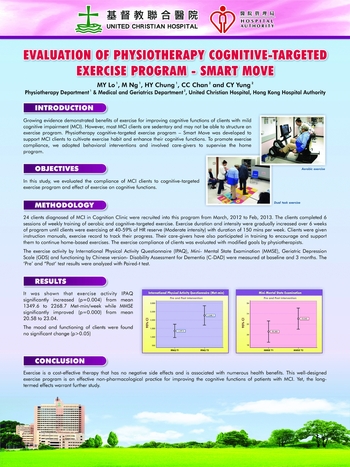


PS02-142 Effects of cognitive rehabilitation in outpatients with mild cognitive impairment
A. Otani, S. Matsumoto, K. Ueda, U. Nishi, Watanabe Hospital, Japan
Objectives: The purpose of this study is to clarify the effects of cognitive rehabilitation in outpatients with mild cognitive impairment (MCI).
Methods: Older adults of outpatients with MCI (n = 8; mean age = 75.3 years) were randomly allocated to the cognitive rehabilitation or control group (n = 8 mean age = 78.9). Participants in the exercise group exercised under the supervision of occupation therapist for 360 min/day, 1 or 2 days/week, for 25 ~ 37 months. Control group had no cognitive rehabilitation for 16 ~43 months. The change of Japanese cognitive measurement scale, which was called Hasegawa's dementia scale revised (HDS-R, Maximum point is 30) between first visiting and last visiting were measured. The experimental group completed cognitive rehabilitation training, which were circle exercise of finger, words findings among same category, spot the difference, Japanese KARUTA game etc.
Results: The decline of points of HDS-R of groups using cognitive rehabilitation was 0.3 after training compared with baseline levels. The decline of points of HDS-R of control groups was 9.4. We found significant change between group exercised and control group (p = 0.0014).
Conclusion: Cognitive rehabilitation intervention was associated with positive maintenance in cognitive function in older adults with MCI.
PS02-144 Reality orientation as a therapeutic modality for dementia and mild cognitive impairment: A meta-analysis study
Kayoung Kim, J.W. Han, Y. S. J. Seo, Y. J. Kim, K.-N. Lee, H. L. Jiang, Seoul National University Bundang Hospital, Korea
S.-H. Ryu, Kunkuk University Hospital, Korea
H.-G. Jeong, Korea University College of Medicine, Korea
J.-C. Lee, Samil Pricewaterhouse Coopers, Korea
K.W. Kim, Seoul National University, Korea
Objectives: To evaluate the effectiveness of Reality Orientation (RO) for patients having dementia, or mild cognitive impairment (MCI).
Methods: We searched PubMed, EMBASE, The Cochrane library, psychINFO in order to find studies on dementia or MCI. All RCTs of RO evaluating the effectiveness for dementia or MCI, including negative findings, which included outcome measures of global cognition, behavior, memory, frontal function, mood, and quality of life. Data were reexamined by two reviewers using our data extraction format. Reviewers performed data extraction and checked risk of bias of included studies.
Results: Thirteen RCTs on RO met our inclusion criteria and two studies were excluded in final meta-analysis because they had different settings for control groups. Meta-analyses were performed with 467 participants of which 258 received RO while 209 received usual care. Results showed that individuals with dementia or MCI obtained moderate benefit with improvements in global cognition (standardized mean difference (SMD) 0.472, 95% CI 0.231 to 0.714), quality of life (SMD 0.445, 95% CI 0.157 to 0.734), and communication (SMD 0.545, 95% CI 0.263 to 0.827) when they received RO.
Conclusion: Although some results in this study need to be explored more, our finding suggests that RO can be beneficial method for people with dementia or MCI.
PS02-145 Snoezelen and multi-sensory stimulation in elderly with dementia or MCI: A meta-analysis study
Jiyeong Seo, J.W. Han, Y.S.K. Kim, Y.J. Kim, K.N. Lee, H.L. Jiang, K.W. Kim, Seoul National University Bundang Hospital, Korea
S.-H. Ryu, Kunkuk University Hospital, Korea
H.-G. Jeong, Korea University College of Medicine, Korea
J.-C. Lee, Samil Pricewaterhouse Coopers, Korea
Background: Snoezelen, multi-sensory stimulation is an intervention by stimulating the primary senses of vision, hearing, smell, touch and taste. In recent years, use of snoezelen or multisensory stimulation was expanding widely. But, effectiveness of snoezelen or multisensory stimulation has been a controversial issue in clinical application for elderly with dementia or mild cognitive impairment (MCI).
Objectives: To assess the clinical efficacy of snoezelen or multisensory stimulation by using meta-analysis for elderly with dementia or MCI.
Methods: We searched PubMed, EMBASE, Cochrane library, psychINFO database to find trials for dementia or MCI. All RCTs of snoezelen or multisensory stimulation evaluating the effectiveness for global cognition, behavior, mood, and activities of daily living in dementia or MCI were included analysis. Two reviewers performed data review, data extraction and checked risk of bias of included studies.
Results: Two studies showed significant behavioral improvement at post-treatment (Lin 2007[SMD -0.511, 95% CI 0.035to 0.987] and Staal 2007 [SMD -0.844, 95% CI 0.009to 1.697]) by snoezelen or multi-sensory stimulation (versus activity groups). Snoezelen or multi-sensory stimulation did not show any effects on mood and global cognition in pooled-analysis (versus activity groups). Likewise, they failed to demonstrate any significant effects on global cognition, behavior, mood and activities of daily living when compared with usual care.
Conclusions: The results suggest that there is insufficient evidence of the effectiveness of snoezelen and multisensory stimulation in elderly with dementia or MCI. More data are needed to evaluate clinical efficacy of snoezelen and multisensory stimulation.
PS02-146 Music therapy with moderate Alzheimer's disease in long-term care center
Kyung-Phil Kwak, Dongguk University Gyeongju Hospital, Korea
Music therapy is a potential non-pharmacological treatment for behavioral and psychological symptoms (BPSD) of dementia. However, although some studies have found it to be helpful, studies demonstrating the effectiveness of this approach are lacking. The purpose of this study was to reflect about the effects of the music therapy with moderate Alzheimer's disease.
This case control study was carried out by music therapists in four long-term care centers. The participants were 82 patients with moderate Alzheimer's disease (CDR = 2.0 or 3.0) assigned randomly to a music therapy group and a control group. 120 participants with dementia were randomized to a sequence of 12 weeks of music therapy. The session of music therapy has four music activity types rhythm playing with Korean instrument, exercising with music, singing of old Korean pop and conversational session with the special songs and singer. The aim of this study was to examine the effect of music therapy on agitation and to explore its effect on psychotropic medication and caregiver burden.
The study showed a significant reduction in activity disturbances in the music therapy group during a 12-week period measured with Alzheimer's Disease Rating Scale (BEHAVE-AD). Agitation disruptiveness increased during standard care and decreased during music therapy. Short Zarit Burden Inventory (S-ZBI) and the prescription of psychotropic medication decreased significantly more often during music therapy than during standard care.
Conclusions: Music therapy is a safe and effective method for treating agitation in moderate AD and also a reduction for caregiver burden in long-term care center.
PS02-148 Recurrent and consistent improvement of cognitive impairment and depression following very short time of treatment with Enoxaparin
Liviu Feldinger, Tel Aviv University Sackler Faculty of Medicine, Israel
An 88 year old patient with no psychiatric history, diagnosed recently with Parkinson's disease and treated accordingly was brought to evaluation because of a gradual cognitive and affective deterioration. On 1st visit his MMSE scored 21/30, and he was diagnosed with dementia and depressive state. Various medication trials proved useless. Four months later he fell and fractured his femur, was successfully operated on and discharged with treatment with Enoxaparin 40 mg I.M. twice a day. Five days after surgery, on a psychiatric follow, a remarkable clinical improvement in his mood and cognitive state was noted and his MMSE scored 24/30. A week later, the amelioration of his cognitive state and depression were maintained. Two weeks still later, the treatment with Enoxaparin was discontinued, and 3 days thereafter, he became again depressed, and his cognition deteriorated rapidly to the point that one week later his MMSE scored only 15/30 and he had both delusions and hallucinations.
Olanzapine 5 mg daily was added, without any effect. Physical examination, laboratory tests and brain CT were normal. At 3 other successive psychiatric evaluations condition was the same. Three months after surgery, a sudden swollen was noted on his foot, ultrasound examination indicated DVT, and I.M. injections were started with Enoxaparin 40 mg twice a day.
A dramatic improvement in his cognition and mood was again evident two days later: he wasn't depressed, and scored 24/30 on MMSE. Olanzapine was stopped and the improvement persisted. As no improvement of the DVT was seen, the Enoxaparin was increased to 100 mg daily, followed by an additional improvement of the patient's cognition—consistently maintained to date. To the best of our knowledge, this is the first observation in humans, of a clear correlation between treatment with Enoxaparin and improvement in cognitive state and depression.
PS02-149 Rivastigmine patch in the one-year treatment of mild to moderate Alzheimer's disease and Parkinson's disease dementia
Pai-Yi Chiu, T.-J. Lai, Chung Shan Medical University, Taiwan
Objective: The purpose of this study was to investigate the one-year efficacy and tolerability of rivastigmine patch in the treatment of patients with mild to moderate Alzheimer's disease (AD) and Parkinson's disease dementia (PDD).
Methods: This was a prospective, open-label study for patients who met the criteria for mild to moderate AD or PDD. Efficacy evaluations were conducted with MMSE, CASI, CDR-SB, FAB, IADL, BADL, and NPI scales. Adverse effects and causes of withdrawal were summarized descriptively.
Results: The study was conducted from Oct. 2, 2011 (first patient enrolled) to April 12, 2013 (last patient completed). A total of 41 patients visited a dementia clinic in a regional hospital were enrolled into the study. Patients were divided into two groups according to the diagnosis; 28 patients were AD and 13 patients were PDD. Among them, 18 (43.9%) completed the study. In AD group, the results showed a similar rate of decline of their cognition and global functioning in comparison of findings of several previous studies; however, in PDD group, the results showed no decline of cognition in 1-year follow up and stabilization in neuropsychiatric disturbances. Twelve (29.3%) subjects reported at least one adverse event. The most frequent adverse events observed were skin lesions or itching (14.6%), followed by dizziness (7.3%), nausea (4.9%), and abdominal pain (4.9%). A total of 3 subjects had serious adverse events (7.3%), including 1 death, but none were related to rivastigmine patch.
Conclusions: Based on the results of this study, rivastigmine patch was found to be well tolerated in patients with mild to moderate AD and PDD in 1-year treatment. Rivastigmine patch demonstrated not only the efficacy of maintenance of cognition but also the stabilization of neuropsychiatric symptoms of patients with AD and PDD.
PS02-150 Impact of exogenous testosterone on mood: A systematic review and meta-analysis of randomized placebo-controlled trials
George Grossberg, H. Amanatkar, J. Chibnall, Saint Louis University, United States
Background: In the last decade, there have been a surge of new clinical trials studying the impact of exogenous testosterone on mood. The results of these studies were inconsistent.
Objective: In order to clarify this confusing picture, this meta-analysis was performed to compare the impact of exogenous testosterone on different subpopulations.
Methods: PubMed, the Cochrane Library, and reference list of retrieved articles were the sources of information. Meta-analysis of extracted statistical data from controlled clinical trials utilizing most commonly depression rating scales was performed.
Results: 16 trials met selection criteria. The selected trials included 944 subjects aged 20–80 years with 6–52 weeks duration of study. Meta-analysis of data showed a significant positive impact of testosterone on mood when compared to placebo (z = 4.592, p < 0.0001). Subgroup analysis showed a significant effect size of 5.279 (p < 0.0001) in the trials with mean age of less than 60 years. However, the effect size was not statistically significant in the trials with mean age of more than 60 years. The effect size in hypogonadal men was 4.192 (p < 0.0001), while the result was not statistically significant in eugonadal men. In addition, the effect size was larger in patients with subthreshold depression compared to patients with major depression. (z = 4.480, p < 0.0001 in subthreshold depression versus z = 2.080, p = 0.038 in major depression) Oral testosterone compared to oral dehydroepiandrosterone, testosterone gel, and intramuscular testosterone did not show a significant result. Larger effect size was observed in the studies with 8–24 weeks of duration compared to trials with duration of six, 30, and 52 weeks.
Conclusion: This meta-analysis supports testosterone replacement therapy in middle aged depressed men with low testosterone. Testosterone may be used as a monotherapy in dysthymia and minor depression or as an augmentation therapy in major depression in middle aged hypogonadal men.
PS02-151 Statins reduce the risk of depression at one year after stroke
Jae-Min Kim, H.-J. Kang, K.-Y. Bae, S.-W. Kim, Il-S. Shin, J.-S. Yoon, Chonnam National University Medical School, Korea
R. Stewart, King's College London, United Kingdom
M.-S. Park, K.-H. Cho, Chonnam National University Medical School, Korea
Objectives: Associations between serum cholesterol levels or lipid lowering treatment and depression risk have been controversial. Associations between statin use and depression risk have been investigated in patients with coronary artery diseases, but have not been examined following stroke. This study aimed to investigate whether statin use was associated with depression ascertained at two weeks and one year after stroke.
Methods: A total of 423 patients were evaluated two weeks after stroke, and 288 (68%) were followed one year later. At the two examinations, depression (major or minor depressive disorder) was diagnosed according to DSM-IV criteria, and depression severity was assessed by the Hospital Anxiety and Depression Scale-depression subscale and the Hamilton Depression Rating Scale. Logistic regression and repeated measures ANOVA analyses were carried out.
Results: Statins were used in 251 (59%) of 423 patients at baseline. Statin use was not associated with poststroke depression (PSD) status at baseline, but was significantly associated with reduced risk of all PSD, and of major PSD specifically, at follow-up. Statin use was also associated with better trajectories of depression assessment scales scores over the one year follow-up.
Conclusions: Statin use was associated with a reduced risk of depression at one year after stroke. Likely causality and underlying mechanisms need to be further clarified.
PS02-153 High dietary supplements are associated with a decreased risk of cognitive impairment: A cohort study from KLOSCAD
Yoonseop So, J.W. Han, T.H. Kim, J.-Y. Seo, K.Y. Kim, K.W. Kim, Seoul National University Bundang Hospital, Korea
Objective: This study examined the association of supplements with cognitive impairment in older adults.
Method: The KLOSCAD is a population-based prospective elderly cohort study on cognitive aging and dementia that was launched in 2009. A simple random sample (N = 13,749) was drawn from Koreans aged 60 years or older. Finally 7083 participants (age = 70.34 ± 6.93 years old, education = 8.01 ± 5.29 years, female = 57.4%) were eligible for the current analysis (response rate = 51.5%). Participants had clinical and neuropsychological evaluations for dementia. Participants were divided into two groups which were normal group and cognitive impairment group. Cognitive impairment group was CIND and all-cause dementia included AD and other types of possible or probable dementia. Supplements which we surveyed are Ginkgo, Ginseng, Multi-vitamin, Omega-3(DHA, EPA), green tea. Odds ratios of association between supplements intake and cognitive impairment group were calculated in logistic regression models controlling for confounding variables.
Results: Ginseng, Multi-vitamin, Omega-3, was significantly difference between normal group and cognitive impairment group (p = 0.007, p<0.001, p = 0.002 respectively). But Ginkgo, green tea were not significantly (p = 0.685, p = 0.532 respectively) different between normal group and cognitive impairment group. Multi-vitamin in upper-middle quartile (50th~75th percentile, OR = 0.56, p = 0.001) and the upper quartile (75th~100th percentile, OR = 0.64, p = 0.010) was significantly associated with a decreased risk of cognitive impairment after controlling for age, gender, education, smoking, alcohol intake, exercise (MET), head trauma, CIRS, MHIS, GDS. But the other supplements was not significantly associated with decreased the risk of cognitive impairment after controlling for confounding variables.
Conclusions: More normal group than cognitive impairment group took supplements. Multi-vitamin was significantly associated with decreased risk of cognitive impairment in elderly Korean.
This work was supported by the National Research Foundation of Korea (NRF) grant funded by the Korea government (MEST) (No. 2011-0018262).
PS02-154 Oriental therapy for dementia in Korea
Narei Hong, H.-J. Jo, Hallym University, Korea
Objective: In Korean traditional medicine, dementia has been called as ‘Mae-byung,’ ‘Gun-mang’ or ‘Jeon-gwang.’ There were many traditional herbal medicine prescriptions for these diseases. Nowadays numerous studies about developing new drugs from these traditional prescriptions have been proceeding.
Method: The published journals, thesis and internet articles in Korea about oriental medicine and dementia were reviewed.
Results: The origin of Korean herbal therapy is Chinese oriental medicine. They thought that liver, heart and kidney problem, energy loss, blood stasis, ‘Hwa’ and mind imbalance after aging could cause the symptoms of dementia. Besides traditional prescriptions such as ‘Jo-wi-seung-chung-tang’ or ‘Won-ji-seok-mo-po-san,’ there have been vigorous studies about oriental treatment of dementia. Although most of them has been herbal medicine-centered, some studies have included other treatment such as ‘yak-chim’ (Korean medicated acupuncture). ‘Chi-me-dan’ is the first newly developed drug from Korean traditional prescription. After ‘Chi-me-dan,’ many Korean oriental medical researchers has presented many prescriptions or compounds for making new drugs for dementia. Some of them are promising in treatment of dementia and have relatively firm scientific basis.
Conclusion: Many Korean people emphasized the role of Korean traditional medicine in degenerative diseases including dementia. Actually, lack of scientific basis was the most serious problems in Korean traditional medicine. But recent researchers in Korean traditional medicine have made their efforts to overcome these weaknesses by inducing Western deductive methods and scientific theories such as acetylcholine theory or genetic theories. More co-workings of traditional medical and westernized medical researchers are warranted in developing new drugs for dementia.
PS02-155 Medical co-morbidities in psychiatric patients admitted to an acute assessment and treatment unit in Melbourne, Australia
Anita Goh, A. Westphal, B. Hamilton, N. Lautenschlager, The University of Melbourne, Australia
Objectives: To determine the nature and incidence of medical comorbidities and their subsequent interventions in psychogeriatric inpatients aged over 65 years old. To investigate whether the presence of an integrated medical resident impacted on the scope of care and whether it influenced patient outcomes.
Method: A retrospective file audit was conducted in order to determine the prevalence of medical co-morbidities in psychiatric illnesses and nature of medical interventions provided for psychogeriatric inpatients. Medical comorbidities were categorised according to the Cumulative Illness Rating Scale.
Results: 165 admissions into an acute inpatient psychogeriatric unit were audited. There were more medical resident contacts and assessments when a half time medical intern was employed. However, these increased number of contacts and assessments made no difference in the rates of emergency medical transfers or geriatric registrar visits, and there was no significant difference between groups in non-psychiatric drug change. The introduction of the medical intern reduced the use of frequent manual feeding.
Conclusion: The employment of a medical resident to the treating team, and the results of this project directly positively affected the clinical care of the elderly with mental disorders by reorienting the staff in old age psychiatry to medical issues, and by developing a comprehensive understanding of their medical and physical needs. The results made the treating team more aware of the increased number of medical interventions necessary in those with dementia diagnoses, and the particular types of interventions that were more frequently necessary (manual assistance with feeding, bladder scanning, nebuliser administration, wound management). This project also highlighted that older patients, many of whom had dementia, had a significantly greater number of organ systems affected by comorbidities. This information helped the treating team to manage the patient's illness and better plan their admission and care.
PS02-156 The effects of fall risk increasing drugs on postural control: A literature review
Claudine Lamoth, M. Moek, University of Groningen, The Netherlands
M. De Groot, J. Van Campen, L. Tulner, Slotervaart Hospital, The Netherlands
J. Beijnen, Utrecht University, The Netherlands
Background: Meta-analyses showed that psychotropic (antidepressants, neuroleptics, benzodiazepines, antiepileptics) and some cardiac drugs (digoxin, type IA antiarrhythmics, diuretics) are associated with increased fall risk. Since balance and gait disorders are the most consistent predictors of future falls, falls due to usage of these so-called Fall Risk Increasing Drugs (FRIDs) might be partly caused by impairments of postural control these drugs can induce.
Objective: To examine the effects of FRIDs on postural control by reviewing literature.
Data sources: Electronic database of PubMed and reference lists of identified papers were searched.
Study selection: Only controlled research papers examining the effects of FRIDs on postural control were included. FRIDs were defined as antidepressants, neuroleptics, benzodiazepines, antiepileptics, digoxin, type IA antiarrhythmics, and diuretics.
Study appraisal and synthesis methods: 78 papers were included, whereof study methods for quantifying postural control, and the effects of FRIDs on postural control were abstracted.
Results: Postural control was assessed with a variety of computerized instruments, mainly evaluating aspects of body sway during quiet standing. In general, postural control was impaired, indicated by an increase in parameters quantifying body sway, when using psychotropic FRIDs. The effects were more pronounced when people were at higher age, used psychotropics at higher daily doses, with longer half-life, and administered for a longer period.
Conclusions: From the present literature review, it can be concluded that an increased fall risk by the usage of psychotropic drugs, is associated with impairments in postural control. The sedative effects of these drugs on postural control, cognitive functioning, and muscle relaxation are reversible, as was proven in intervention studies where FRIDs were withdrawn. The findings of the present literature review highlight the importance of using psychotropic drugs in the older population only at the lowest effective dose and for a limited period of time.
PS02-158 Cognitive function in thyroid disorders
Hyunseuk Kim, J.S. Cheon, J. Lee, Kosin University Gospel Hospital, Korea
Objectives: The aims of this study were to know changes of cognitive function and its characteristics, and to identify influencing factors on cognitive function in patients with thyroid disorders.
Methods: Data of 98 patients with thyroid disorders (16 males and 82 females) recruited from thyroid clinic in the Endocine Center of Kosin University Gospel Hospital were obtained by semi-structred interviews and MoCA-K (Korean Version of the Montreal Cognitive Assessment) and Korean version of the HDRS-17 (Hamilton Depression Rating Scale-17).
Results: 1) The cognitive dysfunction was seen in 24 patients with thyroid disorders (24.49%). The total scores of the MoCA-K tests in thyroid patients with cognitive dysfunction (18.42±3.75) were significantly (p<0.001) lower than those of controls (26.43±2.01). Their subtest scores of the MoCA-K such as visuospatial/executive, naming, attention, language, abstraction, delayed recall were also lower than those of controls.
2) The thyroid patients with MoCA-K <23 showed higher age and onset age of thyroid disorders, and had lower education and HDL-cholesterol (P<0.001 respectively).
3) Total scores of the MoCA-K tests in patients with thyroid disorders had positive correlation with education (ρ = 0.583, p<0.01), and had negative correlation with age (ρ = -0.462, p<0.01) and onset age of thyroid disorders (ρ = -0.494, p<0.01). Otherwise, triiodothyronine and HDL-cholesterol had positive correlation, and sex and triglyceride had negative correlation with some subtest scores of the MoCA-K.
Conclusions: The cognitive dysfunction accompanied in about 1/4 of patients with thyroid disorders. The finding that the cognitive function in thyroid disorders seemed to be mainly associated with age and onset age of thyroid disorders, suggested a possibility of an important role of aging mechanism.


