Contemporary nominations to the Supreme Court of the United States are unavoidably, and perhaps inevitably, political. When a Supreme Court vacancy arises, presidents make public speeches to introduce and rally the country behind their nominee. Senators, particularly members of the Senate Judiciary Committee, frequently appear before the media to praise or criticize the nominee's qualifications, record or character. The political drama that accompanied the failed nomination of Robert Bork, the hotly debated nomination of Clarence Thomas, the Senate's refusal to consider Merrick Garland's nomination and the intense partisan conflict over the recent confirmation of Brett Kavanaugh has generated concern from all sides of the political spectrum about the deleterious consequences of political contestation. As Chief Justice John Roberts has warned:
When you have a sharply political, divisive hearing process, it increases the danger that whoever comes out of it will be viewed in those terms… If the Democrats and Republicans have been fighting so fiercely about whether you're going to be confirmed, it's natural for some members of the public to think, well, you must be identified in a particular way as a result of that process (Hananel Reference Hananel2016).
Politically contested nomination processes may not only elevate political factors over legal qualifications and threaten the viability of well-credentialed jurists (for example, Epstein et al. Reference Epstein2006). They may also inflict institutional harm by weakening judicial legitimacy. Reflecting such concerns, appointments to high courts in Europe are now performed by independent committees (as in Denmark, Norway and the United Kingdom) or require confirmation by overwhelming supermajorities to ensure broad consensus across parties (as in Germany).
In this article, we examine how political contestation over judicial nominations affects Americans’ attitudes toward Supreme Court nominees and perceptions of the Court's legitimacy. We make two key theoretical contributions to research on public opinion and the judiciary. First, we argue that political actors in adjoining branches of government can affect attitudes toward the courts. While scholars have documented the media's role in affecting public reactions to high-profile court decisions (Christenson and Glick Reference Christenson and Glick2015; Zilis Reference Zilis2015), we argue that rhetoric from the president and Congress can influence attitudes toward courts and their nominees.
Secondly, we argue that political rhetoric about judicial nominations provides partisan cues that the public uses to form impressions about nominees and the courts and to generate a polarized response across partisan lines. Our argument contrasts with expectations from previous studies, which suggest that politically contested nominations should have either no effect or uniformly negative effects on attitudes toward the judiciary. Despite widespread normative concern about politicization of the nomination process and large bodies of scholarship on public attitudes toward court rulings (for example, Bartels and Johnston Reference Bartels and Johnston2013; Christenson and Glick Reference Christenson and Glick2015; Gibson and Nelson Reference Gibson and Nelson2015) and Supreme Court nominees (for example, Kastellec, Lax and Phillips Reference Kastellec, Lax and Phillips2010; Sen Reference Sen2017), extant research provides no evidence about how political contestation over judicial nominations by presidents and senators shapes public opinion.
We assess our argument using a conjoint experiment conducted with a national survey of 2,500 US adults in January 2017. Respondents evaluated potential nominees for the Supreme Court vacancy inherited by President Trump when a nomination was imminent. We find that political contestation polarized partisans’ attitudes toward the Court and its prospective members. Absent rhetoric attributed to the president and members of the Senate, Democrats and Republicans in the American public view the Court and its prospective members in largely similar terms. When presented with rhetoric from President Trump and Congress, however, Republicans provided greater support for the prospective nominee and positive evaluations of the Court's legitimacy, while these same messages led to declines among Democrats. Additional analyses suggest that contestation generates divergent partisan responses by shaping impressions of the nominee's impartiality.
Our results suggest two potential vulnerabilities of the judiciary that are underappreciated in the existing literature. First, attitudes toward judicial nominees and the Court are influenced by political rhetoric from other branches of government. Secondly, in contrast with scholarship in judicial politics which argues that public opinion toward courts is immune to partisan influences, we show that contestation can divide public opinion over the judiciary just as with other political institutions. In combination, the findings provide some support for concerns that politically charged nominations have deleterious effects on the Court's legitimacy among subsets of the electorate most critical to ensuring compliance with the Court's rulings – those who disagree with its decisions on ideological grounds.
POLITICAL CONTESTATION AND SUPREME COURT NOMINATIONS
Article II of the US Constitution gives the president and Senate the power to nominate and confirm Supreme Court justices, respectively, making the nomination process one of the few circumstances in which all three branches of government are explicitly intertwined. Contrasting executive and legislative preferences over judicial nominees have introduced overtly partisan nomination fights into the judiciary since the nation's early years.Footnote 1 For instance, after being nominated to the Supreme Court by George Washington, John Rutledge's opposition to the Jay Treaty with Britain cost him support from Federalists and led to his defeat in the Senate (Davis Reference Davis2005). A half-century later, John Tyler's persistent policy clashes with congressional Whigs were reflected in nomination battles, with Congress either refusing to consider or rejecting outright eight of Tyler's nominees to the Court (Beth and Palmer Reference Beth and Palmer2011).
Robert Bork's failed nomination to the Supreme Court, however, marked an intensification of political conflict in the nomination process (Epstein et al. Reference Epstein2006), which reached new heights with the Senate's refusal to consider Merrick Garland's nomination in 2016. Secular trends in American politics, such as party polarization and the judiciary's increased role in deciding matters of policy, may also contribute to the increased contentiousness of judicial nominations (Binder and Maltzman Reference Binder and Maltzman2009). Rhetoric that has accompanied recent nominations highlights this partisan contentiousness. For instance, Senate Democrats referred to Neil Gorsuch as a ‘radical’ with ‘right-wing, pro-big business views’ and ‘not a neutral legal mind but someone with a deep-seated conservative ideology’.Footnote 2 Similarly, upon Elena Kagan's nomination, Republican Senator Chuck Grassley expressed concern about her ‘deeply held liberal principles’ and suggested she would ‘use her personal politics and ideology to drive her legal philosophy’ on the Court.Footnote 3
POLITICAL CONTESTATION AND PUBLIC OPINION TOWARD THE JUDICIARY
Partisan disagreements over the political and legal qualities of Supreme Court nominees exemplify political contestation over the judiciary: the introduction of partisan and ideological disagreements that animate politics within the executive and legislative branches to the judicial arena. Simply put, contestation occurs when partisan or ideological figures issue political statements about judges, court rulings or the judicial process. For example, if a notable Democrat expresses support for a judicial nominee against prominent Republican opposition, the partisan and ideological differences between the two figures are projected onto the nominee. This behavior also occurs outside the nomination process, as exemplified by President Trump's statements against federal judges who ruled against his controversial executive actions.Footnote 4
We argue that political contestation in relation to Supreme Court nominees polarizes support for the nominees and the Court along politically salient lines. Our theory builds upon foundational work in American politics that notes the importance of partisan and ideological cues from trusted elite signals in shaping political evaluations (Berinsky Reference Berinsky2007; Zaller Reference Zaller1992). We expect that rhetoric from political actors during judicial nominations causes the public to view the Court and its members through more explicitly political lenses. Under these conditions, individuals use messages from prominent elites with clear partisan identities – for instance, a president or senator – about a judicial nominee to evaluate the nominee and the Court as a whole. As a result, individuals of different partisan and ideological stripes reach divergent evaluations. For instance, partisans who receive positive signals about a nominee from a co-partisan political elite should increase support for the nominee at hand and the Court more generally, while individuals who receive negative signals from co-partisan elites should decrease their support.Footnote 5 Moreover, by viewing the Court through a more explicitly political lens, exposure to political messages is also likely to affect how individuals view the Court more generally.
While our expectations follow from a voluminous literature that documents the influence of elite rhetoric on public opinion and often leads to opinion divergence across party lines (for example, Berinsky Reference Berinsky2007; Druckman, Peterson and Slothuus Reference Druckman, Peterson and Slothuus2013), they contrast with most existing theories of public opinion in the context of the courts. Instead, though this literature is not focused specifically on contestation over nominations, its arguments suggest competing mechanisms that generate conflicting predictions about the effect of contested nominations on public opinion. For instance, consistent with the ‘myth of legality’, Gibson and Caldeira (Reference Gibson and Caldeira2009a) show that exposure to interest group advertisements during the confirmation hearings for Justice Samuel Alito reduced citizens’ evaluations of the Supreme Court by depicting it as a political body. This perspective suggests that partisan contestation over judicial nominations should lead to overall reductions in institutional support but does not predict heterogeneous effects across party lines.
A second perspective argues that the effect of partisan rhetoric on support for the Court depends upon whether contestation violates the public's expectations about the infusion of politics into the nomination process (for example, Gibson Reference Gibson2012). If the public expects nominations to be accompanied by partisan wrangling, as they reasonably may, then contestation should have no effect on attitudes toward the Court; alternatively, it may reduce the public's opinion of the Court if it violates their normative beliefs about its insulation from the political process.
A third perspective suggests that political contestation could increase public support for the Court because ‘exposure to courts – including exposure associated with controversial circumstances – enhances rather than detracts from judicial legitimacy’ (Gibson, Caldeira and Spence Reference Gibson, Caldeira and Spence2003, 553). None of this literature argues or allows for the possibility that the effects of contested nominations depend on individuals’ partisanship – and as such, previous studies do not predict that political contestation could result in polarized attitudes across party lines. As Gibson (Reference Gibson2007, 533) summarizes existing perspectives, ‘Although the American people are severely divided on many important issues of public policy, when it comes to the institution itself, support for the Court has little if anything to do with ideology and partisanship.’
Overall, this body of scholarship suggests that attitudes toward judicial institutions are largely invulnerable to partisan influences; whether its predictions would apply to public opinion on specific nominees, however, is less clear.
An emergent literature challenges these characterizations of the potential for opinion polarization toward courts. For instance, Bartels and Johnston (Reference Bartels and Johnston2013) and Christenson and Glick (Reference Christenson and Glick2015) both find that ideological dissatisfaction with judicial rulings can reduce individuals’ perceptions of legitimacy (c.f., Gibson and Nelson Reference Gibson and Nelson2015). Related research shows that partisanship affects whether individuals accept Supreme Court decisions (Nicholson and Hansford Reference Nicholson and Hansford2014) and structures their evaluations of judicial nominees (Sen Reference Sen2017). These studies suggest that contestation increases the salience of partisan and ideological considerations when evaluating judicial rulings, thus generating divergent attitudes across partisan lines. In further research on attitudes toward judicial independence, Clark and Kastellec (Reference Clark and Kastellec2015) show that Americans are strongly responsive to partisan source cues. Bartels and Johnston (Reference Bartels and Johnston2012) provide a potential explanation for these findings by showing that the public understands the Supreme Court as political and desires that justices are selected based upon ideological considerations. Consistent with our argument, this research indicates that contestation over Supreme Court nominees could polarize Americans’ attitudes toward the Court across partisan and ideological lines.
Despite the centrality of partisan and ideological conflict to Supreme Court nominations (for example, Epstein et al. Reference Epstein2006), no study of which we are aware directly examines how politically contested nomination processes affect public evaluations of Supreme Court nominees and the Court more generally. Several recent studies evaluate related aspects, however. For instance, Chen and Bryan (Reference Chen and Bryan2018) study how nominees’ refusal to answer questions about their political views affects their public support, while Armaly (Reference Armaly2018b) studies how perceptions of the Court's legitimacy were affected by messages about the political importance of filling the Supreme Court seat made vacant upon Scalia's death in 2016. In the study most related to our own, Armaly (Reference Armaly2018a) shows that messages from political actors outside the Court can affect the public's impressions of it. Crucially, however, no study speaks to the effects of political rhetoric from actors in the adjoining branches of government – such as the praise and criticism frequently issued by presidents and the hearings held by senators throughout the nomination and confirmation process. Instead, much of what we know about politically contested judicial selection procedures comes from studies of state judicial elections (Gibson Reference Gibson2012; Hall Reference Hall2014).
Though this literature has produced important insights into how judicial elections affect attitudes toward state courts, it is not clear how the findings from this research apply to the context of the Supreme Court in which justices are selected by the president with the consent of the Senate.
DATA AND METHODS
We conducted a conjoint experiment embedded in a nationally representative survey to investigate how contestation over Supreme Court nominees affects public opinion. The survey was conducted by YouGov with a sample of 2,500 respondents weighted to characteristics of the national population.Footnote 6 Table A.1 provides descriptive statistics for the sample.
An experiment is well suited for studying our hypotheses because randomizing the treatment assignment – here, political rhetoric related to a Supreme Court nominee – provides a high level of internal validity for concluding that any potential differences in respondents’ attitudes are due to the treatment and not other potential confounding factors. Additionally, the timing and design of our study provide a degree of realism that is less commonly found in survey experiments. First, we fielded the survey in a context where a nomination to the Supreme Court was imminent. Though Barack Obama nominated Merrick Garland to fill the Supreme Court seat that became vacant upon the death of Antonin Scalia, the Senate failed to confirm Garland and the seat was left open when Donald Trump assumed office. Nominating a successor to Scalia was a top priority for Trump and it was widely expected that the nominee would be announced in the first weeks of his presidency. Thus we began fielding our survey on 21 January 2017, the day following Trump's inauguration, and interviews were completed on January 30. Somewhat fortuitously, Trump announced the nomination of Neil Gorsuch the following day, January 31.Footnote 7 This allows us to capture attitudes toward prospective nominees to the Court when a nomination was forthcoming but before the public had an opportunity to form attitudes based on the characteristics of the actual nominee or the rhetoric that accompanied him/her, providing realism that we would lack if respondents were asked to consider hypothetical scenarios.
Secondly, following several recent studies (Kirkland and Coppock Reference Kirkland and Coppock2018; Sen Reference Sen2017), our conjoint design presented respondents with a set of attributes that characterized potential Supreme Court nominees. As we describe below, these attributes contained information about the potential nominee's gender, race or ethnicity, age, legal training, professional experience and ideology. These characteristics are commonly invoked by presidents, senators, members of the legal community and political commentators when discussing the merits of Supreme Court nominees. This design improves upon a more standard vignette approach by providing a fairly realistic and comprehensive description of the nominee that includes information the public is likely to consider when forming their evaluations.
Respondents were first told: ‘As you may know, the U.S. Supreme Court currently has one vacancy due to the death of Justice Antonin Scalia in February 2016. President Trump will need to nominate a replacement justice.’ Respondents then received the following prompt: ‘Suppose Trump is considering nominating the following individual to serve as a justice on the Supreme Court’ and were presented with a series of attributes about the nominee's biographical information, legal training and experience and position on abortion. The values of these attributes were randomly assigned to each respondent and are displayed in Table 1.Footnote 8
Characteristics of potential Supreme Court nominees

Note: attribute values were randomly assigned to respondents for each potential nominee. Subjects were randomly assigned to receive the statements attributed to Trump and Senate Democrats, with half of the sample not receiving statements at all and the other half receiving one of the four statements from Trump and one of the four statements from Senate Democrats shown above.
Our key manipulation is the random assignment of half of our sample to the Rhetoric condition in which respondents were presented with messages from political actors about the potential Supreme Court nominee. In addition to the six attributes listed above, these respondents received statements attributed to President Trump and Senate Democrats that expressed support for and opposition to, respectively, the potential nominee. The statements were modeled after those made by previous presidents and senators when discussing characteristics of recent Supreme Court nominees. As an example, President Obama noted Merrick Garland's ‘brilliant legal mind’ and his ‘character’ when nominating him to the Court, closely mirroring statements (a) and (c) attributed to President Trump.Footnote 9 Similarly, Senator Chuck Grassley's argument that Elena Kagan would ‘use her personal politics and ideology to drive her legal philosophy’ parallels statement (b) attributed to Senate Democrats.Footnote 10
Respondents assigned to the Rhetoric condition received one statement from both Trump and Senate Democrats, which simulates how political discussions about judicial nominations occur in the real world, where the public is exposed to competing views through two-sided information flows. These elites are the highest-profile and most publicly salient political actors who make the case for and against judicial nominees. Among the respondents assigned to the Rhetoric condition, we varied the content of the messages from Trump and Senate Democrats so that they emphasized either the nominee's qualifications, ideology, personal character or impartiality. The statements were randomized separately so that each respondent was randomly assigned to receive one of the four statements attributed to Trump and one of the four statements attributed to Senate Democrats. Our randomization strategy implies that some respondents will receive competing messages that emphasize the same dimension of the nominee's record, while other respondents will receive messages about different attributes of the nominee.
In the analyses that follow, we consider whether the effects of contestation vary according to the specific content of the messages.Footnote 11 Our use of political rhetoric reflects the political realities of modern judicial nominations where actors outside the Court – primarily the president and members of the Senate – publicly debate over the nominee, but contrasts with the design used in Sen (Reference Sen2017). Respondents in that study were randomly assigned to receive descriptive information about the nominee's partisan affiliation, which is generally not a major topic of discussion during judicial nominations. Our study further builds upon this research by considering how political rhetoric about nominees affects, rather than is moderated by, perceptions of the Court's legitimacy.
While it may not be surprising that presidents would make statements in support of their nominees (and that their partisan opponents would make statements opposing the nominees), our control group allows us to estimate the effects of exposure to these messages. Accordingly, we estimate the treatment effects of contestation against the counterfactual that individuals do not receive messages in support of or in opposition to a potential judicial nominee.Footnote 12 To the extent that respondents are unsurprised by political rhetoric toward judicial nominees, moreover, any potential treatment effects are likely to be attenuated. However, as shown below, attitudes toward nominees or the Court generally were not statistically distinguishable among partisans in the control group, which suggests that respondents did not bring meaningfully different partisan views toward the judiciary to bear when participating in our study.
It bears emphasizing that the design of our study mitigates the potential for our results to simply reflect polarized responses to a partisan president. As described above, all respondents received a prompt that referenced President Trump's role in filling the Supreme Court vacancy. This prompt appeared at the same time respondents received information about the characteristics of the potential nominee. Any treatment effects we identify are thus attributable to the president's and the partisan opposition's political rhetoric toward the nominee rather than merely referencing a polarizing political figure such as President Trump. And while our survey was fielded at a time when national politics was more salient than usual given Trump's inauguration, national politics are routinely amplified when presidents take to the national stage to announce their Supreme Court nominees as Trump did a week later with Neil Gorsuch and again in summer 2018 with Brett Kavanaugh.
After respondents were presented with the profile of a potential Supreme Court nominee, we asked them to evaluate the nominee and the Court as a whole. We measured support for the nominee with a five-point Likert scale in response to the following question: ‘On a scale from strongly oppose to strongly support, where would you place your level of support for this potential nominee?’Footnote 13 We then asked respondents to suppose that the nominee was confirmed by the Senate and began serving as a justice on the Supreme Court. We measured respondents’ prospective attitudes toward the Supreme Court using a battery of questions we modeled after a scale commonly used in research on judicial legitimacy. Each question was measured on a five-point scale ranging from ‘strongly disagree’ to ‘strongly agree’. These questions scale well together (Cronbach's α = 0.78) and we constructed an additive scale using responses to them as a measure of respondents’ perceptions of legitimacy, where larger values indicate increased legitimacy.Footnote 14 Appendix Table A.2 displays the question wordings and summary statistics for the measures that comprise our dependent variables.
Each respondent received four profiles of potential Supreme Court nominees, with the dependent variables measured after each of them.Footnote 15 Respondents therefore evaluated a total of 10,000 nominee profiles; we note that we obtain substantively identical patterns of results when using only the first nominee profile each respondent was shown, which suggests that responses to later profiles were not influenced by the characteristics of the potential nominees that preceded them.Footnote 16 We regressed the dependent variables described above on Rhetoric, the indicator for receiving the messages attributed to Trump and Senate Democrats, as well as a set of indicators for the other attributes of the potential nominee. This provides estimates of the average marginal component-specific effect (AMCE) of each characteristic (see Hainmueller and Hopkins Reference Hainmueller and Hopkins2015), which represents the average difference in attitudes when comparing a respondent who received the partisan rhetoric to one who did not, calculated over all possible combinations of the nominee's other attributes. Random assignment of each attribute helps ensure that nominees accompanied by the partisan rhetoric have the same distribution on average for all the other attributes as nominees who were not accompanied by the partisan rhetoric.
We estimate linear regressions with standard errors clustered on respondents to account for the non-independence across observations that results from each respondent being shown multiple profiles.Footnote 17 As we outlined above, we expect political contestation to have heterogeneous effects among partisan groups. Specifically, given the context of a Republican president, we expect contestation to decrease evaluations of the nominee and the Court more generally among Democrats but to increase it among Republicans.
The context and design of our study provide a relatively difficult test for measuring the effect of partisan rhetoric on attitudes toward the nomination process for two reasons. First, we conducted our study in a particularly unique nomination environment. The duration of the vacancy on the Court caused by Scalia's death – at the time of the survey, nearly twelve months – and the degree of partisan infighting over the seat suggests that this vacancy was particularly salient to the American public and that individuals were likely to already have been exposed to statements regarding the nomination from prominent partisan actors in government.Footnote 18 These considerations suggest that our experiment is likely to uncover muted treatment effects, at least in comparison to a more typical nomination context in which a vacancy was in the public consciousness for a shorter period of time and the public was less likely to have already received partisan signals about the nomination from elected officials.Footnote 19
Second, as we sought to increase external validity by basing our treatment conditions upon actual statements made by elected officials, we recognize that our experimental treatments were relatively weak compared to the vitriol that is sometimes unleashed by independent organizations. For example, following Sonia Sotomayor's nomination to the Court, the conservative interest group Committee for Justice released an attack advertisement implying that she ‘led a group supporting violent Puerto Rican terrorists’.Footnote 20 By designing our treatment conditions to reflect the kinds of statements ordinarily made by elected partisan officials, we expect that we may uncover weaker effects than if we attributed the more inflammatory language employed by unelected political officials or interest groups to the elected officials in our study.
Before presenting the results, we point out that our experimental design does not allow us to study the long-term implications of contestation for attitudes toward nominees or the Court. Though this is a limitation of our chosen design, prior studies lack clear empirical evidence of the effect of contestation on judicial attitudes in both the near and long term. If we do not find evidence of an effect in our experimental setting, it is unlikely that political contestation would have long-term consequences for how the public views the Court. We return to this issue in the conclusion.
RESULTS
Our theoretical argument predicts that political contestation polarizes opinion toward the judicial nominees and the Court more generally. More specifically, in the context of a Republican presidency, we expect that partisan rhetoric leads to more positive evaluations of potential judicial nominees from Republican identifiers and more negative evaluations among Democratic identifiers. We study this hypothesis by examining whether exposure to rhetoric attributed to partisan officials increased disagreement between Democratic and Republican respondents by producing divergent effects among them. We begin by studying the effect of contestation among partisans and estimated the AMCEs of assignment to the Rhetoric condition and the other attributes of the potential judicial nominees based on whether respondents self-identified as Democrats, Republicans or Independents.Footnote 21
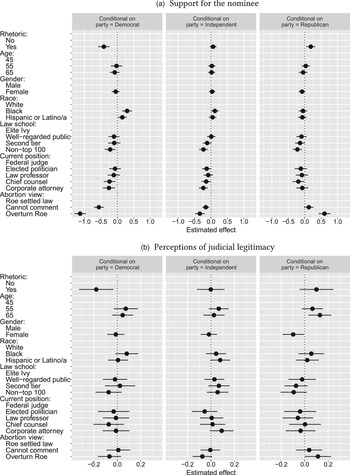
Figure 1a shows how contestation affected respondents’ support for prospective judicial nominees across party lines. For each characteristic, the plotted points show the increase or decrease in support for the nominee relative to the baseline condition (the first value listed under each attribute category). The horizontal lines are the 95 per cent confidence intervals associated with the estimates and the vertical dashed line at zero represents the null hypothesis of no effect. All statistical tests are two sided.
Political contestation and public opinion
Note: plots show the average marginal component effects (AMCEs) of each profile characteristic by respondent partisanship. Results for Democrats, Independents and Republicans are shown in the left, center and right panels, respectively. The horizontal lines indicate the 95 per cent confidence intervals associated with the estimated AMCEs. The dependent variables are listed above each plot.

The results provide strong support for our hypothesis that contestation would have differential effects among partisans. As the left panel shows, contestation significantly reduced support for the nominee among Democrats. The coefficient is negative (−0.41) and statistically significant (p < 0.001). However, as the panel on the far right shows, rhetoric significantly increased support for the nominee among Republicans (0.19; p < 0.008). Rhetoric had clearly divergent effects on Democrats and Republicans, as the coefficients are statistically distinguishable at p < 0.001. Among Independents, however, we find no evidence that contestation from partisan actors affected support for the nominee, as the estimated effect is not statistically distinguishable from zero (p = 0.239).
Figure 1b shows that contestation also has implications for how the public views the Court more generally. Contestation significantly decreased judicial legitimacy among Democrats (−0.18; p < 0.02); among Republicans, however, the coefficient is positively signed yet somewhat smaller in magnitude (0.10) and not statistically significant at conventional levels (p = 0.18). The estimated AMCEs for Republicans and Democrats are statistically different from one another (p < 0.001), however, indicating that rhetoric had a differential effect on legitimacy for Republicans and Democrats. We again find that rhetoric had no effect on perceptions of legitimacy among Independents, as the estimated effect is virtually zero (−0.002) and not statistically significant.
Our results and accompanying inferences are not simply an artifact of respondents’ repeated evaluations or the large sample size produced by this design. Our findings are substantively similar and remain statistically significant when limiting our analyses to the first profile evaluated by each of our respondents, adding further support to our inferences. These results are displayed in Figure A.2.
The results for the other attributes are also of substantive interest. For the most part, we find similar patterns across party lines in the effects of background and demographic characteristics on support for the nominee. We find no evidence that either age or gender affected support, but we did find that respondents across all partisan groups provided greater support for nominees with prestigious educational backgrounds and who had experience on the federal bench. The nominee's race/ethnicity had statistically significant effects on support among Democratic respondents but not among either Republicans or Independents. Partisans reacted most strongly to the nominee's abortion views: Democrats and Republicans expressed significantly different levels of support for the nominee based on whether he or she expressed views on Roe v. Wade that were consistent with respondents’ partisan positions. We find little evidence, however, that the nominee's individual characteristics affected perceptions of the Court's legitimacy, and these patterns are consistent across respondent partisanship. Instead, our evidence suggests that statements about individual nominees from partisan elites have a substantially greater influence on legitimacy than any of their particular characteristics.
Figure 2 presents the results when testing our hypothesis that contestation polarizes partisans’ views of the Court and its prospective members. The plots show the predicted values and associated 95 per cent confidence intervals of the dependent variables for Democrats (shown with circles and in darker grey) and Republicans (shown with diamonds and in lighter grey) based on whether respondents were assigned to the Rhetoric condition.Footnote 22 The left plot shows the predicted level of support for the potential nominee. Among respondents in the control group, Republicans (mean = 3.03) and Democrats (mean = 2.95) provided nearly identical levels of support,Footnote 23 suggesting that Americans do not generally view judicial nominees through devoutly partisan lenses in the absence of partisan rhetoric. This finding is especially interesting given that nominees are chosen by presidents, about whom Americans have strikingly divergent views across party lines and whose involvement in the legislative process intensifies partisan conflict (Lee Reference Lee2008). Among respondents who were assigned to receive the partisan messages, however, Democrats (mean = 2.55) and Republicans (mean = 3.23) were much more polarized in their attitudes toward the nominee. The partisan difference in mean levels of support was more than seven times larger (0.08 compared to 0.68) and statistically significant (p < 0.001) among respondents in the treatment condition.
Political contestation and the polarization of partisan attitudes
Note: plots show the predicted values of the two dependent values based on respondent partisanship and whether they were assigned to the Rhetoric condition. Democrats are plotted with circles and in darker grey and Republicans with diamonds and in lighter grey. The horizontal lines are the 95 per cent confidence intervals. Partisan rhetoric about judicial nominees significantly polarizes partisans’ evaluations of the nominee and perceptions of the court's legitimacy.

Contestation also polarized respondents’ views of the Court's legitimacy across party lines, as the plot on the right shows in Figure 2. Consistent with prior research (for example, Gibson Reference Gibson2007), Republicans and Democrats had nearly identical perceptions of the Court's legitimacy in the absence of partisan rhetoric. The mean legitimacy score (on our 1–5 scale) for Republicans in the control condition was 3.16 compared with 3.13 for Democrats in the control group (p = 0.667). However, views of the Court polarized among respondents who received the partisan messages, as legitimacy decreased among Democrats (to 2.95) and increased among Republicans (to 3.26). Thus political contestation increased partisan polarization in judicial legitimacy by more than nine times relative to the control condition, and this difference is statistically significant at p < 0.001. In contrast with theories that argue that judicial attitudes are invulnerable to partisan influences or suggest that contestation has uniformly negative consequences for the Court's legitimacy, we find strong evidence that contestation significantly polarizes partisans’ attitudes toward judicial nominees and support for the Court more generally.
Our data indicate that partisans responded to messages attributed to political actors about Supreme Court nominees in predictably partisan ways. The president's co-partisans were generally more supportive of the nominee when he or she was endorsed by the president and criticized by the opposition party in the Senate. Respondents from the party opposite the president, however, reduced their support of the nominee when exposed to the same messages. In both cases, respondents reacted to partisan cues from elite sources and evaluated the nominee accordingly. Moreover, the effects of the political rhetoric that accompanied the Supreme Court nominees in our study also affected how respondents evaluated the Court more generally and significantly polarized how members of opposite parties viewed the Court's legitimacy.
Consistent with our argument, we obtain substantively identical results when distinguishing respondents based on their symbolic ideologies.Footnote 24 Political contestation significantly increased support for the nominee (0.18; p < 0.004) and perceptions of legitimacy (0.15; p < 0.03) among conservatives but decreased support (−0.29; p < 0.004) and legitimacy (−0.27; p < 0.003) among liberals. These results are also generally consistent with the findings from Bartels and Johnston (Reference Bartels and Johnston2013) and Christenson and Glick (Reference Christenson and Glick2015), in which judicial rulings prompt individuals to perceive the Court as more or less ideologically distant and subsequently provide lower or higher assessments of legitimacy. These results provide further evidence that contestation activates politically salient identities when evaluating judicial nominees and produces polarized responses from individuals on opposite sides of the political spectrum.
Likewise, our results are robust to distinguishing respondents based on their favorability toward Trump (see Appendix Figure A.6). Among respondents with favorable attitudes toward Trump (41.3 per cent of the sample), contestation significantly increased support for the nominee (0.29; p < 0.001); however, contestation significantly decreased support for the nominee by a similar degree among respondents with unfavorable attitudes toward Trump (−0.29; p < 0.001). Similarly, contestation increased legitimacy among respondents with favorable attitudes toward Trump (0.10) though the effect falls short of statistical significance (p = 0.103); however, contestation significantly reduced legitimacy among respondents with unfavorable attitudes toward Trump (−0.12; p = 0.03). These results are all statistically distinguishable from each other, providing additional evidence that contestation generated quite different reactions based on the ideological and affective alignment between respondents and the president.
Our theoretical focus on heterogeneous effects across partisans led us to uncover empirical results that contrast with arguments about the effects of contestation found in the existing literature. Given the relatively balanced partisan composition of our sample (and the American electorate), our results imply that there were little or no aggregate effects of contestation. Overall, contestation decreased support for the nominee by 0.04 (p = 0.332) and perceptions of legitimacy by 0.03 (p = 0.461); neither estimate was statistically distinguishable from zero or substantively large (see Appendix Figure A.7). The largely null findings in the aggregate, however, disguised divergent effects among partisans.
We note three important caveats, however. First, both aggregate estimates are negatively signed and, as we noted above, our treatments were relatively weak. Stronger, more forceful treatments could have produced larger overall effects. Secondly, if the partisan composition of the electorate were to change or partisan asymmetries in response to contestation were to grow, contestation could register more dramatic aggregate effects. Thirdly, we generally found stronger negative effects among Democrats than we found positive effects among Republicans. This asymmetry could be explained by Democrats’ status as the out-party given the Republican presidential administration, though we cannot formally test this explanation with our data.
ROBUSTNESS CHECKS AND EXTENSIONS
We conducted two sets of theoretically motivated robustness checks to further study the relationship among contestation, partisanship, and evaluations of the nominee and the Court. First, we investigated whether the content of the messages attributed to President Trump and Senate Democrats (described in Table 1) generated varying effects. If contestation affects public opinion based on the sender's attributes, we expect the content of the messages to matter less than the political alignment between the sender and members of the public. However, if contestation affects public opinion by making the nominee's political characteristics salient, we might expect larger effects from messages that emphasized the nominee's ideological views.
Generally speaking, we do not find that the effects varied based on the content of the messages (see Appendix Figure A.8). Compared to respondents who were not in the Rhetoric condition, we find that the messages consistently reduced evaluations of the nominee and the Court among Democrats but increased evaluations among Republicans.Footnote 25 Perhaps most importantly, criticism or praise that references the nominee's ideological beliefs did not result in substantially more polarized reactions from partisans than messages that emphasized the nominee's character or qualifications. The findings suggest that the effects of political contestation reflect the political actors from whom the messages are sent rather than the nature of the comments themselves.
In a second robustness check, respondents’ knowledge about the Court conditioned our results in theoretically interesting (and potentially unexpected) ways.Footnote 26 These results are shown in Appendix Figures A.9 and A.10. We found that the effects of contestation on support for the nominee were substantially larger among high-knowledge respondents. Among Democrats, contestation reduced support by more than twice as much among respondents with high levels of knowledge than it did among those with lower levels of knowledge (−0.68 v. −0.30, p = 0.012). Similarly, among Republicans, contestation increased support by three times as much among high-knowledge respondents (0.30 v. 0.09, p = 0.102). As a result, contestation increased partisan polarization in support of the nominee by a substantially greater degree among high-knowledge respondents.
On the one hand, these results are surprising given that respondents with higher levels of knowledge are likely to recognize that judicial nominations are hard-fought political battles and expect the partisan rhetoric that accompanies them. Public opinion research further suggests that high-knowledge respondents would have relatively well-formed opinions and are less responsive to political messages such as those in our treatment condition. On the other hand, partisans with greater knowledge of the courts may also perceive greater stakes from the outcomes of nominations. However, these patterns do not apply to partisans’ perceptions of judicial legitimacy, as the effects of contestation on legitimacy are statistically indistinguishable for low-and high-knowledge respondents among both Democrats (−0.16 and −0.19, respectively) and Republicans (0.03 and 0.21, respectively). Consistent with Gibson and Nelson (Reference Gibson and Nelson2015), high levels of knowledge of the judiciary may insulate diffuse support for the courts from dissatisfaction with any particular judicial officer or ruling. Addressing this hypothesis is an intriguing direction for future research.
CONTESTATION, PERCEPTIONS OF IMPARTIALITY AND PUBLIC OPINION
The results presented above provide strong evidence that partisan messages influence the public's attitudes toward judicial nominees and extend to evaluations of the Court more generally. In a final set of analyses, we consider a possible mechanism through which partisan rhetoric produces these effects and propose that contestation affects the public's perceptions about the impartiality of the nominee and the Court as an institution. If contestation encourages the public to view justices and courts through partisan lenses, individuals may be more likely to use partisanship as a heuristic for evaluating the procedures employed by those actors and institutions. Scholars have long recognized that Americans’ attitudes toward the judiciary are shaped by perceptions of its impartiality even though the public also understands that justices apply their own ideological principles when making decisions (Gibson and Caldeira Reference Gibson and Caldeira2011).
Previous research indicates that depictions of the Supreme Court as political reduce evaluations of its fairness (Baird and Gangl Reference Baird and Gangl2006) and public support for individual justices and the Court as a whole (Ramirez Reference Ramirez2008). The linkages between impartiality and support for justices and judicial institutions identified in previous research lead us to suspect that increased (decreased) impressions of impartiality among Republicans (Democrats) could explain the increased partisan polarization in support for judicial nominees and evaluations of legitimacy documented above. We evaluated the effect of contestation on perceptions of impartiality with the following question: ‘On a scale from strongly mistrust to strongly trust, how much would you trust that this potential nominee would reach impartial decisions regardless of the parties or issues involved in the case?’Footnote 27 Responses were measured on a five-point scale, with higher values indicating greater trust in the nominee's impartiality.Footnote 28
As Figure 3 shows, contestation strongly affected respondents’ perceptions of the nominee's impartiality. Contestation significantly reduced Democratic respondents’ assessments that the nominee could decide cases fairly (−0.28, p < 0.001), but significantly increased Republican respondents’ trust in the nominee's ability to be impartial (0.18, p < 0.002). We find no evidence that contestation affected assessments of impartiality among Independents, however. These results are consistent with our main findings, and suggest that contestation prompts partisans to apply their partisan identity as a heuristic when evaluating the attributes of judicial nominees.
Contestation and perceptions of impartiality
Note: plots show the average marginal component effects (AMCEs) of each profile characteristic by respondent partisanship. Results for Democrats, Independents and Republicans are shown in the left, center and right panels, respectively. The horizontal lines indicate the 95 per cent confidence intervals associated with the estimated AMCEs. The dependent variable is respondents’ perceptions of the nominee's impartiality measured on a five-point scale with larger values indicating more positive assessments of impartiality.

The results of these additional analyses reinforce and extend our main findings about how politically contested judicial nominations affect public opinion toward judicial nominees and the Court more generally. The findings suggest that contestation increases the association between evaluations of the Court and the familiar criteria – partisanship and ideology – that structure evaluations of other political actors and institutions. In so doing, the public relies more heavily on politically relevant cues when forming impressions of the nominee's characteristics and how the nominee may influence Court decision making in the future. Just as Americans of different partisan stripes have been deeply divided over recent presidents and presidential candidates, our findings suggest that contestation may subject judicial nominees to similar patterns, particularly in an era of intensified partisan cleavages.
CONCLUSION
We contribute new evidence about how partisan contestation over US Supreme Court nominations affects public opinion. Our data reveal deep partisan divisions in how the American public responds to contestation. When a nomination is contested, the president's co-partisans increase their evaluations of the nominee while members of the opposite party reduce their support. Further, we find that the effects of partisan rhetoric extend to more general evaluations of the Court's legitimacy. While rhetoric leads the president's co-partisans to see the Court in a more favorable light, it reduces the Court's standing among members of the opposite party.
Our findings have five important implications for research on public opinion, the judiciary and political institutions. First, our argument and findings contrast with dominant perspectives in judicial politics that emphasize the distinctiveness of public opinion in the context of the courts and which minimize or rule out the possibility that partisan or ideological influences affect how Americans evaluate justices, judicial decisions and the courts more generally. Consistent with this view, respondents in our study did evaluate the prospective nominees and the Court as an institution in largely similar ways across party lines in the absence of rhetoric from the president and members of the Senate. However, we also showed that rhetoric polarizes partisans’ opinions toward the Court. In an era of intense partisan polarization, public attitudes toward the Court are not immune to the influence of partisanship, which shapes opinions on virtually every other facet of political life. More generally, our findings indicate that not only can political rhetoric shape the criteria respondents use to evaluate political officials (Rogowski and Stone Reference Rogowski and StoneForthcoming); it can also have a direct effect on voter evaluations even in the presence of other relevant information.
Second, our study complements recent literature that investigates whether support for the Court is contingent upon satisfaction with its rulings (Bartels and Johnston Reference Bartels and Johnston2013; Christenson and Glick Reference Christenson and Glick2015; Gibson and Nelson Reference Gibson and Nelson2015). While this research studies how public opinion responds to judicial outputs, we show that public opinion is responsive to the procedures that determine the composition of the Supreme Court.
Third, political contestation can generate partisan reactions toward judicial nominees just as it can toward presidents (for example, Cameron and Park Reference Cameron and Park2011; Lee Reference Lee2008) and congressional candidates (Rogowski Reference Rogowski2018). As a consequence, our results highlight the interdependence between political institutions as it relates to American public opinion. Courts are potentially vulnerable to political discourse that originates from actors in other branches of government and, as we show, the public is not immune to responding to these messages in predictably partisan ways. While the Supreme Court may be deeply concerned with maintaining its legitimacy, our findings suggest that political incentives for members of other branches of government pose an obstacle for the Court to do so.
Fourth, our findings suggest that the polarized partisan reaction to recent Supreme Court nominees documented by Kastellec et al. (Reference Kastellec2015) may reflect the increased political nature of judicial nominations and ideological polarization across party lines (Rogowski and Sutherland Reference Rogowski and Sutherland2016) over the last several decades. Fifth, and finally, our results are suggestive of the political costs that may accompany the exercise of presidential prerogatives (Christenson and Kriner Reference Christenson and Kriner2017; Reeves and Rogowski Reference Reeves and Rogowski2016; Reeves and Rogowski Reference Reeves and Rogowski2018), particularly among the presidents’ opponents.
We close with some unresolved questions and opportunities for future research. Our findings raise important normative and empirical questions about the concept of legitimacy. It is somewhat unclear, for instance, whether our findings related to partisanship and legitimacy ought to raise concern. On the one hand, aggregate levels of legitimacy did not change when the nominee in our experiment was subject to partisan contestation. This suggests that the Court's legitimacy may indeed be secured even in the face of politically contested nomination processes because the members of the public who identify with the ‘winning’ side provide the Court with a strong backstop of support. Thus our findings may reinforce the Court's standing in American society because declines in perceptions of the Court among segments of the public that are induced by political nomination procedures are canceled out by increases in its standing among individuals on the other side of the political spectrum.
On the other hand, because the Court relies upon legitimacy to secure compliance with its decisions, the fact that contentious nominations reduce support among opposite partisans – the individuals most likely to disagree with a new nominee's rulings – may bode poorly for the institutional power of the judiciary. In this way, the negative effects of contestation among the Court's ideological opponents may lead to lower overall support for any single Court ruling, given that the corresponding increase in legitimacy we uncover is among individuals already predisposed to agree with the Court's decisions.
Our study leaves open the question of whether the effects we identify will persist over time. We suspect that the impact of politically contested nominations on views of the Court may be relatively fleeting as public attentiveness subsides once a nominee is confirmed. But it is also possible that successive contested nominations could have a deeper and more cumulative effect on public opinion. This is an important question for further research. And while we only examine contestation in the context of nominations, we expect that our argument applies to a larger phenomenon of partisan contestation over developments within the judiciary, including the Court's decisions in cases such as Citizens United and President Trump's public condemnation of the US District Court judge who issued an injunction on his controversial ‘travel ban’ executive order. Future studies should consider how the elected branches of government interact with the public to shape attitudes toward the judiciary in contexts such as these.
Finally, by design, our study has some important limitations. Experiments are necessarily simplifications of real-world phenomena, and ours is no exception. Our treatments were rather simple and benign, and in the real world citizens are often exposed to rhetoric on an ongoing basis that can be considerably more heated than the rhetoric contained in our study. This suggests our findings may underestimate the potential for politically contested nominations to affect public opinion.
Though we conducted our experiment in a real-world setting where a nomination was forthcoming, additional research is needed to study the generalizability of our findings across additional nominations and in other settings at the federal and state levels in the United States, over time, and in countries with different institutional arrangements. For instance, it is unclear on the basis of the findings offered here whether they would be obtained if the partisan affiliations of the president and relevant senator were different. While the Senate Democrats in our experiment were depicted as opposing the president's nominee, members of the party opposite the president do routinely support a president's Supreme Court nominee. We suspect that such countervailing signals could help mitigate the polarizing consequences identified in our study. Identifying whether our results persist in the context of mixed political signals, however, is an important question for further exploration. It would also be instructive to study how contestation could affect public opinion toward other officials and institutions subject to the advice and consent process, such as Cabinet officials and agency heads.
Supplementary material
Data replication sets are available in Harvard Dataverse at: https://doi.org/10.7910/DVN/OXIOI9 and online appendices at: https://doi.org/10.1017/S0007123419000383.
Acknowledgements
We thank Stephen Ansolabehere, Miles Armaly, Brandon Bartels, Ryan Black, Jim Gibson, Thomas Gschwend, Chase Harrison, Mike Nelson, Miguel Pereira, Andrew Reeves, Albert Rivero, Mike Salamone, Gerald Schneider, James Sieja, Dan Smith, Sebastian Sternberg, Jeff Ziegler and Mike Zilis for helpful comments. Our research was generously supported by the Faculty of Arts and Science and the Dean's Competitive Fund for Promising Scholarship at Harvard University. Previous versions of this article were presented at the 2017 annual conferences of the Mid-West Political Science Association, European Political Science Association and American Political Science Association. The data, replication instructions and codebook can be found at https://doi.org/10.7910/DVN/OXIOI9.
Funding
Our research was generously supported by the Faculty of Arts and Science and the Dean's Competitive Fund for Promising Scholarship at Harvard University.