Introduction
Seashore paspalum is a warm-season turfgrass primarily used in the coastal southern United States and similar regions around the world (Duncan and Carrow Reference Duncan and Carrow2002; Raymer et al. Reference Raymer, Braman, Burpee, Carrow, Chen and Murphy2008). In addition to desirable qualities such as dark-green color, fine texture, and tolerance to low-mowing and foot traffic (Brosnan and Deputy Reference Brosnan and Deputy2009; Trenholm et al. Reference Trenholm, Duncan and Carrow1999, Reference Trenholm, Carrow and Duncan2000); seashore paspalum is also well adapted to environmental stresses, including high salt concentrations, drought, flooding, wide pH ranges (4.0 to 10.2), and low light (Duncan Reference Duncan1999; Jiang et al. Reference Jiang, Duncan and Carrow2004; McCullough and Raymer Reference McCullough and Raymer2011; Shahba et al. Reference Shahba, Alshammary and Abbas2012).
Bermudagrass often invades seashore paspalum, reducing overall turf quality and decreasing the long-term sustainability of seashore paspalum. Aggressive stolons and rhizomes make bermudagrass one of the most difficult to control weeds in turfgrass (Beard Reference Beard1973; McElroy and Breeden Reference McElroy and Breeden2006; Webster and Nichols Reference Webster and Nichols2012). Selective suppression often requires multiple herbicide applications over multiple years. To selectively suppress bermudagrass in turfgrass, herbicides such as ethofumesate plus flurprimidol, topramezone, mesotrione, fenoxaprop, and fluazifop alone or in combination with triclopyr have been used (Brosnan and Breeden Reference Brosnan and Breeden2013; Johnson and Duncan Reference Johnson and Duncan2000; McElroy and Breeden Reference McElroy and Breeden2006). However, unacceptable turfgrass injury can occur with these herbicides depending on application timing, frequency, and rate.
Labeled and unlabeled herbicides that are safe to apply to seashore paspalum include carfentrazone, dithiopyr, halosulfuron, oxadiazon, prodiamine, clopyralid, metsulfuron, quinclorac, pronamide, bentazon, dicamba, imazaquin, and mecoprop + 2,4-D + dicamba (McCullough et al. Reference McCullough, Yu and Barreda2012; Patton et al. Reference Patton, Trappe, Richardson and Nelson2009; Unruh et al. Reference Unruh, Stephenson, Brecke and Trenholm2006). However, none of these herbicides will control bermudagrass. Ethofumesate is the only potential herbicide for bermudagrass suppression in seashore paspalum; however, ethofumesate results in unacceptable turfgrass injury in most situations (Johnson and Duncan Reference Johnson and Duncan2000, Reference Johnson and Duncan2003; McCullough et al. Reference McCullough, Yu and Johnston2016; Unruh et al. Reference Unruh, Stephenson, Brecke and Trenholm2006).
Topramezone is a carotenoid biosynthesis inhibitor that specifically inhibits p-hydroxyphenylpyruvate dioxygenase (HPPD). Topramezone is applied to corn (Zea mays L.) as Impact® and Armezon® and to turfgrass as Pylex® for the control of both grass and broadleaf weeds (Anonymous 2006; Bollman et al. Reference Bollman, Boerboom, Becker and Fritz2008; Grossmann and Ehrhardt Reference Grossmann and Ehrhardt2007).
Among HPPD-inhibiting herbicides, topramezone and tembotrione have shown potential for bermudagrass suppression (Brewer et al. Reference Brewer, Willis, Rana and Askew2017; Brosnan et al. Reference Brosnan, Kopsell, Elmore, Breeden and Armel2011). However, topramezone is considered to be more active (Elmore et al. Reference Elmore, Brosnan, Kopsell, Breeden and Mueller2011a). Previous research indicates no HPPD inhibitor herbicide alone effectively controls bermudagrass, suggesting that mixtures with other modes of action may be required to provide effective long-term control of bermudagrass (McElroy and Breeden Reference McElroy and Breeden2006).
Triclopyr is a synthetic auxin herbicide that suppresses bermudagrass with higher control potential when used in combination with other herbicides (Brosnan and Breeden Reference Brosnan and Breeden2013; Cox et al. Reference Cox, Rana, Brewer and Askew2017; Doroh et al. Reference Doroh, McElroy and Van Santen2011; Lewis et al. Reference Lewis, McElroy, Sorochan, Mueller, Samples and Breeden2010; McElroy and Breeden Reference McElroy and Breeden2006). Triclopyr in combination with fluazifop or fenoxaprop increases bermudagrass suppression and reduces zoysiagrass injury (McElroy and Breeden Reference McElroy and Breeden2006). Triclopyr significantly increases bermudagrass suppression when applied in combination with topramezone compared to topramezone or triclopyr alone (Brosnan and Breeden Reference Brosnan and Breeden2013).
Previous research showed that topramezone combined with triclopyr provides bermudagrass suppression in zoysiagrass and tall fescue (Brosnan and Breeden Reference Brosnan and Breeden2013; McElroy and Breeden Reference McElroy and Breeden2006). However, no study has been conducted on their efficacy against bermudagrass within seashore paspalum. Our research objective was to evaluate bermudagrass and seashore paspalum response to topramezone and triclopyr alone and these herbicides in combination.
Materials and Methods
Research was conducted at the Auburn University Sports Surface Field Laboratory and Weed Science greenhouse in Auburn, Alabama, to evaluate bermudagrass and seashore paspalum tolerance to topramezone (Pylex® Herbicide 2.8C; BASF Corporation, Research Triangle Park, NC) and triclopyr (Turflon Ester 4SL; Dow AgroSciences LLC). Field and greenhouse experiments were conducted to achieve aforementioned objective. The turfgrass varieties were Tifway bermudagrass (Cynodon dactylon × C. transvaalensis L. Pers.) and Sea Spray seashore paspalum (Paspalum vaginatum Sw.).
Greenhouse Trials
Greenhouse trials were conducted in conditions of 32/27 C (±3 C day/night) with average relative humidity 68%. The trials were conducted from February to May 2019. Single plugs (5 cm in diameter) of bermudagrass and seashore paspalum were transplanted individually into plastic pots (10 cm in diameter) filled with a Marvyn sandy loam soil (fine-loamy, kaolinitic, thermic Typic Kanhapludults), pH 6.5, 1.1% organic matter. Pots were irrigated three times a day with overhead irrigation and fertilized (Miracle-Gro Water-Soluble All-Purpose Plant Food [28-8-16; ~6 kg N ha−1], Scotts Miracle-Gro Products Inc., Marysville, OH) to promote growth.
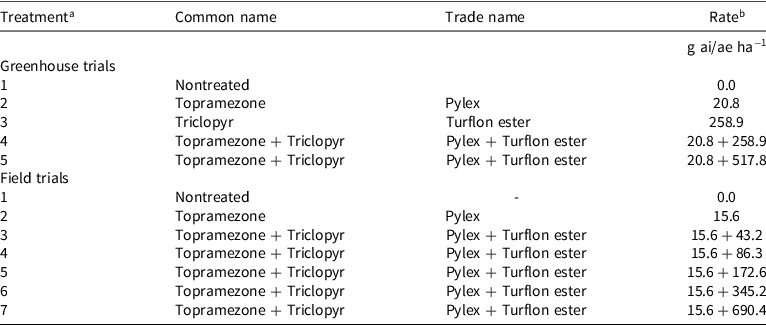
Treatments were arranged in a randomized complete block design with four replications and the trial was repeated twice. Treatments were topramezone and triclopyr applied alone and as a mixture at variable rates (Table 1). Herbicide treatments were applied with a CO2-pressurized sprayer calibrated to deliver 280 L ha−1 spray solution with a handheld four-nozzle boom (TeeJet TP8003VS nozzles with 25-cm spacing; Spraying Systems Company, Wheaton, IL). A nonionic surfactant (Induce, Helena® Chemical Company, Collierville, TN) at 0.25% vol/vol was included in all treatments. Bermudagrass and seashore paspalum injury, chlorophyll fluorescence parameter (Fv/Fm) that reflects the maximum quantum efficiency of photosystem II, and clipping weight were measured weekly at 7, 14, 21, 28, 35, 42, and 48 d after treatment (DAT). Injury was estimated as an average of bleaching and necrosis. Bleaching and necrosis ratings were recorded as visually estimated percentages, with 0% (no white tissue) and 100% (entirely white-discolored tissue), and 0% (no necrosis) and 100% (entirely necrotic tissue), respectively. Dry clipping weight (plant material was oven-dried at 60 C for 72 h) was measured to determine treatment impact on bermudagrass and seashore paspalum growth. Fv/Fm were assessed with a chlorophyll fluorometer designed for light-adapted yield (OS1-FL Portable, Opti-Sciences, Inc., Hudson, NH). The measurements were made approximately 0.5 cm from the bermudagrass and seashore paspalum leaves at midday (between 11:30 AM to 12:30 PM Central time).
Common name and trade name, along with rates used in the studies.

a A nonionic surfactant at 0.25% vol/vol was included in all treatments.
b Rates are expressed in active ingredient (ai) for topramezone and acid equivalent (ae) for triclopyr.
Data for each response variable were tested for normality and homogeneity, and subjected to ANOVA with the PROC GLM procedure of SAS 9.4 (SAS Institute Inc, Cary, NC) to test for significance (P < 0.05) of bermudagrass and seashore paspalum, topramezone and triclopyr treatments and runs with the visual plant injury (bleaching and necrosis), Fv/Fm, and dry weight variables. Fisher’s protected LSD (P < 0.001) was used to compare bleaching and necrosis results. Injury, Fv/Fm, and clipping weight were expressed as mean and standard deviation of mean (±SE) of eight independent replicates. The Fv/Fm data are presented in percent relative to the nontreated. Negative % Fv/Fm indicates a decrease in photochemical efficiency. Figures were plotted with the Sigma Plot 11.0 program (Systat Software Inc.).
Field Trials
Field research was conducted from September to November 2016, and repeated from August to October 2017. The soil type for both years was a Marvyn sandy loam (fine-loamy, kaolinitic, thermic Typic Kanhapludult), pH 6.1, 1.5% organic matter (OM), with fertilizer applied monthly at 24.4 kg ha−1 N in liquid urea form and irrigation applied as needed to promote turfgrass health.
Treatments were arranged in a randomized complete block design with four replications. Treatments were a combination of topramezone and triclopyr (Table 1) applied twice on an 18-d interval. A nonionic surfactant at 0.25% vol/vol was included in all treatments. Treatments were applied using the same or similar apparatus used for the greenhouse trials. Plots were not mowed the day before or after application.
Visual ratings were made 3, 7, 14, 21, 25, 32, 46, and 60 d after initial treatment (DAIT). Both bermudagrass and seashore paspalum injury were evaluated relative to the nontreated on a 0% no injury (bleaching or necrosis) to 100% (complete plant death) scale. Seashore paspalum injury greater than 20% was considered commercially unacceptable.
Data were tested for normality and homogeneity of variance, and subjected to ANOVA with the PROC GLM procedure of SAS 9.4 (SAS Institute Inc, Cary, NC) to test for significance (P < 0.05) of bermudagrass and seashore paspalum, topramezone and triclopyr treatments and years. Year-by-treatment interactions were detected for bermudagrass and seashore paspalum injury; therefore, the years are presented separately. While this statistical difference was observed, our assessment of the data was that years are visually similar and extrapolation with both years is warranted. Year was considered random, and the result of each replicate was expressed as mean and standard error of mean (±SE) of four independent replicates. Graphs were plotted with the Sigma Plot 10.0 program (Systat Software Inc).
Results and Discussion
Greenhouse Trials
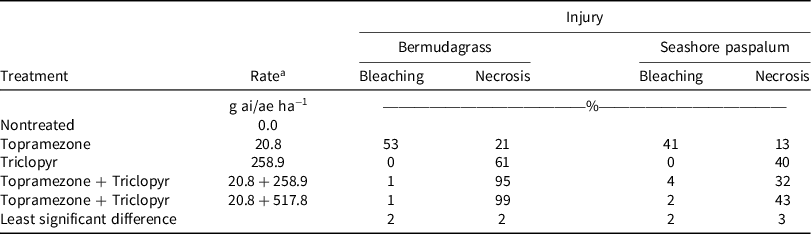
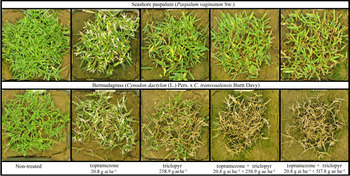
Treatment-by-run interaction was nonsignificant (P > 0.05) for injury, Fv/Fm, and clipping weight; thus, data were pooled over experimental runs. Bermudagrass and seashore paspalum treated with topramezone alone manifested severe leaf bleaching, primarily in the younger tissue (Table 2; Figure 1). This leaf bleaching symptom is typical from herbicides that inhibit the production of photoprotective carotenoid pigments (Grossmann and Ehrhardt Reference Grossmann and Ehrhardt2007; Sandmann et al. Reference Sandmann, Schmidt, Linden and Böger1991). Topramezone plus triclopyr significantly decreased bermudagrass and seashore paspalum bleaching symptoms and increased bermudagrass necrosis (Table 2; Figure 1).
Bleaching and necrosis of seashore paspalum and bermudagrass following topramezone and triclopyr application alone or in mixture at 21 d after application under greenhouse conditions.

a Rates are expressed in active ingredient (ai) for topramezone and acid equivalent (ae) for triclopyr.
Seashore paspalum and bermudagrass following topramezone and triclopyr application alone or in mixture. Bermudagrass growth suppression was 100% with topramezone plus triclopyr under greenhouse conditions.

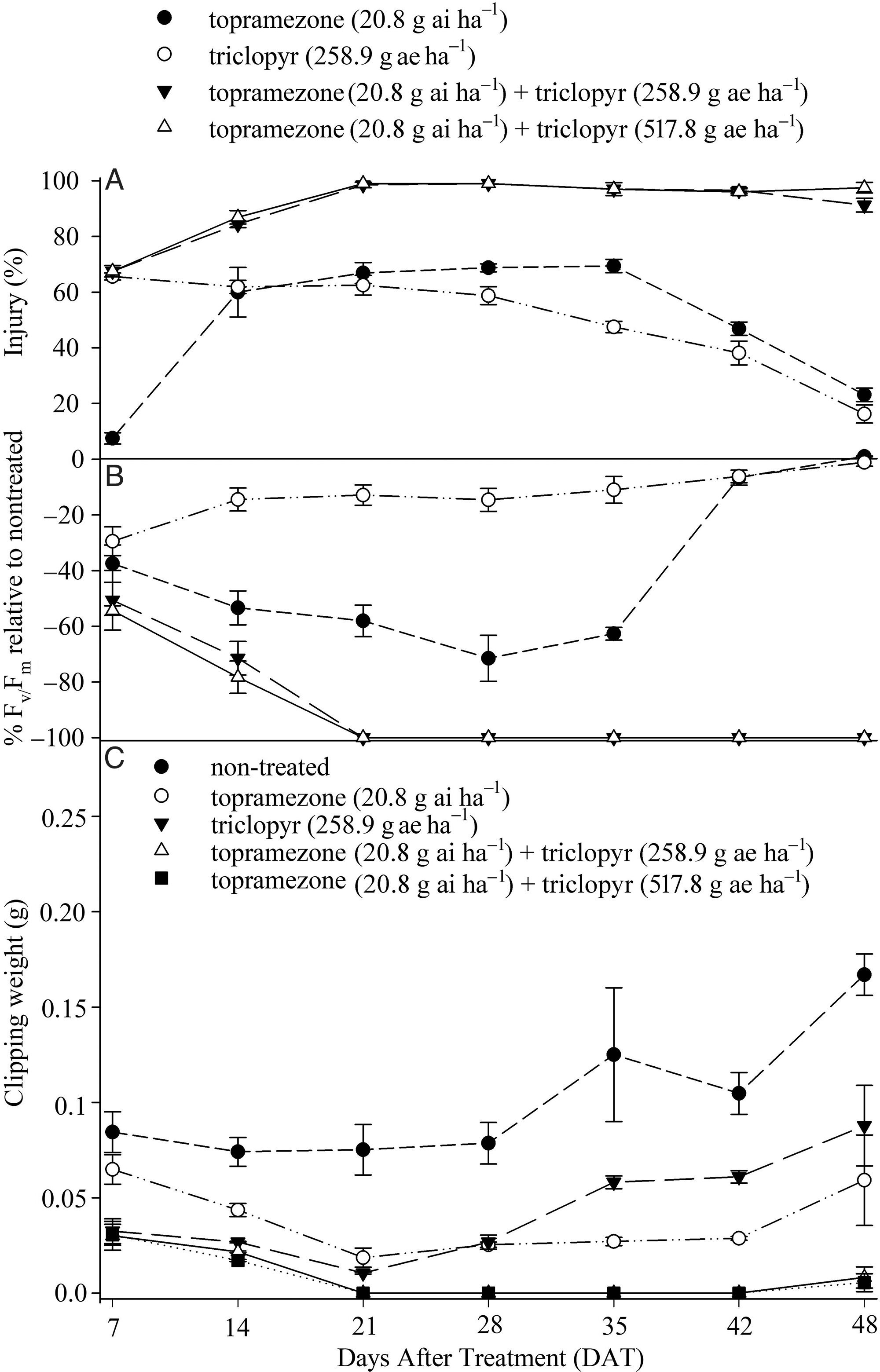
Topramezone (20.8 g ha−1) or triclopyr (258.9 g ha−1) used alone did not kill bermudagrass based on injury, Fv/Fm values, or clipping weight (Figure 2). Injury was <70% from single applications for the duration of the trial. A single application of topramezone mixed with triclopyr (20.8 + 258.9 or 20.8 + 517.8 g ha−1) resulted in 100% injury to bermudagrass 21 DAT (Figure 2A). However, by 35 DAT, bermudagrass began to regrow from regenerative underground rhizomes, indicating the need of sequential application for effective long-term control.
Control (%; A), chlorophyll fluorescence (Fv/Fm; B), and clipping weight (g; C) of bermudagrass treated with topramezone or triclopyr alone or in combination at 7, 14, 21, 28, 35, 42, and 48 d after application (DAT) under greenhouse conditions. Error bars indicate standard errors of individual means, n = 8.

The Fv/Fm values for nontreated bermudagrass ranged from 0.658 to 0.713 throughout the trials. Topramezone alone reduced bermudagrass Fv/Fm values to a greater degree than triclopyr alone. Topramezone reduced Fv/Fm >60% at 28 DAT; however, triclopyr use resulted in reduced Fv/Fm values of <20% at the same time (Figure 2B). Topramezone alone resulted in reduced Fv/Fm more than triclopyr alone because the site of action of topramezone primarily results in inhibition of carotenoid biosynthesis coupled to secondary inhibition of chlorophyll biosynthesis to reduce the overall photosynthetic ability (Brosnan et al. Reference Brosnan, Kopsell, Elmore, Breeden and Armel2011; Hess Reference Hess2000). However, use of triclopyr, a synthetic auxin herbicide, resulted only in growth regulation and showed no direct effect on photosynthetic activities (Matsue et al. Reference Matsue, Koike and Uchida1993; Sterling and Hall Reference Sterling, Hall, Roe, Burton and Kuhr1997).
Topramezone in combination with triclopyr reduced bermudagrass Fv/Fm values by 100% at 21 DAT due to the death of photosynthetic tissues. Although new growth was observed 35 DAT, there was not enough leaf tissue to measure Fv/Fm.
Compared with the nontreated plants, topramezone or triclopyr use resulted in reduced bermudagrass clipping weight at 7, 14, and 21 DAT, but suppression was limited, and bermudagrass recovered by 28 DAT (Figure 2C). Total bermudagrass growth suppression was achieved only with topramezone in mixture with triclopyr, but bermudagrass injury decreased as recovery increased at 48 DAT. Although topramezone plus triclopyr suppresses bermudagrass, sequential applications over multiple years will be needed for effective long-term control because bermudagrass has the regeneration potential owing to its underground rhizomes (Brosnan and Breeden Reference Brosnan and Breeden2013; Lewis et al. Reference Lewis, McElroy, Sorochan, Mueller, Samples and Breeden2010).
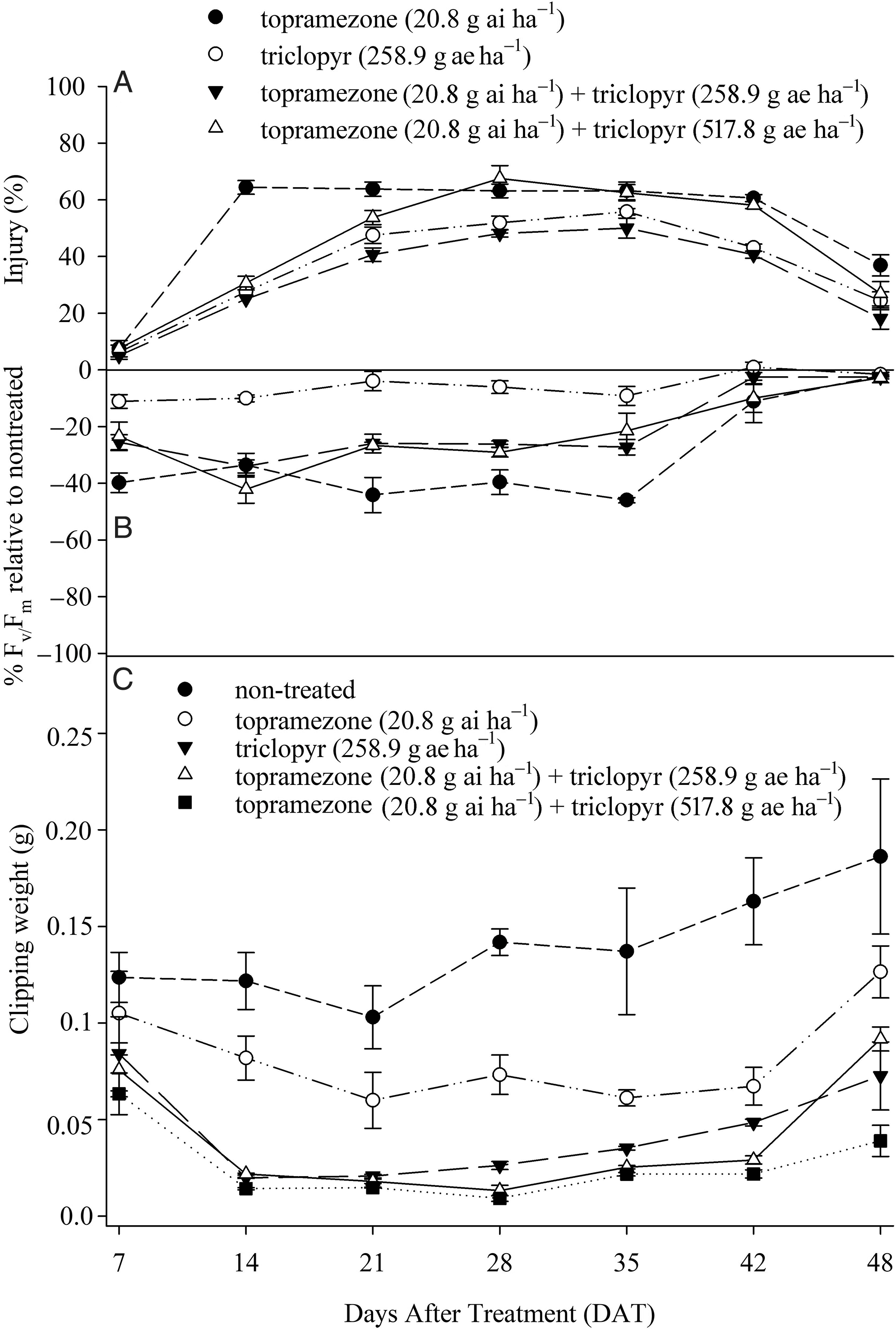
Topramezone or triclopyr alone or in mixture resulted in >40% injury to seashore paspalum under greenhouse conditions (Figure 3A). Topramezone used at 20.8 g ha−1 alone or in combination with triclopyr (20.8 + 517.8 g ha−1) resulted in >60% injury to seashore paspalum at 28 DAT. The lowest injury was observed when topramezone + triclopyr (20.8 + 258.9 g ha−1) was used.
Injury (%; A), chlorophyll fluorescence (Fv/Fm; B), and clipping weight (g; C) of seashore paspalum treated with topramezone or triclopyr alone or in combination at 7, 14, 21, 28, 35, 42, and 48 d after application (DAT) under greenhouse conditions. Error bars indicate standard errors of individual means, n = 8.

The Fv/Fm values for nontreated seashore paspalum ranged from 0.694 to 0.739 throughout the trials. At each rating date, topramezone treatment resulted in reduced seashore paspalum Fv/Fm values to a greater degree than when triclopyr was used. Fv/Fm values were reduced by ≥40% at 21, 28, and 35 DAT when topramezone was used (Figure 3B), whereas triclopyr use resulted in Fv/Fm values that were reduced by <15% on all rating dates. The topramezone plus triclopyr mixture resulted in increased Fv/Fm values compared to topramezone applied alone at 21, 28, and 35 DAT.
These results indicated that the increase in bleaching injury caused by topramezone coincided with reductions in Fv/Fm. Similar reductions in Fv/Fm have been observed for bermudagrass leaf tissue treated with mesotrione, topramezone, and tembotrione (Elmore et al. Reference Elmore, Brosnan, Kopsell and Breeden2011b). The scientific literature explains that Fv/Fm is quantification of the photosystem II efficiency, and that photosystem II efficiency reduction can often be the first manifestation of stress in the leaf (Maxwell and Johnson Reference Maxwell and Johnson2000; McElroy and Walker Reference McElroy and Walker2009).
Topramezone used alone reduced the clipping weight of seashore paspalum less than when triclopyr alone or in mixture with triclopyr (Figure 3C). This result was expected because plant growth regulator herbicides such as triclopyr are used on roadside rights-of-way to reduce the need for mowing (Jeffries et al. Reference Jeffries, Gannon and Yelverton2017).
Field Trials
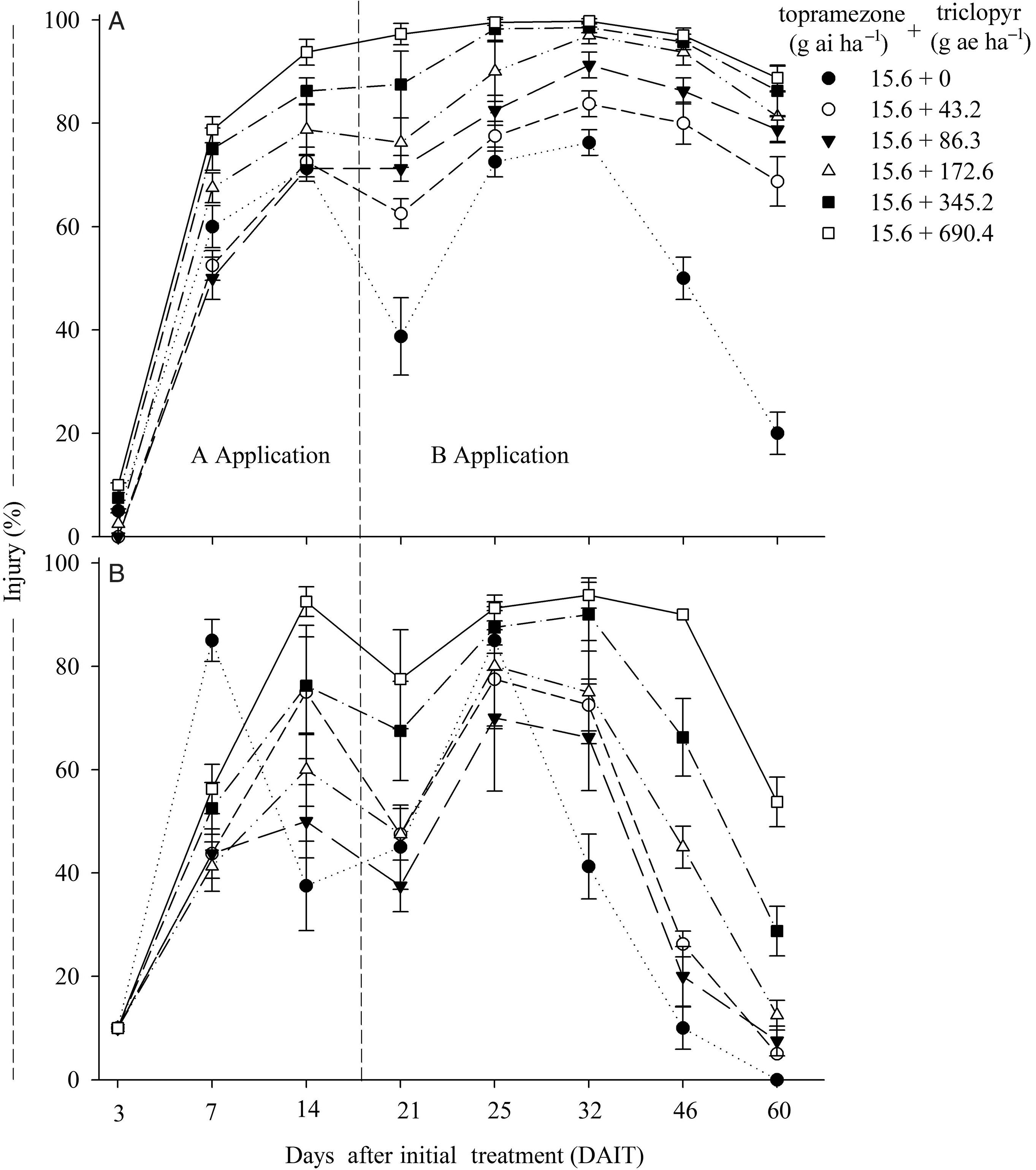
In general, topramezone used alone induced bermudagrass bleaching with minimal necrosis, which resulted in low bermudagrass suppression by study conclusion (Figure 4 A and B). In 2016, topramezone used alone resulted in approximately 68% injury to bermudagrass at 14 DAIT (Figure 4A). In 2017, topramezone used alone resulted in approximately 85% injury to bermudagrass at 7 DAIT, but that decreased to less than 40% at 14 DAIT (Figure 4B).
Bermudagrass injury with topramezone + triclopyr at 3, 7, 14, 21, 25, 32, 46, and 60 d after initial treatment (DAIT) in 2016 (A) and 2017 (B) under field conditions. The vertical line is the timing of the sequential application. Error bars indicate standard errors of individual means, n = 4.

Sequential applications of topramezone alone resulted in increased initial bleaching but did not improve bermudagrass suppression 60 DAIT (Figure 4 A and B). In 2016, bermudagrass injury was increased after the sequential application, reaching a maximum of 76% at 32 DAIT. Similarly, in 2017, maximum bermudagrass injury was 85% at 25 DAIT. In both 2016 and 2017, bermudagrass injury was <50% at 46 DAIT and the injury continued decreasing up to 60 DAIT. Brosnan et al. (Reference Brosnan, Kopsell, Elmore, Breeden and Armel2011) also indicated 50% bermudagrass injury when topramezone was used at 0.018, 0.025, and 38 g ha−1, but visual bleaching decreased for all rates after 21 d. Other researchers report similar symptoms following application of the HPPD inhibitor herbicide mesotrione on other turfgrasses (Elmore et al. Reference Elmore, Brosnan, Kopsell, Breeden and Mueller2011a; McCurdy et al. Reference McCurdy, McElroy, Breeden and Kopsell2008; Willis et al. Reference Willis, Askew and McElroy2007).
Topramezone used in combination with triclopyr at all rates resulted in increased bermudagrass injury, although none of the combined treatments completely killed bermudagrass. In 2016, topramezone + triclopyr resulted in bermudagrass injury of approximately 86% and 94% when the combination was used at 15.6 + 345.2 and 15.6 + 690.4 g ha−1, respectively, at 14 DAIT (Figure 4A). Topramezone + triclopyr combinations used at 15.6 + 43.2, 15.6 + 86.3, and 15.6 + 172.6 g ha−1 resulted in bermudagrass injury by 73%, 71%, and 79%, respectively, at 14 DAIT (Figure 4A). In 2017, by 14 DAIT, significant increases in bermudagrass injury at all combined rates of topramezone + triclopyr also were observed. However, only topramezone + triclopyr used at 15.6 + 690.4 g ha−1 resulted in >90% injury to bermudagrass at 14 DAIT in 2017 (Figure 4B). All other combinations resulted in <80% injury to bermudagrass at 14 DAIT.
Sequential application of topramezone + triclopyr caused greater bermudagrass injury in both years. In 2016, all combination rates caused >80% injury to bermudagrass at 32 DAIT (Figure 4A). Use of topramezone at 15.6 g ha−1 + triclopyr at 172.6, 345.2, or 690.4 g ha−1 resulted in ≥95% injury to bermudagrass, whereas in 2017, only rates of 15.6 + 345.2 and 15.6 + 690.4 g ha−1 resulted in ≥90% injury to bermudagrass (Figure 4B). In both years, bermudagrass injury decreased after 46 DAIT for all topramezone + triclopyr treatments.
In agreement with results reported by Brosnan and Breeden (Reference Brosnan and Breeden2013), topramezone combined with triclopyr resulted in significantly greater bermudagrass injury compared to topramezone or triclopyr used alone. Results from the present study indicate that combining topramezone with triclopyr reduces visual bleaching injury caused by topramezone alone and induces more necrotic symptoms in bermudagrass. Similarly, Brosnan et al. (Reference Brosnan, Breeden, Patton and Weisenberger2013) reported that triclopyr used with topramezone caused reduced leaf bleaching in smooth crabgrass without reducing control. Decreased bleaching is important because this type of injury caused by HPPD inhibitor herbicides may be deemed unacceptable by turfgrass managers or the general public.
Several studies have indicated the synergism of carotenoid-inhibiting herbicides and triclopyr. The addition of triclopyr increased mesotrione efficacy for controlling multi-tiller smooth crabgrass [Digitaria ischaemum (Schreb.) Schreb. ex Muhl.] in tall fescue (Festuca arundinacea Shreb.), and the addition of triclopyr reduced bleaching of the smooth crabgrass (Yu and McCullough Reference Yu and McCullough2016). Triclopyr also provides a synergistic effect when combined with herbicides that inhibit the acetyl-CoA carboxylase enzyme (Doroh et al. Reference Doroh, McElroy and Van Santen2011; Lewis et al. Reference Lewis, McElroy, Sorochan, Mueller, Samples and Breeden2010; McElroy and Breeden Reference McElroy and Breeden2006).
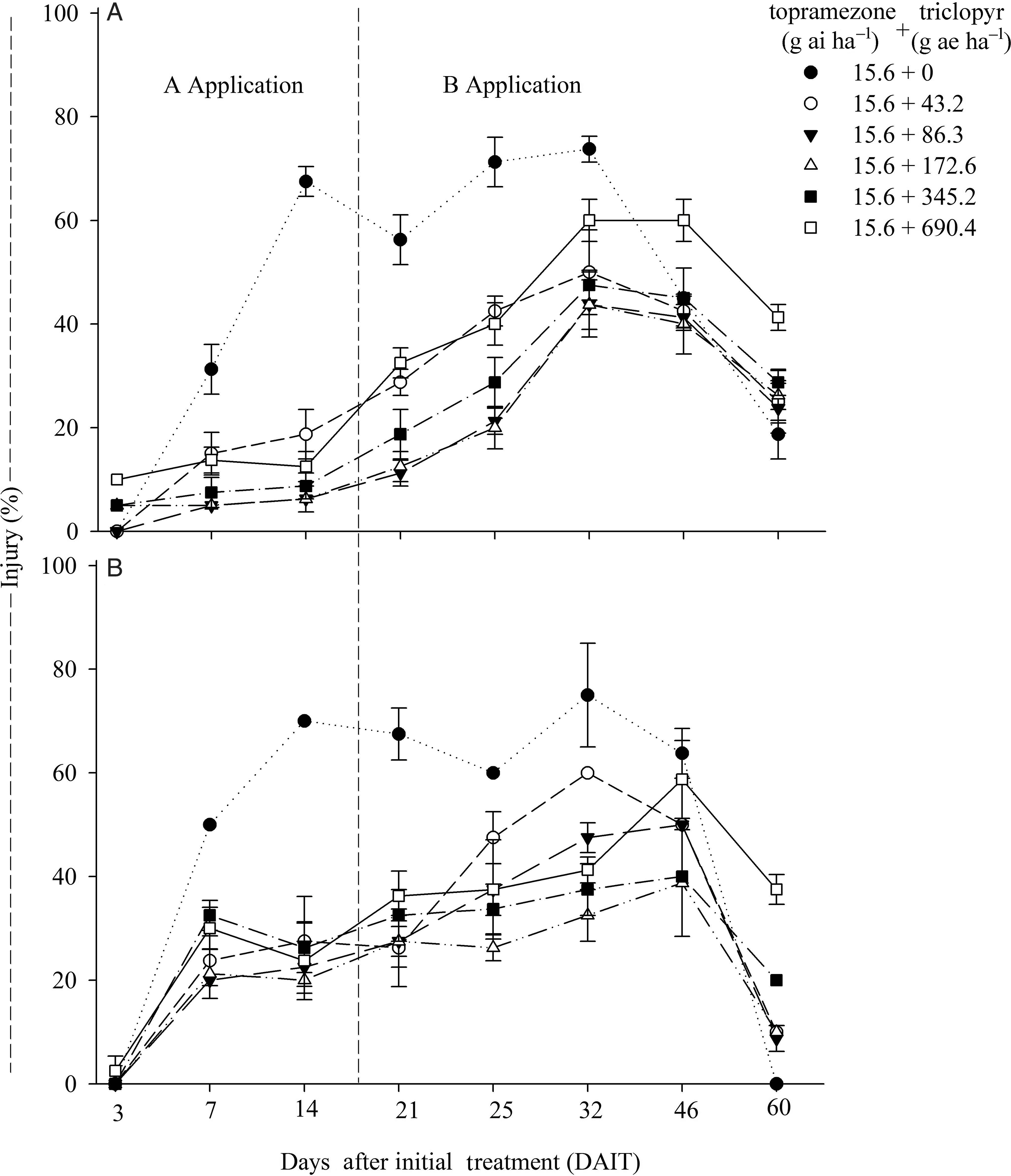
In both years, topramezone used alone resulted in >65% injury to seashore paspalum at 14 DAIT and >70% at 32 DAIT (Figure 5 A and B). By 60 DAIT when topramezone was used alone, seashore paspalum recovered from injury to levels that were deemed acceptable. Triclopyr reduced bleaching caused by topramezone alone at all rates tested. In 2016, all topramezone + triclopyr treatments resulted in less than 25% injury to seashore paspalum until after sequential application. Likewise, in 2017 seashore paspalum injury was less than 30% until after the sequential application (Figure 5B).
Seashore paspalum injury with topramezone + triclopyr at 3, 7, 14, 21, 25, 32, 46, and 60 d after initial treatment (DAIT) in 2016 (A) and 2017 (B) under field conditions. The vertical line is the timing of the sequential application. Error bars indicate standard errors of individual means, n = 4.

Sequential application of topramezone + triclopyr resulted in increased injury compared to a single application (Figure 5 A and B). Topramezone (15.6 g ha−1) plus triclopyr (86.3, 172.6, or 345.2 g ha−1) resulted in <50% seashore paspalum injury. Injury decreased for all treatments after 46 DAIT. In 2017, seashore paspalum recovered faster from herbicide injury than in 2016 (Figure 5B).
Our findings suggest that hybrid bermudagrass cannot be killed with two applications of topramezone with or without triclopyr. However, it may be possible to use topramezone with or without triclopyr as a component in a program to suppress bermudagrass in seashore paspalum. There are currently no single application programs for bermudagrass suppression in any scenario. Even glyphosate requires sequential or multiple applications to provide long-term bermudagrass control (Johnson Reference Johnson1988).
Selective bermudagrass suppression in other turfgrass species is largely achieved with multiple applications over multiple years (Johnson and Carrow Reference Johnson and Carrow1995; McCarty Reference McCarty1996). Such applications allow bermudagrass removal from a turfgrass stand and the simultaneous growth into the killed areas by the desirable turfgrass. Acceptable bermudagrass suppression has been achieved following sequential applications of ethofumesate plus atrazine applied in March, April, and May, which had no effect on the quality of St. Augustinegrass [Stenotaphrum secundatum (Waltz.) Kuntze] (McCarty Reference McCarty1996). Fenoxaprop plus ethofumesate (0.2 + 1.7 kg ha−1) can be used to suppress bermudagrass in tall fescue with only transient injury within 1 to 2 wk of application (Johnson and Carrow Reference Johnson and Carrow1995). Clodinafop, fenoxaprop, and metamifop mixed with triclopyr can suppress >89% of bermudagrass in zoysiagrass (Zoysia matrella L. Merr; Doroh et al. Reference Doroh, McElroy and Van Santen2011).
Topramezone could potentially be integrated into such bermudagrass suppression programs. In our estimation, such programs will likely require manipulation of topramezone rate, application timing, application interval, and number of applications. Furthermore, we have demonstrated that triclopyr is a possible synergist for bermudagrass suppression that also reduces seashore paspalum injury, at least in the short term.
Acknowledgments
This publication was supported by the Alabama Agricultural Experiment Station and the Hatch program of the U.S. Department of Agriculture–National Institute of Food and Agriculture. No conflicts of interest have been declared.