Introduction
All classes of poultry have definite requirements for sodium (Na), potassium (K) and chloride (Cl) in the correct amounts/ ratio for pivotal physiological functions especially acid-base homeostasis. The Na and K are major cations whereas Cl and bicarbonate (HCO3) are major anions in body fluids. Cations and anions are closely linked to the conditions of alkalosis and acidosis in body fluids, respectively. The resulting net alkalosis and acidosis could be examined simply by measuring these ions in the diet and then in the faeces. There is a third expression, other than the cations and anions, referred to as endogenous acid production (H+ endo). It is known to play a crucial role in causing acidosis in body fluids because of its involvement in protein metabolism (Mongin, Reference MONGIN1981).
Sodium, the major cation in extracellular fluid, is closely associated with Cl and HCO3 ions in the body fluids. Diets deficient in Na lead to adrenal malfunction, and this results in increased uric acid levels, which may cause physiological shock and ultimately death in the chicks. Broiler chickens have the ability to maintain blood and tissue Na homeostasis by excreting excess Na and conserving short supply in the diet, demonstrating their hypotonic nature (Leeson and Summers, Reference LEESON and SUMMERS2001).
Potassium is the third most abundant element in the animal (El-Deek et al., Reference EL-DEEK, EL-DEEN, HAMDY, ASAR, YAKOUT and ATTIA2010) and is the focal intracellular cation as well. Muscle, blood and nerve cells are abundant in K reserves. It participates in the metabolic and regulatory processes that are essential to the body homeostasis such as acid base balance (ABB), osmotic pressure regulation, safeguarding intracellular homeostasis, development of membrane potentials of cells (nerve transmission), glucose and amino acid absorption and transport (Leeson and Summers, Reference LEESON and SUMMERS2001). Changes in K homeostasis can affect cell function as a consequence of its involvement in many vital procedures, and in turn, can manipulate physiological responses of the birds. The excretion of K is influenced by a number of hormonal factors (aldosterone, anti-diuretic hormone and deoxycorticosterone). Further, the concentration of K excretion in urine is variable. It is related to serum Na concentrations and the bird's hydration status, where losses can be caused by an increase in water consumption, since the osmotic gradient favours the movement of intracellular fluid water in the urine, which may carry K.
Poultry diets are marginal in K especially, when the animal protein is included as a large percentage of the total diet protein. Additionally, the moderate K availability from natural feedstuffs may lead to borderline conditions in certain diets during times of stress or for maximum processing yield of breast meat. K is extremely important for optimal nitrogen retention owing to a consistent ratio between nitrogen and K in fresh tissues (Leeson and Summers, Reference LEESON and SUMMERS2001). The reported requirement for K in relationship to nitrogen is 5 mEq/g of amino acid nitrogen for optimal retention in poultry meat.
Chloride, in addition to Na and K, serves as the major electrolyte of the body fluids. Being a negatively charged ion, its role with positively charged ions (i.e. Na and K) is necessary to maintain osmolarity of the body fluids and acid base homeostasis. Interestingly, Cl is found to be combined with Na in various salts, the most common one in poultry diets being sodium chloride (NaCl).
The interrelationship of these electrolytes is known as dietary electrolyte balance (DEB = Na+K-Cl; mEq/kg), which plays an influential role in homeostasis of the body fluids. Mongin (Reference MONGIN1981) studied the basic role of the DEB for chickens, and assumed that the electrolyte equilibrium could be best described in a combination. The purpose of this review is to acquire information regarding individual role of each electrolyte (Na, K, Cl), their combination (i.e. DEB) and sources of these electrolytes, and to know how they influence the acid base balance, blood chemistry, carcass traits and anticoccidial interaction in broiler chickens under various dietary and environmental strategies.
Dietary electrolytes and acid-base balance
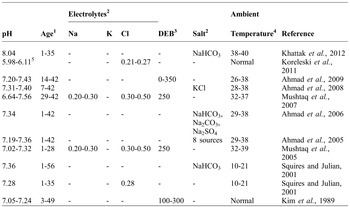
The acid-base balance (ABB), blood pH and growth rate in broilers, as influenced by the relationship of cation and anion, was studied many years ago by Hurwitz et al. (Reference HURWITZ, COHEN, BAR and BORNSTEIN1973). The influence of ABB is affected by a number of other factors; among these diet composition and environmental conditions are important (Table 1). These conditions may profoundly affect regulation of pH in the blood and tissues where there is a deviation from ABB. Acids are known to be the final metabolites removed from the body by either the kidneys or lungs; though if these metabolites keep accumulating in the body, they can alter the ABB from its normal status (Ruíz-López and Austic, Reference RUÍZ-LÓPEZ and AUSTIC1993). The concentration and chemical properties of the acids and bases dissolved in the blood plasma are major determinants of its pH and can be identified as: 1) carbonic acid; 2) metabolisable acids (acetic and lactic); and 3) non-metabolisable inorganic acids and bases.
Impact of electrolytes, dietary electrolyte balance and salts on acid base balance of broilers under various environmental regimens.

1Day
2Percentage
3Milliequivalent per kg (mEq/kg)
4Centigrade
5pH of breast meat after 24h
It is anticipated that ABB is the direct response of blood pH, which depicts birds' normal physiological and biochemical status, and is further reflected in growth performance of the birds. The growth of broiler was found greatest when blood pH was 7.28, whereas a decrease in growth was found when pH values were greater than 7.30 or lower than 7.20 (Hurwitz et al., Reference HURWITZ, COHEN, BAR and BORNSTEIN1973). It has been shown that pH values greater than 7.25 depressed growth rate and feed efficiency during panting conditions. This narrow range of pH determines the activity of enzymes that is depicted in terms of better health status and growth performance. Rising blood pH can be adjusted by a reduction in the respiratory rate of birds; however this increase can occur with acclimatisation temperatures, and can be improved by promoting water consumption (Belay and Teeter, Reference BELAY and TEETER1993).
It is assumed that the blood cations (Na and K) are complemented inversely through the shuffling of various anions (Cl and HCO3) concentrations, so as Cl goes up, HCO3goes down and vice versa to maintain ABB. Diets supplemented with extra Cl can cause blood acidosis or, on the other hand, adding HCO3 to the diet can result in blood alkalosis within certain physiological limits. The mechanism behind this might be the consumption of a non-absorbable or poorly absorbable cations accompanied by an absorbable anion and vice versa, which may strongly influence the ABB. The addition of HCO3 to the diet may lower the level of ‘effective Cl’ in the diet by eliminating some Cl from the bird through the kidneys. Benton et al. (Reference BENTON, BALNAVE and BRAKE1998) stated that an increase in plasma Cl decreases H+ excretion and HCO3 reabsorption by the kidneys, whereas an increase in plasma Na increases H+ excretion and HCO3 reabsorption although both situations affect blood pH differently. An increase in plasma K decreases HCO3reabsorption from the kidneys. It has been established that every 0.1 unit decrease in pH (H+ increase) causes plasma K to increase from 0.2 to 1.7 mEq/l. So, the electrolyte relationship in plasma is best identified as: 1) K content follows H+ (K inversely related to pH), 2) HCO3content follows Na content, and 3) HCO3 content inversely follows Cl content (Benton et al., Reference BENTON, BALNAVE and BRAKE1998).
Higher levels of dietary Cl as known to depress blood pH and HCO3 (Ruíz-López and Austic, Reference RUÍZ-LÓPEZ and AUSTIC1993) are major causative agents linked to intensifying the occurrence of tibial dyschondroplasia (TD) and cartilage abnormalities by dietary induced metabolic acidosis, and possibly attributed to competitive assimilation with calcium in the small intestine. Bone is known to be involved in the buffering system of body fluids, as evident from release of calcium ions in the blood to correct its pH. Another factor of induced acidosis is the reduction of Na:Cl ratio (Teeter et al., Reference TEETER, SMITH, OWENS, ARP, SANGIAH and BREAZILE1985). Any excess K ions compete with buffer anions in the renal tubule fluid, preventing H+ removal, which in turn reabsorbs and the result may be acidosis. The H+ excretion and HCO3− reabsorption by the kidneys is reduced by increasing Cl ions where it potentially contributes to blood acidification per se.
With increasing DEB, blood pH augments linearly as cations (Na/K) are responsible for the increase in DEB while DEB reduced with anions (Cl/HCO3). A range of DEB i.e. 150-350 mEq/kg was recommended by Murakami et al., (Reference MURAKAMI, OVIEDO-RONDON, MARTINS, PEREIRA and SCAPINELLO2001) and Rondon et al., (Reference RONDON, MURAKAMI, FURLAN, MOREIRA and MACARI2001) but how changing electrolytes behave in this range is not yet identified. Changes in DEB and ABB is linked to loss of appetite with a corresponding reduction in growth performance. However this type of depression in growth, owing to the disturbed pattern of feed intake, may possibly be the consequence of affecting such areas of the brain which control feed intake in birds (Mongin, Reference MONGIN1981).
Dietary electrolytes, heat stress and acid-base balance
Bicarbonate provides a vital buffer system for maintaining normal blood pH, being under the dual regulatory control of both the lungs and kidneys. Major advances have been made in understanding how kidneys control the concentration of HCO3i.e. by modifying reabsorption from the renal tubules to maintain ABB. Blood pH, as determined by the bicarbonate buffering system, is represented by the Henderson-Hassel Balch equation, i.e., pH = 6.1 + log [HCO3–] / 0.03 pCO2. Normally, the ratio of HCO3and 0.03 pCO2 is 20:1, resulting in a blood pH of approximately 7.4. Increased ventilation decreases pCO2 during heat stress, which increases the log term in the Henderson-Hassel Balch equation, thereby increasing the pH and potentially induces respiratory alkalosis. The levels of Na, K and Cl in the plasma are all affected by respiratory alkalosis. Of the three ions, changes in K are better understood.
Plasma K increases from 0.2 to 1.7 mEq/l for every 0.1 unit decrease in pH. The increase in plasma K has been attributed to decreased excretion (Ait-Boulahsen et al., Reference AIT-BOULAHSEN and EDENS1995) and uptake by cells. The former appears to predominate under chronic heat stress conditions, and the latter during acute heat stress. Besides the relationship between plasma K and pH, Borges et al. (Reference BORGES, FISCHER DA SILVA, ARIKI, HOOGE and CUMMINGS2003) showed that K (as KHCO3) exaggerated respiratory alkalosis and resulted in high pH. Mushtaq et al. (Reference MUSHTAQ, MIRZA, ATHAR, HOOGE, AHMAD, AHMAD, MUSHTAQ and NOREEN2007) showed reduced serum K level by increasing dietary Na in heat-stressed broilers.
An increase in plasma Na was found to accompany haemodilution in hot summer conditions (Ait-Boulahsen et al., 1995). This increase has been ascribed to peripheral vasodilation and increased blood flow to vascular beds, however does not represent a physiological response to alkalosis. Plasma Cl has been found to increase during heat stress in poultry (Ait-Boulahsen et al., 1995). This increase has been attributed to a mechanism known as the ‘chloride shift’ across erythrocyte membranes as blood CO2 levels decrease. An increase in plasma Cl appears to contribute towards lowering of blood pH, thus represents an appropriate response to alkalosis per se. The range of supplementation of dietary electrolytes in the form of a balance i.e. DEB is known to influence ABB in broilers (Murakami et al., Reference MURAKAMI, OVIEDO-RONDON, MARTINS, PEREIRA and SCAPINELLO2001; Rondon et al., Reference RONDON, MURAKAMI, FURLAN, MOREIRA and MACARI2001). Lower values of DEB (< 50 mEq/kg) are associated with blood acidosis while higher values (> 300 mEq/kg) could be related to blood alkalosis (Ahmad et al., Reference AHMAD, MUSHTAQ, KHAN, BABAR, YOUSAF, HASAN and KAMRAN2009) under heat stress conditions. This association of lower and higher DEB with acidosis and alkalosis is a direct reflection of adding anions and cations, respectively, in the diets. Therefore, the extremes of DEB should be avoided to protect broilers from acid-base imbalances.
Dietary electrolytes, salts and acid-base balance
There has been always a tendency to link acid-base balance with electrolytes and environment, especially temperature. Nevertheless, contributing salt plays an important role in this regard. In the first place, NaHCO3 is considered as an appropriate supplemental salt (Mongin, Reference MONGIN1981) especially during heat stress (Ahmad et al., Reference AHMAD, SARWAR and MAHR-UN-NISA2005) as it provides Na and HCO3–, for maintaining pH. When heat-stressed broilers were offered 0.2% NaHCO3 they had lower pH and better performance than an unsupplemented group (Khattak et al., Reference KHATTAK, ACAMOVI, SPARKS, PASHA, JOIYA, HAYAT and ALI2012). When higher quantities (0.5% NaHCO3) were offered, broilers exhibited the same blood pH (7.4) as the unsupplemented group (without NaHCO3) in summer conditions, indicating NaHCO3 did not cause further alkalosis in heat stress (Teeter et al., Reference TEETER, SMITH, OWENS, ARP, SANGIAH and BREAZILE1985). However, similar blood pH, during panting behaviour, in diets with and without NaHCO3 indicated that the alkalosis was not exacerbated and the birds performed better. The addition of 0.5 and 1.0% NaHCO3 to the feed of broilers subjected to high temperature improved growth performance. Gorman and Balnave (Reference GORMAN and BALNAVE1994) indicated that heat-stressed broilers responded better to supplements of NaHCO3 than other dietary salts.
In another study by Smith and Teeter (Reference SMITH and TEETER1993), heat stress conditions were rectified by adding KCl in the feed and/ or drinking water to minimise poor growth responses in broilers. Similar findings of improved weight gain were observed by supplementing KCl, NaCl and NaHCO3 in the feed (Borges, Reference BORGES1997). The beneficial effects of KCl supplementation could, under heat stress conditions, replace K tissue reserves lost by altered tissue cell permeability and would supply Cl for alkalosis. Teeter and Belay (Reference TEETER and BELAY1996) observed no effect on the performance of birds with the addition of NH4Cl. Similarly, Leeson and Summers (Reference LEESON and SUMMERS2001) were inconclusive regarding the beneficial effects of NH4Cl, which may either be due to changing ABB or water intake. Hooge (Reference HOOGE2003) stated that it was better to ‘prevent’ heat stress with NaHCO3 and KCl. So it is recommended to use NaHCO3 and KCl as a potential remedy under heat stress conditions. These observations led to the idea that different electrolyte sources led to a positive impact on the performance of heat-stressed broilers. However, variations among different studies indicated that there is a need to define the electrolyte source, its amount and combination of different sources for optimum broiler growth performance under heat stress conditions. Moreover, in this regard, not only the source but the concentration of different electrolytes could play a major role.
Dietary electrolytes, protein source and acid-base balance
It is anticipated that the metabolism of minerals (especially electrolytes) and amino acids can often be used to adjust ABB. Protein source used in the feed can affect the electrolyte and ABB e.g. animal by-products increase the production of organic acids and reduce Na and K contribution, increasing the relative amount of Cl. Mongin (Reference MONGIN1981) initiated this issue that protein source is directly related with H+ endo, which is affected by the composition, the presence of organic phosphorus and other mineral composition of protein sources. Further, Walser (Reference WALSER1986) discussed that ammonium ion (NH4+) excretion reflects increased acid removal if it is accompanied by Cl ions or occurs in exchange for Na ions. Generally, the oxidation of protein is considered as a net contributor to acidification, although this depends on its amino acid profile, whereby oxidation of dicarboxylic amino acids tend to cause metabolic alkalosis and oxidation of neutral amino acids has no effect on acid-base balance (Walser, Reference WALSER1986). It is known that the phosphorylation of amino acids causes metabolic acidosis.
Dietary electrolyte balance is assumed to have a complex relationship with changing dietary CP. Increasing the DEB from 200 mEq/kg to 350 mEq/kg improved growth performance in broilers fed high CP diets (28.6%) but not on low CP diets (14.3%; Adekunmisi and Robbins, Reference ADEKUNMISI and ROBBINS1987). However, this relationship (DEB × CP) did not influence broiler performance in the starter period (Borges et al., Reference BORGES, LAURENTIZ, ARAÚJO, ARAÚJO, MAIORKA and ARIKI2002). Animal protein sources can ameliorate reduced performance by adding DEB (>200 mEq/kg), especially K supplementation as these are typically deficient in this mineral (Murakami et al., Reference MURAKAMI, SALEH, WATKINS and WALDROUP2000).
The absorption of amino acids (AA) appears to be an Na-dependant process, however absorption of AA sources may vary, as 2-hydroxy-4-methylthio butanoic acid (HMB) doesn't need such carrier. However, supplementing methionine through HMB along with Na showed a positive growth response from d 1-21 (Motl et al., Reference MOTL and FRITTS2005). In another experiment, a positive response for HMB, when compared with DL-Methionine (DLM), was found at all levels of dietary Na (0.15, 0.20 and 0.25%) for growth performance at 48 d of age (Ribeiro et al., Reference RIBEIRO, KESSLER, VIOLA, SILVA, RUBIN, RABER, PINHEIRO and LECZNIESKI2008). It is clear from these results that DLM and HMB are equally available in the presence of Na. Nevertheless, when these sources were compared with K levels (0.90, 1.00 and 1.10%), a consistent interaction was observed for better FI, while deteriorating FCR was seen for the highest level of K fed (Ribeiro et al., Reference RIBEIRO, KESSLER, VIOLA, SILVA, RUBIN, RABER, PINHEIRO and LECZNIESKI2008).
A new direction in this area has been shown by Cowieson et al. (Reference COWIESON, ACAMOVIC and BEDFORD2004), who found an increased requirement of Na by ingesting higher levels of phytate, which is ameliorated by phytase supplementations. The flow of endogenous AA is reduced in increased NaCl diets, however Na can disrupt phytate:protein complexes, thus mitigating one of the mechanisms by which phytate exerts its antinutritional effect and disrupts AA flow (Cowieson et al., Reference COWIESON, BEDFORD, RAVINDRAN and SELLE2011). The effect of phytase on ileal AA digestibility could be completely negated by increasing dietary Na concentrations (Ravindran et al., Reference RAVINDRAN, COWIESON and SELLE2008). It appears that phytate may compromise the efficiency of Na-dependent transport systems and the intestinal uptake of AAs and glucose by the depletion of Na, which is counteracted by phytase. Earlier, the relationship between Na and Cl with arginine: lysine ratio was deemed of great importance, especially with respect to ambient temperature (Brake et al., Reference BRAKE, BALNAVE and DIBNER1998). In broilers aged three to seven weeks old and kept under heat stress conditions, the ratio between arginine:lysine was standardised at 1.34 when Na and Cl were added according to NRC (1994) recommendations. However, when Na and Cl in the diet was increased, the recommended arginine:lysine ratio was found to be below 1.05; thus showing that under heat stress, the adjustment of the electrolyte balance for maximum bird performance can be related to the composition of amino acids in the diet (Brake et al., Reference BRAKE, BALNAVE and DIBNER1998). Kim et al. (Reference KIM, HAN and CHOI1989) suggested that cations (Na and K) alleviate, but chloride exacerbates the lysine-arginine antagonism that is associated with altering ABB in broilers. Various salts, including K-acetate, NaHCO3- and high DEB in low arginine diets, tend to increase free arginine in the plasma. This is due to reduced arginine catabolism, especially in high lysine diets. However supplementation of NaHCO3 with increasing levels of lysine has nothing to do with growth performance in heat-stressed broilers (Kidd et al., Reference KIDD, BARBER, ZUMWALT, BRANTON and HOEHLER2003).
Dietary electrolytes and blood chemistry
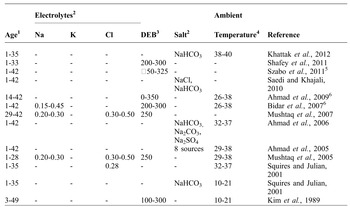
The blood system is particularly sensitive to changes in ABB or other physiological deviations, thus can be used as an indicator of performance responses in broiler chickens. The dependency of blood chemistry is mainly influenced by various electrolytes, DEB and salts in different studies (Table 2). The maintenance of intracellular osmolarity is accomplished through the Na-K pump. Cl competes with HCO3 for the cations in extracellular fluid to establish electrical neutrality. The quantitative and morphological changes in blood cells are coupled with a number of factors such as differential cell count, haematocrit (Hk), and haemoglobin (Hb) contents. Higher Hk and Hb contents are associated with low Cl/ high HCO3 diets (Squires and Julian, Reference SQUIRES and JULIAN2001). Phosphate, HCO3 and Cl in conjunction with Hb are most closely associated with the pH of the bloodstream, which is normally maintained within a range of 7.35-7.45. Depression in blood pH and HCO3 is associated with high dietary Cl (Ruíz-López and Austic, Reference RUÍZ-LÓPEZ and AUSTIC1993) and is associated with the oxygen affinity of Hb. Moreover, increased supplementation via dietary Cl from 0.31 to 0.73% reduced serum K and Ca ions (Mushtaq, Reference MUSHTAQ2010; Mushtaq et al., Reference MUSHTAQ, PASHA, AKRAM, MUSHTAQ, PARVIN, FAROOQ, MEHMOOD, IQBAL and HWANGBO2013a). However, these parameters, along with the partial pressure of blood CO2 (pCO2), increased with increasing DEB from 100 to 300 mEq/kg (Kim et al., Reference KIM, HAN and CHOI1989). Increasing dietary Cl from 0.30 to 0.40% decreased serum Na and K while serum K was found to positively correlate with increased water consumption (Ruíz-López and Austic, Reference RUÍZ-LÓPEZ and AUSTIC1993). Serum Cl tended to be greater in birds receiving high levels of dietary Cl, and the electrolyte concentration in serum can be used as a reflection of the respective supplemental electrolyte in the diet (Ahmad et al., Reference AHMAD, SARWAR and MAHR-UN-NISA2005; Mushtaq, Reference MUSHTAQ2010; Mushtaq et al., Reference MUSHTAQ, PASHA, AKRAM, MUSHTAQ, PARVIN, FAROOQ, MEHMOOD, IQBAL and HWANGBO2013a).
The studies of electrolytes, dietary electrolyte balance and salts with special reference to blood chemistry of broilers under various environmental regimens.

1Day
2Percentage
3Milliequivalent per kg (mEq/kg)
4Centigrade
5Better immunity
6No Effect on blood pH
Dietary electrolytes, heat stress and blood chemistry
The blood chemistry of the broilers under heat stress is entirely different from that under normal ambient temperature, as birds maintain their regulatory system by excreting Na and K coupled with HCO3 during respiratory alkalosis (Ahmad et al., Reference AHMAD, KHALID, MUSHTAQ, MIRZA, NADEEM, BABAR and AHMAD2008). Reducing blood Hk and Hb concentrations alongside increasing blood glucose are commonly seen in heat-distressed broilers (Borges, Reference BORGES1997).
Higher H:L and lower serum electrolytes (Na, K and Cl) were observed by Salvador et al. (Reference SALVADOR, ARIKI, BORGES, PEDROSO and MORAES1999) as a consequence of high ambient temperature. When the same concept of high environmental temperature on electrolyte status was investigated in different broiler strains (Thai Indigenous, Thai Indigenous crossbred and broiler chickens), the Thai Indigenous chicken preserved the electrolytes in their body better than Thai Indigenous crossbred and broiler chickens, respectively (Aengwanich, Reference AENGWANICH2007).
The interrelationship of Na and Cl for blood parameters under sub-tropical summer conditions was clearly described by Mushtaq et al. (Reference MUSHTAQ, SARWAR, NAWAZ, MIRZA and AHMAD2005; Reference MUSHTAQ, MIRZA, ATHAR, HOOGE, AHMAD, AHMAD, MUSHTAQ and NOREEN2007). From d 1-28, dietary Na or Cl affected the acid-base status and serum Na and K in hot environments. Maximum blood pH (7.39) at 0.40% Cl was seen, and an interactive effect (Na × Cl) was found to be highly influential on blood pH. Birds fed diets containing 0.25% Na and 0.30% Cl showed low blood pH (Mushtaq et al., Reference MUSHTAQ, SARWAR, NAWAZ, MIRZA and AHMAD2005). From d 28-42, the main and interaction effects of dietary Na and Cl profoundly affected the blood pH as well as serum Na and K. Further, the increase in dietary Na from 0.20 to 0.30% increased serum HCO3 in a linear fashion. Blood pH increased with increased serum HCO3, and as a result, the birds made physiological adjustments to keep the blood pH near optimal (7.35; Mushtaq et al., Reference MUSHTAQ, MIRZA, ATHAR, HOOGE, AHMAD, AHMAD, MUSHTAQ and NOREEN2007). Demand for Na and K contents dropped off (Borges, Reference BORGES1997) while Cl concentration increased (Belay and Teeter, Reference BELAY and TEETER1993) as the temperature rose and resulted in low blood electrolyte balance. The effects of different levels of dietary Na or Cl were more pronounced on blood parameters, which supported the view that DEB might be used to predict or adjust acid-base status in blood (Murakami et al., Reference MURAKAMI, OVIEDO-RONDON, MARTINS, PEREIRA and SCAPINELLO2001). However, the role of K has not yet been explored to such extent as that of Na and Cl. Higher blood Na and Cl, as a result of high dietary Na and Cl intakes, was observed with a higher (350 mEq/kg) and lower (0 mEq/kg) concentration of DEB, respectively (Ahmad et al., Reference AHMAD, MUSHTAQ, KHAN, BABAR, YOUSAF, HASAN and KAMRAN2009). Therefore, a level of DEB between 150-250 mEq/kg is recommended to maintain blood pH under sub-tropical summer conditions.
The association of reduced plasma Na and K has generally been reported owing to high ambient temperatures (Belay and Teeter, Reference BELAY and TEETER1993; Ait-Boulahsen et al., 1995; Borges, Reference BORGES1997), probably as a result of haemodilution following increased water consumption. Regardless of this fact, it was observed that the difference in the period of heat stress at the time of sampling may indicate no change in plasma K and Na levels. Hence it can be suggested from the above discussion, that higher concentrations of dietary Na should be balanced with manipulated Cl and K contents so as to adjust ABB in heat distressed broilers. In addition it has been observed that any varying degree of change in blood chemistry (particularly mineral chemistry) should be closely monitored and corrected by selection of supplemental electrolytes or DEB.
Dietary electrolytes, salts and blood chemistry
The source of a dietary electrolyte (i.e. salt) is an important factor in order to determine the acidic properties of a particular anion, such as Cl or sulphates (SO4). The acidic properties of K2SO4 and Na2SO4 are different from each other, and range between 58 and 84%, respectively, mainly owing to the anionic source. This acidic property of the source may not be apparent in heat stress conditions, as high pH is compensated for with anions (SO4) in heat-stressed birds (Ruíz-López and Austic, Reference RUÍZ-LÓPEZ and AUSTIC1993; Ahmad et al., Reference AHMAD, MUSHTAQ, SARWAR, HOOGE and MIRZA2006).
It has been considered that salts of various sources might have a different effect on bird physiology and blood characteristics, depending upon whether they are included in the feed or water (Borges et al., Reference BORGES, FISCHER DA SILVA, MAJORKA, HOOGE and CUMMINGS2004). The supplementation of electrolytes through the water not only stimulates water intake but also counterbalances for the losses of electrolytes (Dai et al., Reference DAI, BESSEI and QUANG2009). Supplementing water with KCl has been reported to regulate the level of erythrocytes and Hb of heat-stressed broiler chicks (Borges et al., Reference BORGES, FISCHER DA SILVA, ARIKI, HOOGE and CUMMINGS2003). When drinking water was supplemented with 0.6% KCl, lower blood pH (up to 7.31) was observed and birds showed better physiological adaptation under severe heat stress conditions (35 to 38°C; Ahmad et al., Reference AHMAD, KHALID, MUSHTAQ, MIRZA, NADEEM, BABAR and AHMAD2008). Further, the increased supplementation of KCl (1.5%) along with NaHCO3 (0.5%) elevated the serum K and HCO3 (Naseem et al., Reference NASEEM, SHAMOON, YOUNUS, IQBAL, AAMIR, ASIM and AKHTER2005). However, serum Na and K concentrations were deflated under heat stress conditions in a group supplemented with only NaHCO3 compared to an un-supplemented group (Khattak et al., Reference KHATTAK, ACAMOVI, SPARKS, PASHA, JOIYA, HAYAT and ALI2012). When NaHCO3 was supplemented with Na2CO3 and Na2SO4, reduced pH and elevated blood Na along with improved blood DEB were observed (Ahmad et al., Reference AHMAD, MUSHTAQ, SARWAR, HOOGE and MIRZA2006). High pH values (7.33 and 7.34) with better performance were noticed in birds fed NaHCO3 and KHCO3 supplements in heat-stressed broilers (Ahmad et al., Reference AHMAD, SARWAR and MAHR-UN-NISA2005). In the case of NH4Cl salt, when it was supplemented in the diet from 0.3 or 1.0% it resulted in low blood pH in heat-stressed broilers (Borges et al., Reference BORGES, FISCHER DA SILVA, ARIKI, HOOGE and CUMMINGS2003). Later on, NH4Cl was compared with other salt sources; it caused a reduction in blood pH (Ahmad et al., Reference AHMAD, SARWAR and MAHR-UN-NISA2005).
Under normal physiological state, the blood pH is used to follow the pattern of increase with the supplementing cations and decrease with the increasing level of anions (Mushtaq, Reference MUSHTAQ2010; Mushtaq et al., Reference MUSHTAQ, PASHA, AKRAM, MUSHTAQ, PARVIN, FAROOQ, MEHMOOD, IQBAL and HWANGBO2013a; Reference MUSHTAQ, PASHA, AKRAM, MUSHTAQ, PARVIN, CHOI, HWANGBO and KIM2013b). Due to acidogenic role of dietary Cl (Murakami et al., Reference MURAKAMI, OVIEDO-RONDON, MARTINS, PEREIRA and SCAPINELLO2001), a sharp reduction in pH was observed in CaCl2 supplemented diets that indicate the probable role of reduced absorption of Ca in the distal part of the intestine and more excretion as CaCO3 so that Cl is retained to reduce blood pH (Mongin, Reference MONGIN1981). It means the role of dietary Cl is more sensitive in the case of CaCl2 supplemented diets in order to maintain acid base balance (Mushtaq, Reference MUSHTAQ2010; Mushtaq et al. Reference MUSHTAQ, PASHA, AKRAM, MUSHTAQ, PARVIN, FAROOQ, MEHMOOD, IQBAL and HWANGBO2013a). In the case of NaCl, feeding 0.5% elevated plasma Na concentration (Soliman et al., Reference SOLIMAN, EL-SLAMONY, HASSAAN and EL-KARIM2011). The partial pressure of oxygen and the saturation of Hb with oxygen was elevated at cool temperature when the requirements of Na were equally fulfilled from NaCl and NaHCO3 (Saedi and Khajali, Reference SAEDI and KHAJALI2010). A higher serum Na+ and HCO3− and lower Cl− and Ca2+ were observed in NH4Cl supplemented diets under normal physiological temperature (Mushtaq, Reference MUSHTAQ2010; Mushtaq et al., Reference MUSHTAQ, PASHA, AKRAM, MUSHTAQ, PARVIN, FAROOQ, MEHMOOD, IQBAL and HWANGBO2013a).
Dietary electrolytes and carcass characteristics
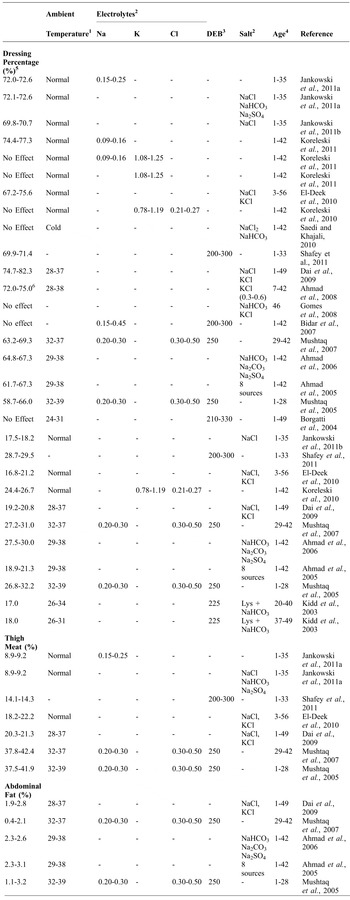
Carcass responses are generally related to protein and amino acid dietary concentrations, but are less related with electrolytes in the diet, however the impact of electrolytes is different under normal and high environmental temperature (Table 3).
Under normal physiological states, the electrolytes or even DEB are not potentially involved in carcass responses (CR; Murakami et al., Reference MURAKAMI, WATKINS, SALEH, ENGLAND and WALDROUP1997; Borgatti et al., Reference BORGATTI, ALBUQUERQUE, MEISTER, SOUZA, LIMA and TRINDADE NETO2004; Bidar et al., Reference BIDAR, REZAEI, ZADEH and KERMANSHAHI2007; Sayed et al., Reference SAYED, ABOU EL-WAFA and ABOU-KHASHBA2008; Jankowski et al., Reference JANKOWSKI, JUŚKIEWICZ, ZDUŃCZYK, SMIECINSKA and KWIECIŃSKI2011a). However, Na-supplemented birds showed better CR than un-supplemented groups (Jankowski et al., Reference JANKOWSKI, ZDUŃCZYK, JUŚKIEWICZ and KWIECIŃSKI2011b). Increasing dietary Na from 0.09 to 0.16% enhanced CR (Koreleski et al., Reference KORELESKI, SWIATKIEWICZ and AREZEWSKA2010). Similar responses were observed by supplementing high protein along with K, which improved ABB leading to better CR (Al-Batshan and Hussein, Reference AL-BATSHAN and HUSSEIN1999), however the DP was not affected by increasing dietary K supplementation alone (Koreleski et al., Reference KORELESKI, SWIATKIEWICZ and AREZEWSKA2010; Reference KORELESKI, SWIATKIEWICZ and AREZEWSKA2011). Increasing supplementation of Cl did not affect CR; however, has been involved with poor stored meat quality by reducing its pH (Koreleski et al., Reference KORELESKI, SWIATKIEWICZ and AREZEWSKA2011). Lower pH might be related to post mortem changes of glycogen into lactic acid. Under heat stress conditions, the interactive effects of different levels of dietary Na or Cl were more pronounced on CR (Murakami et al., Reference MURAKAMI, OVIEDO-RONDON, MARTINS, PEREIRA and SCAPINELLO2001; Mushtaq et al., Reference MUSHTAQ, MIRZA, ATHAR, HOOGE, AHMAD, AHMAD, MUSHTAQ and NOREEN2007). When the combination of electrolytes (i.e. DEB) was compared with other minerals (Ca and P), the CR was found to be deteriorated (Shafey et al., Reference SHAFEY, ALJUMAAH, ABDELHALIM, MADY and GHANNAM2011). DEB values between 160 to 190 mEq/kg have been recommended for best carcass yield by Vieites et al. (Reference VIEITES, KLING DE MORAES, ALBINO, ROSTAGNO, ATENCIO and VARGAS2005).
Electrolytes, particularly Na, affect the absorption of monosaccharides and amino acids in broilers, as evident from increased breast (BMY) and thigh meat yield (TMY) with increasing the dietary level of Na and DEB (Borgatti et al., Reference BORGATTI, ALBUQUERQUE, MEISTER, SOUZA, LIMA and TRINDADE NETO2004; Mushtaq, Reference MUSHTAQ2010; Mushtaq et al., Reference MUSHTAQ, PASHA, AKRAM, MUSHTAQ, PARVIN, CHOI, HWANGBO and KIM2013b). On the contrary, under heat stress condition, a linear decrease in BMY was noted for increasing levels of dietary Na, while a quadratic effect was observed in TMY by adding Na (Mushtaq et al., Reference MUSHTAQ, MIRZA, ATHAR, HOOGE, AHMAD, AHMAD, MUSHTAQ and NOREEN2007). Increasing dietary K (0.78-1.20%) increased BMY (Koreleski et al., Reference KORELESKI, SWIATKIEWICZ and AREZEWSKA2010) without any response from adding extra Cl into the diets.
Impact of electrolytes, dietary electrolyte balance and salts on carcass characteristics of broilers under various environmental regimens.

1Centigrade 2Percentage 3Milliequivalent per kg (mEq/kg) 4Days 5Dressing Percentage (Percent of live weight without organs) 6Dressing Percentage (Percent of live weight with organs)
Reduced abdominal fat percentage (AFP) was observed with increasing Na and DEB supplementation under normal physiological states (Mushtaq, Reference MUSHTAQ2010; Jankowski et al., Reference JANKOWSKI, JUŚKIEWICZ, ZDUŃCZYK, SMIECINSKA and KWIECIŃSKI2011a; Mushtaq et al., Reference MUSHTAQ, PASHA, AKRAM, MUSHTAQ, PARVIN, CHOI, HWANGBO and KIM2013b), although increasing K and Cl did not affect AFP (Koreleski et al., Reference KORELESKI, SWIATKIEWICZ and AREZEWSKA2010). Under heat stress, increasing levels of Na with constant DEB decreased AFP (Mushtaq et al., Reference MUSHTAQ, SARWAR, NAWAZ, MIRZA and AHMAD2005; Reference MUSHTAQ, MIRZA, ATHAR, HOOGE, AHMAD, AHMAD, MUSHTAQ and NOREEN2007). Mushtaq et al. (Reference MUSHTAQ, MIRZA, ATHAR, HOOGE, AHMAD, AHMAD, MUSHTAQ and NOREEN2007) observed a quadratic effect of supplementing Cl on AFP.
Supplemental salts have variable effects on the carcass characteristics of broilers, depending on the contributing electrolyte (cation or anion), mode (water or feed) and prevailing environmental conditions. In most of the recent work published, carcass traits have not been evaluated in all the supplemental salts, except Na.
The varying impact of salts do not appear to affect carcass traits under normal environmental temperatures (Murakami et al., Reference MURAKAMI, WATKINS, SALEH, ENGLAND and WALDROUP1997; Gomes et al., Reference GOMES, VIEIRA, REIS, FREITAS, BARROS, FURTADO and SILVA2008; Mushtaq, Reference MUSHTAQ2010; Jankowski et al., Reference JANKOWSKI, JUŚKIEWICZ, ZDUŃCZYK, SMIECINSKA and KWIECIŃSKI2011a). However, the varying impact of salts and heat stress was observed in other studies. Higher CR, DP and BMY and lower AFP were found in heat-stressed broilers fed NaHCO3 supplemented diets (Ahmad et al., Reference AHMAD, SARWAR and MAHR-UN-NISA2005). The levels of 0.2 to 0.4% NaHCO3 were found best in improving carcass yield across several environmental conditions (Hooge et al., Reference HOOGE, CUMMINGS and MCNAUGHTON1999). This might be due to the fact that the FDA have approved NaHCO3 as a ‘generally recognized as safe’ feed ingredient. Nevertheless, higher levels of NaHCO3 could be more detrimental when administered via drinking water than in feed. This might be related to the intake of Na and alterations to cellular membrane ionic potential (Hayat et al., Reference HAYAT, BALNAVE and BRAKE1999). BMY was reportedly reduced by increasing NaHCO3 supplementation from 0.10 to 0.25% during 21-49 days of age and 0.36-1.80% during 21-42 day of age (Hayat et al., Reference HAYAT, BALNAVE and BRAKE1999).The addition of NaHCO3 along AAs (Thr and Arg) in high lysine diets had no effect on BMY in broilers reared under heat stress (Kidd et al., Reference KIDD, BARBER, ZUMWALT, BRANTON and HOEHLER2003). The supplementation of KCl improved DP at the 0.6% level without affecting BMY and TMY percentages and BMY was higher at 0.4% KCl as compared to other levels (El-Deek et al., Reference EL-DEEK, EL-DEEN, HAMDY, ASAR, YAKOUT and ATTIA2010). This level is considered sufficient for maximum DP and TM when compared with unsupplemented diets (Dai et al., Reference DAI, BESSEI and QUANG2009). However, carcass fat was not affected by KCl supplementation in the drinking water (Smith and Teeter, Reference SMITH and TEETER1987) in heat stress condition.
Supplementation with NaCl improved DP and BMY in broilers of at the age of 35 d as compared to the group having no NaCl without affecting AFP (Jankowski et al., Reference JANKOWSKI, ZDUŃCZYK, JUŚKIEWICZ and KWIECIŃSKI2011b) and supplementation of 0.30% NaCl improved DP and BMY with no effect on TMY (El-Deek et al., Reference EL-DEEK, EL-DEEN, HAMDY, ASAR, YAKOUT and ATTIA2010). Increasing levels of NaCl, i.e. 0.40%, reduced AFP (Dai et al., Reference DAI, BESSEI and QUANG2009). Similarly Bláha et al. (Reference BLÁHA, DRASLAROVÁ and KROESNA2000) suggested that feeding electrolytes caused a reduction in fat contents of broiler meat.
Similarly, no effect of NaHCO3 and KCl supplementation in the drinking water was observed on carcass yield and intestinal contents within 24 hours of processing (Gomes et al., Reference GOMES, VIEIRA, REIS, FREITAS, BARROS, FURTADO and SILVA2008). Whiting et al. (Reference WHITING, ANDREWS and STAMPS1991) conducted two trials to investigate the effect of NaHCO3 and KCl in drinking water on carcass and meat quality characteristics under thermoneutral and cyclic heat-stress climatic conditions. The carcasses from cyclic heat-stressed broilers gained more weight than the thermoneutral broiler carcass during ice-water chilling. A profound effect of temperature treatment was detected for AFP, where differences in AFP were found among water treatments (5% KCl or 5% NaHCO3) under normal ambient conditions, but not under cyclic environmental conditions. Oven-cooked fillets from cyclic heat-stressed broilers had a lower CR than the thermoneutral (control) birds. Broilers given 0.5% NaHCO3 from five to eight weeks of age had higher shear resistance values than broilers given a combination of 0.5% NaHCO3 and 0.5% KCl or tap water-fed controls.
Supplementation with KCl and NaCl via the drinking water or feed (El-Deek et al., Reference EL-DEEK, EL-DEEN, HAMDY, ASAR, YAKOUT and ATTIA2010) had no effect on DP in heat-stressed broilers (Smith, Reference SMITH1994). The birds consuming the diet supplemented with 0.2% NaCl and KCl showed lower DP than unsupplemented group; however birds consuming 0.2% NaCl had more BMY than 0.2% KCl (Dai et al., Reference DAI, BESSEI and QUANG2009).
When Na-salts were compared, the combination of NaCl and NaHCO3 in poultry diets did not show any effect on DP (Murakami et al., Reference MURAKAMI, WATKINS, SALEH, ENGLAND and WALDROUP1997) even by adding Na2SO4 (Jankowski et al., Reference JANKOWSKI, JUŚKIEWICZ, ZDUŃCZYK, SMIECINSKA and KWIECIŃSKI2011a). However, when diets were supplemented with these three salts together (NaHCO3, NaCl and Na2SO4); lower breast meat yield was noted in the Na2SO4 supplemented diets (Hooge et al., Reference HOOGE, CUMMINGS and MCNAUGHTON1999). Similar reports of lower BMY were given for Na2SO4 supplemental diets by Ahmad et al. (Reference AHMAD, MUSHTAQ, SARWAR, HOOGE and MIRZA2006), when they compared NaHCO3 and Na2CO3, and NaHCO3 showed higher DP under heat stress conditions. Similarly, higher BMY and lowest AFP were noticed in NaHCO3 (0.55-0.65%) and NH4Cl (0.66-0.73%) when compared with other salt sources (Ahmad et al., Reference AHMAD, SARWAR and MAHR-UN-NISA2005). When the K-salts were compared, K2SO4 showed least response for DP and AFP without affecting BMY and TMY as compared to K2CO3 and KHCO3 (Ahmad et al., Reference AHMAD, SARWAR and MAHR-UN-NISA2005). Under normal physiological states, K2SO4 responded in the same manner as K2CO3 in feed (Mushtaq, Reference MUSHTAQ2010). This indicated that SO4 has nothing to do with better carcass responses, as birds did not show any improvement in DP, BMY or TMY.
Dietary electrolytes and coccidiostats
Coccidiosis, or wet litter syndrome, potentially highlights the interrelationship of certain electrolytes and coccidiostats in broilers. Some coccidiostats complement the addition of electrolytes, while others interfere with their activity. Ionophoric anticoccidials influence the transmembrane flow of cations (Na or K) and increase water intake in order to maintain osmotic balance. Monensin is considered as one of the best ionophoric anticoccidials that works with the transmembrane flow of Na. Non-ionophoric anticoccidials are not commonly used in broiler production (Leeson and Summers, Reference LEESON and SUMMERS2001).
Monensin and salinomycin are found to be potentially useful in combination with NaHCO3, KHCO3 and sesquicarbonate (Hooge et al., Reference HOOGE, CUMMINGS and MCNAUGHTON2000; Hooge, Reference HOOGE2003). The KHCO3 has been found to be partially as effective as NaHCO3 when use in combination with either monensin or salinomycin (Hooge et al., Reference HOOGE, CUMMINGS and MCNAUGHTON2000). Improved growth performance has been associated with supplemental NaHCO3 in broiler diets with or without coccidial challenge. It has been stated that lower levels of NaHCO3 (i.e. 0.2-0.3%) appeared to balance ionophores (either monensin or salinomycin) during all phases of growth in different environmental conditions (Hooge et al., Reference HOOGE, CUMMINGS and MCNAUGHTON1999). A level of 0.25% dietary NaHCO3 without monensin improved growth performance and decreased mortality. Further, the dietary NaHCO3 (0.20%) or KHCO3 (0.14%) were equally effective for improving growth parameters in a coccidial-inoculation broiler pen trial using monensin. In another trial, with a coccidial challenge, dietary KHCO3 (0.06) was found as effective as NaHCO3 in improving growth with salinomycin (Hooge et al., Reference HOOGE, CUMMINGS and MCNAUGHTON2000). Similar behaviour of NaHCO3 was not observed across several experiments when semduramicin was supplemented in place of other anticoccidials (Pesti et al., Reference PESTI, CERVANTES, BAKALLI, BAFUNDO and GARCIA1999). Adding extra Na from NaCl was found ineffective for growth promotion in high monensin diets. Contrarily, in another study with NaCl and monensin, better growth response was noticed with 0.38% dietary NaCl plus monensin fed to four week old broilers (Hurst et al., Reference HURST, DAY and DILWORTH1974). Similarly, improved BW was observed in 0.17-0.19% Na diets, without increasing the demand for Na in high monensin diets in a series of seven litter pen trials involving about 0.2 million birds (Gard et al., Reference GARD, MURPHY, SCHLEGEL, TONKINSON and WELLENREITER1980). Nam et al. (Reference NAM, MANNING, PATEL and MCGINNIS1979) found 0.15% sodium to be adequate in combination with monensin compared to higher levels of Na (0.20-0.35%). Similar findings were recorded with or without monensin when increasing dietary NaCl levels from 0.11 to 0.45% (Hooge et al., Reference HOOGE, CUMMINGS and MCNAUGHTON1999). Saylor and Fleet (Reference SAYLOR and FLEET1984) stated that the effectiveness of ionophores was complemented with the addition of NaCl. Without a coccidiostat, increasing Na from 0.15% to 0.30 and 0.45% had no effect in diets containing 1.0% K. With monensin, 0.15 and 0.45% Na treatments were equivalent in growth responses at low or high K levels (0.5 or 1.0%). Moreover, feed efficiency of birds with varying DEB range (125-200 mEq/kg) performed better with monensin (Karunajeewa and Barr, Reference KARUNAJEEWA and BARR1988).
Leeson and Summers (Reference LEESON and SUMMERS2001) recommended that dietary Na level should be reduced to counter the effect of ionophores particularly lasalocid, keeping the Cl levels constant. The high levels of Cl are known to enhance litter wetness in NaCl supplemented diets (Hooge et al., Reference HOOGE, CUMMINGS and MCNAUGHTON1999). Ouart et al. (Reference OUART, DAMRON and CHRISTMAS1995) found elevated levels of water consumption with lasalocid as compared to other coccidiostats across different seasons. Inadequate testing of lasalocid with NaHCO3 has also been shown to enhance its effectiveness (Hooge et al., Reference HOOGE, CUMMINGS and MCNAUGHTON2000). Nam et al. (Reference NAM, MANNING, PATEL and MCGINNIS1979) found 0.15% Na to be adequate with lasalocid compared to higher levels of Na (0.20-0.35%). Later on, dietary 0.20% NaHCO3 or 0.14% KHCO3 with lasalocid were found equally effective to improve growth performance in coccidial challenge (Hooge et al., Reference HOOGE, CUMMINGS and MCNAUGHTON2000). Further, increasing dietary Na (0.30-0.45%) and lowering dietary K with lasalocid gave optimum performance. In another trial, the best BW was obtained with 0.42% Na, 0.55% K, and 0.27% Cl and either monensin or lasalocid. The chickens fed the diets containing lasalocid utilised feed less efficiently than those given the diets containing monensin in a different DEB regimen (125-205 mEq/kg; Karunajeewa and Barr, Reference KARUNAJEEWA and BARR1988). It can be extracted from the discussed reports that wet litter problems can be prevented by judicial use of ionophores (monensin) or by addition of NaHCO3/ NaCl to the diets along with the ionophores, whereas excessive Na-salts should be avoided to prevent tissue swelling by intracellular water accumulation. Nevertheless it is recommended to investigate the role of salts with coccidiostats (chemical and ionophores), focusing on excreta and litter wetness, in broilers under different temperature regimens, before applying these ideas in practice.
Conclusions
It is inferred from the available literature that a balance between electrolytes (Na, K and Cl) is critical to maintain acid base balance and blood chemistry. Moreover, dietary electrolyte balance would be a good approach to adjust physiological changes, keeping in mind the correct usage of salt source and environmental condition. The inclusion of electrolytes through a combination of suitable salts (NaHCO3 and KCl) in the diet, to maintain dietary electrolyte balance (150-250 mEq/kg) is mandatory. Most of the times, electrolytes have no influence on carcass characteristics, but this could alter with changing salt supplements, especially the addition of NaHCO3 and KCl in hot summer conditions. Research indicates that the concentration of supplemental salts in the presence of ionophores could be reduced. Therefore, nutritional manipulation needs to match the physiological requirements of the birds for electrolytes and to achieve maximum growth potential. From the available data, it can be recommended that dietary electrolyte balance should be within the range of 150 and 250 mEq/kg, fed along with NaHCO3 and KCl supplemental salts, however the concentration of sodium and chloride should be kept low.