Introduction
In June 1588, twenty-seven inhabitants of Rickmansworth complained to two Justices of the Peace (JPs) in the neighbouring parish of Watford about the great disorder in Mill End in and around the alehouse kept by one Richard Heyward. Drunkenness daily caused both quarrels and breaches of the peace; indeed Heyward’s customers were indulging in ‘common bawderie whiche is not onelie damnable to the users, but scandalus to all us’. The petitioners claimed that they had frequently given ‘cristian and charitable warnynge bothe to the goodman and goodwiffe of the saide Alehouse, and to the haunters of ytt’ but to no avail; all that they had received for their pains was ‘moste bade & lewde speaches’ and menacing threats. Furthermore many other alehouses in the vicinity ‘in like condision for Dronnkennes’ should also be closed down because poverty in the town was increasing due to men spending their time and money in them ‘to the undoinge of hole howseholdes’. Even worse, women often followed their husbands’ bad examples and they too had threatened the petitioners.Footnote 1
In the light of recent scholarship on alehouse sociability, this article identifies the opponents of Heyward’s alehouse and uncovers their motives.Footnote 2 Did they simply object to the poorer sort spending what little money they had in alehouses; or was their complaint driven by ‘godly’ convictions, that is, ‘hostility to traditional culture’ and ‘a will to impose certain standards upon society’;Footnote 3 or was there personal animosity against the alehouse keeper? This petition is considered from a different perspective to that of most other scholarship, which tends to view ‘protest from below’; that is, it focuses on complaints made, and actions taken, by subordinates against the activities of property owners and other elites.Footnote 4 Specifically, research into pauper petitions considers the complaints ‘voiced’ by the poor as archetypal ‘weapons of the weak’.Footnote 5 The Rickmansworth petition was, on the contrary, produced by the better sort of the parish against the activities of their social inferiors: the petitioners were respectable householders, some of whom held minor manors and many of whom held local office either before or after 1588. Beyond their own locality, these were men of the middling sort. Only Wrightson’s study of early modern constables and jurymen discusses local concerns about keeping order within a community from the point of view of the middling sort, demonstrating the dilemmas faced by local officials living among those whose conduct they were expected to regulate.Footnote 6 In addition, the survival of correspondence between the JPs to whom the petition was addressed reveals the mechanics by which such a complaint might be presented initially to local JPs and subsequently to Quarter Sessions. From this distance in time it is impossible either to examine the validity of the complaints or to identify the unruly alehouse haunters. It is, however, possible to identify most of the petitioners; their specific target, Richard Heyward; and the two JPs to whom their petition was addressed. Some tentative conclusions might therefore be drawn regarding the motivation for the petition. This episode is all the more interesting since the petition was generated in the late sixteenth century, while most scholarship on early modern alehouses and their opponents focuses on the later period.Footnote 7
Late sixteenth-century attitudes to alehouses
Official attitudes towards late sixteenth-century alehouses and their keepers can be ascertained from five sources: two of them ‘secular’ and three ecclesiastical. Firstly, the legislation in place in 1588 was the 1552 ‘Acte for Kepers of Alehouses to be bounde by Recognizaunces’.Footnote 8 Considering the ‘intolerable hurtes and trobles’ that had been daily increasing as a result of ‘suche abuses and disorders as are had and used in commen Alehouses and other houses called Tiplinge houses’, parliament required all alehouse keepers to be licensed on bond; justices were to license only as many alehouses as they thought necessary for an area; licences were to be issued at the Quarter Sessions, or by justices acting together outside the sessions; those who refused to be licensed, or whom the justices would not license, but continued to trade would be sent to gaol. Those who were permitted to trade were to be bound by recognisance, with two sureties, to maintain an orderly house and not permit the playing of unlawful games on their premises.Footnote 9 Clark has suggested that the statute was ‘an attempt to codify and establish a national framework for the growing variety of controls which had sprung up in the localities (especially in towns) in recent years’ and that its immediate impact was accordingly ‘not exactly dramatic’.Footnote 10 The next Act of Parliament explicitly concerning alehouses was not passed until 1604: ‘An Acte to restraine the inordinate hauntinge and tiplinge in Innes Alehouses and other Victuallinge Houses.’Footnote 11 The detailed strictures of that early Stuart Act were not in place in 1588. It is nonetheless noteworthy that in Elizabeth’s parliaments various attempts were made to introduce new laws regulating alehouses. For example, in early March 1576 ‘A bill against the disorders of ale howses and of prices of ale and [beer]’ was read three times and rejected.Footnote 12 On 1st February 1581 ‘A bill that noe person should keepe any inn or common alehowse except he be authorised by the iustice of assise’ was first read and rejected.Footnote 13 And on 8th February 1589 the MP Henry Jackman recorded the details of an abortive bill ‘for disorders in innes and alehouses’.Footnote 14 In the context of the provisions of the 1552 Act and the later concerns of MPs, it is clear why the petition was addressed to two local justices: in law, they were the men with the power to revoke Heyward’s licence and to close down the offending alehouse in Mill End.
In Eirenarcha, his book of advice and guidance for JPs published 1582, William Lambarde summarised the provisions of the 1552 Act and provided a template for an alehouse keeper’s recognisance, together with a gloss on the conditions of such recognisances.Footnote 15 He emphasised that it was the alehouse keeper’s particular premises that were licensed: the individual was licensed ‘only within the now house of him … (and not elsewhere)’, noting in the margin ‘For, every place is not meete.’ Furthermore, he elucidated the more general terms of the Act, in the process giving an insight into what might take place in these premises. For example, unlawful games, which were not specified in 1552, were listed by Lambarde as ‘Tables, Dice, Cardes, Tennis, Bowles, Closhe, Coytes, Loggets, or other’.Footnote 16 These were not to be played in the alehouse keeper’s house, nor ‘in his garden, orchard, or other his grounde, or place’. Meat was not to be dressed, served or eaten on days forbidden by law. He was not to allow onto his premises either anyone known for ‘theft, incontinencie, or drunkennesse’ or any other undesirables about whom the constable had previously informed him. Finally, Lambarde explained, the recognisance was intended for ‘the better brydeling of these nurseries of naughtinesse’.
In addition to the secular, practical side of regulating alehouses, moral regulation was urged by clerics and the Church. Firstly the Book of Homilies, published in 1563, includes the lengthy ‘Homilie against Gluttonie and Dronkennes’.Footnote 17 This was, perhaps counterintuitively, directed at wealthier parishioners. Ignoring beer and ale because the Bible only told of men being drunk on wine, the homily urged moderation in wine drinking and consideration of one’s neighbours. The example of drunkards was evil to those among whom they dwelled; they were an occasion of offence to many; and while they wasted their substance in banqueting, their own household was not provided for; their wives and children were ‘evyll entreated’; they had not the means to relieve their poor neighbours ‘in tyme of necessitie’, as they might have, if they lived soberly. Finally, they were unprofitable to the commonwealth, for ‘a dronkarde is neyther fyt to rule, nor to be ruled’.Footnote 18
Taking a rather different line from the homily, bishops’ visitation articles frequently enquired about those who attended alehouses, but in general they were concerned with when customers attended them rather than with their attendance per se. For example, in 1572 the bishop of Rochester enquired whether ‘there be any in your parish that keep any alehouses, tippling or victualling in the time of sermons, or other Divine Service; and who they be’.Footnote 19 On the other hand, he also wanted to know whether there were ‘any blasphemers of the name of God, or common swearers, any that are enemies unto the Gospel, contemners of preachers and ministers of God’s word, such as use commonly in tippling houses or taverns to rail, scoff, or jest at the preachers or professors of the truth; and who they are and wither they resort’.Footnote 20 No similar visitation articles from the bishop of London have survived in the archive of the archdeaconry of St Albans, which had jurisdiction over Rickmansworth.
Much of the work on early modern attitudes to alehouses cites various virulent ‘godly’ publications, but virtually all of those quoted were published in the seventeenth century.Footnote 21 There is, however, one pamphlet that was published in 1572 that is particularly relevant here: An earnest Complaint of divers vain, wicked and abused Exercises, practised on the Saboth day: which tende to the hinderance of the Gospel, and increase of many abhominable vices … by Humfrey Roberts.Footnote 22 From 1562 to 1573 Roberts was vicar of Kings Langley (Hertfordshire), less than seven miles from Rickmansworth. While attacking abuses of the Sabbath, he incidentally throws light on some late sixteenth-century leisure activities.Footnote 23 Having lambasted those who worked on the Sabbath, Roberts turned on ‘Playes and games used upon the Saboth daye: And first of Tavernes, and Alehouse haunting.’ His vitriolic text is worth quoting in detail:
For wheras they should resorte unto the Church to serve God in his congregation: then are they in Taverns & Alehouses, tossing of pots, … And truely, better they were, to worke upon the Sonday (if need should require:) then so to passe the time, in dronknes, swearyng, and blasphemynge of Gods name: playinge at wicked and unlawfull games: wherein are used most horryble swearyng and forswearyng: brawlyng and fightynge; with a nomber of other abhominaple Vices, spendynge both the time, and their goodes wastefully, appearynge more lyke Monsters, then men.Footnote 24
He also fulminated against games played for money, popularly known as ‘silver games’. He complained that people were prepared to go ten or twelve miles on a Sunday morning to a silver game ‘ther to spend the time in vanyties al the day long’.Footnote 25 Thus a man might find the churches empty, ‘savyng the minister & iii or iiii lame & old folke: for the rest are gon to folow the Devils daunce’. Perhaps such games were a particular eastern counties’ pastime, since it was reported at the Essex Midsummer Quarter Sessions of 1569 that on Sunday 3rd July at High Laver and on Sunday 10th July at Shello (now Shellow Bowells) ‘certayne sylver games’ were announced and subsequently played mostly by young men and servants, some of them apparently losing ‘more then their yeres w[ages]’.Footnote 26 As we shall see, Roberts’ tract has a direct link with one of the JPs to whom the Rickmansworth petition was addressed.
Locating Rickmansworth
Rickmansworth lies in the extreme south-west of Hertfordshire, on the edge of the Chiltern hills, bordering on both Buckinghamshire and the former county of Middlesex. Such a location, at the junction of three county boundaries, meant it was handily placed for local miscreants to slip into a neighbouring jurisdiction in an attempt to escape justice. The large parish covered just over 10,000 acres and had a boundary of about twenty-six miles in circumference.Footnote 27 As already noted, it was in the archdeaconry of St Albans, which originally lay in the diocese of Lincoln – again miles away – but in 1540 the whole archdeaconry was formally transferred to the diocese of London.Footnote 28 The parish had a recent history of kicking against authority: in the 1510s there were known Lollards in the vicinity and in 1522 there occurred a serious arson attack on the parish church of St Mary.Footnote 29 It is highly likely that the arsonists were Lollards, or had Lollard sympathies: the Chilterns area was a Lollard stronghold, and Amersham (Buckinghamshire), only ten miles away, was a known centre of Lollardy. Furthermore this attack took place in 1522, fourteen years before the formal break with Rome, so, at the very least, some parishioners were unhappy with the old religion: thus early on there were what might be loosely termed ‘reformist tendencies’ within the parish.
The parish of Rickmansworth was also large in terms of population, with several centres of habitation. In addition to the main town, situated at the confluence of the rivers Gade, Chess and Colne, there was Batchworth at the bottom of the hill on the road to Northwood (Middlesex); Croxley on the road to Watford; Chorleywood just off the road to Amersham; and West Hyde on the road to Uxbridge (Middlesex). Mill End, the site of the troublesome alehouse, named for the location of one of several mills on the Colne, was technically part of Rickmansworth town but it lay on the outskirts, also on the road to Uxbridge.
Suitable records from which to calculate population figures for sixteenth-century Rickmansworth are patchy. The 1524 Lay Subsidy reported a total of 147 taxpayers in the various population centres of the parish.Footnote 30 There is debate over whether the 1524 Subsidy payers were heads of households or males aged sixteen or over. Indeed, the status of those who were taxed at Rickmansworth is unclear: as well as widows, girls with guardians were also assessed; furthermore, some males with the same surname were assessed consecutively, the second either being assessed on a lesser value of goods or on wages. Using two different multipliers to allow for these discrepancies, the number of men, women and children in Rickmansworth in 1524 was somewhere between 470 and 698.Footnote 31 Later sixteenth-century populations are usually calculated from figures in the diocesan ‘censuses’ of 1563 and 1603 but neither return has survived for the archdeaconry of St Albans.Footnote 32 However, in early 1595 the bishop elect of London asked the then archdeacon of St Albans for details concerning his new diocese, including numbers of communicants.Footnote 33 The numbers given by the archdeacon, William Huchenson, are somewhat rounded but he knew Rickmansworth because he had been vicar there from July 1581 to October 1584.Footnote 34 Huchenson indicated that Rickmansworth was the third largest parish in the archdeaconry with about eight hundred communicants.Footnote 35 This rounded figure suggests a total population of about 1,080.Footnote 36 The population of England as a whole was increasing rapidly in the sixteenth century, so an increase of somewhere between four hundred and six hundred since 1524 is entirely plausible.
Rickmansworth did not acquire its own formal market until 1542, probably reflecting the former dominance in the area of the abbey of St Albans.Footnote 37 Prior to the abbey’s dissolution in 1539 locals were expected to use the market at Watford belonging to the abbot’s manor of Cassio. Additionally, with a number of roads running through the town, Rickmansworth had several inns wherein informal marketing by private bargaining would have taken place between local suppliers and other inhabitants or with people travelling through.Footnote 38 As well as being places of recreation, such buildings were also places of business.
Beer brewing had arrived from the continent in the fifteenth century. Becoming well established in London and several southern towns by 1500, it then ‘fanned out across the country to the main urban centres’.Footnote 39 Hailwood notes that some towns had a common brewer, from whom all alehouse keepers were required to buy their beer and ale, thus regulating the strength of beer there.Footnote 40 This was probably not the case at Rickmansworth but there was a commercial beer brewer in the town by the 1550s. When an inventory of the goods of Robert Heathe, ‘bere bruar’, was made in the winter of 1558–9, his meagre possessions were valued at just £11 0s 4d.Footnote 41 They included his brewhouse and kitchen with the brass and the brewing vessel; the ‘Wotemel myll’Footnote 42 with the drying kilns; and two old horses and a beer cart. By the late sixteenth century the beer brewer Simon Corbett was established in the town and his sons continued the business after his death.Footnote 43
Before 1539 most of the manors in south-west Hertfordshire were owned by St Albans abbey. The manorial structure in Rickmansworth was highly complex with at least twelve manors before the dissolution, and one, the rectory manor, added afterwards.Footnote 44 At the dissolution the manors came into the hands of the Crown and were subsequently leased to various individuals but by the 1570s the main manor of Rickmansworth was again a Crown manor.Footnote 45 Leet courts, or halmotes, were therefore held on behalf of the queen and some of their records have survived.Footnote 46 These provide names of ‘capital pledges’, perhaps main tenants; of tenants absent from the court represented by essoins; of manorial officers appointed for each community, such as constables; and of chief pledges for each tithing group.Footnote 47 At the Rickmansworth halmote land transactions were recorded and jurors (homagers) presented infractions of bylaws. These court records include the names of many of the signatories to the petition.
Signatories to the petition
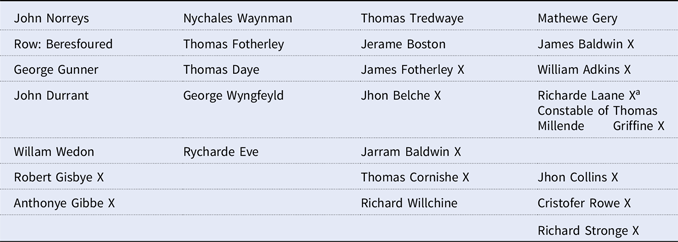
Table 1 sets out the petitioners’ names in the order that their signatures or marks were added to the document. Probate material survives for eighteen of the twenty-seven men confirming that they were among the wealthier members of the parish. From names occurring in wills and probate inventories it is often possible to reconstruct social and/or economic networks within a particular community by comparing the witnesses, executors, overseers and appraisers. As well as indicating something of the petitioners’ lifestyle and possessions, the Rickmansworth material does provide evidence of links between some of them, since they did indeed act as executors, overseers, witnesses or appraisers for others, but not as frequently as one might expect given their connection through the petition. Some, by contrast, appear in scarcely any documents.
The order of signatories to the ‘Peticion of the inhabitantes of Rickmerswoorth for the pullinge downe of Alehouses’, Hertfordshire Archives and Local Studies, 8430

Notes: Spellings as in the original.
An ‘X’ against a name indicates that that person marked the document, the others signed their name.
a In the original it is not clear whether Richard Lane or Thomas Griffin was denoted ‘Constable of Millende’ but as Griffin was constable of Rickmansworth in 1579, it seems likely that Lane was constable of Mill End in 1588. Shepherds Farm in Mill End was in the hands of the Lane family for several centuries.
The Rickmansworth bishops’ transcripts for the two years from Michaelmas 1587 to 1589 are missing, so it is impossible to identify the churchwardens immediately before, after and at the time when the petition was presented. However, one of the three wardens in the year 1586–7 was Robert Gisbye, one of the petitioners, and all three wardens in 1589–90 were petitioners: George Gunner, George Wingfield and Rowland Beresford.Footnote 48 Furthermore, the constable of Mill End marked the petition and many of the other subscribers had been homagers of the main manor of Rickmansworth.Footnote 49 Thus, most of the twenty-seven were active in the running and organisation of the local community, whether secular or religious.
The order of the signatures, at least the first column, is significant. John Norris held land in the manor of the More and held the manor of Woodoaks on behalf of his wife, although it is likely that he lived most of the time in London; nevertheless, as we shall see, he was very active in advancing the petition.Footnote 50 Rowland Beresford, Norris’s brother-in-law, held the manor of Linsters in West Hyde and was churchwarden in 1589–90.Footnote 51 Both he and George Gunner had their wills proved in the Prerogative Court of Canterbury, as did Anthony Gibb.Footnote 52 George Gunner leased the rectory manor; he was parish sideman in 1583–4; and as already noted, churchwarden in 1589–90.Footnote 53 John Durrant was a parish sideman in 1583–4 and churchwarden in 1595–6.Footnote 54 Robert Gisbye, as already noted, was churchwarden in 1586–7. William Wedon is harder to pin down. There were two men of that name, and he is not distinguished in the petition, but both men held substantial property in Batchworth: one at Stockers, the other at Frogmore.Footnote 55
The signature that is most conspicuously absent from the petition is that of the vicar of Rickmansworth. A comparator may be useful here: in December 1597, thirty inhabitants of Buntingford (Hertfordshire) presented a petition to local justices complaining about the disorderly alehouse kept by John Stanfield alias ‘grene cloke’.Footnote 56 This petition was signed by the vicar, Richard Awnsham, and, judging by the handwriting and the position of his signature, was probably written by him. But not so at Rickmansworth. John Sterne had been instituted vicar on 13th October 1584.Footnote 57 Shortly after this, on 14th November 1584, he was appointed one of the ‘Clerkes or Prechers of the Corporacion elected & chosen for the Archdeaconrie of St Albons’.Footnote 58 At about this time Sterne signed three notes addressed to the Archdeacon of St Albans confirming that certain parishioners had acknowledged their sins or faults.Footnote 59 The note by signed Sterne on 10th March 1585 identifies the churchwardens and three ‘sworne men’ of the parish: one of the wardens (Richard Eve) and all three sworn men (George Gunner, George Wingfield and John Durrant) were signatories to the petition. But Sterne himself left the parish in early 1588. His replacement, Tobias Chalfont, noted only as ‘clerk’, was appointed on 15th March 1588 and was subsequently described as ‘non-graduate; non-preacher; resident; negligent in doing exercises set’.Footnote 60 Less than two years later, on 28th February 1590, William Edmonds, MA, was instituted as vicar, serving the parish until 1621.Footnote 61 At the time when the petition was drawn up, therefore, a temporary, non-preaching vicar was in post. It is impossible to explain why the petitioners had not acted against Heyward when Sterne was vicar, or had not waited until a permanent vicar was appointed. Perhaps some particularly rowdy behaviour had occurred on recent summer’s evenings; perhaps the Mill End alehouse was attracting undesirables over the county boundaries from Middlesex and Buckinghamshire. Whatever the case, in June 1588 matters had come to a head and leading parishioners decided to leverage the full weight of the law against Richard Heyward.
The business of a late sixteenth-century alehouse keeper
Before characterising Heyward, it is useful to consider how a late sixteenth-century alehouse keeper might run his business. In July 1577, the Privy Council sent a circular letter to magistrates enquiring about the number of inns, taverns and alehouses in every shire.Footnote 62 According to Clark, inns were ‘usually large, fashionable establishments offering wine, ale and beer, together with quite elaborate food and lodging to well-heeled travellers’; taverns sold wine to ‘the more prosperous’ but did not have extensive accommodation; alehouses were generally ‘smaller premises serving ale or beer (and later spirits) and providing rather basic food and accommodation for the lower orders’.Footnote 63 The 1577 return from the Hertfordshire justices reported that there were then 125 inns, 14 taverns and 333 alehouses in the county, excluding those in St Albans. Clark calculated that this meant roughly one alehouse per sixty people.Footnote 64
As already noted, the 1552 Act stated that alehouse keepers were to be regulated and licensed. Although alehouses were often meagre establishments, far less grand than inns or even taverns, Clark questioned the conventional wisdom – fuelled by contemporary hyperbole – that alehouse keepers necessarily came from the ranks of the local poor. His analysis of alehouse licences from Kent (1590–1619) and (part of) Hertfordshire (1604–07) demonstrated that ‘a clear majority of rural alehouse-keepers at this time were recruited from poorer occupational groupings, although … there was a core of more substantial victuallers, often yeomen, who probably ran the larger establishments’.Footnote 65
As the provisions of the 1552 Act indicate, records relating to an alehouse keeper were mainly generated at the Quarter Sessions. Surviving late sixteenth-century Hertfordshire Quarter Sessions records include those from Dacorum Hundred, wherein Kings Langley was located, but not those from Cashio Hundred, wherein Rickmansworth was located. There is, consequently, no way of knowing how Richard Heyward was dealt with once the complaint against him was received at the Quarter Sessions. Archival attrition also means that there are no presentments concerning disorderly alehouses or details of alehouse licences issued in Cashio Hundred, which begs the question as to how the 1588 petition survived at all (of which more later).
To turn to another comparator, the ‘career’ of Ellis Cogdell, a relatively poor alehouse keeper in Chipperfield within Humfrey Roberts’ parish of Kings Langley, is worth considering briefly as a proxy for Heyward’s business not least because Cogdell’s is much better documented.Footnote 66 At the Dacorum Sessions for 1593–4, the jury presented that there was ‘daunsing’ at Cogdell’s alehouse during the time of evening prayer and that his house was generally disorderly. The inhabitants therefore desired to have it ‘put down’.Footnote 67 Within the surviving records are notes that Cogdell was summoned (several times) to appear, but no record of any decision taken.Footnote 68 Some eleven years later, however, on 10th December 1605, a recognisance was taken allowing Ellis Cogdell, husbandman, to ‘keepe a common alehouse and victualinge house’ in Kings Langley, provided that certain conditions were adhered to and certain activities were not permitted.Footnote 69 Cogdell was bound in the sum of £10 and his two guarantors in £5 each. From his probate inventory, exhibited in 1628 and valued at £38 5s 11d, it is clear that he had indeed continued his aleselling business: goods in the ‘Seller’ included ‘3 Hoggesheades [and] 4 barelles’.Footnote 70 Thus despite complaints from his neighbours, his alehouse was allowed to continue, properly regulated, perhaps for two reasons: firstly, because it enabled him to supplement his income and ensure that he did not become a charge on the parish; and secondly, because it provided a place of ‘good fellowship’ in Chipperfield, which was two miles distant from the main village. His experiences demonstrate how the magistrates might, at least in principle, have responded to the Rickmansworth petitioners’ concerns, which were by no means unique.
So, who was Richard Heyward – the offending, perhaps even offensive, alehouse keeper at Mill End? At the risk of typecasting him, it might not be surprising to find that at the halmote held in early 1575 he and Thomas Hall were presented for having encroached on the queen’s waste at Mill End and placing pales (that is, fencing) and jannam (furze or gorse) as hedging around their enclosures.Footnote 71 From this one might infer that Heyward was a poor man, who had encroached on the manorial waste to enable him to scrape together a living. Heyward and Hall, however, were ordered to remove the pales and jannam from the waste before the feast of Pentecost, on pain of each paying 10s. In 1560–64 a labourer might have earned 6d to 8d per day, so 10s was a very hefty fine – and one that the homage thought they could pay. Perhaps it was even a fee for or a tax on their infraction.Footnote 72 Secondly, the court also ordered Heyward and Hall to place their pales on ‘their own lands as they ought to be from the lane to the river’, before the feast of St Michael, on pain of each of them paying another 10s. They were, it seems, landholders – tenants whose land abutted the waste in Mill End – rather than being landless poor. Being a tenant would suggest Heyward was at least in his mid-to-late twenties in 1575, and so probably in his early forties in 1588.
The petitioners referred to ‘the goodman and goodwiffe of the saide Alehouse’, confirming that Heyward was married at that time. Furthermore, ‘goodman’ indicates that he was a householder, perhaps even of yeoman status.Footnote 73 In De Republica Anglorum, written in 1583, Sir Thomas Smith noted that ‘These [yeomen] be not called masters, for that (as I saide) pertaineth to gentlemen onely: But to their surnames, men adde goodman: as … goodman White, … goodman Browne, amongest their neighbours, I meane not in matters of importance or in lawe.’Footnote 74 Indeed, in general terms Heyward was a respectable householder: between 1573 and 1579 he served five times as a homager and in 1574 he was one of the capital pledges at the main court of Rickmansworth, this latter just a few months before being presented for the encroachment discussed above.Footnote 75 Furthermore, in June 1587 Thomas Hall, Henry Belche, Charles Spencer and ‘Rychard Hawarde’ appraised the goods of the recently deceased Thomas Lane.Footnote 76 All of this suggests that Hayward was a man of some standing in the local community. Even so, in June 1588 twenty-seven of his fellow parishioners chose to complain in no uncertain terms about the goings on in his alehouse.
The justices and the petition
Resident gentlemen were thin on the ground in south-west Hertfordshire, largely as a consequence of the former domination of St Albans abbey. There was no resident JP in the parish of Rickmansworth; indeed the two largest manors in the parish were both owned by the Crown. The More, where a disused palace was falling into ruin, had no lessee and the tenant of the site of Rickmansworth manor, resident at the Bury, was Francis Palmer, who had recently succeeded his widowed mother.Footnote 77 It was partly of necessity, therefore, that the petitioners addressed their complaint to Sir Charles Morison of Cassiobury and Francis Heydon, esquire, of Oxhey, both resident in the neighbouring parish of Watford. These two men were frequently active together in the government of this part of Hertfordshire and Morison, in particular, had impeccable godly credentials. Furthermore, the petitioners addressed these magistrates specifically because ‘we knowe your worshippes greate care in removinge the causes of soe greate Abuses’.Footnote 78
Francis Heydon was the eldest son of Henry Heydon of the Grove, Watford. On Henry’s death in 1559 Francis inherited the Grove, which was a submanor of the manor of Cassio.Footnote 79 Francis also held land in Oxhey, where he was living in 1588 and where he was assessed for the subsidy in 1595 on land valued at £20.Footnote 80
Sir Charles Morison, born in 1549, was the son of Sir Richard Morison, one of the Marian exiles.Footnote 81 In 1566 his mother Bridget married, as her third husband, Francis Russell (1526/7–85), second earl of Bedford.Footnote 82 Humfrey Roberts had dedicated his Sabbatarian pamphlet An earnest Complaint to Francis Russell, and in the next year, 1573, perhaps as a reward, Russell had appointed Roberts rector of Chenies, adjacent to Rickmansworth but in Buckinghamshire; however Roberts did not enjoy this prestigious appointment for long, since he died in September 1575.Footnote 83 An inventory – now lost – of Francis Russell’s library at Chenies, made in 1584, included numerous pamphlets dedicated to him.Footnote 84 Charles Morison was Russell’s executor and as such it is quite possible that Morison saw Roberts’ pamphlet within the collection; indeed, given his upbringing among the Marian exiles and his evangelical background, it may well have appealed to him personally. As lord of the manor of Cassio, Morison’s residence was at Cassiobury, Watford. He was a magistrate in Hertfordshire from about 1577 and was sheriff in 1579–80.Footnote 85
Papers in the Cassiobury archive at the British Library show that in the late 1580s the two men were charged with organising the civil defence of their part of the county: the threat of invasion by Spain was very real and, although an inland county, musters were frequently held in Hertfordshire at this time. Among these papers is a letter from Heydon to Morison, written at Oxhey on 11th June 1588.Footnote 86 The date and the fact that it was bound into group of documents mostly relating to Hertfordshire musters might suggest that this letter might be concerned with the provision of local defence. On the contrary, its sole concern was with disorderly alehouses in Rickmansworth: Heydon had apparently received the petition and was suggesting to Morison what action they should take. This rare insight into the way in which late sixteenth century JPs worked is related here in full:
It may please yow to understand that Master Noris & Master Basford were commyng to yow yesterday, with a petition in wrytyng made by them & many others of their neyghbors concernyng Dysorders of Alehowse Kepers in Ricmersworth and specyall of one Heyward, as may apere by the sayd petition. Havyng understandyng of your absense from home, thay brought it to me requestyng me to delyver it unto yow, because Master Noris hymself is this day to ryde to London & tarryeth there most part of the terme/ He tellethe me the neyghbors are greatly greved & dysquyeted with the same & do crave spedy reformation thereof. & therefore, yff yow shalt be so pleased, I thynk it good he were presently forbydden & his ale pole taken downe / The others perhapes wyll take warnyng by hym, yff not, when it shalt please yow to apoynt, I wyll wayte upon yow for som order to be taken for them also / & in the menetyme I have sent yow the sayd petition, praying yow to use your Good pleasure therein, as also to Lay up the same petition, &, yff yow shalbe from home att the next sessyons, yf it wyll please yow to Leave it that I may com by it att that tyme.
Thus it is clear the petition had been delivered personally to Heydon at Oxhey by Norris and Beresford, because Morison was known to be away from home. Heydon suggested that action be taken immediately against Heyward, as a warning to the other alehouse keepers in the locality, and advised that the petition be presented at the next Quarter Session, perhaps with a view to revoking Heyward’s licence. In the meantime they could forbid him to sell alcohol and have his ale pole down taken. In the 1580s, like his medieval counterparts, Heyward advertised his business by hanging a pole outside his premises to indicate that refreshments were available; if no pole were hanging, he had nothing to sell.Footnote 87
Heydon’s suggestion that they should immediately forbid him to trade is indicative of JPs’ powers acting independently of the Sessions. His tone indicates that he sympathised with the petitioners. The letter incidentally explains how it subsequently became separated from the petition: either Morison took the petition to the next Session, or Heydon collected it from Cassiobury and took it himself. Given the nature of the petition it is likely that originally it was filed with Quarter Sessions papers from St Albans, but later it must have been separated from them and thus survived.Footnote 88 On the one hand, as a matter of convenience the petitioners presented their document to Heydon and Morison because they were the nearest JPs; on the other hand Heydon appears to have been sympathetic to their request and Morison was likely to act given his known religious views.
When and why the petitioners signed
Whereas the JPs were bound to act in the interests of law and order, and were probably motivated by moral concerns as well, what motivated the petitioners? Firstly it is worth considering whether there were any ‘godly’ among them, as demonstrated by the preambles of their surviving wills. Of the twelve preambles all but one are very similar to that of George Gunner: ‘I commende and committ my soule into the handes of allmightie god my onlie Saviour and redeemer.’Footnote 89 Only Rowland Beresford added ‘trusting to rise in glorye bothe in soule and bodie to life everlasting’.Footnote 90 Setting aside the question of the provenance of preambles – whether writer or testator – these preambles are unremarkable for the late sixteenth century and provide no clear ‘godly’ sentiments among or between the petitioners. Indeed, Thomas Aldwyn of Croxley Hall and Charles Spencer, two prominent parishioners who did not sign the petition, had preambles similar to Gunner’s.Footnote 91 Aldwyn and Spencer were witnesses or appraisers of various Rickmansworth probate documents, including some of those of the petitioners, and were prominent in the manor courts.Footnote 92 Perhaps Aldwyn did not sign the petition because he was in sympathy with Heyward: he owned furnishings and household equipment in four rooms of The Bell in Rickmansworth and also held 120 acres of land belonging to that inn.Footnote 93 Furthermore, at his property of Croxley Hall he had some playing tables as well as a great deal of brewing equipment.Footnote 94 Similarly, Charles Spencer, a trader in the town, had a pair of playing tables, so one might think he too was sympathetic towards Heyward. Perhaps he was, but, like Matthew Gery, one of the petitioners, he also possessed a Bible.Footnote 95 Moreover, possession of playing tables did not automatically signify comradeship with the alehouse keeper for Jerome Boston, one of the petitioners, also had a pair of tables.Footnote 96
So why and when did those particular twenty-seven men sign? And why were Aldwyn and Spencer not signatories? It is possible to ascertain where the various signatories lived. As they came from each of the communities within the parish, rather than from one particular area, it was not a question of going from door-to-door to drum up support. The petition was probably signed on a Sunday before or after the church service. Norris and Beresford were the first signatories – perhaps the prime movers since they held property in West Hyde not far from Heyward’s alehouse – and their commitment to the enterprise is underlined by their delivering the petition to Heydon at his Oxhey home. It also seems likely that when the paper was full no more signatures were sought: Aldwyn’s and Spencer’s were simply not needed, rather than not offered. The timing would also fit. Heydon wrote his letter on 11th June 1588, a Tuesday; in it he said that Norris and Beresford had called at his house with the petition the previous day, a Monday. Plausibly the petition had been signed the day before – Sunday 9th June – at St Mary’s. It would be satisfying to link the signatories through a church seating plan but the only surviving plan, made in 1825, indicates that over time various pews had been reassigned to different properties.Footnote 97
In his discussion of seventeenth-century petitions against alehouses, Hailwood noted that many were largely concerned with the drinking habits of the poor.Footnote 98 In 1597 the Buntingford petitioners, during a period of poor harvests, complained about ‘the excessyve myspendinge of god’s cretures in this tyme of scarsytie’. The Rickmansworth petitioners complained that poverty in the town was increasing due to men spending their time and money in alehouses ‘to the undoinge of hole howseholdes’. Indeed, Peter Clark actually referenced the 1588 Rickmansworth petition when discussing petitions against alehouses wherein ratepayers decried the poor wasting their meagre cash on beer or ale.Footnote 99 On balance, it does seem likely that this secular, practical concern motivated the Rickmansworth petitioners. It is also possible that the petition was a personal attack on Heyward, but as already suggested, he had some status locally and was a manorial tenant. Furthermore, one particular document indicates that he was not subsequently shunned by his fellow parishioners. His association with Thomas Hall remained, but perhaps surprisingly in view of the petition, just two years later, in August 1590, they were two of the appraisers of the inventory of Christopher Rowe, who had been one of the petitioners against Heyward’s alehouse.Footnote 100
In fact, like Ellis Cogdell, Heyward continued to run his alehouse. The will of Simon Corbett, a local beer brewer, written on 3rd April 1608, bequeathed to his son Robert his outstanding debts (presumably for beer supplied): these were owing to him upon scores by ‘William Hartley, John Hogge, William Ley, Thomas [deleted] Richard [inserted] Heywarde and Sara Rulye’.Footnote 101 This indicates that Richard was still in business and that his son Thomas was assisting him: the debt was due from Richard rather than Thomas. Richard’s probate inventory was drawn up in early 1610.Footnote 102 Neither his status nor his occupation are given, but conspicuously in the hall of ‘Richard Hayward Late of Myllend’ there was ‘a payre of playing tables’. The inventory, exhibited by his son Thomas, was valued at just £7 10s 10d, suggesting that Richard was quite old, possibly even retired from business, when he died. Also in the hall with the playing tables were two pot hangers, a fire shovel, a pair of tongs, two andirons and a ‘Cricket stole’; altogether these were appraised at 6s. For comparison, in January 1607 the inventory of Bray Rolfe, gentleman of neighbouring Sarratt, was valued at £110 19s 7d. Rolfe, son of a former burgess and mayor of St Albans and the brother of James, Official of the Archdeacon of St Albans, died unmarried, during his mother’s lifetime. In his hall he had a pair of playing tables, valued at 2s, and a fire shovel and tongs, a pair of andirons, 2 pot hooks and 2 chairs, valued at 3s 10d.Footnote 103 These particular goods of a gentleman were of about the same value as those of Heyward, indicating that the latter’s goods were not necessarily meagre.
The Rickmansworth petition’s significance
Although, to be sure, this study concerns just one late sixteenth-century anti-alehouse petition addressed to two local JPs, it is, nevertheless, significant. Taken together with the related letter from Heydon to Morison, which reveals how such a petition might be dealt with by the justices and the action that they might take independently of the Quarter Sessions, the matter of Richard Heyward’s unruly alehouse sheds light on an under-recorded aspect of magistrates’ duties. Furthermore, as the various petitioners, and indeed Heyward himself, were located firmly among the better sort of their own parish, it also sheds light on concerns raised at this middling level of society.
Due to the lack of Quarter Sessions records it is impossible to know how the magistrates dealt with Heyward. In 1588 those in authority were greatly concerned about disorder. It was well known that Phillip of Spain intended to invade England. Hertfordshire, an inland county, had been reclassified as ‘maritime’ for the purpose of raising money and weapons and for supplying soldiers to defend the coastline.Footnote 104 Concerns to regulate rowdy behaviour in alehouses might well have sprung from a genuine fear of disorder at this worrying time. Since Heyward was still running an alehouse in the 1600s, it is likely that in 1588 he was reprimanded and, in accordance with the 1552 Act, was subsequently bound by recognisance, with two sureties, to maintain an orderly house and not permit the playing of unlawful games on his premises. Situated in Mill End, some half a mile from Rickmansworth town centre, his alehouse provided an indispensable site for sociability. Nonetheless, with appropriate magisterial oversight it could be effectively regulated for ‘the better brydeling of these nurseries of naughtinesse’.
Acknowledgements
The subject of this article was first aired as the Lionel Munby Memorial Lecture given to the Hertfordshire Association for Local History on 11th May 2016. Thanks are due to participants at various subsequent seminars and conferences for their comments and suggestions, including: Locality & Region Seminar, Institute of Historical Research, London; the Post-graduate Research Seminar, Kellogg College, University of Oxford; Centre for Reformation and Early Modern Studies, University of Birmingham; Durham Early Modern Studies Conference, University of Durham.