In recent years, several risk behaviours have been widely linked with the establishment/development of chronic diseases in paediatric and adult populations – for example, sedentary lifestyle, smoking, and consumption of fast foods.Reference Mushtaq, Gull and Mushtaq 1 More recently, researchers have focussed their efforts on understanding the effects of non-traditional risk behaviours over health outcomes. With this in mind, recent studies have analysed the relationship between skipping meals and unhealthy outcomes.Reference Freitas Júnior, Christofaro and Codogno 2 – Reference Duncan, Duncan and Fernandes 5 More specifically, skipping breakfast has been pointed out as a potentially harmful behaviour, as it is related to increased body fatness in paediatric populations.Reference Dupuy, Godeau, Vignes and Ahluwalia 3 – Reference Duncan, Duncan and Fernandes 5
Among men, follow-up data have supported a significant relationship between higher breakfast frequency and lower development of CHDs, which is apparently mediated by the effect of obesity, diabetes mellitus, arterial hypertension, and hypercholesterolaemia.Reference Cahill, Chiuve and Mekary 6 In agreement with this, previous investigations have identified that, in obese adolescents, skipping breakfast is related to an unfavourable lipid profile and increased fasting glucose levels.Reference Freitas Júnior, Christofaro and Codogno 2 On the other hand, although significantly linked to the above-mentioned outcomes, there is an absence of data analysing the effect of skipping breakfast on cardiovascular and inflammatory outcomes in paediatric populations.
Thus, our objective was to analyse the relationship between frequency of breakfast consumption and metabolic, inflammatory, and cardiovascular risk factors in adolescents.
Methods
Sample
The present study is made up of baseline measures from a cohort study, which was being carried out in Presidente Prudente city (200,000 inhabitants; western Sao Paulo State, Brazil) during 2013 and 2014 (second half). Initially, a minimum sample size was estimated (r=0.26, 80% of power and α of 5%),Reference Miot 7 which identified that at least 86 adolescents should be recruited. In all, seven large public and primary schools in the metropolitan region of the city were invited to participate in the study, and, of these, three agreed to participate. Subsequently, all school children between 11 and 14 years of age from the included schools (overall students n=495) were invited to participate in the study, and 120 adolescents agreed to participate and fulfilled all the inclusion criteria; age between 11 and 14 years; regularly enrolled in the school unit; absence of any known diseases (healthy patient apparently); not consuming drugs; and signature of parents or legal guardians. The study had been previously approved by the Human Research Ethics Committee (process: 322.650/2013) of the Universidade Estadual Paulista, Presidente Prudente, Brazil.
Biochemical variables
Blood samples were collected in the morning, after 12 hours of overnight fasting, by a nurse in a private laboratory, which met all the quality control standards adopted by the Brazilian Health Ministry. Total cholesterol, its fractions – high-density lipoprotein cholesterol and low-density lipoprotein cholesterol – and triacylglycerol levels were measured using an enzymatic colorimetric kit processed in an Autohumalyzer (Dimension RxL Max model; Siemens Dade-Behring, Deerfield, Illinois). High-sensitivity C-reactive protein level was determined by turbidimetric method (model LabMax 240; LABEST brand, Chema Diagnostica, Monsano, Italy) using an enzyme kit (Millipore, St. Charles, Missouri, United States of America; intra- and inter-assay coefficients ranging between 4.6 and 6.0 kit %, respectively).
A continuous score was computed from the four lipid variables. Each lipid variable was standardised ([value−mean]/standard deviation [high-density lipoprotein cholesterol z scores were multiplied by −1]). The z scores of the individual factors were then summed to create the cluster lipid variable, identified as dyslipidaemia.
Blood pressure
Systolic and diastolic blood pressure were assessed using the oscillometric method in an automatic device (model HEM 742 INT; Omron Healthcare Inc. Intellisense, Bannockburn, Illinois, United States of America), validated by Christofaro et al.Reference Christofaro, Fernandes and Gerage 8 All measurements were performed after 10 minutes at rest in the seated position. A cuff, of appropriate size for the arm circumference age below 13 years [child size] (6×12 cm) and age above 13 years [medium size] (9×18 cm), was wrapped around the midpoint of the humerus of the right arm. Adjustments were made where necessary for obese adolescents with an arm circumference greater than that of their age group. Measurements were taken three times, separated by an interval of one minute, and the average of the last two measurements was considered as the blood pressure.Reference Pickering, Hall and Appel 9
Intima-media thickness
The carotid intima-media thickness and femoral intima-media thickness were assessed by a trained doctor using a Doppler ultrasound examination (model Philips HD 11 XE; Philips, Barueri, Sao Paulo, Brazil), equipped with a high resolution, multi-frequency linear transducer, set to 12 MHz, in a private hospital in the city. All recommendations of the Brazilian Society of Cardiology 10 were adopted for this procedure. The common carotid artery and the femoral artery (right side) were evaluated in order to estimate intima-media thickness; in others words, the distance between two echogenic lines that show the lumen/intima interface and media/adventitia of the arterial wall was evaluated.Reference Jourdan, Wühl and Litwin 11 When testing the common carotid artery, the neck was slightly hyper-extended and inclined at an angle of 45°. To assess the femoral artery, the adolescent’s leg was stretched out on the bed and the measurement was carried out near the inguinal line.
Trunk fatness
Trunk fatness was assessed using a dual-energy X-ray absorptiometry scanner (Lunar DPX-NT; General Electric Healthcare, Little Chalfont, Buckinghamshire, United Kingdom) with GE Medical System Lunar software, version 4.7, and this variable was expressed as a percentage. The scanner quality was tested by a trained researcher before each measurement, in accordance with the manufacturer’s recommendations. Following this stage, an examination of the entire body was performed. Throughout the test, the patients wore light clothing, no shoes, and remained in the supine position on the machine, remaining immobile for ~15 minutes.
Breakfast frequency
Breakfast frequency was assessed through face-to-face interviews. Taking into account a typical week, the number of days with breakfast consumption was reported by the adolescent (variable ranging from zero to seven days). Skipping breakfast denoted a breakfast frequency of ⩽6 days/week.
Other information
Concurrent with the face-to-face interview, ethnicity – white, black, oriental, and other – sex, and chronological age were established. In addition, body weight was measured using an electronic scale (Filizzola PL 150model; Filizzola Ltda, Sao Paulo, Brazil), and height was measured using a wall-mounted stadiometer (Sanny model; American Medical of the Brazil Ltda, Brazil). All anthropometric measurements were performed according to standardised techniques.
Statistical analyses
First, normality of the data set was assessed and non-parametric variables were transformed to logarithm (high sensitivity C-reactive protein). Descriptive statistics were composed of mean values and their standard deviations. One-way analysis of variance (Tukey’s post-hoc) and the Student t test were used to compare numerical variables. The Spearman correlation (rho) was applied to analyse the relationship between breakfast intake frequency (low and high) and the dependent variables (systolic blood pressure, diastolic blood pressure, total cholesterol, high-density lipoprotein cholesterol, low-density lipoprotein cholesterol, triacylglycerol, dyslipidaemia, carotid intima-media thickness, femoral intima-media thickness, and high-sensitivity C-reactive protein). Variables with significant relationships were included in the multivariate model (linear regression), composed of breakfast intake and dependent variables (crude model); adjusted by sex (Model 2); sex, age, and ethnicity (Model 3); and sex, age, ethnicity, and trunk fatness (Model 4). Statistical significance was set at 5% (p-value<0.05), and all statistical analyses were performed using BioEstat software (version 5.0, Tefé, Amazonas).
Results
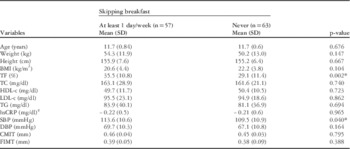
The overall sample comprised of 120 adolescents of both the sexes (62 boys [mean age 11.7±0.8 years]). In this study, 47.5% (95% CI: 38.5–56.4%) of the adolescents (n=57) reported skipping breakfast at least 1 day/week. Adolescents who skipped breakfast had higher values of trunk fatness (p-value=0.002) and systolic blood pressure (p-value=0.040) (Table 1).
General characteristics of the adolescents according to skipping breakfast (Presidente Prudente, Sao Paulo, Brazil, 2013).

#Variable under logarithm transformation; BMI=body mass index; CIMT=carotid intima-media thickness; DBP=diastolic blood pressure; FIMT=femoral intima-media thickness; HDL-c=high-density lipoprotein cholesterol; hsCRP=high-sensitivity C-reactive protein; LDL-c=low-density lipoprotein cholesterol; SBP=systolic blood pressure; TC=total cholesterol; TF=trunk fatness; TG=triacylglycerol; SD=standard deviation
*p-value <0.05
Adolescents with a higher frequency of breakfast consumption had lower values of trunk fatness (None: 37.7 [CI=33.3–42.1]; 1–2 days: 35.7 [CI=27.4–44.1]; 3–5 days: 32.6 [CI=28.1–37.1]; 6–7 days: 29.1 [CI=26.2–31.9]; one-way analysis of variance with p-value=0.008, and Tukey’s post-hoc with p-value=0.006 for the comparison between the groups “None” and “6–7 days”).
Breakfast frequency was negatively related to systolic blood pressure (p-value=0.045), z score of dyslipidaemia (p-value=0.044), and trunk fatness (ρ=−0.32; p-value=0.001). On the other hand, there was no relationship with metabolic, inflammatory or cardiovascular variables (Table 2).
Relationship between breakfast frequency, metabolic, inflammatory, and haemodynamic outcomes among adolescents (Presidente Prudente, Sao Paulo. Brazil, 2013).

CIMT=carotid intima-media thickness; DBP=diastolic blood pressure; FIMT=femoral intima-media thickness; HDL-c=high-density lipoprotein cholesterol; hsCRP=high-sensitivity C-reactive protein; LDL-c=low-density lipoprotein cholesterol; ρ=Spearman correlation coefficient; SBP=systolic blood pressure; TC=total cholesterol; TG=triacylglycerol
*p-value<0.05
In the multivariate model (linear regression; Table 3), breakfast frequency was negatively related to systolic blood pressure (β −1.99 [−3.67; −0.31]) and z score dyslipidaemia (β −0.46 [−0.90; −0.01]), independent of sex, age, or ethnicity (Models 2 and 3), but was dependent on trunk fatness (Model 4). trunk fatness and systolic blood pressure were positively and significantly related to cardiovascular, metabolic, and inflammatory variables (Table 4).
Adjusted relationship between breakfast frequency and metabolic, inflammatory, and haemodynamic outcomes among adolescents (Presidente Prudente, São Paulo, Brazil, 2013).

Model 2=adjusted by sex; Model 3=adjusted by sex, age, and ethnicity; Model 4=adjusted by sex, age, ethnicity, and trunk fatness; SBP=systolic blood pressure
Relationship between blood pressure, metabolic, inflammatory, and cardiovascular risk factors among adolescents (Presidente Prudente, São Paulo. Brazil, 2013).

CIMT=carotid intima-media thickness; hsCRP=high-sensitive C-reactive protein; DBP=diastolic blood pressure; FIMT=femoral intima-media thickness; HDL-C=high-density lipoprotein cholesterol; LDL-C=low-density lipoprotein cholesterol; ρ=Spearman correlation coefficient; SBP=systolic blood pressure; TC=total cholesterol; TF=trunk fatness; TG=triacylglycerol
*p-value <0.05
Discussion
Our results show that breakfast intake is related to reduction in blood pressure and z score dyslipidaemia among adolescents, this fact being mediated by trunk fatness.
Some studies have shown that the prevalence of skipping breakfast is elevated in adolescents. In our study, 47.5% of the adolescents reported skipping breakfast at least 1 day/week. In parallel, another study with Brazilian children and adolescents reported ~35% of young people eating breakfast on lesser than 5 days/week.Reference Duncan, Duncan and Fernandes 5 Similarly, ~53% of Iranian adolescents reported skipping breakfast.Reference Jourdan, Wühl and Litwin 11 The high rate of this unhealthy behaviour is worrying, as it has been associated with cardiovascular risk factors during early life.Reference Shafiee, Kelishadi and Qorbani 12
In this study, adolescents who skipped breakfast demonstrated higher trunk fatness and systolic blood pressure than their non-skipping counterparts. A hypothesis for the association between skipping breakfast and higher values of trunk fat is the possible increase in the appetite of children and adolescents who skip breakfast and are, therefore, more likely to consume foods with high-energy density during the day, increasing the probability of being overweight.Reference Jansen, Mackenbach and Joosten-van Zwanenburg 13 , Reference Szajewska and Ruszczynski 14
The scientific literature has pointed out that skipping breakfast can be associated with higher systolic blood pressure in boysReference Kollias, Antonodimitrakis and Grammatikos 15 and, in agreement with our findings, this relationship is mainly mediated by trunk fatness.Reference Alexander, Ventura and Spruijt-Metz 4 Mechanisms linking blood pressure and skipping breakfast are still unclear, but it is well documented that increased body fatness is related to higher sympathetic activity in paediatric populations.Reference Vanderlei, Pastre, Freitas and Godoy 16 Oxidative stress related to increased adiposity over-stimulates specific brain regions responsible for the control of sympathetic activity,Reference Hirooka, Sagara and Kishi 17 leading to increases in resting heart rate and blood pressure.
Moreover, abdominal adipose tissue is responsible for both the release of inflammatory agents and increased lipolysis, which causes insulin resistance in endothelial tissue, and, thus, this two-way process both decreases the release of nitric oxide and increases the release of endothelin-1.Reference Huang 18 Likewise, the interaction of these factors may explain the relationship between the adolescents who skipped breakfast and the elevated haemodynamic response found in our study.
There were no statistical significant relationships between breakfast intake, inflammation, and intima-media thickness in the adolescents. To our knowledge, there are no other studies that have verified the relationship between breakfast intake and intima-media thickness among adolescents. Our results could be explained by the characteristics of the sample, because obesity has a pivotal role in the development of atherosclerosis, and our sample was not composed exclusively of obese adolescents.Reference Huang 18 Moreover, atherosclerotic events are observed in adulthood after decades of silent development, and, therefore, it seems unlikely to observe it in paediatric populations without risk factors, such as metabolic syndrome.Reference Jourdan, Wühl and Litwin 11
On the other hand, it is noteworthy that in groups of exclusively obese adolescents, the relationships between skipping breakfast and metabolic variables are independent of body fatness.Reference Freitas Júnior, Christofaro and Codogno 2 Moreover, dyslipidaemia and systolic blood pressure were related to inflammation and femoral intima-media thickness, suggesting that avoiding skipping breakfast would have an indirect protective effect against these unhealthy outcomes.
This study has some limitations, such as its cross-sectional design – it is not possible to establish a causal relationship between skipping breakfast and the dependent variables – and the self-report of skipping breakfast – there is no previously validated questionnaire to assess skipping breakfast in adolescents; however, as for strengths, we can mention the analysis of the relationship between skipping breakfast and cardiovascular parameters not previously analysed in the literature, such as the artery intima-media thickness and high-sensitivity C-reactive protein. Furthermore, it is considered a strength that the adjusted analyses of all potential confounders – that is, sex, age, ethnicity, and trunk fat mass – were taken into account, both analysed separately and in blocks in order to determine if possible associations were independent of such factors.
In conclusion, our data suggest that skipping breakfast is related to cardiovascular risk factors in adolescents and this relationship is mediated by trunk fatness.
Acknowledgement
None.
Financial Support
The authors thank the State of São Paulo Research Support Foundation (FAPESP [Process: 2013/06052-2]) and CNPq (Process: 476295/2013-0) for funding this research project.
Conflicts of Interest
None.
Ethical Standards
The study had been previously approved by the Human Research Ethics Committee (process: 322.650/2013) and was in accordance with National Health Council (Resolution no. 466/12).