Introduction
Many devices using advances in technology have been, and are being, developed in order to reduce health problems or improve quality of life for ‘vulnerable’ adults (Lewis Reference Lewis1998; Miskelly Reference Miskelly2001; Scherer Reference Scherer2005). The devices that form part of ‘telecare’ – the process of delivering personal and social care remotely and in response to individual need – are one important new kind of ‘assistive technology’. Telecare devices are designed to assist individuals in both maintaining independence and maximising control over their lives, and to keep them safe from harm. To give a few examples: tagging and tracking devices using global positioning systems (GPS) can reduce the risks associated with wandering and getting lost in some people with cognitive impairment. Video monitoring can help carers to see whether someone for whom they care is in danger or need of assistance. ‘Smart homes’ are living environments that integrate information technology, telecommunications and embedded sensors to facilitate independent living, reduce social isolation, and lower the risks associated with, for example, leaving a cooker alight or a window open.
The potential value of these devices for improving the delivery of social-care services in the community is believed to be considerable, with telecare gaining significant political support (Department of Health 2009a, 2009b). Commentators have argued that telecare is a mechanism through which the contemporary political goals of empowerment, independence and safeguarding can be realised in practice whilst, simultaneously, helping to reduce the spiralling costs of health and social care, and tackling the forthcoming demographic challenges associated with an ageing society (Brownsell and Bradley Reference Brownsell and Bradley2003; Franco et al. Reference Franco, Kirkwood, Powell, Catt, Goodwin, Ordovas and van der Ouderaa2007; Tang and Venables Reference Tang and Venables2000).
Recently, however, the practical value of telecare has come under the microscope as different kinds of telecare devices have been subject to ethical scrutiny, leading to the identification of a number of ethical issues. Some of these ethical issues arise out of the potential future harms associated with the development of assistive technologies (AT) and the telecare industry, with developments in robotics, for example, potentially threatening the very nature of what it means to care and to be human (Baldwin Reference Baldwin2005; Coeckelbergh Reference Coeckelbergh2010; Parks Reference Parks2010; Sparrow and Sparrow Reference Sparrow and Sparrow2006). Other issues are orientated towards conflicts between ethical principles when AT devices are integrated into care services generally (Eccles Reference Eccles2010), or for different client groups (Perry, Beyer and Holm Reference Perry, Beyer and Holm2009). Specific concerns have also been raised about particular kinds of novel devices that generate new harms associated with remote monitoring and surveillance (Eltis Reference Eltis2005; Robinson et al. Reference Robinson, Hutchings, Corner, Finch, Hughes, Brittain and Bond2007; Welsh et al. Reference Welsh, Hassiotis, O'Mahoney and Deahl2003).
In this paper, our focus is on the latter concern: the use of telecare devices for remote monitoring and surveillance. Perhaps the best known type of remote monitoring device is the use of tagging and tracking systems, employed to tackle the ‘problem’ of wandering in people with dementia. A number of recent papers have discussed the ethical issues associated with the use of tagging and tracking (Eltis Reference Eltis2005; Hughes and Louw Reference Hughes and Louw2002; Hughes et al. Reference Hughes, Newby, Louw, Campbell and Hutton2008; Plastow Reference Plastow2006; Welsh et al. Reference Welsh, Hassiotis, O'Mahoney and Deahl2003). These papers have raised some general ethical concerns relating to the use of technology as a means to enhance the safety of older people with dementia, drawing particular attention to the tension between enabling people to maintain control over their lives to the greatest extent possible, and protecting them from coming to harm in an independent living environment (Robinson et al. Reference Robinson, Hutchings, Corner, Finch, Hughes, Brittain and Bond2007). Recently, devices have been developed to detect when a person has fallen. Falls are a major care and cost burden to health and social services world-wide (e.g. Englander, Hodson and Terregrossa Reference Englander, Hodson and Terregrossa1996; Scuffham and Chaplin Reference Scuffham and Chaplin2002), being common in older adults (Blake et al. Reference Blake, Morgan, Bendall, Dallosso, Ebrahim, Arie, Fentem and Bassey1988; Prudham and Evans Reference Prudham and Evans1981), potentially causing significant physical or psychological injury (Sattin et al. Reference Sattin, Lambert Huber, DeVito, Rodriguez, Ros, Bacchelli, Stevens and Waxweiler1990; Tinetti, Speechley and Ginter Reference Tinetti, Speechley and Ginter1988; Vellas et al. Reference Vellas, Wayne, Romero, Baumgartner and Garry1997), or reducing physical activity levels and social participation (Delbaere et al. Reference Delbaere, Crombez, Vanderstraeten, Willems and Cambier2004). Older adults are often unable to get up once they have fallen (Fleming and Brayne Reference Fleming and Brayne2008; Vellas et al. Reference Vellas, Cayla, Bocquet, de Pemille and Albarede1987), leading to further injury or death (Lord Reference Lord1990; Tinetti, Liu and Claus Reference Tinetti, Liu and Claus1993; Wild, Nayak and Isaacs Reference Wild, Nayak and Isaacs1981), and subsequent admission to nursing care homes (Alexander, Rivara and Wolf Reference Alexander, Rivara and Wolf1992; Lord Reference Lord1994; Tinetti and Williams Reference Tinetti and Williams1997). There is evidence that fall prevention strategies and interventions can be effective (Campbell and Robertson Reference Campbell and Robertson2006; Close et al. Reference Close, Ellis, Hooper, Glucksman, Jackson and Swift1999; Davison et al. Reference Davison, Bond, Dawson, Steen and Kenny2005; Logan et al. Reference Logan, Coupland, Gladman, Sahota, Stoner-Hobbs, Robertson, Tomlinson, Ward, Sach and Avery2010), if properly translated into practice (Clemson Reference Clemson2010), and so devices that alert carers or services to the fact that someone has fallen have the potential to be of value both as part of a broader falls prevention strategy, and in preventing harm arising from a delayed response. In contrast to tagging and tracking, there has been a lack of attention paid to the ethical aspects of using fall detectors beyond those papers that have explored ethical issues in telecare more broadly (Eccles Reference Eccles2010; Perry, Beyer and Holm Reference Perry, Beyer and Holm2009).
The aim of this paper is to substantiate these broad analyses, and shed light on the specific ethical issues raised by the use of fall detectors in people's own homes. We first outline some types of device that have been developed and how they function within the delivery of care and support; we then discuss various ethical issues that need to be addressed in the use of such devices; finally, we suggest a checklist of ethical issues that we believe could guide the appropriate use of such devices. We propose that the manufacturers of fall detectors should be obliged to provide information to potential customers that includes consideration of these ethical issues.
Types of detector
Progress in remote monitoring technology for fall detection is rapid, with novel techniques, such as acoustic segmentation under development. Acoustic segmentation uses advanced microphone technology to differentiate the sound of a person falling from competing noise (Zhuang et al. Reference Zhuang, Huang, Potamianos and Haseqawa-Johnson2009). However, currently, there are two main technological paradigms for detecting falls: automatic sensors and video monitoring.
Automatic sensors
Automatic fall detector sensors operate either directly or indirectly. The main components of most direct sensors are an accelerometer which detects the body's motion during a fall, and a microcontroller that sends a wireless signal to generate an alarm when a fall is detected. Direct sensor devices are worn either round the waist or on the wrist and manufacturers claim that they are unobtrusive and of low cost for the user (Campo and Grangereau Reference Campo and Grangereau2008; Miskelly Reference Miskelly2001; Prado-Velasco, Rio-Cidoncha and Ortiz-Martin Reference Prado-Velasco, Rio-Cidoncha and Ortiz-Martin2008). The differences between the various devices are their added features that aid the accelerometer in detecting falls and decrease the number of false alarms. Some examples of these added features include a tilt meter to determine the wearer's orientation after acceleration (Doughty, Lewis and McIntosh Reference Doughty, Lewis and McIntosh2000), a meter to determine whether or not an impact has taken place after acceleration (Noury et al. Reference Noury, Fleury, Rumeau, Bourke, Laighin, Raille and Lundy2007), a motion detector to determine the wearer's state of consciousness after acceleration (Bourke and Lyons Reference Bourke and Lyons2008), and a GPS tracking device in order to locate the wearer and enable a rapid response (Prado-Velasco, Rio-Cidoncha and Ortiz-Martin Reference Prado-Velasco, Rio-Cidoncha and Ortiz-Martin2008). Emerging data from pilot studies into the use of automatic sensor devices have revealed good rates of sensitivity to the detection of falls in experimental settings (Bourke and Lyons Reference Bourke and Lyons2008; Kangas et al. Reference Kangas, Konttila, Lindgren, Winblad and Jamsa2008; Lindemann et al. Reference Lindemann, Hock, Stuber, Keck and Becker2005), but no device completely eliminates the possibility of a false alarm.
Indirect sensors include motion detection devices such as bed occupancy sensors, floor pressure sensors, or inactivity sensors that use passive infra-red technology to detect when a person is not moving. Indirect sensors can be programmed to raise alarms when patterns of activity are recorded that deviate from a person's normal pattern of movements (Campo and Chan Reference Campo and Chan2002). For example, a bed occupancy sensor would need to be programmed so that an alarm is not raised during a nightly trip to the bathroom, but sensitive enough to raise an alarm if the sensor registers that the user was out of bed for a prolonged period of time. The use of indirect movement sensors may be effective in monitoring that a person has fallen and raising an alarm accordingly, but such sensors do not, of course, operate specifically as fall detection devices. In practice, there will be many other reasons why an alert is raised that have nothing to do with a person falling. In some cases, an alert will be raised when the person has not come to harm, but has simply deviated from a typical daily or nightly routine. As such, the likelihood of false alarms being raised with movement or inactivity sensors is likely to be significantly higher than with the use of direct sensors.
Video monitoring
Video monitoring involves real-time remote surveillance of the user while in the home setting, and may be considered to be a specific type of indirect automatic sensor. Older systems rely on video and audio communication using either a monitor or television and a touch-tone telephone (Miskelly Reference Miskelly2001). Some systems can relay the images to a secure website, and some cameras have the ability to pan, tilt, zoom and scan the accommodation. They may allow a remote viewer to monitor the user at any time, or alert the viewer when an alarm, such as a fire alarm, has been set off. Newer video systems are exploring less obtrusive real-time monitoring methods. These systems detect falls from the user's lying posture using scene analysis, or they detect abrupt movements using vector analysis software. Vector analysis involves detecting variations in a user's movements which are then sorted according to their direction and/or amplitude (Noury et al. Reference Noury, Fleury, Rumeau, Bourke, Laighin, Raille and Lundy2007). By focusing on the differences between successive images from the user's body positions and only transmitting the distinct variations that are consistent with a fall, these systems avoid relying on constant remote surveillance to detect when a fall has taken place. Video cameras using scene or vector analysis may also reduce the invasion of the user's privacy by using low image resolution, filtering the image into shape outline and motion vectors, or transmitting full images only once a fall is detected.
Types of responses
While there is much research aimed at developing highly reliable fall detectors and examining the possible benefits that fall detectors play within a falls prevention strategy, less attention has been given to considering how the device is integrated into the provision of care in a person's own home. Questions such as who will be notified, and what action should be taken, once an alarm is raised, remain unanswered and unaddressed in much of the literature on fall detection technology. Importantly, however, the different ways that technologies are used to detect falls in practice leads to support being reshaped in ways that impact markedly on the ethical issues raised by the actions that constitute that support.
When fall detectors are used by professional service providers, such as local councils with social services responsibilities, these devices are linked to a broad technological infrastructure, and are provided in service users' homes as an element of an integrated telecare service. Using fall detectors in this way means that an alarm generated from the detection system transmits a wireless signal to a community control centre which can then notify local social services to respond appropriately, for example by sending a person with suitable skills to aid the user. In order to reduce the rate of false alarms communicated to social services the control centre might attempt communication with the user prior to a decision as to whether the user requires assistance. Prior communication with the user might reduce inappropriate and costly responses but could lead to increased response time.
Another possibility is for this fall detection system to alert a relative or friend of the user, for example by the person in the control centre transmitting the signal to a mobile phone or a pager. It is then the responsibility of that relative or friend to decide what type of action should be taken. Understanding the ethical dimensions of this professional service model of responsive care also requires further questions to be addressed: which organisation runs the centre and the response team, and how are these funded? Does the organisation have policies and procedures to guide the response, including, for example, protocols for entering the user's private residence? Does the device store or transmit information about the user? Who in the organisation has access to this information; and what is the nature of this information, particularly if a video monitoring system is in place?
Alternatively, fall detectors can be used as a direct form of support by relatives or friends without third-party involvement. In these cases, the alarm is raised directly with a relative or friend once the sensor has detected a fall, and, again, it is the responsibility of the relative or friend to respond to this alarm. If a video monitoring system is being used, it is possible for a relative or friend to log on to a computer and view the user at any time, or to do so only once the video monitoring system has detected a fall, depending on the nature of the technology employed.
Ethical issues
Ethical issues arise from both the type of device being used – specifically its technological capabilities – and the way that the device is used as a component of supporting a person in their own home, either by informal carers or through the provision and delivery of a professional care service. It is important to recognise that ethical considerations will be required in the broader process of developing fall-prevention strategies within which the use of a fall detector might be only one component. In this paper, however, we are concerned with the ethics of recent developments in remotely monitoring, detecting and responding to falls. Therefore, we limit our analysis to the ethical issues that arise in using fall detectors in practice. We consider the ethical issues under four headings, although recognising that these are not mutually exclusive: autonomy, privacy, benefit and use of resources. Our analysis is based upon a principlist approach to explore the ethical issues, amending the ‘four principles’ framework (Beauchamp and Childress Reference Beauchamp and Childress2008) to highlight the first-order ethical principles that we believe are most pertinent to social care, in general, and the use of fall detectors in particular. Whilst principlism has been criticised for its rigidity and limitations in exposing the nature of the ethical challenges that arise in the use of telecare (Baldwin Reference Baldwin2005; Eccles Reference Eccles2010), it is a commonly used strategy in this area (Bjorneby et al. Reference Bjorneby, Topo, Cahill, Begley, Jones, Hagen, Macijauskiene and Holthe2004; Marshall Reference Marshall2000; Perry, Beyer and Holm Reference Perry, Beyer and Holm2009), and has been praised for linking universally valid norms to a common moral language that can be understood, and applied, by practitioners who have limited training in methods of ethical analysis (Gillon Reference Gillon1994).
Autonomy
Respect for autonomy, interpreted here as the right of each individual to control her own life and be free from unwanted interference, is a central principle of health and social care ethics. The fact that a person is older, and more vulnerable to falling, does not of itself diminish the importance of this principle. This principle has implications for three main aspects of the use of fall detectors: consent for their use; control of their use; and the nature of the response. It might also be seen as the principle that underlies the importance of privacy which will be discussed in the next section.
If the user has the capacity to decide whether, and how, a fall detector should be used then such a detector should be used only with her valid consent. Most liberal societies insist on this principle of consent in the setting of health and social care, and allow adults with capacity to refuse beneficial, and even life-saving treatment. Valid consent involves three elements: the person has the capacity to make the relevant decision, is appropriately informed, and is able to make a free, voluntary decision. The issue of informing users about the use of fall detectors may not be straightforward in practice. Consider a woman with early mild dementia who is at risk from falls and aware of this risk. Her family suggest that a video monitoring system is put in place, a camera in each room of her flat. The system will send real-time images to a secure website accessible only to a few specified family members. The woman, let us suppose, is capable of understanding this and agrees to the video surveillance. She appears both to have the capacity to consent and to have been fully informed. One camera surveys her bedroom. Because of the dementia she readily forgets that some of her family can see exactly what she is doing. In the privacy of her bedroom she behaves in ways that she would not want her family to observe. Was her consent to have the system installed valid? What exactly is the necessary information for valid consent? If, at the time of giving consent, she is not able to imagine all the situations that might be observed, does she have the capacity to consent?
Even if the user gives valid consent for a monitoring system to be set up, the principle of autonomy would require service providers or carers to respect any change of mind or decision to interrupt the monitoring. Some devices have to be worn around the waist or upper chest; they are not discreet and could be stigmatising or distressing for the user. It is reasonable to believe that a person who originally agreed to wear such a device may change her mind as there is some evidence that wearing electronic devices can cause older adults to feel embarrassed or fearful (Robinson et al. Reference Robinson, Hutchings, Corner, Finch, Hughes, Brittain and Bond2007). Clearly the ability for users to change their mind might decrease the value of the monitoring system and might increase the risk of harm, but considerations of autonomy emphasise that there would need to be very good reasons to justify overriding personal control of the use of the device. Indeed, the principle of autonomy would challenge arguments about the use of non-removable devices in scenarios where the user was judged to be at very high risk of falling. Much of the literature, however, interprets non-compliance as a problem – a result of inadequate device design or systemic failings, for example – rather than as the valid expression of the user's free choice (Alwan et al. Reference Alwan, Rajendran, Kell, Mack, Dalal, Wolfe and Felder2006; Levine and Tideiksaar Reference Levine and Tideiksaar1995; Nelson et al. Reference Nelson, Powell-Cope, Gavin-Dreschnack, Quigley, Bulat, Baptiste, Applegarth and Friedman2004). This failure to ensure that the principle of autonomy lies at the heart of all decisions relating to the use of fall detectors could be explained by the claim that telecare only promotes forms of self-management that concord with compliance to medical instruction and standardised care regimes (Schermer Reference Schermer2009).
In the interests of respecting their autonomy, users, if they have the capacity, must agree not only to the nature of the monitoring but also the responses that will be initiated should a fall be detected. This would require information to be provided in relation to a number of uncertain, and potentially difficult, questions: Who is told about a fall? Who has access to their home if they do fall? What might be the longer-term consequences of people knowing about falls? In relation to the last question, for example, data from alarms that are raised by automatic sensors or through video monitoring could lead family members to become so concerned that they take steps to move their relative into a care home. As a corollary to the decision about the nature of the response invoked once an alarm is raised, service providers would need to give careful consideration to ensure that users were fully informed about potential implications of the detection, alert, and response process being proposed.
We have emphasised some ways in which fall detection devices might interfere with autonomy. These devices may also promote users' autonomy, for example through increasing independence for longer periods of time, enabling users to continue directing their own life plan to the fullest extent, and without unnecessary interference from external services. Given that the evidence suggests that most people with care needs would like to receive care in their own home setting rather than moving to a residential care or nursing home (Help the Aged 2008), the use of fall detectors is likely to respect autonomy, assuming that the challenges of fully informing the user in the process of gaining consent can be overcome.
Privacy
All fall detectors compromise the users' privacy, although this occurs in different ways and to different extents. Video monitoring, where the viewer has the ability to see exactly what the user is doing, can be a highly significant invasion of privacy, as in the example of the woman with mild dementia discussed above. The extent of this invasion may depend on which rooms contain a camera. It seems intuitively likely to us that most people would prefer cameras not to be placed in private settings such as bathrooms or bedrooms, although these may be rooms in which the risk of falling is most significant. This issue could be exacerbated further if data about third parties are collected by video cameras or a motion-detection device such as a bed occupancy sensor. Such data might include visual recordings of users and their homes, or it might include the collection of other forms of personal data, such as information about partners' daily activities and routines.
Even if users lack the capacity to consent to, or refuse, the use of monitoring, they still have strong privacy interests and these should be violated only with very good reason. Further empirical evidence is required to flesh out the nature and scope of user and public concerns about privacy in relation to the use of fall detectors. A corollary of this concern is that in those situations where considerations of risk reduction justify the use of monitoring, privacy should be compromised to the least possible extent. Here, the use of certain technologies would appear to be more morally defensible than the use of other technologies. Cameras that use intelligent software to detect falls without providing the viewer with a continuous video of the user will reduce the invasion of privacy, as will automatic sensors. However, personal data are still produced by these devices, such as the location of the user in the home (Noury et al. Reference Noury, Fleury, Rumeau, Bourke, Laighin, Raille and Lundy2007). Even the information that the user has fallen impacts negatively on privacy interests and needs to be justified.
The ‘added features’ of fall detectors can also change the nature and extent of the invasion of privacy. GPS tracking systems used as part of a fall detection system will provide the viewer with information about the user's movements outside the home, unless the system is designed to operate within a limited range. A system that only provides this information after a fall is detected would reduce, although not eliminate, such an invasion of privacy. Finally, privacy concerns would be raised if the data collected by monitoring systems were used for purposes other than that for which they have been designed, or to which the user had consented. Concerns have been raised in empirical studies that commercial companies could acquire such data to direct marketing strategies to sell aids, adaptations or other devices, or that governmental agencies might use data about a person's functional abilities to make changes to a person's benefit payments or eligibility for publicly-funded social-care support (Percival and Hanson Reference Percival and Hanson2006; Percival, Hanson and Osipovic Reference Percival, Hanson, Osipovic, Loader, Hardey and Keeble2009).
Benefit
Reviews of the literature have demonstrated that the best form of intervention for falls in assisted living and nursing home settings is an individualised system catered specifically to the user (Tilly and Reed Reference Tilly and Reed2006), within a broad interagency strategy focused on reducing the frequency of the person falling (Martin Reference Martin2009). The main purpose of fall detectors is to improve safety. There is some evidence that they decrease users' fears about falling (Brownsell and Hawley Reference Brownsell and Hawley2004a), although this is far from conclusive (Brownsell and Hawley Reference Brownsell and Hawley2004b; Laviolette and Hanson Reference Laviolette and Hanson2007). Evidence from qualitative studies suggesting that electronic devices worn on the body do not make people feel safer, but rather more vulnerable – either because they are constant reminders of the dangers that they face (Brownsell and Hawley Reference Brownsell and Hawley2004a), because they feel embarrassed, or because they feel that they are more likely to be the victim of theft (Robinson et al. Reference Robinson, Hutchings, Corner, Finch, Hughes, Brittain and Bond2007). However, if fall detectors do reduce the fear of falling, they will likely impact positively on the user's quality of life, not only because of the positive effect of making people feel less afraid, but also because of the likelihood that the person will engage in a more active lifestyle, be involved in an increased range of activities, and be better integrated in the community. Benefits will also be realised if, as they are intended to do, fall detectors enable people to enjoy greater freedom, and remain in their own homes for longer than it would otherwise be possible or safe to do so. Given the evidence of two recent surveys (Landau et al. Reference Landau, Werner, Auslander, Shoval and Heinik2009; Rialle et al. Reference Rialle, Ollivet, Guigui and Herve2008), an interview study (White, Montgomery and McShane Reference White, Montgomery and McShane2010), and a focus group study (Landau et al. Reference Landau, Auslander, Werner, Shoval and Heinik2010) of caregivers' attitudes towards different kinds of telecare devices, it is apparent that fall detectors may also benefit others by providing reassurance to carers and reducing the economic or psychological burden of direct caring.
There are, however, a number of possible disadvantages associated with the use of fall detectors. First, it has been claimed that remote monitoring and detection technology will lead to a reduction in human interactions and an increase in social isolation (Lowe Reference Lowe2009; Marshall Reference Marshall2000) as, ironically given the aim of telecare, people become institutionalised in their own homes (Eccles Reference Eccles2010). For example, a care-giver may decrease the number of visits because of the ability to monitor remotely, and the delivery of care at distance would be detached from the value of the interpersonal act of caring itself. The empirical evidence of the impact of technological devices and telecare on social isolation, user–provider care relationships and interaction is conflicting. On the one hand, this intuition appears to be substantiated by research (Tang, Gann and Curry Reference Tang, Gann and Curry2000), with concerns also being raised by service providers that telecare will be used to justify cost-cutting and redundancies in professional care services (Percival and Hanson Reference Percival and Hanson2006; Percival, Hanson and Osipovic Reference Percival, Hanson, Osipovic, Loader, Hardey and Keeble2009). On the other hand, a recent study in the Netherlands of nursing practices has shown that new technologies can facilitate social and affective relationships between care providers and care recipients (Pols Reference Pols2010; Pols and Moser Reference Pols and Moser2009).
Secondly, fall detectors may lead to increased, rather than decreased, risks from falls either because a user might be encouraged to engage in behaviours that increase the likelihood of falling (Brownsell and Hawley Reference Brownsell, Hawley, Wootton, Dimmick and Kvedar2006), or because too much reliance is placed upon them. This problem would be made worse by the possibility that the user switches off the device. Thirdly, instead of decreasing the chance that a person may be moved into a care home, a fall detector may increase this chance through making relatives aware how frequently the person falls. This might, or might not, be in the person's best interests. For example, a user who falls may alarm relatives unduly and even if a care home were to provide a safer environment it might nevertheless be in the person's overall best interests to remain in their own home. This claim cannot, however, be substantiated empirically as there is currently limited evidence of relatives' attitudes towards the use of fall detectors or telecare more broadly. Finally, there are significant concerns about the likelihood of false positives and false negatives, which have been documented in empirical studies of direct sensors (Brownsell and Hawley Reference Brownsell and Hawley2004a), and raised as serious concerns by both users and care providers (Brownsell and Hawley Reference Brownsell and Hawley2004b).
Use of resources
The remote monitoring devices and responses that follow the detection of a fall require resources of time and money, regardless of whether the fall detector is integrated within a family carer or professional system of support. Inevitably, the use of such resources raises the question of whether, in a particular instance, using a detector is a good or a poor use of resources. There may also be an issue of whether the use of the detector is fair on the person, or people, who take the brunt of the burden to respond. The mere possibility of using a detector may have a deleterious effect on a carer, relative or service. For example, a daughter who lives near her frail father may visit him every day. When she goes on holiday another family member or friend takes over the visits. New technology, by providing a means by which the daughter can continue to check on her father, may deprive her of a much-needed break from her responsibility, or alternatively fundamentally change the way she perceives that responsibility. Again, empirical research with relatives is required to substantiate this claim, and assess the impact of resource-use concerns associated with the act of responding.
State resources and private insurance have to be used efficiently. Even when it is in the best interests of the user for such resources to be used, it does not necessarily follow that this will be the best use of those resources. Every time social- or health-care services respond to the detection of a fall, there are opportunity costs associated with this action. The response is at the expense of something else, helping another patient, for example. False positives will be particularly wasteful of resources. In some circumstances these services may choose whether or not to take on the role of monitoring or responding, but this will not always be the case. Relatives may draw more heavily upon primary care services as a result of making use of the detector, for example making an appointment for their father to be checked by the general practitioner every time a fall is detected. Without the detection system many of these falls are likely to occur without the family member's knowledge. Again, such appointments have an opportunity cost, and might not be judged to be a good use of the doctor's time.
Discussion
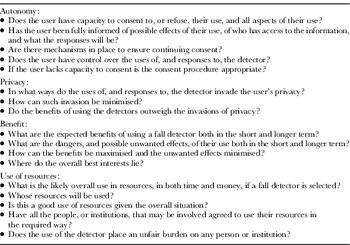
Current research that focuses on designing the most efficient and reliable fall detectors may lead to many beneficial effects for those at risk of falls, their families, care-givers, and, through reducing costs, society. There are, however, many ethical issues that need to be addressed when considering the use of such detectors. As we have outlined, ethical considerations arise out of the nature of the care process, or support system, within which the fall detection device is incorporated, as well as from the nature of the device itself. Paying close attention to ethical considerations may affect not only the decision as to whether to use a device, but also which device to use, which of the possible features to include, and the nature of the responses instigated once a fall is detected. Professionals deciding to use fall detectors within their service, or who are involved in advising people and their carers on the use of these technologies, will need to be aware of the ways that ethical issues arise in their own practices, and shape how they should help relatives to make appropriate decisions. In Table 1 we suggest a brief checklist of some questions to ask in working through the four types of ethical issues that we have raised.
A checklist of some ethical issues when considering the use of fall detectors

In addition, we believe that the manufacturers of fall detectors have a duty to ensure that ethical considerations lie at the heart of the decision-making process relating to the use of these devices. Neither users, relatives nor professionals can be expected to be fully aware of all the issues that might be raised by the functioning of a particular device, particularly given the rapid technological advances being made in this area. We believe that there is, therefore, a duty on manufacturers to inform potential buyers and users of the various ethical issues that need to be considered and the possible related unwanted effects that might arise from how they are used and integrated into the provision of care or support services. The pharmaceutical industry is obliged to provide information for patients about the possible unwanted effects of medications through the production of leaflets, for example. Manufacturers of non-pharmaceutical products such as those discussed in this paper should be under a similar obligation.
Acknowledgements
We would like to acknowledge the valuable comments from an unknown reviewer. MD is grateful to the Ethox Foundation, and TH is grateful to the Uehiro Foundation and the Brocher Foundation, for support whilst working on this paper.