INTRODUCTION
Numerous studies have examined lawyers’ careers within law firms, particularly promotions (Kay and Hagan Reference Kay and Hagan1995; Reference Kay and Hagan1998; Beckman and Phillips Reference Beckman and Phillips2005; Gorman Reference Gorman2006), earnings (Dinovitzer et al. Reference Dinovitzer, Reichman and Sterling2009; Hagan and Kay Reference Hagan and Kay2010; Kay Reference Kay2019), areas of practice (Heinz et al. Reference Heinz, Nelson, Sandefur and Laumann2005), and relationships with clients (Sarat and Felstiner Reference Sarat and Felstiner1995; Dinovitzer et al. Reference Dinovitzer, Gunz and Gunz2014). Far fewer studies have paid attention to the movement of lawyers out of law firms (but see Kay et al. Reference Kay, Alarie and Adjei2013; Reference Kay, Alarie and Adjei2016; Dinovitzer and Garth Reference Dinovitzer and Garth2020). Research is pressing here because a growing body of research suggests that law firms face particular challenges with turnover, especially of women (Noonan and Corcoran Reference Noonan and Corcoran2004; Beckman and Phillips Reference Beckman and Phillips2005; Cheng Reference Cheng2017; Ganguli, Hausmann, and Viarengo Reference Ganguli, Hausmann and Viarengo2021) and racial minorities (Wilkins and Gulati Reference Wilkins and Gulati1996; Gorman and Kay Reference Gorman and Kay2010; Payne-Pikus et al. Reference Payne-Pikus, Hagan and Nelson2010; Carbado and Gulati 2013). Some studies suggest that the culture of law firms may be to blame for the exodus of women and minorities from law firms and private practice generally (Sommerlad Reference Sommerlad2016; Sterling and Reichman Reference Sterling and Reichman2016; Westfahl and Wilkins Reference Westfahl and Wilkins2017; Gorman and Kay Reference Gorman and Kay2020).
The culture that develops within a law firm has important implications for the ability of lawyers to work collaboratively within firms, job satisfaction, and commitment to stay with the firm (Hillman Reference Hillman2018; Oakley and Vaughan Reference Oakley and Vaughan2019). Law firm culture provides the relational foundation that connects junior lawyers to powerful mentors (Kay and Wallace Reference Kay and Wallace2009; Westfaul and Wilkins Reference Westfahl and Wilkins2017) and shapes professional development through challenging assignments (Kay and Gorman Reference Kay and Gorman.2012). Firm culture also communicates workplace expectations, including: the pace of work and billable hour targets (Fortney Reference Fortney2000), lawyers’ availability after hours via mobile technology (Choroszewicz and Kay Reference Choroszewicz and Kay.2019), and whether law firm leaders support family-friendly workplace policies such as flexible work (Easteal et al. Reference Easteal, Caligari, Bartels and Fitch2015) and paid parental leaves (Kay et al. Reference Kay, Alarie and Adjei2016). In many respects, law firm culture shapes lawyers’ understandings about “how things are done” at their firm (Chambliss Reference Chambliss2010, 1). The culture of a firm also communicates the extent to which diverse groups are welcome through hiring practices and opportunities for advancement (Gorman and Kay Reference Gorman and Kay2010; Rivera and Tilcsik Reference Rivera and Tilcsik2016; Sommerlad Reference Sommerlad2016; Westfahl and Wilkins Reference Westfahl and Wilkins2017; Adediran Reference Adediran2018). New law graduates are acutely aware of distinct law firm cultures and consciously assess their “fit” with a firm’s culture when selecting to which firms they will pursue applications (Rowan and Vaughan Reference Rowan and Vaughan2018) and again after hiring, whether to remain with the firm (Payne-Pikus et al. Reference Payne-Pikus, Hagan and Nelson2010). Yet, most research has focused on elite large law firms (Adams and Engel Reference Adams and Engel2015; Garth and Sterling Reference Garth and Sterling2018; Dinovitzer and Garth Reference Dinovitzer and Garth2020; Tureta and Júnior Reference Tureta and Júnior2020; Ganguli et al., Reference Ganguli, Hausmann and Viarengo2021) and law firm leaders’ assessments of job candidates in terms of their cultural traits (i.e., leisure pursuits, life experiences, and self-presentation) and “fit” with the firm (Rivera and Tilcsik Reference Rivera and Tilcsik2016; Ballakrishnen Reference Ballakrishnen2019). Little work has examined law firm cultures in non-elite corporate firms or perceived cultural fit by lawyers themselves after their hiring (though see Garth and Sterling Reference Garth and Sterling2018).
This article seeks to understand the role of law firm culture in the retention and attrition of lawyers launching their careers in private law firms. The writings of two scholars, John Hagan and Emmanuel Lazega, inform the theoretical framing of this article. John Hagan’s work draws attention to the importance of social capital—the flow of resources through social relationships—in building law firm culture and encouraging lawyers’ attachment to the firms where they work. Emmanuel Lazega’s work identifies network aspects of collegiality within law firms that build solidarity and guard against turnover. Bringing together the theoretical approaches of these two scholars offers new insight on law firm culture and its consequences for lawyers’ careers. I draw on a near-thirty-year longitudinal study of 1,007 Canadian lawyers who launched their careers in private law firms to examine the approaches advanced by these two scholars.
This article advances research on turnover in three areas. First, I trace the timing of lawyers’ departures from law firms. In so doing, I identify periods of instability and document differential risks of early turnover between men and women lawyers. Second, I examine dimensions of law firm culture that may influence a lawyer’s decision to leave their firm. These dimensions comprise workplace climate and expectations, including prospects for advancement, and social dynamics between lawyers, such as level of collegiality within the firm and occasions for professional development through trusted mentors. Third, I incorporate individuals’ propensities, such an internal drive or empowerment, that might make some lawyers more apt to explore other job possibilities regardless of years of service with a firm. To conduct these analyses, I draw on a unique longitudinal study of Canadian lawyers. I begin below by addressing contemporary challenges to law firm collegiality. Next, I summarize the scholarship of John Hagan and Emmanuel Lazega on law firm culture and then turn attention to the broader research literature on job turnover.
Background
Law Firm Culture: The Resilience of Collegiality
Early studies claimed that the behavior of large law firms was governed by social norms revolving around the concept of collegiality (Mayer Reference Mayer1966; Nelson Reference Nelson1988). Partners valued a sense of community derived from personal relationships among equals (Glendon Reference Glendon1994; Gorman Reference Gorman1999). Beginning in the 1970s, the relatively stable world of law firms, particularly large law firms, confronted challenges brought on by increased government regulation leading to more “law,” the service economy outperforming manufacturing (Dinovitzer and Garth Reference Dinovitzer and Garth2020), and a boon in complex litigation (Galanter and Henderson Reference Galanter and Henderson2008). The new era was described as one of increasing commercialization and declining professionalism (Nelson and Trubek Reference Nelson, Trubek, Nelson and Trubek1992). In the 1980s, globalization of the economy drove international trade and large law firms became corporatized (Flood Reference Flood2011), international in reach (Faulconbridge and Muzio Reference Faulconbridge and Muzio2009), and grew exponentially (Dinovitzer and Garth Reference Dinovitzer and Garth2020). By the 1980s, new values began to undermine the ideal of collegiality. Increased competition among corporations eroded longstanding relationships between companies and law firms (Galanter and Henderson Reference Galanter and Henderson2008). Large law firms increasingly emphasized financial success (Kronman Reference Kronman1993) and tracked billable hours as a method to identify successful lawyers (Glendon Reference Glendon1994). Lawyers who did not perform at expected levels—including partners—saw their compensation reduced or their firm affiliations revoked (Galanter and Palay Reference Galanter and Palay1991; Gorman Reference Gorman1999). The new tournament within firms saw the emergence of multi-tier partnerships (Henderson Reference Henderson2006; Ackroyd and Muzio Reference Ackroyd and Muzio2007) and the growth of positions other than associates and equity partners, including contract attorney and of counsel (Galanter and Henderson Reference Galanter and Henderson2008).
These changes have largely impacted big firms, yet recent events and pressures—including the global financial crisis, COVID-19 pandemic, diversity policies (Seuffert, Mundy, and Price Reference Seuffert, Mundy and Price2018), digitalization in the legal industry (Flood and Robb Reference Flood and Robb2019; Kronblad Reference Kronblad2020), demands to offer more flexible forms of work organization (Tureta and Júnior Reference Tureta and Júnior2020), and commodification pressures from economic globalization— affect small and large law firms (Chow and Tsui-Auch Reference Chow and Tsui-Auch2020). Taken together, these dramatic changes have prompted some scholars to surmise that collegiality would eventually be supplanted by bureaucracy (Abel Reference Abel2004) and a business or managerial logic of operation (Chow and Tsui-Auch Reference Chow and Tsui-Auch2020; Tureta and Júnior Reference Tureta and Júnior2020).
Although law firms, particularly large firms, have undergone tremendous change over the last fifty years, collegiality does not appear to have vanished from law firms. Evidence suggests that cooperation remains in law firms, but its form is more nuanced than lawyers simply teaming together to apply their collective skills to resolve legal matters (Garth and Sterling Reference Garth and Sterling2018; Lazega Reference Lazega2020). Two scholars, John Hagan and Emmanuel Lazega, have advanced complementary visions of the cooperative social relationships that are the foundation of law firm culture.
John Hagan’s collaborative research highlights the importance of social capital. This is comprised of two interrelated components: relationships and intangible resources of “trust, reciprocity, information, commitments, and solidarity” (McCarthy, Hagan, and Martin Reference McCarthy, Hagan and Martin2002, 833; see also Kay and Hagan Reference Kay and Hagan2003). The social capital derived from personal and professional networks facilitates a flow of information resources that advantage lawyers in their prospects for upward career mobility (Kay and Hagan Reference Kay and Hagan1999; Dinovitzer and Hagan Reference Dinovitzer and Hagan2006). Hagan and colleagues contend that mentors within the firm offer a particularly valuable form of social capital by bringing junior lawyers on board challenging cases, coaching juniors on law firm performance metrics, and touting their protégés’ accomplishments to senior partners of the firm (Kay and Hagan Reference Kay and Hagan1998; Kay, Hagan, and Parker Reference Kay, Hagan and Parker2009). Collegial relationships within firms and the flow of information represent rich social capital that fosters a strong firm culture. However, when social capital is relegated to privileged groups with shared backgrounds, while “outsider” lawyers are delegated less valued resources or excluded entirely from interesting work and enriching professional relationships, then the firm culture risks alienating some lawyers (Kay and Hagan Reference Kay and Hagan1998; Reference Kay and Hagan1999). In addition to the role of social capital in building law firm culture, Hagan’s work also emphasizes the importance of lawyers’ sense of agency or power (Hagan Reference Hagan1990; Hagan and Kay Reference Hagan and Kay2007) in shaping or resisting law firm cultures (Hagan and Kay Reference Hagan and Kay.1995; Kay and Hagan Reference Kay and Hagan1998) and in prompting mobility within and from law firms (Hagan, Huxter, and Parker Reference Hagan, Huxter and Parker1998; Kay and Hagan Reference Kay, Hagan and Felstiner2005).
The scope of Hagan’s research on social capital and law firm culture is broad—both in terms of what constitutes social capital and its relationship to lawyers’ career mobility. In contrast, the work of Emmanuel Lazega can be characterized as more narrowly focused on the internal dynamics of law firms. Lazega identifies three systems that help law firms to maintain cooperation and prevent quitting behavior. First, an official “welfare system” based on formal rules—which express policies and allocate resources to members—provides the procedures to guide case intake and work assignment and thus signals solidary behavior (Lazega Reference Lazega2000, 246). The welfare system is intertwined with an informal patronage system or “clientelistic” procedure: partners and associates choose one another for mentorship and distribution of work based on strategic and reputational-based criteria (Lazega Reference Lazega2000, 249). Yet, patronage creates a threat to firm integration because patronage builds strong work ties between “finders” (those who recruit clients) and “grinders” (junior lawyers who carry out much of the actual work), who are then in a position to defect and launch their own firm. According to Lazega, a third process, “niche-seeking,” takes place that helps the welfare system to keep the patronage system in check (Reference Lazega2000, 258). In niche-seeking behaviors, lawyers seek out talented and dependable colleagues at the same rank for advice and to help with workload (Lazega Reference Lazega1999). It is in a lawyer’s interest to seek out reliable coworkers in the same office, same specialty, and even same hierarchical status. This niche-seeking logic in lawyers’ choices to “team up” forges durable cooperation and the sharing of resources on a trusted exchange basis (Lazega and Pattison Reference Lazega and Pattison1999).
Both Hagan and Lazega affirm that collegiality remains important to law firms’ ability to retain talented lawyers. Their research encourages us to think broadly about substantive dimensions of collegiality and consequences for lawyers’ social mobility. In the present study, I attempt to gain traction on several dimensions of law firm collegiality which may build loyalty to law firms and reduce turnover, including: (1) lawyers’ perceptions of their working relationships with colleagues; (2) organizational policies that provide flexibility in work arrangements; and (3) the role of mentors. In addition to these dimensions, I incorporate factors identified in studies of turnover from the sociology of work and occupations literature. I discuss this literature next.
Job Turnover Literature
A variety of conceptual models for the turnover process have been developed. Common to these models is the claim that job satisfaction is a key antecedent of intentions to change jobs (Li et al. Reference Li, Zhu and Park.2018) and actual turnover (Jo and Ellingson Reference Jo and Ellingson2019). Competitive pay and benefits are considered essential to the retention of personnel (Buttner and Lowe Reference Buttner and Lowe2017), though a warm climate of collegiality, marked by teamwork and offers of help to solve problems and reduce work overload, also encourages employees to remain loyal to a firm (Dhar and Dhar Reference Dhar and Dhar.2010). Following these models, I assess the effects on turnover of satisfaction with two aspects of firms: status rewards and collegiality. I expect that lawyers who are more satisfied with opportunities for status rewards (i.e., pay, prestige, and promotions) and collegial relationships will be less inclined to quit their firms.
Job satisfaction is also contingent on one’s expectations. For professionals, expectations and evaluations of future prospects may be especially important. Studies have shown that employees with higher education levels may become dissatisfied quickly if a job does not meet expectations and leave for opportunities elsewhere (Lake et al. Reference Lake, Highhouse and Shrift2018). These expectations are likely shaped by whether the individual landed the sort of job they desired most at the time of job search (Wallace Reference Wallace and Van Hoy2001) and their evaluation of the job itself, in terms of working conditions and incentives within the firm (Stumpf Reference Stumpf2014). Especially when new graduates do not land their initial preference for first jobs, they may start off hesitant in their long-term dedication to the firm and on the search for new employment that better aligns with their preferences. Therefore, I expect that satisfaction with the initial job match will reduce turnover.
Even for lawyers who were hired by the firm they desired most, their future with the firm is far from certain. The degree to which lawyers are integrated within the firm may be pivotal to their continued service. One workplace policy strategy to enhance integration is for firms to offer flexible scheduling (Crossley et al. Reference Crossley, Bennett, Jex and Burnfield2007; Rubin and Brody Reference Rubin and Brody2011). These workplace policies strengthen collegial bonds within the firm and foster attachment to the firm (Benson and Brown Reference Benson and Brown2007). Even if employees do not avail themselves of these policies, the presence of such policies sends a powerful signal that firm management values employees and acknowledges the importance of personal and family involvements (Mennino et al. Reference Mennino, Rubin and Brayfield2005). As a result, I expect that firms with these benefits will experience lower turnover.
Time in law firm settings also shapes lawyers’ inclinations to change jobs. In the initial phase of a new job, it may be relatively easy for a junior lawyer to leave his or her job in search of a better job (or better fit), particularly if the current job rewards fall below expectations. However, after the match has endured a while, lawyers are less inclined to leave because their attachment to the firm and compensation have grown such that the cost of leaving the job is high (Wallace Reference Wallace1997; Van Dam Reference Van Dam2005). This attachment may extend beyond the immediate firm to private practice such that the only job alternatives contemplated are those with other firms. I therefore expect that the longer a lawyer has worked in a law firm, the less likely he or she will be to exit, and any job change is likely to be to another firm rather than to other possible destinations (e.g., government and in-house counsel).
Nonetheless, some employees appear prone to early flight from firms and impervious to the comfort that grows with the passage of time. Therefore, beyond organizational context, personality traits may comprise a strong self-driver of turnover. One personality trait that may be salient is locus of control. This refers to the extent to which people believe they, rather than external factors such as chance and powerful others, are in control of the events that influence their lives (Levenson Reference Levenson1974). Internal locus of control has been found to be positively related to job satisfaction (Firth et al. Reference Firth, Mellor, Moore and Loquet2004) and to mediate the relationship between job stressors and intention to leave a job (Gupta et al. Reference Gupta, Bhattacharya, Sheorey and Coelho2018). Lawyers with intrinsic motivators, such as a powerful locus of control, are more likely to make job changes, especially when opportunities for challenging work and promotions are limited (Kay and Hagan Reference Kay and Hagan2003). Thus, a strong locus of control is expected to be a powerful generator of momentum to change jobs.
At the same time, law firm leaders strive to foster collaboration and developmental opportunities to nurture attachment to the firm. Workplace cultures that value early professional development through guidance from dedicated mentors may prove especially effective in reducing turnover (Gorman and Kay Reference Gorman and Kay2020). Mentors may solidify junior lawyers’ commitment to build their career with the law firm where they were hired after graduation. Mentors offer newcomers opportunities to demonstrate their competence through challenging work assignments (Kmec Reference Kmec2007). Numerous studies have emphasized the importance of mentoring on professionals’ job satisfaction, commitment, and retention (Sander Reference Sander2006; Kay and Wallace Reference Kay and Wallace2009; Paustian-Underdahl et al. Reference Paustian-Underdahl, King, Rogelberg, Kulich and Gentry2017). In firms that fail to offer a hospitable climate of collegiality and opportunities plush for professional development, junior lawyers may be motivated to seek employment elsewhere (Wilkins and Gulati Reference Wilkins and Gulati1996). Therefore, I expect that mentors will play a pivotal role in retaining lawyers in law firms.
Methods
Data for this study come from a longitudinal panel survey of lawyers in the province of Ontario, Canada. The province is home to 46 percent of the country’s lawyers (Federation of Law Societies of Canada 2021). Data were collected at five time points and at six-year intervals across twenty-seven years, from 1990 to 2017. The relatively short intervals were selected to capture knowledge of recent job histories and workplace conditions while these events and situations could be easily recalled by participants (Manzoni et al. Reference Manzoni, Vermont, Luijkx and Muffels.2010). The original sample consisted of a disproportionately stratified, random sample of lawyers from the membership records of the Ontario Law Society. The sample was stratified by gender to include equal numbers of men and women admitted to the Ontario Bar during a fifteen-year span, 1975 to 1990, the first span of time in which sizeable numbers of women entered the profession. Questionnaires were mailed directly to respondents’ places of work. Survey “panels” took place in 1990, 1996, 2002, 2009, and 2017, with panels yielding an impressive response rate of 72 percent, on average (N=1,597).Footnote 1
The surveys were designed using a unique format, including a professional work history calendar summarizing job changes across time. Each survey wave gathered information on up to eight professional positions in the period between survey panels. Surveys included a range of questions about job satisfaction, workplace responsibilities, mentoring experiences, and organizational characteristics, as well as questions about life outside law, including cohabitation and marriage, children, and parental leaves. The survey panels were merged, and the work and life histories nested into individual biographical records. In this article, the sample is restricted to 1,007 law graduates who started their careers in private law firm settings. Many of the lawyers in this fifteen-year cohort navigated their careers through the recessions of 1981–82, 1990–92, and 2008-09, as well as the historical changes to the structure of law practice discussed earlier in this article. This longitudinal study provides a unique opportunity to follow their career pathways during a turbulent time in the profession of law.
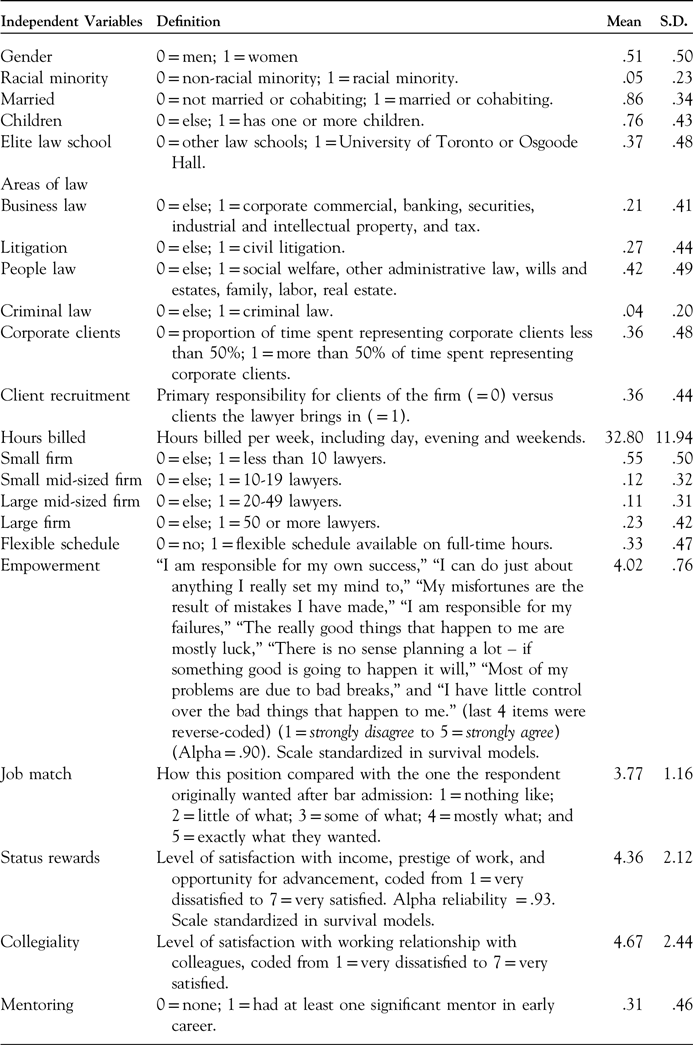
The initial dependent variable is the risk of leaving the law firm where a lawyer started his or her career after graduation from law school. Techniques of event history analysis are employed to capture both the probability and the timing of leaving the law firm. Subsequent dependent variables explore destination pathways to another law firm, or eventually to solo practice, and non-private practice. The measurement of variables, independent and dependent, is detailed in Table 1.
Operationalization and Measurement of Study Variables

Estimation
Survey data were restructured into an event history format where a single spell accounts for each job held by each respondent during his or her labor force experience since graduation from law school. These spells were then divided into person-months segments. Particularly important for this research is that respondents were asked to indicate if and when they changed jobs and when such changes involved transitions from law firms to other firms, to solo practice, and job moves to non-private law practice settings. To specify the risk sets for the transitions out of law firm environments, I produced a single data-file, with person-months for individuals starting out their careers in law firm settings. The resulting data file tracked 523 months and contained 215,317 person-month spells.
In order to examine the rates of exiting work in law firms, I employ hazard models, which estimate the log of job mobility as a linear function of a vector of explanatory variables and duration terms. Rather than choosing a specific parametric form for the transition rate, I utilize the piecewise exponential model. This model imposes the fewest shape assumptions on the baseline distribution (Park and Sandefur Reference Park and Sandefur2003, 246). One of the benefits of the piecewise exponential model is the ability to separate out durations of time to evaluate how risks of job transitions vary over time (Blossfeld and Rohwer Reference Blossfeld and Rohwer2002). Thus, a piecewise exponential model offers the flexibility of the Cox Proportional Hazards model with the added advantage of being able to estimate the shape of the hazard function (Blossfeld et al. Reference Blossfeld, Rohwer and Schneider2019). The model treats the hazard rate as a step function of T, time. Thus, each time period is assigned a “time dummy variable” with the estimates for each dummy representing the hazard function for that specific time period (Mills Reference Mills2011, 121).
When estimating the piecewise exponential model, survival time is divided into intervals. The assumption is that the hazard is constant within each interval but can vary across intervals. If J is a set of intervals with the specified cut-points of α0, α1, …, αj, and α0 = 0 and αj = ∞ (infinity), interval j is (α j-1, αj) and the hazard for lawyer i is:
 $${\rm h}_{ i} (t)= \lambda e ^{\beta x_i} \quad \quad \quad for \ \alpha_{{\it j}{\hbox -}1} \le {\rm t} \lt \alpha_{j}$$
which is equivalent to:
 $$\rm log \ h_{\it i}(\it t) = \rm \alpha_{j} + \rm x_{\it i}\beta$$
Where αj = log λ.
Therefore, the intercept in the log-hazard equation can vary in an unrestricted manner across intervals (Mills Reference Mills2011, 121).
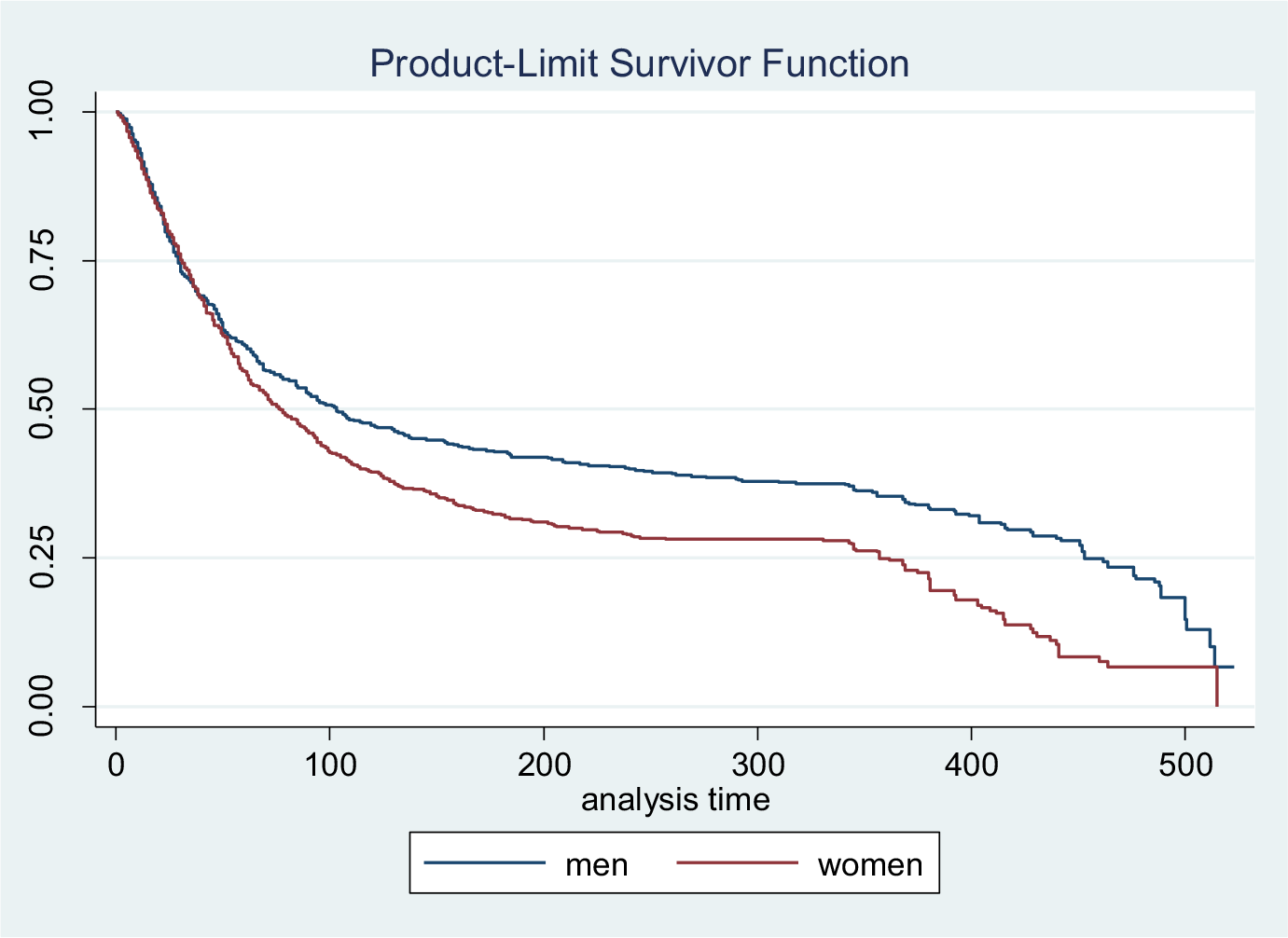
I begin by describing the overall gender differences in the process of moving out of the first jobs in law firms, using the Kaplan-Meier estimator of the survivor function. The product-limit (Kaplan-Meier) estimation method of the survivor function provides a general description of the process under study and is useful to graphically compare survivor functions among two or more groups (Blossfeld and Rohwer Reference Blossfeld and Rohwer2002; Hosmer et al. Reference Hosmer, Lemeshow and May2008). Survivor functions show the proportions of lawyers who remain across time in the law firm where they launched their career. Figure 1 presents the empirical survival functions by gender for moves out of law firms where lawyers started after law school. There is evidence that men and women differ in the rate at which they leave law firms. Men exit their first law firm much slower than women. The median survivor time for men (the time when 50 percent of the sample has not experienced the event and thus remain with their first firm) is significantly higher than that for women. Fifty percent of men did not exit from their first law firm during their initial fourteen years (168 months) in law practice. In comparison, 50 percent of women remain with their first firm as of eleven years (133 months) in law practice. At the lower quartile, we see 25 percent of women had left their first firm by four years; 25 percent of men had left by six years. Interesting, the rates of departure (or descent in the survival estimates) are largely parallel for men and women up until the first fifty months (4.2 years) and then the trajectories divide sharply, with women leaving law firms at a much more rapid rate (as shown by the steep decline in the survival curve of women). A log-rank test for equality of survival functions shows that the differences between men and women are statistically significant (χ2=17.85, p < .001).
Product-Limit Survivor Function of Leaving First Law Firm.

While this description based on survival functions offers a revealing picture of overall gender differences in job mobility out of law firms, it does not control for lawyers’ human capital, organizational context, job satisfaction, or collegiality. Next, we explore multivariate survival models to assess the relative effects of determinants of job mobility specified in the earlier theoretical discussion.
Results
To examine the change in rates over duration in a state, I divided the time in the first state into several time intervals. Based on the exploratory analyses of the distribution of state transitions across early labor market tenure (measured in months) and to maximize model fit, I established the duration of the tenure pieces along two-year breakpoints, resulting in nine pieces within which the rate is constrained to be constant but varies otherwise (Dobrev Reference Dobrev2005, 809). The time periods are: 0–24, 25–48, 49–72, 73–96, 97–120, 121–144, 145–168, 169–192, 193–216 months (2-year time spans), and finally 217 months or more (reference category).
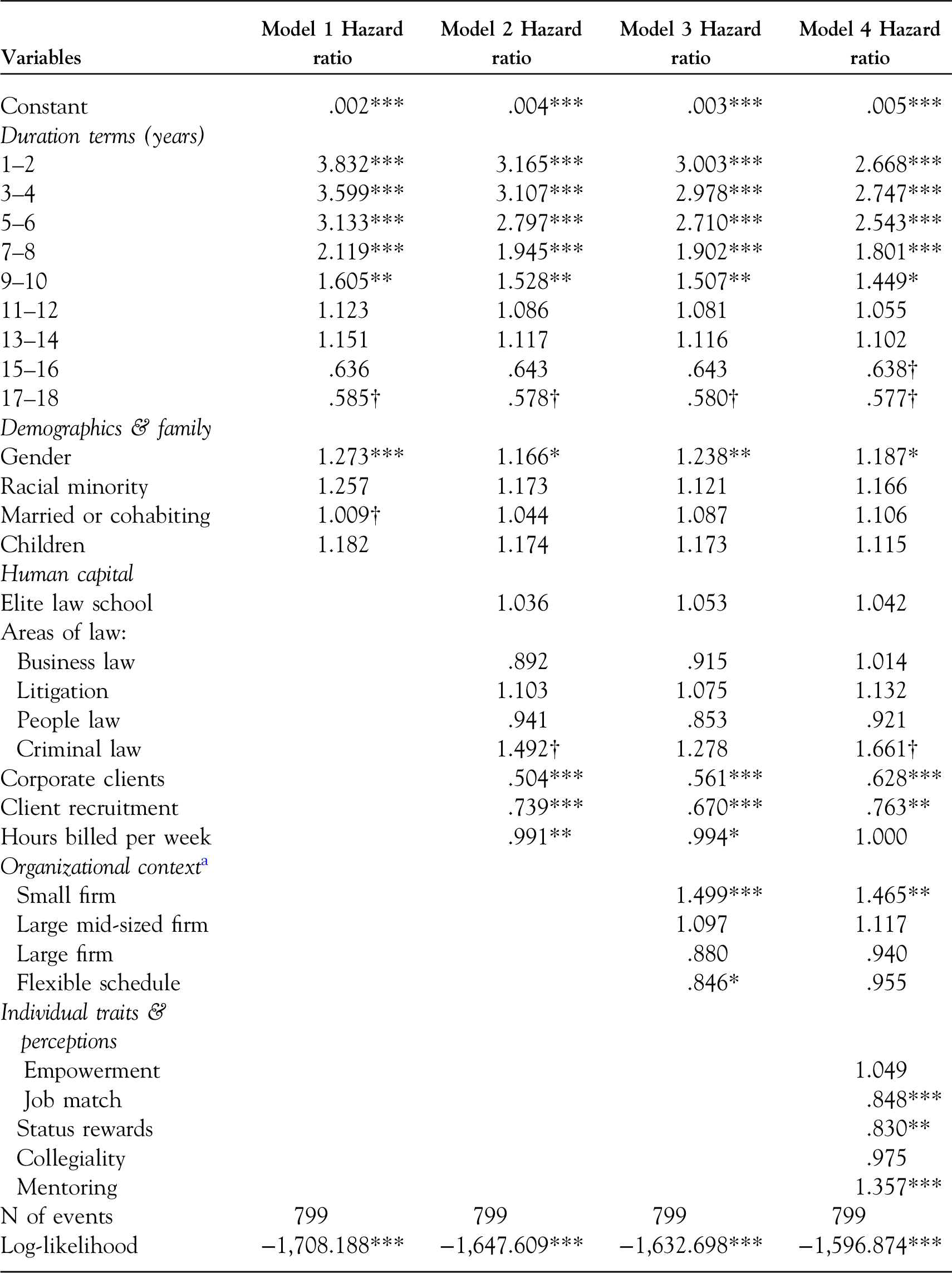
Examining the sets of estimates pertaining to duration terms in job moves out of law firms (see model 1 of Table 2), we see that the log of the baseline hazard rates is highest in the initial time interval (the first two years of practice) and then gradually decreases across subsequent time intervals (three to fourteen years). Risks of leaving firm environments are elevated during the first eight years.
Piecewise Exponential Estimates of Determinants of Leaving Law Firms (N=1,006)

a Small mid-sized firm is the comparison category. * p < 0.05; ** p < 0.01; *** p < 0.001 (two-tailed tests).
Why might risks of leaving be highest in the early period? One argument is mismatches between lawyers’ aspirations and the rewards offered by firms are more likely to occur at the beginning of new jobs because of imperfect information or compromises made in the effort to secure employment (Blossfeld and Rohwer Reference Blossfeld and Rohwer2002). In the initial phase of a new job, it is relatively easy for a lawyer to move out of his or her job in search of a better job (Park and Sandefur Reference Park and Sandefur2003). Therefore, in the first couple of years, lawyers very quickly assess their compatibility and security with the firm, and transition to another firm in search of a better match. However, as investments in job-specific human capital grow over job tenure and uncertainty about the match decreases, the risk of leaving declines (Blossfeld and Rohwer Reference Blossfeld and Rohwer2002). Yet, leaving is not always voluntary. During this early career phase, junior lawyers are vulnerable to being terminated at regular assessments and contract renewals leading up to the partnership decision. The traditional “up or out” system that dominated many law firms (Gorman Reference Gorman1999) denied lawyers an option to stay on after being denied partnership. Even the relatively recent expansion of salaried and non-profit-sharing positions (i.e., salaried partners and permanent associates) (Galanter and Henderson Reference Galanter and Henderson2008) may prove insufficient to absorb the burgeoning ranks of senior associates. By years nine to ten, most partnership decisions have transpired, after which the risk of leaving law firms falls markedly and continues to decline with each passing year (see model 1, Table 2).
Model 1 also includes demographic and family variables. Most impressive is the gender difference in risks of leaving initial law firms. Women have a 1.27 greater chance than men of leaving their initial law firms.Footnote 2 Married or cohabiting lawyers also have an increased hazard compared with their single colleagues of leaving their first law firm, though the effect is at borderline significance (HR=1.009, p < .10).
Model 2 examines the effects of human capital and organizational features on turnover from initial firms. In terms of human capital, neither elite law school status nor fields of law practice have significant impacts on the hazard for exit from law firms. That said, criminal lawyers appear at higher risk to leave the firms where they start law practice, but the effect is at borderline statistical significance (HR=1.492, p <.10). Rather, the leading factors of lawyer job movement out of firms are more direct measures of productivity and client origination. For example, success in recruiting new clients, or “rainmaking,” is valued by law firms, and lawyers with this talent have a lower hazard of leaving their law firm. The hazard of leaving the firm for lawyers who are successful rainmakers is around 26 percent less than the hazard for those who lack responsibility for recruiting clients (p < .001). Junior lawyers who serve corporate clients of the firm also have reduced risks of leaving their firm. The hazard of leaving the firm for lawyers who spend most of their time serving corporate clients is about 50 percent of the hazard for those who serve individual clients (p < .001). Billing elevated hours also reduces the hazard of leaving the law firm (HR=.991, p < .01).
In addition, organizational context is related to turnover (see model 3). Firm size is particularly important. Lawyers leave small firms of less than ten lawyers at a greater rate than from larger sized firms (HR=1.499, p < .001). Lawyers in small firms have a 1.5 greater chance of leaving their firm than lawyers working in small mid-sized firms of ten to nineteen lawyers (the comparison category of firm size). A workplace policy that appears effective in reducing turnover is flexible scheduling (HR=.846, p < .001). This accommodation, while still requiring full-time hours, reduces lawyers’ hazard of leaving firms by 15 percent.
Individual evaluations of jobs are tapped in model 4. Landing a job that was highly desired at time of entering the labor market reduces the hazard for leaving firms (HR=.848, p < .001). This early matching of aspirations and offers reduces subsequent job search behavior and retains lawyers within their initial firm. Two facets of job satisfaction impact job turnover, but in opposite directions. Lawyers who are satisfied with the rewards offered by their firm are at a reduced hazard of leaving their firm (HR=.830, p < .01). Status rewards are powerful enticements to remain with firms. Meanwhile, satisfaction with colleagues does not have the predicted effect of reducing risk of leaving. Nor does one’s sense of empowerment (i.e., locus of control) influence the risk of exiting from law firm settings. However, the presence of a mentor early on in one’s career makes a difference, though not as predicted by the job turnover research literature (Payne-Pikus et al. Reference Payne-Pikus, Hagan and Nelson2010; Paustian-Underdahl et al. Reference Paustian-Underdahl, King, Rogelberg, Kulich and Gentry2017). Rather than encouraging retention within law firms, the presence of a mentor augments the hazard of leaving law firms (HR=1.357, p < .001). Lawyers who had a mentor increase their hazard of leaving the law firm by 36 percent. It is noteworthy that in this final model, even while controlling for human capital, organizational context, levels of job satisfaction and mentoring, the gender difference in turnover from law firms remains statistically significant (HR=1.187, p < .05).
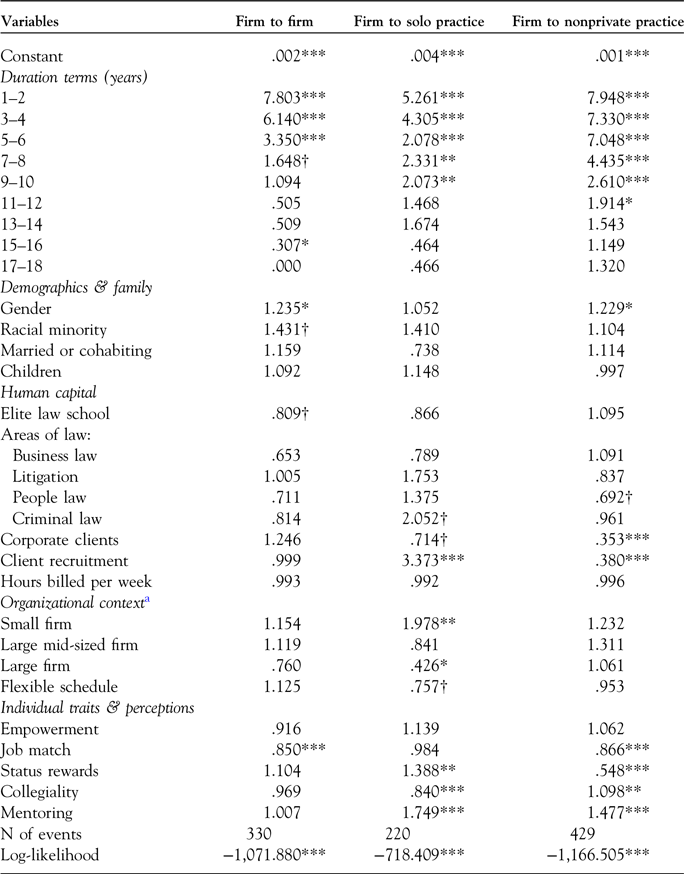
So far, the analysis has focused on departures from law firms where lawyers launched their career after graduating from law school. But where do lawyers go? If they do not stay with the firm, either as a partner or salaried associate, do they seek employment with another firm? The first model in Table 3 presents results from a survival model analysis of movement out of the law firm where lawyers launched their career to another law firm. Again, time intervals matter. Lawyers moving between firms are most likely to make such a move early in their career—typically within the first four years of entering law practice. Women are at a greater risk of moving to another firm (HR=1.235, p < .05), as are racial minorities—though the latter effect is at borderline statistical significance (HR=1.431, p <. 10). Graduates of elite law schools are less likely to move between law firms, though again the effect is at borderline significance (HR=.809, p < .10). It is likely that elite law school graduates are more competitive in the legal labor market and better achieve desired matches in their initial jobs. Areas of law, client responsibilities and firm sizes do not have direct effects on the hazard of moving between firms. However, lawyers who achieved their desired job match are less likely to exit the firm they joined after law school—the hazard of leaving the firm declines by an estimated 15 percent for these lawyers (HR=.850, p < .001).
Piecewise Exponential Estimates of Determinants of Movement Out of Law Firms (N=1,006)

a Small mid-sized firm is the comparison category. * p < 0.05; **p < 0.01; ***p < 0.001 (two-tailed tests).
Do lawyers more often continue working in law firm settings throughout their careers, or do many at some point step out to establish themselves as sole practitioners? The next model in Table 3 examines this possibility. This model presents lawyers who started in a law firm setting and the risk that at some point they will move to solo practice (Note that they may stay with one firm or move between law firms prior to becoming a sole practitioner). Again, the hazard for making such a move is greatest during the first four years of practice, though the hazard that lawyers will make this move remains elevated for the entire initial ten years in practice. There appears to be no significant effects of gender, racial minority group, or law school prestige. Criminal lawyers are more likely than other lawyers to make the move to solo practice, though the effect is at borderline significance (HR=2.052, p < .10). Lawyers who serve corporate clients have a reduced hazard of leaving firm settings for solo practice (HR=.714, p < .10), again at borderline significance. Lawyers who succeed at bringing in new clients have a higher hazard for setting up their own law offices: these lawyers have a 3.4 greater chance of leaving to establish themselves as a sole practitioner (HR=3.373, p < .001). The hazard of moving to solo practice for lawyers in small firms is 98 percent greater than the hazard for those working in firms of small mid-sized firms of ten to nineteen lawyers (HR=1.978, p < .001). As expected, lawyers working in firms with flexible hours are less likely to make the move to solo practice, though this effect is at borderline significance (HR=.757, p < .10). Individual traits and perceptions also surface in the move to solo practice. Interestingly, lawyers satisfied with status rewards (e.g., pay, promotions, and prestige) are more likely to move to solo practice (HR=1.388, p < .01). It appears that these extrinsic rewards are insufficient to retain lawyers in law firms. Satisfaction with collegiality in the firm, however, reduces the hazard of leaving to set up a solo practice (HR=.840, p < .001). While collegiality appears to offer a glue that fastens lawyers to careers with law firms, experiences of mentoring do not operate in the same fashion. Lawyers who report having a mentor early in their career are in fact more likely to establish solo practice (HR=1.749, p < .001).
There is also the possibility that lawyers who start out in a law firm decide to leave private practice, making the move to, for example: government employment, private industry, in-house counsel with a corporation, or academe. In the third column of Table 3, I explore this next pathway out from law firms. The risks of leaving law firms for employment in the nonprivate practice sector is highest during the first six years after entering law practice. The risk of pursuing this path is still elevated until year twelve, after which time the risk of leaving firms diminishes dramatically. Various factors shape the job transition. Gender has an impressive effect. Women have a 1.23 greater chance than their male colleagues of leaving law firms to work in the nonprivate sector (HR=1.229, p < .05). This effect remains significant even after controlling for human capital, law firm size, and job satisfaction. Lawyers working in the area of “people law” (i.e., social welfare, other administrative law, wills and estates, family, labor, and real estate) also have a higher hazard of moving to nonprivate practice (HR=.692, p < .10), though this effect is at borderline statistical significance. Client responsibilities are highly impactful. Lawyers serving corporate clients and who are active in the recruitment of clients to their law firm are less likely to leaving law firm settings for nonprivate practice (HR=.353 and .380, p < .001, respectively). Not surprisingly, lawyers who feel they have achieved a good job match and are satisfied with status rewards offered by their law firm are less likely to move to nonprivate practice (HR=.866 and .548, p < .001, respectively). Yet, interestingly, neither collegiality nor mentorship are sufficient to hold lawyers within law firms. Lawyers who report positive collegial relations and have mentors are more likely to move out of firm settings to nonprivate practice (HR=1.098, p < .01 and 1.477, p < .001, respectively).
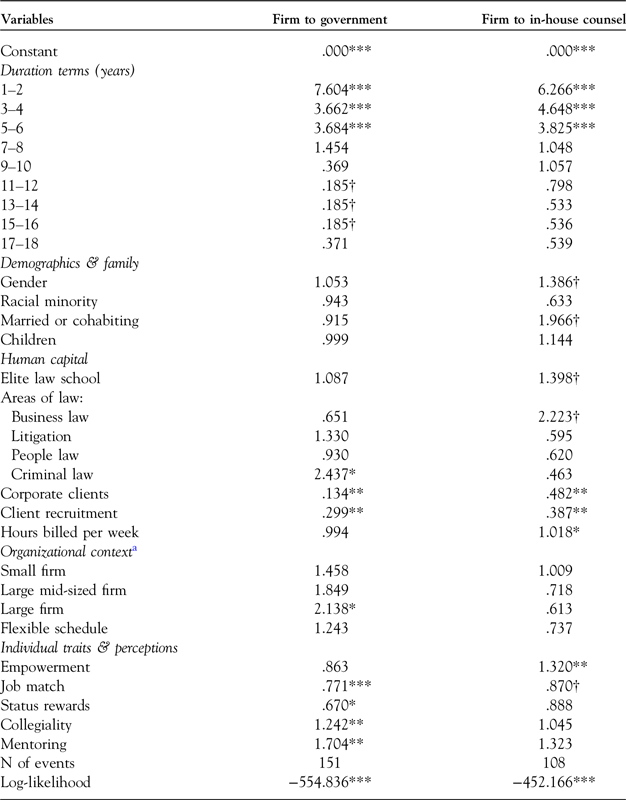
The move to nonprivate practice is a substantial job change and the nature of this job move is explored further in Table 4. Here two specific job pathways are highlighted: the move to government employment and the move to in-house counsel at a corporation. For both these moves, the risk of leaving law firms is highest during the first six years of practice. Women have a 1.39 greater chance than their male colleagues of leaving law firms to join a corporation as in-house counsel, though the effect is at a borderline significance level (HR=1.386, p < .10). Lawyers working in the area of business law are more likely to make the move to in-house counsel than lawyers working in other areas of law. Meanwhile, lawyers working in criminal law are more likely to move to government than lawyers working in other areas of law. These areas of law align with the work of in-house counsel with a corporation (i.e., commercial litigation, contracts, intellectual property, tax) and lawyers’ work in government, for example, with the Department of Justice (i.e., criminal law, human rights).
Piecewise Exponential Estimates of Determinants of Movement Out of Law Firms to Employment with Government and In-House Counsel with Corporations (N=1,006)

a Small mid-sized firm is the comparison category. * p < 0.05; **p < 0.01; ***p < 0.001 (two-tailed tests).
Lawyers serving corporate clients and who recruit new clients to the firm are less likely to leave law firm settings for in-house counsel positions (HR=.482 and .387, p < .01, respectively) and they are also less likely to leave firms for government jobs (HR=.134 and .299, p < .001, respectively). Working elevated hours at one’s law firm is related to a higher risk of leaving firms for in-house counsel (HR=1.018, p < .05), while working in a large law firm is related to a higher risk of leaving firms for government employment (HR=2.138, p < .05). Individual attributes and perceptions are also relevant. Lawyers with a strong locus of control (i.e., empowerment) are more inclined to leave law firms for in-house counsel positions (HR=1.320, p < .01), but there is no similar effect on moves to government. Not surprisingly, lawyers satisfied that they have achieved a good match with their law firm are less likely to move to either in-house counsel or government jobs (HR=.870, p < .10 and HR=.771, p < .05, respectively). Satisfaction with status rewards (i.e., pay and promotions) reduces the risk of leaving firms for government work (HR=.670, p < .05), however, lawyers satisfied with their initial firm’s climate of collegiality and who benefitted from a mentor are at an elevated risk of joining government (HR=1.242, p < .001 and HR=1.704, p < .01, respectively). Thus, while pay and advancement opportunities may make lawyers reluctant to give up a career with the firm, enjoyment of colleagues and mentors is not enough to hold them to law firms (and perhaps those collegial relationships they enjoy can be found equally in government employment).
Discussion and Conclusion
This article set out to examine the factors that encourage lawyers to leave law firms with attention to the role of law firm culture. I aimed to advance research on three fronts by: (1) tracing timing of departures from law firms; (2) examining social dimensions of firm culture, particularly aspects of collegiality and mentorship, that may influence retention or departure; and (3) identifying destination pathways from law firms.
On the first point (timing), results revealed that the risk of leaving the law firm one joined after law school was greatest during the first eight years of law practice—the period leading up to partnership decisions. However, the likelihood of continuing in the same law firm was increased for lawyers with three career attributes: success at client recruitment, greater time dedicated to serving corporate clients, and high billable hours. This is not surprising as success at “rain-making” and service of valued corporate clients are attributes highly valued by law firm leaders (Sterling and Reichman Reference Sterling and Reichman2016). In addition, law firms are dominated by engrained cultural beliefs and practices surrounding billable hours as benchmarks of work commitment and productivity (Moen et al. Reference Moen, Kelly and Hill2011). Lawyers who struggle to bring in new clients, who lack opportunities to work with corporate clients, or who fall short of billable hour targets are likely to be passed over for promotion. The prospect of partnership refusal results in lawyers having to leave firms leading up to partnership decisions, especially where an “up or out” system of partnership prevails (Gorman Reference Gorman2006). Interestingly, movement out of initial law firms appears more common among lawyers starting out in small law firms. It may be that small law firms are less able to offer incentives needed to retain junior lawyers. Or perhaps lawyers leave due to the struggles facing small firms during tough economic times.
On the second point (social dimensions of firm culture), one of the most striking effects was that women are at higher risk of leaving law firms than are men. The pervasive gender difference was not explained by levels of human capital, organizational context, or levels of job satisfaction or collegiality. However, various organizational structures as pointers of law firm culture made a difference for lawyers generally. For example, firms that offered flexible schedules were better able to retain their lawyers. Research suggests that even when lawyers do not take up these work arrangements, the availability of these policies may signal to lawyers that the firm is accommodating and partners care about their employees (Raskin Reference Raskin2006). The impact of this policy, however, fell from statistical significance when overall job satisfaction and mentoring were taken into account. Evidence of lawyer-to-firm matching or “cultural fit” (Rowan and Vaughan Reference Rowan and Vaughan2018) was signaled through lawyers’ reported levels of satisfaction with aspects of their initial law firm after graduation. For example, lawyers that landed an initial job with their desired firm were more likely to continue working in law firms throughout their career, as were lawyers that expressed satisfaction with status rewards (i.e., income, prestige of work, opportunities for advancement) offered at their entry-point law firms. These findings suggest the importance of law firm culture to junior lawyers as they assess their future with the law firm and firm practice generally.
Interestingly, lawyers’ satisfaction with the level of collegiality in those early jobs was insufficient to reduce the hazard of quitting their initial law firm. Recall that both John Hagan’s conception of social capital formation in law firms and Emmanuel Lazega’s appreciation of lawyers’ efforts to build stable networks with dependable colleagues suggest a strong basis for law firm solidarity. Nonetheless, the present article’s efforts to capture dimensions of collegiality may illuminate an important distinction between collegiality as climate—where there is a friendly environment and where legal matters are largely undertaken by lawyers working independently on files—versus collegiality as behavior—where lawyers have direct experience with colleagues lending their expertise to cases and the synergy of active teamwork. This more behavioral form of collegiality comprises social actions that build from the ground up durable cooperation in firms. Thus, lawyers may express satisfaction with the general atmosphere of collegiality in their initial law firm, but this collegiality may represent little more than a friendly climate of professionalism—and not the strong relationships of cooperation and exchange sought after by junior lawyers. The more behavioral form of collegiality aligns with what Lazega and Pattison (Reference Lazega and Pattison1999) described as “niche-seeking” actions within firms. It is also likely that this form of collegiality is especially valuable, as a mechanism of integration and mentoring, for the retention of women and racial minorities in law firms, given evidence of gendering cultures (Pringle et al. Reference Pringle, Harris, Ravenswood, Giddings, Ryan and Jaeger2017) and homophily disadvantage in the case of racial minorities (Woodson Reference Woodson2015). Thus, future work should further investigate distinct forms of collegiality—climate and behavior—in shaping lawyers’ attachment to law firms and with an eye to diversity outcomes.
Past studies suggest that an important dimension of law firm culture is the presence of mentors to support the professional development of junior lawyers. Surprisingly, results showed that having a mentor did not offer the binding ingredient to hold lawyers to firms. Why is it that mentoring does not build lawyers’ commitment to pursue a long career with the firm in which they were first employed? One possible explanation is that by providing opportunities for learning and development, law firm mentors also increase junior lawyers’ marketability, encouraging them to explore job prospects elsewhere (Ito and Brotheridge Reference Ito and Brotheridge2005), thus risking turnover for the law firm (Preenen et al. Reference Preenan, De Pater, Van Vianen and Keijzer2011). That mentorship potentially augments the threat that lawyers will defect from their law firm was anticipated by Lazega (Reference Lazega2000; Reference Lazega2001). Lazega argued that patronage, while facilitating the professional development of junior lawyers under the capable supervision of senior lawyers, also establishes strong work ties between “finders” and “grinders,” who might then quit the firm to set up their own firm. The present analysis did not uncover evidence that lawyers successful as “finders” (i.e., client recruitment) are more likely to depart their firm to establish new firms with colleagues (or to join other existing firms). However, lawyers who were successful “finders” were more likely to depart law firms to establish themselves as sole practitioners. The ability to recruit new clients perhaps builds confidence that one could “make it one’s own” by launching an independent law practice.
A third key contribution of this article is an analysis of destination pathways out of law firms. Movement between firms was most common during the first four years of practice. Movement to solo practice appeared to trail on longer, with an elevated risk of movement enduring ten years after entering law practice. There were increased hazards of moving to nonprivate practice for even longer—up to twelve years after law school graduation and joining a law firm. However, for all destination pathways, the risk of movement out of law firms was greatest in the early years of law practice. Several factors are noteworthy in these transitions from law firms. First, women were more likely to move between law firms and they were also more likely than men to leave private law practice. The gender difference in the risk of these transitions remained even when controlling for a host of human capital and organizational factors. Second, clientele responsibilities (i.e., recruitment of clients and service of corporate clients) reduced movement out of private practice. However, as noted above, successful rainmakers were more likely to leave law firm settings to establish their own law offices as sole practitioners.
Furthermore, a perceived good match between the lawyer and the firm consistently reduced movement to other firms and out of private practice. However, the availability of status rewards reduced job movement to nonprivate practice but was not enough to stall movement to independent law practice. Satisfaction with the level of collegiality at one’s firm reduced the likelihood of moving to solo practice but was insufficient to curtail leaving law firms for nonprivate practice. The experience of having a mentor early in a lawyer’s career appeared to facilitate movement to solo practice and to nonprivate practice. This suggests that the support offered by mentors may extend beyond the immediate law firm environment. In other words, mentors—having developed a friendship and concern for their junior lawyers—may extend a “helping hand” to protégés in their job search beyond the law firm. The idea that mentorship or patronage may foster commitment to the firm as well as a possible bridge to careers outside the firm—for example, to in-house counsel at a major corporate client of the large law firm or to a smaller firm led by a mentor’s law school classmate—has been overlooked in studies of mentorship in law firms.
The pathways out of law firms traced through this study suggest that traditional concept of a career, complete with invitation to partnership, with a single law firm is no longer the dominant model (see also Hillman Reference Hillman2018). Along this line, research has paid special attention to changing career paths within law firms, particularly in large global law firms (Nelson Reference Nelson1983; Gilson and Mnookin Reference Gilson and Mnookin1989; Galanter and Henderson Reference Galanter and Henderson2008; Malhotra, Smets, and Morris Reference Malhotra, Mets and Morris2016). Less attention has been directed toward the study of the flow of lawyers out of firms and where lawyers then go (though see Kay Reference Kay1997; Kay et al. Reference Kay, Alarie and Adjei2016) or the career pathways pursued by lawyers more generally after law school (though see Dinovitzer and Dawe Reference Dinovitzer and Dawe2016; Kay Reference Kay2019). The results of the present study revealed that there is a considerable flow of lawyers out of firms. Supplemental analyses found the majority of these job moves are out of small firms (of less than ten lawyers) (Supplemental analyses are not shown but are available from the author). This is consistent with research conducted by Dinovitzer and Garth (Reference Dinovitzer and Garth2020, 353) of US law graduates early in their careers, using the After the JD Study, which showed that lawyers working in large law firms expressed lower mobility intentions than their peers in smaller law firms. I conducted supplemental analyses to estimate separate models for lawyers who started out in small versus large law firms and to compare the effects of different independent variables in the two samples. The results are intriguing and reminiscent of the “two hemispheres” of law practice documented by John Heinz and colleagues (Reference Heinz, Nelson, Sandefur and Laumann2005).
Timing of out-flow differed between small (less than ten lawyers) and large (more than fifty lawyers) law firms. The hazard of leaving a small firm remained elevated for the first ten years of practice, as junior lawyers jockeyed for positions (often at other firms). In contrast, the hazard of leaving a large law firm appeared to “peak” at specific intervals: in the first two years and in years five to six. Following these cycles, the hazard of leaving a big firm was statistically significant and negative in the years that followed, suggesting a “locking in” to a career with the big firm by year nine. The hazard of leaving a small firm was 28 percent higher for women than for men (HR=1.274, p < .01), however, there was no statistically significant gender difference in leaving large firms. Not surprisingly, corporate clients mattered for the retention of lawyers in big firms, while job match and collegiality were salient to the retention of lawyers working closely in small firms. Finally, mentors appeared to offer lawyers in small firms a “lending hand” in their job moves out of firms (HR=1.691, p < .001), and mentors also eased job moves out of big firms, albeit with reduced effect and at borderline significance level (HR=1.391, p=.06).
These findings are consistent with the idea that smaller firms offer fewer opportunities for upward mobility within the firm, yet these work settings offer junior lawyers a range of challenging work and perhaps more sponsorship and even eventual spinoffs to solo practice or other small firms. Meanwhile, large firms may operate more as a “brand” where loyalty to the firm, as evidenced through retention, high billables and advancement, are expected by firm leaders to be the primary goal of associate lawyers. In contrast, small firm lawyers, particularly those in shared geographic areas, may operate as a community of practitioners, sending overflow legal work to each other’s offices or collaborating on legal documents (e.g., two sides of a real estate transaction). In that context, the movement of lawyers to other small firms or even solo practice may reflect a more positive outcome rather than the result of dissatisfaction with the firm or attrition based on poor performance (as the large firm tournament models would suggest). Yet, women’s higher rate of movement out of small firms is curious and merits study. Future work should examine whether women’s movement out of small firms is the result of reduced benefits afforded by small firms (e.g., lack of parental leave plans, flexible hours option) and consequently women’s search for better work-life balance (as Ganguli et al. Reference Ganguli, Hausmann and Viarengo2021 found with reference to women’s turnover from law firms). Equally, does frustration with personal and professional requirements lead to an effort to establish innovative work arrangements through independent practice or by setting up a new small firm with like-minded colleagues (as Pringle et al. Reference Pringle, Harris, Ravenswood, Giddings, Ryan and Jaeger2017 hint at in their discussion of agency for change)?
Finally, the study has revealed a surprisingly high level of lawyer traffic out of firms (of various sizes) into nonprivate practice and this traffic was greater than that between firms. More of the talent flow from firms to nonprivate practice was to government employment rather than to positions as in-house counsel with corporations. Overall, it appears that “portfolio careers” are more common than acknowledged in the research literature, with many lawyers seeking out opportunities within the legal world but outside of traditional law firm structure (see Hemming and Wilkinson Reference Hemming and Wilkinson2019; Dinovitzer and Garth Reference Dinovitzer and Garth2020).
Unique factors hastened some of these job changes. For example, working long hours increased the risk of leaving firms for in-house counsel, while working in large law firms was related to a higher risk of moving to government employment. It might seem remarkable that collegiality and mentoring were not sufficient to bond lawyers to their initial firms, but these social dynamics (as work collaborations and personal friendships) may be seen by lawyers as portable and even replicable in other settings (e.g., in the litigation department in another law firm or in legal teams working on policy development in government), whereas earnings and benefits may not be matched in moves to nonprivate practice—hence satisfaction with these tangible assets held greater power in dissuading lawyers from leaving firms for nonprivate practice.
Limitations of the present study should be noted. First is the challenge of harnessing culture through social survey research. Empirical observation of law firm culture is an elusive task—one that demands creative markers of the community internal to a law firm. As anthropologists have noted, the study of culture is toilsome: culture is not an autonomous, coherent entity (Wolf Reference Wolf1984). Rather, as scholars studying culture in other professions remark, culture is “reflected in the interplay between specific actors, history, material conditions and ideological constructs” (Mathias et al. Reference Mathias, Gulbas, Chin and Perry2021, 639). Yet, it is possible to gain traction on organizational culture within law firms and several scholars have explored shared values among law firm lawyers (e.g., Kay and Hagan Reference Kay and Hagan1998; Adediran Reference Adediran2018; Ballakrishnen Reference Ballakrishnen2019). The respective scholarship of John Hagan and Emmanuel Lazega suggest a complementary vision of law firm culture where structural (e.g., provision of flexible work options, compensation arrangements, formal mentoring programs) and social aspects (e.g., patronage through informal mentoring, teamwork among lawyers with similar levels of experience) of a firm shape its culture. Lawyers’ perceptions of collegiality, mentoring relationships and cultural match provide signals of some of the “softer” social aspects of a law firm’s culture.
Second, and related to the study of culture, the measures used in the present study are imperfect—for instance, status rewards in part reflect firm size and revenues, and job match also mirrors law graduates’ expectations during the job search. Future work could advance our understanding of culture through indicators of shared values among law firm members—for example, through commitment to maintaining racial diversity, engagement in pro bono work, and strength of organizational identity. Future work might also refine the silhouette of law firm culture with a nuanced account of the extent of enduring collaborative efforts within the firm. It is noteworthy that Hagan’s exploration of law firms was conducted through a large-scale survey of the profession in Toronto, Canada; while Lazega’s study was of a single law firm in the northeastern US examined through social network analysis. Their innovative sociological projects suggest the study of law firm culture is not the exclusive domain of qualitative research (i.e., interviews) nor limited to the discipline of anthropology.
FUTURE RESEARCH
One direction for future research is the role of mentorship in lawyers’ job mobility. The present study invited lawyers to identify whether they felt they had a mentor who provided advice and guidance early in their career. It is likely that respondents to the survey interpreted this question as referencing mentors located in the law firm they joined after law school. Further, it is probable that any significant mentoring relationship would develop after graduation and in the context of joining the firm as a junior associate. Not surprisingly then, most research has assumed that mentors are to be found inside the firm where professionals work (e.g., Saffie-Robertson Reference Saffie-Robertson2020; Cai et al. Reference Cai, Liu, Liu, Yao and Jia2021; Ahmed et al. Reference Ahmed, Arnott, Dacko and Wilson2022). On-the-job sources of knowledge offer lessons of organizational accountability, efficiency, and competitiveness, as well as implementation of professional knowledge to actual legal cases (Adams and Sawchuk Reference Adams and Sawchuk2021)—hence mentors within the law firm are invaluable to junior lawyers “learning the ropes.” However, I suggest that it is possible that some lawyers receive mentorship from lawyers working in other law firms. Those lawyers may be principles from articling placements, family members, or former law school classmates. This is an interesting route worth investigating—one not considered in studies of the legal profession.
Interestingly, studies of other occupations have paid attention to mentors external to firms (Read, Fisher, and Juran Reference Read, Fisher and Juran2020). Some suggest that unwelcoming firm cultures may lead women to develop more open and externally focused mentor networks (Thomas and Higgins Reference Thomas, Higgins, Arthur and Rosseau1996). Mentors outside the firm cannot provide the same firm-specific knowledge, access to clients of the firm, nor provide connections to firm leaders in the same way than an insider can (Kmec Reference Kmec2007). However, mentors external to the firm may share knowledge of job opportunities elsewhere. In so doing, these mentors may play a motivational role, encouraging junior lawyers to better achieve their work goals through job moves. Learning more about the location of mentors (i.e., internal or external to the firm) and how location shapes the content of mentoring will help researchers to better understand how different mentoring relationships, not simply a lack of mentoring, operate to nudge lawyers toward opportunities outside their law firm. If these mentor networks, internal versus external, are shaped by gender and race (as suggested by Thomas and Higgins Reference Thomas, Higgins, Arthur and Rosseau1996), this condition may shed new light on the attrition of women and racial minorities from law firms.
Another area for future research is to explore gender differences in the relationship between mentorship and turnover. Past studies show that there are significant differences in the impact mentors have on subsequent job search behavior between men and women (Yip et al. Reference Yip, Ehrhardt, Black and Walker2018). Is the mentoring experienced by men and women lawyers qualitatively different and what are the implications for retention in law firms? Do the resources that flow through social networks of patronage vary for male and female junior lawyers? More broadly, how do cultures vary across law firms of different sizes? Do some firm cultures leave mentoring to informal arrangements (that may leave out women and racialized lawyers) or be resistant to women’s mentorship programs (for a review of barriers to mentorship, see Harris Reference Harris2022)? In this respect, law firm cultures may be more or less inclusive and law firm policies may have a special role to play in providing workplace accommodations (e.g., flexible hours, parental leaves, telework) and distribution of resources (e.g., assignments, formal mentoring) (Tremblay and Mascova Reference Tremblay and Mascova2013). It should be acknowledged that despite growing research attention to the importance of law firm culture (see Rivera and Tilcsik Reference Rivera and Tilcsik2016; Sommerlad Reference Sommerlad2016; Westfaul and Wilkins Reference Westfahl and Wilkins2017; Oakley and Vaughan Reference Oakley and Vaughan2019), more work is needed to understand the complex nature of law firm culture. Advances to knowledge of firm culture could be made by attending to policies initiated by law firm leaders to establish behavioral expectations of collegiality and inclusion (LaFlamme et al. Reference LaFlamme, Pellerin, Brière and Brière2019) and to encourage a climate of innovation (Bibi et al. Reference Bibi, Khan, Qian, Garavelli, Natalicchio and Capolupo2020). Research also needs to identify the types of social networks within firms that nurture collegial transactions and conversely the circumstances when collegiality is eroded through conflict and noncooperation among lawyers.