Introduction
In this paper, we discuss our research with our Indigenous school partners in a First Nation community in Canada. To better frame this work, we start by addressing the terminology utilised in this article. The term Indigenous Peoples in an inclusive term that globally represents descendants of those who inhabited a geographical region prior to colonisation (First Peoples Worldwide, 2016). In Canada, Indigenous Peoples are known as Aboriginal Peoples. Aboriginal Peoples in Canada are represented by three groups: First Nations, Métis and Inuit (Constitution Act of Canada, 1982). Differences amongst Aboriginal Peoples in Canada are related to ethnicity (First Nations, Métis, Inuit and those with or without registered treaty status), geography (remote, rural, on-reserve, urban) and jurisdiction (federal, provincial, tribe, band) (Smylie and Anderson, Reference Smylie and Anderson2006). There is a rich diversity of social, economic, political and environmental circumstances that form important variances in Aboriginal communities (Waldram et al., Reference Waldram, Herring and Young2006).
In this research, the inclusive term Indigenous is used when discussing all Aboriginal groups in Canada: First Nations, Métis and Inuit (Constitution Act of Canada, 1982), or when it is appropriate to discuss Indigenous Peoples in an international context. If a certain group (First Nations, Métis or Inuit) is specifically being referred to, as defined by the Canadian Constitution, then a more specific term will be used.
Physical activity and healthy child development
Physical activity is a fundamental component in the healthy growth and development of children (Janssen & Leblanc, Reference Janssen and Leblanc2010). Not only does physical activity promote muscular and skeletal growth, it aids in the prevention of chronic diseases such as diabetes, heart disease and cancer in childhood and later in life (Janssen and Leblanc, Reference Janssen and Leblanc2010). Physical activity is also important for psychosocial health, improving self-esteem while reducing depression and anxiety (Biddle et al., Reference Biddle, Ciaccioni, Thomas and Vergeer2018). Research looking specifically at learning, academic performance and physical activity indicates that physical activity positively effects academic-related outcomes such as standardised tests, executive functioning, memory, on-task behaviour and school enjoyment (Webster et al., Reference Webster, Russ, Vazou, Goh and Erwin2015; de Greeff et al., Reference de Greeff, Bosker, Oosterlaan, Visscher and Hartman2018).
Over the past two decades, a wealth of research has been conducted examining the effect of physical activity on children's brain function. Physical activity stimulates neurobiological, psychosocial and behavioural mechanisms that enhance brain function (Lubans et al., Reference Lubans, Richards, Hillman, Faulkner, Beauchamp, Nilsson and Biddle2016). For example, there is a strong relationship between children's cardiovascular fitness and cognition and a large body of evidence forming that indicates that physical activity is crucial for brain structural and functional development (Khan and Hillman, Reference Khan and Hillman2014). The psychosocial outcomes improved by physical activity include increased self-esteem, self-acceptance and social connectedness (Lubans et al., Reference Lubans, Richards, Hillman, Faulkner, Beauchamp, Nilsson and Biddle2016). As a result, children who participate in physical activity experience less negative mental health outcomes (Lubans et al., Reference Lubans, Richards, Hillman, Faulkner, Beauchamp, Nilsson and Biddle2016; Biddle et al., Reference Biddle, Ciaccioni, Thomas and Vergeer2018). Physical activity also improves sleep duration and efficiency for children, which in turn, improves behaviours such as self-regulation and coping skills, benefiting children's academic and social skills (Stone et al., Reference Stone, Stevens and Faulkner2013; Lubans et al., Reference Lubans, Richards, Hillman, Faulkner, Beauchamp, Nilsson and Biddle2016).
The benefits of physical activity on children's health and development are evident; unfortunately, many children around the world are not amassing enough physical activity to acquire these benefits (Tremblay et al., Reference Tremblay, Gray, Akinroye, Harrington, Katzmarzyk, Lambert, Prista, Reilly, del Pilar Rodríguez, Sarmiento Duenas, Standage and Tomkinson2014). For example, in Canada, Australia and the USA, only 20–39% of children are meeting physical activity guidelines (Tremblay et al., Reference Tremblay, Gray, Akinroye, Harrington, Katzmarzyk, Lambert, Prista, Reilly, del Pilar Rodríguez, Sarmiento Duenas, Standage and Tomkinson2014).
Physical activity and Indigenous children
Although increasing physical activity is a global concern for all children, there may be additional benefits in promoting and supporting physical activity for Indigenous children, as it is a means to address the legacy of ill health rooted in historic trauma (Bruner et al., Reference Bruner, Hillier, Baillie, Lavallee, Bruner, Hare and Lévesque2016). Amongst Indigenous youth in Canada, there are alarmingly high rates of obesity, chronic disease and mental health issues (Reading, Reference Reading2009; Kirmayer et al., Reference Kirmayer, Simpson and Cargo2003). This trend of ill health can be seen in many Indigenous populations globally (Anderson et al., Reference Anderson, Robson, Connolly, Al-Yaman, Bjertness, King and Pesantes2016). Increasing opportunities for physical activity can help Indigenous children receive health benefits such as reduced risk of cardiovascular disease, diabetes, certain cancers, depression, anxiety and increased self-esteem (Coble et al., Reference Coble, Rhodes and Higgins2008; Janssen and Leblanc, Reference Janssen and Leblanc2010; Bruner et al., Reference Bruner, Hillier, Baillie, Lavallee, Bruner, Hare and Lévesque2016).
Indigenous youth in Canada also experience a disproportionate level of low academic attainment (Mushquash and Bova, Reference Mushquash and Bova2007; Friesen and Krauth, Reference Friesen and Krauth2009). High school non-completion for on-reserve Indigenous Peoples is approximately 61% in Canada (Statistics Canada, 2013). In the 2008/2010 First Nations Regional Health Survey, data showed that 14% of First Nations children living on reserve aged 6–11 years repeated a grade, compared with 3.5% of children in the general Canadian population (First Nations Information Governance Centre, 2012). The academic achievement gap is caused by the downstream effect of using Euro-Western education as a tool for oppression and colonisation, primarily through the Canadian Residential School System (Battiste, Reference Battiste1998; The Truth and Reconciliation Commission of Canada, 2015). Promoting physical activity is one approach, of many, that may aid in closing the gap in academic achievement for Indigenous children because of the host of positive neurophysiological adaptations in the brain that take place when children are physically active (de Greeff et al., Reference de Greeff, Bosker, Oosterlaan, Visscher and Hartman2018).
Movement integration
The wealth of research conducted over the past decade demonstrating that physical activity has a positive impact on brain function and learning (de Greeff et al., Reference de Greeff, Bosker, Oosterlaan, Visscher and Hartman2018) has stimulated some teachers to incorporate physical activity into their classroom in an approach called movement integration. Movement integration is defined as infusing physical activity in the classrooms during normal classroom time (Webster et al., Reference Webster, Zarrett, Cook, Egan, Nesbitt and Weaver2017). Movement integration can be academic infused or non-academic, both having positive impacts on learning-related outcomes (Mavilidi et al., Reference Mavilidi, Okely, Chandler, Domazet and Paas2018). Academic-infused movement integration integrates academic content and movement, whereas non-academic movement integration involves providing movement opportunities that do not involve academic content (Webster et al., Reference Webster, Zarrett, Cook, Egan, Nesbitt and Weaver2017). When children take part in movement integration, they are physically active for 1–10 min at varying degrees of intensity in their classroom during class time (Mahar et al., Reference Mahar, Murphy, Rowe, Golden, Shields and Raedeke2006; Grieco et al., Reference Grieco, Jowers and Bartholomew2009; Bartholomew and Jowers, Reference Bartholomew and Jowers2011; Donnelly and Lambourne, Reference Donnelly and Lambourne2011). While participating in academic-infused movement integration, the teacher integrates curricular material into the movement so that the students are learning while exercising (Grieco et al., Reference Grieco, Jowers and Bartholomew2009; Bartholomew and Jowers, Reference Bartholomew and Jowers2011; Donnelly and Lambourne, Reference Donnelly and Lambourne2011). The intention of movement integration is not to replace physical education, but to supplement it (Webster et al., Reference Webster, Russ, Vazou, Goh and Erwin2015; Watson et al., Reference Watson, Timperio, Brown, Best and Hesketh2017).
A body of compelling evidence is forming around the benefits of movement integration such as (a) improved academic outcomes, (b) improved on-task behaviour, (c) improved cognitive functioning, (d) increased moderate-to-vigorous physical activity, (e) reduction in sedentary time and (f) increased student enjoyment and effort (Webster et al., Reference Webster, Russ, Vazou, Goh and Erwin2015; Watson et al., Reference Watson, Timperio, Brown, Best and Hesketh2017). Moreover, teachers can continue to teach academic content while students are active, reducing the concern of taking time away from the academic curriculum for physical activity (Donnelly and Lambourne, Reference Donnelly and Lambourne2011).
Perceptions of movement integration
It is important to understand the perceptions of educators and students who have experienced movement integration as it is unlikely that teachers will use movement integration if they or their students perceive it negatively (Goh et al., Reference Goh, Hannon, Newton, Webster, Podlog and Pillow2013; McMullen et al., Reference McMullen, Kulinna and Cothran2014; Carlson et al., Reference Carlson, Engelberg, Cain, Conway, Geremia, Bonilla and Sallis2017). Moreover, it is important to understand the barriers and facilitators to implementing movement integration so that activities can be adapted and supports can be put in place to help teachers overcome those barriers and utilise available facilitators (Webster et al., Reference Webster, Zarrett, Cook, Egan, Nesbitt and Weaver2017).
While it is crucial to understand the perspectives of all educators and students, there are additional motives for ensuring there is an understanding of the perspective of Indigenous educators and students who take part in movement integration. Examining the perceptions of Indigenous teachers and Indigenous students who take part in education interventions is consistent with the standards for research with Indigenous Peoples (Canadian Institutes of Health Research et al., 2014) and aligns with decolonising methods in education (Battiste, Reference Battiste1998; Zavala, Reference Zavala2013). Collaborating with teachers and students to understand their perspective on education interventions increases the strength of the research relationship between non-Indigenous researchers and Indigenous community partners. Engaging in meaningful conversations about their experiences shows the participants that their knowledge is relevant and valuable, and this demonstrates respect for the expertise they bring to the research partnership (Canadian Institutes of Health Research et al., 2014; The Truth and Reconciliation Commission of Canada, 2015).
By gaining insight from the participants in this study, we were able to gather valuable information on how, when and why teachers might utilise movement integration with Indigenous students, and what barriers and facilitators exist to utilising movement integration.
Methods
Participants and study background
This qualitative study was conducted in collaboration with a First Nation elementary school in a First Nation community located near a mid-sized Canadian city. The school follows the provincial government curriculum used by all schools within the province it is located in. In addition, this school also incorporates traditional Indigenous language classes and cultural teachings. Ethical approval for this study was received from the researcher's university ethics board and from the participating school's First Nation Council. Participants included a female Indigenous teacher of kindergarten and grade one students (combined class), a female Indigenous teacher of grade four and five students (combined class), and an Indigenous grade four and five class (Table 1). A combined class is a class with one teacher that teaches two grades because of low student numbers in those respective grades (Table 2).
Participant demographics

Interview topics

Both the teachers and the grade four and five class took part in a previous intervention, as part of a larger project, where academic-infused movement integration was utilised in their classrooms. Only the grade four and five combined class took part in the qualitative interviews for this study as the school principal believed interviewing the kindergarten and grade one students would not be appropriate. The kindergarten and grade one teacher had 2 years teaching experience and the grade four and five teacher had taught for 7 years. The grade four and five combined class had 13 students participate (92% participation rate). The mean age of the grade four and five combined class participants was 9½ years old (Table 1).
The academic-infused movement integration programme used in the interventions was Energisers, developed by the Activity Promotion Laboratory in the Department of Exercise and Sport Science at East Carolina University (Mahar et al., Reference Mahar, Kenny, Shields, Scales and Collins2010). Previous research by Mahar et al. (Reference Mahar, Murphy, Rowe, Golden, Shields and Raedeke2006) established that Energisers improved on-task behaviour for participants in grades three and four. Energisers are available on the Internet for public use (http://www.ecu.edu/cs-hhp/exss/apl-projects.cfm) and are available for grades three through five and kindergarten through grade two. The movement integration activities provided with Energisers encompass the cognitive domain of learning and include activities for multiple subject areas such as English language arts, mathematics, social studies and science. Air Writing is an example of one Energiser activity used in this intervention. During Air Writing, students hop, march or jump around the class. When the teacher calls out a letter or shape, the children freeze and air write that shape or letter. Each Energiser was 5 min in length and was conducted in the classroom. They were done twice a day, once in the morning and once in the afternoon. The Energiser activity was selected based on what subject area and content was being taught during that day and time.
This qualitative research was part of a larger participatory action research (PAR) project. A multi-stage project was designed to assess the effects of movement integration on the on-task behaviour of Indigenous children and to understand the perceptions of the students and teachers who engaged in the movement integration intervention. The qualitative findings presented in this paper are the result of the third study in the project, which examined the perceptions of students and teachers who engaged in the movement integration interventions. The first two studies revealed significant improvements in on-task behaviour with the use of movement integration in a kindergarten and grade one class, and a grade four and five class.
Participatory action research and timeline
PAR guided this research project. The selection of the methodology, the project design and methods were informed by an advocacy/participatory and a pragmatic worldview (Creswell, Reference Creswell2007, p. 43). Advocacy/participatory worldview advocates for an action agenda and often includes issues facing marginalised groups (Creswell, Reference Creswell2007, p. 45). Pragmatism emphasises a ‘what works’ approach and centres on solutions to problems (Creswell, Reference Creswell2007, p. 45). Coupling these worldviews led to the selection of PAR methodology because their attributes align well with the objectives of PAR.
PAR is cyclical and is made up of reflection, data collection and action phases (Baum et al., Reference Baum, MacDougall and Smith2006). The goal of PAR is to embark on a process of positive change through partnership on research that is meaningful to those involved (Macdonald, Reference MacDonald2012). Empowerment, capacity building, reciprocity and shared power and decision-making are central aspects of PAR (Baum et al., Reference Baum, MacDougall and Smith2006). The researcher who led this project began the research process by engaging in a series of meetings with school leaders and teachers at the participating school about physical activity, student needs, behaviour and learning outcomes. These meetings resulted in the development of a research project that reflected the phases of PAR. Two intervention studies were designed to produce action, as a result of changes to the students’ on-task behaviour, and the third qualitative study discussed in this paper represented the reflection component of PAR.
It was decided at the meetings that the kindergarten and grade one combined class and a grade four and five combined class would be ideal classes to work with for this project as they had larger class sizes, they represented different age groups in the elementary school setting, and they had teachers who were interested in participating. On-task behaviour was chosen by teachers and school leaders as the outcome to assess for the two intervention studies that preceded this qualitative study as they felt it was an important learning attribute. The teachers and school leaders felt it was relevant to Indigenous learners because on-task behaviour is the precursor to learning in all situations and contexts. Whether a student is learning math, reading or their traditional language and culture, they need to be on-task to learn (Rink, Reference Rink2001).
Data collection
Qualitative methods were used so that the perspectives and experiences of the participants could be described and understood (Creswell, Reference Creswell2003, p. 184). One-on-one interviews with both teachers and a focus group with the grade four and five combined class participants were conducted with the intent to provide context for the two previous movement integration interventions. A focus group with the student participants was chosen as discussion amongst young participants has been shown to provide rich descriptive data (Onwuegbuzie et al., Reference Onwuegbuzie, Dickinson, Leech and Zoran2009). The decision to include all student participants in one large focus group was made because of scheduling issues. The focus group had to be scheduled near the end of the school year and the class had many field trips, school parties and ceremonies in those weeks. There was one day that the researcher and the class both had availability during lunch. One-on-one interviews were conducted with the teachers because it was predicted that the information they may share could be confidential due to discussing individual student participants.
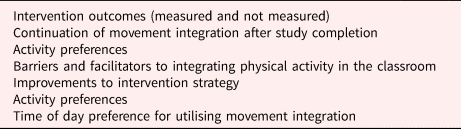
Both the student focus group and the two one-on-one interviews with teachers used a semi-structured interview guide. A semi-structured guide allowed for the systematic collection of data on important topics while allowing the conversations to flow to other topics that were also important but were not initially identified as important (Morse and Field, Reference Morse and Field1995, p. 94). The topics that guided the semi-structured interviews and focus groups are presented in Table 1. To help the student participants convey their experiences, the questions were framed around asking them what they liked and did not like about certain aspects of the Energisers. Prompts were used once the participants started to share answers.
The interviews and focus groups were audio recorded and data were transcribed verbatim. Interview transcripts and initial results were returned to participants for member checking and review. Students in the participating grade four and five combined class were given a focus group pizza lunch and a day-long class party with crafts and outdoor activities provided by the researcher as a way to thank them for participating in the project. Teachers were given $100 gift cards for participating in the project.
Data analysis
Thematic analysis was the chosen method of data analysis for this study. Thematic analysis supported deep analysis by permitting the researcher to locate what the participants were saying in different contexts and allowed for aligning statements with different themes (Wilkinson et al., Reference Wilkinson, Joffe, Yardley, Marks and Yardley2004). Important topics and quotes were first coded into categories. Then the interviews were read again, and the categories were grouped into larger themes. The themes were based on common threads that extended through all the interview data (Morse and Field, Reference Morse and Field1995, p. 140).
The rigour of this study was established using methods that increased the study's trustworthiness (Morse and Field, Reference Morse and Field1995, p. 144). Guba's (Reference Guba1981) commonly cited constructs for ensuring trustworthiness include credibility, transferability, dependability and confirmability. Many methods were employed to ensure these aspects of rigour were addressed. The first step in ensuring this study was trustworthy was the adoption of commonly used approaches in this area of research, such as relationship building. When conducting qualitative research with Indigenous Peoples, it is essential that there are strong reciprocal relationships in place (Castellano, Reference Castellano2004). These relationships help, in part, to address the stereotyping and misinterpretation of results, which has historically been an issue in research with Indigenous communities (Castellano, Reference Castellano2004; Canadian Institutes of Health Research et al., 2014). Information should not be gathered in brief encounters with Indigenous Peoples. Attempts to gain an understanding of the perspective and concerns from an objective, short-term, outsider vantage point has produced much of the research that Indigenous Peoples reject as misinterpretations of their reality (Castellano, Reference Castellano2004). To foster the development of relationships, the researcher volunteered at the school prior to engaging in any research. Spending time as a member of the school community provided the researcher with hundreds of moments to share their personality and fostered friendships within the walls of the staff room, kitchen, gymnasium and classrooms.
A second, and related, approach to trustworthiness is establishing familiarity with the community and culture (Shenton, Reference Shenton2004). While volunteering at the school, the researcher developed relationships with the teachers, school staff, students and community members who volunteered or worked at the school. Another method that supported the trustworthiness of this study, particularly the credibility, was triangulating the data. To triangulate the data, the researcher used the one-on-one interview data, the focus group data, observational data from field notes and supporting information such as informal conversations to ensure what they were hearing, seeing and interpreting was aligned with what the participants actually thought.
Other tactics to ensure credible results included (a) having good rapport with the participants; (b) letting participants know regularly that participation was optional; (c) regular encouragement in the interviews and focus group to be frank; (d) letting participants know that the research project would have the same level of success no matter what they said in the interviews; (e) using probes to elicit details (Shenton, Reference Shenton2004). Member checking was another method used to increase the trustworthiness of this study (Guba, Reference Guba1981). Both the transcripts and data analysis with themes were returned to the teachers to review and verify. The teachers saw no issue with the transcripts. Once they had reviewed the transcripts, we sat down together to go over the themes. Both teachers felt the themes reflected their words and perspectives. With the student participants, member checking was done verbally by talking to them as a group and telling them how their words were interpreted. They were then asked if the researcher had understood them correctly. Additionally, each participant in the class was asked if the findings represented their thoughts. Lastly, the way in which this study has been written strengthens its trustworthiness. By writing in thick description information has been provided so that the reader can determine whether what happened in the described research setting matches up with settings familiar to them (Shenton, Reference Shenton2004).
Results
The themes that emerged in this study depicted both positive aspects and challenges of incorporating movement integration. The first theme, Filling two needs with one action, examines the importance placed on increased physical activity and the academic benefits from the teacher's perspective. The second theme, Chaos is a barrier to classroom activity, looks at classroom management issues that present a barrier to utilising movement integration. The third theme, Customise classroom activity, reveals the need to tailor classroom activity to the setting and students. The last theme, Make it fun, captures the perspectives of the student participants. This theme reveals the desire for games and competition amongst the participants, and what they felt were the benefits to movement integration. The names of all participants discussed in the results have been replaced with pseudonyms.
When these interviews took place, the teachers and students had not yet seen the on-task quantitative results from the previous interventions. The qualitative interviews for this study were conducted shortly after the interventions were complete and the movement integration intervention data had not been analysed yet. When analysed, the intervention data showed there were significant improvements in on-task behaviour after the movement integration interventions.
Filling two needs with one action
This theme encompasses the two perceived positive outcomes of movement integration, increased physical activity and academic benefits. Both teachers valued movement integration because it allowed them to give their students more opportunities to be physically active throughout the day, and they both believed that movement integration helped their students learn in certain situations. Sarah, the kindergarten and grade one combined class teacher believed that young children need physical activity and that movement integration was an excellent way to provide them more throughout the day.
‘I don't think it's [school] a very natural setting for children; so as much exploring and playing you can fit in, active, jumping, running whatever you can fit in to make it not sitting all day in a desk that's a good thing.’
Sarah further explained, ‘I thought [movement integration] was good to get them up and off of the floor and out of their seats because the little ones they can't sit very long.’ When asked if she would recommend movement integration to other teachers she stated, ‘I would definitely recommend being active in the classroom! I mean they are kids, they should be running around and playing all day but we have to have them in school 6 h a day.’
Sarah was sceptical as to whether or not movement integration assisted students in becoming more on-task. When asked if movement integration helped her students become more on-task she stated, ‘I know sometimes it works and sometimes it doesn't.’ Regardless of whether or not movement integration helped her students stay on-task, Sarah recognised that they needed breaks from academic content.
Amanda, the grade four and five combined class teacher also felt that it was crucial for her students to get more physical activity throughout the day. She thought this was one of the biggest benefits of movement integration.
‘I like the whole idea of them getting a little bit more exercise in class because for example a few in my class, like Shaun and Gavin, they don't get any exercise anywhere because as soon as they get home they go and play their video games. Right, so whatever they do get in school is all they get.’
Amanda also believed that her students felt better when they got more activity during the day. She explained, ‘There are some that would like to continue them on for the sake of feeling better. So I think that was a good outcome.’ When discussing the academic benefits of movement integration Amanda, like Sarah, was unsure if the activities helped the students stay on-task. However, she did believe that they helped with her student's memorisation. The students enjoyed an activity that had them engage in physical activity while practicing their spelling words for the week. Amanda explained that ‘when you did the spelling activities I found it made them memorize the spelling words a lot more and they did very well on their spelling tests.’ When Amanda was asked about recommending movement integration to other teachers she shared ‘I think all teachers, once they actually see what is going on and what it's all about, would be like “hey you know that's a good idea.” My kids [her own children who go to another school] would really benefit from that.’
Chaos is a barrier to classroom activity
When discussing barriers to utilising movement integration, the sole issue for Sarah and Amanda was the ‘chaos’ it caused in their classrooms. Sarah explained, ‘there were a few times where it got a little bit chaotic just because there were some that thought this is just time to fool around.’ Observational data supported this finding; it was clear that the students in the kindergarten and grade one class were much louder and more rambunctious during movement integration than the grade four and five students. Lack of safety in the kindergarten and grade one classroom was also discussed as a consequence of the chaos. ‘You always have to worry about that [safety]. Especially in the classroom, you don't want them doing anything too crazy and then hitting their heads on the desk or chair.’ However, there were no injuries when the students were engaging in movement integration in this study.
When talking with Sarah about what could be done to reduce the chaos she said, ‘if we had started at the beginning of the year when we were teaching all the [acceptable classroom] behaviours I think it would have gone a lot smoother.’ She further explained that it is important to ‘lay out the ground rules first so they know it's not just fun activity time but it's actually something that they are expected to do.’ The directions for each individual Energiser activity were explained before doing them; however, general rules for movement integration were not developed and taught to the students during the intervention. For example, if the activity was Air Writing they were told that they should do the movement asked of them, such as hop or jump around the classroom, and when they hear a letter or a shape called out they are to freeze and draw it in the air. However, at the beginning of the interventions, there were no rules taught to the students that applied to all the activities part of the movement integration intervention, such as no hitting or no yelling.
After the activities were complete both Sarah and Amanda felt that it was a challenge to get the students settled back down. Sarah also described how children responded differently to physical activity in the classroom. ‘Those activities, I think they are really good for some kids and then other kids I think it just gets them more riled up.’ When describing this issue, she seemed undecided on whether the chaos created by some of the children after movement integration was worth the benefit of having her other students more on-task.
Amanda stated that getting the students settled back down after movement integration was an issue in her class as well. ‘Having to settle them back down is a challenge’ she stated. She further suggested, ‘I think a lot of the activities would work really well when we'd come right into the class before we start trying to get on-task.’ She explained that if they were already up and moving and not on a specific task yet then it was easier to justify using movement integration. She did not like the idea of getting them up out of their desks when they were already on-task because it was hard to settle them back down.
Customise classroom activity
Both teachers felt that it was important to tailor movement integration to the needs of their students and not just use the pre-developed programmes exactly as they are described. This need was very evident in the kindergarten and grade one classroom. Sarah felt that it was important to customise movement integration by using activities that incorporated academic content the students already grasped. Some activities during the intervention resulted in certain students displaying poor behaviour. Sarah explained it likely had to do with whether students understood the directions of the activity and could participate with the knowledge and skills they possessed. If they could not present the skills or knowledge needed to engage in the activity they would become frustrated and act out.
‘We would get Michael for like 2 min of the activity and then he would just kind of go sit in the corner or lay on the floor or something. But when you tell him to go run some laps in the gym and he can do it. But when you get him into that structured setting where you are asking him to jump now, what number is on the card, what does that correspond to, are you doing a sit up or a star jump? I think he struggles with that. But if you just tell him to run, yeah he understands that. …just moving.’
Sarah suggested that for young students it would be helpful to use movement integration that incorporates curricular content only when the teacher is confident that all of the students grasp the material and it would be a review activity. She felt that if she were trying to teach new material she would not work it into movement integration and that she would prefer to do classroom physical activity that is not linked to curriculum with the goal being to get them active and on-task.
‘I think you could find a balance between using it to teach and using it for burning off energy. I guess the purpose of it is to get them active so that they can focus again after so maybe not so much emphasis on curriculum, or make it a review. So instead of teaching something new like long and short vowels, which is way too hard, teach something they already know like their shapes, letter sounds, or something simple they already know. I think I would mix it up so for those who are like Michael, and are having trouble focusing, maybe we start with something that doesn't require any focus, just moving.’
Within this theme of customising classroom activity emerged the idea that movement integration needs to be enjoyable. The grade four and five teacher Amanda made it clear that if the activities were not perceived as enjoyable by her students they would not take part in them or would complain about them. One of the best ways to do this according to Amanda was to frame movement integration as games, not exercise: ‘Because if you say exercise then they are not going to want to do it; “play a game” [they say to me].’ Amanda explained, ‘competition seemed to motivate them more.’
Make it fun
The voices of the students are also important to include when examining the barriers, facilitators and other perceptions of those who took part in the movement integration intervention. Participants in this study took part in one focus group interview. When interviewing the grade four and five participants they all agreed that they enjoyed the movement integration intervention and would like to keep doing the activities. When asked if they liked all the activities they said that they enjoyed the ‘fun’ activities the most. The activities they thought were fun were the ones that were competitive. When the students were asked to talk about what made activities fun Brian said he enjoyed competitive games because ‘It makes it more challenging’. The students also stated that they liked it when the activities had teams, for example, all of the students liked it when the class was divided into two teams or boys v girls.
While it was obvious that the students loved competition, it was clear that many did not like the activities that focused on what they perceived was ‘exercise’. Building on what Amanda explained, the students also described that they did not enjoy some activities ‘because they were hard’. When asked which activities were too hard, Brian explained, ‘The ones where we had to jump up and down and when we were doing the sun jumps’. Gavin also explained that ‘the crawling ones’ were too hard. The physical activity they were describing was from the activities that were higher intensity and required the students to be active for longer periods of time.
When talking to the participants about the benefits of movement integration, some students were quick to recognise that more physical activity was good for their bodies. For example, Tyler exclaimed, ‘you get strong doing them!’ The students liked that the activities they were doing incorporated what they were learning in class. However, when asked about academic benefits stemming from movement integration the students were unable to give examples of how it benefited them without prompting. When asked if they felt movement integration helped them remember what they were learning in class some students said ‘ya’. But when prompted and asked about remembering spelling words when doing the spelling activity, multiple students shouted ‘yes!’ When the researcher inquired about being tired after movement integration and if this was a good or a bad thing the majority of the students said it was a ‘good thing’. Nolan stated, ‘that [being tired] means you worked out and burned off your energy’. Picking up on this idea, the researcher further prompted about being able to sit and listen after movement integration, and multiple students agreed that they felt they were better able to sit and listen to their teacher after movement integration. Collectively, the students felt that movement integration was beneficial and when asked if they wanted to do more or less of the activities almost the entire class simultaneously said ‘More!’
Discussion
Through the use of one-on-one interviews with two teachers and a focus group with a grade four and five combined class, valuable information was gathered about the perceptions these participants held on movement integration. The outcome assessed in the movement integration interventions the participants took part in was on-task behaviour, thus much of the conversation centred on the impact of movement integration on on-task behaviour. Both teachers in this study stated that they thought movement integration improved the students’ on-task behaviour occasionally. The teachers also believed that movement integration assisted some students in becoming more on-task but not others. Similarly, student focus group data indicated that the students felt movement integration helped them academically only occasionally.
Contradictory to the teachers’ beliefs about the efficacy of movement integration, data from the interventions conducted prior to the qualitative interviews showed that all participants had a positive change in on-task behaviour from before movement integration to after movement integration. This discrepancy between the teachers’ beliefs and the actual on-task data is intriguing and warrants further investigation in future research. Investigating if this discrepancy is an issue in other studies examining movement integration, and if so, why teachers’ observations do not correspond with actual results may provide insight into teacher's willingness to implement movement integration.
Weeks after the interviews for this study took place the researcher shared the on-task quantitative results with the teachers, and both educators were astonished by the findings. The grade four and five teacher explained that she was so blinded by the few minutes of chaos when settling the children down after movement integration that she failed to notice how much more on-task they were for the remainder of the class. This may suggest that teachers should be encouraged to observe the effects of movement integration after the children have settled down into regular classroom instruction, not in the ensuing minutes immediately after movement integration. These findings also speak to the need to objectively measure on-task behaviour and not rely on subjective perceptions when making decisions about teaching and learning.
Both teachers in this study valued the health benefits of physical activity for their students. The largest benefit of movement integration for them was giving the students more opportunities to be active throughout the school day. This finding is consistent with the results from multiple movement integration studies (Cothran et al., Reference Cothran, Kulinna and Garn2010; Dinkel et al., Reference Dinkel, Schaffer, Snyder and Lee2017; Webster et al., Reference Webster, Zarrett, Cook, Egan, Nesbitt and Weaver2017) that also found that teachers valued movement integration because of the additional movement the children received and because of the health benefits associated with physical activity. These common findings indicate that when promoting movement integration to teachers, increased physical activity and potential health benefits should be touted.
Despite the benefits, the teachers discussed they also identified barriers to continuing with movement integration. The primary challenge they associated with movement integration was settling the students down after the activities. This barrier is not unique to this study; other studies looking at barriers to movement integration also cite class behaviour issues as a concern that impedes movement integration (Goh et al., Reference Goh, Hannon, Newton, Webster, Podlog and Pillow2013; McMullen et al., Reference McMullen, Kulinna and Cothran2014; Carlson et al., Reference Carlson, Engelberg, Cain, Conway, Geremia, Bonilla and Sallis2017; Webster et al., Reference Webster, Zarrett, Cook, Egan, Nesbitt and Weaver2017). A study by McMullen et al. (Reference McMullen, Kulinna and Cothran2014), which examined perceptions on movement integration of non-Indigenous teachers who taught Indigenous students, also found that threats to classroom management were the biggest barriers to utilising movement integration.
The kindergarten and grade one teacher from this study suggested that there should be simple rules that apply for all movement integration, and students need to be taught these rules at the beginning of the year. She also suggested that teachers should use movement integration regularly so the children remember how the activities are done and what is expected of them. A recommendation arising from this study and others (Goh et al., Reference Goh, Hannon, Webster and Podlog2017) to help reduce the chaos of movement integration and aid children in settling back down for regular classroom instruction is making clear rules and following the rules on a regular basis. Webster et al. (Reference Webster, Zarrett, Cook, Egan, Nesbitt and Weaver2017) suggested that calming activities such as yoga, stretching and visualisation could be used following movement integration to help children settle down for sedentary instruction. It is perceivable that a combination of these strategies may help teachers manage the transition out of movement integration. Future research should investigate strategies for classroom management during and after movement integration through experimental studies, given it is one of the most cited barriers to movement integration.
Teachers in this study stated that it was important to tailor classroom-based physical activity to meet the needs of their students. The kindergarten and grade one teacher in this study discussed choosing only movement (no academic content integrated) in certain situations. It was apparent that some of the academic-infused activities were too complicated for the kindergarten and grade one class. Sometimes students did not participate in certain activities because the curricular content embedded in the activity was content they had not yet grasped. Thus, they grew frustrated and would act out or not want to take part anymore. This challenge was caused by the activities chosen and how they were explained; it was not the fault of the children who struggled to participate. This finding aligns with developmental research indicating that asking young children to remember the rules of a new activity, remember the overall classroom rules, recall material they have recently been taught, all while exhibiting motor skills that may also be new to them is cognitively taxing. These cognitive processes require focused attention, inhibition and motor control and are fairly sophisticated processes for children in kindergarten (Becker et al., Reference Becker, McClelland, Loprinzi and Trost2014).
By choosing to remove the academic content from the activity, the kindergarten and grade one teacher thought that more students would participate in the classroom-based physical activity. Accordingly, if more students participated in the activity, then there would be more students’ on-task afterward. The teacher also stated that integrating academic curriculum into the activities may be easier when she knew that all the students comprehended the material and the activity would be more of a review.
This notion of utilising just physical activity, and not integrating curricular content, to ensure that all children can understand the directions and follow the rules is congruent with findings from another movement integration study with Indigenous children (McMullen et al., Reference McMullen, Kulinna and Cothran2014), which found that teachers were more likely to utilise movement integration when the physical activity was easy to implement and the children grasped the activity quickly. The concept of tailoring movement integration to the needs of teachers and students is a promising practice in movement integration that may aid in the adoption and adherence of movement integration for all students (Webster et al., Reference Webster, Russ, Vazou, Goh and Erwin2015; Goh et al., Reference Goh, Hannon, Webster and Podlog2017), and should be encouraged when promoting movement integration.
Within the grade four and five classroom, the findings on customisation of classroom activity concentrated on making the activities fun. The teacher and her students stated multiple times that it was important for the activities to be fun and that the activities with competition were the most enjoyable. This finding on the importance of student enjoyment during movement integration has been found in numerous studies (Dinkel et al., Reference Dinkel, Schaffer, Snyder and Lee2017; Webster et al., Reference Webster, Zarrett, Cook, Egan, Nesbitt and Weaver2017; Cothran et al., Reference Cothran, Kulinna and Garn2010). This finding was also seen in another qualitative study looking at the perceptions of teachers of Indigenous students (McMullen et al., Reference McMullen, Kulinna and Cothran2014). In the study by McMullen et al., results showed that whether the students perceived movement integration as fun or not strongly influenced whether the teacher utilised movement integration. These findings suggest that teachers who want to use movement integration should focus on making the activities fun and possibly competitive for the students. When students enjoy movement integration, teachers are more motivated to use movement integration. Including elements of fun into daily classroom activities can increase student engagement and learning (Minchew and Hopper, Reference Minchew and Hopper2008).
One change that could be made when using movement integration with Indigenous children is modifying some of the content to reflect the Indigenous knowledge from the students’ local community. Integrating Indigenous knowledge into education for Indigenous students is a promising practice (Battiste, Reference Battiste1998; Canadian Council on Learning, 2009). A key feature in the integration of Indigenous knowledge and pedagogy is having students learn by doing, learning through experience and learning through enjoyment (Battiste, Reference Battiste2002). Indigenous knowledge can be embodied by students through the use of songs, ceremonies and symbols when teaching (Battiste, Reference Battiste2002). For example, instead of having the kindergarten children mimic zoo animals during movement integration have them mimic animals that are local and important to their community while a teacher shares knowledge on the importance of that animal. This is just one example of using movement integration to teach students about Indigenous knowledge through enjoyment and experience.
The research approach used in this study may also provide researchers with some guidance for future projects on physical activity and Indigenous communities. Through the use of PAR, this study was designed and conducted with school leaders and teachers. Physical activity interventions involving Indigenous students should be developed in collaboration with community to ensure the outcomes, processes and activities are important and relevant to the community for which they are designed (Mushquash and Bova, Reference Mushquash and Bova2007; Robinson et al., Reference Robinson, Borden and Robinson2013; Oosman et al., Reference Oosman, Smylie, Humbert and Henry2016). Often in research, Indigenous communities are constrained to the investigation of variables that are seen as important in Western culture and their beliefs and values are not integrated into the research process (Oosman et al., Reference Oosman, Smylie, Humbert and Henry2016). For this project, Indigenous community leaders and non-Indigenous partners worked together to investigate outcomes that were of value to the community.
This participatory process supports the overarching goal of The Truth and Reconciliation Commission of Canada, which is to forge the important path to reconciliation for all people in Canada (The Truth and Reconciliation Commission of Canada, 2015). In 2015, The Truth and Reconciliation Commission of Canada filed its final report after travelling across Canada for 6 years to listen to the individuals, families and communities that had been affected by the Residential School System. For over 100 years in Canada, Indigenous children were removed from their families and communities and placed in often-distant Residential Schools as a method of colonisation (The Truth and Reconciliation Commission of Canada, 2015). Residential Schools have left a devastating legacy, and the effect is still seen in Indigenous communities and in the relationship between Indigenous Peoples and non-Indigenous people. The inequity and disadvantage caused by colonisation and the Residential School System is still very visible in the education outcomes of Indigenous children (Preston et al., Reference Preston, Cottrell, Pelletier and Pearce2012).
Reconciliation requires rejecting paternalistic and racist mindsets while committing to developing a relationship based on mutual respect (The Truth and Reconciliation Commission of Canada, 2015). Within the Calls to Action in The Truth and Reconciliation report, there is the request that both Indigenous and non-Indigenous communities and leaders work together to seek ways to eliminate the education gap between Indigenous and non-Indigenous Canadian children (The Truth and Reconciliation Commission of Canada, 2015). Addressing the current issues that affect Indigenous children's education is an important step in rectifying the injustices of the Residential School System and colonisation. Through PAR, this project sought to investigate a novel education method that can assist Indigenous children on their path to education success.
Conclusion
An important finding in this study was that the results were similar to the results from a study looking at the perceptions regarding movement integration of teachers, who were not Indigenous, but taught Indigenous children (McMullen et al., Reference McMullen, Kulinna and Cothran2014). Moreover, findings from this study are also comparable to the findings from multiple other studies on movement integration with non-Indigenous students and teachers. This may indicate that few, if any, changes need to be made when using movement integration with Indigenous children. The issues that do need to be addressed, such as threats to classroom management, are universal to all teachers. Similarly, tailoring movement integration to the students and ensuring it is enjoyable are important features to focus on for all children.
Movement integration may be an effective tool for teachers in First Nation schools, as it requires minimal space compared with other forms of physical activity and very few supplies are needed. These benefits may, in a small way, help address some of the space and equipment issues caused by inequitable funding for First Nation schools. Movement integration can reduce classroom behavioural issues and students enjoy it. It is crucial not to underestimate the importance of making school enjoyable for Indigenous children. Classroom engagement is a protective factor to the high disengagement and dropout rates for Indigenous students (Congress of Aboriginal Peoples, 2010). Last, this study represents a small, but important, step in furthering the body of evidence-based practices on engaging Indigenous students in physical activity and promoting academic success.
Acknowledgements
We gratefully acknowledge the contributions of our community partners who supported this work and welcomed us into their school and community. We would also like to thank the student participants who took part in this study. We would like to acknowledge the contribution of a Canadian Institutes of Health Research Doctoral Scholarship in supporting this research.
Serene Kerpan is an Assistant Professor in the Faculty of Health Sciences at the University of Ontario Institute of Technology. Through community-engaged scholarship, she cultivates strong relationships with Indigenous schools and communities to co-investigate the effect of physical activity on the well-being of Indigenous children and youth.
M. Louise Humbert is a Professor in the College of Kinesiology at the University of Saskatchewan. She is a past president of Physical and Health Education Canada.
Sylvia Abonyi is an Associate Professor in the Department of Community Health and Epidemiology at the University of Saskatchewan and Research Faculty in the Saskatchewan Population Health and Evaluation Research Unit (SPHERU). Trained as an anthropologist, her research is grounded in understanding culture as a determinant of health, with implications for population health programme and policy. Current research has focused on revealing experiences and aspirations for ageing well in rural and remote Indigenous and non-Indigenous communities.