INTRODUCTION
Ubiquitous in introductions to linguistics and language acquisition, poverty of the stimulus (POS) arguments have instigated considerable debate in the recent linguistics literature.Footnote 1 Proponents of POS arguments point to them as incontrovertible proof that children access an innate knowledge of grammar to acquire language. Critics of POS arguments argue that adult speech provides children with all the information they require. In this article I use the comparative method to challenge the logic of POS arguments. Rather than question the premises of POS arguments, as previous critics have done, I demonstrate how individual POS arguments lead to a reductio ad absurdum. The reductio makes crucial use of the comparative method to reveal the fine detail of grammatical variation between genetically related languages.
The reductio begins by formulating a POS argument for a linguistic construction in one language. This POS argument concludes that children must be equipped with innate knowledge of this construction for its acquisition. However, the comparative method shows that details of this construction vary across related languages. Systematic comparison leads inevitably to the conclusion that children must have innate knowledge of different details of the construction for each language, which is clearly absurd. Feats of acquisition which appear extraordinary from the perspective of a single language become ordinary from the perspective of an entire language family. The reductio shows that universal principles of grammar cannot be established on the basis of POS arguments from a single language.
POS arguments can be divided into positive and negative types (Fodor & Crowther, Reference Fodor and Crowther2002). Poverty of the Positive Stimulus (POPS) arguments claim that some constructions are so rare that children cannot possibly acquire them from the input language. For example, Chomsky (Reference Chomsky1975: 32) argued that children learning English never invert auxiliary verbs in the dependent clauses of yes/no questions, as in (1).
(1) * Is the man who ___ tall is in the room?
Chomsky asserted that the data from inversion in single-clause questions is ambiguous for determining which auxiliary should be inverted in two-clause questions, in the sense that children could induce two different rules. The ‘string-dependent’ rule inverts the first auxiliary in the sentence to form the question, while the ‘structure-dependent’ rule inverts the first auxiliary of the main clause to form the question. These two rules produce an identical output for questions with one clause, but children with the string-dependent rule should produce questions such as (1) for sentences with dependent clauses. Children could use positive evidence from questions with dependent clauses to acquire the structure-dependent rule, but Chomsky claimed that such evidence is not available to children learning English. The POPS argument concludes that the missing information is supplied by Universal Grammar (UG) in the form of an innate structure dependency principle.
Poverty of the Negative Stimulus (PONS) arguments are based on constraints that exist in the adult language. For example, the that-trace constraint of English allows the optional use of complementizers in declarative sentences (2a) but not in interrogative sentences (2c) (Haegeman (Reference Haegeman1994: 11).
- (2)
a. They think (that) the cumquats are ripe.
b. What do they think ___ are ripe?
c. *What do they think that ___ are ripe?
This PONS argument asserts that children cannot acquire the that-trace constraint based solely on the observation of the target language. Children could construct the question in (2c) by analogy with the sentences in (2a and 2b) and would presumably require negative evidence such as overt correction to learn this constraint. Since studies of children learning English have shown that children do not receive systematic linguistic correction (Brown & Hanlon, Reference Brown, Hanlon and Hayes1970), and rarely pay attention to it when they do, the PONS argument concludes that the missing information about constraints is supplied by the children's innate knowledge of UG.
Fodor and Crowther (Reference Fodor and Crowther2002) note that while the poverty of positive evidence sets a lower limit on human language, the poverty of negative evidence sets an upper limit. Without sufficient positive evidence, children will have no basis for constructing linguistic rules. Without sufficient negative experience, children will have no basis for constraining linguistic rules. The poverty of positive evidence creates a set of difficulties for language learners that are separate from and complementary to the difficulties created by the poverty of negative evidence. A solution to the poverty of positive evidence does not provide a solution to the poverty of negative evidence.
Critics of POPS arguments, such as Pullum and Scholz (Reference Pullum and Scholz2002) and MacWhinney (Reference MacWhinney2004), have questioned the premise that children lack the evidence they need to acquire rare constructions. While the basis of such criticism is questionable (Legate & Yang, Reference Legate and Yang2002), ultimately an argument by argument refutation of POPS arguments is defeated by the creation of new POPS arguments (Crain & Pietroski, Reference Crain and Pietroski2002). Another problem for critics of POPS arguments is that refutations of these arguments do not touch PONS arguments.
In this article, I use a sample of Mayan languages to create reductio ad absurdum arguments against POPS and PONS arguments. The Mayan language family consists of thirty languages spoken by people living in Mexico, Guatemala, Belize and Honduras (Kaufman, Reference Kaufman1974). The number of speakers ranges between 141 for Mochó and 563 for Lancandón to 99,000 Q'anjob'al speakers, half a million Mam speakers, and a million speakers of K'iche' and Yucatec (Richards, Reference Richards2003). The language family is divided into four main branches with a linguistic history of four thousand years and a written history of over a thousand years (England, Reference England1994; Kaufman, Reference Kaufman, England and Elliott1990). Mayan languages are morphologically ergative, head-marking languages. The verb complex uses a set of ergative prefixes to cross-reference the subject of transitive verbs and a set of absolutive clitics to cross-reference the subject of intransitive verbs as well as the objects of transitive verbs. In Mayan linguistics, the ergative person markers are referred to as ‘Set A’ and the absolutive person markers are referred to as ‘Set B’. This terminology was developed because many Mayan languages extend the Set A morphemes to cross-reference the subjects of intransitive verbs in certain contexts.
The article proceeds as follows. The next section applies the comparative method to three PONS arguments for Mayan languages. These arguments illustrate the types of PONS arguments that can be constructed in other language families, as well as the variation to be found in these constructions across individual Mayan languages. This variation forms the basis for the reductio argument against the PONS arguments. As the number of such variants increases, the likelihood that their solution lies in UG is reduced. I then apply the comparative method to arguments from the poverty of the positive stimulus. Comparison reveals a new side of the POPS argument. Poverty in one language may correspond to the complete absence of the construction in another language. UG will be of little use to children learning a construction that is rare in one language and non-existent in another. I conclude that POS arguments which do not use the comparative method fail to provide valid arguments for UG.
THREE MAYAN POVERTY OF THE NEGATIVE STIMULUS ARGUMENTS
In this section I present three Mayan PONS arguments. These arguments make use of constructions with constraints that vary across the Mayan languages. Constraints on these constructions lead to PONS arguments, but the cross-linguistic variation suggests that children acquire the specific constraint instantiations from positive evidence.
The causative alternation
The causative alternation provides an example that poses a PONS argument. Some English verbs have both intransitive and transitive argument structures (3), whereas others do not (4). Children learning English must learn which verbs allow a causal agent to be added to their argument structure. A PONS argument can be constructed for the causative alternation, since children only find positive evidence for verbs that alternate between intransitive and transitive forms. They do not encounter negative evidence for the non-alternating verbs (cf. Bowerman & Croft, Reference Bowerman, Croft, Bowerman and Brown2008; Braine, Reference Braine and Slobin1971).
- (3)
a. The plate dropped.
b. I dropped the plate.
- (4)
a. The plate fell.
b. * I fell the plate.
Pinker (Reference Pinker1989) proposed a solution to the causative problem in the form of constraints on possible semantic operations. He analyzed the causative alternation as an operation that converts a predicate which specifies a “change” into a predicate which specifies how an agent “causes” the change to occur. Pinker linked this broad-range rule for the causative alternation to a set of narrow-range rules which precisely delineate the permissible changes. One narrow-range rule picks out verbs of externally caused change of physical state. This narrow-range rule predicts that English verbs such as break, open and boil undergo the causative alternation. Another narrow-range rule picks out verbs of emotional expression. This rule predicts that English verbs such as laugh, cry and smile do not undergo the causative alternation. Pinker speculated that “there is a universal continuum of lexical causativizability, presumably corresponding to the ease of conceiving of a given kind of event as being directly causable from without” (p. 134).
The causative alternation is one form of a more general change in verb transitivity. A causative alternation adds an agent argument to an intransitive verb while an anticausative alternation removes an agent argument from a transitive verb (5). The causative as well as the anticausative alternations provide the basis for a PONS argument of how children learn which verbs do not undergo causative and anticausative alternations.
- (5)
a. The machine detected the metal.
b. * The metal detected.
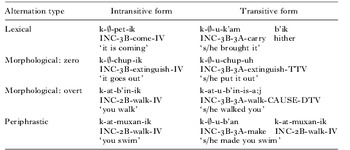
Another dimension of the causative alternation is the type of change that takes place. A lexical alternation substitutes different verbs, e.g. come::bring. A morphological alternation adds a derivational affix to either the intransitive or transitive stem, e.g. be rich::enrich. A zero type of derivation accounts for verbs that do not change form between transitive and intransitive contexts, e.g. spin::spin. A periphrastic alternation adds another syntactic clause, e.g. appear::make appear. The direction of the alternation is clear in the case of overt morphological and periphrastic types of alternation, but is difficult to discern in the case of lexical and zero derivation types of alternation. Mayan languages display a similar complexity, cf. Table 1.
Types of causative alternations in K'iche'

While English has several types of causative alternations, the process is more complicated in the Mayan languages (Pye, Reference Pye and Levy1993). The Mayan language K'iche' uses the causative suffix -is to derive the causative form of one class of intransitive verbs (6). (As noted in the ‘Appendix: list of abbreviations’, ‘A’ marks ergative agreement and ‘B’ marks absolutive agreement. Numbers indicate person.)
- (6)
a. k-∅-poqow-ik
INC-3B-boil-IV
‘It is boiling.’
b. k-∅-a-poqow-is-a:j
INC-3B-2A-boil-CAUSE-DTV
‘You are boiling it.’ (=cause to boil)
A small number of intransitive verbs in K'iche' change argument structure without adding the causative affix: (7) and (8). These verbs share the feature of alternating between intransitive and transitive verb forms by a derivational process that is distinct from the regular causative process (cf. Dayley, Reference Dayley1985).
- (7)
a. x-∅-tzaq-ik
COM-3B-fall-IV
‘S/he/it fell.’
b. x-∅-in-tzaq-oh
COM-3B-1A-drop-TTV
‘I dropped/lost it.’
- (8)
a. x-∅-tzalij-ik
COM-3B-return-IV
‘S/he/it returned.’
b. x-∅-a-tzali:-j
COM-3B-2A-return-TV
‘You returned it.’
A third class of K'iche' verbs makes use of the absolutive antipassive construction to effect an anticausative alternation. The absolutive antipassive is typically used to focus on an action rather than the result of the action (Mondloch, Reference Mondloch1981). With many K'iche' verbs, the antipassive acts as an anticausative: (9) and (10).Footnote 2
- (9)
a. k-∅-chaku-n-ik
INC-3B-work-ABS-IV
‘S/he/it is working.’
b. k-∅-u-chaku:-j
INC-3B-3A-work-DTV
‘He/she is working it.’
- (10)
a. x-in-tze'-n-ik
COM-1B-laugh-ABS-IV
‘I laughed.’
b. x-in-a-tze'-j
COM-1B-2A-laugh-DTV
‘You made me laugh.’
A fourth class of intransitive verbs in K'iche' does not undergo any of these processes. The only way to express a transitive notion with the members of this set is to use a complex sentence containing the matrix verb –b'an ‘do/make’. Examples of periphrastic verbs are shown in (11) and (12).
- (11)
a. k-in-pet-ik
INC-1B-come-IV
‘I am coming.’
b. k-∅-in-b'an k-at-pet-ik
INC-3B-1A-do INC-2B-come-IV
‘I will make you come.’
- (12)
a. k-in-muxan-ik
INC-1B-swim-IV
‘I am swimming.’
b. k-∅-in-b'an k-at-muxan-ik
INC-3B-1A-do INC-2B-swim-IV
‘I will make you swim.’
Children learning K'iche', then, must discover which of these alternation types a verb undergoes. All of the intransitive verbs allow the periphrastic construction, but the meaning denotes a cause that is less direct than that encoded by the affixal forms. K'iche' children will hear intransitive and transitive forms of the verbs in the first three classes, but not for the periphrastic class. It is this class that poses a PONS problem for the K'iche' causative. K'iche' children are not corrected for producing the ill-formed verb stem *-muxan-is-aj by overgeneralizing the causative suffix to the intransitive verb -muxan ‘swim’. The second and third types of alternations pose a different PONS problem. The absolutive antipassive construction is a type of anticausative, since it derives intransitive verb stems from transitive verb stems. Many transitive verbs do not undergo this anticausative alternation, so K'iche' children face a different type of PONS problem in discovering which transitive verbs prohibit this use of the anticausative construction. Verbs that participate in more than one of these alternation types (e.g. -miq'-is-aj, -miq'-oh ‘heat something’; -tzalij-is-aj, -tzalij ‘return’; -xojow-is-aj, -xoj-oh ‘dance’) further complicate the acquisition problem.
Pinker's solution predicts that the K'iche' verbs that participate in these different types of alternations fall into different narrow-range verb classes. His solution demands that the verbs that add the causative suffix -is would belong to one or more narrow-range classes such as coming into or going out of existence, while verbs with the periphrastic alternation would belong to a different set of narrow-range classes such as motion in a lexically specified direction.
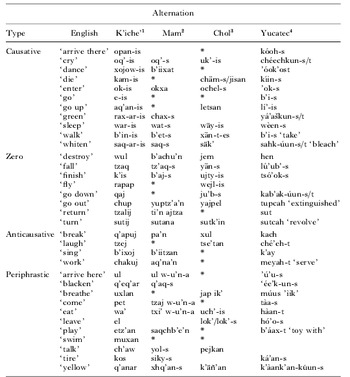
A list of Mayan verbs that participate in these alternations as well as those that do not is necessary to test Pinker's hypothesis. This is typically the type of information that is missing from dictionaries of any language. Table 2 lists the causative alternation classes for a sample of K'iche' verbs in comparison to verbs in three other Mayan languages.Footnote 3 The table lists transitive verb forms for the four languages. An asterisk indicates verbs that speakers find unacceptable with a morphological suffix and that therefore require the periphrastic alternation in that language. A blank indicates that no information is available for that item.
Causative verb classes in Mayan languages

notes: [1] Fieldnotes, Zunil dialect, 1988.
[2] The Mam causatives were checked with Ana Elizabeth Lopez Ramirez who speaks the San Ildefonso Ixtahuacán dialect of Mam.
[3] Gutiérrez Sánchez (Reference Gutiérrez Sánchez2004). The causatives were checked with Asunción Lopez Perez who speaks the Tila dialect of Chol.
[4] Yucatec has two causative suffixes -s and -t. The -s/t note indicates that the verb takes both forms (Bricker et al., Reference Bricker, Po'ot Yah and Dzul de Po'ot1998).
The alternation classes in Table 2 are organized by reference to the K'iche' verbs. All of the K'iche' verbs in the causative alternation class are shown with the -is suffix. There are many equivalent verbs in Mam and Chol that do not take an -is/-s suffix. Mam has a transitive verb -b'iixat ‘dance’ while Chol uses the construction -cha'leñ soñ ‘do a dance’, which contains the light verb -cha'leñ ‘do’. Table 2 lists the transitive ‘dance’ verb for Mam and has an asterisk for the Chol ‘dance’ verb, indicating that its transitive use requires a periphrastic form and does not take the causative suffix -is/-s. K'iche', Chol and Yucatec add the causative suffix to the verb ‘die’, but Mam does not. All four languages use the causative suffix with the verb ‘sleep’.
The Mam verb -ul ‘arrive here’ belongs to its own exceptional alternation category. It is intransitive like the K'iche' verb -ul, but Mam uses the agent phrase w-u'n-a, 1A-by-enc, ‘by me’ rather than the causative suffix or a periphrastic construction with the verb ‘make’ to express the transitive meaning. Chol allows the verb -säk' ‘whiten’ to be used in transitive sentences without adding a causative suffix.
The class of zero alternating verbs in K'iche' is illustrated by the examples in (7) and (8). The equivalent verbs in the other three Mayan languages have different transitive forms. The asterisks indicate once again that examples such as the Mam verbs -ku'tz ‘lower’ and -liipat ‘fly’, as well as the Chol verb -sujtel ‘return’, require the periphrastic alternation rather than the zero alternation. The verbs for ‘finish’ in Mam, Chol and Yucatec take the causative suffix, while the equivalent verb in K'iche' does not.
The periphrastic class in K'iche' is illustrated by the examples in (11) and (12). This verb class should have asterisks for the equivalent verbs in the other Mayan languages to indicate that they require a periphrastic alternation. Instead there are just as many differences for the periphrastic class as for the other verb classes. The verbs for ‘tire’ and ‘blacken’ in Mam and Yucatec take the causative suffix; the K'iche' equivalents require the periphrastic alternation. K'iche' and Mam do not apply the causative suffix to the verb ‘eat’, while this is acceptable in Chol. K'iche', Mam and Chol do not use the causative suffix with the verb ‘come’, but Yucatec does.
The causatives create a PONS problem within each language, since children must learn which verbs belong to the class of verbs that add the causative suffix or require the periphrastic alternation. Systematic comparison exposes variation between Mayan languages that rules out a solution based on narrow-range verb classes. Consider the motion verbs ‘go’, ‘come’, ‘arrive here’ and ‘arrive there’. These verbs have similar meanings and should belong to the same narrow-range verb classes. The verbs ‘go’ and ‘come’ require the periphrastic alternation in Chol, while the K'iche' ‘go’ verb takes the causative suffix but not the verb ‘come’. The verbs for ‘arrive there’ in K'iche' and Yucatec take the causative suffix while the K'iche' verb ‘arrive here’ requires the periphrastic alternation and ‘arrive here’ in Yucatec takes the causative suffix. The color verbs ‘whiten’, ‘blacken’, etc. display a similar degree of intra- and inter-linguistic variation. This variation obviates Pinker's narrow-range verb classes and demonstrates the necessity of testing theories in more than one language.Footnote 4
Verb complements
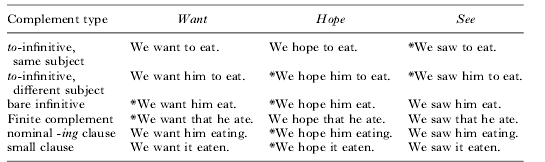
Linguists have long acknowledged that lexical constraints on rules pose difficulties for a theory of grammar (Dowty, Reference Dowty, Davis and Mithun1979). The lexicon is known to preserve many quirky features. PONS arguments based on syntactic constraints such as the that-trace constraint appear to be more compelling, since syntactic constraints are not supposed to rely on lexical quirks. Verb complementation provides an arena in which much variation is found within and between languages (Noonan, Reference Noonan and Shopen1985). Consider the examples of English complement types provided in Table 3.
English verb complement types (Quirk et al. Reference Quirk, Greenbaum, Leech and Svartvik1985)
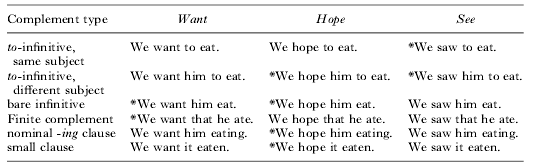
Children will hear matrix verbs such as want and hope used with different complement types and face the logical problem of ruling out such alternatives for matrix verbs such as see (Braine, Reference Braine and Slobin1971). Children can only use the language they hear to learn which complement types occur with each verb, not the complement types that are unacceptable with each verb. This reasoning leads to the conclusion that verb complement types must be specified in UG.Footnote 5
The logical problem of acquiring verb complement types is revealed in its full generality when we examine complementation across a family of languages rather than just looking at English. Mayan languages have several types of verb complements. The K'iche' progressive verb allows both indicative and nominalized complement types (13). The nominalized complement type in (13b) contains the nominalizing suffix -eem.
(13) K'iche' verb complement types (Sis Iboy, Reference Sis Iboy1997)
a. tajin k-in-atin-ikPROG INC-B1-bathe-IND‘I am bathing.’ (Literally: ‘It is progressing I bathe.’)
b. k-in-tajin pa atin-eemINC-B1-PROG PREP bathe-NOM‘I am bathing.’ (Literally: ‘I am progressing to bath.’)
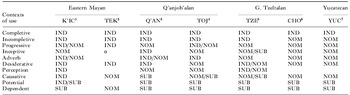
The indicative type of verb complement has inflections for aspect, agreement and indicative status. Nominalized complements lack aspect inflection and may or may not be inflected for agreement or nominalization. Verbs of motion select the subjunctive form of a verb complement. Subjunctive complements are inflected for agreement and dependent status. Table 4 lists the contexts where these complement types appear in seven Mayan languages. The complement types in Table 4 are abbreviated as IND ‘indicative’, NOM ‘nominalized’ and SUB ‘subjunctive’.
Mayan verb complements

notes:
[1] England (Reference England1994), Kaufman (Reference Kaufman, England and Elliott1990), Par Sapón (Reference Par Sapón2007) and Sis Iboy (Reference Sis Iboy1997).
[2] Pérez Vail & Simón Morales (Reference Pérez Vail and Simón Morales2007).
[3] Pedro Mateo Pedro (2009, p.c.).
[4] Louanna Furbee (1976, p.c.).
[5] Gilles Polian (p.c.); Sántiz & Polian (Reference Sántiz and Polian2007).
[6] Asunción Lopez Perez (p.c.); Vázquez Alvarez (Reference Vázquez Alvarez2002).
[7] Barbara Pfeiler (2009, p.c.)
Mayan children can acquire these complement types by analyzing the adult speech they hear. The PONS argument enters when the children observe matrix verbs that select a variety of different complement types. At that point the children will be tempted to overgeneralize the types of verb complement for each matrix verb. The PONS argument shows that children cannot use evidence from adult language to constrain their overgeneralizations, so they must rely upon UG. Since UG does not explain the variety of complement types that verbs select in different Mayan languages, UG will not provide children with a reliable guide for constraining verb complementation in a single Mayan language.
Agreement raising
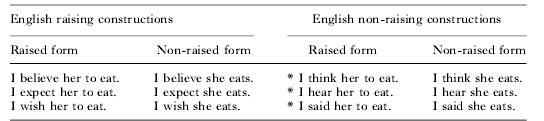
The English phenomenon of subject raising produces another syntactic PONS problem. Subjects may raise out of subordinate clauses to become the object of the matrix verb in a number of contexts. These constructions have been analyzed as examples of exceptional case marking in recent grammatical frameworks.Footnote 6 Examples of some English raising and non-raising constructions are shown in Table 5.
English raising and non-raising constructions
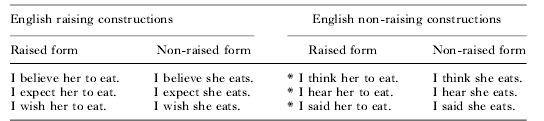
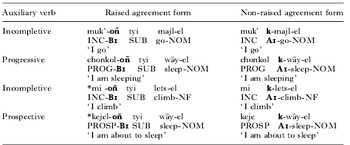
Mayan languages have rich agreement systems, so the corresponding construction takes the form of agreement raising. The subject of the complement verb will have an ergative Set A cross-reference marker, which I refer to as the unraised agreement form. When it is cross-referenced on the verb in the matrix clause, it will have an absolutive Set B marker, which I refer to as the raised agreement form.
Some examples of agreement raising constructions in Chol are shown in Table 6. Table 6 shows sentences with the auxiliary verbs muk' and chonkol with non-raised and raised agreement. The non-raised examples have an ergative agreement prefix (e.g. k- ‘A1’) shown in bold on the complement verb, while the raised forms have an absolutive agreement suffix on the auxiliary verb (e.g. -oñ ‘B1’). The auxiliary verbs mi and keje only allow intransitive complements to have non-raised agreement (Gutiérrez Sánchez, Reference Gutiérrez Sánchez2004: 17). The PONS problem for children is to discover which constructions allow the option of agreement raising, which forbid it, and which require it. The Cholan option of agreement raising creates a PONS problem since children cannot learn the constraints on agreement raising on the basis of positive evidence alone.
Agreement raising constructions in Chol (Gutiérrez Sánchez, Reference Gutiérrez Sánchez2004; Vázquez Alvarez, Reference Vázquez Alvarez2002)

The PONS problem these structures create in Chol is actually much worse. Gutiérrez Sánchez (Reference Gutiérrez Sánchez2004: 231, 236) notes that the existential añ is an exception to the agreement raising option for the auxiliaries muk' and chonkol. The existential only appears with muk' and chonkol in the non-raised form. Children acquiring Chol have to learn the lexical exceptions for the auxiliaries that allow the option of agreement raising.
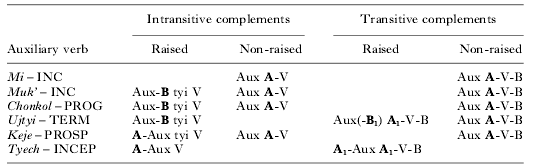
A third PONS problem for agreement raising constructions in Chol is illustrated in (14). Vázquez Alvarez (Reference Vázquez Alvarez2002: 121) states that agreement raising for the terminative auxiliary is obligatory for intransitive verbs, but is optional for transitive verbs. Children acquiring Chol cannot acquire such a constraint on the basis of positive evidence alone, and so the distinction between agreement raising for transitive and intransitive verb complements in Chol creates another PONS problem. Vázquez Alvarez summarizes these constraints as shown in Table 7.
(14) Chol terminative auxiliary constraints (Vázquez Alvarez, Reference Vázquez Alvarez2002: 122)
a. Terminative Auxiliary with intransitive complement (Vázquez Alvarez example 70b)
ujty-i-y-ety tyi wäy-elTERM-IND-EPN-B2 SUB sleep-NOM‘You finished sleeping.’
b. Terminative Auxiliary with transitive complement (Vázquez Alvarez example 71a)
ujty-i (-y-ety) a-mek'-oñTERM-IND (-EPN-B2) A2-hug-B1‘You stopped hugging me.’
Auxiliary complement constraints on agreement raising in Chol (Vázquez Alvarez, Reference Vázquez Alvarez2002)
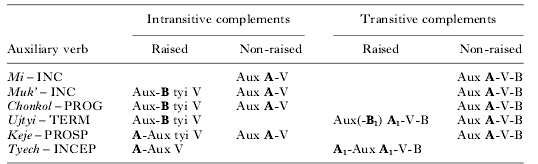
The agreement raising constraints in Chol produce a particularly complex PONS argument. One possibility is that universally some auxiliary verbs allow agreement raising while others do not. The difference between the Chol auxiliaries mi and muk' argues against a UG solution, but other languages might display similar constraints. Unfortunately, there is not a lot of data for the Mayan languages on this topic. The little evidence that exists suggests that constraints on agreement raising are a language-specific affair. Sis Iboy (Reference Sis Iboy1997) provides the examples in (15) and (16) for K'iche'. They show that agreement raising is optional with the progressive auxiliary in K'iche' for both intransitive and transitive complements.
(15) Intransitive agreement raising in K'iche' progressive constructions (Sis Iboy, Reference Sis Iboy1997)
a. tajin k-in-atin-ikPROG INC-B1-bathe-IND‘I am bathing.’
b. k-in-tajin pa atin-eemINC-B1-PROG PREP bathe-NOM‘I am bathing.’
(16) Transitive agreement raising in K'iche' progressive constructions (Sis Iboy, Reference Sis Iboy1997)
a. tajin x-e-qa-to'-oPROG COM-B6-A1-help-IND‘We are helping them.’
b. x-in-tajin chi u-to'-ikCOM-B1-PROG PREP A3-help-NOM‘I was helping him/her.’
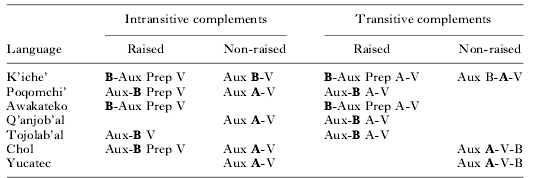
I have incorporated the K'iche' examples of agreement raising in progressive constructions along with examples for the Mayan languages Chol, Tojolab'al, Awakateko and Poqomchi' from Kaufman (Reference Kaufman, England and Elliott1990) in Table 8 to demonstrate the range of variation in agreement raising in Mayan progressive constructions.
Agreement raising in Mayan progressive constructions (Kaufman, Reference Kaufman, England and Elliott1990: 87–93)
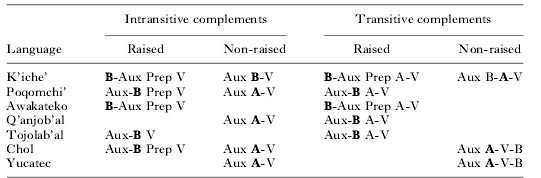
Table 8 shows that agreement raising with intransitive complements is possible in K'iche', Poqomchi' and Chol, and only possible with transitive complements in K'iche' and Awakateko. The difference between K'iche' and Poqomchi' in this respect illustrates a semantic change that has occurred with transitive complements in Mayan progressive constructions. The absolutive prefix that appears on the progressive auxiliary in K'iche' cross-references the subject of the event, while the absolutive suffix that appears on the progressive auxiliary in Poqomchi' cross-references the object of the event. This difference in semantic roles creates another acquisition problem for children learning Mayan languages. However, children should be able to use evidence from the context to decide on the correct interpretation of the progressive affix.
Mayan languages cross-reference subjects in complex sentences on either the matrix or complement verb. The constraints on subject cross-referencing provide the basis for a PONS argument that children access UG to decide which verbs allow the subject to be cross-referenced on the matrix or complement verb.
Summary
In this section I have developed three examples of PONS arguments for Mayan languages. Each of these arguments is based on productive constructions with arbitrary constraints. Children will find positive evidence for the constructions in the input, but require direct negative evidence to prevent generalizing beyond the constraints in the individual adult languages. The comparative method exposes unexpected variation in the nature and scope of the constraints across the Mayan languages. While each construction offers a compelling PONS argument for innate knowledge of linguistic constraints within a single language, comparison across languages reveals the language-specific nature of the constraints. The absurdity of these Mayan PONS arguments lies in the contradiction of a Universal Grammar composed of language-specific constraints. The contradiction can be resolved by debarring language-specific PONS arguments.
THE POVERTY OF THE POSITIVE STIMULUS
The POS arguments that I have discussed to this point are all Poverty of the Negative Stimulus arguments based on constraints on more general rules. A Poverty of the Positive Stimulus (POPS) argument is based on the absence of critical examples in the input. Assessing the poverty of positive evidence in languages with little documentation is challenging. While many excellent grammatical descriptions exist for the Mayan languages, none provide information on the frequency of syntactic constructions in the adult languages, much less for the language addressed to two-year-old children. In this section I analyze the input frequencies of two constructions in Mayan languages. I use Mayan language acquisition data available from the Almaya Language Archive (www.almaya.org) to assess the input frequency of each construction (Pye, Reference Pye and Slobin1992; Pye, Pfeiler, de León, Brown & Mateo, Reference Pye, Pfeiler, de León, Brown, Mateo and Pfeiler2007; Mateo Pedro, Reference Mateo Pedro2010).
Verb particles
The different types of particles that follow K'iche' verbs provide one example of a Mayan POPS argument. These particles appear in specific orders. K'iche' has a set of directional particles that specify the path of motion (b'i-k, la-oq), an irrealis particle (ta-j), an emphatic (k'u-t), an adverbial (chi-k), modal particles (b'a, na), and a locative proadverb particle (wi-h) that is used when a locative or instrumental phrase is focused (Mondloch, Reference Mondloch1978). Examples of K'iche' particle combinations are shown in (17).
(17) K'iche' Text (Norman, Reference Norman and Furbee-Losee1976: 43)
a. jawchi' in-k'oo chiwi wa' (no. 24)where B1-exist already PLOC here‘Where am I here?’
b. na xee tachi wa' k'oo-lik (no. 25)NEG below IRR already here exist-ST‘He was not here.’
The K'iche' particle orders create a POPS problem that is similar to the problem of acquiring the auxiliary verb order of English (Kimball, Reference Kimball1973). K'iche' speakers produce sentences with different combinations of particles, but seldom produce sentences containing the full set of verb particles. It is easy to see how K'iche' children acquire the individual particles, but exceedingly difficult to see how children determine the order for all of the particle combinations.Footnote 7
I analyzed a one-hour sample of a mother's speech addressed to a K'iche' child (aged 2;9) in the file alchaay.1 to assess the frequency of multiple verb particles in the K'iche' input. The child's mother produced 290 utterances with verb particles out of a total of 627 utterances. Of these 290 utterances, 25 utterances contain a series of two verb particles, two utterances contain a series of three verb particles, and only one utterance contains a series of four verb particles (18). The results are shown in Table 9.
(18) Verb particle constructions in a sample of K'iche' input
a. Three verb particle utterances
i. maji kuk'am k'u b'e la linaj patax chawe kamik.
Maji k-0-u-k'am k'u b'e la le: inaj patax chi-aw-e: kamik.if_not INC-B3-A2-carry so off then the little duck at-A2-POS today‘If not, he will carry off then the little duck from you today.’
ii. kana ja kan wi puwi' le. kan-a ja kan wi pa-u-wi' le.stay-DEP so behind PLOC on-A3-hair there‘That it stay behind on top there.’
b. Four verb particle utterance
ay, ma katchab'etaj ta b'a xa ne ay, ma k-at-chab'e-taj ta b'a xa neay, NEG INC-B2-understand-PASS IRR indeed only perhaps‘Ay, you are not indeed understood perhaps.’
Number of verb particle combinations in K'iche' input (proportion of total utterances)

This analysis confirms my impression that utterances with multiple verb particles are rare events in speech to K'iche' children. Multiple particle exemplars often fail to overlap with one another. Remarkably, the examples in (18) do not have any particles in common so a K'iche' child would only be able to use such examples to establish three separate particle series. She would not be able to use this evidence to determine a single rule that could generate the permissible orders of all nine verb particles. These results show that positive evidence for multiple verb particle combinations is insufficient for K'iche' children to establish their order.
Comparison with the closely related language Mam reveals another dimension of the verb particle problem. Like K'iche', Mam has a set of directional particles that specify the path of motion. Unlike K'iche', the directional particles in Mam are virtually obligatory with transitive verbs. England (1983: 170) notes that only the transitive verbs -aj ‘want’, -ky'i' ‘not want’ and -il ‘see’ occur in texts or recordings without directionals. Mam permits combinations of up to three directional particles to occur with verbs (e.g. etzb'aj from el ‘out’, tzaj ‘toward’ and b'aj ‘finish’), while K'iche' does not. Children acquiring Mam will encounter massive examples of verbs used with one or two directional particles whereas children acquiring K'iche' will encounter relatively few examples of verbs used with a single directional particle. Children acquiring K'iche' face a poverty of the positive stimulus problem learning that K'iche' does not allow combinations of directional particles.
As this example shows, the comparative method has important implications for poverty of positive stimulus arguments. Frequent constructions in one language may correspond to non-existent constructions in related languages. This possibility implies that in some cases children must refrain from using Universal Grammar principles to supply content that is absent from one language but present in others. The poverty of positive stimulus can be expected to vary across languages and thus children's reliance on innate knowledge of grammar must also vary.
Progressive complements
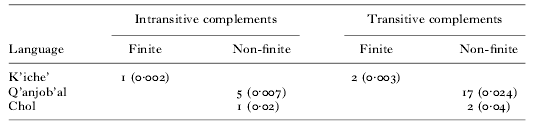
The progressive construction that I describe in the previous section (cf. Table 4) also produces a POPS argument. The progressive construction has finite and non-finite complement forms in K'iche' and Chol; it has only a non-finite complement form in Q'anjob'al (Mateo Pedro, Reference Mateo Pedro2010). Progressive constructions vary in frequency as well as form in K'iche', Q'anjob'al and Chol. For this study, I analyzed the forms and frequency of progressive constructions in samples of the language addressed to two-year-old speakers of these languages, using the sample of the K'iche' mother's speech from the file alchaay.1, the Q'anjob'al father's speech from the file QA190507, and the Chol mother's speech from the file CE240306. In these samples, the K'iche' mother produced a total of 627 utterances, the Q'anjob'al father produced a total of 717 utterances, and the Chol mother produced a total of 56 utterances. The number and types of their progressive constructions are shown in Table 10. Examples of the parents' progressive constructions are shown in (19).
(19) Parental Progressive constructions in three Mayan languages
a. K'iche' intransitive verb (alchaay.1)
chab'ij k'ut chare: jachin tajin ka'anow lawa. ch-∅-a-b'ij k'ut chi-r-e: jachin tajin k-0-b'an-ow le: a-wa:.IMP-B3-A2-say EMP at-A3-POS who PROG INC-B3-do-ANT the A2-food‘Say to him who is making your food.’
b. Q'anjob'al transitive verb (QA190507)
lan lohoni. lanan ∅-lo-on-i.PROG B3-eat-ANT-NOM‘S/he is eating.’
c. Chol transitive verb (CE240306) jiñli carro chonkol y säklañthis car PROG and look_for‘It is this car he is looking for.’
Frequency of progressive constructions (proportion of total utterances)
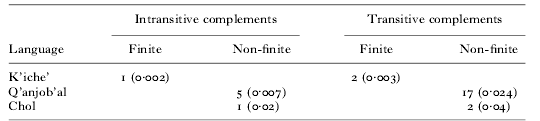
These results demonstrate that progressive constructions in the Chol input occur at approximately twice the Q'anjob'al rate and ten times the K'iche' rate. Thus children acquiring Chol will have many more opportunities to observe progressive constructions than children acquiring K'iche'. Grammatical descriptions for K'iche' and Chol assert that progressive constructions in these languages have both finite and non-finite complement forms. Progressive constructions in Q'anjob'al only have non-finite complement forms. The speech addressed to children in these three languages only uses one complement form in each language. Language input to children acquiring Chol and Q'anjob'al children only contains non-finite complement forms, while speech to K'iche' children only contains finite complement forms. In this respect, children acquiring K'iche' and Chol encounter a poverty of positive evidence for alternate forms of progressive verb complements in their language, even though the rate of progressives in the Chol input is ten times that of the K'iche' input.
A poverty of positive evidence argument based on the K'iche' and Chol data would claim that since evidence for the alternate progressive constructions is missing from the input in these languages, the children must supply the missing constructions from their knowledge of UG. However, Q'anjob'al is problematic for this POPS argument, because the alternate progressive construction is ungrammatical in this language. The absurdity of POPS arguments has an altogether different character from the absurdity of PONS arguments. In the case of POPS arguments, UG may supply knowledge that is ungrammatical in the target language. The comparative method ensures that poverty of a stimulus is not automatically equated with evidence for UG.
CONCLUSION
This article brings the comparative method to bear on the poverty of the stimulus debate. I formulated several reductio ad absurdum arguments against POS arguments using constructions from a sample of Mayan languages. As POS arguments are compared in closely related languages, the language-specific nature of the proposed universal principles and constraints becomes obvious. It is absurd to think that POS arguments lead to valid conclusions about the principles and constraints of Universal Grammar. The absurdity takes a different form for poverty of the positive stimulus and poverty of the negative stimulus arguments. The absurdity of POPS arguments is that rare constructions in some languages may correspond to constructions that are entirely absent in other languages. The absurdity of PONS arguments stems from the widespread variation in constraints in related languages. While POS arguments of both positive and negative types appear irrefutable for a single language, systematic comparison reveals their underlying contradictions. Published arguments from the poverty of the stimulus lack systematic cross-linguistic validation.
POS arguments have provoked a number of criticisms, including the possibility that the input children receive is rich enough to resolve POPS problems without the aid of UG (Pullum & Scholz, Reference Pullum and Scholz2002; MacWhinney, Reference MacWhinney2004) or that children might use indirect negative evidence, i.e. regularities in the input (Hirsh-Pasek, Treiman & Schneiderman, Reference Hirsh-Pasek, Treiman and Schneiderman1984). The reductio arguments I make in this article accept the initial premise of POS arguments, but take the conclusion to the absurd by illustrating how linguistic rules and constraints that form the basis of POS arguments vary between languages. The reductio defeats the logic of POS arguments rather than addressing their empirical shortcomings.
The reductio provokes different responses from proponents and critics of POS arguments. Critics of POS arguments claim that the reductio adds nothing new to the literature, since research has already shown how children can resolve POS arguments through the richness of the input. While critics of POS arguments take such claims as read, proponents respond in two ways. One response claims that the critics' argument against the POS conclusion assumes that children have access to a rich set of linguistic features, which is precisely what proponents of the POS arguments claim (Fodor & Crowther, Reference Fodor and Crowther2002). Another response is to acknowledge that children can use positive evidence to solve some POS problems, and then provide new POS arguments that supposedly do not admit such solutions (Crain & Pietroski, Reference Crain and Pietroski2002). The reductio is immune to such replies, since it places the burden of proof on proponents of POS arguments to demonstrate that their arguments hold for an entire language family.
Proponents of POS arguments object to the reductio by claiming that the Mayan POS arguments are less general than POS arguments for English. This objection assumes, for example, that the principles that account for auxiliary word orders in English are more general than the principles that account for verb particle orders in K'iche'. Absent some criterion of significance, the objection is circular since the evidence that these properties are less general is that they vary across languages. This objection does not defeat the Mayan reductio arguments; it simply ignores them. The challenge to proponents is to advance a POS argument that does not vary across languages or to show how POS arguments can accommodate language variation.Footnote 8
Another objection to the Mayan reductio arguments is to claim that the POS arguments on which they are based can be solved by cues from the input. This objection turns the arguments of the critics of POS arguments against the Mayan reductio arguments in order to preserve POS arguments. The reductio proponent can respond in kind by claiming that additional Mayan POS arguments can be constructed which do not have this defect.Footnote 9 Objections made to the individual reductio arguments do not rule out the reductio in principle, only individual instantiations of the reductio.
The reductio arguments do not prove that children lack innate principles of Universal Grammar. They merely show that POS arguments, by themselves, do not establish that linguistic principles are innate. POS arguments for a single language appear to offer irrefutable evidence for UG. The comparative method provides a stricter means to show that linguistic research has more than local import. Systematic comparison is more exacting than comparison between randomly chosen languages, since comparison between unrelated languages does not control for structural differences. Researchers often fail to note such differences because their focus is on the features that the languages share. The reductio shows that it is precisely the variable features that pose the main challenge to claims for innateness. POS arguments are empty without a serious effort to respond to the cross-linguistic variation observed in the world's languages and dialects.
APPENDIX: LIST OF ABBREVIATIONS
All Mayan examples are shown in the practical orthography developed by the Proyecto Lingüístico Francisco Marroquín (Kaufman, Reference Kaufman1976) with a single exception: I use <’>rather than <7>for the glottal stop. The other orthographic symbols have their standard IPA values except: <tz>=/ts/, <ch>=/tʃ/, <b’>=/ /, <tz’>=/ts'/, <ch'>=/tʃ'/, <x>=/ʃ/, <j>=/x/, <ä>=/ɨ/. For Mam and Q'anjob'al <x>=/ʂ/ and <xh>=/ʃ/. I use the following abbreviations throughout the article:
- 1
first person singular
- 2
second person singular
- 3
third person singular
- 4
first person plural
- A
ergative cross-reference
- ABS
absolutive antipassive
- ANT
antipassive suffix
- APL
applicative suffix
- B
absolutive cross-reference
- CAUSE
causative suffix
- CL
classifier
- COM
completive aspect
- DEP
dependent suffix
- DTV
derived transitive verb
- EMP
emphatic particle
- EPN
epenthetic glide
- EXC
exclamation particle
- FAM
familiar particle
- INCEP
inceptive aspect
- IMP
imperative
- INC
incompletive aspect
- IND
indicative status suffix
- INSTR
instrumental suffix
- IRR
irrealis
- IV
intransitive verb
- CHO
Chol
- K'IC
K'iche'
- Q'AN
Q'anjob'al
- TEK
Tektiteko (B'a'aj)
- TOJ
Tojolabal
- TZE
Tzeltal
- YUK
Yucatec
- NEG
negation particle
- NOM
nominalization suffix
- PASS
passive suffix
- PLOC
locative focus particle
- POS
possessive relational noun
- POT
potential particle
- PREP
preposition
- PROG
progressive verb
- PROSP
prospective aspect
- REP
repetitive suffix
- SUB
subjunctive suffix
- ST
positional verb suffix
- T
tense
- TERM
terminative aspect
- TTV
root terminative verb status suffix
- TV
transitive verb
- V
vowel
- VTD
derived transitive verb status suffix