Traumatic brain injuries (TBIs) are broadly defined as acquired, nondegenerative injuries to the brain following the exertion of a mechanical force. Reference Bhatti, Stevens and Mir1 Although the etiology and natural history of such injuries are constantly under debate and review, Reference Maas2 TBIs are 1 of the most common causes of mortality and morbidity, Reference Maas3 with the World Health Organization (WHO) reporting that TBIs are the third leading cause of death and disability among young adults. Reference Sharma and Lawrence4,5
Survivors of TBIs have to undergo long periods of rehabilitation and live with an incurable and often devastating disability that places a strain on family and friend networks and, therefore, society. Reference Iaccarino, Bhatnagar and Zafonte6 A review by Finkelstein et al. attempted to quantify the total economic burden of TBIs annually for the United States, placing it at $76.3 billion Reference Finkelstein, Corso and Miller7 ($11.3 billion in direct medical costs and $64 billion in indirect costs). This figure is likely to be higher for low- to middle-income countries (LMICs), Reference Celso, Tepas and Langland-Orban8 where there are increased incidence and higher mortality and morbidity from TBIs. Reference Puvanachandra and Hyder9
Detecting TBIs early and providing necessary acute interventions is crucial in limiting long-term disability. Reference Swadron, LeRoux and Smith10 The ability to do this is down to a range of factors, including appropriate radiological imaging equipment, Reference Pozzato, Meares and Kifley11 accessible ambulance services and hospitals, Reference Quaglio, Gallucci and Brand12 and adequate training of clinicians in prehospital care and trauma management. Reference Kolias, Guilfoyle and Helmy13
Pakistan is a low-income country with a population of over 200 million. Traumatic incidents and injuries have been shown to be the 5th leading cause of disability in Pakistan, Reference Bhatti, Stevens and Mir1 with estimates of trauma-related injuries being over 6 million annually, equivalent to 45.9 per 1000 people. Reference Fatmi, Hadden and Razzak14 These figures are some of the highest relative to countries matched for economy such as Egypt and matched for region such as Iran and Afghanistan. 15 Pakistan also has a high prevalence of TBIs, largely as a result of road traffic incidents (RTIs). Reference Raja, Vohra and Ahmed16 Approximately 30% of patients involved in RTIs in Pakistan experienced a traumatic brain injury, with 10% of these being classified as moderate or severe. Reference Shamim, Razzak and Jooma17
Despite the significant burden of TBIs in Pakistan, there exists very few data about the presentation and acute management of TBI patients. There have been recent efforts to characterize the condition in the major cities, namely Karachi, Lahore, and Rawalpindi. Reference Umerani, Abas and Sharif18 However, there currently exists no epidemiological data for the Southern Punjab region of Pakistan. This poses a significant issue due to differences in this region compared with the aforementioned areas that have been previously studied. Southern Punjab is characteristically more rural, with sparse road networks and limited transport and neurosurgical services. Reference Bhatti, Rafique and Azad19
Our study, therefore, seeks to understand the incidence, presentation, and basic epidemiology of TBIs presenting in Southern Punjab by examining the attendances of TBI patients at Nishtar Hospital, 1 of the region’s 2 tertiary care centers. Nishtar Hospital cares for a population of around 32 million people, and until 2015 Nishtar Hospital had the only neurosurgical unit in the area. Reference Sharma and Lawrence4 We hope to delineate the presentation of TBIs at Nishtar Hospital to provide novel data for TBIs in Southern Punjab, as well as identify any areas of service improvement to reduce the acute and long-term burden of this condition.
Materials and Methods
A cross-sectional study design was chosen by the authors to achieve the main aim of this study. The site of the study was Nishtar Hospital, a 1200 bed facility, which includes a 95-bed neurosurgery specialty ward and an 8-bed neuro-intensive care unit. A form (available in the Supplementary Materials) was developed that collected the following pieces of data; age, gender, mode of transport to the hospital, location of the injury, time of injury, time of arrival at the hospital, cause of injury, prehospital care received, multiple injuries, computerized tomography (CT) scan taken, CT findings, Glasgow Coma Scale (GCS) score taken, GCS findings, and team in charge of managing the injury. These measures were chosen as they are thought to have an impact on the prognosis of TBI as determined through a consensus from clinicians at the selected hospital, clinical guidelines, and a review of other similar studies and literature. Reference Puvanachandra and Hyder9,Reference Agrawal, Munivenkatappa and Shukla20–Reference Taylor, Bell and Breiding22 Categories and structure of the survey form were also determined by consensus from clinicians, other similar studies, Reference Puvanachandra and Hyder9,Reference Agrawal, Munivenkatappa and Shukla20–Reference Taylor, Bell and Breiding22 and clinical guidelines, namely Advanced Trauma and Life Support (ATLS) and American College of Surgeons Traumatic Brain Injury Guidelines. 23 The study was reported according to the REporting of studies Conducted using Observational Routinely-collected health Data (RECORD) Statement available in the Supplementary Materials.
All patients presenting to the hospital during the study period, diagnosed as per hospital guidelines with TBI were included in this study. We excluded all patients with a distance of injury > 700 km and time delay > 48 h. Patient recruitment and data collection occurred sequentially over 3 wk (May 1, 2016 to May 22, 2016) at Nishtar Hospital. Patients were flagged for this study following the diagnosis of TBI by doctors in the emergency department and in the neurosurgery department (if they were directly referred there from other hospitals). Cases were also collected from the pediatrics unit in the hospital whose patients used a separate emergency pathway.
The survey form was filled in by the doctor seeing the patient and completed as the patient was assessed and treated in the emergency or neurosurgical departments. The survey form was completed separately and in addition to the patient’s routine medical documentation. Where information for the form was required from patients, this was obtained by doctors translating the form’s questions into Urdu and asking the patient’s accompaniers or, in some cases, where appropriate, asking the patients directly. Patients or patients’ accompaniers were asked about the location of the injury, and Google Maps (Alphabet Inc., Mountain View, CA) was used to determine distances to the hospital from the location of the injury for every patient.
Following the 3-wk collection period, forms were aggregated, and the data were analyzed. Data are expressed as mean (standard deviation [SD], minimum-maximum range) or as frequency, as appropriate. Frequency data were compared with the chi-squared test, and confidence intervals were calculated with the Wilson-Brown method. SPSS (v. 24.0, IBM Corp., Armonk, NY) was used to analyze the data, and Excel (v. 2016, Microsoft Corp., Redmond, WA) and Prism (v.9, GraphPad Software, San Diego, CA) were used to produce tables and graphs.
TBI severity classification was done according to GCS score severity. TBI severity may be classified according to CT scan score as in the Rotterdam and Marshall Scores, Reference Maas, Hukkelhoven and Marshall24,Reference Zhu, Wang and Liu25 by broad pathoanatomic classification, by broad etiology, or by injury progression. Reference Steyerberg, Mushkudiani and Perel26 However, this study was a snapshot study; therefore, we used GCS scores as the primary indicator of severity. Patients with a “mild” injury had a GCS score of between 15/15 and 13/15, those with a “moderate” injury had a score of between 12/15 and 9/15, and those with a “severe” injury had a score between 8/15 and 3/15, as per the scoring system of Teasdale and Jennet. Reference Teasdale and Jennett27
Ethics approval for the study was received from the University of Birmingham, United Kingdom, as the first authors were registered students there at the time of data collection. Localhost institution approval from the Department of Neurosurgery at Nishtar Hospital was also attained. All data were collected in line with local confidentiality procedures of which the study team was aware. There was no interventional nature to the study. The majority of the information collected was routinely collected in the assessment and management of patients presenting with a head injury.
Results
In total, 468 patients presented to the emergency and neurosurgery department with TBI during the 3-wk study period. Seven patients were excluded because of a distance of injury > 700 km, and 11 were excluded because of a time delay > 48 h. Resultantly, there were 450 patients (379 male [84.2%] and 71 female [15.2%]) who were included as part of this study. The mean age was 28.9 y (SD 14.1; range, 1.0-78.0 y), with 80 people (17.8%) experiencing multiple injuries.
Mode of Arrival
Table 1 displays the “Mode of Arrival” of the patients. The 2 most commonly used forms of transport were a car, used by 226 (50.2%) people, and the provincial government-funded emergency ambulance service known as the “1122 ambulance service” (due to the need to dial the numbers “1122” on their mobile or telephone to access the service), used by 150 (44.7%) people. Forms of transport such as charity ambulances and arriving by motorbike or being physically carried (which were included in the “Other mode” category) were used minimally by 23 (5.2%) patients. There was a stark contrast in the “Mode of Arrival” for TBI patients within versus outside Multan. Within Multan, which was defined as a 20-km radius around the hospital, 85.2% (n = 150) of patients used the “1122” ambulance service, whereas, outside Multan, 74.8% (n = 190) of patients used a car to arrive at the hospital.
Mode of arrival at the hospital

* Referred to the comparison within/outside Multan.
a Other mode of transports in the above table include motorcycle, public buses, and being physically carried.
Delays From Time of Injury to Presentation
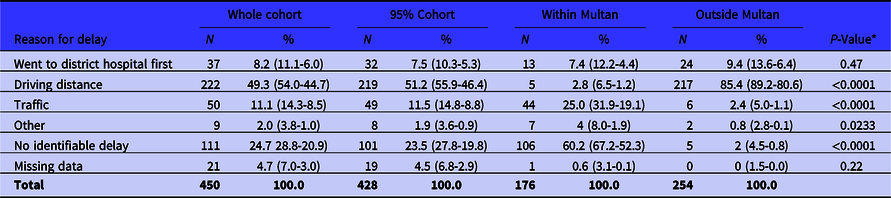
The mean delay from injury to the presentation at Nishtar was 2.9 h (SD 4.10; range 0.15-48 h), with Table 2 showing the major reasons for delay for the cohort as a whole (n = 450). With outliers accounted for at the 95% level (n = 428), the mean delay dropped to 2.4 h. The mean delay to presentation for those within Multan (n = 176) was 0.9 h (SD 0.96; range, 0.15-6 h) with 106 people (60.2%) of this population presenting to the hospital without an “identifiable delay.”
Reason for delay from time of injury to the presentation

* Referred to the comparison within/outside Multan.
Travel Distance
Mean travel distance to the hospital from the location of injury was 81.0 km (SD 92.2; range, 1-700 km) for the cohort as a whole (n = 450), but with outliers accounted for at the 95% level (n = 428), the mean travel distance was 70.8 km. For those within Multan, the mean travel distance was 9.2 km (SD 2.03; range 1-15 km). For those presenting to the hospital who had “travel distance” as the identifiable reason for the delay (n = 222), the mean distance of injury was 133.5 km (SD 96.14; range, 10-700 km). Inside Multan, 148 patients (84%) had a presentation time of less than 1 h.
Causes of Injury, Assessment, and Management
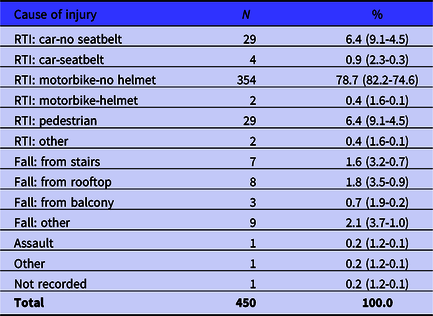
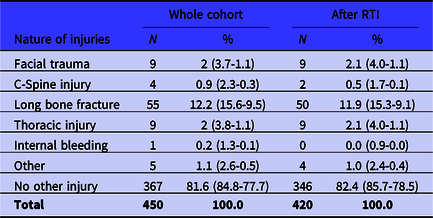
From the whole cohort (n = 450), 420 (93.2%) were involved in an RTI, and of these, 356 patients (79.1%) presented after having a motorcycle accident. Of these, only 2 were wearing a helmet at the time of the accident. The remainder were as a result of falls or assault (Table 3). Seventy-one patients (16.9%) presenting after an RTI had multiple injuries, with 50 (14.5%) having “long bone fractures” (Table 4).
Causes of injury

Nature of multiple injuries

C-Spine immobilization was not observed in any patients upon their arrival at the hospital, and 37 (8.2%) patients presented after confirming they had attended another hospital.
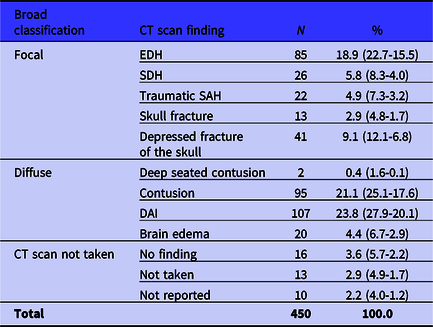
CT scans were conducted in 436 patients (97.1%); Table 5 outlines the major findings. CT scans were broadly defined pathoanatomically as diffuse (involving diffuse axonal injury [DAI], infarction, hypoxic injury, edema, vascular events) or focal (involving subarachnoid hemorrhage [SAH], intracerebral hemorrhage [ICH], epidural hematoma [EDH], axonal tears, skull fractures, nerve avulsions). Table 5 also records the number of patients with CT scans that went unreported (10-2.2%) and the number of patients without CT scans (13-2.9%).
CT scan findings

GCS score on arrival to the hospital was recorded in 413 (91.8%) patients out of 450 patients. A total of 232 (51.6%) of these patients were classified as having a mild injury, 133 (29.6%) as moderate, and 48 (10.7%) as severe. Thirty-seven patients (8.2%) did not have a GCS score recorded on arrival at the hospital. Of the patients without CT scans, 12 (85.7%) were classified as having mild injuries, 1 (7.1%) had a moderate injury, and 1 (7.1%) did not have a CT scan recorded (Table 6). Inside Multan (n = 176), there were 108 (61.4%) patients with mild injuries, 37 (21.0%) with moderate injuries, and 10 (5.7%) with severe injuries. Twenty-one people (11.9%) did not have their GCS taken.
GCS score on arrival to hospital for different cohorts

* Referred to the comparison within/outside Multan.
Discussion
This study aids in highlighting the challenge faced when tackling TBIs in the unstudied region of Southern Punjab. Our results are generally consistent with similar studies from other regions of Pakistan in that we have found younger males involved in RTIs are the main demographic of patients experiencing TBIs. Reference Raja, Vohra and Ahmed16,Reference Umerani, Abas and Sharif18 However, the male to female ratio has been slightly higher in our cohort of TBI patients as compared with other studies (6:1 vs 3:1), Reference Umerani, Abas and Sharif18 perhaps owing to more male users of the road and social concerns about women presenting to hospital in this more rural region of Pakistan. Also, we have found that the vast majority of TBI patients have been injured whilst riding a motorbike and not wearing a helmet (78.7%). We have also identified a significant discrepancy in the delay to the presentation of patients arriving from within versus outside Multan, as previously described. Moreover, although there is debate as to whether GCS scores serve as good predictors of condition severity in the immediate phase of TBI, Reference Gill, Windemuth and Steele28 our analysis showed that there were more “severe” injuries presenting at Nishtar Hospital than in other studies. Reference Raja, Vohra and Ahmed16,Reference Umerani, Abas and Sharif18 There was a noted disparity between severe injuries within versus outside Multan. Of the patients arriving from outside Multan, 48.5% (n = 123) had “severe” and “moderate” injuries based on GCS, whereas only 26.7% (n = 47) of patients arriving from within Multan experienced these. The high number of “severe” injuries generally in this study is perhaps a product of the high number of RTIs and the fact that patients arriving from outside Multan were delayed in receiving medical assistance or instead chose to go to other hospitals in the region that do not have any neurosurgical facilities likely contributes to the higher moderate-severe GCS score severity for patients presenting from outside Multan.
In terms of identifying areas of improvement of TBI care, we noted a more than expected inequality of access to urgent medical care within versus outside Multan, reflected in the significant difference in the mean delay to the presentation (>4 h) at Nishtar Hospital for patients presenting from within Multan versus those presenting from outside of Multan. Indeed the “1122” provincial government-funded emergency ambulance service does not operate beyond Multan metropolitan area; therefore, patients in Southern Punjab are usually deprived of the ambulances’ ability to bypass traffic and ensure more timely transfer to hospital (as well as the immediate prehospital care and recognition of severity the ambulances medically trained personnel can provide). Another factor in the large difference in mean delay is the poor road network in the more rural aspects of Southern Punjab, which sometimes only allow access for motorbikes or powerful off-road cars. Reference Chaudhry, Malik and Imran29 These are both issues that should be investigated and addressed by policy-makers, as even small delays to presentation have been associated with worsened prognoses Reference Zimmerman, Fox and Griffin30 and significant emphasis in the trauma literature regarding the concept of the “Golden Hour,” which indicates that prompt medical and surgical treatment in the initial stages of a traumatic injury can greatly reduce the risk of death. Reference Sasada, Williamson and Gabbott31
Another interesting aspect of our study was that we found no evidence of adequate prehospital care in patients, as defined by ATLS or American College of Surgeons guidelines. Indeed C-Spine immobilization in head injury patients is imperative until any pathological findings can be ruled out on imaging according to American College of Surgeons guidelines, 23 yet we found no evidence of any patient with C-Spine immobilization nor any patient managed in the prehospital setting as per ATLS guidelines. This could be due to the absence of “1122” ambulance service medical records and clerking sheets, but also due to the chaotic presentation at hospitals, where patients are brought, bleeding and injured, to the front door of the hospital instead of the emergency department. There needs to be a more formalized system of presenting at hospital and more focus on managing patients at the time of injury to prevent adverse outcomes in accordance with internationally recognized and evidence-based guidelines such as those produced by ATLS or the American College of Surgeons.
Also, of note is that 86.4% (n = 389) of patients presented after RTIs in cars (7.3%; n = 33) or motorbikes (79.1%; n = 356). Although no official statistics exist, the large proportion of RTI incidents involving motorbikes to some extent reflect that motorbikes are the primary mode of transport in Lahore, whereas this is likely to be less of the case in more affluent cities such as Islamabad or Lahore. This has several impacts on the frequency of TBI as well as GCS score severity. It was also interesting to note that 85.1% (n = 383) of patients presenting after RTIs in cars or motorbikes were not wearing seatbelts or helmets as precautions. Most notably, 354 (78.7%) cases of TBI were caused by an RTI involving a motorbike where no helmet was worn. Although there is a financial penalty for not wearing helmets in Pakistan of around 200 rupees (£0.94; $1.25), this is largely unenforced. General attitudes to helmets are mixed, with many patients forgoing their usage for comfort in the summer months when the temperature regularly climbs to 45°C. Other reasons include poor education about the dangers of not wearing a helmet and economic reasons. A helmet costs upward of 2000 rupees (£9.40, $12.54), almost 10% of the cost of a motorcycle, and this is a cost some do not want to bear. This is an area we encourage policy-makers to investigate, as helmet use reduces the incidence and markedly improves the outcomes of TBIs. Reference Ganti, Bodhit and Daneshvar32
There may have been some weaknesses in this study when collecting data, either in the translation and understanding of the form’s questions or through ticking the wrong boxes. It was not always clear to the patients the time of the injury, and this was often estimated; even when patients’ accompaniers responded, this was often guessed. With regard to prehospital care, there were no formal clerking records to indicate whether patients had received any care. In terms of CT scanning, the findings may have been skewed as a result of junior interpretation. In further studies that are slightly longer, patients should be tracked to ascertain mortality and to understand whether there are adverse outcomes for different cohorts of patients. Moreover, the mortality of those patients presenting from within Multan, those who have access to the “1122” provincial government emergency ambulance service, and those from cities outside Multan should be analyzed. As mentioned earlier, TBI care is known to be “time-sensitive,” and it is imperative for patients to seek immediate medical care. Last, it would be interesting to perform this study in autumn or winter months when the temperature is cooler, and perhaps motorbike users are more likely to be wearing helmets.
Overall, we believe that, although the results of this study can be generalized to some extent to Southern Punjab and other similar regions, we believe it is only the beginning of an evidence base and larger, multicenter studies taking into account the limitations above are needed to fully delineate the burden of TBI and necessary steps for limiting this burden in Southern Punjab and similar regions.
Conclusions
This study demonstrates the challenges faced by emergency services in managing TBIs and further shows the unique pressures faced by a single center treating head injuries for a large geographic area. Our study found that TBIs affect a young cohort (mean age, 28.9 y), predominantly as a result of RTIs (93.2%), with the majority of participants (79.1%) not wearing helmets. We also identified that the majority (56%) of participants traveled to the hospital from outside Multan, and poor ambulance coverage of these areas and poor road networks lead to significant delays in presentation (mean a delay for all patients was 2.4 h with outliers excluded). Overall, it is clear that significant clinician level and wider governmental policy level changes are needed to reduce morbidity and mortality. These include raising awareness of the hazards of not wearing helmets when riding motorbikes, training of all prehospital staff in ATLS protocols, and widening the provincial government-funded emergency ambulance service beyond city limits. Moreover, as poor road networks were the leading cause of delay, local government should strive to improve road quality, which will reduce time to presentation. Whereas mortality data were too difficult to collect due to poor use and implementation of identification tracking systems; it must be an avenue for future research to fully characterize the long-term burden faced in the area as a result of TBIs.
Supplementary material
To view supplementary material for this article, please visit https://doi.org/10.1017/dmp.2021.361
Author Contributions
Authors Usama Rahman and Moaz Hamid have contributed equally to this article and should be considered joint first authors. Conceptualization, Usama Rahman and Moaz Hamid; methodology, Usama Rahman, Azhar Javid and Muhammad Shan Dasti; validation, Usama Rahman and Moaz Hamid; formal analysis, Usama Rahman, Luca Vedovelli and Moaz Hamid; investigation, Usama Rahman; resources, Tahir Nouman, Azhar Javid; data curation, Usama Rahman and Moaz Hamid, writing—original draft preparation, Usama Rahman; writing—review and editing, Moaz Hamid and Luca Vedovelli; visualization, Moaz Hamid and Luca Vedovelli; supervision, Muhammad Shan Dasti, Tahir Nouman and Azhar Javid; project administration, Usama Rahman and Moaz Hamid. All authors have read and agreed to the published version of the manuscript.
Conflict(s) of interest
The authors declare no conflict of interest.
Data availability statement
Data are available from the corresponding author on reasonable request.