Since 2015, when the right-wing Law and Justice party (PiS) came to power in Poland, its actions and rhetoric have reflected fundamentalist Roman Catholic idée fixe, thus obviously threatening women’s rights, LGBTQ+ people, and art. The recent attempt to tighten the already restrictive law on abortion in October 2020 sparked the largest antigovernment demonstrations since those that preceded the fall of communism in 1989. A few months earlier, in August 2020, street protests and new forms of activism rose up against the repressions of the Polish LGBTQ+ community. Amid these crises, art might seem even more vulnerable, as artists can hardly count on demonstrations and anger to defend their freedoms. But forget anger, celebrate reenactment.
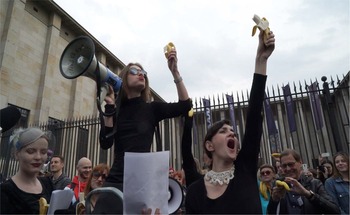
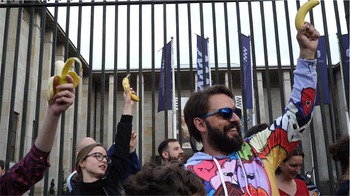
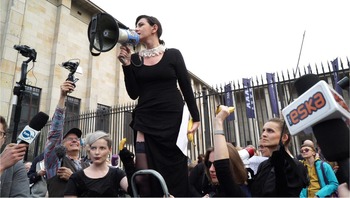
Eating Bananas Outside the National Museum in Warsaw, 29 April 2019: “Every Bite for the Artist.” From left: Edka Jarząb, Magda Staroszczyk (at podium), Joanna Drozda. (Photo by Magda Mosiewicz)

Jedzenie Bananów przed Muzeum Narodowym (Eating Bananas Outside the National Museum), which took place in Warsaw on 29 April 2019, was a grassroots protest, which I co-organized, against an act of censorship resulting directly from the conservative, antifeminist, homophobic politics of the Polish government and its lackeys. Shortly after three feminist works were removed from display by the Museum’s new director on the grounds of indecency, several thousand protesters gathered to perform a mass reenactment of one of the censored works: Sztuka konsumpcyjna (Consumer Art, 1972) by Natalia LL.Footnote 1
The banana protest evoked not only the present context of Polish right-wing politics, the culture war that has been declared on art, and the more general problem of underrepresentation of women’s art in museums, but also the variety of historical memories involving eating bananas in political, cultural, sexual, or pop art circumstances. It opened a process of “unlimited semiosis,” in other words, “a continuous shifting from meaning to meaning” (Eco Reference Eco1990:4). Umberto Eco elaborated on this concept in his Theory of Semiotics: “From a sign which is taken as a type, it is possible to penetrate, from the center to the farthest periphery, the whole universe of cultural units, each of which can in turn become the center and create infinite peripheries” (Reference Eco1976:122). In this semiotic orgy a banana with or without phallic connotations always stands proudly against censorship.
The Funny Fruit
Bananas are hilarious. They have a funny name, they are crooked, phallic, and far too yellow to be taken seriously. Easy to peel, uncomplicated to store, they excel at generating new contexts and taking on meanings, though almost invariably humorous ones, as when Banksy places bananas instead of guns in the hands of gangsters out of Pulp Fiction (Pulp Fiction, 2002), adding yet another layer of irony to Tarantino’s vision of masculinity. Or when they serve as biting political satire, as in Mado Klümper’s poster depicting four stages of the ripening of a sadly dangling bunch: green…yellow…overripe…Donald Trump. In this work, titled Completely Bananas (2016), the punchline is yet another bananas joke, as if the visual one was not sufficient: “going bananas” (see Rogger et al. Reference Rogger, Voegeli and Widmer2018:8).
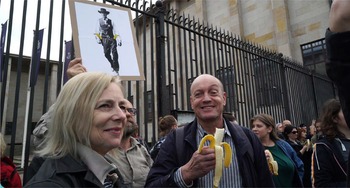
Eating Bananas Outside the National Museum in Warsaw, 29 April 2019: “We have for some time been going through a difficult patch and we very much need social solidarity.” (Photo by Magda Mosiewicz)

In a sense, the banana has for years functioned as an instrument for disarming, if not the patriarchy, then at least the male ego, for ridiculing the male propensity for violence and phallic pride. There is thus a particular subversive potential in the four-minute Andy Warhol film Mario Banana (1964), where the wonderful drag queen Mario Montez, reclining, peels, fondles, and passionately eats the phallic fruit. The combination of the studied camp form, the pornographic aura of queer subversion, and yet the celebration of masculinity is thanks to the banana — the funny fruit.
On the cover of I’m Your Man (1988), the man of the title, Leonard Cohen, is depicted in dark glasses and a dark suit, standing and eating a banana. “At the times we think we’re the coolest, what everyone else sees is a guy with his mouth full of banana” — that was Cohen’s self-ironic comment on the photo (Nadel Reference Nadel1996:390). It would, however, be wrong to forget that this remark only works in a world where a banana is a humble, banal fruit available at every corner shop for less than a dollar a pound. In the past, on the other side of the Iron Curtain, however, the banana was still a symbol of luxury, as extraordinary as the idea of calling into question men’s gravity and privilege.
The status of the banana in Poland has changed radically with the economic and political transformation of the past 30 years. Since 1989, politics and the banana have grown significantly more democratic; the economy has joined the global system and provided a steady stream of desirable consumer goods. The banana has lost its exceptional, luxury status, even coming under suspicion for its carbon footprint and exploitation of plantation workers. And so a change in the perception and interpretation of its visual or performative uses has been inevitable, especially when inspired by the contemporaneous political context. The Eating Bananas street performance and the artworks removed from the National Museum exhibition, which gave rise to the protest, bridge the past and the present.
Before the Eating Bananas Outside the National Museum action could be organized; before feminist performers could gather and police forces and media descend on the scene; before thousands of people, yellow fruit in hand, could congregate — there was visual artist Natalia LL’s Consumer Art, taking us back to 1972. And even four years before Natalia LL’s censored work, a young boy performed his own banana street performance on nearly the same spot as the 2019 event — also in protest against censorship and oppression.
Protoperformance
The topography is surprisingly simple, with all the significant points lying along the single axis of Aleje Jerozolimskie (Jerusalem Avenue), Warsaw’s main drag with its Poniatowski Bridge leading to the other side of the Wisła (Vistula) river, the side until recently known for high levels of crime, troublemaking, drunkenness, and small-scale peddling of illegal merchandise. It was here, by the first bus stop after the bridge, that in 1968 there was a street stall where an exorbitant sum could get you a banana. Crossing back over the bridge, you find the National Museum on your left, followed closely by the monumental Party House, the former Communist party headquarters and then, after 1989, the stock market. It is also here where a roundabout, since 2002, has been home to a big fake palm tree — but we will return to the palm tree later.
In March 1968 Warsaw convulsed with protests against the censoring of the National Theatre performance of Dziady (Forefathers’ Eve) by Adam Mickiewicz, a 19th-century masterpiece of Romantic drama that stands at the pinnacle of the Polish literary cannon. The authorities saw sedition in the performance and shut down the play, giving rise to loud protests from writers, intellectuals, and the wider public and provoking student demonstrations, suppressed with exceptional brutality amid numerous arrests and a campaign of lies in the press and on TV. The party made use of these events in its own fractional struggles, which sparked off an anti-Semitic propaganda campaign against the so-called banana youth — a moniker designed to portray the protesters as the spoiled offspring of wealthy, presumably Jewish, dignitaries, directors, and bureaucrats — all those who were to be removed from the party. In this way, the protests could be depicted as adventurism by the privileged few who complained about the -government, even as they could afford to stuff themselves with the pricey banana, the unreachable object of desire for the popular masses.
It was one such boy, aged 17 at the time, who saw plainclothes police viciously beat up students outside the university and heard the TV’s tirades against the nefarious “Zionists” and “banana youths” and decided to show himself as a “banana youth” in quite the literal sense: he took the tram to the Poniatowski Bridge where he spent all his savings on a single banana. From the stall to the Party House was a less than two-kilometer walk:
He walks all the way; his banner — the banana.
He bites off one end. An aroma quite unlike anything he’s ever known wafts in the air. A scent from the world of the gods. Of nectar and ambrosia. A barely detectable sharpness wrapped up in delicacy.
He nods to the passersby. A few stare, others smile, as if understanding. He hopes the banana is visible from the trams. Another kilometer to go. Half the banana left. He starts to salivate. What was to be a performance has become a test of character. He is telling himself: one more bite now — and Communism will prevail.
As he reaches the Party House, it is but scraps that hang from his hand. Only someone familiar with bananas could know what it was. There remains one last gesture, to throw the skin over his shoulder. (Zaremba Bielawski Reference Zaremba Bielawski and Kalinowski2018:94–95)
The author of the performance, Maciej Zaremba Bielawski, who describes it in a recently published autobiography, emigrated from Poland just a few months later, together with his brothers and his mother. His mother was Jewish, though he did not know that at the time.Footnote 2 It is not their story that is the subject here, however, but the banana as the instrument of protest against idiocy, brutality, defamation, and censorship. For it was the censorship of the National Theatre repertory that started it all, and it was most likely outside the National Museum that the boy swallowed the last bite of his banana.
The Beckettian Banana
The peculiar status of the banana as a symbol of privilege and luxury, or a treat from the capitalist West, is attested not just by the political slur of “banana youths,” or the slightly later “Bananowy song” (Banana Song), a pop song painting a paradisiacal vision of a holiday on the warm seas, but most of all by the sensual memory of the aroma and flavor that would linger in memory for many years. “An aroma quite unlike anything he’s ever known wafts in the air. A scent from the world of the gods,” writes Zaremba Bielawski. That is exactly how the spectators remembered Samuel Beckett’s Krapp’s Last Tape at Warsaw’s Studio Theatre in 1985, where the author’s stage instructions were followed to the letter:
Krapp […] unlocks second drawer, peers into it, feels about inside it, takes out a large banana, peers at it, locks drawer, puts keys back in his pocket. He turns, advances to edge of stage, halts, strokes banana, peels it, drops skin at his feet, puts end of banana in his mouth and remains motionless, staring vacuously before him. Finally he bites off the end […], finishes banana, returns to table, […] takes out a second large banana […] (Reference Beckett1958:4)
Krapp was played by Tadeusz Łomnicki, one of the outstanding actors of his time, but his mastery was, according to the reviewers, no match for the impact made on the audience by the banana. As the small space filled with the aroma of the tropical fruit, a collective sigh would emanate from the audience: “each spectator wished for that banana and Łomnicki knew how to use that.” Were the stage directions not so precise, one might think that the drawn-out silent scene was his version of refined torture. The audience would “react to the banana scene with agitation,” “wondering who paid the actor for the devoured banana”; “the shock escalated when Łomnicki threw a half-eaten banana to the floor! The audience held their breath,” we learn from reviews and memoirs of audience members. “As for me, I was back then particularly bothered by the fate of that half of a banana that Krapp tossed angrily to the side of the stage,” one spectator would write, no doubt giving voice to the general feeling. To this day, all those who saw it remember the banana scene.Footnote 3
Beckett and the banana: this combination might almost suffice to define the mental condition of the Polish society in the run-up to 1989. An existential gloom and hopelessness married to an illusion of a better world elsewhere and an unfulfilled need for consumption. Wild differentials in levels of cultural capital and community of basic wants. Refined art and simple dreams. Intellectualism and cravings.
It is this paradoxical meeting of Beckett and the banana that seems to explain what happened in the wake of 1989: social acceptance of the costs and painful consequences of the economic transformation, including sharp social stratification in the name of the free market. Capitalism was expected to dispel the existential gloom and satiate the need for consumption; we did not realize that it actually aims not to fulfill needs but to generate them ad infinitum and that consumption itself does not so much dispel gloom as it reduces all hope. The desire for the banana was an integrating force, but once some had satiated it and others had not, there could no longer be any community, and class superiority gained a new form of expression. The economic distinction deepened the cultural one. The acceptance of the social costs of the economic transformation — inevitable when introducing neoliberal capitalism — thus led to a rapid buildup of social divisions and the inevitable cultural conflict.
The conflict is of course rooted in the economics — in the division into beneficiaries and victims of the systemic transformation — but today it plays out primarily in terms of culture. Since the collapse of the community of “Beckett and the banana,” the objects of desire for both spiritual and baser cravings have changed. Beckett has ceased to define the horizon of cultural aspiration and the banana has lost its consumption value, replaced by new, different desires. Meanwhile, political discourse has since 1989 developed a renewed interest in equality, suspended for the duration of the economic and political transformation. Artists and activists are again visibly and vocally debunking universal claims of high art and mindless consumerism but in social critique and a need for genuine cultural change.
Movements for the emancipation of women and nonheteronormative persons articulate this need most loudly and clearly, while generating the strongest resistance, especially as their demands extend not just to specific issues of civic rights and representation but to changes of language, customs, and narrative modes. They are thus in need of allies everywhere — and in the past too.
Natalia LL and the Phallic Object
Polish feminist art is another important and extensive issue that is not the subject of this article and yet cannot be overlooked in the context of the works that have been subject to censorship. In April 2019, the newly appointed director of the National Museum ordered the removal of three works from the Gallery of 20th and 21st Century Art. First to go was the film documentation of the Grupa Sędzia Główny performance Part XL. Tele Game, which officially took place on public TV in 2005. In it, the performers would do live what viewers calling in asked of them. The viewers, the bulk of them men, mostly asked the performers to undress. The performance thus played on the male fantasies of power on the one hand, and on objectification of the female body of the other.Footnote 4
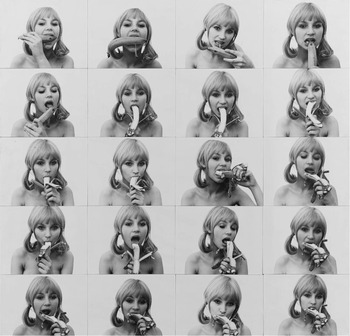
Natalia LL, Consumer Art, 1972, black-and-white photography. (Photo courtesy of Natalia LL Archive / ZW Foundation in Toruń)

Next, Katarzyna Kozyra’s 2005 video Pojawienie się Lou Salome (The Appearance of Lou Salome) was removed: the female performer led two actors dressed up as dogs in Friedrich Nietzsche and Rainer Maria Rilke masks on a leash around Vienna’s Schwarzenberg Palace.Footnote 5
The third piece removed from the Gallery — one of the best-known examples both of Polish contemporary art and of global feminist art — was the cycle of photographs and a video titled Sztuka konsumpcyjna (Consumer Art) by Natalia LL dated 1972–1975. It shows a young woman sensually and shamelessly licking, fondling, and eating phallic-shaped objects such as bananas and frankfurters, as well as eating ice cream that melts and flows out of her mouth. In the photos and film frames, it is only the model’s head that can be seen, except for some that also feature her nude shoulders and, more rarely, her breasts.Footnote 6
Consumer Art was born of Natalia LL’s idea to record the most mundane things, such as talking, sitting, eating, sleeping. This was her first quasi-feminist gesture: to revalue the quotidian, to pay attention to and discover new dimensions of the mundane. In the banal action of eating, she discovered the erotic dimension, tying eroticism to consumption and consumption to provocation. At first glance, it may all seem like a fulfillment of male fantasy. Soon, however, it becomes clear that the woman eating the banana is celebrating nothing but her own pleasure: this is the second feminist aspect of the work. In this expression of female sexuality, female pleasure has no need for a man, or rather reduces him to a symbolic prop, an object of consumption. The woman is no longer a passive object; she takes on an active role, devouring the symbol of male domination. That is generally the third characteristic of feminist art.
In Consumer Art the woman subverts completely the stereotypical order of things, turning a quotidian activity into (erotic and visual) art, subordinating eroticism to her own pleasure, finding satisfaction in the objectification of symbolic manhood. The traditionally male triad — art, sex, and power — becomes the domain of female action. All the while, she stares shamelessly into the camera:
When the model stares at the implied spectator, her gaze infringes on the safe space that a male spectator, following the usual convention, expects to find between himself and the woman in the image. The woman does not belong to a different world, but uses her gaze to encroach on the world the man is conditioned to consider his own. (Jakubowska Reference Jakubowska1997:123)
Art historians — aside from Agata Jakubowska, whose interpretation focuses on the active role of the woman and the reduction of the man to a tasty banana “penis” — have attempted to skip over the sexual and gender impact of Natalia LL’s piece and focus instead on the issue of consumption. First, Consumer Art could be viewed as a critique of political economy of socialism, unable to provide the people with basic consumer goods such as bananas or frankfurters. Second, it could be seen as a critique of consumer culture, though at the time, the message would resonate more strongly in the West than in Poland where consumption (and especially the excess of it) remained in the sphere of aspirations more than reality. Third, eroticism itself could be tied to consumption, turning Consumer Art into a critique of the commodification of the erotic in mass culture (see Piotrowski Reference Piotrowski2005:377–78).
Piotr Piotrowski, while tracing all these possible interpretative strategies, wanted to focus on the political, specifically Polish context of Consumer Art from a feminist perspective. The Communist regime in the 1970s attempted to hide its antiwomen policies behind window dressing and propaganda. The problem, however, went deeper, Piotrowski says:
It is the basic problem of the Polish culture’s negative attitude to women, the attitude shaped by the Catholic tradition, worldview, and institutions, which in the Communist period, and in the 1970s in particular, were by no means marginal in social and political life. (2005:378)
Nearly 50 years later, the influence of the same culture and of the same Church loom even larger, reflected not just in the choices (and prejudices) of at least half of the society but also in the institutional antifeminism and homophobia in legislation, distribution of financial means, and all of politics.
Bearing in mind the attempts to censor women’s art already in the 1990s (see Leszkowicz Reference Leszkowicz2005) and the political turmoil over women’s and gay rights that has been unfolding in Poland for the past three decades, the recent interpretations of Consumer Art would most likely follow in the steps of the “queer feminist continuum” proposed by Paweł Leszkowicz in his essay on queer feminist iconography in contemporary Polish art. According to Leszkowicz the feminist and LGBTQ+ alliance has been essential for the liberalizing of Poland, as both movements emerged simultaneously in the 1990s and formed an emancipatory partnership to challenge heteronormative patriarchy fueled by political ambitions of the Catholic Church.
The harmonious collaboration of feminist and queer politics still remains topical, essential, and unbroken into the twenty-first century; the two are united in a common struggle for equal rights and participation. Although together they have had a bigger social, political, and academic impact, as well as increased visibility […] they are still not strong enough to change and overcome two crucial legal obstacles in Poland: the antiabortion law and the lack of legalized civil partnership or gay marriage. Both movements remain on the subversive side of mainstream culture and politics. (Leszkowicz Reference Leszkowicz, Jones and Silver2015:197–98)
As long as civil rights and artistic freedoms are at stake, feminist and queer agendas will overlap and the concept of queer feminist continuum will be synonymous with social solidarity — a solidarity quite different from the movement that led to the fall of communism in 1989. The Solidarność movement at that time was inspired by dreams of independence from the Soviets, political freedoms, and capitalism. And as such it was supported by the Catholic Church. More than 30 years later neither feminists nor LGBTQ+ communities can expect this support as their primary demands beside personal freedoms concern equality, intersectional justice, and separation of church from state.
Politics of Enmity
What the three pieces removed from the National Museum have in common is a clear antipatriarchal message: Sędzia Główny exposes the male power to ridicule; Katarzyna Kozyra, as a dominatrix, subordinates men; and Natalia LL instrumentalizes and devours masculinity. At present, however, none of the pieces seems particularly radical either in message or aesthetics. Their message resonates with classic feminism; it is clearly part of the mainstream discourse and broad cultural critique. The patriarchal authorities — both in government and in the museum — may not like what these pieces have to say, but their removal from the National Museum exhibition serves as a shameless demonstration of the authorities’ own anxieties and prejudice, as well as an example of the culture war fought from the position of a conservative backlash.
In 2015 and 2019, general elections in Poland were won by the populist right-wing Law and Justice (PiS) party, closely linked to the Catholic Church and committed to a program of social welfare spending that has to date ensured consistent support for its government. It is one of the government’s top priorities to subordinate Poland’s social and cultural life to fundamentalist Christian and nationalist values. According to this mandate, art is supposed to play a major role by bolstering patriotic sentiment and a sense of belonging to a wonderful nation with a wonderful history, while at the same time providing a bulwark against the pernicious influence of the secular West and European Union.
These ends are served by an alliance with the church and a cultural policy understood as reinforcing the traditional Polish and Catholic social and individual identity, supporting Polish heritage, and shaping historical narratives in the patriotic, heroic, and martyrological spirit. This historical-identitarian paradigm is propagated through state-owned and thus government-controlled media and by public institutions that are financed and overseen by the Ministry for Culture and National Heritage. It is an identity imposed on organizations that depend on the authorities for funding and promoted by official grants competitions. At the same time, the policy targets any artistic and cultural activity that seems to the supporters of the nationalist-Catholic project to “undermine Polish culture” by, for example, staging theatrical productions that “attack the Church, the family, denigrate national values, openly promote homosexuality and various sexual deviations, promote gender ideology […]” (Stankiewicz-Podhorecka Reference Stankiewicz-Podhorecka2015:64).
“Gender ideology,” an absurd but typical and thriving propaganda construct deployed by the government and the church against women protesting patriarchal cultural patterns and male authority or demanding reproductive rights (the right to abortion is in Poland radically limited while access to contraception difficult). A clear analogy is found in the “LGBT ideology” within large numbers of localities around Poland that have since 2019 declared themselves to be “LGBT free zones.”Footnote 7 In these actions by the authorities, it is not hard to recognize mechanisms used by the colonial authorities, including instrumentalization of the law, exclusion, and the politics of enmity (see Mbembe Reference Mbembe2016).
In this way, the Law and Justice government fans the flames of social anxiety, cultivates ignorance, manipulates affect, and constructs an enemy while exploiting such effective instruments of cultural and historical-identity politics as political pressure, economic censorship, financial rewards, and personnel appointments at public institutions (museums, theatres). Examples of this are not hard to find, suffice it to mention the destruction of two of the country’s leading (at Kraków and Wrocław) theatres whose performances contributed in a significant way to public debate; the censorship of the permanent exhibition of the World War II Museum in Gdańsk; the refusal to recognize the results of an official open competition for the position of director of the POLIN Museum of the History of Polish Jews in Warsaw; and, most relevant in this context, the appointment of Jerzy Miziołek as the head of the National Museum in Warsaw in November 2018.
The new director soon made a name for himself as controversial, but it was only his decision to phase out the Gallery of 20th and 21st Century Art, which had opened in 2013, that won him wider notoriety. Without so much as waiting for the gallery’s replacement with a new exhibition of Polish painting, he ordered the removal of the aforementioned pieces, while stating: “This is the National Museum and certain themes from the sphere of gender should not be on explicit display” (in Urzykowski Reference Urzykowski2019).
The ludicrous nature of this explanation is made even more absurd by the fact that the National Museum of Warsaw, like any other, holds few works, other than landscapes and abstractions (for still lifes not infrequently contain that element), in which “certain themes from the sphere of gender” are not “on explicit display.”
Organizing the Protest
On Saturday morning, 27 April 2019, news portals announced the removal from the National Museum exhibition of the pieces of Grupa Sędzia Główny, Katarzyna Kozyra, and the best known of them all, Consumer Art by Natalia LL. According to the daily Gazeta Wyborcza, the director had been pressured into this by the ministry of culture. Director Miziołek, on the other hand, told the media that his decision was motivated by complaints and emails from the public. He made available a letter from the mother of a fourth grader who had visited the museum at the end of February 2019 on a school trip. Entitled “A Child’s Traumatic Visit to the National Museum,” the concerned mother’s letter said:
The children entered the exhibition room to see a massive Lego duck and at the same time to be exposed to the sight of naked women in a film. My son, telling me in tears of this unpleasant experience, gave at the same time the worst possible review that an institution of culture could receive from a visitor: “I never want to go back there again, I never want to see stuff like that.” That is not, I don’t think, what we want, for our children to be discouraged from communing with art… And yet I fear that it will be some time before I persuade my son to visit another museum ever again. The National Museum should perform an educational role for anyone and for the youngest generation in particular in order for them to grow up in the conviction that art is an important component of our culture. In my child, however, the visit to the National Museum left nothing but a sour aftertaste. (in Urzykowski Reference Urzykowski2019)
The letter was addressed both to the museum and to the ministry of culture. “I was called to the ministry to discuss the case,” said Miziołek, before contradicting himself when the ministry issued a stern denial, stating that the director was in charge of the institution’s policy with the ministry in a merely supervisory role. This oversight role allows the ministry to demand explanations on issues relating to the museum’s work and it was such an explanation that the minister had requested (Cichoński Reference Cichoński2019).
Director Miziołek, admonished by the minister, denounced his earlier statement as having been published without his approval and claimed that all his decisions had been made “personally, after consulting experts in 20th and 21st century art.” He also denied any attempts at censorship, citing instead a “changed concept” of the exhibition (TVP.INFO 2019).
Immediately after news of the censorship was made public, social media bristled with criticism and mockery. Natalia LL’s piece became the focus of the discussion and overshadowed the other two works as it was the best known and most accessible. It provided an obvious instrument for protest against the censorship; my first thought on hearing the morning news was: I need to go there and ostentatiously eat a banana.
Starting a Facebook event takes two, maybe three minutes, when you include finding an appropriate picture. When I fed in “Natalia LL,” the search engine produced thousands of returns. I set the time of the event, Eating Bananas Outside the National Museum, for 6:00 p.m. on Monday, 29 April, which was in two days, and I posted it on my profile, inviting a group of friends I knew would be likely to join. I shut down my computer. When I switched it back on a few hours later, thousands had expressed interest and hundreds declared participation. A spontaneous gesture of protest, designed to at best attract some friends from an academic and artistic bubble, had turned into a social phenomenon. By Monday afternoon there were 31,000 declarations of interest and 7,000 of participation. The media in Poland and news portals added to their coverage of the goings-on at the museum the information about the upcoming protest.
Meanwhile, already on Saturday, various people — members of the public, artists, celebrities, opposition politicians — started to publish on Twitter and Facebook films and photos of themselves eating bananas, of their children or even their pets eating bananas. The creative potential of the banana overtook all expectations; social media teemed with not only memes but also microperformances, animated films, satirical drawings, installations, and various other visual forms featuring the banana. At least a few hundred were posted directly to the page of the event. The posts came with hashtags such as #banany (bananas), #nataliall, #bezcenzury (nocensorship), and #wolnybanan (freebanana).
Meanwhile, at the National Museum, as the art historian Jan Przypkowski wrote on Facebook, “an extraordinary installation in praise of censorship [could be seen]: blank screens, accompanied (in two cases) by still visible but now useless labels. By Natalia LL, the label has been simply covered with a piece of paper…” (Przypkowski Reference Przypkowski2019).
By Sunday I was quite aware that if the museum really were to be visited by a crowd of thousands, then a spontaneous choreography and a few shouted slogans would not be enough. The event needed some, however modest, dramaturgy. I turned for help to Magda Mosiewicz, filmmaker, activist, and former leader of Poland’s Green Party; and Marta Jalowska, Magda Staroszczyk, and Dorota Glac of the feminist artist-activist collectives Czarne Szmaty and Teraz Poliz˙. We were also joined by Joanna Drozda, an actor and activist, and Edka Jarząb, a sound artist and performer.
Meanwhile, a few hours before the planned protest and amid the growing wave of criticism and media attention, Director Miziołek released a statement that “in view of the situation,” he would reinstate the pieces by Katarzyna Kozyra and Natalia LL until the “rearrangement” of the whole exhibition started a week later. In other words, while ostensibly backing out of censorship, he upheld the decision to completely rearrange the entire contemporary art exhibition, and in the end the pieces at the center of the storm would be permanently removed from display: two of the three works were put back, only to be removed with the whole exhibition a week later.
The situation had changed enough that a protest against censorship was in question. For that reason, we decided to slightly adjust its formula while confirming it would go on as planned:
SEE YOU WITH THE BANANAS AS PLANNED AND WE’RE CELEBRATING!
We still intend to celebrate artistic freedom and women’s art at 6 pm. Anyone who values these is invited.
We are celebrating a victory and we are celebrating women artists! We are protesting against censorship and demanding appropriate space for women’s art at the National Museum!
The dynamic, unfolding events turned the protest from a performative meeting of friends into a street demonstration with elements of a happening into a feminist action to raise awareness of women’s art and their visibility in public institutions. Demanding space for women in museums and historical narratives was a natural consequence of the professional and social activity of the protest’s organizers. Each of the women who took part in organizing Eating Bananas is engaged in her own artistic, scholarly, educational, organizational, and activist work for women’s rights, visibility and audibility, and for the benefit of nonheteronormative and nonbinary people — and more broadly for the subversion and destruction of the hegemonic, hierarchical, patriarchal narrative in politics, culture, and scholarship. It is impossible to describe all these activities here: Edka Jarząb’s voice workshops for women and feminist performances; Magda Mosiewicz’s film on a transgender politician; Joanna Drozda’s homophile theatre entertainments that promote bodypositive attitudes; my research project HyPaTia: A Women’s History of Polish Theatre;Footnote 8 and various activities of the art collective Grupa Artystyczna Teraz Poliz˙,Footnote 9 made up of Marta Jalowska and Dorota Glac and six other women.
Marta Jalowska, in addition to her work on Teraz Poliż, and Magda Staroszczyk, the curator and researcher, are members of the collective Czarne Szmaty (Black Rags) — an artistic and activist group aiming to take over and queer public space for the benefit of women and the LGBTQ+ community. Czarne Szmaty is closest in spirit to the banana protest. In formulating a clearly feminist message, Czarne Szmaty transcends the simple language of resistance through their actions and use of subversive, surprising, and multifaceted performative strategies.
The most publicized of their actions took place at the Equality Parade of 2018 at the de Gaulle Roundabout, where the fake date palm by Joanna Rajkowska has stood since 2002 at the end of the route once traveled by the boy with the banana. The palm references the name of the street running through the roundabout, Jerusalem Avenue, and thus the 18th-century Jewish village of traders and artisans known as New Jerusalem, which gave the street its name. The palm was placed there as part of the Pozdrowienia z Alej Jerozolimskich project (Greetings from Jerusalem Avenue, 2002) and is today a symbol of remembrance of Warsaw’s Jewish population, which made up a third of the total prior to WWII. An overwhelming majority died in the ghetto and concentration camps of the Nazi occupiers. The palm can be seen in an even broader context, as a celebration of the things missing from Poland’s public space: otherness and multiculturalism — diversity of race, sexual orientation, identity, tradition, and worldview. In the hegemonic culture and homogeneous society, what cannot be seen finds manifestation in a palm right at the center of the capital city.
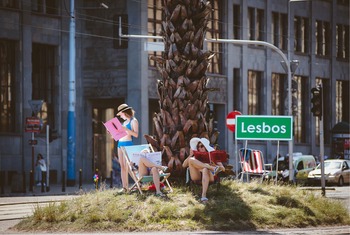
From left: Magda Staroszczyk, Karolina Maciejaszek, Marta Jalowska in Greetings from Lesbos. Czarne Szmaty artist-activist collective #czsz. Warsaw, 9 June 2018. (Photo by Pat Mic)

Attracted by the symbolic capital of the place and its central, exposed location, Czarne Szmaty placed deck chairs around the palm in the middle of the roundabout and put up a sign stating “Lesbos.” With road and foot traffic all around them, the performers spent several hours lying on the deck chairs in swimsuits, reading Sapho, Elizabeth Bishop, and Adrienne Rich.
A semiotic hypertrophy took over Jerusalem Avenue, as if prewar Jews, Polish lesbians, and Syrian refugees on Lesbos were suddenly joined in an associative chain. The outsiders, the unwanted, the irritating others manifested their right to exist. The island of grass with the palm in the middle of the roundabout turned suddenly into a latter-day utopia. The day it took place — the day of the Equality Parade with its demands for civil partnerships, acceptance, and equality — endowed the event with the characteristics of a manifesto. Czarne Szmaty’s laid-back, cheerful performance managed, against all appearances, to seamlessly switch their critique between several different targeted issues, both irreparable wrongdoings and those that could still be averted.
The variety of activities undertaken by the women engaged in Eating Bananas Outside the National Museum, which they did as part of their own individual practices, runs vertically through historical time in the context of inequality and discrimination. These actions brought out from the past works and figures long forgotten and marginalized; they served as interventions into current affairs; and imagined utopias and made demands for the future. At the same time, our mutual connections allowed us, to an extent, to map the feminist academic-artistic-activist scene in Warsaw, not because among us we exhausted all of the work being done by women, by any means, or even exemplify it, but because taken together our actions map a horizontal and synchronic network of institutions and communities that attempt to resist and refute patriarchy. In this sense, the action outside the National Museum, while spontaneous, was neither accidental nor deprived of context.
On the other hand, Eating Bananas Outside the National Museum, a cheerful and pleasant political action involving its participants in an act of collective consumption, subverted Claire Bishop’s dictum that “activation of the audience in participatory art is positioned against its mythic counterpart, passive spectatorial consumption” (Reference Bishop2012:275). If participatory art becomes all about passionate, irrepressible consumption, then its political messaging is suddenly and alarmingly ambiguous. But at least the active character of participation becomes unquestionable. Of course the question raised then is: to what extent does the collective space of social engagement, by its very creation in this way, corrupt the participants with the pleasure and cheerfulness of consumption? The situation is rendered yet more complex by the entanglement of consumption in historical contexts.
Every Bite for the Artist
At noon on Monday I called the relevant bureau at the municipal office to make sure that the gathering did not require formal notification to either municipal or police authorities. A polite lady informed me that this was not necessary since our gathering was spontaneous in character and that the city’s Crisis Management Centre was already well aware of it thanks to media reports. She also mentioned that I might, if I wished, call the police. I did, but could not get through.
Eating Bananas Outside the National Museum in Warsaw, 29 April 2019: “Long live the banana revolution!” (Photo by Magda Mosiewicz)

By 6:00 p.m. several police and TV vehicles parked on the promenade outside the museum, which threatened to restrict our access to the space and make the action much harder to carry out. Happily, the reporters agreed to move their cars after negotiations with the organizers. The police cars also moved out of view with more or less 10 units remaining; all of them, however, kept their distance. Their commander told us they would intervene in case banana skins were thrown into the Museum courtyard, as some earlier reports suggested, or in case of any other disruptive acts. We had, however, thought through the issue of the banana skins and had a plan for them.
Long before the agreed-upon time, people started gathering outside the museum. Most came with friends or were quick to meet them onsite. The prevailing atmosphere was one of a social occasion, almost a picnic. Everybody was carrying bananas, the few who didn’t would get them from others, who had brought whole bunches. A group of people popped up with a basket of bananas to hand out, others had handmade banners, including “Directors, not censors to run museums”; or props such as a giant papier mâché banana with “For the minister” written on it.
Outside the gate, against the background of the museum, an aluminum ladder was placed and black-clad performers with bananas and megaphones climbed up to give a signal to launch the demonstration. Our message was clear: We have met not to celebrate the return of two pieces to the exhibition, especially since that was not to last, but to protest censorship of art and to demand a gallery — even a whole wing in the National Museum — dedicated to women’s art. We gathered a list of artists who should be included and we will read it, but first, “Long live the banana revolution!”
One performer after another scaled the ladder and, with the slogan “Bananas in the air” and then “One bite for every artist,” read out the names of the women in Polish art: Natalia LL, Ewa Partum, Katarzyna Kozyra, Zofia Kulik, Katarzyna Kobro, Zuzanna Janin, Barbara Falender, Dorota Nieznalska, Ewa Kuryluk, Krystyna Piotrowska, Anna Baumgart, Alicja Z ˙ ebrowska, Joanna Rajkowska, and many others. After celebrating the artists, there followed a list of demands, each emphasized with a chomp on a banana: censorship-free art, sex education, free choice, secular state. In between, the crowd would chant: “We want education, not indoctrination,” “free art,” “bring color to the National Museum,” “down with censorship.”
Eating Bananas Outside the National Museum in Warsaw, 29 April 2019: “We cannot allow censorship of women, of their works, of their art. Because it will not end with women, it will end with all freethinking people — but it starts with women. It always starts with the female body.” From left: Edka Jarząb, Joanna Drozda (at podium), Marta Jalowska. (Photo by Magda Mosiewicz)

The logic of events turned Eating Bananas Outside the National Museum from a single-issue event into a general protest, obviously targeting the current right-wing government’s policies towards art, women, and minorities, as articulated from the aluminum ladder by Marta Jalowska: “We cannot allow censorship of women, of their works, of their art. Because it will not end with women, it will end with all freethinking people — but it starts with women. It always starts with the female body.”
Then it was the turn of two museum employees to scale the ladder and thank everyone for their presence, for caring about artistic freedom and autonomy of the institutions of culture, and to ask for solidarity. “We have for some time been going through a difficult patch and we very much need social solidarity,” one said. “Solidarity’s our weapon,” answered a chant from the crowd.
Meanwhile biodegradable rubbish bags started making the rounds among the crowd, filling quickly with banana skins. “Let us remember the planet and send all the waste to compost,” was the message at the end of the protest. Photos of the composting skins were posted to Facebook later that evening, which helped preserve a positive image of the organizers of the protest. There were many who were critical of the banana protest, and not just on the right but also from engaged people who raised the issues of exploitation of plantation workers, the environment, carbon footprint, and consumption as such. In the end, the banana protest as a mocking, critical, subversive, and light-hearted action, allowing for easy and spectacular yet safe participation for all those present, took on greater complexity and disturbing ambiguity.
Culture theorist and environmental activist Kornelia Sobczak would go on to formulate a critical view that we had wasted an opportunity to reevaluate Natalia LL’s work and to endow it with new meaning:
This may have been the opportunity to review the work after nearly 50 years and to say, for example, “yes, consumption is obscene.” Yet not in an erotic sense, but an ethical one: the banana is not an innocent fruit not because of its phallic shape but because we can get it thanks to slave labor and exploitation. What is Consumer Art today? (Sobczak Reference Sobczak2020)
If the banana is to remain the emblem of opposition to censorship, perhaps the ecological and exploitative aspects of its production should also be brought to light, no matter that it casts a shadow on the banana’s image.
On Disappearing
The Eating Bananas Outside the National Museum action in Warsaw was widely reported by global media, both newspapers and TV stations (The Independent, The Washington Post, CNN, BBC, Euronews, and others), as well as by Gazeta Wyborcza, Poland’s liberal and (currently) antigovernment newspaper of record. The paper even sent a reporter to the protest who conducted a number of interviews, resulting in a film posted to the newspaper’s website — featuring four men and not a single woman (Urzykowski Reference Urzykowski2019). The protest’s feminist message was effectively sidelined by mansplaining.
In December 2019, the news spread around the world that the Italian artist Maurizio CattelanFootnote 10 put on sale at an art fair in Miami a work called Comedian, made up of a banana attached to the wall with silver adhesive tape. What is more, three buyers paid US$120,000 each for the limited-edition pieces, which came with a certificate of authenticity and replacement instructions. If that were not sensational enough, Cattelan’s piece was destroyed when another artist, David Datuna, took the banana off the wall and consumed it before the gathered public as his own performance, Hungry Artist. The eaten banana was replaced and the -gallery director denied the piece of art had been destroyed, as the banana functioned in it as an idea. The Hungry Artist performance found its way onto the internet and Cattelan’s piece to the collectors.
This extreme example of the obscenity of consumption is not about the eating of a banana but about a whole series of events involving immaterial consumption — the most extreme example of the capitalist economy: generating imagined prestige, corrupting critical gestures in the service of the commodification of scandal, and distributing these goods as the emperor’s new clothes. Exposure of ersatz prestige, corrupted critical acts, and fake scandals could be a response to the appeal to rethink Consumer Art by Natalia LL and to reinterpret its critical message. It is very likely, however, that once we start to reinterpret Consumer Art in the context of a capitalist economy and obscene consumption, the woman’s body, her material corporality, will disappear again, and with it her capacity for demanding rights. Women’s demands have always been secondary to “the big problems” of the world; the banana protest managed to reverse this order, putting at the center women’s art, bodies, and presence.