Latinos under the age of 18 represent one-third of the growing Latino population in the United States and have been found to be at elevated risk for depression when compared to adolescents of other ethnic groups (Centers for Disease Control and Prevention, 2014). Depression in adolescence is related to depression in adulthood, poorer physical health, and higher incidence of risk taking (Zeiders, Umaña-Taylor, & Derlan, Reference Zeiders, Umaña-Taylor and Derlan2013). Culturally based stressors, such as minority, acculturative, and discriminatory stress, have been linked to negative mental health outcomes among Latino youth. However, cultural protective factors, such as youth's connections to their ethnic–racial group, may serve as buffers against depression. Based on recommendations for investigating cultural processes and psychopathology development (Causadias, Reference Causadias2013), this study focuses on how ethnic–racial identity development may curtail depressive symptoms among Latino adolescents.
Latino Mental Health in the United States
Depression affects both US-born and immigrant Latinos of all age groups at higher rates than members of any other ethnic–racial group (Alegría et al., Reference Alegría, Canino, Shrout, Woo, Duan, Vila and Meng2008; Chavez-Korell et al., Reference Chavez-Korell, Delgado Rendón, Beer, Rodriguez, Garr, Pine and Malcolm2012; Lorenzo-Blanco & Cortina, Reference Lorenzo-Blanco and Cortina2013; Paz, Reinhard, Kuebbeler, Contreras, & Sánchez, Reference Paz, Reinhard, Kuebbeler, Contreras and Sánchez2015; Stein, Gonzalez, & Huq, Reference Stein, Gonzalez and Huq2012; Torres & Ong, Reference Torres and Ong2010). Poor family functioning and acculturative stress have been identified as principal factors leading to depression among low-income Latinos, particularly for women (Sarmiento & Cardemil, Reference Sarmiento and Cardemil2009). High levels of poverty, stressful migration experiences, and discrimination have also been found to contribute to depressive symptoms among recent Latino immigrants (Ornelas & Perreira, Reference Ornelas and Perreira2011). These newcomers, however, display lower incidence of depression than US-born Latinos or immigrants with longer US residence (Alegría et al., Reference Alegría, Mulvaney-Day, Torres, Polo, Cao and Canino2007; Cook, Alegría, Lin, & Guo, Reference Cook, Alegría, Lin and Guo2009). Research with Latino immigrants has often used the term “immigrant paradox” to refer to these and similar findings that recently arrived immigrants outperform US-born citizens of Latino immigrant heritage on outcomes such as physical, mental, and behavioral health (Alegría et al., Reference Alegría, Mulvaney-Day, Torres, Polo, Cao and Canino2007, Reference Alegría, Canino, Shrout, Woo, Duan, Vila and Meng2008; American Psychological Association, 2012; Portes & Rumbaut, Reference Portes and Rumbaut2006). This latter group's discrimination experiences and their awareness of the lower societal standing of their ethnic group are some of the reasons for the higher levels of depression in this population (Flippen & Parrado, Reference Flippen and Parrado2015; Leong, Kalibatseva, & Park, Reference Leong, Kalibatseva and Park2013).
The aforementioned findings for adult Latinos are mirrored among Latino youth, with those born in the United States reporting higher rates of depression than either those born abroad or youth of other ethnic–racial groups (e.g., Centers for Disease Control and Prevention, 2014; Potochnick & Perreira, Reference Potochnick and Perreira2010). Previous longitudinal studies examining rates of depression among adolescents have found that females and youth of color experience increases in their rates of depression as they age (Adkins, Wang, Dupre, Van den Oord, & Elder, Reference Adkins, Wang, Dupre, Van den Oord and Elder2009). However, few studies with Latinos specifically have examined the trajectories of depressive symptomatology across adolescence. Results from one study revealed that Latino boys tended to exhibit stable rates of depressive symptoms, whereas Latino girls experienced decreasing rates of depression across middle to late adolescence (Zeiders et al., Reference Zeiders, Umaña-Taylor and Derlan2013). Another finding revealed that Latino youth are at elevated risk for depression as they age, with this risk being higher for girls (Lorenzo-Blanco, Unger, Ritt-Olson, Soto, & Baezconde-Garbanati, Reference Lorenzo-Blanco, Unger, Ritt-Olson, Soto and Baezconde-Garbanati2011).
The higher rates of depression in this population have been attributed to exposure to cultural stressors such as acculturation and ethnic discrimination (e.g., Berkel et al., Reference Berkel, Knight, Zeiders, Tein, Roosa, Gonzales and Saenz2010; García Coll et al., Reference Garcia Coll, Crnic, Lamberty, Wasik, Jenkins, Garcia and McAdoo1996; Lorenzo-Blanco et al., Reference Lorenzo-Blanco, Unger, Ritt-Olson, Soto and Baezconde-Garbanati2011; Umaña-Taylor & Updegraff, Reference Umaña-Taylor and Updegraff2007; Zeiders et al., Reference Zeiders, Umaña-Taylor and Derlan2013). These stressors are common occurrences in the lives of minority youth and have been theorized to negatively affect these adolescents’ psychological development, leading to depression, impaired self-esteem, and lower academic outcomes (Berkel et al., Reference Berkel, Knight, Zeiders, Tein, Roosa, Gonzales and Saenz2010; García Coll et al., Reference Garcia Coll, Crnic, Lamberty, Wasik, Jenkins, Garcia and McAdoo1996; Schwartz et al., Reference Schwartz, Unger, Baezconde-Garbanati, Zamboanga, Lorenzo-Blanco, Des Rosiers and Szapocznik2015; Smokowski & Bacallao, Reference Smokowski and Bacallao2007). However, cultural resources such as their ethnic–racial identity, strong family connections, and nurturing cultural values and practices have been shown to serve to enhance and protect the mental health of Latino youth (Neblett, Rivas-Drake, & Umaña-Taylor, Reference Neblett, Rivas-Drake and Umaña-Taylor2012; Torres, Yznaga, & Moore, Reference Torres, Yznaga and Moore2011). These cultural resources strengthen adolescents’ connection to their ethnic–racial background and immigrant heritage, which has been found to improve their self-esteem and help them develop coping strategies to deal with acculturative stress and experiences of discrimination (Rivas-Drake, Seaton, et al., Reference Rivas-Drake, Seaton, Markstrom, Quintana, Syed, Lee and Yip2014; Umaña-Taylor & Updegraff, Reference Umaña-Taylor and Updegraff2007).
Theoretical Framework
To guide the aims of this study, we draw on recommendations from the field of cultural developmental psychopathology and its suggestion to assess individual- and social-level cultural processes, as well as incorporating a developmental perspective, to investigate the initiation, maintenance, and derailment of psychopathology (Causadias, Reference Causadias2013). We focus on ethnic–racial identity, which is a multidimensional construct conceptualized as the process by which individuals gains knowledge about their ethnic group with the goal of developing a sense of clarity about the meaning of that group membership, how they view their own group, how others perceive their group, as well as how central their ethnicity is to their sense of self (Phinney, Reference Phinney1989; Umaña-Taylor, Reference Umaña-Taylor, Schwartz, Luyckx, Vignoles and J2011; Umaña-Taylor et al., Reference Umaña-Taylor, Quintana, Lee, Cross, Rivas-Drake, Schwartz and Seaton2014). Ethnic–racial identity therefore can be considered both an individual-level and a social-level cultural process as one develops a sense of self regarding one's ethnic group membership based on their connections to a social group. To incorporate a cultural developmental perspective, it is important to examine ethnic–racial identity over time during adolescence due to youths’ increasing cognitive abilities and sensitivity to social environmental cues; these abilities and sensitivities make ethnic–racial identity development a more salient and qualitatively different process in adolescence than in the earlier childhood years. At the same time, adolescence is also a period of greater vulnerability to mental health problems, and examining ethnic–racial identity and depressive symptoms over time during adolescence may help us understand the potential of such cultural protective factors to impede psychopathology development in Latino youth.
Further, to establish the association between ethnic–racial identity and depressive symptoms, we draw on the Phenomenological Variant of Ecological Systems Theory (PVEST; Spencer, Reference Spencer, Damon and Lerner2006). According to PVEST, it is not enough to know the ethnicity (or race) of an individual to determine his or her vulnerability for negative outcomes, because members of all ethnic/racial groups have characteristics and experiences that place them at risk as well as those that protect them from such risk. Moreover, a risk factor at one point in time (or development) may become a protective factor at another (Spencer, Reference Spencer, Damon and Lerner2006). Thus, all youth have a level of vulnerability that is derived from the balancing of risk and protective factors across development. In addition, in PVEST, identity takes a central role in youths’ experiences, as a lens through which people make meaning of and respond to (e.g., cope with) their social ecologies. Thus, the subjective significance and meaning of ethnicity is an aspect of adolescents’ experiences as ethnic group members that should be considered alongside the group membership itself. The prevalent set of culturally based stressors (e.g., social ecologies) that are associated with mental health problems among Latino youth places ethnic–racial identity as a relevant protective factor to study.
Ethnic–Racial Identity and Depression
Ethnic–racial identity is a normative developmental phenomenon for ethnic minority youth in the United States. Two primary conceptualizations have emerged in the literature; both have been used and suggest that ethnic–racial identity and its development are multidimensional. According to the first of these, the process perspective, ethnic–racial identity encompasses youth exploring their feelings regarding the meaning of their ethnicity and race as well as forming an attachment to their ethnic–racial group (Phinney, Reference Phinney1989; Umaña-Taylor et al., Reference Umaña-Taylor, Quintana, Lee, Cross, Rivas-Drake, Schwartz and Seaton2014). This developmental progression occurs as youth mature and acquire more complex cognitive abilities, allowing them to engage critically with their feelings related to belonging to their ethnic–racial group (Torres et al., Reference Torres, Yznaga and Moore2011). The second, the content perspective, explores the varied beliefs and attitudes youth have regarding their ethnic–racial group and their relationship to other groups (Sellers, Smith, Shelton, Rowley, & Chavous, Reference Sellers, Smith, Shelton, Rowley and Chavous1998; Umaña-Taylor et al., Reference Umaña-Taylor, Quintana, Lee, Cross, Rivas-Drake, Schwartz and Seaton2014). Ethnic–racial identity content (e.g., regard) has been identified as promoting positive youth development through greater feelings of psychological well-being (including lower depression symptoms), and also protecting them from the damaging effects of discrimination (Neblett et al., Reference Neblett, Rivas-Drake and Umaña-Taylor2012; Rivas-Drake, Seaton, et al., Reference Rivas-Drake, Seaton, Markstrom, Quintana, Syed, Lee and Yip2014, Rivas-Drake, Syed, et al., Reference Rivas-Drake, Syed, Umaña-Taylor, Markstrom, French, Schwartz and Lee2014). Yet there is a dearth of studies examining the potential relation of ethnic–racial identity content to longitudinal trajectories of depression.
Although ethnic–racial identity is often associated with positive psychosocial functioning among ethnic minority youth, evidence for psychological benefits has been largely derived from indicators other than depression. For instance, there is converging empirical evidence to suggest that different facets of ethnic–racial identity are associated with positive self-esteem (e.g., Rivas-Drake, Syed, et al., Reference Rivas-Drake, Syed, Umaña-Taylor, Markstrom, French, Schwartz and Lee2014; Smith & Silva, Reference Smith and Silva2011), and self-esteem is often considered a key mechanism through which ethnic–racial identity instills promotive and protective benefits in other domains, such as school and coping outcomes (e.g., Romero, Edwards, Fryberg, & Orduña, Reference Romero, Edwards, Fryberg and Orduña2014; Schwartz, Zamboanga, & Jarvis, Reference Schwartz, Zamboanga and Jarvis2007; Scott, Wallander, & Cameron, Reference Scott, Wallander and Cameron2015; Umaña-Taylor, Updegraff, & Gonzales-Backen, Reference Umaña-Taylor, Updegraff and Gonzales-Backen2011).
However, critical reviews and meta-analyses of adolescent ethnic–racial identity studies have noted the mixed findings with respect to the role of ethnic–racial identity in depression (Rivas-Drake, Syed, et al., Reference Rivas-Drake, Syed, Umaña-Taylor, Markstrom, French, Schwartz and Lee2014; Scott et al., Reference Scott, Wallander and Cameron2015; Smith & Silva, Reference Smith and Silva2011). Some studies have demonstrated negative associations between ethnic–racial identity and depressive symptoms (e.g., Lim, Gowey, Silverstein, Dumont-Driscoll, & Janicke, Reference Lim, Gowey, Silverstein, Dumont-Driscoll and Janicke2016; Piña-Watson, Das, Molleda, & Camacho, Reference Piña-Watson, Das, Molleda and Camacho2017; Tummala-Narra, Reference Tummala-Narra2015), whereas others do not find such benefits (e.g., Fisher, Reynolds, Hsu, Barnes, & Tyler, Reference Fisher, Reynolds, Hsu, Barnes and Tyler2014; Granberg, Simons, Gibbons, & Melby, Reference Granberg, Simons, Gibbons and Melby2008; Tummala-Narra, Li, Liu, & Wang, Reference Tummala-Narra, Li, Liu and Wang2014; Tynes, Umaña-Taylor, Rose, Lin, & Anderson, Reference Tynes, Umaña-Taylor, Rose, Lin and Anderson2012; Umaña-Taylor et al., Reference Umaña-Taylor, Updegraff and Gonzales-Backen2011). Therefore, there is a need to better understand the nature of the link between ethnic–racial identity and depressive symptomatology in adolescence, given the salience of identity development as well as the prevalence of depression during this period of life. Further, assessing the centrality and regard dimensions of ethnic–racial identity, which are increasingly studied aspects of identity content, may provide new insights as to which properties of ethnic–racial identity are most pertinent for depression in youth (Neblett et al., Reference Neblett, Rivas-Drake and Umaña-Taylor2012).
Relative to other aspects of ethnic–racial identity, few studies of centrality and regard have been conducted with Latino adolescent samples. Taking a broader view of the literature, however, a few trends are evident. In particular, the findings for centrality are more equivocal than those for private and public regard. For instance, among the few studies of centrality with Latino youth, French and Chavez (Reference French and Chavez2010) found that higher ethnic centrality was associated with less depressive symptomatology among Latino college students, whereas Rivas-Drake (Reference Rivas-Drake2011) did not. By contrast, numerous studies have found a negative association between private regard (and constructs reflecting affect toward one's ethnic group) and depressive symptoms, as reported in two meta-analyses (Rivas-Drake, Syed, et al., Reference Rivas-Drake, Syed, Umaña-Taylor, Markstrom, French, Schwartz and Lee2014; Smith & Silva, Reference Smith and Silva2011). Among the few longitudinal studies of ethnic–racial identity and depression, Gonzales-Backen, Bámaca-Colbert, and Allen (Reference Gonzales-Backen, Bámaca-Colbert and Allen2016) found that both increases in and higher initial levels of positive ethnic affect (i.e., ethnic affirmation) were associated with declines in depressive symptoms over time among Mexican-origin girls. In a study with a pooled ethnic sample that included Mexican American adolescents, ethnic centrality was not associated with anxiety or happiness; however, more positive private regard was linked to greater happiness in the face of daily stress (Kiang, Yip, Gonzales-Backen, Witkow, & Fuligni, Reference Kiang, Yip, Gonzales-Backen, Witkow and Fuligni2006). The authors concluded that the valence youth ascribe to their ethnic group members (i.e., their private regard) might be more pertinent than centrality to the psychological well-being of ethnic minority youth. Finally, positive public regard has been associated with fewer depressive symptoms among Chinese American early adolescents (Rivas-Drake, Hughes & Way, Reference Rivas-Drake, Hughes and Way2008) and among college students of diverse Latino heritages (French & Chavez, Reference French and Chavez2010; Rivas-Drake, Reference Rivas-Drake2011, Reference Rivas-Drake2012); it has also been linked with fewer somatic symptoms among Dominican early adolescents (Rivas-Drake, Hughes, & Way, Reference Rivas-Drake, Hughes and Way2009). Conversely, more negative public regard has been associated with more depressive symptoms among Latino college students (Brittian et al., Reference Brittian, Kim, Armenta, Lee, Umaña-Taylor, Schwartz and Hudson2015).
Our review of extant studies revealed a dearth of longitudinal research examining Latino adolescent ethnic–racial identity and depression (e.g., Gonzales-Backen et al., Reference Gonzales-Backen, Bámaca-Colbert and Allen2016, study of Mexican-origin girls). Notable exceptions have found, for instance, that differences in parents’ and adolescents’ ethnic–racial identity (using a composite measure reflecting multiple dimensions) predicted adolescent depression symptoms over a 2-year period, but only indirectly through adolescents’ reports of family functioning (Cano et al., Reference Cano, Schwartz, Castillo, Unger, Huang, Zamboanga and Lizzi2016; Schwartz et al., Reference Schwartz, Unger, Baezconde-Garbanati, Zamboanga, Lorenzo-Blanco, Des Rosiers and Szapocznik2015). The vast majority of studies, however, have assessed the relationships between aspects of ethnic–racial identity and depression using cross-sectional data; scholars in this area have noted the need for longitudinal examinations (Scott et al., Reference Scott, Wallander and Cameron2015; Smith & Silva, Reference Smith and Silva2011). Thus, assessing ethnic–racial identity content and depression within a longitudinal framework, as we do in the present study, has the potential to illuminate how the importance and meaning of one's ethnicity may be linked to mental health across time for Latino adolescents.
Present Study
Guided by a cultural developmental psychopathology perspective (Causadias, Reference Causadias2013) and by the phenomenological variant of ecological systems theory (Spencer, Reference Spencer, Damon and Lerner2006), the goal of the current study with Latino adolescents was to better understand the normative developmental nature of ethnic–racial identity and depression and how these two phenomena develop in relation to each other. We examine the role of three aspects of ethnic–identity content increasingly studied among adolescents (centrality, private regard, and public regard) in order to better understand how the significance and meaning of ethnicity matters for the psychosocial functioning of these youth. We expected both the levels of depressive symptomatology and the three dimensions of ethnic–racial identity to increase as youth aged through adolescence (Hypothesis 1 and 2, respectively). Moreover, taking a longitudinal approach allowed us to better understand the nature of the associations among different facets of ethnic–racial identity content and depressive symptoms over time across middle adolescence, when elevated levels in various aspects of ethnic–racial identity (e.g., French, Seidman, Allen, & Aber, Reference French, Seidman, Allen and Aber2006; Umaña-Taylor, Gonzales-Backen, & Guimond, Reference Umaña-Taylor, Gonzales-Backen and Guimond2009) and in depressive symptoms (e.g., Lorenzo-Blanco et al., Reference Lorenzo-Blanco, Unger, Ritt-Olson, Soto and Baezconde-Garbanati2011; Stein et al., Reference Stein, Gonzalez and Huq2012) have been observed among Latino youth.
Further, we sought to better understand the developmental associations of ethnicity and depressive symptoms beyond the risk presumed in youths’ mere ethnic group membership; we expected ethnic–racial identity to be a phenomenological lens that would inform psychological adjustment. Ethnic–racial identity is often experienced as a positive influence in the lives of youth of color, including Latinos, and is thus considered a protective factor for positive adjustment; similarly, it is theorized to be negatively associated with negative adjustment outcomes (cf. Neblett et al., Reference Neblett, Rivas-Drake and Umaña-Taylor2012; Rivas-Drake & Stein, Reference Rivas-Drake and Stein2017). Spencer (Reference Spencer, Damon and Lerner2006) also explicitly acknowledges the potential of ethnic–racial identity to promote adaptive adjustment. Accordingly, we expected ethnic–racial identity to serve as a cultural protective factor that is linked to diminished depressive symptomatology (and, potentially, to declining levels of such symptomatology over time) among Latino adolescents, who are otherwise at risk for exhibiting depressive symptoms (Hypothesis 3). We reasoned that viewing one's ethnic–racial group as an important and defining aspect of one's self (i.e., greater centrality) implies a stronger sense of connection to other Latinos and thereby serves as a cultural protective factor. Furthermore, we expected that youths’ own positive affect toward and about their ethnic group (i.e., more positive private regard) and their perception that others view their group more favorably (i.e., more positive public regard) would also be associated with fewer depressive symptoms.
We focused on Latino adolescents due to the prevalence of depression in this particular population. Our focus on ethnic–racial identity content (e.g., centrality, public regard, and private regard) helps shed additional light on aspects of ethnic–racial identity that are being increasingly studied among adolescents of other ethnic/racial groups but that have been understudied with respect to Latinos. Ethnic–racial identity content is thought to be salient with regard to how Latino youth may navigate various kinds of stressors (e.g., Armenta & Hunt, Reference Armenta and Hunt2009; Rivas-Drake, Reference Rivas-Drake2012; Rivas-Drake et al., Reference Rivas-Drake, Hughes and Way2009), though this aspect of identity has primarily been examined in the context of psychological adjustment problems (e.g., depression and internalizing) among Black American youth (e.g., Carter, Seaton, & Rivas-Drake, Reference Carter, Seaton and Rivas-Drake2017; Sellers, Copeland-Linder, Martin, & Lewis, Reference Sellers, Copeland-Linder, Martin and Lewis2006). Moreover, few studies exist that assess ethnic–racial identity and depression longitudinally with any population. In examining these associations, we accounted for the possibility that youth who are immigrants or children of immigrants would experience better psychological adjustment (i.e., fewer symptoms and declining symptomatology over time), based on previous findings in this regard (e.g., Potochnick & Perreira, Reference Potochnick and Perreira2010). Previous research has also shown gender to be a potentially important factor in the prevalence of depression among Latino adolescents (e.g., Huq, Stein, & Gonzalez, Reference Huq, Stein and Gonzalez2017); thus, in our analyses, we accounted for the role of gender on initial levels of and change over time in depressive symptoms.
Method
Participants
For the current study, data were drawn from a longitudinal study that examined family processes of Latino families in southeast Michigan. Adolescents (N = 148, 53.4% girls) were either 13 (n = 68) or 14 years old (n = 80) at the start of the study. All adolescents self-identified as Latino or Hispanic and a majority were born in the United States (78.3%) to caregiver respondents who were born outside the United States (91.3%; 81% Mexican). The sample is considered to be of lower socioeconomic status, as the overwhelming majority of adolescents received free or reduced-price lunch (84.9%) and the median household income was between $20,000 and $29,999, as reported by a primary caregiver.
Procedure
Following recommended practices for recruiting ethnic minority participants, which are often considered hard-to-reach populations that require culturally sensitive approaches, a community-responsive outreach was employed to recruit participants into the study (see Rivas-Drake, Camacho, & Guillaume, Reference Rivas-Drake, Camacho and Guillaume2016). For example, a bilingual, community-based liaison with extensive experience and familiarity with Latino communities in southeast Michigan was an integral part of the bilingual and bicultural research staff. Flyers in both Spanish and English were posted in community centers, recreational areas, shopping districts, youth centers, and churches across southeast Michigan, inviting families to participate. Eligibility was determined by a brief prescreening protocol to ensure that the adolescents were 13 or 14 years old and enrolled in either eighth or ninth grade (68 screened families were deemed ineligible). Furthermore, both the adolescent and the primary caregiver had to self-identify as Latino or Hispanic. Families deemed eligible were scheduled for an appointment to complete the consent process and the initial study survey. One hundred fifty parents were consented, and consent and assent were obtained for 148 adolescents. Throughout the course of the study, the community liaison also fielded participants’ requests for community resources and information (e.g., where to find tutoring for their children), delivered presentations on various topics in churches and other community-based settings, and vetted accessibility and content of the Spanish versions of the family-relevant community resources, college information, and immigration and deportation resource guides developed by the university research team as part of the community-responsive approach to retention of study families (Rivas-Drake et al., Reference Rivas-Drake, Camacho and Guillaume2016).
Once participants were recruited, informed consent was obtained from caregivers for the participation of their child and informed assent was obtained from adolescents. Self-report surveys were administered to adolescents at a location of the caregivers’ choosing. All adolescents filled out surveys in English, which took approximately 45 min to complete, and for which they received a $20 gift card. Surveys were de-identified and participants were assigned a unique identifier. Adolescents were contacted annually for the next 2 years to complete the same surveys as in Wave 1. Incentives for participation in Waves 2 and 3 were $25 and $30 gift cards, respectively. Retention of participants from Wave 1 to Wave 2 was 94.59% and from Wave 2 to Wave 3 was 85.00%. A majority of participants completed assessments at all three waves (n = 119, 80.41%), followed by participants who completed two assessments (n = 20, 13.51%), and participants who completed one assessment (n = 9, 6.08%). No new participants were recruited after the first wave of data collection. Immigrant and US-born caregivers and adolescents did not differ in their likelihood of completing one, two, or three waves of the study, χ2 (2) = 0.08, p = .96; χ2 (2) = 0.98, p = .61, respectively. In addition, girls and boys did not differ in their likelihood of completing one, two, or three waves of the study, χ2 (2) = 0.71, p = .70.
Measures
Data for the current study include adolescents’ reports of ethnic–racial centrality, private regard, public regard, as well as depressive symptoms, their own immigration status, and gender. In addition, the primary caregiver reported his or her own immigration status.
Ethnic–racial identity
The Multidimensional Inventory of Black Identity—Teen (Scottham, Sellers, & Nguyên, Reference Scottham, Sellers and Nguyên2008) was used to measure adolescents’ ethnic–racial identity content. This measure suggests that identity is a multidimensional construct, and accordingly it assesses several dimensions of ethnic–racial identity. For the current study, three dimensions were assessed: centrality, private regard, and public regard. Centrality measures the extent to which an individual's ethnicity or race is considered to be an important aspect in the conceptualization of one's self. Private regard measures the degree to which an individual feels positively about his or her ethnic–racial group. Public regard measures the extent to which an individual perceives that others view his or her ethnic–racial group positively. The Multidimensional Inventory of Black Identity—Teen was originally developed to only measure Black adolescent racial identity. However, these dimensions of racial identity have since been theorized to exist across all ethnic–racial minority groups (Umaña-Taylor et al., Reference Umaña-Taylor, Quintana, Lee, Cross, Rivas-Drake, Schwartz and Seaton2014), and the measures have produced good reliability among Latino youth and adult samples (e.g., Cavanaugh, Stein, Supple, Gonzalez, & Kiang, Reference Cavanaugh, Stein, Supple, Gonzalez and Kiang2017; Rivas-Drake, Reference Rivas-Drake2011; Stein, Rivas-Drake, & Camacho, Reference Stein, Rivas-Drake and Camacho2017).
Wording of the items was changed so as to be applicable to any ethnic–racial group. Each of the three subscales asked adolescents to indicate how much they disagreed or agreed with each of three items on 5-point Likert-like scales (1 = strongly disagree, 5 = strongly agree). An item from the centrality subscale read, “If I were to describe myself to someone, one of the first things that I would tell them is my ethnicity.” An item from the private regard subscale read, “I am happy that I am my ethnicity.” An item from the public regard subscale read, “People think that people of my ethnicity are as good as people from other ethnicities.” Items from each subscale were averaged to create mean scores of centrality, private regard, and public regard, with higher scores indicating higher levels of each dimension of ethnic–racial identity. Alpha reliabilities for each of the subscales were adequate across the three waves (centrality αW1 = 0.73, αW2 = 0.80, αW3 = 0.79; private regard αW1 = 0.79, αW2 = 0.89, αW3 = 0.81; public regard αW1 = 0.78, αW2 = 0.82, αW3 = 0.86).
Depression
To measure depressive symptoms of the adolescents, the Center for Epidemiological Studies Depression Scale (Eaton, Smith, Ybarra, Muntaner, & Tien, Reference Eaton, Smith, Ybarra, Muntaner, Tien and Maruish2004) was used. This measure has been used as an assessment of depressive symptoms experienced in nonclinical and clinical populations, and its validity has been confirmed repeatedly across various age groups and ethnic–racial groups (Eaton et al., Reference Eaton, Smith, Ybarra, Muntaner, Tien and Maruish2004). Adolescents were asked to indicate the frequency of various depressive symptoms experienced in the recent past. Responses were measured on a 5-point Likert-like scale (1 = not at all or less than 1 day, 2 = 1 or 2 days, 3 = 3 to 4 days, 4 = 5 to 7 days, 5 = nearly every day for 2 weeks). The scale is composed of 20 items and an item from the scale reads, “Nothing made me happy.” Items from the scale were averaged to create a mean score of depression, with higher scores indicating higher levels of depressive symptoms experienced in the recent past. The alpha reliabilities for this scale were strong across the waves (αW1 = 0.94, αW2 = 0.95, αW3 = 0.94).
Gender
Adolescents indicated their gender from three options: girl, boy, or other (and were asked to specify what other gender label they preferred). No adolescents in the study sample chose the third option. Gender was dummy-coded, such that girl was coded as 0, boy was coded as 1.
Parent and adolescent immigration
The adolescent and their primary caregiver were both asked to report their place of birth. Responses for both variables were dummy-coded, such that if the caregiver's or adolescent's place of birth was the United States, they were coded as a 0. If the caregiver's or adolescent's place of birth was any country other than the United States, they were coded as a 1.
Analysis strategy
To better understand the nature of the three dimensions of ethnic–racial identity and depression in the sample, descriptive statistics and bivariate correlations were estimated. Next, to assess longitudinal change in these constructs, unconditional latent change models were estimated. Then, to examine the developmental relations between dimensions of ethnic–racial identity and depression, multivariate latent change models were estimated. In the case that developmental change was not observed in the dimensions of ethnic–racial identity, conditional latent change models would be estimated for depression, with a dimension of ethnic–racial identity conditioned to be a time-varying covariate. Maximum likelihood estimation was used to account for missing data. Moreover, given the nonnormalcy of the distributions of some of the variables (e.g., depression), robust maximum likelihood was used.
For all latent change models, a latent intercept and latent slope factor were estimated to model the initial status and developmental change for a given trajectory. Trajectories were centered at Wave 1 for all models. The latent intercept factor was modeled from Wave 1 reports; thus, paths from each of the observed variables to the latent intercept factor were entered as 1. Next, slope factors were modeled such that paths from each of the observed variables to the latent slope factor were set at 0, 1, 2.
Multivariate models were estimated to assess the potential developmental relations between trajectories of depression and dimensions of ethnic–racial identity. The intercept factor from one trajectory was regressed on the slope factor of the other trajectory to estimate the association of the initial status of one trajectory on the development of the other trajectory. Intercept factors were allowed to covary with each other to estimate the relation between depression and dimensions of ethnic–racial identity at the beginning of the trajectories. Similarly, slope factors were allowed to covary with each other to estimate the relation between developmental change in depression and dimensions of ethnic–racial identity. In the case that change was not observed in a dimension of ethnic–racial identity, conditional latent change models were estimated for depression with that dimension of ethnic–racial identity added to the model as a time-varying covariate to test the longitudinal association of that dimension on depression within and across waves. Repeated measures of ethnic–racial identity were not constrained to be equal across time when entered as a time-varying covariate. Gender and both adolescent and primary caregiver immigration status were included in multivariate and conditional latent change models as control variables.
Assessment of model fit for all latent change models was based on five goodness-of-fit indices: the chi-square test of model fit, the comparative fit index (CFI), the Tucker–Lewis index (TLI), the standardized root mean square residual (SRMR), and the root mean square error of approximation (RMSEA). Models were considered to be a good fit with a nonsignificant chi-square test of model fit, a CFI and TLI at or above 0.95, and an SRMR and RMSEA at or below 0.08 (Hu & Bentler, Reference Hu and Bentler1999). All analyses of change were conducted in Mplus Version 8 (Muthén & Muthén, Reference Muthén and Muthén1998–2018). Intercept-only latent change models were estimated and used as the null model in the calculation of CFIs for each of the models, as these models are more appropriate than default null models (Widaman & Thompson, Reference Widaman and Thompson2003).
Results
Descriptive statistics
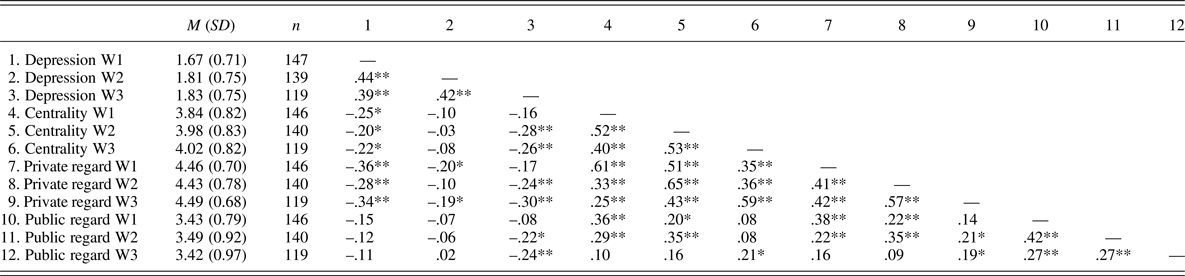
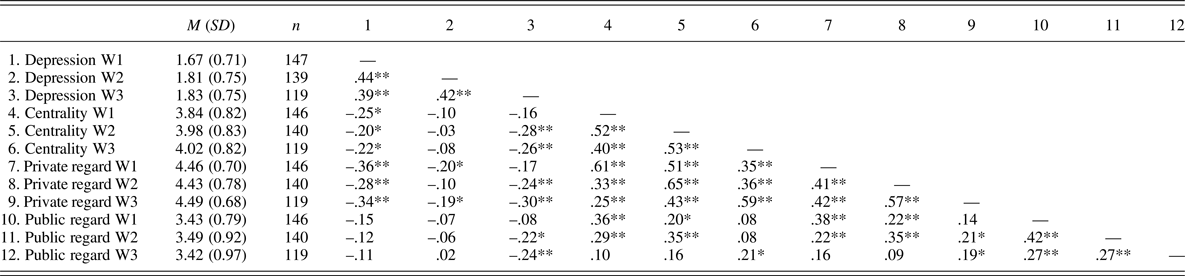
Sample means, standard deviations, and bivariate correlations for all key study variables can be found in Table 1. The mean depression score at Wave 1 was just .5 point above the lowest scale anchor (M W1 = 1.67), indicating that the adolescents experienced, on average, depressive symptoms 1 day per week. However, at Waves 2 and 3, depression mean scores increased to 1.81 and 1.83, respectively, indicating that by then, the adolescents experienced symptoms 2 days per week. The means of the ethnic–racial identity measures revealed that centrality at Wave 1 was approaching 1 point above the scale midpoint (M W1 = 3.84), implying that ethnic–racial identity was of some importance to these adolescents. In Waves 2 and 3, increases were observed from Wave 1 centrality (M W2 = 3.98, M W3 = 4.02), meaning that by then, the adolescents were more likely to agree that being Latino was important to their sense of self. Little change in the mean scores of private regard and public regard were observed. The private regard mean scores were nearly 1.5 points above the scale midpoint, suggesting that adolescents felt positively about being Latino. However, the public regard mean scores were nearly .5 point above the scale midpoint, suggesting that, on average, adolescents believed that people of other ethnic–racial groups viewed Latinos only slightly positively.
Means, sample size, and zero-order correlations for key study variables (N = 148)
Note: W, wave. *p < .05. **p < .01.
Next, bivariate correlations were estimated to examine the relations between variables within and across time. Small to moderate positive relations were observed for depression and each of the ethnic–racial identity dimensions from Wave 1 to Wave 2 and from Wave 2 to Wave 3 (rs ranging from .27 to .57). Examining the within-time relations between depression and ethnic–racial identity, results revealed significant negative relations between depression and centrality at Waves 1 and 3 (rs = –.25, –.26, respectively), but not for Wave 2 (r = –.03), indicating that higher levels of centrality were related to lower levels of depressive symptoms. Similarly, results estimating the within-time relations between depression and private regard revealed significant negative relations between depression and private regard at Waves 1 and 3 (rs = –.36, –.30, respectively), but not for Wave 2 (r = –.10), suggesting that higher levels of private regard were related to lower levels of depressive symptoms. Finally, a significant negative within-time relation between depression and public regard was observed only at Wave 3 (r = –.24); relations at Waves 1 and 2 were not significant (rs = –.15, –.06, respectively).
Unconditional latent change models
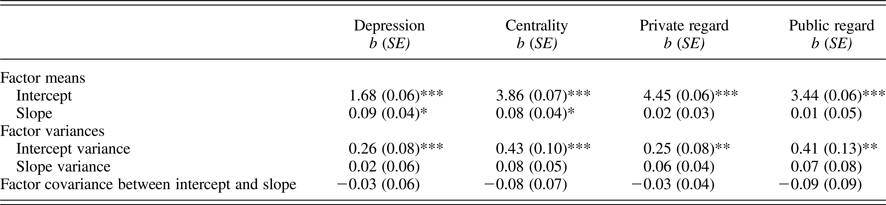
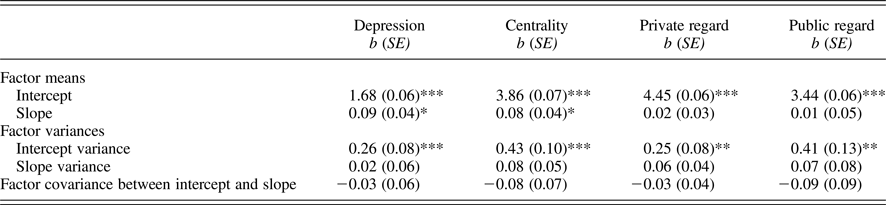
To assess developmental change in depression and the three dimensions of ethnic–racial identity content, unconditional latent change models were estimated (see Table 2 for all model estimates). The first model estimated was for depression, and it fit the data well: χ2 (1) = 0.79, p = .37; CFI = 1.01; TLI = 1.02; RMSEA = 0.00; SRMR = 0.02. The intercept and slope factors of depression were positive and significant, suggesting that, on average, adolescents’ experiences of depressive symptoms were increasing over the 3 years. The second model that was estimated was centrality. The model was deemed to have a good fit: χ2 (1) = 0.71, p = .40; CFI = 1.00; TLI = 1.01; RMSEA = 0.00; SRMR = 0.02. Similar to depression, results from the intercept and slope factors of centrality were both positive and significant, indicating that, on average, centrality increased over the course of the 3 years of the study. Models of private and public regard were estimated and fit the data well: χ2 (1) = 0.65, p = .42; CFI = 1.01; TLI = 1.01; RMSEA = 0.00; SRMR = 0.02, and χ2 (1) = 0.76, p = .38; CFI = 1.01; TLI = 1.03; RMSEA = 0.00; SRMR = 0.02, respectively. Results revealed that for both models significant intercept factors were observed but not significant slope factors, suggesting that there was no developmental change in private or public regard over the 3 years.
Unconditional latent change model for depression and dimensions of ethnic–racial identity (N = 148)
*p < .05. **p < .01. ***p < .001.
Multivariate latent change model
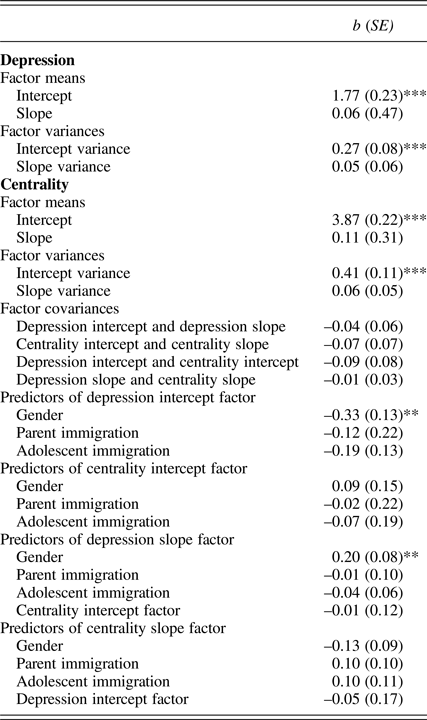
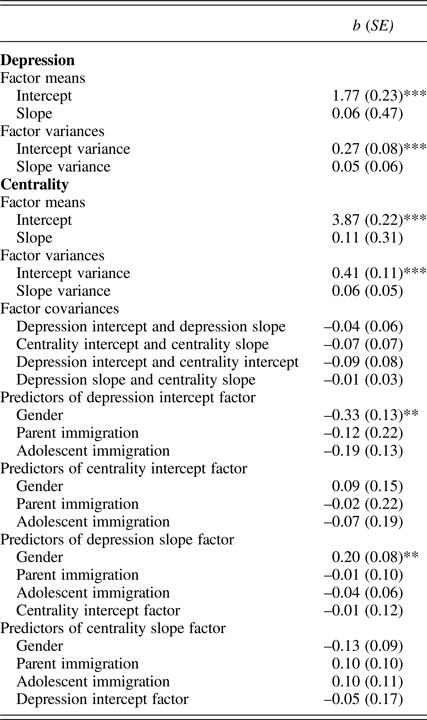
With normative developmental change observed in both of the unconditional latent change models of depression and centrality, a multivariate latent change model was estimated to examine the potential developmental relation between the two trajectories (see Table 3 for all model estimates). Fit statistics suggested the model fit the data well: χ2 (10) = 14.31, p = .16; CFI = 0.98; TLI = 0.91; RMSEA = 0.06; SRMR = 0.04. Results indicated that initial levels of centrality did not predict developmental changes in depression, nor did initial levels of depression predict developmental changes in centrality. No significant relation was observed between the intercept or slope factors of centrality and depression, suggesting that centrality and depression did not covary at Wave 1 and that developmental change of the two trajectories did not covary.
Multivariate latent change model for depression and centrality (n = 147)
*p < .05. **p < .01. ***p < .001.
Results did reveal a significant association of gender on both the intercept and slope factors of depression, where girls had significantly higher intercepts than boys, but boys had significantly higher slopes than girls. These results thus indicate that whereas girls had higher levels of depressive symptoms compared to boys at Wave 1, boys experienced greater increases in depressive symptoms over time.
Conditional latent change models
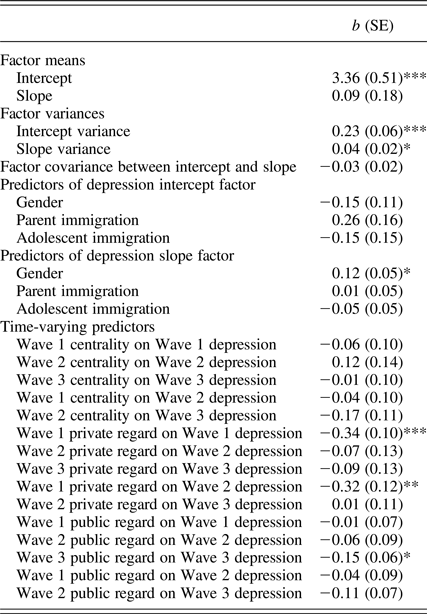
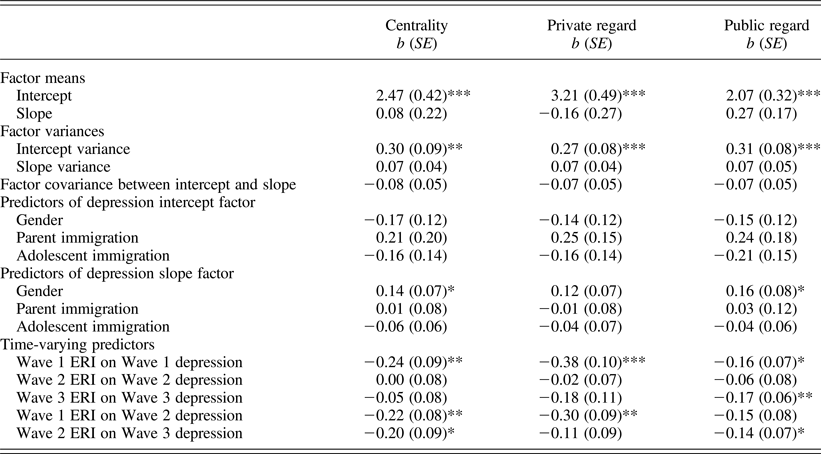
Although developmental relations were not observed in the trajectories of depression and centrality, we were still interested in examining the within- and across-time associations of centrality on depression at each wave. Therefore, we estimated a conditional latent change model of depression with centrality modeled as a time-varying covariate. In addition, as no normative developmental change had been observed in the dimensions of private regard and public regard, conditional latent change models of depression were estimated for these as well, where private and public regard were added to models as time-varying covariates and were regressed on the concurrent and prospective means of depression (i.e., Wave 1 centrality on Wave 1 and Wave 2 depression; see Table 4 for all model estimates).
Time-varying covariate latent change model for depression (n = 114)
Note: ERI, ethnic–racial identity. *p < .05. **p < .01. ***p < .001.
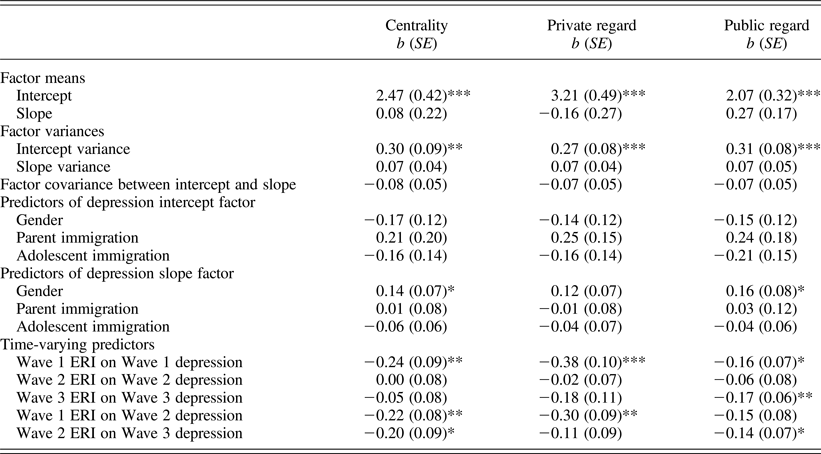
In the estimation of the model with centrality, the model fit was considered good on most of the goodness-of-fit statistics: χ2 (8) = 10.28, p = .25; CFI = 0.96; TLI = 0.93; RMSEA = 0.05; SRMR = 0.04. Results indicated a negative association of Wave 1 centrality on Wave 1 depression, suggesting that higher levels of centrality were related to fewer depressive symptoms. This within-time associations of centrality on depression was not observed at Wave 2 or Wave 3. Wave 1 centrality negatively predicted Wave 2 depression and Wave 2 centrality negatively predicted Wave 3 depression, suggesting that higher levels of centrality were related to fewer depressive symptoms at subsequent points in time.
The model for private regard was deemed an acceptable fit: χ2 (8) = 11.60, p = .17; CFI = 0.93; TLI = 0.89; RMSEA = 0.06; SRMR = 0.04. Results revealed a negative concurrent prediction of private regard on depression at Wave 1, but not at Wave 2 or Wave 3. In the assessment of the across-time paths, Wave 1 private regard negatively predicted Wave 2 depression, implying that higher levels of Wave 1 private regard were related to lower levels of Wave 2 depression, but a similar prospective association was not found between Wave 2 private regard and Wave 3 depression. Thus, the link between earlier private regard on later depression was observed only earlier in development.
The model for public regard fit the data well: χ2 (8) = 6.41, p = .60; CFI = 1.02; TLI = 1.05; RMSEA = 0.00; SRMR = 0.03. Within-time associations of public regard on depression were not observed at Wave 1 or Wave 2. However, a significant negative association of public regard on depression was observed at Wave 3, meaning that higher levels of public regard were related to lower levels of depression. Results indicated that Wave 2 public regard predicted Wave 3 depression, net the prediction of Wave 3 public regard on Wave 3 depression, but a similar prospective association was not found between Wave 1 public regard and Wave 2 depression. Thus, the link between earlier public regard on later depression was observed only later in development.
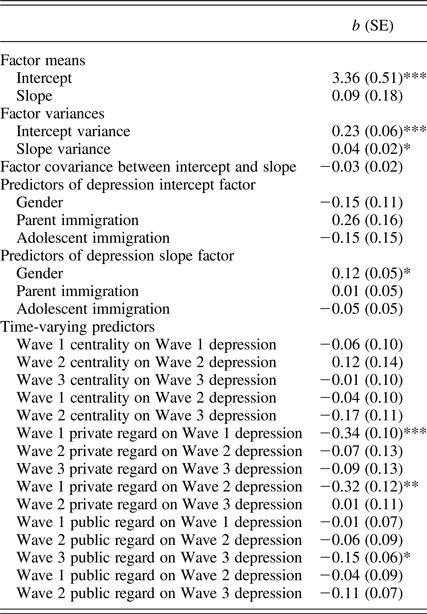
Finally, to assess the concurrent and prospective associations of the different dimensions of ethnic–racial identity simultaneously, we estimated a conditional latent change model of depression, where centrality, private regard, and public regard were added to the model as time-varying covariates and were regressed on the concurrent and prospective means of depression. The model fit the data well: χ2 (16) = 13.38, p = .64; CFI = 1.05; TLI = 1.07; RMSEA = 0.00; SRMR = 0.03 (see Table 5 for model estimates). Results indicated significant negative associations of private regard at Wave 1 on depression at Waves 1 and 2. Thus, higher levels of private regard were associated with lower levels of depression at the start of the study and predicted lower levels of depression 1 year later, above and beyond the effects of the other dimensions of ethnic–racial identity. Results also revealed a significant within-time association of public regard on depression at Wave 3.
Time-varying covariate latent change model for depression (n = 114)
*p < .05. **p < .01. ***p < .001.
Discussion
The size and increase of the Latino population in the United States underscores the importance of understanding some of the protective factors that potentially impact their mental health outcomes. Higher rates of depression among this population have been attributed to exposure to cultural stressors; however, such cultural resources as ethnic–racial identity are thought to protect the mental health of this population (e.g., Neblett et al., Reference Neblett, Rivas-Drake and Umaña-Taylor2012; Rivas-Drake & Stein, Reference Rivas-Drake and Stein2017; Torres et al., Reference Torres, Yznaga and Moore2011). Guided by a cultural developmental psychopathology framework and the phenomenological variant of ecological systems theory, we sought to understand how ethnic–racial identity was associated with the derailment of depressive symptoms across adolescence (Causadias, Reference Causadias2013; Spencer, Reference Spencer, Damon and Lerner2006).
The current study of adolescents examined three dimensions of their ethnic–racial identity content: how important their ethnic group membership is to their sense of self (centrality), how positively they feel about it (private regard), and how positively they believe others view their group (public regard). We found that different dimensions of ethnic–racial identity were associated with fewer depressive symptoms in distinct ways at different stages of adolescence. These findings provide important insight regarding the role of ethnic–racial identity in depression as well as trajectories of depressive symptomatology across adolescence and thus contribute to our understanding of how ethnic–racial identity content might function to mitigate mental health problems among Latinos generally, and Latino adolescents, in particular.
In line with Hypothesis 1, results revealed that adolescents’ depressive symptoms increased over the 3 years of our study. Our results corroborate previously identified developmental increases in depressive symptoms (e.g., Adkins et al., Reference Adkins, Wang, Dupre, Van den Oord and Elder2009). However, our findings partially contradict previous findings in regard to gender differences in such patterns (e.g., Adkins et al., Reference Adkins, Wang, Dupre, Van den Oord and Elder2009; Zeiders et al., Reference Zeiders, Umaña-Taylor and Derlan2013). On the one hand, girls in the present sample reported higher initial levels of depressive symptoms than boys, which is consistent with previous research. On the other hand, boys reported greater increases than girls in their level of depressive symptoms over time. Thus these results only partially supported Hypothesis 1, as it was expected that, regardless of gender, levels of depressive symptomatology would increase.
We found no differences in depressive symptoms between youth with immigrant parents and those whose parents were born in the United States. It should be mentioned, though, that our sample was overwhelmingly composed of children of immigrants, and so had little variability in immigrant generation. Similarly, no differences in depressive symptoms were identified between foreign-born youth and those born in the United States. This parallels the recent findings of Tummala-Narra (Reference Tummala-Narra2015), but contrasts with previous studies suggesting that US-born Latino youth report higher levels of depression than immigrant youth (Alegría et al., Reference Alegría, Canino, Shrout, Woo, Duan, Vila and Meng2008; Potochnick & Perreira, Reference Potochnick and Perreira2010).
In our sample, youths’ centrality (their views of their ethnic–racial group as being an important part of their lives) was shown to increase over the course of the 3 years of the study. Feelings of public and private regard were stable over that time. These results provided partial support for Hypothesis 2, in that we expected to observe increases in all three dimensions of ethnic–racial identity. This provides important foundational knowledge, as there have been few longitudinal studies of centrality among Latino adolescents. Through a cultural developmental perspective, advances in cognitive abilities and increased sensitivity to social environmental cues across adolescence likely make thinking about one's ethnic–racial group membership a more salient process, especially for ethnic minority youth (Neblett et al., Reference Neblett, Rivas-Drake and Umaña-Taylor2012; Umaña-Taylor et al., Reference Umaña-Taylor, Quintana, Lee, Cross, Rivas-Drake, Schwartz and Seaton2014). Through a phenomenological variant of ecological systems theory perspective, the increase in centrality supports the notion that as adolescents become older, their ethnic–racial identity may become a more important vehicle for navigating adolescence and play a more meaningful role in their development, including their mental health. In addition, the adolescents in the current study had high initial levels of private regard that remained consistently high across adolescence. This pattern of high levels of private regard, in particular among Latino youth, has also been found in previous studies (e.g., Rivas-Drake, Syed, et al., Reference Rivas-Drake, Syed, Umaña-Taylor, Markstrom, French, Schwartz and Lee2014).
Changes in centrality were not associated with changes in depressive symptoms over time. Rather, higher levels of prior ethnic–racial centrality were associated with fewer depressive symptoms at subsequent waves, after accounting for the nature of change in depressive symptoms, more generally. Furthermore, youth showing more positive affect toward and about members of their ethnic group (i.e., higher levels of private regard) experienced lower depression at earlier waves, but this relationship was not carried over to later waves. Previous studies have identified private regard as a protective influence on youths’ mental health and well-being (Berkel et al., Reference Berkel, Knight, Zeiders, Tein, Roosa, Gonzales and Saenz2010; Kiang et al., Reference Kiang, Yip, Gonzales-Backen, Witkow and Fuligni2006). Our results support and extend these previous findings by demonstrating a direct cross-sectional and longitudinal association between youths’ private regard and their levels of depression. Finally, we found youths’ higher levels of public regard to predict fewer depressive symptoms, but only in later development. Together, the results supported Hypothesis 3, as each dimension of ethnic–racial identity demonstrated some negative, prospective associations with depressive symptomology. These results extend findings from previous studies that have shown positive public regard to be cross-sectionally associated with mental health among Latino early and late adolescents (e.g., French & Chavez, Reference French and Chavez2010; Rivas-Drake et al., Reference Rivas-Drake, Hughes and Way2009).
Much of what is known about ethnic–racial identity and psychological adjustment is based on cross-sectional studies and with samples of Black American youth, with only a few studies of Latino and Asian-origin youth (cf. Rivas-Drake, Seaton, et al., Reference Rivas-Drake, Seaton, Markstrom, Quintana, Syed, Lee and Yip2014; Rivas-Drake, Syed, et al., Reference Rivas-Drake, Syed, Umaña-Taylor, Markstrom, French, Schwartz and Lee2014, for two recent reviews). Through a longitudinal approach, the current results lend support to most of our hypotheses and illustrate an interesting developmental pattern in Latino youths’ depressive symptoms as it relates to the significance and meaning they place on their ethnic–racial group membership. After accounting for the three ethnic–racial identity content dimensions in a single model, the results indicated that personal views about one's ethnic group were associated with one's levels of depressive symptoms during early adolescence. However, in later adolescence, increasing awareness of societal perceptions of one's ethnic–racial group evinced a stronger association to one's depressive symptoms. Emerging intervention research has begun to show that when adolescents of diverse ethnic–racial groups have opportunities to constructively develop their thinking about their ethnic–racial group membership, they gain positive psychosocial and academic benefits, including fewer depressive symptoms (Umaña-Taylor, Kornienko, Douglass, & Updegraff, Reference Umaña-Taylor, Kornienko, Bayless and Updegraff2018). For translational research, further understanding youths' social awareness of societal perceptions of their ethnic–racial group may be a way to understand how Latino youth, in particular, cope with minority, discriminatory, and acculturative stressors, especially as they enter late adolescence. Our current findings and recent intervention research continue to underscore adaptive benefits in ethnic–racial identity among ethnic minority youth (Neblett et al., Reference Neblett, Rivas-Drake and Umaña-Taylor2012; Rivas-Drake, Seaton, et al., Reference Rivas-Drake, Seaton, Markstrom, Quintana, Syed, Lee and Yip2014; Umaña-Taylor, Reference Umaña-Taylor, Schwartz, Luyckx, Vignoles and J2011; Umaña-Taylor et al., Reference Umaña-Taylor, Quintana, Lee, Cross, Rivas-Drake, Schwartz and Seaton2014; Zimmerman et al., Reference Zimmerman, Stoddard, Eisman, Caldwell, Aiyer and Miller2013), and emphasize the need to more closely examine the cascading effects of ethnic–racial identity development in overall functioning in a myriad of domains, and its impact in later adulthood (Masten & Cicchetti, Reference Masten and Cicchetti2010).
Limitations and future directions
Although our results contribute to and extend the current literature on this topic, they must be considered in the context of several important limitations and caveats. First, the current findings have limited generalizability due to the geographically restricted nature of the study and the fact that it relied on a community-based sample. Future studies may be able to obtain a more representative sample from multiple geographic regions, which could bolster the potential generalizability of results. Second, the current study participants were primarily of lower socioeconomic status; further research on ethnic–racial identity and depressive symptoms among samples of higher socioeconomic status or with more socioeconomic status variability may yield different findings. A third methodological limitation could be the sample size and number of waves in the study. The ability to detect effects, especially in more complex models, like the multivariate latent change model, can be compromised with smaller sample sizes (ns ≤ 200 or less; Hertzog, Lindenberger, Ghisletta, & von Oertzen, Reference Hertzog, Lindenberger, Ghisletta and von Oertzen2006). Perhaps more effects would have emerged if the sample size were larger, thus granting more power to detect effects. Moreover, the time span of our study (3 years) may not have been sufficient to capture meaningful changes in private and public regard, which emerged as stable during this relatively brief period. Future research would also benefit from a design with a longer time span, perhaps even bridging from late adolescence to young adulthood, an important period of reexamination and potential redefinition of ethnic–racial identity among Latinos (e.g., Stein et al., Reference Stein, Rivas-Drake and Camacho2017; Syed, Azmitia, & Phinney, Reference Syed, Azmitia and Phinney2007). Finally, nearly all measures were self-report measures from the adolescent participants (the exception being the caregiver reporting their own immigration status). Single, self-report measurement constitutes a method bias, as it presents a primary source of measurement error (Podsakoff, MacKenzie, Lee, & Podsakoff, Reference Podsakoff, MacKenzie, Lee and Podsakoff2003). The inclusion of data measuring depression observationally by another individual could work to mitigate measurement error.
A final important caveat from an ecological perspective is that the political and historical context may have influenced some of the findings, as the second and third waves of data collection occurred during the 2016 presidential election cycle. Fuller-Rowell, Burrow, and Ong (Reference Fuller-Rowell, Burrow and Ong2011) found that the 2008 presidential election of Barack Obama was associated with heightened racial centrality, private regard, and public regard among African American college students in the days following the election. Given the pervasive and widely publicized xenophobic remarks, particularly regarding Mexican-origin people, trumpeted during the 2016 election cycle, it is possible that both the ethnic–racial identity beliefs and psychological health of the youth in our study were impacted by this sociopolitical and historical context. Such contentious anti-Latino and anti-immigrant discourse, as well as the more stringent enforcement of immigration policies, including a dramatic increase in deportations and detentions, have had important repercussions for Latino immigrants and their families (Wray-Lake et al., Reference Wray-Lake, Wells, Alvis, Delgado, Syvertsen and Metzger2018).
Latino youth are growing up and developing their identities amid an environment of social exclusion and stigmatization where immigrants of their ethnic group are commonly denigrated through negative media portrayals and calls for mass deportations (Yoshikawa, Suárez-Orozco, & Gonzales, Reference Yoshikawa, Suárez-Orozco and Gonzales2017. While these damaging experiences more severely impact undocumented immigrants and their children, they affect the Latino community as a whole exposing it to high levels of stress and fear, with the attendant deleterious mental health outcomes (Roche, Vaquera, White, & Rivera, Reference Roche, Vaquera, White and Rivera2018). Merely knowing someone who has been deported or detained has been linked to negative mental health outcomes among Latinos, regardless of their own documentation status (Vargas, Juárez, Sanchez, & Livaudais, Reference Vargas, Juárez, Sanchez and Livaudais2018). All of these different factors raise our awareness about the many different sources of vulnerabilities present in the lives of Latino youth that pose a threat to their mental health. Our study provides some additional evidence about the protective effects of ethnic–racial identity content (centrality, public regard and private regard) as potential sources of strength and resilience for Latino youth to draw upon. Given the current contentious political climate of our country, future studies should further explore the protective role that ethnic–racial identity plays in the lives of minority youth.