1. Introduction
A quadrotor aircraft is an unmanned aerial vehicle (UAV) equipped with four rotors positioned at equal distances from the centre of gravity in a square configuration, as illustrated in Figure 1. These rotors generate thrust through angular velocities provided by electric motors. By controlling the angular speeds, various flight manoeuvres can be achieved. For instance, vertical take-off and landing (VTOL) is accomplished when the rotors generate equal thrust. Other manoeuvres, such as rolling, pitching and yawing, are achieved by introducing variations in the angular velocities of the rotors. Due to its versatile trajectory-tracking capabilities, the quadrotor has found applications in military, civilian and humanitarian sectors. Extensive research has been conducted to enhance its performance and to meet the control requirements for a wide range of applications. Nevertheless, designing an effective trajectory tracking control algorithm for a quadrotor UAV remains a challenging problem.
Schematic of UAV quadrotor.

Quadrotor UAV is a multi-input-multi-output, underactuated and nonlinearly coupled dynamical system. It has four inputs corresponding to the four rotors and six outputs, namely, position in the XYZ plane and attitude angles of roll, pitch and yaw (Gharib and Moavenian, Reference Gharib and Moavenian2016). By assuming stable hover and small variations in the attitude angles, the quadrotor model can be decoupled into attitude control and position control. The former addresses rolling, pitching and yawing, while the latter is associated with achieving a position in three-dimensional space Zuo (Reference Zuo2010). To design efficient controllers, both linear and nonlinear state feedback control (SFC) schemes have been proposed in the literature. For instance, Tayebi and McGilvray (Reference Tayebi and McGilvray2006) employed a unit quaternion representation to design an attitude control system that achieves the VTOL objective. A tracking control approach for quadrotor flight in three-dimensional space was presented by Jiao et al. (Reference Jiao, Liu, Zhang and Lian2018), and the tracking control objective was achieved by designing a classical proportional-integral-derivative (PID) control algorithm by Bouabdallah et al. (Reference Bouabdallah, Noth and Siegwart2004). However, these control techniques focused on either attitude control or position control for quadrotor UAVs. Moreover, empirical tuning of the control parameters proved challenging due to the coupled dynamics of the underactuated quadrotor model.
Adaptive control is an online estimation technique used to assist in tuning control gains, and it has been widely applied in quadrotor UAV control applications. An et al. (Reference An, Yuan and Li2016) proposed an intelligent control algorithm capable of self-tuning using adaptive criteria. A PID controller was employed as the baseline controller in this technique, and the error between the output and the desired reference was minimised using an adaptive law to achieve stabilisation. Elkhatem and Engin (Reference Elkhatem and Engin2022) proposed adaptive criteria for tuning weighting matrices in the linear quadratic regulator (LQR) technique. Effective tracking control performance was achieved, addressing challenges such as faults caused by actuator inefficiencies, parametric uncertainties and internal disturbances. Zhao et al. (Reference Zhao, Xian, Zhang and Zhang2014) used a robust integral of the signum error to design an adaptive law based on immersion and invariance. The tracking control objective was achieved, and the technique also addressed unwanted uncertainties and disturbances. However, as an online estimation technique, adaptive control is prone to failure if the estimation process fails. Additionally, inaccurate measurements of quadrotor state variables can lead to ineffective performance Ahmed and Ali Shah (Reference Ahmed and Ali Shah2022); Pan et al. (Reference Pan, Shao, Xiong and Zhang2023).
Due to its robustness and asymptotic stability, the sliding mode control (SMC) technique is a popular robust control approach for achieving stabilisation and trajectory tracking of quadrotor UAVs. An algorithm using the SMC technique for achieving asymptotic trajectory tracking was presented by Zhao et al. (Reference Zhao, Xian, Zhang and Zhang2015) and Nguyen and Hong (Reference Nguyen and Hong2018). This approach employed a nonlinear manifold and demonstrated high-precision tracking of the desired reference trajectory. Additionally, Wang et al. (Reference Wang, Ye, Tian, Zheng and Christov2016) adopted a similar control design methodology, wherein the authors introduced adaptive configurations within the control law, thereby enhancing robustness to mechanical variations. Kang et al. (Reference Kang, Miao, Liu, Duan, Wang and Jiang2021) proposed a second-order SMC algorithm for a quadrotor with an unbalanced load during flight. The authors first updated the dynamical model to account for the unbalanced load conditions and then designed the control algorithm to stabilise the quadrotor. While robustness was ensured in this study, the controller exhibited unwanted chattering due to the switching function employed in the control law. Chattering in controllers is known to cause heating issues and potential damage to actuators, which can alter the dynamics of a quadrotor model. Therefore, using SMC as a standalone controller can result in inaccurate flight performance Wan et al. (Reference Wan, Chen and Lungu2023).
To enhance the robustness of controllers using the SMC technique, a reinforcement learning-based approach was proposed by Wang et al. (Reference Wang, Alattas, Bouteraa, Mofid and Mobayen2023). In this method, an ideal reference model was designed and the actual system dynamics were aligned with the reference model through matching conditions. This approach effectively addressed challenges such as chattering, modelling uncertainties and disturbances. However, its reliance on linearisation of the system model limited its applicability to certain nonlinear systems. In contrast, Hou et al. (Reference Hou, Yu and Lu2022) and Wu et al. (Reference Wu, Yan, Lin, Wu and Xiao2021) developed controllers that operated without model linearisation, achieving finite-time convergence with an emphasis on trajectory tracking under disturbances and noise. Additionally, Mofid and Mobayen (Reference Mofid and Mobayen2024) proposed a fractional-order SMC technique integrated with adaptive laws to address issues such as chattering, empirical control gain tuning and disturbances. This approach used event-triggered criteria based on tracking errors. Similarly, Liu et al. (Reference Liu, Wang, Sepestanaki, Pouzesh, Mobayen, Rouhani and Fekih2024) introduced an event-triggered tracking error framework to achieve prescribed performance within finite time by imposing constraints on the system output. Their work employed Lyapunov criteria to develop robust SMC strategies capable of ensuring desired control performance in the presence of disturbances, faults and time delays. Nevertheless, the challenge of completely eliminating chattering remained unresolved, primarily due to the switching function embedded within the equivalent controller, which continued to hinder the complete rejection of chattering.
To address the issue of unwanted chattering in controllers, backstepping control (BSC) schemes have been developed for quadrotor attitude and position control, as presented by Wang et al. (Reference Wang, Alattas, Bouteraa, Mofid and Mobayen2023), Liu et al. (Reference Liu, Gai, Zhang and Li2019), Zhu and Cao (Reference Zhu and Cao2019), Li et al. (Reference Li, Duan and Min2024) and Chen et al. (Reference Chen, Xiong and Wu2021). The adoption of BSC techniques effectively resolved the chattering issue while ensuring stabilisation and trajectory tracking. However, the design methodology of BSC heavily relies on the Lyapunov function as the primary design tool, necessitating the cancellation of indefinite cross-coupling terms. This cancellation increases control activity, thereby compromising system robustness. Moreover, BSC-based controllers are particularly vulnerable to uncertainties and disturbances.
In the literature, control techniques have been presented to take advantage of each of the aforementioned controllers. Chen et al. (Reference Chen, Jiang, Zhang, Jiang and Tao2016) proposed a BSC technique combined with SMC to achieve trajectory tracking of a quadrotor UAV in the Cartesian plane. In this algorithm, the SMC technique was used for attitude control, while position control was achieved using the BSC algorithm. SMC provided fast convergence and robustness against internal faults, but it introduced chattering in the control inputs when inverse motor dynamics were calculated for rotor inputs. Additionally, the BSC scheme required repeated derivatives of the controller. Gong et al. (Reference Gong, Hou, Zhao, Bai and Tian2012) designed a similar approach, developing a controller by combining BSC and SMC for inner attitude control, while position control was achieved using a proportional derivative (PD) algorithm. However, empirical tuning of position control gains remained challenging, along with the issues of repeated derivatives and chattering. Nettari et al. (Reference Nettari, Labbadi and Kurt2023) used a super-twisting algorithm in combination with SMC and BSC to reduce chattering. Furthermore, the repeated derivative problem was addressed by proposing a dynamic surface-based algorithm by Gao et al. (Reference Gao, Wei, Li, Ji and Jia2022), Zhu et al. (Reference Zhu, Wang, Sun, Ge and Zhang2020) and Niu et al. (Reference Niu, Ban, Zhang, Gong and Yu2021), and adaptive laws were introduced to solve the problem of empirical tuning by Zheng et al. (Reference Zheng, Yang, Zhao and Chen2022) and Zou and Meng (Reference Zou and Meng2018). Despite these advances, external disturbances due to wind and atmospheric changes continued to pose challenges for achieving accurate results. Moreover, designing adaptive laws required accurate information about all state variables and nominal models.
State observers have emerged as powerful tools for estimating state variables using measurable outputs. Once state estimation is achieved, the estimated variables are incorporated into the control algorithm to finalise the output feedback control (OFC) technique. Lee et al. (Reference Lee, Burg, Xian and Dawson2007) proposed an OFC technique based on a modified tracking error to achieve quadrotor UAV tracking control. An auxiliary controller was designed using error terms for translational velocities, while nonlinear terms were handled under the assumption of linear unknown parameters. Meng et al. (Reference Meng, Chen, Hua, Qian and Sun2020) proposed a robust SMC-based OFC algorithm combined with a disturbance observer (DO) to achieve desired tracking performance in the presence of disturbances, uncertainties and input saturations. However, issues such as chattering and explicit tuning of control gains were not resolved. To address the control gain parameter challenges, an adaptive OFC algorithm was designed by Flores et al. (Reference Flores, González-Huitron and Rodrguez-Mata2020) to achieve quadrotor tracking control. Nevertheless, the problems of repeated derivatives of state variables and control inputs required by the BSC technique remained unaddressed. Dierks and Jagannathan (Reference Dierks and Jagannathan2009) introduced a novel OFC technique to estimate states and attenuate disturbances. However, in this technique, estimation and tracking errors depended on the maximum bound of disturbances. Hence, disturbances of higher magnitudes posed a greater risk of instability. In practice, quadrotor UAVs face disturbances from both internal dynamics and the external environment, making it inadequate to rely on predefined maximum disturbance bounds. Thus, the behaviour and bounds of disturbances, when lumped together, cannot be explicitly assumed.
To address the challenges posed by unwanted internal and external disturbances, as well as to achieve hovering and tracking control objectives, disturbance observer-based control (DOBC) techniques can be employed. Chen et al. (Reference Chen, Xiong and Wu2021) proposed a nonlinear DO to estimate exogenous disturbances with constant peak-to-peak magnitude and frequency. However, this algorithm required information about all state variables, including quadrotor positions, attitude angles and their rates. Wang and Chen (Reference Wang and Chen2016) presented a DOBC algorithm for tackling external disturbances during the flight of a small-scale indoor quadrotor. In this work, disturbances and uncertainties were lumped together, and a constant maximum bound was assumed, enabling the design of a linear-dual DO. However, in practical applications, the behaviour of disturbances is unknown, making it inadequate to define a fixed bound. Wang et al. (Reference Wang, Sun, van Kampen and Chu2019), Chen et al. (Reference Chen, Lei, Zhang, Tao and Jiang2016) and Wang et al. (Reference Wang, Alattas, Bouteraa, Mofid and Mobayen2023) proposed a nonlinear DO technique for attenuating internal and external disturbances. However, standalone SMC-based DO and BSC methods were used to formulate control algorithms, without addressing issues such as chattering and high control activity. Additionally, the rate of change of the DO was required for BSC algorithms. Furthermore, aforementioned control techniques were based on state-feedback control (SFC) techniques assuming that state information is accurately known due to onboard sensors, whereas SFC techniques are vulnerable if accurate state information is unavailable Siddiqui et al. (Reference Siddiqui, Zhu, Rasool, Afzal and Ahmed2024).
DOBC techniques based on OFC have been explored to address the problems caused by sensor and actuator inefficiencies. For instance, Ma et al. (Reference Ma, Liu, Li and Yang2018) and Shi et al. (Reference Shi, Wu and Chou2018) respectively used high-gain observers (HGO) and extended high-gain observers (EHGO) to estimate quadrotor attitude states and achieve point-to-point attitude tracking. However, these techniques were limited to integral-chain systems and were not applicable to the full underactuated quadrotor model. Furthermore, these techniques suffered from the peaking phenomenon before reaching steady states, potentially leading to finite escape times. Specifically, the lack of global growth conditions in these observers could destabilise the closed-loop system if observer gains were set too high.
Wang et al. (Reference Wang, Li, Wang and Su2021) and Shao et al. (Reference Shao, Liu and Wang2018) presented trajectory tracking controllers based on extended state observers. However, these controllers exhibited oscillations in attitude and position outputs before achieving steady-state tracking performance. To address this, Astolfi et al. (Reference Astolfi, Marconi, Praly and Teel2018) and Jung and Kim (Reference Jung and Kim2022) proposed a low-power observer (LPO) to preserve the performance of HGO and EHGO while solving the peaking phenomenon. However, this method was limited to systems without internal and external disturbances, whereas quadrotor UAVs are inherently subject to inevitable disturbances during flight. Similarly, Siddiqui et al. (Reference Siddiqui, Zhu, Rasool, Afzal and Ahmed2024) combined the LPO technique with SMC to design a trajectory-tracking controller. However, the study assumed only internal disturbances, overlooking the inevitable external disturbances encountered during quadrotor flights. Nevertheless, designing an LPO in the presence of disturbances remains a challenging problem. Furthermore, to the best of the authors’ knowledge, LPO-based state estimation has not yet been applied to estimate both rotational and translational state variables of a quadrotor. Moreover, this technique has not been integrated with DOBC to achieve trajectory tracking control of quadrotor UAVs. Combining this technique with BSC and a first-order filter based on a dynamic surface technique to address the issue of repeated derivatives presents a significant research challenge. Hence, these gaps provide a compelling direction for this research work.
In summary, the uncertain environment, disturbances, modelling and parametric uncertainties, and the underactuated, strongly coupled nonlinear dynamics of quadrotor UAVs render the design of trajectory tracking control algorithms highly challenging. The aforementioned problems form the basis for conducting this research. The major contributions of this research paper are as follows.
-
1. Different from previous research studies Li et al. (Reference Li, Duan and Min2024); Shao et al. (Reference Shao, Liu and Wang2018); Wang et al. (Reference Wang, Li, Wang and Su2021; Reference Wang, Alattas, Bouteraa, Mofid and Mobayen2023), this paper presents an LPO-based trajectory tracking algorithm.
-
2. The LPO technique is designed for the estimation of rotational and translational state variables, i.e. the position of the quadrotor and attitude angles, respectively.
-
3. The LPO-based state estimation and DOBC are combined into an OFC algorithm that achieves nonlinear trajectory tracking while attenuating six types of disturbances: exogenous, nonlinear with variable frequency and magnitude, constant, Gaussian distributed random disturbance, uniform distributed random disturbance and band-limited white noise.
-
4. A dynamic surface-based control is integrated within the BSC to solve the repeated derivative of a controller and DO.
-
5. An adaptive filter is designed based on an auxiliary adaptive control such that the filter adapts to unknown bounded uncertainties and avoids empirical tuning of the control gains.
The structure of the paper is as follows. In Section 2, the problem description and preliminaries for the quadrotor UAV model and control design are presented. Section 3 presents the control design and stability analysis. Control validation and simulations are presented in Section 4. The paper is concluded in Section 5.
2. Problem statement and preliminaries
2.1. Problem statement
In this paper, the aim is to design a trajectory tracking control for a quadrotor under multiple unknown disturbances. For attenuation of nonlinear disturbances with variable frequency and internal noises, a DO will be designed and combined with the controller. The control technique based on BSC algorithm, filter and adaptive auxiliary control will solve the problem of repeated derivative. Furthermore, a state estimation criteria using LPO will be designed and combined with the controller to formulate the DOBC technique for trajectory tracking.
2.2. Mathematical model
Dynamical model of quadrotor can be described by translations
 $v = {[{v_x}{\rm{\;\;\;\;}}{v_y}{\rm{\;\;\;\;}}{v_z}]^T}$
and rotations
 ${\rm{\Omega }} = {[p{\rm{\;\;\;\;}}q{\rm{\;\;\;\;}}r]^T}$
, and its motion can be written as follows Zuo (Reference Zuo2010):
 $${\dot p = v;\dot v = - gz + {T \over m}Rz}$$
where
 $m$
and
 $g$
denotes mass and gravitational forces, respectively,
 $z = {[0{\rm{\;\;}}0{\rm{\;\;}}1]^T}$
is a unit vector and
 $T = \mathop \sum \limits_{i = 1}^4 {f_i} = b\mathop \sum \limits_{i = 1}^4 \omega _i^2$
is the thrust of rotors where
 ${f_i}$
and
 ${\omega _i}$
are the force, rotor speed of the
 ${i^{{\rm{th}}}}$
rotor and
 $b$
is denoting lift coefficient. Here,
 $\left( {{x_B},{y_B},{z_B}} \right)$
denotes the position with respect to body frame of quadrotor as shown in Figure 1. Additionally,
 $R$
is the rotational matrix written as follows:
 $$R = \left[ {\matrix{ {{\rm{cos}}\,\theta \,{\rm{cos}}\,\psi } \hfill & {{\rm{sin}}\,\theta\, {\rm{sin}}\,\psi\, {\rm{sin}}\,\phi - {\rm{sin}}\,\psi \,{\rm{cos}}\,\phi } \hfill & {{\rm{sin}}\,\theta\, {\rm{cos}}\,\psi \,{\rm{cos}}\,\phi + {\rm{sin}}\,\psi \,{\rm{sin}}\,\phi } \hfill \cr {{\rm{cos}}\,\theta\, {\rm{sin}}\,\psi } \hfill & {{\rm{sin}}\,\theta\, {\rm{sin}}\,\psi\, {\rm{sin}}\,\phi + {\rm{cos}}\,\psi {\rm{\,cos}}\,\phi } \hfill & {{\rm{sin}}\,\theta\, {\rm{sin}}\,\psi \,{\rm{cos}}\,\phi - {\rm{cos}}\,\psi \,{\rm{sin}}\,\phi } \hfill \cr { \hskip 6pt- {\rm{sin}}\,\theta } \hfill & \hskip 35pt{{\rm{cos}}\,\theta\, {\rm{sin}}\,\phi } \hfill & \hskip 35pt{{\rm{\;\;cos}}\,\theta\, {\rm{cos}}\,\phi } \hfill \cr } } \right]$$
Defining
 $x$
,
 $y$
and
 $z$
for representation of quadrotor position in Cartesian plane, then a dynamical model can be obtained as follows (Zuo, Reference Zuo2010):
 $$\matrix{ {\ddot x} & \hskip-10pt{ = \left( {{\rm{cos}}\,\phi\, {\rm{sin}}\,\theta\, {\rm{cos}}\,\psi + {\rm{sin}}\,\phi\, {\rm{sin}}\,\psi } \right){U_p}/m} \cr {\ddot y} & \hskip-10pt{ = \left( {{\rm{cos}}\,\phi\, {\rm{sin}}\,\theta\, {\rm{sin}}\,\psi - {\rm{sin}}\,\phi \,{\rm{cos}}\,\psi } \right){U_p}/m} \cr {\ddot z} & \hskip-68pt{ = \left( {{\rm{cos}}\,\phi \,{\rm{cos}}\,\theta } \right){U_p}/m - g} \cr {\ddot \phi } & \hskip-13pt{ = \dot \theta \dot \psi \left( {{I_y} - {I_z}} \right)/{I_x} + \dot \theta {{\rm{\Omega }}_r}{I_r}/{I_x} + l/{I_x}{U_\phi }} \cr {\ddot \theta } & \hskip-13pt{ = \dot \phi \dot \psi \left( {{I_z} - {I_x}} \right)/{I_y} - \dot \phi {{\rm{\Omega }}_r}{I_r}/{I_y} + l/{I_y}{U_\theta }} \cr {\ddot \psi } & \hskip-56pt{ = \dot \phi \dot \theta \left( {{I_x} - {I_y}} \right)/{I_z} + 1/{I_z}{U_\,\psi }} \cr } $$
where
 $l$
is a length of the rotor from the centre of gravity,
 ${I_x}$
,
 ${I_y}$
and
 ${I_z}$
denote the inertia of the quadrotor and
 ${I_r}$
denotes the inertia of a rotor. In addition,
 ${{\rm{\Omega }}_r} = {\omega _1} - {\omega _2} + {\omega _3} - {\omega _4}$
. Additionally,
 ${U_p}$
,
 ${U_\phi }$
,
 ${U_\theta }$
and
 ${U_\psi }$
are representing control inputs written as follows:
 $$\matrix{ {{U_p}} \hfill & \hskip-7pt{ = b\left( {\omega _1^2 + \omega _2^2 + \omega _3^2 + \omega _4^2} \right);{U_\phi } = b\left( {\omega _4^2 - \omega _2^2} \right)} \hfill \cr {{U_\theta }} \hfill & \hskip-7pt{ = b\left( {\omega _1^2 - \omega _3^2} \right);{U_\psi } = d\left( { - \omega _1^2 + \omega _2^2 - \omega _3^2 + \omega _4^2} \right)} \hfill \cr } $$
where
 $b$
and
 $d$
are denoting lift and resistance coefficients, respectively. Assuming X =
 $\left[ {\phi, {\dot \phi}, \theta, \dot \theta, \psi, \dot \psi, x,\dot x,y,\dot y,z,\dot z{]^T} = } \;\right[{x_1},{x_2},{x_3},{x_4},{x_5},{x_6},{x_7},{x_8},{x_9},{x_{10}},{x_{11}},{x_{12}}{]^T}$
, then, the state space model is written as follows:
 $$\dot X = \left[ {\matrix{ {{x_2}} \cr {{x_4}{x_6}\left( {{I_y} - {I_z}{I_x}} \right)/{I_x} + {x_4}{{\rm{\Omega }}_r}{I_r}/{I_x} + l/{I_x}{U_\phi }} \cr {{x_4}} \cr {{x_2}{x_6}\left( {{I_z} - {I_x}} \right)/{I_y} - {x_2}{{\rm{\Omega }}_r}{I_r}/{I_y} + l/{I_y}{U_\theta }} \cr {{x_6}} \cr {{x_2}{x_4}\left( {{I_x} - {I_y}} \right)/{I_z} + 1/{I_z}{U_\psi }} \cr {{x_8}} \cr {{U_x}{U_p}/m} \cr {{x_{10}}} \cr {{U_y}{U_p}/m} \cr {{x_{12}}} \cr {\left( {{\rm{cos}}{x_1}{\rm{cos}}{x_3}} \right){U_p}/m - g} \cr } } \right]$$
where
 $$\matrix{ {{U_x}} \hfill & { = {\rm{cos}}\,\phi\, {\rm{sin}}\,\theta\, {\rm{cos}}\,\psi + {\rm{sin}}\,\phi\, {\rm{sin}}\,\psi } \hfill \cr {{U_y}} \hfill & { = {\rm{cos}}\,\phi\, {\rm{sin}}\,\theta\, {\rm{sin}}\,\psi - {\rm{sin}}\,\phi\, {\rm{cos}}\,\psi } \hfill \cr } $$
2.3. Lemmas and assumptions
Following are the necessary Lemmas and assumptions used to facilitate the control design. Lemma
 $1$
Wang and Huang (Reference Wang and Huang2005): According to the continuous property of functions, a continuous function
 $w\left( x \right)$
can be bounded by a maximum value
 $\bar w$
if the initial conditions of the functions are in the compact set. Lemma
 $2$
Kristic et al. (Reference Kristic, Kanellakopoulis, Kokotovic and Mayne1996): Suppose that a function
 $V\left( t \right) \ge 0$
is a continuous function defined for
 $\forall t \in {R^ + }$
and its initial condition
 $V\left( 0 \right)$
is bounded. If the nonlinear function
 $V\left( t \right)$
satisfies
 $V\left( t \right) \le aV\left( t \right) + b$
, where
 $a$
and
 $b$
are positive constants, then
 $V\left( t \right)$
is uniformly ultimately bounded. Assumption
 $1$
Bouabdallah et al. (Reference Bouabdallah, Noth and Siegwart2004): Assuming small angle approximation, i.e.
 ${\rm{cos}}x \approx 1$
and
 ${\rm{sin}}x \approx x$
, quadrotor model in Equation (3) can be decoupled into position and attitude submodels consisting of
 ${[\ddot x{\rm{\;\;\;\;}}\ddot y{\rm{\;\;\;\;}}\ddot z]^T}$
and
 ${[\ddot \phi {\rm{\;\;\;\;}}\ddot \theta {\rm{\;\;\;\;}}\ddot \psi ]^T}$
, respectively. Assumption
 $2$
: The reference trajectory is locally differentiable.
3. Control development and stability analysis
From the mathematical model presented in Equation (3), it is evident that the attitude model is driven by the position model. Consequently, attitude control is inherently embedded within the system and is not directly accessible for user manipulation. As a result, it functions as an inner-loop control. In contrast, position control operates as an outer-loop control, using the desired trajectory to generate appropriate attitude commands for the inner-loop control (Lopez-Sanchez et al., Reference Lopez-Sanchez, Rossomando, Pérez-Alcocer, Soria, Carelli and Moreno-Valenzuela2021). This hierarchical control structure ensures that position control governs the overall trajectory, while attitude control maintains system stability and responsiveness. A schematic representation of this operation is illustrated in Figure 2.
Operation of outer-loop control and inner-loop control.

3.1. Attitude control
Let
 ${f_1}\left( x \right) = {x_4}{x_6}\left( {{I_y} - {I_z}} \right)/{I_x} + {x_4}{{\rm{\Omega }}_r}{I_r}/{I_x}$
,
 ${b_1} = l/{I_x}$
. Then, without loss of generality, the roll submodel can be written in the class of a nonlinear system as follows:
 $$\matrix{ {{{\dot x}_1} = } \hfill & \hskip-7pt{{x_2}}; \hfill \cr {{{\dot x}_2} = } \hfill & \hskip-7pt{{f_1}\left( x \right) + {b_1}{U_\phi } + {d_\phi }} \hfill \cr } $$
where
 ${d_\phi }$
represents unknown bounded disturbance. To estimate disturbance, a DO is designed as follows:

where
 ${\lambda _\phi }$
is a positive DO gain. Defining the estimation error as
 $ {\tilde {d_\phi} } = {\hat {d_\phi} } - {d_\phi }$
, then it can be derived that
 $${\dot {\tilde {d_\phi}} } \le - {\lambda _\phi }{\tilde {d_\phi} } + {\bar {d_\phi} }$$
where
 ${\bar {d_\phi} } = 0.5 + 0.5\dot {d_\phi} ^{\hskip-3pt2} \ge {\dot {d_\phi} }$
is a maximum bound obtained using Young’s inequality. To design a control input
 ${U_\phi }$
, defining tracking errors are as follows:
 $${z_1} = {x_1} - {x_{\phi r}};{\rm{\;\;}}{z_2} = {x_2} - {\xi _1} - {\dot x_{\phi r}}$$
where
 ${x_{\phi r}}$
is representing a desired roll angle and
 ${\xi _1}$
denotes a filter. Using Equations (7) and (10), the coordinate transformation is written as
 $$\matrix{ {{{\dot z}_1}} \hfill & \hskip-7pt{ = - {p_1}{z_1} + {z_2} + {e_1} + {{\dot x}_{\phi r}}} \hfill \cr {{{\dot z}_2}} \hfill & \hskip-7pt{ = {f_1}\left( x \right) + {b_1}{U_\phi } + {d_\phi } - {{\ddot x}_{\phi r}} - {\mu _1}/\tau + {\xi _1}/\tau } \hfill \cr } $$
where
 $\tau $
is the time constant of the filter,
 ${e_1} = {\xi _1} - {\mu _1}$
and
 ${\mu _1}$
denotes an auxiliary control law written as follows:
 $${\mu _1} = - {p_1}{z_1} + {\dot x_{{\phi _r}}}$$
Next, the control input is designed as
 $$\matrix{ {{U_\phi } = } \hfill & \hskip-8pt{ - b_1^{ - 1}\left( {{z_1} + {f_1}\left( x \right) - {{\ddot x}_{\phi r}} - \left( {{{\hat \mu }_1} - {\xi _1}} \right)/\tau + {k_1}{z_2} + {{\hat d}_\phi }} \right)} \hfill \cr {{{\hat \mu }_1} = } \hfill & {{\rm{\;\;}} \hskip-15pt- {{\hat p}_1}{z_1} + {{\dot x}_{\phi r}};{{\dot {\hat p}_1}} = - {\alpha _\phi }{z_1}{z_2}/\tau ;{{\dot \xi }_1} = \left( {{{\hat \mu }_1} - {\xi _1}} \right)/\tau ;{\rm{\;\;}}{\xi _1}\left( 0 \right) = {{\hat \mu }_1}\left( 0 \right)} \hfill \cr } $$
where
 ${\hat \mu _1}$
is auxiliary backstepping control input and
 ${\hat p_1}$
is an adaptive control gain.
Next, for designing the OFC algorithm,
 ${d_\phi } = 0$
is assumed. Then, an LPO for state estimation is designed as
 $$\matrix{ {{{\hat x}_1}} \hfill & \hskip-8pt{ = {w_1};{\rm{\;\;}}{{\dot w}_1} = \left( {{w_2} + {\beta _1}{{\tilde x}_1}} \right)/\varepsilon } \hfill \cr {{{\hat x}_2}} \hfill & \hskip-8pt{ = {w_2}/\varepsilon ;{{\dot w}_2} = \varepsilon \left( {{{\hat f}_1}\left( {\hat x} \right) + {b_1}{U_\phi }} \right) + {\beta _2}{{\tilde x}_1}/\varepsilon } \hfill \cr } $$
where
 ${\tilde x_1} = {y_\phi } - {\hat x_1}$
and
 ${y_\phi } = {x_1}$
is a measurable output angle,
 ${\hat f_1}\left( {\hat x} \right)$
is nominal model of
 ${f_1}\left( x \right),$
and
 $\varepsilon $
is a constant. Furthermore,
 ${\beta _1}$
and
 ${\beta _2}$
are constants such that the polynomial
 ${w^2} + {\beta _1}w + {\beta _2}$
is Hurwitz.
Remark 1 Once state estimation criteria are designed, then the state variables in the DO and controller are replaced with the estimated state variables obtained using LPO.
Theorem 1 The nonlinear system in Equation (7) with unknown bounded disturbances is uniformly ultimately bounded if the DO, control algorithm and LPO-based state observer are designed according to Equations (8), (13) and (14), respectively. Furthermore, the tracking error, state estimation error and disturbance estimation error converge to a small neighbourhood of the origin when the control gains are designed according to the criteria given as
 $${k_1} \gt 0.5,{\lambda _\phi } \gt 1,{\rm{\;}}\tau \in \left( {0,1} \right),{\beta _1}/\varepsilon \gt 1,{\beta _2} \gt 0,{\alpha _\phi } \gt 0$$
where the control parameters
 ${\beta _1}$
and
 ${\beta _2}$
should satisfy Hurwitz criteria.
Proof Choosing the Lyapunov candidate function for tracking error as
 $${V_1} = 0.5z_1^2$$
taking the derivative and using Equation (10) yields
 $${{{\dot V}_1} = {z_1}{{\dot z}_1} = - {p_1}z_1^2 + {z_1}{z_2} + {z_1}{e_1} + {z_1}{{\dot x}_{\phi r}}}$$
Redesign the Lyapunov candidate function as follows:
 $${V = {V_1} + 0.5\left( {z_2^2 + e_1^2 + \tilde p_1^2/{\alpha _\phi } + \tilde d_\phi ^2 + \tilde x_1^2 + \tilde x_2^2} \right)}$$
where
 ${\tilde x_1} = {x_1} - {\hat x_1}$
,
 ${\tilde x_2} = {x_2} - {\hat x_2}$
and
 ${\tilde p_1} = {p_1} - {\hat p_1}$
. Next, taking derivative and simplifying yields
 $$\matrix{ {\dot V = } \hfill & \!\!{ - {p_1}z_1^2 + {z_1}{z_2} + {z_1}{e_1} + {z_1}{{\dot x}_{\phi r}} + {z_2}{{\dot z}_2} + {e_1}{{\dot e}_1} + {{\tilde p}_1}{{\dot {\tilde p}}_1}/{\alpha _\phi } + {{{\tilde d}_\phi} }{{\dot {\tilde d}_\phi} }} \hfill \cr {{\rm{\;\;}}} \hfill & { + {{\tilde x}_1}{{\dot {\tilde x}_1}} + {{\tilde x}_2}{{\dot {\tilde x}_2}}} \hfill \cr } $$
Invoking Equations (9), (10), (13), (14) and using Young’s inequality followed by simplification yields
 $$\matrix{ {\dot V \le } \hfill & \!\!{ - {p_1}z_1^2 - \left( {{k_1} - 0.5} \right)z_2^2 - \left( {{\lambda _\phi } - 1} \right)\tilde {d_\phi} ^2 - \left( {1/\tau - 1} \right)e_1^2 - \left( {{\beta _1}/\varepsilon - 1} \right)\tilde x_1^2} \hfill \cr {{\rm{\;\;}}} \hfill & { - 0.5\tilde x_2^2 - \tilde p_1^2/{\alpha _\phi } + {F_{\rm{A}}}\left( {\rm{{\ast}}} \right) + 0.5\left( {\dot x_{\phi r}^2 + \bar {d_\phi} ^2 + \tilde f_\phi ^2 + z_1^2} \right) + {c_1}\tilde x_2^2 + \tilde p_1^2/{\alpha _\phi }} \hfill \cr } $$
where
 ${c_1} = \left( {2 + \beta _2^2/\left( {2{\varepsilon ^4}} \right)} \right)$
,
 ${\tilde f_\phi } = {f_1}\left( x \right) - {\hat f_1}\left( {\hat x} \right)$
and
 ${F_{\rm{A}}}\left( {\rm{{\ast}}} \right) = {F_{\rm{A}}}\left( {{x_1},{x_2},{z_1},{z_2},{e_1}} \right) = {{\partial {\mu _1}} \over {\partial {x_1}}}{\dot x_1} + {{\partial {\mu _1}} \over {\partial {z_1}}}{\dot z_1}$
is a continuous function. According to Lemma
 $1$
, the function
 ${F_{\rm{A}}}\left( {\rm{{\ast}}} \right)$
can be bounded by a maximum value
 ${\bar F_{\rm{A}}}$
provided that the initial conditions are in the compact set (Wang and Huang, Reference Wang and Huang2005). The stability of state-estimation is also investigated and validated in the following corollary.
Corollary 1 (Khalil, Reference Khalil2017). Assuming that
 ${\hat f_1}\left( {\hat x} \right)$
is locally Lipschitz in its arguments, then there exists
 ${\varepsilon ^{\rm{*}}} \in \left( {0,1} \right]$
such that for
 $0 \lt \varepsilon \lt {\varepsilon ^{\rm{*}}},$
the estimation errors
 ${\tilde x_1} = {x_1} - {\hat x_1}$
and
 ${\tilde x_2} = {x_2} - {\hat x_2}$
of the state observer are bounded as follows:
 $$\left| {{{\tilde x}_i}} \right| \le {\rm{max}}\left\{ {{b \over {{\varepsilon ^{i - 1}}}}\left| {\left| {\tilde x\left( 0 \right)} \right|} \right|{e^{{{ - at} \over \varepsilon }}},{\varepsilon ^{\rho + 1 - i}}ck} \right\}$$
where
 $a$
,
 $b$
,
 $c$
and
 $k$
are positive constants. Here,
 $i \in \left[ {1,2} \right]$
and
 $\rho = 2$
is the order of the system. Corollary 2 (Atassi and Khalil, Reference Atassi and Khalil1999). If the state observer gains are designed sufficiently large, i.e.
 $\varepsilon $
sufficiently small, then the OFC technique recovers the trajectories of the SFC technique. Hence, the designed controller can be finalised by replacing state variables with estimated state variables obtained using state estimation criteria.
Remark 2
 ${p_1}$
is a positive unknown constant. It is estimated using adaptive control criteria,
 ${\dot {\hat p_1}}$
.
Now, the control gain parameters criteria can be deduced from Equation (20) as
 ${k_1} \gt 0.5$
,
 ${\lambda _\phi } \gt 1$
,
 $\tau \in \left( {0,1} \right)$
,
 ${\beta _1}/\varepsilon \gt 1$
and the state estimation gains, i.e.
 ${\beta _1}$
and
 ${\beta _2}$
should satisfy Hurwitz criteria. Furthermore,
 $\varepsilon \in \left( {0,1} \right]$
should be chosen sufficiently small. Additionally,
 ${\alpha _\phi } \gt 0$
should be designed for tuning adaptive control gain.
Rewrite Equation (20) as follows:
 $$\dot V \le - {\kappa _\phi }V + \bar B$$
where
 ${\kappa _\phi } = 2{\rm{min}}\left\{ {{p_1},{k_1} - 0.5,{\lambda _\phi } - 1,1/\tau - 1,{\beta _1}/\varepsilon - 1} \right\}$
and
 ${\bar B} \ge 0.5{\tilde B} = 2{F_{\rm{A}}}\left( {\rm{{\ast}}} \right) + \dot x_{\phi r}^2 + \bar d_\phi ^2 + \tilde f_\phi ^2 + z_1^2 + 2{c_1}\tilde x_2^2 + 2\tilde p_1^2/{\alpha _\phi }$
. Now, according to Lemma
 $2$
, it can be written that
 $$0 \le V\left( t \right) \le V\left( 0 \right){e^{ - {\kappa _\phi }t}} + \bar B\left( {1 - {e^{ - {\kappa _\phi }t}}} \right)/{\kappa _\phi }$$
It is evident that for
 $t \to \infty $
,
 $V$
converges to
 $\bar B/{\kappa _\phi }$
. Hence, there exists a time
 $T$
such that for
 $t \ge T$
, the tracking error and
 $\tilde B$
converge, satisfying
 ${z_1} \le \sqrt {2\bar B/{\kappa _\phi }} $
and
 ${\tilde B_\phi } \le \sqrt {2\bar B/{\kappa _\phi }} $
, respectively. The term
 $\sqrt {2\bar B/{\kappa _\phi }} $
can be reduced to an arbitrarily small value either by increasing
 ${\kappa _\phi }$
or decreasing
 $\bar B$
. However,
 $\bar B$
is independent of the control gain parameters, whereas
 ${\kappa _\phi }$
depends on the control gains. This implies that the tracking error can converge to a small neighbourhood of the origin if
 ${\kappa _\phi }$
is appropriately increased by designing the control gains to achieve the desired transient performance and control objective. This completes the proof.
3.2. Position control
Define an auxiliary control
 $U = {[{U_x},{U_y},{U_z}]^T} = - gz + {T \over m}Rz$
and assume that the position of the quadrotor during flight mission is opposed by the external disturbances along XYZ axes defined by variables
 ${d_x}\left( t \right)$
,
 ${d_y}\left( t \right)$
and
 ${d_z}\left( t \right)$
. Hence, the mathematical model of quadrotor position can be obtained as
 $\left[ {{{\dot x}_7},{{\dot x}_8},{{\dot x}_9},{{\dot x}_{10}},{{\dot x}_{11}},{{\dot x}_{12}}{]^T} = } \;\right[{x_8},{U_x} + {d_x}\left( t \right),{x_{10}},{U_y} + {d_y}\left( t \right),{x_{11}},{U_z} + {d_z}\left( t \right){]^T}$
. Without loss of generality, the position submodel along the x-axis is written as follows:
 $${\dot x_7} = {x_8};{\rm{\;\;}}{\dot x_8} = {U_x} + {d_x}$$
where
 ${d_x}$
is unknown bounded disturbance. The DO to estimate the disturbance appearing in Equation (24) is designed as follows:
 $${{{\dot \gamma }_x} = - {\lambda _x}{\gamma _x} - {\lambda _x}\left( {{U_x} + {\lambda _x}{x_8}} \right);{{\hat d}_x} = {\gamma _x} + {\lambda _x}{x_8}}$$
where
 ${\lambda _x}$
is a DO control gain. Next, defining estimation error as
 ${\tilde {d_x}} = {\hat {d_x}} - {d_x}$
. Then, the error dynamics can be derived as follows:
 $${\dot {\tilde d_x}} = - {\lambda _x}{\tilde {d_x}} + {\bar {d_x}}$$
where
 ${\bar d_x} = 0.5 + 0.5\dot d_x^2 \ge {\dot d_x}$
. Next, defining tracking error for position control along the x-axis as follows:
 $${z_7} = {x_7} - {r_x};{\rm{\;\;}}{z_8} = {x_8} - {\xi _4} - {\dot r_x}$$
where
 ${\xi _4}$
denotes a filter and
 ${r_x}$
is the reference position along the x-axis. Now, using Equations (24) and (27), the coordinate transformation is obtained as follows:
 $${{{\dot z}_7} = {{\dot x}_7} - {{\dot r}_x} = {x_8} - {{\dot r}_x};{{\dot z}_8} = {U_x} + {d_x} - {{\ddot r}_x} - {\mu _4}/{\tau _p} + {\xi _4}/{\tau _p}}$$
where
 ${\tau _p}$
denotes the time constant of filter for position model, and
 ${\mu _4}$
denotes an auxiliary control law written as
 $${\mu _4} = - {p_4}{z_7} + {\dot r_x}$$
where
 ${p_4}$
is a positive constant. Next, the controller for achieving quadrotor position control along the x-axis is designed as follows:
 $$\matrix{ {{U_x} = {\rm{\;\;}}} \hfill & \hskip-13pt{ - {z_7} + {{\ddot r}_x} + \left( {{{\hat \mu }_4} - {\xi _4}} \right)/{\tau _p} - {k_4}{z_8} - {{\hat d}_x}} \hfill \cr {{{\hat \mu }_4} = {\rm{\;\;}}} \hfill & \hskip-13pt{ - {{\hat p}_4}{z_7} + {{\dot r}_x};{\rm{\;\;}}{{\dot {\hat p}}_4} = - {\alpha _x}{z_7}{z_8}/{\tau _p}{{\dot \xi }_4} = {\rm{\;\;}}\left( {{{\hat \mu }_4} - {\xi _4}} \right)/{\tau _p};{\rm{\;\;}}{\xi _4}\left( 0 \right) = {{\hat \mu }_4}\left( 0 \right)} \hfill \cr } $$
Remark 3
 ${\hat \mu _4}$
and
 ${\hat p_4}$
denotes auxiliary backstepping control and adaptive control gain, respectively. Next, to achieve the state estimation criteria, an LPO is designed as follows:
 $$\matrix{ {{{\hat x}_7}} \hfill & \hskip-6pt{ = {w_7};{\rm{\;\;}}{{\dot w}_7} = \left( {{w_8} + {\beta _7}{{\tilde x}_7}} \right)/\varepsilon } \hfill \cr {{{\hat x}_8}} \hfill & \hskip-6pt{ = {w_8}/\varepsilon ;{{\dot w}_8} = \varepsilon {{\hat f}_4}\left( {\hat x,{U_x}} \right) + {\beta _8}{{\tilde x}_7}/\varepsilon } \hfill \cr } $$
where
 ${\tilde x_7} = \left( {{y_x} - {{\hat x}_7}} \right)$
and
 ${y_x} = {x_7}$
is the measurable output along the x-axis. In addition,
 ${\beta _7} \gt 0$
and
 ${\beta _8} \gt 0$
are LPO gains. Furthermore,
 ${\hat f_4}\left( {\hat x,{U_x}} \right) = {\rm{cos}}\,{\hat x_1}{\rm{sin}}\,{\hat x_3}{\rm{cos}}\,{\hat x_5} + {\rm{sin}}\,{\hat x_1}{\rm{sin}}\,{\hat x_3}$
. Position control requires information of estimated attitude angles. Hence, the dynamics of attitude control should be much faster than the position control to achieve the desired trajectory tracking control of quadrotor UAV.
Using a similar approach yields auxiliary controllers
 ${U_y}$
and
 ${U_z}$
for quadrotor position along the
 $y$
-axis and
 $z$
-axis, respectively. Once, the auxiliary controllers are obtained then the position control,
 ${U_p}$
can be formulated as follows:
 $${{U_p} = {{m\left( {{U_z} + g} \right)} \over {{\rm{cos}}\,{\phi _{{\rm{des}}}}\,{\rm{cos}}\,{\theta _{{\rm{des}}}}}}}$$
where the desired roll and pitch attitude angles can be obtained by using Equation (6) written as follows:
 $$\matrix{ {{\theta _{{\rm{des}}}}} \hfill & \hskip-8pt{ = {\rm{ta}}{{\rm{n}}^{ - 1}}\left( {{{{U_x}{\rm{cos}}{\psi _{{\rm{des}}}} + {U_y}{\rm{sin}}{\psi _{{\rm{des}}}}} \over {{U_z} + g}}} \right)} \hfill \cr {{\phi _{{\rm{des}}}}} \hfill & \hskip-8pt{ = {\rm{ta}}{{\rm{n}}^{ - 1}}\left( {{{\left( {{U_x}{\rm{sin}}{\psi _{{\rm{des}}}} - {U_y}{\rm{cos}}{\psi _{{\rm{des}}}}} \right){\rm{cos}}{\theta _{{\rm{des}}}}} \over {{U_z} + g}}} \right)} \hfill \cr } $$
where
 ${\psi _{{\rm{des}}}}$
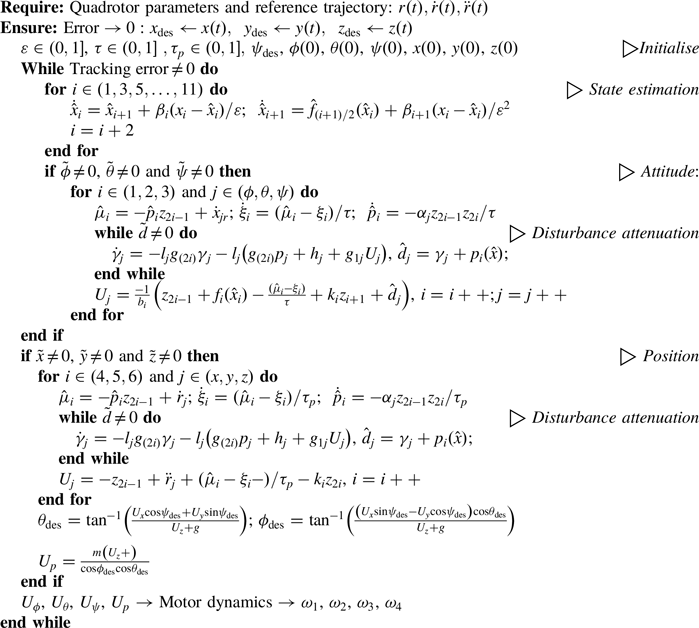
is the desired yaw angle. The complete controller design including attitude control and position control is summarised in algorithm 1 and Figure 3.
Block diagram of closed-loop control system.

Remark 4 It should be noted that the desired roll and pitch angles are obtained using Equation (33) based on auxiliary position control inputs, i.e.
 ${U_x}$
,
 ${U_y}$
and
 ${U_z}$
.
Remark 5 The auxiliary control inputs are designed using a similar approach as that of the position control along the x-axis. However, the quadrotor model accepts only one position control input. Thus, a position control is formulated using Equation (32) to guarantee the position tracking of quadrotor.
Control algorithm

Theorem 2 For a quadrotor UAV system in Equation (3), the tracking error, disturbance estimation error and state estimation errors converge to a small neighbourhood of the origin, if the controller is designed according to algorithm 3 and control gains are designed according to following criteria:
 $${{k_i} \gt 0.5,\;\;{\lambda _j} \gt 1,\;\;\tau \in \left( {0,1} \right],{\rm{\;\;}}{\tau _p} \in \left( {0,1} \right],{\beta _i}/\varepsilon \gt 1,\;\;{\beta _{i + 1}} \gt 0,\;\;{\alpha _j} \gt 0}$$
where
 $i \in \left( {1,2, \ldots, 6} \right)$
and
 $j \in \left( {\phi, \theta, \psi, x,y,z} \right)$
.
Proof. The proof follows similar steps to Theorem
 $1$
and therefore it is omitted here.
4. Simulations results
4.1. Setup of desired trajectories and disturbances modelling
The trajectory-tracking control algorithm presented in this paper is implemented on a DJI F
 $450$
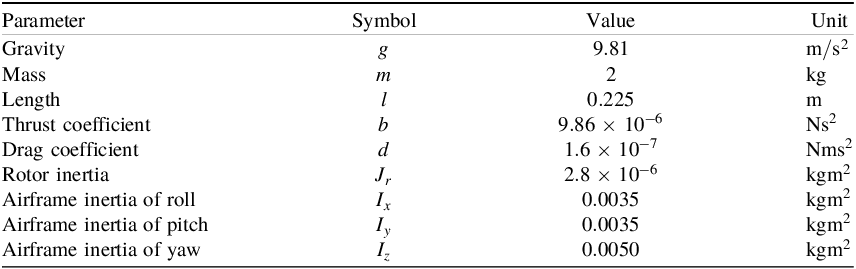
quadrotor, and simulations are performed using MATLAB/Simulink. The quadrotor parameters are selected according to Ahmed and Er (Reference Ahmed and Er2024) and Nguyen and Hong (Reference Nguyen and Hong2018) and are provided in Table 1. Simulations are conducted for spiral, circular and aggressive manoeuvre trajectories, denoted as
 $r\left( t \right) = {\left[ {\matrix{ {{x_{{\rm{des}}}},{y_{{\rm{des}}}},{z_{{\rm{des}}}}} \hfill \cr } } \right]^T}$
. For spiral trajectory,
 ${x_{{\rm{des}}}} = 3.25 - 3{\rm{cos}}\left( {{t \over {15}}} \right),{\rm{\;}}{y_{{\rm{des}}}} = 0.50 + 3{\rm{sin}}\left( {{t \over {15}}} \right),{\rm{\;}}{z_{{\rm{des}}}} = 0.5 + 0.10t$
; for circular trajectory,
 ${x_{{\rm{des}}}} = 3.25 - 3{\rm{cos}}\left( {{t \over {15}}} \right),{y_{{\rm{des}}}} = 0.50 + 3{\rm{sin}}\left( {{t \over {15}}} \right),{z_{{\rm{des}}}} = 5;$
and for aggressive maneuvers,
 ${x_{{\rm{des}}}} = 0.1t{\rm{cos}}\left( {0.5t} \right),{y_{{\rm{des}}}} = {\rm{cos}}\left( {0.5t} \right),{z_{{\rm{des}}}} = 0.5{\rm{sin}}\left( {0.5t} \right) + 2$
. Furthermore, it is assumed that the UAV quadrotor’s flight mission is opposed by six different types of disturbances, which affect each submodel of the position and attitude subsystems. Specifically, the position tracking of the quadrotor along the XYZ axes is subject to exogenous disturbances, constant disturbances and nonlinear disturbances with variable frequency and magnitude, as described below (Ahmed and Er, Reference Ahmed and Er2024):
 $${{d_\phi }\left( t \right) = A\xi ;{\rm{\;\;}}\dot \xi = {1 \over {{\kappa _\phi }}}C\xi ;{d_\theta }\left( t \right) = {\kappa _\theta }{\rm{\;\;}}\forall {\rm{\;\;}}t \gt {t_\theta };{d_\psi }\left( t \right) = v + {k_\psi }{t_\psi };k = {f_1} - {f_0}/T}$$
DJI F450 quadrotor parameters (Ahmed and Er, Reference Ahmed and Er2024; Nguyen and Hong, Reference Nguyen and Hong2018)

where
 $A = \left[ {0{\rm{\;\;}}1} \right]$
and
 $C = \left[ {0{\rm{\;\;}}{\omega _\phi }; - {\omega _\phi }{\rm{\;\;}}0} \right]$
. Here,
 ${\omega _\phi } = 0.05$
,
 ${t_\theta } = 50$
,
 ${t_\psi } = 20$
and
 $\left[ {{\kappa _\phi },{\kappa _\theta },{\kappa _\psi }{]^T} = } \right[1,1,0.2{]^T}$
. In addition,
 ${d_0} = 0$
,
 ${d_1} = 1/40$
and
 $v = 1$
are constants, and
 ${f_1} = {10^{ - 3}}$
and
 ${f_0} = {10^{ - 2}}$
denote final and initial frequencies, respectively. In addition, internal noise disturbances in the attitude model are assumed as Gaussian distributed random disturbance in roll angle with mean =
 $0.75$
, variance =
 $0.1$
, seed =
 $1$
and sample time =
 $10$
s. In pitch angle, uniform distributed random disturbance is assumed with peak-to-peak magnitude of
 $\left[ { - 0.5,{\rm{\;}}0.5} \right]$
, seed =
 $0.5$
and sample time =
 $5$
s. Additionally, in yaw angle, the disturbance assumed is modelled by band-limited white noise with noise power =
 $0.05$
and sample time =
 $1$
s.
4.2. Design of control gains
For the DOBC algorithm, the DOs must exhibit faster convergence compared with their respective controllers. To ensure that the DOs converge more quickly than the controllers, the parameters are designed as follows:
 ${\lambda _\phi } = {\lambda _\theta } = {\lambda _\psi } = 10$
for the attitude DOs and
 ${\lambda _x} = {\lambda _y} = {\lambda _z} = 2$
for the position DOs, enabling the estimation of internal and external disturbances, respectively. Additionally, the time constants for the filters are chosen as
 $\tau = 0.001$
,
 ${\tau _p} = 0.1$
and
 $\varepsilon = {10^{ - 5}}$
. The designed adaptive control gains, backstepping control gains and state-estimation gains are summarised in Table 2.
Control parameters

4.3. Trajectory tracking simulations
The simulation begins with the quadrotor at rest, with the initial conditions for positions and attitude angles set as
 ${[x\left( 0 \right),y\left( 0 \right),z\left( 0 \right),\phi \left( 0 \right),\theta \left( 0 \right),\left( 0 \right)\left] \;=\; \right[0,0,0,0,0,0]^T}$
. The simulation time is set to
 $2{\rm{\;\;min}}$
for the flight missions involving circular and spiral trajectories, whereas for aggressive manoeuvres, the simulations are conducted for
 $30$
s.
Upon simulating the closed-loop system, the quadrotor UAV demonstrates successful trajectory tracking performance. Figure 4 illustrates the trajectory tracking results and the corresponding root mean square error (RMSE) bar charts for three distinct simulated flight trajectories: circular, spiral and aggressive.
Trajectory tracking and bar-charts of RMSE.

For the circular trajectory, the quadrotor initially ascends to a height of
 $5$
m before following the desired circular path. Notably, the controller designed in this study avoids the initial overshoot observed in the comparative controller from Li et al. (Reference Li, Duan and Min2024), which experiences overshoot before stabilising along the trajectory. The accompanying bar chart of RMSE values highlights a significant reduction in position tracking errors during circular trajectory tracking. However, a noticeable increase in the RMSE along the z-axis is observed due to the initial ascent and the overshoot required to achieve the desired altitude. In the case of the spiral trajectory, the quadrotor UAV starts from the origin and successfully tracks the varying positions along the
 $x$
-,
 $y$
- and
 $z$
-axes, forming the desired spiral path. The corresponding RMSE plots for each axis indicate a substantial reduction in RMSE values during the flight.
Moreover, the controller achieves successful trajectory tracking for aggressive manoeuvres. It is observed that the quadrotor initially ascends directly to the desired trajectory before following it. In contrast, the comparative controller exhibits a slight overshoot before stabilising. This behaviour is attributed to the initial condition of the flight mission, where the quadrotor starts at the origin, while the desired trajectory begins at
 $\left( {{x_{{\rm{des}}}}\left( 0 \right),{y_{{\rm{des}}}}\left( 0 \right),{z_{{\rm{des}}}}\left( 0 \right)} \right) = \left( {0,1,2} \right)$
. Consequently, the initial ascent and overshoot are unavoidable. Nevertheless, the proposed controller demonstrates exceptional performance in tracking aggressive manoeuvres, even in the presence of disturbances, as evidenced by the significant reduction in RMSE values for these scenarios.
To avoid the repetition of the similar simulation results, the following results are only presented for the case of spiral trajectory tracking. Figure 5 presents the quadrotor’s position and attitude tracking performance during the spiral trajectory tracking mission. It is worth noting that the desired roll and pitch angles are generated by the position control, which operates as an outer-loop control, with the yaw angle initialised as
 ${\psi _{{\rm{des}}}} = \pi /12$
radians. The plots of the estimated position and attitude outputs match those of the actual quadrotor outputs. Therefore, these plots are omitted here. Instead, Table 3 is provided, showcasing the maximum and norm of the state-estimation errors.
Position and attitude tracking :
 ${[x,y,z,\phi, \theta, \psi ]^T}$
.

State estimation errors

Figure 6 illustrates the attenuation of internal and external disturbances affecting the F
 $450$
quadrotor during its trajectory tracking mission. A significant advantage of the DO proposed in this paper is its ability to estimate and reject nonlinear disturbances with unknown frequencies, in contrast to the DO presented by Li et al. (Reference Li, Duan and Min2024), which is limited to attenuating sinusoidal disturbances. Furthermore, the DO developed in this study demonstrates exceptional performance in estimating and rejecting internal disturbances, including band-limited white noise, Gaussian distributed random disturbance and uniformly distributed random disturbances.
Position and attitude DO:
 ${[{\hat {d_x}},{\hat {d_y}},{\hat {d_z}},{\hat {d_\phi} },{\hat {d_\theta} },{\hat {d_\psi} }]^T}$
.

The control inputs required to achieve trajectory tracking, disturbance attenuation and state estimation are depicted in Figure 7. Although the quadrotor’s position model is inherently underactuated, the control design presented in this paper assumes full actuation. This approach involves designing separate controllers for each axis, with the position control formulated according to Equation (32). It is noteworthy that the position control input does not reach a constant steady-state due to the persistent presence of disturbances throughout the flight mission. Instead, the control algorithm continuously attenuates disturbances during flight operations. Figure 8 illustrates the applied filters, while Figure 9 shows the forces and torques generated by each rotor. The filtering of position and attitude angles depends on the chosen time constants,
 ${\tau _p}$
and
 $\tau $
, respectively.
Position and attitude control inputs
 ${[{U_p},{U_x},{U_y},{U_z}]^T}$
.

Filters
 ${[{\xi _x},{\xi _y},{\xi _z},{\xi _\phi },{\xi _\theta },{\xi _\psi }]^T}$
.

Forces and torques.

4.4. Discussion on comparison
The control technique proposed in this paper is compared with the nonlinear DO-based backstepping control method presented by Li et al. (Reference Li, Duan and Min2024). While both methods achieve trajectory tracking, the nonlinear DO-based backstepping approach exhibits overshoot before converging to the desired trajectory. Additionally, it is limited to attenuating only sinusoidal disturbances. In contrast, the DO-based controller presented in this paper addresses six distinct types of disturbances, including nonlinear disturbances with unknown variable frequency, random disturbances and noise.
A significant advantage of the proposed control method is its adaptive auxiliary control framework, which facilitates filter design and enables online tuning of control gains when faced with unknown uncertainties and disturbances. This adaptive feature simplifies control gain tuning compared with the empirical approach required by the nonlinear DO-based backstepping technique. Specifically, the tracking errors in the proposed method can be minimised by increasing control gains,
 ${\alpha _i}$
and
 ${k_i}$
, or by reducing the time constants,
 $\tau $
and
 ${\tau _p}$
, for attitude and position control, respectively.
Both the proposed method and the nonlinear DO-based backstepping technique employ simplified mathematical models without higher-order nonlinearities or Coriolis terms. Since the control design relies on nonlinear DO, unmodeled dynamics and uncertainties can be lumped within the disturbances and effectively attenuated. To test this, random disturbances and nonlinear disturbances with variable frequency and magnitude were introduced during simulations. Despite these disturbances, the proposed control technique successfully achieved the desired flight missions, demonstrating its robustness and effectiveness.
4.5. Challenges and limitations
For the control method proposed in this paper, it should be noted that time constants cannot be tuned to very small values. While smaller time constants were observed to reduce trajectory tracking errors during simulations, they also resulted in increased control inputs, leading to unrealistic steady-state values for thrust, force and torque of each rotor. Furthermore, although the comparison method does not incorporate state-estimation capabilities, it effectively addresses the input-delay problem commonly encountered in practical quadrotor UAV operations. Thus, implementing the proposed control scheme in an experimental setup, improving the algorithm to handle input delays and establishing a systematic design criterion for time constants are significant limitations of this study.
Moreover, the control design assumes that the desired trajectory is differentiable, which can be challenging in real experiments. To address this, a command-filter-based approach or Levant’s differentiator could be integrated into the controller to achieve numerical differentiation. However, such techniques often introduce delays and differentiation errors, necessitating the development of error compensation algorithms. These considerations highlight potential areas for future research to address the identified limitations.
In summary, the control technique presented in this paper achieves remarkable trajectory-tracking performance and addresses several challenges, such as the peaking phenomenon commonly observed in high-gain observers and the repeated differentiation requirement in backstepping control. Additionally, the proposed method uses a single DO to estimate and reject linear and nonlinear disturbances, as well as noise. The algorithm relies only on measurable output information, i.e. position and attitude, making it robust to uncertain parameters of the F
 $450$
quadrotor when combined with disturbances and noise.
6. Conclusion
In this research, a trajectory tracking control algorithm has been proposed, combining a filter obtained through adaptive auxiliary control and dynamic surface control, integrated with a nonlinear DO. Additionally, a state estimation criterion based on an LPO has been incorporated into the controller. The DO is capable of attenuating both internal and external disturbances, ensuring robust control performance. Stability analysis, conducted using Lyapunov criteria, demonstrates that the closed-loop system is uniformly ultimately bounded. Based on the control design, stability analysis and simulation results, it is concluded that the controller is both effective and stable. Furthermore, it achieves impressive trajectory tracking performance in the presence of multiple unknown internal and external disturbances in an uncertain environment. Future research can focus on experimental validation, the development of controllers with filters for differentiating desired trajectories and addressing time delays in UAV systems.
Competing interests
There are no competing interests to disclose.