Introduction
Several researchers have found that difficulty in retrieving people's names is very common in the early stages of Alzheimer's disease (AD) and is highly predictive of progress to AD in individuals with probable dementia (Thompson et al., Reference Thompson, Graham, Patterson, Sahakian and Hodges2002; Semenza et al., Reference Semenza, Mondini, Borgo, Pasini and Sgaramella2003; De Jager and Budge, Reference De Jager and Budge2005; Ahmed et al., Reference Ahmed, Arnold, Thompson, Graham and Hodges2008). There is evidence that recall of people's names may be compromised in mild cognitive impairment (MCI) (Estevez-Gonzalez et al., Reference Estevez-Gonzalez2004; Joubert et al., Reference Joubert2010; Clague et al., Reference Clague, Graham, Thompson and Hodges2011; Juncos-Rabadán et al., Reference Juncos-Rabadán, Rodríguez, Facal, Cuba and Pereiro2011). However, to our knowledge, the utility of famous people naming tasks in discriminating MCI patients from normal controls looking at their sensitivity and specificity has only been directly investigated in one study (Brouillette et al., Reference Brouillette2011).
Although somewhat controversial, the term MCI is defined as a diagnostic entity for characterizing individuals who suffer from some cognitive impairment, but of insufficient severity to constitute dementia (Petersen, Reference Petersen2004). There is general consensus regarding the criteria used to diagnose MCI and the classification of MCI into two main broad types, amnestic and non-amnestic, depending on whether the memory is deteriorated or not (Albert et al., Reference Albert2011). The two main types of MCI may be differentiated into four subtypes (single domain amnestic, multiple domain amnestic, single domain non-amnestic, and multiple domain non-amnestic), depending on whether the impairment affects one or more cognitive domains (Petersen, Reference Petersen2004). The general core clinical and cognitive criteria (Albert et al., Reference Albert2011) for diagnosing MCI are as follows: (i) evidence of concern about a change in cognition, in comparison with the previous level; (ii) evidence of lower performance in one or more cognitive domains that is greater than expected for the patient's age and educational background; (iii) preservation of independence in functional abilities; and (iv) non-fulfillment of diagnostic criteria for dementia. The multiple domain amnestic MCI (mda-MCI) and single domain amnestic MCI (sda-MCI) subtypes are most likely to progress to AD and probably represent prodromal forms of AD (Dubois et al., Reference Dubois2007). Diagnostic criteria for mda-MCI include objective impairments in several cognitive domains including memory, whereas for sda-MCI include only objective memory impairments.
Brouillette et al. (Reference Brouillette2011) proposed the Memory for Names test (Mem4Names test), in which patients are required to name 72 famous people shown in pictures, to distinguish MCI from normal controls. The authors reported that the best sensitivity was 68.3% and the best specificity was 68.6% (cut-score of 49) for classifying normal controls from MCI participants (including amnestic and non-amnestic), with an AUC (area under curve ROC) value of 0.75 (95% CI = 0.66–0.84). This total correct classification value was similar to that reported by other researchers for verbal fluency tests. Verbal fluency is typically defined as the ability to produce words under specific constraints (categories or letters) within a fixed time interval (Lezak, Reference Lezak2004), and it is the core of the most widely used lexical task for detecting MCI (Taler and Phillips, Reference Taler and Phillips2009). Recent studies on the classification value of verbal fluency for detecting MCI reported AUC values ranging from 0.87%, for discriminating an unspecified group of MCI (for animals category fluency) (Cunje et al., Reference Cunje, Molloy, Standish and Lewis2007), to 70.4% and 61.7% (respectively for fruits and animals) for discriminating a group of MCI patients including multiple-domain, amnestic single-domain, and non-amnestic single domain subtypes (Radanovic et al., Reference Radanovic2009).
The main aim of the present study was to explore the potential utility of a famous people's naming task that elicited a tip-of-the-tongue (TOT) state for discriminating between aMCI patients and normal controls. Unlike the previous studies (Cunje et al., Reference Cunje, Molloy, Standish and Lewis2007; Radanovic et al., Reference Radanovic2009; Brouillette et al., Reference Brouillette2011), we restricted our investigation to the aMCI type, including the mda-MCI and sda-MCI subtypes, because it is the most likely to progress to AD. The TOT phenomenon consists of experiencing a failure to recall a word of which one has knowledge accompanied by the sensation that recall is imminent (Brown and McNeill, Reference Brown and McNeill1966) and constitutes one of the most frequently self-acknowledged types of memory failure among older adults (especially as regards recall of proper nouns). Serial and connectionist models of language production have coincided in attributing TOTs to failure in phonological activation following successful activation of the semantic representation of the target word (Burke et al., Reference Burke, MacKay, Worthley and Wade1991; Levelt et al., Reference Levelt, Roelofs and Meyer1999). We have previously shown that mda-MCI patients produce more TOTs than normal controls when naming photographs of famous people, and we have suggested that phonological activation is the main process affected in those patients (Juncos-Rabadán et al., Reference Juncos-Rabadán, Rodríguez, Facal, Cuba and Pereiro2011). A further aim of the present study was to compare the classification value of the TOT for proper names with that of the semantic fluency test used in the neuropsychological assessment.
Methods
Participants
Eighty-four participants aged over 50 years with MCI were recruited from patients attending Primary Care Health Centres in Santiago de Compostela and Vigo, Spain, with subjective memory complaints and with no prior diagnosis of cognitive impairment. All subjects met the general criteria for MCI outlined by Albert et al. (Reference Albert2011) and the criteria for aMCI proposed by Petersen and colleagues (Petersen, Reference Petersen2004; Dubois et al., Reference Dubois2007). Thirty-two of the aMCI fulfilled criteria for mda-MCI and 52 subjects fulfilled criteria for sda-MCI. All subjects fulfilled the following criteria: (1) memory complaints corroborated by an informant; (2) performance of less than 1.5 SDs below age norms for the Spanish version of the California Verbal Learning Test (CVLT), which evaluates free and cued recall of words (Benedet and Alejandre, Reference Benedet and Alejandre1998); (3) no significant impact on activities of daily living; and (4) without dementia. With respect to general cognitive functioning, the mda-MCI subjects scored less than 1.5 SDs below age- and education-related norms in the Mini-Mental State Examination (MMSE) and in at least two cognitive subscales of the Cambridge Cognitive Examination (CAMCOG-R), which assesses deterioration in specific domains such as language, attention-calculation, praxis, perception, and executive functioning (Huppert et al., Reference Huppert1996).
One-hundred and six control participants were recruited from the same Primary Care Health Centres. All control subjects scored higher than the cut-off on memory, general cognitive functioning, and specific cognitive domain tests.
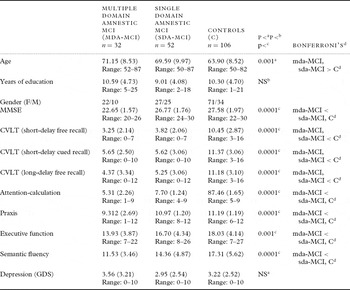
For the purposes of the present study, the participants underwent the following neuropsychological tests: (1) The Mini-Mental State Examination (Folstein et al., Reference Folstein, Folstein and McHogh1975); (2) The Californian Verbal Learning Test (Delis et al., Reference Delis, Kramer, Kaplen, Ober, Benedet and Alexander1987; Spanish version, TAVEC by Benedet and Alejandre, Reference Benedet and Alejandre1998), which assesses short-delay free recall, short-delay recall with semantic cues, and long-delay free recall; (3) The Spanish version of the CAMCOG-R, which includes subscales for specific domains such as attention-calculation, praxis, and executive functioning and is sensitive to MCI detection (Gallagher et al., Reference Gallagher2010); (4) Semantic verbal fluency, animals (Lezak, Reference Lezak2004); and (5) The Geriatric Depression Scale (GDS, short version; Yesavage et al., Reference Yesavage1983). The demographic and neuropsychological profile of the participants is summarized in Table 1, together with the differences between groups calculated by the corresponding ANCOVAs (see below in Statistical analysis).
Mean values and standard deviations (in parentheses) of the demographic and neuropsychological measures for amnestic MCI patients (split into two groups multiple domain amnestic MCI and single domain amnestic MCI) and controls

aANOVA; bANCOVA with age as a covariate; cANCOVA with age and years of education as covariates.
dIntergroup differences, Bonferroni test.
None of the participants had any history of clinical stroke, traumatic brain injury, motor–sensory defects, alcohol or drug abuse/dependence, and none were diagnosed with any significant medical or psychiatric illnesses. To control for the effects of depression, patients who scored more than ten in depression screening (GDS) were not included in the study. All participants had normal or corrected-to-normal vision and sufficient hearing ability.
All subjects gave their written informed consent prior to participation in the study. The research project was approved by the Galician Clinical Research Ethics Committee (Xunta de Galicia, Spain), and the study was performed in accordance with the ethical standards established in the 1964 Declaration of Helsinki. All participants underwent extensive evaluation, including review of their medical history, and neuropsychological assessment.
TOT task
The TOT task has been described in previous studies (Juncos-Rabadán et al., Reference Juncos-Rabadán, Facal, Rodríguez and Pereiro2010; Reference Juncos-Rabadán, Rodríguez, Facal, Cuba and Pereiro2011). Briefly, 50 color photographs (10 × 13 cm) of famous people (which in a pilot study were awarded scores of between 4 and 5 points for familiarity on a scale of 1–5, by 25 healthy adults aged between 55 and 80 years) were presented to the participants. The photographs represented famous people (actors and TV stars 28%, politicians 28%, singers 12%, and members of the royal Spanish and English families 20%) from Galicia, Spain, and other countries and from several decades in the twentieth century and from the present. In response to each picture, the participant was required to give one of three answers: (a) “I don't know the name” (DK); (b) “I know the name,” followed by pronunciation of the target word, which was counted as correct (COR) when it corresponded with the target; or (c) “I know the name but I can't recall it” (counted as a TOT). When the TOT response or an incorrect name was produced, subjects were encouraged to say everything that they knew about the person's profession; responses were classified by the researcher as full semantic knowledge if an exact and complete description of the profession was given, as incomplete semantic knowledge when the response denoted partial knowledge or a general description of the profession (i.e. “a TV presenter”), or as no semantic knowledge if an incorrect profession was given. The target name was then presented to the subject together with two non-target names, one that was semantically related (another person belonging to the same profession), and another that was not related at all. For each such triad, the subject was asked to state which of the names presented separately on the screen was the correct name of the person in the previously presented photograph. TOTs were classified as positive TOT (pTOTs) when subjects recognized the target name and said that it was the name that they had been trying to remember. When subjects said that it was not the name that they were trying to remember, the TOT was classified as a negative TOT (negTOTs).
From the measures obtained in the TOT task, we selected those variables that in previous studies (Juncos-Rabadán et al., Reference Juncos-Rabadán, Facal, Rodríguez and Pereiro2010; Reference Juncos-Rabadán, Rodríguez, Facal, Cuba and Pereiro2011) appeared to be the most relevant as regards different semantic and lexical aspects: (a) feeling of knowing, which indicates that participants were sure they knew the name of the famous person, independently of whether the name was recalled or not (Schwartz, Reference Schwartz2002), and was measured by the number of times that participants said they knew the name; (b) knowledge about the famous person, measured by the summarized scores, which indicated that an exact and complete description of the profession was given, and refers to the actual knowledge that participants displayed about the famous people; (c) semantic access was estimated by a proportional measure that represents successful access to the semantic representations of the names and indicates success in the processing stage in which meaning-based representations are activated. This was calculated by the equation ((CORs + pTOTs)/N), which was defined by Juncos-Rabadán et al. (Reference Juncos-Rabadán, Facal, Rodríguez and Pereiro2010) from the method proposed by Gollan and Brown (Reference Gollan and Brown2006), and which represents the proportion of responses that involve successful semantic access (CORs: correct answers, and pTOTs: positive TOTs) in the total number of items (N = 50); (d) phonological access was also estimated by a proportional measure that represents success in phonological access. This was calculated by the equation (CORs/(CORs + pTOTs)), which represents the proportion of successful semantic retrievals in which form retrieval is also successful (correct answers) and indicates success in the processing stage in which form-based representations are activated.
Statistical analysis
ANOVA was used to establish the starting point for age and educational differences between the aMCI and control groups. ANCOVAs, with age and years of education as covariates for controlling differences in those variables, were used to analyze neuropsychological group differences. Bonferroni's tests were used for post hoc comparisons. Levene's test was used to assess the homogeneity of variance. If the variance was not homogeneous, the Kruskal–Wallis test was used to determine the significance. Univariate and multivariate logistic regression models (Enter procedure) were used to explore the value of the TOT measures for discriminating between the entire aMCI sample (aMCI, including mda- and sda-MCI) and controls. Univariate and multivariate analyses to single and multi-domain subtypes of aMCI separately were not performed because the subgroups were not large enough to produce reliable results. Feeling of knowing, semantic knowledge of the person, semantic access, phonological access were considered independent variables, and the presence or absence of aMCI were considered as dependent variables. Semantic verbal fluency was also considered as an independent variable for comparison. All scores were converted to categorical variables, and the median value was considered as a cut-off for determining low and high levels of performance. The prevalence of aMCI, relative to controls and according to each independent variable, was estimated from the number and percentage of cases and odds ratios (ORs), with 95% confidence intervals (CI). Only those variables that were significantly (p < 0.05) associated with aMCI in the univariate model were considered for the multivariate logistic regression models. Logistic regression with maximum likelihood estimators was used because the two groups did not have identical covariance matrices (Box Test, F = 49, 51; p < 0.01) (Press and Wilson, Reference Press and Wilson1978). Receiver-operating characteristic curve (ROC) analyses were used to determine the AUC determined by the multivariate logistic models. All statistical analyses were performed with SPSS for Windows, version 18.0.
Results
The ANCOVAs on neuropsychological measures (Table 1) revealed that, as expected, all the aMCI patients displayed memory impairment, and that the mda-MCI patients differed significantly from sda-MCI in general cognitive functioning (MMSE) and in specific domains such as attention, praxis, and executive functioning. The sda-MCI group differed significantly from controls in memory measures, but not in MMSE or in other specific domains, thus confirming the isolated nature of memory impairment in this group.
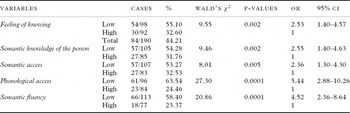
Univariate regression analyses showed that all TOT variables significantly predicted aMCI (see Table 2), which indicates that the rate of incidence increased significantly when the feeling of knowing (OR = 2.53; 95% CI = 1.40–4.57), the semantic knowledge of the person (OR = 2.55; 95% CI = 1.40–4.63), the semantic access (OR = 2.36; 95% CI = 1.30–4.30), and the phonological access (OR = 5.44; 95% CI = 2.88–10.26) to names were low.
Prevalence of amnestic MCI, including mda-MCI and sda-MCI subgroups, versus controls according to the performance (low and high) of lexical variables (univariate logistic regression)

To assess the predictive value of the TOT measures for discriminating between normal controls and aMCI patients, a multivariate logistic regression model (Model 1), which included feeling of knowing, semantic knowledge of the person, semantic access, and phonological access (all significant in univariate analysis), was constructed. Only phonological access (OR = 5.13; 95% CI = 2.64–10.00) remained significantly associated with aMCI, and the OR was similar to that obtained in the univariate analysis. The Hosmer and Lemeshow test revealed a satisfactory goodness-of-fit measure for the model (χ2 = 3.57, f.d. = 5, p = 0.613). Model 1 correctly classified 70% of controls (specificity) and 71.6 of aMCI patients (sensitivity); the AUC value (ROC analysis) was 0.74 (95% CI = 0.67–0.81) and accounted for 23.5% (Nagelkerke R2) of the variance (see Table 3).
Multivariate logistic regression model (Model 1) including only the TOT measures

To compare the value of the TOT variables included in Model 1 with the value of semantic verbal fluency for differentiating aMCI patients from controls, univariate regression analysis was applied to the semantic verbal fluency scores (animals) as the dependent variables. The analysis revealed that the incidence of aMCI increased significantly when the semantic verbal fluency decreased (OR = 4.52; 95% CI = 1.51–6.68). Semantic verbal fluency correctly classified 55.2% of controls (specificity) and 78.6% of aMCI patients (sensitivity); the AUC value was 0.66 (95% CI = 0.59–0.74) and accounted for 15.4 (Nagelkerke R2) of the variance.
As the univariate analysis indicated that semantic verbal fluency was significant, another multivariate model was constructed (Model 2) to test the added value of semantic verbal fluency to the Model 1. Model 2 showed that only phonological access (OR = 3.55; 95% CI = 1.75–7.21) and semantic fluency (OR = 3.18; 95% CI = 1.51–6.68) were significantly associated with aMCI. Model 2 (χ2 = 4.51, f.d. = 5, p = 0.478) correctly classified 80% of controls (specificity) and 65.4% of aMCI patients (sensitivity); the AUC was 0.77 (95% CI = 0.70–0.84) and accounted for 28.9% (Nagelkerke R2) of the variance (see Table 4).
Multivariate logistic regression model (Model 2) including TOT measures and semantic fluency

Discussion
The results of this study show that TOTs for proper names successfully differentiated between aMCI patients and normal controls. This provides new evidence for the previously reported deterioration of the retrieval of people's names in MCI (Estevez-Gonzalez et al., Reference Estevez-Gonzalez2004; Joubert et al., Reference Joubert2010; Clague et al., Reference Clague, Graham, Thompson and Hodges2011; Juncos-Rabadán et al., Reference Juncos-Rabadán, Rodríguez, Facal, Cuba and Pereiro2011). Each of the measures related to semantic (feeling of knowing, semantic knowledge of the person, and semantic access) and phonological processes (phonological access) was separately associated (significant ORs) with aMCI. These findings are consistent with previous reports of semantic (Clague et al., Reference Clague, Graham, Thompson and Hodges2011) and phonological (Juncos-Rabadán et al., Reference Juncos-Rabadán, Rodríguez, Facal, Cuba and Pereiro2011) deficits in naming of proper names by MCI sufferers. However, the most interesting outcome of this study (and directly related to the main aim) was the classification value of Model 1 composed by the four TOT measures. The sensitivity (71.6%), specificity (70%), and AUC value (0.74) for classifying aMCI patients from normal controls were adequate and slightly higher than those obtained by Brouillette et al. (Reference Brouillette2011) in the Mem4Names test. The proportion of variance explained by the model was almost 25%, which is quite high considering that only the TOT variables were entered in the model. This indicates that other cognitive processes, such as semantic memory, working memory, and processing speed that underlying the TOT phenomenon (Facal et al., Reference Facal, Juncos-Rabadán, Rodriguez and Pereiro2012), may be compromised in aMCI together with episodic memory, which is the main cause of aMCI, according to the usual classification (Petersen, Reference Petersen2004).
Another interesting aspect of the present study was the comparison between Model 1 and semantic verbal fluency. As expected and consistently with previous studies (Cunje et al., Reference Cunje, Molloy, Standish and Lewis2007; Radanovic et al., Reference Radanovic2009), semantic verbal fluency successfully differentiated between aMCI and normal controls. The total classification value (AUC = 0.66%) and the variance accounted for (15.4) were lower than those of Model 1. Addition of semantic verbal fluency to the TOT measures in Model 2 increased the total classification value by 0.03% and the explained variance by 0.05%, with respect to Model 1.
Although Model 1 comprised all TOT variables, only the phonological access measure remained significantly associated with aMCI, with an OR similar to that obtained in the univariate analysis. The other semantic variables that were significant in univariate analysis lost their significance when they were included in the multivariate model. The explanatory power of the phonological access variable was also maintained in Model 2 when semantic verbal fluency was included, and the OR was even higher than for the latter variable. These findings are consistent with the hypothesis maintained by our team in previous studies (Juncos-Rabadán et al., Reference Juncos-Rabadán, Rodríguez, Facal, Cuba and Pereiro2011), which considers that phonological accessing is the process most affected in TOT events for proper names in aMCI patients and involves a greater deficit in transmission of the activation from semantic to phonological representations than that produced by age in normal control groups (Burke et al., Reference Burke, MacKay, Worthley and Wade1991; Juncos-Rabadán et al., Reference Juncos-Rabadán, Facal, Rodríguez and Pereiro2010). Together, the results of the univariate and multivariate analyses appear to indicate that, as phonological processes are the most affected in aMCI, semantic processes may also deteriorate (Joubert et al., Reference Joubert2010; Clague et al., Reference Clague, Graham, Thompson and Hodges2011).
One limitation of the current study is that we were unable to apply univariate and multivariate analyses to single- and multi-domain subtypes of aMCI separately, as the subgroups were not large enough to produce reliable results. We hope in the near future to obtain new data on comparisons between the two aMCI subgroups.
In summary, TOTs for proper names may sensitively discriminate aMCI patients from normal controls with a variable that represents phonological access (one of the processes most affected). Indeed, correct classification of these groups can be difficult, even with a complex battery of instruments, and represents an important neuropsychological challenge.
Conflict of interest
None.
Description of authors’ roles
Onésimo Juncos-Rabadán designed the study, supervised the data collection, and wrote the paper. David Facal collaborated in the design of the study, implemented the study, and collaborated in writing the paper. Cristina Lojo-Seoane collected data and collaborated in the statistical analyses. Arturo X. Pereiro collaborated in the design of the study, was responsible for the statistical analysis, and collaborated in writing the paper.
Acknowledgments
This work was supported by the Spanish Directorate General for Science and Technology under Projects SEJ2007-67964-CO2-01 and PSI2010-22224-C03-01.