One way or another, grammatical change is nearly always a stepwise process. Innovative forms spread gradually through the grammar of a language, occurring earlier or establishing themselves faster in some grammatical contexts than in others (Aitchison, Reference Aitchison1991:85–88; Harris & Campbell, Reference Harris and Campbell1995:chap. 5). The literature abounds with examples of gradual change, particularly so the literature on grammaticalization (Bybee, Perkins, & Pagliuca, Reference Bybee, Perkins and Pagliuca1994; Hopper & Traugott, Reference Hopper and Closs Traugott2003). A few examples should suffice here to make the point. Lee (Reference Lee2011) found that English much is developing from a predominantly positive polarity item into a strictly negative polarity item. She reported that the change takes place faster for adverbial uses of much, as in (1a), than for pronominal uses, as in (1b).
(1)
a. Mr. Bond did not worry much about Pat (1856, COHA)
b. “They didn't bring much,” he said. (1875, COHA)
Chappell (Reference Chappell2008) discussed the development of the verb shuō ‘say’ into a complementizer in Beijing Mandarin. She suggested that the complementizer use first combined with perception and speech act verbs and later also with cognition verbs, such as juéde ‘think, feel’ in (2) (cf. Güldemann, Reference Güldemann, Güldemann and von Roncador2002).
(2) wǒ zǒngshi juéde shuō, shēnghuó-lǐ; quē-le diănr shénme
I always feel say life-in miss-PFV little something
‘I always feel that there is something a little lacking in my life.’ (quoted from Chappell, Reference Chappell2008:84)
De Smet and Van de Velde (Reference De Smet and Van de Velde2013) described the development of Dutch wie weet ‘who knows’ from a clausal matrix, as in (3a), into an epistemic adverb, meaning ‘maybe’. As an adverbial, wie weet first appeared in the clausal periphery, as in (3b), then in clause-initial position, as in (3c), and finally in other clause-internal positions, as in (3d).
(3)
a. … en wie weet of hunne dikwijls herhaalde argumenten niet eenigen indruk op 's Konings gemoed gemaakt hebben. (1841, CHK)
‘… and who knows if their oft-repeated arguments have not left some impression on the King's mind?’
b. Maar wie weet! De tyd vermag alles, en dien vooruit te loopen, zou alles bederven. (1874, CHK)
‘But who knows! Time can do anything, and to run ahead of it would spoil everything.’
c. Enfin, wie weet gebeurt het nog eens. (1907, CHK)
‘Anyway, maybe it comes to pass sometime.’
d. Ik knik, opgelucht dat hij iets van zichzelf laat zien, iets dat ik herken en op grond waarvan er wie weet nog iets als een band kan ontstaan. (2002, TNC)
‘I nod, relieved that he reveals something of himself, something I recognize and on the basis of which something like a connection could perhaps still develop.’
In all of these cases, change seems to spread through the grammar of the language, affecting one context after another. Gradual changes can be thought of as a special manifestation of the “constraints problem” first described by Weinreich, Labov, and Herzog (Reference Weinreich, Labov, Herzog, Lehmann and Malkiel1968:101). An understanding of language change presupposes an understanding of what are possible changes. This includes understanding the conditions under which speakers can come up with innovative linguistic behavior. Taking the form of a sequence of successful innovations, the progression of gradual change suggests a mechanism by which different steps of change successively become possible. It is this mechanism that is the focus of the present paper.
So far, the gradualness of grammatical change has predominantly been interpreted in terms of a reanalysis-and-actualization model (Harris & Campbell, Reference Harris and Campbell1995; Langacker, Reference Langacker and Li1977; Timberlake, Reference Timberlake and Li1977). That model holds that an expression is assigned a new underlying structure in ambiguous contexts (reanalysis), in response to which its grammatical surface behavior gradually changes (actualization). For example, on this view, Dutch wie weet, illustrated in (3), was first reanalyzed as an epistemic adverb in contexts that allowed the new analysis. Consequently, it picked up the full behavior expected of epistemic adverbs, spreading to new contexts incompatible with the old analysis. The model is problematic, however (De Smet, Reference De Smet, Coussé and Von Mengden2013a; Fischer, Reference Fischer2007; Haspelmath, Reference Haspelmath1998). Even though actualization is recognized as gradual, there is nothing in the reanalysis-and-actualization model to explain the gradualness. For example, if it is an epistemic adverb, then why does adverbial wie weet still resist clause-internal uses other than in clause-initial position? In fact, since the reanalysis-and-actualization model interprets reanalysis as abrupt, the gradualness of actualization is at odds with it.
An alternative model holds that the steps of change, rather than being independently caused by a prior reanalysis, are caused by one another. This line of thinking has its roots in modeling approaches to language change (e.g., Skousen, Reference Skousen1989; Tabor, Reference Tabor1994). I will here refer to this view on grammatical change as the cascade model. According to the cascade model, the likelihood of any given (step of) change is determined by the resemblance of its outcome to already established constructions (see also Denison, Reference Denison1986; De Smet, Reference De Smet2012; Naro, Reference Naro1981; Petré, Reference Petré2012; Rosemeyer, Reference Rosemeyer2014). This gives potential new steps of change different likelihoods, which explains why they do not occur all at the same time. The reason change can progress beyond the first most likely steps is that each step taken produces new analogical models to base subsequent changes on, thereby shifting the likelihoods for potential new steps.
The history of Dutch wie weet, as illustrated in (3), can be reinterpreted in terms of the cascade model. As a matrix clause, wie weet developed epistemic meaning. Its subsequent formal development was determined by the similarity relations wie weet maintained or newly entered into. At first, these included its formal similarity to other matrix clauses and its semantic resemblance to epistemic adverbs. The analogical pull exerted by those conflicting models explains why wie weet first extended to peripheral contexts, where it could pass both for an adverb and for an elliptical matrix clause. But once the peripheral uses were established, these became a bridgehead to the development of uses in other more strictly adverbial contexts. Consequently, wie weet spread to clause-initial position, syntactically behaving as an adverb, but in a position where it resembled its newly established clause-peripheral use and still looked somewhat like a clausal matrix. As the clause-initial use emerged, other clause-internal uses received additional analogical support and eventually appeared too. As such, each step of the long-term development is a response to previous steps through local analogies operating over highly specific constructions.
The cascade model has important advantages over the reanalysis-and-actualization model. It does not have the teleological flaw inherent in the reanalysis-and-actualization model, it is compatible with gradualness and it can better predict the specific sequence of steps in a given gradual change (De Smet, Reference De Smet2012). Moreover, the cascade model can be extended to changes that do not involve syntactic category change, such as lexical diffusion (De Smet, Reference De Smet2013b; Rosemeyer, Reference Rosemeyer2014).
Underlying the cascade model, there can be assumed a simple dynamic at work: shifts in what is conventional change also what is conceivable. By default, innovations are intrinsically unlikely. That is both because speakers avoid deviation from convention and because for the linguistic coding of experience they will automatically home in on conventional means first. What is conventional will be better entrenched and constitute a more or less automated mental routine (Langacker, Reference Langacker1987:57–59). In mental retrieval such routines will typically outcompete any less conventional means of expression (cf. Kapatsinski, Reference Kapatsinski2009:168). Grammatical innovations can only happen when a speaker defeats the odds by retrieving and selecting an expression despite its being unconventional in a given grammatical context—what is called “partial sanction” in Langacker (Reference Langacker1987:71). There are at least two factors that can shift the odds in favor of the unconventional. First, an unconventional expression will be likely if its deviation from convention is so minimal as to be (almost) undetectable—hence the role of analogy in gradual change. Second, this effect will be the stronger, the more accessible the analogically related conventional expressions are in mental retrieval. This will eventually depend on how well established they are. To stick with the example of adverbial wie weet, the more conventionalized the clause-initial use becomes, the stronger the analogical support it offers to other clause-internal uses.
Arguably, then, new and unconventional coding solutions can arise to the extent that speakers have easy mental access to any analogically related conventional coding solutions. Assuming a trade-off in language processing between storage and computation, one could say that the retrievability of associated stored patterns “saves” computational effort, which can be “spent” again in the creative assembly of a new unconventional pattern. This interaction between the conventional and unconventional should repeat itself with each step of a gradual change.
From this hypothesized dynamic, testable predictions can be derived. The dynamic predicts that the more readily retrievable a conventional use of an expression is, the better are its chances of being used also in similar but unconventional ways. If the hypothesis holds, new uses of an expression should show up under circumstances that facilitate the expression's retrieval. As already hinted at, conventionalization links naturally to Langacker's (Reference Langacker1987) notion of entrenchment, which is associated with discourse frequency. At the same time, retrievability can also be temporarily boosted by priming, which is primarily associated with recency. So the general prediction can be split out into two more specific ones. First, an innovation should become more likely as one of the patterns from which it receives analogical support becomes more firmly entrenched. This prediction will here be tested against individual variation, with frequency differences in the usage of individual speakers taken to reflect different degrees of entrenchment (cf. De Smet, Reference De Smetforthcoming; Schmid & Mantlik, Reference Schmid and Mantlik2015). Second, an innovation should also be more likely when one of its analogical support patterns has recently been activated by priming. This prediction will here be tested against the effect of direct priming in discourse and indirect priming through collocational associations.
The change that is to be subjected to these predictions here is a relatively simple one, the development of English key from a noun into an adjective (Denison, Reference Denison and Brinton2001). In what follows, the development is examined in detail, drawing on a dataset collected from the Hansard Corpus (HC). Some necessary background is presented on the development of key into an adjective, and the corpus data are discussed. Next, the different procedures for testing the hypothesis and their results are described. The analysis of the data largely supports the predictions. Innovative uses of key are found to typically occur under conditions that improve the retrievability of already established uses of key. Innovations are more likely to occur in individual speakers who frequently rely on conventional uses of key. Innovations are also more likely to occur when conventional uses of key have been primed. This is consistent with the mechanism hypothesized to underlie gradual grammatical change, adding further support to the cascade model of change.
Note at the outset that this paper focuses exclusively on the language-internal side of change. If the cascade model presented here is correct, it still offers only a rough sketch that is blind to the social dimensions of change. The question that guides the present discussion is which language-internal conditions are to be met for speakers to produce innovative linguistic structures.
BACKGROUND
The development of English key from a noun into an adjective has already received ample attention in the literature (Denison, Reference Denison and Brinton2001, Reference Denisonforthcoming; De Smet, Reference De Smet2012; Van Goethem & De Smet, Reference Van Goethem and De Smet2014; Vartiainen, Reference Vartiainen2013). The beginning of the change has been situated in the second half of the 20th century (Denison, Reference Denison and Brinton2001; De Smet, Reference De Smet2012; Vartiainen, Reference Vartiainen2013:175–176). The change is illustrated by the examples in (4). Key in (4a) functions as the first element of what is in all likelihood a noun-noun compound, key phrases. In other words, key is probably a noun here. In (4b), key is separated from observations by an intervening adjective, experimental. Because the English noun phrase normally has adjectival premodifiers placed before nominal premodifiers (Denison, Reference Denison and Brinton2001), the ordering in (4b) suggests that key is an adjective. It almost certainly is an adjective in (4c), where key is used with very, an intensifier typically found with adjectives. Key is also very likely to be an adjective in (4d), where it is used predicatively and without the determiner a count noun would normally require in this position.
(4)
a. The proposed wording of the possible agreement was given to Dr. Adenauer with certain key phrases in blank. (1952, quoted from De Smet, Reference De Smet2012: 623)
b. Therefore, we shall start our description of the behavior of electric charges in motion by summarizing the key experimental observations. (1961, ibid.)
c. He alienated a lot of very key political players in this town. (1991, ibid.)
d. Her confirmation was key because symptoms like the kind I had can be caused by other factors, too. (1991, ibid.)
The existing literature leaves little doubt that the development of key is a gradual process (see in particular Denison [Reference Denison and Brinton2001] and De Smet [Reference De Smet2012]). Although finer-grained distinctions are possible, for present purposes, three major stages will be distinguished. First, key became increasingly productive as the first element in noun-noun compounds. This stage will be referred to as the compounding stage. The compounding stage is illustrated in (5) (or (4a)). Note that key-compounds may consist of more than two nouns, as in (5b).
(5)
a. … the Government's desperate desire to shield themselves from effective scrutiny in the first key hours. … (1996, HC)
b. … not a key election pledge, but an important pledge. (1999, HC)
Later, key began to appear in constructions that are not exclusively adjectival but much more strongly associated with adjectives than with nouns. While these constructions still marginally allow an analysis of key as a noun, their appearance indicates that the syntactic tie between key and its head is loosening. This stage will be referred to as the debonding stage (after the concept of “debonding” introduced by Norde [Reference Norde2009] and applied to noun-to-adjective shifts in Van Goethem & De Smet [Reference Van Goethem and De Smet2014]). Constructions characteristic of the debonding stage include one-substitution, as in (6a), and the use of key before a premodifying adjective, as in (6b) (or (4b)).
(6)
a. The year 1991 was the key one, when the modern scheme came into operation. (1996, HC)
b. … access to most of the key official documents in the Sandline affair. (1999, HC)
Finally, key adopted behavior that is exclusively adjectival. This is the adjective stage. Constructions characteristic of the adjective stage include adverbial premodification, as in (7a) (or (4c)), coordination to other adjectives, as in (7b), predicative use, as in (7c) (or (4d)), or any combinations of these.
(7)
a. NATO … is playing an equally key part in building the peace. (1998, HC)
b. It is true to say that we are setting some key and important issues on one side. (1995, HC)
c. When he elaborated on those special circumstances, one seemed to be key. (1997, HC)
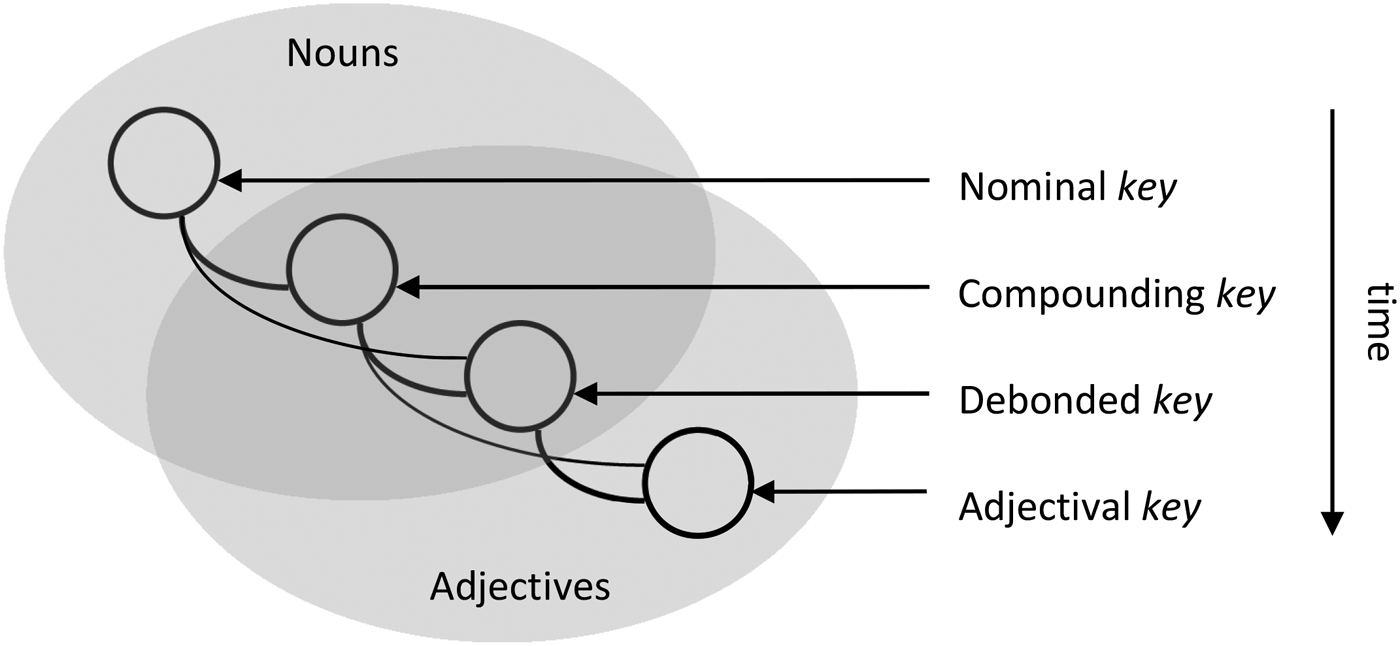
As is typical of gradual change, the steps of change overlap. This holds also for the stages in the development of key. As will be shown, the increase in the productivity of key-compounding continues during the debonding and adjective stages. Likewise, debonded uses continue to grow in frequency during the adjective stage. That said, there is a clear temporal order in the onset of the steps. By way of summary, Figure 1 visualizes the different uses of key, as have been defined, highlighting the analogical relations holding between them and placing them in the larger constructional networks of noun phrases and adjective phrases under which they resort.
Analogical relations between the developmental stages of key and their place within the broader categories of nouns and adjectives.

DATA
Data on the history of key were drawn from the Hansard Corpus. The corpus, compiled by Marc Alexander, is made up of material available from the online Hansard Archive.Footnote 1 It contains transcripts of the parliamentary debates that took place in the British Houses of Parliament, covering almost the entire 19th and 20th centuries. Data on key were collected from the transcripts dating from the 1970s, 1980s, and 1990s, which is the period that roughly coincides with the onset of the debonding and adjective stages in the history of key. More details on data extraction procedures are given in the following sections, as they differ from case study to case study.
The spoken data represented by the Hansard Corpus differ fundamentally from the speech language users produce in spontaneous conversation. Probably, many parliamentary interventions have been prepared in writing, perhaps sometimes by others than the speaker they are attributed to. It is also obvious that the transcripts of parliamentary debates have been heavily postedited. They lack the hesitations, false starts, inconsistencies, and repetitions that are characteristic of spontaneous speech and that are inevitable even in a well-prepared delivery. Nevertheless, there were at least two good reasons for using the Hansard Corpus here. One major advantage of the Hansard Corpus is that it allows tracking of individual speakers over time, with very extensive amounts of data available for the more active members of parliament. This property of the corpus was exploited in the case studies addressing entrenchment effects. The other important advantage of the data is that parliamentary debates are organized into conversational turns. Members of parliament, when taking the floor, typically respond to a previous turn. It is this property of the corpus that was taken advantage of in the case study on priming effects.
FINDINGS
The following sections apply the predictions made by the cascade model to the history of key, testing them on data drawn from the Hansard Corpus. The discussion starts by addressing the effects of entrenchment, and then moves on to priming effects.
Entrenchment
The cascade model predicts that innovative patterns should benefit from the entrenchment of any similar-looking patterns. As key-compounds become better entrenched, the extension of key to debonded and adjectival uses is expected to become easier. Likewise, increased entrenchment of debonded uses should facilitate the emergence of adjectival uses. Taking discourse frequency as a proxy to entrenchment, these predictions are borne out by the long-term development of key, with its specific sequence of stages. Compounding uses appeared before debonded uses, which appeared before adjectival uses. However, because this sequence of change is derived from aggregate data, it generalizes over individuals. There is something of a logical leap in invoking a social phenomenon (the development of key in English) to support a psychological claim (entrenchment and analogy at work in individual speakers) (cf. Schmid & Mantlik, Reference Schmid and Mantlik2015). It is on such grounds that Bergs (Reference Bergs2005:5) argued that:
any claim about cognitive, universal or typological determinants of linguistic change need not only hold for the level of the speech community or its subgroups, but also for a substantial number of speakers in isolation, if it wants to reflect reality.
Therefore, more convincing evidence in support of the hypothesis would be obtained if the prediction also holds for individual variation. For example, speakers differ from each other in the extent to which they rely on key-compounding. That is straightforwardly reflected in their usage frequencies. Assuming again that those usage frequencies can serve as a proxy to entrenchment, they should predict which speakers are most likely to produce the more innovative debonding and adjectival uses. On this logic, synchronic variation across individuals is to respect the pattern of diachronic change observed in the overall population. More precisely, speakers' behavior should follow a probabilistic implicational hierarchy, such that behavior characteristic of a diachronically later stage is most likely to be found in speakers displaying the behavior associated with diachronically earlier stages (cf. Paunonen, Reference Paunonen1976). Indeed, a failure to confirm this could falsify the cascade model. If the steps of a gradual change truly follow from one another, it is expected that an individual should be less likely to adopt a (diachronically) later step if they have not yet adopted the earlier step, even when the later step is already available in the larger population.
In order to study the behavior of individual speakers, those speakers were selected from the Hansard Corpus who produced at least 300,000 words of running text over one decade (i.e., the 1970s, 1980s, or 1990s). Speakers were selected only from the House of Commons transcripts, where speakers are consistently identified by their full name. A total of 169 different speakers matched the criterion. Of these, 32 produced over 300,000 words of text in two consecutive decades and six did so in three consecutive decades. This gives us the split up of speakers over decades reproduced in Table 1, with accompanying total word counts per decade. The rightmost column provides the total number of instances of key, prior to manual exclusion of noise.
Division of data over speakers and decades

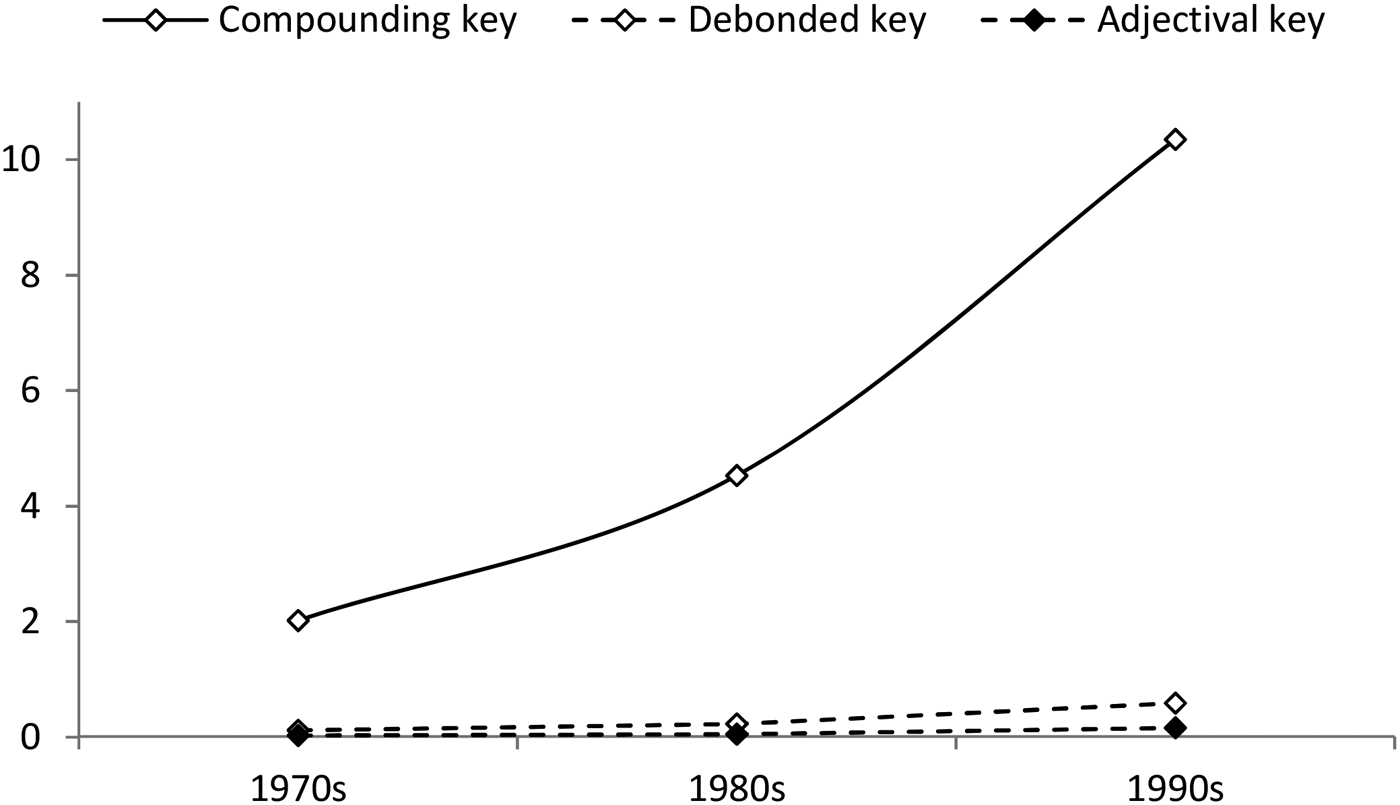
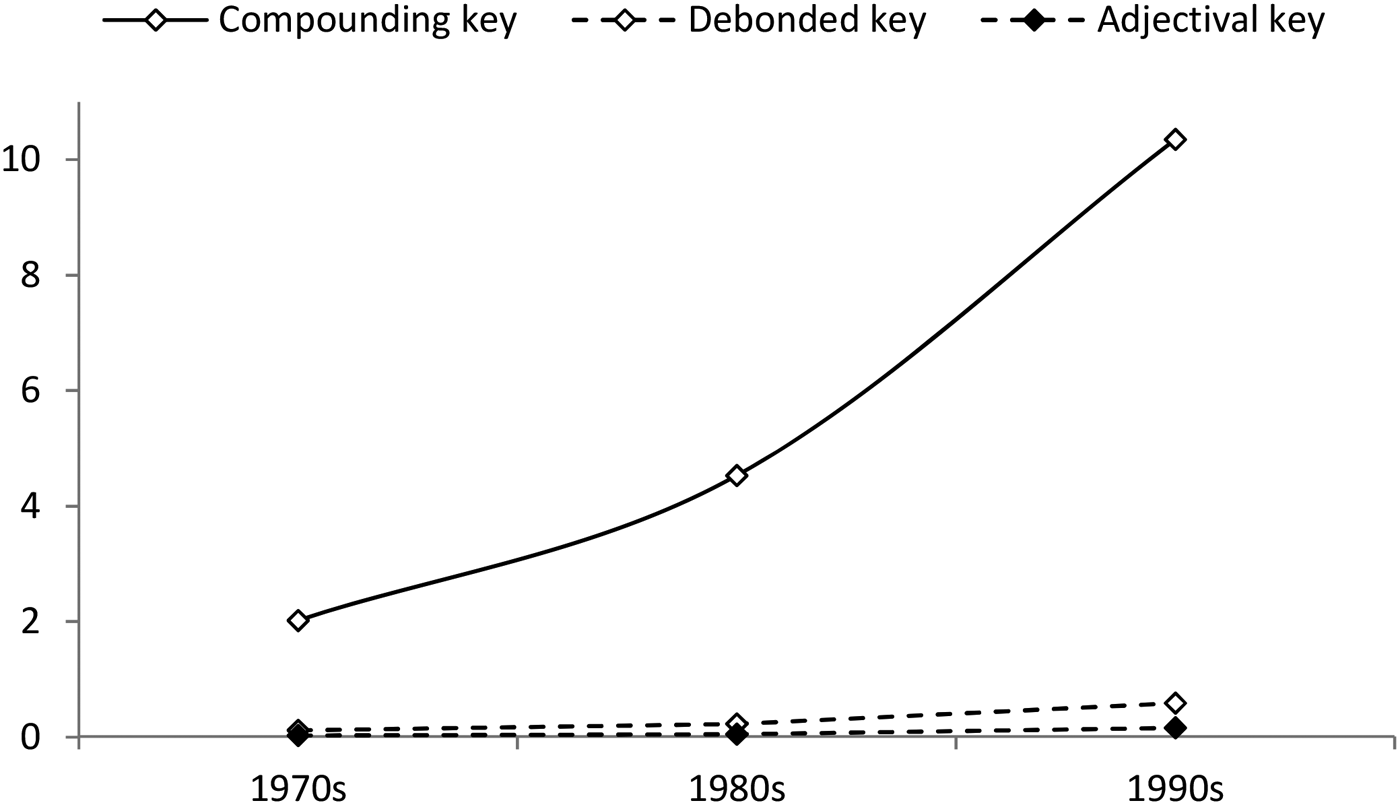
From the subcorpus described in Table 1, all instances of key were extracted and linked to the individual speakers who produced them. The examples were manually annotated, sifting out noise and distinguishing between nominal, compounding, debonded, and adjectival uses. Figure 2 gives the normalized frequencies of the different uses of key centrally at issue here. In the aggregate data for the period, debonded and adjectival uses never rise above a frequency of 0.6 per 100,000 words. Compounding uses are much more frequent, on average about 18 times more frequent than debonded uses, which in turn are about 4 times more frequent than adjectival uses. This is in line with the diachronic sequence of stages. The frequencies justify treating the debonded and adjectival uses of key as (relatively) unconventional and innovative in the period under study, while the compounding uses are treated as (relatively) conventional and established.Footnote 2 Finally, it should be clear that even the large corpus used here contains rather few of the innovative debonded and adjectival uses. To compensate for that, the case studies in this and the following sections either collapse the distinction between debonded and adjectival uses, or else collapse that among the three subperiods.
Normalized frequency of key in compounding, debonded, and adjectival use (frequencies per 100,000 words); n speakers = 169, n observations = 4826.
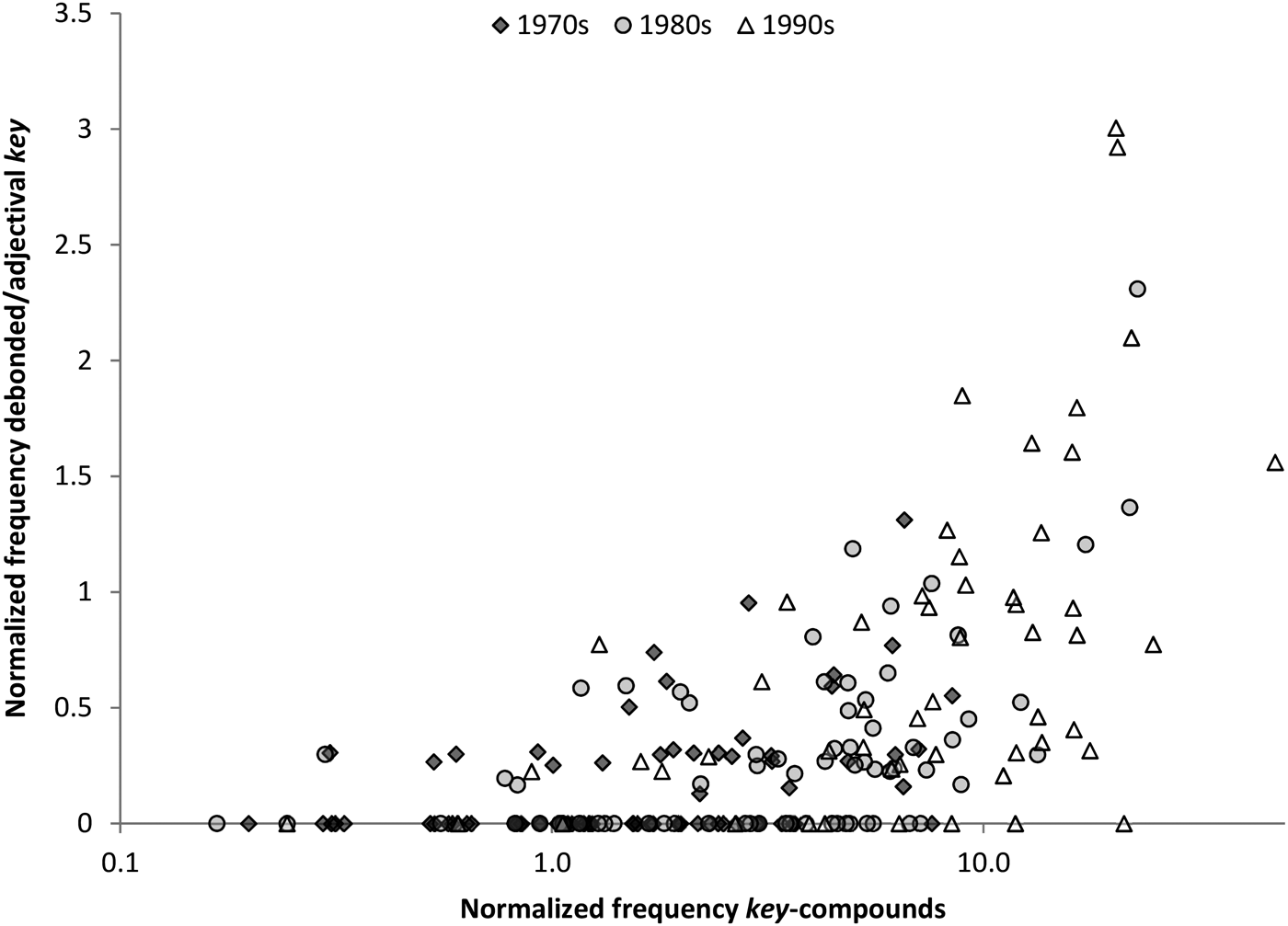
Using the annotated dataset, a usage profile was determined for every speaker in the corpus. On this basis, it could be investigated whether individuals’ synchronic behavior reflects the diachronic trends in the population. Figure 3 plots individual speakers with respect to their advancement on the different stages of the historical development of key.Footnote 3 Specifically, their use of key-compounding (x-axis) is set out against their use of debonded and adjectival key (y-axis). It is found that individual speakers' usage profiles reflect the diachronic order of events. The likelihood for a speaker to use debonded or adjectival key increases with their reliance on compounding key. The trend is seen in all three decades (R 2 = .26 for the 1970s; R 2 = .52 for the 1980s; R 2 = .27 for the 1990s).Footnote 4 This confirms the idea that stronger entrenchment of key-compounding will make it easier for speakers to select key in the similar, but comparatively unconventional debonded and adjectival contexts. While correlation cannot prove causality, it is at least in line with the interdependence assumed to exist between the steps of a long-term development.
Speakers' use of debonded/adjectival key as a function of their use of key-compounding; n speakers = 169, n observations = 4826.
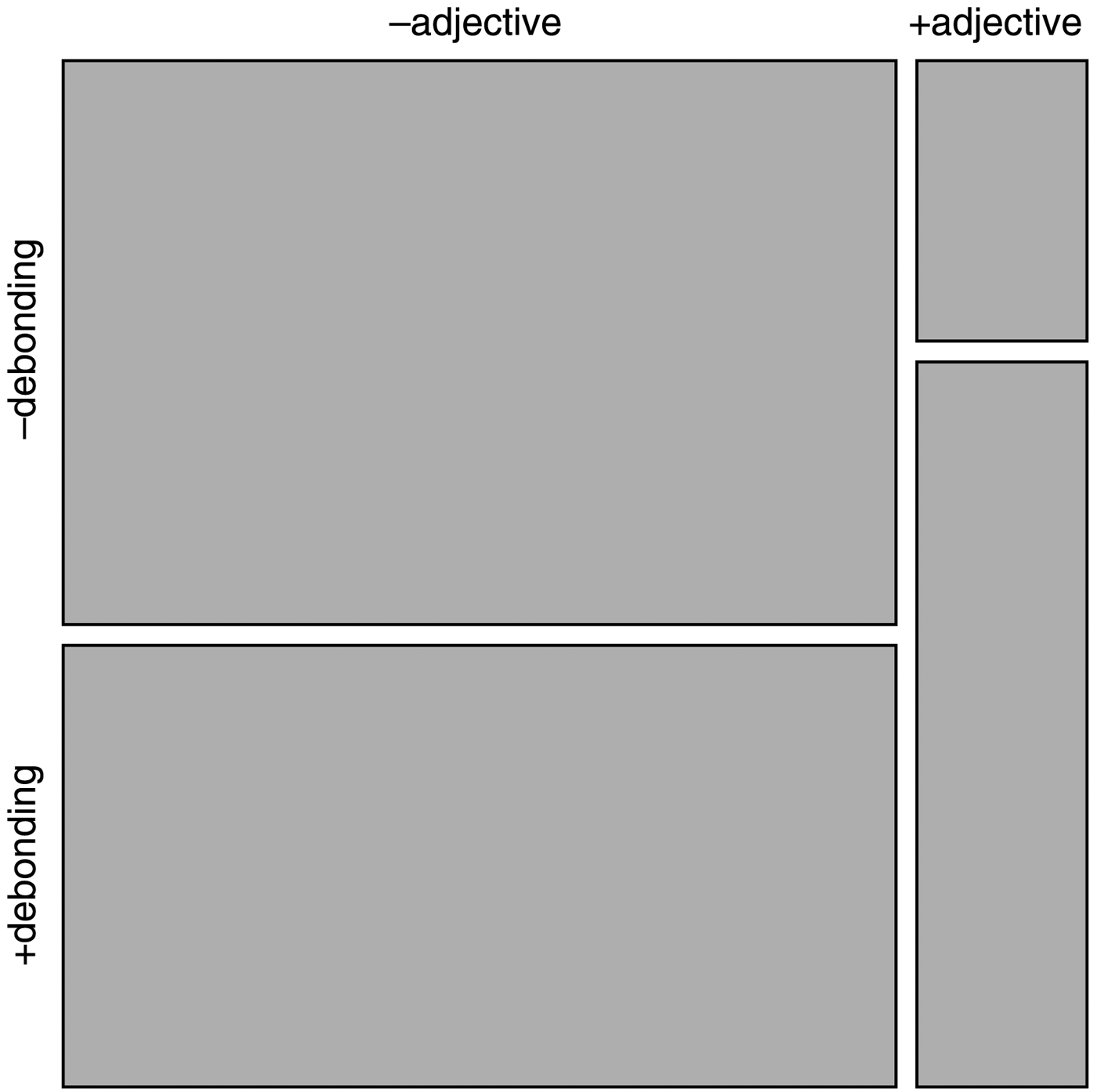
To corroborate this interpretation, a number of additional aspects of individual variation were investigated. First, there should also be a correlation between speakers' use of debonded key and their use of adjectival key. Because the incidence of those two constructions is much lower in the dataset, the different decades were collapsed. Next, simple distinctions were made (i) between speakers who do or do not display debonded key and (ii) between speakers who do and do not display adjectival key. This produces four speaker types, defined by the variables [± debonded key] and [± adjectival key]. The distribution of the four types in the dataset is visualized in the mosaic plot in Figure 4. Specifically, the relative share of the four speaker types in the sample is reflected in the size of the corresponding cells of the plot. The most common speaker type, [– adjectival key; – debonded key], is the one that shows none of the innovative constructions, which suggests that the new uses of key are not being adopted by all speakers yet (confirming their innovative status, cf. note 2). The least common speaker type, [+ adjectival key; – debonded key], is the one that shows evidence of adjectival key but not of debonded key. That is the speaker type whose behavior does not reflect the diachronic trend in the population. Most importantly, the plot shows that if speakers use debonded key, they are also more likely to use adjectival key (Pearson's χ2 9.49, p = .002; φ = .211). This is consistent with the cascade model, which assumes that availability of the debonded use facilitates extension to the adjectival use.
Distribution of speakers with and without debonded key (y-axis) and with and without adjectival key (x-axis); n speakers = 169, n observations = 311.
Second, if the cascade model holds, new steps of a long-term development depend primarily on the immediately preceding step and less so on any earlier stages. In the cascade model, this is what accounts for the observed order of stages in a development. With respect to key, it can be expected that for debonded and adjectival uses to arise, the compounding uses were a necessary transitional step. In contrast, the free noun key would offer less or no analogical support to debonded and adjective uses. Individual variation is consistent with this. Instances of (nonliteral) free noun uses of key, as in (8), were counted per individual speaker and compared to the frequencies of key-compounds and debonded or adjectival key.
(8) I start with a subject that I have often mentioned before because it is the key. (1977, HC)
It was found that, across individuals, the normalized frequency of the free noun key positively correlates with the normalized frequency of key-compounds (R 2 = .28) but much less so with the normalized frequency of debonded and adjectival key (R 2 = .07).Footnote 5 This supports the status of key-compounds as a transitional stage between the noun and the adjective key. Speakers who frequently use the free noun key are more likely to produce key-compounds. Speakers who frequently use key-compounds are more likely to produce debonded and adjectival key. But there is no direct connection between the noun key and debonded and adjectival key.
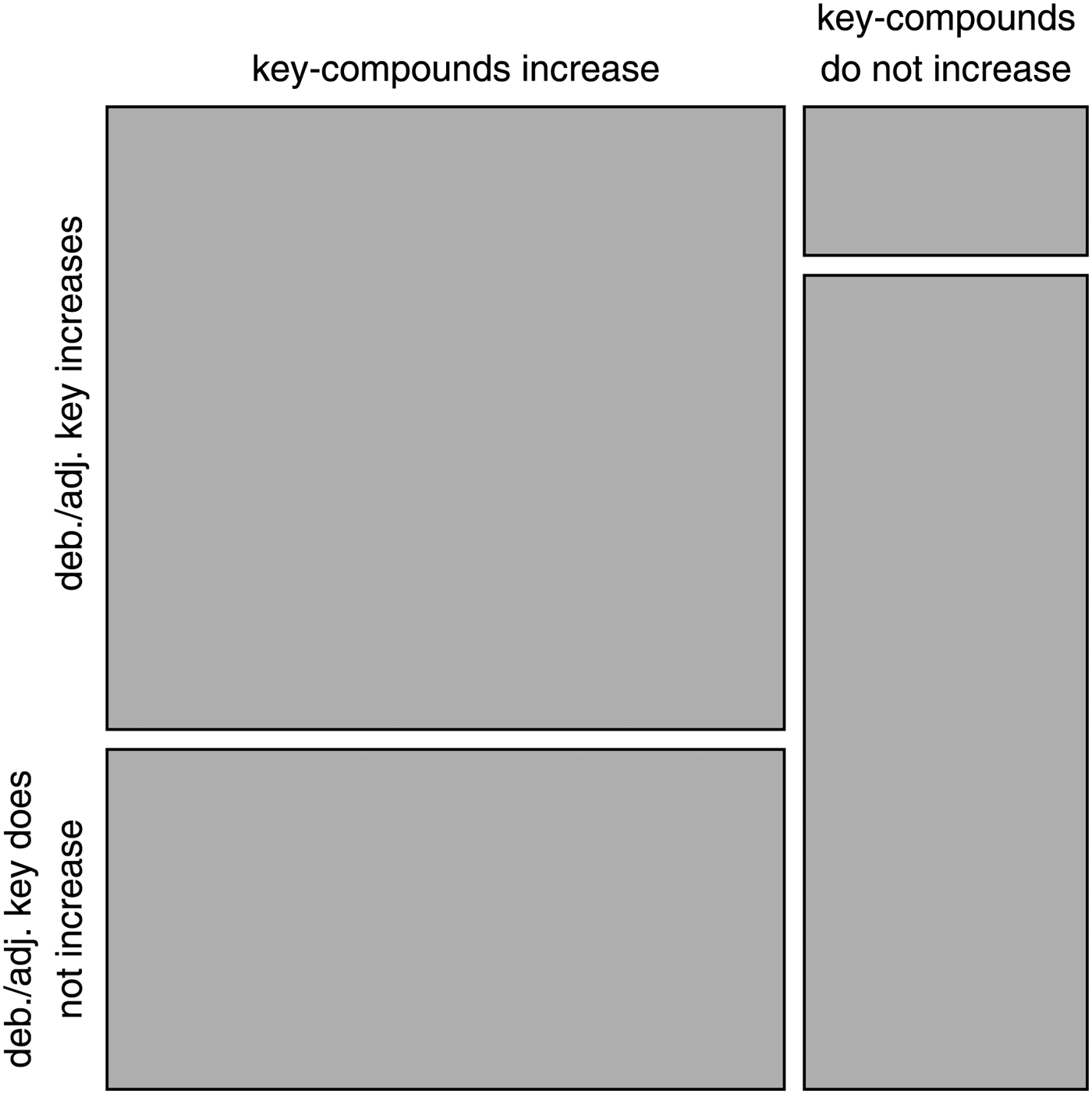
Third, the assumed interdependence of the steps of change should also be visible over speakers' lifetimes (cf. Petré & Van de Velde, Reference Petré and Van de Velde2014). As pointed out, for 38 speakers, the dataset contains observations over more than one decade. These speakers were divided into four types, depending on whether or not their use of key-compounding increased over their lifetimes and whether or not their use of debonded and adjectival key increased over their lifetimes.Footnote 6 The mosaic plot in Figure 5 shows how the four speaker types distribute. Again, cell sizes reflect the proportionate share of each speaker type in the sample. There is a strong correlation between increasing use of key-compounding and increasing use of debonded and adjectival key (p = .007, using a Fischer's exact test; φ = .45). That is, speakers whose use of key-compounds increases over time are also likely to show an increase in their use of debonded and adjectival key. Conversely, speakers whose use of key-compounds does not increase are unlikely to show an increase in their use of debonded and adjectival key. The speaker type whose behavior goes against the predictions of the cascade model (increasing use of debonded/adjectival key, despite decreasing use of key-compounding) is also the rarest.
Distribution of speakers whose use of key-compounds does or does not increase (x-axis) and whose use of debonded/adjectival key does or does not increase (y-axis); n speakers = 38, n observations = 1936.
In sum, variation both between and within individual speakers is consistent with the predictions of the cascade model. Speakers tend to adopt behavior belonging to the more advanced stages of change only to the extent that they display behavior belonging to the (immediately) preceding stages. The interdependencies between steps of change revealed here do not prove causal relations, but they are consistent with the assumption of causality.
Priming
An expression that is strongly entrenched enjoys easy retrievability on a more or less permanent basis. Priming, by contrast, causes a temporary surge in retrievability. The effect has been extremely well documented under experimental conditions. But in natural language use, too, there is good evidence that priming influences speakers' textual choices, for instance in the form of textual persistence (Szmrecsanyi, Reference Szmrecsanyi2006; Torres Cacoullos, Reference Torres Cacoullos, Adli, García and Kaufmann2015; Weiner & Labov, Reference Weiner and Labov1983). In light of the research hypothesis, it is expected that priming also facilitates an expression's selection in unconventional contexts.
In the development of key, such priming effects may manifest themselves in different ways. Trivially, key is likely to prime itself. A speaker should more readily select key in their own discourse turn if a previous speaker did so in theirs. The more interesting question, however, is whether conventional uses of key prime innovative uses. If so, this would again support the link between increased retrievability and innovation. In what follows, tentative evidence is presented that prior occurrences of conventional key facilitate innovative uses of key further down in discourse. Next, another type of priming effect will be considered. It has been argued that expressions are primed by their collocates (Hoey, Reference Hoey2005). The relation could also be couched in terms of “cotextual entrenchment” (Schmid & Mantlik, Reference Schmid and Mantlik2015). Although the link between collocational and priming relations still awaits more empirical evidence (Durrant & Doherty, Reference Durrant and Doherty2010), it here provides another testable prediction. Specifically, it is expected that key is more likely to be used innovatively if it has been primed by other contextual elements it is collocationally associated with. Evidence to that effect is presented next.
Priming across discourse turns
To test whether priming facilitates innovation, the corpus data were manipulated to distinguish between a primed and nonprimed condition. For the primed condition, the Hansard Corpus (this time including also the material from the House of Lords) was searched for all instances in which key is used in two immediately consecutive turns. Priming could also have been investigated within the same speakers' turn, but this could have confounded the priming effect with the entrenchment effect. The disadvantage of the across-turns approach taken here is that turns in parliamentary debates can be very long,Footnote 7 making for a considerable distance between the assumed prime and its target. For the 1970s, only 137 contexts were found with key in two consecutive turns, which was not enough to pursue the analysis. The datasets for the 1980s (n = 412) and 1990s (n = 1082), however, were manually analyzed to identify cases in which the first key was a key-compound. Within that subset, the second key in the adjacency pair was then analyzed to check the incidence of debonded or adjectival key. An example of a relevant adjacency pair is given in (9), with a key compound in the first turn (a key element) and another instance of key in the second—in this case, the second instance of key is an innovative adjectival use (these key locally employed personnel).
(9) [Viscount Cranborne] My Lords, the locally enlisted military personnel serving with the Army and the Royal Navy in Hong Kong are a key element of the British garrison, as indeed are the locally employed civilian staff. Recruitment and retention are satisfactory and at present we have no plans to take any additional steps to retain their services between now and 1997.
[Edward Shackleton] The noble Viscount visualises the locally employed personnel taking on some of the duties of the garrison, is he confident, although he has made no reference to it, that he will be able to retain these key locally employed personnel? (1990, HC)
For the nonprimed condition, control sets were collected for the 1980s and 1990s, each containing 1000 randomly selected instances of key not preceded by another instance of key within at least 20 turns. These, too, were manually analyzed. Recall here that the point is not to prove that there is priming in the data: in the “primed condition,” priming is plausible.Footnote 8 Rather, the question is whether key, when primed, behaves more innovatively.
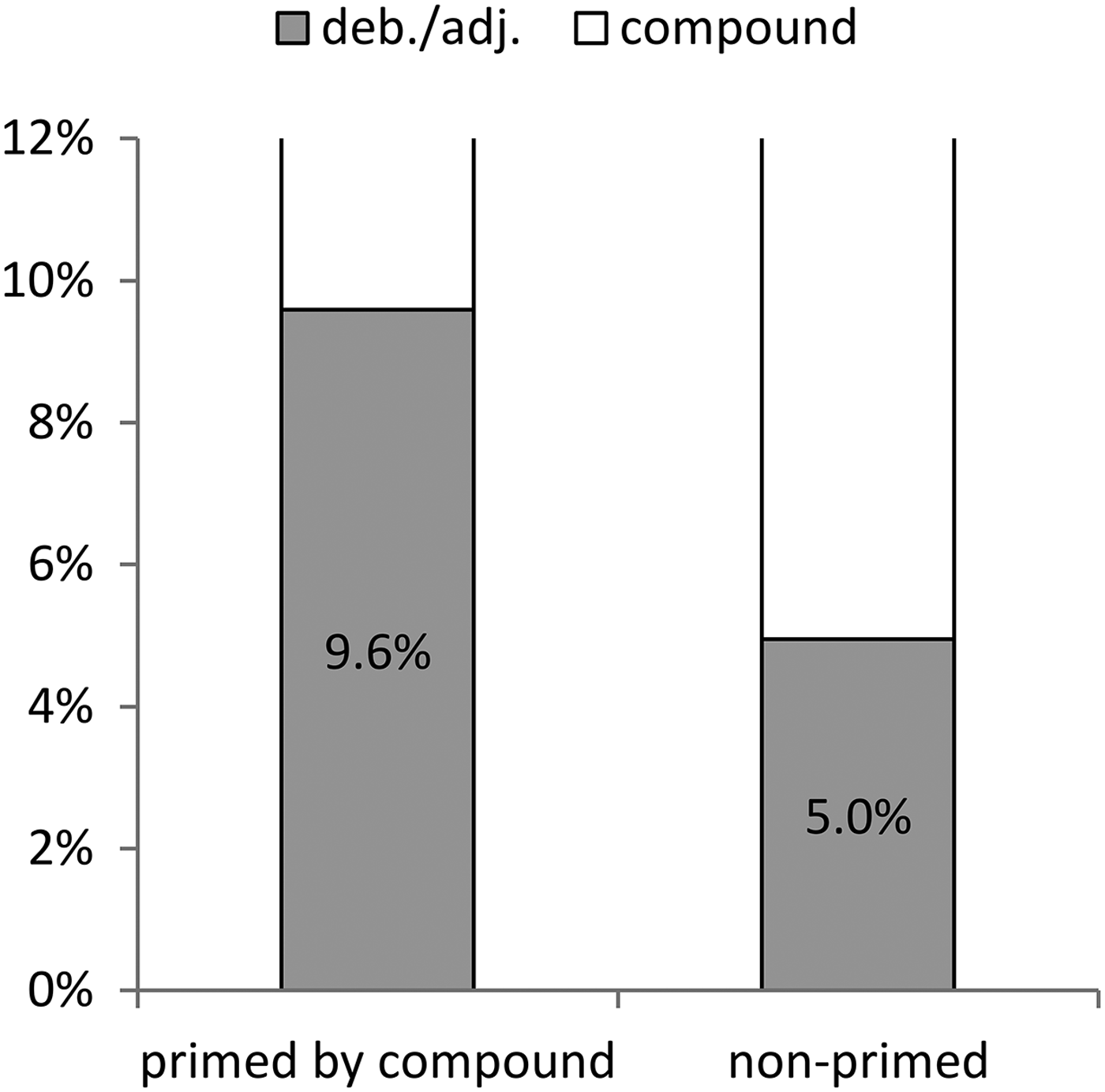
Evidence that this is so is found for the 1980s, as shown in Figure 6. When preceded by a key-compound in the immediately preceding turn, key is about twice as likely to be used in debonded or adjectival constructions compared to the control set. The effect is very small but it is significant (χ2 = 4.81, p = .028; φ = .08). The finding again supports the idea that innovations thrive under conditions improving the retrievability of their analogical model.
Incidence of debonded/adjectival key versus key-compounds following a key-compound in the previous turn (1980s); n “primed by compound” = 146, n “nonprimed” = 707.
While this is in line with the hypothesis, the finding needs to be qualified in two ways. First, the finding is not confirmed for the 1990s (χ2 = .13, p = .71; φ = .01). It is possible that the effect disappeared over time. This might still be consistent with the hypothesis (albeit post hoc), because dependency on priming should be stronger the more innovative an expression is. But given that the effect in the 1980s is not very strong to begin with, either the observed effect or its absence may also simply be a fluke of the data. As such, the evidence here is encouraging but still tentative. Second, if the hypothesized priming effect exists, it should be clear that while it supports the hypothesis, it cannot be a major propagator of change in its own right, at least for relatively low-frequency expressions like key. In the corpus, the primed condition is so uncommon that the great majority of adjectival and debonded instances of key must occur outside primed contexts.Footnote 9
Collocational priming
If collocational priming promotes innovations in the development of key, it is expected that new uses of key are more likely to surface when key has been primed by another contextually available lexical element. The more innovative the use, the stronger this effect should be. The prediction can be tested with some precision on the nonpredicative adjectival and debonded uses of key. Because in these uses key is always a premodifying element, it always patterns with a nominal head that associates with the form key to a greater or lesser degree. For example, it is intuitively clear that role in (10a), being the head of a frequent key-compound (key role), more strongly associates with key than land in (10b).
(10)
a. That is a key and important role. (1988, HC)
b. The question of key industrial land bears directly on harbours. (1973, HC)
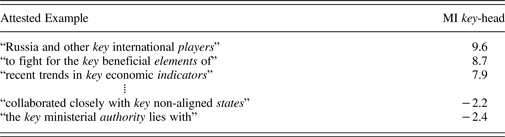
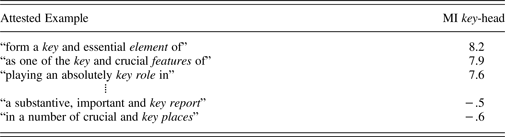
Intuitions about collocational association can be backed up by mutual information (MI) scores based on joint occurrence in the Hansard Corpus. As expected, key role is then found to be a strong collocation with a mutual information score of 7.6,Footnote 10 whereas key land is simply unattested. This means that, other things being equal, key is more likely to have been collocationally primed in (10a) than in (10b). Pursuing this logic, MI scores for key and its nominal head were calculated for all the attested debonded and adjectival uses of key. The attested instances were collected from the data used to analyze individual variation (cf. Figure 4). For debonded uses, there were 209 types (from 248 tokens), for adjectival uses, there were 37 types (from 63 tokens). MI scores were calculated on the basis of the complete 1970–1999 portion of the Hansard Corpus.Footnote 11Tables 2 and 3 illustrate the procedure, by listing some attested instances of debonded and adjectival key, along with MI scores that measure the strength of the collocational tie between key and the nominal head it is attested with. The examples are ordered by their MI score, from highest to lowest.
MI scores for attested combinations of key and its nominal head in debonded constructions
MI scores for attested combinations of key and its nominal head in adjectival constructions
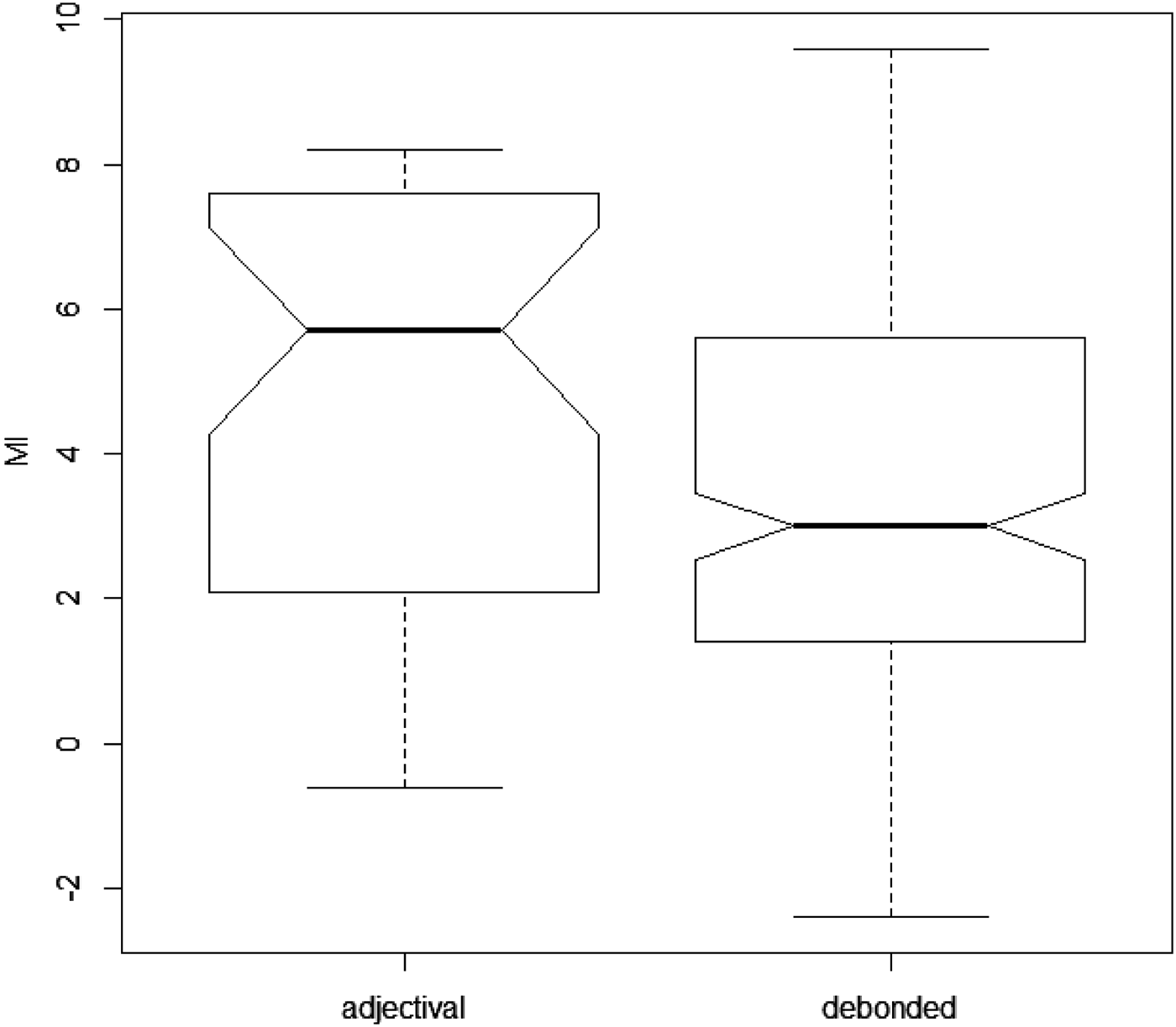
If debonded and adjectival uses of key differ in their dependence on collocational priming, this should be visible from the MI scores collected. The results are summarized and visualized in Figure 7. The boxplots show the range and distribution of MI scores in both grammatical contexts. The waist of each of the boxplots marks the confidence interval (at p = .95) for the median. It is found that adjectival uses of key tend more strongly to occur with established key-collocates than debonded uses. Paradoxically, then, the construction that is grammatically further removed from key-compounding is collocationally more like it. Yet, this is in line with the prediction. Grammatically, key is still the least conventionalized in purely adjectival contexts, but this is compensated for by the presence of a key-collocate. The most innovative uses of key, then, are also the ones most likely to be resorted to in contexts where key has been collocationally primed. Debonded uses of key, which are grammatically less deviant and are already better established, depend less heavily on the presence of a key-collocate. Still, taking an MI of 3 or more as the threshold for linguistic significance (Stubbs, Reference Stubbs1995), even debonded uses are built on well-established key-compounds in about half of all cases (105 of 209, i.e., 50.2%).Footnote 12 All this fits in with the idea that innovations to an expression's use tend to occur under conditions that improve that expression's mental retrievability.
MI scores for key and its head in premodifying debonded and adjectival constructions in the Hansard Corpus.
CONCLUSIONS
The history of English key is a modest change, hardly complicated and with minimal impact on the structure of English. Nevertheless, from its development, a theoretical point can be made. The evidence presented here is largely consistent with the predictions made by the cascade model. As the constructions resorting under an earlier stage of a change become better entrenched, they more easily spark off the innovations that constitute the following stage. This is visible in patterns of variation across individual speakers, as well as in the changes speakers undergo in the course of their lifetimes. Similarly, when earlier-stage constructions have been primed, the chances for innovative constructions to appear may improve. The priming effect is weakly evidenced in contexts involving direct priming from previous discourse. It is seen more convincingly in contexts involving indirect priming through the contextual presence of collocates.
From these findings we begin to glean a clearer picture of the language-internal factors that drive gradual change. Expressions expand their usage contexts along pathways determined by similarity relations, driven on by local analogies. However, each analogical extension is a little leap into the unconventional. Therefore, analogical extensions depend on facilitating factors. What ultimately triggers the observed chains of analogical extensions is the interaction between conventionalization (entrenchment) and linguistic creativity (innovation). Creativity and innovation are unlikely and costly, but given conventional, readily available source material to work from, it comes within the language user's reach. This way, it appears, expressions' usage can continually expand to the fringes of what is grammatically conceivable. And when the conceivable becomes fully acceptable and conventional, the edges of conceivability, in turn, expand outward.