In the past 20 years, there has been a proliferation of studies investigating neighborhood explanations for crime and delinquency (Leventhal & Brooks-Gunn, Reference Leventhal and Brooks–Gunn2000; Sampson, Morenoff, & Gannon-Rowley, Reference Sampson, Morenoff and Gannon-Rowley2002). Most of this research has concentrated on sociodemographic measures of neighborhood quality. Drawing upon social disorganization theory, the most widely used indicators have been poverty, income, unemployment, female-headed households, public assistance, and racial/ethnic heterogeneity. Several studies have reported that such variables are related to delinquency and crime and that their effect is, in large measure, indirect through their impact upon social ties and informal social control (Bursik & Grasmick, Reference Bursik and Grasmick1993; Sampson, Reference Sampson2012). However, almost all of this research has focused upon adolescent males (Odgers et al., Reference Odgers, Moffitt, Tach, Sampson, Taylor and Matthews2009; Simons, Simons, Burt, Brody, & Cutrona, Reference Simons, Simons, Burt, Brody and Cutrona2005). Thus, it is not clear how well this model explains adult antisocial behavior, especially that of adult women (Belknap, Reference Belknap2007; Chesney-Lind & Pasko, Reference Chesney-Lind and Pasko2013). The first goal of the present study was to replicate findings of prior neighborhood studies using a sample of adult African American females.
In addition to neglecting the effect of neighborhood disorganization on women, neighborhood studies have tended to employ a macro focus that ignores individual variation. This approach cannot explain heterogeneity in the behavior of those living in the same disadvantaged neighborhood. In contrast to purely structural models, multilevel studies find that neighborhood effects on delinquency and crime are moderated by individual characteristics and/or experiences (Barnes & Jacobs, Reference Barnes and Jacobs2013; Bush, Lengua, & Colder, Reference Bush, Lengua and Colder2010; Simons et al., Reference Simons, Simons, Burt, Brody and Cutrona2005). Recently, a profusion of studies has reported that genetic variation often interacts with the environmental context to influence the probability of various behaviors (Caspi et al., Reference Caspi, Sugden, Moffitt, Taylor, Craig and Harrington2003; Dick, Reference Dick2011; Freese & Shostak, Reference Freese and Shostak2009; Guo, Roettger, & Cai, Reference Guo, Roettger and Cai2008; Shanahan, Vaisey, Rickson, & Smolen, Reference Shanahan, Vaisey, Erickson and Smolen2008). Several recent scholars (e.g., Bakermans-Kranenburg & van IJzendoorn, Reference Bakermans-Kranenburg and van IJzendoorn2011; Beach et al., Reference Beach, Lei, Brody, Simons, Cutrona and Philibert2012; Belsky, Bakermans-Kranenburg, & van IJzendoorn, Reference Belsky, Bakermans-Kranenburg and van IJzendoorn2007, Reference Belsky and Pluess2013; Simons & Lei, Reference Simons, Lei, Gibson and Krohn2013; Simons et al., Reference Simons, Lei, Brody, Beach, Philibert and Gibbons2011; van IJzendoorn, Belsky, & Bakermans-Kranenburg, Reference van IJzendoorn, Belsky and Bakermans-Kranenburg2012) have proposed the differential susceptibility view of Gene × Environment (G × E) interaction. This perspective argues that the polymorphisms used in most G × E interaction studies exert their influence by augmenting susceptibility to social context, whether that environment is adverse or supportive. Thus, those persons most vulnerable to adverse social environments are the same ones who reap the most benefit from environmental support.
Building upon these findings, the present study investigated the extent to which variation in the serotonin transporter linked polymorphic region (5-HTTLPR) gene and the dopamine receptor D4 (DRD4) gene moderates the effect of neighborhood disadvantage and social ties on adult women's antisocial behavior; both genes that have been linked to adolescent and adult men's antisocial behavior (Bakermans-Kranenburg & van IJzendoorn, Reference Bakermans-Kranenburg and van IJzendoorn2011; Brody et al., Reference Brody, Beach, Chen, Obasi, Philibert and Kogan2011; Homberg & Lesch, Reference Homberg and Lesch2010; Sakai et al., Reference Sakai, Young, Stallings, Timberlake, Smolen and Stetler2006; Simons et al., Reference Simons, Lei, Brody, Beach, Philibert and Gibbons2011; Simons, Lei, et al., Reference Beach, Lei, Brody, Simons, Cutrona and Philibert2012; van IJzendoorn, Belsky, & Bakermans-Kranenburg, Reference van IJzendoorn, Belsky and Bakermans-Kranenburg2012). Our investigation used multilevel data from a sample of approximately 400 African American women. Such a sample is particularly relevant for examining these ideas, given the wealth of data indicating that, in general, African American women have higher rates of crime and antisocial behavior than women in other ethnic groups (Belknap, Reference Belknap2007) and are more apt to reside in extremely disadvantaged neighborhoods (McNulty, Reference McNulty2001; Peterson & Krivo, Reference Peterson and Krivo2010).
Neighborhood Characteristics and Antisocial Behavior
Neighborhood studies can be traced back to the early 20th century. Shaw and McKay (Reference Shaw and McKay1942/1969) were among the first to argue that residing in a disadvantaged neighborhood increases the probability that an individual will engage in delinquency, crime, and other antisocial behaviors. They argued that this association exists because informal social control is weak in disadvantaged neighborhoods. Their perspective gained popularity in the 1990s when sociologists and criminologists began to focus upon the avenues whereby neighborhood disadvantage might produce this effect (Sampson, Reference Sampson2012; Sampson et al., Reference Sampson, Morenoff and Gannon-Rowley2002). Bursik and Grasmick (Reference Bursik and Grasmick1993) argued that the greatest shortcoming of Shaw and McKay's social disorganization theory was its failure to consider relational networks that pertain to the public sphere of social control. They proposed that neighborhood disadvantage affects deviance and crime through its impact on neighborhood social ties and cohesion. Disadvantage makes it difficult for residents to establish the social cohesion, ties, and common values necessary to constrain individuals from engaging in crime and other deviant behaviors. In other words, the relationship between neighborhood characteristics and antisocial behavior is mediated by the level of cohesion or social ties that exist among residents in the area.
Several studies have reported support for this perspective (Browning, Burrington, Leventhal, & Brooks-Gunn, Reference Browning, Burrington, Leventhal and Brooks-Gunn2008; Rountree & Warner, Reference Rountree and Warner1999; Sampson, Raudenbush, & Earls, Reference Sampson, Raudenbush and Earls1997). However, while neighborhoods consist of individuals of diverse ages, most researchers utilized child and adolescent samples (Odgers et al., Reference Odgers, Moffitt, Tach, Sampson, Taylor and Matthews2009; Simons et al., Reference Simons, Simons, Burt, Brody and Cutrona2005), largely omitting adult antisocial behavior from their analysis. During the past decade, increasing evidence suggests that neighborhood social cohesion or ties mediate the association between neighborhood characteristics and adult physical and mental health problems (Valerie, Beggs, & Hurlbert, Reference Valerie, Beggs and Hurlbert2011; Vartanian & Houser, Reference Vartanian and Houser2010). Less is known about whether this neighborhood effect also holds for adult antisocial behavior.
Feminist scholars have claimed that the neighborhood disorganization perspective remains a “male theory” (Belknap, Reference Belknap2007; Chesney-Lind & Pasko, Reference Chesney-Lind and Pasko2013). They have charged that traditional neighborhood studies were presumed to be gender neutral, focused disproportionately on males, ignored women's experience, or simply used gender as a control variable. For instance, the data provided by Shaw and McKay (Reference Shaw and McKay1942/1969) in support of their perspective focused only on boys. In addition, subsequent tests of the theory have relied almost exclusively upon male samples (e.g., Bares & Jacobs, Reference Barnes and Jacobs2013; Beaver, Gibson, DeLisi, Vaughn, & Wright, Reference Beaver, Gibson, DeLisi, Vaughn and Wright2012).
It is important that recent neighborhood studies have found evidence that females and males tend to have different experiences in their neighborhoods (Cobbina, Miller, & Brunson, Reference Cobbina, Miller and Brunson2008; Zimmerman & Messner, Reference Zimmerman and Messner2010). Therefore, it is uncertain as to whether the results of prior neighborhood studies generalize to women. Although the social disorganization framework has proved to be a powerful framework for explaining male antisocial behavior, it is not clear that it is a useful perspective for explaining variations in female offending.
The first goal of the present study was to address this gap in the literature. Using a sample of adult African American women, we attempted to replicate findings of prior studies that have found support for the neighborhood disorganization framework. Using multilevel data, we examined the extent to which women living in areas of concentrated disadvantage have higher levels of antisocial behavior than those living in more advantaged areas. Further, we investigated whether the influence of concentrated disadvantage on women's antisocial behavior is mediated by neighborhood social ties.
Gene–Neighborhood Interaction
Neighborhood studies largely ignore individual-level factors, focusing instead on links among neighborhood structure, neighborhood processes, and human behavior (Leventhal & Brooks-Gunn, Reference Leventhal and Brooks–Gunn2000; Sampson et al., Reference Sampson, Morenoff and Gannon-Rowley2002). The primary assumption guiding this research is that people who live in the same neighborhood are more similar to one another than to those who live in different neighborhoods. However, empirical studies reveal that not all individuals, indeed not even the majority of individuals, from disadvantaged neighborhoods become deviant or antisocial (Elliott et al., Reference Elliott, Menard, Rankin, Elliott, Wilson and Huizinga2006; Mayer & Jencks, Reference Mayer and Jencks1989). Thus, a central question remains: Why is there so much heterogeneity in the behavior of individuals residing in the same neighborhood? Understanding which individual characteristics influence the relationship between neighborhood contexts and human behavior is crucial to the advancement of neighborhood research.
In the past decade, a number of social scientists have attempted to make their models more precise and biologically integrated by incorporating genetic effects into their theoretical frameworks (e.g., Bakermans-Kranenburg & van IJzendoorn, Reference Bakermans-Kranenburg and van IJzendoorn2011; Beach et al., Reference Beach, Lei, Brody, Simons, Cutrona and Philibert2012; Beaver et al., Reference Beaver, Gibson, DeLisi, Vaughn and Wright2012; Brody et al., Reference Brody, Beach, Chen, Obasi, Philibert and Kogan2011; Caspi et al., Reference Caspi, Sugden, Moffitt, Taylor, Craig and Harrington2003; Guo et al., Reference Guo, Roettger and Cai2008; Shanahan et al., Reference Shanahan, Vaisey, Erickson and Smolen2008; Simons et al., Reference Simons, Lei, Brody, Beach, Philibert and Gibbons2011). A growing body of literature suggests that genetic variability moderates the impact of the social environment on human behavior (Duncan & Keller, Reference Duncan and Keller2011). Although such G × E research has increased dramatically in recent years, only a few studies have investigated Gene × Neighborhood interactions (e.g., Barnes & Jacobs, Reference Barnes and Jacobs2013; Beaver et al., Reference Beaver, Gibson, DeLisi, Vaughn and Wright2012; Hart & Marmorstein, Reference Hart and Marmorstein2009; Simons, Lei, et al., Reference Simons, Beach and Barr2012). For example, using samples from the National Longitudinal Study of Adolescent Health, Barnes and Jacobs (Reference Barnes and Jacobs2013) found that men with one or more copies of the risk allele for the dopamine receptor gene show higher levels of violent behavior than those with no copy when they live in disadvantaged neighborhoods. While these studies provide valuable insights regarding Gene × Neighborhood interactions, they are limited in that they exclude women in their analyses and ignore the role of neighborhood social ties and cohesion as an important mediator in social disorganization framework. The present study extended the focus of these studies in three respects.
First, the few G × E neighborhood studies that have been conducted focus upon children and adolescents; the current study extended this work by examining whether such G × E effects also operate for adult women. Second, whereas prior studies investigated the extent to which genes moderate the impact of neighborhood disadvantage on antisocial behavior, we went on to examine whether genetic variation also moderates the impact of neighborhood social ties on antisocial behavior. Third, as part of this analysis, we examined whether the effect of G × Neighborhood Disadvantage on antisocial behavior is eliminated when the effect of G × Neighborhood Social Ties is considered. In other words, we extended social disorganization theory by examining the extent to which the G × Neighborhood Disadvantage effect on antisocial behavior is explained by the G × Social Ties effect on antisocial behavior.
Much of the research investigating the molecular genetic basis of aggressive and antisocial behavior has focused upon variation in the 5-HTT gene or the DRD4 gene. The 5-HTT gene is involved in the regulation of serotonergic neurotransmission that has been linked to sensitivity to punishment and displeasure (see Carver, Johnson, & Joormann, Reference Carver, Johnson and Joormann2008; Frank, D'Lauro, & Curran, Reference Frank, D'Lauro and Curran2007). It contains a functional polymorphism in the 5′ promoter region (5-HTTLPR) that consists of 14 or 16 repeats of a 20–22 base pair (bp) unit. Several studies have shown that this polymorphism influences human behavior (Brody et al., Reference Brody, Beach, Chen, Obasi, Philibert and Kogan2011; Caspi et al., Reference Caspi, Sugden, Moffitt, Taylor, Craig and Harrington2003; Homberg & Lesch, Reference Homberg and Lesch2010; Sakai et al., Reference Sakai, Young, Stallings, Timberlake, Smolen and Stetler2006; van IJzendoorn, Belsky, & Bakermans-Kranenburg, Reference van IJzendoorn, Belsky and Bakermans-Kranenburg2012). This research indicates that individuals with the short allele, which is associated with reduced serotonin transporter expression and diminished mRNA for serotonergic neurotransmission, are more likely to engage in conduct disorder, aggression, and/or antisocial behavior than persons with the long allele.
The dopaminergic neurotransmitter system has been implicated in reward sensitivity and sensation seeking (see Bakermans-Kranenburg & van IJzendoorn, Reference Bakermans-Kranenburg and van IJzendoorn2011; Beach et al., Reference Beach, Lei, Brody, Simons, Cutrona and Philibert2012; Simons et al., Reference Simons, Lei, Brody, Beach, Philibert and Gibbons2011). The DRD4 gene has a functional polymorphism that ranges from 2 to 11 copies of a 48 bp located in the third exon of chromosome 11. Most studies (Beach et al., Reference Beach, Lei, Brody, Simons, Cutrona and Philibert2012; Beaver et al., Reference Beaver, Wright, DeLisi, Walsh, Vaughn and Boisvert2007; Brody et al., Reference Brody, Chen, Yu, Beach, Kogan and Simons2012; Simons et al., Reference Simons, Lei, Brody, Beach, Philibert and Gibbons2011) distinguish between a long (7 to 9 repeats) and a short (2 to 6 repeats) polymorphism group. Studies have provided evidence that individuals carrying the long allele of DRD4 show less efficient transcription than those with the short allele (Ebstein, Reference Ebstein2006) and might be at a higher risk of antisocial behavior.
In most cases, variation in these two polymorphisms does not show a direct effect on antisocial behavior; rather, they exert their influence by moderating the effect of the social environment. A number of studies have reported that the short allele of 5-HTTLPR or the long allele of DRD4 increases the probability that an adverse social environment will lead to antisocial behavior (e.g., Bakermans-Kranenburg & van IJzendoorn, Reference Bakermans-Kranenburg and van IJzendoorn2011; Barnes & Jacobs, Reference Barnes and Jacobs2013; Beach et al., Reference Beach, Lei, Brody, Simons, Cutrona and Philibert2012; Brody et al., Reference Brody, Beach, Chen, Obasi, Philibert and Kogan2011; Caspi et al., Reference Caspi, Sugden, Moffitt, Taylor, Craig and Harrington2003; Homberg & Lesch, Reference Homberg and Lesch2010; Simons et al., Reference Simons, Lei, Brody, Beach, Philibert and Gibbons2011; Simons, Lei, et al., Reference Simons, Beach and Barr2012). Thus, in the present study, we expected that both neighborhood disadvantage and weak social ties will have a greater impact on the antisocial behavior of women with one or two copies of either the short allele of 5-HTTLPR or the long allele of DRD4 than upon those with no copies of these alleles.
Models of G × E Interaction
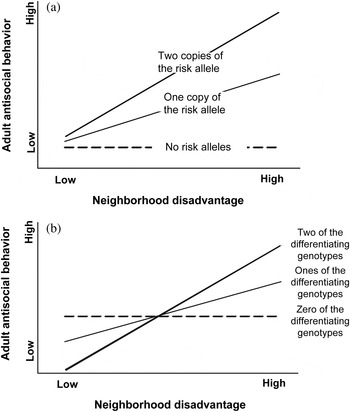
Genetically informed social science requires models of the manner in which genetic variables combine with environmental context to influence behavioral outcomes (Freeze, 2008; Shanahan & Hofer, Reference Shanahan and Hofer2005; Simons & Lei, Reference Simons, Lei, Gibson and Krohn2013). The model utilized in the vast majority of G × E studies of antisocial behavior, as well as of other adjustment problems, assumes that allelic variation in a particular gene amplifies the probability that exposure to some adverse social condition (e.g., racial discrimination, economic hardship, community disorder) will lead to antisocial behavior. In psychology and psychiatry, this is labeled the diathesis–stress perspective. This model asserts that some individuals possess minor alleles that operate as diatheses to amplify the effects of environmental stress or adversity. It assumes that some individuals are by nature more vulnerable than others because they possess dysfunctional “risk alleles” that foster maladjustment in the face of deleterious environmental stimuli. Support for the diathesis–stress perspective is evident when a graph of the G × E effect shows a fan shape such that increases in adversity are associated with a greater increase in antisocial behavior for those with the risk allele than for those without the risk allele (Simons & Lei, Reference Simons, Lei, Gibson and Krohn2013). Figure 1a depicts a hypothetical example of this perspective.
(a) The diathesis–stress hypothesis and (b) the differential susceptibility hypothesis.

The diathesis–stress model, with its focus on risk alleles, is contradicted by the fact that over the past several thousand years evolution seems to have conserved these various alleles. While truly dysfunctional genetic variants should largely disappear over time, most of the so-called risk alleles studied by behavioral science researchers are highly prevalent, often being present in 40% to 50% of the members of the populations being investigated (Ellis, Boyce, Belsky, Bakermans-Kranenburg, & van IJzendoorn, Reference Bakermans-Kranenburg and van IJzendoorn2011). Thus, contrary to the negative view usually taken of these alleles, this suggests that, at least in certain contexts, these genetic variants must provide advantages over other genotypes. This view is an essential component of the alternative model of gene by environment interaction recently proposed by Belsky and his collaborators.
Belsky and colleagues (Belsky, Bakermans-Kranenburg, & van IJzendoorn, Reference Belsky, Bakermans-Kranenburg and van IJzendoorn2007; Ellis et al., Reference Ellis, Boyce, Belsky, Bakermans-Kranenburg and van IJzendoorn2011) argue that the polymorphisms used in most G × E studies of child and adolescent adjustment exert their influence by augmenting susceptibility to social context, whether that environment is adverse or supportive. Thus, those persons most vulnerable to adverse social environments are the same ones who reap the most benefit from environmental support. Belsky and colleagues label this view of G × E the differential susceptibility perspective. Their model assumes that some individuals are more sensitive than others to the effects of both favorable and adverse social environments. In other words, they are more “plastic.” Belsky and colleagues often refer to genetic variants thought to enhance sensitivity to social context as “plasticity alleles.” Furthermore, they have indicated that the more plasticity alleles one carries, the more susceptible one will be to environmental influence. For example, using a composite measure of cumulative genetic plasticity, Belsky and Beaver (Reference Belsky and Beaver2011) revealed that individuals with multiple plasticity alleles scored lower than others on self-regulation when reared by hostile parents, whereas persons with this genotype scored higher than others on self-regulation when reared by supportive parents.
Support for the differential susceptibility or plasticity argument is evident when the slopes for a gene by environment interaction show a crossover effect, with the susceptibility group showing worse outcomes than the comparison group when the environment is negative but demonstrating better outcomes than the comparison group when the environment is positive (Belsky et al., Reference Belsky, Bakermans-Kranenburg and van IJzendoorn2007; Simons & Lei, Reference Simons, Lei, Gibson and Krohn2013; Simons et al., Reference Simons, Simons, Lei, Beach, Brody and Philibert2013). Figure 1b provides a hypothetical example of the differential susceptibility perspective. In a recent article, Belsky and Pluess (Reference Belsky and Pluess2009) reviewed scores of studies reporting a G × E effect on child or adolescent adjustment. Many of these studies focused on outcomes involving conduct problems and related deviant behaviors. Although these studies appeared to support a diathesis–stress model, Belsky and colleagues concluded that a careful inspection of the results pointed to a different interpretation as all of the studies included in the review showed a crossover effect.
Respondents with so-called risk alleles showed more problem behavior than other genotypes when their environment was adverse but manifested fewer problems than other genotypes when their environment was more supportive. Thus, rather than simply showing that some individuals are more vulnerable to adverse conditions than others, the data supported the idea that some people are genetically predisposed to be more susceptible to environmental influence than others. The findings suggested that what were assumed to be risk alleles are in actuality plasticity alleles. In most of these studies, however, this pattern was not recognized or discussed because the authors were operating out of the diathesis–stress paradigm.
Recent meta-analyses of G × E studies (Bakermans-Kranenburg & van IJzendoorn, Reference Bakermans-Kranenburg and van IJzendoorn2011; van IJzendoorn, Belsky, & Bakermans-Kranenburg, Reference van IJzendoorn, Belsky and Bakermans-Kranenburg2012) have provided strong evidence that the two genetic polymorphisms of concern in the present study (5-HTTLPR short allele and DRD4 long allele) operate as susceptibility alleles. They are associated with increased problem behavior in adverse social environments but enhanced success in favorable social environments. Further, this research shows that the more minor alleles an individual carries, the more susceptible he or she is to social environmental influence. Given these findings, we summed these two genotypes to obtain an index of differentiating genotypes. We hypothesized that women high on differentiating genotypes will show greater antisocial behavior than other genotypes in response to an adverse neighborhood context, whereas they will show less antisocial behavior than other genotypes when living in an advantaged neighborhood context.
Methodological Challenge
In the present study, we graphed all significant G × E interactions in an effort to determine whether the pattern best supports the diathesis–stress or differential susceptibility argument. Most recent studies have used the Johnson–Neyman technique or the pick-a-point approach to distinguish differential susceptibility from diathesis–stress. This procedure identifies regions of significance for interactions between genotypes and environmental variables (Bauer & Curran, Reference Bauer and Curran2005; Roisman et al., Reference Roisman, Newman, Fraley, Haltigan, Gron and Haydon2012; Simons & et al., Reference Simons, Lei, Brody, Beach, Philibert and Gibbons2011). However, research indicates that the statistical power to test differential susceptibility is often limited by range restrictions and variation in environmental measurements (Belsky, Pluess, & Widaman, Reference Belsky, Pluess and Widaman2013; Dick, Reference Dick2011; Duncan & Keller, Reference Duncan and Keller2011). Testing for the differential susceptibility requires that one have data representing the full range of the social environment, from very adverse to very favorable, and this often is not the case. We anticipated encountering this problem in the present study.
There is strong evidence that institutional racism has resulted in residential patterns where African Americans are overrepresented in seriously disadvantaged neighborhoods while underrepresented in middle class areas (McNulty, Reference McNulty2001; Peterson & Krivo, Reference Peterson and Krivo2010). This skew in residential distribution is likely to result in too few cases, hence limited variation and statistical power, to assess the interaction of genes with residence in advantaged neighborhoods.
To address the issue of statistical power with small sample sizes, Widaman et al. (Reference Widaman, Helm, Castro-Schilo, Pluess, Stallings and Belsky2012) proposed a new procedure for evaluating the crossover point of simple regression lines in order to determine the pattern of interaction effects. Unlike classical post hoc tests, this new approach directly estimates the confidence interval (CI) of the crossover point to test for G × E effects and to distinguish differential susceptibility from diathesis–stress. Support for the differential susceptibility perspective requires that the simple regression lines cross within a range of values of the independent variable. Hence, if the CI of the crossover point includes that range of values on the independent variable, the data provides support for differential susceptibility. In contrast, if the CI is located outside of the range of values for the independent variable, the data supports the diathesis–stress model.
Research Design
Sample
We tested our hypotheses using data from the Family and Community Health Study (FACHS), a multisite investigation of neighborhood and family effects on health and development (see Beach et al., Reference Beach, Lei, Brody, Simons, Cutrona and Philibert2012; Simons et al., Reference Simons, Lei, Brody, Beach, Philibert and Gibbons2011). FACHS was designed to identify neighborhood and family processes that contribute to school-age African American children's development in families living in a wide variety of community settings outside the inner-city core. Each family includes a child who was in 5th grade at the time of recruitment. At the first wave, the FACHS sample consists of 889 African American children (411 boys, 478 girls) and their primary caregivers (PCs; 60 men, 829 women). At study inception, about half of the sample resided in Georgia and the other half in Iowa. The children averaged 10 years of age (5th grade) at the beginning of the study in 1997–1998. Of the 889 PCs interviewed at Wave 1, 693 were interviewed again at Wave 5 (77.26% of the original sample). As part of Wave 5 (2007–2008) data collection, PCs were asked to provide DNA for genotype analysis. Of the 693 participants, 549 (80%) agreed to DNA collection, and a saliva sample was obtained from 472 females. Successful genotyping for both 5-HTTLPR and DRD4 was achieved for 467 of these respondents (a call rate of 98.9%). Analyses indicated that those individuals who did not participate in the genetic component of the study did not differ significantly from those who participated with regard to antisocial behavior, age, education, family structure, household income, or neighborhood characteristics.
Current study participants
The current study involves a two-level data structure, that is, individuals nested in neighborhoods. The neighborhood-level data was created using the 2000 census Summary Tape File 3 that was geocoded with participants' residential addresses in 1996. Additional details regarding neighborhood data can be found in Stewart and Simons (Reference Stewart and Simons2010). In the current study, analyses are based upon the 397 of 467 female respondents who were nested within 67 census tracts, were genotyped for both 5-HTTLPR and DRD4, and provided data on all respondent measurements at the first wave. Participants included in the present study did not significantly differ from those excluded due to missing data with regard to neighborhood disadvantage and antisocial behavior at Wave 1. Of the 397 respondents, 56% self-identified as single parents, 40% lived below the poverty line, and 62% did not hold a high school diploma. The resulting sample had a mean age of 36.98 years (SD = 7.92) and an average per capita annual income of $6,456.
Procedures
The measures of neighborhood characteristics were created using the 2000 census data that were geocoded with participant's residential addresses at Wave 1. The questionnaires were administered in the respondent's home and took on average 2 hr to complete. The instruments were presented on laptop computers. Questions appeared in sequence on the screen, which both the researcher and participant could see. The researcher read each question aloud and the participant entered an anonymous response using a separate keypad. In addition, participants were also asked to provide a saliva sample at Wave 5. Samples were frozen and shipped via courier to a laboratory at the University of Iowa.
Measures
Adult antisocial behavior
Adult antisocial behavior was assessed with the Diagnostic Interview Schedule (Robins, Cottler, Bucholz, & Compton, Reference Robins, Cottler, Bucholz and Compton1997; Shaffer et al., Reference Shaffer, Schwab-Stone, Fisher, Cohen, Piacentini and Davies1993) that focuses on the symptoms of antisocial personality disorder (ASPD) listed in DSM-IV (1994, pp. 649–650). The measure consisted of 35 itemsFootnote 1 (e.g., “have you stolen things or money by holding someone up,” “have you sometimes pretended you were sick or injured to collect insurance, worker's compensation, or disability pay,” “have you sometimes used a stick, knife, gun, bottle, or bat to hurt someone,” and “have you often driven when you were high or drowsy on alcohol or drugs”) rated on a dichotomous scale (0 = no, 1 = yes) designed to assess the seven ASPD lifetime symptoms under criterion in the DSM-IV manual. The items were scored and clustered into the seven symptoms using diagnostic algorithms corresponding to DSM-IV criteria developed by the Division of Child and Adolescent Psychiatry at Columbia University (Lahey, Flagg, Bird, & Schwab-Stone, Reference Lahey, Flagg, Bird and Schwab-Stone1996; Shaffer et al., Reference Shaffer, Schwab-Stone, Fisher, Cohen, Piacentini and Davies1993). Finally, a symptom count was obtained by summing scores for the seven diagnostic symptoms (0 = symptom is absent, 1 = symptom is present): (a) failure to conform to social norms with respect to lawful behaviors, (b) deceitfulness, (c) impulsivity, (d) irritability and aggressiveness, (e) reckless disregard for safety of self or others, (f) consistent irresponsibility, and (g) lack of remorse for the mistreatment of others. The maximum possible score of 7 corresponds to a subject reporting that she had engaged in acts pertaining to all of the different symptoms. Confirmatory factor analysis of the seven symptoms used to assess antisocial behavior produced factor loadings that ranged from 0.46 for impulsivity to 0.66 for irritability and aggressive. Coefficient alpha for the scale was 0.70.
Neighborhood social ties
Neighborhood social ties was assessed from four items, such as “You can count on adults in your neighborhood to watch out that children are safe and don't get in trouble,” “Parents in your neighborhood know their children's friends,” “Adults in your neighborhood know who the local children are,” and “Parents in this neighborhood generally know each other.” The response format for all these items was “1 = true,” and “0 = false.” Following the example of Raudenbush and Sampson (Reference Raudenbush and Sampson1999), a neighborhood-level measure of social ties was created summing and averaging across respondents within each of the 67 census tracts. A higher score indicates a higher level of neighborhood social ties. Coefficient alpha for the scale was 0.82.
Concentrated disadvantage
Concentrated disadvantage was assessed with 2000 Summary Tape File 3 census tract data. Following previous studies (Sampson et al., Reference Sampson, Raudenbush and Earls1997; Simons et al., Reference Simons, Simons, Burt, Brody and Cutrona2005), the scale include five items: average per-capita income, the percentage of unemployment, the percentage of residents below the poverty threshold, the percentage of female-headed households, and the percentage of those receiving public assistance. To provide equal weight for each item, per capita income was reverse coded, and we used factor scores obtained through principal-components analyses to form the scale. Factor loadings ranged from 0.74 for per capita income to 0.88 for the percentage of residents below the poverty threshold. Coefficient alpha for the measure was 0.89.
Heterogeneity of racial composition
Heterogeneity of racial composition was assessed by using census data regarding the percentage of White residents in the respondent's census tract in 2000 (M = 57.72, SD = 28.37). Previous studies have indicated that African Americans are more likely than Whites to experience anxiety and racial discrimination and to commit crime/deviance in predominately White affluent neighborhoods (Tatum, Reference Tatum1999).
Control variables
This study included five control variables that might influence the relationships among neighborhood variables and adult antisocial behavior, including high school graduation, single family status, age, residential history (moved = 1), and family income below the federal poverty line (http://www.census.gov/hhes/www/poverty/data/threshld).
Genotyping
Participants were asked to contribute a saliva sample using Oragene™ DNA kits (Genotek, Calgary, Alberta, Canada). Those who chose to participate rinsed their mouths with tap water and then deposited 4 ml of saliva in the Oragene sample vial. The vial was sealed, inverted, and shipped via courier to a laboratory at the University of Iowa, where samples were prepared according to the manufacturer's specifications. Genotyping was performed for variable number tandem repeat (VNTR) polymorphisms in 5-HTTLPR and DRD4.
Genotype at the 5-HTTLPR located on chromosome 17q11.1-q12 has a functional polymorphism in the variable repeat sequence in the promoter region (Bradley, Dodelzon, Sandhu, & Philibert, Reference Bradley, Dodelzon, Sandhu and Philibert2005). The homozygous long allelic variant (16 or 18 repeats) is related to higher concentrations of 5-HTT messenger RNA (mRNA) and a greater rate of reuptake than the homozygous short allelic variant (14 repeats). A number of studies have provided evidence that the short allele of 5-HTTLPR is associated with conduct disorder, aggression, and/or antisocial behavior (Caspi, Hariri, Holmes, Uher, & Moffit, Reference Caspi, Hariri, Holmes, Uher and Moffitt2010; Sakai et al., Reference Sakai, Young, Stallings, Timberlake, Smolen and Stetler2006; Simons et al., Reference Simons, Lei, Brody, Beach, Philibert and Gibbons2011).
The genotype of the DRD4 VNTR was determined for each participant as described by Lichter et al. (Reference Lichter, Barr, Kennedy, van Tol, Kidd and Livak1993). This involved using the primers F-CGCGACTACGTGGTCTACTCG and R-AGGACCCTCATGGCCTTG, standard Taq polymerase and buffer, standard deoxyribonucleotide triphosphates with the addition of 100 µmol/L 7-deaza guanosine triphosphate and 10% dimethyl sulfoxide. The resulting polymerase chain reaction products were electrophoresed on a 6% nondenaturing polyacrylamide gel and the products visualized using silver staining. Studies have found that individuals carrying the low-activity allele (seven repeats or more, long allele) are at increased risk for depression or antisocial behavior in response to environment (Beach et al., Reference Beach, Lei, Brody, Simons, Cutrona and Philibert2012; Brody, Chen, & Beach Reference Brody, Chen and Beach2013; Brody et al., Reference Brody, Chen, Yu, Beach, Kogan and Simons2012; Simons et al., Reference Simons, Lei, Brody, Beach, Philibert and Gibbons2011).
There are three main models for coding gene sequences (Lewis, Reference Lewis2002). In the present study in humans, the short allele of 5-HTTLPR and the long allele of DRD4 polymorphism are minor alleles, or so-called risk alleles and plasticity alleles (Belsky & Beaver, Reference Belsky and Beaver2011; Brody et al., Reference Brody, Beach, Chen, Obasi, Philibert and Kogan2011; Caspi et al., Reference Caspi, Sugden, Moffitt, Taylor, Craig and Harrington2003; Ebstein, Reference Ebstein2006). Using the dominant model, individuals receive a score of 1 if they are either heterozygous or homozygous for the minor allele and a score of 0 if they are homozygous for the major allele. The additive model counts the number of minor alleles for the gene (i.e., 0, 1, 2). Thus, those heterogeneous for the minor allele receive a 1 and those homogeneous for the allele received a 2. Finally, using the recessive model, individuals receive a score of 1 if they are homozygous for the minor allele and otherwise receive a score of 0. Consistent with prior research (Beach et al., Reference Beach, Lei, Brody, Simons, Cutrona and Philibert2012; Belsky & Beaver, Reference Belsky and Beaver2011; Simons et al., Reference Simons, Lei, Brody, Beach, Philibert and Gibbons2011; Simons, Lei, et al., Reference Simons, Beach and Barr2012; van IJzendoorn, Belsky, & Bakermans-Kranenburg, Reference van IJzendoorn, Belsky and Bakermans-Kranenburg2012), the current study used the dominant model.Footnote 2 We treated both 5-HTTLPR and DRD4 as dichotomous variables where individuals received a score of 1 if they were carrying at least one copy of the minor allele and a score of 0 if they were homozygous for the major allele.
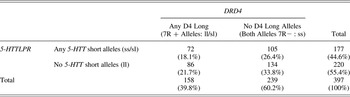
Thus, for 5-HTTLPR, 1 = at least one short allele, short–short/short-–long (ss/sl); 0 = pair of long alleles (ll). Using this criteria, 177 (44.6%) had at least one copy of the short allele. Among the 397 respondents, 7.3% were homozygous for the short allele (ss), 37.3% were heterozygous (sl), and 55.4% were homozygous for the long allele (ll). Using the Hardy–Weinberg equilibrium test, the observed distribution of 5-HTTLPR polymorphism did not differ significantly (χ2 = 0.06, df = 1, p = .82) from that predicted on the basis of simple Mendelian inheritance.
Similarly, for DRD4, 1 = alleles with at least one 7 or longer repeat (ll/sl) and 0 = alleles with two repeats less than 7 (ss). Using this criteria, 158 (39.8%) individuals had at least one copy of the long allele. Among the 397 respondents used in our analysis, 6.6% were homozygous for 7R + allele (ll), 33.2% were heterozygous (sl), and 60.2% were homozygous for the short allele (ss). The observed distribution of this polymorphism did not differ significantly (χ2 = 1.74, df = 1, p = .19) from that predicted by the Hardy–Weinberg equilibrium law.
Because the differential susceptibility perspective suggests that the more differentiating genotypes one carries, the more susceptible one will be to environmental influences, we summed the two genotypes (5-HTTLPR and DRD4) to form an index of differentiating genotypes. Respondents with the 5-HTTLPR long allele and the DRD4 short allele received a score of 0, those with either the 5-HTTLPR ss/sl allele or the DRD4 ll/sl allele were assigned a score of 1, and those with both the 5-HTTLPR ss/sl allele and the DRD4 ll/sl allele received a score of 2. As shown in Table 1, the distribution of this cumulative index was 0 of the differentiating genotype (33.8%), 1 of the differentiating genotype (21.7% + 26.4% = 48.1%), and 2 of the differentiating genotypes (18.1%).
Allele frequency distributions of the 5-HTTLPR and DRD4 gene polymorphism

Note: 5-HTTLPR, serotonin transporter linked polymorphic region gene; DRD4, dopamine receptor D4 gene; 7R, seven repeat; ll, long–long; sl, short–long; ss, short–short; 5-HTT, serotonin transporter gene.
Analytic strategy
Because respondents are clustered within neighborhoods, the error terms of regression models are not independent, which leads to an underestimation of standard errors. To avoid this problem, and given that antisocial behavior is a count variable, we used the multilevel Poisson model (Snijders & Bosker, Reference Snijders and Bosker2012) available in the nonlinear mixed effects function of the “nlme” R-package (Pinheiro, Bates, Saikat, Sarkar, & the R Core Team, Reference Pinheiro, Bates, Saikat and Sarkar2009). This model allowed us to generate a simultaneous estimation of relationships across hierarchical levels and to decompose the total variation in our dependent variable into variances at individual and neighborhood levels.
Using the multilevel Poisson model begins with the unconditional model to estimate how much variability in adult antisocial behavior exists at each level. This model has no predictors at the respondent and neighborhood levels, as shown in the following equation:
 $$\log \lpar {\rm \lambda} _{ij} \rpar = {\rm\gamma} _{00} + u_{oj}\comma \quad u_{0j} \sim N\lpar 0\comma \; {\rm\sigma} _{u0}^2 \rpar \quad {\rm var} \lpar e_{0i} \rpar = 1\comma \;$$
where log(λ ij ) represents the log of the count of antisocial behaviors for individual i in neighborhood j, γ00 is the grand mean, the level-one residual variance e 0i is constrained to be 1, and u 0j is the variance of neighborhoods.
Then, models include main effects and all control variables. They are used to test for social disorganization theory and genetic effect. The general equation is
 $$\eqalign{\log \lpar {\rm \lambda} _{ij} \rpar = {\rm \gamma} _{00} + {\rm \gamma} _{10} X_{ij} + &{\rm \gamma} _{01} W_j + {\rm\gamma} _{m0} C_{ij} + u_{oj}\comma \cr & \;\;\quad u_{0j} \sim N\lpar 0\comma \; {\rm\sigma} _{u0}^2 \rpar \quad {\rm var} \lpar e_{0i} \rpar = 1\comma \;}$$
where γ10 represents the fixed effect of individual-level predictors, X ij (an index of differentiating genotypes), γ01 is the fixed effect of neighborhood-level predictors, W j (neighborhood measures), γ m0 is the fixed effect of individual-level control variables (C ij ), and other symbols are the same as in the equations above. Finally, we include cross-level interaction effects that test for G × E effects. The general equation is
 $$\eqalign{\log \lpar {\rm\lambda} _{ij} \rpar & = {\rm\gamma} _{00} + {\rm\gamma} _{10} X_{ij} + {\rm\gamma} _{01} W_j + {\rm\gamma} _{11} X_{ij} W_j \cr & \quad+ {\rm\gamma} _{m0} C_{ij} + u_{oj}\comma \quad u_{0j} \sim N\lpar 0\comma \; {\rm\sigma} _{u0}^2 \rpar \quad {\rm var} \lpar e_{0i} \rpar = 1\comma \; }$$
where γ11 represents the effect of cross-level interaction between X ij (an index of differentiating genotypes) and W j (neighborhood measures), and other symbols are as defined above.
Neighborhood variables were standardized before the interaction terms are calculated. The benefits of utilizing standardized scores in the interaction model include making coefficients easier to interpret, reducing multicollinearity, and making the simple slope easier to test (Dawson & Richter, Reference Dawson and Richter2006). In addition, the variance inflation factors (VIF) and the tolerance statistics are used to detect whether multicolinearity exists among variables. To account for neighborhood measures that could provide plausible rival explanations and to avoid individual-level propensities, all analyses controlled for individual socioeconomic variables, residence history, and age. When interactions effects were present, post hoc analyses of significant interaction terms were conducted using the simple slope test (Bauer & Curran, Reference Bauer and Curran2005). Furthermore, we used the CI of the crossover point of the simple regression lines to distinguish differential susceptibility from diathesis–stress (Widaman et al, Reference Widaman, Helm, Castro-Schilo, Pluess, Stallings and Belsky2012). The crossover point is calculated by the following equation:
 $$C = - \displaystyle{{{\rm\gamma} _{10} } \over {{\rm\gamma} _{11} }}\comma \;$$
where C is the crossover point of the simple regression lines and γ10 and γ11 are as defined above. To make statistical inference on the point estimates of C, the CI for the estimates of C is required. According to Widaman et al. (Reference Widaman, Helm, Castro-Schilo, Pluess, Stallings and Belsky2012), the standard error of C is estimated by the reparameterized equation using the nonlinear regression and is used to construct the CIs of C. Because multilevel Poisson models are used in the current study, the reparameterized equation is calculated by generalized nonlinear mixed models (PROC NLMIXED in SAS, SAS Institute, Cary, NC). For our study, if the 95% CI of the crossover point is within the range of the neighborhood measure, the differential susceptibility perspective is supported.
Results
Initial findings
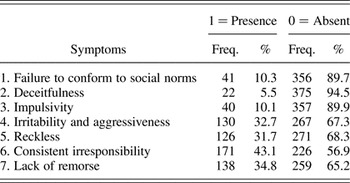
The DSM-IV (1994, pp. 649–650) specifies seven symptoms of ASPD: (a) failure to conform to social norms, (b) deceitfulness, (c) impulsivity, (d) aggressiveness, (e) recklessness, (f) irresponsibility, and (g) a lack of remorse. Frequency analysis indicated that 34.8% of respondents did not have any symptoms of antisocial behavior, 37.3% had one or two symptoms, and 27.9% had three or more symptoms. As can be seen in Table 2, the most frequently presented symptoms involved irresponsibility (43.1%), lack of remorse for the mistreatment of others (34.8%), irritability and aggressiveness (32.7%), and reckless disregard for safety of self or others (31.7%). Deceitfulness (5.5%) was a low frequency symptom. The mean symptom count for antisocial behavior was 1.68 (SD = 1.67). Moreover, respondents had lived in their neighborhoods an average of more than 20 years.
Descriptive statistics for antisocial behavior

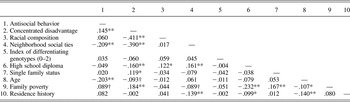
The zero order correlations among the study variables are presented in Table 3. As expected, living in a neighborhood with concentrated disadvantage or weak social ties is associated with increased risk of antisocial behavior. In addition, structurally disadvantaged neighborhoods have weak neighborhood social ties. By contrast, there is no significant correlation between the index of differentiating genotypes and antisocial behavior. Consistent with previous molecular genetic studies (Bakermans-Kranenburg & van IJzendoorn, Reference Bakermans-Kranenburg and van IJzendoorn2011; Caspi et al., Reference Caspi, Sugden, Moffitt, Taylor, Craig and Harrington2003; van IJzendoorn, Belsky, & Bakermans-Kranenburg, Reference van IJzendoorn, Belsky and Bakermans-Kranenburg2012), both the DRD4 long allele and the 5-HTTLPR short allele show no association with antisocial behavior.
Correlation matrix for the study variables

Note: N = 397.
†p < .10. *p ≤ .05. **p ≤ .01 (two-tailed tests).
Prior to beginning the multilevel modeling, we tested for gene–environment correlation (rGE) as it is possible that genotype may influence selection into different types of neighborhoods. The presence of rGE may further confound the examination of G × E effects (Caspi & Moffitt, Reference Caspi and Moffitt2006; Freese & Shostak, Reference Freese and Shostak2009). Table 3 shows that there were no significant zero-order correlations between the neighborhood measures (either concentrated disadvantage or neighborhood social ties) and the index of differentiating genotypes. Furthermore, in analyses not shown, neither DRD4 nor 5-HTTLPR genotypes were related to either concentrated disadvantage or neighborhood social ties. Thus, there is no evidence of an active rGE effect whereby people seek out or evoke environments that are compatible with their genetic predispositions, indicating an absence of rGE effects in the current study.
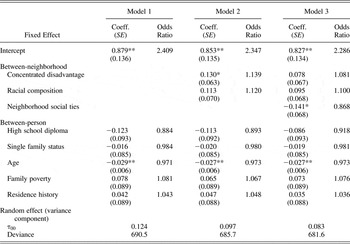
Tables 4 and 5 show the results of using multilevel Poisson modeling to examine the effects of concentrated disadvantage, neighborhood social ties, and genetic variation on women's antisocial behavior, controlling for education, family structure, age, family poverty, and residential history. We first checked for potential multicollinearity among variables. VIF scores ranged between 1.010 for the index of differentiating genotypes and 1.527 for concentrated disadvantage, and all measures of tolerance were above 0.60, indicating no evidence of multicollinearity (VIF < 10 and tolerance > 0.20) among the study variables. The results of an unconditional model indicate that the neighborhood random effect is significant. Approximately 11% (intraclass correlation coefficient = 0.111) of the total variance occurs across neighborhoods. This result is consistent with previous research reporting that there is substantial variation across neighborhoods in levels of antisocial behavior.
Poisson multilevel regression models examining neighborhood measures as predictors of adult antisocial behavior

Note: Unstandardized coefficient and odds ratio are shown with robust standard errors in parentheses. Family poverty and age are group centered, and the measures of concentrated disadvantage and neighborhood social ties are standardized by z transformation (mean = 0, SD = 1). N (persons) = 397 and N (neighborhoods) = 67.
†p < .10. *p ≤ .05. **p ≤ .01 (two-tailed tests).
Poisson multilevel regression models examining neighborhood measures and genetic diversity as predictors of adult antisocial behavior

Note: Unstandardized coefficient and odds ratio shown with robust standard errors in parentheses. Family poverty and age are group centered, and the measures of concentrated disadvantage and neighborhood social ties are standardized by z transformation (mean = 0, SD = 1). N (persons) = 397 and N (neighborhoods) = 67.
†p < .10. *p ≤ .05. **p ≤ .01 (two-tailed tests)
Concentrated disadvantage, social ties, and adult antisocial behavior
As shown in Table 4, the first model includes all individual-level control variables. The second model adds two neighborhood measurements: concentrated disadvantage and racial composition. A comparison of Model 1 with Model 2 indicates that the neighborhood variance is reduced by 21.77% when these two neighborhood measurements are included. The table shows that an increase of one standard deviation in concentrated disadvantage is associated with an increase of 14% in the odds of adult antisocial behavior, odds ratio = 1.139, 95% CI = (1.001, 1.291), p = .041. In contrast, racial composition is not significantly related to antisocial behavior.
Model 3 adds the variable neighborhood social ties. The difference in deviance between Model 2 and Model 3 is significant (Δχ2 = 4.10, df = 1, p = .043), implying that the measure of neighborhood social ties improves the model fit. Consistent with the mediation argument, the effect of concentrated disadvantage on antisocial behavior is no longer significant when neighborhood social ties is included in the model. Comparing Model 2 with Model 3, neighborhood variation is reduced by 14.43% when neighborhood social ties is added to the model. Therefore, social ties explain a substantial variation in antisocial behavior. A standard deviation increase in neighborhood social ties is related to a 13% decrease in the odds of adult antisocial behavior, odds ratio = 0.868, 95% CI = (0.761, 0.993), p = .039. This pattern of results suggests that neighborhood social ties is a mediator of the effect of concentrated disadvantage on antisocial behavior. Thus, as expected, our results with a sample of adult women replicate prior research with children and adolescents.
The effect of genetic variations on adult antisocial behavior
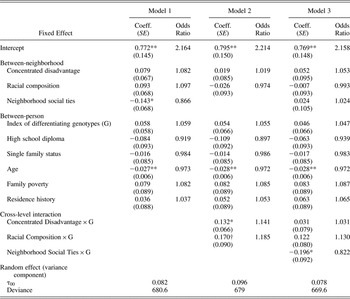
Table 5 presents multilevel models including the index of differentiating genotypes. Controlling for all individual-level demographic predictors and neighborhood measures, the number of differentiating genotypes is not significantly related to adult antisocial behavior, odds ratio = 1.059, 95% CI = (0.946, 1.187), p = .318. This finding is consistent with prior molecular studies indicating that so-called risk alleles generally have little main effect on problem behavior (Caspi et al., Reference Caspi, Sugden, Moffitt, Taylor, Craig and Harrington2003; Cicchetti & Rogosch, Reference Cicchetti and Rogosch2012; Simons et al., Reference Simons, Lei, Brody, Beach, Philibert and Gibbons2011).
The effect of G × E on antisocial behavior
The next set of models examines the extent to which variation in genes moderates the impact of the neighborhood variables. Model 2 adds the interactions of genes with concentrated disadvantage and racial composition. The interaction term for the number of differentiating genotypes and concentrated disadvantage is statistically significant, odds ratio = 1.141, 95% CI = (1.002, 1.299), p = .046, whereas the interaction of the number of differentiating genotypes with racial composition only approaches significance.
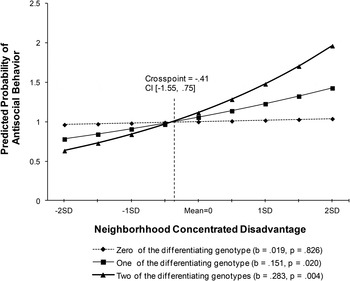
To further examine the interaction of concentrated disadvantage with the index of differentiating genotypes, we graphed the effect in Figure 2 for levels of concentrated disadvantage that range from −2 to +2 SD from the mean. The graph shows that the effect of neighborhood concentrated disadvantage on antisocial behavior was strongest for respondents with two of the differentiating genotypes, relatively weaker for those with only one of the differentiating genotype, and weakest for those with no differentiating genotype. Using a simple slope test (Bauer & Curran, Reference Bauer and Curran2005), the slopes for individuals with either one, b = 0.283, 95% CI = (0.089, 0.478), p = .004, or two, b = 0.151, 95% CI = (0.024, 0.278), p = .020, of the differentiating genotypes are significantly different from zero, whereas the slope is not significantly different from zero for those with 0 of the differentiating genotypes, b = 0.019, 95% CI = (–0.148, 0.186), p = .826.
The effect of neighborhood concentrated disadvantage on adult antisocial behavior by number of differentiating genotypes.

The differential susceptibility explanation for this G × E effect was tested using the CI for the crossover point of the simple regression lines. If the CI includes the range of observed values on the independent variable, a crossing pattern exists and the differential susceptibility is supported (Widaman et al., Reference Widaman, Helm, Castro-Schilo, Pluess, Stallings and Belsky2012). As shown in Figure 2, the crossover point for the simple regression lines is –0.41, C = –1 × (0.054/0.132). The 95% CI of the crossover point ranges from –1.55 to 0.75. It covers the mean score of concentrated disadvantage (mean = 0) and a range of possible values of concentrated disadvantage (–1.80 to 2.60). These results present the expected crossing pattern and provide strong support for the differential susceptibility perspective.
The last model in Table 5 incorporates the interaction term between neighborhood social ties and the number of differentiating genotypes. The difference in deviance between Model 2 and Model 3 is significant (Δχ2 = 9.4, df = 1, p = .002), indicating that the cross-level interaction of the number of differentiating genotypes and neighborhood social ties improves the fit of the model. The interaction effect of the number of differentiating genotypes and neighborhood social ties is significant, odds ratio = 0.822, 95% CI = (0.687, 0.983), p = .032. Inclusion of this interaction term reduces the interaction effect of the number of differentiating genotypes and concentrated disadvantage to nonsignificance (p > .05). This suggests a pattern of mediation where the effect of the interaction of Genes × Concentrated Disadvantage is mediated by the interaction of Genes × Social Ties.Footnote 3
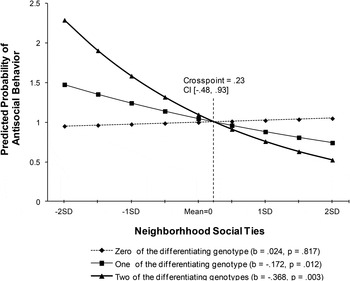
Figure 3 shows the graph of the interaction of the number of differentiating genotypes and neighborhood social ties. Using the simple slope procedure, the slopes for respondents with either one, b = –0.368, 95% CI = (–0.609, –0.127), p = .003, or two, b = –0.172, 95% CI = (–0.306, –0.038), p = .012, of the differentiating genotypes are significantly different from zero, whereas the slope for noncarriers is not, b = 0.024, 95% CI = (–0.182, 0.231), p = .817.Footnote 4 In other words, the effect of neighborhood social ties on antisocial behavior is significantly greater for women with more differentiating genotypes than for those who do not have these genotypes.
The effect of neighborhood social ties on adult antisocial behavior by number of differentiating genotypes.

As Figure 3 shows, the crossover point of the simple regression lines is 0.23, C = –1 × (0.046/–0.196). We estimated the 95% CI of this crossover point using the reparameterized equation to be between –0.48 and 0.93. The range includes the mean score and the possible range of observed values on the measure of neighborhood social ties (–3.26 to 1.51). Thus, as was the case for the interaction of the number of differentiating genotypes and concentrated disadvantage, the slopes depicted in Figure 3 show a crossover pattern consonant with the differential susceptibility perspective.
Supplementary analysis
Studies have indicated that population genetic admixture may confound G × E findings (Halder et al., Reference Halder, Yang, Kranzler, Stein, Shriver and Gelernter2009). We employed the Structure program, version 2.3.4 (Falush, Stephens, & Pritchard, Reference Falush, Stephens and Pritchard2007) with a panel of 24 ancestry informative markers to infer the number of ancestral populations and to estimate an ancestry proportion of each participant. The average proportion of African ancestry in our sample is 94.7%. Including the ancestry proportion as a covariate into research models does not change our results. There is no evidence for genetics admixture as a potential confound in the present study.
To address the robustness of our findings, we then performed two additional analyses with two alternative schemes of the DRD4 gene. First, a number of studies have indicated that the presence of the DRD4 7-repeat is shown to cause reduced DRD4 mRNA expression in vitro (Schoots & Van Tol, Reference Schoots and Van Tol2003) and suggested that the DRD4 48-bp VNTR can be coded as an individual carrying one or more 7-repeat allele versus all others (Belsky & Pluess, Reference Belsky and Pluess2013). Further, other studies reported that the DRD4 2-repeat may be similar in effect to the 7-repeat (Matthews & Butler, Reference Matthews and Butler2011; Reist et al., Reference Reist, Ozdemir, Wang, Hashemzadeh, Mee and Moyzis2007) and defined genetic risk by the presence of at least one copy of the DRD4 2-repeat or/and 7-repeat alleles. Using these alternative ways of forming the DRD4 polymorphism, the results of G × Neighborhood indicated a pattern virtually identical to those depicted in Figures 2 and 3, suggesting that women with a greater number of differentiating genotypes are more sensitive to the effects of both favorable and adverse neighborhood context.
Discussion
Prior research has provided rather strong support for the neighborhood disorganization perspective. These studies indicate that concentrated disadvantage increases the probability of antisocial behavior and it does so by disrupting social ties and informal social control (Leventhal & Brooks-Gunn, Reference Leventhal and Brooks–Gunn2000; Sampson et al., Reference Sampson, Morenoff and Gannon-Rowley2002). However, most of this research has focused on children and adolescents, and the few studies conducted on adult populations have only included males. As a result, some feminist scholars have asserted that there is virtually no evidence that community disorganization theory is applicable to females (Belknap, Reference Belknap2007; Chesney-Lind & Pasko, Reference Chesney-Lind and Pasko2013). The present study attempted to address this limitation in past research by testing the neighborhood disorganization model using a sample of African American women. Consonant with the findings from prior research, our results indicated that concentrated disadvantage is associated with increased involvement in antisocial behavior and that this effect is mediated, in large measure, by neighborhood social ties. This finding suggests that the theory is not simply a theory of adolescent or male deviant behavior. It is also explains the antisocial behavior of adult women.
A second limitation of past research on social disorganization theory is that it has paid little attention to personal differences in the way that individuals respond to neighborhood concentrated disadvantage and social ties (Leventhal & Brooks-Gunn, Reference Leventhal and Brooks–Gunn2000). We attempted to address this issue by examining the extent to which variation in genes moderates the effect of neighborhood disorganization on antisocial behavior. Neurobiological findings (Bevilacqua & Goldman, Reference Bevilacqua and Goldman2011; Lohoff, Reference Lohoff, Nurnberger and Berrettini2012) indicate that the serotonin and dopamine systems play an important role in modulating the balance between excitatory and inhibitory neurotransmission in the brain and that the genes 5-HTTLPR and DRD4 contain information for the production of proteins that influence the functioning of various neurotransmission circuits. There is evidence (e.g., Ebstein, Reference Ebstein2006; Sakai et al., Reference Sakai, Young, Stallings, Timberlake, Smolen and Stetler2006) that the short allele of 5-HTTLPR and the long allele of DRD4, which are associated with reduced transcriptional efficiency and diminished mRNA for serotonergic and dopaminergic neurotransmission respectively, influence reward sensitivity and emotion regulation. Such findings suggest that these polymorphisms may impact an individual's responsiveness to environmental events. Consistent with this expectation, past research has found that 5-HTTLPR and DRD4 are often found to interact with aspects of the environment, such as parenting and discrimination, to influence individual well-being (Bakermans-Kranenburg & van IJzendoorn, Reference Bakermans-Kranenburg and van IJzendoorn2011; Brody et al., Reference Brody, Beach, Chen, Obasi, Philibert and Kogan2011; Cicchetti & Rogosch, Reference Cicchetti and Rogosch2012; Simons et al., Reference Simons, Lei, Brody, Beach, Philibert and Gibbons2011; Simons, Lei, et al., Reference Simons, Beach and Barr2012; van IJzendoorn, Belsky, & Bakermans-Kranenburg, Reference van IJzendoorn, Belsky and Bakermans-Kranenburg2012).
The present study extended this research by examining the extent to which an accumulation of these genetic variants also moderates the impact of neighborhood disorganization. Our results indicated that this is the case. Although these genes had no direct effect on antisocial behavior, they moderated the association of both concentrated disadvantage and social ties with increased involvement in antisocial behavior. Further, our results indicated a pattern of mediation in that the moderating effect of genetic variation on the relationship between concentrated disadvantage and antisocial behavior was explained by the interaction of genetic variation with social ties. These findings suggest that variation in genes involved in regulation of the serotonergic and dopaminergic neurotransmitter systems is an individual difference that accounts, at least in part, for dissimilarities in the way that people respond to neighborhood influences.
Further, several recent studies have reported evidence indicating that both the 5-HTTLPR and DRD4 genes interact with the environment in the manner predicted by the differential susceptibility perspective (Simons et al., Reference Simons, Lei, Brody, Beach, Philibert and Gibbons2011, Reference Simons, Lei, Stewart, Beach, Brody and Philibert2012; van IJzendoorn, Belsky, & Bakermans-Kranenburg, Reference van IJzendoorn, Belsky and Bakermans-Kranenburg2012). This model asserts that persons with the minor alleles of these genes are more sensitive to the effects of both favorable and adverse social environments because these alleles influence activity in the brain's limbic circuitry, especially the amygdala, thereby increasing emotional responsiveness to environmental conditions (Simons, Beach, & Barr, Reference Simons, Beach and Barr2012). For instance, the minor allele (7+) of the DRD4 gene, which is linked to reduced dopaminergic transporter protein function, has been shown in a number of studies to foster sensation seeking and reward sensitivity to environmental cues (Bakermans-Kranenburg & van IJzendoorn, Reference Bakermans-Kranenburg and van IJzendoorn2011). Based upon such findings, the differential susceptibility perspective assumes that people with the minor alleles in 5-HTTLPR and DRD4 are more likely than those without these alleles to be influenced by both the stressful and supportive conditions extant in their social environment. One of the goals of the present study was to test whether the interaction of these polymorphisms with variations in neighborhood environment also conform to the pattern predicted by differential susceptibility.
Tests of the differential susceptibility perspective usually rely upon the Johnson–Neyman technique or the pick-a-point approach to evaluate the G × E effect. These procedures require data, however, representing the full range of values on the environmental variable of interest, from adverse to favorable, and enough variation in the measures to estimate the confidence region (Belsky et al., Reference Belsky, Pluess and Widaman2013; Dick, Reference Dick2011). Our data could not meet these requirements because African American families tend to be overrepresented in disadvantaged neighborhoods (McNulty, Reference McNulty2001; Peterson & Krivo, Reference Peterson and Krivo2010). Fortunately, Widaman et al. (Reference Widaman, Helm, Castro-Schilo, Pluess, Stallings and Belsky2012) recently developed the reparameterized model as a method for testing the differential susceptibility perspective under such circumstances. Using their approach, our findings provide evidence for the crossover effect predicted by the differential susceptibility model. Women with the focal alleles showed poorer adjustment than other genotypes when the neighborhood environment was adverse but better adjustment than other genotypes when the neighborhood environment was favorable.
From a theoretical standpoint, these results replicate and extend the existing neighborhood literature. Consistent with past findings for adolescents and young men (Sampson, Reference Sampson2012), we found that neighborhood disadvantage increases the probability of antisocial behavior among African American women and that this relationship is explained, in large measure, by neighborhood social ties. It was also the case, however, that there was much heterogeneity in antisocial behavior among individuals residing in the same neighborhood. Our results suggest that some individuals are genetically predisposed to be more sensitive to neighborhood conditions than others. Individuals with particular variants of the serotonin transporter gene and the DRD4 gene showed higher rates of antisocial behavior than other genotypes when the neighborhood environment was adverse but demonstrated less antisocial behavior than other genotypes when they resided in advantaged neighborhoods with strong social ties.
Limitations
An advantage of the present study is that the data set included genetic data and both census and process measures of neighborhood characteristics. In addition, the sample consisted of families nested within neighborhoods that allowed us to perform multilevel analyses. Nevertheless, the study also suffered from limitations that need to be noted. First of all, given that the adults in the sample were selected because of their status as primary caregivers, virtually all of them were women. The lack of men in our sample prevented us from being able to assess the extent to which our results might differ by gender. There is certainly a need for neighborhood studies that focus upon women given their exclusion in prior research; however, it is also important that our results be replicated with samples that include both men and women so that gender differences can be investigated.
Second, that all of the women in our sample were African Americans might be viewed as a strength as well as a limitation. Neighborhood studies of African American women are important for theoretical and policy reasons given that they have been shown to have higher rates of antisocial behavior than women in other ethnic groups (Belknap, Reference Belknap2007) and are more apt to reside in extremely disadvantaged neighborhoods (McNulty, Reference McNulty2001; Peterson & Krivo, Reference Peterson and Krivo2010). In contrast, the results obtain in the present study clearly need to be replicated with women from other ethnic groups.
Third, community research shows that people select themselves into neighborhoods based upon personal characteristics (Sampson, Reference Sampson2012; Sampson et al., Reference Sampson, Morenoff and Gannon-Rowley2002), and genetic studies (Caspi & Moffitt, Reference Caspi and Moffitt2006) have found rGE effects in which people select environments that are compatible with their genetic predispositions. Unfortunately, selection bias is nearly impossible to completely rule out in nonexperimental studies. To reduce neighborhood selection bias in the present study, individual demographic variables were included as controls in all of our models. Further, our analyses indicated that there were no associations between variations in either DRD4 or 5-HTTLPR and our neighborhood measures. Thus, while selection bias cannot be completely ruled out in the present study, it is unlikely that it exerted a significant effect upon our findings.
Conclusion
Research on gene–neighborhood interactions provides an alternative framework for understanding the relationships between neighborhood influences and human behaviors. Findings from this study extend neighborhood studies to women and support the conclusion that particular genetic polymorphisms amplify sensitivity to neighborhood context. Our study suggests that the short allele of 5-HTTLPR and the long allele of DRD4 enhance susceptibility to concentrated disadvantage and the absence of neighborhood social ties.